My Brother Grabbed My Son at Christmas and Called Him a Burden—Then My Seven-Year-Old Asked One Question That Made My Father Drop His Wineglass and Go Pale
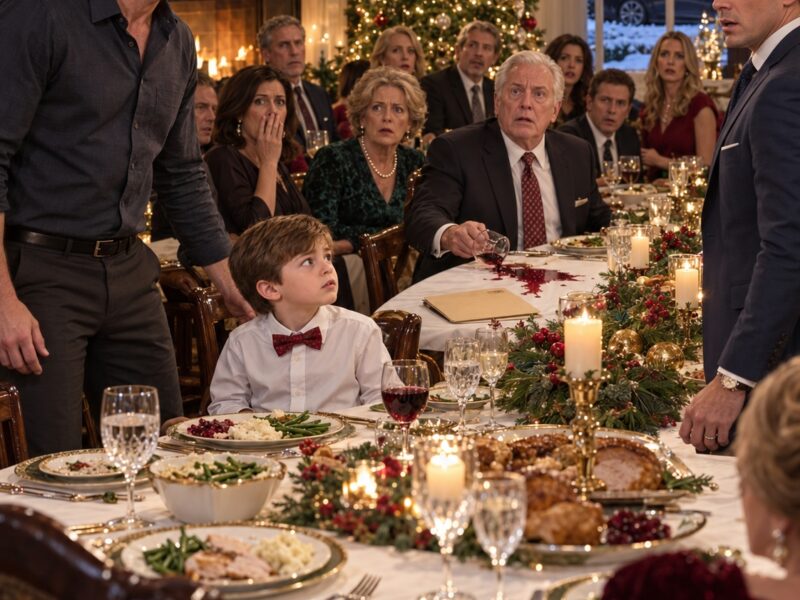
The night my brother grabbed my seven-year-old son at Christmas, seventeen relatives watched.
My father said nothing.
Then my son asked one quiet question that made the most powerful man in our family drop his wineglass.
“Let go of him.”
My voice came out so low that the conversation around the table stopped before anyone consciously understood why.
Bradley still had his hand around Eli’s upper arm.
Not hard enough to leave a bruise.
Hard enough that my son’s white shirt had twisted under his fingers and his red bow tie had gone crooked.
Bradley smiled at me.
That smile was worse than anger.
“Oh, relax, Nate.”
“Let go.”
“He’s fine.”
“Bradley.”
Something in my voice finally reached him.
He released Eli.
My son slid back into his chair.
His fork landed against the china with a small metallic click.
No one moved.
My mother stared at her plate.
My aunt Claire suddenly became fascinated by the centerpiece.
Bradley’s wife, Melissa, held her wineglass near her mouth but did not drink.
My father, Richard Cole, sat at the head of the table beneath the chandelier like he had every Christmas of my life.
He did not look at me.
Bradley adjusted his cuff.
“You’re making this dramatic.”
I stood.
“You just grabbed my kid.”
“He was being rude.”
Eli had not said a word.
“He was eating mashed potatoes.”
Bradley laughed.
A few people almost joined him from habit.
Then thought better of it.
My brother looked down the table toward Eli.
“Well, at least he’s quiet. That’s something.”
“Stop.”
“What?”
“Stop talking about him.”
Bradley leaned back.
“You always do this.”
“Do what?”
“Turn every joke into some single-dad tragedy.”
He swirled his wine.
“You want everybody to pretend the situation isn’t what it is.”
I felt my hands tighten.
“What situation?”
My mother whispered, “Nathan.”
Not his name.
Mine.
A warning.
Bradley heard it and smiled.
He had spent thirty-eight years understanding exactly how far our parents would allow him to go.
“He’s not really part of this.”
The room changed.
Eli’s face did not.
That was what frightened me.
He already knew how to disappear inside himself.
Bradley continued.
“He’s a financial drain everybody keeps pretending is family obligation.”
My chair scraped backward.
“Say that again.”
“Nathan,” my father said finally.
Not to Bradley.
To me.
“Sit down.”
I looked at him.
“You heard him.”
Richard picked up his wineglass.
“It’s Christmas.”
As if the calendar were the injured party.
Bradley shrugged.
“I’m saying what everybody thinks.”
“No,” I said. “You’re saying what you think because nobody in this room has ever made you pay for saying it.”
His expression sharpened.
“Oh, please.”
Then Eli moved.
Very slowly, my son set his fork flat beside his plate.
He looked at Bradley first.
Then at my father.
His voice was small but steady.
“Then why does Grandpa pay Uncle Brad from Grandma June’s school money when I eat here?”
Nobody breathed.
I did not understand the question.
Not at first.
Bradley did.
My father did.
That was obvious.
Bradley’s smile vanished so completely it looked erased.
My father’s hand jerked.
The wineglass struck the edge of his plate.
It cracked.
Red wine spilled across the white tablecloth.
My mother went pale.
Melissa’s hand flew to her mouth.
And my seven-year-old son looked at me as if he had just realized the thing he had been carrying might finally be too heavy to hold alone.
I bent toward him.
“Eli.”
His eyes filled.
“Dad, I didn’t know if I was supposed to tell.”
The rage inside me disappeared.
Not faded.
Disappeared.
What replaced it was worse.
Fear.
“What are you talking about?”
Bradley stood.
“He doesn’t know what he heard.”
My father said sharply, “Bradley, stop.”
That was the second strange thing.
Richard Cole never told Bradley to stop.
Not when we were children.
Not when we were adults.
Not when Bradley humiliated me at family gatherings.
Not even when he had just grabbed Eli.
But now my father was afraid.
Eli looked at me.
“I heard them in Grandpa’s office.”
“When?”
He swallowed.
“When Uncle Brad got the blue car.”
The Porsche.
Three months earlier.
My brother had arrived at Sunday dinner in a midnight-blue Porsche 911 and parked it directly beneath my parents’ exterior lights, where nobody could possibly miss it.
Bradley had spent twenty minutes pretending he did not want to talk about it.
Which meant, in Bradley language, that he wanted everyone to talk about nothing else.
I looked at my father.
“What did he hear?”
Richard’s face had gone gray.
“Nathan, not here.”
“Where?”
“Not in front of everyone.”
I laughed once.
A dead sound.
“My brother just called my son a financial burden in front of everyone.”
“He grabbed him.”
“And now my son is telling me he heard something about money you manage for him.”
“This is exactly where we’re having the conversation.”
My mother stood.
“Nathan, don’t do this.”
I turned.
“Do what?”
“Destroy Christmas?”
Her eyes flashed.
There it was.
The oldest rule in our family.
The person naming the damage was always more dangerous than the person causing it.
I looked around the table.
Seventeen relatives.
Three generations.
Candles.
Silver.
A twenty-pound turkey.
A tree visible through the dining-room arch, decorated so perfectly that my mother had hired someone to do it.
And my seven-year-old son sitting at the far end beside the swinging kitchen door because those were the seats she assigned us every year.
I saw the whole arrangement suddenly.
Not as tradition.
As architecture.
My father at the head.
Bradley to his right.
My mother to his left.
Status diminishing with distance until you reached me and Eli by the draft.
I picked up my son’s coat from the chair behind him.
“We’re leaving.”
My father pushed back his chair.
“Nathan.”
“No.”
“You don’t even know what he’s talking about.”
“Exactly.”
I helped Eli into his coat.
“And the fact that all three of you do is the only information I need tonight.”
My mother’s voice rose.
“You are not walking out over a child misunderstanding an adult conversation.”
I looked at her.
“Watch me.”
Snow blew against my face the moment I opened the front door.
I did not close it behind us.
Maybe that was childish.
I have never regretted it.
My ten-year-old Honda Civic took four attempts to start because the temperature had dropped twenty degrees since we arrived.
Eli sat in the back seat.
Very straight.
Bow tie still crooked.
The heater blew air that felt refrigerated.
I stared through the windshield.
My hands shook against the steering wheel.
“Dad?”
I turned.
His voice was barely audible.
“Do you have to work extra because I cost too much?”
There are questions a parent knows how to answer because children ask versions of them all the time.
Can monsters get in through windows?
Will you die someday?
Why doesn’t Mom live with us?
This was not one of those.
I unbuckled.
Twisted in my seat until I could reach him.
“No.”
“But Uncle Brad said—”
“Uncle Bradley is wrong.”
“He told Grandpa that you work all the time because of me.”
My chest tightened.
“When?”
“The office.”
I leaned closer.
“Listen to me.”
He did.
“You have never cost me too much.”
“You understand?”
His mouth trembled.
“I work because adults need money to pay for life.”
“Food.”
“Rent.”
“Heat.”
“Shoes.”
“Everybody costs something to keep alive.”
“That is not the same as being a burden.”
His eyes filled.
“But Grandpa charges for me.”
I stopped.
“What does that mean?”
Eli looked toward the house.
“Uncle Brad said if I eat there, they can use Grandma June’s money.”
My entire body went cold.
“What money?”
He frowned.
“The school money.”
That was when I understood.
My grandmother June.
The trust.
June Cole died three years earlier at eighty-four.
She was my father’s mother.
The only wealthy person in our family who had never acted impressed by wealth.
She drove an old Volvo until the floor mats wore through.
Saved wrapping paper.
Bought store-brand cereal.
Once wore the same navy coat to fifteen Christmases because, as she put it, “the coat has not filed a complaint.”
She also saw people clearly.
Bradley hated that about her.
I loved it.
When she died, she left educational trusts for her two great-grandsons.
Connor, Bradley’s son.
And Eli.
Equal shares.
Exactly equal.
The family had been shocked.
Bradley had been offended.
Not because Connor needed more.
Because Bradley believed Connor deserved more.
At the attorney’s office after June’s death, he had said:
“Connor goes to St. Matthew’s.”
“He has travel lacrosse.”
“His opportunities cost more.”
The trust attorney had looked at him.
“Your grandmother’s language provides equal beneficial shares.”
Bradley leaned back.
“That doesn’t make sense.”
“It does legally.”
“What about discretion?”
“Your father has discretion regarding legitimate support and education expenses.”
Bradley looked at Richard.
My father avoided his eyes.
I remembered that now.
At the time I had been too exhausted to care.
Eli was four.
I was working warehouse shifts.
Paying off family-court debt.
Learning how to be a single father without admitting to anyone how terrified I was.
The trust felt like one piece of my son’s life I did not have to worry about.
June had protected it.
My father was trustee.
I made myself a promise.
I would not touch Eli’s share.
No winter coats.
No camp.
No rent.
No groceries.
I would let it grow for college.
I thought refusing to use it meant I was protecting it.
I had never requested a statement.
Not once.
Now my seven-year-old son was telling me my brother had apparently been billing something to it.
I looked back toward my parents’ house.
Every downstairs window glowed gold against the snow.
The Porsche sat beneath the floodlight.
Midnight blue.
Perfect.
“Eli.”
“Yes?”
“I need you to tell me exactly what you heard.”
He looked scared.
“You’re not in trouble.”
“I promise.”
His shoulders lowered a little.
“Connor and I were hiding.”
“When?”
“The dinner when Uncle Brad brought the blue car.”
“Hide-and-seek?”
He nodded.
“I went in Grandpa’s office.”
“Behind the big desk.”
The space between the desk and wall.
Perfect for a small child.
“Then Grandpa and Uncle Brad came in.”
“Did they know you were there?”
“No.”
“What did they say?”
Eli picked at the cuff of his coat.
“I don’t remember everything.”
“That’s okay.”
“Only tell me what you remember.”
He thought.
“Uncle Brad had papers.”
“He said something about quarterly.”
“Invoices?”
“Yes.”
My heart began pounding.
“He said the Thanksgiving food counts because I eat there.”
“And Grandpa said it was too much.”
“Too much what?”
“The car.”
I stopped breathing.
“What about the car?”
Eli’s eyes moved to the Porsche.
“Uncle Brad said I ride in it sometimes.”
“So it counts.”
“Counts as what?”
“I don’t know.”
He looked ashamed.
“I’m sorry.”
“No.”
I reached back.
“You never apologize for not understanding grown-up money.”
“Ever.”
He nodded.
“Anything else?”
A long pause.
Then:
“Uncle Brad said you’d never ask because you’re too busy pretending you don’t need anybody.”
The sentence hit harder than the insult at dinner.
“He said the money would be Connor’s someday anyway.”
“Because Great-Grandma made a mistake.”
I sat back.
The windshield blurred.
Not snow.
My eyes.
For years Bradley had mocked me for being broke.
My apartment.
My old car.
My job.
My secondhand furniture.
My son’s public school.
And while I refused to touch one dollar of Eli’s trust because I wanted my child to have something unspoiled—
my brother had apparently been using it.
For what?
Meals?
Babysitting?
His car?
I turned the ignition.
The Civic coughed.
Started.
“Dad?”
“Yes?”
“Are you mad at me?”
That broke something inside me.
“No.”
I put the car in park again.
Got out.
Opened the rear door.
Kneeling in slush, I wrapped my arms around him.
“I am angry.”
“But never at you.”
“Do you understand?”
“Yes.”
“You told the truth.”
“That is never something you apologize to me for.”
He nodded against my shoulder.
Behind us, the front door of my parents’ house finally closed.
The next morning I called my best friend.
Owen Parker had known me since nineteen.
We met loading pallets in a warehouse during community college and disliked the same supervisor strongly enough to become friends.
He drove two hours during the worst snowstorm of that winter when Eli was born six weeks early.
He helped build every piece of furniture in our first apartment after my divorce.
Eli called him Uncle Owen even though no blood connected them.
Blood had become less impressive to me over time.
Owen came over with coffee.
I told him everything.
He did not interrupt.
When I finished, he said:
“You need a lawyer.”
“I need statements.”
“You need a lawyer who gets statements.”
“It’s Christmas.”
“Fraud celebrates holidays too.”
I looked at him.
“You think it’s fraud?”
“I think you don’t know yet.”
He leaned forward.
“That matters.”
“You have what a seven-year-old overheard.”
“That’s enough to investigate.”
“Not enough to accuse.”
That distinction steadied me.
Owen had always been good at separating anger from action.
“Do not call Bradley.”
“I want to.”
“I know.”
“Do not call your dad.”
“I really want to.”
“I know.”
“Because the second you warn them, paperwork starts becoming harder to find.”
I stared.
“You think my father would hide something?”
Owen’s expression changed.
“Nate.”
That was all.
My family trained me to doubt myself before doubting them.
The habit had survived thirty-three years.
On December 27, I sat across from Mara Whitcomb.
Trust-and-estate litigator.
Gray suit.
No family photographs in her office.
Nothing on her desk except a yellow legal pad and a silver pen.
She listened without changing expression.
When I finished, she said:
“You have suspicions.”
“Yes.”
“You do not have proof.”
“I know.”
“Good.”
I blinked.
“Good?”
“Clients who know the difference between suspicion and evidence are easier to protect.”
She clicked her pen.
“You are Eli’s custodial parent and natural guardian.”
“You are entitled to information concerning distributions made for his benefit.”
“If your father is acting as trustee, he owes fiduciary duties to the trust beneficiaries.”
“What do we ask for?”
“Everything.”
She began writing.
“Initial funding.”
“Investment statements.”
“Every distribution.”
“Receipts.”
“Invoices.”
“Tax filings.”
“Trustee compensation.”
“Correspondence supporting unusual expenses.”
“How far back?”
“From inception.”
I swallowed.
“And if he refuses?”
“Then I petition for an accounting.”
“If the records show misuse?”
“Then remedies depend on what happened.”
“Restitution.”
“Surcharge against the trustee.”
“Removal.”
“Potential claims against recipients who knowingly benefited.”
“And if records were falsified or transfers were disguised?”
She looked at me.
“Then other lawyers and possibly prosecutors may become interested.”
My mouth went dry.
“He’s my father.”
Mara set down the pen.
“I understand.”
“No, I mean…”
I stopped.
I did not know what I meant.
Maybe I wanted genetics to function as immunity.
Maybe I wanted her to tell me a father who had failed emotionally could not have failed financially too.
Mara’s face softened slightly.
“Nathan, my job is not to decide whether you stop loving your father.”
“My job is to determine whether he protected your son’s money.”
“Those are separate questions.”
I looked through the glass wall behind her.
People carried files.
Phones rang.
Ordinary office.
My family was about to become paperwork.
“What happens first?”
“I send the demand.”
She paused.
“Before I do, I need you certain about one thing.”
“What?”
“If the records are bad, your family may blame you for making them visible.”
I laughed without humor.
“They already blame me for things I didn’t do.”
“That isn’t an answer.”
I thought of Eli.
White shirt.
Red bow tie.
Fork placed carefully beside his plate.
Then why does Grandpa pay Uncle Brad from Grandma June’s school money when I eat here?
“Send it.”
The demand reached my father December 29.
He called fourteen times that afternoon.
I answered none.
The first voicemail was measured.
“Nathan, call me.”
“There’s obviously confusion.”
The fourth sounded irritated.
“You have involved an attorney in a family matter.”
The seventh:
“Your mother is sick over this.”
The tenth:
“Bradley has done nothing except help your child.”
The thirteenth had no anger left.
Just fear.
“Nate.”
A pause.
“Please call before this becomes something none of us can undo.”
I listened at midnight after Eli slept.
Once.
Then again.
A younger version of me would have called.
Not because I believed him.
Because I could not tolerate my father sounding hurt.
That had always been the mechanism.
He hurt me.
I managed his discomfort about it.
This time, I deleted none of the messages.
Forwarded them to Mara.
Then went to bed.
My father produced records on day twenty-eight.
Not complete.
But enough to start.
Mara called.
“You need to come in.”
“Bad?”
“Yes.”
“How bad?”
“Come in.”
A forensic accountant named Daniel Cho joined us.
Quiet man.
Half-moon reading glasses.
He had arranged two years of distributions into categories.
Some were legitimate.
School supplies.
Pediatric dental work.
A summer reading program.
Those were small.
Then came the rest.
Family dinner support.
Transportation.
Social development.
Recreational enrichment.
Childcare.
Safe residential environment.
I stared.
“Safe residential environment?”
Daniel opened an invoice.
Bradley’s property-tax payment.
Part of it.
Charged to Eli’s trust because, according to the supporting memo, Bradley’s home “provided recurring family-based supervision and safe social interaction for minor beneficiary.”
I almost laughed.
“My son has slept there once.”
Daniel nodded.
“Four thousand three hundred dollars over two years.”
Another line.
Country club fees.
“What does Eli have to do with Bradley’s country club?”
Mara said nothing.
Daniel read the coding.
“Social development access.”
My mouth opened.
“No.”
“Did Eli attend?”
“One Christmas brunch.”
“Maybe twice.”
Daniel highlighted another category.
Childcare.
Payments to Bradley for afternoons Eli spent at his house with Connor.
Not babysitting arranged by me.
Playdates.
Bradley had invoiced the trust.
Seventy-five dollars an hour.
One Saturday showed five hours.
I remembered it.
Bradley invited Eli because Connor wanted someone to play a new video game with.
He later joked I owed him one.
Apparently he meant literally.
My face burned.
Daniel continued.
Thanksgiving groceries.
Christmas catering.
Tickets.
A ski trip.
I stopped him.
“Ski trip?”
He turned the laptop.
Four days in Vermont.
Lodging.
Equipment.
Meal allocation.
Nine hundred eighty dollars charged to Eli’s trust as “winter recreational development.”
I stared.
“He wasn’t there.”
Mara looked at me.
“You’re sure?”
“He had the flu.”
“I took two unpaid days.”
Daniel made a note.
“That’s important.”
Then he opened another file.
“Transportation is the biggest recurring item.”
Eight hundred seventy-five dollars.
Monthly.
Fifteen months.
Exactly the amount of Bradley’s Porsche lease.
The room went silent.
I sat back.
“No.”
Daniel placed the lease beside the trust statement.
Same amount.
Same monthly date.
Bradley had coded his personal car payment as transportation support because Eli occasionally rode in it during family events.
I thought of that Porsche under my parents’ floodlight.
Bradley tossing the key onto the kitchen counter.
Smart investment, Nate.
Networking tool.
My son bought the car.
Not all of it.
Enough.
Enough that his uncle could drive a luxury car while calling him a burden.
I stood because sitting became impossible.
“How much?”
Mara answered.
“Preliminary total.”
“Forty-seven thousand, six hundred and twenty dollars.”
I stared.
“From Eli’s share?”
“Yes.”
“What about Connor’s?”
Daniel turned another sheet.
“Almost untouched.”
I felt something move behind my ribs.
“Same dinners?”
“Yes.”
“Same family?”
“Yes.”
“One child charged.”
“One not.”
“Yes.”
Mara folded her hands.
“This is no longer an uncomfortable exercise of broad discretion.”
“This is a serious fiduciary problem.”
“My father signed these?”
“Every distribution above the automatic threshold required trustee approval.”
“Yes.”
I closed my eyes.
He knew.
Maybe not every detail.
Enough.
“He has to be removed.”
My own voice surprised me.
Mara nodded.
“Yes.”
“And Bradley?”
“Restitution.”
“Potential civil claims.”
“Potential referral depending on what the document trail shows about intent.”
I looked at the Porsche lease.
“Do it.”
Mara watched me.
“No family meeting?”
“No.”
Then I remembered Christmas.
My father’s shattered glass.
My mother’s face.
Bradley’s smirk dying.
I changed my mind.
“One meeting.”
Mara’s eyebrow lifted.
“Why?”
“Because before you file anything public, I want to know if one person in that family can tell the truth without being forced.”
She considered.
“Controlled location.”
“Here.”
“Counsel present.”
“Yes.”
“No recording by you unless we discuss it first.”
“Fine.”
“No threats.”
“I don’t need threats.”
Mara looked at Daniel.
Then back at me.
“Good.”
The message to my parents was intentionally neutral.
Review meeting concerning administration of June Cole’s educational trust.
My father agreed immediately.
Bradley complained about scheduling.
Of course he did.
He arrived twelve minutes late in a gray suit.
Checked his watch.
“Can we make this quick?”
My mother came with my father.
She air-kissed beside my cheek.
“This has gotten completely out of hand.”
I said nothing.
Mara entered.
Everyone sat.
Bradley looked at her.
Then at me.
“I assume this is the part where Nathan gets to complain about Christmas.”
Mara opened a folder.
“No.”
“This meeting concerns possible misappropriation of trust assets belonging to a minor.”
Bradley laughed.
Actually laughed.
My father did not.
That was important.
Bradley leaned back.
“You’re joking.”
Mara slid the first item across.
“Thanksgiving dinner.”
Four hundred sixty dollars allocated to Eli’s trust.
Connor charged zero.
Bradley shrugged.
“Support expense.”
“Permitted.”
Mara produced childcare invoices.
He explained his time had value.
Produced park tickets.
He explained outings counted.
My mother relaxed.
I watched it happen.
Every small item gave them hope.
Maybe all of it could be explained.
Mara let Bradley explain.
That was her strategy.
Let him become comfortable.
Then she turned on the wall screen.
Spreadsheet.
One row highlighted.
Transportation Support — $875 monthly.
Bradley stopped smiling.
Mara clicked.
His Porsche lease appeared beside it.
Same amount.
Same date.
His signature.
Nobody moved.
Mara’s voice remained calm.
“Would you like to explain why Eli’s educational trust paid fifteen consecutive installments matching your personal vehicle lease?”
Bradley’s mouth opened.
“I drive him.”
“Sometimes.”
“He’s been in the car.”
I stared at him.
“You took him for ice cream twice.”
Bradley looked at me.
“The vehicle is part of providing—”
Mara cut in.
“No.”
First time her voice sharpened.
“A beneficiary occasionally riding in a personally leased sports car does not convert that lease into a legitimate support expense.”
Bradley looked toward my father.
Richard stared at the table.
Mara turned.
“Mr. Cole.”
“You approved every payment.”
My father’s hands were flat on the table.
“Bradley told me there were transportation expenses.”
“You did not review the lease?”
“I trusted my son.”
I laughed.
Everyone looked at me.
“Which one?”
My father flinched.
The room became quiet.
“You trusted Bradley enough to spend Eli’s money.”
“You never trusted me enough to tell me it was happening.”
“Nathan—”
“Did you know Connor wasn’t being charged?”
Silence.
“Dad.”
“I knew their expenses were structured differently.”
“Why?”
He swallowed.
“Bradley said Connor’s education costs were already high.”
I stared.
“So you protected Connor’s share.”
“No.”
“But not Eli’s.”
“That isn’t what I—”
“That is exactly what happened.”
My mother suddenly began crying.
Not delicately.
Something collapsed.
Barbara Cole had spent my whole life treating emotional control like social class.
Now she covered her face.
“We were going to put it back.”
Bradley turned.
“Mom.”
She ignored him.
“We were.”
My father whispered, “Barbara.”
“No.”
She shook him off.
“Nathan deserves to know.”
Bradley stood.
“Sit down.”
His voice sounded like my father’s.
For one second I saw the entire inheritance of control.
My mother looked at me.
“Bradley lost almost everything.”
The sentence made no sense.
“What?”
“Two commercial deals failed.”
“Then refinancing.”
“Then another loan.”
“Melissa doesn’t know how bad it is.”
Their house was close to foreclosure.
The Porsche was image.
The private school was image.
The club membership was image.
The vacations were debt.
Bradley’s real-estate practice had been declining for two years.
My parents knew.
Not at first.
Then completely.
My father had used trustee discretion to push money toward Bradley through Eli’s share because Connor’s trust was the future they still wanted to preserve.
I felt sick.
“Why Eli?”
My mother cried harder.
“He has you.”
I stared.
“What does that mean?”
“You work.”
“You’re careful.”
“You don’t spend.”
“You always manage.”
“And Connor?”
“Connor has expenses.”
I stood.
“My seven-year-old son’s money became available because you thought I was responsible enough to absorb the theft.”
“No.”
My father started crying.
That shocked me more than anything else.
“We intended to repay it.”
“When?”
“When things stabilized.”
“Whose things?”
Silence.
I looked at Bradley.
He had gone very still.
“You called him a burden.”
Bradley looked away.
“While his money paid for your car.”
“Nate—”
“No.”
“You grabbed him.”
“You told seventeen people he was a financial drain.”
“And the entire time, you were draining him.”
Bradley’s face twisted.
“You’ve always wanted this.”
“What?”
“To see me fail.”
There it was.
The center of him.
Not guilt.
Comparison.
“You think this is about beating you?”
“You’ve resented me your whole life.”
I laughed.
“I worked sixty-hour weeks so I wouldn’t use my own child’s trust.”
“You used his trust to lease a Porsche.”
“There is no competition left, Bradley.”
His face went red.
Mara spoke.
“We’re done with the emotional portion.”
She placed documents on the table.
Richard’s resignation as trustee.
Appointment of June’s successor trustee, Harriet Lane.
Restitution agreement.
Forty-seven thousand six hundred twenty dollars.
Interest.
Ninety-day deadline.
Bradley stared.
“I don’t have fifty thousand dollars.”
Mara looked at him.
“Then liquidate assets.”
“What assets?”
She glanced at his watch.
Then:
“I understand there is a vehicle.”
My father signed first.
His hand shook.
Bradley did not.
Not immediately.
He read every line.
Then looked at me.
I knew what he wanted.
Mercy.
Permission.
A smaller consequence.
I thought of Eli in the back seat.
Do you have to work extra because I cost too much?
“Sign.”
My voice barely moved.
Bradley signed.
The family did not collapse that day.
It changed shape.
That is different.
Bradley sold the Porsche.
Then several watches.
Then a boat share I had not known existed.
He refinanced what he could.
Melissa discovered their finances during the process.
She did not leave immediately.
Real marriages rarely obey dramatic timing.
They fought.
Counseled.
Separated briefly.
Eventually sold the large house and moved into a smaller rental.
Connor changed schools.
That hurt him.
I hated that.
He was nine.
None of this was his fault.
I told Eli that repeatedly.
Connor’s trust remained untouched.
Harriet Lane audited both shares.
June’s instructions had been clear.
Equal.
Fair.
No punishment transferred between children.
That mattered to me more than watching Bradley lose anything.
My father resigned as trustee permanently.
Mara filed the required accounting with the court.
Because full restitution was made and the beneficiaries’ interests were secured, the dispute resolved civilly under the terms negotiated through counsel.
There were no dramatic arrests.
No handcuffs at Christmas.
Consequences were quieter.
My father lost control of the trust.
Bradley lost money he had no right to use.
My parents lost access to us.
That final consequence came from me.
Not Mara.
My mother called.
My father wrote.
Aunt Claire said:
“They’re your parents.”
As if I had forgotten biology.
I told her:
“They knew what Bradley called Eli.”
“They watched it happen.”
“They took his money.”
“Those are also facts.”
Christmas the following year happened in my apartment.
Four-foot tree.
Chicken instead of turkey.
Owen wore the ugliest sweater I had ever seen.
Eli loved it.
Connor sent a message through a game app.
Want to play dragons later?
Then:
I’m sorry about Dad.
Eli showed me.
“What do I say?”
“What do you want to say?”
He thought.
Okay. Dragons at 8.
That was enough.
Children understand boundaries better than adults when adults stop making them complicated.
We ate at a folding table.
Three mismatched plates.
Owen.
Me.
Eli.
My cousin Jenna came too.
She had called months earlier to apologize for staying silent at the Christmas table.
She brought a lopsided apple pie.
Eli sat anywhere he wanted.
He chose the chair closest to the radiator because he liked being warm.
No seating hierarchy.
No gold place cards.
No grandfather at the head.
Halfway through dinner, he asked:
“Do I have to say thank you before dessert?”
Owen said:
“You should thank your father because he cooked.”
Eli looked at the chicken.
“He didn’t cook very well.”
I pointed my fork at him.
“Trust restored enough for disrespect, apparently.”
He laughed.
Loudly.
That laugh still does something to me.
Because I remember the seven-year-old who learned to become quiet whenever adults became cruel.
I remember believing calm was protection.
It wasn’t.
Sometimes calm is only silence with better posture.
Protecting Eli required action.
Expensive action.
Uncomfortable action.
Action that made people who shared my last name hate me.
Mara once told me:
“Boundaries feel cruelest to people who benefited from you having none.”
I wrote that down.
Years passed.
Bradley completed restitution.
He and Melissa remained married, though their life became smaller and more honest.
He never apologized to me in a way that mattered.
Once, at my father’s funeral years later, he approached.
“Nate.”
I turned.
He looked older.
No custom suit.
No performative watch.
“I was awful to Eli.”
“Yes.”
“I know saying sorry now doesn’t—”
“No.”
He nodded.
“I thought money made me better than you.”
I waited.
“And when I lost mine, I needed yours to prove I still was.”
That was the first true thing he ever said about it.
I looked toward Connor.
Now a teenager.
Talking to Eli near the church steps.
The boys had remained friends despite us.
“I hope you figure out what to do with that.”
Bradley nodded.
“I’m trying.”
I did not hug him.
Did not punish him either.
Some relationships do not need restoration to reach an honest ending.
My father lived another six years after the trust case.
We were mostly estranged.
He sent birthday cards to Eli.
I returned the first two.
Then one year he wrote only:
No money. No explanation. I hope school is going well.
I let Eli decide.
He kept it.
That became the rule.
Access to my son would never again be something family members inherited automatically.
It would be earned through behavior.
Slowly.
Clearly.
Safely.
Richard saw Eli twice before he died.
Public places.
Owen came with us the first time.
My father did not complain.
At the second meeting, Eli was twelve.
Richard looked frail.
He said:
“I failed you.”
Eli looked at him.
“Dad told me.”
I nearly choked.
My father almost smiled.
“That sounds like your dad.”
Then Eli asked:
“Why didn’t you just say no to Uncle Brad?”
My father looked down.
Because that was always the question.
Not why the money moved.
Not why Bradley asked.
Why did the person entrusted to protect a child say yes?
Richard answered slowly.
“Because your uncle was struggling.”
“I was afraid he’d lose everything.”
Eli frowned.
“So you let him take mine?”
My father’s eyes filled.
“Yes.”
Eli thought.
“That was dumb.”
A laugh escaped me.
Richard laughed too.
Then cried.
“Yes.”
“It was.”
There are apologies adults decorate with complicated language because simplicity exposes too much.
My son had always been better at simplicity.
After Richard died, I found out he changed his personal will.
Nothing dramatic.
He did not disinherit Bradley.
Did not give everything to me.
He divided his estate equally.
But he added a letter.
One paragraph for each grandson.
Connor’s told him his father’s mistakes were not his inheritance.
Eli’s said:
I once treated your security as something flexible because I believed your father would always find a way to save you. That was not faith in your father. It was an excuse for my failure. I am sorry.
Eli read it once.
Put it in June’s cedar box.
The trust itself grew.
Harriet managed it conservatively.
No one billed Christmas dinner.
No one invoiced playdates.
No luxury-car payments.
When Eli turned eighteen, part of the account became available for education under June’s terms.
He was accepted to three colleges.
One expensive.
One very expensive.
One state university with a strong engineering program.
I told him not to choose based on protecting the money.
He looked at me.
“That’s funny.”
“What?”
“You protected it my whole life so I wouldn’t have to choose based on money.”
I stared.
He was right.
“Okay.”
“Then choose based on where you want to be.”
He chose the state school.
Not because it was cheaper.
Because it had a robotics lab he loved.
June would have understood.
By then I had moved out of warehouse-floor operations into regional logistics management.
A promotion I once turned down in another form had eventually returned with less travel.
Better pay.
Stable hours.
I still drove the old Civic until it died with 247,000 miles.
Eli begged me to replace it years before.
“You have money now.”
“I know.”
“The ceiling fabric is literally falling.”
“It builds character.”
“It builds mold.”
When I finally bought another car, it was a used Subaru.
Bradley heard and texted:
Still allergic to luxury?
I looked at the message.
Then deleted it.
Not every invitation to the old dance requires a response.
The Christmas question became family legend in distorted forms.
Aunts told versions.
Cousins simplified it.
Some said Eli exposed a “trust scandal.”
Others said my father had stolen everything.
Neither was exactly true.
Truth is less tidy.
Bradley abused access.
My father enabled it.
My mother knew enough and chose image over interruption.
I stayed quiet for too long because I mistook endurance for dignity.
Eli overheard what adults thought children could not understand.
Then asked a question.
That question did not save him.
What happened afterward did.
The records.
The lawyer.
The accounting.
The boundaries.
The years of reminding him he was not expensive to love.
That distinction matters to me.
People like stories where one brilliant sentence destroys villains.
Real life rarely works that way.
A sentence opens the door.
Then somebody has to walk through it and do the work.
The last Christmas before Eli left for college, he came home from his part-time job carrying a ridiculous red bow tie.
I recognized it.
Not the same one.
Close.
He put it on before dinner.
Owen laughed.
“Going to a bank?”
Eli looked at me.
I froze.
He remembered.
Of course he remembered.
At seven, in the Civic, I had told him his white shirt and red bow tie made him look like he was going to run a bank.
He smiled.
“You still have that terrible car?”
“No.”
“Good.”
We ate roast chicken.
Same mismatched plates.
Owen brought a dog.
Different dog.
Same chaos.
Connor came.
Bradley did not.
That was Eli’s decision.
Connor was twenty.
Tall.
Nothing like his father except around the eyes.
He brought dessert.
At one point the boys disappeared into Eli’s room and I heard them laughing over some game.
Dragons.
Still.
Years later.
I stood in the kitchen holding June’s old recipe card for sugar cookies.
Owen leaned against the counter.
“You okay?”
“Yeah.”
“You look weird.”
“My son is leaving for college.”
“Ah.”
“The ancient tragedy.”
“Shut up.”
He handed me a beer.
“You did good.”
I shook my head.
“We did enough.”
“Same thing.”
“No.”
I looked down the hallway.
“I spent years thinking good parenting meant preventing him from ever being hurt.”
“I couldn’t.”
“Good parenting turned out to be making sure the people who hurt him did not get unlimited access to do it again.”
Owen raised his bottle.
“I’ll drink to that.”
After dinner, Eli sat with me by the window.
Snow had started.
He looked at the bow tie.
“Do you remember that Christmas?”
“Yes.”
“Do you ever wish I didn’t say it?”
The question surprised me.
“No.”
“Not even a little?”
“I wish you never had to know enough to ask.”
“That’s different.”
He nodded.
“What if I hadn’t?”
I thought.
Maybe the theft continued.
Maybe I found out later.
Maybe Bradley drained more.
Maybe my parents kept teaching my son that love came with invoices.
“I don’t know.”
Eli looked at me.
“Grandma June probably would’ve been mad.”
“She would have risen from the grave over the Porsche.”
He laughed.
Then became serious.
“I used to think I caused everything.”
My chest tightened.
“You were seven.”
“I know.”
“But after Grandpa stopped coming around.”
“Uncle Brad sold his house.”
“Everybody got weird.”
“I thought if I’d kept my mouth shut…”
I reached across.
“No.”
“You didn’t break the family.”
“But—”
“You told the truth.”
“The truth revealed what was already broken.”
He looked out at the snow.
“That sounds like something Mara would say.”
“It absolutely is.”
He smiled.
Then:
“Do you know what I remember most?”
“What?”
“Not Uncle Brad grabbing me.”
“Not Grandpa dropping the glass.”
“The car.”
I frowned.
“What about it?”
“You kneeling in the snow.”
My eyes stung.
“You told me I never had to pay to be loved.”
He looked embarrassed suddenly.
Like nineteen-year-old boys do when they accidentally reveal tenderness.
“I believed you.”
I could not speak for a moment.
All those years.
All those bills.
Court filings.
Overtime.
Therapy.
Trust accountings.
Christmases away from my parents.
And the thing I had most wanted him to carry from childhood had survived.
Not the insult.
Not the money.
That sentence.
“You should believe me.”
“I still do.”
He stood.
“Want help with dishes?”
“No.”
“Great.”
“Go away.”
He laughed.
Loud.
Uncareful.
Then disappeared down the hall.
I sat alone by the window for a while.
Snow covered the parked cars outside our building.
The radiator clanked.
Some things never improve.
On the shelf beside me sat June’s cedar box.
Her recipe cards.
Her letter.
A copy of the final trust accounting.
The first statement from Harriet showing Eli’s share restored.
I sometimes wonder whether June knew what she was doing when she divided that money equally.
Maybe she simply loved both boys.
Maybe she understood the family better than we realized and built one last piece of fairness before leaving.
Either way, she succeeded eventually.
Not because the paperwork was magical.
Paper cannot stop selfish people.
It can only tell you what they promised not to do.
People still have to enforce it.
That was the lesson I learned too late.
Love without boundaries is not automatically generosity.
Silence is not automatically grace.
Family loyalty that requires one child to pay so another adult can preserve an image is not loyalty at all.
It is exploitation wearing familiar clothes.
For five Christmases, I believed getting Eli through dinner quietly was protection.
I ironed his shirts.
Fixed his bow tie.
Told him to stand near me if Bradley got mean.
Promised we could leave early.
I treated the cruelty like weather.
Something to prepare for.
Something to survive.
That was my failure.
Parents do not get to control every storm.
But we can stop returning our children to the same place and calling repeated harm tradition.
The last time I ever stood in my parents’ dining room, Bradley’s hand was around my son’s arm.
My father’s glass broke.
My mother looked down.
Seventeen relatives stayed silent.
And a seven-year-old boy asked one question no adult in that room had been brave enough to ask.
Who was really paying for this family?
The answer cost my brother his luxury car.
My father his trusteeship.
My parents their unquestioned authority.
And me the version of my family I had spent decades hoping might one day become real.
I would pay that price again.
Because the person who gained the most was not me.
It was Eli.
He got his inheritance back.
More importantly, he got a father who finally understood that keeping peace and keeping a child safe are not always the same thing.
And he never again had to sit at anybody’s table wondering what it cost him to be allowed there.









