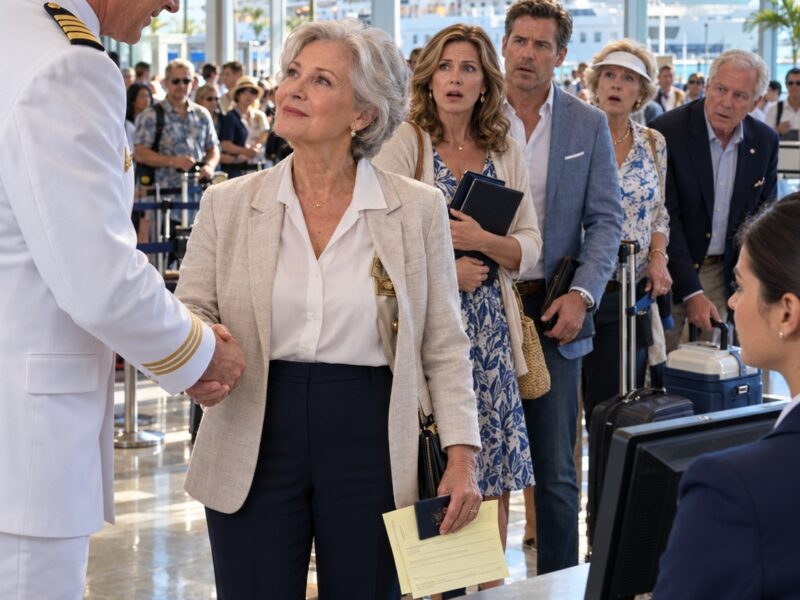
My Daughter Charged Me Separately for the Family Cruise I Offered Them—She Had No Idea the Ship’s Director Still Remembered Exactly Who I Was
At the travel office, my daughter looked straight past me and told the agent, “Charge her separately. She’s not part of our package.”
Five months later, the family she had excluded arrived at the cruise terminal using a discounted rate tied to a benefit they insisted had nothing to do with me.
Then the ship’s hotel director walked past hundreds of waiting passengers, stopped in front of my chair, and said the one sentence my daughter never expected to hear.
The sentence that changed our family vacation was not shouted.
That is important.
My daughter Brooke did not slam her hand on the travel agent’s desk or announce that I was unwanted. She did not roll her eyes, call me a burden, or say anything dramatic enough that a stranger might have stepped in.
She simply looked at the computer screen and said, “Charge her separately. She’s not part of our package.”
The printer behind the travel agent began to hum.
That sound is what I remember.
Not because printers are memorable, but because when someone says something cruel in a calm voice, ordinary noises suddenly become very clear.
Dana Kowalski, the travel advisor, stopped typing.
My son-in-law Grant leaned back in his chair and crossed his arms.
“Agreed,” he said. “Keep ours clean.”
Then he glanced at me with the kind of smile people use when they want credit for not being openly rude.
“You’ve got your own arrangement, Toni.”
I was seventy-one years old.
I had spent forty-four years working for Seabright Cruise Line, twenty-one of them aboard ships and the rest at the company’s Miami headquarters.
The trip in front of us had been my idea.
My gift.
On Christmas Day, I had handed Brooke an envelope authorizing three companion cabins at my retiree rate so my daughter, her husband, their two children, and Grant’s parents could take a seven-night Caribbean cruise for a fraction of the normal fare.
But sitting in that Weston travel office in January, I understood that a gift could be accepted while the giver was quietly removed from it.
Dana looked at me.
Her fingers remained above the keyboard.
“Mrs. Danforth?”
Brooke did not turn around.
I folded my hands in my lap.
“Of course,” I said.
My voice sounded normal.
That was another thing forty-four years in hospitality had taught me.
You can be insulted, exhausted, frightened, or grieving, and still say “of course” in a tone that makes another person believe everything is perfectly manageable.
Dana led me to a smaller side counter.
“There aren’t any balcony cabins left beside theirs,” she said softly.
“That’s fine.”
“There’s an inside cabin on Deck Four.”
“That’s fine too.”
“Cabin 4127. Near the forward elevators.”
“Book it.”
She gave me the price.
$1,043 including taxes and port fees.
I handed her my credit card.
At the main desk, I heard Grant say, “Toni doesn’t need a balcony. She’s seen the ocean.”
Brooke laughed.
Not much.
A small laugh.
The kind that says I’m with him without requiring anyone to defend the sentence later.
Dana lowered her voice.
“If she isn’t linked to your reservation, there may be an issue at embarkation.”
Grant answered before Brooke could.
“She’ll be standing right there.”
Flat.
Final.
Dana stopped talking.
When she returned my receipt, she held the paper between us a second longer than necessary.
I thought she was embarrassed for me.
I did not yet understand she had been trying to warn me.
Outside, Brooke kissed the air near my cheek.
Grant was already checking his phone.
I sat alone in my car with the receipt on my knee and watched January sunlight flash against the windshields in the parking lot.
The amount did not hurt.
I had spent more than that on a single corporate dinner.
What hurt was that I had offered my family a door, and they had walked through it while asking me to use another entrance.
And the worst part was that I had agreed.
My name is Antonia Danforth, though everyone has called me Toni since I was twelve.
I live in a two-bedroom condo in Plantation, Florida, with a narrow balcony facing a canal where two iguanas behave as though they own the building.
Every morning at 6:15 I drink black coffee outside.
Old habit.
Ships teach you to wake before clocks become necessary.
Near my front door sits a small porcelain dish.
Keys on top.
Underneath them, an old brass name badge.
The lettering has softened around the edges, but it still reads:
A. DANFORTH
HOTEL DIRECTOR
SEABRIGHT STAR
I received that badge in 1991.
I was thirty-six.
The first woman Seabright had ever promoted to hotel director aboard one of its major ships.
Almost nine hundred crew members reported through my division.
Guest services.
Housekeeping.
Food and beverage.
Entertainment coordination.
Shore operations.
I had captains who respected me, captains who tolerated me, and one captain who refused to call me Director for three months until I corrected him in front of an executive from Miami.
He called me Director after that.
My husband Walt used to tease me about the badge.
“You wear that thing at home someday, and I’m charging you rent.”
He died in 2019.
High school chemistry teacher for thirty-one years.
He could make a classroom full of sixteen-year-olds care about covalent bonds and turn a baking-soda volcano into comedy.
I miss him most in the mornings.
Especially the first sip of coffee.
He always stole it.
Brooke is forty-one.
She manages the front office of a dental practice in Weston.
Good at it too.
No double bookings.
No insurance forms sitting unsigned.
No patient leaves without knowing their next appointment.
She married Grant Holloway in 2009.
Two children.
Lily, fourteen.
Owen, eleven.
Lily asks questions as though answers are oxygen.
Owen says everything he thinks.
His mother calls that impulsive.
I call it efficient.
When Brooke was little, I was away too much.
That is not a confession designed to make you forgive what came later.
It is simply true.
From the time she was born until she was thirteen, my contracts took me away for months at a time.
Four months aboard.
Six or eight weeks home.
Then back.
Walt handled school mornings.
Dentist visits.
Stomach bugs.
Parent conferences.
Birthday cakes.
He learned to braid hair badly.
Brooke adored him for it.
When she was sixteen, we fought over curfew.
She stood in our kitchen and said, “You were a postcard, Mom.”
I remember the refrigerator buzzing behind her.
I remember the way Walt looked down.
Mostly I remember that I had no answer.
She was not entirely wrong.
I sent postcards from St. Thomas.
Nassau.
Cozumel.
Alaska.
Barcelona once.
I put little hearts around her name.
None of those cards drove her to school.
So I made a private rule.
I would not demand closeness.
I would not force myself into plans.
I would not use motherhood like a boarding pass to seats she did not offer me.
Guilt is a quiet tenant.
It never misses rent.
There was one Christmas Brooke never forgave me for.
We will get there.
It mattered more than I understood.
The cruise was my attempt to move something between us without calling it repair.
Christmas Day 2025 fell on a Thursday.
We ate at Brooke’s house.
Ham.
Scalloped potatoes.
Green bean casserole from Grant’s mother Patrice’s recipe, complete with handwritten instructions mailed from Columbus even though Brooke had made it at least twelve times.
After pie, I placed a white envelope beside Brooke’s coffee cup.
“What’s this?”
“A cruise.”
Lily nearly knocked over her water.
“A cruise?”
“All of us,” I said. “June. If everybody wants to go.”
Inside was the authorization number for my Seabright retiree travel benefit.
The benefit was generous.
After forty-four years, I could sail once annually at a retired-officer rate and sponsor up to three additional cabins for companions.
The rate varied.
For the June 13 sailing aboard Seabright Lumina, it was $689 per person plus taxes and fees.
Balcony.
Seven nights.
Eastern Caribbean.
Out of Port Everglades.
Lily’s eyes widened.
“Grandma, will you show me where you slept?”
I laughed.
“I’ll show you where I worked. Sleeping was optional.”
Owen asked whether crew lived “under the water.”
Grant studied the paper.
He had been quiet through dessert.
Then:
“Does your name have to be on everything?”
I thought he was joking.
He was not.
Brooke took the envelope from him.
“We’ll handle booking.”
“Dana at Palmetto Coast Travel can do it.”
“Perfect.”
I said:
“It’s your trip too.”
What I did not say was that I wanted Brooke to see the life I had once chosen over being home.
I wanted to show her the narrow crew corridors.
The crew elevators.
A purser’s office.
The hotel operations board where every morning began.
I wanted her to see that I had not sailed away because she mattered less.
I had sailed because I was thirty years old in an industry that gave women tiny windows and expected gratitude for the view.
But explanation is not the same as repair.
I knew that.
January 10, we went to Palmetto Coast Travel.
Small storefront between a dry cleaner and nail salon.
Dana sat behind two monitors.
Brooke in front.
Grant beside her.
I sat by a brochure rack.
Three balcony cabins.
9214 for Brooke and Grant.
9216 for Lily and Owen.
9218 for Patrice and Dale.
Then:
“And Mrs. Danforth?”
That was when Brooke said it.
Charge her separately.
Not part of our package.
I paid.
Said nothing.
Drove home.
That evening, I heard a ship leaving Port Everglades.
Three horn blasts.
Long.
Low.
The sound moved through humid air and across my canal.
For forty-four years, that sound had meant departure.
That night it sounded like something else.
Permission.
Permission to disappear politely.
So I made a decision I later came to dislike.
I would go anyway.
I would be pleasant.
Useful.
Quiet.
The passenger nobody remembered.
A week later, Brooke invited me for spaghetti.
I brought garlic bread and clementines because Owen eats them like candy.
The moment I entered her kitchen, I saw the refrigerator.
A countdown board.
Blue marker.
Cartoon ship.
Smiling whale.
At the top:
HOLLOWAY FAMILY CRUISE
Below:
146 DAYS.
Six photographs.
Brooke.
Grant.
Lily.
Owen.
Patrice.
Dale.
Six faces.
I counted twice.
Owen came behind me holding two clementines.
“Grandma, you’re not on it.”
“So I see.”
Brooke kept stirring sauce.
“We ran out of room.”
There was an entire blue ocean with nothing in it except a whale.
Owen pointed.
“There’s room here.”
“Owen,” Brooke said. “Set the table.”
He went.
Under the poster was a printed booking confirmation.
Ship.
Date.
Three cabins.
Six guests.
Party name:
HOLLOWAY.
No prices.
No sponsor.
No me.
I ate spaghetti.
Complimented the sauce.
It came from a jar.
On the way home, I told myself poster board cost two dollars.
It cost more than that to leave it hanging.
Grant and I had history.
In March 2024 he came to my condo carrying a blue folder.
Brooke with him.
He needed $60,000.
His company, Holloway Commercial Kitchen Supply, sold ovens, coolers, dishwashers, ventilation systems.
He could sell.
God, that man could sell.
He could make a grease trap sound aspirational.
He wanted a bigger warehouse because Coral Sands Resort and Casino was “about to” name him exclusive supplier.
I had approved galley contracts for eleven ships while serving as a vice president at Seabright headquarters.
I read Grant’s plan.
One major prospective customer.
No signed contract.
No fallback account.
No secondary revenue pipeline.
Inventory exposure.
Lease exposure.
I closed the folder after twenty minutes.
“One customer is not a business plan.”
His jaw shifted.
“So no.”
“No to the plan.”
“Same thing.”
“It isn’t.”
Brooke stood by my refrigerator.
Arms folded.
Said nothing.
Eight months later, Coral Sands selected another supplier.
Grant had already signed the warehouse lease.
Bought inventory.
He lost roughly $140,000.
Brooke told me as though my refusal had caused it.
Grant stopped calling me Mom.
“Toni.”
The way you address a cashier after reading the badge.
I hoped the cruise might soften that.
Instead, a week after booking, Patrice Holloway posted on Facebook.
A friend forwarded it.
Photo of the Seabright Lumina.
Caption:
My son Grant got the whole family an industry rate! So proud of him.
One comment asked:
Isn’t Brooke’s mom from Seabright?
Patrice replied:
She answered phones there years ago lol. She’s booking her own.
Phone lady.
That was new.
In fairness, I did answer phones.
In 1977.
For six weeks.
Afterward, other people answered mine.
The insult mattered less than “industry rate.”
Grant sold kitchen equipment.
He had never worked for Seabright.
But maybe he had found a promotion.
Group deal.
Travel-industry arrangement.
People exaggerate for their parents.
I had watched grown captains inflate job titles for mothers.
I let it go.
February 8, Brooke called.
“Quick thing.”
“Yes?”
“You’ll keep the kids formal night?”
I understood instantly.
The Lumina chef’s table.
Adults only.
Eight courses.
$189 per person.
“Who’s going?”
“Me, Grant, Pat, Dale.”
Four adults.
$756.
“And the kids?”
“With you.”
Not a question.
“You’re not doing anything that night anyway.”
I closed my eyes.
“Of course.”
“I’ll bring cards.”
That evening Lily added me to a group chat.
HOLLOWAY CRUISE CREW ⚓
I scrolled upward.
Packing lists.
Sunscreen.
Excursions.
Dinner plans.
Then:
Night 2 — chef’s table, adults. Kids with Mom’s mom.
Mom’s mom.
A relationship label.
No name.
Lily messaged:
Added Grandma so she can see pics!
Ten minutes later:
Brooke removed you.
Gray text.
Tiny.
Efficient.
The next morning Brooke texted privately:
Sorry. Kids chat. Too much noise for you.
I did not answer.
February 21, I drove Lily to volleyball.
Halfway along Sawgrass Expressway she asked:
“Grandma, what’s companion fare?”
Both hands tightened on the wheel.
“Where did you hear that?”
“Paper in Dad’s printer.”
She pulled one knee toward her chest.
“It said sponsor and companion fare a lot.”
“What did your dad say?”
“He grabbed it.”
“Why?”
“He said none of my business.”
Then:
“Why would Dad hide a discount?”
Companion fare.
At Seabright, the phrase had one precise meaning.
My benefit.
I had given Brooke authorization on Christmas.
Grant said they had their own rate.
I told Lily:
“Seabright has lots of promotions.”
True.
Incomplete.
That night I opened Dana’s contact.
Hovered.
Closed it.
I had promised myself I would not audit Brooke’s trip.
At her wedding she once told me:
“You don’t have to run everything just because you know how.”
So I did nothing.
Sometimes restraint is maturity.
Sometimes it is fear wearing better clothes.
Owen’s birthday was February 28.
Cruise-ship cake.
Countdown poster now 105 days.
Still six faces.
Owen looked at the board.
“Mom, why isn’t Grandma there?”
Brooke cut cake.
“Grandma’s not in our package, bud.”
Light.
Easy.
“What’s a package?”
I answered.
“It’s what people call a list when they don’t want to say list.”
Brooke looked at me.
I gave her the smile I used on guests requesting impossible upgrades.
Warm.
Temporary.
Later, I went to the garage for ice.
Grant stood between golf clubs and freezer.
Phone to his ear.
Voice low.
“I told you the fifteenth.”
Pause.
“You’ll have it on the fifteenth.”
He saw my shadow.
Turned away.
I took my ice.
Said nothing.
At that point I did not know who he owed.
Only that men do not sound like that when discussing something harmless.
My seventy-first birthday was March 14.
Brooke texted:
Happy birthday, Mom. Crazy weekend. Two soccer games. Call soon.
No call.
Patrice posted:
91 DAYS TILL OUR HOLLOWAY CRUISE!
I made salmon.
Rice.
Opened white wine.
Ate alone on my balcony while an iguana watched me from the railing like a judgmental little landlord.
After dinner, I took my brass badge from the porcelain dish.
I turned it over.
The pin still worked.
Hotel Director.
First woman.
Seven years aboard that ship.
Hundreds of crew.
Thousands of passengers every week.
My work gave me a home.
Pension.
Career.
Respect.
It also took most of Brooke’s childhood.
Both things were true.
Two days after my birthday, Seabright sent an automated email.
Subject:
COMPANION ALLOTMENT STATEMENT — 2026
I used to approve those templates.
Automatic after final payment.
I opened it with coffee in my hand.
Three cabins.
Lumina.
June 13.
Lead guest:
Brooke Holloway.
Companion rate:
$689 per guest.
Sponsor:
Antonia Danforth.
Status:
SPONSOR NOT LINKED — VERIFICATION REQUIRED AT EMBARKATION
At bottom:
ALLOTMENT REMAINING: ZERO
I read it three times.
Set the coffee down.
They had not found an industry rate.
There was no secret promotion.
They had used my companion benefit.
All three cabins.
Six people.
Then removed me from their reservation.
Not part of the package.
Part of the price.
My thumb pressed so hard into the brass badge it left an imprint.
Lily’s question returned.
Why hide a discount?
Now I knew what.
Not why.
I called Seabright retiree travel the next morning.
Maribel Ortiz answered.
Young voice.
Professional.
I gave authorization.
Typing.
Then she stopped.
“Oh.”
“That reassuring?”
She laughed nervously.
“You’re Mrs. Danforth.”
“I’m afraid so.”
I asked her to read section 4.2 of companion travel rules.
She did.
Sponsored cabins must remain linked to retiree.
Sponsor must embark with companions.
At check-in, sponsor verifies each companion cabin individually.
Unverified cabin gets repriced to best available public fare for category on sailing date.
Difference payable before boarding.
Companion fares nonrefundable.
Guests who decline new fare may cancel.
“So they need me at the pier.”
“Yes.”
“And signature?”
“One per cabin.”
One per cabin.
I wrote it down.
Maribel hesitated.
“Would you like me to cancel them?”
I could.
One word.
Three cabins gone.
Brooke receives email before lunch.
No terminal confrontation.
No need to watch.
“No.”
“Are you sure?”
“Cancellation would be my decision.”
I looked at the paper.
“I want to see what theirs will be.”
Maribel went quiet.
Then:
“I’ll note you called.”
Next day I called Dana.
“Mrs. Danforth.”
She sounded unsurprised.
“You expected me?”
“For two months.”
“I got the allotment statement.”
“I figured.”
A door closed on her end.
“May I read my January notes?”
“Yes.”
Booking systems remember.
Every instruction timestamped.
Dana read:
“January tenth. Lead guest requested sponsor removed from reservation. Advised lead guest companion verification required at embarkation. Lead guest spouse stated, quote, ‘She’ll be standing right there.’ Proceeded per instruction.”
My chest tightened.
That sentence.
I had heard it while paying for my separate cabin.
Thought it concerned dinner.
It had gone into Seabright’s booking record.
“There’s more,” Dana said.
“Go ahead.”
“Mr. Holloway requested guest confirmations for his parents without fare amounts.”
“Gift copies?”
“Yes.”
“Did he say it was a gift?”
“He said they were reimbursing him.”
I watched a pelican dive into the canal.
“Dana.”
“Yes?”
“Why didn’t you call me?”
Silence.
Then:
“I’m not supposed to override a lead guest.”
“That wasn’t my question.”
Another breath.
“I should have called.”
“No.”
“You documented the warning.”
“Yes.”
“That matters.”
“Do you want me to reconnect you?”
“Only if Brooke asks.”
We both knew she would not.
Now I understood how.
I still did not understand my daughter.
To understand Brooke, I had to return to Christmas 1990.
The Christmas I had spent thirty-five years refusing to explain because explaining felt like asking forgiveness twice.
I was thirty-five.
Assistant hotel director aboard Seabright Star.
We were scheduled through St. Thomas Christmas Day.
I promised Brooke I would be home.
Then the hotel director broke his ankle in Nassau.
Miami called.
They needed me to cover.
It was the opportunity I had worked thirteen years to earn.
A woman acting hotel director on a holiday sailing.
Visibility mattered.
I said yes.
At seven Christmas evening, I stood in the purser’s office holding a ship-to-shore telephone.
Calls home cost four dollars a minute.
I had saved for forty.
Walt answered.
Television behind him.
Cousins.
Dog barking.
“Put Brooke on.”
Silence.
“Walt?”
“She won’t come to the phone.”
“Is she sick?”
“No.”
He breathed.
“She waited at the front window until nine last night.”
My throat closed.
“She thought you’d walk up the driveway.”
Brooke was six.
She wore a red velvet Christmas dress.
Walt later told me that after nine, she removed it herself.
Hung it neatly in her closet.
Did not cry.
At nine that night, Seabright Star left St. Thomas.
Three horn blasts across Charlotte Amalie harbor.
I stood on the aft deck.
Thought:
That is the sound of me leaving her again.
Brooke’s wound was real.
I never denied that.
But sitting at my kitchen table thirty-five years later, companion allotment statement before me, I understood something I had never permitted myself to understand.
Being sorry for being gone did not require agreeing to disappear.
I tried to talk to her in April.
Soccer.
Work.
Birthday.
No time.
Mother’s Day, I drove to Weston carrying lemon pound cake.
Countdown board:
34 days.
After lunch, kids went to pool.
Grant sat at island on his phone.
Brooke loaded dishwasher.
I stood in the kitchen.
“Brooke.”
She kept stacking plates.
“I need to tell you something about the reservation.”
“Mom, please.”
“The three cabins are under my companion allotment.”
Grant’s thumb stopped moving.
“I received confirmation in March.”
Brooke shut dishwasher.
Turned.
“At embarkation, the sponsor verifies each cabin.”
“I am the sponsor.”
“You need my signature.”
For one second I thought she heard me.
Then:
“Stop inserting yourself into our trip.”
“I am not asking to be in your package.”
“I am telling you what is already inside it.”
Grant laughed.
Short.
Comfortable.
“Toni, come on.”
He put his phone down.
“It’s been nearly five years.”
“Nobody remembers who you were.”
Through glass doors behind him, Lily stood dripping from pool.
She heard.
I saw it in the way she went still.
I picked up my purse.
Kissed Brooke’s cheek.
She allowed it.
“Happy Mother’s Day.”
Grant’s sentence rode beside me all the way home.
Nobody remembers who you were.
Thirty-four days later, I found out somebody certainly did.
But first, Grant’s mother called.
May 28.
Ohio number.
“Toni? Patrice Holloway.”
We had spoken perhaps six times in seventeen years.
She asked for airport pickup June 11.
“Brooke says you’re free, retired and all.”
I agreed.
Then Patrice continued.
“Can you believe what Grant did for us?”
“What?”
“Our balcony was only forty-one hundred.”
She said it proudly.
“Half the listed price.”
I knew the actual cost.
$689 each plus approximately $145 tax and fees.
$1,668 total.
Grant charged his parents $4,100.
Markup:
$2,432.
“Patrice.”
“Yes?”
“You might ask Grant for an invoice.”
The warmth vanished.
“Why?”
“Good practice with travel.”
“I don’t need advice about my son, Toni.”
Small laugh.
“Some of us actually help our children.”
I looked at my kitchen counter.
“I’ll see you June eleventh.”
She hung up.
I did arithmetic twice.
Then remembered Grant in garage.
You’ll have it on the fifteenth.
Airport day arrived.
Patrice and Dale had four suitcases and a medical cooler.
Patrice claimed front seat without asking.
Dale sat behind holding cooler.
“Nice to see you, Toni.”
“I’m glad you’re here, Dale.”
On I-595, Patrice turned air vent toward herself.
“You must have been proud working phones at such a large company.”
I kept my eyes ahead.
“The phones were busy.”
“Grant says you did very well for clerical.”
“I did fine.”
A mile later:
“I gave my son twenty-five thousand dollars in March 2024.”
Dale shifted behind.
She continued.
“When his own mother-in-law wouldn’t give him a dime.”
Dale said quietly:
“I know how much now.”
Patrice ignored him.
“He told me you called him an amateur.”
“I told him one customer isn’t a business plan.”
“Well.”
Patrice looked out windshield.
“We know how that turned out.”
We did.
I just knew more than she did.
Night before sailing, Brooke booked dinner at Salt Line.
Seven people.
Long table.
Every chair filled except far end near kitchen door.
My chair.
Every server exiting kitchen brushed behind me.
Lily sat beside.
Without speaking she moved bread plate closer so I had more room.
Halfway through entrée, Patrice tapped wine glass.
“I want to toast Grant.”
Grant smiled.
She raised glass.
“Whose connections got this family onto a ship.”
Glasses clinked.
Dale last.
Brooke kissed Grant’s cheek.
Owen raised lemonade.
Looked at me when I did not lift mine.
Check came.
Grant said:
“Separate for her. She’s not in our package.”
The server looked at me.
Apologetic eyes.
I knew those eyes.
Young service workers everywhere share them.
“That’s fine.”
My bill:
$61.40.
Grouper.
Iced tea.
Twenty percent tip.
Outside, warm salt air.
SUV valet line.
For one minute, Brooke and I stood alone under striped awning.
I tried once more.
“Tomorrow at check-in, you’ll need me.”
She watched street.
“What we need, Mom, is for you to take an Uber.”
“Brooke.”
She turned.
“You left on ships my whole childhood.”
Voice low.
“You don’t get to be the captain now.”
There it was.
Thirty-five years.
Two sentences.
I could have told her about forty-minute phone call.
Red velvet dress.
Horn in St. Thomas.
But valet stand was wrong place.
“I am not trying to be captain.”
I said.
“I’m telling you where the rocks are.”
Grant pulled up.
Door shut.
They drove away.
Patrice waved from back seat.
At home, I laid clothes for morning.
Navy slacks.
White blouse.
Linen jacket.
Printed section 4.2 went in purse beside passport.
Then I took brass badge from dish.
Pinned it inside lining of jacket.
Nobody remembers who you were.
Fine.
I remembered.
Three promises.
I would not lie on any form.
I would not make a scene.
I would be exactly where rules required me.
And I would not sign my name beneath something untrue.
Not even for Brooke.
June 13.
Embarkation day.
At 7:02, text:
No room in SUV with Pat and Dale plus bags. Take Uber. Terminal 21. Don’t be late.
Don’t be late.
I had arrived early to nearly a thousand ship departures.
Uber cost thirty-eight dollars.
Driver asked:
“Vacation?”
“I’m going to find out.”
Terminal 21 at Port Everglades.
Bright hall.
Rope lines.
Plastic chairs.
Walls of windows.
Beyond glass:
Seabright Lumina.
Fourteen decks.
White hull.
2,900 guests.
I stood watching for a minute.
Some things never lose magic.
At 10:40 I could have checked into my own cabin.
Pool deck by eleven.
Iced tea.
Section 4.2 said sponsor must embark with companions.
So I sat in a blue chair.
Documents in hand.
Waited.
At noon, another ship sounded horn.
Three blasts.
For forty-four years, that sound meant I was leaving someone.
That day I was waiting for them to arrive.
12:15.
Grant’s SUV.
Family came through terminal doors in a wave.
Grant first.
Patrice in white visor reading CRUISE CREW.
Dale with insulin cooler.
Owen pulling shark backpack.
Lily last, earbuds in.
Lily saw me first.
Smiled.
Started waving.
Brooke noticed.
Lifted two fingers off passport folder like greeting neighbor.
Kept walking.
They passed within six feet.
Grant said loudly:
“See? She’s early. Old habits.”
Patrice laughed.
“She’s got nowhere else to be.”
They went to counter.
Young agent Kira scanned passports.
Beep.
Beep.
Beep.
Then stopped.
Screen.
Scroll.
Her brow tightened.
“Mrs. Holloway, your three cabins are companion fare.”
“Yes.”
“I need sponsor verification before I can print boarding cards.”
She looked around.
“Where is your sponsor?”
Grant leaned forward.
“She’s around.”
“She must come to counter.”
I stayed seated.
Not yet.
I wanted to see the decision.
Grant turned to Brooke.
“Go get your mom.”
Brooke started toward me.
Behind her, Kira picked up phone.
Guest services supervisor came.
Ranata Solis.
She looked at booking.
Then sponsor name.
Her eyebrows rose.
Seabright flags retired senior officers.
When one of us has an issue at pier, ship receives courtesy call.
Ranata dialed.
“Get me Lumina. Ask for Mr. Merrick.”
Brooke reached me.
“Mom.”
The word sounded administrative.
“They need you.”
“I know.”
“Come sign whatever it is.”
“I know what it is.”
“Then come.”
I stood.
Smoothed jacket.
Before I took a step, a crew-only door opened across terminal.
A tall man emerged in white uniform.
Gray at temples.
Four gold stripes.
Hotel director.
His name bar:
LUCA MERRICK
People turned.
Senior officer in whites attracts attention even in cruise terminal.
Luca walked past rope line.
Past check-in counters.
Past Grant.
Past Patrice, who stepped aside.
Past Brooke.
Stopped before me.
He dipped his head.
Old style.
Exactly how I taught officers in 1996.
“Welcome home, Mrs. Danforth.”
My family turned.
All of them.
Luca smiled.
“These three cabins can’t board without your signature.”
Blood left Grant’s face first.
Then Brooke’s.
Patrice’s mouth opened.
Dale placed cooler on floor very slowly.
Luca hugged me.
Right there.
Three hundred strangers.
Entire family.
When he stepped back, jacket opened.
He saw brass badge pinned inside.
His face softened.
“You still have it.”
“Some things you don’t give back.”
Patrice finally spoke.
“I’m sorry. Who are you?”
Luca turned.
Perfect courtesy.
“Luca Merrick, ma’am. Hotel director.”
He nodded toward me.
“In 1996 I was a twenty-two-year-old assistant waiter. Mrs. Danforth hired me.”
“Hired you?”
“She was Seabright’s first woman hotel director.”
Patrice stared at Grant.
“She answered phones.”
Luca smiled.
“Yes, ma’am.”
Pause.
“For three thousand guests a week.”
Grant turned blotchy red.
Luca added:
“Every hotel officer on Lumina still trains on the hospitality manual she wrote.”
Then looked at me.
“Everyone on that ship remembers who she was.”
I said nothing.
I did not need to.
Luca touched my elbow.
“Ranata handles fares. I only came down to say hello.”
Then returned crew-side.
Entire family watched.
Then looked at me.
Ranata placed yellow form on counter.
Three cabin numbers.
Blank signature line beside each.
“Your options are simple.”
she said.
“Verify, pay difference to current fare, or decline boarding.”
“What difference?”
Grant asked.
Ranata checked screen.
“Best available fare for balcony today is $2,389 per guest.”
Grant did arithmetic.
“That’s seventeen hundred more each.”
“Approximately thirty-four hundred per cabin.”
Silence.
“Companion fare already paid is nonrefundable.”
She checked clock.
“Check-in closes 2:30.”
Announcement:
Group Seven boarding.
Grant turned to me.
Smile forced.
“Just sign it, Toni.”
Brooke stepped beside.
“Mom.”
Ranata set pen down.
“It’s per stateroom, Mrs. Danforth.”
Take your time.
Per stateroom.
I had underlined that twice in March.
I picked up pen.
Grant suddenly slammed travel folder down.
“This is a setup.”
Terminal ceiling carried his voice.
Nearby conversations stopped.
“You planned this for months.”
Ranata:
“Sir, lower your voice.”
Grant pointed toward me.
“She’s extorting her own family.”
I did not raise my voice.
One person shouting makes quiet person easier to hear.
“I told you Mother’s Day.”
“No, you didn’t.”
“I told you my signature was required.”
I paused.
“You said nobody remembers who I was.”
Ranata turned monitor.
“There is a booking note.”
Dana’s January note.
Sponsor removed at lead guest request.
Verification advised.
Quote:
She’ll be standing right there.
Grant stared at his own words.
Timestamped.
A woman in line wearing matching visor whispered:
“He said that.”
I looked at Grant.
“I am standing right here.”
He had no answer.
I turned to Ranata.
“Verification is separate per cabin?”
“Yes.”
I signed one line.
Antonia Danforth.
Same signature I once placed on crew contracts.
Guest letters.
Menus.
Disciplinary reports.
“I’m verifying Lily and Owen.”
Ranata typed.
“Cabin 9216 confirmed and linked to your reservation.”
I set pen beside two blank lines.
Brooke stared.
“Mom.”
This part was for her.
Not crowd.
“At Dana’s desk you said I wasn’t part of your package.”
Her lips parted.
“I believed you.”
I let sentence breathe.
“You’re not part of mine.”
Her eyes filled.
For a second she looked six.
Red velvet dress.
Window.
Waiting.
Then:
“The kids are watching.”
“Good.”
I kept voice low.
“I want them to remember I told the truth.”
Lily came beside me.
Took my hand.
“Grandma.”
“Yes?”
“Do we get to see where you worked now?”
I looked down.
“Yes, sweetheart.”
Behind her Owen stared at ship.
He did not understand adult arithmetic.
Good.
He had time.
Ranata printed fare summaries for remaining cabins.
Patrice picked hers up.
Read.
Cabin 9218.
Patrice and Dale.
Companion fare:
$689 each.
Taxes:
$145 each.
Total paid:
$1,668.
She read twice.
Then:
“Grant.”
Her voice thin.
“You charged me forty-one hundred.”
“Mom, there were fees.”
“This says sixteen hundred.”
“Travel fees.”
She stared.
Hands began shaking.
“Twenty-five thousand in 2024.”
Then:
“And now this.”
Dale put one hand on her shoulder.
No words.
Patrice looked at me.
“You could have signed.”
“You could have spared us.”
I answered quietly.
“If I signed, you would never have seen that number.”
She opened mouth.
Closed.
No answer.
Ranata turned card reader to Grant.
“Cabin 9214. $3,400 difference.”
Grant produced black card.
Tap.
Beep twice.
Declined.
“Again.”
Again.
Declined.
Second card.
Blue.
Printer chattered.
“Declined.”
Ranata remained neutral.
“Insufficient available credit.”
Brooke stared at Grant.
I remembered garage call.
You’ll have it on fifteenth.
“Grant.”
“Not here.”
“What is wrong with the cards?”
“Brooke—”
“What is wrong?”
He did not answer.
Answer enough.
For next hour he paced terminal wall.
Called bank.
Someone named Rick.
Returned twice with other cards.
Declined.
Groups boarded.
Hall emptied.
2:05.
Brooke opened wallet.
Pulled emergency card Walt had helped her open at nineteen.
“For emergencies only.”
She put it on reader.
Approved.
Patrice held out hand to Dale.
He gave card.
She paid $3,400 difference for their cabin herself.
“We’ll discuss the rest in Columbus.”
No eye contact with Grant.
2:11.
Key cards printed.
All aboard 3:00.
$6,800 in unexpected charges.
Nineteen minutes to spare.
Luca waited at gangway.
Offered arm.
I took it until ship doors.
Gangway smelled like salt and paint.
Inside atrium, several crew had gathered.
One stepped forward.
Gray hair.
Reading glasses.
Black vest.
Rafael Santos.
In 1996 he had been twenty-five-year-old bartender.
Best rum punch in Caribbean.
Never late.
“Mrs. D.”
He stood straighter.
“The bar still runs your way.”
“Then I know where to find decent iced tea.”
Lily walked left holding hand.
Owen right with shark backpack.
Their cabin officially linked to me.
Behind came Brooke and Grant.
Not touching.
Then Patrice and Dale.
I did not turn.
For thirty-five years I kept looking back at Brooke.
Waiting for her to wave.
That afternoon, for first time, I looked where I was going.
Cruise lasted seven days.
Formal night, Brooke and Grant went to chef’s table with Patrice and Dale.
They did not have babysitter anymore.
Lily and Owen ate with me in dining room.
Owen ordered two desserts.
I permitted it under retired-executive authority.
Wednesday we docked St. Thomas.
I walked Lily along pier.
Showed approximate place Seabright Star had tied Christmas 1990.
“This is where you called Mom?”
I stopped.
“How do you know?”
“Grandpa told me.”
She looked at harbor.
“He said you saved forty minutes.”
I had to sit on bollard.
Walt.
Even after death, still explaining me to our daughter’s daughter.
Lily sat beside.
“Mom says you picked work.”
“I did.”
“Did you regret it?”
“Yes.”
“Would you change it?”
I looked at ship.
“That’s harder.”
She nodded.
“Adults always say that when answer is complicated.”
“Adults say that when we’re buying time.”
She smiled.
“I would change some choices.”
I said.
“I would not erase whole life.”
“Your mother deserved more of me.”
“So did I.”
“Both can be true.”
Lily considered.
“Mom thinks you don’t care that she was sad.”
“I care too much.”
“Then why don’t you tell her?”
“Sometimes guilt becomes easier than conversation.”
Lily looked at me.
“That sounds dumb.”
“It is.”
On final night Luca invited me to officer wardroom.
I brought Lily.
She asked chief engineer eleven questions.
He answered all.
Brooke spoke two sentences to me all week.
“Pass sunscreen.”
And:
“The kids like the ship.”
Consequences came after cruise.
Quietly.
Grant began repaying his parents $200 per month July 15.
Patrice made him sign agreement.
Brooke’s emergency card carried $3,400 balance.
A week after docking, Brooke texted:
You humiliated us.
I read it on balcony.
Coffee.
Iguanas.
Thought long time.
Then replied:
No, honey. I stopped hiding for you.
No response.
She did not apologize.
I did not expect immediate one.
She also did not block me.
August, Owen came to condo with poster board.
Markers.
Spent afternoon dining table.
When done:
GRANDMA’S PACKAGE — JUNE 2027
Ship.
Ocean.
Whale.
Largest photo:
Me.
Lily and Owen beside.
Plenty of room.
“Mom and Dad can come.”
Owen said.
“If they buy their own ticket.”
“I did not teach you that.”
“I know.”
Next Sunday, I called Brooke.
“Next June I’m taking kids on cruise.”
Silence.
“My companion cabins.”
“My package.”
“You and Grant may come.”
“You can book regular fare.”
“Are you serious?”
“I’ve never been more serious about vacation.”
Benefit was for life.
One cabin for me.
Three for people I choose.
Every year.
Grant thought I lived on Social Security and “clerical pension.”
I never corrected him.
What retired senior vice president has is her business.
Before Lily left, I gave her brass badge.
She held it carefully.
“Why me?”
“Because you asked where I worked.”
She looked up.
“Nobody else did?”
“No.”
That answer hurt in a way I had stopped admitting.
Fall passed.
Thanksgiving awkward.
Brooke invited me.
I accepted.
Grant apologized for “how terminal got.”
Not for using benefit.
Not for charging parents.
Progress comes in uneven luggage.
Patrice barely spoke to Grant.
Dale helped Owen carve turkey.
Lily showed me history project about women in maritime careers.
Brooke saw badge displayed on first slide.
Her face changed.
After dinner she cornered Lily.
“You interviewed Grandma?”
“For school.”
“You didn’t ask me.”
“It wasn’t about you.”
I heard from hallway.
Brooke came out.
Saw me.
Neither spoke.
Sometimes children refuse inherited arguments simply because nobody taught them how sacred they were supposed to be.
December, Brooke asked for coffee.
Just us.
I chose a bakery halfway between Plantation and Weston.
She arrived late.
Seven minutes.
I noticed because ships train you.
She sat.
Ordered latte.
Did not touch it.
“I’m angry.”
“I know.”
“You made us pay.”
“Yes.”
“You signed for kids but not me.”
“Yes.”
“You chose my children over me.”
“No.”
Her eyes sharpened.
“That’s what it looked like.”
“I chose a cabin whose passengers had not lied to me about what they were using.”
She looked away.
“Grant handled booking.”
“You were there when I was separated.”
Silence.
“You said I wasn’t part of package.”
“I was mad.”
“At what?”
“You.”
“For?”
“Everything.”
There it was.
Not terminal.
Not booking.
Everything.
She gripped cup.
“When I was six, you chose a ship on Christmas.”
“Yes.”
“When I was nine, you missed my recital.”
“Yes.”
“When I was eleven, Dad took me to ER for stitches and you called two days later.”
“Yes.”
“You come back and act like career was this grand historic thing.”
“It was.”
She flinched.
I continued.
“And you were hurt by it.”
“Both are true.”
“I hate when you say that.”
“I know.”
“It sounds like executive language.”
I almost smiled.
“Probably.”
She leaned forward.
“You always explain everything calmly.”
“Like if voice stays soft, nobody gets to call you cruel.”
That struck.
I had done that.
Hospitality voice.
Boardroom voice.
Fix cabin.
Not guest.
Let everyone keep dignity.
Even when dignity required me to disappear.
“You’re right.”
Brooke stared.
“What?”
“You’re right.”
“I used calmness as armor.”
Her eyes filled.
“I wanted you to be upset.”
“I was.”
“You never showed it.”
“I thought showing hurt would make you responsible for mine.”
“I owed you years.”
“So I kept paying with silence.”
Brooke swallowed.
“And then at terminal?”
“I stopped.”
We sat.
Bakery espresso machine hissed behind us.
She said:
“I knew it was your rate.”
My chest tightened.
“You personally knew?”
“Yes.”
“From when?”
“January.”
“Dana told us.”
I stared.
“Then why?”
Brooke looked at napkin.
“Grant said it didn’t matter.”
“He said you’d show up.”
“You always show up eventually.”
That sentence landed harder than expected.
Eventually.
Not first.
Not on time emotionally.
Eventually.
Brooke continued.
“He said after everything, you could help without needing credit.”
“Was that what you believed?”
“I don’t know.”
“Brooke.”
“Yes.”
Tears came.
“I thought you owed me.”
There.
Not greed.
Debt.
Emotional debt converted into travel currency.
She wiped face.
“I know that sounds awful.”
“It sounds honest.”
“He said if we included you as sponsor, whole trip would become about your old Seabright stories.”
“I thought—”
She stopped.
“What?”
“I thought for once you could be useful without being impressive.”
I leaned back.
The sentence hurt.
Because it contained a childhood.
A girl tired of mother returning with stories about governors, captains, storms, celebrities, gala dinners.
A girl whose father stayed home.
“I understand why you resent the career.”
She nodded.
“I do not accept being erased because of it.”
She looked at me.
“That’s fair.”
First time.
Fair.
Then:
“I didn’t know about his parents’ markup.”
“I believe you.”
“You do?”
“Yes.”
She exhaled.
“I didn’t know cards were maxed either.”
“How bad?”
“Bad.”
Grant’s company.
Warehouse debt.
Personal guarantees.
Credit cards.
He had used some of Patrice’s $25,000 to keep business afloat.
Then charged parents cruise markup to cover final payments elsewhere.
“I asked him to show me books.”
Brooke said.
“He refused.”
“That’s a marriage problem.”
“I know.”
“You want my help?”
She looked at me.
Old pattern.
Executive mother.
Audit.
Fix.
I waited.
Brooke said:
“Not yet.”
“All right.”
Her expression changed.
“You’re not going to tell me what to do?”
“No.”
“That’s new.”
“So is asking.”
First intimacy between mother and daughter in years.
Not hug.
Not forgiveness.
Permission.
Two weeks later Brooke called.
“Can you look at business books?”
“Yes.”
“As accountant?”
“No.”
“You need independent CPA.”
“I can help you understand questions to ask.”
“That’s enough.”
We sat at my dining table.
Grant reluctantly produced statements.
His business was not fraudulent.
That mattered.
It was failing.
Inventory debt.
Warehouse lease.
Credit lines.
Personal cards.
Vendor balances.
He had hidden severity.
He had also borrowed $18,000 from Patrice after cruise in addition to earlier $25,000.
Brooke did not know.
Grant sat across.
Arms folded.
“You enjoying this?”
“No.”
“You were right about casino.”
“Yes.”
“Want medal?”
“No.”
I slid statement toward him.
“You have three choices.”
“Don’t—”
“Grant.”
Brooke’s voice.
“Let her finish.”
He stared at wife.
First crack in old alignment.
I explained.
Sell excess inventory.
Negotiate warehouse exit.
Bring in turnaround CPA.
Stop using family loans without written agreements.
Potentially close business before it consumed personal finances.
Grant looked sick.
“I built this.”
“I know.”
“You think I should quit.”
“I think one business failing does not make you failure.”
He laughed bitterly.
“Easy for you.”
“No.”
I touched brass badge beside keys.
“I spent forty-four years learning titles feel permanent until they don’t.”
He looked.
Then:
“You knew director.”
“Luca?”
“Yes.”
“Obviously.”
“No.”
He looked irritated.
“Meaning?”
“I knew a twenty-two-year-old assistant waiter.”
“He became director.”
“That was his work.”
Grant’s face shifted.
Maybe first time he understood networks not as leverage.
As memory.
The company eventually wound down over five months.
Not bankruptcy.
Structured liquidation.
Grant sold equipment.
Negotiated lease.
Paid vendors.
Patrice received repayment plan.
Brooke kept house.
There were consequences.
No miracle.
Grant took sales position with larger supplier.
Salary lower than pride wanted.
Benefits better than family needed.
He resented me less after he stopped needing me as villain.
Not instantly.
Slowly.
Patrice apologized one afternoon.
Over phone.
“I should not have said clerical.”
“No.”
“You shouldn’t have.”
She laughed nervously.
“I suppose I believed my son.”
“That’s normal.”
“I also wanted to believe he was giving us something.”
“I understand.”
“And you were.”
“Yes.”
Long pause.
“Thank you.”
“You’re welcome.”
Then:
“You still could’ve signed.”
I laughed.
“So could you have asked for invoice.”
She laughed too.
That was as close as we got.
The deeper issue remained Brooke.
In February, nearly year after booking office, she came to my condo carrying red garment bag.
She hung it over dining chair.
I recognized dress before zipper fully opened.
Red velvet.
Child size.
Christmas 1990.
She had kept it thirty-five years.
“I found it when cleaning Dad’s boxes.”
My throat closed.
“I didn’t know you still had it.”
“I forgot.”
She sat.
“I thought you should see.”
I touched velvet.
Tiny.
She had been six.
Brooke said:
“Dad told Lily about call.”
“I know.”
“He told her you saved forty minutes.”
“Yes.”
“He never told me.”
I looked up.
“What did he tell you?”
“That you called.”
“That I wouldn’t speak.”
Brooke’s eyes filled.
“I built story where you forgot.”
“I did not forget.”
“I still didn’t come.”
“I know.”
She whispered:
“Why didn’t you tell me?”
“Because when you said I was postcard, you were right.”
“Not entirely.”
“No.”
“But enough.”
“I thought explanations would sound like excuses.”
“So I let you keep anger.”
She looked at dress.
“For decades.”
“Yes.”
“That was stupid.”
“Yes.”
We both laughed through tears.
Then she asked:
“Were you proud that Christmas?”
“What?”
“Covering director job.”
“Yes.”
“Even though I was home waiting.”
I breathed.
“Yes.”
She nodded slowly.
“I think that’s the part I couldn’t handle.”
“That I could hurt you and still be proud.”
“Yes.”
“Both were true.”
She sighed.
“I still hate when you say that.”
“I know.”
She reached for my hand.
First time in years she did it without occasion.
Second intimacy.
No apology yet.
But touch.
March, one year after allotment email, Brooke invited me to Lily’s school presentation.
Front row seat reserved.
Card:
GRANDMA TONI
Not Mom’s mom.
Presentation about women at sea.
Lily showed old photo of me in white uniform.
Hair dark.
Badge bright.
Brooke cried quietly beside.
After, she said:
“I didn’t know.”
“What?”
“Any of it.”
“You never asked.”
She winced.
“That sounds like terminal.”
“It is true there too.”
She nodded.
“I’m asking now.”
Third intimacy.
Then the real midpoint truth arrived.
Walt’s old papers.
Brooke brought a file found in his desk.
Inside were letters I had sent from ships.
Not postcards.
Long letters.
Pages.
Notes about missing Brooke.
Schedules.
Requests for Walt to tape school plays.
Money set aside for flights.
One letter Christmas 1990.
Tell her I chose wrong. Don’t tell her job made it worth missing her. She should never have to compete with work in the story.
Brooke read aloud.
Stopped.
“Dad hid these.”
I looked at handwriting.
“He didn’t hide them.”
“What?”
“I asked him not to give them.”
Brooke stared.
“Why?”
“Because I didn’t want you managing my guilt.”
“You were a child.”
“I was adult.”
“I thought apology should not require you to comfort me.”
She pushed papers away.
“You keep making decisions for other people’s dignity.”
I froze.
Same training manual.
Fix cabin.
Not guest.
Let guest keep pride.
I had made myself smaller to protect Brooke from my explanations.
Grant had made me smaller to protect his pride.
Brooke had made me smaller to collect emotional debt.
Different motives.
Same disappearance.
That was the hidden pattern.
Not a cruise problem.
A family where everyone decided what someone else should know.
Brooke stood.
“I need air.”
We walked canal.
No solution.
At bridge she said:
“I used your benefit because I thought I was collecting.”
“Collecting what?”
“All those years.”
I nodded.
“I know.”
“That’s ugly.”
“Yes.”
She stopped.
“You don’t have to agree that fast.”
I smiled.
“You want dishonest reassurance?”
“No.”
She laughed despite herself.
“I’m sorry.”
There.
Simple.
“For cruise?”
“For saying you weren’t part of package.”
“For using benefit.”
“For Mother’s Day.”
“For letting Grant dismiss career because it made my anger easier.”
“For making kids part of it.”
She looked at water.
“I’m still angry about childhood.”
“You’re allowed.”
“But I don’t want to keep charging interest.”
That sentence stayed.
I hugged her.
Not cinematic.
Awkward at first.
Then real.
By spring, Grant’s business closure had strained marriage.
He blamed Brooke for involving me.
Brooke blamed him for debt.
Therapy.
Arguments.
No divorce.
At least not then.
My role:
Not referee.
That was growth.
I did not pay debts.
Did not call creditors.
Did not tell Brooke whether to stay.
I watched.
Harder than running a ship.
June 2027 approached.
Owen’s poster still on my refrigerator.
Grandma’s Package.
I booked three cabins.
Mine.
Kids.
One for Nadia, my friend from headquarters days who had spent retirement caring for sister.
Third remained open.
Brooke asked:
“You’re not saving it for us?”
“No.”
Her face fell slightly.
Then she nodded.
“That’s fair.”
Two weeks later:
“Grant and I booked regular fare.”
“Good.”
“Deck Seven.”
“Also good.”
“We’d like dinner together one night.”
I smiled.
“Ask kids.”
She laughed.
“Still making me work.”
“No.”
“Making you ask.”
Second cruise was different before it began.
At terminal, Brooke arrived before me.
She waited in blue chairs.
When I entered, she stood.
“Mom.”
No administrative tone.
“Want us to check in together?”
I looked at her.
“Yes.”
Luca was still director.
He came down later but did not make entrance.
No need.
He hugged Brooke too.
She introduced herself:
“I’m the daughter who never asked enough questions.”
Luca smiled.
“Ships are good places for second questions.”
Grant shook his hand.
No joke.
Patrice and Dale stayed home that year.
Too much family.
Even oceans have limits.
On formal night, Brooke and I walked promenade deck.
Warm wind.
Black water.
She said:
“Do you know what I remember most from last year?”
“What?”
“Not paying $3,400.”
I laughed.
“What then?”
“Lily taking your hand.”
I remembered.
“She didn’t look at me.”
Brooke said.
“I deserved that.”
“No child should have to choose.”
“I put her there.”
“Yes.”
She accepted.
Then:
“I thought you embarrassed me.”
“I know.”
“You stopped hiding.”
“Yes.”
“Worse.”
I looked over rail.
“Worse?”
“For me.”
She smiled sadly.
“Better for us.”
That cruise did not fix everything.
Nothing should.
But we began making memories not organized around debt.
St. Thomas again.
Brooke came with me this time.
We stood near pier where Star had docked 1990.
She held red velvet dress photo on phone.
“I forgive you.”
I looked at her.
“You don’t have to.”
“I know.”
“That’s why I can.”
My throat tightened.
She continued.
“I don’t forgive all of it.”
“Fair.”
“I forgive Christmas.”
“Thank you.”
Then she smiled.
“And I reserve right to complain about recital.”
“Forever.”
“Good.”
We walked.
For first time, old horn in my head went quiet.
Back home, Grant repaid parents steadily.
His sales job suited him better than ownership.
He hated admitting.
Patrice delighted in admitting for him.
Brooke remained dental manager.
Lily started looking at colleges.
Marine engineering appeared briefly.
Then journalism.
Owen wanted to become chef because chef’s table fascinated him from hallway.
Kids survive family drama partly by converting it into career ideas.
I started volunteering with Seabright retirees mentoring young hospitality managers.
One afternoon a woman named Carmen, thirty-two, asked:
“How do you lead without disappearing into job?”
I almost gave policy answer.
Instead:
“You don’t.”
She looked confused.
“You will disappear sometimes.”
“Work will take things.”
“Family will take things.”
“Leadership is noticing what you’re charging other people for ambition.”
“And letting them tell you the bill.”
She wrote it down.
I wished someone told me at thirty.
My seventy-third birthday arrived.
Brooke planned dinner.
Small.
No cruise theme.
At dessert, she handed me envelope.
I looked suspicious.
“Travel office trauma.”
She smiled.
“Open it.”
Inside:
Photocopy of countdown poster from first cruise.
But altered.
Owen had recreated.
DANFORTH FAMILY CRUISE — MEMORIES WE OWE NO ONE
Photos:
Me.
Brooke.
Grant.
Lily.
Owen.
Walt’s picture.
Even Patrice and Dale tiny in corner.
No package borders.
No categories.
Brooke said:
“I know paper doesn’t fix things.”
“No.”
“But it can say what we mean now.”
I touched Walt’s picture.
“What do we mean?”
She answered:
“You were gone.”
“You came back.”
“You had a whole life we didn’t understand.”
“And I had a whole childhood you didn’t see.”
“We’re not pretending either one cancels the other.”
I looked at her.
“You’ve been listening.”
“Unfortunately.”
We laughed.
Then Grant cleared throat.
“Toni.”
“Yes?”
“I owe you an apology.”
Kids went quiet.
“For what specifically?”
He smiled reluctantly.
“All right.”
He had learned.
“For using your benefit while telling you we had another rate.”
“For charging my parents markup.”
“For acting like your career was nothing because I was angry about loan.”
“For saying nobody remembered who you were.”
He looked at Lily.
“That one was especially stupid.”
Lily nodded.
“Very.”
Brooke gave her look.
“What?”
“Honesty is family value now.”
Owen nearly fell off chair laughing.
Grant continued.
“I don’t expect you to forget.”
“I won’t.”
“Fair.”
“I accept apology.”
He exhaled.
No hug.
Enough.
Years move quickly at seventy.
Lily graduated high school.
I attended.
Front row because Brooke saved seat.
Not out of guilt.
Just seat.
At dinner Lily gave me brass badge back.
I had given it to her after first cruise.
“Why?”
“I made copy.”
She wore replica on backpack during college applications.
Original belonged in my dish.
“You sure?”
“Yes.”
“Also I want you to wear it one more time.”
“For what?”
She had applied for Seabright summer maritime internship.
Guest operations.
My heart did something ridiculous.
Brooke looked terrified.
“You’re going to sea?”
“Eight weeks.”
Brooke stared at me.
I stared back.
Then both started laughing.
History has a sense of humor.
Lily was accepted.
First day, we drove to Port Everglades.
She wore navy slacks.
White blouse.
Temporary trainee badge.
I wore linen jacket.
Original badge pinned inside.
At terminal, Brooke fussed about sunscreen.
Grant asked about pay.
Owen wanted crew food details.
Lily hugged everyone.
Me last.
“Grandma.”
“Yes?”
“What if I hate it?”
“Then come home.”
“What if I love it?”
I looked at Brooke.
She looked at me.
“Then come home anyway.”
Brooke said.
“Between contracts.”
We both laughed.
Lily boarded.
Ship horn sounded.
Three blasts.
Brooke reached for my hand.
“I hate that sound.”
“I know.”
“I think I understand now why you loved it.”
“I know.”
She squeezed.
That was all.
Lily returned eight weeks later sunburned, exhausted, in love with sea.
She did not make career of it.
One summer was enough.
But she understood.
Maybe that was what I had wanted all along.
Not absolution.
Context.
Walt used to say chemistry was about bonds.
Some stable.
Some reactive.
Some require energy to break.
Some energy to form.
Families are worse because they pretend bonds do not have structure.
Mine did.
Guilt bonded me to Brooke.
Resentment bonded Brooke to absence.
Pride bonded Grant to story where I was controlling mother-in-law.
Money made all those bonds visible.
The cruise did not create anything.
It exposed arrangement.
Years after first travel office, Dana Kowalski sent Christmas card.
Inside:
Still telling clients sponsors must stay linked. I use your family as unnamed cautionary tale.
I called her.
“You’re making me training material?”
“Only useful people become training material.”
Fair.
Maribel moved up at Seabright.
Ranata became port operations manager.
Luca retired.
At retirement dinner, he invited me.
I went.
He toasted:
“To Mrs. D, who taught us fix cabin, not guest.”
I stood when asked.
Looked at room full hospitality people.
Then said:
“I need to amend manual.”
Laughter.
“No.”
“I’m serious.”
“Fix cabin, not guest remains good service.”
“But family isn’t service.”
“People we love are not guests whose pride we preserve by hiding broken things.”
Room quieted.
“Sometimes you have to point at cabin and say door does not close.”
“Sometimes love means letting someone be embarrassed by truth they chose.”
“And sometimes guilt is just another way of deciding for someone else.”
Luca raised glass.
“I knew retirement made people wise.”
“Retirement made me dangerous.”
Applause.
This time, applause felt fine.
At seventy-five, I sold condo.
Not because broke.
Not because needed help.
Stairs? None.
But maintenance bored me.
Moved to smaller place closer Brooke.
Ten minutes.
Not in her house.
Boundaries can be measured in miles.
Brooke helped pack.
Found porcelain dish.
Badge.
Receipt from cabin 4127.
I had kept it.
$1,043.
She held.
“You kept this?”
“Yes.”
“Why?”
“Reminder.”
“Of me being awful?”
“No.”
“Of me agreeing too quickly.”
She sat on floor.
“Do you regret paying it?”
I thought.
“No.”
“Really?”
“I needed to know I could pay own way.”
“Before learning you didn’t have to?”
“Yes.”
She turned receipt.
“I hated that cabin.”
“You never saw it.”
“I hated that you were in there.”
I smiled.
“I barely slept.”
“Why?”
“Old habit.”
She leaned against box.
“Mom?”
“Yes?”
“When you die—”
“Strong opening.”
She laughed.
“When eventually, decades from now, obviously.”
“Proceed.”
“Can I keep badge?”
“You have copy.”
“I want original.”
I looked at brass.
“Yes.”
“Not cruise benefit?”
“That expires with me.”
“Good.”
She grinned.
“I don’t want paperwork.”
Moving day, we sat on empty balcony floor eating takeout.
Far away, ship horn.
Three blasts.
Brooke heard.
Looked toward east.
“You still love it?”
“Yes.”
“Still owe it apology?”
“Yes.”
“Both?”
I smiled.
“Unfortunately.”
She groaned.
“I still hate that phrase.”
“You’re consistent.”
My final cruise came year later.
Not final because doctor.
Final because I decided.
Seabright had introduced new ship.
Aurora.
Luca’s replacement director knew me through company, not personally.
Brooke asked:
“Who’s in package?”
I said:
“You.”
“Grant.”
“Lily.”
“Owen.”
She blinked.
“What about companion cabins?”
“Patrice and Dale.”
“Nadia.”
“And third?”
“I only need three total.”
Brooke looked suspicious.
“You aren’t charging yourself separately?”
“Very funny.”
At booking office, not Dana—she retired.
Young advisor.
Screen.
“Mrs. Danforth, should I link all cabins under sponsor reservation?”
I looked at Brooke.
She looked at me.
“Yes.”
she said.
“All of us.”
Advisor typed.
No one applauded.
No one laughed.
No one made me separate.
On embarkation day, we arrived together.
One SUV plus my sedan because baggage.
I drove myself.
Old habits.
Terminal had changed.
More screens.
Less paper.
Blue chairs still ugly.
At check-in, agent scanned passport.
“Mrs. Danforth?”
“Yes.”
“Thank you for your years with Seabright.”
Brooke smiled beside me.
Not embarrassed.
Not indebted.
Just proud.
We boarded.
As Aurora pulled away, entire family stood at rail.
Patrice complained about wind.
Dale held hat.
Owen now sixteen photographed wake.
Lily twenty watched crew line handling.
Grant brought drinks.
Brooke stood beside me.
Horn blasted.
Once.
Twice.
Three times.
The sound rolled over Port Everglades.
For first time, I did not hear departure.
I heard continuity.
Brooke touched my arm.
“You know what I finally understood?”
“What?”
“You weren’t choosing ship instead of me every time.”
“No.”
“Sometimes you were choosing person you needed to become.”
I swallowed.
“Sometimes I still chose wrong.”
“I know.”
She leaned head lightly toward mine.
“That’s not same thing as never choosing me.”
“No.”
Below us, terminal shrank.
Cars.
Roads.
Blue chairs behind glass.
Places where people decide who belongs in which line.
Brooke said:
“I’m sorry I made you pay separately.”
I looked at horizon.
“I’m sorry I taught you my absence was a debt you had to collect.”
She squeezed arm.
“We’re terrible at simple apologies.”
“We’re Danforth women.”
“That’s not excuse.”
“Good catch.”
She laughed.
Later that night, after dinner, Owen found old countdown photo on his phone.
First poster.
Six faces.
No me.
He showed everyone.
Grant winced.
Patrice said:
“Oh, that was ugly.”
Brooke looked at me.
“Can we delete it?”
“No.”
“Why?”
“Because it happened.”
“You want it?”
“No.”
“But pretending it didn’t happen would be another kind of erasing.”
She nodded.
Lily took picture of all of us at table.
No filters.
Patrice talking mid-shot.
Grant eyes closed.
Dale chewing.
Owen laughing.
Brooke looking sideways.
Me in center.
Not because matriarch.
Because waiter happened to stand there.
That became refrigerator photo in my new place.
No package label.
No cruise title.
Just people.
When we returned, I placed brass badge in porcelain dish.
Receipt from cabin 4127 went into shredder.
Brooke watched.
“You sure?”
“Yes.”
“Why now?”
“I don’t need reminder anymore.”
She nodded.
Then helped me empty shredder because paper got stuck.
Real healing is rarely cinematic.
Sometimes it is two women on kitchen floor pulling seventy-five-year-old cruise receipt out of cheap shredder teeth.
Months later, Lily asked for badge for journalism project.
I gave.
She interviewed me.
Recorded.
At end:
“What do you want people to remember?”
I looked at microphone.
Not career.
Not first woman director.
Not terminal surprise.
“Silence isn’t always weakness.”
She waited.
“Sometimes it’s patience.”
“Sometimes fear.”
“Sometimes guilt.”
“And sometimes people decide what your silence means because you let them.”
“What did yours mean?”
“For too long?”
“Yes.”
“That I would accept any seat as long as family let me stay in room.”
“And now?”
I looked toward refrigerator photo.
“Now it means I’m listening before I answer.”
She stopped recording.
“Grandma?”
“Yes?”
“Good answer.”
One year later, on my seventy-seventh birthday, Brooke brought cake.
Grant carried plates.
Owen complained candles constituted fire code violation.
Lily gave badge back.
Brooke handed envelope.
I raised eyebrow.
“Again?”
“No prenup.”
“Wrong story.”
“Cruise trauma then.”
Inside was a single printed page.
Family itinerary.
Weekend in Key West.
Drive.
No ship.
At top:
TONI’S BIRTHDAY — EVERYONE PAYS THEIR OWN WAY
I laughed so hard I cried.
Brooke did too.
Grant said:
“I insisted on wording.”
“Of course you did.”
At bottom, one line:
NO PACKAGES.
That line remained on my refrigerator for years.
Not because dramatic.
Because it was accurate.
After dinner, everyone left except Brooke.
We sat balcony.
Canal dark.
An iguana—perhaps descendant of original critics—sat on wall.
Brooke asked:
“Do you think Dad would’ve liked how we turned out?”
“He would have pretended not to be surprised.”
She smiled.
“He always knew.”
“Yes.”
“I miss him.”
“Me too.”
Ship horn sounded far away.
Three blasts.
Brooke did not tense anymore.
Neither did I.
She asked:
“If you could do it again, would you take Christmas sailing?”
The question had lived between us thirty-seven years.
I answered carefully.
“No.”
She looked at me.
“No?”
“I would tell company no.”
Tears filled her eyes.
“But I cannot make that version real.”
“I can only tell you truth now.”
She nodded.
“I think I needed that.”
“I know.”
“Why didn’t you say it sooner?”
“Because I thought accepting blame was nobler than asking you to see me as complicated.”
“That’s stupid.”
“Yes.”
We laughed.
Then she took my hand.
No ship.
No terminal.
No audience.
Just daughter and mother.
The brass badge lay inside by keys.
I thought of Dana’s office.
January sunlight.
Printer humming.
Brooke saying:
Charge her separately.
Not part of our package.
I thought of myself opening purse.
Paying.
Making room for everyone else’s pride.
Then Terminal 21.
Luca’s white uniform.
Welcome home.
Yellow verification form.
Three lines.
One signature.
I thought of the middle line only.
The one for Lily and Owen.
The signature I chose.
That was difference.
Not power.
Choice.
For years I had confused love with letting other people assign me the least comfortable cabin.
Then I learned something retirement should not have taken so long to teach.
You can regret the years you were absent without agreeing to be absent forever.
You can acknowledge someone’s hurt without handing them authority over your worth.
You can love your daughter and still decline to sign the line she expects.
And you can open a door for family without pretending everyone who walks through it gets to decide whether you belong on the other side.
Brooke stood to leave.
At sliding door she turned.
“Mom.”
“Yes?”
“Key West.”
“What?”
“Don’t book separate hotel.”
I smiled.
“Am I in package?”
She rolled her eyes.
“Unfortunately.”
“Need that in writing.”
“Good night.”
She left.
I remained on balcony.
Another ship sounded far out.
Three long blasts over Florida night.
Once that sound took me away from my daughter.
Years later it carried us into the same terminal where she finally saw me.
Now it was only a ship leaving on time.
I finished my coffee.
Inside, on the refrigerator, the family itinerary moved slightly in the air-conditioning.
At the bottom, in Brooke’s handwriting:
NO PACKAGES.
I smiled.
This time, nobody charged me separately.









