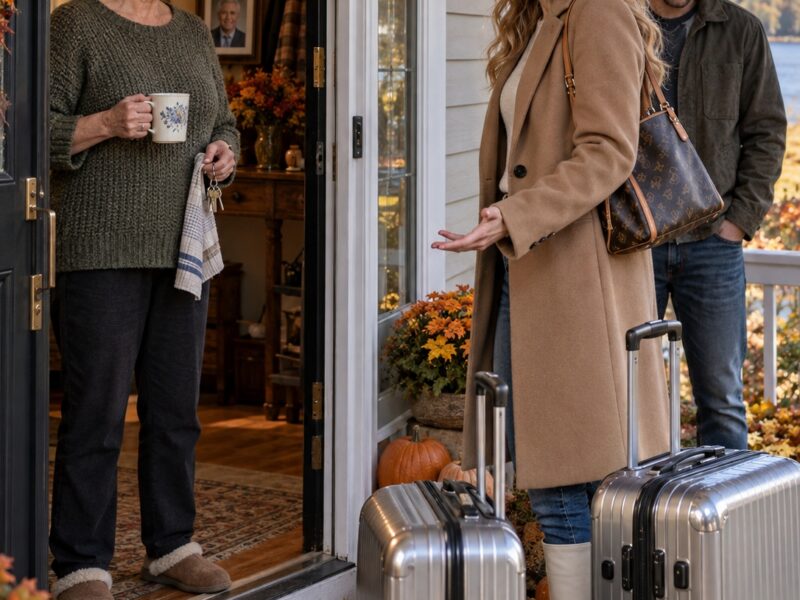
My Daughter-in-Law Arrived With Suitcases to Claim My Late Husband’s Cabin, But One Quiet Sentence Exposed What My Son Promised Behind My Back
She brought suitcases to my porch like the house had already changed owners.
My son stood behind her and stared at his shoes.
I only needed one sentence to make them both understand I was not dead yet.
The first suitcase hit my front porch at 9:12 on a Tuesday morning.
It made a heavy, ugly sound against the old planks, the kind of sound that tells you someone has arrived not to visit, but to take up space.
I was standing in my kitchen in northern Michigan, rinsing blueberries in a colander, while my coffee cooled beside the sink and the lake wind pushed yellow leaves across the yard. The house was quiet in the way houses become quiet after years of grief. Not empty exactly. Just careful. The kind of quiet that has learned not to expect footsteps in the hall.
Then came the second thud.
Louder.
Deliberate.
I did not rush to the door.
That was important.
For most of my life, I had answered every disturbance immediately. A sick child. A late bill. A neighbor needing jumper cables. My husband’s work gloves left in the rain. My son forgetting something for school. My daughter-in-law complaining that I had not replied quickly enough to a message she ended with three question marks.
I used to believe urgency meant love.
Age teaches you that sometimes urgency is only someone else trying to make their problem your emergency.
I set the colander down. Dried my hands on a blue dish towel. Picked up my coffee, took one slow sip, and walked toward the front door at my own pace.
Through the sidelight window, I saw them.
My daughter-in-law, Lauren, was dragging two oversized silver hard-shell suitcases up my front steps. She wore cream boots that had no business touching a leaf-stained porch, a camel coat belted too tightly at the waist, and sunglasses pushed on top of her head even though the morning was gray.
My son, Matthew, stood three paces behind her with both hands shoved deep into his jacket pockets.
He looked at his boots.
That told me more than his mouth would.
I opened the door and let the crisp October air sweep into the hallway.
Lauren did not say hello.
She did not hug me, ask how I had been sleeping, mention the mums blooming by the steps, or comment on the framed photograph of my late husband, Peter, that still sat on the console table beside the door.
She pushed past me as if my threshold belonged to whoever arrived with enough luggage.
Her designer tote scraped against the hallway wall.
“We need the keys to the cabin today, Margaret,” she announced.
Not Mom.
Not Mrs. Calloway.
Margaret.
She dropped one suitcase near the coat rack and placed her hands on her hips.
“Matthew said we could pick them up this morning. We already packed the essentials.”
Essentials.
Two suitcases large enough to smuggle a small appliance.
I remained in the doorway for a moment, watching a maple leaf blow across the porch where Peter used to sit every October with his fishing notebook and pretend he was organizing tackle when really he was avoiding raking.
The cabin was thirty-eight miles north, on a narrow arm of Silver Birch Lake. Peter built it himself over three summers when Matthew was still losing baby teeth. It was not luxurious. No granite. No guest wing. No hot tub. It had pine walls, a cast-iron stove, a red metal roof, two small bedrooms, and the smell of cedar that clung to your sweater after one night.
Peter called it “our quiet place.”
After he died, people began referring to it as property.
That word always sounded wrong in my mouth.
I looked past Lauren to my son.
“Matthew?”
He finally lifted his face.
He was thirty-two, but in that moment I saw the boy who used to hide broken lamps behind the couch and hope time would fix them. His jaw was rough with two days of stubble. His eyes were tired. His guilt had no spine in it.
“Mom,” he said.
The word came out thin.
“Lauren’s cousin is taking over our apartment lease. We need a place to stay for a few months while we save. The cabin’s empty, and it’s not like you’ve been using it.”
Lauren cut in before I could answer.
“It makes perfect financial sense. We live rent-free. You get someone to watch the place. Everybody wins.”
She held out her hand.
Palm up.
Waiting for keys.
I looked at that hand.
French manicure. Gold bracelet. A diamond ring my son had financed for four years because Lauren said a modest one would make people think he did not value her.
Then I looked at the suitcases.
Then at Matthew.
“You promised her my cabin?”
He rubbed the back of his neck.
“I told her we could talk about it.”
Lauren gave a sharp laugh.
“You said your mom would understand. There’s no reason for an old woman to keep a whole lake cabin empty when family needs help.”
An old woman.
I was sixty-one.
My knees complained in damp weather and I needed reading glasses for menus, but I was still capable of splitting firewood if I had to and still owned enough sense to recognize theft when it arrived wearing perfume.
“I see,” I said.
Lauren smiled as if the matter had been settled.
“Great. So where are the keys?”
I did not raise my voice.
I did not point at the door.
I did not remind my son that his father had taught him to knock before entering any house that was not his own.
I simply looked Lauren in the eye and said the sentence I had prepared the night before.
“You can keep your bags packed, Lauren. I shut off the main water valve, drained the pipes, and brought the pump back here yesterday. Unless you plan on carrying buckets from the lake to flush the toilet, you won’t be staying there.”
The color left her face so quickly it almost satisfied me.
Almost.
Her hand dropped.
Matthew blinked.
“What? Mom, why would you do that?”
“Because it is my cabin, and I winterize it when I choose.”
“It’s not even freezing yet.”
“Then you should have asked before promising it.”
Lauren turned on him.
“You told me she never goes up there.”
“I thought—”
“You thought what?” I asked.
Matthew went silent.
Lauren recovered first. People like Lauren always do. Her shock hardened into anger, and anger gave her back her favorite weapon: entitlement.
“Turn it back on,” she said.
I laughed once.
Not loudly.
Enough.
“Excuse me?”
“Turn the water back on. Matthew can install whatever pump you removed. We already signed the sublet paperwork with my cousin. We have to be out by Friday.”
There it was.
The first crack in the wall.
“You already signed paperwork.”
Lauren’s mouth tightened.
“Yes. Because Matthew said we had a place.”
Matthew closed his eyes.
I looked at him.
He had not only promised her my cabin. He had allowed another legal arrangement to be made around that promise, hoping my softness would cover the gap between his cowardice and his wife’s appetite.
“How much is her cousin paying?” I asked.
Lauren stiffened.
“That’s none of your business.”
“It became my business when you dragged luggage into my hallway.”
Matthew whispered, “Lauren.”
“No,” she snapped. “I’m not going to stand here and be interrogated by your mother like some criminal.”
I tilted my head.
“No one called you a criminal.”
“You implied it.”
“Interesting.”
Her cheeks flushed.
She reached down and grabbed the handle of her suitcase.
“Fine. If you want to be difficult, Matthew and I will drive up and check it ourselves.”
“Take your hand off the bag.”
My voice dropped.
Not loud.
Low.
The hallway changed.
Matthew looked up.
Lauren froze with her fingers wrapped around the handle.
For three years, she had mistaken my silence for weakness. She had rolled her eyes at my casseroles, corrected my pronunciation of restaurant names, made little jokes about “boomer décor,” and called Peter’s fishing photos “rustic clutter” when she thought I was too far away to hear.
I had tolerated it because Matthew loved her, or thought he did.
I had tolerated it because Peter was gone, and after losing a husband, a woman can become afraid of losing the remaining family by insisting on respect.
But fear is expensive.
Eventually, the bill comes due.
“You do not get to take luggage onto my property,” I said. “You do not get to force your way into a house my husband built. And you do not get to make plans with my son involving things you do not own.”
Lauren’s eyes narrowed.
“We’re family.”
“Then behave like it.”
She stepped closer.
“Family helps.”
“Family asks.”
That stopped her for half a second.
Matthew found his voice.
“Mom, we just need a break.”
“No,” I said. “You need a plan.”
Lauren threw up her hands.
“This is ridiculous. The cabin is sitting empty.”
“So is the county jail on Tuesdays. That doesn’t mean you move in.”
Matthew’s mouth twitched before he caught himself.
Lauren saw it.
Her fury shifted toward him.
“Are you laughing?”
“No.”
“You better not be.”
He looked down again.
That familiar posture cut deeper than I expected. My son had become a man who apologized with his shoulders but still let other people do the damage.
I picked up Lauren’s silk scarf from the console table where she had tossed it over Peter’s photograph.
I held it out.
“The conversation is over. Take your bags and leave my house.”
She stared at the scarf as if I had handed her something dead.
Matthew exhaled.
“Lauren, go wait in the car. Please.”
Her head whipped toward him.
“Are you serious?”
“Just let me talk to Mom.”
“Now you want to talk?”
“Lauren.”
She snatched the scarf, grabbed both suitcases with unnecessary force, and dragged them back across my hardwood, leaving two thin gray streaks from the wheels.
The front door slammed hard enough to shake the glass.
Silence rushed in behind it.
Matthew stood in the hallway, shoulders slumped.
For one moment, I saw him at twelve again, waiting outside the principal’s office after stealing another boy’s calculator because he wanted to seem richer than he was.
Peter had made him return it.
I had cried in the car.
Peter told me gently, “Maggie, love cannot mean padding every sharp corner in his life.”
I had forgotten that too often after he died.
Matthew looked at me with pleading eyes.
“Mom, you’re putting me in a terrible spot.”
“No,” I said. “You walked into one and brought luggage.”
He winced.
“She’s going to make my life hell.”
“Your wife’s temper is not my mortgage.”
“Please. Just for a month.”
“Lauren said a few months.”
“She exaggerates.”
“She said you signed sublet paperwork.”
He swallowed.
I walked past him into the kitchen and poured my lukewarm coffee down the sink. He followed me, desperation making him taller somehow, like a boy trying to fill his father’s boots.
“Mom, I’ll turn the water back on myself. I’ll pay electric. I’ll cover everything.”
“You cannot even cover your own cell phone.”
His face changed.
I opened the kitchen drawer, took out my phone, and pulled up the family wireless account.
For sixteen months, I had paid Matthew and Lauren’s phone bill. First it was “just until his commission check came.” Then “only until the holidays.” Then nobody mentioned it anymore because free things become invisible if you let people use them long enough.
He watched my thumb move.
“Mom, what are you doing?”
“I’m removing myself from your financial life.”
“Over a phone bill?”
“Over a pattern.”
I cancelled the automatic payment and removed my card.
Then I opened my banking app and cancelled the small monthly transfer I had been sending into Matthew’s account since he “needed breathing room” after Lauren quit her marketing job to “build her personal brand.”
Two hundred dollars a month.
Not life-changing.
But symbolic.
Symbols matter when people have been spending them without permission.
Matthew stared.
“I didn’t ask you to do that.”
“No. You only allowed it to keep happening.”
His mouth opened.
Closed.
Then, quietly, “I’m sorry.”
I looked at him.
I wanted to believe that sentence. Mothers are built to search for the child beneath the grown man. We dig through excuses, bad choices, pride, cruelty, and fear, hoping to find the boy who once brought us dandelions in a plastic cup.
But wanting is not evidence.
“You need to leave,” I said.
He nodded slowly.
At the door, he paused.
“Dad would have wanted me to have somewhere safe.”
The words struck so sharply that for a second I forgot to breathe.
Then the pain became clear.
Useful.
“No, Matthew,” I said. “Your father would have handed you a hammer, taught you how to build safety, and expected you not to steal it from your mother.”
He flinched.
Good.
He left ten minutes later with Lauren in the passenger seat, her arms folded, jaw tight, sunglasses back over her eyes.
I watched their SUV disappear down the road.
Then I went upstairs, opened the hall closet, and took down the old cardboard box marked Matt — School / Baseball / Photos.
It was heavier than I expected.
Not from trophies.
From time.
I set it by the front door.
Because I knew Lauren would not stop.
People who confuse access with ownership rarely accept the first locked door.
I packed that afternoon.
Two sweaters. Jeans. Boots. Soup. Coffee. A loaf of bread. Peter’s old green thermos. The cabin deed. The spare key ring. My laptop. A small framed photo of Peter standing on the half-built porch with a hammer in his hand and sawdust on his cheek.
I did not take the pump.
Because the pump had never left the cabin.
That was the part I had not told them.
I had shut off the main water valve and drained the pipes, yes. But the pump sat where it always had, in the utility shed behind the stacked cedar kindling. My sentence had been technically true and strategically incomplete.
Peter used to call that “letting fools finish the math.”
The drive north took fifty-two minutes.
The road narrowed after the last gas station. Pines crowded the shoulder, dark and tall. Gray water flashed between trunks as I reached the lake road. Fallen leaves blew across the gravel like scraps of old letters.
The cabin appeared around the bend exactly as it always had: red roof, small porch, stone chimney, one stubborn window box still holding dried lavender from summer.
I parked.
For a moment, I stayed in the car.
Grief lives in places.
Sometimes you have to let it know you are coming inside.
I unlocked the heavy pine door and stepped into cold cedar air. Dust floated in the slanted afternoon light. Peter’s wool jacket still hung on the peg beside the stove because I had never found the courage to move it.
“Hello, sweetheart,” I whispered.
The cabin answered with silence.
I carried groceries to the kitchen, switched on breakers, turned the main valve, primed the pump, and within twenty minutes water rattled through the pipes like the house clearing its throat. I built a fire in the cast-iron stove. The first smoke curl carried the smell of birch and ash.
By evening, the cabin was warm.
I ate soup from a chipped blue bowl Peter had hated because the handle was too small. I sat in his rocking chair with a book open on my lap and did not read a word.
Outside, the lake turned black under the clouds.
My phone buzzed fourteen times.
Matthew.
Lauren.
Matthew.
Unknown number.
Lauren.
I turned it face down.
For the first time in years, I slept in the cabin alone and did not feel alone.
At 7:03 the next morning, tires crunched on gravel.
I woke instantly.
Old mothers and widows sleep lightly. We know the difference between wind and arrival.
I put on Peter’s flannel over my thermal shirt, poured coffee into a mug, and walked to the front window. I lifted the curtain with two fingers.
Lauren’s white SUV sat in the driveway.
Matthew got out first, carrying a red metal toolbox.
Lauren followed with a brand-new padlock in one hand.
For several seconds, I simply watched them.
Not surprised.
Not even angry.
There is a strange calm that arrives when someone confirms your worst suspicion so precisely that you no longer have to wonder whether you were being unfair.
Lauren pointed at the front door.
“Just get the old lock off quickly,” she ordered. “We can change the back door later. I want the bags inside before it gets too cold.”
Matthew walked up the steps, head down, toolbox in hand.
He looked miserable.
He still walked.
That distinction mattered.
I unlocked the front door and stepped onto the porch with my coffee.
“Good morning.”
Matthew startled so violently that the toolbox slipped from his hand. It hit the steps with a metallic crash, spilling a wrench, screwdriver, tape measure, and one very guilty-looking drill bit across the wood.
Lauren stopped dead.
The padlock dangled from her fingers.
For once, she had no opening line.
I took a sip of coffee.
It was excellent.
“Mom,” Matthew gasped. “What are you doing here?”
“I’m enjoying my morning coffee at my cabin.” I looked at the toolbox. “The more interesting question is why you are on my porch with tools and a new lock.”
Lauren recovered.
“You lied to us.”
“No.”
“You said the water was off.”
“It was.”
“You said you brought the pump back.”
“I allowed you to believe that.”
“That’s lying.”
“That’s rich, coming from a woman holding a padlock she intended to put on my door.”
Matthew knelt to gather his tools.
“Mom, we weren’t breaking in.”
I looked at him.
He stopped reaching.
“Jess thought if we got inside, you’d cool down once you saw we were serious.”
“Leave the tools, Matthew.”
He stared.
“What?”
“Leave them. Step down to the driveway.”
Lauren made a sharp noise.
“You cannot be serious.”
“I am extremely serious.”
She marched up one step.
“We have nowhere else to go. My cousin moved into the apartment this morning. We cannot afford hotel rates until we find another place.”
“That sounds like a logistics problem.”
“You hateful old woman.”
Matthew stood.
“Lauren.”
“No,” she snapped. “I am sick of your mother playing victim because she has a cabin she doesn’t use.”
I set my coffee on the porch rail.
Slowly.
Then I moved to stand in the center of the doorway.
I am not a large woman. Five feet four on a good day, smaller when tired. But there are moments when a woman’s body becomes less important than her refusal to move.
“Step back,” I said.
Lauren’s eyes flicked over my face.
Whatever she saw there made her stop.
“Are you going to let her treat me like this?” she demanded, turning toward Matthew. “Tell her to move.”
Matthew looked at his wife.
Then at me.
Then at the cabin his father built board by board while teaching him how to hold nails between his teeth and not swallow them.
For the first time in a long while, I saw him see himself.
Really see.
The toolbox. The lock. His mother standing in a doorway. His wife asking him to force his way through.
His face changed.
“Jess,” he said, voice low, “let’s go.”
Her mouth fell open.
“What?”
“We’re leaving.”
“No, we are not.”
“Yes,” he said.
It was not loud.
But it was the first adult sentence I had heard from him in months.
Lauren stared at him as if he had betrayed her personally by developing a spine.
“You deserve nothing that belongs to me,” I said. “Neither of you does.”
Matthew swallowed.
I turned and pointed toward the porch swing.
A cardboard box sat there, sealed with packing tape.
“Yesterday I went through the hall closet at the house. Your baseball trophies, school photos, the model airplane you built with your father, your old varsity jacket. I brought them here.”
Matthew stared at the box.
“It is the last of your belongings on my property,” I continued. “From now on, you do not show up at my house in the city without an invitation. You do not come here without an invitation. You do not send Lauren. You do not use your father’s memory like a spare key.”
His eyes filled.
Lauren rolled hers.
“Oh, please.”
I looked at her.
“And you,” I said, “will never speak to me from inside one of my homes again.”
Matthew walked to the porch swing and lifted the box.
He held it against his chest like something breakable.
“I’m sorry, Mom,” he whispered.
Lauren stormed down the steps.
“Get in the car, David.”
She called him David when she wanted him obedient.
His name was Matthew.
He looked at me once more, then carried his box down the stairs and followed her.
The SUV doors slammed.
The engine started.
Gravel spat beneath the tires as they backed down the drive.
I stood on the porch until the road swallowed them.
Then I picked up the toolbox they had forgotten and carried it inside.
Peter would have laughed himself sick at that.
At noon, a handyman from town named Earl installed smart locks on both doors. Earl had known Peter through the bait shop and had the tact not to ask why a widow suddenly needed reinforced deadbolts.
He only said, “Keypad or fingerprint?”
“Keypad.”
“Good. Fingerprints get fussy in the cold.”
Practical people are a blessing.
While Earl worked, my phone buzzed with a message from my city neighbor, Martha.
Lauren is pounding on your front door. Looks upset. Want me to call someone?
I typed back:
No. Thank you. I’m out of town.
Then I added:
Garage code changed yesterday. Windows locked. She won’t get in.
Martha replied with three clapping emojis and one casserole emoji, which I assumed meant she approved and planned to bring food.
I set the phone down and looked across the lake.
Lauren had lost the cabin.
So she tried my house.
Access is addictive.
People who are used to open doors often mistake locked ones for cruelty.
For three days, I stayed at the cabin.
I swept the porch. Stocked the pantry. Took Peter’s jacket down, folded it carefully, and placed it in a cedar chest instead of letting it hang like a ghost. I cried for seven minutes afterward, sitting on the floor with my back against the bed.
Not for Matthew.
Not for Lauren.
For Peter.
For the years when being a mother had felt like building something instead of defending ruins.
Then I opened my laptop and reviewed every place where Matthew still had access to me.
Phone plan.
Credit card authorized user.
Emergency gas card.
Streaming services.
Family cloud storage.
A small life insurance beneficiary designation I had not updated since he married.
I changed all of it.
Not because I stopped loving him.
Because love had become tangled with access, and access had become a weapon.
On Thursday afternoon, Matthew called.
I answered while sitting in Peter’s rocking chair with tea beside me.
“Mom,” he said, breathless. “Did you cancel the emergency card?”
“Yes.”
“Lauren tried to pay for the motel, and it declined.”
“That is correct.”
“She’s furious.”
“I assumed.”
“Mom, please. We’ve been in a cheap motel for two nights. It’s expensive. Her cousin won’t break the sublet. We don’t have anywhere to go.”
“You had an apartment.”
He went quiet.
“You gave it away.”
“We were trying to get ahead.”
“No,” I said. “You were trying to get ahead by standing on me.”
He made a wounded sound.
The old me would have softened there.
The old me would have said, Come home for a few days.
The old me would have cooked pasta, washed their towels, listened to Lauren complain about mattress firmness, and pretended not to notice when my guest room became storage.
The old me was tired.
“Matthew,” I said, “funding Lauren’s motel stay because you sublet your apartment for cash is not an emergency. It is a consequence.”
His breathing changed.
“Are you really going to leave us out here?”
“I am leaving you to manage your own life.”
“Mom.”
“If you want a relationship with me going forward, it will be on different terms. You will not ask me for money. You will not ask to live in my properties. You will not show up uninvited. Lauren will treat me with basic respect or she will not be welcome near me.”
A long silence followed.
Outside the window, a heron lifted from the dock and moved low over the water.
Finally, Matthew said, “I understand.”
I did not know if he did.
But it was the first time he had said the words without arguing.
“Good,” I said. “Take care of yourself.”
I hung up before he could turn understanding into another request.
Two weeks later, I learned from Martha, who knew everyone and pretended she didn’t, that Lauren’s cousin had damaged the apartment plumbing while moving in a washing machine he was not supposed to install. Matthew and Lauren had to cover repairs because the lease transfer violated their own rental agreement. The lump sum they had been so clever about disappeared into plumbers, motel bills, and deposits on a cramped studio across town.
I felt no joy.
Joy would have meant I was still emotionally waiting for the universe to punish them properly.
What I felt was space.
Clean, cold space.
The kind that opens after a noisy machine shuts off.
Matthew came by my city house a month later.
Alone.
He texted first.
That mattered.
Could I come by Sunday for coffee? Just me. No favors.
I stared at the message for a long time before answering.
One hour. Noon.
He arrived at 11:58 with store-bought muffins and no expectations. His hair was shorter. His coat was older. He looked embarrassed but sober in a way that had nothing to do with alcohol.
We sat at the kitchen table.
At first, we talked about nothing.
Weather.
Road work near the bridge.
A sale on snow tires.
Then he looked at his coffee and said, “Lauren and I are separating.”
I did not move.
“That is your business.”
“I know.”
He looked up.
“I’m not asking to move in.”
“Good.”
A faint, sad smile touched his mouth.
“I deserved that.”
“You earned it.”
He nodded.
“She’s angry all the time. Not just at you. At everything. At me. At the apartment. At not having what she thinks other people owe her.”
“And what do you think?”
He rubbed his hands together.
“I think I let her be loud so I wouldn’t have to be honest.”
That was a better sentence than I expected.
I waited.
“I promised her the cabin because I didn’t want to fight with her. I thought you’d be easier to disappoint.”
There it was.
The truth I had already known but needed him to say.
My fingers tightened around my mug.
“I was easier,” I said.
His eyes filled.
“I’m sorry.”
“I believe you.”
He exhaled shakily.
“But I am not ready to be close,” I added.
His face fell, then steadied.
“Okay.”
No argument.
No guilt.
No wounded performance.
Just okay.
That was the beginning of whatever came next.
Not reconciliation.
Not yet.
A beginning.
Over the winter, Matthew kept showing up carefully.
Not often.
Not entitled.
He came once to shovel my city walkway after a storm and left before I could offer lunch. He mailed me copies of documents showing he had removed himself from Lauren’s remaining financial schemes. He started therapy, which he told me with the embarrassed tone men use when admitting they are learning emotional literacy later than they should have.
Lauren sent one email.
Just one.
It began with I hope you’re happy and ended with you ruined our marriage.
I forwarded it to a folder titled People Who Need Mirrors and did not reply.
In January, Matthew filed for divorce.
By March, he had moved into a modest one-bedroom near his work and was paying every bill himself. I knew because he told me once and then stopped telling me unless I asked.
That mattered too.
A year after the suitcase morning, I invited him to the cabin.
Not to stay.
To visit.
He arrived with work gloves, firewood, and a pie from the bakery Peter loved. He stood on the porch for a moment, looking at the smart lock.
“I hate that I’m the reason you needed that,” he said.
“You are one of the reasons.”
He nodded.
“Fair.”
We stacked firewood. Cleaned gutters. Repaired a loose porch rail. At noon, we ate soup at the small table by the window. For a while, the only sound was wind moving through pine branches and the stove clicking as it cooled.
Matthew looked around.
“I forgot how small it is.”
“It was never small to your father.”
“I know.”
“Do you?”
He took that seriously.
“I’m starting to.”
After lunch, he walked to the porch swing, the same place where I had left his box of childhood things.
“I went through the photos,” he said.
“And?”
“There’s one of Dad teaching me to use the hand drill. I’m maybe eight.” He rubbed his jaw. “I kept thinking about the lock.”
I said nothing.
“I showed up with tools to break into the house where that picture was taken.”
His voice cracked.
Good.
Some realizations should hurt. Pain is not always damage. Sometimes it is the body discovering a boundary it should have had long ago.
“I don’t know how I became that man,” he said.
I looked at him.
“You avoided small truths until they became one large lie.”
He closed his eyes.
“That sounds like Dad.”
“It is something he would have said more gently.”
Matthew laughed through his nose.
“Probably with more boat metaphors.”
“Definitely.”
For the first time in a long time, the memory of Peter did not arrive between us like accusation.
It sat with us.
Warm.
Steady.
By summer, Matthew and I had a routine.
Coffee twice a month.
No surprise visits.
No money conversations.
If he needed advice, he asked if I had space to hear it. Sometimes I did. Sometimes I did not. He accepted both.
One July afternoon, he brought a small wooden box to the cabin.
“What’s that?”
“Something I made.”
He looked nervous.
Inside was a new key rack carved from cedar, simple and sturdy, with four hooks.
“I thought the cabin needed one by the door.”
I ran my fingers over the sanded edge.
“You made this?”
“With help from a guy at the community workshop.”
“It’s beautiful.”
He swallowed.
“I didn’t put my name on the back.”
I looked up.
He continued, “It’s yours.”
That was when I hugged him.
Not because a key rack fixed anything.
Because he had finally understood the difference between giving and claiming.
The cabin changed after that.
Not all at once.
I painted the kitchen cabinets sage green because Lauren had once called them depressing brown. I replaced the guest mattress. I planted lavender again in the window box. I took Peter’s fishing notebooks out of the drawer, read them, laughed at his terrible spelling, and cried only once.
In September, I hosted dinner there for the first time since Peter died.
Matthew came.
Martha came.
Earl the handyman came because he had basically become my lock consultant and occasional porch repair critic.
We ate chili. Burned cornbread. Opened windows because Earl insisted the stove smoked only because “somebody lacked technique,” by which he meant me.
Matthew washed dishes without being asked.
That small sound—water running, plates clinking, my son quietly cleaning in the kitchen his father built—settled something in me I had not realized was still shaking.
Later, after everyone left, I sat on the porch with tea.
The lake was black glass.
The air smelled of smoke and pine.
My phone buzzed.
A message from Matthew.
Thank you for tonight. I know I lost the right to call the cabin home. But it felt good to be invited.
I read it twice.
Then replied:
That is how homes work. Invitation matters.
He sent back:
I’m learning.
I believed him.
Not because he said it.
Because the past year had finally given the sentence evidence.
Two years after Lauren arrived with suitcases, I changed my will.
Not angrily.
Not dramatically.
Carefully.
The cabin would not automatically go to Matthew.
I placed it in a trust with clear terms. He could use it by agreement. He could inherit partial responsibility if he demonstrated continued financial independence and respect for the property. If not, the cabin would transfer to a local conservation group Peter had supported.
My attorney, a woman named Paula Greene who wore bright red glasses and had no patience for sentimental fog, read the draft aloud.
Matthew knew.
I told him before signing.
He looked pained, but not offended.
“I understand,” he said.
“You can be sad.”
“I am.”
“You can be angry.”
“I’m trying not to be.”
“That’s not the same.”
He breathed out.
“I’m angry at myself.”
“That’s allowed.”
“Do you trust me less than you used to?”
“Yes.”
He nodded, eyes wet.
“But more than I did two years ago,” I added.
That made him smile a little.
“Okay.”
I signed the papers.
The world did not end.
People think love requires leaving every door unlocked.
It does not.
Love built this cabin. Boundaries kept it from becoming a place where love went to be used up.
The last time Lauren contacted me was through a mutual acquaintance who mentioned she had moved to Grand Rapids, remarried quickly, and was posting photos from a townhouse kitchen she called “our forever space.” In every photo, there were candles on the counter and no sign of a lake.
I wished her growth.
Not happiness exactly.
Growth.
Happiness without growth tends to become someone else’s burden.
Three autumns after the suitcase morning, I woke at the cabin before dawn. The air had the first sharp edge of frost. I made coffee, wrapped myself in Peter’s old flannel, and stepped onto the porch.
The smart lock glowed faintly behind me.
The lake was silver in the early light.
For years after Peter died, I thought my life had become a waiting room. Waiting for grief to soften. Waiting for Matthew to visit. Waiting for Lauren to approve of me. Waiting for the house to feel less empty. Waiting for someone to need me in a way that still felt like love.
But that morning, standing barefoot inside my boots with steam rising from my mug, I understood that waiting had been another kind of unlocked door.
So I stopped.
I built routines that belonged only to me.
I joined a woodworking class and made one crooked stool that Earl called “brave.” I learned to fish badly and kept doing it because Peter would have found that hilarious. I volunteered at the library on Wednesdays. I hosted soup nights in winter. I took myself to the movies in the middle of the day and bought popcorn without sharing.
Matthew visited sometimes.
Always after asking.
Sometimes he brought a woman named Claire, who spoke gently, worked as a school counselor, and once told Matthew in front of me, “Your mother said no. That means no.”
I liked her immediately.
The first time he asked if they could stay at the cabin for a weekend, he gave me three weeks’ notice, offered to pay utilities, and said, “If you don’t want that, I’ll understand.”
I looked at him for a long time.
Then handed him the guest code.
Not a key.
A code.
Temporary.
Boundaries can have expiration dates and still be generous.
They left the cabin cleaner than they found it. Claire replaced the dish soap without mentioning it. Matthew stacked more firewood than he used.
When they returned the next day, he said, “Thank you for trusting me.”
“I trusted the terms.”
He laughed.
“Fair.”
Then he added, “Still. Thank you.”
That was enough.
On the fourth anniversary of Peter’s death, I drove to the cabin alone.
I brought yellow chrysanthemums, his fishing hat, and the old photograph of him on the half-built porch. I set the flowers by the stove, placed the hat on the table, and made coffee strong enough that he would have complained while drinking two cups.
I spoke aloud because grief sometimes deserves conversation.
“You were right,” I told him. “About sharp corners.”
The stove popped softly.
“I kept trying to pad them for Matthew. Then he turned into a man who thought every corner would soften for him.”
Wind moved across the roof.
“I think he’s learning now.”
I smiled.
“So am I.”
At sunset, Matthew called.
I answered.
“Hey, Mom.”
“Hi.”
“I know today’s Dad’s day. I just wanted to say I’m thinking about him.”
“I am too.”
“I won’t keep you.”
“You’re not.”
A pause.
Then he said, “Thank you for not giving me the cabin.”
That surprised me.
“What?”
“If you had, I don’t think I would have understood what I was asking for. Or taking. Or whatever it was.” His voice went rough. “You made me face myself. I hated it. But I needed it.”
I looked out at the water.
The sky had turned the color of embers.
“You’re welcome,” I said.
We both laughed a little because what else do you say after a sentence like that?
After we hung up, I sat on the porch until the first stars appeared.
The cabin stood warm behind me.
Mine.
Not because I hoarded it.
Because I finally understood stewardship.
Peter had built it as a place of peace. For years, I mistook peace for quiet compliance. But real peace is not silence purchased by letting other people take what they want. Real peace is a locked door when it needs to be locked, an invitation when it is freely given, and a woman standing in her own threshold refusing to move.
That Tuesday morning, Lauren arrived with suitcases because she believed my life had empty rooms waiting for her convenience.
She was wrong.
My house was not empty.
My cabin was not empty.
I was still there.
And that was the sentence she never expected me to say without saying it.
I am still here.
I am still the owner.
I am still the mother.
I am still the widow of the man who built this place with his hands.
I am still allowed to say no.
Years earlier, I thought love meant keeping every light on for people who might come home.
Now I know better.
Love is not an unlocked cabin in the woods.
Love is the courage to protect the fire so it does not burn the whole house down.
That night, before bed, I checked the front door.
The keypad blinked once.
Locked.
Outside, the lake moved quietly under the moon.
Inside, the stove held its heat.
And for the first time in a long time, I slept through the night without listening for someone else’s demands on the porch.









