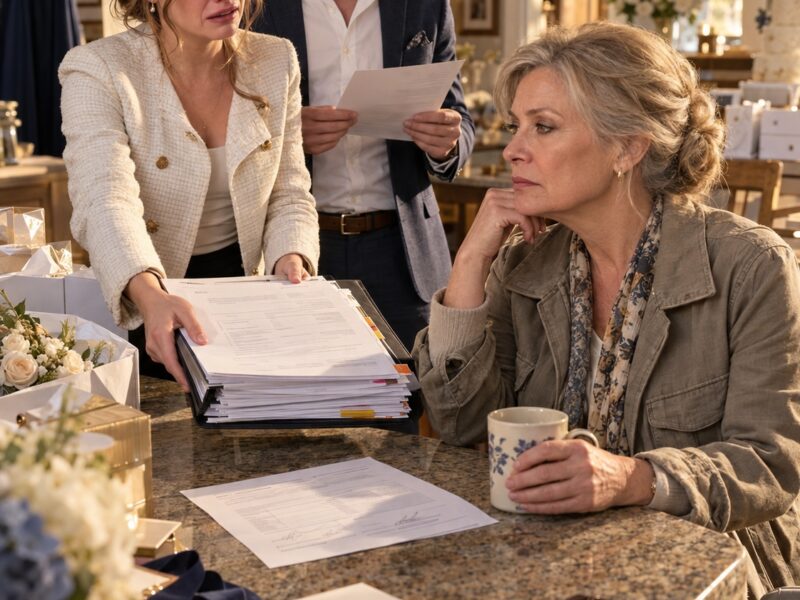
My Daughter Said I Wasn’t “Close Enough” for Her Wedding—So I Left Town, and Before I Came Home, the Ceremony Was Gone and Her Secret Wasn’t
My daughter uninvited me from her wedding on a Tuesday night while I was washing the coffee cup she had given me for Mother’s Day.
Three days later, I boarded a plane to Santa Fe instead of begging for a chair at her reception.
By the time I came home, the wedding was gone, her fiancé’s wealthy family had stopped answering their phones, and my signature was sitting on contracts I had never seen.
My name is Evelyn Carter.
I was sixty-four that spring, widowed for nine years, retired from a thirty-two-year career in public education, and still living in the modest brick house outside Columbus, Ohio, where my husband and I had raised our two children.
I had never considered myself a dramatic woman.
I liked sensible shoes, good coffee, paid-off credit cards, hydrangeas that bloomed when they were supposed to, and knowing exactly how much money was in my checking account.
My daughter, Claire, used to tease me about that.
“You could make a spreadsheet for breathing, Mom.”
“I probably could.”
“And color-code it.”
“Only if your oxygen levels were inconsistent.”
She used to laugh.
That was before she met Adam Sterling.
I want to be careful here, because it would be easy to tell this story as if Adam walked into my daughter’s life carrying a villain’s mustache and a bag marked BAD DECISIONS.
He did not.
Adam was polite.
Educated.
Handsome in a clean, forgettable way.
He worked in commercial real estate and wore shirts that always looked freshly pressed, even at backyard cookouts.
The first time Claire brought him home, he stood at my kitchen counter slicing lemons while I cooked and asked real questions about my late husband.
Not performative questions.
Specific ones.
“What subject did he teach?”
“Was he always that tall?”
“Did he really build the deck himself?”
I liked him.
That matters.
His family was different.
Richard and Valerie Sterling lived in a stone house in New Albany behind gates that seemed ridiculous for a neighborhood where everybody’s lawn service knew everybody else’s business.
Richard owned Sterling Architectural Group, a regional development company with glossy brochures full of glass office buildings, luxury apartment complexes, and phrases like curated living.
Valerie had never held a conventional job, but she sat on charity boards, hosted luncheons, and could pronounce the name of any designer dress within ten feet.
She was also extraordinarily skilled at making ordinary people feel as if they had spilled something.
The first time we met, she looked at my handbag.
Not rudely.
That would have been easier.
She looked at it the way a museum curator might examine an artifact from a less successful civilization.
“Oh,” she said pleasantly. “That color is practical.”
I thanked her.
Claire kicked me lightly under the table.
Later, in the car, she said, “Mom, you don’t have to be so defensive.”
“I said thank you.”
“You know what I mean.”
“No, Claire. I genuinely don’t.”
She sighed.
That sigh became common over the next two years.
Claire had always been more interested in appearances than her brother, Daniel, but before Adam she could laugh at herself.
She bought expensive lipstick and wore it with Target jeans.
She loved boutique hotels but also ate leftover Chinese food straight from the carton.
After she became engaged, something sharpened.
There were expectations.
Words I had never heard her use suddenly entered every conversation.
Elevated.
Curated.
Timeless.
Editorial.
Cohesive.
Apparently even marriage now required branding.
The wedding was scheduled for June at Hawthorne Conservatory, a private botanical venue north of Columbus with glass ceilings, imported stone fountains, and a rental fee large enough to have purchased my first house.
When Claire first told me the cost, I thought she had accidentally included an extra zero.
She laughed.
“Mom.”
“What?”
“It’s once in a lifetime.”
“So is retirement.”
“You always do that.”
“Do what?”
“Turn everything into money.”
I almost reminded her that vendors had already turned the wedding into money.
Instead I kept quiet.
Her father, Michael, would have known how to handle the conversation.
Michael could tell Claire no in a way that made her believe she had reached the conclusion herself.
I tended to use the shorter version.
No.
Losing him had changed the balance of our family.
Daniel became more protective of me.
Claire became more impatient.
And I became the parent who was still available to blame.
I understood that more than she knew.
Grief rarely arrives alone.
It brings resentment about who survived.
The original wedding budget was sixty-five thousand dollars.
That already made me uncomfortable, but Adam’s parents said they would cover most of it.
Richard Sterling stood at my dining table during Christmas and waved away the subject.
“We have one daughter-in-law coming into the family. We’ll do it properly.”
I noticed Claire glowing when he said properly.
I also noticed Adam look down.
At the time, I thought he was embarrassed by his father’s extravagance.
Later, I understood he knew more than he admitted.
My contribution was supposed to be ten thousand dollars.
Michael and I had always planned to give both children something substantial when they married.
Daniel had received money for his small wedding and first apartment years earlier.
Fair was fair.
So I wrote Claire the check.
She hugged me.
For a moment, I had my old daughter back.
“Thank you, Mom.”
“You’re welcome.”
“I know you think the whole thing is insane.”
“I think orchids being flown in from Hawaii when Ohio contains flowers is insane.”
She laughed.
“I knew it.”
“But it’s your wedding.”
She rested her head briefly against my shoulder.
“I want Dad there.”
The sentence caught me.
“So do I.”
“Sometimes I think if everything is beautiful enough, maybe it won’t feel so obvious that he isn’t.”
There it was.
Under the centerpieces.
Under the imported linen.
Under the champagne wall and calligraphed place cards.
Grief.
I kissed her temple.
“It will still feel obvious.”
Claire stiffened.
I continued gently.
“And that’s okay.”
She pulled away.
“I don’t want to be sad that day.”
“You probably will be for five minutes.”
“Mom.”
“And happy for fifty other reasons.”
She stared.
“You always make everything so… real.”
I almost laughed.
“What would you prefer?”
“I don’t know.”
She gathered her purse.
“Sometimes I wish you could just let something be perfect.”
That sentence stayed with me.
Three months later, perfection apparently no longer had room for me.
The phone call came exactly twenty-three days before the wedding.
I was at my kitchen sink.
Claire had been evasive for weeks.
I knew there was a rehearsal dinner because Daniel mentioned taking Friday off work.
I knew dresses had been fitted because photos appeared online.
I knew Valerie was hosting a bridesmaids’ brunch because my cousin somehow received an invitation.
But every time I asked Claire what I needed to do, she said:
“We’re finalizing things.”
Or:
“I’ll let you know.”
That evening I finally asked directly.
“What time do you need me at Hawthorne on Friday?”
Silence.
Not long.
Three seconds, perhaps.
Long enough.
“Mom.”
“Yes?”
Another pause.
“You probably shouldn’t plan on coming Friday.”
I stopped washing the cup.
“To the rehearsal?”
“To the weekend.”
I turned off the faucet.
“What does that mean?”
Claire inhaled.
When she answered, her voice had the careful smoothness people use when they have rehearsed something unpleasant.
“Adam and I had to make some difficult decisions.”
“About?”
“The guest list.”
I looked at the wall clock.
Six fourteen.
I remember that because the absurdity of the moment made details unusually clear.
“You’re telling me three weeks before your wedding that I’m not invited?”
“It isn’t like that.”
I waited.
She continued.
“The whole event became much more intimate.”
“How intimate?”
“Mom.”
“I’m asking a number.”
“One hundred and twenty.”
I almost laughed.
Instead I leaned one hand against the counter.
“One hundred and twenty people are coming to your intimate wedding, but your mother is not one of them.”
“You’re making it sound cruel.”
“Then make it sound accurate.”
Another silence.
Claire lowered her voice.
“Valerie has concerns.”
There it was.
“About me?”
“Not you personally.”
“That is usually what people say immediately before discussing someone personally.”
“She just wants the wedding to feel cohesive.”
I closed my eyes.
“Cohesive.”
“Yes.”
“What part of me disrupts the cohesion?”
“Mom, please.”
“My face?”
“No.”
“My clothes?”
“I didn’t say that.”
“My house?”
“This is exactly why I didn’t want to have this conversation.”
I opened my eyes.
“You are having it because you made a decision.”
Claire’s voice sharpened.
“Tom’s family—”
“Adam.”
“What?”
“You just said Tom.”
She exhaled.
“I’m stressed.”
“Clearly.”
“Adam’s family is paying for almost everything now. They have colleagues coming from New York, investors, people from their social circle. Valerie wants the photographs and the atmosphere to feel a certain way.”
My hand tightened around the dish towel.
“And I don’t feel that way.”
“That isn’t what I said.”
“It is exactly what you said with expensive vocabulary.”
She went quiet.
I could hear traffic through her car speaker.
She was driving.
I wondered whether Adam sat beside her.
I wondered whether Valerie had supplied the phrasing.
Then Claire said the sentence that changed something permanent between us.
“This event is really just for the people we’re closest to right now.”
I looked down at the Mother’s Day cup in the sink.
It said BEST MOM EVER in uneven gold letters.
Claire had bought it when she was sixteen.
She had thought it was hilarious.
“Closest,” I repeated.
“Emotionally, Mom.”
I almost admired the addition.
It made the insult more precise.
I had spent twenty-eight years being available.
I had stayed awake through asthma attacks.
Paid college tuition after Michael died.
Put fifteen thousand dollars toward Claire’s first condo.
Taken unpaid days from work when she had surgery.
Loaned her money twice when she changed jobs.
Stored half her furniture in my basement.
Hosted the engagement party.
Written the wedding check.
And now proximity had apparently expired.
I did not list any of it.
Love is not an invoice.
But neither is it permission to be humiliated.
“All right,” I said.
Claire hesitated.
“What?”
“I understand.”
“You do?”
“Yes.”
I dried my hands.
“I hope you have a beautiful wedding.”
“Mom, don’t do that.”
“Do what?”
“Get cold.”
“I’m not cold.”
“You are.”
“I am respecting your decision.”
“You’re trying to make me feel guilty.”
“No.”
I meant it.
That seemed to unsettle her more than anger would have.
“If you want a wedding without me, Claire, I will not stand outside the gate arguing that I deserve entry.”
“That’s dramatic.”
“No. Dramatic would be arriving anyway.”
She said nothing.
“Good night.”
“Mom—”
I ended the call.
Then I stood in the kitchen.
No crying.
Not yet.
No smashed plate.
No angry text.
The refrigerator hummed.
Somewhere outside, a lawn mower started.
Ordinary sounds.
That almost made it worse.
I sat at the kitchen table and opened my laptop.
At six forty-seven, I searched:
Santa Fe New Mexico June vacation rental.
At seven twelve, I booked a small adobe casita for two weeks.
At seven twenty, I bought the plane ticket.
At eight, I poured a glass of wine.
At eight thirty, Daniel called.
“Mom.”
“Hello.”
“What happened?”
So Claire had already told him.
“You’ll need to be more specific.”
“She uninvited you?”
“She made a guest-list decision.”
“Mom.”
“Yes.”
“This is insane.”
“I agree.”
“I’m calling her.”
“No.”
“What?”
“Do not fight my battle.”
“She excluded her mother.”
“That is her choice.”
“She’s going to regret it.”
“That will also be her choice.”
Daniel was silent.
My son had always been quicker to anger on my behalf than I was.
“Are you okay?”
“No.”
Finally, honesty.
“But I will be.”
“What are you going to do?”
“New Mexico.”
“What?”
“I booked a trip.”
He laughed once in disbelief.
“When?”
“Wedding week.”
“Mom.”
“What?”
“You’re serious.”
“Very.”
“Claire is going to lose her mind.”
“She has one hundred and twenty close people available to help her find it.”
Daniel laughed despite himself.
Then immediately sounded guilty.
“Sorry.”
“Don’t be.”
“Can I come?”
“No.”
“Why?”
“You are invited.”
“So?”
“So attend your sister’s wedding.”
“After this?”
“Yes.”
He protested.
I cut him off.
“Daniel, if you boycott because of me, Claire gets to rewrite this later as a family attack.”
He went quiet.
“I will not give her that.”
“You’re scary sometimes.”
“I was a middle-school principal for fourteen years.”
“Fair.”
The next morning I moved the remaining wedding money out of the account I used for family gifts.
Not because I planned revenge.
Because I no longer had a wedding to finance.
The ten thousand dollars already given was hers.
I did not request it back.
That would have turned a boundary into punishment.
But the additional five thousand I had planned to give after the ceremony remained mine.
I also removed Claire as an authorized user on an old emergency credit card.
That decision felt paranoid.
Later, it proved insufficiently paranoid.
I flew to Albuquerque six days later and rented a small SUV.
Santa Fe was hot, dry, and so visually different from Ohio that my brain finally stopped rehearsing the phone call every seven minutes.
My casita sat behind an older couple’s home on the edge of town.
Terracotta walls.
Blue door.
Small courtyard with lavender.
I slept ten hours the first night.
The next morning, I hiked early while the air was cool.
I ate lunch alone without feeling abandoned.
That distinction mattered.
Alone was a physical condition.
Excluded was an action.
The first I could enjoy.
The second I had to grieve.
I muted Claire.
Adam.
Valerie Sterling.
Several cousins who began sending cheerful messages asking whether I had chosen my “mother-of-the-bride look.”
I did not explain.
Daniel remained unmuted.
So did my neighbor.
And my doctor.
I was old enough to know boundaries should not prevent emergency contact.
For three days, nothing happened.
I visited galleries.
Read on the patio.
Bought earrings I did not need.
Had coffee with a retired nurse from Minnesota who never asked whether my daughter loved me.
Then, Thursday morning, Daniel texted.
Where exactly are you?
I was eating toast.
Santa Fe.
His reply came immediately.
As in New Mexico?
There is another one?
Three dots appeared.
Disappeared.
Returned.
Claire’s venue canceled.
I stopped chewing.
Not because I felt satisfaction.
Because consequences rarely arrive that cleanly.
Why?
My phone rang.
Daniel did not bother waiting.
“Mom?”
“I’m here.”
“Are you sitting?”
“Yes.”
“Good.”
He sounded exhausted.
“What happened?”
“The final venue payment bounced.”
“How much?”
“Eighteen thousand.”
I set down my coffee.
“I thought the Sterlings were paying.”
“They were supposed to.”
“Supposed to.”
Daniel exhaled.
“Richard’s company is in trouble.”
“How much trouble?”
“Apparently catastrophic.”
That word did not sound like my son.
“Who said catastrophic?”
“Adam.”
Now I listened differently.
Daniel continued.
“Sterling Architectural lost two major contracts last year. They’ve been borrowing against property, using credit to cover operating costs, moving money around.”
“Did Claire know?”
“I don’t know.”
“Did Adam?”
“Probably.”
A cold feeling moved through me.
“Probably is not an answer.”
“I know.”
Daniel lowered his voice.
“I went to Claire’s apartment this morning because she asked me to help finish centerpieces.”
“And?”
“She was on the floor crying.”
He paused.
“There were boxes everywhere. Imported napkins, glass chargers, whatever those things are.”
“Centerpieces?”
“No idea.”
Despite everything, I smiled.
“The venue emailed at seven. Final payment was returned. Caterer hasn’t received the balance either.”
“What about Richard?”
“Not answering.”
“Valerie?”
“Claims there’s a banking issue.”
I looked across the courtyard.
A hummingbird hovered near the lavender.
“Is there?”
“No.”
Daniel sounded angry now.
“Their cards are maxed out.”
I closed my eyes.
Of course.
The family that found my handbag too practical had apparently financed elegance with revolving debt.
“Claire tried calling you.”
“I muted her.”
“I assumed.”
“What does she want?”
Daniel hesitated.
That told me.
“How much?”
“Mom.”
“How much?”
“Eighteen for the venue.”
I laughed once.
Not because it was funny.
Because predictability sometimes becomes absurd.
“And she expects me to pay it.”
“She hasn’t said that to me directly.”
“She will.”
Daniel was quiet.
Then:
“I’m sorry.”
“For what?”
“For being related to her.”
“You had no role in this.”
“Still.”
I looked at the mountains.
“Daniel.”
“Yes?”
“Do not give her money.”
“I wasn’t going to.”
“I mean it.”
“She’s my sister.”
“Exactly.”
He understood.
Love could help her survive.
Money could help her avoid reality.
Those were not always the same thing.
At noon, Claire called from an unfamiliar number.
I watched it ring.
Then ring again.
Third time.
I answered.
“Hello?”
“Mom.”
Her voice was already crying.
Not crying exactly.
Crying-adjacent.
The strained voice of someone standing near panic.
“Where are you?”
“New Mexico.”
“Why?”
I almost admired the question.
“You know why.”
“Mom, everything is falling apart.”
“I heard.”
“Daniel called you?”
“Yes.”
“He had no right to tell you before I did.”
“He is not the current problem.”
“I need you to come home.”
The speed of it stunned me.
“For what?”
“To help.”
“With what?”
Silence.
Then:
“The venue.”
I let the silence continue.
“Mom?”
“Yes?”
“We need eighteen thousand dollars.”
There it was.
“No.”
She inhaled sharply.
“You didn’t even let me explain.”
“The answer does not require detail.”
“Please.”
“No.”
“Dad would never—”
“Do not use your dead father to negotiate with me.”
Silence.
My voice had changed.
So had hers.
“I didn’t mean it like that.”
“You meant exactly what you needed it to mean.”
“Mom, please. This is my wedding.”
“I know.”
“If we lose Hawthorne, everything is ruined.”
“Then choose another place.”
“There isn’t time.”
“Courthouses accept appointments.”
She made a frustrated sound.
“That’s not funny.”
“I am not joking.”
“You have the money.”
I stared across the courtyard.
There it was again.
Not could you help?
Not would you consider?
You have it.
“My finances are private.”
“You told me you had retirement savings.”
“I also told you not to spend eighty thousand dollars on one day.”
“It’s not eighty.”
“How much is it?”
Silence.
“Claire.”
“Seventy-four.”
“Before this payment?”
Another silence.
I almost closed my eyes.
Instead I sat straighter.
“Who agreed to seventy-four thousand dollars?”
“Everyone.”
“No.”
“What?”
“Everyone did not agree. I did not agree.”
“You gave me money.”
“I gave you ten thousand dollars.”
“Exactly.”
“That was a gift, not approval of every contract you signed afterward.”
Her breathing grew faster.
“Tom’s family—”
“Adam.”
“Stop doing that.”
“Doing what?”
“Correcting everything.”
“Then say your fiancé’s name.”
She went quiet.
I wondered again whether Adam was beside her.
“His parents had a banking issue,” Claire said.
“That is not what Daniel told me.”
“Daniel doesn’t know everything.”
“Neither do you, apparently.”
“Mom.”
“Are the Sterlings broke?”
No answer.
“Claire?”
“They’re having liquidity problems.”
I actually laughed.
She became angry.
“This is not funny.”
“No. The vocabulary is.”
“My future father-in-law’s business is going through restructuring.”
“Are they paying the venue?”
“No.”
“Caterer?”
“No.”
“Florist?”
She hesitated.
“No.”
“Photographer?”
“I don’t know.”
“That means no.”
Claire began crying for real.
“Please just help me save the date.”
I thought about her words three weeks earlier.
Closest people.
Cohesive.
Atmosphere.
Photographs.
“How much does closeness cost today?”
She stopped crying.
“What?”
“You explained that I was not close enough to attend.”
“Mom, don’t.”
“I am trying to understand the new terms.”
“That conversation was a mistake.”
“Was it?”
“Yes.”
“Which part?”
“All of it.”
“Because it hurt me?”
Silence.
“Or because you need money?”
Her voice dropped.
“That’s cruel.”
“No.”
I stood and walked into the casita.
“It is specific.”
“Valerie pressured me.”
“I believe that.”
“You don’t understand what she’s like.”
“I understand enough.”
“She made me feel like everything had to be perfect.”
“And you made a choice.”
“Adam wanted me to keep the peace.”
“Another choice.”
“You weren’t there.”
“No.”
I paused.
“By your request.”
Claire started crying harder.
For a second, I wanted to surrender.
Maternal instinct is not always noble.
Sometimes it is simply intolerant of hearing your child suffer.
I could transfer the money.
I could save Hawthorne.
I could restore the flowers, the glass ceiling, the photographs.
And Claire would learn that she could remove me from her life while retaining full access to my resources.
I loved her too much to teach that lesson.
“No,” I said again.
“You’re really going to let my wedding be canceled?”
“I am not canceling anything.”
“You know what I mean.”
“I do.”
My voice softened.
“That is why the answer is still no.”
She hung up.
I sat on the edge of the bed for ten minutes.
Then cried.
That part matters.
Boundaries do not feel powerful when you love the person on the other side.
They feel terrible.
Necessary and terrible can exist together.
The next morning, Hawthorne Conservatory formally released the wedding date.
The eighteen-thousand-dollar deadline passed.
Someone else on a waiting list took the venue within forty-eight hours.
The caterer suspended service.
The floral company refused shipment without payment.
A luxury transportation company canceled three vehicles.
The imported orchids never left the distributor.
Claire’s eighty-thousand-dollar dream collapsed through a series of ordinary emails.
She called me sixteen times.
I did not answer.
Not because I wanted her to suffer.
Because we had already had the conversation.
Repeating no until someone accepts it is not communication.
It is exhaustion.
Three days later, Daniel called again.
His voice sounded different.
“Mom.”
I put down my book.
“What happened?”
“I found something.”
Every parent recognizes that tone.
Not panic.
Shock.
“What?”
“I went to Claire’s apartment.”
“Why?”
“To help her pack decorations.”
“Daniel.”
“She’s still my sister.”
“I know.”
He exhaled.
“There’s a binder.”
I waited.
“Vendor contracts.”
“Yes?”
“Your name is on them.”
My body went completely still.
“What do you mean?”
“Financial guarantor.”
My mouth went dry.
“Which contracts?”
“Catering.”
He turned a page.
“Florist.”
Another.
“Rental company.”
“How many?”
“I’ve found four.”
I stood.
“Did I sign them?”
“No.”
He swallowed.
“Someone signed them for you.”
For several seconds, the room lost sound.
Not dramatically.
My brain simply stopped processing the birds outside.
“Send me photographs.”
“Already did.”
I opened the message.
There it was.
EVELYN CARTER
My address.
My phone number.
A signature that resembled mine if viewed from another room.
I enlarged the photograph.
The E was wrong.
I looped mine differently.
Claire knew that.
Apparently not well enough.
“Did Adam know?”
“I don’t know.”
“Find out.”
“Mom—”
“I am not asking you to interrogate him.”
I closed my eyes.
“Sorry.”
Old habits.
Solve.
Control.
Manage.
“I’ll handle it.”
Daniel sounded furious.
“She used you.”
“Yes.”
“After uninviting you.”
“Yes.”
“I want to call the police.”
“No.”
“Why not?”
“Because first I’m calling an attorney.”
That afternoon I spent two hours with Caroline Webb, a lawyer I had known through the school district.
She listened without interrupting.
Then she asked one question.
“Do you want to protect yourself, punish your daughter, or both?”
I stared.
“Protect myself.”
“Good.”
She folded her hands.
“Because those are different legal strategies.”
I appreciated her immediately.
We sent written notices to every vendor stating that I had never signed or authorized the agreements.
Attached were copies of my driver’s license signature and an affidavit.
We froze my credit.
Added passwords to financial accounts.
Closed an old joint checking account Claire still technically had access to from college.
Three hundred forty-two dollars remained.
I transferred it.
Then Caroline told me something I did not know.
One contract contained my old checking-account routing information.
The account had been closed seven years earlier.
“Where would Claire get that?”
I stared at the screen.
“Old files.”
“You keep paper statements?”
“Tax records.”
“Accessible?”
“My house.”
“Does she have a key?”
I stopped.
Claire had a key.
She had possessed one since she was nineteen.
I called my neighbor.
“Janet, can you do me a favor?”
“Of course.”
“Go to my house.”
“Everything okay?”
“I think so.”
“Use your key.”
“Okay.”
“Tell me if anything looks wrong.”
Twenty minutes later she called.
“Evelyn.”
My stomach dropped.
“What?”
“Your office drawer is open.”
I closed my eyes.
“What drawer?”
“The filing cabinet.”
“Which one?”
“Taxes.”
I sat down.
The betrayal changed shape.
It was no longer a daughter asking too much.
It was preparation.
Claire had entered my house.
Searched my records.
Copied financial information.
Then decided I was not aesthetically suitable to watch her marry.
Caroline asked whether I wanted to file a criminal complaint.
I said no.
Not yet.
She did not praise the decision.
Good lawyers rarely praise emotional restraint because it is not always legally intelligent.
Instead she said:
“Then understand the risk.”
“I do.”
“No.”
She leaned forward on the video call.
“You understand the pain. I’m asking whether you understand the risk.”
I listened.
“If a vendor sues, you may need to defend yourself. If your daughter uses your identity again, your decision not to report this will not protect you.”
I looked at the documents.
“I want one chance to hear her explain.”
“Fair.”
Caroline paused.
“But explanation is not exoneration.”
I wrote that down.
The wedding date passed while I was still in Santa Fe.
I woke at six without intending to.
For nearly an hour, I lay in bed staring at the ceiling.
Somewhere in Ohio, there should have been bridesmaids waking.
Makeup artists arriving.
Champagne opening.
Michael should have been absent in a way everyone felt.
I should have been wearing the navy dress hanging unused in my closet.
Instead, I made coffee.
At ten, Daniel sent a photograph.
His backyard.
Folding chairs stacked against the fence.
Not today.
That was all.
I cried again.
Not because I wanted the extravagant wedding.
Because I had imagined my daughter married that day since she was little enough to wear pillowcases as veils.
You can reject the wedding and still grieve the dream.
I stayed in New Mexico the full two weeks.
Some relatives thought that was cruel.
I know because relatives are terrible at keeping private opinions private.
One aunt texted:
Claire needs her mother right now.
I answered:
She has my number.
The aunt replied:
You know what I mean.
I did.
She meant mothers were expected to cross boundaries their children created whenever consequences became uncomfortable.
I did not respond.
When I finally returned home, Claire and Adam were sitting on my front porch.
I saw them before I pulled into the driveway.
Claire stood.
Adam remained seated.
He looked exhausted.
His usually perfect shirt was wrinkled.
Claire held a thick folder against her stomach.
I parked.
Got out.
Opened the trunk.
“Mom.”
“Hello.”
“We’ve been waiting two hours.”
“I did not know you were coming.”
“We need to talk.”
“I have frozen food.”
She stared.
I carried my suitcase inside first.
Then groceries.
Then watered the basil plant Janet had somehow kept alive.
Claire and Adam followed.
I pointed toward the entry rug.
“Shoes.”
Claire looked at me.
“What?”
“Take them off.”
Adam did immediately.
Claire followed.
There was something strangely clarifying about watching two adults who had created thirty thousand dollars of financial chaos stand in my hallway in socks.
I put the kettle on.
Nobody spoke.
When the tea was ready, I poured one cup.
Mine.
Claire noticed.
I sat at the kitchen island.
“So.”
She placed the folder in front of me.
“We owe twenty-seven thousand dollars.”
“I know.”
“The vendors are threatening collections.”
“I know.”
“The florist says because the flowers were special-order, we owe the full amount.”
I nodded.
“And the rentals.”
“Yes.”
Adam cleared his throat.
“My parents are not helping.”
That was the first time he spoke.
I looked at him.
“What happened to your father’s company?”
Adam rubbed both hands over his face.
“Debt.”
“How much?”
“A lot.”
“Adam.”
“Four point six million between the business and personally guaranteed loans.”
Claire looked at him.
Not shocked.
So she knew.
“When did you know?”
He stared at the counter.
“February.”
The wedding was June.
Claire had become distant in March.
I looked at my daughter.
“When did you know?”
She whispered:
“March.”
There it was.
Layer two.
The Sterlings had not surprised them three weeks before the wedding.
Claire and Adam knew the financial foundation was collapsing.
They continued upgrading the event anyway.
“Why?”
Claire began crying.
“Because everything was already booked.”
“No.”
“That is true.”
“It is incomplete.”
She looked at me.
I waited.
Finally Adam said:
“Valerie believed the company would close a sale.”
“What sale?”
“An apartment project.”
“And?”
“It fell through.”
“When?”
“April.”
“Then why continue?”
Neither answered.
I understood.
Because canceling earlier would reveal the lie.
Because prestige requires witnesses.
Because pretending one more week always feels cheaper than admitting the truth today.
I looked at Claire.
“Why did you forge my signature?”
Adam turned sharply.
“What?”
Claire’s face went white.
So he did not know.
Good.
At least that answer arrived clearly.
“What did you say?” Adam asked.
Claire stared at me.
I pushed one photocopy toward him.
He read.
His mouth opened.
“Claire.”
She said nothing.
“You told me your mother agreed.”
No answer.
“You said she signed the guarantees after the engagement party.”
Claire’s face crumpled.
“I was going to fix it.”
Every family seems to have one sentence that arrives right before disaster.
Ours was apparently that one.
I was going to fix it.
Adam stood.
“You lied to me.”
Claire snapped.
“Your family lied about paying for everything!”
“My father lied.”
“You knew!”
“I told you in February we needed to cut the budget.”
“You also told me he would figure it out.”
“I thought he would.”
Claire stood too.
“You let your mother treat mine like garbage.”
Adam went still.
I remained seated.
This was not my argument.
Claire continued.
“You knew she thought Mom was embarrassing.”
“I told you not to uninvite her.”
My eyes lifted.
Claire froze.
Adam realized what he had said.
Interesting.
“You told her what?” I asked.
Adam looked at me.
“I told Claire it was wrong.”
Claire laughed bitterly.
“You said it once.”
“I said it repeatedly.”
“You said, ‘I don’t think this is a good idea.’ Then you went to work.”
“What was I supposed to do?”
“Tell your mother no.”
Adam’s voice sharpened.
“You are thirty-two years old.”
Silence.
That one hurt because it was true.
Valerie had pressured Claire.
Adam had failed to protect her from that pressure.
But Claire had still made the decision.
Adults can be manipulated without becoming puppets.
Responsibility survives influence.
Claire sank back onto the stool.
“I thought if your mom saw me choose Mom over her, she’d make the whole marriage miserable.”
Adam stared.
“And you thought humiliating your mother would make ours better?”
Claire covered her face.
Nobody spoke for a long time.
Then I said:
“I am not paying these bills.”
Claire lowered her hands.
“Mom.”
“No.”
“We could lose the apartment.”
“Then move.”
“My credit will be destroyed.”
“Then rebuild it.”
“That could take years.”
“Yes.”
Her eyes filled.
“You don’t care.”
There are moments when a parent can choose comfort or truth.
Neither is always correct.
This time truth was.
“I care enough not to help you avoid what you did.”
She flinched.
I tapped the contract.
“You used my identity.”
“I’m sorry.”
“You entered my house.”
“I’m sorry.”
“You searched my financial records.”
“I panicked.”
“You signed my name.”
She looked down.
I waited.
“Say it.”
“What?”
“Without explanation.”
Claire’s lips trembled.
“I forged your signature.”
“Again.”
Adam looked uncomfortable.
Good.
“I forged your signature.”
I nodded.
“Thank you.”
She stared.
“Thank you?”
“For saying the correct sentence.”
I stood.
Then walked to the small hook near the pantry where family spare keys hung.
Claire’s house key was not there.
It was on her keychain.
I held out my hand.
“What?”
“My key.”
Her face collapsed again.
“Mom.”
“The key.”
“I would never—”
“You already did.”
That ended it.
Slowly, Claire removed the brass key.
Placed it in my palm.
I closed my fingers.
She looked like a little girl for half a second.
That hurt more than seeing her angry.
“You’re cutting me off.”
“No.”
“Then what is this?”
“A lock.”
Her face twisted.
“You know what I mean.”
“I am not cutting you out of my life.”
I put the key into the drawer.
“I am removing your unsupervised access to my house.”
“That sounds clinical.”
“I spent thirty-two years in school administration.”
“It’s how I survive emotional conversations.”
Adam almost smiled.
Wrong moment.
He stopped.
Claire looked at the floor.
“What happens now?”
“You call every vendor.”
“We did.”
“You call again.”
“What do we say?”
“The truth.”
She looked horrified.
“That I forged—”
“Yes.”
“Mom.”
“You can either tell them before my attorney does.”
Claire stared.
“You hired a lawyer?”
“Of course.”
Her shoulders fell.
For perhaps the first time, she understood that I was not performing anger.
I had reorganized reality.
That frightened her more.
Adam spoke quietly.
“What happens if they report her?”
I looked at Claire.
“That is not mine to control.”
Claire started crying.
I wanted to hug her.
I did not.
Not yet.
Physical comfort can sometimes become emotional escape.
She needed to stay inside the moment.
“You have until tomorrow afternoon to notify each vendor in writing that I did not authorize the guarantees.”
“What if they sue us?”
“You respond.”
“With what money?”
“You make payment arrangements.”
“We can’t pay thirty thousand dollars.”
“You can’t pay it today.”
I corrected her.
“That is different.”
Adam sat again.
“What about my parents?”
“What about them?”
“They caused part of this.”
“Yes.”
“They promised to pay.”
“Then your attorney can determine whether that promise created any enforceable obligation.”
He nodded slowly.
Claire looked between us.
“So you’re really not helping.”
I thought about the ten thousand dollars already given.
The engagement party.
The condo down payment.
The tuition.
Years of small rescues I had never counted as rescues because she was my daughter.
“I am helping.”
Her face hardened.
“How?”
“I am refusing to become another person who teaches you that consequences disappear when you cry hard enough.”
She looked as if I had slapped her.
Maybe I deserved that reaction.
The sentence was sharp.
But it was also true.
They left after an hour.
No hug.
No dramatic door slam.
Adam thanked me for tea I had not given him.
Stress makes people strange.
After they drove away, I sat in my kitchen.
The house was quiet.
Then I cried again.
The next month was ugly.
Not cinematic.
Ugly in the ordinary ways money becomes emotional.
Claire sold the custom wedding dress for less than half what she paid.
Adam returned a leased luxury SUV and bought a used Honda.
They canceled a planned honeymoon in Greece.
They moved from their upscale apartment into a two-bedroom duplex twenty-five minutes farther from downtown.
Valerie Sterling called me once.
Only once.
Her voice had lost some of its lacquer.
“Evelyn.”
“Valerie.”
“I understand the children are under terrible strain.”
“They are.”
“I thought perhaps the two mothers could work together.”
I stood in my backyard deadheading roses.
“On what?”
“Financial support.”
“Yours or mine?”
Silence.
That gave me my answer.
She continued.
“Richard’s situation is temporary.”
“I hope so.”
“Claire is devastated.”
“I know.”
“She says you’re refusing to help.”
“That is correct.”
Valerie lowered her voice.
“She is your daughter.”
“Yes.”
“Surely family means something.”
I laughed.
I could not help it.
“What?”
“Nothing.”
“Evelyn.”
“I was told your family needed a very particular wedding atmosphere.”
She went silent.
I continued.
“I would hate to interfere with the aesthetic now.”
“That is petty.”
“Probably.”
Honesty is useful.
“But I’m still not paying.”
I hung up.
Then blocked her.
Claire called less.
Daniel became the awkward bridge between us.
I hated that.
So eventually I called my daughter myself.
Not to fix.
To prevent triangulation.
“Hello?”
She sounded cautious.
“Hi.”
“Mom.”
“I don’t want your brother carrying messages between us.”
“Okay.”
“So if you need to tell me something that is not a request for money, call.”
Silence.
“That’s it?”
“For today.”
She swallowed.
“Okay.”
Then:
“I’m sorry.”
I waited.
Not because I demanded more.
Because I wanted to know what the apology contained.
“I’m sorry I uninvited you.”
Good.
“I’m sorry I let Valerie make me ashamed of things I was never ashamed of before.”
Better.
“I’m sorry I took your documents.”
Her voice broke.
“And I’m sorry I signed your name.”
I closed my eyes.
“Thank you.”
“I don’t expect you to forgive me.”
“I probably will.”
She became quiet.
“Probably?”
“Forgiveness is not the same as restoring every privilege immediately.”
“I know.”
That was new.
Two weeks later, Daniel called.
“Don’t be mad.”
An excellent beginning.
“What?”
“Claire and Adam are getting married Saturday.”
I stared at the phone.
“What?”
“Courthouse Friday.”
He continued quickly.
“Then barbecue at my house Saturday. Fifteen people. Maybe eighteen.”
“Why didn’t Claire call?”
“She thinks you won’t come.”
I looked toward my dining room.
The navy dress still hung upstairs.
I had not returned it because I kept forgetting.
“Did she invite me?”
Daniel hesitated.
“No.”
“Then I’m not attending another wedding I was not invited to.”
“Mom.”
“No.”
“I told you not to fight her battle before.”
“This isn’t about fighting.”
“Then tell her to call.”
He sighed.
“You two are exhausting.”
“You chose to have relatives.”
“I did not.”
“Fair.”
Thirty minutes later, Claire called.
“Mom?”
“Yes?”
“We’re getting married Friday.”
“I heard.”
“Daniel.”
“Daniel.”
A weak laugh.
“We’re having people over Saturday.”
“All right.”
She paused.
“I’d like you to come.”
There it was.
Simple.
No prestige.
No euphemism.
No closest circle.
“Do you actually want me there?”
“Yes.”
“Not because Daniel told you to invite me?”
“No.”
“Not because you need something?”
Her voice tightened, but she answered.
“No.”
“Then I’ll come.”
Claire cried.
I let her.
Saturday afternoon, I drove to Daniel’s house carrying potato salad.
Not catered.
Mine.
The party was in his backyard.
Four folding tables.
Paper plates.
A grocery-store sheet cake.
A cooler full of drinks.
Someone’s Bluetooth speaker played Motown.
Adam wore khakis.
Claire wore a simple ivory dress she bought online.
Valerie did not attend.
Neither did Richard.
I later learned she considered the barbecue “too painful.”
Perhaps.
Maybe humiliation was simply a language she understood only when spoken toward her.
I did not need to decide.
Claire saw me at the gate.
For a second, neither of us moved.
Then she walked over.
“Hi.”
“Hi.”
She looked at the bowl in my hands.
“Potato salad?”
“Your brother requested it.”
“You still put too much mustard in it.”
“You still lack taste.”
A tiny smile.
Then she looked at me.
Really looked.
“I’m glad you came.”
I nodded.
“So am I.”
No hug yet.
That was okay.
The ceremony itself was almost offensively ordinary.
They stood beneath Daniel’s oak tree.
A friend read a short poem.
Adam’s college roommate officiated through an online certification.
Claire cried during her vows.
Adam forgot one line and laughed.
Nobody cared about cohesion.
Nobody adjusted me for photographs.
At one point the wind lifted Claire’s veil and wrapped it around Daniel’s face.
We all laughed.
For the first time in months, my daughter laughed without checking who was watching.
Michael would have liked that wedding.
That thought arrived so suddenly I had to look away.
Claire noticed.
Afterward, she found me near the drink table.
“You okay?”
I nodded.
“Your dad.”
Her eyes filled.
“Yeah.”
“He would have liked this.”
She looked around at plastic cups.
“Really?”
“Yes.”
“More than Hawthorne?”
“Much more.”
“Why?”
“Because nobody here is pretending.”
That hurt her a little.
I saw it.
But she nodded.
“You’re right.”
Then she did something small.
She took my hand.
Not a speech.
Not absolution.
Just contact.
I let her.
Trust rebuilt slowly after that.
Very slowly.
Claire and Adam spent nearly three years paying wedding debts.
The vendors agreed to payment plans after Caroline sent the fraud documentation.
Two considered filing police reports over the forged guarantees.
Neither ultimately pursued criminal charges once Claire admitted responsibility and signed revised agreements directly in her own name.
That was luck.
I told her so.
She did not argue.
Adam’s relationship with his parents changed more dramatically.
Richard sold part of the company.
They lost the New Albany house.
Valerie moved into a condominium she described as temporary for eighteen months.
To my knowledge, she never apologized to me.
That stopped mattering.
Adam eventually admitted he had spent most of his life managing his mother the same way Claire had.
Avoid conflict.
Give her small wins.
Tell yourself peace is the goal.
Then discover the accumulation of small surrenders has become your life.
Marriage counseling helped them.
Not immediately.
There were ugly months.
Adam resented Claire for the forged contracts.
Claire resented him for failing to challenge his mother.
Both resented the financial pressure.
Neither could convincingly blame me anymore.
That was healthy.
Uncomfortable.
But healthy.
About eight months after the canceled wedding, Claire came to my house alone.
She rang the doorbell.
The detail mattered.
She once had a key.
Now she waited.
I opened the door.
“Hi.”
“Hi.”
“Can I come in?”
“Yes.”
She removed her shoes without being asked.
We sat at the kitchen table.
Claire looked nervous.
“I brought something.”
She placed an envelope between us.
My first instinct was suspicion.
I hated that.
“What is it?”
“Five hundred dollars.”
“Why?”
“Wedding money.”
I frowned.
“I gave you ten thousand.”
“I know.”
“You don’t owe me that gift.”
“I know.”
“Then?”
She folded her hands.
“I want to repay something.”
“What?”
“I don’t know.”
That was honest.
“I can’t repay humiliating you.”
“No.”
“I can’t undo going through your files.”
“No.”
“I can’t make you un-hear what I said.”
“No.”
Her eyes filled.
“So I thought maybe I could start with the money.”
I pushed the envelope back.
“No.”
She flinched.
“Mom.”
“The money was a gift.”
“But—”
“Claire.”
I rested my hand on the envelope.
“If you want to repair our relationship, do not turn it into accounting.”
She stared.
“I thought you liked accounting.”
“Professionally.”
A small laugh escaped her.
I continued.
“Pay your vendors.”
“We are.”
“Build emergency savings.”
“We started.”
“Do not forge anyone’s signature.”
She covered her face.
“Oh my God.”
“I had to.”
“You really didn’t.”
I smiled.
She lowered her hands.
Then her expression became serious.
“What do I do?”
That question was harder.
“Show up.”
“For what?”
“Ordinary things.”
She frowned.
“Call when you don’t need money.”
“Come for dinner when there’s no crisis.”
“Remember my birthday without asking Daniel.”
“Let me know when you’re angry instead of disappearing for three months.”
I looked at her.
“And if you are ashamed of me again, say it to my face before you let someone else make decisions with it.”
Claire cried.
I reached across the table.
This time I held her hand.
A year later, she had a key again.
Not because she asked.
Because I gave it.
There was no ceremony.
I simply placed it on the table after dinner.
Claire stared.
“What’s that?”
“You know what it is.”
She touched it but did not pick it up.
“Are you sure?”
“Yes.”
“What if—”
“It opens a door.”
I looked at her.
“It is not forgiveness.”
“I know.”
“It is not unlimited access.”
“I know.”
“It is a key.”
Claire nodded.
Then picked it up.
“Thank you.”
That was enough.
I never returned to the mother-daughter relationship we had before the wedding.
For a long time, I thought that meant something had failed.
Then I realized the old relationship contained the conditions that made the disaster possible.
I had been too available.
Not loving.
Available.
There is a difference.
Every time Claire had trouble, I moved toward it before she asked herself what she could do.
College shortfall.
I paid.
Car repair.
I paid.
Condo closing gap.
I paid.
Career transition.
I paid.
Not enormous sums every time.
But enough to establish a pattern.
I had thought reliability was simply motherhood.
Claire slowly learned to treat it as infrastructure.
Infrastructure does not have feelings.
It is simply there when needed.
The canceled wedding was the first time I stepped out of position.
That was why it felt like abandonment to her.
To me, it felt like survival.
I changed too.
Santa Fe became an annual trip.
Not two weeks every year.
Sometimes four days.
Sometimes six.
I joined a hiking group.
Then a gardening club.
I remodeled the upstairs bathroom with the five thousand dollars I had once planned to give as a wedding gift.
Claire saw it and laughed.
“So this is where my champagne fountain went.”
“Walk-in shower.”
“Cold.”
“Heated floor.”
“Cruel.”
We both laughed.
Progress.
Daniel married no one because he claimed watching his sister had fulfilled his lifetime wedding quota.
He remained close to both of us.
But I stopped letting him become translator.
If Claire and I had a problem, I called Claire.
If she was angry, she called me.
Sometimes those calls went badly.
Healthy does not mean pleasant.
It means direct enough to survive.
Three years after the original wedding date, Claire invited me to lunch.
Not urgent.
That itself was remarkable.
We met at a small Italian restaurant.
She arrived first.
I noticed she wore the old silver necklace Michael gave her at sixteen.
“Dad’s necklace.”
She touched it.
“I found it while cleaning.”
“Cleaning or moving?”
“Cleaning.”
“You voluntarily cleaned?”
“Marriage has changed me.”
We ordered.
Halfway through lunch, Claire said:
“I saw Valerie yesterday.”
I waited.
“She asked whether we’re planning a vow renewal.”
I nearly choked on water.
“You’ve been married three years.”
“I know.”
“What did you say?”
“No.”
Good.
“She said it would be nice to finally do things properly.”
I raised an eyebrow.
Claire looked down.
“Three years ago, I would have heard that as an instruction.”
“And now?”
“I heard it as information about her.”
I smiled.
“That sounds expensive.”
“Therapy was.”
We laughed.
Then Claire’s face softened.
“I finally understand something.”
“What?”
“You weren’t punishing me when you left.”
I did not answer immediately.
“Part of me was angry.”
“Sure.”
“But no.”
“I left because I could not sit home waiting to see photographs from a wedding I had financed and been excluded from.”
She nodded.
“I thought you went away to make a statement.”
“No.”
“What statement would require airfare?”
She smiled.
Then looked at me.
“I’m sorry.”
I had heard her apologize before.
This one felt different because she did not immediately explain herself afterward.
No Valerie.
No stress.
No money.
Just:
“I’m sorry.”
I nodded.
“I know.”
“Do you forgive me?”
I considered the question.
“Mostly.”
She laughed.
“Mostly?”
“Yes.”
“That’s very Mom.”
“Complete emotional statements are often inaccurate.”
“Also very Mom.”
Then she reached across the table.
We held hands.
No dramatic music.
No audience.
No photographer.
That was probably why it mattered.
Years later, when people heard some version of the story, they tended to focus on the satisfying parts.
The wealthy family turned out to be broke.
The expensive venue canceled.
The mother refused to rescue the spoiled daughter.
The fraudulent signature was discovered.
People like clean reversals.
They are easier to applaud.
Living through it was not clean.
I did not feel victorious watching Claire cry.
I did not enjoy seeing her wedding collapse.
I did not feel powerful taking back my house key.
I felt heartsick.
Relieved.
Angry.
Ashamed that part of me was relieved.
Proud that I held the line.
Terrified that holding it might cost me my daughter permanently.
All of those things were true at once.
And the biggest surprise was not that the wedding was canceled.
It was that canceling it turned out not to be the worst thing that happened.
The worst thing was discovering Claire had decided I was useful enough to guarantee debts but not respectable enough to appear in photographs.
That was the betrayal.
The canceled wedding merely exposed it.
The best thing that happened was not revenge either.
It was the small backyard ceremony one month later.
Folding chairs.
Potato salad.
A cheap speaker.
A bride who stopped trying to become somebody else’s idea of elegant for twenty minutes and laughed when her veil wrapped around her brother’s face.
That was the marriage I wanted to witness.
Not because it was inexpensive.
Because it was honest.
I keep one photograph from that afternoon on my mantel.
Claire and Adam are standing beneath Daniel’s oak tree.
Daniel is behind them laughing.
My face is visible on the left edge.
Not centered.
Not styled.
Not even looking at the camera.
Claire is looking at me.
That is my favorite part.
The woman who once said I did not belong in the picture was finally looking toward me instead of worrying about how the picture looked.
The navy mother-of-the-bride dress remained in my closet for another year.
Eventually I donated it.
The volunteer at the charity shop held it up.
“Beautiful dress.”
“Yes.”
“Special occasion?”
I smiled.
“Almost.”
She did not understand.
She did not need to.
I walked out wearing my practical handbag and drove home in my seven-year-old car.
The house was quiet when I entered.
My key turned easily in the lock.
There was another key on Claire’s ring now.
But the difference was that neither of us confused access with entitlement anymore.
That lesson cost us an expensive wedding, a pile of debt, several years of trust, and more tears than either of us would ever admit.
Still, we learned it.
Being someone’s mother did not mean I had to purchase my place in her life.
Being someone’s daughter did not mean Claire could spend love like a line of credit.
And forgiveness, we eventually discovered, was not pretending the door had never been locked.
It was deciding, slowly and carefully, when it was safe to hand over a new key.









