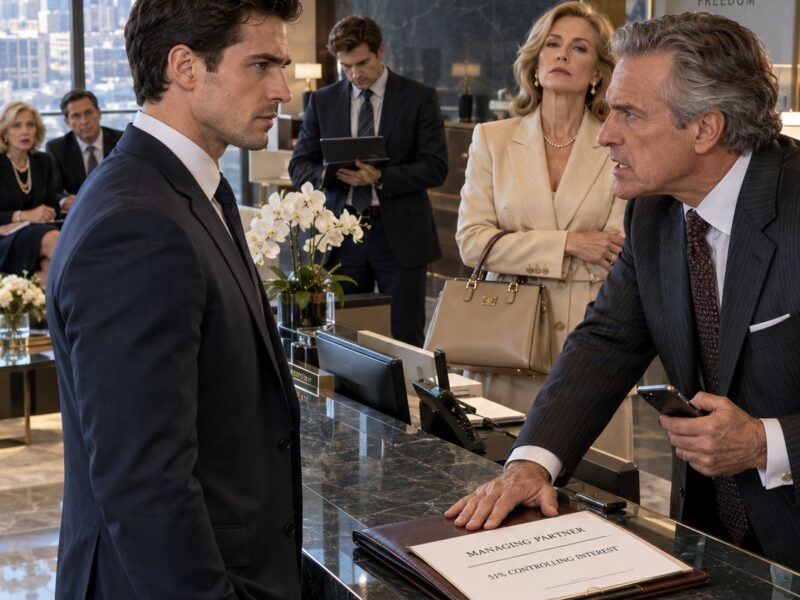
MY FAMILY ABANDONED ME FOR EIGHT YEARS—THEN WALKED INTO MY BOUTIQUE ACQUISITION FIRM AND DEMANDED I MAKE MY FATHER MANAGING PARTNER
My father slammed a leather folder onto the receptionist’s glass desk hard enough to make everyone in the lobby look up.
The sound cracked across the seventeenth floor of the tower like a dropped plate.
Six feet away, two of my largest clients stopped talking.
My father smiled.
It was the same smile he used when I was twelve and he was about to humiliate me at dinner, then call it motivation.
“You’re going to make me managing partner,” he said.
My mother stood half a step behind him in a camel-colored blazer, clutching a structured leather handbag with both hands. My younger brother hovered near the glass doors, his shoulders rounded beneath an oversized sport coat.
I looked at the folder.
MANAGING PARTNER AND CONTROLLING INTEREST TRANSFER AGREEMENT.
The font was heavy, official-looking, and slightly ridiculous.
My father tapped one finger against it.
“Fifty-one percent,” he said. “Signed over today.”
“And if I don’t?”
His smile widened.
“I make one phone call.”
The receptionist behind the desk went very still.
My father leaned closer.
“I know the director at the state acquisitions oversight division. One complaint from me and this place gets frozen while they investigate. Six months. Maybe a year. Your sellers panic. Your lenders pull commitments. Your investors leave.”
He opened his hands.
“So don’t turn this into something ugly, Silas.”
My name is Silas Crane.
I was thirty-four years old that morning.
I owned seventy-six percent of Harrowgate Acquisition Partners, a boutique buy-side and restructuring firm that specialized in acquiring distressed family businesses, specialty manufacturers, logistics companies, and regional service firms too complicated for traditional private equity and too small for the giant banks to care about.
We had twenty-seven employees.
Four active acquisitions under exclusivity.
Just under $310 million in committed capital from private investors.
A spotless compliance record.
And exactly zero ownership held by anyone standing in front of me.
I looked at my father.
Then my mother.
Then my brother.
Eight years.
That was how long it had been since any of them had stood this close to me.
My mother’s perfume hit me a second later.
Powdery gardenia.
The same scent she had worn to every Thanksgiving of my childhood.
For half a second, I was eleven again, sitting at the end of a dining table listening to her praise somebody else’s son immediately after I brought home a report card with one B.
The body remembers before dignity catches up.
I breathed in slowly.
Let my shoulders drop.
Then looked at my father.
“Make the call.”
His eyes narrowed.
“What?”
“Call him.”
I nodded toward the phone in his hand.
“Put it on speaker.”
Something changed in my brother’s face.
Tiny.
Gone quickly.
My father gave a short laugh.
“You think I’m bluffing?”
“I think if you have enough influence to shut down a regulated acquisition firm with one phone call, everybody here should hear exactly how it works.”
One of my clients in the waiting area shifted in her chair.
Eleanor Gaines.
Seventy-three.
Widow.
Former hospital board chair.
The kind of woman who could make a contractor lower a bid by twenty thousand dollars simply by asking why a line item existed.
Beside her sat Caleb Monroe, owner of a commercial construction group I had helped restructure three years earlier.
Both were watching.
My father noticed.
His ego did the rest.
He pulled up a contact.
“Fine.”
He placed the phone on the reception desk.
Before he dialed, my mother stepped forward.
“Silas, sweetheart.”
I had not heard her call me sweetheart in eight years.
“We didn’t come here to fight.”
“No?”
“No.”
She glanced around the office.
The river behind the floor-to-ceiling windows.
The charcoal walls.
The framed closing photographs from deals our team had completed.
A bronze sculpture in the reception area.
Her eyes moved across everything the way an appraiser moves through a foreclosed house.
“We came because family should not remain divided forever.”
I almost admired the sentence.
No apology.
No acknowledgment.
Just a declaration that distance had somehow occurred by weather.
Behind her, my brother shifted his hands deeper into his jacket pockets.
I noticed.
Then forgot about it.
For the moment.
My father picked up the folder again.
“This company exists because you’re a Crane.”
“No.”
He laughed.
“Don’t embarrass yourself.”
“I built it.”
“With what?”
He spread his arms.
“My name.”
“My relationships.”
“My training.”
“I never worked for you.”
“You grew up around business.”
“So did Preston.”
That landed.
My brother looked away.
My father’s jaw tightened.
“You always were arrogant.”
“And you always mistook boundaries for arrogance.”
My mother flinched.
Not because the words hurt.
Because I had said them in public.
That was the old family rule.
Cruelty was acceptable.
Naming cruelty was rude.
My father slapped the folder down again.
“Fifty-one percent.”
“No.”
“Managing partner title.”
“No.”
“A board seat for your mother.”
“No.”
“And a senior operating role for Preston.”
I finally looked at my brother.
He looked exhausted.
Not offended.
Not surprised.
Just tired.
“Does Preston know what role he’s getting?”
My father answered before he could.
“He’ll learn.”
I looked back at him.
“So the answer is no.”
My father raised the phone.
“This is your last chance.”
“Call him.”
He stared.
I waited.
Then he dialed.
The phone rang.
Once.
Twice.
Three times.
Four.
A man answered.
“Harrison Vale.”
My father’s face changed immediately.
Warm.
Clubby.
“Harry. Reg Crane.”
There was a pause.
“Mr. Crane.”
Not Harry.
My father ignored that.
“I’m standing in my son’s office downtown.”
Another pause.
“All right.”
“There are some serious irregularities here.”
I folded my arms.
My father glanced at me.
“Commingling of acquisition fees. Misrepresentation of investor capital. Potential abuse of seller escrow.”
My receptionist’s eyes widened.
None of it was true.
My father continued.
“I think this firm needs to be frozen temporarily while I step in and stabilize things as managing partner.”
Silence.
Long enough that even my father’s smile began to weaken.
Then Harrison Vale said:
“Mr. Crane, I need you to stop talking for a moment.”
My father blinked.
The whole lobby listened.
Harrison continued.
“I’ve been expecting to hear from you.”
My father’s expression changed.
Only slightly.
But I saw it.
“Excuse me?”
“A complaint crossed my desk thirty-two days ago.”
My mother’s grip tightened around her handbag.
“A junior partner at Northlake Transaction Advisors reported that you approached him during a charity event and demanded an advisory position in exchange for not contacting one of their major investors.”
My father’s face emptied.
Harrison kept going.
“He also reported that when he refused, you claimed personal relationships inside this office and threatened regulatory trouble.”
My father leaned toward the phone.
“That’s completely—”
“Please let me finish.”
Harrison’s voice never rose.
That made it worse.
“That report, standing alone, was insufficient to establish a pattern.”
The lobby had become silent enough to hear the HVAC vents.
Harrison said:
“Your call this morning has now provided the second incident.”
My father’s lips parted.
“And because this line is recorded, you have personally provided corroborating evidence of substantially similar conduct.”
I watched his right hand begin to tremble.
He tried to recover.
“This is a private family dispute.”
Harrison answered immediately.
“I don’t have a category for family disputes.”
My mother leaned toward the phone.
“Mr. Vale, I think perhaps you’re misunderstanding. Our son has always been very impulsive, and my husband is trying to protect—”
“Ma’am.”
She stopped.
“I don’t care whether you are his mother.”
My mother physically recoiled.
Harrison continued.
“If your husband is threatening a regulated firm with weaponized complaints in order to obtain private ownership rights, that is not parenting.”
Caleb Monroe lowered his eyes.
Not from embarrassment.
To hide a smile.
My father grabbed the phone.
“Harrison, we’ve had drinks together.”
“No.”
“You’ve been at the club.”
“Yes.”
“We know the same people.”
“Yes.”
“That does not mean you know me.”
The distinction landed.
My father went pale.
Harrison said:
“Silas, are you there?”
I stepped closer.
“I’m here.”
“Do you want this incident formally documented?”
“Yes.”
My father’s head snapped toward me.
“Silas.”
I ignored him.
Harrison continued.
“Third-party coercion, attempted interference with business ownership, and threatened misuse of regulatory process?”
“Yes.”
“Preserve the lobby footage.”
“I will.”
“Preserve the document your father brought.”
My eyes dropped toward the leather folder.
“I will.”
“And if they remain after being instructed to leave, contact building security and file trespassing complaints.”
My mother whispered:
“This is insane.”
Harrison heard her.
“Ma’am, the version of this morning where your family walked away from this without a record ended when your husband dialed my office.”
Then the line went dead.
Nobody moved.
My father stared at the phone.
I stared at him.
Eight years earlier, I would have enjoyed that moment.
I would have wanted to watch him shrink.
I would have wanted every second of humiliation he had ever given me returned with interest.
At thirty-four, I mostly felt tired.
Because I understood something my twenty-six-year-old self had not.
Watching someone lose power over you is satisfying for about thirty seconds.
Keeping them from getting it back is the real work.
I reached for the folder.
My father grabbed it first.
I put my hand on top.
“No.”
His eyes lifted.
“This stays.”
“Give me that.”
“It’s evidence.”
“It belongs to me.”
“You brought it into my office and used it to demand ownership under threat.”
His jaw flexed.
“You ungrateful son of a—”
My mother touched his arm.
“Reg.”
He shook her off.
I lifted the folder.
“Priya.”
My receptionist looked up immediately.
“Yes?”
“Call building security.”
My father laughed.
“You’re going to have your own father removed?”
“Yes.”
That answer hurt him more than shouting would have.
My mother stepped close enough that I could smell her perfume again.
“Blood is blood.”
I looked at her.
“That sentence has done more damage in this family than almost anything else.”
Her face hardened.
“We gave you everything.”
I almost laughed.
Then realized she meant it.
That was the problem.
They remembered a childhood they had never actually watched.
I said:
“You spent the college fund Grandpa left for me on Preston’s auto-detailing franchise.”
My brother’s eyes closed.
My mother glanced toward Eleanor and Caleb.
“Not here.”
“Why not?”
“Silas.”
“You’re discussing family.”
“So am I.”
My father said:
“That business could have succeeded.”
“It lasted five months.”
“Seven.”
Preston spoke for the first time.
Everyone looked at him.
“Five and a half.”
My father turned.
“What?”
Preston’s hands remained inside his jacket.
“The business stopped taking customers after five and a half months.”
My father stared.
“That is not the point.”
I looked at Preston.
Something about his posture bothered me again.
Too still.
Hands hidden.
I filed it away.
Security arrived.
Two building officers.
No drama.
No handcuffs.
Not yet.
My father started explaining who he knew.
The officers did not care.
My mother told me I would regret humiliating my family.
Preston said nothing.
At the elevators, he turned once.
Looked at me.
Then away.
The doors closed.
Only then did Eleanor Gaines speak.
“You were going to apologize.”
I looked at her.
“For the scene.”
“Don’t.”
She lifted her coffee.
“I’ve had financial advisers for forty years.”
She glanced toward the elevator.
“That is the first time I have ever watched one refuse to compromise his own firm because the person threatening him happened to share his DNA.”
Caleb nodded.
“I’ve had lenders fold under less.”
Eleanor looked at me.
“I came in this morning to discuss moving twenty million dollars from one adviser to another.”
I blinked.
“I know.”
“I’ve decided.”
I tried not to look surprised.
“That quickly?”
She smiled.
“I’ve spent my whole life assessing people under pressure.”
She picked up her handbag.
“You did not panic.”
“You did not negotiate with coercion.”
“And you did not use me as leverage while I sat six feet away.”
She extended her hand.
“Move the accounts.”
Caleb laughed softly.
“Make that two of us.”
I looked at him.
“My development proceeds.”
“All of them?”
“Yes.”
“Caleb—”
He leaned back.
“My last adviser once changed a covenant because a louder client complained.”
“You just told your own father no while he threatened your business in public.”
“That tells me more than another ninety-page pitch book.”
An hour later, I was back in my office reviewing Eleanor’s trust structure when Freya Lawson entered and closed the door.
Freya had joined Harrowgate two years earlier as office manager.
She had become the operational spine of the firm before either of us officially admitted it.
Sharp.
Blunt.
Impossible to impress.
She placed a network diagnostic report on my desk.
“We have a problem.”
I looked up.
“What?”
“Your father was the distraction.”
My body became still.
Freya tapped the paper.
“Somebody tried to file an emergency ownership amendment with the state corporate registry while he was shouting in the lobby.”
I stared.
“What amendment?”
“Adding Reginald Crane and Beatrice Crane as controlling managing partners.”
My chair felt suddenly too small.
“That’s impossible.”
“Correct.”
“Any ownership transfer requires two-factor approval from my personal device.”
“I know.”
“It failed.”
“Correct.”
I looked at her.
“Then what’s the problem?”
“The problem is that someone knew which filing form to use.”
She tapped another line.
“And submitted it through our building’s guest Wi-Fi.”
My mind jumped backward.
Preston.
Hands inside jacket.
Too still.
Freya said:
“The tablet joined the network at 10:11.”
“The filing attempt happened at 10:14.”
“The tablet disconnected at 10:18.”
“Your family left at 10:19.”
I felt something cold settle inside me.
“My father wasn’t trying to scare me into signing.”
“He was.”
Freya nodded.
“But that was not the only plan.”
I finished the sentence.
“He was covering Preston.”
She looked at me.
“Yes.”
We pulled the lobby footage.
Preston in the corner.
Hands hidden beneath his jacket.
Thumbs moving.
I watched twice.
Then once more.
Not because I needed confirmation.
Because some part of me was still seven years old, still remembering the little brother who crawled into my room during thunderstorms.
Parents teach children roles before children understand they are being cast.
I had been the difficult one.
Preston had been the one who needed help.
I was expected to achieve without requiring attention.
He was rewarded for needing rescue.
By adulthood, he no longer understood the difference between support and exemption.
I picked up the phone.
Freya asked:
“Legal?”
“No.”
“Police?”
“Yes.”
Detective Raymond Thorne worked financial crimes for the city.
I had met him two years earlier when one of our clients discovered a minority partner draining money from a commercial property account.
Thorne was sixty.
Humorless.
Patient.
A man who seemed personally offended by white-collar criminals who assumed paperwork made theft respectable.
I described the lobby.
The folder.
Harrison Vale’s earlier complaint.
The registry attempt.
The IP logs.
Security footage.
Thorne became quiet.
“Do you still have the folder?”
“Yes.”
“Don’t touch it more than necessary.”
“Already handled.”
“That’s fine.”
“Put it in a clean envelope.”
“Any email or voicemail from them?”
“My mother sent a birthday card.”
“When?”
“Two months ago.”
“Keep it.”
“My father left a voicemail.”
“Keep that too.”
“I deleted it.”
Pause.
“Cloud backup?”
I checked.
“Yes.”
“Good.”
Thorne said:
“Silas, this matters.”
“I know.”
“No.”
His voice sharpened.
“I mean it matters beyond your family.”
“The prior complaint Harrison mentioned stalled because it lacked independent corroboration.”
“You may have just supplied it.”
I looked through the office glass.
Freya stood near the reception desk, already preserving camera files.
Thorne asked:
“Do you want this handled quietly?”
The question hurt.
Because somewhere in me, despite everything, family still triggered the instinct to protect family.
Even after family tried to steal from me.
I thought of my grandfather.
Walter Crane.
The only adult in my childhood who had ever treated me like competence mattered.
He started Crane Freight with one truck.
Built it to eighteen.
He used to take me on Saturday delivery runs.
He knew every driver’s name.
Every mechanic.
Every restaurant owner who paid late but always eventually paid.
He once told me:
“A business is every small promise it keeps when nobody is watching.”
My father inherited that business.
Then spent fifteen years breaking small promises.
Overpaid warehouse leases.
Consulting contracts with country-club friends.
Equipment purchases nobody needed.
Driver bonuses delayed while Preston’s ventures received six-figure checks.
By the time my father called me at twenty-six, Crane Freight was nearly insolvent.
He wanted me to quit my analyst job.
Move home.
Run the company.
For half my salary.
Preston would retain the inherited ownership.
I would do the work.
He would collect dividends.
“You owe this family.”
my father told me.
I reminded him he had spent my education fund on Preston’s failed business.
He went silent.
Then said:
“You’re cut out.”
Everything goes to Preston.
Don’t come to Thanksgiving.
Don’t come to my funeral.
Let’s see how far your arrogance gets you with nothing.
I sat alone in a studio apartment that night.
Bad radiator.
Student debt.
A window that leaked winter air through the frame.
I almost called him back.
Almost apologized.
Then realized every version of that call ended the same way.
I would be welcomed only if I became useful on his terms.
So I built something else.
I spent six years learning acquisitions from the bottom.
Not glamorous deals.
Ugly deals.
Family-owned machine shops where siblings had stopped speaking.
Construction companies whose founders had died without succession plans.
Restaurants with valuable real estate and terrible bookkeeping.
Widows who inherited businesses they had never been allowed to understand.
Owners whose companies were worth millions on paper but would collapse in three months without working capital.
I learned tax structuring.
Commercial credit.
Asset valuation.
Corporate governance.
Earn-outs.
Distressed debt.
Seller financing.
Real estate carve-outs.
I learned which lawyers explained things clearly and which used complexity to hide weak arguments.
I started taking clients senior partners did not want.
Small.
Messy.
Time-consuming.
Those clients taught me what Harrowgate would later become.
Not a firm for giant corporations buying giant corporations.
A firm for people whose businesses were tangled up with identity, family, grief, debt, and fear.
At thirty-two, I left my employer.
Leased four thousand square feet on the seventeenth floor.
No family came to the opening.
No one knew there was an opening.
The leasing agent shook my hand.
“Congratulations.”
Then moved on.
I stood in the empty office alone for about two minutes and let myself feel proud.
Then went back to work.
I named the firm Harrowgate.
A gate and a narrow crossing.
Something you passed through carefully.
Nothing inherited.
No Crane in the name.
Deliberate.
By the time my parents found me again, we had bought or restructured twenty-three companies.
Saved nine from liquidation.
Returned five to family ownership after recapitalization.
Closed four deals that larger firms had rejected as too small to justify the trouble.
I had built something from nothing.
And now my father wanted controlling interest because Preston had burned through everything he was given.
The protein supplement company.
Gone.
The dog-walking app.
Gone.
Sneaker resale venture.
Gone.
Cryptocurrency.
Almost everything remaining.
Then Uncle Marcus appeared.
My mother’s older brother.
He had called twice a year throughout our estrangement.
Warm.
Sympathetic.
The only relative who pretended neutrality.
A year after Harrowgate opened, I invited him to dinner.
Steak.
Good Scotch.
Showed him the office.
He asked about the lease.
Our assets.
My watch.
Our deal volume.
How much capital we controlled.
At the time, I thought:
Finally.
Someone in the family is interested in what I built.
What he was actually doing was inventory.
Two weeks later, my parents knew almost exactly what Harrowgate was worth.
I learned that later.
At the time, all I knew was that two months before the lobby confrontation, my mother sent me a birthday card.
Eighteen days late.
No apology.
No real note.
Just:
Love, Mom.
Then my father left a voicemail.
Warm voice.
Rehearsed.
“Life’s too short.”
“Family matters.”
“We should talk like adults.”
Freya heard about it the next morning.
She asked:
“Has anyone in your family ever contacted you after a long silence without wanting something?”
I could not answer.
She said:
“Then they want something.”
I told her she was paranoid.
She was right.
Now, sitting in my office with Detective Thorne on the phone, I understood the entire approach had been staged.
The card.
The voicemail.
Uncle Marcus’s reconnaissance.
The lobby.
The fake transfer agreement.
Preston’s tablet.
This was not a family reconciliation that turned ugly.
It was an acquisition attempt.
My own specialty.
Just badly executed.
Thorne repeated:
“Do you want this handled quietly?”
I thought about blood.
Then contracts.
Then the company I built specifically so nobody could redefine ownership because of blood.
“No.”
I said.
“Maximum lawful charges.”
Freya looked at me.
Not approving.
Not disapproving.
Just understanding.
Thorne said:
“Good.”
“Then preserve everything and do not contact them.”
I stayed at the office until almost ten.
Reviewed every active acquisition.
Every escrow account.
Every seller deposit.
Every investor subscription.
Nothing touched.
Nothing compromised.
The registry system had done exactly what I designed it to do.
No second factor.
No ownership change.
At ten-fifteen, outside counsel called.
Patricia O’Neil.
She had formed Harrowgate.
Written our operating agreement.
Built the protections nobody noticed until we needed them.
She listened.
Then said:
“Your family chose the worst possible firm to try this against.”
I laughed despite myself.
“Meaning?”
“You designed every ownership provision around the assumption someone someday might try to weaponize paperwork.”
“I was thinking hostile investors.”
“Apparently you underestimated Thanksgiving.”
She became serious.
“Do nothing informal.”
“No calls.”
“No negotiation.”
“Don’t sign anything.”
“Don’t threaten them.”
“Let Thorne investigate.”
“Let the regulator document.”
“The only way this gets messy for you now is if they drag you into their behavior.”
I drove home through a quiet city.
Sat in my kitchen.
One light on.
Thought about the twenty-six-year-old version of myself in that freezing apartment.
I wished I could tell him:
Do not call.
Study instead.
Keep going.
The next morning, I arrived at Harrowgate at six-thirty.
Changed the guest Wi-Fi credentials.
Personally checked every server-room access log.
Asked building security to flag my parents and brother.
At 8:52, Freya called.
“They’re back.”
I closed my eyes.
“Where?”
“Downstairs lobby.”
“With what?”
“Another folder.”
Pause.
“And what looks like an official government document.”
I took the elevator down.
My father stood at the marble security desk.
My mother beside him.
Preston near the revolving doors.
This time my father held a document with a government seal.
Building security supervisor Carl Jenkins looked relieved when he saw me.
“He says he has authority to seize your servers.”
Carl said.
My father turned.
“There he is.”
I ignored him.
Held out my hand.
“Document.”
He gave it to me with a smile.
STATE COMMERCE AUTHORITY — EMERGENCY ACQUISITION COMPLIANCE AUDIT
Below that:
Special Audit Administrator: Reginald Crane.
I almost admired the audacity.
Almost.
My father said:
“Your little call yesterday changed nothing.”
“This is bigger than Harrison Vale.”
“Federal-state coordination.”
“Your operation is under emergency review.”
“I’m authorized to secure all records until the audit clears.”
I looked at him.
“Who issued this?”
“It’s right there.”
He pointed to the seal.
My mother said:
“Silas, stop making this harder.”
Preston stared at the floor.
That bothered me.
My father continued.
“You can still resolve this privately.”
“There it is.”
I said.
“What?”
“The ask.”
He lowered his voice.
“Sign yesterday’s agreement.”
“The audit goes away.”
Carl Jenkins looked at him.
Then at me.
My father had just offered to make a supposed government investigation disappear in exchange for ownership.
He did not notice what he had admitted.
I pulled out my phone.
Called Sarah Delgado.
Senior state auditor.
She had reviewed Harrowgate since our second year.
She answered.
“Silas?”
“Is there an audit open on Harrowgate?”
Keyboard noise.
“What kind?”
“Emergency acquisition compliance audit.”
Longer keyboard noise.
“No.”
“Any special audit administrator named Reginald Crane?”
Sarah laughed once.
Not because it was funny.
Because the title offended her professionally.
“There is no such position.”
I looked at my father.
He watched me.
Sarah continued.
“There’s no active audit.”
“No pending audit.”
“No emergency order.”
“No authorization to seize records.”
“Who gave you that document?”
“My father.”
Silence.
Then:
“Send me a photograph.”
I did.
Sarah became very quiet.
“Silas.”
“Yes?”
“That seal is a reproduction of our department seal.”
My father’s smile vanished.
“That’s serious?”
“Yes.”
She did not elaborate.
Did not need to.
“Log this call.”
I said.
“Already am.”
“Send written confirmation.”
“Two minutes.”
I hung up.
Then looked at my father.
“There’s no audit.”
He pointed.
“That’s an official seal.”
“Exactly.”
My brother broke.
“I didn’t know about the seal.”
My father turned so fast his shoulder nearly hit him.
“What?”
Preston stepped backward.
“I didn’t.”
My mother whispered:
“Preston.”
He looked at her.
Something changed in him.
“I thought it was a scare letter.”
My father stared.
“Shut up.”
“No.”
The word came out cracked.
But it came.
Preston’s hands left his pockets.
“I’m not doing this again.”
My mother’s face changed.
“Doing what?”
He pointed toward the paper.
“This.”
Then toward me.
“Yesterday too.”
I stared.
My father said:
“Preston.”
My brother looked at me.
His face suddenly resembled the eight-year-old who used to sleep on my floor during thunderstorms.
“I filed the ownership amendment.”
My mother closed her eyes.
Carl Jenkins went completely still.
Preston continued.
“Dad gave me the form.”
“Marcus told him how your LLC was structured.”
“I used the guest network while he argued with you.”
I did not move.
My father said:
“You stupid little—”
“Stop.”
Preston shouted it.
For the first time.
Everyone stopped.
“I’ve spent my whole life doing what you tell me because you always said you’d fix it if something went wrong.”
He looked toward the forged document.
“This doesn’t get fixed.”
My father’s face transformed.
Not anger.
Fear.
Real fear.
Preston continued.
“The printer is in the hotel room.”
“The draft files too.”
“Dad wrote the transfer agreement.”
“Mom helped with the language.”
My mother gasped.
“I did not—”
“You told him to add the clause saying Silas was mentally impaired by stress.”
Her face went white.
I stared at her.
There it was.
Another layer.
Not merely theft.
They had prepared a narrative to explain why my ownership could be overridden.
My father shouted:
“He is my son!”
Carl Jenkins said:
“Sir, lower your voice.”
My father rounded on him.
“Stay out of this.”
The revolving doors opened.
Detective Thorne walked in.
Two uniformed officers behind him.
Timing so precise I wondered whether he had been waiting outside.
He probably had.
Thorne looked at me.
Then Preston.
Then the paper.
“Is that the document?”
I handed it over.
He studied the seal.
Looked at my father.
“Reginald Crane?”
My father straightened.
“You need to understand—”
Thorne said:
“I do.”
He nodded to the officers.
“You’re under arrest on suspicion of attempted corporate extortion, wire fraud, conspiracy to commit fraudulent transfer of a business entity, and use of a forged government instrument.”
My mother made a sound I had never heard from her.
My father stepped backward.
“You have no idea who I know.”
Thorne did not react.
“I know the mayor’s office.”
Nothing.
“I know judges.”
Thorne took one wrist.
“I know people who can have your badge by—”
“Save it for your attorney.”
The cuff closed.
My father stared.
Thorne said:
“Nobody in this lobby is impressed.”
My mother’s handbag slipped from her fingers.
Hit the marble.
The sound was absurdly ordinary.
She was detained seconds later on conspiracy allegations.
Preston was not arrested immediately.
He asked for an attorney.
Then asked to cooperate.
Thorne separated him from our parents.
As officers led my father away, he looked at me.
Not sorry.
Not ashamed.
Betrayed.
As if my refusal to let him steal from me were the real disloyalty.
“You did this.”
he said.
I looked at him.
“No.”
“You did.”
“You walked into my office with the folder.”
“You called the regulator.”
“You came back with a forged government order.”
“You did this.”
His face twisted.
“I’m your father.”
“That used to mean something.”
The doors closed behind him.
I looked down at my mother’s handbag.
Nobody had picked it up.
For most of my childhood, my mother could control a room with silence.
Now her purse sat alone on a marble floor while everyone watched someone else decide what happened next.
I did not feel triumph.
Relief.
Clean.
Cold.
Almost medical.
Like something malignant had finally been removed instead of managed around.
Thorne questioned Preston for four hours.
My brother’s cooperation changed the case.
He admitted our parents had approached Northlake Transaction Advisors before Harrowgate.
Same plan.
Advisory role.
Threatened complaint.
He admitted Uncle Marcus had been feeding them information about my firm.
Not passwords.
Not confidential files.
Market gossip.
Office structure.
Public filings.
My approximate net worth.
He admitted my father had been trying to find a path back into my life since learning Preston had depleted most of the family money.
He admitted the late birthday card was strategic.
The voicemail strategic.
My mother had rehearsed what my father would say.
I listened to Thorne relay it the next day.
Something in me hurt anyway.
Not because I expected better.
Because hope does not die once.
It dies in installments.
“Marcus involved?”
I asked.
“Morally?”
Thorne said.
“Clearly.”
“Criminally?”
“Maybe not enough.”
“He gathered public information.”
“He encouraged them.”
“Didn’t sign.”
“Didn’t file.”
“Didn’t forge.”
I nodded.
“What happens to Preston?”
“Depends how truthful he remains.”
“He attempted unauthorized access.”
“Yes.”
“Cooperation matters.”
I stared out the window.
“Do you want him prosecuted?”
Thorne asked.
I turned.
“That’s not my call.”
He smiled faintly.
“Good answer.”
The story became local business news for about forty-eight hours.
Not national.
Not glamorous enough.
FORMER LOGISTICS EXECUTIVE CHARGED IN ATTEMPTED TAKEOVER OF SON’S ACQUISITION FIRM.
Harrowgate was mentioned once.
As the victim.
Freya refused two interview requests without asking me.
“Our firm does not comment on pending criminal matters.”
Perfect.
Clients did not leave.
Not one.
In fact, referrals increased.
Apparently there is a market advantage to being publicly difficult to extort.
Eleanor moved her full portfolio.
Caleb referred two developers.
One of our sellers, whose family manufacturing company we were acquiring, called me.
“I heard about your father.”
I braced.
He continued:
“My brother has been threatening to kill our deal if we don’t keep him on payroll after closing.”
I became alert.
“Do you have that in writing?”
“No.”
“Then start documenting.”
That conversation reminded me why I built Harrowgate.
The firm had never truly been about acquisition multiples.
It was about exits.
Not financial exits.
Human ones.
Helping people separate business from family when the two had become dangerously confused.
Over the following month, prosecutors added charges.
The registry logs.
Security footage.
Forged seal.
Transfer agreement.
Recorded regulatory call.
Preston’s testimony.
Northlake complaint.
A pattern.
My father’s attorney called the whole thing a family misunderstanding.
The prosecutor responded by reading aloud the clause demanding fifty-one percent ownership in exchange for not filing a damaging regulatory complaint.
The judge did not find the misunderstanding persuasive.
My father was denied immediate release pending a later bond review.
My mother posted bond after three days.
Three days probably felt longer to her than it would have to almost anyone else.
Status had always been oxygen to Beatrice Crane.
Her lawyer argued she followed her husband.
I disagreed privately.
The court did not ask me.
Preston received a cooperation agreement.
Unauthorized computer access.
Probation recommendation if he testified fully.
I did not object.
Because punishment was not the same thing as repair.
And because unlike my parents, he eventually stopped lying when lying still benefited him.
Three weeks after the arrest, Preston left me a voicemail.
I listened in my kitchen.
“Silas.”
Long pause.
“It’s me.”
His voice sounded different.
Less polished.
“I know you probably won’t call back.”
Another pause.
“I wouldn’t.”
He apologized for the tablet.
For standing in the corner.
For spending years pretending our parents’ favoritism was something happening to him instead of something benefiting him.
Then he said:
“I used to think you got the short end.”
“I’m starting to understand you were the only one who got out.”
I closed my eyes.
He continued.
“I don’t know if there’s ever a way back.”
His breathing filled almost twenty seconds.
Then the message ended.
I did not call.
Not then.
Forgiveness and access are different things.
People confuse them because people prefer redemption stories with doors opening at the end.
Real boundaries sometimes remain locked.
My father’s case resolved five months later.
Plea agreement.
Four years.
Fraud.
Extortion.
Forged government instrument folded into the sentence.
My mother accepted a reduced conspiracy charge.
Probation.
Fine.
Mandatory financial disclosure.
She never called.
For once, she understood there was no audience left for the performance.
Uncle Marcus called once.
Said he had only wanted the family reunited.
I deleted the voicemail.
Thorne found no charge that fit what Marcus had done.
There is no criminal statute against being a coward with excellent observational skills.
Harrowgate kept growing.
Freya became COO.
She deserved the title long before the lobby.
I handed her the compensation package personally.
She read halfway.
Looked up.
“This is more than I was going to ask for.”
“I know.”
She frowned.
“That’s not how negotiation works.”
“It is when I already know you’re underpricing yourself.”
She smiled despite trying not to.
I reminded her of her interview.
Two years earlier.
She told me if a relative ever walked into my office trying to manipulate ownership, she would call security before waiting for permission.
“You did exactly that.”
I said.
“You noticed Preston.”
“You preserved the logs.”
“You protected the firm before I even understood the attack.”
“That’s COO work.”
Her expression softened.
Just slightly.
“My mother spent twenty years being taken for granted in her own business.”
she said.
“I told myself I wouldn’t.”
“You won’t here.”
Oliver Grant, our senior associate, took over more deal responsibility.
He came from a family where his older brother had always been the chosen son.
I recognized the wound the first week I hired him.
The first acquisition I let him lead alone was a specialty plastics company outside Dayton.
Founder dying.
Three adult children fighting.
One wanted cash.
One wanted control.
One wanted nobody to sell anything because selling felt like admitting their father would not return.
Oliver called me the night before signing.
“What if I screw this up?”
“You might.”
Silence.
“That’s helpful.”
“You asked.”
“What would you do?”
“I’d go into the room.”
“Listen.”
“Then decide.”
“What if they don’t respect me?”
I smiled.
“You’re still asking the wrong question.”
“What’s the right one?”
“Do you respect your own work enough to stay clear when they don’t?”
He closed the acquisition.
A month later, he came into my office.
“My dad never told me I did anything well without mentioning my brother.”
I looked at him.
“In this building, that math does not apply.”
He nodded.
Left.
No speech needed.
A year after the arrest, Harrowgate moved to a larger floor.
Same building.
Twenty-third.
I almost stayed on seventeen out of sentiment.
Freya told me sentiment was an expensive real estate strategy.
She was right.
The old lobby became another company’s reception area.
I walked through it once before we moved.
Same river view.
Same glass desk.
Different receptionist.
I remembered my father’s folder hitting the surface.
The phone call.
My mother’s perfume.
Preston’s hands hidden inside his jacket.
I expected something dramatic.
Nothing.
Places do not hold power once you stop asking them to.
On the new floor, I kept one object in my top desk drawer.
A stopwatch.
Old.
Scuffed.
Same model my father used when I was nine.
That year, he spent an entire Saturday helping Preston build a wooden derby car.
Sanded the wheels.
Measured the weight.
Timed test runs down the driveway.
I sat inside alone building my science project.
I had asked for help.
My father said:
“You don’t need it like Preston does.”
I placed third.
Preston did not place.
On the ride home, Dad said the judges were incompetent.
Nobody said anything about my ribbon.
Years later, at an estate sale, I saw the same model stopwatch.
Bought it.
Never replaced the dead battery.
It sits in the drawer measuring nothing.
Some afternoons I open the drawer and remember being invisible at nine.
Not painfully anymore.
More like reading an old file from a case already closed.
Preston wrote me once after our father entered prison.
Not a request.
A letter.
He had taken a job managing inventory at a regional auto-parts distributor.
Entry level.
No family money.
No title.
He wrote:
I am learning that having to do small things correctly every day is different from being told you are talented. I think you learned that before I did.
I kept the letter.
Did not respond.
Six months later, I sent him one thing.
A copy of our grandfather Walter’s original handwritten operating notes from Crane Freight.
I had found them in old estate records.
On the first page:
A reputation is the sum of promises kept when nobody is watching.
No note from me.
No return address necessary.
Preston knew.
Two weeks later, he texted:
Got it.
I did not answer.
Not every bridge needs to be crossed immediately simply because someone stopped setting fire to it.
My mother sold the country-club house.
My father’s legal costs consumed most of what remained.
Crane Freight had already been sold in pieces before the arrest.
The final warehouse changed ownership.
Grandpa’s name disappeared from the trucks.
I drove past once.
The building looked smaller than I remembered.
I felt sad.
But not defeated.
Inheritance is not always property.
Sometimes it is a sentence someone said while unloading produce from a truck.
Sometimes it is the memory of a man who kept promises better than the son who inherited his company.
Sometimes the thing you inherit is a standard.
That can survive liquidation.
Harrowgate closed its fiftieth transaction three years after my family walked into the lobby.
A machine-components company in Indiana.
Founder seventy-one.
Daughter wanted to run it.
Son wanted his inheritance immediately.
Father could not admit he preferred his daughter professionally because he feared breaking the family.
We structured a buyout.
Daughter became CEO.
Son received fair value over time.
Father retained a non-voting advisory stake.
At the closing dinner, the daughter raised a glass.
“To Silas.”
I shook my head.
“No.”
She laughed.
“You literally put the deal together.”
“Your family did.”
Her brother stared at his wine.
Then said:
“He made us stop lying about what we actually wanted.”
I smiled.
“That part I’ll accept.”
On the drive home, I thought of my own family.
How different things might have been if someone had forced us to name the truth before favoritism hardened into identity.
Maybe nothing would have changed.
Maybe everything.
There is no value in pretending childhood could have been renegotiated after closing.
I stopped trying.
People sometimes ask whether success felt like revenge.
No.
Revenge requires an audience.
Most of my best moments had none.
Signing the first office lease alone.
Closing a deal nobody else wanted.
Watching Freya become COO.
Watching Oliver lead without asking permission.
Seeing clients keep businesses, homes, dignity.
Sitting in my kitchen after midnight knowing nobody could call and take any of it because I disappointed them.
That was not revenge.
It was ownership.
Real ownership.
Not the kind printed on the fraudulent agreement my father brought.
The kind built through years nobody applauded.
I learned something else too.
My father believed power was the ability to make other people respond.
He dominated rooms.
Raised his voice.
Withheld money.
Threatened access.
Threatened inheritance.
Threatened relationships.
Threatened regulators.
Every tool depended on one assumption:
The other person would panic first.
Harrowgate survived because I had built it around the opposite assumption.
Nobody gets access because they sound important.
Nobody gets ownership because they are related.
Nobody gets trusted because trust would be socially easier than verification.
Documentation is not cynicism.
Boundaries are not cruelty.
Governance is not a lack of love.
Sometimes it is the only thing that keeps love from becoming leverage.
Five years after the arrest, Harrison Vale retired.
He invited me to lunch.
The first time we met in person without an active matter between us.
He ordered soup.
I ordered steak.
He said:
“You know what I remember about that phone call?”
“My father threatening you?”
“No.”
“You saying put him on speaker.”
I laughed.
“Why?”
“Most people threatened with oversight try to move the conversation somewhere private.”
“You did the opposite.”
“I wanted witnesses.”
“Exactly.”
He stirred his soup.
“That told me before he even called what kind of firm you probably ran.”
I looked at him.
“You were already investigating him.”
“Yes.”
“Would you have eventually contacted me?”
“Maybe.”
He thought.
“Your father accelerated his own timeline.”
“That sounds like him.”
Harrison smiled.
“People like your father often think systems only exist to be influenced.”
“They forget systems also create records.”
“That’s what caught him.”
“Not me.”
“Not you.”
“His own repeated behavior.”
We ate quietly.
Then Harrison said:
“You know, your father asked me once at the club how a man gets appointed to advisory committees.”
I laughed.
“Of course he did.”
“He had no interest in the work.”
“I know.”
“He wanted the title.”
“I know.”
Harrison looked at me.
“You built the opposite life.”
The sentence stayed with me.
Years earlier, my father told me everything I had came from the foundation he built.
He was wrong.
But not completely.
Some foundations are built from what happened.
Others from what you decide never to repeat.
Mine came from both.
I built Harrowgate because I knew what it felt like when family changed rules after the fact.
Because I knew what it felt like when someone else’s confidence counted more than my competence.
Because I knew what it felt like when money intended for me disappeared into a favored child’s failure.
Because I knew how easily love became a collection mechanism in our house.
Every safeguard my father hated was something he had taught me to need.
Two-factor ownership changes.
Independent counsel.
Recorded board votes.
Conflict policies.
Security procedures.
Clear employment roles.
No handshake ownership.
No family exceptions.
He called those things cold.
They saved my company.
On my fortieth birthday, Freya organized dinner for the senior team.
No surprise party.
She knew I hated those.
Eleanor Gaines came.
Caleb Monroe came.
Oliver came with his wife.
A few early clients.
No family.
At dessert, the server brought a cake.
No candles.
Freya said:
“I assumed forty individual flames would violate building code.”
I laughed.
Then she handed me a thin package.
Inside was a framed copy of Harrowgate’s original operating agreement.
The signature page.
Mine.
Patricia O’Neil’s witness line.
Date.
The first document establishing that the firm belonged exactly where the document said it belonged.
No hidden clause.
No family entitlement.
Freya had placed a small brass plaque beneath it.
THE RULES DO NOT CHANGE DEPENDING ON WHO IS ASKING.
I stared at it.
Oliver said:
“You say that constantly.”
“I do not.”
“You absolutely do.”
Everyone laughed.
I felt something shift.
Not healing.
That word sometimes asks too much.
Integration, maybe.
The ability to look at where you came from without mistaking it for where you still live.
That night, back home, I opened my desk drawer.
The old stopwatch.
Dead.
Still.
I held it.
Remembered my father timing Preston’s little wooden car while I worked alone in the kitchen.
For years, that memory meant:
He loved Preston more.
Later:
I was invisible.
Later:
I succeeded anyway.
Now it meant something smaller.
A man made choices.
A boy noticed.
The boy grew up.
That was all.
I placed the stopwatch back.
Closed the drawer.
No ceremony.
The next morning, sunlight came across the river through Harrowgate’s new windows.
Freya was already there.
Oliver had a seller call at eight.
Two analysts argued quietly over working-capital adjustments.
A client had sent bagels.
My calendar contained six meetings.
Ordinary work.
The kind that builds a life without announcing that it is building one.
Sometimes, even now, I remember my father standing in the old lobby.
Folder on the glass desk.
Certain that ownership was something he could demand because parenthood made him permanently entitled to whatever I created afterward.
He said:
“You’re going to make me managing partner.”
As if the eight years between us had been empty.
They were not.
They contained every unpaid Tuesday night.
Every difficult client.
Every exam.
Every rejection.
Every contract.
Every boundary.
Every morning I showed up after nobody from my family did.
My father thought he walked into a company and discovered his son had become wealthy.
What he actually walked into was the physical structure of eight years spent learning not to need his permission.
That was why his threat failed.
Not because I was smarter.
Not because Harrison Vale happened to have an open file.
Not because Detective Thorne arrived at the right moment.
Those things mattered.
But the foundation came earlier.
The night my father told me I would have nothing without him, I believed him for about an hour.
Then I opened my laptop.
And started building anyway.
By the time he walked into my lobby eight years later demanding controlling interest, he was already too late.
He thought he had come to take my company.
What he discovered instead was that he had finally entered the one place in my life where being my father gave him no authority at all.









