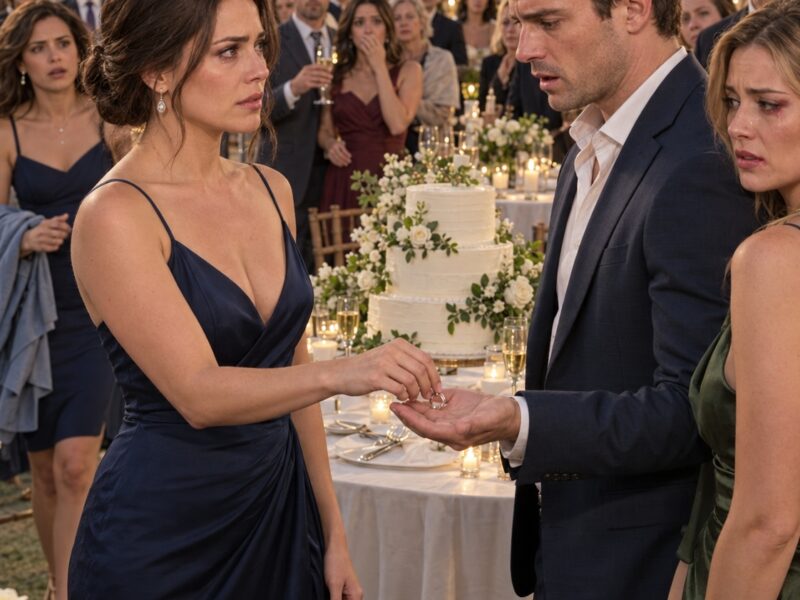
My Fiancé Kissed His Ex “for Closure” Beside Our Engagement Cake—So I Returned His Ring and Let One Quiet Decision Expose Everything He Expected Me to Forgive
My fiancé kissed his ex beside our engagement cake while I was still holding the little porcelain plate meant for our first slice.
He called it closure.
I called it the last decision he would ever make for both of us.
The party was being held on the garden terrace of a restored inn outside Richmond, Virginia, one of those places where the brick walls had been old long enough to become expensive again.
Forty-six people stood beneath strings of warm lights.
My mother was talking to Ethan’s mother near the bar.
My best friend Maya was arguing with the photographer about whether the oak tree behind the cake table made the background look romantic or haunted.
A jazz trio was playing something soft enough that nobody had to stop talking.
Then Samantha Reed put one hand against Ethan’s collar.
And he kissed her.
Not on the cheek.
Not a quick startled mistake.
On the mouth.
His right hand settled at her waist.
Her fingers tightened against his lapel.
I stood ten feet away holding the plate.
For a second, I did not understand what I was seeing.
That sounds impossible.
It wasn’t.
The human mind is very good at protecting itself from information it has not agreed to receive.
Someone behind me laughed.
Then stopped.
The music continued.
That was almost worse.
The bass player kept plucking softly while my future husband kissed the woman he had dated for five years before me.
When Ethan finally pulled away, Samantha looked down.
He looked directly at me.
His face changed.
Not enough.
“Lauren.”
I put the plate on the cake table.
The fork rattled against porcelain.
Ethan stepped toward me.
“It was for closure.”
My voice came out thinner than I wanted.
“At our engagement party?”
“Lauren.”
“At our engagement party?”
Several nearby conversations had stopped.
His older brother, Caleb, turned away from the bar.
Maya was already moving toward me.
Ethan lowered his voice.
“Please.”
I looked at Samantha.
Her lipstick had smeared slightly at one corner.
She wiped it with her thumb.
I had told her thirty minutes earlier that the shade looked beautiful on her.
That detail lived in my head for months.
I looked back at Ethan.
“You kissed her.”
“I know.”
“While we’re celebrating getting married.”
“It isn’t what you think.”
I actually laughed.
Not because anything was funny.
Because there are sentences people say when they are desperate to make another person doubt her own eyesight, and apparently my body found that absurd before my mind did.
“What do I think?”
He glanced at the guests.
“Can we not do this here?”
“You did it here.”
“Lauren.”
His jaw tightened.
“Samantha and I were saying goodbye to something that ended a long time ago.”
“You kissed goodbye?”
“It was one moment.”
“A very public one.”
“I didn’t plan it.”
Samantha finally spoke.
“I should leave.”
Ethan turned toward her immediately.
“No.”
That hurt almost more than the kiss.
Automatic.
Protective.
“No, stay.”
He looked back at me.
“We’re not going to make this uglier than it already is.”
There it was.
We.
As though the problem now belonged equally to both of us.
I looked down at my left hand.
The ring was a round diamond on a narrow platinum band.
Beautiful.
Elegant.
Ethan had proposed at the overlook above the James River eight months earlier.
I had cried before he finished the question.
Now I hooked my right thumb beneath the band.
It stuck at the knuckle.
“Lauren.”
I twisted harder.
My finger hurt.
Maya reached us.
“You okay?”
“No.”
The ring came free.
Ethan saw it.
His entire expression changed.
“Don’t.”
I held the ring between two fingers.
He stared.
“Don’t do something permanent because you’re upset.”
I extended my hand.
He did not move.
“Take it.”
“Lauren, come on.”
“Take it.”
“What are you doing?”
I looked at him.
“We’re not getting married.”
His face emptied.
Behind him, Samantha closed her eyes.
Caleb muttered something under his breath.
Ethan glanced around the terrace.
Forty-six people.
Drinks.
Flowers.
Cake.
Our parents.
The carefully managed evidence of a future.
He held out his hand.
I placed the ring in his palm.
His fingers closed around it.
“Don’t tell people that.”
I stared.
“What?”
“Not yet.”
“Ethan.”
“We need a minute.”
“No.”
“You’re in shock.”
“Yes.”
“That’s my point.”
I picked up my purse from beneath the gift table.
“Maya, can you help me find my coat?”
She nodded instantly.
Ethan followed.
“You are not leaving like this.”
“I am.”
“Lauren.”
Caleb came between us.
“Everybody calm down.”
I looked at him.
He held both hands slightly raised.
Not aggressive.
The universal gesture of a man who wants the woman harmed by a situation to regulate it for everyone else.
“There’s a private office inside,” he said. “You two can talk.”
“I don’t want to talk.”
“You should hear him out.”
“I heard him.”
Ethan said:
“Thank you.”
I turned toward him.
“Do not thank your brother for helping you manage me.”
Caleb stepped backward.
Maya returned with two coats.
I put my arm into the wrong one.
She gently stopped me.
“That’s mine.”
I looked down.
Pale wool.
Mine was blue.
“Right.”
My hands were shaking badly now.
Maya switched them.
Ethan lowered his voice.
“Please stay until everybody leaves.”
“Why?”
“My mother is crying.”
I looked toward Judith Parker.
She stood by the French doors with one hand pressed against her mouth.
I could not tell whether she was crying because her son had kissed his ex or because his fiancée had publicly returned the ring.
Maybe both.
Ethan continued:
“There are people here who drove three hours.”
“We paid for dinner.”
“There’s still cake.”
“You want me to stay for dessert?”
“That isn’t what I mean.”
“What do you mean?”
He exhaled.
“Can we get through the evening without turning three good years into one terrible moment?”
My throat tightened.
There was the hook.
Three good years.
He knew exactly where to put it.
“I was there for the three years too.”
“I know.”
“So stop using them like evidence I have to stay.”
His face hardened.
“You always do this.”
I went still.
“Do what?”
“You make things absolute.”
I stared at him.
Behind him, Samantha looked miserable.
For a fraction of a second, I almost felt sorry for her.
Then I remembered the kiss.
I looked at Ethan.
“You kissed your ex at our engagement party.”
“Yes.”
“And you’re frustrated with my reaction.”
“I’m frustrated that you won’t let me explain.”
“I let you explain.”
“You called it closure.”
He rubbed both hands over his face.
“Because that’s what it was.”
“Then congratulations.”
I moved around him.
“Consider it closed.”
Maya followed me through the restaurant.
Nobody stopped us.
Outside, the air had turned cool.
I walked in the wrong direction.
Maya touched my elbow.
“Your car’s the other way.”
I turned.
My heels clicked too loudly on the sidewalk.
At my car, I pressed the trunk button instead of unlock.
The trunk opened.
I stared at it.
Maya closed it.
“Give yourself a second.”
“I can drive.”
“I didn’t ask yet.”
That nearly broke me.
I got into the driver’s seat.
Keys in my lap.
My phone began ringing.
Ethan.
I let it stop.
Then again.
I silenced it.
Maya sat beside me.
She had her own wedding in November.
Earlier that afternoon, I had given her the bakery’s contact information because she liked our engagement cake.
The thought felt obscene now.
“You don’t have to settle every detail tonight,” she said.
“I’m not going back.”
“I mean the calls.”
“Vendors.”
“Money.”
“Tonight can just be getting home.”
I nodded.
Then drove.
At my apartment, I sat on the bathroom floor and cried because one earring clasp would not open.
Not because of the kiss.
Because my fingers were shaking and I could not get one small piece of metal to behave.
Maya sat on the closed toilet lid.
She did not tell me Ethan loved me.
Did not tell me people make mistakes.
Did not ask whether I was sure.
She waited.
Eventually I washed my face.
“I’m thirty-four.”
“Yes.”
“I have a wedding venue.”
“Had.”
I looked at her.
“Too soon?”
“No.”
I laughed through tears.
That was why Maya was my friend.
I worked as the patient-services coordinator at a large dental practice in Richmond.
Not glamorous.
I managed schedules for five dentists and nine hygienists, dealt with insurance authorizations, angry patients, emergency appointments, late labs, and enough human anxiety about root canals to qualify as a minor field of psychology.
I earned enough to pay my own rent.
Ethan had his apartment across town.
We had intentionally kept both leases until six weeks before the wedding.
We planned to look for a house in spring.
No shared mortgage.
No children.
No joint accounts.
At the time, I had occasionally worried that our lives were not intertwined enough.
That night, I thanked every cautious decision we had made.
Maya left after nine.
My phone had twenty-three messages.
Most from Ethan.
Two from Judith.
One from Caleb.
One from Samantha.
I opened Ethan’s first.
Are you home?
Then:
Please tell me you’re safe.
Six minutes later:
You left me there to deal with everyone. That wasn’t fair.
I stared at that message.
That wasn’t fair.
I typed:
I am home. I will not discuss our relationship tonight. I’ll contact you tomorrow about practical matters.
His reply came immediately.
Practical matters? Lauren, we’re engaged.
I looked at the pale indentation around my ring finger.
No.
We had been engaged.
That distinction would become the fight beneath every fight that followed.
The next morning, I woke at two because a hairpin was pressing into my scalp.
I had fallen asleep without removing them.
For a few seconds, I reached toward the other side of the bed.
Ethan had stayed Friday night.
His pillow was still slightly lower.
My body remembered him before my mind did.
I wanted to call.
I wanted him to say:
I was cruel.
I was stupid.
I saw your face afterward and understood what I had done.
Instead, at seven thirty, he sent:
Can I come over?
I answered:
Not today.
Then I opened our wedding folder.
Venue contract.
Florist estimate.
Photographer email.
Dress deposit.
Guest list.
Meal notes.
Samantha’s name appeared near the bottom.
I remembered the conversation about inviting her.
Three months earlier, Ethan and I had been folding laundry at his apartment.
He held up one of my shirts.
“Samantha will probably be at the engagement party.”
I looked over.
“Why?”
“Everyone else from college will.”
“If we leave her out, it becomes a thing.”
“Would it be weird for you?”
“No.”
He found a missing sock under the bed.
“We broke up almost five years ago.”
I knew their history.
College sweethearts.
Five years together.
Trips.
Families intertwined.
Talk of moving to Charlotte after graduation.
Then Ethan took a job in Richmond.
Samantha wanted D.C.
They fought.
Ended.
A year later, Ethan met me.
I had seen Samantha at birthdays and cookouts.
She was polite.
Occasionally too familiar, but familiarity made sense when you had five years of stories with someone.
Once, at a barbecue, she reminded Ethan about a cabin trip in West Virginia.
He finished the story for her.
I stood there holding a paper plate and felt invisible.
Later I told him.
He said:
“I can’t erase what happened before you.”
I answered:
“I didn’t ask you to.”
But we moved on before I explained what I had asked.
Maybe I had been doing that often.
Leaving things half-explained because finishing them felt needy.
The phone rang.
Ethan.
I answered.
“Can I come over?”
“No.”
“We can’t do this by text.”
“We can handle bookings by email.”
“I mean us.”
I sat at the dining table.
A loose button from my cardigan lay beside a sewing kit.
“Why did you kiss her?”
“I told you.”
“Tell me again.”
Long breath.
“After my toast, she came over.”
“She said it was strange seeing me get married.”
“She said she wanted to know we were okay.”
“I told her I didn’t want the past following either of us.”
“And?”
“And we talked about what went wrong.”
I waited.
“I said I forgave her.”
“She said she forgave me.”
“And then?”
He paused.
“We kissed.”
“Why?”
“It felt like saying goodbye.”
I closed my eyes.
“You had already said goodbye.”
“Not properly.”
“You broke up five years ago.”
“That doesn’t mean everything was resolved.”
I pressed the loose button into my palm.
“Did you think about me?”
“Of course.”
“What did you think I would do?”
Silence.
“Ethan.”
“I didn’t think you’d end the engagement.”
That was the answer.
Not:
I thought you wouldn’t mind.
Not:
I believed it was respectful.
He simply had not believed the consequence could be large.
“I thought you’d understand the kiss wasn’t about wanting her back.”
“You could have said goodbye without kissing her.”
“I know that now.”
“After.”
“Yes.”
I looked toward my kitchen.
The coffee he liked was in my cabinet because he stayed most weekends.
“You keep asking me to respect what the kiss meant to you.”
“What?”
“You say closure.”
“You say goodbye.”
“You say letting go.”
“You want me to use your meaning.”
“What meaning do I get?”
“Lauren—”
“You were engaged to me when you did it.”
“I’m still engaged to you.”
“No.”
His voice sharpened.
“Stop saying that.”
My spine went cold.
“What?”
“Stop making a permanent statement while you’re angry.”
“I gave you the ring.”
“You were upset.”
“I knew what the ring meant when I handed it back.”
“You cannot throw away three years because of eleven seconds.”
“How long was it?”
“What?”
“The kiss.”
“I don’t know.”
“You just said eleven seconds.”
Silence.
I stopped breathing.
“Why do you know that?”
“I don’t.”
“You just—”
“Caleb said someone filmed it.”
The room changed.
“Who?”
“I don’t know.”
“Have you watched it?”
“No.”
“Ethan.”
“No.”
Too fast.
I let the silence sit.
Finally:
“Lauren.”
“What?”
“Do not turn a video into evidence like I’m on trial.”
“I didn’t know there was a video until you told me.”
He went quiet.
That conversation ended five minutes later.
An hour afterward, Leah Montgomery messaged me.
She was part of Ethan’s old college group.
I liked her.
She had been filming his toast.
I didn’t stop recording quickly enough. I have what happened near the cake. Do you want the original?
My stomach tightened.
I said yes.
The file arrived.
I watched once.
Ethan finished his toast.
I heard myself laughing somewhere behind Leah’s phone.
The camera moved.
Samantha stepped close to Ethan.
They spoke.
No clean audio.
Someone crossed in front.
Then the frame settled.
Samantha touched his collar.
Ethan leaned toward her.
Not dragged.
Not surprised.
His hand found her waist before their mouths met.
Eight seconds.
Maybe nine.
Afterward, Ethan turned.
I entered the edge of the frame with the plate in my hand.
Then his voice:
It was for closure.
I paused the video.
My own face appeared in profile.
Trust ending before I understood it had ended.
There was no evidence of what they said beforehand.
No proof of planning.
No proof of a prior affair.
But the video answered one question.
He participated.
Fully.
I saved it.
Then did something more difficult.
I stopped watching.
Monday morning, I called the venue coordinator.
We had paid a $3,600 deposit.
Half each.
The wedding was ten months away.
Under the contract, $1,800 was nonrefundable.
The rest would be returned if both parties signed cancellation paperwork.
I felt physically sick.
Losing $900 for a wedding I no longer wanted still felt like losing $900.
People often say money should not matter in emotional decisions.
Usually people who say that are not the ones losing it.
I signed my part.
Sent it to Ethan.
He called within two minutes.
“We don’t need to cancel the venue.”
“I do.”
“Move the date.”
“No.”
“Take six months.”
“No.”
“You’re willing to lose nine hundred dollars to prove something?”
“I would prefer not to lose it.”
“Then don’t.”
“I also don’t want a wedding reservation.”
“We could put it on hold.”
“The coordinator needs an answer.”
“You don’t need to decide this week.”
“I already decided Saturday.”
His voice tightened.
“You cannot keep treating that moment like a legal ruling.”
“It was my answer.”
“We were both emotional.”
“I was.”
“You kissed Samantha before I did anything.”
There was a pause.
“I know.”
“Then stop making my reaction the shared mistake.”
We signed the cancellation form Tuesday.
My refund arrived three weeks later.
I lost $900.
The dress deposit cost another $400.
The flowers had not been booked.
The photographer had not been paid.
The wedding website never went live.
The end of my engagement cost less than replacing a transmission.
It still hurt every time I entered a number into the spreadsheet.
Then Ethan sent me a draft statement.
Subject:
From Ethan & Lauren
I opened it at my desk after work.
It described “an emotional misunderstanding.”
Said Ethan’s interaction with Samantha was “a final moment of closure that did not change his commitment.”
Then:
Lauren understands the intention behind the moment, and we are taking private time to work through the hurt.
At the bottom:
Ethan & Lauren
I read it twice.
Then a third time.
He had written my understanding for me.
I started editing.
Deleted misunderstanding.
Changed taking private time to ended engagement.
Wrote half a paragraph explaining that agreeing to invite Samantha was not consent to watch him kiss her.
Then stopped.
Why was I improving a statement I did not agree to send?
I closed the draft.
Texted:
Do not use my name on this. I do not agree with it. If you send your own explanation, sign it yourself.
He called.
“You could have changed the wording.”
“I did.”
“So send me the changes.”
“I’m not making a joint statement.”
“People think I cheated on you in front of everybody.”
“People saw you kiss your ex.”
“You’re happy to let them think the worst.”
I sat back down.
The front office lights had dimmed automatically.
Only the reception strip remained bright.
“I don’t control what forty-six people think.”
“You could tell them you understand.”
“I do understand.”
“Then say that.”
“I understand your explanation.”
“I do not agree it makes the kiss acceptable.”
“Same thing.”
“No.”
His frustration became audible.
“Why does everything have to be this exact?”
Because for three days, I realized, exact language was the only thing keeping my reality from being rewritten.
“It has to be exact because you keep changing the noun.”
“What?”
“I ended the engagement.”
“You call it space.”
“You kissed your ex.”
“You call it closure.”
“I returned the ring.”
“You call it anger.”
“At some point, one of us gets to use the words that match what actually happened.”
He was silent.
Then:
“Can I at least say we’re talking?”
“You can say you’ve spoken to me.”
“And?”
“Do not say I’m planning to marry you afterward.”
I saved his written confirmation that he would not use my name.
Not because I expected litigation.
Because I had started to understand how exhausting it is when another person decides your meaning is editable.
Samantha contacted me the following night.
She wanted coffee.
I declined.
Phone call.
I nearly declined that too.
Then accepted.
Not because I owed her.
Because I wanted one question answered.
She sounded smaller on the phone than she had at the party.
“I’m sorry.”
“For what?”
“That night.”
“Which part?”
Silence.
“The kiss.”
Good.
A noun.
She continued.
“Ethan told me there were things about our breakup he had never really processed.”
“Did you know before the party?”
“That he had unresolved feelings?”
“Yes.”
“A little.”
My fingers tightened around the phone.
“What does a little mean?”
“He messaged me two weeks earlier.”
I stood.
“What did he say?”
Samantha hesitated.
“That seeing me at the party might be strange.”
“He said he wanted us to talk before the wedding.”
The room became very quiet.
“Before the wedding or before the engagement party?”
“Before you got married.”
“Did he suggest talking privately?”
“Yes.”
“Did you?”
“We tried at the party.”
“Why there?”
“He said it was the only time we’d both be around without making a separate meeting look secret.”
I closed my eyes.
There it was.
Not a planned kiss.
But a planned reckoning.
One he never told me about.
“What exactly did he want closure from?”
“I don’t know.”
“That’s not true.”
She breathed slowly.
“He said he sometimes wondered whether we had ended because of timing rather than because we were wrong for each other.”
I sat down.
“While engaged to me.”
“Yes.”
“He told you that?”
“Yes.”
“Did he say he wanted you back?”
“No.”
“Did you want him back?”
Her answer took too long.
“I didn’t know.”
At least it was honest.
“Did he kiss you or did you kiss him?”
“We both did.”
“Thank you.”
She sounded startled.
“For what?”
“For not pretending gravity did it.”
Samantha began crying.
“I didn’t go there intending to destroy your engagement.”
“I believe you.”
“I don’t know whether that makes it better.”
“It doesn’t.”
Silence.
Then:
“He keeps telling people you knew I would be there.”
“I knew.”
“I agreed you could attend.”
“That is not the same thing.”
“I know.”
That distinction mattered more than I expected.
Samantha asked whether the three of us could meet.
“No.”
“It might help everyone stop choosing sides.”
“My engagement ended.”
“That is big enough for me without solving your friend group too.”
She apologized again.
I ended the call.
Then I called Ethan.
He answered immediately.
“Samantha told me you contacted her before the party.”
Silence.
“How long before?”
“Lauren.”
“How long?”
“Maybe two weeks.”
“You told her you wondered whether your breakup had been timing.”
“It was a conversation.”
“You never told me.”
“Because I knew you’d hear it wrong.”
I laughed.
“Wrong?”
“I wanted to put it to bed before marrying you.”
“You were already planning to marry me.”
“That’s why I needed to do it.”
I stood at my kitchen counter.
“There is something almost impressive about how every betrayal becomes evidence of your commitment.”
“That is unfair.”
“No.”
“It is exact.”
He became angry.
“I didn’t meet her secretly.”
“You used our engagement party to have an emotional conversation with your ex because you thought arranging a separate meeting would look suspicious.”
“I was trying to avoid secrecy.”
“By keeping it from me.”
He stopped.
I continued.
“Did Caleb know?”
Silence.
That was another answer.
“Ethan.”
“He knew I wanted to talk to her.”
My stomach dropped.
“Your brother knew.”
“He told me I should resolve it before the wedding.”
“Did he tell you to kiss her?”
“No.”
“Did he tell you to tell me?”
Pause.
“Yes.”
That hurt in a new place.
“And you didn’t.”
“I was going to.”
“When?”
“After.”
The most dangerous word in bad relationships is sometimes after.
After I decide.
After I do it.
After you react.
After the facts cannot be changed.
Then your permission can be collected.
“I’m done talking tonight.”
“Lauren—”
“No.”
I ended the call.
Maya came over with Thai food.
I told her.
She looked furious.
“Caleb knew?”
“That Ethan wanted to talk.”
“Not the kiss?”
“Apparently not.”
“Do you believe him?”
“I don’t know.”
Maya opened the containers.
“Do you need to?”
That stopped me.
“What?”
“Do you need to prove they planned the kiss?”
“I don’t know.”
“You already ended the engagement because of what you saw.”
“Every new detail keeps feeling like it has to justify the first decision.”
I stared at her.
She handed me chopsticks.
“There it is.”
For the next week, almost everyone tried to make uncertainty my responsibility.
Ethan’s mother called.
“Three years is a long time.”
“Yes.”
“He made one terrible choice.”
“Yes.”
“He loves you.”
“I believe he does.”
That answer confused her.
“If you believe that, then why—”
“Love is not the only qualification for marriage.”
She went silent.
My aunt called.
A mutual friend.
Caleb.
Each conversation contained some version of:
Are you sure?
Could you slow down?
Could you postpone instead?
Could you count the good years?
I counted them.
That was the problem.
There had been good years.
Ethan brought groceries when I had the flu.
Stayed through terrible movies.
Drove me to urgent care at midnight when I cut my hand cooking.
He remembered how I liked my eggs.
Called my mother on her birthday without being reminded.
Loved my laugh.
Was patient when I struggled with work stress.
I did not need to erase those things to leave.
That became one of the hardest truths.
A relationship can contain genuine love and still become a relationship you should not enter more deeply.
Ethan requested that we keep our premarital-counseling appointment.
It was already booked.
Three weeks after the party.
Dr. Helen Morris.
I nearly canceled.
Then I worried I was avoiding something.
Not reconciliation.
Certainty.
I called Helen.
Explained the engagement had ended.
“Does Ethan agree?”
“No.”
“What do you want from the appointment?”
“To say that clearly with someone else in the room.”
“That is a legitimate goal.”
“I’m not attending as preparation for marriage.”
“Then I will not frame it that way.”
I wrote that sentence down.
Then scratched it out.
I did not want to turn therapy into evidence.
I told Ethan I would attend once.
I am going to discuss ending the relationship and practical matters. My attendance is not agreement to resume the engagement.
His answer:
This is exactly why we need help.
The morning of the session, Ethan texted:
Should I bring the ring?
I stared.
No.
He replied:
I still have it. You don’t have to leave without it if we make progress.
I am not coming to put it back on.
No answer.
He was already in the waiting room when I arrived.
He looked exhausted.
I hated that I still knew the difference between his tired face and his worried face.
“You look tired,” he said.
“So do you.”
Helen called us in.
Two chairs.
Sofa.
I chose the chair nearest the door.
Then immediately worried it looked theatrical.
Stayed anyway.
Helen asked what each of us hoped to accomplish.
Ethan spoke first.
“We were happy before one stupid moment.”
“I mishandled something involving my ex.”
“People watching made it bigger.”
“I want Lauren to understand what happened so we can move forward.”
Helen turned toward me.
“I want him to hear that I ended the engagement.”
Ethan shifted.
“I asked you not to start there.”
“She asked why I’m here.”
His jaw tightened.
Helen said:
“It sounds as if your goals differ.”
“They do.”
Ethan leaned forward.
“I’m not denying she’s hurt.”
“But ending everything without even trying to repair it—”
I interrupted.
“We are trying something right now.”
“What?”
“You are trying to persuade me the relationship is still active.”
“I am trying to save it.”
“To save it, you need me to agree it exists.”
He looked at Helen.
“This is what she does.”
“What?”
“Turns language into rules.”
Helen asked:
“Why does the language matter to you, Lauren?”
I answered slowly.
“Because every time I say I ended the engagement, Ethan changes it to a pause.”
“Every time I say he kissed Samantha, he says closure.”
“Every time I say I returned the ring, he says I was angry.”
“If I don’t insist on the words, I disappear inside his explanation.”
Ethan went still.
Helen did too.
Then she asked him:
“What did you expect Lauren to understand when you kissed Samantha?”
“That I loved Lauren.”
I stared.
Helen said:
“Help me understand.”
Ethan rubbed his palms together.
“Samantha and I had unfinished history.”
“I wanted it finished.”
“I was about to marry Lauren.”
“The kiss was saying goodbye.”
I asked:
“Did I know you planned that conversation?”
“No.”
“Did I know you were still wondering whether timing ended your relationship with Samantha?”
“No.”
“Did you tell your brother?”
“Yes.”
“Did he advise you to tell me?”
Ethan’s eyes flashed.
“This is becoming a prosecution.”
“No.”
“It’s a sequence.”
Helen intervened gently.
“Answer the question.”
Ethan looked away.
“Yes.”
“Why didn’t you tell Lauren?”
“I was afraid she’d overreact.”
The room went silent.
He heard it as soon as he said it.
I felt something inside me settle.
Not rage.
Clarity.
“You hid the conversation because you were afraid of my reaction.”
“I was trying to avoid hurting you.”
“So you chose an action you knew might hurt me and removed my ability to respond before it happened.”
“That isn’t what I meant.”
“It is what you did.”
His eyes filled.
For the first time, I felt grief instead of argument.
Ethan reached into his jacket.
Small velvet box.
He placed it on the coffee table.
Opened it.
My ring.
The diamond looked exactly as it had three weeks earlier.
That offended me somehow.
Objects should change after disasters.
They rarely do.
“I brought it because I hoped we’d get somewhere.”
I started crying.
Helen handed me tissues.
Ethan leaned forward.
“You don’t need to choose a new date.”
“Put it on.”
“We tell everyone we’re working on things.”
“I’m not wearing it.”
“Why did you come?”
The question sounded genuinely desperate.
I pressed the tissue beneath my nose.
“I came to say this where nobody could finish the sentence for me.”
He stared.
“I don’t want to be engaged to you.”
His face collapsed.
“I don’t want to keep dating.”
“I am not waiting for closure.”
“I’m sorry that hurts you.”
“It hurts me too.”
He sat back.
Helen allowed the silence.
Then she asked about practical matters.
Refunds.
Engagement gifts.
Belongings.
Contact boundaries.
Ethan kept returning to us.
I kept returning to what remained to settle.
At the end, Helen asked if either of us wanted another session.
“No.”
Ethan stared at the ring.
Then closed the box.
In the parking lot, he followed me.
“I still think we’ll regret this.”
I looked at him.
There was a tiny patch of shaving cream dried beneath one ear.
For three years I would have wiped it away.
My hand actually twitched.
Then stayed at my side.
“I need to go.”
He moved.
I drove home.
That Sunday I sent one email.
Our families.
Friends involved in the wedding.
People already making travel plans.
Subject:
Wedding Update
I wrote:
The wedding planned for May will not take place. I ended my engagement to Ethan after he kissed Samantha at our engagement party. Ethan has described the kiss as closure. Inviting Samantha to the party did not mean I agreed to that kiss, and I am not postponing the wedding or choosing another date. Please cancel any arrangements you have made. I will contact people separately regarding engagement gifts. Thank you for the care you have shown me.
I signed one name.
Lauren.
Not Ethan & Lauren.
My aunt answered:
I’m sorry. I hope you don’t close the door on a good man over one bad afternoon.
I wrote:
Thank you for caring. My decision is made.
Then returned three wine glasses to a department store.
That became life for a while.
Not dramatic revelations.
Returns.
Receipts.
Cancelled appointments.
Cards.
A deposit lost here.
A refund there.
A friend who stopped inviting me because Ethan might attend.
Another friend who invited me and quietly told me who would be there first.
Some people became easier.
Some became harder.
Caleb called a month later.
“I owe you an apology.”
“For what?”
“I knew Ethan wanted to talk to Samantha.”
“Yes.”
“He told me he still had questions about their breakup.”
I closed my eyes.
“What did you say?”
“That he needed to figure it out before marrying you.”
“Did you tell him to tell me?”
“Yes.”
“Why didn’t you tell me?”
Caleb was quiet.
“Because he’s my brother.”
That answer was painful.
Also honest.
He continued.
“I thought if I inserted myself, I’d create drama.”
“So you let him manage it.”
“Yes.”
“I was wrong.”
I leaned against my kitchen counter.
“What changed?”
“I watched you give him the ring.”
He exhaled.
“I kept telling myself you were angry.”
“Then at dinner last week, somebody asked whether you two had a new date.”
“Ethan said you were still figuring things out.”
“I told him that wasn’t what you said.”
For weeks I had wanted someone from his side to use my actual words.
The relief almost embarrassed me.
“Thank you.”
“I should have done it earlier.”
“Yes.”
Caleb took that without defending himself.
Then:
“I still love him.”
“I know.”
“I’m not asking you not to.”
“He’s going through hell.”
“I know.”
“And I know you are too.”
That mattered.
Samantha contacted me again during the same month.
She sounded angry this time.
Not at me exactly.
At consequences.
“People think we were having an affair.”
“Were you?”
“No.”
“I don’t know that.”
“We weren’t.”
“Okay.”
“You believe me?”
“I believe that you are telling me you weren’t.”
She exhaled.
“Can you tell people?”
“I haven’t told anyone you were.”
“You told them about the kiss.”
“Because the kiss happened.”
“My friends have stopped inviting me.”
“I’m sorry.”
“You could say we spoke.”
“We did.”
“That it was closure.”
“That’s what Ethan calls it.”
“You don’t?”
“No.”
She became quiet.
Then:
“What do you call it?”
I considered.
“A choice.”
No drama in the word.
That was why it fit.
She asked me to send another email.
I refused.
Then she said something unexpected.
“He asked me out after the party.”
I stopped.
“What?”
“Not immediately.”
“Two weeks later.”
My hand tightened around the phone.
“What did he say?”
“That everything had blown up.”
“That maybe the kiss meant we should finally understand whether there was something still between us.”
I closed my eyes.
“Did you go?”
“No.”
“Why?”
“Because by then I understood something.”
“What?”
“If he could turn kissing me into proof he loved you, he could turn wanting you back into proof he loved me.”
That was the sharpest thing Samantha ever said.
“Did he tell me?”
“No.”
“Why are you telling me?”
“Because he keeps saying the kiss was only closure.”
Her voice broke.
“It wasn’t that simple.”
There it was.
The last layer I had been chasing.
Not proof of a secret years-long affair.
Something more ordinary.
And more damning.
Ethan had not known what he wanted.
He kissed Samantha because he believed ambiguity belonged to him to explore and certainty belonged to me to maintain.
When I left, he briefly reached toward the old relationship too.
Not because Samantha was his great lost love.
Because consequences made every closed door look attractive.
That night I cried.
Not because I doubted ending the engagement.
Because I finally stopped hoping for a version in which one mistake had happened inside an otherwise intact structure.
The kiss mattered.
But the deeper problem was entitlement to options.
He wanted to explore unresolved feelings and still have me waiting.
Wanted to lose control at the party and control the language afterward.
Wanted counseling without accepting that I could attend and still leave.
Wanted my ring available.
My forgiveness available.
My future available.
I had mistaken his fear of losing me for proof that he respected my right to go.
They were not the same thing.
I did not confront Ethan about Samantha’s disclosure.
That surprised even me.
Three months earlier, I would have needed him to admit it.
Now I did not.
He emailed once in July.
A long message.
He said he had never imagined our relationship ending that way.
Still believed he had been trying to close an old chapter.
Hoped someday I would understand the party differently.
I read it at breakfast.
Then again after work.
That day I had missed him.
A patient arrived at the practice with a puppy sleeping in her husband’s arms.
Ethan loved dogs.
He always stopped to greet them.
The memory made me want to call.
I remembered winter flu.
Groceries.
Changed sheets.
The terrible movie he watched because I needed to know how it ended.
Good things remained good.
I did not need to punish them because the relationship was over.
I replied:
I do not want further contact about resuming our relationship. All practical arrangements between us are complete. Please respect that.
No explanation.
No evidence.
No Samantha.
No closure debate.
He did not contact me again that year.
Healing was irritatingly ordinary.
I would have an entirely fine Tuesday.
Then cry because I pulled two plates from the cabinet.
Buy Ethan’s coffee by habit.
Leave it unopened for a week.
Eventually give it to Maya.
For a while, I scheduled every weekend.
Breakfast.
Movies.
Hikes.
Dinner.
Anything except an empty Saturday.
An empty Saturday felt like someone was late.
By August, I was tired of converting loneliness into appointments.
Maya asked me to come over.
“No relationship autopsy.”
“Promise?”
“Rob bought a board game.”
“That sounds worse.”
“It is.”
I went.
Rob misread a rule.
Maya corrected him.
He checked.
She was right.
Nobody became defensive.
Nobody called her dramatic.
They argued for thirty seconds.
Then played.
I went home with leftover rice.
Slept until eight.
Small event.
Large lesson.
Some friendships thinned.
One woman stopped inviting me when Ethan attended.
When I finally asked, she admitted it.
“I don’t know how to handle both of you.”
“You don’t need to manage us.”
“I know.”
“I just don’t want another uncomfortable night.”
I almost asked why my absence had become the solution to his discomfort.
Instead I said:
“Then invite who you want.”
We remained friendly.
Less close.
Boundaries reveal architecture.
Not every relationship is built to carry them.
At work, I made one serious scheduling error.
Put a patient into the wrong follow-up slot.
Caught it before she left.
My supervisor, Denise, noticed.
“Rough week?”
“Rough month.”
“Need to go home?”
“No.”
“Then slow down.”
She pointed at the schedule.
“Check every date before you say it.”
No emotional speech.
No pity.
Expectation.
I needed that.
By autumn, the practice administrator asked me to lead a scheduling-system transition.
I almost said no.
Then realized I had been doing unofficial troubleshooting for years.
I negotiated a raise.
The first time I had ever negotiated compensation directly.
My voice shook.
I did it anyway.
The raise was modest.
The feeling was not.
My future stopped looking like the wedding that did not happen.
It became Tuesday lunch.
A new project.
Rent renewal.
A haircut.
Deciding whether to travel with Maya and Rob without wondering if I was becoming the third wheel.
I learned that rebuilding a life does not require making it impressive.
Only yours.
Maya’s wedding invitation arrived in September.
My name alone.
Inside:
Meal choice.
Guest option.
I left the guest line blank.
Then stared at it.
A wedding.
Same year.
Same circle adjacent enough that some people would know the story.
I called her.
“Ethan isn’t coming.”
“You didn’t have to—”
“Yes, I did.”
She cut me off.
“Rob and I made the list.”
“I wanted you to know.”
“Thank you.”
“Want a guest?”
“No.”
“That’s fine.”
“Where am I sitting?”
“With people you like.”
“And you can leave whenever you want.”
“You don’t owe me staying until the last song.”
My throat tightened.
“I want to be there.”
“Then come.”
I mailed the RSVP.
One attending.
In October I helped Maya fold place cards.
Rob discovered two relatives with the same name and nearly assigned the vegetarian entrée to the wrong one.
They bickered.
Maya called her mother.
Rob searched texts.
I sat between them eating takeout.
Nobody asked me for marriage advice.
Good.
I wore a navy dress I already owned.
Repaired the hem myself.
Booked a hotel I could afford.
Read the cancellation policy carefully out of habit.
The morning of Maya’s wedding, I nearly packed enough for four days.
Then took things out.
One night.
I only needed one night.
At the ceremony, an older couple sat beside me.
The husband gave me an extra program.
When Rob saw Maya walking toward him, he stopped shifting his weight.
His entire face softened.
I cried.
Not because weddings were ruined for me.
Because they weren’t.
That surprised me.
During the vows, Rob promised to make coffee when he woke first.
That was the line that broke me.
Not forever.
Not destiny.
Coffee.
Ordinary care.
At dinner, someone asked:
“Is Ethan coming later?”
“We’re not together.”
“Oh.”
“I’m sorry.”
“Thank you.”
Then his wife asked whether I had watched the newest season of a show we both liked.
Conversation moved.
No investigation.
No pity.
Bread passed.
I ate while it was hot.
When the speeches began, I turned my chair so I could see Maya.
I did not watch the door.
That was new.
Around ten-thirty I picked up my coat.
Thought I would say good night.
Maya was dancing with Rob and six friends.
Someone had started an absurd dance move nobody could follow.
Maya saw me.
Waved me over.
I lifted my coat.
She waved again.
Come here.
I looked at the exit.
Then the dance floor.
Months earlier, leaving the engagement party had felt like survival.
That night, staying did not feel like surrender.
So I put my coat back down.
Walked onto the dance floor.
Maya grabbed my hand.
No one asked whether I was okay.
No one asked whether I missed Ethan.
No one asked if I had forgiven him.
They simply made room.
A year after my engagement ended, Ethan and I saw each other for the first time since counseling.
Not planned.
A grocery store.
Of course.
Romantic dramas should probably avoid fluorescent produce sections, but real life lacks discipline.
I was comparing avocados.
He appeared beside the citrus display.
We both stopped.
“Hi.”
“Hi.”
He looked different.
Thinner.
More gray near the temples.
I probably looked different too.
“How are you?”
“Good.”
“You?”
“Good.”
The answer sounded inadequate.
Then he smiled.
“Still overthinking avocados?”
“Still buying bad ones?”
“I’ve improved.”
“Congratulations.”
Silence.
Then he said:
“I owe you something.”
My body tensed.
Not fear.
Preparation.
“An apology.”
I waited.
He looked down.
“I kept calling it closure because I thought if I could give the kiss a harmless name, you’d have to accept it.”
I said nothing.
“I also kept calling what you did a reaction.”
“Because if it was a decision, I had to accept that I couldn’t reverse it.”
That was new.
Honest.
“I’m sorry.”
“For the kiss?”
“Yes.”
“And for everything after.”
“For telling people we were taking space.”
“For bringing the ring to counseling.”
“For asking my family to talk to you.”
“For contacting Samantha afterward.”
There it was.
He knew I knew.
Maybe she had told him.
Maybe it no longer mattered.
“I was panicking.”
He swallowed.
“That doesn’t make it okay.”
“No.”
“It doesn’t.”
I touched one avocado.
Put it back.
Ethan laughed softly.
“I really did love you.”
“I know.”
His eyes lifted.
“That was never the part I doubted.”
That hurt him.
I saw it.
Also freed him a little.
He nodded.
“I’m seeing someone.”
I was surprised by how little the sentence moved inside me.
“Good.”
“You?”
“No.”
“Are you happy?”
I considered.
“Mostly.”
He smiled.
“That sounds real.”
“It is.”
We stood beside the citrus.
Then he said:
“I’m glad you didn’t marry me.”
My eyebrows lifted.
“Interesting closing argument.”
He laughed.
“No.”
“I mean…”
He looked for words.
“I think I would have married you while still believing love meant you’d always translate my choices generously.”
“That would have been unfair.”
“Yes.”
He nodded.
“I’m sorry I learned that from losing you.”
I felt the old ache.
Not desire.
Grief for who we could have been if we had both understood earlier.
“Me too.”
We said goodbye.
No hug.
No promise to be friends.
I bought the avocados.
Two were bad.
Some things never improve.
The following spring, I moved to a larger apartment.
Not because I needed space for a husband.
Because the building had better light and a small balcony.
I bought a plant.
Nearly killed it.
Maya rescued it.
At the practice, I became operations coordinator.
New title.
New responsibilities.
I supervised people who once trained me.
The first week, an employee made a scheduling mistake and started crying.
“I’m sorry.”
“I’m so sorry.”
I heard myself say:
“Tell me what happened.”
Not:
Calm down.
Not:
Don’t make this a big deal.
Tell me what happened.
We fixed it.
That became important to me.
Accuracy before comfort.
My mother eventually asked if I regretted ending the engagement.
She had remained carefully neutral through most of the fallout.
Too neutral sometimes.
We were eating breakfast.
She stirred her coffee.
“I liked Ethan.”
“I know.”
“He was good to you for a long time.”
“Yes.”
“You don’t ever think one mistake—”
I put down my fork.
“Mom.”
She stopped.
I softened.
“I do think about the good years.”
“That isn’t the same as regretting the decision.”
She nodded.
“I’m trying to understand.”
“Then understand this.”
“I didn’t leave because I believed Ethan was evil.”
“I left because when he made a choice that changed how I saw our future, he spent weeks trying to tell me what I was allowed to call it.”
My mother looked down.
“That’s the part people miss.”
“Yes.”
“The kiss was awful.”
“But the argument afterward told me what marriage would be like whenever we disagreed about reality.”
She reached across the table.
“I’m sorry I asked you to reconsider so many times.”
I looked at her.
“You did.”
“I thought marriage was too big to end quickly.”
“It is big.”
“That is why I didn’t want to enter it while already learning I had to fight for my own meaning.”
She squeezed my hand.
No speech.
Enough.
Two years later, Maya and Rob had a baby.
I became the friend who brought food and left before bedtime.
One night, Maya sat on the couch with the baby asleep against her.
“You ever want this?”
“Sometimes.”
“Marriage?”
“Maybe.”
“Kids?”
“Maybe.”
She smiled.
“A lot of maybes.”
“I like maybe now.”
That was true.
For years, maybe had felt like failure to decide.
Now it felt like ownership.
Nobody else filled it for me.
I dated.
Badly at first.
One man spent an entire dinner explaining cryptocurrency after I told him three times I was not interested.
Another asked on our second date how soon I wanted children.
One kind man became a friend.
Nothing dramatic.
Then I met Peter Lang at a charity dental clinic where his architecture firm was donating redesign work.
He was not mysterious.
Not powerful.
Not Ethan’s opposite engineered by fiction.
He was simply thoughtful.
Divorced.
No children.
He asked if I wanted coffee.
I said not yet.
He said:
“Okay.”
Two weeks later I asked him.
He said yes.
Our relationship grew slowly.
The first time he mentioned an ex, my shoulders tightened automatically.
He noticed.
“You okay?”
“Yes.”
Then I stopped.
“No.”
I told him enough.
Not the whole story.
Not yet.
He listened.
“I’m friends with one ex.”
“That may be difficult for me.”
“Okay.”
“You don’t have to end the friendship.”
“I wasn’t going to.”
I smiled despite myself.
“Good.”
“But you can ask questions.”
“I may.”
“Okay.”
The simplicity felt almost suspicious.
Then less so.
A year later, Peter and I attended another engagement party.
Not ours.
His colleague.
There was cake.
Garden lights.
An ex-girlfriend of his happened to be there with her husband.
Peter introduced us.
She was warm.
Brief.
Normal.
At one point I watched them laugh over some old university story.
My stomach tightened.
History.
Muscle memory.
Peter came back to my side.
“What?”
“Nothing.”
His expression said he did not believe me.
I exhaled.
“Old reaction.”
“Want to leave?”
“No.”
“Want me to stop talking to her?”
“No.”
“What do you want?”
That question.
Not what should I do to prove something.
What do you want?
“Hold my hand for a second.”
He did.
No grand rescue.
My body settled.
Five minutes later, I let go.
Healing sometimes looks embarrassingly small.
Three years after the engagement party, I still had the video Leah sent.
I almost deleted it dozens of times.
Then realized deleting it felt too ceremonial.
Keeping it felt too ceremonial too.
So I moved it to an archive drive with old tax documents and apartment leases.
That was where it belonged.
Record.
Not shrine.
The ring never returned to me.
Good.
I later heard Ethan sold it.
Also good.
What would I have done with it?
Turned it into a necklace?
Thrown it into the James River?
Objects do not need dramatic endings simply because relationships had them.
Samantha married someone else four years later.
Leah mentioned it casually.
I felt nothing dramatic.
I hoped the marriage was kind.
That surprised me.
Ethan moved to Charlotte.
Caleb stayed in Richmond.
We became the kind of acquaintances who could nod at a fundraiser without reopening history.
Judith sent me a Christmas card for two years.
Then stopped.
No villain collapsed.
No empire burned.
No one was publicly ruined.
That is not what consequences always look like.
Sometimes the consequence is simpler.
A person believed you would stay.
You did not.
A future they treated as guaranteed disappeared.
Then everybody had to build something else.
One evening, nearly five years after the party, Peter found me looking through an old box.
Inside was the engagement-party menu.
I had kept it accidentally between tax folders.
He picked it up.
“Do you want this?”
I thought.
“No.”
“Trash?”
I smiled.
“Yes.”
He put it in the recycling.
No ritual.
No fire.
No final speech.
Then asked:
“Thai or pizza?”
“Thai.”
“Your usual?”
I looked at him.
He froze.
“What?”
“Nothing.”
“Was that wrong?”
“No.”
I laughed.
“It was perfect.”
We ordered dinner.
That night, while waiting for delivery, Peter asked something he had never asked before.
“Do you think returning the ring immediately was impulsive?”
I considered.
“Fast.”
“Yes.”
“Impulsive?”
“No.”
“How can something be fast but not impulsive?”
“Because some decisions happen in one second after years of information you didn’t know you were collecting.”
He leaned against the counter.
“What information?”
I thought about Ethan.
The cabin stories.
The familiarity.
The times he told me I was overthinking.
The choice to plan a closure conversation without me.
The kiss.
Then every attempt afterward to rename my decision.
“The kiss was the event.”
“The weeks after were the explanation.”
Peter nodded.
“That makes sense.”
I looked at him.
“You know what I used to hate?”
“What?”
“People saying I threw away three years.”
“Why?”
“Because it made staying sound like the default.”
“And leaving like destruction.”
He waited.
“I didn’t throw away three years.”
“I lived them.”
“Some were beautiful.”
“Some taught me things.”
“They ended.”
“That isn’t waste.”
Peter reached for my hand.
Not dramatically.
I let him.
Years earlier, Ethan had said kissing Samantha was closure.
For a long time, I hated the word.
It sounded selfish.
Convenient.
A polished label applied after the damage.
Now I think closure exists.
Just not the way he used it.
Closure is not something you take from another person’s body while your fiancée watches.
It is not a final kiss.
A private conversation.
A speech.
A perfect apology.
Closure is what happens when you stop requiring the past to agree with you before you continue.
I never got Ethan to fully understand the party the way I experienced it.
He never got me to understand it the way he wanted.
Eventually, that stopped mattering.
He was allowed his explanation.
I was allowed my conclusion.
Those two things could exist without a wedding between them.
The engagement cake appeared in photographs for years.
White frosting.
Small green leaves.
Two sugar flowers.
In one picture, I am holding the little plate.
Ethan is looking toward Samantha.
Nobody seeing the photograph without context would know what happened ten seconds later.
That used to disturb me.
Now I find it useful.
Photographs freeze moments.
Lives do not.
The woman holding that plate thought the worst possibility was losing the future she had planned.
She was wrong.
The worse possibility would have been keeping it after learning what it required her to ignore.
I did not know that yet.
She did one thing correctly anyway.
She believed what she saw.
She removed the ring.
She gave it back.
Then, despite forty-six guests, two families, thousands of dollars, three years of memories, and a man insisting she was reacting too quickly, she walked out.
For a long time, people described that as the dramatic part.
It wasn’t.
The dramatic part lasted maybe five minutes.
The difficult part was repeating the same quiet decision afterward.
Cancel the venue.
Return the gift.
Decline the photograph session.
Correct the word break.
Attend counseling and still say no.
Ignore the ring in the box.
Tell friends not to plan another date.
Ask people not to pass messages.
Let good memories remain good without letting them become handcuffs.
Build Saturdays that did not wait for someone who was not coming.
Sit through another wedding.
Dance.
Date again.
Trust slowly.
That was the real story.
Not that my fiancé kissed his ex.
People betray each other every day.
The important part was what happened when he told me I should accept his meaning instead of my own.
I didn’t.
Years later, I no longer think the strongest thing I did was return the ring.
It was the sentence that came immediately after.
“We’re not getting married.”
Not because it punished him.
Because it was the first sentence in the entire disaster that nobody else had written for me.
And once I learned what that felt like, I stopped letting anyone finish my sentences again.









