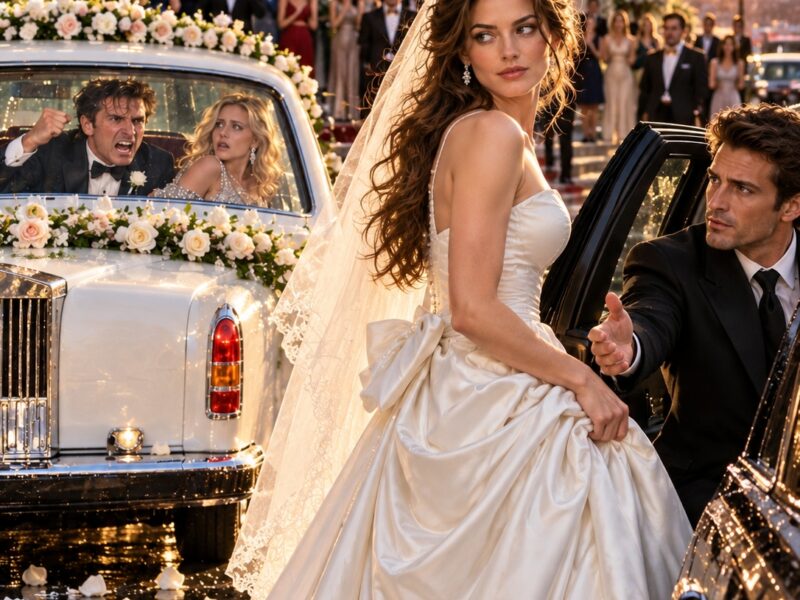
My Fiancé Put His First Love in My Wedding Car and Left Me on the Curb—So I Walked Away and Married the Rival He Feared Most
My fiancé put another woman into my wedding car and told me to wait for the next one.
I was standing beneath the awning of the Bellevue House in Newport, Rhode Island, wearing an ivory silk gown my mother would never live to see, when Savannah Pierce slipped on the wet limestone steps.
She did not fall far.
One heel skidded sideways.
Her right knee touched the pavement.
Her silver dress tore at the hem.
Then she screamed my fiancé’s name.
“Ryan!”
Ryan Pembroke was beside her before I had processed what happened.
He dropped to one knee.
“Don’t move.”
Savannah grabbed his lapels with both hands.
“My ankle.”
Her face had gone pale.
“I heard something crack.”
Behind me, the string quartet stopped tuning.
The wedding coordinator hurried down the steps.
“Should I call an ambulance?”
“No.”
Savannah answered so quickly everyone looked at her.
She swallowed.
“I hate ambulances.”
Ryan touched her arm.
“Savannah.”
“You know why.”
His face changed.
I knew why too.
Savannah’s father had died after a car accident when she was seventeen.
For the past five years, that history had functioned as an explanation for many things.
Her fear of hospitals.
Her panic around sirens.
Her need to call Ryan whenever anything went wrong.
It had never before involved my wedding.
I looked toward the curb.
My father’s Bentley waited beneath the rain.
Cream paint.
White roses woven around the rear windows.
A small brass plaque fixed above the bumper.
CLAIRE & RYAN.
The car had carried my parents away from their wedding thirty-six years earlier.
After my mother died, Dad stored it in a climate-controlled garage and refused every request from museums, magazines, and charity events.
He spent eight months restoring it for me.
Savannah knew that.
She had listened to my father tell the story at the rehearsal dinner twelve hours earlier.
Ryan looked at the Bentley.
“I’ll take her to urgent care.”
I stared at him.
“What?”
“It’s four minutes away.”
“In my wedding car?”
He stood.
Savannah leaned heavily against him.
“The driver’s right there.”
“Ryan.”
“Claire, she may have broken her ankle.”
“So call the ambulance.”
Savannah shook her head.
“No, please.”
I looked directly at her.
She looked directly back.
For one second there was something strange in her eyes.
Not pain.
Attention.
As though she was watching to see what I would do.
Ryan’s mother, Patricia Pembroke, came through the hotel doors.
She saw Savannah.
Then me.
Then the car.
Her decision took less than three seconds.
“Ryan, go.”
I turned.
“The ceremony starts in eighteen minutes.”
“We can delay.”
“There are two hundred guests already seated.”
Patricia touched my elbow.
“Claire, this is not the moment to become territorial over a car.”
Territorial.
I looked down at her hand until she removed it.
Ryan bent and lifted Savannah into his arms.
She wrapped one arm around his shoulders.
“Ryan.”
He looked at me.
“I’ll meet you at the chapel.”
“If that ankle is broken, you won’t.”
“We’ll figure it out.”
“Call an ambulance.”
“She asked me not to.”
“And I am asking you not to take my father’s wedding car.”
His face hardened.
That expression was familiar.
The one that meant my objection had become the problem.
“Claire.”
“No.”
“Do not turn this into something ugly.”
Savannah rested her head against his shoulder.
“I told him you’d be upset.”
I stared at her.
There it was again.
No tears.
No grimace.
No uncontrolled physical reaction.
Only careful awareness.
Ryan opened the Bentley’s rear door.
I stepped forward.
“Put her in the hotel car.”
“The hotel car isn’t here yet.”
“There are six black SUVs parked twenty feet away.”
“They belong to guests.”
“My father would give you his kidneys right now if you asked.”
Ryan closed his eyes.
“Claire, enough.”
The rain tapped against the awning.
Nobody around us spoke.
Ryan placed Savannah on the cream leather seat.
He gathered the torn silver fabric away from the door.
Then he climbed into the back beside her.
I stood there.
In my wedding dress.
Holding a bouquet.
Watching.
Ryan lowered the window.
“Take the bridesmaids’ car.”
I said nothing.
“Claire.”
He softened his voice.
“I love you.”
That made it worse.
“Wait for the next one.”
The window rose.
The Bentley pulled away.
One white rose came loose from the rear garland.
Then another.
The second landed in the gutter.
The car turned at the end of the block.
Gone.
My maid of honor, Elise Morgan, stepped beside me.
She had known me since college and possessed the useful quality of never filling silence simply because it frightened her.
“What do you need?”
“My phone.”
She handed it over.
I called my father.
He answered immediately.
“We’re five minutes from the chapel.”
“Dad.”
Something in my voice changed his.
“What happened?”
“Don’t go inside.”
Silence.
“Claire.”
“Ryan left.”
“What do you mean left?”
“Savannah fell.”
Another silence.
This one harder.
“He took her to urgent care.”
“In what?”
I looked at the wet street.
“The Bentley.”
My father breathed once through his nose.
Then asked the only question that mattered.
“Are you safe?”
My eyes burned.
Not What explanation did he give?
Not Can the ceremony still happen?
Not What will people say?
Are you safe?
“Yes.”
“Where do you want me?”
“Hotel.”
“I’m coming.”
“Bring Marcus.”
Marcus Levin had been our family attorney for twenty-three years.
My father did not ask why.
“Ten minutes.”
I ended the call.
Then called the chapel.
Reverend Hall answered.
“Claire?”
“The wedding is canceled.”
He became quiet.
“Are you certain?”
“Yes.”
“There are approximately—”
“I know.”
My hand shook.
“Please tell everyone there has been a change.”
I looked toward the hotel.
“The reception still happens.”
“Claire?”
“The food is cooked.”
“Staff are working.”
“Guests traveled.”
“Everyone gets paid.”
“There will simply be no marriage.”
“What do I tell them?”
“The truth.”
I swallowed.
“The bride and groom will not be arriving.”
I ended the call.
The wedding coordinator stared at me.
“What should we do with the vendor payments?”
“Freeze anything remaining that goes directly to Pembroke Development or vendors Ryan personally contracted.”
Her eyes widened.
“Preserve every invoice.”
“Every text.”
“Every change order.”
“Pay the hotel employees from my event account.”
“Should I contact Mr. Pembroke?”
I looked toward the road.
“He knows where his wedding is.”
Elise put one arm around me.
That was when my legs started shaking.
She got me upstairs before they failed.
The suite door closed.
My knees hit the carpet.
The corset of my dress would not let me fold forward enough to breathe.
“Elise.”
“I’m here.”
“I can’t—”
“I know.”
She began undoing buttons.
I pressed my palms against the floor.
One bridesmaid whispered:
“He’ll come back.”
I laughed.
It sounded awful.
“That’s the problem.”
They looked at me.
I stared at the carpet.
“Ryan always comes back.”
Savannah had been Ryan’s childhood friend.
First girlfriend.
First heartbreak.
Permanent emergency.
They grew up three streets apart in Providence.
Dated through high school.
Separated after college when Savannah chose costume design in Chicago and Ryan refused to leave Rhode Island.
Years passed.
Savannah married somebody else.
Ryan built Pembroke Development with his mother.
Then Savannah divorced.
Two years before our wedding, she returned.
Since then she had experienced a flat tire during our anniversary dinner.
Food poisoning at my father’s birthday.
A panic attack during our engagement party.
A burst pipe the weekend Ryan and I chose our venue.
Every crisis required Ryan.
Every objection from me was translated into character.
When I stayed quiet, I was compassionate.
When I objected, I was jealous.
Ryan had always returned.
To dinner.
To my bed.
To the plans.
To me.
That afternoon I finally understood returning was not the same as choosing.
Elise helped me out of the gown.
I put on black trousers, a white blouse, and the camel coat from our rehearsal dinner.
Ten minutes.
That was all it took to stop looking like a bride.
I stared at the dress lying across the bed.
It felt less like changing clothes than leaving a body behind.
My father arrived with Marcus.
Dad stopped when he saw the gown.
His mouth tightened.
“I can report the Bentley stolen.”
Despite everything, I almost smiled.
“He had permission to drive it to the chapel.”
“Not to take his ex-girlfriend sightseeing.”
“Find the car first.”
“Fight later.”
Marcus opened his laptop.
“Before we discuss anything financial, one question.”
I sat.
“Did you sign the marriage license?”
“No.”
“Was any ceremony performed?”
“No.”
“Did you make a verbal declaration in front of the officiant?”
“I never reached the chapel.”
Marcus nodded.
“Then you are not married.”
My father handed me water.
“What financial issue?”
I looked at Marcus.
He grimaced.
“You instructed us to keep the final structure confidential until after the ceremony.”
Dad’s eyes moved between us.
“What structure?”
The Pierhaven project was supposed to transform thirty-eight acres of abandoned Newport waterfront.
Hotel.
Apartments.
Market hall.
Public park.
Restored shipyard structures.
My family controlled the land through Sutton Maritime Holdings.
Pembroke Development controlled several preliminary permits and the hotel-development concept.
Ryan and I had proposed merging our interests after marriage.
Six months earlier, to reassure lenders, I signed what we called a marital contribution agreement.
Twenty-eight percent of Sutton Waterfront LLC would move into a jointly controlled spousal entity.
Ryan would contribute his Pembroke equity.
Together, after marriage, we would control the development.
My father stared.
“You signed away twenty-eight percent?”
“No.”
Marcus rotated the laptop.
“She signed a conditional escrow instruction.”
The distinction mattered.
The transfer became effective only after two events.
A lawful marriage.
And filing the executed marriage certificate.
No marriage.
No transfer.
The condition had felt conservative when Marcus proposed it.
Now it looked like a locked door Ryan had failed to reach.
My father sat down.
“Did Ryan know?”
“He signed the agreement.”
“That isn’t what I asked.”
I looked at him.
“I don’t know how carefully he read it.”
Marcus said:
“We freeze every Pierhaven transfer.”
“Now.”
I nodded.
“Notify escrow that no marriage occurred.”
Marcus began typing.
My father watched me.
Then asked quietly:
“Did he want the land?”
The question hurt differently.
Not because I believed the answer was yes.
Because I could no longer confidently say no.
My phone began vibrating.
Messages.
Guests.
Ryan’s mother.
Wedding vendors.
I turned it facedown.
Twenty minutes later Patricia texted:
Savannah’s ankle is badly sprained. I hope when you calm down you understand how cruel canceling the wedding over a medical emergency looks.
Ryan sent nothing.
At three nineteen, Dad opened the Bentley tracking app.
The car had left urgent care.
The ceremony had been scheduled for two.
At three thirty-eight, Ryan finally called.
I stared at his name.
Answered.
“We’re coming.”
No hello.
“Tell Reverend Hall to shorten the service.”
“There is no service.”
Silence.
“What?”
“I canceled it.”
“Claire.”
“Yes.”
“Do not do this.”
“I already did.”
“You canceled our wedding because I took an injured friend to a clinic?”
“I canceled because you left me on a sidewalk in a wedding dress after I asked you not to.”
“She couldn’t walk.”
“An ambulance could.”
“She panics in ambulances.”
“A hotel car could.”
“There wasn’t one.”
“Four guests offered SUVs.”
He said nothing.
I continued.
“You wanted my car.”
“This is about a car?”
“No.”
“The car made the answer visible.”
His breathing changed.
“Where are you?”
“Hotel.”
“Stay there.”
That word.
Stay.
After everything.
As though my continued availability were a resource he controlled.
“We have two hundred guests,” he said.
“Our investors are there.”
“The lieutenant governor’s office sent someone.”
“This isn’t a game.”
“I know.”
“Wait for me.”
Marcus looked up.
The escrow confirmation appeared on his screen.
TRANSFER SUSPENDED — CONDITION NOT SATISFIED.
I stood.
“I’m leaving.”
“Claire, don’t.”
“Goodbye, Ryan.”
I ended the call.
Dad had another vehicle brought to the service entrance.
Plain black SUV.
No flowers.
No family history.
Elise came with me.
As we pulled out, the Bentley entered the circular drive.
Ryan sat in front beside the driver.
Savannah sat in back.
Gray brace around her ankle.
My white wedding roses across her lap.
Our cars passed.
Ryan recognized me.
He twisted around.
The Bentley stopped abruptly.
Ryan got out before it fully settled.
He ran after our SUV.
“Claire!”
I watched through the rear window.
He made it half a block.
I did not ask the driver to slow down.
That night, the reception continued without us.
Guests ate lobster beneath our initials.
A jazz trio played songs we had chosen for a marriage that did not exist.
Elise’s husband sent us one video.
Ryan stood in the center of the ballroom.
Still in his tuxedo.
“Where is Claire?”
Nobody answered.
Then Savannah appeared behind him on crutches.
The brace remained.
She looked toward the camera.
For perhaps half a second—
She smiled.
Then lowered her face.
I slept at Dad’s waterfront house.
At six the next morning Ryan arrived at the gate.
He stayed for three hours.
I did not let him in.
He used those three hours efficiently.
Called Elise.
Told her I was in shock.
Called Dad.
Called Marcus.
Called two board members.
Told Patricia to organize a “family breakfast.”
At nine twenty-seven, Savannah posted a photograph from urgent care.
Her wrapped ankle rested across Ryan’s lap.
My wedding roses stood in a plastic pitcher beside them.
Some people show you exactly who they are when plans become inconvenient. Grateful for the friend who never leaves anyone behind.
I stared at it.
Then laughed once.
Dad looked over his coffee.
“What?”
“She made herself the abandoned one.”
By noon, a society account reported that I had “disappeared shortly before my ceremony after an emotional disagreement about the groom helping an injured family friend.”
Anonymous sources described me as stressed.
Possessive.
Under pressure from Pierhaven.
Patricia called Dad demanding a statement protecting Ryan.
My father listened for approximately twelve seconds.
Then hung up.
He entered the kitchen looking pleased.
“Your mother would’ve used more words.”
“Mom would have called back to make sure Patricia understood every one.”
We ate toast.
It was strangely comforting.
At ten, Marcus arrived with paperwork.
And a man Ryan hated.
Julian Mercer.
Thirty-eight.
Architect.
Former design director at Pembroke Development.
Founder of Mercer Studio.
The man Ryan had called, more than once, “the most expensive betrayal of my career.”
Julian wore a navy sweater and carried drawings.
He stopped in the kitchen doorway.
His gaze went from me to Dad to the wedding flowers somebody had dumped into a pitcher beside the sink.
“I can come back.”
I looked at Marcus.
“Why is he here?”
“Pierhaven.”
Julian put the drawings down.
“Your permits depend partly on Pembroke’s design package.”
“If Sutton removes them, somebody has to determine what belongs to the site and what remains their intellectual property.”
I looked at Marcus.
“You called Ryan’s former architect the morning after my wedding?”
“Canceled wedding.”
Marcus opened a folder.
“Precision helps.”
Julian’s mouth shifted.
Not quite a smile.
During the next hour, he explained the project without treating me like a woman who had been publicly abandoned twelve hours earlier.
No pity.
No false gentleness.
Just facts.
Pembroke controlled architecture licenses and consultant agreements.
Sutton controlled land, waterfront access, and historic easements.
If the partnership collapsed, nobody got everything.
Could Pembroke seek reimbursement?
Yes.
Could they take the land?
Not without the marriage-triggered contribution agreement.
Julian glanced at the contract.
“Did Ryan know that?”
“He signed it.”
I paused.
“That is not the same thing.”
Julian looked at me.
“No.”
“What happened between you two?”
“Ryan and me?”
“Yes.”
Julian rolled one drawing closed.
“He wanted to move a public waterfront walkway behind loading access at a Miami project.”
“Why?”
“Private shoreline.”
“I refused to stamp it.”
“He told me you leaked confidential plans.”
“I presented them at a zoning hearing.”
“It was mandatory.”
I remembered Ryan returning from Miami furious.
He had called Julian disloyal.
Jealous.
Unstable.
Julian shrugged.
“The truth usually has poor marketing.”
He gathered his papers.
“I’ll send Marcus the assessment.”
“You don’t want the contract?”
“Eventually.”
He met my eyes.
“Not now.”
“Why?”
“Because hiring me directly twenty-four hours after canceling your wedding to my former boss will look like retaliation.”
I stared.
“You’re turning down work?”
“I’m postponing my opportunity to overcharge you until the optics become defensible.”
I laughed.
First real laugh since the Bentley left.
Julian smiled.
Only slightly.
Then walked out.
That afternoon Ryan held a press conference.
A press conference.
About our canceled wedding.
He stood outside Pembroke Development’s Providence headquarters in an open-collar shirt.
Patricia beside him.
Savannah absent.
Her gray ankle brace did excellent public-relations work without her.
Ryan said the wedding had been “postponed following an emotional misunderstanding.”
He loved me.
Expected reconciliation.
Pierhaven would continue.
Then he made his mistake.
“Natalie—”
He stopped.
Used my name correctly.
“Claire and I have binding agreements reflecting our shared future.”
He meant the property document.
Marcus called before the stream ended.
“He’s going to use it.”
“Let him.”
“If we correct him now, he adjusts.”
“Exactly.”
Silence.
“Claire.”
“He needs to put his interpretation on the record.”
Marcus sighed.
“Your mother would’ve liked you today.”
“She created this version.”
My statement contained four sentences.
The wedding was canceled, not postponed.
No marriage occurred.
Sutton Maritime has suspended the Pierhaven partnership pending review.
I wish Ms. Pierce a quick recovery.
Elise laughed for an entire minute over the last sentence.
Ryan returned after dark.
This time I met him at the gate.
He looked exhausted.
“You brought Mercer into this.”
“Marcus requested a technical assessment.”
“Julian has wanted Pierhaven for years.”
“He refused the engagement.”
“Of course.”
Ryan laughed.
“He performs virtue whenever you’re watching.”
“How would he know I was watching?”
That silenced him.
He grabbed one iron bar of the gate.
“Claire.”
“Don’t turn one terrible afternoon into corporate warfare.”
“You held a press conference.”
“Because you froze a billion-dollar project.”
“I froze a transfer of my family’s land that depended on a marriage you abandoned.”
“I didn’t abandon you.”
“Savannah was injured.”
“She refused an ambulance.”
“You know why.”
“I know you chose her request over mine.”
His grip tightened.
“I was coming back.”
“You called one hour and thirty-eight minutes after the ceremony time.”
He closed his eyes.
“What do you want?”
“Complete separation of our personal property.”
“Every Pierhaven expense.”
“No public claims about reconciliation.”
His face changed.
“You’re ending five years because I helped someone who was hurt?”
“It ended in the Bentley.”
“Because of a car?”
“Because you told me to wait.”
I stepped closer to the gate.
“And for the first time, I decided not to.”
His expression softened.
That was more dangerous than anger.
He knew how to become the man I had loved.
“Claire.”
His voice broke slightly.
“I made the wrong call.”
I said nothing.
“I should’ve put Savannah in another car.”
“Yes.”
“I should’ve stayed.”
“Yes.”
“I’m sorry.”
My throat tightened.
“Come inside.”
He touched the gate.
“Please.”
“Let me hold you.”
“We cancel the honeymoon.”
“Take a week.”
“Private ceremony.”
“No guests.”
“No pressure.”
For one terrible moment, I wanted it.
Five years did not disappear because clarity arrived.
I wanted him in Dad’s kitchen.
Shoes by the door.
Coffee in his hand.
I wanted my old life to become recognizable again.
Then his phone lit.
Savannah.
He turned the screen toward his leg.
Too late.
“Answer.”
“She’s probably checking in.”
“Answer it.”
He declined the call.
Then looked at me.
“See?”
“I’m choosing you.”
Everything inside me went quiet.
“That’s the problem.”
His forehead creased.
“What?”
“I don’t want to spend a marriage watching you decline Savannah’s calls as proof that I matter.”
“Claire.”
“You still think choosing me is an action you perform when I’m watching.”
I stepped backward.
He called after me.
“The agreement is signed.”
I stopped.
“Pierhaven doesn’t disappear because you’re angry.”
I looked over my shoulder.
“Show it to the board.”
The Bentley came home the next morning.
The driver delivered it to Dad’s garage.
Roses gone.
Mud on the carpet.
Pharmacy receipt in the side pocket.
Half-empty champagne bottle beneath the rear seat.
Dad stared at it.
“I did not put champagne in this car.”
Marcus crouched.
“Don’t touch anything.”
The Bentley had an aftermarket security system installed during restoration.
Exterior cameras.
GPS.
Cabin audio triggered automatically after unusual braking or collision events.
Dad had insisted on it because the car was irreplaceable.
The driver mentioned the system had saved data after Ryan’s hard stop when he jumped out to chase my SUV.
We opened the file with Marcus present.
Timestamp.
1:44 p.m.
Savannah sat alone in the back seat outside urgent care.
Ryan was inside speaking with reception.
She looked through the window.
Then removed the silver heel from her supposedly injured foot.
She put both feet on the floor.
Stood.
Walked three steps.
No limp.
My stomach dropped.
Savannah opened the champagne compartment.
Poured herself a glass.
Called someone.
“He came.”
Pause.
“Of course he came.”
She laughed.
“She looked ready to murder me.”
Another pause.
“No.”
“She won’t cancel.”
I leaned closer.
“Pierhaven closes Monday.”
“She needs him.”
The caller answered too faintly to understand.
Savannah laughed again.
“I didn’t break anything.”
She looked at her ankle.
“I twisted it enough to sell the moment.”
Dad swore.
Marcus did not react.
Lawyers are trained for gifts from heaven.
At two thirty-six Ryan returned.
“The scan is clear.”
Savannah reclined immediately.
“Sprain.”
“We need to leave.”
“Let Claire wait.”
“The ceremony started half an hour ago.”
“Then it’s already ruined.”
“Savannah.”
“Stay with me ten minutes.”
“You promised I would always matter.”
A long silence.
Then a cork popped.
At two fifty-four Ryan spoke.
“Claire will be furious.”
Savannah laughed softly.
“But?”
Ryan answered:
“She signed the transfer.”
My hand went cold.
“She can’t blow up Pierhaven without blowing up her father.”
“She’ll still be there.”
Savannah leaned across the seat.
Kissed him.
Ryan did not move away.
The video ended six minutes later.
Marcus closed the laptop.
Dad stood very still.
I looked at the Bentley.
My mother’s car.
My father’s restoration.
My wedding flowers.
The place where two people had calculated my tolerance.
Marcus said:
“We preserve everything.”
I nodded.
“Then?”
“Then we negotiate from facts.”
“No.”
He looked at me.
“Then we let Ryan show everybody the agreement.”
The emergency Pierhaven steering committee met Tuesday.
Ryan requested it.
Invited both boards.
Lead lender.
City observers.
Reporters.
He accused Sutton Maritime of using a personal dispute to seize Pembroke Development’s work.
I approved the press.
Marcus hated that.
“You want cameras?”
“I want Ryan confident.”
The meeting took place in a waterfront hotel ballroom overlooking our parcel.
Old shipyard.
Rusting rail lines.
Brick warehouses.
Thirty-eight acres my grandfather had refused to sell.
Pierhaven was supposed to become something better.
That mattered.
I did not want my wedding disaster to erase why the project existed.
Ryan entered at nine.
Patricia beside him.
Two lawyers.
Savannah on crutches.
Gray brace.
Pale blue dress.
Her face composed.
Julian Mercer did not attend.
He had submitted his technical assessment through counsel and stayed in Boston.
Smart man.
The chair opened proceedings.
“First question.”
“Did the wedding produce a legal ownership transfer?”
Ryan stood.
“Yes.”
His attorney projected the marital contribution agreement.
My signature appeared.
So did Ryan’s.
Ryan looked around the room.
“Ms. Sutton voluntarily executed a transfer of twenty-eight percent of Sutton Waterfront LLC into our joint entity.”
“That commitment secured Pembroke’s investment.”
“She cannot revoke it because she became emotional over a private matter.”
My father turned sharply toward me.
He knew the structure now.
Still hated seeing it on a screen.
The committee chair asked:
“Ms. Sutton.”
“Did you sign this?”
“Yes.”
Ryan relaxed.
“Did you understand it involved ownership?”
“Yes.”
His lawyer smiled.
Ryan believed he had won.
I stood.
“Page two.”
His attorney hesitated.
Marcus handed a complete copy to the chair.
Page two appeared.
I pointed.
“The agreement becomes effective upon solemnization of a lawful marriage between Ryan Pembroke and Claire Sutton and subsequent recording of an executed marriage certificate.”
The room quieted.
“Until both conditions are completed, the instrument remains an escrow instruction and conveys no ownership.”
The chair read it.
Ryan leaned forward.
“She prevented the ceremony.”
I looked at him.
“You left in my car.”
Someone laughed near the back.
Quickly stopped.
Ryan’s lawyer whispered in his ear.
He pushed the man away.
“We had a binding agreement to marry.”
“No.”
“We had a wedding scheduled.”
I held up the unsigned Rhode Island marriage license.
“Adults remain free not to marry until the marriage actually happens.”
The chair turned toward Ryan’s counsel.
“Was Mr. Pembroke advised regarding the condition?”
His own lawyer answered.
“Our written advice accurately described it.”
Ryan looked at him.
Betrayed.
But nobody had betrayed him.
He simply had not read.
Patricia’s face went rigid.
Savannah lowered her crutches slightly.
A reporter began typing.
Ryan stood.
“This doesn’t excuse Claire’s own scheme.”
My stomach tightened.
He produced an email.
Six months earlier, I had written Julian after Pembroke missed the second deadline for a flood-wall redesign.
If Pembroke cannot deliver a compliant plan by March, would Mercer Studio be available to assess replacement options?
Julian responded:
I can review risk assumptions, but I will not solicit Pierhaven while contractual restrictions remain.
A photograph appeared.
Julian and me at a Boston restaurant.
Drawings between us.
Ryan looked at the board.
“She was negotiating with my competitor while engaged to me.”
“Then she used Savannah’s accident to create a reason to cancel the wedding and replace Pembroke.”
The room changed.
I felt it.
My father stared at me.
Marcus closed his eyes.
The chair asked:
“Did this meeting occur?”
“Yes.”
“Did you disclose it?”
“No.”
Ryan smiled.
“Was Mercer preparing a competing design?”
“No.”
“Why was the communication confidential?”
I could have blamed Ryan.
His temper.
His obsession with Julian.
His refusal to hear bad technical news when it came from somebody he disliked.
All true.
Also convenient.
I took a breath.
“Because I believed my concern justified avoiding proper committee disclosure.”
Ryan’s smile faded slightly.
“I was wrong.”
The room grew quiet.
Marcus looked at me.
I continued.
“I was trying to protect the land from an engineering risk.”
“But I bypassed governance because I expected the discussion to become personal.”
“My reasons do not erase the omission.”
The chair called a recess.
Dad pulled me into the corridor.
“Why didn’t you tell me?”
“Because you would have told Ryan.”
“I was chairman.”
“And you wanted this wedding.”
His face tightened.
“You think I would have ignored a safety issue?”
“No.”
“I think you would have told me to work it out with my fiancé.”
“That’s unfair.”
“Is it false?”
He did not answer.
When the meeting resumed, the committee ruled the marriage-triggered land transfer invalid.
Sutton retained the property.
Then it placed me on temporary leave from Pierhaven.
Independent review.
My undisclosed Julian contact required investigation.
Julian and Mercer Studio were temporarily barred from bidding.
The lender paused commitments.
Ryan had lost the land transfer.
And still succeeded in damaging me.
Outside, cameras swarmed.
Savannah stood beside him on her crutches.
A reporter shouted:
“Ms. Sutton, did you cancel the wedding to replace Pembroke Development with your fiancé’s rival?”
“No.”
“Are you romantically involved with Julian Mercer?”
“No.”
“Why meet him secretly?”
“Because I made a poor governance decision while trying to protect the project.”
I looked directly toward the cameras.
“The review will receive the complete record.”
That answer did not trend.
The photograph did.
By dinner, I was the runaway bride who had been secretly planning a corporate coup with my fiancé’s enemy.
Ryan texted:
End this. Restore Pembroke. Say Mercer was a mistake. I’ll make the rest disappear.
I replied:
You already disappeared.
My leave blocked internal Pierhaven records.
It did not block my wedding records.
Or Dad’s car.
Or public permit files.
Marcus preserved the Bentley data.
The recording proved Savannah had exaggerated her injury.
It proved Ryan knew the property agreement existed.
It proved he believed I would wait because my family needed Pierhaven.
It proved the kiss.
It did not prove I had acted correctly with Julian.
For that, I needed his records.
I called.
He answered:
“I can’t speak to you directly while the review is active.”
“Then pretend this is about the weather.”
“No.”
“Worth trying.”
“I sent everything through counsel.”
“What everything?”
“The February meeting file.”
“Your invitation.”
“My refusal to prepare a replacement scheme.”
“And the flood memo I sent Pembroke three months before you contacted me.”
I stopped.
“What?”
“I warned them first.”
“Twice.”
Ryan’s team had rejected Julian’s recommended seawall because it reduced the private marina by eighteen slips.
I remembered being copied on one email.
Then calling Ryan during the Boston meeting.
Julian said:
“You left the table to take that call while I explained the earlier memo.”
I closed my eyes.
“I forgot.”
“I know.”
“That isn’t an excuse.”
“No.”
Silence.
“Julian.”
“Yes?”
“I’m sorry your name is in this.”
“I believe you.”
My throat tightened.
He continued.
“That doesn’t repair the week.”
“No.”
He ended the call.
That mattered.
He did not turn my apology into immediate access.
He did not rescue me.
He protected his own boundary.
It irritated me.
It also made me trust him more.
I looked for the missing piece.
If Ryan needed the marriage certificate to trigger the land transfer, why stay at urgent care?
Savannah’s kiss explained desire.
Not confidence.
Elise found the answer.
Wedding-planning messages.
Three days before the ceremony, Patricia had emailed Reverend Hall.
If the bride arrives late, can the ceremony proceed and signatures be completed at the reception?
He answered:
Both parties must appear, consent, and sign personally.
Patricia forwarded it to Ryan.
One sentence.
Do not let Savannah delay you beyond 2:30. The land documents require the certificate.
I stared.
Ryan knew.
He had stayed anyway.
Not because he misunderstood.
Because he believed I would remain available no matter how publicly he deprioritized me.
That was worse than fraud.
More intimate.
The actual financial misconduct appeared two days later.
Wedding invoices.
Savannah’s Bellevue House suite.
Paid by Pembroke Development.
Her stylist.
Paid through Pierhaven’s community-relations budget.
Her silver dress.
Same.
Transportation.
Same.
Savannah had been listed as:
STAKEHOLDER RELATIONS CONSULTANT.
I laughed when I read it.
Then stopped.
Because somebody had intentionally spent project money to bring Ryan’s former lover to our wedding in a designer dress.
Marcus sent everything to the independent investigator.
Savannah stopped using crutches the next day.
Social media disappeared.
Ryan went on television and complained that private vehicle recordings had been weaponized.
He did not discuss the champagne.
The kiss.
Or his belief that I could not leave because of the land.
The city did not care which woman he loved.
It cared that public-development money may have funded his private affair.
That distinction saved me from turning the hearing into a revenge spectacle.
Before the formal review, Savannah asked to meet.
I brought Elise.
Hotel café.
Neutral ground.
Savannah arrived in flats.
No brace.
“I did hurt my ankle.”
“You also said you twisted it enough to sell the moment.”
Her mouth tightened.
“I was embarrassed.”
“Why are we here?”
She removed her sunglasses.
“Ryan says the invoices were your policy.”
“Did you perform community-relations work?”
“I introduced him to two donors.”
“For a museum board.”
Silence.
“No.”
She looked toward Elise.
No sympathy there.
Savannah rubbed the edge of the table.
“He told me you knew.”
“Knew what?”
“About us.”
“When?”
“March.”
I stared.
“He said your relationship had become an arrangement.”
“Pierhaven.”
“Family expectations.”
“He said after the land transfer you would separate quietly.”
I leaned back.
“You attended my bridal shower in April.”
“I thought you were performing.”
“Did I behave as if I knew?”
Savannah looked down.
“No.”
“Then you knew he might be lying.”
“Yes.”
“Why the wedding day?”
Her eyes filled.
Not innocent tears.
Real ones.
Because selfish people can still hurt.
“Everyone treated me like the mistake he survived before becoming respectable.”
She looked out the window.
“Patricia invited me to holidays.”
“Ryan called whenever he felt trapped.”
“Then he went home to you.”
“I got tired of being where he escaped.”
“So you decided I should be the person abandoned instead.”
She flinched.
“I thought if he chose me in public, he couldn’t undo it later.”
“You were right.”
“I know.”
“Did he promise to marry you?”
Silence.
“No.”
“Did he say you would be together?”
“He said we would finally have a real chance.”
Not the same.
She opened her phone.
Messages.
Ryan had promised her a leadership role in brand partnerships after Pierhaven closed.
Another message from the night before the wedding:
Do not create a scene before the ceremony. If anything interferes with the license, everything changes.
Savannah looked at me.
“He knew I wanted to interrupt.”
“After.”
“He told me to wait until the reception.”
I felt cold.
“I came early.”
“Why?”
“Because I thought once he married you, he would never leave.”
There it was.
Ryan planned to marry me.
Secure the land.
Then confess his affair under controlled circumstances.
Savannah changed the order because she did not trust him.
Neither had treated me as a person.
Only as an obstacle with timing.
“Will you give these messages to the review?”
She looked frightened.
“What happens to me?”
“I don’t know.”
“Can you protect me?”
“No.”
Her eyes hardened.
“You could.”
“I could influence people.”
“That is different.”
“I will not trade protection for testimony.”
She stared.
For a long time.
Then nodded.
“I’ll send everything.”
At the door she turned.
“He loved me first.”
I met her eyes.
“That did not give you my wedding day.”
She left.
I did not forgive her.
I also stopped needing her to be a monster.
Understanding why someone wants something does not erase what they did to obtain it.
The public hearing took place in Providence City Hall.
Ryan at one table.
Patricia beside him.
Pembroke counsel.
Savannah at another with her own lawyer.
Dad and I behind Marcus.
Julian across the aisle.
He barely looked at me.
Good.
The investigator began with my conduct.
She confirmed I had contacted Julian privately.
No competing bid.
No pricing discussion.
No secret contract.
But I had failed to disclose the meeting.
Violation.
Sutton Maritime formally reprimanded me.
I lost my vote in the upcoming architecture selection.
I stood.
“I accept the finding.”
The room quieted.
“I believed avoiding Ryan’s reaction would let me address the engineering problem more efficiently.”
“I was wrong.”
“My choice weakened the credibility of a legitimate safety concern and involved Mr. Mercer’s reputation without appropriate disclosure.”
Julian looked at me then.
Only once.
The investigator moved to the engineering record.
Julian had warned Pembroke months earlier.
City engineers agreed with him.
Ryan’s team rejected the safer seawall because it reduced premium marina capacity.
The restaurant photograph remained real.
The story Ryan attached to it did not.
Then came the property agreement.
No marriage.
No transfer.
Simple.
Then the Bentley video.
Savannah walking.
Champagne.
Her words.
I twisted it enough to sell the moment.
Murmurs.
Ryan saying:
Claire signed the transfer. She’ll still be there.
The room changed.
Then the kiss.
Muted.
It needed no sound.
Ryan stared ahead.
The final section showed the wedding expenses.
Savannah’s dress.
Hotel room.
Stylist.
Pierhaven money.
Ryan’s approval.
Patricia had received two expense reports and never questioned them.
Then Savannah’s messages.
Interrupt after the ceremony. Once the certificate is signed, nothing changes the land deal.
Her answer:
If I wait, you won’t come with me.
Ryan:
Trust me.
People laughed.
Not kindly.
Ryan stood.
“I made personal mistakes.”
The investigator paused.
“They do not erase Pembroke Development’s contribution.”
“Pierhaven exists because I assembled the team.”
Dad spoke beside me.
“It exists because my family kept that land for sixty-three years.”
Ryan looked at me.
“Claire.”
“Tell them.”
“You know what I built.”
“You did build part of it.”
I said it because truth mattered even when inconvenient.
“That legitimate work will be valued and reimbursed.”
Relief flickered across his face.
Then died.
“It does not give you my land.”
“Or excuse false expenses.”
“We can repay those.”
“Then repay them.”
“And us.”
The microphone carried my answer clearly.
“There is no us.”
His face broke.
Just briefly.
Savannah looked toward him.
Maybe waiting for her reward.
Ryan never turned.
Pembroke Development’s board suspended him that afternoon.
Patricia resigned rather than face a no-confidence vote.
Pierhaven terminated Pembroke’s development role for improper expenses and material design failures.
The company received compensation for legitimate work already completed.
No theft.
No revenge.
A clean separation.
Outside, Ryan caught me on the courthouse steps.
“You won.”
I looked at him.
“This isn’t what winning looks like.”
“You kept the land.”
“You kept the project.”
“And Mercer gets what he wanted.”
I sighed.
“I lost a wedding.”
“A partner.”
“My authority for the next design selection.”
“And months of my life explaining why your affair was not a corporate strategy.”
He looked toward Julian.
“He wanted this.”
“He warned you about a seawall.”
“He wants you.”
That possibility had existed quietly for some time.
I finally admitted it.
“Maybe.”
Ryan’s face tightened.
Julian heard nothing.
He was already walking away with his attorney.
The consequences arrived without dramatic music.
Savannah repaid money connected to the false consulting arrangement through a civil settlement.
She lost design work.
Not forever.
Enough to force her to rebuild.
Patricia moved off Pembroke’s board.
Ryan was eventually terminated after auditors discovered other personal expenses mixed into project accounts.
He sold a vacation property and part of his equity to cover repayments.
No prison.
None was necessary.
The company survived under professional leadership.
I returned to Pierhaven after fulfilling the terms of my reprimand.
Julian and I communicated only through formal channels for three months.
I hated how much I noticed his absence.
The new development competition was blind.
Six teams.
Four architecture firms.
I had no vote.
Julian delegated Mercer Studio’s presentation to partners.
They won.
Independent panel.
Highest technical score.
Best flood protection.
Strongest public-waterfront design.
Ryan called it fixed.
Nobody found evidence.
For once, I did not answer him.
Two days after the contract award, Julian texted:
The review is complete. Can I buy you dinner without becoming Exhibit A?
I read the message while sitting in the Bentley.
I had avoided the car for months.
Then one Saturday I drove it alone along Ocean Avenue until cream leather stopped making my hands tremble.
I typed:
Only if we arrive separately.
He answered:
That ruins my elaborate plan to steal your father’s car.
Dinner was chowder and paper menus in a small harbor restaurant.
No valet.
No photographers.
Julian had chosen it for precisely those reasons.
“Romantic.”
“I considered the city council cafeteria.”
“Excellent recovery.”
For thirty minutes we discussed nothing related to Ryan.
Julian grew up above his parents’ hardware store in Worcester.
Studied architecture because he loved railway stations.
Divorced at twenty-nine.
No scandal.
No enemy.
His former wife now lived in Seattle with her wife and occasionally texted him about ugly buildings.
“Why haven’t you remarried?”
“I date badly.”
“How?”
“One woman told me I turn every conversation into a site analysis.”
I looked around.
“Do you?”
“The emergency exit is poorly located.”
I laughed.
Then he became serious.
“I don’t want to be the man who benefits from what happened to you.”
“You did benefit professionally.”
“Yes.”
“Mercer won a project Pembroke lost.”
“Yes.”
“That bothers you?”
“It makes me careful.”
“Would you rather lose?”
“No.”
“Good.”
I leaned back.
“I don’t want nobility that depends on bad architecture.”
After dinner we walked along the harbor.
At the Bentley, Julian stopped several feet from me.
“Can I kiss you?”
Direct.
No assumption.
Not yet.
“All right.”
He did not ask why.
I drove home disappointed.
In him?
No.
In myself.
That was useful.
Our second dinner ended in a parking garage.
The kiss lasted long enough for the motion-sensor lights to shut off.
When they came back, his hand was at my waist.
Mine gripped his coat.
I stepped back.
“Still okay?”
“Yes.”
“You sound surprised.”
“I am.”
We dated quietly.
Not secretly.
There is a difference.
Both boards received disclosure.
I remained recused from Mercer Studio compensation.
Dad discovered us because Julian’s boots were beside my back door one morning.
He arrived carrying old Pierhaven photographs.
Julian was in my kitchen arguing with my coffee machine.
Dad looked at the boots.
Then Julian.
Then me.
“Is this disclosed?”
“Good morning, Dad.”
Julian set down the filter.
“Both boards received notice.”
“Claire is recused from my contract.”
Dad looked at him.
“I asked my daughter.”
Julian nodded.
Then stopped speaking.
My father was visibly unsettled.
Ryan had never stopped speaking when corrected.
Dad looked at me.
“How long?”
“Three months.”
“Does Marcus know?”
“Marcus knew before we did.”
Dad opened his archive box harder than necessary.
For twenty minutes he and Julian argued about which warehouse wall belonged to the 1968 machine shop.
I left to shower.
When I returned, Julian had made coffee.
Dad had accepted it.
Later Dad said:
“He isn’t Ryan.”
“Remarkable observation.”
“That wasn’t approval.”
“I didn’t ask.”
He looked down at an old photograph.
“Do you love him?”
“I don’t know yet.”
“Good.”
I frowned.
“Good?”
“You knew too quickly last time.”
I almost argued.
Then stopped.
With Ryan, I had not truly known quickly.
I had decided quickly.
Then spent years defending the decision.
“Julian makes me feel calm.”
Dad considered.
“That can be another way to hide.”
“You are determined not to approve.”
“I am determined not to turn my approval into pressure again.”
That softened me.
A week later Julian came to dinner.
Dad burned fish while interrogating him about public-access easements.
Elise arrived with dessert and asked whether she should take minutes.
It was awkward.
Ordinary.
More intimate than every polished introduction Ryan ever received.
Julian and I did not become magically healthy because Ryan had been unhealthy.
That would have been another fantasy.
Our first serious fight involved stairs.
Mercer redesigned the hotel lobby circulation after accessibility consultants identified problems.
Safer.
Better.
Also reduced rentable event space.
I learned after city submission.
“Why didn’t you bring this to operations?”
“The original route was unsafe.”
“I am not arguing against safety.”
“Then what are you arguing?”
“That you made a decision affecting thirty years of operating cost without asking the operating team.”
Julian stood beside the architectural model.
Jaw tight.
“Ryan spent years negotiating safety against revenue.”
“Do not use Ryan to make your decisions morally untouchable.”
The studio went silent.
Employees suddenly found screens fascinating.
Julian looked at me.
“Do not use process to reopen settled engineering.”
I closed the model cover.
“Full team tomorrow.”
“Submission is already filed.”
“Then it may need revision.”
I walked out.
He followed.
“Claire.”
I stopped.
“I was right about the route.”
“That is not the same as being right about how you handled it.”
“Would you have supported it?”
“Probably.”
“Then this is about being consulted.”
“Yes.”
“People affected by decisions tend to care about that.”
He heard the wedding-car echo.
His expression changed.
“I am not Ryan.”
“Then don’t ask me to wait in another vehicle while you decide where we’re going.”
Silence.
I regretted it immediately.
Julian stepped back.
“That was cruel.”
“Yes.”
“You knew it would hurt.”
“Yes.”
He returned to the studio.
Closed the door.
The design team met.
The safety issue was real.
An operations manager proposed shifting storage walls.
We recovered almost all the lost event floor.
Julian had been right about safety.
Wrong about process.
I had been right about consultation.
Wrong to weaponize Ryan.
Neither fact forced immediate reconciliation.
We stayed apart three weeks.
I apologized.
Julian accepted.
Then said he needed time.
I hated that.
I respected it.
During those weeks, Ryan attempted one final public comeback.
He and Savannah were no longer together.
She had expected marriage.
He expected her to issue a statement minimizing the Bentley recording.
She refused.
Ryan told her:
“You’ve already destroyed enough.”
Savannah recorded the argument.
In it, Ryan finally said aloud what he had spent years avoiding.
“I was never marrying you before Pierhaven closed.”
“I needed Claire.”
Savannah answered:
“You told me you needed the land.”
Ryan said:
“At the time, they were the same problem.”
She released the audio after he went on television blaming both women for manipulating him.
The recording destroyed whatever sympathy remained.
Ryan called me from an unknown number.
“Are you happy?”
“No.”
“You got everything.”
“You keep using that word to mean you lost something.”
“Pembroke was my life.”
“Then you shouldn’t have billed Savannah’s dress to it.”
He laughed bitterly.
“You make every small thing sound like the crime.”
The silver dress flashed through my mind.
Then, absurdly, I laughed.
A real laugh.
Ryan did too.
For one second he sounded like the man I remembered.
“I miss you.”
My throat tightened.
“I miss who I thought you were.”
“Come see me.”
“One conversation.”
“No lawyers.”
“No cameras.”
“We’re having one.”
“Claire.”
“Goodbye, Ryan.”
I blocked the number.
Two days later Julian came to my house.
No groceries.
No flowers.
He stood on the porch with his hands in his pockets.
“I don’t want to become a test you administer every time another man fails.”
“I don’t want that either.”
“You will compare me to him again.”
“Probably less if you stop redesigning major parts of my life without meetings.”
“Reasonable.”
“You will become certain and stop listening.”
“Also probable.”
“This is a bad reconciliation speech.”
“I design stairs.”
I opened the door.
“Come in.”
We sat at the kitchen table.
Talked.
Not about whether one of us was good and the other bad.
About what happened.
He told me the Ryan comparison made him feel that every mistake he made would inherit somebody else’s meaning.
I told him decisiveness frightened me most when it wore the costume of competence.
Nothing was solved immediately.
He stayed for coffee.
That was enough.
The next morning I let him drive the Bentley.
Only after he waited for me to hand him the keys.
Pierhaven took another three years.
Contaminated soil.
Storm-model revisions.
Lender negotiations.
Budget overruns.
Historic-building surprises.
Real problems.
None became viral headlines.
We simply solved them.
Dad stepped back from Sutton Maritime.
I received his board seat through an outside nomination process.
One director voted against me because of the undisclosed Julian meeting.
I asked him to remain on the board.
Julian and I learned how to work in adjacent systems without pretending boundaries made us strangers.
Every design meeting began with a list:
Technical decision.
Operating decision.
Joint decision.
We still fought.
Sometimes we went home angry.
Sometimes one of us slept in Boston.
Not because the relationship was failing.
Because a night apart can be kinder than another hour spent trying to win.
He moved into my Newport house after eighteen months.
Kept his Boston apartment.
He left cabinet doors open.
I closed them with increasing theatrical outrage.
One Sunday he found the unsigned marriage license from my first wedding.
It was still in a desk drawer.
“Why keep this?”
“I don’t know.”
“Do you want to?”
I looked at the blank signatures.
“No.”
We fed it into the shredder.
The machine jammed halfway.
Julian spent twenty minutes pulling pieces of legal paper from the blades with tweezers.
“Symbolism is badly engineered.”
“Put it on a building.”
Pierhaven Park opened before the hotel.
Families entered within minutes.
Children climbed granite blocks salvaged from the old shipyard.
Fishermen complained about new railings.
Then discovered lower fishing platforms designed specifically for them.
At sunset Julian and I stood at the end of the public pier.
He looked toward the marina.
“Eighteen boat slips died for this view.”
“A solemn sacrifice.”
He reached inside his coat.
“If that’s a punch list, I’m leaving.”
“It isn’t.”
Small wooden box.
He did not kneel.
I noticed.
“I know the last man who asked you to marry him tied the question to land.”
He swallowed.
“Family.”
“A company.”
“A schedule.”
“I tried to find some version of this untouched by those things.”
He looked around.
“I don’t think one exists.”
“We met because of the work.”
“We learned each other through it.”
“This pier is partly your family’s.”
“Partly my design.”
“Mostly it belongs to strangers who don’t care about either of us.”
“Julian.”
“I’m getting there.”
“You’re conducting a site analysis.”
“Nerves.”
He opened the box.
Emerald-cut diamond.
East-west setting.
Simple platinum band.
“Will you marry me?”
I stared.
“Not because Ryan left.”
“Not because Mercer won.”
“Because even on terrible days, I still want to come home and argue with you about cabinet doors.”
Fear arrived before my answer.
Wet limestone.
The Bentley leaving.
Ryan saying:
Wait for the next one.
Julian watched my face.
“If the answer is not yet, that is an answer.”
“Would you be angry?”
“Yes.”
I laughed.
“At least you’re honest.”
“I would be quietly angry.”
“Then?”
“I’d survive.”
“Good.”
He waited.
“Is that your answer?”
“No.”
His face changed.
“My answer is yes.”
I held out my hand.
“The fear is coming too.”
He smiled.
“It can sit in the back.”
He slid the ring onto my finger.
Then kissed me while an elderly fisherman yelled:
“Congratulations.”
Pause.
“Now move, you’re standing over my line.”
We moved.
The Pierhaven Hotel opened six weeks later.
Storm-rated glass.
Public waterfront.
Restored shipyard structures.
The staircase Julian and I fought about curved through the lobby.
Wheelchair users accessed every level through the same central circulation route.
The event floor lost only eighty square feet in the final design.
At the opening, I thanked Pembroke Development publicly for legitimate planning work completed before its removal.
Some guests shifted.
Julian did not.
Erasing Ryan’s contribution would have made history cleaner.
Less true.
I had learned enough about false histories.
After the ceremony, I found Julian near the staircase.
“You could’ve stood beside me.”
“You told me to stand with the architects.”
“I changed my mind.”
“Useful information after all the photographs.”
“Are you angry?”
“Mildly.”
“What will this cost?”
“Dinner.”
“Extortion.”
“Relationship management.”
Through the windows, Dad’s cream Bentley waited at the curb.
No flowers.
No brass plaque.
Just a car.
The hotel belonged to Sutton.
The architecture contract belonged to Mercer Studio.
The park belonged to the public.
Nothing required a marriage certificate.
Our engagement lasted a year.
We signed a prenuptial agreement keeping Sutton and Mercer fully separate.
No property contribution activated by marriage.
Marcus reviewed it.
“This is the least romantic agreement I have ever admired.”
“Thank you.”
Julian said:
“I’m offended.”
We planned the wedding together.
Pierhaven Hotel.
Public park remained open.
No private estate.
No merger masquerading as love.
Elise reserved the Bentley.
“You sure?”
“It’s a car.”
“It has had a very emotional career.”
“So have I.”
Three months before the wedding, Ryan sent me a letter.
Not email.
Paper.
He apologized for Savannah.
The financial charges.
The press campaign.
The car.
Therapy had apparently helped him understand something.
His final paragraph read:
I knew Savannah’s ankle was not broken when we left urgent care. I stayed because I needed to prove to myself that you would still be waiting. When you weren’t, I blamed you for making visible what that said about me.
I read it twice.
Then put it away.
No response.
The night before my wedding to Julian, I slept badly.
At dawn I went to Dad’s garage.
Sat in the Bentley.
The cream leather had been restored.
No stain.
No flowers.
The old wedding plaque was gone.
Dad appeared.
“We can use another car.”
“I want this one.”
“Your mother would say machinery has no memory.”
“Mom named every car she owned.”
“She was inconsistent.”
He sat beside me.
After a minute:
“Do you miss Ryan?”
“Sometimes.”
“Should I worry?”
“No.”
“Missing someone isn’t the same as wanting the life back.”
Dad nodded.
“Julian is less polished.”
“You like him.”
“I do.”
“He argues about drainage.”
“Builds character.”
We sat there until breakfast.
Wedding afternoon arrived clear.
Wind across the bay.
No rain.
My gown was ivory crepe.
Simpler.
No six-yard train.
Elise carried emergency flats.
At two, Dad turned the Bentley key.
Engine coughed.
Stopped.
He tried again.
Click.
Nothing.
Elise stared at me in the mirror.
“Do not interpret this.”
“I’m not.”
“Your face is interpreting.”
The hotel was less than two miles away.
A bridesmaids’ SUV waited.
Dad reached for his phone.
Then Julian appeared at the garage entrance.
Dark suit.
No tie yet.
“You are not supposed to see me.”
“The hotel called because you’re late.”
“I assumed someone was injured.”
Elise raised both hands.
“Nobody is injured.”
“The car is dramatic.”
Julian looked at the Bentley.
Then the SUV.
“We’ll take the next one.”
My whole body locked.
He saw it instantly.
Silence.
Then Julian stepped closer.
“Together.”
I breathed.
“What?”
“We take the next car together.”
“Or we walk.”
“Or we cancel the ceremony and go eat the food.”
He held my eyes.
“But you are not waiting here for me.”
Something inside my chest released.
“The next car.”
He smiled.
“The next car.”
We climbed into the bridesmaids’ SUV with Dad, Elise, three bouquets, and a sewing kit.
Julian tied his tie while Dad complained about the Bentley’s starter.
The driver took the wrong entrance.
We arrived through the hotel kitchen.
Cooks applauded when they saw my dress.
We crossed the ballroom together.
Guests stood.
Outside the glass walls, families walked through Pierhaven Park without caring that a wedding had started.
The pier where Julian proposed stretched into Narragansett Bay.
There was no aisle where one person waited at the end for the other.
Julian and I walked side by side.
The marriage license sat on a small table.
Only two names.
No land transfer beneath it.
No corporate agreement.
No family strategy.
His vows were short.
“I will not promise that I will always make the right choice.”
He looked at me.
“I promise I will not hide my choices inside certainty.”
“If I leave a room, I will tell you whether I am coming back.”
“And if we need another car, I will wait with you.”
People laughed softly.
I had written vows.
They stayed in my pocket.
Instead I said:
“I spent years proving love by waiting.”
“For calls.”
“For explanations.”
“For someone else’s emergency to finish.”
I looked at him.
“I choose you because you never need me to wait outside my own life.”
“I will still be impatient.”
“I will still compare things that should not always be compared.”
“I will try to tell you when memory is speaking before I punish you for it.”
Reverend Hall asked if we consented.
“Yes.”
Both of us.
We signed the license before leaving the table.
The reception filled the ballroom.
Dad danced badly.
Elise’s speech included the phrase stakeholder relations consultant, causing three board members to nearly choke on champagne.
Near sunset, the Bentley finally arrived.
Failed starter relay.
Repaired.
Dad parked it outside.
No roses.
No names.
Julian held out the keys.
“Do you want to drive in that dress?”
“I can drive.”
“Then drive.”
I looked at him.
“Actually, you can.”
“If invited.”
“You’re invited.”
I handed him the keys.
Opened the passenger door myself.
We left the reception for twenty minutes.
Just us.
No photographers.
No destination.
At a red light, teenagers saw my dress and yelled congratulations.
Julian waved.
I laughed.
“Where are we going?”
“Nowhere yet.”
“Excellent navigation.”
“Keep driving.”
We passed Pierhaven.
The shipyard.
Then the intersection leading toward the urgent-care clinic where Ryan had taken Savannah years earlier.
Julian glanced at me.
He did not ask.
“Straight.”
I said.
He went straight.
I looked through the windshield.
Once, another man had driven away in this car and told me to wait for whatever came next.
I had thought losing him was the disaster.
It wasn’t.
The disaster would have been waiting.
For once, the wedding car was not carrying someone away from me.
It was carrying us forward.









