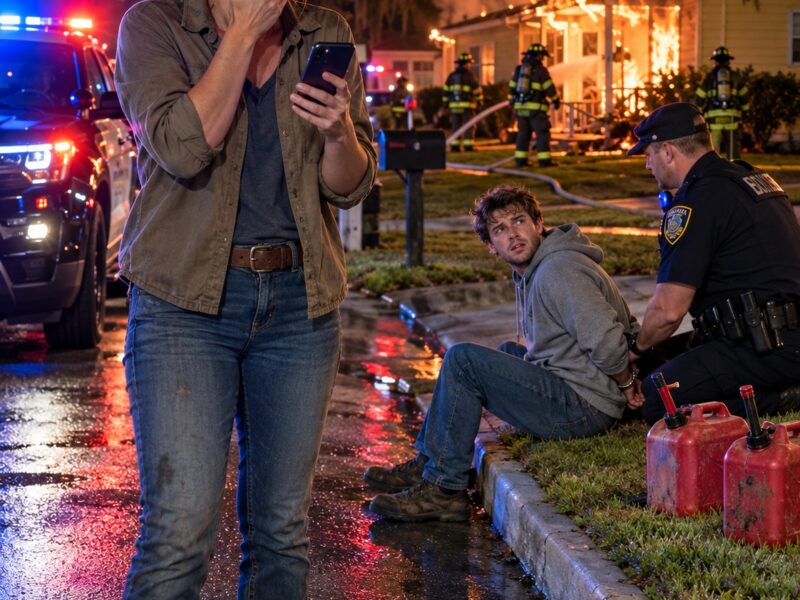
My Grandma Called Me, Trembling: “Don’t Go Home”—Minutes Later, Police Cars Surrounded My Street, and My Brother Was Sitting in Handcuffs Outside My Burning House
“Don’t go home, Miriam. Whatever you do, don’t turn onto your street.”
My grandmother was seventy-nine years old, and I’d never heard her sound so frightened.
It was 11:58 on a Thursday night. I was standing beside a gas pump on Highway 441 in Ocala, Florida, with a receipt between my teeth and the nozzle still in my truck’s tank.
“Grandma? What’s wrong?”
Her breathing was ragged.
“Please, honey. Just listen to me this once.”
“Are you hurt? Is something happening at Mom’s?”
“No. It’s your house.”
I straightened.
“What about my house?”
For a moment, all I heard was static.
Then she whispered, “Your brother took the red cans from the garage.”
My stomach turned cold.
“Grayson?”
“Don’t go home.”
The call ended.
Twelve minutes later, I stood behind a police barricade six houses from my driveway, watching firefighters battle flames at my back door.
Two red gasoline cans lay in the grass.
My brother sat on the curb with his hands secured behind him.
And when he saw me, he shouted the same words he’d used to escape consequences since childhood.
“Mary! Tell them I was only trying to help!”
The worst part wasn’t that my brother had apparently set my house on fire.
It was that someone in my family had known he was capable of doing it for ten years.
My name is Miriam Vogel. I was thirty-three when this happened, and I inspected houses for a living.
That detail matters more than it probably sounds.
My job was to walk through a house before someone bought it and tell them what they might not want to hear.
A roof could look perfect from the street while its decking rotted underneath. A freshly painted wall could hide old water damage. A seller could smile across a kitchen table and assure everybody that the electrical system was fine, but a smile wouldn’t make an overheated breaker safe.
I photographed everything.
Loose shingles.
Cracked foundations.
Improper wiring.
Water stains.
Missing handrails.
I wrote reports in the same format every time: what I observed, why it mattered, and what needed further evaluation or repair.
Sometimes buyers thanked me.
Sometimes real estate agents stopped referring clients because my reports were inconvenient.
I slept fine either way.
A house didn’t become safe because its owner was a nice person.
That was something my mentor, Cal Rourke, had taught me when I was twenty-four.
It was also a principle I’d somehow failed to apply to my own family.
I was the oldest child of Cynthia and Dale Vogel.
My brother, Grayson, was twenty-seven.
He was six years younger than me, good-looking, charming when he wanted something, and permanently on the verge of getting his life together.
At least, that was how our mother described him.
Grayson didn’t have a steady career. He’d worked in landscaping, construction, vehicle detailing, and at least three jobs involving a cousin who supposedly had a business opportunity.
Every opportunity ended with somebody else being unfair.
A supervisor was unreasonable.
A partner stole his idea.
A customer refused to pay.
A girlfriend was too demanding.
A landlord didn’t understand his situation.
Somehow, the responsibility always landed elsewhere.
My mother believed Grayson needed understanding.
My father believed Grayson needed another chance.
And I was expected to provide both whenever their patience or money ran out.
By thirty-three, I’d spent most of my adult life quietly financing emergencies I hadn’t created.
I’d paid an overdue utility bill for Grayson because his power was about to be disconnected.
I’d covered two car payments because he needed transportation for a job he quit three weeks later.
I’d loaned him money for tools, helped him write résumés, and picked him up from places where he claimed someone had abandoned him.
He rarely paid me back.
My mother called it helping family.
When I reminded her that my savings weren’t endless, she would smile and say, “You’ve always been good at managing, Miriam.”
I used to think that was a compliment.
Eventually, I understood it meant nobody needed to worry about what things cost me.
Eight days before the fire, I had finally closed on my first house.
It wasn’t enormous.
A single-story three-bedroom home on a quiet street in southeast Ocala, with pale yellow siding, a screened back porch, and an aging live oak that shaded part of the driveway.
The kitchen needed fresh paint.
The bathroom vanity was chipped.
The roof had perhaps eight useful years remaining, according to my own inspection.
But the foundation was sound, the electrical system had been updated, and the mortgage was something I could afford if business remained steady.
I had saved for six years.
Six years of keeping the same truck after it passed 200,000 miles.
Six years of packing lunches instead of buying them.
Six years of turning down vacations, working Saturdays, and setting aside whatever was left after taxes.
I put twenty percent down.
When the closing attorney handed me the keys, I sat in my truck and cried.
Not because I was suddenly wealthy.
Because the keys belonged to me.
For the first time in my adult life, I had a door that nobody in my family could open without asking.
I didn’t realize how much that would bother them.
Nine hours before Grandma’s warning, I was sitting at my mother’s dining table in Belleview, eating pot roast.
She’d invited me for a family dinner to celebrate the new house.
That’s what she’d said on the phone.
“I want everyone together, honey. You’ve worked hard. We should have a proper meal.”
I should have known something was wrong when she insisted Grayson and his girlfriend, Brittany, would be there.
Brittany was twenty-five, a nail technician who worked at a salon near the mall.
She had been dating Grayson for a little over a year.
They lived in the apartment above my parents’ detached garage, paying no rent while supposedly saving for their own place.
Brittany was quiet around my family.
At first, I’d mistaken that for shyness.
Later, I realized she was constantly calculating how much trouble honesty might cause her.
The dinner began normally.
My father asked about a house I’d inspected in Silver Springs.
My grandmother, Edith Halman, complained that the weather had become too warm for March.
Brittany complimented the potatoes.
Grayson barely spoke.
He kept turning his phone over on the table, screen down, then picking it up again.
My mother waited until the dishes were nearly empty.
Then she folded her napkin.
“So, Miriam,” she said brightly, “you have three bedrooms.”
I looked up.
“Yes.”
“And you’re living there alone.”
“Yes.”
She smiled.
“I’ve been thinking.”
That phrase had preceded some of the most expensive conversations of my life.
“About what?”
“Well, your brother and Brittany are trying to save money.”
Brittany immediately looked at her plate.
Grayson leaned back in his chair.
I felt the shape of the conversation before my mother finished speaking.
“They could take the two spare bedrooms for a little while,” she continued. “Maybe a year. Just until they’re back on their feet.”
I set down my fork.
“What?”
“Think about it. You have all that space. They wouldn’t be in your way.”
“They’d be living in my house.”
“They’re family.”
“I know who they are, Mom.”
Her smile tightened.
“No need to get defensive.”
I looked at Grayson.
He was watching me.
Not hopefully.
Expectantly.
“Did you know Mom was going to ask this?” I said.
He shrugged.
“We talked about it.”
“And?”
“And it makes sense.”
I almost laughed.
“Does it?”
“Mary, you work all day. Half the rooms would sit empty.”
“Rooms don’t have to be occupied just because they exist.”
He rolled his eyes.
“See? That’s what I’m talking about.”
I looked at Brittany.
She kept her hands folded beneath the table.
“Is this what you want?” I asked her.
She glanced toward Grayson.
“I mean, it would help.”
“Would you pay rent?”
My mother answered before Brittany could.
“Oh, Miriam. Don’t turn this into a business arrangement.”
“It’s my house.”
Grayson leaned forward.
“You know what your problem is?”
I said nothing.
“You act like anybody who needs help is trying to take something from you.”
I looked at him.
Then at my mother.
“Are you asking to live there rent-free?”
My mother sighed.
“Just temporarily.”
“And have you asked what it would cost me?”
Grayson laughed.
“What would it cost? You already pay the mortgage.”
“Utilities. Insurance considerations. Maintenance. Wear on the property. And the fact that I’d be sharing my home with two people.”
He waved one hand.
“Jesus, Mary. You inspect houses all day and now you can’t stop inspecting your own family.”
My father stared at the ceiling fan.
Grandma’s hand appeared beneath the tablecloth and settled against my wrist.
Her fingers were cool.
Dry.
Steady.
I looked toward her.
She didn’t say anything.
She just held on.
I turned back to my mother.
“No.”
The word was quiet.
Simple.
My mother blinked.
“You haven’t even thought about it.”
“I thought about having my own place for six years.”
“That’s not what I meant.”
“It’s what I mean.”
Grayson pushed back his chair.
There was no shouting.
He rarely shouted in front of our parents.
He preferred the tone that made everyone else feel as though they’d disappointed him.
“You bought that house to prove you don’t need us.”
I looked at him.
“No, Grayson. I bought it because I could.”
He laughed once.
A short, ugly sound.
“Enjoy it.”
Then he stood and walked into the kitchen.
The garage door opened a minute later.
My father followed him outside.
Nobody finished dessert.
Grandma kept her hand on my wrist until I finally stood to leave at eleven-twenty.
My mother walked me to the front hall.
She hadn’t spoken much since Grayson left.
At the door, she said, “You hurt his feelings.”
I looked at her.
“Mom, he wanted to move into my house without paying rent.”
“He just wants somewhere to start over.”
“He has somewhere. Your garage apartment.”
“That’s different.”
“How?”
She sighed.
“You’ve always managed on your own, Miriam. Grayson isn’t like you.”
I waited.
She continued.
“He needs people.”
I looked at my keys.
Then back at her.
“So do I.”
She seemed genuinely surprised.
I don’t think she’d ever considered that possibility.
Grandma came to the doorway behind us.
She looked smaller than usual in her pale blue cardigan.
“Drive carefully,” she told me.
I kissed her cheek.
“I will.”
Then I left.
As I backed down the driveway, I noticed the garage door was still open.
The light was on.
My father’s truck sat outside.
I didn’t see Grayson.
If I had looked more carefully, perhaps I would have noticed something.
But I was tired.
I wanted to get home.
And I still believed the worst thing my brother would do that night was complain about me.
Grandma called thirty-eight minutes later.
I had stopped for gas because the truck was nearly empty.
When her name appeared on my phone, I assumed she’d forgotten to tell me something about Sunday dinner.
Instead, she told me not to go home.
After the call ended, I stood beside the pump with the nozzle dripping into the tank opening.
The station lights hummed overhead.
A tractor-trailer rolled past on Highway 441.
I tried calling her back.
Four rings.
Then voicemail.
My grandfather’s voice answered, even though he’d been dead almost ten years.
“You’ve reached the Halmans. Leave us a message after the tone.”
Grandma had never changed it.
I tried again.
Nothing.
I stood there staring at the screen.
Then my mother’s name appeared.
I answered immediately.
“Mom?”
“Has your brother gotten there?”
No hello.
No explanation.
Just that.
My stomach tightened.
“Gotten where?”
“Your house.”
“Why would Grayson be at my house?”
She hesitated.
“He was upset after dinner.”
“I noticed.”
“Your father heard him in the garage.”
I looked toward the road.
“What was he doing?”
“Just don’t make this into something, Miriam.”
I nearly laughed.
“Mom, Grandma just called me terrified and told me not to go home. Now you’re asking whether Grayson has arrived there. What is happening?”
A long silence.
Then she said, “You know how your brother gets when he’s upset.”
I felt my grip tighten around the phone.
“That’s not an answer.”
“Miriam—”
“Mom. What did he take from the garage?”
She didn’t answer.
I could hear a television in the background.
Then a door closing.
Finally, she said, “Call me when you’re home.”
The line went dead.
I stared at the phone.
My grandmother had warned me away from my own house.
My mother wanted to know whether Grayson had reached it.
Neither had asked whether I was safe.
I climbed into my truck.
Started the engine.
Then stopped.
The entrance to my street was less than ten minutes away.
I could have driven straight there.
I could have confronted Grayson.
I could have decided Grandma was confused and Mom was being dramatic.
I could have done what I’d always done—arrived, managed whatever disaster Grayson had created, and figured out afterward how much it would cost me.
Instead, I remembered Grandma’s voice.
Please trust me.
I turned onto the road leading to a little Baptist church six houses from my place.
The church parking lot was empty.
Its illuminated sign had been missing a letter for months.
WE COME, it read.
I parked beneath a live oak and switched off the engine.
At 12:06, the first police car passed.
No siren.
Just blue lights flashing silently across the road.
Then another.
Then another.
I got out.
I don’t know why I walked instead of driving.
Maybe I still believed I could approach my own house as an ordinary homeowner.
Maybe I thought whatever had happened would be easier to understand if I reached it slowly.
But when I turned the corner, I saw an orange glow rising behind my roof.
And I began running.
An Ocala Fire Rescue engine was parked partly on my lawn.
Its emergency lights illuminated the oak tree, the driveway, and the front windows I’d cleaned two days earlier.
Firefighters moved around the side of the house.
A hose stretched across the driveway.
Smoke drifted over the roofline.
A police officer stepped in front of me.
“Ma’am, you need to stay back.”
“That’s my house.”
He looked at me.
“Are you Miriam Vogel?”
“Yes.”
“I’m Officer Dyer. Were you inside the property tonight?”
“No.”
“Where were you?”
“At my parents’ house. Then a gas station.”
He nodded.
“Is anyone supposed to be inside?”
“No.”
My voice cracked.
“My grandmother told me not to come home.”
The officer’s pen stopped.
“Your grandmother?”
“Yes. Edith Halman.”
He looked at me carefully.
“She’s the one who called 911.”
I stared.
“What?”
He glanced toward the patrol cars.
“She’s the caller who reported concern about a possible fire and told dispatch someone might be coming to your property.”
I looked past him.
Toward the curb.
And saw Grayson.
He sat on the sidewalk wearing a gray hoodie and jeans.
His hands were secured behind him.
A uniformed officer stood nearby.
Grayson saw me.
His expression changed instantly.
Relief.
Then indignation.
“Mary!”
He shifted forward.
“Tell them I came to help!”
I stared at him.
Behind him, my back porch was burning.
“Help with what?”
He opened his mouth.
Then closed it.
I looked toward the lawn.
Two red gasoline cans lay near the hose reel.
They had been placed beside an evidence marker.
Someone had written VOGEL on both in black permanent marker.
The letters leaned slightly left.
My father labeled everything in his garage that way.
Coffee cans.
Toolboxes.
Paint buckets.
Extension cords.
I had seen that handwriting a thousand times.
I looked at the cans.
Then at my brother.
“Grayson.”
His face went pale.
I couldn’t think of another sentence.
Not one that was safe to say.
Not one I wouldn’t regret.
So I said nothing.
The firefighters continued working behind me.
Water hissed against the burning wood.
Somewhere, glass broke.
And the house I’d waited six years to own began coming apart in the middle of the night.
I didn’t sleep.
At four in the morning, after giving my statement and collecting what information the officers could provide, I drove to a motel on Silver Springs Boulevard.
The room smelled of bleach and old air-conditioning.
The bedspread was orange.
The window unit rattled every few minutes.
I sat on the edge of the mattress holding my house keys.
There was soot beneath my fingernails from touching the outside fence.
I couldn’t remember doing it.
I kept thinking about the closing.
The attorney handing me the keys.
The way I’d sat in my truck crying because I finally owned something.
Eight days.
That was how long I’d lived there.
Eight days before my family turned the house into an emergency I was expected to manage.
At five-thirty, I called my grandmother.
Voicemail.
I called again.
Nothing.
Then I called my father.
He answered after three rings.
“Miriam?”
“Dad.”
His voice sounded exhausted.
“Are you okay?”
It was the first time anyone in my immediate family had asked me that question since the fire.
For a moment, I couldn’t answer.
Then I said, “I’m alive.”
He breathed out.
“Thank God.”
I stared at the motel wall.
“Why were your gas cans at my house?”
Silence.
“Dad?”
“They were in the garage earlier.”
“Who took them?”
“I don’t know.”
I closed my eyes.
“Grayson was there.”
“I heard.”
“He was detained.”
“I know.”
“Dad, he was at my house with your gasoline cans.”
My father didn’t answer.
Then he said, “We’ll talk in the morning.”
I looked at the keys in my hand.
“About what?”
He hesitated.
“The family.”
I ended the call.
For the first time in my life, I didn’t wait for him to finish explaining why I needed to be patient.
At seven the next morning, I returned to my house.
The back porch was gone.
The kitchen wall behind it was blackened, and several roof members had been damaged by heat.
The rest of the house still stood.
That was almost worse.
From the street, it looked salvageable.
Like a person who had been hurt badly but was still standing because they hadn’t yet realized they were supposed to fall.
The air smelled of wet ash and melted plastic.
I parked beside the curb.
A state fire investigator named Detective Aaron Chandler stood near the back doorway wearing a navy polo shirt and work boots.
He was in his late forties, with thinning brown hair and an expression that suggested he had spent years watching people tell stories the evidence didn’t support.
He approached when he saw me.
“Ms. Vogel?”
“Yes.”
“I’m Detective Chandler with the state fire investigation bureau.”
I nodded.
He looked toward the damaged porch.
“I understand you’re a home inspector.”
“Yes.”
“Then you know why I can’t let you enter until the scene has been released.”
“I know.”
I stared past him.
The aluminum threshold beneath the back door had warped.
The deepest visible damage appeared near the doorway.
Not at the far edge of the porch.
Not near the yard.
Near the entrance to my kitchen.
I couldn’t stop myself.
“The burn damage is concentrated at the threshold,” I said.
Chandler looked at me.
“I haven’t completed the origin-and-cause examination.”
“I know.”
I pointed.
“But that isn’t what I’d expect from a small brush fire in the yard.”
He studied my face.
Then asked, “Do you have photographs of the property before last night?”
“Forty-six.”
He raised an eyebrow.
“Of the porch?”
“The whole house. I inspected it before closing.”
“Can you provide them?”
“Yes.”
He nodded.
“Good.”
Then he asked something that made the back of my neck go cold.
“Where was the debris pile your brother says you asked him to burn?”
I stared at him.
“What debris pile?”
“He says you had renovation waste in the yard.”
I looked at the concrete slab.
The melted hose reel.
The blackened doorframe.
“There wasn’t one.”
“Are you certain?”
“I painted two rooms and replaced a bathroom vanity. The old vanity was taken away by the contractor.”
Chandler watched me.
I continued.
“I photographed the yard before closing. And again after moving in.”
He made another note.
“Please send those photographs.”
I nodded.
Then he looked toward the road.
A familiar truck was approaching.
My father’s truck.
My mother climbed out before it stopped completely.
She still wore her light blue scrubs from the dental office where she worked.
Her name badge was crooked.
Her hair looked as though she’d slept in a chair.
She hurried toward us.
And the first words out of her mouth were not about my house.
“Where is Grayson?”
I stared.
“Good morning to you too, Mom.”
She stopped.
“Did they take him to jail?”
“Yes.”
“Which jail?”
“Marion County.”
She put a hand against her chest.
“Oh, God.”
I looked at the smoking remains of my kitchen.
“That’s what you’re worried about?”
She turned.
“Miriam, don’t start.”
I felt something inside me go very still.
“Start what?”
“You know what I mean.”
“No, actually. I don’t.”
My father stood beside his truck, staring at the ground.
I pointed toward the evidence markers.
“Dad, those are your gasoline cans.”
He looked up.
Then away.
My mother lowered her voice.
“Your brother went over there because he was upset. He wasn’t thinking clearly.”
“He brought gasoline to my house after midnight.”
“You don’t know what happened.”
“I know enough to be standing outside a burned kitchen.”
Chandler remained silent.
He didn’t interrupt.
He simply listened.
My mother looked at me.
Then said the sentence that would follow me for weeks.
“Miriam, you can take this. Grayson can’t.”
I stared at her.
She meant it.
Every word.
She was looking at her daughter standing in front of a burned house and measuring the disaster according to who could survive the consequences.
Apparently, I had already won that contest.
So I was expected to lose everything else.
I looked at my father.
He was studying his boots.
Then I looked back at my mother.
“I’ll be speaking with the investigators,” I said.
She pressed her lips together.
“Fine. We’re going to see about your brother’s bond.”
She turned toward the truck.
My father followed.
Neither offered to drive me to the motel.
Neither asked whether I had clothes.
Or whether I’d eaten.
Or whether I had somewhere to sleep the following night.
I stood beside the yellow tape and watched them leave.
For the first time, I let them drive away without trying to repair the conversation.
By Friday afternoon, my insurance company had placed the claim on hold pending the official fire investigation.
I understood why.
A fire involving a relative, disputed circumstances, and evidence of a possible deliberate ignition wasn’t the kind of claim an adjuster could approve over the phone.
Her name was Elaine Fenn.
She sounded about forty, spoke with careful precision, and refused to say anything she couldn’t support.
“Ms. Vogel,” she explained, “we’re awaiting the origin-and-cause report. We’ll also need your recorded statement and documentation of the property before the incident.”
“I have photographs.”
“Good. Please provide them.”
“What about temporary housing?”
“We’re reviewing which provisions may apply. I don’t want to promise reimbursement before we’ve confirmed coverage.”
I looked at the motel receipt beside my laptop.
“Understood.”
She hesitated.
“There’s something else I need to explain.”
I closed my eyes.
“Go ahead.”
“If the damage was intentionally caused by an insured person, or by someone acting with your authorization, that can affect coverage.”
I looked toward the window.
“Are you asking whether I told my brother to burn my house?”
“I’m explaining why the investigation matters.”
“No. I didn’t authorize anything.”
“Then make sure you provide complete, accurate information.”
I almost laughed.
Accuracy was the one thing in my life I knew how to provide.
After we hung up, I opened a folder on my laptop.
VOGEL RESIDENCE — PRE-PURCHASE INSPECTION
Forty-six photographs.
The screened porch.
The concrete slab.
The back door.
The hose reel.
The grass beside the foundation.
Every angle showed the same thing.
No brush pile.
No construction debris.
Nothing remotely resembling the excuse Grayson had given investigators.
I copied the images into a separate folder.
Then checked their original dates.
February second.
Before closing.
Before the argument at dinner.
Before anyone had imagined there would be an insurance claim.
I sent the files to Detective Chandler.
A few minutes later, my mother called.
I almost ignored it.
Then answered.
“We posted Grayson’s bond,” she announced.
I looked at the motel wall.
“Okay.”
“Twenty-five thousand dollars. Your father used money from the boat fund.”
I said nothing.
“The lawyer thinks this can be handled if everyone stays calm.”
I closed my eyes.
“Mom, my house burned.”
“I know.”
“And Grayson told investigators I asked him to burn a pile that never existed.”
She sighed.
“He was trying to help you clean up after the renovation.”
“No.”
“Miriam—”
“No. There was nothing to burn.”
A pause.
Then she said, “His lawyer says if you explain that you asked him to burn the debris, it becomes a terrible accident instead of something more serious.”
I felt my stomach turn.
“You want me to lie.”
“Don’t use that word.”
“What word would you prefer?”
“I’m asking you to help your brother.”
“By telling investigators I authorized him to start a fire at my house?”
“He didn’t intend for the damage to be so bad.”
I stared at the window.
“Mom, how would you know what he intended?”
She didn’t answer.
Then she said quietly, “There could have been a pile.”
I sat very still.
For several seconds, all I heard was the rattling air conditioner.
Finally, I asked, “What did you say?”
“There could have been some old wood from the porch.”
“Mom, I was there. I own the house.”
“Don’t make everything so literal.”
I closed my eyes.
My entire career depended on being literal.
A missing handrail wasn’t a difference of opinion.
A damaged electrical connection wasn’t a misunderstanding.
A burn pattern at a doorway couldn’t be moved to the middle of a yard simply because someone preferred that explanation.
“I’m not signing anything that isn’t true,” I said.
My mother exhaled sharply.
“You have no idea what this could do to Grayson.”
I looked at my motel key.
“And you have no idea what it already did to me.”
She hung up.
I sat there for a long time afterward.
Not crying.
Not angry.
Just trying to understand how easily my family had turned the destruction of my home into a problem with my cooperation.
On Saturday, I drove to Belleview to see Grandma.
I hadn’t spoken to her since the warning.
That frightened me.
She normally called every Sunday afternoon to ask whether I’d eaten enough vegetables and complain that the grocery store had stopped carrying the marmalade she liked.
Now her phone went straight to voicemail.
When I arrived, my mother answered the door.
She looked surprised.
“What are you doing here?”
“Seeing Grandma.”
“She’s resting.”
“It’s two in the afternoon.”
“She had a difficult night.”
“So did I.”
My mother stepped aside reluctantly.
I walked down the hallway toward the enclosed Florida room at the back of the house.
Grandma had lived there since 2019, after she sold her little place in Leesburg.
It had once been a screened porch.
My parents enclosed it, added a small bathroom, and installed a window air conditioner.
Grandma loved the light.
She kept a chair beside the window, a crossword puzzle book on the side table, and a stack of library novels beneath her lamp.
When I entered, she was sitting in her usual chair.
Her gray hair had been brushed neatly.
She wore a cardigan over a flowered blouse.
She looked smaller than she had at dinner.
“Grandma.”
She turned.
Her face changed.
“Miriam.”
I hurried toward her and knelt beside the chair.
“Are you okay?”
She took my hands.
Her grip was stronger than I expected.
“Are you?”
I laughed once.
Then began crying.
I couldn’t help it.
For two days, people had asked me for statements, photographs, explanations, and decisions.
Grandma was the first person who seemed to want nothing from me except the truth about how I felt.
“I don’t know,” I admitted.
She pulled me closer.
“Oh, honey.”
I rested my forehead against her knees for a moment.
Then sat on the ottoman.
“Grandma, how did you know?”
Her expression changed.
She looked toward the doorway.
“Not here.”
I frowned.
“What?”
She squeezed my hand.
“Ask me when your mother isn’t home.”
I stared.
Before I could answer, my mother’s voice came from behind us.
“Mama’s tired, Miriam.”
I turned.
She stood in the doorway holding a basket of laundry.
“She needs rest.”
Grandma’s hand tightened around mine.
“I’m fine,” she said.
My mother smiled.
“The doctor’s been concerned about your memory lately.”
I looked at Grandma.
She was staring directly at her daughter.
“What doctor?” I asked.
“Her regular physician. We’re considering an evaluation.”
Grandma said nothing.
My mother continued.
“She was very confused Thursday night.”
I felt my stomach tighten.
“Confused enough to call the police?”
“That’s exactly what worries me.”
I looked toward Grandma.
She lifted her chin slightly.
“I knew what I was saying.”
My mother sighed.
“Mama, please.”
I stood.
For a moment, I wanted to argue.
Then I looked at Grandma’s face.
She was frightened.
Not confused.
Frightened.
I bent and kissed her cheek.
“I’ll see you soon.”
She whispered, “Come when the house is quiet.”
I nodded.
As I walked through the kitchen, I noticed her little flip phone plugged into the wall beside the sugar jar.
Grandma had carried that phone everywhere for eight years.
Now it sat on the counter, several rooms from where she slept.
My mother followed my gaze.
“It’s charging.”
I didn’t ask.
She answered anyway.
“Grayson’s in the garage, by the way.”
I looked at her.
“Why would I need to know that?”
She didn’t respond.
When I stepped outside, Brittany was standing at the top of the garage apartment stairs.
She watched me walk to my truck.
I looked up.
For a moment, I thought she might speak.
She didn’t.
But she didn’t go back inside either.
She simply stood there until I drove away.
The fire investigator called Monday morning while I was lying beneath a house in northwest Ocala.
I had a headlamp strapped to my forehead and spiderwebs caught in my hair.
The crawl space smelled of damp soil, old lumber, and insulation that had probably been installed during the first Bush administration.
My clients were a young couple buying their first home.
They waited near the access opening, periodically asking whether everything looked okay.
“Define okay,” I called back.
The husband laughed nervously.
I photographed a scorched electrical junction box.
The heat damage appeared old, and someone had painted over part of the surrounding wood.
I recorded the location and recommended evaluation by a licensed electrician.
The wife leaned toward the opening.
“Do you ever soften a report if the seller seems nice?”
I looked toward her.
“The wiring doesn’t know whether the seller is nice.”
She laughed.
Then looked embarrassed.
“Sorry. That was probably a stupid question.”
“It wasn’t.”
I shifted sideways to photograph the next section.
“People get attached to stories about houses. My job is to tell them what the house actually shows.”
When I finally climbed out, both buyers were waiting near the driveway.
The wife handed me a bottle of water.
It was such a simple kindness that I almost cried.
My phone had buzzed twice while I was under the house.
Detective Chandler.
I called him back.
“Ms. Vogel?”
“Yes.”
“The scene at your property has been released for limited access. Can you meet me there at two?”
I looked at my watch.
“Yes.”
“Bring your photographs.”
I hesitated.
“Did something change?”
He paused.
“We have several things to discuss.”
I looked toward the young couple standing beside their future home.
They were excited.
Nervous.
Full of plans.
For a moment, I wanted to tell them how quickly a house could stop feeling safe.
Instead, I put away my tools and finished their inspection.
One home at a time.
That was all I could manage.
At two o’clock, Chandler was standing on the remains of my back porch.
He waited while I approached.
The smell of smoke had settled into everything.
Even the grass seemed to carry it.
I wore work boots and a denim shirt.
My camera hung from a strap around my neck.
I had brought the original photographs on a flash drive and printed copies of several images.
Chandler looked at the folder.
“Thorough.”
“Occupational hazard.”
He almost smiled.
Then turned toward the damaged doorway.
“The deepest fire damage is concentrated near the threshold,” he said.
I looked at the warped metal.
“I noticed.”
“We’re continuing laboratory analysis and reviewing witness statements. I can’t give you a final determination yet.”
“I understand.”
He studied me.
“Your brother’s account has changed.”
I felt my stomach tighten.
“How?”
“He says you asked him to burn renovation debris and that the fire spread accidentally.”
I nodded.
“I heard.”
“Your mother gave a statement supporting the existence of that debris.”
For a moment, I couldn’t move.
“What?”
Chandler watched me.
“She says she saw a pile of old wood during a recent visit.”
I stared at him.
My mother hadn’t been to the house since closing.
She’d refused my invitation to help unpack because Grayson needed her to drive him to an appointment.
“She wasn’t there,” I said.
“Can you explain?”
“She hasn’t visited since I moved in.”
Chandler made a note.
I looked at the burned threshold.
Then at the grass.
Then back at him.
“Detective, I have forty-six photographs taken before closing. I have additional pictures from the week after. There was no pile.”
He nodded.
“I’ve reviewed some of them.”
“Then why is my mother’s statement being treated as evidence?”
“It is evidence of what she says she observed. That doesn’t mean we’ve accepted it as accurate.”
I swallowed.
He continued.
“I need your formal written statement. I also need to speak with your grandmother.”
I looked up.
“Why?”
“She’s the person who called 911. Her account of what she heard before the fire could be important.”
I thought of Grandma sitting by the window.
My mother standing in the doorway.
The phone left charging in the kitchen.
“Mom says she’s confused,” I said.
Chandler studied me.
“Is she?”
“No.”
“Does she have any diagnosed condition affecting her ability to provide information?”
“Not that I know of.”
He nodded.
“Then I’d like to speak with her directly.”
I looked toward the house.
For a moment, I imagined Grandma having to explain why she’d warned me.
I imagined my mother standing beside her, correcting her memories.
The thought made my stomach turn.
“I’ll see what I can do,” I said.
Chandler watched me.
Then asked, “Ms. Vogel, do you have someone helping you through this?”
I almost laughed.
“Do you mean emotionally or legally?”
“Both.”
I looked down.
“Not enough.”
He nodded.
“You might want independent legal advice. This is going to become complicated.”
I looked at the house I’d worked six years to buy.
“It already is.”
My father came to the motel that evening.
I found him sitting on the tailgate of my truck beneath the parking lot light.
He wore faded jeans and a green work shirt.
There was sawdust caught near one cuff.
He had worked as a maintenance supervisor for most of his life and still carried a tape measure on his belt even when he wasn’t working.
When I approached, he looked up.
“Mary.”
I stopped.
“Dad.”
He patted the tailgate.
I sat beside him.
For a while, we watched moths circle the overhead light.
Then he said, “Do you remember the shed?”
I looked at him.
“What shed?”
“The one at the old house in Silver Springs Shores.”
I felt something shift.
Of course I remembered it.
April 2016.
The week after Grandpa Halman’s funeral.
Our family was still grieving when the backyard shed burned down in the middle of the night.
Grayson’s dirt bike had been inside.
The shed was insured through my parents’ homeowner’s policy.
My father told the insurance company lightning had started the fire.
The claim was paid.
We moved on.
At the time, I was twenty-three and living in Gainesville.
I came home for the funeral and stayed another week.
Grayson was seventeen.
He was angry about everything.
Grandpa’s death.
School.
A girlfriend who’d broken up with him.
The fact that his parents wanted him to get a summer job.
I remembered his dirt bike.
He’d damaged the engine and had been begging Dad to replace it.
After the shed burned, my parents used some insurance money to buy him another one.
I’d thought it was a terrible lesson.
But I’d been told to mind my own business.
Now I looked at Dad.
“What about the shed?”
He stared at the moths.
“It wasn’t lightning.”
I felt my stomach tighten.
“What?”
He rubbed his hands together.
“Your grandmother saw Grayson coming out of the yard that night.”
I turned toward him.
“What did she see?”
“A red gasoline can.”
I stared.
My father looked down.
“He was seventeen.”
I couldn’t speak.
Dad continued.
“We had the insurance inspection. I said lightning because I didn’t want him charged with anything. Your mother agreed.”
“And Grandma?”
“She kept quiet.”
I looked away.
The motel parking lot seemed to tilt slightly.
Ten years.
For ten years, my family had known Grayson set a fire involving insured property.
They had concealed it.
Taken the money.
Allowed him to believe there would be no real consequences.
And now my house had burned too.
“Why are you telling me this?” I asked.
Dad didn’t answer.
Instead, he reached into his shirt pocket.
He removed a thick envelope.
My name was written on it in black marker.
He placed it between us.
“There’s sixty-one thousand dollars in there.”
I stared.
“What?”
“Some of the money from the boat fund. Some from retirement.”
I looked at the envelope.
“Why?”
“To help you rebuild.”
For a moment, I felt something close to relief.
My father was finally offering help without making me ask.
Then he continued.
“Just tell the investigators Grayson was burning the debris pile you asked him to clear.”
I turned slowly.
He stared at the pavement.
“If it’s an accident, his lawyer thinks we can keep him out of prison.”
I looked at the envelope.
Then at my father.
“You’re offering me money to lie.”
He flinched.
“Don’t put it that way.”
“How else should I put it?”
“Mary, I don’t know how to have a son in prison.”
I felt my throat tighten.
He finally looked at me.
“I know how to have a daughter who’s okay.”
For several seconds, neither of us spoke.
Then I asked, “Did you ever wonder if I was okay?”
His expression changed.
I continued.
“When the fire started? When you found out my house was burning? When I spent the night alone in a motel?”
He looked away.
“I knew you’d manage.”
There it was again.
The family compliment that had become an excuse.
I stood.
Dad remained seated.
“I have to go upstairs,” I said.
He looked toward the envelope.
“Take it.”
I didn’t move.
“Please, Mary.”
I stared at the money.
Sixty-one thousand dollars could change my immediate situation.
It could pay contractors.
Keep the mortgage current.
Let me stop worrying about hotel bills.
I wish I could say I rejected it without hesitation.
I didn’t.
For a moment, I wanted that money badly enough to feel ashamed.
Then I looked at my father.
“I’m not agreeing to your terms.”
He nodded as though he’d expected the answer.
But he left the envelope on the tailgate.
Then got into his truck and drove away.
I stood in the parking lot for a long time.
Finally, I picked up the envelope.
I put it in my glove box.
I didn’t cash anything.
I didn’t spend a dollar.
But I kept it.
Because I wasn’t as certain about the future as I wanted to be.
And because I wanted my father to have to look at the offer again someday.
Brittany contacted me the next afternoon.
The message came from a number I didn’t recognize.
Walmart. Noon. Your truck. Please don’t tell Grayson.
I arrived ten minutes early and parked near the garden center.
Rain hammered the windshield.
At exactly noon, Brittany hurried across the parking lot holding a canvas bag above her head.
She climbed into the passenger seat.
Her hair was wet.
Her hands were shaking.
She smelled faintly of acetone from the nail salon.
“Thank you for coming,” she said.
I nodded.
“What’s going on?”
She looked through the rear window.
Then turned toward me.
“Your mother told me what to say.”
I felt my stomach tighten.
“About what?”
“Thursday night.”
Brittany pressed her hands together.
“She wants me to tell the detective Grayson was home with me until twelve-thirty.”
I watched her.
“Was he?”
She shook her head.
“No. I was asleep by eleven. He was in the garage with your dad.”
Rain struck the windshield so hard we could barely see the store.
Brittany wiped her face.
“I don’t want to lie to the police, Miriam.”
“Then don’t.”
She looked at me desperately.
“It’s not that simple.”
I waited.
She continued.
“I live in their garage apartment. I don’t have enough saved for another deposit. If I upset your mother, she can tell me to leave.”
I nodded slowly.
I understood that fear.
Not because I agreed with lying.
Because I’d spent years making decisions around the possibility of losing housing, employment, or family support.
“What did Grayson say after dinner?” I asked.
Brittany looked down.
She hesitated.
Then whispered, “He said you’d come running back when you had nowhere else to go.”
I stared.
“He said what?”
“He was in the garage. He wasn’t even yelling. He said, ‘She thinks she can live without us. Wait until she needs something.’”
I felt my hands go cold.
Brittany continued.
“I thought he was just angry.”
I looked through the windshield.
The rain blurred every car into a shape without details.
“Will you tell Detective Chandler that?”
She shook her head.
“Not yet.”
I nodded.
“I understand.”
She looked surprised.
“You do?”
“Yes. But I can’t make the decision for you.”
I reached into the cup holder and handed her Chandler’s card.
“If you decide to tell the truth, call him. You don’t need my permission.”
She took the card.
For several seconds, she stared at it.
Then she whispered, “He’s not sorry.”
I looked at her.
She continued.
“Grayson thinks you’ll give in. He keeps saying everything will go back to normal once you stop being stubborn.”
I felt something settle inside me.
“Normal for whom?”
Brittany gave a sad little smile.
“Exactly.”
Then she climbed out and ran through the rain.
I watched her disappear inside her car.
For the first time since the fire, I understood something important.
My brother hadn’t expected the fire to end our relationship.
He’d expected it to repair the relationship on his terms.
He thought destroying my independence would make me grateful to come home.
The rebuilding estimate arrived on Wednesday.
Hugh Dockery, a contractor who had repaired storm and fire damage throughout Marion County for more than twenty years, met me beside my driveway.
Elaine Fenn, the insurance adjuster, joined us.
I wanted them there at the same time.
I was tired of receiving separate explanations that left me wondering which version mattered.
Hugh walked the house with a clipboard.
He examined the damaged kitchen, the roof structure, the smoke residue throughout the interior, and the areas affected by firefighting water.
He didn’t pretend the work would be simple.
“The walls can probably be saved in most rooms,” he said. “But that kitchen has to come out. The affected roof framing needs replacement. We’ll need proper smoke remediation before anything gets enclosed again.”
He wrote several figures.
Then turned the clipboard toward me.
The preliminary estimate was $148,000.
I stared.
A number on a page shouldn’t be capable of changing the temperature of your body.
This one did.
“That’s more than half what I paid for the house.”
Hugh nodded.
“I know.”
“The mortgage is due next week.”
“I know.”
“I’ve got ninety-four hundred in savings.”
He said nothing.
I continued.
“And two clients canceled their inspections because they’d seen the fire on the local news.”
Elaine watched me.
I looked at her.
“Tell me what happens if my family says I authorized the fire.”
She took a breath.
“We evaluate all available evidence and the terms of your policy. If you knowingly authorized someone to set the fire, that would raise serious coverage issues.”
“And if I didn’t?”
“Then we continue the investigation and determine what covered losses are payable.”
I laughed without humor.
“So the statement my mother wants me to sign could destroy my insurance claim.”
Elaine didn’t answer immediately.
Then she said, “You need to give a truthful account. Not one designed to produce a particular insurance outcome.”
I nodded.
Hugh looked at the ruined kitchen.
Then said, “I’ve got other jobs, Miriam. I can’t promise a start date without the funding arranged.”
“I understand.”
He hesitated.
“But I can help you put together a repair plan and document the damage properly.”
I looked at him.
“Why?”
He shrugged.
“Because somebody ought to.”
It was the kindest answer I’d heard in days.
After they left, I sat on my front step.
The door still worked.
That seemed ridiculous.
My kitchen was ruined, my porch was gone, and the roof above the back rooms needed major repairs.
But the front door still opened with the key I’d received at closing.
I kept turning that key in my hand.
I wasn’t ready to give up the house.
Not because it was beautiful.
Because I’d bought it without asking anybody’s permission.
On Thursday morning, I went back to Grandma.
My mother was working at the dental office.
My father had gone fishing with an old friend.
Grayson was supposed to be meeting with his attorney.
I drove to Belleview carrying a small bag of groceries and a spare phone charger.
This time, I used the side entrance to the Florida room.
Grandma had given me a key months earlier for emergencies.
When I entered, she was sitting beside the window with her purse on her lap.
She looked as though she’d been expecting me.
“Close the door, honey.”
I did.
Then I sat beside her.
“Grandma. Tell me what happened.”
She took a slow breath.
“I need to start with the old shed.”
I nodded.
“Dad told me.”
Her expression changed.
“He told you Grayson did it?”
“Yes.”
She closed her eyes.
For a moment, I thought she might cry.
Then she said, “I saw him.”
The room was very quiet.
Grandma looked toward the window.
“It was two in the morning. Your grandfather had been buried the week before, and I couldn’t sleep.”
She folded her hands.
“I went into the kitchen for water. Through the back window, I saw orange light coming from the shed.”
I waited.
“Grayson came across the yard carrying a red can.”
Her voice remained steady.
“He looked straight at me through the glass. I don’t think he expected anyone to be awake.”
“What did you do?”
“I went outside.”
She looked down.
“I asked him what happened. He said the old bike was junk and nobody would give him the money to fix it.”
I swallowed.
“He admitted starting the fire?”
“He said he only wanted the insurance to pay for another bike.”
I stared at her.
Grandma continued.
“Your mother heard us talking. She came outside and brought Grayson inside. The next morning, she took me into the laundry room and told me I couldn’t say anything.”
“Why?”
Grandma’s eyes filled.
“She said if I told the truth, I’d be the one who broke this family.”
I looked down.
“For ten years, I believed her.”
She wiped her cheek with the edge of her cardigan.
“I watched Grayson grow into a man who thought consequences were things other people could carry.”
Her voice trembled.
“And I told myself staying quiet was keeping peace.”
I reached for her hand.
“What happened Thursday night?”
Grandma looked toward the door.
“After dinner, I heard the garage open.”
She swallowed.
“I was awake in here, reading. I heard Grayson arguing with your father.”
“About me?”
“Yes.”
I felt my stomach tighten.
“Then I smelled gasoline through the open window.”
She closed her eyes.
“I looked out and saw Grayson near the truck. He was carrying one of the red cans.”
I stared.
“How did you know he was going to my house?”
“Your mother came into the kitchen and said he’d driven off toward Ocala. She was upset. She said he’d threatened to teach you a lesson.”
My stomach turned.
Grandma squeezed my hand.
“I called you because I knew you were still on the road. Then I called 911.”
I couldn’t speak.
Grandma continued.
“I didn’t know exactly what he would do. I told the dispatcher what I’d seen and what I was afraid might happen.”
She looked directly at me.
“I wasn’t sure I’d be believed.”
I swallowed.
“Grandma, you saved me.”
Her eyes filled.
“I should have spoken ten years ago.”
I shook my head.
“You spoke when it mattered.”
She looked down.
Then she whispered, “I spoke late.”
For a while, neither of us said anything.
Then I asked, “Why wouldn’t you talk when Mom was here?”
Grandma looked toward her purse.
“Your mother has been telling people I’m confused.”
“I know.”
“She made an appointment with a specialist. Says my memory needs checking.”
“Have you been forgetting things?”
Grandma gave me a tired smile.
“Sometimes I forget what I came into a room for. Sometimes I forget where I put my glasses.”
I nodded.
“That’s worth discussing with your doctor if you’re concerned.”
She looked relieved.
Then her expression hardened.
“But I know what I saw, Miriam.”
“I believe you.”
She squeezed my hand.
“Your mother keeps saying I can’t be trusted because I called the police on my grandson.”
I looked down.
Grandma continued.
“I want my own doctor to decide whether I need an evaluation. Not your mother’s lawyer.”
I nodded.
“We can arrange that.”
She hesitated.
Then pointed toward the bed.
“There’s something underneath.”
I looked.
A navy suitcase stood partly hidden beneath the frame.
My grandfather’s old luggage tag hung from the handle.
“I packed it the night of the fire,” she said.
I stared.
“You packed?”
“Yes.”
“Why?”
She looked at me.
“Because I knew things couldn’t stay the way they were.”
I felt tears rise.
“Grandma, you can come with me.”
She shook her head gently.
“Not sneaking out a side door like I’ve stolen something.”
I frowned.
“What do you mean?”
She straightened.
“When you come for me, Miriam, come through the front door. Ask me where everybody can hear. And let me answer.”
I looked at the suitcase.
Then at her.
For the first time, I understood that Grandma didn’t only want somewhere else to live.
She wanted to leave as a person whose decision mattered.
Not as an old woman being moved quietly from one room to another.
I nodded.
“All right.”
Then the garage door opened.
A moment later, Grayson appeared in the doorway.
He wore basketball shorts and a gray T-shirt.
His hair was damp.
A towel hung over one shoulder.
He looked like a man who had just finished washing his truck.
Not like someone accused of setting his sister’s house on fire.
“What are you doing here?” he asked.
I stood.
“Visiting Grandma.”
His eyes moved toward the suitcase.
Then back to me.
“You’re making everything worse.”
I felt Grandma’s hand reach for my wrist.
“Grayson, I’m leaving.”
He stepped into the doorway.
“You could end this with one sentence, Mary.”
I stared.
“So could you.”
He smiled.
The same smile he’d used when we were children and he wanted me to cover for something he’d broken.
“I’m not the one with a house to rebuild.”
I looked at him.
For several seconds, I couldn’t speak.
Then I asked, “Why did you go there?”
He shrugged.
“I was trying to make a point.”
“What point?”
“That you can’t just decide you don’t need family anymore.”
I stared.
He looked toward Grandma.
Then back at me.
“I wasn’t going to let anything happen to you.”
My stomach tightened.
“What?”
He lowered his voice.
“I knew you’d be upset. I was going to come get you afterward.”
I felt cold.
“After what?”
He looked irritated.
“After the porch caught. I thought you’d come outside.”
I stared.
“You thought I’d be home.”
He hesitated.
Then said, “I knew your routine.”
The room seemed to shrink.
I normally arrived home from my parents’ house, showered, and went to bed.
My bedroom was down the hallway from the kitchen.
The fire had been concentrated at the back doorway.
Grayson had expected me to be inside.
He hadn’t warned me.
He hadn’t knocked.
He hadn’t called.
He’d planned to arrive afterward, when I was frightened and had nowhere safe to sleep.
“Were you going to rescue me?” I asked.
He looked almost relieved that I’d understood.
“Exactly.”
Grandma made a small sound beside me.
I stared at my brother.
For a moment, I remembered him at six years old, crying because he’d fallen off his bicycle.
I remembered teaching him to swim.
Helping with homework.
Picking him up from school.
Then I looked at the twenty-seven-year-old man standing in the doorway.
“You planned for me to lose my home so I’d need you.”
He looked away.
“Don’t be dramatic.”
I took a breath.
“You need to leave the doorway.”
He didn’t move.
I glanced toward Grandma.
She was watching him carefully.
Then I said, “Your bond conditions prohibit contact with me. I’m going to document this and tell Detective Chandler.”
Grayson’s expression changed.
“Mary.”
I moved past him without touching him.
In the driveway, his truck stood with the tailgate down.
A gray fleece blanket lay folded in the bed.
Neat.
Square.
Ready.
I took a photograph.
Then got into my truck.
I didn’t cry until I reached the end of the street.
My mother came to the motel that night.
She knocked with the brisk impatience of someone who expected to be admitted immediately.
I opened the door but didn’t invite her inside.
She held a manila envelope.
“What’s that?” I asked.
“Your grandmother’s appointment information.”
I looked down.
A medical office logo appeared in the corner.
“She has an evaluation scheduled at a clinic near Leesburg,” Mom said. “There’s also an assisted-living facility with availability.”
I stared.
“Why would she need assisted living?”
“She isn’t thinking clearly.”
“She’s seventy-nine, Mom. That doesn’t mean she’s incapable.”
“She called the police on her own grandson.”
I felt anger rise.
“She believed he was dangerous. She was right.”
My mother pressed her lips together.
“You don’t know what she saw.”
“Neither do you.”
She held out the envelope.
“There’s something else.”
I didn’t take it.
“Grayson’s attorney prepared a statement. It explains that he was burning renovation debris at your request and the fire spread accidentally.”
I stared at her.
“You’ve already given a statement supporting that story.”
“Yes.”
“Even though you’ve never visited the house since I bought it.”
Her expression hardened.
“Miriam, we are trying to keep this family together.”
“By lying?”
“By protecting your brother.”
I looked down the motel walkway.
The ice machine hummed near the stairs.
My mother continued.
“If you sign the statement, all of this can become an unfortunate accident. Your grandmother can stay where she is. We won’t have to go through this ridiculous medical argument.”
I looked back at her.
“Are you saying you’ll cancel Grandma’s evaluation if I lie?”
She hesitated.
“I’m saying we can stop upsetting her.”
I stared.
“And if I don’t sign?”
My mother looked at me.
Then said quietly, “You can handle being alone, Miriam.”
I felt something inside me settle.
There was no point arguing about what she’d just admitted.
“Please leave,” I said.
She blinked.
“What?”
“I’m not signing it.”
“Miriam—”
“And Grandma will make her own decisions about where she lives.”
My mother looked almost offended.
Then she placed the envelope on top of the window air conditioner.
“You’re going to regret this.”
I held her gaze.
“Maybe.”
She turned and walked away.
I watched her get into her car.
Then I looked at the envelope.
A lie for my brother.
A medical appointment for my grandmother.
Two ways to make inconvenient witnesses stop talking.
I didn’t open it.
I called an attorney instead.
Her name was Denise Keller.
She practiced civil litigation in Ocala and had experience representing people involved in disputed insurance claims.
She listened while I explained the fire, the pressure from my family, and the money my father had offered.
When I finished, she asked whether I’d signed anything.
“No.”
“Good.”
“Did I make things worse by keeping the envelope?”
“Not necessarily. Preserve it and tell me exactly how you received it. Don’t use or negotiate any payment connected to changing your statement.”
I nodded.
She continued.
“Your brother needs his own criminal defense attorney. You need advice independent of his lawyer, especially regarding insurance and any attempt to influence your account.”
I took notes.
“What about Grandma?”
“If she’s a competent adult, she gets to decide where she lives. A family member can’t simply declare her incapable. If there’s a genuine concern about cognition, it can be evaluated appropriately.”
I closed my eyes.
“Thank you.”
Denise paused.
“Miriam, I also want you to consider your own safety. You’ve described a recent fire and an unwanted encounter with your brother despite conditions restricting contact.”
“I know.”
“Document further contact. Follow the investigators’ guidance. And don’t meet him alone.”
I looked at the motel door.
“All right.”
After the call, I opened my laptop.
I created a new document.
At the top, I typed:
PROPERTY INCIDENT STATEMENT — MIRIAM VOGEL
Then I began writing.
Not as a frightened daughter.
Not as an angry sister.
As an inspector.
I recorded the dates.
The dinner.
The calls.
The time I arrived at the church parking lot.
The police vehicles.
The two gas cans.
The damaged threshold.
The absence of a debris pile.
I attached photographs.
I described my conversation with Grayson without adding what I thought he meant.
When I reached the final paragraph, I stopped.
Then wrote one sentence I’d never imagined needing to put in a formal document.
At no time did I ask or authorize my brother to start a fire at my property.
I read the statement twice.
Then saved it.
For the first time since the gas station, I slept through the night.
Cal Rourke came to the house on Friday morning.
He was sixty-eight, retired from home inspections, and incapable of walking into a room without noticing something wrong with it.
He had trained me when I was twenty-four.
He’d also been the first person to tell me I was good at something without adding that it meant I ought to help somebody else.
We stood inside what remained of my bedroom.
The room hadn’t burned directly.
It had been damaged by smoke and heat.
The ceiling was stained.
The carpet smelled terrible.
One side of the mattress was blackened.
Cal stood beside the bed with a notepad.
He looked toward the hallway.
“You’d have been sleeping here.”
I nodded.
“Probably.”
“Thursday night. Around midnight.”
“Yes.”
He wrote something.
Then looked up.
“Put that in your statement.”
I swallowed.
“Cal, it’s my family.”
He capped his pen.
“Then write it like it’s a stranger’s house.”
I looked at him.
He continued.
“Same standards. Same words. No softening the report because you like the owner.”
I tried to smile.
“That’s what you taught me.”
“I know.”
He looked toward the damaged ceiling.
“You’ve inspected hundreds of houses, Miriam. You’ve warned buyers about things sellers didn’t want them to know.”
I nodded.
“Ever change a report because a seller cried?”
“No.”
“Ever leave out a serious defect because the agent was your friend?”
“No.”
He looked directly at me.
“Then don’t start now.”
I felt tears rise.
Cal softened his voice.
“Your family has had thirty-three years to get used to you making things easier for them.”
I looked down.
“They don’t know what to do when you stop.”
He handed me the notebook.
“That doesn’t mean you’re wrong.”
I stood in the doorway for a long time after he left.
Then I opened my statement.
I added the bedroom’s location in relation to the kitchen.
I documented the smoke damage.
I described where I normally slept.
And I left out everything I couldn’t prove.
That was the hardest part.
My feelings were enormous.
The facts didn’t need to be.
Monday morning, I gave my formal statement to Detective Chandler.
Denise had reviewed it with me beforehand.
I brought printed copies, original photographs, and a drive containing the files in their original form.
Chandler read the statement slowly.
He stopped at the photographs of the backyard.
“Why did you take so many?”
“I inspect every property before buying it, including my own.”
He looked at one showing the concrete slab.
“No debris.”
“No.”
He examined another photograph.
The hose reel.
The screen door.
The grass.
The same yard.
No brush pile.
He nodded.
Then turned to the section describing the red cans.
“You recognize the handwriting?”
“Yes.”
“How?”
“My father labels almost everything in his garage. I’ve seen that exact style of lettering for years.”
“Could someone imitate it?”
“Certainly.”
He looked up.
I continued.
“I’m not claiming handwriting proves who brought the cans. I’m telling you why I recognized the labels.”
For the first time, Chandler smiled.
“You’re used to giving evidence.”
“I’m used to describing what I observe.”
He nodded.
Then pointed toward another paragraph.
“Your brother told you he intended to help you afterward?”
“Yes.”
“Those were his words?”
“As closely as I can remember. I wrote them down immediately after leaving.”
Chandler made a note.
Then asked about Grandma.
I explained what she’d told me.
I also explained that my mother had questioned her memory and arranged an appointment.
Chandler listened.
“We’ll need to speak with your grandmother directly.”
“I know.”
He looked at me.
“Can she come here?”
“I think so.”
“Does she want to?”
“Yes.”
“Then let her make that decision.”
I nodded.
Before leaving, I signed the statement.
Chandler looked at the page.
“You understand this contradicts your mother’s account.”
“Yes.”
“That could raise separate questions about whether her statement was accurate.”
“I understand.”
He waited.
I looked back at him.
“I didn’t write hers.”
He nodded slowly.
“Fair enough.”
Then he placed the documents into the case file.
As I walked outside, my phone rang.
Mom.
I answered.
“You went to the investigators,” she said.
No greeting.
No question about my house.
“Yes.”
“Against your own brother.”
“I gave a statement about a fire at my property.”
She exhaled sharply.
“You have no idea what you’ve done to this family.”
I looked toward my truck.
“Mom, the family was already in trouble before I wrote anything down.”
She was silent.
Then said, “After Friday, Grandma won’t be a reliable witness anymore. The doctor will explain.”
I stopped walking.
“What does that mean?”
“It means we’re getting her evaluated.”
I looked toward the courthouse across the street.
“And you’re assuming the result before the appointment happens.”
My mother didn’t answer.
I took a breath.
“I’m coming Friday morning.”
Her voice changed.
“Good. Grayson’s lawyer has the statement ready.”
I didn’t correct her.
Not yet.
When the call ended, I sat in my truck.
I could see my reflection in the windshield.
I looked tired.
Older.
But I didn’t look confused.
For the first time in weeks, I knew exactly what I was going to do next.
On Tuesday, I signed a month-to-month lease on a small duplex in northeast Ocala.
Two bedrooms.
Terrazzo floors.
A narrow kitchen.
A carport big enough for my truck.
It cost more than I wanted to spend, but it was near my clients and far enough from Belleview that I wouldn’t have to drive past my parents’ house every day.
Cal helped me move in.
We bought a used metal bed frame for forty-five dollars and a clean mattress from a local furniture outlet.
He assembled the bed while I washed the kitchen cabinets.
When he finished, he looked toward the smaller bedroom.
“Who’s this for?”
I smoothed the blanket.
“Somebody who’s been packed for three weeks.”
Cal studied me for a moment.
Then nodded.
“Good.”
He didn’t ask for the whole story.
That was one of the reasons I loved him.
Later that afternoon, I called my father.
“Friday at ten,” I said.
He was quiet.
“Miriam, your mother’s arranged a family meeting.”
“I know.”
“Your aunt Estelle is coming.”
“Fine.”
“Grayson may be there.”
“He isn’t supposed to contact me. He needs to follow the conditions set by the court.”
My father sighed.
“Mary.”
“Dad, I’m coming to ask Grandma whether she wants to leave with me.”
Another pause.
“Your mother thinks you’re coming to sign the statement.”
“I know what she thinks.”
He didn’t answer.
I looked toward the second bedroom.
“I’m coming through the front door. And if Grandma wants to come with me, we’re leaving through it.”
My father’s breathing sounded heavy.
Then he said quietly, “Your mother isn’t going to like that.”
I looked down.
“For once, Dad, that isn’t the most important thing.”
I ended the call.
Grandma called Thursday night.
Not from her own phone.
From Brittany’s.
I recognized her voice immediately.
“Miriam?”
“Grandma!”
“Don’t sound so worried, honey. You’ll give me a heart attack.”
I laughed through sudden tears.
“Where are you?”
“In my room.”
“Is Mom there?”
“Down the hall. Brittany brought me her phone.”
I smiled.
“She did?”
“She seems like a good girl when she stops being frightened.”
I looked toward the small bedroom.
The bed was ready.
Fresh sheets.
A quilt.
A lamp beside the window.
“Are you still sure about tomorrow?” I asked.
Grandma was silent for a moment.
Then said, “I’ve had my suitcase packed since the fire.”
I swallowed.
“I know.”
“I’ll have my shoes on.”
My eyes filled.
“Grandma.”
“Listen to me, Miriam.”
Her voice grew steady.
“When you come tomorrow, don’t rush your words.”
I sat on the edge of the bed.
“Okay.”
“They’ve heard you agree. They’ve heard you leave. They’ve heard you tell them you’ll think about things.”
I closed my eyes.
“They’ve never really heard you finish a sentence when they don’t like what you’re saying.”
I looked toward the window.
“Tomorrow they will.”
Grandma gave a soft little laugh.
“Good.”
Then I asked the question I’d been carrying since the gas station.
“Why did you call me first?”
She was quiet.
For a moment, I heard a television playing in the background.
Then she answered.
“Because you were the one I could still turn around.”
I pressed my hand against my chest.
She continued.
“Grayson had already left. Calling the police was important, but you were still on the road. I knew you might listen.”
I couldn’t speak.
Then she said, “And honey?”
“Yes?”
“Wear something comfortable for driving.”
I laughed through tears.
“Okay.”
She hung up.
I set the phone down.
Then walked into my own bedroom.
I laid out a navy windbreaker, jeans, and a white T-shirt.
The clothes I’d wear when inspecting a house I knew had serious problems.
Friday morning was bright and warm.
I left the duplex at 9:20.
The drive south took a little over half an hour.
I passed the gas station where Grandma had called.
I didn’t look toward pump four.
When I reached my parents’ street, I saw Aunt Estelle’s car in the driveway.
My father’s truck stood beside the garage.
Grayson’s truck was partly visible inside.
I parked at the curb.
Then walked up the front path.
My mother opened the door before I rang twice.
She’d done her hair.
She wore a pale green blouse.
She looked as though she’d prepared for a holiday gathering.
“You came.”
“Yes.”
She stepped aside.
I entered.
The living room had been arranged like a meeting room.
My mother sat in her usual chair near the lamp.
Aunt Estelle occupied the sofa.
My father stood beside the china cabinet.
Brittany hovered near the kitchen doorway.
And Grandma sat in the chair by the window.
Her purse rested on her lap.
Her hair was neatly brushed.
On her feet were the soft white shoes she wore to church.
When she saw me, she smiled.
It was a small smile.
But I understood it.
She was ready.
On the coffee table sat a typed statement.
A yellow sticky note marked the signature line.
Beside it lay a pen from the dental office.
My mother gestured toward the empty chair.
“Sit down, Miriam.”
I did.
She folded her hands.
“We can finish this today.”
I looked at the statement.
“Finish what?”
“Your brother’s situation.”
Aunt Estelle leaned forward.
“Your mother has been trying to find a solution that protects everyone.”
I looked at her.
“I know she’s been trying.”
My mother smiled slightly.
Then pushed the pen toward me.
“Sign it. We’ll never speak of this again.”
I looked at the page.
Then reached into my jacket.
My mother relaxed.
She thought I was getting my own pen.
Instead, I removed the envelope Dad had given me.
I placed it on top of the statement.
My name faced upward.
“Sixty-one thousand dollars,” I said.
My father looked toward the table.
“Uncashed. Unspent.”
My mother frowned.
“Miriam.”
I took out my phone.
“I also brought the statement I already gave Detective Chandler.”
The room changed.
Aunt Estelle straightened.
My mother stared.
“What?”
“I signed a truthful statement on Monday.”
Her expression hardened.
“You went behind our backs?”
I looked at her.
“It’s my house.”
“Grayson could go to prison.”
“He has an attorney. The court will decide what happens.”
My mother pressed her lips together.
Then repeated the sentence I’d heard all my life.
“You can take this, Miriam. He can’t.”
I looked at her.
For once, I didn’t rush to defend myself.
I didn’t explain how hard I’d worked.
Didn’t remind her of all the money I’d given Grayson.
Didn’t list every time I’d swallowed my anger to preserve Sunday dinner.
I simply said, “I’m going to read what I wrote.”
And I did.
Slowly.
The date.
The time.
The family dinner.
Grandma’s call.
Mom’s call.
The police vehicles.
The damaged threshold.
The photographs showing no debris pile.
The gasoline cans.
My brother’s statements.
My lack of authorization.
I read every word.
When I finished, the room was silent.
Then I looked at my father.
“Dad, whose gasoline cans were those?”
He stared at the table.
My mother said, “Dale, don’t.”
I waited.
Dad lifted his head.
“Mine.”
My mother turned toward him.
“Dale.”
He swallowed.
“I labeled them. They were on the garage shelf earlier that night.”
Aunt Estelle stared.
“Then how did they get to Miriam’s?”
Dad looked toward the kitchen.
He didn’t answer.
He didn’t need to.
The garage door opened.
Grayson entered.
He wore shorts and a T-shirt.
His feet were wet, as though he’d been washing his truck.
He stopped when he saw me.
For a moment, he looked surprised.
Then irritated.
“I thought we were fixing this.”
I looked at him.
“You’re not supposed to contact me.”
He waved one hand.
“Don’t start with that.”
My mother stood.
“Grayson, go back to the garage.”
He ignored her.
He looked directly at me.
“I wasn’t trying to hurt you.”
I sat very still.
He continued.
“It was just the porch.”
Aunt Estelle covered her mouth.
Grayson seemed not to notice.
“I knew you’d be upset, Mary. I was going to come over and help afterward.”
I stared.
“Help me with what?”
He looked frustrated.
“With everything.”
I waited.
Then he said it.
“You were supposed to come home to us.”
My father went completely still.
Brittany stepped away from the doorway.
Grayson’s voice grew louder.
“You bought that house to prove you don’t need anyone. You were going to stop coming to dinner, stop helping out, and act like you’re better than us.”
I looked at my mother.
She wasn’t speaking.
Grayson continued.
“I figured if the house got damaged, you’d realize you still needed family.”
He looked around as though expecting somebody to agree.
Nobody did.
Aunt Estelle lowered her hand from her mouth.
My father stared at his son.
Brittany looked toward the front door.
For a moment, I felt the old instinct rising.
Explain.
Calm everyone down.
Find a way to make Grayson’s words less awful.
Then I remembered Cal.
Write it like it’s a stranger’s house.
I looked at my brother.
“You set a fire at my home because you wanted me to depend on you.”
He looked away.
“It wasn’t supposed to get that bad.”
I stood.
“You don’t get to decide how much damage another person should be willing to suffer.”
He started to speak.
I turned away before he could.
Then I looked toward Grandma.
She was sitting with both feet flat on the floor.
“Grandma,” I said, “do you want to come with me?”
The room fell completely silent.
Grandma placed her hands on the arms of her chair.
Then stood.
Slowly.
Carefully.
She looked at my mother.
“Cynthia, ten years ago, you told me I’d destroy this family if I said what I saw.”
My mother went pale.
“Mama—”
“I believed you.”
Grandma’s voice trembled.
“I let Dale call the shed fire an accident. I watched Grayson grow up believing we’d always explain his mistakes for him.”
She swallowed.
“Then I watched him do it again.”
My mother shook her head.
“You’re confused.”
Grandma straightened.
“I’m seventy-nine years old. Sometimes I forget where I put my glasses. But I know what gasoline smells like.”
Aunt Estelle stared at her.
Grandma continued.
“I called the police because I was frightened. I called Miriam because I wanted her to live.”
My mother’s eyes filled.
“Mama, please.”
Grandma looked toward me.
“The suitcase is under my bed, honey.”
I nodded.
Then walked past Grayson.
Down the hallway.
Into the Florida room.
I pulled the navy suitcase from beneath the bed.
Grandpa’s old luggage tag swung from the handle.
The wheels rattled across the terrazzo floor as I brought it back.
No one stopped me.
When I reached the living room, Brittany had picked up a canvas bag from beside the kitchen door.
She looked toward my mother.
“I won’t lie about where Grayson was Thursday night.”
Grayson turned.
“Brittany.”
She flinched.
Then lifted her chin.
“I was asleep. I told you that already.”
She looked at me.
“Can I come too?”
I nodded.
“Yes.”
Grandma walked toward the front door.
My mother moved into her path.
“Mama, if you leave this house—”
Grandma stopped.
Then looked at her daughter.
“Then you’ll have to learn how to manage without me.”
My mother’s mouth opened.
Nothing came out.
Grandma placed her hand on the doorknob.
Then said quietly, “You always told Miriam she was the strong one. Maybe it’s time you tried being strong enough to tell the truth.”
She opened the door.
Florida sunlight filled the hallway.
And we walked out together.
Grayson followed us onto the lawn.
He shouted something about betrayal.
Then something about the family.
I didn’t turn around.
I opened the passenger door and helped Grandma into the truck.
Brittany climbed into the back seat.
I placed the suitcase behind the driver’s seat.
When I turned, my mother stood on the porch.
She held one hand against the white column.
“I thought you could take it,” she said.
I looked at her.
“I could.”
She blinked.
“I did.”
My voice remained steady.
“But that was never the question.”
My father came down the walkway.
He stopped near my truck.
“I’ll call Chandler,” he said.
I looked at him.
“And tell him the cans were mine. I’ll tell him what I know.”
I nodded.
“Tell him, Dad. Not me.”
He swallowed.
Then looked toward Grandma.
She sat with her purse on her lap and her seat belt fastened.
Dad touched the hood of my truck.
For a moment, he looked as though he wanted to say more.
He didn’t.
I climbed into the driver’s seat.
Grandma looked at me.
“Where are we going?”
I smiled through tears.
“Home.”
She looked toward the road.
Then nodded.
“Good.”
At the stop sign, I called Detective Chandler.
“It’s Miriam.”
“Ms. Vogel.”
“Grandma’s with me. Brittany too. They both want to speak with you.”
A pause.
Then he said, “All right. Bring them in.”
I looked at Grandma.
She was watching the sunlight move through the windshield.
For the first time in weeks, she looked peaceful.
The months that followed were difficult.
I wish I could say that telling the truth instantly solved everything.
It didn’t.
Grayson faced criminal proceedings.
His attorney challenged parts of the evidence.
The prosecution relied on witness statements, the fire investigation, photographs, and additional information gathered after Grandma and Brittany spoke to Detective Chandler.
My mother eventually corrected her earlier statement after consulting her own attorney.
My father confirmed that the gasoline cans belonged to him and explained what he’d observed before Grayson left the garage.
The case moved through the courts.
It took time.
And for much of that time, I continued living in the duplex while paying a mortgage on a house I couldn’t occupy.
The insurance review was stressful.
There were additional interviews.
More documents.
Questions about my family’s contradictory accounts.
But I had my original inspection photographs, my written statement, and the independent findings from the fire investigation.
Eventually, the insurer approved the covered loss.
Hugh Dockery began reconstruction in June.
He replaced damaged framing, rebuilt the kitchen, and installed a new rear door.
When I visited during construction, he showed me the threshold.
“Steel,” he said.
I ran my hand over it.
“Good choice.”
He smiled.
“Thought you’d appreciate it.”
I did.
My brother ultimately entered a guilty plea to a serious arson charge.
He received a prison sentence followed by probation and was ordered to pay restitution according to the court’s judgment.
When I heard the outcome, I didn’t feel triumphant.
I felt tired.
Sad.
Relieved.
Sometimes all three feelings arrived in the same breath.
I didn’t go to the courthouse expecting to feel vindicated by watching my brother lose his freedom.
I went because I wanted the truth to matter.
And because I wanted him to understand that what he called a lesson had been a choice that could have ended my life.
Grandma settled into the duplex more easily than either of us expected.
She claimed the smaller bedroom.
Placed her crossword books beside the lamp.
Hung a photograph of Grandpa above the dresser.
Then informed me that the kitchen needed a better can opener.
I bought one the next day.
Her medical evaluation was arranged through her own physician, with Grandma’s knowledge and consent.
It didn’t establish that she was incapable of making decisions about her life.
Like many older adults, she had some ordinary age-related concerns worth monitoring.
But she knew where she lived, what had happened, and what she wanted.
She wanted to stay with me.
So she did.
My father visited on Tuesdays.
At first, the visits were awkward.
He sat in the kitchen drinking coffee while Grandma completed crosswords.
Sometimes he brought groceries.
Sometimes he fixed something small around the duplex.
He didn’t ask me to forgive him.
That helped.
One afternoon, while he was repairing the screen door, he said, “I should have listened to you.”
I looked at him.
“Yes.”
He nodded.
“I should have listened to Mama too.”
“Yes.”
He looked down.
“I don’t know how to fix what we did.”
I considered the question.
“Start by not asking me to pretend it didn’t happen.”
He nodded slowly.
Then returned to the screen.
It wasn’t a reconciliation.
Not yet.
But it was the first conversation we’d had in which he didn’t expect me to do the emotional work for both of us.
My mother didn’t visit for months.
She sent messages occasionally.
Some were angry.
Some were apologetic.
Some sounded as though she still believed everything could return to normal if I would simply stop discussing it.
I told Dad she was welcome to visit under clear conditions.
No Grayson.
No pressure on Grandma.
No attempts to change anyone’s account.
No pretending the fire was a misunderstanding.
She didn’t come.
I learned to live with that.
Brittany moved to Gainesville and found a job at another salon.
She sent Grandma photographs of her cat.
Sometimes she texted me.
We weren’t close.
But we understood something about one another that neither needed to explain.
We had both spent too long confusing having somewhere to live with having somewhere safe to be ourselves.
The certificate of occupancy for my rebuilt house arrived on a Thursday.
I held it in my hands for a long time.
Then drove back to the duplex.
Grandma was waiting by the door.
She wore her white church shoes.
The navy suitcase stood beside her.
I stared.
“Grandma?”
She smiled.
“I heard you on the phone with Hugh yesterday.”
I laughed.
“You were eavesdropping?”
“I’m old. It’s one of the few hobbies nobody charges me for.”
I hugged her.
Then noticed the luggage tag.
Grandpa’s old tag was gone.
In its place was a new one.
Written in Grandma’s careful handwriting was my address.
My house.
The one I’d worked six years to buy.
The one I’d almost lost.
The one my brother believed he could destroy to make me dependent on him again.
Grandma touched the handle of her suitcase.
“Ready?”
I nodded.
“Yes.”
We drove across Ocala in the late afternoon.
The new kitchen smelled of paint and fresh wood.
Sunlight fell across the floor.
The back porch had been rebuilt.
The hose reel was back beside the wall.
I stood in the doorway looking toward the yard.
Grandma came up beside me.
“It’s nice.”
I swallowed.
“It’s different.”
She nodded.
“Some things are.”
I looked at her.
“Do you ever wish we could go back?”
She considered the question.
Then shook her head.
“Back to what?”
I looked toward the kitchen.
For years, I’d imagined that family meant people who would protect one another from the worst things life could do.
Now I understood that protection wasn’t the same as concealment.
Love didn’t require lying.
And strength wasn’t an endless capacity to absorb damage so other people could avoid consequences.
I carried Grandma’s suitcase down the hallway.
She chose the bedroom overlooking the front garden.
Then asked whether we could put a bird feeder outside the window.
I told her yes.
That evening, we ate takeout chicken at the kitchen counter because I hadn’t unpacked the dishes.
Grandma insisted we use proper napkins.
I laughed.
She laughed too.
For a little while, we didn’t talk about the fire.
Or Grayson.
Or Mom.
We talked about the neighbor’s ridiculous lawn decorations and whether the oak tree needed trimming.
Ordinary things.
Safe things.
Things people ought to be able to discuss in their own homes without wondering whether someone was about to demand a sacrifice.
After dinner, Grandma walked toward the back door.
She rested her hand on the new steel threshold.
Then looked at me.
“Do you remember what I said that night?”
I nodded.
“Don’t go home.”
She smiled sadly.
“I thought I was telling you to stay away from your house.”
I looked at the new porch.
Then at the grandmother who had been brave enough to break ten years of silence.
“Maybe you were telling me something else.”
She raised an eyebrow.
“What?”
I thought about the motel.
The photographs.
The money I’d refused.
The courtroom.
The little bedroom in the duplex.
The white shoes Grandma wore when she walked through my parents’ front door.
Then I smiled.
“Maybe you were telling me not to go back to the place where I had to keep proving I deserved to be safe.”
Grandma studied me.
Then nodded.
“That’s a better way of putting it.”
She opened the back door.
Warm Florida air moved through the kitchen.
Outside, the garden was quiet.
No flashing lights.
No smoke.
No one waiting to tell me that my brother’s feelings mattered more than my future.
Grandma stepped onto the porch and looked up at the evening sky.
I followed her.
For a while, we stood together without speaking.
Then she reached for my hand.
I took it.
And when she said, “Let’s go home, Miriam,” I finally understood something I’d spent thirty-three years trying to learn.
Being the one who could survive everything never meant I was supposed to.
This time, I had chosen a home where nobody needed me to disappear so someone else could remain comfortable.
And that was where I intended to stay.









