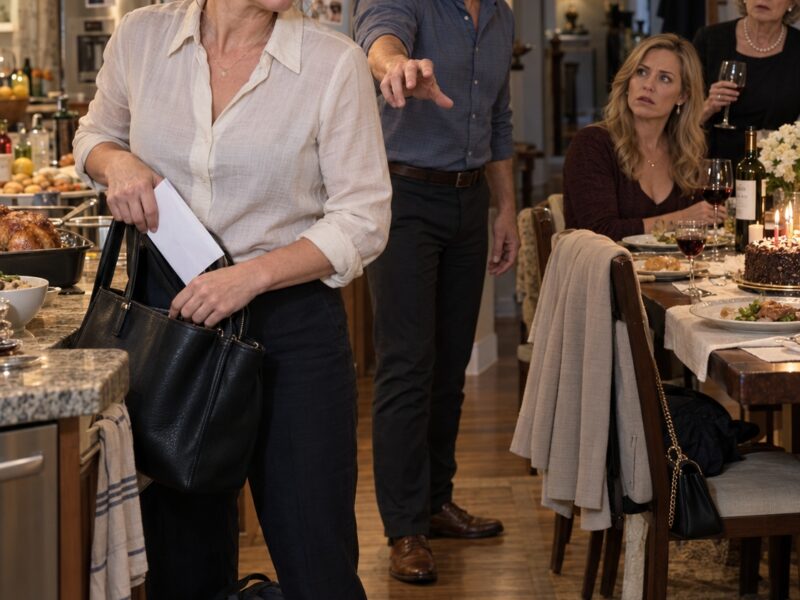
My Husband Called Me a Freeloader in Front of His Mistress and Demanded My Paycheck—So I Took It, Walked Out, and Let the Numbers Tell the Truth
My husband called me a freeloader while my paycheck was sitting six feet away on the kitchen counter.
The woman he had just kissed was sitting in my chair.
And when I picked up the envelope, he told me to leave the money behind.
That was the moment my marriage ended.
Not when I saw his hand at the back of another woman’s neck.
Not when she smiled against his mouth in the hallway.
Not even when he looked at me afterward with irritation instead of shame.
It ended when he pointed toward the white envelope beside the birthday cake and said, “Don’t take that. We have bills.”
My name is Erin Wallace.
I was forty-one years old that Friday night, married for twelve years, and still wearing flour beneath one thumbnail because I had gone directly from a ten-hour shift at Bell & Finch Bakehouse to the grocery store to buy ingredients for my husband’s birthday dinner.
I had been awake since 3:15 that morning.
At four, I had unlocked the bakery production room.
At four-ten, I checked the overnight dough.
At five, I corrected a wholesale order before eighty-four sandwich rolls went to the wrong restaurant.
At six-thirty, I covered for an employee whose son had a fever.
At eleven-forty, I used half my lunch break to compare mushroom prices because Daniel liked the expensive cremini ones in his birthday roast.
At two-fifteen, I picked up my paper paycheck.
One thousand nine hundred eleven dollars and forty-two cents.
Overtime had made it larger than usual.
I put it in the side pocket of my purse.
Then I bought groceries.
By six-thirty, the roast was in the oven.
The potatoes needed twenty minutes.
The mushrooms were sliced.
Daniel’s mother, Marianne, had arrived with a bottle of wine.
His coworker Steven came early because Daniel had asked him to help move a display cabinet at the furniture showroom the next morning.
And then the doorbell rang.
Daniel opened it.
Kara Whitmore stood outside.
Thirty-seven.
Blond.
Divorced.
Regional sales consultant for one of the furniture lines Daniel represented.
I knew her.
I had served her dinner twice.
She had once sent me a holiday card addressed to Daniel and Erin, in that order.
“What is she doing here?” I asked.
Daniel looked annoyed.
“She had a client meeting nearby.”
Kara lifted a bakery box.
“I brought dessert.”
I stared at it.
“I made a cake.”
Her smile faltered.
“Oh.”
Marianne stepped between the moment before it became one.
“Well, now we have two desserts.”
Everybody laughed except me.
I wish I could say I knew immediately.
I did not.
People always imagine betrayal comes with a smell.
A sound.
A warning your body recognizes before your mind does.
Sometimes it looks like a woman putting tiramisu beside a homemade chocolate cake.
Sometimes it sounds like your husband saying:
“Can you grab more wineglasses?”
I went into the dining room.
Steven followed to help.
When I came back, Daniel and Kara were no longer in the kitchen.
I heard the coat closet close.
Then Kara laughed.
Quiet.
I walked toward the hallway.
Daniel stood with one hand against the wall.
The other was behind Kara’s neck.
He kissed her.
Not accidentally.
Not goodbye.
Not the stunned half-second two people regret before it becomes real.
He knew where to put his hand.
She knew how to lean into him.
I stood there long enough for Kara to open her eyes.
She saw me first.
Her body stiffened.
Daniel turned.
“Erin.”
I remember thinking his shirt needed ironing.
That is what shock does.
It gives you stupid tasks because the real one is too large.
“What are you doing?”
Daniel stepped away.
“Nothing.”
Kara looked at the floor.
I stared at him.
“You’re kissing her.”
“It got out of hand.”
“So it was something.”
Marianne appeared from the kitchen.
“What’s wrong?”
Nobody answered.
Then Kara said:
“I should go.”
Daniel turned to her immediately.
“No.”
That hurt.
One syllable.
Automatic.
Protective.
“No, stay.”
I looked at him.
He realized.
“Erin, we are not doing this in the hallway.”
I laughed once.
“Where would you prefer?”
“Not tonight.”
“Why?”
His jaw tightened.
“It’s my birthday.”
That sentence was so absurd I almost admired it.
I walked into the kitchen.
Everybody followed.
The roast hissed in its pan.
The timer on the oven showed seventeen minutes.
My paycheck sat beside the grocery receipts.
Daniel came behind me.
“Can we be adults?”
I turned.
“Were you being an adult with your hand behind her head?”
“Erin.”
Kara sat slowly in the chair I usually used.
Marianne remained standing.
Steven looked toward the door like a man trying to calculate whether leaving would make him more or less involved.
Daniel lowered his voice.
“You’ve been unhappy for months.”
“That is your explanation?”
“No.”
“I’m saying this is complicated.”
“How long?”
Kara looked at Daniel.
He looked away.
That was answer enough.
“How long?”
Daniel said:
“Nothing has happened the way you think.”
“I literally watched something happen.”
“Because you walked in during one moment.”
Kara whispered:
“He told me you were separating.”
I turned toward her.
Daniel said:
“Kara.”
She looked at him.
“What?”
“You did.”
I stared at him.
“When did we separate?”
“We’ve been emotionally separated.”
“Interesting.”
“I still bought your birthday mushrooms.”
Marianne said:
“Erin, maybe everybody needs to calm down.”
I looked at her.
Her son had just been caught kissing another woman beside our coat rack.
She wanted the temperature lowered.
Not the truth raised.
“I am calm.”
Daniel laughed bitterly.
“No, you’re not.”
Then he said the sentence.
The one that did what the kiss had not.
“You’ve been living off me for years, Erin.”
Silence.
Steven’s head lifted.
Marianne whispered:
“Daniel.”
He continued because angry people often think momentum is evidence.
“I pay for this house.”
“I carry the real bills.”
“I’m the one under pressure every month.”
“You work mornings at a bakery and come home before lunch.”
Kara looked down.
Something inside me stopped moving.
“What did you call me?”
Daniel rubbed both hands over his face.
“Don’t make me repeat it.”
“Do.”
He looked at me.
“Fine.”
“You act like you contribute equally, but you don’t.”
“You’ve had the luxury of an easy schedule because I keep everything afloat.”
My voice sounded strangely distant.
“So I’m what?”
He exhaled.
“A freeloader.”
Marianne closed her eyes.
Steven set the dish towel he was holding on the counter.
Kara said:
“Daniel, maybe—”
He snapped:
“Stay out of it.”
I looked at the white envelope.
My paycheck.
I had brought it home every other Friday for twelve years.
Most months I deposited it into our household checking account before I even changed out of my work clothes.
Groceries.
Utilities.
Insurance.
Phones.
Car payments.
Credit cards.
Dental bills.
Birthday dinners.
The little expenses people forget because somebody else keeps remembering them.
I picked up the envelope.
Daniel saw.
“Did you deposit that?”
“No.”
“Then leave it.”
I looked at him.
“The Visa payment comes out Monday.”
I put the envelope in my purse.
His expression changed.
“Erin.”
“I heard you.”
“We have bills.”
“You said you pay them.”
“Don’t be childish.”
I walked upstairs.
My overnight bag was in the closet.
I put in two work shirts.
Underwear.
Socks.
Jeans.
Toothbrush.
My hand shook hard enough that I dropped the toothpaste twice.
When I came downstairs, Daniel was waiting near the bottom step.
“Where are you going?”
“Away from here.”
“That is not an answer.”
“It is tonight.”
My bag would not zip because a sleeve was caught in the teeth.
I put it on the step.
Pulled the fabric loose.
Daniel watched me struggle.
Twelve years of marriage.
And somehow that was the image that stayed.
Not him kissing Kara.
Him standing there while I fought with a zipper.
“You’re walking out over one conversation?”
I looked up.
“I saw you kiss her.”
“We weren’t going to discuss this tonight.”
“Interesting use of ‘we.’”
“You’re making a scene.”
“You invited the scene into our house.”
Kara stood in the kitchen doorway.
“I really should leave.”
I looked at her.
“Were you told I was moving out?”
She swallowed.
“He said you two had basically agreed the marriage was over.”
“Did he tell you that before or after I invited his mother to his birthday dinner?”
Daniel snapped:
“Enough.”
Marianne moved toward me.
“Erin, please.”
“It’s still his birthday.”
I looked at the roast.
At the cake.
At the mushrooms.
At the wine.
“He’s forty-four.”
“He can finish dinner.”
Then I walked out.
Daniel followed me to the porch.
“At least leave the check.”
I turned.
He actually held out his hand.
For the money.
Not for me.
“Tomorrow we can talk.”
I lifted my purse strap higher.
“No.”
His face hardened.
“You’re going to put us in a hole over this?”
I almost answered.
Instead I got into my car.
Drove away.
The first place I stopped was the Meijer parking lot three miles from our house.
Not dramatic.
Not beautiful.
Shopping carts rattled over cracked pavement.
A man was trying to wedge a large houseplant into the back seat of a Honda.
My phone kept vibrating.
I opened my banking app.
Personal checking balance:
$347.18.
That was all I had immediately available in my own name.
Not because I earned nothing.
Because my wages went into our household account.
Daniel transferred a fixed amount monthly for rent.
Most of the rest of his pay remained in the account he had always used before marriage.
The arrangement had started practically.
His commission income changed month to month.
Mine was steady.
I covered recurring household costs.
He handled rent and bigger irregular expenses.
Over time, practical became invisible.
I took out the check.
$1,911.42.
My name.
My hours.
My overtime.
I called my cousin Maya.
She answered:
“Did you make the lemon potatoes?”
“I need somewhere to sleep.”
She went quiet.
“Tonight?”
“Yes.”
“What happened?”
I told her about the kiss.
Then the kitchen.
When I reached the word freeloader, my voice stopped working.
Maya waited.
“He said that?”
“In front of Kara.”
“And Marianne?”
“Yes.”
“And Steven.”
“Yes.”
“Come here.”
“I have work at four.”
“Then you’ll leave from here.”
“I don’t want to disrupt—”
“Erin.”
Her voice sharpened.
“Come here.”
She lived twenty-five minutes away.
At a red light, I noticed flour on my work shirt.
The one sticking out of my bag.
I had changed before dinner.
I suddenly remembered Daniel telling people at a barbecue the previous summer:
“Erin works a couple mornings at a bakery.”
A couple mornings.
I worked forty to forty-eight hours most weeks.
I started at four because bread does not wait for respectable business hours.
I supervised six people.
Scheduled wholesale production.
Managed inventory.
Trained new bakers.
Handled commercial ovens that cost more than Daniel’s car.
But because I came home around noon or one, Daniel gradually transformed my job into something cute.
A hobby with aprons.
I had corrected him for years.
Then stopped.
That silence had cost me more than I knew.
Maya opened her door before I knocked.
She had moved laundry off the couch.
“Put your bag there.”
“I can get a hotel.”
“With what money?”
I flinched.
She immediately regretted the phrasing.
“Sorry.”
“No.”
“You’re right.”
“Did you eat?”
“No.”
“I have soup.”
“I can’t.”
“I’m eating.”
“You can sit.”
I sat.
My phone rang.
Daniel.
Maya looked at the screen.
“Are you safe?”
“Yes.”
“Tell him that.”
“Then stop.”
I texted:
I’m safe. I have somewhere to stay. I’ll deal with practical matters after work tomorrow.
His response came instantly.
Where?
I did not answer.
Then:
Mom is upset. Steven left. This is ridiculous.
Not:
I’m sorry.
Not:
I should never have called you that.
Not:
I sent Kara home.
The check remained in my purse.
Maya put soup in front of me.
I deposited the check into my personal account using the banking app.
Three photographs before it accepted the image because my hand would not hold steady.
Expected availability:
Tuesday.
For the weekend, I had $347.
Gas.
Food.
Maybe lawyer consultation if I could find one cheap enough.
Maya said:
“You can stay here through the weekend.”
Then, after a moment:
“The small room is full of boxes.”
“I can clear it Monday.”
“If this turns into more than a couple nights, I need rent.”
“Of course.”
“Six hundred a month including utilities.”
She looked embarrassed.
“Is that okay?”
I opened the calculator.
Not because I resented her.
Because for the first time in twelve years, every number belonged directly to me.
Two normal checks.
Approximately $3,550 a month take-home depending on overtime.
Six hundred rent.
Car.
Gas.
Food.
Insurance.
Possible legal fees.
Possible obligations on the house.
“I think I can.”
Maya nodded.
“We’ll put it in writing.”
I looked up.
She shrugged.
“Family still deserves clear numbers.”
I nearly cried again.
At 3:15 the next morning, I woke with my cheek against the seam of Maya’s couch.
For three seconds I thought I was at home.
Then her refrigerator clicked on.
I dressed in the dark.
One black sock.
One navy.
Work shirt with an old bleach mark.
My shoes were still in the car.
At Bell & Finch Bakehouse, the ovens were already preheating.
My boss, Diane Finch, was sixty-three and had the emotional style of a building inspector.
If the wall was stable, she did not compliment it.
If it cracked, she said so.
I had worked for her fourteen years.
She saw my overnight bag near the office.
“You going somewhere?”
“Staying with Maya.”
She looked at my face.
“Daniel?”
“Yes.”
“Need to leave?”
“No.”
“Then work.”
I was grateful enough to love her for that.
By six-thirty, the bakery smelled of butter and yeast.
I checked proofing.
Corrected a café order.
Rejected a driver’s request for an early pickup because promising impossible things did not make them possible.
Work held me.
Then at 7:12 I reached automatically for my phone to tell Daniel I had extra sourdough.
Habit moved before reality.
I put the phone down.
Diane saw.
Said nothing.
At noon, Daniel had sent nine messages.
The night “got out of hand.”
He wanted me to come home.
We needed to be practical.
He asked whether I had deposited the check.
Still no apology for the word.
No clear answer about Kara.
I bought a gas-station sandwich.
Ate it in my car.
Shredded lettuce fell between the seat and console.
For twelve years, Saturday lunch had usually been leftovers I packed for both of us.
That sandwich was mediocre.
It also belonged entirely to me.
Marianne called while I was finishing it.
“I don’t understand what happened last night.”
“I saw Daniel kiss Kara.”
“He said things have been difficult.”
“Did he tell you he called me a freeloader?”
Silence.
“You heard him.”
“Yes.”
“You told me to think about his birthday.”
“I wanted everybody to calm down.”
“I left so everyone could.”
“He’s worried about the house.”
I closed my eyes.
“Of course he is.”
“He had to cover the card payment.”
“Marianne.”
“Yes?”
“I am sitting in my car after working since four in the morning.”
“I am paying Maya for a room.”
“I left our joint savings untouched.”
“I will find out what I legally owe.”
“But Daniel being worried about money does not mean I stole money from him.”
“I didn’t say you stole—”
“You called me because he implied it.”
She went quiet.
That evening, Maya and I cleared the spare bedroom.
A box split on the stairs.
Paperbacks scattered everywhere.
We spent ten minutes gathering them.
“This isn’t how I thought I’d spend Saturday,” she said.
“Me either.”
We laughed.
Then I went upstairs and cried while putting a pillowcase on a pillow.
Sunday became paperwork.
Lease.
Bills.
Account screenshots.
Pay records.
Insurance.
Credit card balances.
At three in the afternoon, I searched:
Michigan divorce attorney consultation cost.
I closed the website.
Opened it again.
Booked Tuesday.
The attorney’s name was Marisol Chen.
Her office sat above a pharmacy.
She was fifty-something, wore red glasses, and did not tell me I was brave.
Thank God.
“How long married?”
“Twelve years.”
“Children?”
“No.”
“House?”
“Rental.”
“Lease?”
“Both names.”
“Accounts?”
I explained.
Then:
“I took my paycheck.”
Marisol looked up.
“Whose name was on it?”
“Mine.”
“Where did you deposit it?”
“My personal checking.”
“Did you move anything out of joint savings?”
“No.”
“Good.”
“So he can’t control where my paycheck goes?”
“That is not exactly how marital property works.”
My stomach dropped.
She raised one hand.
“Listen to the rest.”
“You are allowed to earn money.”
“You are allowed to have an account.”
“You are allowed to leave a home.”
“But separation doesn’t magically erase shared obligations or turn every dollar into separate property.”
“We document.”
“We disclose.”
“We stop making emotional transfers.”
I almost laughed.
“Emotional transfers?”
“You would be amazed.”
She asked me to collect twelve months of statements.
Pay stubs.
Rent history.
Joint debts.
Retirement balances.
“Do not empty anything.”
“I haven’t.”
“Do not hide income.”
“I won’t.”
“Do not lend him money just because he panics.”
I stared.
She noticed.
“He asked?”
“Not yet.”
“He will.”
She was right.
First came a voicemail.
“We both had time to cool off.”
“I need you to be practical.”
“Your next payday is next Friday.”
“We need to know what’s coming in.”
I played it twice.
Not:
Can we talk about what I did?
What’s coming in.
Money.
Marisol helped me draft a temporary expense arrangement.
We each paid half the rent through the lease term.
Existing utilities divided.
Joint card balance tracked.
No new expenses presumed shared without agreement.
Daniel hated it.
“This is marriage by spreadsheet.”
I answered:
“We are separating.”
He said:
“You used to understand that households don’t work like invoices.”
That line stayed with me.
Because our household had worked precisely because I had treated every need like mine before anybody wrote an invoice.
I downloaded a year of account statements.
Then I began adding.
My wages deposited into household checking:
$46,982.16.
Daniel’s rent transfers:
$20,400.
Other Daniel transfers:
$6,700.
My wages were not all supporting him.
Some paid my car.
My phone.
My expenses.
That mattered.
Fairness required context.
But the story he had told—that I worked a few mornings and lived off him—could not survive the page.
Groceries.
Utilities.
Health insurance contribution.
Cell phones.
Household supplies.
Car insurance.
Joint credit card payments.
Streaming services he used.
Christmas gifts for his family.
His mother’s birthday dinner.
His showroom clothes charged to the joint card and repaid from household funds when commissions were late.
I stared at the numbers.
Not because I needed to prove I was superior.
Because I had spent years being told the shape of our marriage by somebody who had apparently never added it up.
At work the next Wednesday, Diane came through the production room holding the shop phone.
“There’s a Kara Whitmore asking about a pastry order.”
I stopped weighing dough.
“What?”
“Ninety-six mini pastries for Friday.”
“We don’t have a ticket.”
“She says you know.”
I took the phone into the office.
“Kara.”
“Hi.”
She sounded almost cheerful.
“Daniel said he talked to you about my client breakfast.”
“No.”
Pause.
“He said you handle these things for him.”
“I have before.”
“So you can do it?”
“You can place an order with Bell & Finch.”
“I am speaking to Bell & Finch.”
“You are speaking to an employee who did not approve an order.”
She became quiet.
“Is this because of what happened?”
“No.”
“It is because ninety-six pastries were never ordered.”
I transferred her to Diane.
Standard assortment.
$312.
Payment required in advance.
Daniel called during my break.
“You really made Kara call the shop like a stranger?”
“She is a customer placing an order.”
“I told her it was handled.”
“You didn’t ask me.”
“You’ve done breakfasts for me for years.”
“When you asked.”
“You’re embarrassing me.”
I looked through the bakery window.
One of my employees was loading baguettes into racks.
“I’m going back to work.”
He called twice more.
I left the phone in my locker.
Friday was payday.
My wages went into my account.
I paid my half of June rent directly to the property manager.
Paid Maya.
Paid the agreed card amount.
Put $150 into a savings account labeled:
APARTMENT.
That evening Daniel texted:
Why didn’t the household account get your check?
I sent receipts.
He replied:
What about the rest?
I washed my dinner bowl before answering.
Tell me which existing bill you mean. I paid everything on our written schedule.
His response:
Our marriage should not need a schedule.
I forwarded it to Marisol.
Then slept.
Two days later, Daniel asked to visit Maya’s house.
I agreed.
Maya stayed home but did not sit with us.
Daniel brought Thai takeout.
My usual order.
Extra rice.
The sight of it almost broke me.
People who hurt you still know how you take your food.
We sat at Maya’s little kitchen table.
Daniel looked around.
“Is the room comfortable?”
“It’s fine.”
“You hate small beds.”
He remembered.
That hurt too.
“I miss you,” he said.
I looked at him.
The shirt he wore was one I bought him for Christmas.
There was rice stuck to the cuff.
“What is happening with Kara?”
His thumb moved along the edge of the takeout container.
“Can we eat first?”
“No.”
“I came to talk about us.”
“So tell me.”
He talked.
The house felt empty.
Marianne kept calling.
He could not find the insurance renewal.
He had not been sleeping.
The grocery bill surprised him.
He did not know the password for the utility portal because I had always handled it.
He missed me.
Some of it sounded like the man I married.
Tired.
Familiar.
Human.
“Come home.”
I almost wanted to.
Not because anything was fixed.
Because home is a powerful drug when you are sleeping in someone else’s spare room.
“Are you still seeing Kara?”
His face closed.
“It’s complicated.”
I pushed my food away.
“Then I’m not coming home.”
“You’re making this an ultimatum.”
“Yes.”
He blinked.
“I need the relationship with her to stop.”
“I need you to talk honestly about the kiss.”
“And I need financial decisions to stop assuming my entire paycheck belongs to whatever shortfall you tell me exists.”
“I never said it belonged to me.”
“You told me to leave it on the counter while I left the house.”
“We had bills.”
“There is always a bill.”
He stood.
Then sat again.
I waited.
I wanted an apology.
A real one.
For the kiss.
For Kara.
For humiliating me.
For turning my work into a hobby.
For the word.
Instead:
“You know what would help?”
I almost smiled because I knew.
“What?”
“Put your pay back into the household account.”
My chest went quiet.
“We get normal financially.”
“Then work out the personal piece.”
“No.”
He stared.
“Erin.”
“No.”
“You have all these conditions now.”
“Yes.”
He packed the extra rice back into the bag.
I watched him do it.
And realized I was still trying to interpret whether he was taking it because he wanted it or because I had refused him.
That exhausted me more than anything.
At the door he said:
“Think about it.”
“I have.”
He left.
I cried afterward while Maya put a lid on the leftovers.
“I wanted him to answer me.”
“I know.”
She did not say I should be relieved.
That was kindness.
Work suffered the following week.
I transposed two wholesale quantities.
Diane caught it before shipping.
She put the paper in front of me.
“This one is wrong.”
“I know.”
“Apparently not.”
I closed my eyes.
“Sorry.”
“Five minutes.”
“I’m fine.”
“No.”
“You’re distracted.”
“I can work with sad.”
“I cannot work with careless.”
That embarrassed me.
Also saved me.
I went outside.
Drank water.
Looked at the loading dock.
Then returned.
Diane did not reduce my responsibilities to protect me.
She expected me to do the job.
There was dignity in that.
I started looking for apartments.
One near work had a balcony.
Another applicant got it first.
I cried.
Then felt ridiculous.
Then stopped calling myself ridiculous.
Loss did not have to be proportional to be real.
Another apartment was cheaper but added thirty-five minutes to a commute that began before sunrise.
I crossed it off.
At the end of May, Daniel emailed the lease renewal.
It makes no sense to give up the house. You’ll come back eventually.
I called.
“I’m not renewing.”
“You don’t need to decide now.”
“I have.”
“We built that place together.”
“Yes.”
“Doesn’t that matter?”
“Yes.”
“That is not the same as staying.”
He became angry.
“So where does that leave me?”
“You can speak to the property manager about your options.”
“You sound like my lawyer.”
“No.”
“I sound like mine.”
I gave formal notice.
The lease would end August 31.
Then came the day I returned for belongings.
Maya came with me.
Boxes.
Tape.
Borrowed hand truck.
I expected Daniel.
I did not expect Marianne.
Or Kara.
They were both sitting at my kitchen table.
Marianne had brought cookies.
Kara was scrolling her phone.
Daniel said:
“I thought it would be better if everybody talked.”
Maya whispered:
“Want to leave?”
I looked at the boxes.
“No.”
I sat nearest the hallway.
Daniel began with his version.
How difficult the month had been.
How he had covered expenses.
How he had gone to work every day while I “figured myself out.”
“I went to work too.”
“That isn’t the point.”
“Then get to it.”
He tapped my folder.
“You’ve got everything on paper now.”
“How am I supposed to manage if the money stops?”
“The agreed payments have not stopped.”
Marianne leaned forward.
“Have you paid rent?”
I opened the folder.
Placed the receipt down.
“My half for June.”
She read:
$875.
“Daniel’s half is there too.”
Daniel said:
“What about May?”
“Paid before I left.”
“From the household account.”
“Yes.”
He pointed.
“With my rent transfer.”
I opened the statement.
“Your transfer is here.”
“Mine is here.”
“The actual payment is here.”
Marianne began reading.
Daniel leaned back.
“Why are we doing this?”
I looked at him.
“Because you called me a freeloader.”
“That was said in anger.”
“You have spent years telling people I barely work.”
“I never said barely.”
Marianne looked down at a pay stub.
Then up.
“This says eighty hours.”
“For two weeks.”
“That is normal.”
She looked at Daniel.
“You told me she went in a couple mornings.”
He rubbed his forehead.
“You took it wrong.”
“I start at four.”
“I said quietly.”
“I come home around noon because I have already worked eight hours.”
Marianne looked back at the page.
Overtime.
Year-to-date wages.
My deposits.
Then the household summary.
She began tracing numbers with one finger.
Groceries.
Utilities.
Insurance.
Phones.
Card payments.
Daniel’s transfers beside mine.
Kara had stopped looking at her phone.
She looked at Daniel.
“I thought you paid everything.”
He snapped:
“I pay the rent.”
I said:
“Yes.”
“And it is on the page.”
“I am not pretending you contributed nothing.”
He looked almost surprised.
“Then why are we doing this?”
“Because you pretended I did.”
Silence.
Maya went upstairs for boxes.
Kara spoke.
“He told me you were basically separated.”
“We weren’t.”
“I didn’t know anything about the money.”
“I believe you didn’t know the numbers.”
Daniel said:
“There is no reason to make this an attack on Kara.”
I looked at him.
“You invited her.”
That stopped him.
Marianne turned another page.
“What is this savings balance?”
“Joint savings.”
“Did you take it?”
“No.”
I showed the balance from the week I left.
$7,108.33.
Unmoved.
Then the paycheck deposit.
$1,911.42.
“My wages.”
“Deposited into my account.”
“Disclosed to my lawyer.”
Daniel said:
“You were paid again yesterday.”
“Yes.”
“So you have money.”
“For my rent.”
“My food.”
“My car.”
“My lawyer.”
“My half of our agreed obligations.”
He leaned forward.
“Then lend me fifteen hundred.”
The room changed.
Marianne slowly put the paper down.
“For what?”
Daniel looked at his mother.
“Cash flow.”
“Until commission clears.”
“You said you pay everything.”
Kara’s voice was very quiet.
Daniel turned.
“I did.”
“Until Erin decided to make it impossible.”
I almost answered.
Then realized I did not have to.
Marianne did.
“No.”
Daniel stared.
“What?”
“You asked if I can lend it.”
“I can’t.”
“I have roof repairs.”
His face reddened.
Kara picked up her purse.
“You told me everything was fine.”
“It was.”
“Until she left?”
“Kara.”
She stood.
“I need to go.”
For the first time, I understood something.
Daniel’s version of financial competence had depended on a second income he publicly minimized.
My grocery planning.
My bill tracking.
My overtime.
My willingness to absorb short months.
Not fraudulent.
Not criminal.
But deeply dishonest in the way people sometimes become dishonest when acknowledging help threatens the story they tell about themselves.
I gathered my papers.
Daniel looked at me.
“So now everybody thinks I’m a monster.”
“No.”
“I think you called your wife a freeloader while relying on her paycheck.”
“That is not the same thing.”
“No.”
“It isn’t.”
I meant it.
He was not a monster.
That made the truth more useful.
He was a man who had grown comfortable taking labor seriously only when it looked like his.
I stood.
“Send unresolved bills through Marisol.”
Maya carried down the bookcase.
It caught on the stair corner.
We had to tilt it.
Daniel watched.
He did not offer to help.
Maybe because he was angry.
Maybe because helping would have complicated the symbolism.
For once, I stopped trying to decode him.
In June, I filed for divorce.
Nothing exploded.
Papers.
Forms.
Disclosure.
Rent.
Work.
Groceries.
Daniel hired counsel.
I paid my half of temporary obligations.
He paid his.
Then he started discovering small services I had provided without billing anyone.
He sent me a quote for weekly housecleaning.
Can we split this?
I answered:
No. I no longer live there. I will split the final move-out clean as agreed.
His reply:
We never had this expense before.
I stared at it.
Then laughed.
Of course we had.
The expense had been my Saturday afternoon.
Unpaid.
Unnamed.
Because when a wife cleans, the house somehow “stays clean.”
He asked me to call the insurance agent because “you know her.”
I sent him the number.
He asked when his car registration was due.
I did not answer.
Then he emailed:
Kara is not staying over anymore. There is no reason to keep destroying twelve years.
I read it three times.
I wanted details.
Did she leave after seeing the spreadsheets?
After he asked for money?
Did Daniel end it?
Was there another fight?
Curiosity is not the same as wanting somebody back.
I had to learn that too.
I found the lease termination email.
Read it.
Then replied:
My plans have not changed.
He called.
“She’s gone.”
“I heard you.”
“Then we can start over.”
“I am continuing with the divorce.”
“Why?”
I leaned against Maya’s desk.
There was a dent in the wood under my palm.
“Because Kara leaving does not undo how you saw me.”
“I said one word.”
“No.”
“You lived inside that word long before you said it.”
Silence.
He tried another angle.
“Think about the good years.”
“I do.”
“They matter.”
“They do.”
“Then why throw them away?”
“I’m not throwing away years that already happened.”
“I am deciding the next ones.”
He said:
“You’re cold now.”
Maybe.
Or maybe I had stopped cushioning every hard surface for him.
Marianne asked to meet me for coffee.
I expected another reconciliation campaign.
Instead she brought two recipe cards and a scarf I had left at her house.
“I should’ve asked about your work.”
I looked at her.
“You knew where I worked.”
“I didn’t know.”
“That’s different.”
She stirred coffee she had not sweetened.
“Daniel said you worked mornings.”
“I let myself hear what was convenient.”
I said nothing.
She continued.
“That night, when he called you that…”
Her eyes filled.
“I wanted the birthday dinner to continue.”
“I told you to think about him.”
“I was wrong.”
I had wanted that apology while eating a sandwich in my car.
Now it arrived weeks later and did not transform anything.
Still mattered.
“Thank you.”
She nodded.
Then:
“I believed him when he said you took money.”
“I’m sorry.”
“Thank you.”
No explanation after.
That helped.
She asked whether we could occasionally have coffee.
“I don’t know.”
Then:
“Maybe.”
She accepted maybe.
Another change.
Daniel’s coworker Steven came into the bakery later that summer.
Ordered pastries for his daughter’s graduation.
Waited until the counter cleared.
“Daniel asked me to tell people you had been moving money before the birthday.”
My stomach tightened.
“Did you?”
“No.”
“I told him I saw you take the paycheck envelope.”
“That’s all.”
“Thank you.”
He picked at tape on the box.
“I should’ve said something that night.”
“When?”
“When he called you a freeloader.”
I waited.
“I was thinking about having to work with him Monday.”
“I wanted out.”
“I’m sorry.”
I nodded.
“I wanted out too.”
We did not pretend he had been heroic.
Truth did not require upgrading everybody into better characters.
August arrived.
I found an apartment.
One bedroom.
Tiny kitchen.
Ten minutes from the bakery.
$1,180 a month.
The closet stuck unless you lifted the handle.
The bedroom light was offensively bright.
I applied with pay stubs.
Bank statements.
Employment verification.
The manager called Diane.
Diane apparently said:
“She’s been here fourteen years.”
“If she says she’ll pay you Tuesday, schedule whatever you need around Tuesday.”
I was approved.
First month plus deposit emptied more of my savings than I liked.
I stared at the lower balance.
Then paid.
Not because independence felt glamorous.
Because it cost what it cost.
On August 31, Daniel and I moved out of the old house.
Separately.
Maya and I rented a van.
Daniel hired movers.
The kitchen looked wrong without appliances.
I found a wooden spoon behind the stove.
Put it in my box.
Daniel stood in the living room checking an inventory list.
“Do you want the curtains?”
“They won’t fit.”
“They’re good curtains.”
“Then keep them.”
We did not turn every object into litigation.
The dining table stayed with him.
That hurt.
We had assembled it ourselves after his first large commission.
Flat-pack furniture.
Sandwiches on the floor.
We were happy that day.
Marisol asked:
“Will it fit your apartment?”
“No.”
“Would you need storage?”
“Yes.”
“Then what are you preserving?”
I hated her.
Then understood.
Memory.
Not furniture.
Daniel kept the table.
I bought a small secondhand one for eighty dollars.
One leg wobbled.
I tightened it with a screwdriver.
Ate dinner beside the kitchen window.
First night alone, I did not drink champagne.
Did not play music.
Did not photograph the keys.
I set my alarm.
Put my work shoes beside the door.
Listened to footsteps from the apartment above.
The place did not feel like home.
It felt like somewhere I had paid for.
That was enough.
The divorce moved toward final settlement.
Joint savings went first to joint debt.
Residual balance divided.
Retirement accounts handled correctly through formal orders.
No dramatic jackpot.
No secret offshore account.
Reality is usually less satisfying and more useful.
Daniel did not lose everything.
Neither did I.
We divided what existed.
More importantly, I began seeing what had never appeared on balance sheets.
The value of remembering every due date.
The value of cooking.
Cleaning.
Shopping.
Finding cheap insurance.
Covering his commission gaps.
Being available.
Smoothing.
Not because a court awarded me a fictional hourly wage for being married.
It did not.
Because I finally stopped calling those things nothing.
The final hearing happened in November.
Cold rain.
Fluorescent hallway.
Marisol beside me.
Daniel across from us with his attorney.
He looked tired.
Older maybe.
Or simply no longer filtered through familiarity.
The judge asked routine questions.
Length of marriage.
Settlement voluntary.
Financial disclosures complete.
Then:
“Is there a reasonable likelihood the marriage can be preserved?”
I had thought about the answer in the car.
“No.”
I did not look at Daniel.
The judge entered the judgment.
That was it.
Twelve years ended before lunch.
In the hallway, Daniel approached.
“Can we talk?”
“About what?”
“Us.”
My bag slid off my shoulder.
I pulled it back.
“Not today.”
He looked hurt.
“I wish things had gone differently.”
“So do I.”
Both true.
I went home.
Made a sandwich.
Slept for an hour.
I expected freedom to feel electric.
Mostly I felt hungry.
There were still tasks afterward.
Close household account.
Final utility.
Insurance changes.
Retirement confirmations.
Each one crossed off Marisol’s list.
Eventually nothing remained.
Then Daniel asked for $300 until payday.
I read the message during lunch at work.
Three hundred dollars.
I could send it.
It would not destroy me.
That was what made it difficult.
For years, I had solved gaps because solving them was easier than enduring the discomfort of saying no.
I put my phone down.
Finished eating.
Then typed:
I’m not able to lend you money.
His response:
Never thought we’d end up like this.
I did not explain how we ended up anywhere.
For once, the boundary did not need a closing argument.
In January, I registered for a six-week laminated-pastry class.
$440.
I had wanted to take it for years.
Never found the right time.
That phrase suddenly sounded suspicious.
Never found the money.
Never found the weekend.
Daniel had plans.
House needed something.
Somebody’s birthday.
A short month.
Now I saved for it deliberately.
Diane adjusted my schedule.
My first croissants were ugly.
Butter leaked.
One opened at the side like a mouth.
The instructor pointed at my tray.
“You rushed the turn.”
“I’ve been working dough fourteen years.”
“Then you have fourteen years of habits to argue with.”
Fair.
I wrote it down.
Brought three rejects to Maya.
She selected the ugliest.
“Tastes good.”
“It should have better layers.”
“Then I will destroy the evidence.”
We ate them over plates.
By spring, Diane asked me to sit down after shift.
That usually meant something had gone wrong.
She closed the office door.
“I’m sixty-four.”
“Yes.”
“That is how age works.”
She looked annoyed.
“I want to cut my hours.”
I waited.
“I’m making you production manager.”
I stared.
“I already run production.”
“Exactly.”
“With the title.”
“And salary.”
“How much?”
She slid paper across the desk.
The raise was real.
Not miraculous.
Enough to matter.
Health contribution improved.
Paid time off increased.
Quarterly bonus tied to wholesale targets.
I read twice.
“You look upset.”
“I’m not.”
“Good.”
“Because I’m not taking it back.”
I laughed.
Then asked:
“Why now?”
Diane looked at me like I had missed something obvious.
“Because you’ve been doing most of it for three years.”
That sentence entered somewhere deep.
“You never said.”
“You never asked.”
“That sounds like something Daniel would say.”
Her face changed.
“Then let me correct it.”
She leaned forward.
“I should have formalized it sooner.”
“You deserved the title when the work became yours.”
Clean.
No defense.
I signed.
That year, my income passed sixty thousand for the first time.
Not because I secretly had been underpaid by half.
Because I took more responsibility.
Learned costing software.
Handled staffing.
Completed food-safety management certification.
Negotiated a packaging contract.
Worked.
Progress was not a montage.
It was spreadsheets.
Burned pastry.
Bad sleep.
Good shoes.
One shift after another.
Daniel heard about the promotion through Steven.
He texted:
Production manager. Congratulations.
I stared.
Then replied:
Thank you.
Nothing else.
He responded:
Guess the bakery was more serious than I gave it credit for.
I almost wrote:
It was serious when I worked there while married to you.
Then deleted it.
Understanding arriving late did not require my editorial assistance.
Months became years.
I bought a better mattress.
Painted the apartment kitchen a pale blue the landlord approved.
Replaced the wobbling table when one joint finally split.
Kept the old screwdriver.
Maya married her boyfriend and moved across town.
I gave her the book she had lent me the first month I stayed with her.
She laughed.
“You kept this two years?”
“I was busy divorcing.”
Fair.
Marianne and I remained loosely connected.
Coffee every few months.
She stopped giving me Daniel updates unless I asked.
I almost never asked.
Kara disappeared from my life entirely.
I heard she moved to Ohio.
Whether she and Daniel continued after I left became irrelevant before I expected it would.
One afternoon, four years after the divorce, Bell & Finch received an inquiry about providing breakfast pastries for a regional furniture-industry event.
I recognized the company.
Daniel’s employer.
Diane put the request on my desk.
“Conflict?”
“No.”
“You sure?”
“Yes.”
“Then quote it.”
I did.
Standard pricing.
Deposit.
Delivery fee.
No discount.
No surcharge.
No revenge.
The order was confirmed by a new office coordinator.
The morning of delivery, I checked every box.
Not because Daniel might be there.
Because that was my job.
He was there.
I saw him across the hotel conference lobby while our driver unloaded racks.
Daniel had more gray hair.
I probably did too.
He noticed me.
Walked over.
“Erin.”
“Hi.”
“Did you do all this?”
I looked at the boxes.
“My team did.”
He smiled slightly.
“Right.”
Then:
“You look good.”
“So do you.”
He laughed.
“I don’t.”
“You look fine.”
We stood awkwardly.
Then he said:
“I heard you’re a manager now.”
“Four years.”
“I know.”
Of course.
Mutual people.
Old information travels slowly but persistently.
He looked toward the pastry display.
“I owe you an apology.”
I waited.
Not because I needed it.
Because he had begun.
“I used to tell people you worked a few mornings.”
“Yes.”
“I knew that wasn’t accurate.”
That surprised me.
“Why?”
He looked down.
“Because saying you worked full-time made the way we handled money look different.”
My chest went quiet.
There it was.
Not ignorance.
Storytelling.
“I liked being the one who paid the rent.”
“It made me feel successful.”
“If I said your money paid everything else, then it sounded more like we were both keeping the house up.”
“We were.”
“Yes.”
He rubbed the back of his neck.
“I know.”
“And when commissions got bad…”
He exhaled.
“I let you smooth it over.”
“Then resented that I needed it.”
Accurate.
I said:
“That sounds exhausting.”
“For both of us.”
He smiled sadly.
“Yeah.”
Then:
“I’m sorry I called you a freeloader.”
“For a long time I wanted you to understand exactly how wrong you were.”
“What changed?”
“I understood it.”
He looked at me.
“That was enough?”
Eventually.
“Yes.”
He nodded.
The event coordinator called his name.
Daniel glanced back.
Then:
“I hope you’re happy.”
“I am.”
Not triumphant.
Just true.
He went back inside.
I checked the delivery sheet.
Signed it.
Went to the bakery.
That evening, I stopped at the grocery store.
Eggs.
Milk.
Onions.
Potatoes.
Coffee.
I reached automatically for the brand Daniel used to like.
Stopped.
Moved my hand six inches.
Bought mine.
Near the end of the aisle sat a small jar of cherry preserves.
Expensive enough that twelve-years-married Erin would have stood there doing household math.
Do we need it?
Would Daniel eat it?
Are preserves already at home?
Could that six dollars go toward the Visa balance?
I checked my grocery budget on my phone.
There was room.
I put the jar in the cart.
Such a small thing.
That is what nobody tells you about leaving.
The dramatic moment is easy to describe.
Your husband kisses another woman.
Calls you a freeloader.
Demands your paycheck.
You pick it up.
You walk out.
People understand that scene.
What comes afterward is harder to explain because freedom rarely arrives as one large event.
It arrives as smaller permissions.
You may pay rent and still buy the coffee you like.
You may say no to a loan you could technically afford.
You may stop remembering another adult’s insurance renewal.
You may keep a good memory without returning to the person inside it.
You may accept an apology without treating it as an invitation.
You may admit the marriage had happy years without using happiness as evidence that the ending was wrong.
I did not become rich after leaving Daniel.
That would make a simpler story.
I still worked before sunrise.
Still checked grocery prices.
Still worried when my car made a new sound.
Still waited for payday before large purchases.
But the money I earned stopped disappearing into a story where my work was too small to count.
I knew what came in.
I knew what went out.
I knew which choices were mine.
Years earlier, Daniel had stood in our kitchen and said:
“My money pays the rent.”
He was correct.
Partly.
His money paid rent.
My money paid much of the life around it.
Neither contribution made one of us the owner of the other.
That was the lesson I learned too late for the marriage and just in time for myself.
On the fifth anniversary of the night I left, May happened to fall on a Friday payday again.
Diane handed me no paper envelope anymore.
Bell & Finch had finally moved everyone to direct deposit.
My phone notification appeared while I was cooling croissants.
PAYROLL DEPOSITED.
I checked it at lunch.
Rent already budgeted.
Insurance.
Savings.
Groceries.
A weekend class in chocolate work I had signed up for.
Everything had a place.
Nobody was waiting in a kitchen asking me to leave the rest on the counter.
After work, I drove home.
The apartment I once thought would be temporary had become too small after my promotion, so the previous year I moved into a little two-bedroom duplex.
Not luxurious.
A porch.
A patch of grass.
Enough kitchen counter to roll pastry.
Maya called while I was bringing groceries inside.
“What are you doing tonight?”
“Nothing.”
“Come over.”
“I just got home.”
“You’re old.”
“You’re older.”
“By nine months.”
“Ancient.”
She laughed.
“Bring something.”
I looked into the grocery bag.
Cherry preserves.
Again.
I had started keeping them regularly.
“I have jam.”
“That is not a party contribution.”
“It’s artisanal.”
“That is grocery-store jam with self-esteem.”
I laughed.
“I’ll bring dessert.”
I made a simple tart.
Not for Daniel.
Not a customer.
Not an anniversary.
Not a performance.
Because I wanted to.
While it baked, I found an old folder in the hall closet.
Divorce papers.
Lease receipts.
Temporary expense schedules.
Pay stubs.
The first twelve-month summary.
My finger stopped over the number:
$46,982.16 — Erin wages deposited to household account.
For years that page had felt like evidence.
Now it looked like arithmetic.
I put the folder back.
No need to burn it.
No need to frame it.
The numbers had already done their work.
They told me the truth at a time when the people around me preferred a simpler story.
I had never been a freeloader.
But eventually even that sentence became less important.
Because freedom was not proving Daniel’s word false forever.
Freedom was reaching a point where his definition of me no longer required a response.
The tart timer rang.
I took it from the oven.
The crust had browned slightly more on one side.
Not perfect.
Still good.
I carried it to Maya’s house.
We ate it warm.
Nobody asked who paid the rent.
Nobody asked what I owed for being there.
And when I left that night, I took my purse, my keys, and every dollar that belonged in it with me.









