My Husband Hung Up My 911 Call While Our Six-Year-Old Son’s Heart Was Failing—Then Told the Dispatcher It Was a Butt Dial
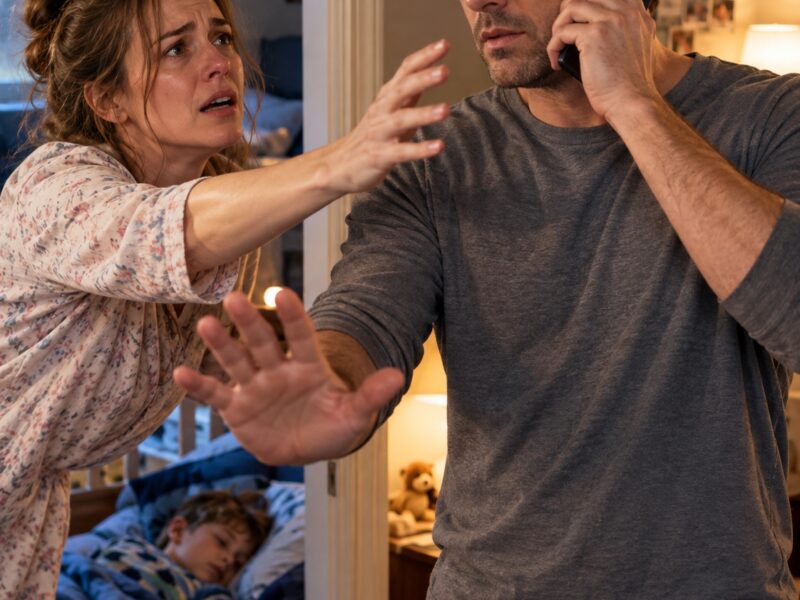
My six-year-old son was barely conscious when my husband took my phone from my hand, ended my 911 call, and slipped it into his pocket.
When the dispatcher called back, Trevor smiled into the phone and said it had been a butt dial while our child’s heartbeat stumbled behind him.
I thought my husband was panicking about money—until days later, at 11:42 p.m., he called from a bar and asked what time our son’s funeral would be.
The dispatcher had barely finished saying, “911, what’s the address of your emergency?” when Trevor took the phone out of my hand.
He did not snatch it.
That would have been easier to understand.
He took it calmly, almost gently, the way you take scissors away from a child who does not understand that scissors can hurt him.
Then he pressed the red button.
The call disappeared.
Our son Owen lay behind us on his little blue bed, six years old, forty-four pounds, his dinosaur pajamas damp around the collar with sweat. His skin had gone gray beneath the fever flush, and the pulse beneath my fingertips had been so wrong that I had stopped counting twice because I thought I had made a mistake.
I count things for a living.
Hospital procedure codes. Claim numbers. Dates. Charges. Denials. Deductibles. The ugly little trail of numbers that follows people out of emergency rooms.
Numbers make sense to me.
Owen’s heartbeat did not.
It slowed until I could feel the space between beats, then raced in short frightened bursts before stumbling again.
“Give me my phone,” I said.
Trevor put it into the back pocket of his gray sweatpants.
“An ambulance is going to cost us three thousand dollars.”
For a second, I honestly thought I had misheard him.
“What?”
“He’s dehydrated.”
“He needs a doctor.”
“He has a stomach bug, Hannah.”
Owen made a weak sound behind us.
Not a word.
Just air.
I turned.
His eyes were half open, but they were not looking at anything.
“Trevor.”
“He threw up. Kids throw up.”
“His heart is wrong.”
“You’re scaring yourself.”
My phone started ringing from his pocket.
We both looked at it.
He knew what it was.
So did I.
When you disconnect a 911 call, they call back.
“Give it to me.”
Trevor pulled the phone out, glanced at the screen, and answered.
His voice changed instantly.
Smooth.
Warm.
The voice he used with unhappy customers.
“Hey, yeah. Sorry about that.”
I stepped toward him.
He turned away.
“Accidental call,” he said. “Butt dial. Everything’s fine here.”
My mouth opened.
Nothing came out.
He listened for a second.
“Yep. Positive. Sorry again.”
Then he hung up.
Behind him, Owen’s arm slid off the bed.
It hung there loosely, fingers inches above the carpet.
That was when something in me became very quiet.
Not calmer.
Sharper.
“Move.”
Trevor turned.
“Hannah—”
“Move.”
He must have heard something different in my voice because his expression changed.
Only slightly.
But I saw it.
I stepped past him and scooped Owen up with his blanket wrapped around him.
He had never felt so heavy.
He had never felt so light.
Trevor followed me into the hallway.
“Where are you going?”
“Hospital.”
“I said we can drive him if he’s not better in an hour.”
“We’re driving now.”
“Hannah, think.”
“I am.”
He stepped in front of me.
His arms spread across the hallway.
For one second, he filled it completely.
My husband.
My son’s father.
A man who had cried harder than I did the day Owen was born.
A man who once stayed awake all night because our baby had a croupy cough and he was afraid he might sleep through the sound.
He stood between me and the front door.
I walked straight toward him.
He did not move until a rake scraped outside our open front window.
Mr. Albright next door.
Seventy-nine years old.
Every Saturday morning at seven, he raked his lawn whether leaves existed or not.
Trevor heard it.
I watched him hear it.
Then he stepped aside.
I carried Owen into the kitchen, opened the junk drawer with one hand, found the spare car key beneath dead batteries and takeout menus, and went barefoot across the wet October grass.
Mr. Albright looked up.
His rake froze in midair.
“Hannah?”
“I need to get Owen to St. Brendan’s.”
One look at my son’s face and his expression changed.
“Want me to call an ambulance?”
“No time.”
I laid Owen across the back seat, climbed in beside him long enough to buckle him, then got behind the wheel.
Trevor opened the passenger door.
For half a second I thought he was going to stop me again.
Instead, he sat down.
Closed the door.
Put on his seat belt.
Like we were going to Target.
I pulled out so fast the tires slipped on wet pavement.
My hands would not stop shaking.
I talked to Owen the entire way.
I do not remember most of what I said.
I remember counting.
Ten.
Nine.
Eight.
It was something Owen and I had done since he was four.
At the pediatrician.
During thunderstorms.
Before the first day of kindergarten.
Whenever he got scared, we counted backward.
He always slowed at four.
Then I would say three with him.
Two.
One.
“You’re brave,” I would tell him.
That morning I kept starting over.
Ten.
Nine.
Eight.
Beside me, Trevor texted someone.
He never once said our son’s name.
St. Brendan’s emergency entrance appeared ahead of us at 7:38 a.m.
I remember the digital clock because later every minute mattered.
I pulled into the drop-off lane crooked.
A security guard shouted something.
I was already carrying Owen through the sliding doors.
A triage nurse took one look at him.
Her face changed.
She took him from my arms and ran.
Everything after that happened too fast and too slowly.
Curtain.
Bed.
Scissors cutting through dinosaur pajamas.
Hands attaching pads.
Someone asking his weight.
Someone asking what he had taken.
“Nothing,” I said.
“Children’s fever medicine earlier this week. Nothing else.”
“Any prescriptions in the home?”
“No.”
“Any heart medication?”
“No.”
Then the monitor made a sound I had only heard on television.
A long tone.
A nurse put both hands on my shoulders and walked me backward.
“No.”
“Hannah, come with me.”
“No.”
“Let them work.”
Through the gap in the curtain, I saw a doctor begin compressions.
Someone counted.
“One, two, three, four—”
I pressed my back against the hallway wall.
My bare feet were freezing.
I started counting too.
Backward.
Ten.
Nine.
Eight.
Seven.
Six.
Five.
Four—
I stalled.
Like Owen always did.
“Three,” I whispered.
“Two.”
“One.”
The flat tone broke.
A beep.
Another.
Then a ragged series.
A nurse beside me released a breath.
“Okay.”
She squeezed my shoulder.
“Okay. We have him.”
I slid halfway down the wall.
Someone caught me.
Later they told me his heart had stopped for less than a minute.
Time is funny that way.
Forty seconds can be an entire lifetime when your child is on the other side of a curtain.
They stabilized him, placed a breathing tube, and moved him to the pediatric intensive care unit.
The emergency physician sat with us in a consultation room with two plastic chairs, one box of tissues, and a framed watercolor print of a lake that I stared at while she explained that Owen had suffered a dangerous cardiac rhythm.
One possibility was inflammation after a viral infection.
He had been coughing.
He had a mild fever earlier in the week.
It made sense.
It was also incomplete.
“We’re sending more labs,” she said. “Including a broader toxicology panel.”
Trevor looked up.
“How long?”
“A few days, usually.”
“Exactly how many?”
The doctor studied him.
“It depends on the reference lab.”
Trevor nodded.
He had been staring at his phone almost the entire conversation.
I looked down at my left wrist.
Four dark marks were forming where he had held me near Owen’s doorway when I tried to get my phone back.
I pulled my sleeve over them.
I told myself he had panicked.
Money had been tight.
His company’s bonuses had changed.
Our home-equity line was still open from a kitchen project we never finished.
Ambulances were expensive.
People made stupid decisions when frightened.
That explanation was easier than the other one.
The other explanation did not yet have a shape.
Four days earlier, before any of this, I had almost refused to go to dinner.
It was a Friday evening in early October, the kind Ohio gets when the trees are beginning to turn but the air is still warm enough that everyone pretends summer has not really left.
Owen had a runny nose and a little cough.
Nothing frightening.
Half his first-grade class seemed to have the same thing.
I was tired.
I work from home as a medical billing and coding specialist, which sounds boring because most of it is.
I spend eight hours a day reading strangers’ hospital stories without seeing their faces.
A code tells me someone had a CT scan.
Another tells me somebody needed stitches.
Another tells me that somebody spent three hours in an emergency room waiting for a doctor who was probably dealing with someone sicker.
I am good at it.
Good enough that people at work sent difficult claims to me.
I used to think that meant I noticed things.
Trevor came home early carrying grocery-store flowers with the price sticker still on the plastic.
“We never do anything anymore,” he said.
“Just us.”
He had made reservations at a small Italian restaurant in the Short North.
His younger sister Brooke was already on her way to babysit.
“Trevor, Owen’s sick.”
“He has a cold.”
“He’s clingy.”
“He’s six. He’ll survive three hours with Aunt Bee.”
Brooke arrived fifteen minutes later carrying a blender in a canvas tote.
“I’m making him my pink smoothie.”
Owen came running down the hallway in dinosaur pajamas and slammed into her legs.
She lifted him.
Spun him.
He laughed.
I remember standing there with one earring in my hand thinking how lucky we were.
That thought would haunt me more than any scream.
Brooke was thirty-six, five years younger than Trevor, and worked as a home health aide.
She drove from one elderly client’s house to another, helping people bathe, sorting medication boxes, reheating soup, sitting through daytime television with people whose families visited less than they should.
She had never married.
She had been Owen’s Aunt Bee since he was three weeks old because he could not say Brooke when he was little.
Before Trevor and I left, Owen became anxious.
He clutched my coat.
“Don’t go.”
“Buddy, we’ll be back before you know it.”
“No.”
His lower lip trembled.
So I crouched.
“Count with me.”
Ten.
Nine.
Eight.
He breathed.
Seven.
Six.
Five.
At four he slowed.
I smiled.
“Three.”
“Two.”
“One.”
Owen wiped his nose on his sleeve.
“Okay. I’m brave.”
Brooke laughed.
But when I stood, I noticed her hands shaking as she unpacked the blender.
I noticed she looked at Trevor across Owen’s head.
Trevor did not look back.
I noticed it the way you notice a crack in a sidewalk.
Then I stepped over it.
Dinner was lovely.
I hate that it was lovely.
Trevor held my hand across the table.
He talked about opening a real college fund for Owen.
Said he had been working too much.
Said I looked tired and that it was his fault.
He kept checking his phone.
“Game,” he said.
“Ohio State.”
I believed him because ordinary explanations are powerful when you love someone.
He asked if I remembered our first apartment.
The one with the radiator that banged all winter.
The one where we ate Chinese food sitting on moving boxes because the couch had not arrived.
“We were happy there,” he said.
“We’re happy now.”
I said it automatically.
Trevor looked at me for a second longer than necessary.
“Yeah.”
Then he smiled.
“Of course.”
We came home at ten-thirty.
Owen was asleep.
Brooke had cleaned the kitchen.
Blender washed.
Glasses put away.
Counter wiped.
She hugged me too tightly.
Would not take the twenty dollars I tried to give her.
“Family,” she said.
Then she left.
At four the next morning, Owen vomited.
I cleaned him up.
Changed sheets.
Gave him water.
He said his stomach hurt.
His eyes felt funny.
I assumed a stomach bug.
At five-thirty, he vomited again.
I lay beside him.
At some point, I fell asleep.
When I woke, Trevor sat at the edge of the bed holding an empty chocolate pudding cup.
“Gave him some medicine for his stomach.”
“What medicine?”
“Just something to settle it.”
“What?”
He stood before I could push.
“He finally fell asleep. Don’t wake him.”
I was exhausted.
I let the answer go.
That choice would come back to me in the PICU every time I saw pudding.
Owen’s intensive-care room had a glass wall facing the nurses’ station and a narrow window toward the parking garage.
There were four IV pumps.
Six lines.
A ventilator.
A monitor whose green line became the center of my existence.
I counted everything.
Pumps.
Breaths.
Spaces between alarms.
The exact number of ceiling tiles above his bed.
It was the only way I knew not to dissolve.
The attending physician was Dr. Anand Mehta.
Tall.
Silver at his temples.
He crouched when he spoke to frightened parents instead of standing over them.
Sunday morning he explained that Owen’s rhythm had stabilized with medication.
Most likely cause remained viral inflammation.
“But the quick screen downstairs only checks common substances,” he said. “We sent a broader toxicology panel to an outside lab because the rhythm is unusual.”
Trevor’s head came up.
“How long?”
“Four or five days.”
“Four or five?”
“Approximately.”
“Which one?”
Dr. Mehta paused.
“Why?”
“I like knowing what to expect.”
Trevor smiled.
Then rested his hand on my shoulder.
I remember that hand because of the bruises beneath my sleeve.
Sunday afternoon, Trevor followed Dr. Mehta into the hall.
Their voices carried.
“If it comes to that,” Trevor said, “do both parents have to sign a do-not-resuscitate order?”
Silence.
Dr. Mehta answered carefully.
“We are nowhere near that conversation, Mr. Pruitt.”
“I know.”
“I just want the process.”
I told myself that was Trevor.
He read endings of novels first.
Checked weather forecasts ten days out.
Looked up restaurant menus before we went.
Prepared for the worst so nothing surprised him.
That was what I told myself.
Monday morning, the unit social worker offered parking vouchers and meal cards.
Trevor asked for bereavement-leave paperwork.
“Just so it’s ready.”
The social worker stared.
So did I.
After she left, I said, “Trevor, he’s not dying.”
“I didn’t say he is.”
“You asked about bereavement leave.”
“My company is a nightmare about paperwork.”
“You’re talking like this is already decided.”
“I’m being realistic.”
Then:
“One of us has to be.”
That sentence sat between us for the rest of the day.
Brooke came Sunday evening and Monday afternoon.
Both times she cried outside the room before entering.
Loud, gulping sobs.
Then inside she stood at the foot of Owen’s bed.
She did not get close.
“Come closer,” I told her once.
She shook her head.
“I don’t want to mess with anything.”
Rosa Delgado, Owen’s night nurse, noticed.
Rosa was in her fifties, short and broad-shouldered, with reading glasses on a beaded chain and a voice like warm gravel.
Sunday night, while I used the restroom, Brooke asked Rosa whether Owen could hear people while sedated.
Then whether he might remember anything from before he became sick.
Rosa answered.
And documented it.
I did not know that yet.
Late Monday morning, Trevor’s phone lay faceup on the tray beside Owen’s bed while he went to the restroom.
A notification appeared.
Northfield Mutual. Payment received. Policy ending 4471.
I assumed car insurance.
Maybe workplace life insurance.
We had several policies.
I process insurance claims eight hours a day and barely thought about it.
That detail humiliated me later.
Monday afternoon Trevor said a commercial HVAC client had an emergency.
He disappeared for three hours.
When he returned, he smelled like cold air and some kind of floral air freshener.
He sat in the corner.
Said nothing.
I did not ask where he had been.
I was watching Owen’s numbers.
Tuesday, Owen improved enough to remove the breathing tube.
Four minutes.
Coughing.
Gagging.
Then breath.
His own breath.
Uneven.
Noisy.
Perfect.
Twenty minutes later:
“Mama.”
One word.
I had heard it ten thousand times.
Crib.
Back seat.
Playground.
Never understood it could be taken.
I leaned against the bed rail because my legs failed.
Owen raised his fingers.
Four.
Five.
Seven.
“Counting?”
He nodded.
“You’re brave,” I whispered.
“You are the bravest person I know.”
Trevor stood in the doorway.
I expected tears.
Instead, blankness.
Then hallway.
Phone call.
Hand against wall.
A small strike with the side of his fist.
At five-thirty, a nurse brought chocolate pudding.
Owen ate three spoonfuls.
I looked at the cup.
Cold passed through my stomach.
Saturday.
Trevor.
Pudding.
“Medicine for stomach.”
The memory hovered.
Then exhaustion buried it.
At six-twenty, I fainted in the family bathroom.
Hit my chin.
Four stitches.
Apple juice.
Crackers.
A physician assistant told me I was going to become a patient if I did not sleep.
When I returned upstairs, Dr. Mehta and Trevor both insisted I go home.
Trevor touched my cheek beneath the stitches.
“I’ve got him.”
I said no.
Three times.
Then Owen whispered:
“Go sleep, Mama.”
“I’ll count.”
So I went.
Before leaving, I peeled one glow-in-the-dark plastic star from my pocket.
I had taken it from Owen’s ceiling when I showered at home Sunday.
Thirty-one stars decorated his room.
He knew the exact number.
I stuck that one on the monitor frame.
Above the green heartbeat line.
“Your star,” I told him.
Then kissed his forehead.
At the nurses’ station Rosa watched me leave.
She opened her mouth.
Closed it.
I drove home.
Fell into bed wearing my clothes.
Three hours later, my phone rang.
11:42 p.m.
Trevor.
A sports bar roared behind him.
“So what time’s the funeral?”
I sat upright.
“What?”
“They’ll want Saturday.”
Pause.
“Ten or two. You pick.”
“Owen is alive.”
The longest silence of my marriage.
“Nobody called you?”
“Who would call me?”
“What are you talking about?”
His voice softened.
Loosened.
“God, Han.”
“I’m drunk.”
“Bad dream.”
“Forget it.”
Then he hung up.
He did not answer when I called back.
The PICU desk did.
The secretary covered the phone.
Spoke to someone.
Then came back very carefully.
“Owen is okay right now.”
Right now.
Those words changed everything.
“But Rosa asked me to ask you something.”
“What?”
“Can you come in?”
“When?”
“Now.”
I left the house wearing one sneaker and one slipper.
Trevor’s fleece.
His cologne around me.
One question.
Why did my husband know something about our son that I did not?
I reached the fourth floor eight minutes after midnight.
The unit secretary buzzed the doors before I even reached the intercom.
That frightened me more than anything.
They had been watching for me.
A crash cart stood outside Room Seven.
Red metal.
Drawers.
Wheels.
I started running.
Rosa stepped in front of me.
“He’s alive.”
“Move.”
“Hannah.”
She took me by both arms.
“He is alive.”
“What happened?”
“I need ninety seconds.”
“No.”
“Ninety.”
She steered me into a narrow utility room lined with gauze, tubing, and saline bags.
Fluorescent light flattened everything.
She shut the door.
Her glasses dropped against her chest.
She looked furious.
“I’m supposed to let the team tell you tomorrow morning.”
“Tell me.”
“Owen’s toxicology resulted at six.”
A heart medication.
One usually prescribed for older adults.
Nobody at the hospital had given it.
Nobody in our home had a prescription.
Child protection had been notified.
Both parents would be interviewed.
Then Trevor left the unit at 10:05.
Before leaving, he had asked Rosa how long a hospital keeps a child after death before a funeral home comes.
Twice.
I put one hand against the metal shelf beside me.
“At five, Brooke came,” Rosa continued.
“She said Trevor was sleeping in the car and she’d sit with Owen.”
“I had another patient two rooms down.”
“I kept coming back.”
“At eleven-thirty, I walked in and Brooke had a green-lid thermos.”
My skin went cold.
“She was holding it to Owen’s mouth.”
“Said it was apple juice from home.”
“I took it away.”
“She grabbed it back.”
“Said she didn’t know outside drinks weren’t allowed.”
“She left.”
“What time?”
“Eleven thirty-eight.”
My knees felt loose.
“At eleven-fifty, Owen’s rhythm became unstable again.”
Rosa continued quickly.
“We caught it immediately.”
“The doctor was at bedside in under a minute.”
“He is stable.”
“But Hannah…”
She stopped.
“What?”
“What time exactly did Trevor call you?”
“Eleven forty-two.”
Rosa went completely still.
I watched her do the arithmetic.
Then she leaned toward me.
“Your husband called asking about a funeral eight minutes before Owen’s heart went wrong.”
I stared.
“He called before I called anybody.”
“Before the medical team knew there was a problem.”
“Before the unit secretary contacted you.”
“He called because he thought something had already happened.”
I looked at the shelves.
White labels blurred.
“No.”
“Hannah.”
“No.”
My stomach turned.
I vomited into the little steel sink.
There was nothing in me except crackers and apple juice from the ER.
Rosa held my hair back.
The exact way I had held Owen at four Saturday morning.
When I straightened, something inside me had changed.
Not because I understood.
Because I finally stopped explaining.
“Can I see him?”
“Yes.”
Owen slept.
Pale.
New wires.
Heart monitor tracing a green line.
The plastic star was still above it.
I sat beside him.
Found his hand.
Counted his heartbeats for a full minute.
Then again.
Then again.
At 1:14, Trevor texted.
Sorry about before. Bad dream. Too many beers. Love you both. Kiss our boy for me.
I read it four times.
Then I took off his fleece.
Folded it.
Put it on the floor in the farthest corner of the room.
At 1:30, Dr. Lena Okafor arrived.
She was younger than I expected, maybe forty, close-cropped hair, fleece vest over scrubs.
She explained exactly what would happen.
Trevor and Brooke removed from visitor list temporarily.
Hospital police nearby.
County child services notified.
A detective would come in the morning.
Owen would not be left alone with any family member until they knew more.
Then she said something I hated but later respected.
“Until we understand what happened, my job is to look at everybody who had access to him.”
“That includes both parents.”
“That includes you.”
I nodded.
It hurt.
But it was right.
At 6:40 a.m., Trevor returned.
Pressed blue shirt.
Clean-shaven.
Two coffees.
His badge did not open the unit doors.
He slipped in behind a nursing assistant pushing a linen cart.
I saw him from Owen’s room.
I moved into the doorway.
Blocked it.
Trevor smiled.
Held out one coffee.
“Morning.”
Then quietly enough that only I could hear:
“What did you tell them?”
“You asked me what time the funeral was.”
His smile stayed.
His eyes changed.
“I was drunk.”
“Move, Hannah.”
“No.”
“I want to see my son.”
“No.”
He set the coffees down carefully.
Then placed both hands on my shoulders.
Applied steady pressure.
Not a shove.
Something worse.
Confidence.
Trying to move me like furniture.
My fingers locked around the metal doorframe.
“Trevor.”
“Stop making this worse.”
Behind me, Owen woke.
He saw his father’s hands on me.
“Daddy!”
Not a greeting.
A scream.
His monitor alarmed.
Rosa came running.
Hospital officer Dale Pike followed.
Trevor released me instantly.
His expression transformed.
Concerned husband.
“I’m his father.”
Then louder:
“Look at her.”
“She’s not well.”
“She fell Tuesday.”
“She hasn’t slept.”
“I’m worried about her.”
He was performing for witnesses.
Officer Pike escorted him out.
As the doors closed, Trevor looked back.
“You did this to him, Hannah.”
“Everybody’s going to know.”
I did not follow.
I went to Owen.
He was shaking.
He started counting.
“Ten.”
“Nine.”
“Eight.”
He stalled.
“Four?”
I sat beside him.
“Three.”
“Two.”
“One.”
The monitor slowed.
Rosa wrapped my hand where hot coffee had splashed it in the struggle.
She said nothing.
Detective Carla Voss arrived at ten.
No comforting voice.
No soft smile.
Gray-blond hair pushed back with reading glasses.
Spiral notebook.
Fast handwriting.
I became grateful for her lack of warmth.
Warmth can make you feel believed before the truth is ready.
Voss wanted facts.
I gave them.
Friday dinner.
Brooke babysitting.
Pink smoothie.
Saturday vomiting.
Pudding cup in Trevor’s hand.
The 911 call.
The callback.
“Butt dial.”
My bruised wrist.
Funeral questions.
11:42.
When I mentioned 911, she stopped writing.
“That call is recorded.”
“And the callback.”
My throat tightened.
“Good.”
Then she explained what did not exist yet.
A direct link to the medication.
Toxicology proved Owen had ingested something not prescribed.
It did not prove who gave it.
Brooke had access through elderly patients.
A defense attorney could say Owen got into her purse accidentally.
Could say she panicked.
Could say the thermos was ordinary juice.
Trevor had likely been on bar cameras Tuesday night.
His funeral question sounded terrible.
But terrible was not the same as proof.
“I need a hand on the drug,” Voss said.
She tapped her notebook.
“A person.”
“An object.”
“A record.”
“Something a jury can touch.”
Then she investigated me.
Who prepared food.
Who gave Owen water.
What medicines I took.
Mental-health history.
I told her about postpartum depression after Owen’s birth.
Low-dose antidepressant.
Stopped four years earlier.
She wrote it down.
I hated watching.
She saw that.
“If I don’t ask you,” she said, “his defense lawyer gets to tell a jury the police never even looked at the mother.”
That stayed with me.
Investigations that survive court cannot be built only from sympathy.
Before she left, Voss told me not to contact Trevor or Brooke.
Do not go home alone.
Call if I saw either.
I went home that afternoon anyway.
Not alone.
I called Mr. Albright.
Asked him to stand on his porch while I went inside.
“Hannah,” he said in his gravelly voice, “after what I saw Saturday, I’ll stand on your porch all day.”
Trevor’s truck was gone.
The house looked almost unchanged.
My coffee cup.
Owen’s sneakers.
Toy dinosaur on the stairs.
Then I opened Trevor’s home office.
Laptop gone.
File drawers half open.
Tax folder empty.
I logged into our bank.
Joint checking balance:
$411.
At 8:15 that morning, someone had transferred $11,400 to an unfamiliar account.
Then I looked at our home-equity line.
We had opened it years earlier for kitchen remodeling.
Never used much.
Now the balance was nearly $58,000.
Withdrawals since March.
Five thousand.
Ten thousand.
Seven thousand.
Then transfers out.
Most connected to an online sports-betting company.
I sat in Trevor’s desk chair.
Read every line from January.
I can find a duplicate charge in a thirty-page hospital claim in under a minute.
It took less time to see what happened to our marriage financially.
Friday nights.
Cash advances.
Overdraft transfers.
Bills delayed.
Charges disguised between ordinary household expenses.
Trevor’s reactions when I asked why the gas bill was late.
Why credit-card minimum jumped.
Why he wanted to refinance.
It had all been there.
I had never looked because it never occurred to me that I needed to.
Then I went to the recycling bin.
I do not know why.
Maybe once you discover one lie, every discarded piece of paper begins to look like a witness.
Beneath a pizza box was a long white envelope.
Northfield Mutual Life Insurance Company.
Inside:
Premium notice.
Juvenile whole life insured.
Owen Pruitt.
Face amount: $250,000.
Policy ending 4471.
Same four digits from Trevor’s notification.
My hands went numb.
I called the insurer.
Verified identity.
The representative pulled application.
Owner: Trevor Pruitt.
Consent signature: Hannah L. Pruitt.
I had never signed it.
The application date was February 18.
I knew exactly where I had been.
Indianapolis.
Certification exam.
Hotel receipt.
Testing center confirmation.
I was not even in Ohio.
The woman put me on hold.
Then transferred me to special investigations.
I gave Detective Voss’s name.
Photographed every document.
Emailed them.
Then I remembered the voicemail.
Unknown number Monday afternoon.
I had ignored every call that was not the hospital.
I stood beside kitchen sink and played it.
A man’s calm voice filled the room.
“Good afternoon, Mrs. Pruitt. This is Gerald Lane from Ashford and Lane Funeral Home. I’m following up on Mr. Pruitt’s consultation regarding arrangements for your son.”
My knees weakened.
“We have Saturday at ten tentatively held, with two p.m. as the alternative, as requested.”
Ten or two.
You pick.
Trevor’s Monday “client emergency.”
Three hours gone.
Floral air freshener when he returned.
He had sat across from a funeral director and planned our son’s service while Owen breathed through a tube.
Then come back to the hospital and sat in the corner.
I went upstairs.
Owen’s ceiling had thirty stars.
A gap near his pillow where I had taken one.
His clean sheets still smelled faintly like strawberry shampoo.
I lay down on his little bed with my shoes on.
I tried to find the moment the man who cried in the delivery room became the man arranging our child’s funeral before he was dead.
I could not find it.
Maybe there was no moment.
Maybe there were a thousand tiny permissions I had mistaken for personality.
Trevor always decided restaurants.
Vacations.
Which bills could wait.
Which worries were real.
Which feelings were excessive.
He liked being the reasonable one.
I had become the woman who said:
“Fine.”
“Okay.”
“You’re probably right.”
Not because I was weak.
Because every marriage develops shortcuts.
Ours had developed one where Trevor’s certainty ended conversations.
I had spent years reading complicated records for strangers.
Yet I had lived with a man whose life I had never learned to read.
Not because signs were invisible.
Because trust is a kind of blindness we call love until it hurts us.
When I returned to the hospital, Owen was watching cartoons.
He noticed my wrapped hand.
“Mama, your hand looks like a burrito.”
I laughed unexpectedly.
“Does it?”
“Yes.”
“A bad burrito.”
He poked the bandage carefully.
Then went back to the television.
I sat beside him for an hour.
Then walked down to parking garage because I had made a decision I did not want him to hear.
I knew Ohio law allowed one-party recording.
I turned on my phone recorder.
Then I called Brooke.
Detective Voss had told me not to.
I knew.
I did it anyway.
Because Voss said she needed a hand on the drug.
And I believed Brooke was the softest point in Trevor’s wall.
She had been doing what her older brother told her to do since childhood.
The phone rang five times.
Then:
“Hannah.”
Her voice sounded raw.
I did not accuse.
“Owen’s awake.”
Silence.
“He’s talking.”
Brooke made a small sound.
“Is he okay?”
“He asked if Aunt Bee was sad.”
Another sound.
Not the loud crying from hospital hallway.
Something smaller.
Real.
“Is he really okay?”
“Yes.”
“Brooke, what was in the thermos?”
“Apple juice.”
“Brooke.”
“I swear.”
“What was in it?”
“I didn’t…”
Her breathing changed.
“I would never…”
“Trevor said it would just—”
She stopped.
I stopped breathing.
“What did Trevor say?”
“I can’t.”
“Brooke.”
“I can’t do this.”
She hung up.
Four words remained on the recording.
Trevor said it would just—
I sent it to Voss.
She called me within ten minutes.
Her voice was controlled.
Angry.
“I understand why you did it.”
“But you may have just told her we’re coming.”
“If she tells Trevor, he has time to prepare.”
She was right.
I wanted action.
Action felt better than waiting.
But impatience can destroy evidence just as easily as fear can.
Thursday morning, Dr. Okafor asked me into the consultation room.
Voss was there.
So was a county caseworker named Renee Hutchins.
A laptop sat open.
I knew before anybody spoke that something had shifted.
Trevor’s attorney had sent letters.
The claim:
I was unstable.
History of depression.
Recent fainting.
Hallway confrontation.
Allegation that I alone prepared Owen’s food.
Then the family iPad.
Searches at 3:12 Saturday morning.
A specific heart medication.
Symptoms of slow heart rate in children.
I stared.
“I was asleep with Owen.”
“Can anyone confirm?” Renee asked gently.
Only Trevor.
Shared Apple account.
Anyone could have used iPad.
Trevor could have planted searches while I slept beside our sick son.
My own husband had built a backup story before the emergency.
Insurance in another sense.
If the first plan failed, suspicion had somewhere else to go.
Then Dr. Okafor told me both parents would temporarily have supervised visits only.
No overnight stay.
It was not a court finding.
It was a safety plan.
If I refused, county might seek stricter order.
I signed.
My hand shook so badly the signature looked foreign.
I thought about the insurance application where someone else had signed my name perfectly.
When I returned to Owen’s room, a nursing assistant sat in the corner with a clipboard.
Owen looked at her.
Then at me.
“Who’s that?”
“Tasha.”
“Why?”
“The doctors want lots of people watching you because you’re important.”
He accepted that.
Then ten minutes later:
“Are you sleeping here tonight?”
“Not tonight.”
His lip pushed out.
“Who counts with me?”
I smiled because crying would scare him.
“I’ll count before I go.”
Then I went to the family bathroom.
Locked the door.
Sat on floor beneath sink where I had split my chin.
For the first time, I allowed myself to understand what Trevor had done not only to Owen, but to me.
He had known my old depression diagnosis.
Known I worried.
Known I had fainted.
Known I worked with medical terminology.
Known exactly what parts of me would look guilty under fluorescent light.
He knew me well enough to weaponize my own history.
I started counting.
Ten.
Nine.
Eight.
Seven.
Six.
Five.
Four—
I stopped.
Then realized I always stopped at four too.
Maybe Owen learned it from me.
Maybe I had taught him without knowing.
“Three.”
“Two.”
“One.”
It was the first time I had ever counted for myself.
Someone knocked.
I did not answer.
“Hannah.”
Rosa.
“Open door or I’ll get key.”
I let her in.
She saw me on floor.
Then lowered herself beside me with a grunt.
“Tasha told me.”
“They think I could have done it.”
“They have to listen to him.”
Rosa removed her glasses.
Polished them on her scrub top.
“Let them listen.”
I turned.
“Hannah, I charted Tuesday night.”
“Every minute.”
“Your husband leaving.”
“What he asked.”
“His sister arriving.”
“What she had.”
“What I took away.”
“What she took back.”
“When she left.”
“When Owen’s rhythm changed.”
“And I charted that you were home.”
“Three miles away.”
“With stitches in your chin.”
She put her glasses back on.
“Lawyers can say whatever they want.”
“Paper doesn’t forget.”
I put my head on her shoulder.
She let me.
She smelled like hand sanitizer and cinnamon gum.
That afternoon, a forensic interviewer from the child advocacy center spoke with Owen.
No parent inside.
Camera running.
Trained questions.
Forty minutes.
Afterward Dr. Okafor told me only what I needed to know.
Owen remembered Friday.
Aunt Bee made pink smoothie.
Called it secret recipe.
Told him drink every drop.
It tasted funny.
“Like pennies.”
Then Saturday.
Daddy came in while Mommy was sleeping.
Gave chocolate medicine in pudding.
Said do not wake Mommy because Mommy was tired.
I pressed the heel of my hand against my mouth.
Dr. Okafor kept her voice even.
“A six-year-old’s statement is not the entire case.”
“But it matters.”
Then Voss called.
Her pace was different.
Faster.
She had obtained records from Brooke’s employer.
One of Brooke’s clients was an eighty-four-year-old woman with congestive heart failure.
A prescription matched what toxicology found in Owen.
Brooke organized that woman’s weekly pill boxes.
The bottle was short.
Voss said:
“Not enough by itself.”
“But it is a hand on the drug.”
Finally.
That evening Owen asked:
“Mama, is Daddy in trouble because of me?”
I took his face in my good hand.
“No.”
“Nothing about this is because of you.”
“Not one single thing.”
“You did everything right.”
“You’re the bravest person I know.”
He thought.
Then:
“Okay.”
At 8:52, I prepared to leave under the safety plan.
Owen counted me out.
Ten.
Nine.
Eight.
I waved from doorway.
At four he slowed.
“Three.”
“Two.”
“One.”
Then my phone buzzed.
Brooke.
I have the thermos. I never washed it.
A photograph followed.
Freezer.
Frozen peas.
Steel thermos.
Green lid.
I’ll give it to you. Only you. If I see a cop car, I’ll pour it down the sink.
Then her address.
Grove City.
Apartment 2C.
I called Voss.
Voicemail.
Again.
Voicemail.
I later learned she was in a stairwell with no signal.
I should have called 911.
I know that.
Instead, I thought about a marked cruiser entering Brooke’s lot.
Brooke seeing lights.
Thermos down sink.
Evidence gone.
She had said:
I don’t know what I’ll do.
I believed her.
So I made a choice.
Not necessarily a smart one.
But mine.
I texted Voss every screenshot.
Going there now. She says she’ll destroy it if police come first. Please come fast.
Then I turned on the recorder.
Drove.
Twenty minutes.
I remember none of road.
Brooke’s apartment complex was a horseshoe of brick buildings around a parking lot.
I pulled in at 9:31.
Saw Trevor’s Silverado.
Hidden behind dumpster enclosure.
Nose in.
My heart started pounding.
Second-floor kitchen light.
Brooke at counter.
Arms wrapped around herself.
Trevor walking behind her.
Back and forth.
He had gotten there first.
Of course.
My earlier call had warned her.
She warned him.
I texted Voss:
Trevor is here. His truck. He’s inside.
Then I got out.
Everybody who hears this tells me I should have waited.
They are right.
But at that moment all I saw was thermos disappearing into drain.
Trevor walking away.
My name becoming his defense.
Owen someday hearing that his mother had hurt him.
I climbed the stairs.
Knocked.
Brooke opened.
Her eyes swollen.
Hands shaking.
Behind her Trevor stood at kitchen counter.
A handwritten statement beside his phone.
He looked at me.
Smiled.
“Perfect.”
“Now we can all get our stories straight.”
He crossed the room.
Put one hand flat on my back.
Moved me inside.
Not rough.
Like an usher.
Then locked the deadbolt.
“Phone.”
I did not move.
He reached into my jacket pocket himself.
Saw recorder.
Stopped it.
Walked to sink.
Dropped phone into gray dishwater.
It hit frying pan beneath surface.
Then Trevor dried his hands on towel.
“Here’s where we are.”
He tapped handwritten page.
“Brooke made a mistake.”
“Owen got into medication in her purse Friday while she made smoothie.”
“She panicked.”
“She’ll sign.”
“She’ll tell detective.”
“It’ll be awful.”
“But it’ll be an accident.”
Brooke stared at floor.
“It wasn’t an accident,” I said.
Trevor continued as though I had not spoken.
“And you stop.”
“Stop calling people.”
“Stop talking about things I said when drunk.”
“Because I have iPad searches.”
“I have your antidepressant history.”
“I have a county caseworker already questioning you.”
He looked from me to Brooke.
“One of you goes down.”
“It doesn’t have to be me.”
I knew then he still thought this was negotiation.
A sales meeting.
Numbers.
Leverage.
Pressure points.
He had spent his career selling air-conditioning systems to people who did not want to pay for them.
He knew how to make hesitation feel expensive.
I did not argue law.
He was better at words than I was when cornered.
So I turned to Brooke.
“Owen asked if Aunt Bee was sad.”
Her head rose.
“He could barely talk.”
“He asked about you.”
“He’s six years old, Brooke.”
“He thinks you’re sad.”
“He is worried about you.”
Her face broke.
There is no cleaner word.
It folded inward.
She covered her mouth.
Then her eyes moved past me.
Past Trevor.
To freezer.
Trevor saw it.
He moved first.
So did I.
The freezer door opened.
Behind frozen peas:
Green lid.
Steel thermos.
Trevor tried to shut door.
I caught it.
He pushed me aside with shoulder.
I kept grip.
Then something happened I still think about more than the rest.
Brooke chose.
Not completely.
Not bravely enough to erase what she had done.
But she chose.
She grabbed Trevor’s phone from counter.
Ran down hallway.
Locked bathroom door.
And called 911.
“I need police.”
“My brother is here.”
“He’s hurting her.”
Trevor froze.
Then went after her.
“Brooke!”
He hit door.
“Open this.”
“Brookie!”
That childhood nickname sounded wrong.
Control without disguise.
I grabbed thermos.
Held it to my chest.
Moved toward front door.
The deadbolt stuck beneath my shaking hand.
Behind me, pounding stopped.
Silence.
Then Trevor:
“Hannah.”
Very quiet.
“Give that to me.”
I backed into corner beside door.
Wrapped both arms around thermos.
Started counting.
“Ten.”
He grabbed shoulder.
“Nine.”
Pulled.
“Eight.”
I curled tighter.
“Seven.”
“Hannah.”
“Six.”
Then someone pounded outside.
“Columbus Police!”
Trevor released me.
The deadbolt turned on second try.
Detective Voss came in with two officers.
She saw me.
Thermos.
Trevor moving toward balcony.
One officer went after him.
They caught him near truck.
Brooke came out of bathroom holding his phone in front of her.
“It’s on here.”
Her voice had become strangely flat.
“Tuesday night.”
“He texted me.”
“He asked if it was done.”
Voss took phone with gloves.
Brooke said:
“I lied.”
“I told him yes.”
That was the truth that changed the entire case.
At 11:39 Tuesday:
Is it done?
At 11:40:
Brooke:
Yes.
At 11:41:
Trevor:
Good. Don’t call me tonight.
At 11:42:
My phone rang.
“So what time’s funeral?”
Brooke confessed at police headquarters with a public defender beside her.
Not instantly.
Not like television.
Hours.
Questions.
Breaks.
Documents.
Then the structure fell.
Trevor’s gambling debt.
The life insurance policy.
My forged signature.
Money promised to Brooke if claim paid.
Medication taken from client over time.
The Friday smoothie.
Saturday pudding.
Tuesday thermos.
The planted iPad searches.
I will not describe quantities or methods.
There is no reason to turn cruelty into instruction.
What mattered was intention.
Trevor had begun seeing our son as a financial solution.
That is the sentence I still have trouble writing in my head.
Our son.
A solution.
Brooke said Trevor told her first exposure would create medical history.
Then later worsening could look like natural complication.
When Owen survived Saturday, Trevor panicked.
When doctors mentioned broader toxicology, he panicked more.
When Owen improved Tuesday, he pressured Brooke.
Brooke lost nerve.
She gave only a little drink.
Owen pushed it away.
Rosa walked in.
Trevor did not know that.
Brooke texted yes because she was afraid to tell him no.
So at 11:42, he believed it was done.
Then he called his wife to ask what funeral time worked.
The prosecution did not depend on Brooke alone.
That mattered.
People lie.
Especially frightened people who want plea agreements.
The case became powerful because every piece pointed same direction independently.
The 911 recording.
Dispatcher callback.
Trevor calling it a butt dial.
Toxicology.
Medication shortage from Brooke’s client.
Insurance application.
My certification records proving forged consent.
Bank statements.
Betting debt.
Funeral-home notes.
Rosa’s charting.
Owen’s forensic interview.
Green thermos.
Text messages.
The family iPad searches.
Trevor’s own attorney’s premature attempt to frame me, which investigators could now compare against the timeline.
And the handwritten statement waiting on Brooke’s counter when police entered.
No single piece was magic.
Together they were a wall.
I spent that night at Grant Medical Center because the struggle at Brooke’s apartment had injured my wrist.
A small fracture near the base of my thumb.
More stitches at chin.
Detective Voss visited after one.
For first time since meeting her, she looked tired.
She sat on rolling stool.
“Trevor is being charged tonight.”
She listed initial charges.
Attempted murder.
Child endangerment.
Insurance fraud.
Forgery.
Assault.
More possible.
Then:
“I need to be careful with you.”
“Charges are not convictions.”
“He has counsel.”
“They’ll fight.”
“But I’ve done this nineteen years.”
She rubbed her eyes.
“I am not worried about where this is going anymore.”
I cried quietly.
Not relief exactly.
Relief assumes danger is over.
It was more like finally knowing which direction floor tilted.
Friday afternoon, Dr. Okafor and Renee Hutchins met me in same consultation room.
Safety plan lifted.
Emergency protective order barred Trevor from contact with Owen or me.
Renee apologized.
“I know yesterday was terrible.”
“I had to do it.”
“I know.”
And mostly I did.
Systems that protect children sometimes hurt innocent parents while finding truth.
I hated it.
I also understood why it existed.
Friday night, I slept beside Owen again.
My cast rested on pillow.
He was fascinated.
“How many fingers?”
“Five.”
He counted anyway.
Then:
“Does it hurt?”
“A little.”
He patted cast twice.
“You got hurt.”
“Yes.”
“Did Daddy do it?”
I had promised myself no lies.
“Yes.”
He thought.
“And that was wrong?”
“Yes.”
“Is he going to hurt us?”
“No.”
Not because I could promise universe.
Because legal protections, police, family, hospital, and my own decisions now stood between us.
Owen nodded.
“Okay.”
Then asked:
“Count?”
We counted.
Ten.
Nine.
Eight.
Seven.
Six.
Five.
Four.
He stopped.
I waited.
This time he said three himself.
“Two.”
“One.”
Rosa came on at seven.
Around ten she checked Owen’s lines.
Then brought heated blanket for my legs.
“Told you.”
“What?”
“Paper doesn’t forget.”
“Rosa…”
I looked at her.
“You saved his life.”
“You saved both of us.”
She shook her head.
“I’ll take some.”
“Not all.”
She looked toward Owen.
“You want know something?”
“When I took that thermos from Brooke Tuesday, he had already pushed it away.”
I stared.
“He had two sips.”
“Then turned his face.”
“Said it tasted like pennies.”
“Brooke was trying to get him to drink more when I came in.”
Rosa smoothed blanket.
“So thank me.”
“But thank him too.”
“He didn’t drink rest.”
That was when I really cried.
Not panicked.
Not breathless.
Slow.
Deep.
Rosa sat on bed edge and held my good hand.
Owen slept through it.
Breathing by himself.
Eleven days after I carried him through emergency doors, he came home.
Portable heart monitor taped to chest.
Small gray box he called robot.
Follow-ups every two weeks.
No running for while.
No gym class.
Medication temporarily.
At first, every beep made me sick.
Every time Owen said his stomach hurt, my hands shook.
I became the mother who checked labels twice.
Then three times.
Therapist told me vigilance was understandable.
But if I turned home into hospital, Owen would learn world was dangerous everywhere.
That was hard to hear.
Because part of me wanted cameras in kitchen.
Locks on medicine.
Logs.
Signatures.
Control.
Trevor had tried control too.
For different reasons.
But fear can make good people imitate bad systems.
So we made reasonable changes.
Medicines locked.
School informed.
Emergency contacts updated.
Then we lived.
January, Dr. Mehta crouched beside us.
“His heart is completely normal.”
I stared.
“Completely?”
“Yes.”
“Say again.”
Owen groaned.
“Mom.”
Dr. Mehta smiled.
“Completely normal.”
I cried in exam room.
Owen rolled his eyes and asked for sticker.
Northfield Mutual rescinded policy and referred file to state fraud investigators.
Nobody received a dollar.
I did not want money.
I wanted the policy to have never existed.
Financial damage was harder.
The $11,400 Trevor moved was gone.
Some to lawyer.
Some to debts.
The $58,000 home-equity balance remained against house.
Divorce did not magically erase it.
My attorney explained division, fraud claims, reimbursement possibilities.
None put cash back immediately.
I refinanced in spring.
Picked up evening coding work.
Sold double kayak we bought for tenth anniversary and used exactly once.
Canceled expensive phone plan.
Learned Owen did not care whether cereal was name brand.
We were tight.
But safe.
Safety is underrated until you lose it.
Brooke pleaded guilty in March.
She agreed to testify truthfully.
I did not attend sentencing.
I could not.
People asked if I forgave her.
I still do not have neat answer.
Some days I remember her spinning toddler Owen in kitchen.
Some days I remember thermos.
Both memories belong to same woman.
That is harder than monster story.
Monsters are easy.
People who love you and still choose terribly are not.
Trevor held out until May.
Then his attorney saw full evidence.
He accepted plea agreement.
The sentence meant Owen would be much older before release could even become realistic.
At sentencing, I gave victim-impact statement.
My hands were folded so nobody could see shaking.
I did not say much.
I said:
“On a Tuesday night in October at 11:42, my husband called me and asked what time our six-year-old son’s funeral would be.”
Then:
“My son is alive.”
I told judge the most important thing that happened to Owen would not be what father tried to do.
He would still have first day of second grade.
First lost tooth after that.
First terrible school concert.
First heartbreak someday.
First job.
Whatever life offered.
Trevor did not get to own story simply because he nearly ended it.
Trevor stared at table.
For eleven years I had wanted him to really see me.
In the end, I found I did not need him to.
Divorce finalized in August.
I received sole custody.
Owen did not see his father.
Some days he asked questions.
“Did Daddy love me?”
Hardest one.
I spoke with therapist before answering.
I told him:
“I believe your dad loved you in ways he understood, but he also made choices that were dangerous and wrong.”
“Love does not make those choices okay.”
Owen thought.
“Can someone love you and be bad?”
“Someone can love you and still do bad things.”
“Then what matters?”
“What they choose.”
He accepted answer better than I did.
For months, Owen feared juice.
Any juice.
Apple.
Orange.
Boxes at school.
He drank water or milk only if he watched me pour.
Therapist said do not force.
So we did not.
Thanksgiving, Mr. Albright came to dinner.
He poured cider.
Drank half glass in one exaggerated swallow.
“Ahhh.”
Owen laughed so hard he got hiccups.
Then:
“Can I try?”
I poured.
He watched.
Took one sip.
Nothing happened.
Ordinary returned one inch at a time.
At summer camp, Owen climbed the yellow bus steps.
Turned around from doorway.
“Seven steps, Mama!”
I waved.
“Seven.”
The bus drove away.
I stood at curb long after it disappeared.
Terrified.
Proud.
Both.
A few weeks later, I woke in middle of night.
No sound.
No nightmare.
My phone lit.
11:42.
For months those numbers had power.
Microwave.
Dashboard.
Receipts.
11:42 meant sports bar.
Funeral.
Secret.
That night I simply looked.
Then got up.
Walked down hallway.
Owen slept sprawled on his back.
One arm above his head.
Blanket kicked off.
Above him were thirty-one glow-in-the-dark stars.
The hospital star had gone back into the gap near his pillow the night we came home.
His lips moved.
I leaned close.
He was counting in his sleep.
I could not hear what number.
So I whispered the last three.
“Three.”
“Two.”
“One.”
He settled.
I pulled the blanket over him.
Walked into hallway.
For months after Trevor left, I had kept the hall light burning all night.
That night, I switched it off.
Not because I was suddenly fearless.
Not because everything had healed.
Because I knew exactly who was inside my house.
And who wasn’t.
Then I went back to bed.
And slept.









