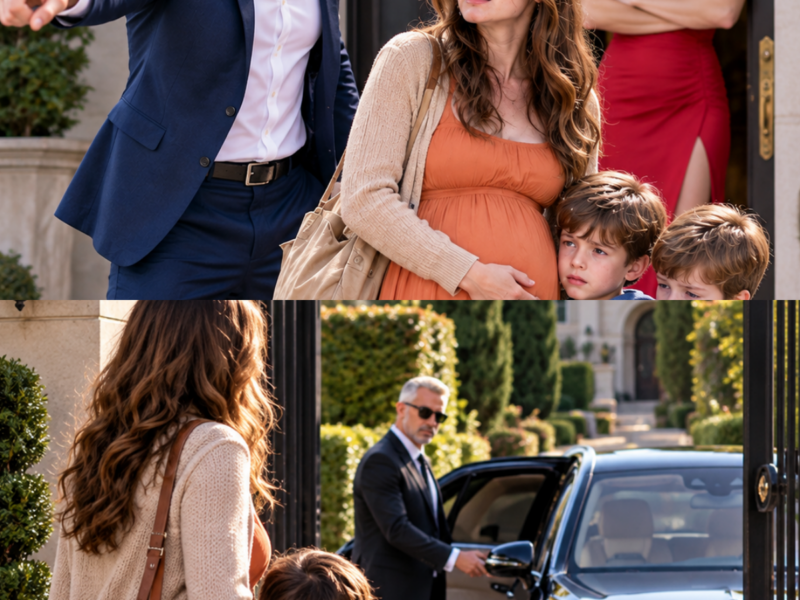
My Husband Threw His Pregnant Wife and Twin Sons Out for His Mistress—Then a Black Maybach Stopped at the Gate Before It Closed and Everything Changed
“Get out of my house.”
The first suitcase hit the wet pavement hard enough for one wheel to snap sideways.
The second burst open.
My sweaters, maternity clothes, and one of Noah’s blue jackets spilled across the private drive while my husband’s mistress stood inside the iron gates with her luggage already in the foyer.
I was six months pregnant.
Our seven-year-old twin sons were standing beside me.
And my husband looked at us as if removing his family from the property were just another item on his morning schedule.
“Cameron,” I said quietly, “the boys are watching.”
His jaw tightened.
“Then don’t make this worse.”
Behind him, Vanessa Langley gave a small, sympathetic smile.
It was the kind of smile women use when they want witnesses to remember them as gracious.
“Maybe Meredith should sit down,” she said. “Stress isn’t good for the baby.”
I looked at her.
Cream wool dress.
Camel coat.
Gold earrings.
One hand resting on a crocodile handbag that cost more than most people’s monthly rent.
A small overnight case stood behind her.
Not outside.
Inside.
She had arrived prepared to stay before my husband had finished throwing me out.
My older twin, Noah, bent toward the open suitcase.
“Mom, your clothes—”
“Leave them.”
Cameron’s voice cracked across the drive.
Noah froze.
His brother, Eli, moved closer to me.
I felt his fingers curl into the back of my coat.
Neither boy cried.
That was worse.
Children should not have to develop dignity in a driveway while their father dismantles their home.
Cameron walked toward us holding a gray folder.
He stopped on the other side of the gate.
“Sign these.”
I did not take them.
“What are they?”
“You know what they are.”
“I know what you told me they were.”
His nostrils flared.
“Separation agreement. Residency waiver. Property release. Temporary custody structure.”
“Temporary?”
“My lawyers will finalize everything.”
“Your lawyers?”
“Meredith.”
He looked toward the security staff as though I were wasting corporate time.
“You’re receiving more than enough to start over.”
Vanessa lowered her eyes.
A performance of delicacy.
I looked at the folder again.
Three days earlier, Cameron had told me the papers were simply an efficient way to “keep a private family matter from becoming ugly.”
The version sitting on my kitchen island had contained language I did not fully understand.
Rights arising from beneficial interests.
Residential claims.
Trust distributions.
Waiver of future contingent interests.
I had asked to take them to my own attorney.
Cameron had become strangely angry.
That was when I stopped thinking the paperwork was mainly about divorce.
Now he extended a pen.
“Sign.”
“No.”
His expression hardened.
“Meredith, I am done negotiating.”
“You never started.”
Vanessa shifted beside him.
“Cameron, maybe this should wait until she’s calmer.”
He did not look at her.
“She’s had a week.”
“A week since what?” I asked. “Since you admitted you were sleeping with her?”
Noah’s head lifted.
I regretted the sentence immediately.
Not because Cameron deserved protection.
Because my sons did.
Cameron saw it.
And instead of being ashamed, he used it.
“Exactly why this needs to end.”
I looked at him.
“Your affair is why this needs to end?”
“Our marriage was finished before Vanessa.”
Vanessa said softly, “I never wanted to come between a family.”
That almost made me laugh.
Her suitcase remained visible through the open door.
I turned back to Cameron.
“Have you decided everything else too?”
“What does that mean?”
“The house.”
“The children.”
“The baby.”
His face changed at the word children.
Only slightly.
But I saw it.
Four weeks earlier, somebody had begun feeding Cameron doubts about whether Noah and Eli were biologically his.
At first the comments were jokes.
Vanessa had once studied a photograph of Noah at a charity dinner and said she could not see the Whitmore chin.
Another afternoon, she had laughed that Eli’s hazel eyes reminded her of a man I had worked with before my marriage.
I told her never to speak about my children that way again.
She apologized.
Too easily.
Then Cameron began asking questions.
Which hospital delivered the twins?
Which laboratory had handled prenatal genetic screening?
Had I ever spoken to my former colleague after marrying?
Questions too precise to be casual.
I knew by then that something was being built.
I just did not know what.
Cameron glanced at Vanessa.
Then said:
“After what I’ve learned, I’m not sure we should keep pretending those boys are mine.”
Everything became still.
Eli made a tiny sound beside me.
Not crying.
Air leaving a child’s body when something has entered it that he does not understand.
I looked at Cameron.
There are sentences that end marriages.
That one ended something more permanent.
My willingness to protect him from himself.
“You said that in front of them.”
“You asked.”
“No.”
“I asked whether you had decided for your children.”
He shook his head.
“Do not twist this.”
“You just told two seven-year-old boys that their father may not be their father.”
“I said I have questions.”
“No.”
“You said exactly what you wanted them to hear.”
His face went red.
For months, I had been watching my husband become a man I almost recognized.
Same dark hair.
Same expensive suits.
Same habit of tapping his ring finger against a glass when impatient.
But ambition had altered the proportion of everything inside him.
Love became useful when it was loyal.
Family became valuable when it looked good.
Questions became attacks if they slowed him down.
And Vanessa had arrived precisely when Cameron began believing the only problem with his life was that other people had not yet admitted how exceptional he was.
I put one hand over my stomach.
A tightening moved low across my abdomen.
Not painful enough to frighten me.
Enough to make me breathe carefully.
Vanessa noticed.
Her eyes widened.
“Cameron, maybe we should call her doctor.”
“I’m fine.”
“Meredith—”
“I said I’m fine.”
She stepped back.
Cameron held out the pen again.
“Last chance.”
I looked at it.
Then at the folder.
Two months earlier, a lawyer named Samuel Reed had said something to me over coffee that had seemed almost paranoid at the time.
If anybody ever tries to make you sign away your rights to the Greenwich residence under pressure, do nothing until you call me.
Even if Cameron says the property is his.
Even if he says everyone agrees.
Even if you think refusing will leave you with nowhere to go.
Do not sign.
Samuel had represented Cameron’s grandfather for thirty-four years.
He was not a dramatic man.
His warning had frightened me because of how quietly he delivered it.
I looked through the gates at the pale stone house where I had raised my sons.
The Whitmore estate sat on eleven acres outside Greenwich, Connecticut.
Cameron had always called it the family house.
In arguments lately, it had become my house.
That distinction now mattered.
I lifted my eyes.
“Before you close the gate, answer one question.”
He gave a bitter laugh.
“What?”
“Are you absolutely sure this house belongs to you?”
For the first time that morning, uncertainty crossed his face.
A fraction of a second.
Then arrogance covered it.
“My family has owned this property for sixty years.”
“That isn’t what I asked.”
Vanessa stepped forward.
“Meredith, asset disputes aren’t going to be settled in a driveway.”
I looked at her.
She wanted inside too badly.
That was what I finally understood.
This was not the face of a woman desperate to begin a life with the man she loved.
It was the face of a woman who wanted a threshold crossed before somebody arrived to stop her.
I looked past Vanessa.
Her suitcase.
A garment bag.
A laptop case.
Already inside.
I turned back to Cameron.
“You brought her belongings into the house before mine were out.”
“It’s over.”
“You keep saying that like repetition creates law.”
His eyes narrowed.
“I am not discussing law with you.”
“Good.”
“Because the document you just threw on my suitcase has a waiver broad enough to reach things you haven’t explained.”
His face changed again.
Not guilt.
Surprise.
Vanessa’s smile vanished.
Only for a second.
But I saw it.
Cameron stepped closer.
“Who have you been talking to?”
“That is the first intelligent question you’ve asked all morning.”
He pointed toward the road.
“Get out.”
I picked up the folder.
Vanessa exhaled.
Cameron relaxed.
Then I placed it flat on top of my closed suitcase.
“I’m not signing.”
His face darkened.
“You have nowhere to go.”
I looked at him.
“That still doesn’t make your paper valid.”
“You think you can live here while fighting me?”
“I think you cannot legally remove a pregnant spouse and two children from a residence by throwing luggage into the street and demanding a signature.”
“Watch me.”
He turned toward the gate controls.
One of the security men hesitated.
Cameron saw him.
“Close it.”
The gate began moving.
Metal sliding through metal.
Eli took my hand.
Noah took the other.
I did not know where we would sleep that night.
My friend Rebecca had a guest room in Westchester.
My parents were in Virginia.
I had access to my own accounts.
I was not helpless.
But standing outside that gate with my children, I understood how quickly a life could change shape.
Then we heard an engine.
Low.
Heavy.
Coming up the private access road behind us.
The security guard looked over my shoulder.
Cameron frowned.
A black Maybach turned around the curve.
Slowly.
The gate stopped halfway.
The car came to a smooth halt several yards behind my suitcases.
Vanessa stopped moving.
Cameron stared.
The driver stepped out in a dark suit.
Walked around the rear.
Opened the door.
Walter Whitmore planted his cane on the pavement before lifting himself from the car.
Cameron’s grandfather had been in Boston for cardiac treatment for almost six weeks.
Nobody expected him home until Friday.
It was Monday.
He looked thinner.
Older.
But the first thing that reached us was not frailty.
It was authority.
Walter did not speak.
His gaze moved across the driveway.
My open suitcase.
Clothes on the ground.
The boys.
My hand over my belly.
Vanessa inside the gate.
Cameron beside the control panel.
Then his eyes stopped on Noah’s blue jacket lying on the wet pavement.
He walked toward it.
Bent with visible difficulty.
Picked it up.
Brushed dirt from the sleeve.
“Whose is this?”
Noah raised his hand slowly.
“Mine, sir.”
Walter held it out.
“I’m your great-grandfather, Noah.”
“I know.”
“Then you can call me Walter when I’m eighty-five.”
Noah took the jacket.
Walter straightened.
He looked at Cameron.
“Explain why my great-grandson’s coat is in the road.”
Cameron went pale.
“Grandfather.”
“I can hear.”
“We weren’t expecting you.”
Walter glanced at the suitcases.
“I gathered that.”
“There are things you don’t know.”
“Then start with the visible ones.”
Cameron looked toward me.
“Meredith lied.”
“About?”
“The boys.”
My stomach twisted.
Walter’s expression did not change.
“And you established that how?”
“I have a report.”
“From?”
“A private source.”
Walter looked at me.
“Have you seen it?”
“Not completely.”
“Were tests performed with your informed authorization?”
“No.”
He looked at Cameron.
“Then continue.”
Cameron’s confidence began to return.
“Our marriage is over.”
“Fine.”
Cameron blinked.
Walter pointed his cane slightly toward Vanessa.
“And she is?”
Vanessa stepped forward.
“Vanessa Langley.”
“I know your name.”
Her smile tightened.
“I meant your purpose in this scene.”
Cameron said sharply:
“She’s with me.”
Walter glanced at the luggage visible inside.
“Clearly.”
“Grandfather—”
“I asked a question.”
Cameron’s voice hardened.
“This is private.”
Walter looked at the gate.
“At the moment it appears remarkably public.”
One of the security men lowered his eyes.
Vanessa said:
“Mr. Whitmore, Cameron is under tremendous pressure.”
Walter did not respond.
He looked at me instead.
“Are you hurt?”
“No.”
“The baby?”
“Stress tightening. Nothing severe.”
He looked at the folder.
“Did you sign?”
“No.”
His shoulders lowered.
One breath.
Relief.
Vanessa saw it.
So did Cameron.
And that single reaction frightened them more than anything Walter had said.
He tapped his cane once on the pavement.
“Open the gate.”
Cameron stepped toward him.
“No.”
The guard froze.
Cameron stared at Walter.
“This is my home.”
Walter turned slowly.
“What did you say?”
“This is my house.”
The silence changed.
Even the wind seemed louder.
Walter looked toward the stone façade.
Then back at his grandson.
“You should be extremely careful when you use the word my around property you have never bothered to understand.”
Cameron’s face hardened.
“I know exactly what I own.”
“No.”
Walter’s voice stayed quiet.
“You know what you expected to inherit.”
“That is not the same thing.”
Vanessa gripped the handle of her handbag.
Cameron glanced at her.
A tiny movement.
Walter saw it.
He pointed his cane toward the gray folder.
“If you had read the documents governing this property, you would never have been stupid enough to place that waiver in front of Meredith.”
“What are you talking about?”
“That is a conversation for inside.”
“I’m not letting her back in.”
Walter turned to the head of security.
“Open the gate completely.”
Cameron said:
“I told you not to.”
The man looked between them.
Walter spoke once.
“Mr. Dalton.”
“Yes, sir.”
“Who employs you?”
“Whitmore Family Office.”
“Who currently controls that office?”
“You do.”
“Open the gate.”
The motors engaged.
The iron gates slid apart.
Cameron stared as if the property itself had betrayed him.
Walter turned toward me.
“Take the boys inside.”
I did not move.
Not yet.
“Walter.”
“Yes?”
“I don’t want them dragged back through another fight.”
“They won’t be.”
“How do you know?”
“Because for the next hour, anyone who raises his voice in my house can leave it.”
Cameron laughed once.
“Your house now?”
Walter looked at him.
“Yes.”
“For today, that phrasing happens to be legally accurate.”
Cameron stopped smiling.
Walter lowered his voice to me.
“Samuel called me from Boston.”
That explained the early return.
“Why?”
“Because someone has been asking questions about documents they should not know exist.”
Vanessa went completely still.
Walter continued, louder now.
“Someone also tried to obtain genetic information connected to my great-grandsons.”
Cameron looked at Vanessa.
She said nothing.
“And,” Walter added, “someone has been very interested in what happens to certain voting rights if Cameron divorces his wife before the new baby is born.”
My skin went cold.
The boys did not understand.
Thank God.
Cameron stared.
“What are you talking about?”
Walter looked at him with something close to grief.
“That is what concerns me most.”
“You genuinely may not know.”
He turned toward the house.
“Inside.”
I took Noah and Eli’s hands.
Two staff members gathered the clothing from the road.
As we passed Vanessa, she looked directly at me.
For the first time since she entered my marriage, she looked afraid.
Not afraid of losing Cameron.
Afraid of losing control.
Four months earlier, I would not have believed any of this possible.
Cameron and I had not begun as a society marriage.
I had been a financial-risk analyst at a Manhattan consulting firm when I met him.
He entered a conference room late, sat at the far end, and challenged three assumptions in my presentation.
I challenged four in his.
Afterward, a senior partner whispered:
“You know that was Cameron Whitmore?”
“Should I?”
The partner looked horrified.
Whitmore Capital had holdings in logistics, real estate, medical manufacturing, infrastructure, and private credit.
Walter Whitmore built the company from a regional freight business into something newspapers called an empire.
Cameron was his only grandson.
At twenty-nine, he already carried himself like a man born into a room everyone else had to earn entry to.
Yet with me, he had been different.
He liked that I did not flatter him.
I liked that he could laugh at himself when nobody important was watching.
We ate pizza on my apartment floor.
Took trains instead of cars.
Argued about market forecasts.
Spent one freezing weekend in Vermont at a motel whose heater sounded like industrial machinery.
When he proposed, he did not use the family yacht or a rooftop.
He asked in my kitchen.
“I like who I am around you.”
At the time, that sounded like love.
Maybe it was.
We married.
The twins came two years later after a difficult pregnancy.
Walter’s wife, Margaret, became unexpectedly close to me.
She had the talent older women sometimes develop for seeing through performances.
“You still thank the staff too much,” she once told me.
“That sounds like a criticism of thanking people.”
“It is a criticism of behaving like you’re borrowing your own life.”
I never forgot it.
When Margaret became ill, I accompanied her to treatments more often than Cameron did.
Not because he did not care.
Because he was working constantly.
He wanted Walter’s respect.
Then his title.
Then increasingly, his power.
Margaret died three years ago.
After that, Cameron changed slowly enough for me to keep adjusting.
Promotion.
Another acquisition.
More dinners.
More weekends.
More conversations where everything important would happen “after the quarter.”
Vanessa arrived during a communications crisis eighteen months before the gate.
She came from money.
Not Whitmore money.
But enough to understand its customs.
She knew exactly how to make ambition feel like recognition.
At first, she treated me beautifully.
Flowers after charity events.
Birthday gifts for Noah and Eli.
Handwritten notes.
Then she began occupying space.
The chair beside Cameron.
The final call of the night.
The first briefing of the morning.
Jokes about decisions I had not been told about.
Once, during a reception, I heard her tell another executive:
“Cameron needs someone who understands the scale of the life he’s entering.”
The woman asked:
“Doesn’t Meredith?”
Vanessa smiled.
“Meredith understands stability.”
“Cameron is building power.”
I walked away before they saw me.
I did not accuse Cameron.
I watched.
His phone code changed.
He began closing his laptop when I entered.
He asked strange questions about Walter’s trusts.
Which properties were held directly?
Which through family entities?
Could voting provisions be amended without unanimous beneficiary consent?
I had worked in finance too long to mistake that for casual curiosity.
When I asked, Cameron said:
“Grandfather won’t live forever.”
I stared.
He did not even hear how it sounded.
A week later, I found a draft proposal on his desk concerning the Newport equestrian property.
Margaret had loved that land.
Walter had repeatedly said it would never be sold.
Cameron wanted to package it with adjacent commercial acreage.
“You know Walter said no.”
“My grandfather thinks saying no is governance.”
“He owns it.”
“For now.”
I looked at him.
He closed the file.
“Don’t explain my family to me.”
The sentence stayed between us.
Later he apologized halfway.
“I’m under pressure.”
Not:
I’m sorry I said that.
Pressure became his universal solvent.
Then came the comments about the twins.
Then the hospital call.
A compliance officer told me someone had requested old genetic records using family authorization.
I did not know any genetic records existed beyond routine prenatal testing.
The officer said the request had triggered review because it involved minors.
I told Cameron.
Expected fury.
He asked:
“What exactly could they access?”
That frightened me more.
Two nights later, his phone lit beside me while he showered.
I did not open it.
The preview was enough.
VANESSA: We should have the final report tomorrow.
I photographed only the notification screen.
Not the message.
Not the phone contents.
Then I called Samuel Reed.
That meeting changed everything.
He sat across from me in a small café off Park Avenue.
Black briefcase.
Untouched coffee.
“Walter asked me to watch certain activity while he was in Boston.”
“Cameron?”
“Yes.”
“What has he done?”
“Mostly questions.”
“That doesn’t sound illegal.”
“It isn’t.”
Samuel folded his hands.
“But the questions are about structures he has no reason to need yet.”
“What structures?”
He looked almost apologetic.
“I am not authorized to explain them.”
“Then why tell me?”
“Because some questions concern you.”
“And the boys.”
My stomach tightened.
“What about them?”
“If your marriage becomes contentious, do not sign any waiver involving family rights without independent counsel.”
“Cameron mentioned separation yesterday.”
Samuel’s face changed.
Only slightly.
That was when I knew.
“You expected that.”
“I considered it possible.”
“Why?”
He leaned toward me.
“Meredith, if anyone tries to remove you from the Greenwich residence and tells you you have no rights because the property belongs to Cameron, call me.”
“Does it?”
“I cannot answer that yet.”
“Why not?”
“Because Walter is alive, competent, and entitled to keep private legal structures private.”
“Then tell me what I need to know.”
Samuel looked directly at me.
“Do not sign.”
“Even if refusing means I have to leave?”
“Especially then.”
A week later, Cameron admitted the affair.
He stood in our bedroom holding the same gray folder he later threw onto the suitcase.
“I want to separate.”
I looked at him.
“Vanessa?”
He denied it for twenty seconds.
Then stopped.
“Yes.”
“How long?”
“Several months.”
I sat down.
Not because my knees failed.
Because I wanted my body still while my mind worked.
“Does she know you’re doing this today?”
“That’s irrelevant.”
“No.”
“It is suddenly very relevant.”
He paced.
“Our marriage has been empty for a long time.”
“That is interesting.”
“What?”
“It became empty without you mentioning it.”
“You know we’ve been distant.”
“You’ve been absent.”
“With Vanessa, I can talk about the future.”
I almost pitied him.
“Of course.”
His face hardened.
“What does that mean?”
“She tells you the future should look exactly like your ambition.”
“You don’t support me.”
“I have spent eight years supporting you.”
“You support limits.”
“I support reality.”
He threw the folder onto the bed.
“Take the settlement.”
I opened it.
The number was large.
Enough for most people to think twice.
Enough for Cameron to believe generosity erased coercion.
Then I saw the waivers.
“I’m not signing this.”
“Why?”
“Because I don’t understand half of what I’m surrendering.”
“You’re surrendering nothing that belongs to you.”
“That sentence is precisely why I need my own lawyer.”
His eyes changed.
“You’ve been talking to someone.”
“Yes.”
“Who?”
“Someone who advised me not to sign broad waivers while pregnant and under threat of removal from my home.”
The next morning, Vanessa arrived with luggage.
Her apartment was supposedly under renovation.
I said nothing.
I packed essentials.
The boys’ clothes.
Medication.
My prenatal files.
Birth certificates.
Laptop.
I planned to leave for one night, regroup, contact Samuel.
His phone went directly to voicemail.
What I did not know was that he was already on a flight back from Boston with Walter.
Cameron saw my bags.
Mistook preparation for surrender.
Then turned it into spectacle.
Now, inside the estate after Walter’s return, the performance collapsed.
A family doctor examined me.
The baby was stable.
I needed rest.
Noah sat on the edge of the bed.
Eli stood beside him.
Neither asked about the mansion.
Noah asked:
“Does Dad think we’re not his?”
I closed my eyes.
Adult cruelty becomes unbearable when repeated by a child.
“Your father heard something that made him confused.”
“But he said it.”
“Yes.”
“Is it true?”
“No.”
“You know?”
“Yes.”
“How?”
“Because I know who your father is.”
That answer was emotionally true but legally incomplete.
Noah looked at his brother.
Eli asked:
“Does Dad love us?”
I reached for both of them.
“Nothing that happens between adults is because you did something wrong.”
“That wasn’t my question.”
Seven.
He was seven.
I swallowed.
“I believe your father loves you.”
“But?”
I hated that he knew there was a but.
“But right now he is making choices that hurt people he loves.”
Eli looked down.
“Will he stop?”
“I don’t know.”
That was the first honest answer I could give.
Walter waited until the doctor left before speaking to Cameron.
I was not in the room.
Samuel later told me enough.
Walter’s study had mahogany walls and an old photograph of Margaret beside the desk.
Cameron stood in front of him.
Vanessa remained near the door.
Cameron insisted the marriage was private.
Walter replied:
“Your affair might be private if you had not entwined it with company systems, trust inquiries, and medical records.”
Vanessa said:
“I have never accessed confidential family files.”
Walter looked at her.
“I did not accuse you.”
She went silent.
Cameron demanded proof.
Samuel opened his laptop.
Someone had searched document titles associated with Whitmore family trusts.
Not opened them.
Searched.
Residential trust.
Descendant beneficiaries.
Voting restrictions.
Succession safeguards.
Medical contingencies.
The searches came from corporate credentials.
Some linked to Cameron’s office.
One from a temporary administrative profile used by communications during an internal PR audit.
Vanessa’s department.
Cameron said:
“That proves nothing.”
Walter agreed.
“Correct.”
“That is why intelligent people investigate before humiliating children.”
Cameron had no answer.
Walter then asked:
“Why is Vanessa living here?”
“My marriage is over.”
“That explains your adultery poorly.”
“It does not explain her luggage.”
Vanessa’s composure tightened.
“My apartment is being renovated.”
Walter looked at Samuel.
“Find her a hotel.”
Cameron stood.
“If she leaves, I leave.”
Walter shrugged.
“You are thirty-eight.”
“No one is holding you hostage.”
It was the first time in Cameron’s life that a threat to withdraw himself produced no panic.
He hated it.
That evening, Walter found me in the enclosed garden.
I should have been resting.
He knew it.
“You’re disobedient.”
“I’ve been called worse today.”
He sat carefully beside me.
I looked at him.
“What did you mean at the gate?”
“About the house?”
“Yes.”
“It is not Cameron’s.”
I breathed out.
“Whose?”
“A residential trust.”
“Your trust?”
“Technically.”
“That sounds deliberately vague.”
“It is deliberately precise.”
Despite everything, I smiled.
Walter looked toward the fountain.
“Margaret and I transferred the estate years ago.”
“No single descendant owns it outright.”
“Residency is governed by conditions.”
“What conditions?”
“I won’t explain everything until Samuel confirms no document has been tampered with.”
“Walter.”
“I know.”
He turned toward me.
“You were thrown into the road this morning.”
“You deserve more than partial answers.”
“But I would rather frustrate you tonight than give an adversary grounds to challenge something tomorrow.”
That word caught me.
“Adversary?”
“You think Vanessa is simply having an affair with your husband?”
“I know she’s having one.”
“That wasn’t the question.”
He looked toward the house.
“I think she wants something else.”
“What?”
“I don’t know yet.”
That frightened me.
Because Walter Whitmore rarely said he did not know.
Later that night, I learned why.
Walking past the guest hallway, I heard Vanessa’s voice through a nearly closed door.
She was speaking quietly.
I would have kept walking if she had not said a name.
“Preston can’t know before we get the amendment.”
Preston Hale was a Whitmore Capital board member.
I stopped.
A man answered too softly to identify.
Vanessa said:
“No.”
“The original.”
“Samuel keeps it outside the corporate archive.”
My heart started beating hard.
Then:
“If Cameron controls the shares before Walter opens it, they can’t stop us.”
I backed away.
No dramatic listening against the door.
No confrontation.
I went directly to Samuel.
Repeated every word.
He stopped typing.
Called Walter.
When I finished, Walter looked older.
Not afraid.
Angry.
“The amendment,” Samuel said.
“She knows it exists.”
“Could she know what it says?”
“No.”
Walter stared at the desk.
“Then someone told her enough.”
I said:
“Tell me.”
He looked at me.
“Not yet.”
I nearly stood.
He raised one hand.
“This is not about distrusting you.”
“Then what?”
“If they have prepared a legal challenge, opening certain sealed instruments outside the required conditions could become ammunition.”
“So we wait.”
“We verify.”
The next morning Vanessa moved to a hotel.
At the door, she stopped in front of me.
“Happy?”
“No.”
“You won.”
I looked at her.
“This was never about winning Cameron.”
Her jaw tightened.
“You think Walter will protect you forever?”
“I think you brought luggage into my house before I left.”
“That tells me enough about what you believed yesterday.”
She stepped closer.
“Families like this care about blood.”
I held her gaze.
“Then make sure whatever blood test you’re relying on is real.”
For the first time, she had no clever answer.
Two hours later, Samuel entered Walter’s study with his phone in hand.
“They located the medical request.”
I was there.
Walter looked up.
“Source?”
“Digital authorization connected to Cameron’s corporate office.”
Cameron’s name seemed to fall into the room.
Samuel continued.
“The request specifically asked for comparative information relevant to paternity.”
I felt sick.
“When?”
“Three days after Vanessa asked legal affairs what would happen to trust succession if a child were legally determined not to be a biological descendant.”
Walter closed his eyes.
“So not coincidence.”
“No.”
My phone rang that afternoon.
Unknown number.
I answered.
A woman spoke quickly.
“My name is Paige Morrison.”
“I work in records management for the lab affiliated with the hospital where your sons were born.”
My hand tightened.
“What about my sons?”
“I shouldn’t be calling you.”
“Then why are you?”
Silence.
“Because someone asked us to create a copy of an old report.”
“What report?”
“Paternity-related genetic data.”
I stood.
“There is no reason anyone should have—”
“I know.”
Her voice shook.
“The first export matched the original.”
“A second request asked for an editable administrative copy.”
“What changed?”
She breathed in.
“I saw a printed version later.”
“It didn’t match.”
My knees weakened.
“What did they change?”
“I can’t explain on the phone.”
“Is the real report clear?”
“Yes.”
“About?”
“Your husband is the father.”
I closed my eyes.
No relief.
Only fury.
Paige continued.
“Do not trust whatever document someone gave him.”
“The original says something different.”
Then the call ended.
Samuel tried the number.
Dead.
Walter stared out toward the gates.
“Someone is altering medical truth to create financial consequences.”
I looked at him.
“Financial.”
Not marital.
He turned.
“Yes.”
That was when the affair stopped being the biggest story in the house.
The authentic report arrived through counsel the next day.
Greater than 99.9 percent probability of paternity.
The copy Cameron had seen was almost identical.
Except one key line had been altered to suggest inconclusive results.
Not enough to prove another father.
Enough to manufacture doubt.
Samuel traced an invoice for the second document request to Crestbridge Advisory.
A consulting entity with barely any public footprint.
Its managing member linked to a fund controlled by Malcolm Voss.
Walter knew the name immediately.
“Voss tried to buy us twelve years ago.”
“What did he want?”
“To break the company.”
Walter looked at Samuel.
“He wanted logistics and infrastructure.”
“He would have sold the rest.”
Samuel nodded.
Crestbridge had also advised a group of lenders that recently offered Cameron aggressive financing for international expansion.
My stomach tightened.
“Vanessa introduced those lenders.”
Walter looked at me.
“How do you know?”
“Cameron told me.”
“He said she understood the future better than the old board.”
Walter gave a humorless laugh.
“There it is.”
The structure became visible.
Vanessa had not merely found an ambitious married man.
She had been around Malcolm Voss’s network before joining Whitmore Capital.
Photographs from industry galas placed them together a year earlier.
Payment records showed a company controlled by Vanessa’s sister receiving consulting fees from a Voss-linked entity.
Then Samuel found three powers of attorney Cameron had signed.
They did not transfer ownership.
They did something more subtle.
Allowed external advisers to conduct valuations.
Access sensitive strategic material.
Prepare financing instruments secured against future personal holdings.
Cameron thought he was accelerating his path to control.
Voss was building leverage around whatever Cameron expected to inherit.
Walter stared at the signatures.
“My grandson opened the door for them.”
“Did he know?”
I asked.
Samuel shook his head.
“Not the full structure.”
Walter looked at me.
“That does not make him innocent.”
“No.”
It mattered that he said it.
Because I did not want a rescue story where Cameron became another victim and everything he did to us vanished beneath Vanessa’s conspiracy.
Manipulation explains.
It does not erase choice.
That evening, I asked Cameron to meet me in the smaller parlor.
Alone.
He looked exhausted.
Angry.
Humiliated by Walter’s return.
Still stubborn enough to cling to Vanessa.
I placed both paternity reports on the coffee table.
“This is the original.”
“This is the copy you saw.”
He read.
His face lost color.
“Where did you get this?”
“Hospital logs.”
“A records witness.”
“Chain of custody.”
“Everything you never bothered to demand.”
He looked up.
“Vanessa said her source—”
“Exactly.”
I felt sadness.
Not triumph.
“Vanessa said.”
“And that was enough for you to tell Noah and Eli they might not be yours.”
“She showed me messages too.”
“Verified?”
“No.”
“Photographs?”
“Yes.”
“Verified?”
He looked away.
“No.”
“Who was supposedly in them?”
“Your old colleague.”
I almost laughed.
“Michael Benton?”
“You traveled with him.”
“For work.”
“Before we married.”
“He has been married to his husband for eleven years.”
Cameron stared.
I said:
“You wanted to believe me guilty.”
“That is not true.”
“Yes.”
“Because if I betrayed you first, then you weren’t a husband leaving his pregnant wife for another woman.”
“You were reacting.”
“You could become the injured person in your own story.”
His mouth opened.
Nothing came.
I slid another document toward him.
“Crestbridge Advisory.”
He stared at the name.
“Do you know it?”
“No.”
“They paid for the manipulated medical request.”
His expression changed.
“Malcolm Voss controls the network behind it.”
He went still.
“How do you know Voss?”
“Walter.”
Cameron looked away too quickly.
“You know him.”
“Vanessa introduced us.”
“For?”
“Financing.”
“Expansion.”
He frowned.
“What are you trying to say?”
“I’m saying you should read everything you signed for people she introduced.”
Anger returned.
“Now you’re trying to convince me she’s using me.”
“I don’t need to convince you.”
“I need you to stop saying things about our sons until you know what is true.”
I stood.
At the doorway, I turned.
“One more thing.”
He looked at me.
“Maybe Vanessa does not want my place.”
“What?”
“Maybe she wants yours.”
For the first time, Cameron did not defend her immediately.
That night, he called Vanessa.
Stopped before pressing her name.
Then called anyway.
He asked about Crestbridge.
She told him the firm worked with everyone.
He asked why a Voss-linked company paid for genetic records.
She said someone must be framing them.
He asked why the authentic report differed.
She blamed the lab.
Then Cameron asked:
“How do you know there is a trust amendment?”
Silence.
“I never told you.”
Another silence.
For months, Cameron had interpreted Vanessa’s knowledge as intelligence.
That night, knowledge became evidence.
Walter called an extraordinary family meeting for the following evening.
Not a dinner.
A board-adjacent legal session in the estate library.
Two independent directors attended.
Samuel.
Walter.
Cameron.
His mother, Caroline.
Vanessa brought counsel.
I entered last.
Simple black maternity dress.
No jewelry.
One hand over my belly because the baby had become active whenever I was tense.
Walter began:
“This is not a marital mediation.”
“No one here is being asked to choose sides in a divorce.”
“This meeting concerns potential breaches of fiduciary duty, misuse of confidential data, falsified records, and a possible hostile acquisition strategy.”
Vanessa’s lawyer immediately objected.
Walter ignored him.
Cameron placed a leather folder on the table.
“I have documents too.”
Vanessa looked almost pleased.
He distributed printed emails.
Messages supposedly between Samuel and me.
In one, I appeared to ask how Cameron could be stripped of voting control.
In another, Samuel appeared to say Walter intended to place certain rights under my administration.
Caroline Whitmore stared at me.
“Meredith?”
I picked up the page.
Parts were real.
Sentences I had written about protecting the children.
Fragments rearranged.
“I didn’t write this.”
Vanessa laughed softly.
“How convenient.”
I looked at her.
“The DNA report has a traceable original.”
“These emails do too.”
Her smile changed.
Samuel connected his laptop to the screen.
“Exactly.”
Original law-firm logs appeared.
Dates matched.
Subjects matched.
Text did not.
Paragraphs had been cut and recombined.
Metadata from the file Cameron received showed recent editing.
Forty-three minutes after an export from a Whitmore Capital terminal assigned to corporate communications.
Vanessa’s department.
Her lawyer objected again.
Samuel nodded.
“You’re correct.”
“That alone does not prove who edited them.”
Then he opened server logs.
Vanessa’s temporary admin credentials had downloaded archives involving me and Samuel.
Cameron turned.
“You accessed their emails?”
Vanessa said:
“There was a campaign forming against you.”
That was her mistake.
Not denial.
Justification.
Cameron’s face altered.
Walter folded his hands.
“And now the medical report.”
Samuel placed two copies beside each other.
Original.
Altered.
He explained the lab process.
The paternity probability.
The change.
The invoice.
The Voss connection.
Caroline covered her mouth.
“My grandsons were never in question?”
“Not scientifically.”
Samuel said.
Walter looked at Cameron.
“And yet you let two children hear otherwise.”
Cameron lowered his eyes.
Vanessa said:
“I also believed the report was genuine.”
Walter nodded toward Samuel.
“Then perhaps you can explain who paid for it.”
The screen changed.
Crestbridge.
Payments.
Corporate links.
Old photographs of Vanessa and Malcolm Voss at events before she joined Whitmore Capital.
Then a payment to her sister’s consulting firm.
Cameron turned toward Vanessa.
“You told me you barely knew Voss.”
“I knew him professionally.”
“That is not what you said.”
“He works with everyone.”
Walter said:
“Not everyone receives six-figure consulting payments through relatives.”
Vanessa’s lawyer whispered to her.
She waved him off.
Cameron stood.
“Was this relationship part of it?”
The question hung there.
For all his arrogance, all his betrayal, I felt no pleasure watching him ask.
Vanessa looked at him.
“At first, I had a professional objective.”
His face broke.
“And after?”
“Things changed.”
Cameron laughed once.
A broken sound.
“How romantic.”
She stiffened.
“You think every conversation between us was fake?”
“No.”
“I’m asking whether you came near me because Voss sent you.”
She did not answer.
That was enough.
Walter raised one hand.
“We are not finished.”
Samuel produced the powers of attorney.
Valuations.
Collateral preparation.
External negotiation rights.
One independent director muttered:
“Cameron, these could put a lien around future personal holdings before you even control them.”
Cameron stared.
“Vanessa said they were standard expansion documents.”
Samuel answered:
“They are standard if someone wants leverage.”
Cameron looked toward her.
“You told me this was how I proved I could run the company.”
Vanessa snapped:
“You wanted power.”
“No one forced your signature onto those pages.”
That was true.
Walter nodded.
“Finally, something accurate.”
Cameron flinched.
Walter looked at him.
“They did not need to forge your ambition.”
“They only needed to flatter it.”
Vanessa suddenly pointed at me.
“This does not change what Walter is doing.”
“Ask him about the trust.”
“Ask why Meredith matters.”
“Ask why somebody who is not a Whitmore by blood gets more protection than you do.”
Cameron looked at the sealed wooden box on the desk.
Walter rested both hands over his cane.
“Meredith does not know the full contents.”
“Not yet.”
Vanessa smiled.
“Because you built it to put her over Cameron.”
“No.”
Walter looked at her.
“I built it to protect children and homes from adults who confuse power with ownership.”
He nodded to Samuel.
“Open the first envelope.”
The room became silent.
My baby kicked hard.
I breathed slowly.
Samuel broke the seal.
The Greenwich estate had been transferred into a residential trust years ago by Walter and Margaret.
No descendant owned it individually.
Cameron had conditional residency rights.
So did certain protected family members.
Then Samuel reached the provision triggered by marital breakdown.
Gross infidelity.
Abandonment.
Financial coercion.
Unjustified removal of minor descendants.
Under those circumstances, priority residency shifted to the caregiving spouse responsible for the descendants.
Me.
Caroline let the paper in her hand fall to the table.
Cameron stared.
Walter looked directly at him.
“When you stood outside shouting ‘my house,’ you were throwing out the person who, under the conditions you created, had more immediate right to remain than you did.”
Cameron looked at me.
“Did you know?”
“No.”
I meant it.
“I knew Samuel told me not to sign.”
“That was all.”
Vanessa closed her eyes.
Now I understood why she needed my waiver.
Cameron saw it too.
“You knew.”
Vanessa’s eyes opened.
“You knew she had residency protection.”
“I knew there might be clauses.”
“That is why you wanted her signature before Walter came back.”
She did not answer.
Walter said:
“The house is only the first instrument.”
Vanessa’s lawyer stood.
“My client will not remain for—”
Vanessa snapped:
“Sit down.”
Everyone looked at her.
She had revealed too much urgency.
Samuel opened the second envelope.
The voting trust amendment had been updated after Noah and Eli were born.
Updated again after my pregnancy became known.
The final beneficiaries were Walter’s descendants.
I did not own the shares.
I would not inherit Cameron’s position.
But under a succession dispute or hostile takeover threat, voting rights tied to the minor children could be temporarily administered by a fiduciary until they reached designated ages.
Samuel paused.
Cameron stared at Walter.
Caroline whispered:
“Who?”
Samuel read my name.
For several seconds I thought I misunderstood.
Me.
Meredith Whitmore.
Provided I retained legal custody and acted under fiduciary oversight.
Samuel and an independent committee would review major decisions.
It was not a crown.
It was a shield.
Vanessa finally lost her composure.
“She isn’t even your blood.”
Walter looked at her.
“That is one reason I trusted her.”
The sentence hit harder than shouting.
Walter continued.
“Margaret watched Meredith care for this family before she knew any instrument like this would ever exist.”
“She asked for nothing.”
“She refused a payout when Cameron suggested she step away from her career.”
“She cared for my wife during treatment.”
“She protected those boys.”
“Blood tells me who someone descended from.”
“Conduct tells me what they will protect.”
My eyes filled at Margaret’s name.
Cameron sank back.
Pieces were aligning inside him.
“If Meredith signed the waiver…”
Samuel nodded.
“You could have argued she surrendered certain protections.”
“And if the boys were discredited…”
“Challenges to the beneficiaries could delay or destabilize the voting structure.”
“And if I gained board control before the baby…”
Walter looked at him.
“You would have tried to amend structures you had no moral business touching.”
Cameron turned to Vanessa.
“That is why the DNA report existed.”
Silence.
“That is why you kept pushing me to get the signature.”
Vanessa’s jaw tightened.
“We needed to stop Walter from controlling everything through children.”
The word escaped.
We.
Cameron froze.
“Who is we?”
She realized.
Too late.
Samuel answered:
“Malcolm Voss and the shell companies that financed this operation.”
The independent directors began taking notes.
Walter formally requested Cameron’s temporary suspension from executive duties pending audit.
Cameron shot up.
“You are firing me from my company?”
Walter’s voice remained quiet.
“No.”
“I am suspending you from a role you compromised.”
“You do not own employment because you share my surname.”
The directors agreed the interim suspension was justified.
Cameron stared at the documents he had signed.
Fear replaced rage.
At the gate, he thought power meant declaring possession.
Now he was learning the company worked the same way as the house.
Mine was not a legal structure.
Vanessa picked up her handbag.
“I’m leaving.”
Walter nodded toward security.
“You may.”
“Corporate devices remain.”
Her lawyer protested.
Samuel said company equipment would be forensically copied under legal hold.
Vanessa looked at Cameron.
“Tell them this is insane.”
He stared at her.
“The report was already altered when you gave it to me.”
She said nothing.
“Answer.”
“It was complicated.”
He laughed.
“That means yes.”
Then Vanessa looked at me.
Real hatred now.
“You think you won.”
I was too tired to be impressed.
“This was never a contest for Cameron.”
“You were the only person who thought it was.”
Security escorted her out.
Caroline began crying.
She came toward me.
“I was wrong.”
I waited.
“For years, I thought you should feel grateful for being accepted into this family.”
“I treated you like an outsider.”
“When Cameron started questioning the boys, I chose not to ask because I did not want scandal.”
She looked ashamed.
“My silence helped this.”
I did not forgive her instantly.
Real forgiveness is not good manners.
“I don’t need you to punish yourself.”
“What do you need?”
“When anyone uses Noah, Eli, or this baby to talk about bloodlines or money, you do not stay quiet.”
She nodded.
“I won’t.”
Across the table, Cameron still had not moved.
After everyone left, he approached me.
“Can we talk?”
“Not tonight.”
“Meredith.”
“No.”
“You did not know how deep this went.”
He looked almost desperate for that distinction to rescue him.
I gave it to him.
Then took away what he wanted it to mean.
“No.”
“You didn’t know.”
“But you knew you were sleeping with Vanessa.”
“You knew you were removing your sons from their home.”
“You knew you were asking me to sign something without independent advice.”
“You knew you used a paternity report you never verified.”
He lowered his eyes.
“She manipulated me.”
“Yes.”
“But she did not pick up my suitcase.”
“You did.”
“She did not tell Noah and Eli they might not be yours.”
“You did.”
“She fed you lies.”
“You chose every lie that made you feel powerful.”
He looked at me.
“I know.”
“Not yet.”
“What does that mean?”
“Knowing means accepting that consequences remain after explanations arrive.”
He did not answer.
The next morning, Cameron asked to speak with me before the boys woke.
He wore a wrinkled shirt.
No suit.
No watch.
No polished heir.
He handed Samuel a full disclosure packet.
Emails.
Messages.
Contracts.
Voss introductions.
Everything he had withheld.
Then he came to me.
“I started the affair before anyone mentioned paternity.”
I nodded.
“I assumed so.”
He flinched.
“It started because Vanessa admired me.”
“She told me Walter was afraid of me.”
“That the board wanted younger leadership.”
“That you were holding me to a domestic life too small for what I could become.”
I said nothing.
“I liked hearing it.”
“At some point, every problem became somebody else’s fault.”
“My grandfather.”
“The board.”
“You.”
“When the fake report came…”
He closed his eyes.
“Part of me knew it was too convenient.”
“Why believe it?”
He looked toward the window.
“Because if you betrayed me, then I didn’t have to feel guilty about betraying you.”
At least that was honest.
“Understanding why you hurt us does not undo it.”
“I know.”
“This time I think I do.”
He placed a signed document on the table.
Temporary voluntary surrender of residence.
Temporary leave from corporate duties.
“I’ll leave today.”
“I don’t want the boys watching security remove me.”
I looked at the paper.
No satisfaction.
“I don’t need you removed as punishment.”
“I need this house safe for them.”
He nodded.
“Do you think they’ll ever look at me normally again?”
“That depends on what you do for years.”
“Not what you promise this morning.”
He swallowed.
I continued.
“Being their father was never about matching DNA.”
“It is about whether they feel protected in your presence.”
“Yesterday they didn’t.”
He nodded.
Then left that afternoon.
Quietly.
No suitcases thrown.
No spectacle.
I would not repeat his cruelty simply because I finally possessed the leverage to do it.
Walter noticed.
“You could have ordered him out immediately.”
“I know.”
“You didn’t.”
“The boys have seen enough.”
He smiled sadly.
“Power tells you more about a person when they choose not to use all of it.”
The investigation moved fast after Vanessa’s devices were secured.
Messages connected her directly to Malcolm Voss.
Instructions.
Plant uncertainty about Meredith.
Encourage Cameron to accelerate succession planning.
Explore vulnerabilities in descendant rights.
Push for divorce before Walter returns.
Obtain waiver.
Create enough internal scandal to weaken market confidence.
Then Voss-linked funds intended to acquire discounted holdings in several Whitmore subsidiaries.
Vanessa had begun as an operative.
But the messages also revealed she developed ambitions of her own.
She expected to remain beside Cameron after he became chief executive.
She had not simply been acting.
That complexity mattered.
She was not a robot following orders.
She had made choices too.
So had Cameron.
The criminal and civil consequences unfolded over months.
I refused to make them the center of my life.
Federal investigators handled what belonged to them.
The board handled the company.
Samuel handled the trust.
I handled my children.
And my divorce.
Our separation agreement gave me primary residential custody initially, with structured parenting time for Cameron.
Not because he was dangerous.
Because Noah and Eli needed emotional stability after the gate.
Cameron did not fight it.
He formally acknowledged paternity based on the certified report.
When he signed that page, his hand shook.
I remembered the pen he held toward me outside.
Balance can change very quietly.
Before the divorce filing became final, Cameron asked for one private meeting.
Neutral Manhattan office.
No family.
No Walter.
No Vanessa.
No audience.
“I’m not asking you to forget.”
“Good.”
“I want to know if there is any chance eventually.”
The word.
Eventually.
I almost smiled.
“No.”
His eyes dropped.
“I forgive enough for the children.”
“I want them to have a father they trust again.”
“But my life is not a waiting room.”
He rubbed his thumb against his palm.
“I destroyed everything.”
“No.”
He looked up.
“You damaged our marriage.”
“You damaged your relationship with the boys.”
“You compromised your job.”
“Those are things.”
“They require consequences.”
“But your life is not everything you lost.”
That surprised him.
I continued.
“You still get to decide who you become after this.”
“Just not with me as the reward.”
He swallowed.
“For years I thought saving the marriage meant saving the family.”
“It doesn’t.”
“A family can change shape and retain dignity.”
“A marriage without respect only teaches children to endure things they shouldn’t.”
Cameron nodded.
Then signed.
The board did not exile him forever.
Walter refused both extremes.
No immediate return to privilege.
No theatrical destruction.
Cameron lost his executive rank.
After mandatory leave and governance review, he was offered a lower-level operating position in a regional subsidiary.
No strategic access.
No board influence.
No family office privileges.
He accepted.
For the first time in his adult life, his surname opened no private elevator.
My role changed too.
I became temporary fiduciary administrator of voting rights tied to the children’s trust.
Under oversight.
Not owner.
Not queen of the Whitmore empire.
That distinction mattered enough for me to repeat it whenever newspapers later exaggerated the story.
My first major decision was to recuse myself from any vote concerning Cameron’s corporate penalties.
Walter heard.
“This is why Margaret trusted you.”
“I don’t want power over Cameron.”
“What do you want?”
“A shield around the kids.”
Then I asked for something Walter did not expect.
I wanted the entire next-generation trust reviewed.
Not to give Noah, Eli, or the baby more.
To give them fewer automatic privileges.
Education requirements.
Independent trustees.
Financial training.
Age thresholds.
No child should grow up believing inheritance made him competent.
Walter leaned back.
“You intend to protect them from the money.”
“Yes.”
He smiled.
“Margaret would have loved arguing with you.”
“Was that a compliment?”
“From me, always.”
My son arrived in March.
Cold morning.
Clear sky.
Labor began before sunrise.
Caroline came with me.
Walter wanted to come too.
I told him no eighty-one-year-old cardiac patient belonged in a labor room.
He argued.
Lost.
Cameron was notified.
He arrived several hours later.
Waited.
Did not demand entry.
That alone told me he had learned something.
When the baby was born, I cried from relief.
Not because the family trust now had another descendant.
Not because another heir changed voting percentages.
Because he was warm.
Alive.
Loud.
Mine to protect without anyone reducing his existence to a clause.
Noah and Eli came later.
They stared at their brother.
Noah said:
“He’s very small.”
Eli said:
“He looks angry.”
“He probably is.”
Cameron asked permission to enter.
I said yes.
He came alone.
No lawyer.
No assistant.
No confidence costume.
He looked at the baby.
Then at the twins.
“I need to tell you something.”
Noah became still.
Cameron crouched.
“Months ago, I said things about whether you were my sons.”
Eli looked down.
Cameron continued.
“I was wrong.”
“Not confused.”
“Wrong.”
“I believed something I should have checked.”
“And I said it in front of you.”
“No father should make his children carry adult suspicion.”
“It was never your fault.”
Noah asked:
“Are we yours?”
Cameron’s face crumpled slightly.
“Yes.”
Eli said:
“Because of the test?”
Cameron looked at me.
Then answered correctly.
“The test confirms biology.”
“But I’m your dad because I’m supposed to behave like one.”
“I did a terrible job of that for a while.”
Noah asked if he would live at the estate again.
“No.”
“Why?”
“Because your mom and I aren’t married anymore.”
“Did she kick you out?”
Cameron was quiet.
Then:
“No.”
“I made choices that meant I needed to leave.”
That answer mattered.
Months passed.
Cameron rebuilt with the boys slowly.
Soccer games.
School pickups.
Counseling.
Missed opportunities followed by apologies without excuses.
He did not become a perfect father because the plot required redemption.
He became more reliable because reality required repetition.
Caroline changed too.
She stopped speaking about family prestige as if it were morality.
One afternoon, she brought me a small box.
Inside was a bracelet Margaret had worn.
“I found this with Mother’s things.”
“She wanted you to have it.”
“How do you know?”
“There was a note.”
Caroline smiled faintly.
“Margaret liked leaving instructions.”
I touched the bracelet.
Caroline’s expression grew serious.
“For years, I thought you were lucky to enter this family.”
“I never considered what you were giving it.”
“I’m sorry.”
I had heard many apologies by then.
Some arrive too late to restore intimacy.
They can still make future behavior possible.
“Thank you.”
That was enough.
A year after the gate, I returned part-time to financial work.
Not Whitmore Capital.
My own consulting practice.
I did not want every professional accomplishment interpreted through the trust.
Then I proposed another project.
A nonprofit fund for women facing sudden housing loss during coercive separations.
Temporary housing.
Independent legal consultation.
Emergency childcare.
Career-placement support.
Not because every woman had a Walter Whitmore in a Maybach.
Most did not.
That was exactly the point.
Walter approved seed funding with conditions.
Independent directors.
External audit.
No family branding.
“No photographs of me handing you a ceremonial check?”
“Absolutely not.”
He looked offended.
“I photograph well.”
“You’re impossible.”
He laughed.
Within eighteen months, the program had helped dozens of women.
Some returned to marriages after gaining safe negotiating space.
Some left.
The goal was never to tell them which.
The goal was to ensure fear about one night’s housing did not become consent to a lifetime decision.
Vanessa eventually faced civil liability and criminal investigation related to records manipulation and corporate espionage.
Malcolm Voss’s acquisition strategy collapsed once the money trail became public in filings.
I did not follow every update.
Caroline once asked:
“Don’t you want to know what happens to Vanessa?”
“No.”
“Not even a little?”
“Sometimes.”
“But I spent months letting that woman occupy my thoughts without paying rent.”
“I’m done.”
True victory, I discovered, is not watching an enemy lose.
It is reaching a morning when you forgot to check.
Cameron never returned to the top of Whitmore Capital.
Years later, he managed operations at a regional subsidiary and eventually earned a larger role.
Earned.
Walter made sure everybody used that word.
No inheritance shortcut.
No golden-heir exemption.
Cameron’s relationship with our sons improved.
Not perfectly.
Noah remained more guarded.
Eli forgave faster.
Their younger brother knew his father mainly as the man who arrived every other weekend with snacks and too many questions about school.
That was not the family Cameron and I once imagined.
It was real.
Reality became more valuable to me than image.
One autumn afternoon, I walked toward the same iron gates where everything had begun.
Noah and Eli were playing football on the lawn with their little brother.
Walter sat beneath a tree with his cane beside him.
The driveway was clean.
No suitcases.
No clothing.
No gray folder.
I could still identify the exact place where the second suitcase burst open.
Walter came beside me.
“Do you still think about it?”
“Yes.”
“Do you regret refusing the settlement?”
“No.”
“Because you got the house?”
I smiled.
“No.”
He looked curious.
“That morning I thought I was fighting for a roof.”
“I wasn’t.”
“What were you fighting for?”
I watched my sons.
“The idea they would carry forward about what love allows.”
Walter stayed quiet.
“If I had signed because I was scared, maybe I would have avoided weeks of conflict.”
“But they would have watched their father humiliate us and learned that wealth gave him the right.”
“And what did they learn instead?”
I thought.
“That adults can lose marriages without losing dignity.”
“That money can protect rights but cannot manufacture courage.”
“That somebody can share your blood and still owe you respect.”
Walter nodded.
“Margaret would say you finally understand the house.”
I laughed.
“Margaret thought the house was too large.”
“She did.”
Noah ran toward us.
“Why are you two staring at the gate?”
“We’re talking about houses.”
He looked back at the mansion.
“This is our house.”
I crouched carefully.
My youngest was too old for me to blame the pregnancy now.
“Yes.”
“As long as we remember what a house is for.”
“What?”
“Keeping people safe.”
Noah considered.
“What if somebody owns it?”
“Ownership tells you who can sign documents.”
“It doesn’t tell you who gets to humiliate people.”
He nodded as though that were obvious.
Maybe for him, someday, it would be.
Eli came running after him.
“I hope nobody ever throws suitcases out again.”
My throat tightened.
“It will not happen again.”
“How do you know?”
“Because if anybody tries, we know what to do now.”
Walter chuckled.
“What?”
Eli asked.
I smiled.
“We don’t sign anything.”
He laughed.
The sun was dropping behind the trees.
Cold air moved through the gate.
I pulled it closed myself.
Not to keep anyone out.
The boys were inside.
Dinner was waiting.
My life had not changed because a Maybach arrived.
That mattered, but it was not the beginning.
My life changed seconds earlier.
When I looked at a pen my husband expected me to take and said no.
Walter’s return protected rights I did not know I had.
The trust protected my sons from people who saw inheritance before humanity.
Samuel’s evidence exposed a corporate scheme.
All of that mattered.
None of it created the part of me capable of refusing.
That already existed.
I had simply spent too many years using strength to preserve peace instead of protect myself.
Cameron once believed our family estate, company, marriage, and children were things attached to his name.
Vanessa believed standing beside a powerful man was the shortest route to power.
Malcolm Voss believed every human weakness could be priced into a transaction.
They were all wrong in different ways.
A house can sit inside a trust.
A conglomerate can be divided into percentages.
A marriage can end on stamped paper.
A bloodline can be proven in a laboratory.
None of those things, by themselves, make a family.
A family is revealed by the person who protects when domination would be easier.
By the person who tells the truth when a lie would preserve status.
By the parent who understands that children should never be used as evidence in an adult war.
And by the person who knows that keeping a home is not worth surrendering the right to respect yourself inside it.
Years later, people in our circles still remembered the black Maybach arriving at the gate.
They told the story as if Walter stepped from the car and rescued me.
I never corrected them at parties.
People like clean stories.
But privately, I knew better.
The most important thing happened before the car appeared.
I had been pregnant.
Humiliated.
Standing beside two frightened boys and two broken suitcases.
The gate was closing.
I had no idea where I would sleep that night.
And I still did not sign.
That was the moment I stopped being afraid that losing my place in someone else’s world meant losing myself.
Everything after that was simply the truth catching up.









