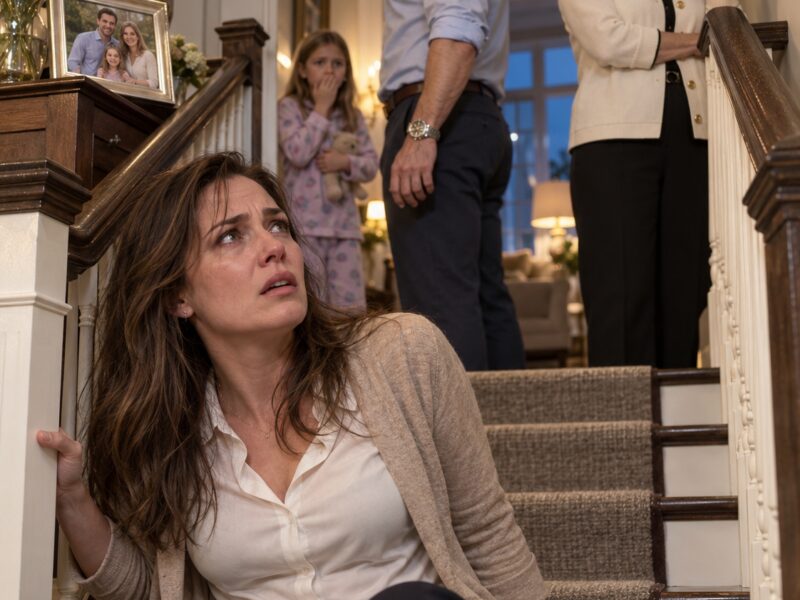
MY HUSBAND THREW ME DOWN THE STAIRS, AND MY MOTHER-IN-LAW CALLED ME “WORTHLESS”—UNTIL MY QUIET FATHER WALKED INTO COURT WITH THE TRUTH THEY NEVER EXPECTED
The first thing I heard was my daughter screaming my name.
The second thing I felt was the stairs disappear beneath my feet.
My shoulder struck the wall.
My hip slammed against the edge of a step.
Then the back of my head snapped hard enough to turn the hallway light into a white blur.
For several seconds, I did not know where I was.
I knew pain.
I knew the carpet against my cheek.
I knew my seven-year-old daughter crying somewhere above me.
Then my husband’s voice came from the top of the stairs.
“You should have listened.”
That brought the room back.
Evan Mercer stood four steps above me, one hand still half raised as if even he had not decided what to do with it.
His face was red.
Breathing hard.
At the landing behind him stood his mother.
Janice Mercer.
Pearls.
Beige cardigan.
Perfect hair.
She had come over for dinner because she said families needed to “talk through misunderstandings before they turned into drama.”
Apparently this was what she meant.
She stared at me on the stairs.
Did not come down.
Did not call an ambulance.
Did not ask whether I could move my fingers.
Instead, she looked at her son.
Then at me.
And said:
“This is what happens when a woman keeps pushing.”
I tried to breathe.
Pain went through my ribs.
My daughter, Sophie, stood at the top of the hall.
Pink pajama pants.
Soccer T-shirt.
One sock.
Her face was completely white.
“Mom?”
I tried to say:
I’m okay.
Nothing came out.
Janice pulled her phone from her purse.
“I’m calling her father.”
Evan laughed.
Not loudly.
Just once.
Ugly.
“Good.”
Janice tapped the screen.
I knew exactly who she was calling.
My father, Henry Dawson.
Retired.
Quiet.
The kind of man who still sharpened kitchen knives by hand and checked the furnace filter every October.
He lived forty minutes away in the same brick house where I grew up.
He drove a fifteen-year-old Honda.
He wore old flannel shirts until my mother threw them out.
To Janice, that made him harmless.
The call connected.
“Henry?”
She put the phone on speaker.
My father’s voice came calm through the hallway.
“Yes?”
Janice looked at me.
“Come get your daughter.”
Pause.
Then:
“What happened?”
“She fell.”
I turned my face against the carpet.
Evan said nothing.
Janice continued.
“She’s hysterical.”
“She’s been making Evan’s life miserable for months.”
“And now she’s turning your granddaughter against him.”
My father did not answer immediately.
That silence was familiar.
He used silence when other people expected panic.
Janice mistook it for weakness.
She smiled.
“Honestly, Henry, come take your worthless daughter home before she destroys this family completely.”
The hallway stopped breathing.
Even Evan looked at his mother.
My father’s voice came through the phone.
Still calm.
“If she has even one injury from someone putting hands on her, your family is going to have to answer for that.”
Janice actually laughed.
“So now you’re threatening us?”
“No.”
“Then what was that?”
“A statement.”
She looked at Evan.
They shared the kind of smile people wear when they believe they have identified the weakest person in the room.
That was the mistake.
Not because my father was powerful in some secret, dramatic way.
Not because he had people waiting to break down doors.
Not because he was about to ruin anyone with a phone call.
The mistake was simpler.
They had no idea how carefully he understood consequences.
At that moment, neither did I.
Three weeks earlier, I still believed my marriage might be saved.
My name is Nora Dawson Mercer.
I was thirty-five.
Evan and I had been married eleven years.
We lived outside Columbus, Ohio, in a two-story house with gray siding and a maple tree that dropped leaves directly into the gutters every fall no matter how often Evan complained about it.
We had one daughter.
Sophie.
Seven.
Obsessed with soccer.
Terrible at remembering water bottles.
Excellent at remembering when adults broke promises.
From outside, we looked ordinary.
I worked as an operations manager for a healthcare logistics company.
Evan managed regional sales for a construction materials supplier.
We had a mortgage.
Two cars.
A refrigerator covered in school papers and orthodontist reminders.
Christmas decorations that stayed in the basement until December first because Sophie insisted that was the law.
For years, nothing about our life seemed dramatic enough to scare me.
That was part of the problem.
Abuse rarely introduced itself using the word abuse.
At first, Evan asked questions.
Why was I late?
Who was I texting?
Why was my supervisor calling after six?
Why did I need dinner with coworkers?
Why did I visit my parents without asking whether he had plans?
I answered.
Then I started explaining before he even asked.
Then apologizing for things that were not wrong.
Then changing things to avoid arguments.
No dinners.
No happy hour.
Shorter calls with my mother.
No stopping at the store on the way home without texting.
He did not have to demand every change.
Eventually, I did the work for him.
Janice called that marriage.
“Men need to feel respected.”
she told me once over coffee.
“He works hard.”
“So do I.”
I had said.
She smiled.
“Of course.”
But the smile meant:
Not in the same way.
Evan was her only son.
His feelings arrived in every room before anyone else’s.
If he got angry, someone had provoked him.
If he insulted me, he was stressed.
If he punched the kitchen cabinet hard enough to crack the trim, it was because I “wouldn’t stop.”
If I cried, Janice called me dramatic.
If I went quiet, she called me cold.
The rules moved.
Evan always stood in the correct place.
I always found myself apologizing from the wrong one.
One Thursday, I came home twenty minutes late.
A scheduling system at work had failed.
I had spent the last hour rerouting deliveries for two outpatient clinics.
Evan waited in the kitchen.
No television.
No music.
Just him.
“Six.”
he said.
“What?”
“You said six.”
“I know.”
I set down my bag.
“The system crashed.”
“You always have a reason.”
I stared.
“It isn’t a reason.”
“It’s what happened.”
“You think I’m stupid?”
I could feel Sophie upstairs.
That changed how I breathed.
“Can we not do this tonight?”
Evan stepped closer.
“You don’t get to decide when I get answers.”
I lowered my voice.
“Sophie can hear.”
“You’re always worried about what Sophie hears.”
“Yes.”
“She’s our daughter.”
His expression changed.
Not louder.
Colder.
“I’m her father too.”
“I know.”
“Do you?”
He walked away.
That night, I called my dad.
He answered on the second ring.
“Hey, kid.”
I had not been a kid in fifteen years.
Still, something in me softened.
“Hi, Dad.”
He was quiet.
Then:
“Are you safe?”
I closed my eyes.
“Yes.”
Lie.
He knew.
He did not push.
My father had never confused love with interrogation.
“If you need me, I’ll come.”
“I know.”
“Nora.”
“Yeah?”
“You don’t need to solve your whole life tonight.”
I swallowed.
“What do I need to do?”
“Make sure you and Sophie are safe tonight.”
Two days later, Evan apologized.
Flowers.
Tulips.
Yellow because he remembered I liked them.
He made breakfast.
Put his arms around me from behind.
“I hate who I become when I think I’m losing you.”
That sentence felt vulnerable.
It was not.
Not exactly.
At the time, I heard:
I love you.
Later I understood it meant:
I cannot tolerate losing control.
I accepted the flowers.
Because leaving eleven years is not a single movement.
It is not standing at the front door and becoming brave.
It is looking at wedding photographs.
It is remembering the man who held your hair while you were sick during pregnancy.
It is remembering the night your daughter was born and how he cried before you did.
It is looking at someone who has become frightening and still seeing pieces of someone you once trusted.
That is what makes it hard.
Not weakness.
History.
A week later, I started writing things down.
Dates.
Arguments.
Texts.
The night Evan blocked the bedroom door.
The time he grabbed my wrist during an argument and left red marks.
The night he smashed my phone against the counter and then bought me a new one.
Janice telling me:
“A good wife doesn’t keep score.”
I did not know yet whether I was building a legal record.
I only needed proof for myself.
Proof that I was not imagining a pattern.
I saved screenshots to a private email.
Copied a few notes onto my work laptop.
Then made the mistake of assuming Evan would never look at my phone while I showered.
He did.
I came out of the bathroom.
He sat on the bed.
My phone in his hand.
“What is this?”
My stomach dropped.
“Give me my phone.”
He read aloud.
“March twelfth.”
“Evan stood in doorway for seventeen minutes and would not let me leave.”
He looked up.
“You’re documenting me?”
“I’m documenting what’s happening.”
“No.”
“You’re building a case.”
“I’m trying to understand.”
“Understand what?”
“Why I’m afraid in my own house.”
His face changed.
“You told your father?”
“Yes.”
“You made me look like a monster.”
“I told him what happened.”
He stood.
For one second I thought he might hit me.
Instead, he threw the phone onto the bed.
“You’re going to regret this.”
Then left.
Twenty minutes later, Janice arrived.
I stayed upstairs.
Could hear them below.
“She’s turning against you.”
Janice said.
“My father is filling her head.”
Evan answered.
Janice’s voice:
“That man has always thought he was better than us.”
Then:
“Maybe she needs to understand what happens when she keeps threatening this family.”
I stopped breathing.
That sentence changed everything.
At 6:14 the next morning, I called my father.
“Dad.”
He answered immediately.
“Nora?”
“I think I’m in trouble.”
No questions about feelings.
No speeches.
“Where are you?”
“Home.”
“Sophie?”
“With me.”
“Leave.”
My fingers tightened around the phone.
“Dad—”
“Take Sophie.”
“Take medication.”
“IDs.”
“School records if you can.”
“Go somewhere safe.”
There was a quality in his voice I had never heard before.
Not panic.
Precision.
I packed one bag.
Sophie watched from the doorway.
“Are we going to Grandpa’s?”
“Yes.”
“For how long?”
“I don’t know.”
She nodded.
Kids notice the answer adults avoid.
I picked up her backpack.
Then the front door opened.
Evan walked in.
He saw the bag.
Then Sophie.
Then me.
“What are you doing?”
“We’re going to my parents’ house.”
“No.”
I kept my voice steady.
“We need space.”
“You are not taking my daughter.”
“Our daughter.”
He closed the door behind him.
“Same thing.”
“No.”
That word surprised me.
He stepped forward.
Sophie took my hand.
“Daddy.”
Evan looked down.
She whispered:
“Please.”
Something in him shifted.
He moved away from the door.
I did not wait.
We left.
Dad stood at the curb when we arrived.
Old baseball cap.
Work jeans.
He opened Sophie’s door first.
“Hey, bug.”
She climbed into his arms.
Then he looked at me.
“Are you hurt?”
“No.”
“Sure?”
“Yes.”
He nodded.
That was all.
No:
I told you so.
No:
Why didn’t you leave sooner?
No:
I knew this would happen.
That evening, Sophie slept in my old room.
I sat at the kitchen table with my father.
My mother, Helen, had died four years earlier from a stroke.
Her ceramic sugar bowl still sat beside the coffee maker.
Dad never replaced it.
“Dad.”
“Yeah?”
“How much do you know about Evan?”
“Enough.”
I frowned.
“That sounds ominous.”
“I pay attention.”
“You barely see him.”
“I listen to you.”
That landed.
Every canceled dinner.
Every strange argument.
Every time I laughed something off.
My father had not been fooled.
“Why didn’t you tell me to leave?”
He looked at me.
“Because I could advise you.”
“I could support you.”
“But I could not become another man making decisions about your life.”
I stared at him.
That sentence sat beside all the ways Evan had controlled me and showed me the difference.
My father continued.
“If I told you what to do before you were ready, you might leave him because of me.”
“Then go back because of yourself.”
“I needed you to trust your own judgment again.”
I looked down.
“I don’t.”
“You will.”
A family lawyer called that night.
Daniel Price.
Dad said they knew each other from years ago.
Daniel spoke carefully.
Protective order.
Temporary parenting arrangements.
Medical documentation.
Police report.
He never promised victory.
He repeated one sentence:
“Do not improve the facts.”
“What?”
“Don’t edit.”
“Don’t embellish.”
“Don’t clean up texts.”
“Don’t rewrite notes.”
“Truth becomes strongest when it remains boring.”
The next morning, Evan filed for emergency custody.
His attorney claimed I removed Sophie from the marital home without notice.
Claimed my father was influencing me.
Claimed I was unstable.
I read the motion twice.
Then vomited in my father’s downstairs bathroom.
Daniel found me sitting at the kitchen table thirty minutes later.
“He hurt me.”
I said.
“And now he says I’m dangerous.”
Daniel nodded.
“I know.”
“How does someone do that?”
“Because court does not automatically know who is telling the truth.”
He sat across from me.
“That’s why evidence matters.”
“What if they believe him?”
“Then we keep showing them what exists.”
My father sat at the far end of the room.
Quiet.
Daniel glanced at him.
“Robert, Ethan’s attorney sent a letter.”
Dad looked up.
“What?”
“They’re alleging your involvement is coercive.”
My father nodded.
“Then I stop direct contact.”
I stared.
“That’s it?”
“That’s exactly it.”
“But they’re lying.”
“So?”
He looked at me.
“We do not answer lies by behaving badly.”
Later, I asked:
“Why does Daniel listen to you?”
Dad smiled faintly.
“We’ve known each other.”
“How?”
“Work.”
“What work?”
He changed the subject.
He had done that my whole life.
His career had always been vague.
Government work.
Paperwork.
He traveled.
Sometimes disappeared for weeks.
Never discussed cases.
I grew up thinking his job had been aggressively boring.
Three days later, Janice came to my father’s house.
I saw her through the front window.
Dad opened the door.
She stood on the porch.
Red coat.
Hard expression.
“You’re destroying my son.”
Dad said:
“No.”
“You’re using your position.”
“No.”
“You think I don’t know people?”
“I’m sure you do.”
“Evan’s company employs hundreds.”
“I know.”
Janice’s eyes narrowed.
“You investigated him?”
Dad said:
“No.”
Then:
“I read public filings after my daughter said she was afraid.”
“You’re trying to ruin him.”
“I’m trying to make sure Nora is safe.”
“You cannot intimidate us.”
“I haven’t.”
She leaned closer.
“My family has influence in this city.”
Dad’s face changed.
Not fear.
Something like fatigue.
“Mrs. Mercer.”
“What?”
“Influence is useful when people are impressed by it.”
She blinked.
“I’m not.”
Janice stared.
Then said the thing she must have regretted later.
“Your daughter has always been weak.”
Dad’s jaw tightened.
Only slightly.
“You saw her on the stairs.”
“Yes.”
“And you called her worthless.”
Janice said nothing.
“You should go.”
“Is that a threat?”
“No.”
“Why won’t you threaten me?”
Dad looked at her.
“Because threats are how your family got here.”
She left.
That evening, I finally asked him directly.
“What did you actually do?”
He was reading at the kitchen table.
He took off his glasses.
“I worked for the government.”
“I know that.”
“No.”
He folded the glasses.
“You know the sentence.”
“You don’t know the job.”
My stomach tightened.
“What was it?”
“Federal prosecutor.”
I laughed once.
Not because it was funny.
Because the idea seemed too large for the man who mowed his own lawn in socks and sandals.
“You were a prosecutor?”
“For twenty-nine years.”
“What kind?”
His expression changed.
“Public corruption.”
“Financial fraud.”
“Organized crime.”
“Cases involving people who thought money and intimidation insulated them from accountability.”
I stared.
“Why didn’t you ever tell me?”
“Because you were my daughter.”
“That makes no sense.”
“It makes complete sense.”
He leaned back.
“I spent decades around people who turned titles into identity.”
“I did not want you growing up thinking my job made you safer, better, or more important.”
I stared at the table.
“Daniel worked with you?”
“Sometimes.”
“Judges?”
“Some.”
“Police?”
“Some.”
“Does Ethan’s family know?”
“Apparently not.”
A strange feeling passed through me.
Relief.
Then something uglier.
Power.
I imagined Janice’s face.
Evan’s.
The courtroom.
My father saw it.
His voice sharpened.
“Don’t.”
I looked up.
“Don’t what?”
“Use me as revenge.”
“I wasn’t—”
“Yes, you were.”
He was right.
He continued.
“My career is not a weapon you get to swing because you are hurt.”
I felt embarrassed.
“I know.”
“Do you?”
I looked away.
Dad softened.
“Nora.”
“They hurt you.”
“I want consequences.”
“But consequences and vengeance are not the same thing.”
He leaned forward.
“If I intimidate a judge, prosecutor, investigator, or opposing lawyer because I once held office, then I become exactly the kind of person I spent my career prosecuting.”
That ended the fantasy.
“What can you do?”
“Be your father.”
“That doesn’t sound like enough.”
“It will be.”
The case escalated.
Evan’s attorney suggested Dad had pressured police.
Daniel requested documentation showing assignment procedures.
Nothing unusual.
They claimed Dad influenced the family court.
Daniel disclosed Dad’s prior career before the other side could make it look hidden.
The judge did not care.
Good.
That was the first lesson.
Dad’s identity changed less than everyone expected.
Evidence still mattered.
Medical records showed bruising along my shoulder and hip.
A mild concussion.
No broken bones.
The emergency-room doctor documented my statement immediately.
A neighbor’s doorbell camera captured part of our front hallway through the glass sidelight.
Not the fall itself.
Enough to show Evan following me toward the stairs.
Enough to show me moving away.
Then his arm reaching into frame.
My notes established months of escalating control.
My texts showed fear before the incident.
Not invented afterward.
Sophie’s statements were handled by a child specialist.
I did not coach her.
Daniel insisted.
“Your daughter is not evidence you own.”
“She is a child.”
That was painful.
Necessary.
Then Evan made his biggest legal mistake.
He gave a written statement claiming Sophie was upstairs in bed during the argument.
Doorbell footage showed her pink pajama leg entering the hallway before the fall.
His timeline put Janice arriving after the incident.
A neighbor’s camera showed Janice’s car parked outside twenty-five minutes earlier.
Small lies.
But lies produce architecture.
Once the judge saw the pattern, credibility changed.
Evan called.
I almost ignored it.
Answered because Daniel said one recorded voicemail might matter more than ten missed calls.
“Nora.”
“What?”
“I made a mistake.”
“You pushed me down the stairs.”
“I didn’t mean for you to fall.”
“You told police I slipped.”
“I panicked.”
“You let your mother call me worthless while I was lying there.”
Silence.
“I said I’m sorry.”
“No.”
My voice surprised me.
“You’re afraid.”
“That’s different.”
He breathed heavily.
“You’re not the woman I married.”
I looked out my father’s kitchen window.
“Neither are you.”
Then hung up.
I did not feel powerful.
I cried in the pantry.
That was another thing stories get wrong.
Boundary does not erase grief.
Sometimes the right sentence still hurts.
The custody hearing arrived three weeks later.
I dressed in navy.
Flat shoes.
Hair tied back.
Not to look strong.
To avoid thinking about clothes.
Dad drove.
Before we left, he found me sitting on the edge of the guest bed.
“You ready?”
“No.”
“Good.”
I frowned.
“What?”
“Honest answer.”
“I wish I wasn’t scared.”
“Courage doesn’t require that.”
“What does it require?”
“Something that matters more.”
I thought of Sophie.
“Okay.”
The courthouse hallway was fluorescent and ordinary.
That helped.
No movie score.
No dramatic crowd.
Just lawyers with folders.
Parents staring at phones.
A vending machine humming near the elevators.
Evan stood near the courtroom with Janice.
When he saw Dad, his expression changed.
Fear.
Not because Dad threatened him.
Because now he understood something.
The quiet old man he had laughed at knew exactly how these rooms worked.
The hearing began.
Evan’s attorney described me as reactive.
Said I left impulsively.
Said Dad orchestrated the litigation.
Daniel stood.
Calm.
“We can address each allegation with records.”
Medical report.
Photos.
Texts.
Timeline.
Video.
Sophie’s protected interview summary.
The judge watched the footage twice.
Then looked at Evan.
“Did you place your hands on your wife?”
He shifted.
“Yes.”
“Did she fall after that?”
“Yes.”
“Did you tell responding officers she fell independently?”
“Yes.”
“Why?”
Silence.
“Mr. Mercer?”
“I was scared.”
“Of what?”
No answer.
The judge looked down at the file.
Then at Janice.
“Were you present?”
“Yes.”
“Did you call emergency services?”
“No.”
“Why not?”
Janice swallowed.
“I thought Nora was being dramatic.”
The room went quiet.
The judge’s voice changed.
“You saw a person fall down stairs and thought the primary issue was dramatics?”
Janice looked down.
That was the first time I saw shame reach her.
Temporary custody remained with me.
Evan received supervised contact.
Protective communication rules.
Mandatory assessment.
Counseling requirements before expanded visitation.
No victory speech.
No dramatic destruction.
Just orders.
Paper.
Dates.
Conditions.
Structure.
Outside, Evan caught up with me.
“Nora.”
I stopped.
He stood six feet away.
“I never wanted this.”
“You wanted control.”
“No.”
“Yes.”
His eyes filled.
“I was angry.”
“So was I.”
“I made a mistake.”
“You made a choice.”
He looked down.
“I’m sorry.”
I believed him.
That surprised me.
But remorse did not equal safety.
“I believe you’re sorry.”
He looked hopeful.
I continued.
“That doesn’t mean I’m coming back.”
The hope disappeared.
I walked away.
Dad waited by the elevator.
I expected something profound.
He said:
“Coffee?”
I laughed.
“Yes.”
Across the street, he stirred sugar into black coffee despite years of claiming sugar ruined coffee.
I watched him.
“Were you ever tempted?”
“About what?”
“To call someone.”
“Make this disappear.”
He looked at me.
“No.”
“Never?”
“I was furious.”
“That’s not what I asked.”
He smiled slightly.
“I knew what you asked.”
He stirred again.
“If I used old relationships to bend the process for you, what would that teach Sophie?”
I thought.
“That rules only matter when we want them to?”
“Exactly.”
He looked at me.
“I helped you find good people.”
“I told you where traps were.”
“I reminded you to save evidence.”
“The rest was yours.”
I stared at him.
“I thought you saved me.”
“No.”
He pointed toward the courthouse.
“You told the truth.”
“You left.”
“You testified.”
“You protected your daughter.”
“You saved yourself.”
That sentence hurt more than I expected.
Because it returned something Evan had taken.
Agency.
Three months later, Janice wrote me.
Two pages.
Handwritten.
First line:
Nora, I don’t expect forgiveness.
I almost stopped.
Didn’t.
She wrote that she spent her life believing protecting family meant defending family regardless of behavior.
When Evan complained about me, she believed him.
When I said I was afraid, she called it manipulation.
When she saw me injured on the stairs, she still thought first about protecting her son.
Then:
I called your father because I wanted him to be embarrassed by you. I thought you were a problem another man needed to remove. I was wrong.
I put the letter down.
For months, I had imagined this apology.
In fantasy, I delivered perfect lines.
Made her cry.
Made her understand.
Reality was quieter.
I did not want her humiliated.
I wanted distance.
Peace.
I called Dad.
“She apologized.”
“How do you feel?”
“I don’t know.”
“That’s allowed.”
“Shouldn’t I feel better?”
“No rule says that.”
I smiled.
“Old man advice?”
“Premium edition.”
Months passed.
Not dramatically.
Paperwork.
Therapy.
School lunches.
Soccer.
Divorce filings.
New health insurance.
Grocery shopping.
The first night Sophie and I slept in our new rental, I woke at two in the morning because the house was silent.
I lay still.
Waiting for footsteps.
None.
No one checking my phone.
No one standing in the hallway.
No one demanding explanation.
At first the quiet frightened me.
Then it became the best thing I owned.
Sophie started sleeping better.
Scored her first goal that spring.
Ran toward me afterward.
Then stopped.
Looked toward the bleachers.
Evan sat beside a court-approved supervisor.
He clapped.
Sophie hesitated.
Then waved.
He waved back.
Healing was not clean.
Love did not disappear just because someone behaved terribly.
Children held contradictions better than adults.
Evan entered counseling.
Accepted responsibility.
Stopped contesting certain facts.
I did not monitor his progress.
That was another lesson.
His rehabilitation was not my job.
My job was rebuilding my life.
Six months after the incident, Janice asked to meet.
Coffee shop.
Public.
I agreed.
She looked older.
No pearls.
No makeup beyond lipstick.
“Nora.”
“Janice.”
“I’m sorry.”
I waited.
She continued.
“I protected Evan from consequences until he started believing consequences were cruelty.”
That sentence was good.
Painfully good.
“I helped create some of this.”
“You didn’t push me.”
“No.”
“But I excused the man who did.”
I stirred my coffee.
“I understand loving your son.”
She looked at me.
“Understanding doesn’t make what you did okay.”
“I know.”
“I may never trust you.”
“I know.”
“You may not be part of my life.”
Her eyes filled.
“I know.”
No hug.
No reconciliation montage.
Just truth.
Sometimes forgiveness begins as accurate description.
A year after the fall, the divorce became final.
I stood on courthouse steps.
Dad beside me.
Sophie at school.
Daniel shook my hand.
“You okay?”
“Yes.”
This time true.
Evan approached.
Different suit.
Thinner.
More tired.
He stopped several feet away.
“I’m not asking you to forgive me.”
“Good.”
He almost smiled.
“I deserved that.”
I looked at him.
He continued.
“I understand now why you documented everything.”
I waited.
“I thought you were building a case against me.”
“I was building proof for myself.”
His face changed.
“That’s worse.”
“What?”
“That you needed proof that what was happening was real.”
He looked down.
“I’m sorry.”
I said:
“I hope you become safe enough for Sophie to love without being afraid of you.”
He nodded.
That was the kindest sentence I could offer.
Not reunion.
Not punishment.
A future conditional on behavior.
Dad and I walked to the parking garage.
Halfway there, I stopped.
“Dad.”
“What?”
“You really prosecuted organized crime?”
He smiled.
“Among other things.”
“You put people in prison?”
“When juries convicted them.”
“Were people afraid of you?”
He thought.
“Some.”
“You never seemed scary.”
“Good.”
“Why?”
“Because power that needs an audience is usually insecure.”
I laughed.
“That sounds like something you practiced saying.”
“Twenty-nine years gives you material.”
Later that night, Dad sat on my porch.
Sophie inside doing homework.
I asked:
“Why didn’t you tell me everything?”
“You asked that.”
“I’m asking again.”
He looked at the street.
“I wanted you to grow up believing you could solve problems without borrowing authority from me.”
“You could have protected me sooner.”
“Yes.”
“Why didn’t you?”
“Because protection can become control if you’re not careful.”
He looked at me.
“I could not save you from every bad choice without teaching you your choices didn’t belong to you.”
Tears came.
“I thought I was weak.”
“You were surviving.”
“I stayed.”
“Yes.”
“For too long.”
“Maybe.”
He shrugged.
“But people who leave after eleven years still left.”
That sentence freed something.
Sophie opened the door.
“Mom?”
“Yeah?”
“Grandpa promised ice cream.”
Dad looked innocent.
I laughed.
“Of course he did.”
Two years later, we planted yellow flowers behind the little house I eventually bought.
Sophie was nine.
Stronger.
Still forgot water bottles.
Dad retired from mowing his own lawn because his knee finally forced him to admit seventy was not fifty.
Janice saw Sophie occasionally under arrangements I controlled.
Evan continued treatment.
We communicated through an app.
Civil.
Brief.
Safe.
I never remarried quickly.
Did not need romance to certify recovery.
I learned to eat alone.
Sleep diagonally.
Buy paint colors without negotiating.
Go to dinner with coworkers.
Visit Dad without texting anyone for permission.
Small freedoms.
They accumulate.
One evening, Sophie asked:
“Mom?”
“Yeah?”
“Did Grandpa scare Dad?”
I looked at her.
“No.”
“Dad said Grandpa was powerful.”
“He had an important job.”
“So he scared him?”
I thought carefully.
“Your grandfather didn’t scare your dad.”
“Then what did?”
“The truth.”
She frowned.
“That’s weird.”
“Sometimes truth is scary when you’ve spent a long time avoiding it.”
She considered.
“Is that why Grandma Janice apologized?”
“Maybe.”
“Do you forgive her?”
“Some days more than others.”
She accepted that.
Children sometimes understand honest complexity better than tidy answers.
That night, after Sophie slept, I opened the drawer where I kept Janice’s letter.
Not as proof.
I had enough proof.
As a reminder.
People can change.
Not always.
Not quickly.
Not because we want them to.
But sometimes.
Evan changed enough to become a safer father.
Janice changed enough to understand that loyalty without accountability can become cruelty.
My father remained exactly who he had always been.
Quiet.
Careful.
Unimpressed by status.
The person I had misunderstood was myself.
For years, I believed strength meant making people regret hurting you.
Making them afraid.
Making them lose what mattered.
I learned something different.
The strongest thing I did was leave.
Then tell the truth without decorating it.
Then refuse to let someone else’s behavior turn me into someone I did not recognize.
Janice once called me worthless while I lay on the floor.
For months, that word followed me.
Not because I believed her completely.
Because part of me already feared it.
Worthless wife.
Failed marriage.
Broken family.
Difficult woman.
Overreacting mother.
Those labels disappear when you stop auditioning for people committed to misunderstanding you.
I was not worthless.
I was not weak.
I was not responsible for Evan’s violence.
And I did not need my father’s old title to prove any of that.
One Sunday, we were eating dinner at Dad’s house.
Sophie asked him:
“Grandpa, were you famous?”
Dad looked horrified.
“No.”
“Mom says you sent bad guys to jail.”
“I helped prosecute cases.”
“That means yes.”
“No.”
She narrowed her eyes.
“Were you a superhero?”
Dad looked at me.
I laughed.
He said:
“No.”
“What were you?”
He thought.
“Prepared.”
Sophie looked disappointed.
“That’s boring.”
Dad smiled.
“It often is.”
She went back to mashed potatoes.
I watched him.
The man Janice mocked.
The man Evan underestimated.
The man I once thought had hidden some dramatic secret that would destroy them.
His real secret was less flashy.
More useful.
He understood that truth becomes powerful when it is preserved before people can rewrite it.
That documents matter.
That timelines matter.
That intimidation collapses when someone refuses to respond emotionally.
That love does not mean controlling outcomes.
That anger does not get to choose your next action.
He taught me all of that without giving me his life.
Only enough tools to reclaim mine.
Years later, I still remembered the stairs.
Not the pain first.
Not anymore.
I remembered Sophie screaming.
Janice’s phone.
Dad’s voice coming through the speaker.
Calm.
Measured.
“If she has even one injury from someone putting hands on her, your family will have to answer for that.”
They laughed.
They thought he meant revenge.
They thought he was threatening them.
He wasn’t.
He meant exactly what he said.
Answer for it.
In records.
In court.
In consequences.
In changed relationships.
In the long ordinary work of becoming better or losing access to the people you harmed.
That was what answering meant.
And when I finally understood that, I stopped wanting Evan and Janice to suffer the way I had suffered.
I wanted something more permanent.
A life where their choices no longer determined mine.
One spring morning, Sophie handed me a yellow flower from the garden.
“Where should this go?”
I pointed toward the sunniest part of the yard.
“Right there.”
We knelt.
Covered the roots.
Pressed the soil.
She looked up.
“You okay?”
I smiled.
“Yes.”
And for once, there was no hidden meaning.
No danger behind the answer.
No man listening from another room.
No one waiting to tell me I was too sensitive.
I was okay.
Not because the past disappeared.
Because it no longer owned the future.
Janice had called me worthless.
Evan had tried to make me afraid.
My father had been powerful enough to ruin them if he had abused the systems he knew.
He did not.
Instead, he taught me the one thing nobody in Evan’s family understood until it was too late.
Power is not making people afraid of what you can do.
Power is knowing exactly what you can do—
and choosing the thing that lets the truth stand on its own.









