My Husband Told Our Marriage Counselor I’d Let Myself Go—While I Spent Every Tuesday Caring for the Mother He Claimed He Was Visiting
Eleven minutes into our first marriage-counseling session, my husband told the therapist I had “let myself go,” then blamed my weekly absences on caring for his mother.
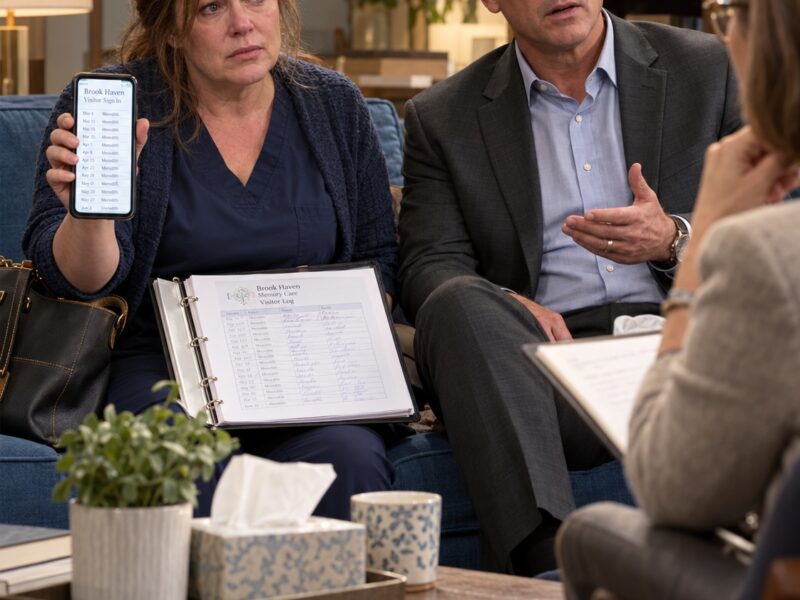
What Greg did not tell her was that my name appeared in Brook Haven’s visitor book fifty-one Tuesdays in a row, while his appeared exactly once.
I still did not know where my husband had really been going every Tuesday—but by the end of that week, I would discover the first lie was nowhere near the worst one.
The white-noise machine beside Lorraine Pike’s office door made a soft rushing sound, like rain trapped inside a plastic box.
I remember that because I needed somewhere to look besides my husband.
Greg sat beside me on a blue loveseat, ankles crossed, charcoal slacks perfectly pressed, wedding ring shining under the lamp. Twenty-two years of marriage had taught me that he looked most reasonable when he was about to say something cruel.
Lorraine leaned slightly forward.
“What has changed between you?”
Greg sighed.
Not an angry sigh.
A wounded one.
He had always been good at those.
“I don’t know where my wife went.”
Lorraine’s pen moved.
I kept my hands folded.
Greg continued.
“Meredith used to take care of herself.”
There it was.
Not us.
Me.
“She swam every morning. She cared how she dressed. She used to do something with her hair.”
I touched nothing.
My gray roots were visible.
Two inches, maybe more.
“I’m not saying people can’t change,” Greg said. “We’re in our fifties. I understand that.”
We were both fifty-one.
He said we’re in our fifties as though he had reached some dignified mountain while I had collapsed during the climb.
“But she’s just… stopped.”
Lorraine glanced toward me.
Greg kept going.
“She lives in scrubs.”
“I work in a medical office.”
“I know.”
He smiled at Lorraine.
“See? That’s what I mean. Everything has an explanation.”
I looked at him.
He did not.
“The weight isn’t the issue by itself.”
That was generous.
“It’s the whole thing. She’s tired. She’s gone every Tuesday. If I ask about dinner, she says she has something at Brook Haven. If I ask about a weekend, she’s tired because she worked four tens so she could keep Tuesday free.”
He folded his hands.
“And meanwhile I’m the one sitting with my mother in memory care.”
Lorraine’s pen stopped.
Not for long.
Long enough.
She turned to me.
“Meredith?”
Greg finally looked.
I nodded.
“He’s right.”
His shoulders loosened.
It was small.
Half an inch.
Relief.
That hurt more than if he had smiled.
“I have let myself go.”
Greg looked toward Lorraine as if we had achieved something.
Then I continued.
“I stopped coloring my hair.”
His expression changed slightly.
“I stopped swimming at six in the morning because I switched to four ten-hour shifts at the clinic.”
Lorraine listened.
“I wear scrubs constantly because I work forty hours in them and drive straight from work or errands to Brook Haven in them.”
Greg’s jaw tightened.
“And I have gained eighteen pounds.”
Silence.
“Most of it in the year since Ruth moved into memory care.”
Lorraine nodded.
“How often do you visit her?”
“Every Tuesday.”
Greg inhaled.
I turned toward him for the first time.
“Every single one.”
His face did not move.
I took my phone from my purse.
“There is a visitor binder at Brook Haven’s front desk.”
Greg looked down at my hand.
“My name is in it fifty-one times.”
The white-noise machine hissed.
“His is in it once.”
Nothing moved.
Not Lorraine’s pen.
Not Greg’s hands.
Not mine.
Then Greg looked at the bookshelf behind Lorraine.
At his watch.
At the office door.
“Could we take five minutes?”
Lorraine’s voice remained neutral.
“Of course.”
Greg stood too quickly.
His knee hit the edge of the coffee table.
He did not acknowledge it.
“I just need some air.”
He was out before Lorraine finished saying yes.
The door closed.
My hands began shaking.
They had been steady while he sat beside me.
Now they shook so badly I needed both thumbs to unlock my phone.
Lorraine watched without comment.
I opened the photo album I had created three weeks earlier.
BROOK HAVEN.
Page after page of visitor-log photographs.
Dates.
Names.
Times.
My signature repeated in blue ink.
Meredith Lowell.
10:02.
9:58.
10:15.
The week of the ice storm, 11:07 because Route 48 had been terrible.
One week missing in January because I had influenza.
Greg’s name appeared on the first page.
Admission day.
11:40 to 12:50.
Then never again.
Lorraine scrolled.
“Have you shown him these?”
“No.”
“Why?”
I had rehearsed answers.
Because he lies.
Because I’m scared.
Because I wanted proof.
None came out.
Instead:
“Because I wanted to hear what he’d say when he thought nobody in the room knew.”
Lorraine looked at me for a long moment.
She did not tell me I was right.
She did not tell me I was paranoid.
She set the phone down.
“Do you know where he goes on Tuesdays?”
“No.”
“You suspect?”
“Yes.”
“Do you know?”
“No.”
That mattered.
I appreciated her for making it matter.
Through the narrow glass beside the door, Greg stood at the far end of the hallway with his phone against his ear and his other hand pressed flat against the wall.
I had watched my husband make hundreds of phone calls.
He paced during difficult ones.
He rolled his eyes during calls with his mother.
He doodled during conference calls.
He had never leaned on a wall like the building was the only thing holding him upright.
“Who is he calling?” Lorraine asked.
“I don’t know.”
“Do you want to ask?”
“No.”
That surprised me.
“Why?”
“Because he will answer.”
Lorraine waited.
“And I’m not sure I’m ready to hear another answer designed before I finish the question.”
The door opened.
Greg returned.
His face had been reconstructed.
Tie straight.
Breathing normal.
He sat.
“I owe you some context.”
Lorraine picked up her pen.
“Okay.”
“I don’t always visit Mom on Tuesdays.”
I looked at the carpet.
“Work is unpredictable.”
“Which days do you visit?” Lorraine asked.
Greg spread his hands.
“Whenever I can.”
“Can you give me examples?”
“Weekends sometimes.”
“Which weekend?”
Greg’s mouth tightened.
“There’s also a courtyard entrance.”
Lorraine said nothing.
“If I come after work, I use the side entrance.”
“Does the facility log visitors there?”
He laughed lightly.
“I didn’t realize I was being audited.”
Lorraine let the joke die by itself.
“Do they?”
“I don’t know.”
I did.
The receptionist had explained three weeks earlier that the courtyard entrance was keypad-only and visitors still had to sign in at the night desk.
Greg did not know I knew.
Lorraine gave us homework.
A simple time log.
One week.
Where we went.
How long.
Nothing investigative.
“Just notice your time,” she said.
Greg smiled.
“Absolutely.”
Client voice.
In the parking lot, we sat inside his car with the engine running.
Four minutes.
I watched the dashboard clock.
11:17.
11:18.
11:19.
11:20.
Finally:
“You ambushed me.”
I looked through the windshield.
“You said it to a stranger first.”
“I was trying to be honest.”
“So was I.”
“In front of her?”
“You chose the room.”
Greg backed out too fast.
My seat belt locked across my chest.
“You made me look like a liar.”
I turned.
“You said you go to Brook Haven.”
“I do.”
“Then there shouldn’t be a problem.”
He gripped the steering wheel.
“You have no idea what the last year has been like for me.”
That was almost funny.
I did not laugh.
We drove home in silence.
Greg went upstairs.
The bedroom light came on.
I stayed in the driveway.
Ten minutes.
Seat belt still buckled.
Purse on my lap.
I thought about walking inside and asking who he had called.
Then I imagined his face.
Hurt first.
Then offended.
Then reasonable.
By the end, I would probably apologize for violating his privacy.
I knew because that was how difficult conversations worked in our marriage.
Greg did not shout.
He reframed.
That skill had kept us married longer than love deserved.
People later asked why I kept visiting his mother.
They meant it kindly.
Usually.
Why give every Tuesday to a woman whose own son could not be bothered?
The answer started twenty-five years earlier in a kitchen in Dayton.
My mother died when I was nineteen.
February.
Route 4.
Black ice.
The sheriff who came to the dorm told me to sit down before he spoke.
After that, there was nobody.
My father had left when I was seven.
No siblings.
One aunt in Arizona who sent Christmas cards but did not know my middle name.
I became competent because incompetence was expensive.
Financial-aid forms.
Leases.
Insurance.
Car repair.
Taxes.
I learned that if I organized pain into folders, it became almost manageable.
Then I met Greg Lowell.
Twenty-six.
Funny.
Loud.
Good-looking in a careless way.
He remembered waitresses’ names.
Tipped too much.
Could make a whole table laugh without making anyone the joke.
Three months into dating, he brought me home.
Ruth opened the door.
Small woman.
Flowered slacks.
Reading glasses hanging from a beaded chain.
She stared at my hair.
“Who does that?”
I blinked.
“My hair?”
“Yes.”
“I do.”
She took my elbow.
“Come here.”
Greg laughed from the living room.
“Run while you can.”
Ruth sat me on a stool beside the stove.
Pot roast in the oven.
Bengals losing in the next room.
She brushed my hair.
No permission requested.
No small talk.
Just long strokes.
Every few passes she hummed.
At one knot she said:
“Good Lord, honey.”
I laughed.
Then cried.
Quietly.
Pretended onions.
Nobody had brushed my hair since my mother.
Ruth never mentioned the tears.
Three years later, she made my wedding dress.
“A girl should have someone measure her.”
That was Ruth.
Practical tenderness.
When our daughter, Tessa, was born, Ruth took her on Tuesdays so I could attend night classes for my medical billing certification.
Tuesday became our day.
Even after classes ended.
Lunch.
Fabric store.
Coffee.
Sometimes nothing.
Greg joined when convenient.
Back then, I thought that was enough.
Greg was a good husband in visible ways.
Warm.
Affectionate.
Funny.
He bought anniversary flowers.
Remembered birthdays.
He also missed the invisible work of life almost entirely.
Doctor scheduling.
School forms.
Insurance calls.
His mother’s prescriptions.
His father’s retirement paperwork.
He showed up when there was a photo.
Ruth once said exactly that.
“Gregory shows up for the pictures.”
She said it fondly.
I laughed.
It took me fourteen years to realize she was not joking.
When Walt died in 2019, Greg was at a distributor conference in Indianapolis.
Heart attack.
Saturday morning.
Ruth found him in the garage.
Greg called me from his hotel.
Voice breaking.
“Take care of Mom.”
“I will.”
“I’ll be home.”
He arrived Friday.
The visitation.
I spent Monday through Thursday choosing the funeral home, writing the obituary, calling family, helping Ruth choose a casket.
Plain oak.
“Walt was an oak man.”
I understood.
Greg called every night.
“How’s Mom?”
Then explained why he still could not leave.
Client dinner.
Keynote.
Regional VP.
I never asked him to choose.
Grief makes strange people stranger.
At the visitation, Walt’s old colleague Ron came through the line.
Put a hand on Greg’s shoulder.
“Your mother says you handled everything. Walt would be proud.”
I stood ten feet away holding the guest-book pen.
Greg said:
“Thank you. It’s been a lot.”
He did not correct Ron.
Something shifted in me.
Then I flattened it.
Wrong night.
Wrong time.
Wrong grief.
There was always a reason not to name the truth.
Six years later, Ruth’s memory began breaking.
First:
keys in the freezer.
Then church on Wednesday.
Calling Tessa by my name.
Driving to a grocery store she had not used in fifteen years.
The neurologist diagnosed Alzheimer’s.
Moderate.
Progressive.
Ruth still had capacity to execute documents.
Her pastor recommended elder-law attorney Dale Hirsch.
Gray mustache.
Slow voice.
Read every paragraph aloud.
Healthcare power of attorney:
Ruth chose me.
“Mary hears doctors.”
My name is Meredith.
Ruth had called me Mary occasionally for years.
Her sister’s name.
I did not care.
“Gregory hears what he wants.”
Greg laughed.
Financial power:
Greg.
He was her son.
Good with money.
Successor agent:
me.
Greg barely looked up from his phone.
“Put Mer as backup.”
I signed.
Thought nothing of it.
Then Ruth leaned toward Dale while Greg stepped into the hall.
“If he’s careless with it, she can step in?”
Dale removed his glasses.
“If he resigns, becomes unable to serve, or a court removes him.”
Ruth nodded.
I filed that away under things frightened older women say.
That October, Brook Haven Memory Care became Ruth’s home.
$7,400 monthly.
Secure unit.
Enclosed courtyard.
Specialized staff.
Greg handled finances.
I handled medicine.
On admission day, he signed the visitor book.
Stayed one hour.
Next Tuesday, I returned.
Then every Tuesday.
I switched to four ten-hour shifts so Tuesday stayed open.
I dropped swimming.
Stopped coloring my hair.
Stopped buying clothes I could not wear to work.
Stopped sleeping enough.
Greg came home on Tuesday evenings around nine.
“Mom was tired.”
“Did she eat?”
“Some.”
That was usually it.
I believed him because believing my husband was easier than auditing him.
I could audit almost anything else.
At Miami Valley Orthopedics, I worked in patient accounts.
Nineteen years.
Statements.
Insurance denials.
Duplicate charges.
Payment histories.
I once found fourteen months of incorrect fees caused by one manually duplicated imaging code.
The new employee, Kayla, stared at me.
“How did you see that?”
“Systems don’t do things.”
“What?”
“People do things on specific dates.”
She wrote it on a sticky note.
I hated that.
Then three weeks before counseling, Brook Haven’s new receptionist asked:
“Is Mr. Lowell coming to Thursday’s care meeting?”
“I’ll ask.”
“I can’t find him in the log.”
“He comes evenings.”
She frowned.
“Night station logs into the same binder.”
“Side courtyard?”
“Staff keypad.”
My body went cold.
“Can I see it?”
She slid the binder over.
I counted.
Forty-nine of my signatures then.
One Greg.
Admission day.
Norine Castellano, Ruth’s Tuesday LPN, saw my face.
“I’m here every Tuesday.”
I looked at her.
She lowered her voice.
“I’ve met your husband once.”
That night Greg came home at 8:55.
Dropped his keys.
“Mom was tired.”
I asked:
“Did she eat?”
“Some.”
Next morning, I tested one thing.
“Norine says hi.”
“Who?”
Pause.
“Oh. Night nurse.”
Norine had worked days for twelve years.
I said nothing.
For once, silence was not surrender.
It was data collection.
I photographed the visitor log.
Waited for Lorraine.
Now, after the first counseling session, our homework forced Greg to account for Tuesday.
The week passed.
He became unusually affectionate.
Took out trash without being asked.
Brought home takeout Thursday.
Asked about my clinic.
Friday night, he touched my hair while we watched television.
“You should make a salon appointment.”
I moved his hand.
“I’m fine.”
“You used to like it.”
“I used to have more time.”
He sighed.
There it was.
My fault for answering.
Tuesday arrived.
I went to Brook Haven.
Ruth sat by the courtyard window.
Blue cardigan.
Hair wild.
I took out her brush.
She turned automatically.
Long strokes.
She hummed.
After a while:
“Did Gregory come?”
“Not today.”
“I was proud of that.”
My hand stopped.
“What?”
Ruth stared outside.
“He never liked hospitals.”
“Brook Haven isn’t a hospital.”
“No.”
She smiled faintly.
“Still.”
Then she forgot the conversation.
Asked where Walt was.
I told her he was not coming today.
I had learned never to make her lose him twice unless necessary.
I left at two.
Greg arrived home at nine.
“Mom was good.”
I looked at him.
“Good how?”
He paused.
“She was awake.”
“What did you talk about?”
He kicked off one shoe.
“I don’t know, Mer. Stuff.”
Then:
“Why?”
“No reason.”
Our second counseling session was Thursday.
Lorraine asked for logs.
Mine:
three pages.
Work.
Brook Haven.
Grocery.
Home.
Sleep.
Greg:
half a page.
Monday — Work.
Tuesday — Mom, errands, 5–9.
Wednesday — Work.
He placed it down.
Then immediately said:
“I need to raise something.”
Prepared.
“My wife went through our finances.”
I stared.
Not yet, I thought.
I had not.
“She called Mom’s facility behind my back.”
True.
“And I think she followed me.”
Not yet.
He turned toward me.
“I’m worried about you.”
There is a strange experience in hearing your husband describe you to a professional as though you are a condition he has been managing.
Greg continued.
“She’s exhausted.”
Lorraine asked:
“Greg, where were you Tuesday?”
He did not blink.
“Caregiver support.”
My body became completely still.
“Where?”
“Beaver Creek United Methodist.”
“What time?”
“Six.”
His voice cracked.
“It’s hard talking about Mom at home.”
Beautiful.
Measured vulnerability.
Lorraine wrote.
I asked one question.
“What time?”
He looked at me.
“Six.”
I wrote 6:00 on the back of my hand.
Greg watched the pen.
That night he placed a manila folder on our kitchen table.
Inside:
a listing agreement for Ruth’s house.
Signed three days earlier.
An admission packet for Meadow View Assisted Living.
$2,900 cheaper than Brook Haven.
No secured memory unit.
A transfer consent form.
Healthcare agent signature line.
My name printed beneath it.
Empty.
“Brook Haven’s expensive.”
Greg sat.
“Mom’s house is sitting empty.”
“You listed it.”
“I was going to tell you.”
“When?”
“When we had a plan.”
“And Meadow View?”
“Good place.”
“No locked memory care.”
“Mer.”
“She has wandered twice.”
“She’s not a prisoner.”
“No. She’s an Alzheimer’s patient.”
His jaw tightened.
“Sign it.”
“No.”
“You haven’t even read everything.”
“I toured Meadow View last year.”
He softened.
“Look at yourself.”
I stared.
“You’re exhausted.”
He leaned forward.
“Sign this and Tuesdays are over.”
“Over.”
“Sleep. Swim again. Get your hair done.”
He smiled.
“I’ll pay.”
That line changed something.
He said it like my body had become a household repair.
I closed the folder.
“I need time.”
“You have thirty days.”
“Why thirty?”
He looked away.
“Brook Haven billing problem.”
“What problem?”
“Autopay.”
That was new.
The next morning, a white envelope arrived.
Brook Haven.
Past due:
$14,800.
Two months.
Discharge process possible if unresolved.
Primary contact nonresponsive.
Secondary contact:
me.
Greg came home at 6:30.
Saw the letter.
“Clerical.”
“Which account pays Brook Haven?”
“Mom’s.”
“Autopay?”
“Yes.”
“Still active?”
“Obviously.”
Systems don’t do things.
People do things on dates.
At 8:02 the next morning, I called Brook Haven billing from my car.
Pat answered.
She sounded relieved.
“Automatic payments stopped March third.”
“Why?”
“Canceled by financial agent.”
Greg.
“Payments after?”
“Checks.”
“Regular?”
“No.”
Amounts short.
Then nothing after August.
Messages ignored.
I wrote every date.
That evening, Greg had a “client dinner.”
I opened our joint checking account.
I had not logged in for almost a year.
Shameful.
Also true.
I sorted chronologically.
March:
$3,100 deposit.
Walt Lowell State Pension Survivor Benefit — Ruth Lowell.
April:
same.
May.
June.
Every month.
Ruth’s pension was depositing into our joint account.
Then:
$1,900 payment.
Larksburg Commons LLC.
Every first of month.
Started February.
Utilities in Beavercreek.
Kroger.
Pizza.
Sporting-goods store.
Mostly Tuesdays.
Between five and eight.
Brook Haven was twenty-five minutes west.
Beavercreek was east.
I searched Larksburg Commons.
Townhomes.
Two and three bedrooms.
Family-friendly.
I added numbers.
$24,800 pension deposits.
$17,100 rent payments.
Brook Haven unpaid.
There was no clerical error.
There were dates.
There was a person.
The following Tuesday, I left Brook Haven at two.
At five, I drove to Beavercreek.
I parked facing outward because apparently betrayal makes everyone think they are in a detective movie.
5:40.
Greg’s silver pickup entered.
Unit 14C.
Basketball hoop over garage.
Faded orange net.
Crack in backboard.
Tessa’s old hoop.
Greg told me he donated it to the YMCA last February.
He got out carrying groceries.
A woman opened the door.
Early forties.
Dark blond hair.
Jeans.
No dramatic lingerie.
No villain.
A teenage boy behind her.
Greg kissed the woman.
Quick.
Ordinary.
The kind of kiss people give after hundreds.
The boy tossed him a basketball.
Greg shot.
Missed.
The boy laughed.
Greg laughed.
I could not remember the last time he had thrown a basketball with Tessa.
She was twenty-one now.
Maybe twelve.
That was the last.
I took one photograph.
Truck.
Unit number.
No faces.
Then drove home.
At 8:55 Greg entered.
Dropped keys.
“Mom was tired.”
I stood at the stove making tea.
“Did she eat?”
“Some.”
That was the last time I asked.
The following counseling session, Greg came prepared to destroy the version of me that might expose him.
“My wife is becoming obsessive.”
Lorraine looked at him.
“In what way?”
“She checks bank accounts.”
“Our joint bank account?”
“Yes.”
“She contacted my mother’s facility.”
Lorraine waited.
“She followed me.”
Greg’s voice softened.
“She’s not sleeping.”
I almost admired him.
Not the lie.
The construction.
He was building a world where any evidence I presented would become evidence of instability.
Lorraine turned.
“Meredith?”
I said nothing.
Greg filled the space.
“Mom’s house is paid off.”
He opened the folder.
“We sell it.”
“Pay Brook Haven.”
“Move her somewhere more affordable.”
“Then Mer doesn’t have to waste every Tuesday.”
Waste.
He corrected:
“Spend.”
Lorraine asked:
“Where do Tuesdays go, Greg?”
He exhaled.
“The support group.”
“Beaver Creek United Methodist.”
“Yes.”
I asked:
“What time again?”
“Six.”
I nodded.
Afterward, Greg told me:
“You’re scaring me.”
I asked:
“Why?”
“You’re acting like everything is evidence.”
I almost laughed.
Instead:
“What would make it stop being evidence?”
He stared.
I left.
Next morning, I called the church.
Gail answered.
“Yes, caregiver group.”
“When?”
“Thursday morning, ten.”
“Tuesday evening?”
“No.”
“Ever?”
“No.”
She had worked there eleven years.
There had never been a Tuesday-evening group.
I sat in my car.
Hands on wheel.
Then called Tessa.
Stopped before pressing the button.
Not yet.
I needed facts.
Not recruits.
That distinction became important.
At Brook Haven the following Tuesday, Ruth recognized me before I spoke.
“Mary.”
Close enough.
I brushed her hair.
“Ruth.”
“Mm?”
“If somebody wanted to move you somewhere cheaper, what would you want?”
She stared into the courtyard.
“Gregory?”
I did not answer.
“He never liked bills.”
Her voice drifted.
“Walt did the bills.”
Then she reached backward.
Found my wrist.
“You’re the one who shows up.”
My throat closed.
“I told Dale.”
I stopped brushing.
“What?”
“I told him.”
She looked at me.
Clear.
“If Gregory gets careless.”
Then the clarity disappeared.
“Did he come today?”
I set the brush down.
“No.”
Not softer.
Not covered.
“No, Ruth. He hasn’t come since the day you moved in.”
She nodded.
Not surprised.
That hurt.
“I’m going to fix what I can.”
Ruth smiled.
“Good girl.”
In the parking lot, I called Dale Hirsch.
He saw me at three.
Pulled the original POA.
Read the relevant clause.
I was successor financial agent.
But I could not simply take control.
Greg had to resign, become unable to serve, or be removed by court.
“Ruth does not have time for litigation,” I said.
“No.”
I showed him the billing letter.
Bank deposits.
Larksburg Commons.
Dale’s face remained professional.
“I represent Ruth.”
“I know.”
“Not you.”
“I know.”
“Not Greg.”
“I know.”
He leaned back.
“This may be financial exploitation of an older adult.”
My stomach turned.
Hearing it aloud changed it.
“What happens?”
“I contact her bank.”
“Can they freeze everything?”
“They may restrict suspicious disbursements while reviewing.”
“Brook Haven needs money.”
“We can make arrangements.”
He continued.
“You should report concerns to Montgomery County Adult Protective Services.”
I nodded.
“And her house?”
“If Greg sells it while authority is being challenged, that complicates matters.”
“Can he?”
“Potentially, unless restricted.”
He opened a drawer.
Pulled one page.
Resignation of agent.
Greg Lowell.
Blank signature.
“In case he decides explaining himself to a county investigator is less attractive than stepping aside.”
Dale walked me out.
Then:
“Meredith.”
“Yes?”
“Why are you doing this?”
I frowned.
“Because it’s Ruth’s money.”
“No.”
He looked at me.
“As wife or agent?”
I thought.
Then:
“As the one who shows up.”
That night I filed the report.
Dates.
Amounts.
No adjectives.
No Joanne.
I did not yet know her name.
I wrote the way I wrote billing disputes.
March 3: autopay canceled.
March 5: survivor benefit deposit.
April 1: Larksburg Commons.
August: last partial Brook Haven payment.
Facts.
The next day, Greg called our daughter.
Before I did.
Tessa called me at 10:40 p.m.
I went onto the back steps.
“Mom?”
“Hi.”
“Dad says you’re going through something.”
I closed my eyes.
“He says you’ve been tracking him.”
“Okay.”
“Mom.”
“I’m listening.”
“He said menopause can mess with sleep.”
There it was.
If I laughed, I would sound unwell.
If I cried, unwell.
If I became angry, unwell.
So I said:
“I am sleeping.”
“He said you’re obsessed with Grandma.”
“That’s interesting.”
Tessa’s voice tightened.
“Can you please not do that?”
“Do what?”
“That calm voice.”
I stopped.
She was right.
“Okay.”
“Are you okay?”
“I think so.”
“Are you and Dad divorcing?”
“I don’t know.”
Silence.
Then:
“That’s the first normal thing anybody has said to me today.”
I almost smiled.
“Tessa.”
“Yeah?”
“I will tell you everything.”
“When?”
“When I can show you instead of asking you to pick which parent sounds more convincing.”
She was quiet.
“That’s a weird answer.”
“I know.”
“I love you.”
“I love you.”
I sat outside until my feet went numb.
The next day, I confirmed the nonexistent support group.
Then Greg showed me Meadow View papers again.
This time, I asked:
“Why does your mother have to leave Brook Haven before the house sells?”
“Cash flow.”
“Where is her pension?”
“Covering expenses.”
“Which?”
“Jesus, Mer.”
He rubbed his forehead.
“This is what I mean.”
“What?”
“You interrogate everything.”
I looked at him.
“No.”
I said quietly.
“I started reading.”
He stared.
The care-plan meeting was scheduled Thursday at two.
Greg called the Brook Haven social worker, Denise Okafor, the night before.
He put the call on speaker while I folded towels.
“My wife is under stress.”
Denise answered:
“This meeting is about Ruth.”
“I know.”
“I’d like to keep it about Ruth.”
End.
Greg hung up.
Then looked at me.
“Bring your visitor book.”
“What?”
“The binder pictures.”
He waved one hand.
“I’ll admit it.”
“Admit what?”
“I should’ve visited more.”
He smiled weakly.
“You win.”
The phrase told me he understood nothing.
“You think that’s what this is?”
“What else?”
I folded a towel.
He leaned against the doorway.
“I love my mother.”
“I believe you.”
He looked surprised.
“You do?”
“Yes.”
I folded another towel.
“I also think you found ways to avoid her because watching her decline frightened you.”
His jaw moved.
“And then you built a life on Tuesdays that let you feel needed somewhere easier.”
He stared.
“Who are you?”
I almost answered.
Instead:
“Tomorrow at two.”
At eleven that night, headlights swept across the living-room wall.
Tessa’s blue Civic.
She came through the kitchen door with her backpack still on.
“Dad called again.”
Of course.
“He was crying.”
That surprised me.
“Mom, Dad doesn’t cry.”
“He does.”
“Not with me.”
She looked twenty-one and twelve simultaneously.
“He says you reported him.”
“I reported concerns about your grandmother’s money.”
“That’s him.”
“It may be.”
She flinched.
“Why won’t you just tell me?”
I opened my phone.
Visitor album.
Handed it to her.
“This first.”
She scrolled.
Once.
Again.
Found Greg on admission day.
Then nothing.
“He told me he goes Tuesdays.”
“I know.”
“He told me you barely go anymore.”
My face became hot.
That lie hurt differently.
Tessa scrolled back.
“Why would he say that?”
“I’m not going to answer for him.”
“Mom.”
“Look at the dates.”
She stared at me.
“I’m not asking you to believe me.”
I pointed.
“Believe the dates.”
Tessa put the phone down.
Then reached across the table.
Tucked gray hair behind my ear.
A gesture from childhood.
Her fingers paused.
“Did Grandma used to brush your hair?”
I nodded.
“I remember.”
That almost broke me.
“There’s a meeting tomorrow.”
“I’m coming.”
I wanted to say no.
Then remembered needing to see the binder myself.
“Okay.”
At Brook Haven, the conference room had a tissue box in the center.
That detail felt ominous.
Denise sat at the head.
Norine beside her.
Greg across from me.
Tessa at my right.
Ruth attended the first fifteen minutes.
Held my sleeve.
Smiled politely at everybody.
Then became restless.
An aide took her into the courtyard.
Greg began.
“Meadow View has availability.”
He placed papers down.
“House valuation: around $265,000.”
“Sell.”
“Pay Brook Haven.”
“Move Mom in two weeks.”
“Financially sustainable.”
Denise waited.
Then:
“We cannot approve transfer today.”
Greg frowned.
“Why?”
“Adult Protective Services inquiry.”
His face changed.
“What?”
“Ruth’s bank placed a temporary review restriction on certain transactions.”
“That’s my mother’s account.”
“Yes.”
“I’m her financial POA.”
“Yes.”
“Who filed?”
“I did.”
Greg turned toward me.
Tessa’s shoulders tightened.
Greg looked at her.
“See?”
Tessa did not answer.
I placed the past-due notice on the table.
“I filed because Brook Haven is unpaid.”
Greg sighed.
“Mer—”
“Ruth’s pension has been depositing into our joint account.”
That stopped him.
I placed bank statements down.
“$3,100 monthly.”
Denise leaned forward.
“Since March.”
I highlighted Larksburg Commons.
“$1,900 monthly.”
“What is that?” Denise asked.
Greg answered too quickly.
“Investment property.”
I looked at him.
“Unit 14C?”
Greg went pale.
Tessa looked between us.
“What’s 14C?”
I did not want to say it.
But hiding truth had already done enough.
“I followed your father last Tuesday.”
Greg laughed once.
“There.”
He pointed at me.
“This.”
Lorraine’s imaginary diagnosis followed him everywhere.
“She’s stalking me now.”
I stayed still.
“I took one photo.”
I placed it down.
Truck.
Unit number.
Basketball hoop.
Tessa reached for it.
Her face changed.
“That’s mine.”
Greg looked at her.
“What?”
“The hoop.”
Her voice went small.
“You said you gave it to the Y.”
Greg said nothing.
Tessa’s eyes filled.
“Who lives there?”
Silence.
Then Greg became honest by accident.
“Her name is Joanne.”
No one moved.
“She’s a widow.”
He swallowed.
“Her son needed somebody.”
The sentence stopped him.
Because even he heard what he had admitted.
He had been fathering somebody else’s child while telling our daughter her mother was falling apart.
I did not ask who Joanne was.
I did not ask how long.
I did not ask whether he loved her.
Those answers could wait.
I turned to Denise.
“What does Ruth need to stay here?”
That mattered now.
Greg stared.
“Meredith.”
I ignored him.
Denise reviewed financial options.
Payment plan.
House rental.
Medicaid planning later if needed.
Use of Ruth’s own assets.
Dale joined by speaker.
He confirmed I was successor financial agent.
Then read Ruth’s question from his notes:
If Gregory gets careless, can Meredith step in?
Greg’s face collapsed.
Not theatrically.
Actually.
His mother had anticipated him.
That was the first wound that reached him.
He leaned toward me.
“Can we talk alone?”
Denise glanced at the courtyard.
“Ruth’s coming back.”
An aide returned her.
Ruth carried a pine cone.
She sat beside me.
Greg lowered his voice.
“Twenty-two years.”
I looked at him.
“Tessa.”
“Our house.”
“Everything.”
He breathed.
“I’ll end it.”
I said nothing.
“I’ll pull the listing.”
Nothing.
“I’ll visit Mom.”
Nothing.
“Every Tuesday.”
That sentence almost got me.
Because some part of me had spent a year wanting precisely that.
Greg continued.
“Withdraw the report.”
There.
The price.
I looked at Ruth.
Her fingers turned the pine cone.
“This isn’t mine to withdraw.”
“It affects us.”
“It concerns her.”
“Meredith.”
Ruth stopped moving.
Looked across the table.
For several seconds, she became wholly herself.
“Gregory.”
He turned.
“Mom.”
“Sign the book.”
Nobody spoke.
I do not think Ruth meant the legal document.
I think she meant Brook Haven’s black binder.
The one beside the peppermints.
The one I had signed fifty-one times.
But Dale heard something else.
“There is a document Mr. Lowell can sign.”
I took out the resignation of agent.
Placed it between us.
Greg stared.
“You planned this.”
“I prepared for it.”
“That’s the same thing.”
“No.”
I looked at him.
“It’s what you taught me.”
He flinched.
The county was already reviewing.
His choices were limited.
Resign voluntarily.
Or explain Ruth’s pension, Brook Haven arrears, and townhome payments under investigation.
Greg picked up the pen.
Signed.
Pushed it back.
Dale confirmed by speaker:
effective immediately.
The financial authority transferred to me.
I did not watch Greg.
I was fixing Ruth’s hair.
The courtyard wind had loosened it.
Blue elastic.
Long slow strokes.
Same as Tuesdays.
Greg left without saying goodbye to his mother.
We stayed thirty minutes.
Payment plan.
Pension redirected to Ruth’s account.
Autopay reinstated.
Listing suspended.
I asked Dale whether Ruth’s empty house could legally be rented.
Likely yes.
Documentation first.
Good.
Tessa carried my folder to the parking lot.
Greg’s pickup remained across the lot.
He sat inside.
“Who’s Joanne?”
I told her.
No adjectives.
Widow.
Teenage son.
Townhome paid from our joint account.
Tuesday nights.
Tessa nodded.
“Did you know before counseling?”
“I knew he wasn’t at Brook Haven.”
“And affair?”
“Last week.”
My phone buzzed.
Greg:
I’ll stay at Joanne’s tonight. Don’t tell Tessa.
Tessa read over my shoulder.
Something in her face changed permanently.
She walked across the lot.
Knocked on his window.
I did not follow.
She spoke for about one minute.
Greg kept both hands on the steering wheel.
Tessa came back.
“What did you say?”
“That if he wants me to know something, he can tell me himself.”
Good girl.
She drove behind me home.
The next morning, I called a divorce attorney.
Not because of Joanne alone.
The affair was almost secondary by then.
I called because Greg had used his mother’s money.
Used our daughter as a witness against me.
Used counseling as a place to establish that I was deteriorating.
Used my exhaustion as proof I was failing while benefiting from the work that exhausted me.
The affair was simply the room where all those habits had gone when I stopped looking.
Attorney Melissa Grant listened.
“Joint funds paid the townhome?”
“Yes.”
“Amount?”
“At least $17,100 rent.”
“Other expenses?”
“Groceries. Sporting goods. Utilities.”
“Any gifts?”
“I haven’t finished.”
“Do not move money except ordinary expenses.”
“I won’t.”
“Open individual checking for future earnings if advised under your circumstances. Keep records. No retaliation.”
“I understand.”
“Do you feel physically unsafe?”
“No.”
“Good.”
“Emotionally?”
I laughed.
She did not.
“I’m serious.”
“No.”
Then:
“Yes.”
“Stay somewhere else?”
“No.”
“Can he?”
“Yes.”
Greg returned Thursday for clothes.
Flowers.
Yellow roses.
White daisies.
Ruth’s favorites.
Not mine.
Card:
Lorraine — Tuesday 9:00.
“It’s over with Joanne.”
I smelled the roses.
He waited.
“I’ll do Tuesdays.”
Silence.
“For real.”
I placed the flowers down.
“I’ll sign the damn book.”
There was anger inside the promise now.
Like being accountable offended him.
“You can check every week.”
I looked at the card.
Everything I had wanted to hear.
Too late.
“I filed for legal separation this morning.”
Greg stared.
“What?”
“Your clothes are boxed in the garage.”
“You’re serious.”
“Yes.”
“Mer.”
“My paycheck starts going to my new account Friday.”
He looked at the flowers.
Then me.
“Over this?”
I almost asked which part.
Instead:
“Yes.”
“You’re blowing up twenty-two years.”
“No.”
My voice stayed level.
“I’m finally reading them.”
He took a step closer.
“You’re punishing Mom.”
“No.”
“She needs both of us.”
“She needs the one who comes.”
Silence.
That sentence struck cleanly.
Greg looked toward the floor.
“You can’t keep me from my mother.”
“I’m not.”
I handed him nothing.
No rules.
No threat.
“You can see Ruth whenever you want.”
Then:
“Just sign the book.”
He stared at me.
Then went to the garage.
One box.
Two.
Three.
Pickup drove away.
I unwrapped the flowers.
Cut stems at an angle.
Put them in our wedding vase.
They were beautiful.
Ruth would have loved them.
The separation became a divorce over winter.
Not dramatic.
Paper.
Disclosures.
Depositions.
Settlement conference.
Greg’s spending on Joanne’s household became relevant to marital assets.
His attorney called it support.
Mine called it dissipation.
The judge did not care about adjectives.
Records mattered.
My whole life had prepared me for that.
Dates.
Amounts.
Signatures.
Greg eventually admitted the relationship had lasted fourteen months.
Joanne had believed we were “essentially separated.”
I believed her.
Why wouldn’t she?
Greg was good at telling different people versions that made each room comfortable.
I never contacted her.
She eventually moved.
Not because I demanded it.
Because Greg stopped paying the townhome from our joint funds.
Whatever happened between them afterward belonged to them.
I had enough story.
Ruth’s house rented in January to an Air Force couple.
$1,800 monthly.
Combined with pension and Social Security, the Brook Haven gap dropped to manageable.
Her savings could cover years.
Dale approved everything.
I signed as agent.
Every transaction documented.
Every receipt saved.
Not because I feared accusation.
Because transparency became a kind of peace.
I saw Lorraine three times alone.
At the second session, she asked:
“When Greg said you had let yourself go, what did you hear?”
“Fat.”
“Only?”
“Old.”
“Only?”
“Unlovable.”
Lorraine waited.
Then:
“What do you hear now?”
I thought.
“Unmanaged.”
She frowned.
I laughed.
“I stopped managing the parts of myself that made his life pleasant.”
That sounded harsh.
Also true.
I had not stopped being capable.
I had redirected capability toward survival.
Ruth.
Work.
Tessa.
Bills.
Marriage maintenance.
I had become less decorative while becoming more necessary.
Greg had noticed only the first part.
At the final session, Lorraine said:
“You answered his question before I asked it.”
“What question?”
“Whether you had let yourself go.”
She smiled slightly.
“You did.”
I stared.
She continued.
“You let go of swimming.”
“Hair appointments.”
“Rest.”
“Friends.”
“Your own finances.”
“Your ability to ask where your husband was without expecting punishment for the question.”
That hurt.
Lorraine leaned back.
“The work is not to become the woman Greg says you used to be.”
“Then who?”
“The woman who decides what comes back.”
I kept that.
Tessa struggled.
Of course she did.
Twenty-one is old enough to understand betrayal and young enough to still want parents who make sense.
She spent Christmas Eve with me.
Christmas dinner with Greg.
Her choice.
I did not ask what he said.
She volunteered little.
“He looks tired.”
I nodded.
“He says he’s going to see Grandma Thursdays now.”
“Good.”
“Not Tuesdays.”
I smiled.
“Apparently Tuesdays are haunted.”
She laughed.
First time in weeks.
In December, Norine called.
“Thought you’d want to know.”
“What?”
“He signed in.”
My heart moved.
“Greg?”
“Thursday. 5:40 to 6:30.”
“Thank you.”
“I’m not reporting him to you.”
“I know.”
“I’m telling you because Ruth was happy.”
That mattered.
Greg began visiting irregularly.
Not every week.
But real visits.
He signed in.
Stayed forty minutes.
Sometimes an hour.
He never regained financial authority.
That consequence stayed.
Ruth deserved that.
Adult Protective Services closed the investigation after restitution arrangements, documented transfer of authority, and review of the financial records.
Greg repaid the misused pension funds from his personal share during divorce settlement.
No prison.
No dramatic arrest.
Accountability did not require spectacle.
His employer learned nothing because it was not relevant.
Good.
Consequences should fit actions.
In February, Tessa told me Greg and Joanne were no longer together.
I said:
“Okay.”
“You don’t care?”
“I care that you’re okay.”
“That’s annoying.”
“I’m your mother.”
“Fair.”
Then she asked:
“Would you ever take him back?”
I thought before answering.
“No.”
“Never?”
“No.”
“Because he cheated?”
“Not only.”
“What, then?”
I looked at her.
“Because he needed me confused.”
Tessa became quiet.
I continued.
“An affair can end.”
“A lie can be corrected.”
“Money can be repaid.”
“But once somebody needs you to distrust your own memory so they can stay comfortable…”
I shook my head.
“I don’t know how to build a home on that again.”
She nodded slowly.
“That makes sense.”
March arrived.
Second Tuesday.
Seven in the morning, I walked into Kettering Recreation Center.
My old six o’clock swim class had moved to seven.
I was the slowest in the lane.
A retired firefighter named Hal lapped me three times.
I did not care.
Water felt different after years away.
Not like fitness.
Like silence.
Afterward, my hair wet, I drove to a small salon beside the clinic.
“Short,” I said.
The stylist lifted my gray hair.
“Color?”
“No.”
“You sure?”
“Yes.”
“Highlights?”
“No.”
She smiled.
“Easy client.”
She cut it.
Chin length.
Gray.
Ruth’s hair.
I FaceTimed Tessa.
She stared.
“It looks like Grandma’s.”
“That was the idea.”
I drove to Brook Haven at ten.
In my back seat:
a cardboard box from Ruth’s house.
Thread.
Pin cushion.
Buttons.
Yellow measuring tape.
The one she wore around her neck while making my wedding dress.
Ruth sat by the courtyard window.
She looked at my hair.
Long time.
Then:
“Who does your hair, honey?”
Twenty-five years disappeared.
“I do.”
She held out her hand.
“For brush.”
I gave it.
Her fingers shook.
She pulled awkwardly through my hair.
Missed sections.
Hummed.
I sat on the footstool.
Let her.
When finished, I opened the box.
Placed the yellow tape measure in her lap.
She frowned.
Unrolled it.
Did not know what it was.
Held it anyway.
We watched birds.
A cardinal landed near the feeder.
Ruth said:
“Pretty.”
“Yes.”
At lunch, the aide came.
Ruth took the measuring tape with her.
I went to the front desk.
Brianna chewed a peppermint.
She smiled.
“Tuesday.”
“Tuesday.”
She slid the binder automatically.
I turned back.
Thursday, March 4.
G. Lowell.
5:40–6:30.
Thursday before.
Same.
I did not photograph it.
Did not count.
Did not need to.
I turned to today.
Signed:
Meredith Lowell.
10:01.
When I left:
11:52.
Brianna closed the binder.
“See you Tuesday?”
“Every Tuesday.”
Outside, March sunlight spread across the courtyard.
Ruth sat on a bench with the yellow tape measure over her knees.
For a moment, I thought about the first counseling session.
Greg listing my gray hair.
My weight.
My scrubs.
The Tuesdays.
He thought I had become less because I had stopped polishing the version of myself he preferred.
He was wrong.
I had become tired.
Overextended.
Too willing to make excuses for people I loved.
But not less.
There is a difference.
I lost eighteen pounds over the next year without trying very hard.
Then gained six back.
Nothing meaningful happened either way.
I kept swimming.
Sometimes.
Skipped it when I was tired.
Bought better scrubs.
Not prettier.
Better pockets.
I dated once eighteen months after the divorce.
A widowed pharmacist named Daniel.
Nice man.
Too soon.
We had three dinners.
At the fourth, he asked whether I could come to Cincinnati for a weekend.
I checked my calendar.
“Tuesday?”
He laughed.
“Not Tuesday.”
Good answer.
We dated six months.
Then decided friendship fit better.
No betrayal.
No disaster.
Growth can be boring.
I came to appreciate boring.
Greg dated.
Eventually settled into an apartment near Beavercreek.
Tessa visited him.
He saw Ruth.
Sometimes.
He apologized to me twice.
First during mediation.
Bad apology.
“I’m sorry things got so complicated.”
I answered:
“They didn’t get complicated by themselves.”
Second, two years later, after Ruth had stopped recognizing either of us.
Better.
We stood near the Brook Haven courtyard.
Greg had signed in.
I saw his name before he reached her room.
He said:
“I’m sorry I made you carry Mom while I told myself I was carrying her.”
I looked at him.
He continued.
“And I’m sorry I made you sound unstable because I was afraid the truth would make me look selfish.”
That was an apology.
I accepted it.
Not reconciliation.
Acceptance.
“Thank you.”
He looked older.
“So that’s it?”
“What?”
“You forgive me?”
“I think so.”
Hope moved into his face.
I stopped it.
“Forgiveness isn’t a lease.”
He almost smiled.
“You always talk like billing.”
“Occupational damage.”
We laughed.
Small.
Real.
Then entered Ruth’s room separately.
She no longer knew us.
But she liked having her hair brushed.
So I brushed.
Greg sat by the window.
For once, he did not pretend he was the one doing the work.
He simply stayed.
That mattered.
Ruth died peacefully at eighty-one.
Early Tuesday morning.
Of course Tuesday.
Brook Haven called me first because I remained healthcare agent.
I arrived before sunrise.
Greg arrived twenty minutes later.
Tessa drove from Columbus.
No drama.
Ruth looked small.
Hands folded.
Her hair had been brushed by Norine.
Blue elastic.
I cried.
Greg cried.
Tessa held both of us.
At the funeral home, the director asked who wanted to handle arrangements.
Greg looked at me.
Then said:
“Meredith knows what Mom wanted.”
Not:
I’ll handle it.
Not:
We’ll decide.
Meredith knows.
That was growth, too late for marriage but not too late for decency.
Plain oak casket.
Like Walt.
Yellow measuring tape tucked into the pocket of Ruth’s blue cardigan.
Hair brushed.
Flowered scarf.
At visitation, Ron came again.
Older.
Cane.
He shook Greg’s hand.
“You took good care of her.”
I stood nearby.
Greg looked at me.
Then back at Ron.
“No.”
He said it clearly.
“Meredith did.”
Ron nodded.
Greg continued.
“I should’ve done more.”
There was no performance in it.
No request for applause.
Just correction.
Twenty-two years earlier, I might have needed that sentence to save our marriage.
Now it simply made the room more truthful.
That was enough.
After the funeral, Tessa and I returned to my house.
Not the old marital house.
I sold my share.
Bought a smaller place near the rec center.
Two bedrooms.
One office.
Kitchen with yellow tile I chose despite everyone saying resale would hate it.
Tessa made coffee.
We sat.
She asked:
“Do you miss Dad?”
“Yes.”
That surprised her.
“Really?”
“Of course.”
“Would you go back?”
“No.”
“How can both be true?”
I smiled.
“You’ll find out.”
She groaned.
“I hate mysterious mom answers.”
“Good.”
I poured coffee.
“Some people belong to your history without belonging to your future.”
She thought about that.
“Grandma?”
“No.”
“Grandma gets both.”
We sat quietly.
On the wall hung one photograph from my wedding.
Not Greg and me.
Ruth adjusting the hem of my dress.
Yellow measuring tape around her neck.
My mother had been dead seven years by then.
Ruth looked furious at the fabric.
I looked happy.
The picture survived everything.
Good memories do not become fraudulent because later years go bad.
That was another thing I learned.
Three months after Ruth’s funeral, Lorraine Pike retired.
She sent former clients a simple notice.
No sentiment.
I wrote her a card.
I almost wrote:
Thank you for saving me.
That was not accurate.
So I wrote:
Thank you for sitting in the room while I listened to him tell his version until I could finally hear mine.
I mailed it.
On the last Tuesday of that year, I went swimming.
Seven a.m.
Hal still lapped me.
“Getting slow, Lowell.”
“I was always slow.”
“Fair.”
Afterward, I drove nowhere.
That felt strange.
For more than a decade, Tuesday had belonged to someone.
First Tessa with Ruth.
Then Ruth with me.
Then Brook Haven.
Now:
nothing.
I sat in the recreation-center parking lot.
Wet hair.
Coffee.
No schedule until noon.
For five minutes I felt lost.
Then I laughed.
Not because it was funny.
Because freedom sometimes arrives looking exactly like an empty calendar.
I drove to a fabric store.
Had not been in one since Ruth’s memory became too fragile for outings.
I bought yellow cloth measuring tape.
No reason.
At home, I hung it on a hook inside my closet.
Not as shrine.
Tool.
Things should be useful.
Ruth taught me that.
Years passed.
Tessa married at twenty-eight.
Small wedding.
At her final fitting, the seamstress stepped away to get pins.
Tessa stood on the platform.
Dress open down the back.
“Mom?”
“What?”
“Can you check the waist?”
I laughed.
“I am not a seamstress.”
“You have Grandma’s tape.”
I had brought it without telling her.
I slipped it around my neck.
Yellow.
Faded.
Ruth’s.
Tessa saw.
Her eyes filled.
“Of course you did.”
I measured.
Wrong.
The seamstress returned and corrected me by almost an inch.
We laughed.
Tessa said:
“Grandma would be horrified.”
“She would take over.”
“Absolutely.”
I adjusted the fabric at her shoulder.
For one second, I saw myself at twenty-nine.
Ruth measuring my wedding dress.
Believing love lasted because people promised.
I no longer believed that.
Love lasts where people keep showing up to do the ordinary work after promises stop being impressive.
Sometimes marriages survive that test.
Mine did not.
Ruth and I did.
Tessa and I did.
Even Greg, eventually, learned some part of it.
He remarried when we were sixty.
Not Joanne.
A woman named Claire from his office.
Tessa liked her.
I met Claire at our granddaughter’s first birthday.
She seemed kind.
Greg introduced us awkwardly.
“You know Meredith.”
Claire smiled.
“I’ve heard a lot.”
I raised an eyebrow.
Greg actually looked embarrassed.
Then Claire added:
“Mostly that you were very good to Ruth.”
I looked at Greg.
He nodded.
Truth, finally uncomplicated.
“Thank you.”
That evening Greg found me by the cake table.
“You look good.”
I laughed.
“Careful.”
“I meant happy.”
“That’s better.”
My hair was fully gray.
I weighed nearly what I had in counseling, maybe five pounds less.
I still wore comfortable shoes.
Apparently none of that had been the emergency.
Greg looked toward Tessa holding her daughter.
“I was awful.”
“Sometimes.”
“You could say more.”
“I already did.”
He smiled.
Then:
“Do you ever think about that first counseling appointment?”
“Yes.”
“What?”
I looked at him.
“The white-noise machine.”
He laughed.
“Seriously?”
“Yes.”
“I remember saying you’d let yourself go.”
“I remember.”
He looked genuinely ashamed.
“I thought you were disappearing.”
“No.”
I glanced toward our daughter.
“I was carrying too much to look decorative while I did it.”
Greg nodded.
“I know that now.”
Good.
We stood together quietly.
Not husband and wife.
Not enemies.
Two people who knew an old version of each other no one else could access.
That is what twenty-two years leaves behind even after paperwork says it is over.
Before leaving, Greg said:
“Tuesday?”
“What?”
“You still swim?”
“Most Tuesdays.”
He smiled.
“Figures.”
I watched him walk toward Claire.
Then Tessa called:
“Mom, picture.”
I almost laughed.
Gregory shows up for the pictures.
Ruth’s voice.
But this time, Greg did not step into ours.
He stood beside his wife.
I stood beside my daughter.
Everyone where they had chosen to be.
The photographer raised the camera.
“Closer.”
Tessa wrapped one arm around me.
Her daughter sat on my hip.
I felt a tiny hand touch my gray hair.
“Grandma.”
“Yes?”
“Pretty.”
The shutter clicked.
Years earlier, my husband had sat beside me in a therapist’s office and described gray roots as evidence I had stopped caring.
Now a three-year-old twisted one silver strand around her finger as though it were something precious.
Life enjoys symmetry when given enough time.
The next Tuesday, I went swimming.
Then stopped at a diner.
Ordered eggs.
Read a book.
Nobody needed me until afternoon.
At ten, my phone buzzed.
A calendar reminder I had forgotten to delete years earlier:
BROOK HAVEN — RUTH — 10:00.
I stared.
For a moment, grief arrived fresh.
Then warm.
I opened the calendar.
Did not delete the recurring Tuesday entry.
Instead, I changed its name.
SHOW UP FOR YOURSELF.
Saved.
The following Tuesday, it appeared again.
10:00.
SHOW UP FOR YOURSELF.
I smiled.
Signed nothing.
Counted nothing.
Proved nothing.
Then I went.









