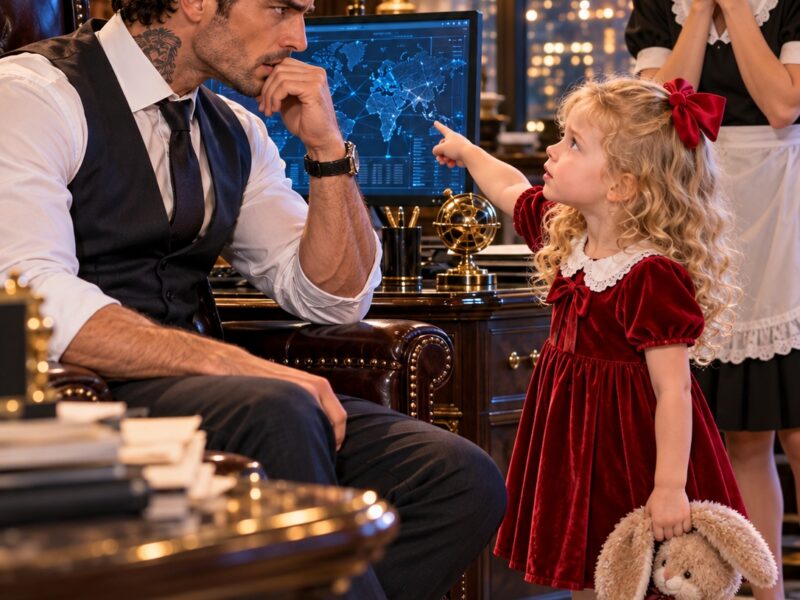
“My Mommy Can Unlock That Code!” the Maid’s Little Girl Told the Mafia Boss — Everyone Froze!
“My mommy can unlock that code, mister.”
The little girl’s voice was barely louder than a whisper, but it stopped every conversation inside Dante Moretti’s private study.
Four of the world’s most expensive cybersecurity specialists turned toward the doorway. Two armed bodyguards exchanged startled looks. Marco Bellini, the man who had stood beside Dante for sixteen years, slowly lowered the phone he had been holding against his ear.
And Dante Moretti himself, a man whose name could empty a restaurant with a single phone call, stopped breathing for one extraordinary second.
Standing beneath the enormous carved doorway was five-year-old Sophie Carter.
She wore a faded yellow nightgown decorated with tiny white flowers. Her bare feet rested on the cold marble, and beneath one arm she carried a handmade cloth doll with a missing button eye. Her light brown hair was tangled from sleep, and she looked entirely unaware that she had just interrupted a meeting involving twenty million dollars, a mysterious encrypted device, and men who had built their lives around keeping dangerous secrets.
Dante set down his whiskey glass.
“What did you say, sweetheart?”
Sophie hugged her doll more tightly.
“My mommy knows how to open that black thing. She used to make computers do stuff like that all the time.”
Nobody laughed.
On the enormous mahogany desk stood a matte-black cube, approximately the size of a lunchbox. A small red indicator blinked on its surface at regular intervals. The device had arrived at the Moretti estate that morning, delivered by an enemy who had apparently decided that humiliation was more valuable than money.
Four specialists had spent nearly eleven hours attempting to access its contents.
They had failed.
Dante had paid nearly two hundred thousand dollars to bring them from New York, California, Switzerland, and Israel. They had arrived with specialized equipment, impressive credentials, and the comfortable confidence of people accustomed to solving problems nobody else could solve.
Now a five-year-old girl was suggesting that the woman who cleaned Dante’s bathrooms could accomplish what they could not.
Marco recovered first.
“She’s a child, Dante. She doesn’t understand what she’s saying.”
But Dante wasn’t looking at Marco.
His attention had shifted to the hallway beyond the little girl.
There, crouched beside the baseboard with a damp cleaning cloth in one hand, was Anna Carter.
The housemaid.
Thirty-four years old. Quiet. Respectful. Almost painfully careful about remaining unnoticed.
She had worked at the Moretti estate for six months, cleaning bedrooms, polishing floors, carrying laundry, and occasionally serving coffee when important guests visited.
Until that moment, Dante could not remember having heard her raise her voice.
Now she was standing perfectly still.
Her expression was controlled, but the cleaning cloth had twisted so tightly between her fingers that water dripped onto the marble.
“Sophie,” she said softly. “Come here, baby.”
The little girl glanced back.
“But Mommy, he’s sad. You always say we should help people when they’re sad.”
Anna’s face lost its color.
Dante noticed.
He noticed everything.
“Mrs. Carter,” he said.
She looked at him.
“Yes, Mr. Moretti?”
“Come inside.”
Marco immediately stepped forward.
“Dante, this is ridiculous. We have actual professionals working on this. Are we seriously going to entertain—”
“Marco.”
One word.
Nothing more.
But Marco fell silent.
Anna slowly approached the desk, one hand resting on Sophie’s shoulder.
Dante watched the woman’s eyes.
For six months, he had thought they were an ordinary shade of blue.
He realized now that they were gray. Pale gray, almost silver, with a coldness that did not belong to someone who was merely frightened of losing her job.
He pointed toward the black cube.
“Your daughter seems convinced you know something about this.”
Anna swallowed.
“Children misunderstand things, sir.”
“Sometimes.”
“She used to see me working on computers before my husband died.”
Dante studied her.
“What did your husband do?”
There was a pause.
“He was an engineer.”
“What kind?”
“Software.”
“Where?”
Anna said nothing.
The silence stretched.
Behind Dante, the Swiss specialist shifted in his chair. The Israeli specialist, a woman named Dr. Miriam Levy, leaned forward slightly.
Dante moved the cube toward Anna.
“Look at it.”
Anna did not reach for the device.
“Mr. Moretti, I don’t think that’s appropriate.”
“I’m asking you to look.”
Slowly, she lowered her eyes.
The red indicator blinked.
Once.
Twice.
Anna’s breathing changed.
It was such a small thing that nobody else noticed, but Dante had spent most of his adult life studying the difference between fear and recognition.
This was recognition.
Anna leaned closer.
Her fingertips moved along the upper edge of the cube, stopping near a nearly invisible groove.
Then she withdrew her hand as though the surface had burned her.
“Where did you get this?” she asked.
Marco’s head snapped toward her.
“That is none of your business.”
Anna ignored him.
For the first time since entering the room, her eyes remained fixed on Dante rather than the floor.
“Where did it come from?”
Dante felt something unfamiliar move through him.
Interest.
Real interest.
“Someone sent it to me.”
“Who?”
“An enemy.”
Anna closed her eyes briefly.
When she opened them again, her expression had changed.
“Mr. Moretti,” she said quietly, “I don’t know who manufactured this particular device.”
Dante waited.
“But I know the encryption architecture.”
Miriam Levy stood.
“What architecture?”
Anna looked directly at her.
“Nightingale.”
The room became so quiet that Dante could hear the grandfather clock ticking behind the bookshelf.
The Swiss specialist whispered something in German.
Miriam stared at Anna.
“That system isn’t commercially documented.”
“No,” Anna replied. “It isn’t.”
“Then how could you possibly recognize it?”
Anna rested her fingertips against the black cube one final time.
“Because my husband and I designed it.”
For several seconds, nobody moved.
Then Marco laughed.
It was a short, humorless sound.
“That’s impossible.”
Anna turned toward him.
And for the first time, Dante noticed something extraordinary.
The housemaid was no longer looking at Marco like an employee looking at her employer’s closest associate.
She was looking at him as though she had been waiting a very long time for this particular conversation.
“Not impossible,” she said.
“Unlikely,” Marco snapped.
Anna’s expression remained unchanged.
“Those are different things.”
Dante almost smiled.
He didn’t.
Instead, he reached for the telephone on his desk.
“Luca.”
His security chief answered immediately.
“Yes, boss?”
“Bring me an isolated computer, a clean monitor, and a mechanical keyboard.”
Anna looked toward him sharply.
“And disconnect the room from the house network,” she added.
Dante raised an eyebrow.
“Anything else?”
“Yes.”
“What?”
She glanced at Sophie.
“My daughter needs to go back to bed.”
Dante looked at the child, who had been following the exchange with the serious concentration of someone trying to understand why adults insisted on making simple things complicated.
He crouched until their faces were level.
“What’s your doll’s name?”
“Penny.”
“What happened to Penny’s eye?”
Sophie looked down at the doll.
“She lost it when we moved. Mommy says you don’t need two eyes to see the important things.”
Something crossed Dante’s face.
Not quite pain.
Not quite memory.
He straightened.
“Your mother is a smart woman.”
Sophie smiled.
“I know.”
Anna took her daughter’s hand.
At the doorway, Sophie looked back.
“Mister?”
“Yes?”
“Don’t be mean to my mommy.”
No one breathed.
Dante watched the child disappear down the hallway.
Then he looked at Anna.
“Mrs. Carter,” he said, “you have thirty minutes to convince me that my daughter-sized visitor was telling the truth.”
Anna glanced at the black cube.
“I won’t need thirty.”
And across the room, Marco Bellini felt the first genuine flicker of fear he had experienced in years.
Twelve hours earlier, Dante Moretti had been standing in the east garden of his estate overlooking the Hudson River when Marco called.
The morning had been cool and cloudless. October sunlight filtered through the branches of old maple trees, and somewhere beyond the stone wall, traffic moved along the parkway.
Dante held an espresso in one hand and a newspaper in the other.
He hadn’t opened the newspaper.
He rarely did anymore.
At thirty-five, Dante controlled an organization his grandfather had built during an era when loyalty was measured in blood and business was conducted in back rooms. His father had expanded it into trucking, construction, warehousing, and legitimate real estate.
Dante had inherited both the businesses and the enemies.
He had spent the previous seven years trying to move more of the family operation into legal territory, but leaving an old life was more complicated than entering one.
There were contracts that couldn’t simply be canceled.
Men whose salaries depended on arrangements Dante increasingly despised.
And competitors who viewed every attempt at reform as weakness.
The phone vibrated.
Marco.
Dante answered.
“What?”
“They took the shipment.”
Dante lowered the newspaper.
“Which shipment?”
“Newark. Three trucks. Twenty million at wholesale.”
He remained silent.
Marco continued.
“The drivers are alive. Whoever intercepted them took the cargo and sent them back.”
“Who?”
“Victor Orlov.”
Dante looked toward the gardener trimming the hedges.
Victor Orlov had been a rival for nearly a decade. He was patient, organized, and cruel in the bureaucratic way of men who believed suffering was simply another operational expense.
A year earlier, Victor had approached Dante with a proposal involving foreign investors and several distribution routes.
Dante had refused.
Victor apparently hadn’t forgotten.
“What does he want?” Dante asked.
“That’s the strange part. He isn’t asking for money.”
“Then what?”
“He sent us something.”
Dante set down his espresso.
“Bring it here.”
Marco arrived forty minutes later.
He carried a steel briefcase.
Inside was the black cube wrapped in velvet.
A folded card rested beneath it.
Dante opened the card.
There were only seven words.
Some doors should never have been opened.
No signature.
No demand.
Only the device.
Marco explained that the drivers had been stopped at a warehouse transfer point by men wearing security uniforms. The attackers knew the shipment schedule, the truck identification numbers, and the warehouse access procedures.
They had avoided hurting the drivers.
That detail bothered Dante more than violence would have.
Victor wasn’t simply stealing cargo.
He was delivering a message.
Someone inside the Moretti organization had given him access.
Dante turned the cube in his hands.
No manufacturer.
No visible port.
Only the blinking red light and a faint seam almost invisible beneath the matte finish.
“What’s inside?”
“We don’t know.”
“Then find out.”
By noon, their internal technology team had exhausted its resources.
By three, Dante had arranged for outside specialists.
By eight, those specialists had exhausted their patience.
The Swiss engineer, Felix Adler, called the system extraordinarily sophisticated.
The California specialist described it as a layered cryptographic storage environment with hardware-based access controls.
Miriam Levy said very little.
The fourth expert, a New York forensic analyst named Daniel Price, finally leaned back and rubbed his eyes.
“Mr. Moretti, I need to be straightforward. Without the correct authentication material, there may be no feasible way to retrieve the contents.”
Dante studied him.
“I didn’t fly you here for a lecture on what’s impossible.”
Daniel met his gaze.
“You hired me because I wouldn’t lie to you.”
That answer earned him another hour.
But by ten that evening, the four experts had reached the same conclusion.
The device was designed to protect its contents against forced access.
And whoever had created it understood that architecture intimately.
Dante poured a glass of whiskey.
Marco paced.
Luca stood by the door.
And Anna Carter entered carrying a tray of coffee.
No one looked at her.
She arranged the cups, replaced a silver spoon that had fallen against a saucer, and quietly collected an empty tray.
The conversation continued around her.
“Could be a customized hardware enclave.”
“Maybe the authentication is external.”
“The timing sequence isn’t standard.”
“We don’t even know whether the red indicator represents a locked state.”
Anna had heard enough.
She recognized the vocabulary.
More importantly, she recognized the frustration.
Four highly trained people were trying to force a door open without understanding why it had been built.
She left the study.
In the hallway, Sophie sat on the Persian runner beside a basket of folded towels.
The girl had been allowed to stay up later than usual because Anna was finishing her shift.
“Mommy,” she whispered, “those men sound like when your old computer wouldn’t work.”
Anna stopped.
“What?”
“The one at Aunt Claire’s house. Remember? You said the bad people changed the locks.”
Anna felt her stomach tighten.
“That was different, sweetheart.”
“Did you fix it?”
“Sophie, please don’t—”
“You did fix it.”
Anna crouched.
“Listen to me, baby. We don’t talk about Mommy’s old work here. Remember?”
Sophie nodded.
But children remember instructions in the way children understand them, and Sophie understood only that the men behind the enormous door were unhappy.
A few minutes later, when Anna stepped away to retrieve cleaning supplies, Sophie wandered toward the study.
And the sentence that would change their lives slipped from her mouth with complete innocence.
“My mommy can unlock that code, mister.”
By the time Anna returned from putting Sophie to bed, Luca had assembled the equipment.
A folding table stood beside the study windows.
The laptop had been prepared without an external network connection, and the specialists had connected the device through an approved forensic interface discovered during their examination.
Anna inspected the setup.
“Has anyone altered the device’s firmware?”
Daniel Price shook his head.
“We’ve kept it noninvasive.”
“Good.”
“Why?”
“Because the outer authentication layer records changes to the system environment. An invasive modification could invalidate the recovery process.”
Felix Adler stared at her.
“How do you know that?”
Anna sat down.
“Because Ethan hated shortcuts.”
“Ethan?”
“My husband.”
She placed her fingers on the keyboard.
For a moment, they remained completely still.
The keys were black.
The monitor glowed faintly.
Her reflection appeared in the dark screen.
And suddenly she was somewhere else.
Cambridge, Massachusetts.
A cramped apartment above a secondhand bookstore.
A rainstorm tapping against the windows.
A man in a faded gray sweater laughing because their prototype had crashed for the fourth time that evening.
Try again, Annie.
Her throat tightened.
Then she began.
She did not type with the exaggerated speed of someone performing for an audience.
She worked carefully, testing the device’s exposed interface against behavior she remembered from an earlier version of Nightingale.
Several minutes passed.
Miriam moved closer.
Anna paused, studied the screen, and began again.
“That’s not the standard implementation,” Miriam murmured.
“No.”
“Whoever adapted it changed the authentication wrapper.”
“Yes.”
“Can you still recover access?”
Anna hesitated.
“I think so.”
Dante remained near the fireplace.
He had expected confidence.
He had expected a performance.
What he was watching instead reminded him of a master pianist returning to an instrument after years of silence.
There were mistakes.
Brief pauses.
Moments when Anna leaned back and frowned.
But there was also something unmistakable.
She understood the underlying design.
Twelve minutes after she began, the red indicator switched off.
A white light appeared.
Daniel Price leaned forward.
“Wait.”
Anna entered one final authorized recovery command.
A new screen opened.
Rows of metadata appeared.
File directories.
Dates.
Encrypted record identifiers.
An index of transactions and document categories.
For a long moment, no one spoke.
Then Felix Adler whispered, “Good God.”
Miriam looked at Anna.
“Who are you?”
Anna ignored the question.
“Mr. Moretti?”
Dante approached.
“Yes?”
“The outer container is accessible. The inner records are still protected.”
“How long to read them?”
“That depends on how much of the original architecture survived the modifications.”
“Hours?”
“Possibly days.”
“Can you do it?”
Anna looked at the monitor.
“Yes.”
It was the first answer she had given him without hesitation.
Dante looked toward his specialists.
“Gentlemen. Dr. Levy. Thank you for your work.”
Miriam remained standing.
“I would like to understand how she did that.”
Anna turned toward her.
For an instant, something like professional warmth appeared.
“So would I,” Anna said. “It’s been a long time since I touched the system.”
Dante paid the specialists and arranged transportation.
By midnight, the study was nearly empty.
Marco had left earlier, claiming that he needed to check security at the warehouses.
Luca remained outside.
Anna was shutting down the workstation when Dante spoke.
“Don’t.”
She turned.
“I need you to keep working.”
“I know.”
“Then come with me.”
He led her upstairs to a private library.
Unlike the magnificent study downstairs, the library was modest.
Two leather chairs.
A cold fireplace.
A narrow bookcase holding first editions that Dante’s father had collected but seldom read.
Rain had begun tapping against the windows.
Dante closed the door.
“Two questions, Mrs. Carter.”
Anna stood near the fireplace.
“I’m listening.”
“Who are you?”
“My name is Anna Carter.”
“That wasn’t what I asked.”
“No.”
“Second question. Why are you in my house?”
Anna looked at him.
For the first time in six months, she seemed to consider telling him everything.
Then she remembered Sophie.
Her daughter’s sleeping face.
Her husband’s grave.
The message that had arrived after his death.
And the name that had brought her here.
“I came because I needed work,” she said.
Dante watched her.
“That’s a carefully chosen answer.”
“It’s still an answer.”
“Not necessarily the truth.”
Anna lowered her eyes.
“You’ve given me an opportunity, Mr. Moretti. I’d prefer to continue working.”
“On the device?”
“Yes.”
“And after you finish?”
“That depends on what it contains.”
Dante walked toward the window.
Outside, security lights illuminated the wet stone driveway.
“People don’t usually come into my house with secrets of this size.”
Anna said nothing.
“Some people would consider that dangerous.”
“I know.”
“Are you afraid?”
Her answer surprised him.
“Every day.”
Dante turned.
“Of me?”
Anna took several seconds before replying.
“No.”
“Then what?”
She looked toward the door.
“Of losing the only person I have left.”
He understood immediately.
Sophie.
Dante returned to his chair.
“You’ll continue tomorrow. You and your daughter will remain in the staff wing. Luca will make sure you have anything you need.”
“Thank you.”
“But Mrs. Carter?”
“Yes?”
“I don’t like being lied to.”
Anna met his gaze.
“Neither do I.”
She left before he could answer.
Dante remained alone in the library.
The grandfather clock downstairs struck one.
He poured himself whiskey and stared at the fireless hearth.
He had heard hundreds of convincing lies in his life.
Anna Carter had just told him one of the best.
And somehow, he had the unmistakable feeling that she hadn’t enjoyed telling it.
Two years earlier, Anna Carter had been a different woman.
Not happier every day.
Not fearless.
But whole.
She lived with her husband, Ethan, and their daughter in a second-floor apartment above a bookstore in Cambridge.
The kitchen was too small for two adults to cook in comfortably. The bedroom window stuck whenever the temperature dropped below freezing. Their upstairs neighbor played classical music at strange hours.
Anna loved almost everything about it.
Especially the mornings.
Ethan would make coffee too strong, burn the toast, and insist that his approach was scientifically optimal because it produced a more complex flavor profile.
Sophie, then three, would sit at the kitchen table drawing purple elephants.
And Anna would stand at the counter arguing with her husband about encryption, grocery prices, or whose turn it was to buy laundry detergent.
They had met at MIT during a research seminar.
Ethan had interrupted her presentation to challenge an assumption in her mathematical model.
Anna had responded by correcting three errors in his question.
He bought her coffee afterward.
Two years later, he proposed during a train trip through Europe.
He had forgotten the engagement ring in a hotel safe in Vienna and made a temporary one from a folded sandwich wrapper.
Anna wore the paper ring for the rest of the journey.
She kept it afterward in a little blue box.
When Sophie was born, Ethan cried so hard that the delivery nurse handed him tissues before Anna had stopped laughing.
Their life was ordinary in the ways that mattered.
And extraordinary in the ways that eventually destroyed it.
Together, Anna and Ethan had designed Nightingale.
The idea began after a journalist they knew had been arrested overseas when confidential correspondence was exposed.
Ethan believed people doing dangerous but legitimate work needed ways to protect their sources.
Anna believed the technology should remain accessible to people who could never afford expensive security systems.
Over four years, they developed an encryption architecture for protecting sensitive information, controlling access, and detecting tampering.
Their first prototype ran on two aging laptops balanced on a dining table.
Their second version attracted attention from researchers.
Their third attracted investors.
Then came Helix Nova.
The Boston-based technology corporation offered them a licensing arrangement worth far more than either had imagined.
One hundred and twenty million dollars in potential payments, equity, research funding, and commercial rights.
Ethan was skeptical.
Anna saw possibilities.
They could create a foundation.
Fund humanitarian deployments.
Provide financial security for Sophie.
And continue the work without worrying about their rent.
They negotiated for months.
Eventually, Helix Nova agreed that the humanitarian implementation would remain independently managed while commercial enterprise applications were licensed under strict conditions.
At the signing ceremony, Helix Nova chairman Adrien Cross shook Ethan’s hand.
“This technology is going to change the world,” he said.
Ethan smiled.
“That’s the idea.”
Four months later, he stopped smiling.
At first, Anna thought he was overworked.
He missed dinner.
Forgot appointments.
Began waking at three in the morning.
One evening, she found him sitting in front of his computer with his hands folded beneath his chin.
The monitor was dark.
“Ethan?”
He didn’t answer.
She sat beside him.
“What’s happening?”
He stared at her for a long time.
Then he said something she would never forget.
“Someone’s using our work to hide people who should be found.”
Anna felt cold.
“What do you mean?”
He turned the monitor toward her.
It contained records from a commercial deployment he had been authorized to audit.
The system itself was working as designed.
That was the terrible part.
Companies were using Nightingale to secure legitimate records, but Ethan had discovered evidence suggesting that certain accounts were concealing illicit payments.
False consulting agreements.
Unexplained transfers.
Connections to shipping firms and intermediaries under investigation.
One suspicious network led to a cluster of companies linked to organized crime on the East Coast.
And buried in the administrative records was a name.
Marco B.
Boston.
“Who is he?” Anna asked.
“I don’t know yet.”
“Are you sure this isn’t some accounting mistake?”
“I wanted it to be.”
She looked at him.
“What are you going to do?”
“Tell someone who can investigate it properly.”
“Ethan—”
“We built this to protect people, Annie. Not to make it easier for someone to hurt them.”
Three days later, his car left the road outside Framingham.
It was raining.
A state trooper came to their apartment at seven fourteen the following morning.
Anna remembered the precise time because the kitchen clock had stopped the previous evening, and Ethan had said he would replace the battery when he came home.
He never did.
The official report concluded that his vehicle had lost control on a wet curve.
There were no witnesses.
The mechanical inspection found no conclusive evidence of deliberate interference.
The investigation closed.
Anna buried her husband eleven days before Sophie’s fourth birthday.
At the funeral, Sophie held a yellow balloon.
She asked why Daddy couldn’t come home.
Anna told her he had died.
Sophie asked what dying meant.
Anna tried to explain.
The little girl considered the answer carefully.
“Will he still know it’s my birthday?”
Anna broke down beside the grave.
For weeks afterward, the apartment felt impossibly large.
His coffee mug remained beside the sink.
His gray sweater hung over the bedroom chair.
The paper engagement ring still rested in its blue box.
Anna could not bring herself to throw away the expired milk in the refrigerator because Ethan had been the one who bought it.
Then she found the message.
It had been sent from Ethan’s phone forty minutes before the accident.
She had overlooked it among dozens of notifications.
Marco B. Boston. If anything happens, start there.
Anna stared at the words until her eyes burned.
She read them again.
And again.
Then she opened her laptop.
Grief did not disappear.
It simply acquired a direction.
For nearly a year, Anna followed the smallest traces.
Her work was not glamorous.
There were no darkened rooms full of glowing monitors or magical discoveries made in seconds.
There were public filings.
Corporate registrations.
Old financial disclosures.
Documents obtained through lawyers.
News archives.
Transportation records.
And months of seemingly useless information.
She lived on savings while pursuing leads that frequently went nowhere.
She moved Sophie into a smaller apartment.
Sold her car.
Stopped buying fresh flowers.
One by one, she reduced her life to essentials.
At night, when Sophie slept, Anna searched.
Eventually, she identified several connections between Helix Nova subsidiaries and shell companies associated with a man named Marco Bellini.
Marco was forty-one.
He had grown up in Brooklyn.
He had known Dante Moretti since adolescence.
He served as Dante’s chief lieutenant and oversaw significant portions of the Moretti organization’s logistics and finances.
Anna found photographs of him at charity galas, private business dinners, and construction events.
He smiled easily.
He wore expensive suits.
He appeared in several photographs with Adrien Cross.
In one image, taken eighteen months before Ethan died, Cross stood beside Marco at a fundraising dinner in Manhattan.
They were shaking hands.
Anna enlarged the photograph.
Then she looked at the date.
It matched one of the suspicious transfers Ethan had flagged.
She printed the picture.
Pinned it to the wall.
And continued searching.
Over time, a theory emerged.
Marco was not merely conducting business with Helix Nova.
He appeared to be benefiting from a secret financial network operating through companies connected to both organizations.
Anna suspected he had concealed transactions from Dante while using the Moretti operation as cover.
But the evidence was incomplete.
There were gaps she couldn’t fill.
Protected records she couldn’t access.
People who might have answers but would never speak to a grieving widow.
She spoke with an attorney who specialized in corporate misconduct.
The attorney listened carefully.
Then he gave her an answer she hated.
“You have enough here to justify questions. You don’t have enough to prove the worst of what you suspect.”
“What about Ethan?”
“His death could be connected. But suspicion isn’t proof.”
“Then how do I get proof?”
He hesitated.
“That’s where you need to be careful.”
Anna understood what he meant.
She also knew that careful people sometimes spent their entire lives waiting for answers that never arrived.
When she learned that the Moretti estate was looking for additional household staff, she applied through a Brooklyn cleaning agency.
She used her legal name.
Her employment history emphasized the housekeeping jobs she had taken since Ethan’s death.
She did not mention Nightingale.
She did not mention her research career.
During the interview, the house manager asked why a woman with her education wanted domestic work.
Anna offered the simplest truthful answer.
“I need a reliable job that lets me support my daughter.”
The house manager nodded.
They hired her.
Six months later, Anna knew the estate better than nearly anyone.
She knew when Dante ate breakfast.
Which corridors Marco preferred.
Which doors remained locked.
Where the housekeepers stored spare linens.
Which employees were kind to Sophie.
She learned that Luca, the security chief, always drank black coffee before sunrise.
That Dante never allowed flowers to be removed from a particular hallway vase.
That the gardener had worked for the Moretti family longer than Dante had been alive.
And she learned that Marco kept a private office near the western staircase.
A room he sometimes entered alone.
A room nobody cleaned without his permission.
Anna never tried to force the door.
She had come looking for answers.
But she had promised herself that she would not risk Sophie for a theory.
Then the black cube arrived.
And Sophie’s innocent sentence destroyed six months of careful invisibility.
On the morning after Anna opened the device, Dante found Sophie sitting at the breakfast table.
It was an unexpected sight.
His breakfast room normally contained one person.
Him.
He preferred it that way.
A single place setting.
Black coffee.
Soft-boiled eggs.
A folded newspaper.
Silence.
But that morning Sophie was sitting in a chair three sizes too large for her, attempting to spread strawberry jam onto a slice of toast.
The jam had reached her fingers, the tablecloth, and one sleeve of her sweater.
Dante stopped in the doorway.
Sophie looked up.
“Good morning, mister.”
He glanced toward the kitchen.
“Where’s your mother?”
“Working.”
“And who brought you here?”
“Mrs. Rosa.”
Rosa was the senior housekeeper.
Dante made a mental note to ask why she had left the child unattended in his breakfast room.
Then Sophie held up the toast.
“Do you want some?”
He looked at the jam.
“No, thank you.”
“It’s good.”
“I believe you.”
She considered him seriously.
“Why don’t you ever smile?”
Dante pulled out his chair.
“Who says I don’t?”
“Your face.”
For the first time in years, he nearly laughed over breakfast.
“My face?”
She nodded.
“It always looks like it’s thinking about taxes.”
Dante stared at her.
Then a small laugh escaped.
It surprised him so much that he covered it by reaching for his coffee.
Sophie grinned.
“There. You did it.”
“Did what?”
“Smiled.”
He unfolded his newspaper.
“I suppose I did.”
She climbed down from her chair and approached him.
Before he could anticipate what she intended, she scrambled onto his lap.
Dante froze.
Sophie settled comfortably against his chest, placed Penny on the table, and looked at his newspaper.
“Why are there so many words?”
“Because people have too much to say.”
“My mommy reads a lot of words.”
“I’ve noticed.”
“She used to read me computer words.”
“Did she?”
“Sometimes Daddy did too.”
Dante went still.
Sophie played with the doll’s remaining button eye.
“My daddy was funny.”
“What made him funny?”
“He put peas in his ears.”
Dante looked down.
“Peas?”
“Just pretending. When Mommy said he wasn’t listening, he’d put peas by his ears and say he couldn’t hear because vegetables were growing there.”
Against his will, Dante smiled again.
“My daddy was silly,” Sophie whispered.
The change in her voice was subtle.
Dante recognized it.
He had heard adults speak with that same quiet ache.
“Do you miss him?”
Sophie nodded.
“Every day.”
Dante looked toward the garden.
When he was eight, his younger sister Elena had died after a sudden illness.
He remembered the hospital.
The harsh fluorescent lights.
His father’s trembling hands.
Elena’s small fingers wrapped around his.
She had been six.
She had asked whether she would be able to see the stars from her hospital window.
Dante had promised to show her when she got better.
He never had the chance.
For years afterward, he refused to speak about her.
His father considered grief a private weakness.
His grandfather believed tears were something a man swallowed.
Dante had spent decades swallowing things.
Sophie looked up.
“Do you miss somebody too?”
He didn’t answer immediately.
“Yes.”
“Who?”
“My sister.”
“Where is she?”
“She died when we were little.”
Sophie nodded with the serious understanding of a child who had learned too much about death.
“Maybe my daddy knows her.”
Dante felt an unexpected pressure behind his eyes.
“Maybe,” he whispered.
Just then Anna appeared in the doorway.
She stopped so abruptly that her shoes squeaked against the polished floor.
“Sophie!”
The little girl looked up.
“Mommy!”
“Come here, please.”
Anna’s expression was strained.
Dante understood why.
A man with his reputation did not usually have five-year-old children climbing into his lap uninvited.
“It’s all right,” he said.
Anna remained standing.
“I’m sorry, Mr. Moretti.”
“She was telling me about her father.”
Something flickered in Anna’s eyes.
Dante gently lifted Sophie onto her feet.
“Your mother needs you.”
Sophie collected Penny.
Then she leaned closer and whispered loudly enough for everyone to hear.
“You should smile more. You’re prettier when you do.”
Dante stared at her.
Anna covered her face with one hand.
But this time, Dante laughed.
An actual laugh.
Warm.
Unrestrained.
It echoed through the breakfast room.
And from the hallway, unseen by the others, Marco Bellini watched.
His expression darkened.
He had known Dante for sixteen years.
He had seen him furious.
Cold.
Calculating.
Amused by other men’s mistakes.
But he had never seen him like this.
Smiling at the daughter of a housemaid.
Looking at her as though she mattered.
Marco turned away.
Something had changed inside the estate.
And he needed to know exactly what.
Anna spent the next three days working on the cube.
The device contained hundreds of protected records.
Some were related to shipping.
Others involved financial transactions, corporate communications, and internal administrative documents.
The modifications to Nightingale had been sophisticated, but the underlying design carried familiar patterns.
Anna recognized mathematical structures she had developed with Ethan.
She remembered arguments they had had over implementation choices.
She remembered bugs they had fixed at three in the morning.
Sometimes a familiar component brought such a vivid memory that she had to leave the room.
Once, she walked into the staff bathroom and cried silently for five minutes.
Then she washed her face and returned to work.
Dante watched without commenting.
He had begun to understand that Anna’s relationship with the device was not simply technical.
It was personal.
On the third afternoon, she found something that made her stop breathing.
A financial ledger.
The file contained transactions through companies connected to Helix Nova, Moretti-associated warehouses, and intermediaries overseas.
Some transactions appeared to reflect business Dante had authorized.
Others did not.
Large sums had been redirected.
Payments had been disguised.
Several internal approval references appeared inconsistent with the supporting records.
And one beneficiary appeared repeatedly.
An entity Anna had already traced to Marco Bellini.
Her hand moved to her mouth.
Not because she was surprised.
Because after two years, she was finally looking at something more solid than suspicion.
She began comparing the ledger against the records Ethan had recovered before his death.
The dates matched.
The companies matched.
And buried inside an archived correspondence folder was a message that made her hands shake.
A note from Adrien Cross to Marco.
Your Cambridge problem is becoming difficult. Handle it before he takes the next step.
The message had been sent four days before Ethan died.
Anna stared at it.
Then she read the reply.
Understood. I’ll make sure the situation doesn’t reach the authorities.
Her stomach tightened.
It was not a direct confession.
But it was more than anything she had possessed before.
She copied the relevant records into a separate protected workspace and documented their source paths.
She knew she would eventually need independent forensic verification.
She also knew she needed to survive long enough to request it.
That evening, Dante entered the study.
“How far?”
“Further than yesterday.”
He looked at her.
“That wasn’t my question.”
Anna gestured toward the screen.
“I found evidence suggesting your shipment was intercepted with help from inside your organization.”
Dante stood still.
“Who?”
“I’m not ready to name anyone.”
His expression hardened.
“Mrs. Carter—”
“If I accuse someone without the complete records, you may act before the evidence can be preserved.”
Dante looked away.
She was right about him.
He disliked being reminded of it.
“What else?”
“Victor Orlov had access to information he shouldn’t have possessed. Shipment schedules. Internal approval references. Certain warehouse records.”
“Someone gave them to him.”
“Yes.”
“For money?”
“Possibly. But I think the missing shipment is part of something larger.”
Dante watched her carefully.
“What aren’t you telling me?”
Anna felt the question settle between them.
He was perceptive.
Much more than she had expected.
“The full picture isn’t clear yet.”
“That isn’t an answer.”
“It’s the best answer I can give you tonight.”
Dante looked at the files.
Then at her.
“Be careful, Anna.”
It was the first time he used her first name casually.
She looked up.
“Why?”
“Because whoever put those records in that box may already know you’re reading them.”
Marco Bellini received the photograph at four seventeen the following afternoon.
His private investigator had been checking Anna Carter’s background since the breakfast-room incident.
The official records were consistent.
Employment.
Addresses.
A deceased husband.
A child.
Nothing unusual on the surface.
But Marco had seen the woman working at the computer.
And something about her concentration bothered him.
He sent a photograph to a contact inside Helix Nova.
Less than an hour later, his private telephone rang.
“Where did you find her?”
The voice belonged to Adrien Cross.
Marco leaned back in his office chair.
“Who’s asking?”
“Don’t play games.”
Marco sat upright.
“Adrien?”
“Where is that woman?”
“In Dante’s house.”
A long silence followed.
Then Cross spoke again.
“Is she alone?”
“She has a daughter.”
“How old?”
“Five.”
Cross muttered something under his breath.
Marco waited.
Finally, Cross said, “Her name is Anna Carter.”
Marco stared at the photograph.
“Yes.”
“She was married to Ethan Carter.”
Something cold settled into Marco’s stomach.
He remembered Ethan.
Of course he remembered.
A brilliant researcher who had discovered information he was never supposed to see.
A man who had threatened to expose a financial arrangement worth millions.
A man who had died on a wet road after refusing to remain silent.
Marco had believed Anna disappeared after the funeral.
Apparently, he had been wrong.
“What is she doing there?” Cross demanded.
“Cleaning.”
“Don’t insult me.”
“She was cleaning until three days ago. Then Dante received an encrypted drive.”
Cross went silent.
Marco continued.
“The woman recognized the software. She’s been working on it.”
“How much has she seen?”
“I don’t know.”
“Then find out.”
Cross hung up.
Marco sat alone in his office.
For the first time, he understood the magnitude of the problem.
Anna had not accidentally entered Dante’s household.
She had come looking for him.
And now she was sitting less than fifty feet from his office, examining records that could destroy everything he had built.
He opened his desk drawer.
Inside was a second phone.
One he used only for conversations that should never appear on company records.
He made a call.
“We have a problem,” he said.
At seven that evening, Marco entered the study while Anna was upstairs putting Sophie to bed.
Luca stood outside the door.
“Dante asked me to check the shipment records,” Marco said.
Luca hesitated.
He had received no such instruction.
But Marco had been part of the household’s inner circle for sixteen years.
Luca stepped aside.
Marco approached the workstation.
The screen was locked.
He knew enough to understand he couldn’t simply open the protected files.
But he had access to an administrative support account used for estate equipment maintenance.
He attempted to interfere with the local working copies visible through that account.
Several files disappeared from the ordinary workspace.
Marco felt a brief rush of satisfaction.
It was not complete.
But it might buy time.
He closed the machine and left.
Eleven minutes later, Anna returned.
She sat down.
Opened the directory.
And immediately noticed the missing files.
Forty-one records.
Gone.
She remained motionless.
Then she checked her separately maintained forensic records.
The original evidence on the protected device remained untouched.
Her independent notes were intact.
The missing working files confirmed something important.
Someone inside the house was trying to interfere.
Anna looked toward the doorway.
Luca stood beyond it.
She understood that several people might have had an opportunity.
But she knew which one had the strongest motive.
She went upstairs.
Dante was reading in the library.
Or pretending to.
He looked up when she entered.
“Anna?”
“Someone interfered with my work.”
His face changed.
“Destroyed anything?”
“Not the original records.”
“Do you know who?”
“I have a strong suspicion.”
“Name.”
She shook her head.
“I need proof that will survive outside this house.”
Dante closed the book.
“You think I would kill someone based on a suspicion?”
Anna looked at him.
“I think you might confront them before you’re certain. And I think the wrong person could destroy the rest of the evidence.”
The answer angered him because he knew it was reasonable.
“How long?”
“Two more days.”
He stared at her.
Then nodded.
“Two days.”
She moved toward the door.
“Anna.”
She stopped.
“When you came here, you weren’t looking for a housekeeping job.”
“No.”
Dante stood.
“Were you looking for someone?”
Anna looked at him.
“Yes.”
“Someone in this house?”
Her silence was answer enough.
“Then when this is over,” Dante said, “you will tell me everything.”
Anna nodded.
“I will.”
The following morning, Sophie woke Anna by placing Penny against her cheek.
“Mommy.”
Anna opened one eye.
“What is it, sweetheart?”
“Penny says you’re tired.”
“Penny is very observant.”
“She says you need pancakes.”
Anna smiled.
“Does she?”
“With blueberries.”
“That’s suspiciously specific.”
Sophie giggled.
For a few beautiful seconds, Anna was simply a mother lying beside her daughter in a narrow bed.
There was no ledger.
No Marco.
No dead husband.
No hidden danger.
Only Sophie’s warm hand against her face.
Then the alarm sounded.
Anna rose.
Helped Sophie dress.
Brushed her hair into a neat braid.
Prepared her school lunch.
On Mondays, Wednesdays, and Fridays, Sophie attended a small private kindergarten in Brooklyn.
The arrangement was part of Anna’s employment benefits. Dante’s house manager had helped her secure a place and organized transportation with the household driver.
Anna had initially refused.
She did not like depending on the Moretti organization.
But Sophie needed school.
Friends.
Normality.
And the little girl loved her teacher.
That Wednesday morning, Sophie wore a yellow raincoat over her uniform.
She carried Penny in one hand and a lunchbox in the other.
Anna knelt beside the car.
“What do we do when we feel scared?”
Sophie answered automatically.
“Find a safe grown-up.”
“And?”
“Tell them what’s wrong.”
“And what do we never do?”
“Go anywhere with people Mommy doesn’t know.”
Anna kissed her forehead.
“That’s my girl.”
Sophie touched her cheek.
“Are you coming to get me today?”
“Enzo will bring you home. I’ll be waiting right here.”
“Promise?”
“Promise.”
The car pulled away.
Sophie pressed Penny against the window and made the doll wave.
Anna watched until the vehicle disappeared beyond the gates.
Then she returned to the study.
By early afternoon, she had recovered additional correspondence connected to the suspicious accounts.
At three fifteen, she found a record that made her grip the edge of the desk.
An internal discussion concerning Ethan.
Cross had asked whether the “researcher problem” was contained.
Marco had responded with a confirmation.
A third message referenced a contractor who had been paid through an intermediary shortly after Ethan’s death.
Anna stared at the screen.
She had spent two years wondering whether she was losing herself inside grief.
Whether the connections were real.
Whether she had sacrificed Sophie’s stability chasing a terrible coincidence.
Now she understood.
Her husband had been right.
He had found something dangerous.
And powerful people had wanted him silent.
Anna covered her mouth.
A sound escaped her.
Not quite a sob.
Not quite a scream.
She lowered her head.
For a long moment, she could smell Ethan’s coffee again.
Hear the upstairs neighbor’s music.
See his gray sweater draped over the chair.
Then she whispered, “I found it, Ethan.”
She looked at the clock.
Three thirty-seven.
Sophie would be home in less than an hour.
Anna saved her notes.
Closed the evidence viewer.
And began reviewing the next document.
At four thirty-five, she checked the window.
No car.
At four forty-five, she checked again.
At four fifty-five, she called the dispatcher.
“Has Enzo left the school?”
“Yes, ma’am. He confirmed pickup at three fifty-two.”
“Then where is he?”
The dispatcher hesitated.
“I’ll check.”
At five oh-seven, Anna called again.
This time nobody answered.
Her chest tightened.
She walked to the garage.
The car was not there.
She called Sophie’s teacher.
The teacher confirmed that Enzo had collected Sophie at the usual time.
Anna stared at the phone.
Something inside her went cold.
She turned.
Walked through the kitchen.
Passed two housekeepers.
Climbed the staircase.
And stopped outside Dante’s study.
Luca took one look at her.
“What’s wrong?”
“My daughter hasn’t come home.”
Luca straightened.
“How long?”
“Thirty-two minutes overdue. Enzo isn’t answering.”
He reached for his radio.
“I’ll get Dante.”
Dante appeared less than two minutes later.
He looked at Anna’s face.
“Where?”
“Brooklyn. School pickup.”
“How long since she was seen?”
“An hour and fifteen minutes.”
Dante turned to Luca.
“Contact Enzo’s family. Check traffic incidents and the route. Find out where that car is.”
Luca moved immediately.
Dante guided Anna into the study.
“Sit down.”
“I can’t.”
“Then stand.”
Her phone vibrated.
Unknown number.
One video attachment.
Anna opened it.
The video lasted eleven seconds.
Sophie sat in a dim room beneath a single hanging light. She was still wearing her school clothes. Penny lay beside her chair.
Her face was wet with tears.
“Mommy,” she whispered.
Then the screen went black.
Anna’s knees nearly gave way.
A message followed.
Bring the complete Nightingale archive and all recovered records. No copies. No authorities. Instructions to follow. Your daughter comes home when we’re satisfied.
Dante read it over her shoulder.
His expression became frighteningly still.
Anna turned toward him.
For a moment, words refused to come.
Then the truth emerged.
“My husband was Ethan Carter.”
Dante frowned.
“The engineer?”
“He was a cryptographer. We built Nightingale together.”
She swallowed.
“Two years ago, he discovered that Helix Nova was using the commercial system to hide criminal transactions.”
Dante said nothing.
“He was going to report what he’d found. Then he died in a car crash.”
Anna’s breathing became uneven.
“The last message he sent me named Marco Bellini.”
Dante’s face changed.
Not dramatically.
But enough.
“Marco?”
Anna nodded.
“I spent a year tracing him. I found connections to Adrien Cross. Financial transfers. Shell companies. I couldn’t prove everything. So I came here.”
Dante stared at her.
“You took a job in my house to investigate Marco?”
“Yes.”
“For six months?”
“Yes.”
“And the device?”
“It contains records that connect them. There are messages about Ethan. There are payments made after his death.”
Dante looked toward the study door.
Then back at her.
“Why didn’t you tell me?”
Anna laughed once.
A broken, exhausted sound.
“Would you have believed me? A housemaid accusing your closest friend of helping murder her husband?”
Dante did not answer.
“Marco has been beside you for sixteen years. I had nothing but documents and a dead man’s message.”
She lowered herself into a chair.
“And now they’ve taken Sophie.”
Her voice finally broke.
“I brought her here because I thought I could keep her safe. I thought if I stayed quiet and found enough evidence, we’d be able to leave.”
Tears slipped down her face.
“She’s five years old.”
Dante stood motionless.
“She’s five,” Anna repeated. “And she thinks I can fix everything.”
He walked around the desk.
Crouched beside her chair.
“Anna.”
She couldn’t look at him.
“Look at me.”
Slowly, she raised her eyes.
“We’re going to find her.”
“You don’t know that.”
“No.”
His answer surprised her.
“I don’t know where she is yet. I don’t know how many people are involved. But I know we have resources, and I know we can act.”
Anna wiped her face.
“What if we’re too late?”
Dante held her gaze.
“Then every minute matters.”
He stood.
Reached for his phone.
And made the first call.
Not to Marco.
Not to another criminal associate.
To Luca.
“Find Enzo. Check the car’s last known location. And get me someone who can contact the FBI’s child abduction team.”
Anna stared at him.
Dante met her eyes.
“We’re doing this properly.”
She whispered, “What about Marco?”
His jaw tightened.
“We’re going to find out exactly what he’s done.”
Marco arrived at the estate shortly before six.
He entered the study looking appropriately alarmed.
“Dante, Luca told me. Has anyone heard from the driver?”
“No.”
“Has there been a demand?”
Dante hesitated just long enough to look distraught.
“Yes.”
“What do they want?”
“Records. Something from that device.”
Marco looked toward Anna.
She stood near the window holding Sophie’s yellow raincoat.
Her eyes were swollen.
Her face was pale.
Marco approached carefully.
“Mrs. Carter, I’m so sorry.”
Anna looked at him.
She had imagined confronting this man hundreds of times.
In some versions, she screamed.
In others, she handed him a folder of evidence and watched his smile disappear.
Sometimes she imagined Ethan standing beside her.
But nothing had prepared her to meet Marco Bellini while her daughter was missing.
“Please,” she whispered. “Find my little girl.”
Marco placed a hand over his heart.
“I’ll do everything I can.”
He turned toward Dante.
“We have contacts who can negotiate discreetly. Whoever took her may panic if law enforcement gets involved.”
Dante watched him.
“Then what do you suggest?”
“Let me reach out. Quietly. I’ll find out who has her.”
Anna tightened her grip on the coat.
Marco looked at it.
“Is that Sophie’s?”
Anna nodded.
“She left her other coat at school last week. I brought this one because I thought—”
Her voice failed.
Marco gently took the coat.
“I’ll show it to our people. Someone might recognize it.”
He pressed it against his chest.
“She’s coming home, Mrs. Carter. I promise.”
Anna stared at him.
And understood with terrible clarity that some people could lie without feeling the weight of the words.
Marco left.
Dante waited until the sound of his car faded.
Then he turned to Anna.
“He’s involved.”
“You believe me?”
“I believe he’s trying to steer me away from the authorities. And he’s far too interested in the device.”
Anna looked toward the door.
“Where will he go?”
“We’re working on that.”
Luca entered.
He had already shared the available information with a federal contact.
The missing child alert was being coordinated through the appropriate agencies, and investigators were reviewing traffic cameras and the vehicle’s last known route.
Enzo’s car had been found abandoned near an industrial section of Brooklyn.
The driver had been taken to a hospital.
He was alive.
Conscious.
And had reported being forced to stop by someone who appeared to be a traffic officer.
Luca looked at Dante.
“Enzo says the men knew Sophie’s name.”
Anna pressed a hand to her mouth.
Dante’s expression darkened.
“What else?”
“One of them told him the child was coming with them because her mother had taken something that didn’t belong to her.”
Anna felt the room tilt.
Her work.
Her hidden search.
Everything had caught up with her.
Then Luca’s telephone rang.
He listened.
His eyes narrowed.
When he ended the call, he looked toward Dante.
“Marco’s vehicle has been seen heading toward the waterfront.”
Dante turned.
“Where?”
“Northern Avenue. Near the old warehouses.”
Anna remembered a document.
One of the corporate property records inside the Nightingale archive.
A warehouse near Pier 7.
An address associated with a Helix Nova holding company.
She hurried to the computer.
Opened the relevant property file.
And pointed.
“There.”
Dante approached.
“Are you certain?”
“It’s connected to Cross.”
Luca studied the information.
“We’ll pass this to the investigators.”
Dante took a slow breath.
For years, he had solved threats with the resources and methods his family understood.
Men.
Money.
Fear.
But looking at Anna, he realized the stakes were different.
This wasn’t a dispute over territory.
This wasn’t a rival trying to embarrass him.
There was a little girl missing.
A little girl who had climbed into his lap and asked why he never smiled.
He turned to Luca.
“Call our federal contact again. Tell them about the warehouse.”
Anna stepped forward.
“I’m going there.”
“No.”
“My daughter could be inside.”
“Anna—”
“Don’t.”
The word stopped him.
Her eyes were wet, but her voice was firm.
“I know you think you’re protecting me. But that’s my child.”
Dante looked at her.
“You can’t just walk into a place where people may be holding her.”
“Then tell me what I can do.”
He considered.
Then reached for his phone.
“Stay here and help identify the evidence they may be after. Give investigators everything you know about the building.”
Anna stared at him.
“You’re asking me to stay behind?”
“I’m asking you to help bring Sophie home without giving the men who took her another person to use against us.”
For a long moment, she looked ready to argue.
Then she remembered the video.
Sophie’s face.
Her trembling voice.
She nodded once.
“Tell me what you need.”
At the warehouse, Marco Bellini climbed a steel staircase to the second floor.
The building smelled of damp cardboard and old machinery.
Several men stood near the windows.
Adrien Cross waited beside an office door.
He wore an expensive charcoal coat that looked absurdly out of place in the industrial building.
Marco approached.
“Where’s the girl?”
Cross nodded toward a smaller adjoining office.
“Inside.”
Marco glanced through the glass.
Sophie sat on a sofa.
A paper cup of water rested on the table beside her.
Penny lay in her lap.
She looked frightened and exhausted.
Marco turned away.
“Dante knows she’s missing.”
“Obviously.”
“He’s looking for the driver.”
“Then your people should have done a better job.”
Marco’s jaw tightened.
Cross approached.
“Did Anna finish the archive?”
“I don’t know.”
“You’re supposed to know.”
“She found something. Maybe enough.”
Cross stared at him.
“And Dante?”
“He suspects an insider.”
“Does he suspect you?”
Marco said nothing.
Cross exhaled slowly.
“Wonderful.”
He walked toward the window.
The harbor lights shimmered through the dirty glass.
For years, Cross had believed money could solve anything.
Regulators could be distracted.
Executives could be replaced.
Auditors could be misled.
Problems could be buried beneath enough corporate paperwork.
Then Ethan Carter had found the records.
And now Ethan’s widow had appeared inside the home of one of the most dangerous men on the East Coast.
Cross had begun to lose control.
“Anna will give us the archive,” Marco insisted.
“Will she?”
“She wants her daughter.”
Cross turned.
“And what happens after she gets her daughter? She walks away with everything she’s seen?”
“We can negotiate.”
Cross laughed bitterly.
“You still think this is a negotiation.”
Marco looked through the office window again.
Sophie was holding Penny close to her chest.
Something about the sight bothered him.
Not enough to change his course.
But enough that he avoided looking a second time.
Cross lowered his voice.
“We need to leave. Tonight. Before Moretti figures out where we are.”
Marco checked his phone.
A new message appeared.
From Dante.
Any update?
Marco typed a response.
Working on it.
He sent it.
Then noticed headlights moving along the road beyond the warehouse.
Two vehicles.
Slow.
Unmarked.
His stomach tightened.
“Adrien.”
Cross turned.
“What?”
“I think we have company.”
At the Moretti estate, Anna sat beside the computer as investigators coordinated the response.
She had provided the building address, the property ownership records, and the relevant communications from the archive.
A federal agent had spoken with her by telephone.
Another investigator was on the way to take a full statement.
None of it felt fast enough.
She stared at Sophie’s photograph on her phone.
The little girl was standing in front of a pumpkin display at a farm outside Cambridge.
It had been taken the previous autumn.
Sophie was missing one front tooth.
She was grinning.
Ethan’s old gray scarf was wrapped around her neck.
Anna pressed the photograph against her chest.
“I promised,” she whispered.
She had promised to be waiting when Sophie returned from school.
Promised that nothing bad would happen.
Promised that the frightening parts of life were behind them.
Now she understood the danger of promises adults made because children needed to hear them.
Her phone rang.
Unknown number.
Anna answered before the second vibration.
“Hello?”
Silence.
Then a small voice.
“Mommy?”
Anna stood so quickly that her chair tipped backward.
“Sophie?”
“Mommy, I want to come home.”
Anna’s legs trembled.
“Baby, where are you?”
“I don’t know.”
“Are you hurt?”
“No.”
“Is Penny with you?”
“Yes.”
Anna closed her eyes.
“Good. That’s good, sweetheart.”
A man’s voice sounded in the background.
“Enough.”
Anna’s heart stopped.
“Wait,” she said quickly. “Please let me talk to her.”
The voice returned.
“Bring the archive.”
Anna recognized him.
Adrien Cross.
She had heard his voice at meetings.
On conference calls.
At the contract signing.
“Mr. Cross,” she said.
Silence.
Then a faint laugh.
“Hello, Anna.”
Her hands went cold.
“You know what I have.”
“I know you’ve been looking where you shouldn’t.”
“My husband found your accounts.”
“Your husband misunderstood things.”
“He died because he understood them.”
Cross said nothing.
Anna looked toward Luca, who was alerting the investigators that she was on a live call.
“Let Sophie go,” she said. “She’s five.”
“Then do what you’re told.”
“You already have a problem with the authorities. Hurting her won’t make the records disappear.”
Cross’s voice sharpened.
“Don’t lecture me.”
Anna swallowed.
“Ethan trusted your company.”
“That was his mistake.”
The sentence hit her like a physical blow.
For two years, she had imagined hearing the truth spoken aloud.
Now it came without remorse.
Cross continued.
“You have one hour.”
The call ended.
Anna stared at the phone.
Luca stepped beside her.
“Was that him?”
She nodded.
“Cross.”
The agent on the other line asked her to recount the conversation.
Anna did.
Every word.
Every pause.
And when she reached the sentence about Ethan’s mistake, her voice broke.
Because the man had finally confirmed what she had feared.
Ethan had not simply died after discovering wrongdoing.
He had trusted people who viewed him as an inconvenience.
The warehouse operation began shortly afterward.
Federal investigators and local officers had established that the building was connected to the missing child investigation.
Vehicles approached discreetly.
The immediate priority was to locate Sophie and remove her safely.
Inside, Marco realized something was wrong when his telephone stopped connecting to Dante.
He approached Cross.
“We need to go.”
Cross glanced toward the office.
“What about the girl?”
“We take her.”
“And the records?”
“Forget the records.”
Cross stared.
“You’re suggesting we walk away from the only leverage we have?”
Marco looked toward the window again.
“I’m suggesting we don’t end up in prison.”
Cross opened his mouth.
Before he could answer, a loud voice came from outside.
“Federal agents! Everyone remain inside and keep your hands visible!”
The room froze.
One of Cross’s employees moved toward the rear exit.
Marco grabbed his arm.
“Don’t.”
The man shook him off.
A second announcement echoed through the warehouse.
Cross’s face drained.
He looked toward Marco.
“You led them here.”
Marco stared at him.
“What?”
“You brought them!”
“You’re out of your mind.”
Cross reached for his phone.
No signal.
The building’s occupants began arguing.
Some wanted to run.
Others wanted to surrender.
Marco moved toward the office where Sophie sat.
She looked up when he entered.
“Where’s my mommy?”
He stopped.
The simple question landed in a place he had spent years pretending didn’t exist.
“She’ll be here soon.”
Sophie clutched Penny.
“That’s what the other man said.”
Marco glanced toward the hallway.
Shouting.
Footsteps.
Cross demanding that someone open the loading doors.
For a moment, Marco saw his life with perfect clarity.
Sixteen years of loyalty twisted into resentment.
A secret arrangement that began with a small percentage.
Then larger payments.
Then forged records.
Then a researcher who would not remain silent.
He had told himself he was only arranging logistics.
That Ethan’s death was Cross’s decision.
That his own role was too small to matter.
But looking at Sophie, he knew the distinction was meaningless.
He had helped create the circumstances that brought a frightened little girl into a warehouse.
She studied his face.
“Are you going to take me home?”
Marco opened his mouth.
No answer came.
Then another voice sounded from outside the office.
“Marco Bellini. This is over.”
Luca.
Marco turned.
Through the corridor window, he could see officers moving into position.
Cross was backing away from them.
His hands had finally risen.
Marco looked at Sophie.
The child was trembling.
He slowly stepped away from the office door.
Then raised his hands.
“There’s a child in here!” he called. “She’s in the office!”
An officer entered moments later.
Sophie shrank against the sofa.
The officer crouched.
“Hi, Sophie. My name is Sarah. I’m here to take you to your mommy.”
Sophie looked at her.
“How do you know my name?”
“Your mommy told us about you.”
“Did she tell you about Penny?”
The officer smiled gently.
“She did.”
Sophie began crying.
Not loudly.
Not dramatically.
Just small, exhausted sobs that seemed to come from somewhere much older than five years.
The officer offered her hand.
Sophie took it.
And twenty minutes later, when the rescue team brought her outside, Anna Carter was waiting near an ambulance behind the secured perimeter.
The moment Sophie saw her, she ran.
“Mommy!”
Anna dropped to her knees.
Sophie collided with her so hard they nearly fell backward.
Anna wrapped both arms around her daughter.
Held her.
Kissed her hair.
Her forehead.
Her cheeks.
Her little hands.
“I’m here,” Anna whispered. “I’m here, baby.”
Sophie buried her face against her mother’s neck.
“I was scared.”
“I know.”
“I wanted you.”
“I know, sweetheart.”
“Penny was scared too.”
Anna closed her eyes.
“Then we’ll take care of Penny together.”
She held Sophie until the paramedic gently asked whether they could check her.
Anna nodded but refused to let go of her hand.
The medical evaluation found no serious injuries.
Sophie was exhausted, frightened, and dehydrated.
But she was alive.
She was coming home.
Across the street, Dante stood beside Luca.
His coat was damp from the mist.
His expression was unreadable.
Luca watched Anna holding her daughter.
“She’s safe.”
Dante nodded.
“Good.”
“Cross is in custody. Marco too.”
Dante remained silent.
After a moment, Luca asked, “You all right?”
Dante looked at Sophie.
At the tiny cloth doll clutched beneath her arm.
At the way Anna rocked her even though the child was already safe.
Then he whispered, “I haven’t been all right for a long time.”
Luca said nothing.
Dante turned away.
“But tonight,” he added, “something went right.”
Dante didn’t visit Marco Bellini immediately.
He waited until the formal investigation was underway and counsel had advised him about the legal consequences of his own involvement.
The archive implicated more than Marco.
It showed evidence of illicit financial activity involving companies connected to the Moretti organization.
Some transactions had been hidden from Dante.
Others reflected decisions he himself had approved years earlier.
He could not simply hand over the records and pretend his own history didn’t exist.
Anna made that clear during their first serious conversation after Sophie returned.
They were sitting in the private library.
Sophie slept upstairs with Rosa nearby.
Dante stood by the cold fireplace.
Anna held a mug of tea.
“The prosecutors will want everything,” she said.
“I know.”
“Not only the records about Marco.”
“I know.”
“Some of those records involve you.”
Dante nodded.
Anna studied him.
“Are you prepared for that?”
He looked toward the window.
For years, he had believed reform meant gradually replacing bad business with good business.
Paying employees properly.
Ending certain contracts.
Investing in legitimate companies.
He had convinced himself that every step forward canceled something behind him.
But the past did not work that way.
“I built a life on things I won’t defend anymore,” he said.
Anna waited.
“And I’ve spent too long believing that wanting to change was the same as changing.”
She lowered her tea.
“What will you do?”
“Tell the truth.”
“Even if it costs you?”
Dante looked at her.
“It already has.”
Anna studied his face.
Then nodded.
It was not forgiveness.
It was recognition.
A man standing at the edge of a decision he could no longer avoid.
Dante eventually cooperated through his attorney, provided records, and accepted the scrutiny that followed.
The legal process moved slowly.
There were subpoenas.
Interviews.
Conflicting accounts.
Questions about money, responsibility, and the difference between ignorance and deliberate avoidance.
Dante was not treated as a hero.
He didn’t ask to be.
Meanwhile, Marco Bellini faced charges connected to financial crimes, the abduction, and the conspiracy surrounding Ethan’s death.
Adrien Cross faced an even broader investigation.
The case attracted national attention.
A prominent technology executive.
A murdered researcher.
A compromised security platform.
Hidden financial networks.
And the extraordinary account of a widowed housekeeper whose technical expertise had helped uncover the evidence.
News outlets wanted interviews with Anna.
She declined most of them.
One reporter asked whether she considered herself brave.
Anna looked down at the question.
Then replied, “I think I was frightened for two years. Being frightened doesn’t mean you stop doing what matters.”
Another asked whether she regretted taking the job at the Moretti estate.
She paused.
“Yes,” she said.
The reporter seemed surprised.
“Even after everything you uncovered?”
Anna looked toward Sophie, who was playing with Penny in the adjoining room.
“I found answers about my husband. But my daughter paid a price for my decisions. I won’t pretend that doesn’t matter.”
She did not allow reporters to photograph Sophie.
She did not describe the warehouse in detail.
She refused requests for television appearances that would require the little girl to recount what happened.
Instead, Anna enrolled Sophie in counseling.
She attended sessions herself.
Some nights Sophie slept peacefully.
Other nights she woke crying.
She became anxious when Anna left the room.
For several weeks, she refused to wear her yellow raincoat.
Anna learned not to rush her.
They developed small routines.
A light left on in the hallway.
A promise that Anna would always say goodbye before leaving.
A calendar on the refrigerator showing where Mommy would be each day.
And a little blue card in Sophie’s school bag containing the names of trusted adults she could ask for help.
Recovery was not dramatic.
It happened gradually.
One breakfast.
One ordinary school morning.
One uninterrupted night of sleep at a time.
Six weeks after Sophie’s rescue, Anna received a letter from a university in Cambridge.
The university was establishing a research initiative in Ethan Carter’s memory.
They wanted Anna to help lead it.
The position included funding for independent security research and support for humanitarian technology projects.
Anna read the letter three times.
Then placed it on the kitchen table.
She was living in a small furnished apartment by then, separate from the Moretti estate.
Dante had helped arrange temporary accommodation during the investigation, but Anna insisted on paying her own expenses as soon as she could.
She needed Sophie to understand that they could build a life belonging entirely to them.
The new apartment was simple.
Two bedrooms.
A narrow kitchen.
Windows overlooking a maple-lined street.
There was no marble staircase.
No staff.
No security gates.
Only a landlord who sometimes forgot to clear the leaves from the steps and a neighbor who baked pumpkin bread on Sundays.
Anna loved it.
She loved being able to leave the front door without asking anyone’s permission.
She loved making dinner while Sophie colored at the kitchen table.
She loved arguing over bedtime.
She loved ordinary things with an intensity that would once have embarrassed her.
But the letter from Cambridge frightened her.
Not because the position was beyond her abilities.
Because accepting it meant returning to the world she had abandoned after Ethan died.
Research.
Public speaking.
Professional visibility.
The possibility that people would once again know who Anna Carter was.
She left the letter on the table for three days.
Then Sophie found it.
“What is this?”
“A job offer.”
“Like cleaning?”
Anna smiled.
“No, sweetheart. A different kind of job.”
“Computers?”
“Yes.”
Sophie’s face brightened.
“Like Daddy?”
Anna swallowed.
“Yes. A little like Daddy.”
Sophie considered the letter.
“Would you be happy?”
Anna stared at her.
It was such a simple question.
And one she had not asked herself in a very long time.
“I think I might.”
Sophie pushed the paper toward her.
“Then you should do it.”
Anna laughed.
“Just like that?”
Sophie nodded.
“Daddy always said you were the smartest mommy.”
Anna’s eyes filled.
“Did he?”
“Yes.”
The little girl leaned closer.
“He said you could fix things even when they looked broken.”
Anna reached across the table.
Pulled her daughter into her arms.
And cried.
For the first time since Ethan’s death, the tears were not entirely made of grief.
Some of them were relief.
Some were gratitude.
And some came from the unfamiliar realization that she was allowed to have a future.
Dante received the news a week later.
Anna visited him at the estate on a rainy Saturday afternoon.
She had come alone.
Sophie was spending the day with her grandmother, who had traveled from Ohio to help during the transition.
The house looked different.
Several staff members had left.
The study was being reorganized.
The west wing was undergoing renovations.
And the security arrangements were more modest than before.
Dante met Anna in the library.
He looked tired.
A little thinner.
There was gray beginning to appear near his temples.
Anna noticed.
“You look like you haven’t slept.”
He smiled faintly.
“Apparently that’s what accountability does to a person.”
She sat.
“I accepted the university position.”
Dante’s smile became real.
“Good.”
“It’s in Cambridge.”
“I assumed.”
“I’ll be moving next month.”
He nodded.
For a moment, neither spoke.
The silence was not uncomfortable.
They had become accustomed to it.
Finally, Dante said, “Ethan would have been proud.”
Anna lowered her eyes.
“I hope so.”
“He would.”
She looked at him.
“You didn’t know him.”
“No.”
“Then how can you say that?”
Dante considered.
“Because I know what he built. And I know what you protected.”
Anna remained silent.
He leaned back.
“I spent most of my life thinking I understood strength.”
“And now?”
“Now I’m starting to think it’s something else.”
She tilted her head.
“What?”
Dante looked toward the hallway.
“Maybe it’s telling the truth when you’d rather hide. Or changing your life when everyone expects you to stay the same.”
Anna smiled slightly.
“That sounds difficult.”
“It is.”
They sat together for a while.
Then Dante reached into a drawer beside his chair.
He removed a small box.
“This is for Sophie.”
Anna hesitated.
“Dante—”
“It’s not expensive.”
She took the box.
Inside was a small cloth repair kit, several colorful buttons, and a tiny packet of polished seashells.
Anna stared.
“Penny?”
He nodded.
“She mentioned the missing eye.”
Anna laughed softly.
“She’s going to love this.”
Dante looked almost embarrassed.
“I thought she could choose what she wants to use.”
Anna closed the box.
“Thank you.”
He looked at her.
“Tell her I said she was right.”
“About what?”
He gave her a small smile.
“I should smile more.”
Over the following months, the investigation continued.
Independent forensic specialists authenticated key records recovered from the Nightingale archive and corroborated them against financial documents obtained through warrants.
The evidence helped establish a conspiracy involving illicit payments, concealed financial arrangements, and efforts to obstruct investigators.
Former employees began cooperating.
Business associates provided records.
One contractor eventually admitted receiving instructions connected to Ethan’s movements in the days before his death.
The legal process took time.
It included disputed evidence, motions, negotiations, and testimony.
Anna attended the proceedings when necessary.
She did not attend every hearing.
There were days when she preferred to take Sophie to the library.
Or work in her new office.
Or sit on the floor helping her daughter build elaborate castles from colored blocks.
Years earlier, Anna would have believed she needed to witness every moment of the case to feel justice.
She no longer did.
She had learned that justice was not something she could carry alone.
And that her life could not remain suspended until every verdict was delivered.
Eventually, Marco Bellini pleaded guilty to several offenses, including conspiracy charges connected to Ethan’s death and the abduction of Sophie.
He received a lengthy federal prison sentence.
Adrien Cross was convicted after a prolonged trial involving financial records, witness testimony, and the communications recovered from the archive.
The verdict did not bring Ethan back.
Anna had never truly believed it would.
But it changed something important.
For two years, Ethan had existed in public records as a gifted engineer killed in an ordinary accident.
Now the truth of his death was recognized.
His work was restored to its rightful context.
The Nightingale project was placed under independent stewardship, with stronger oversight and safeguards against commercial misuse.
A research foundation carried his name.
And in a quiet office in Cambridge, Anna returned to the work they had once loved doing together.
Her office had a large window overlooking a courtyard.
She placed three things on her desk.
A photograph of Sophie.
The little blue box containing Ethan’s paper engagement ring.
And a framed note written in his uneven handwriting.
Build things that protect people.
She looked at those words often.
Especially on difficult days.
One Sunday in late October, nearly a year after Sophie had interrupted the meeting in Dante Moretti’s study, Anna drove with her daughter to visit him.
The trees along the Hudson were turning gold and red.
A light wind scattered leaves across the stone driveway.
The estate seemed quieter than Anna remembered.
Less like a fortress.
More like an enormous house finally learning how to breathe.
Rosa opened the door.
“Sophie!”
The little girl ran into her arms.
“Mrs. Rosa!”
“You’ve grown!”
“Mommy says it’s because I eat broccoli.”
Anna smiled.
“She also eats an extraordinary amount of ice cream.”
Sophie gasped.
“Mommy!”
Rosa laughed and led them inside.
Dante was in the breakfast room.
He wore a dark sweater instead of a suit.
The newspaper was folded beside his coffee.
When Sophie appeared, his entire face changed.
“Uncle Dante!”
She ran toward him.
He crouched to catch her.
And she threw her arms around his neck.
Anna watched.
The man who had once seemed incapable of ordinary affection now lifted Sophie with the easy familiarity of someone who had learned that children required patience rather than authority.
“You’re getting heavy,” he told her.
“It’s because I’m six.”
“Is that right?”
“Yes. Six is much bigger than five.”
“I can see that.”
She held up Penny.
The doll had two eyes again.
One ordinary black button.
One tiny white seashell sewn securely into place.
“Look!”
Dante examined the doll.
“An excellent improvement.”
“Penny says thank you.”
“Tell Penny she’s welcome.”
Anna approached the table.
Dante stood.
“Coffee?”
“Yes, please.”
Rosa brought another cup.
Sophie climbed into her usual chair and began explaining something complicated about a school science project involving magnets.
Dante listened as though she were presenting a major corporate proposal.
Anna watched him over her coffee.
She remembered the first night.
The cold marble.
The black cube.
The angry specialists.
Marco standing behind Dante’s shoulder.
And a little girl in a yellow nightgown who had no idea what she was interrupting.
Sometimes Anna still wondered what would have happened if Sophie had remained silent.
Perhaps the specialists would eventually have identified the system.
Perhaps Anna would have continued quietly collecting evidence.
Perhaps Marco would have discovered her anyway.
There was no way to know.
But that night had forced a decision.
It had brought her into the open.
And it had made everything that followed unavoidable.
Sophie finished her story.
Then turned toward Dante.
“Can I ask you something?”
“Of course.”
“Do you still have the black box?”
Dante looked at Anna.
She raised an eyebrow.
He smiled.
“No, sweetheart. The investigators have it.”
“Did Mommy fix it?”
Anna opened her mouth.
But Dante answered first.
“She helped everyone understand what was inside.”
Sophie looked pleased.
“I told you.”
“You did.”
“And nobody believed me.”
Dante nodded.
“That was our mistake.”
She considered this.
Then asked, “Why?”
Dante sat back.
“Because sometimes grown-ups think they know everything.”
Sophie giggled.
“Mommy says that’s called being stubborn.”
Anna nearly spilled her coffee.
Dante laughed.
“Your mommy may have a point.”
Sophie leaned toward him.
“Uncle Dante?”
“Yes?”
“Do you think Daddy would be happy now?”
The room grew quiet.
Anna lowered her cup.
Dante looked at the little girl.
For a moment, his answer seemed to matter more than anything he had ever said in a boardroom or across a negotiating table.
He did not tell her that her father could see everything.
He did not pretend to know what happened after death.
Instead, he thought about the man who had built a system to protect strangers.
About the widow who had refused to stop searching for the truth.
About the little girl who had survived something no child should have experienced.
And about the life they were building afterward.
“I think,” he said carefully, “your daddy would be very proud of you and your mommy.”
Sophie smiled.
“Because Mommy fixed the code?”
Dante shook his head.
“Because even when things were hard, you both kept going.”
Sophie considered the answer.
Then she placed Penny on the table.
“Mommy says being brave doesn’t mean you’re not scared.”
Anna felt her throat tighten.
Dante nodded.
“Your mommy is right.”
“It means you do the right thing even when you are.”
“Yes.”
Sophie looked satisfied.
Then she reached for a piece of toast.
The conversation shifted to school.
The upcoming Halloween parade.
The difficulty of choosing between a butterfly costume and a princess costume.
Dante suggested that she could be both.
Sophie stared at him as though he had just solved one of humanity’s greatest problems.
Anna laughed.
And for the first time in a very long time, nothing about the sound hurt.
Later, Sophie ran into the garden to show Rosa her new shoes.
Anna and Dante remained at the breakfast table.
The afternoon sun warmed the windows.
Beyond them, the maple trees moved gently in the wind.
“You seem happier,” Dante said.
Anna looked outside.
“I am.”
“Good.”
She turned toward him.
“And you?”
He considered the question.
Then smiled.
“Working on it.”
Anna nodded.
“That counts.”
He looked down at his coffee.
“Sometimes I think about how easily I could have dismissed her that night.”
“Sophie?”
“Yes.”
“You almost did.”
“I know.”
Anna watched her daughter running across the grass.
“Most people did.”
Dante followed her gaze.
“She saw four experts trying to solve a problem. And she knew her mother might be able to help.”
Anna smiled faintly.
“She didn’t know anything about your business. Or Marco. Or Ethan’s work. She just remembered seeing me at a computer.”
“And she trusted you.”
Anna looked at him.
“Yes.”
Dante was quiet for a moment.
Then said, “That might have been the most important thing anyone brought into that room.”
Anna felt tears gathering but did not look away.
Because she understood.
The men in that study had possessed money.
Authority.
Credentials.
Connections.
They had arrived convinced that the answers belonged to people who looked and spoke like them.
Nobody had paid attention to the woman carrying coffee.
Nobody had wondered what kind of life she’d lived before she began cleaning their floors.
Nobody had thought that the person standing silently in the hallway might know something they did not.
Only Sophie.
A little girl with messy hair, bare feet, and a broken doll.
She had looked past the uniform.
Past the job.
Past everything that made her mother invisible to the people around her.
And she had remembered who Anna really was.
Not a housemaid.
Not a widow.
Not a woman defined by the worst thing that had happened to her.
But her mother.
The person who had taught her to tie her shoes.
Who made pancakes shaped like hearts.
Who kissed her forehead twice before bed.
Who could make computers work and fix broken toys and somehow find a way to keep going when the world seemed unbearably cruel.
Anna watched Sophie running back toward the house.
“Mommy!” the little girl called.
Anna stood.
“What is it, baby?”
Sophie held up Penny.
“Her eye came loose again!”
Anna laughed through her tears.
“Bring her here. I’ll fix it.”
Sophie hurried toward her.
Dante rose from his chair and reached for the little repair box he had kept in the cabinet.
The three of them gathered around the breakfast table.
Anna found a needle.
Dante selected a stronger thread.
Sophie supervised with great seriousness.
Outside, the wind scattered golden leaves across the garden.
Inside, nobody was thinking about the encrypted device anymore.
Nobody was discussing money or rival organizations or the terrible secrets that had once lived behind locked doors.
There was only a little girl asking her mother to mend a doll.
A woman who had finally found room in her life for happiness again.
And a man learning, one ordinary morning at a time, that power meant very little if it could not be used to protect something worth loving.
Anna finished securing the seashell eye.
She handed Penny back.
“There,” she whispered. “Good as new.”
Sophie inspected the doll.
Then she shook her head.
“Not good as new, Mommy.”
Anna smiled.
“No?”
The little girl hugged Penny close.
“Better.”
Anna felt her heart turn over.
Because she finally understood something she had spent years resisting.
Their lives would never return to what they had been before Ethan died.
They would always carry his absence.
There would always be moments when Sophie wanted to tell him about school, or Anna heard a song he loved, or an ordinary Tuesday suddenly became unbearably difficult.
Nothing could erase that.
But something beautiful could still grow around the empty space.
Something honest.
Something peaceful.
Something they had built without forgetting who they had lost.
Anna kissed her daughter’s forehead.
And when Sophie ran back toward the garden, Dante remained beside her.
For a moment, they watched in silence.
Then Anna said softly, “Thank you for listening to her that night.”
Dante looked toward Sophie.
The little girl was laughing as Rosa helped her collect fallen leaves.
He smiled.
“No,” he replied. “Thank her for speaking.”
And in the golden autumn light, Anna Carter realized that the most extraordinary thing her daughter had done was never unlocking a mysterious device.
It was reminding a room full of powerful people that wisdom, courage, and human worth cannot be measured by a person’s title, clothing, or place in the world.
Sometimes the person everyone overlooks carries the answer everyone else is searching for.
And sometimes it takes the smallest voice in the room to make the world finally listen.









