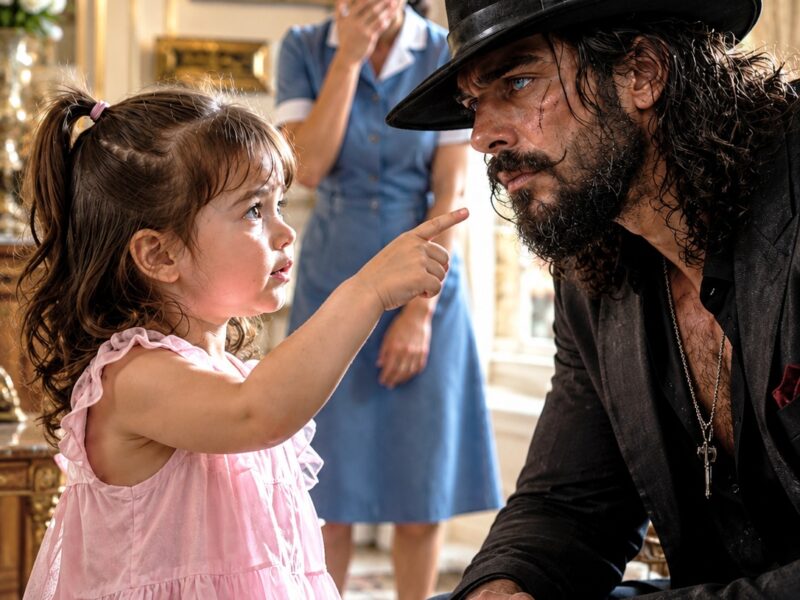
“My Mommy Cries Because of You,” the Maid’s Little Girl Told the Mafia Boss—He Froze
The four-year-old stood in front of the most feared man in Chicago and told him something no adult in his mansion would have dared say.
“My mommy cries because of you.”
Dante Marchetti went completely still—because he knew exactly what a frightened child had once cost him.
The marble beneath Dante Marchetti’s knees was probably worth more than everything I owned.
That was the strange thought that came to me as I stood at the end of the west hallway, one hand gripping a stack of folded towels, and watched my four-year-old daughter accuse my employer of making me cry.
Lily held her stuffed rabbit against her chest.
Dante knelt in front of her.
Neither moved.
For eight months, I had worked inside that mansion without seeing anyone force Dante Marchetti to hesitate.
Men apologized before he accused them.
Lawyers checked their folders twice before entering his study.
Security guards stood straighter when the black sedan carrying him passed the gates.
Even guests who arrived wearing watches worth more than my annual salary lowered their voices when they said his name.
My daughter did not know any of that.
She knew the tall man who owned the house wore dark suits.
She knew everyone became quiet when he appeared.
She knew sometimes I told her not to run in certain halls because Mr. Marchetti was working.
And she knew that some nights, after I thought she had fallen asleep, I sat alone at the kitchen table with the lights off and cried.
Children are dangerous that way.
They connect facts adults spend years separating.
“My mommy cries because of you.”
Lily said it again.
Dante’s expression changed.
Not anger.
That would have been easier.
Something passed behind his gray eyes that looked almost like fear.
“What did you say?”
His voice was soft.
Lily hugged the rabbit tighter.
“At night.”
She pointed toward the kitchen.
“She thinks I sleep.”
I could finally move.
“Lily.”
My voice shook.
She turned.
I hurried toward them, putting down the towels so quickly half slid onto the floor.
“Baby, come here.”
Lily ran into my arms.
I lifted her.
Her legs locked around my waist, small heart beating against my ribs.
“I’m sorry, Mr. Marchetti.”
Dante remained kneeling.
That disturbed me more than if he had stood.
He looked at the empty space where Lily had been.
Then slowly rose.
“Mrs. Bennett.”
He always called me that.
Never Sarah.
Eight months inside his home, and he had maintained exactly the distance our positions required.
“Yes, sir?”
“Is it true?”
I swallowed.
Lily rested her cheek on my shoulder.
“Not the way she thinks.”
Dante’s gaze moved to my daughter.
“She thinks you cry because of me.”
“She’s four.”
“That was not my question.”
The words were firm, but not cruel.
I looked toward the guards at the end of the corridor.
Dante noticed.
“Leave us.”
Both men disappeared without argument.
That was the power people whispered about.
Dante did not need volume.
He looked back at me.
“Why do you cry?”
I almost laughed from nerves.
“That is not really an employer question.”
“No.”
Something tired moved across his face.
“It isn’t.”
He looked toward Lily.
“But apparently I have created a house where a child believes her mother’s sadness belongs to me.”
His voice lowered.
“I would like to understand why.”
I did not answer.
Not there.
Not while Lily listened.
Dante seemed to realize the same thing.
He crouched once more.
Lily watched him cautiously.
“I’m not angry with your mother.”
He said.
“Okay?”
“Okay.”
“And I’m not angry with you.”
She studied him.
“Are you sad?”
Dante froze again.
Children do not respect emotional sequencing.
“Sometimes.”
He admitted.
Lily nodded as if that settled an important matter.
“You need Bunny?”
She held out the stuffed rabbit.
One ear leaned permanently sideways from years of sleep.
Dante stared.
“No.”
Then, after a second:
“But thank you.”
Lily returned Bunny to her chest.
Dante stood.
“Mrs. Bennett.”
“Yes?”
“When Lily is asleep, I would like to speak with you.”
My stomach tightened.
“About what?”
“The truth.”
He walked away.
I stood holding my daughter beneath a chandelier that cost more than the apartment we had lost two years earlier and wondered whether honesty was about to cost me the only stable job I had ever had.
Lily touched my cheek.
“Mama?”
“Yes?”
“Did I bad?”
“No.”
The answer came immediately.
“No, baby.”
“But you’re scared.”
I pressed my lips to her hair.
“Yes.”
“Of him?”
I watched Dante disappear beyond the archway.
“I don’t know.”
That was the first completely honest answer I gave that night.
By nine thirty, Lily was asleep in the small bedroom beside the staff kitchen.
The room had once stored table linens. Mrs. Howard, the house manager, had quietly moved out two cabinets when I first started bringing Lily on evenings my sitter canceled.
Nobody had officially approved it.
Nobody had objected.
That was how kindness often worked in the Marchetti house.
Quietly enough that nobody had to acknowledge needing it.
I pulled Lily’s blanket over her shoulder.
She murmured something about rabbits.
Then slept.
When I stepped into the corridor, Marco Bellini waited.
I recognized him as Dante’s driver, although “driver” never seemed adequate.
Marco was fifty-two, broad through the chest, silver beginning at his temples, and had been beside Dante long before I arrived.
“Boss is waiting.”
He said.
“I figured.”
Marco looked toward Lily’s door.
“Kid has courage.”
“She has no survival instinct.”
“Sometimes same thing at four.”
I almost smiled.
Then he lowered his voice.
“He is not angry.”
“How do you know?”
“I have known him twenty years.”
“That did not answer me.”
Marco’s mouth shifted.
“Good.”
“What?”
“You’ll need that.”
Before I could ask, he walked away.
Dante’s study occupied the southwest corner of the mansion.
I had cleaned around its door hundreds of times.
I had entered perhaps six.
Always with another employee.
Always for less than two minutes.
That night I walked in alone.
The room smelled of leather, cedar, and the faint smoke from a fireplace nobody needed because the entire mansion was warm.
Dante stood at the window.
Rain had begun.
Chicago lights blurred beyond the glass.
“Sit.”
I did.
He remained facing the city.
“Eight months.”
He said.
I waited.
“You have worked here eight months.”
“Yes.”
“And in that time, I don’t believe I have asked one genuine question about your life.”
“That is not part of my employment.”
“No.”
Dante turned.
“That is becoming obvious.”
I folded my hands in my lap.
He approached his desk but did not sit.
“Why do you cry?”
I looked down.
There were things I had told nobody in that house.
I had learned young that information could become debt.
People used what they knew.
Sometimes gently.
Sometimes not.
“My husband left when Lily was two.”
Dante’s expression did not change.
“His name?”
“Evan Bennett.”
“Where is he?”
“I don’t know exactly.”
“That is not the same as not knowing.”
“No.”
I took a breath.
“He is somewhere in Indiana, last I heard.”
Dante waited.
I hated that he was good at silence.
“He wasn’t a good husband.”
“How not good?”
My throat tightened.
“You asked why I cry.”
“Yes.”
“I did not agree to tell you everything.”
A pause.
Then Dante nodded.
“Fair.”
That surprised me.
I continued.
“When I left Evan, I had two hundred seventeen dollars.”
“Lily was two.”
“We stayed with a friend until her landlord threatened to evict all of us.”
“Then a motel.”
“Then a shelter for six weeks.”
“I applied everywhere.”
“This job paid more than any of the others.”
I looked around the room.
“It gave us insurance.”
“Stable hours.”
“A room for Lily on nights I need to stay late.”
“So sometimes I sit in the kitchen and think about how close we came to having nowhere.”
My fingers tightened.
“And I cry.”
Dante’s eyes stayed on me.
“Because you’re afraid of losing this.”
“Yes.”
“So Lily is wrong.”
I hesitated.
“Not completely.”
His expression sharpened.
I wished I had lied.
“Explain.”
“She doesn’t understand your world.”
“Neither do I, mostly.”
“But she notices the guards.”
“The cars.”
“The way the staff goes quiet when you walk in.”
“She hears me tell her not to run.”
“Not to wander.”
“To stay away from your study.”
“To lower her voice.”
Dante looked toward the door.
“In her mind, fear lives here.”
I said.
“And this house is you.”
He slowly sat down.
For the first time, the desk seemed less like a throne and more like furniture supporting a tired man.
“I never wanted a child afraid of me.”
His voice was quiet.
I did not know what to do with the sentence.
“You built a house where grown adults are afraid of you.”
His eyes came to mine.
I immediately regretted it.
Then Dante said:
“Yes.”
No threat.
No denial.
Just one uncomfortable fact.
He leaned back.
“Mrs. Bennett.”
“Yes?”
“There is something you do not know.”
I waited.
“About why the house is like this.”
His gaze moved toward the rain.
“The gates.”
“The cameras.”
“The security.”
“My rules.”
I felt something in my stomach tighten.
Dante’s hands came together on the desk.
“I had a daughter.”
Past tense.
My chest hurt before he said anything else.
“She would be ten now.”
Lily was four.
The difference did not matter.
Loss has no appropriate age.
“What was her name?”
Dante took too long.
“Sophia.”
The name changed him.
He looked toward the fireplace.
For several seconds, I thought that was all he would say.
Then:
“She was six.”
I covered my mouth.
Dante continued without looking at me.
“My work was different then.”
“Less legitimate.”
No euphemism hid what he meant.
“I had enemies who believed anything attached to me was leverage.”
“I kept Sophia away from the city.”
“Private school under her mother’s surname.”
“Another house.”
“Different security team.”
His jaw tightened.
“I convinced myself secrecy was protection.”
I knew where the story was going.
I did not want to.
“One of the families found out anyway.”
“Castellano?”
The name slipped from me because I had heard staff whisper it once after a late-night argument.
Dante looked surprised.
“Yes.”
He did not ask how I knew.
“They took her.”
The words almost disappeared.
“What happened?”
His face became still.
The kind of stillness people use when the alternative is collapse.
“We found the place thirty-one hours later.”
I lowered my eyes.
“Too late?”
“Yes.”
The fireplace cracked.
Rain struck the windows.
Nothing else moved.
“I’m sorry.”
Dante almost smiled.
Not with humor.
“Everyone says that when there is nothing useful left to say.”
“I can say nothing.”
“That might be better.”
So I said nothing.
We sat together in the silence.
After perhaps a minute, Dante spoke again.
“I blamed security.”
“My men.”
“Her mother.”
“Myself.”
“Mostly myself.”
He looked toward the door.
“So I built this.”
“A house where nobody moves without someone knowing.”
“Where there are cameras behind every gate.”
“Armed men around children who are not even mine.”
He gave a small, bitter laugh.
“And tonight a four-year-old tells me her mother cries because of me.”
His eyes returned to mine.
“Maybe I built a fortress so convincing everyone inside forgot it was supposed to be a home.”
I thought about Lily asking whether he needed Bunny.
“Maybe.”
Dante studied me.
No one in the house said maybe to him often.
He seemed almost relieved.
“You can go.”
I stood.
At the door, he said:
“Mrs. Bennett.”
I turned.
“Lily may run in the kitchen hallway.”
I blinked.
“As long as she doesn’t break her neck.”
A reluctant smile escaped me.
“I’ll inform her of the new security policy.”
For the next four days, Dante changed nothing.
That is what made the changes obvious.
He did not suddenly become cheerful.
Did not sweep Lily into his arms or order a playroom constructed overnight.
He simply appeared more often.
At six one evening, I was slicing strawberries while Lily colored at the kitchen island.
Dante entered.
Everyone stopped.
The cook straightened.
Mrs. Howard picked up a cloth.
Dante looked around.
“Continue.”
Nobody did naturally.
He sighed.
Then poured himself coffee.
Lily looked up.
“Hi, sad man.”
I nearly cut my finger.
“Lily.”
Dante’s eyebrow rose.
“Sad man?”
She nodded.
“You told me sometimes.”
“I did.”
“So.”
She returned to coloring.
Dante looked at me.
I looked away.
He took his coffee and left.
The next evening, he returned.
And the next.
Sometimes he said nothing.
Sometimes he asked Lily what she was drawing.
The answers rarely helped.
“House.”
“That does not look like a house.”
“It has door.”
“So does a bank.”
“This is house.”
Dante accepted defeat.
Marco watched these encounters from the hallway with an expression I did not understand.
Five days after the conversation in Dante’s study, I was hanging sheets in the courtyard when Marco approached.
“You know about Sophia.”
Not a question.
“Yes.”
He nodded.
“He tell you?”
“Yes.”
“That is rare.”
“I gathered.”
Marco glanced toward the kitchen windows.
Lily was inside with Mrs. Howard.
“He left out some things.”
I stiffened.
“What things?”
“Not secrets you have no right to.”
Marco said.
“Context.”
I waited.
“After Sophia died, Dante nearly dismantled half his own organization.”
“Not from grief?”
“From rage.”
Marco’s mouth tightened.
“He thought violence could make the equation balance.”
“It never does.”
“No.”
“He eventually understood.”
“Too late for Sophia.”
“Yes.”
Marco stared at the sheet moving in the wind.
“Since then, every time someone gets close, he protects by pushing them farther away.”
“Sounds familiar.”
Marco looked at me.
“Your husband?”
I said nothing.
He nodded.
“Different men.”
“Same bad instinct.”
That stayed with me.
That night, I found Dante outside Lily’s bedroom.
He was standing in the hallway.
Not entering.
Inside, Lily hummed while organizing stuffed animals into what sounded like a medical emergency.
Dante did not turn when I approached.
“Marco told you.”
He said.
“Yes.”
“He talks too much.”
“Only when you leave important parts out.”
Dante exhaled.
Fair.
We listened to Lily singing badly.
“I don’t know how to do this.”
He said.
“What?”
“Be around her without…”
He stopped.
“Without seeing Sophia?”
Dante looked at me.
“Yes.”
There was no shame in admitting grief.
Only exhaustion.
“You don’t have to make Lily into a second chance.”
“I know.”
“Do you?”
His expression tightened.
I continued.
“She is not here to fix what happened.”
“She is not proof you can protect a child correctly this time.”
“She is four.”
“She likes rabbits and hates peas.”
“That is the whole assignment.”
Dante absorbed that.
“What if I make her afraid?”
“Then apologize.”
He almost looked offended.
“What if I get it wrong?”
“Then change what you’re doing.”
“Those answers sound insultingly simple.”
“Children often are.”
A door opened at the far end.
One of the guards approached.
His face was pale.
“Sir.”
Dante’s posture changed instantly.
The vulnerable man disappeared behind the boss.
“What?”
“We found something at the front gate.”
The guard looked at me.
Then toward Lily’s room.
Dante noticed.
“Say it.”
“A photograph.”
My stomach turned.
“Of what?”
The guard hesitated.
Dante’s voice cooled.
“Now.”
“Her.”
He pointed toward Lily’s door.
The photograph had been pushed through the wrought-iron gate inside a plain envelope.
No stamp.
No writing on the outside.
It showed Lily walking beside me near a small neighborhood playground three days earlier.
I remembered the afternoon.
She had insisted on wearing red rain boots even though the sun was out.
The photograph had been taken from across the street.
Long lens.
Clear enough to see her face.
On the back:
ANOTHER LITTLE GIRL IN YOUR HOUSE.
Dante read the words once.
Every trace of softness disappeared.
Marco swore quietly.
I could not breathe.
“Who?”
I whispered.
Dante’s jaw tightened.
“Probably someone who wants me to think I know.”
“That is not an answer.”
“No.”
He turned toward the security room.
“I want every camera from the gate back seventy-two hours.”
“Street cameras.”
“Traffic feeds.”
“Anything legally accessible.”
One of the guards nodded.
“And double—”
Dante stopped himself.
He looked at me.
An old reflex interrupted.
“Mrs. Bennett.”
“What?”
“Would you prefer Lily moved to the east wing tonight?”
The question mattered.
He was asking.
Not ordering.
“Is it safer?”
“Yes.”
“Why?”
“Reinforced windows.”
“Separate stairwell.”
“Two exits.”
“No exterior wall accessible from the garden.”
I thought.
“Yes.”
Dante nodded.
“Marco, arrange it.”
Then to me:
“This happened because someone believes Lily matters to me.”
My stomach tightened.
“She does?”
Dante looked toward the photograph.
His voice became quieter.
“Yes.”
The admission surprised both of us.
“She’s a child in my home.”
He said.
“I will not lie about that to make an enemy less interested.”
“Then what do we do?”
“Find out who took the photograph.”
“No retaliation?”
His eyes met mine.
“You think very little of me.”
“I don’t know enough of you.”
A pause.
“Fair.”
Dante looked at Marco.
“Evidence first.”
Marco nodded.
“Then lawyers.”
Another nod.
“And if there is an immediate threat?”
Dante’s face changed.
“Then security does what security is licensed to do.”
That was not what the old stories said Dante Marchetti would have done.
Apparently Marco noticed too.
He gave his boss a long look.
Dante ignored him.
Lily moved into the east wing that night and thought the entire event was an adventure.
“This bed is giant.”
She bounced once.
“Do not do that.”
“Why?”
“Because Mr. Marchetti probably paid more for that mattress than my car.”
“Can I jump on your car?”
“No.”
Dante stood in the doorway.
I had not realized he was there.
Lily pointed.
“Sad man.”
He glanced at me.
I shrugged.
“You are apparently branded.”
Lily looked at Dante.
“Why people take my picture?”
My throat closed.
I had hoped she did not understand.
Dante walked in slowly.
He crouched.
“Someone made a bad choice.”
“Am I trouble?”
“No.”
The answer came hard.
“No, Lily.”
“Then why guards?”
“Because adults sometimes create trouble around people who did nothing wrong.”
She considered.
“Like Daddy?”
I froze.
Dante did too.
Her father was not a subject we discussed casually.
“What about your daddy?”
Dante asked.
Lily picked at Bunny’s ear.
“He made trouble.”
I swallowed.
“Lily.”
She looked at me.
“You said.”
I had.
Once.
Children remember the sentence you hope disappears.
Dante looked from her to me.
“Did he hurt you?”
The question was to Lily.
She shook her head.
“Mommy.”
Every muscle in Dante’s face tightened.
I stepped forward.
“That is enough.”
He immediately stopped.
Good.
Lily hugged Bunny.
Dante stood.
“Good night.”
She waved.
“Night, sad man.”
Outside the room, Dante waited until the door shut.
“Your husband hurt you.”
“My ex-husband.”
“Yes.”
“It is handled.”
“Is it?”
My anger rose.
“Do not do that.”
“Do what?”
“Become interested because a child said one sentence and decide you are entitled to my whole history.”
Dante took the correction without flinching.
“You’re right.”
That disarmed me again.
“I am sorry.”
I studied him.
“You apologize more than I expected.”
“I have accumulated material.”
Despite fear, I almost laughed.
Dante’s expression softened.
Then hardened again when Marco approached.
“We have a partial plate.”
He said.
“Vehicle from the playground photo.”
“Registered?”
“Rental.”
“Booked through an LLC tied to Castellano Development.”
The air changed.
Dante’s face became blank.
“The same Castellano family?”
I asked.
“Yes.”
The family connected to Sophia’s death.
For one second, Dante was not in the hallway.
I saw that.
He was years earlier.
Another photograph.
Another child.
Another message.
“Dante.”
I used his first name deliberately.
His eyes focused.
“Do not make tonight about Sophia.”
His jaw tightened.
“They are the same people.”
“Then deal with what they did now.”
“Not what they did then.”
Marco looked at me with something close to approval.
Dante breathed in.
Out.
Then:
“Call Rachel Monroe.”
“Who?”
“My attorney.”
Marco answered.
Dante looked at him.
“And Detective Alvarez.”
Marco’s eyebrows rose.
“Police?”
“Yes.”
Dante glanced toward Lily’s closed door.
“If someone is stalking a child, I want that on a record before anyone decides this is some private family dispute.”
That decision saved us later.
The investigation moved more slowly than fear wanted.
Detective Elena Alvarez arrived at nine the next morning.
No relationship to me.
The universe apparently liked repeating names.
She reviewed the photograph, gate footage, and rental information.
Castellano Development denied knowledge.
Of course.
The rental had been arranged by a subcontractor.
The subcontractor claimed identity fraud.
The car had already been returned.
No fingerprints useful enough to identify anyone.
Still, a report existed.
A case number.
Evidence that could not vanish simply because men with money preferred silence.
Dante hated the pace.
“Nothing?”
He asked after the detective left.
Marco shook his head.
“Not nothing.”
“Paper.”
“Paper survives.”
Dante stared.
Then nodded.
Three days later, Lily asked him to color with her.
He nearly refused.
I saw it.
Not because he was busy.
Because connection frightened him now that it had become dangerous.
Lily held out a green crayon.
“You can make tree.”
Dante looked toward me.
I raised an eyebrow.
No help.
He sat.
The most intimidating man in Chicago drew the worst tree I had ever seen.
Lily stared.
“That is broccoli.”
“It is a tree.”
“No.”
She added a trunk beneath it.
“Now tree.”
Dante accepted correction.
Halfway through, Lily said:
“Do you miss your little girl?”
My heart stopped.
Dante’s crayon paused.
Children absorb whispered conversations like walls absorb smoke.
“Who told you?”
“Nobody.”
“You said had daughter.”
He had.
In the study?
No.
He must have said enough around her.
Dante looked at me.
I gave him the choice.
He answered.
“Yes.”
“I miss her.”
“What her name?”
“Sophia.”
“Did she like green?”
A long pause.
“Yes.”
That was apparently enough.
Lily handed him another crayon.
“This for her.”
Purple.
Dante held it.
Then put it in his breast pocket.
Something inside me moved.
Not romance.
Not yet.
Recognition perhaps.
Of grief being allowed to exist without becoming command.
That evening, Dante asked permission before entering the kitchen while Lily was eating dinner.
The absurdity made me smile.
“It is your house.”
“That was not the question.”
“Yes.”
He entered.
Sat across from us.
Mrs. Howard nearly dropped a tray when he ate meatloaf at the kitchen table.
Afterward, when Lily was playing, Dante said:
“I found your ex-husband.”
My fork stopped.
“What?”
“I did not contact him.”
Good.
Dante had learned.
“He lives in Gary.”
“Construction work.”
“Two arrests.”
“No convictions.”
“I told you not to investigate.”
“I know.”
Anger rose.
“Then why?”
“Because the photograph created a security review of everyone who might know your schedule.”
“That included him.”
I wanted to stay angry.
Unfortunately, that made sense.
“Did he know where I work?”
“Possibly.”
“Did he tell anyone?”
“We don’t know.”
“Do not contact him without telling me.”
“Agreed.”
“And no men outside his home.”
Dante hesitated.
“Dante.”
“Fine.”
“No intimidation.”
“Fine.”
“Say the whole sentence.”
He stared.
“I will not intimidate your ex-husband.”
Marco, standing near the coffee machine, suddenly needed to cough.
Dante glared.
I smiled.
The fragile normal lasted two days.
Then Evan called me.
Unknown number.
I almost ignored it.
Something made me answer.
“Sarah.”
My skin went cold.
I knew the voice.
“Evan.”
Dante, across the kitchen reading something on a tablet, looked up instantly.
“How did you get this number?”
“My daughter still has the same mother.”
“You didn’t answer.”
“I heard you’re living with some rich criminal.”
“I work here.”
“Same thing.”
My hand shook.
Dante stood.
I raised one palm.
Stay.
He did.
That mattered.
“What do you want?”
“Lily.”
The word removed the room beneath me.
“What?”
“I want to see her.”
“No.”
“You can’t keep my kid from me.”
“You have not called in two years.”
“I’m calling now.”
“Why?”
Silence.
Then:
“People are asking about her.”
Dante’s face changed.
I put the phone on speaker without explanation.
Evan continued.
“A guy came to the jobsite.”
“Said you were mixed up with Marchetti.”
“Offered to clear something for me if I could help arrange a visit.”
Dante moved closer but stayed silent.
“What something?”
I asked.
“My debt.”
My stomach dropped.
“How much?”
“Not your problem.”
“It becomes my problem when Lily is part of the offer.”
Evan breathed hard.
“Sarah, I screwed up.”
“Again?”
“Yes.”
The honesty surprised me.
“Sports book.”
“Twenty-eight grand.”
Dante closed his eyes briefly.
“Who offered?”
“I don’t know his real name.”
“He said Castellano.”
Dante’s jaw tightened.
“And?”
“He wants me to file for emergency visitation.”
“Claim you’re keeping Lily in a criminal household.”
My fingers went numb.
“They want a court fight.”
Dante whispered.
Evan heard.
“Is that him?”
I ignored the question.
“Did you agree?”
Silence.
“Evan.”
“I signed something.”
I sat down.
“You signed what?”
“Statement.”
“That you’re afraid for her.”
“You haven’t seen her.”
“I know.”
His voice cracked.
“I’m sorry.”
I had heard those words from Evan before.
Usually after a bruise.
After rent money disappeared.
After screaming woke Lily.
Sorry had become meaningless between us.
This sounded different.
Not better.
Just frightened.
“Send me everything.”
I said.
“All messages.”
“Names.”
“Documents.”
“Now.”
“Will you let me see Lily?”
“No.”
The answer came clean.
“You help because she is your daughter.”
“Not as payment.”
Silence.
Then:
“Okay.”
Dante looked at me.
Something like respect passed between us.
Evan sent the files.
Rachel Monroe reviewed them within an hour.
The strategy was clearer now.
Castellano had learned Lily mattered to Dante.
If they could not safely threaten her physically after the police report, they could create legal instability.
A biological father with allegations about a criminal household.
Media.
Custody court.
Dante’s rivals did not need Lily.
They needed Dante distracted and publicly vulnerable while a major port contract was being negotiated.
Modern warfare.
No warehouse kidnapping required.
I hated how rational it was.
“This is because of me.”
Dante said.
We were in his study.
Rachel sat across from us.
“No.”
I replied.
“Their choice is because of them.”
“You sound like me now.”
“Unfortunate.”
Rachel interrupted.
“Let us establish priorities.”
She looked at me.
“Sarah, you and Lily move out of the mansion temporarily.”
My heart jumped.
“Why?”
“Not because Mr. Marchetti is dangerous to her.”
Rachel said.
“Because if Evan files anything, you do not want opposing counsel arguing Lily lives full time inside a property with armed private security and frequent visitors connected to criminal investigations.”
Dante’s face tightened.
“This house is safer than—”
“Physical security and legal optics are different issues.”
Rachel cut him off.
“You are not the client.”
Dante leaned back.
I almost smiled.
“Where would we go?”
Rachel looked at me.
“Do you have an independent apartment?”
“No.”
“My old place was month-to-month.”
“I gave it up.”
Dante spoke.
“I own—”
Rachel pointed at him.
“No.”
He stopped.
I stared.
“I have savings.”
“Enough for deposit?”
“Yes.”
Rachel nodded.
“Then we find a rental in your name.”
“I can help with security recommendations.”
Dante said cautiously.
“Recommendations.”
I repeated.
“Not ownership.”
“Agreed.”
We moved three days later.
Two-bedroom apartment in Oak Park.
Third floor.
Old hardwood floors.
Radiators.
A kitchen half the size of Dante’s pantry.
I loved it immediately.
Lily did too.
“My room yellow?”
“If the landlord approves paint.”
“Ask sad man.”
Dante, carrying a box behind us, said:
“Why would I control the landlord?”
“You control everyone.”
He stopped.
Lily had no idea what she had just said.
I did.
So did Dante.
“No.”
He answered quietly.
“I don’t.”
Good lesson for both of them.
Evan filed for visitation.
Not emergency custody.
Rachel’s intervention and the documentary evidence made his new concern look suspicious.
He admitted through counsel that a third party had encouraged the filing.
The judge ordered supervised visitation evaluation before any contact.
I did not oppose forever.
I opposed immediately.
That distinction mattered.
Evan completed an abuse intervention program, gambling counseling, and six months of consistent child support before Lily saw him again.
The first visit took place in a family center.
Not Dante’s house.
Not mine.
Lily recognized Evan from photographs.
She did not run to him.
Good.
Reality is not required to perform for sentiment.
He cried.
Lily asked why.
He said:
“Because I missed too much.”
She replied:
“Then don’t miss next time.”
Children.
Dante heard about it later.
“That is brutal.”
He said.
“She is four.”
“She is efficient.”
The Castellano pressure moved elsewhere.
The port contract became the next target.
A Moretti—no, Marchetti—partner abruptly withdrew.
A lender requested extra documentation.
Rumors spread that Dante had become attached to “the maid’s family.”
Old associates used that phrase as insult.
Dante heard it.
So did I.
One evening, after Lily fell asleep, he came to the apartment.
No guards inside.
Marco waited downstairs.
Dante sat at my small kitchen table.
It looked ridiculous under him.
“You should replace this.”
He said.
“With what?”
“A table that does not wobble.”
“It cost forty dollars.”
“It is attempting to kill your coffee.”
I folded a napkin beneath one leg.
“Fixed.”
Dante looked offended by poverty’s engineering solutions.
Then his expression changed.
“Frank Ricci left today.”
“Who?”
“One of my senior men.”
“Why?”
“He thinks I’ve lost judgment.”
“Because of Lily?”
“Because I called police.”
I sat.
“What did you tell him?”
“That if stalking children is his preferred business model, he should work elsewhere.”
“And?”
“He does now.”
“That costs you?”
“Yes.”
“How much?”
Dante smiled without humor.
“Enough.”
I studied him.
“Do you regret it?”
“No.”
Immediate.
Then:
“I regret that I needed Sophia to die before I learned there are things victory does not repair.”
The room went quiet.
“I need to ask you something.”
I said.
“Ask.”
“Why did Castellano take Sophia?”
His jaw tightened.
“You know why.”
“Leverage is not enough.”
I looked at him.
“What were they trying to get?”
Dante’s gaze moved to the window.
“The east freight corridor.”
“Three warehouses.”
“Union influence.”
“They believed if I transferred control, they would release her.”
“Did you?”
“Yes.”
I froze.
“They still—”
“Yes.”
He closed his eyes.
“I gave them everything.”
“And they killed her anyway?”
“It was not planned.”
Dante’s voice roughened.
“One of the men panicked when police got close.”
“Castellano claimed it was an accident.”
“Does that matter?”
“No.”
He looked at his hands.
“I learned something terrible that night.”
“What?”
“There is no concession large enough to purchase safety from someone willing to use a child.”
I thought of the legal pressure now.
“So this time?”
“This time we don’t bargain with Lily.”
“We document.”
“Expose.”
“Cut off leverage.”
“Let the courts deal with her father.”
“Let regulators deal with contracts.”
“And you?”
“Learn patience.”
I smiled slightly.
“That may be your hardest sentence.”
“It is.”
The investigation into Castellano’s approach to Evan produced more than expected.
Payments.
Emails.
A consultant communicating with Evan.
One message instructed him to emphasize “the armed environment” around Lily and suggest I had become emotionally dependent on Dante.
Rachel nearly smiled when she read it.
“What?”
I asked.
“This is useful.”
“How?”
“Because manipulating a custody proceeding for commercial leverage creates several problems.”
“For them?”
“For everyone.”
She looked at Dante.
“Which is why Mr. Marchetti will stay out of it.”
Dante opened his mouth.
Rachel raised one finger.
He closed it.
I liked her very much.
Federal investigators became involved after the consultant’s accounts connected to an extortion inquiry around waterfront contracts.
Dante’s legitimate company cooperated.
That cooperation exposed uncomfortable things inside his own organization too.
Shell payments.
Off-book security.
Old bribes predating his current restructuring but continuing under managers he had not questioned closely enough.
Dante had a choice.
Limit disclosure.
Protect himself.
Or hand over enough records to make cooperation real.
He showed me the folders one evening.
“Why are you showing me?”
“Because the decisions could affect Lily.”
“How?”
“If I disclose everything, some companies get hurt.”
“I may face charges.”
“If I don’t, the investigation stays partial.”
“And Castellano’s people keep room to operate.”
I looked at him.
“What do you want me to say?”
“I don’t know.”
He rubbed his jaw.
“That is new.”
“Do not make Lily the reason you become a good man.”
His eyes sharpened.
“I’m serious.”
“If you disclose because you think protecting her makes you noble, then one day when the price gets high enough, you may resent her.”
Dante stared.
“What should the reason be?”
“Because it is right.”
“That sounds inconveniently simple.”
“Lily would approve.”
He looked toward the living room where she had fallen asleep beneath a cartoon blanket.
“Then I disclose.”
“No.”
I shook my head.
“You decide.”
His mouth tightened.
He understood.
The next morning, Dante instructed his attorneys to begin full cooperation regarding operations connected to the extortion investigation.
Not every rumor.
Not invented confessions.
Actual documents.
Actual conduct.
His.
Others’.
The consequences arrived gradually.
A warehouse executive was indicted.
Two security contractors lost licenses.
Frank Ricci, the man who had left, became a cooperating witness for the Castellano side before changing course when investigators showed him the records they already had.
Dante eventually entered a plea agreement regarding financial conspiracy and unlawful payments connected to older port contracts.
No amount of personal growth erased conduct.
He knew that.
When he told me, we were sitting in a hospital cafeteria because Lily had gotten three stitches after falling from playground equipment.
The absurdity of timing seemed appropriate.
“How long?”
I asked.
“Government recommendation is twenty-four to thirty months.”
My throat tightened.
“You’re going to prison.”
“Probably.”
Lily, across the table eating gelatin, looked up.
“What prison?”
Dante froze.
We had been careless.
I closed my eyes.
“Adult trouble.”
I said.
“Like timeout?”
“Bigger.”
Dante answered.
She stared.
“Did you do bad?”
Silence.
He could lie.
He did not.
“Yes.”
“Now?”
“Some before.”
“Some because I did not stop things I should have stopped.”
Lily considered.
“Did you say sorry?”
“I am trying to do more than say it.”
She returned to her gelatin.
“Okay.”
Dante looked destroyed.
“Children have terrifyingly efficient moral systems.”
I said.
“Yes.”
The judge sentenced him to twenty months.
Cooperation mattered.
So did his crimes.
The government dismantled several Castellano-linked extortion schemes.
Salvatore Castellano was charged with conspiracy, commercial extortion, and obstruction tied to the custody manipulation and other cases.
No dramatic shootout.
No bodies in warehouses.
Bank records and arrogant emails did what bullets had failed to do for decades.
I found that satisfying.
Dante began his sentence when Lily was five.
By then, she called him Dante.
Not sad man.
Mostly.
We visited twice a month.
I did not become his romantic partner simply because he had protected us.
That would have confused gratitude with love.
Dante never asked.
That was one of the ways I knew he had changed.
Our relationship grew through smaller things.
Letters about books.
Arguments about Lily’s school.
His ridiculous belief that peanut butter belonged in the refrigerator.
My refusal to agree.
Sometimes he wrote about Sophia.
The letters became less about guilt and more about memory.
Her missing front tooth.
Her love of purple.
The way she cheated at Go Fish.
That mattered.
Grief becomes dangerous when the person lost turns into only the manner of losing them.
Dante started remembering his daughter alive.
One letter said:
I have spent years thinking Sophia’s final thirty-one hours were the most important thing about her because they were the part I failed. They were not. She lived six years before that. I owe her those memories too.
I kept that one.
When he came home, there was no mansion waiting.
Dante had sold it before sentencing.
Part restitution.
Part restructuring.
Part choice.
“The house became a machine for fear.”
He told Marco.
“I don’t need it.”
He rented a townhouse not far from Lily and me.
Normal by his standards.
Still absurd by mine.
One evening he invited us for dinner.
Lily inspected every room.
“No guards?”
“One downstairs.”
“That counts.”
Dante sighed.
“Progress is apparently invisible to children.”
She found the small playroom.
Yellow walls.
Crayons.
A shelf with books.
In one frame:
Sophia.
Six years old.
Purple dress.
Big smile.
Lily studied it.
“Her?”
“Yes.”
Dante crouched.
“That’s Sophia.”
“Your little girl?”
“Yes.”
“She pretty.”
“Very.”
“Did she cry?”
Dante looked surprised.
“Sometimes.”
Lily touched the frame.
“My mommy used to cry.”
“I remember.”
“She doesn’t much now.”
Dante looked at me.
I stood in the doorway.
“No.”
I said.
“I don’t.”
That was true.
Life was not suddenly easy.
Evan’s supervised visits continued inconsistently.
He relapsed once with gambling.
Contact paused.
He returned to treatment.
We maintained boundaries.
My new job helped.
I had stopped working as a maid six months before Dante’s sentencing.
Not because he told me to.
Because the investigation made the estate unstable and because I realized I had spent years being excellent at work other people considered invisible.
Scheduling.
Inventory.
Vendor coordination.
Household budgeting.
Emergency planning.
Rachel helped me translate those things into a resume, but I applied myself.
I became operations coordinator for a nonprofit domestic-violence resource center.
The first paycheck was smaller than Dante’s.
The meaning was larger.
Dante never “fixed” the salary.
Smart man.
We still saw each other.
Sunday dinners.
Lily’s school programs.
Pediatric appointments when she wanted him there.
One December, Lily was assigned a family drawing.
She drew me.
Herself.
Bunny.
Then Dante.
The teacher asked who he was.
Lily wrote:
DANTE. HE USED TO BE SAD BUT NOW HE MAKES PASTA.
Dante framed it.
Of course he did.
Years passed.
Lily learned more gradually.
At eight, she understood Sophia had died because dangerous adults used a child to pressure her father.
At ten, she learned Dante had once been part of a criminal organization.
At twelve, she asked why I ever worked there.
“Money.”
I said.
“Really?”
“Yes.”
She looked disappointed by the lack of destiny.
“Sometimes life begins because rent is due.”
At thirteen, she asked Dante:
“Were you a mafia boss?”
He nearly choked on espresso.
I laughed for five minutes.
“What did your mother tell you?”
He asked.
“Nothing.”
“I Googled.”
He glared at me.
“Parental controls.”
“She is thirteen.”
I said.
“That is when the internet becomes a weapon.”
Lily waited.
Dante finally answered.
“People called me that.”
“Were they wrong?”
“Not entirely.”
“What did you do?”
“Things I’m not proud of.”
“That’s vague.”
“You sound like Rachel.”
“Good.”
Dante looked at me for rescue.
None came.
“I used businesses and people in ways that broke laws.”
He said.
“I threatened people.”
“I paid others to make problems disappear.”
“I told myself it kept worse people away.”
“Sometimes it did.”
“Sometimes I was the worse person.”
Lily absorbed that.
“Did Sophia know?”
The question hurt.
Dante answered.
“No.”
“I kept that part away from her.”
“Did that keep her safe?”
“No.”
“Then why hide it?”
He swallowed.
“Because I wanted to believe being a good father and being a dangerous man could exist in separate rooms.”
Lily stared.
“And?”
“They couldn’t.”
That was enough for the day.
At sixteen, Lily volunteered at the same resource center where I worked.
Not because she wanted to become a social worker.
Because she needed community-service hours and liked the children’s room.
One afternoon Dante arrived to pick us up.
He stopped outside the play area.
A little girl was building blocks.
Her mother met with an advocate nearby.
The child looked up at Dante.
Adults still noticed him.
He was older.
More gray.
No organization behind him anymore.
Still carried himself like rooms belonged to him until reminded otherwise.
The girl held up a block.
“Help.”
Dante entered.
Sat on the carpet.
Helped.
No tragedy.
No connection to Sophia.
No redemption scene.
Just blocks.
That normality moved me more than drama would have.
Later, in the car, Dante said:
“I did not think about Sophia.”
I looked at him.
“When?”
“With the child.”
He sounded almost guilty.
“That is good.”
“Is it?”
“Yes.”
“You’re allowed to meet children who are not ghosts.”
He looked out the window.
“I think that may be the nicest thing you’ve ever said to me.”
“Do not get used to it.”
Lily turned from the back seat.
“You two are weird.”
Accurate.
Dante and I never married.
People expected us to eventually.
We disappointed them.
For several years, we were friends tied together by one child and several disasters.
Then slowly, carefully, we became something more.
Not because he saved me.
Not because I healed him.
Because after both of us had independent lives, we still chose dinner.
Still called.
Still argued.
Still wanted one another present when nothing was wrong.
The first time he asked me on an actual date, Lily was seventeen.
She stared at him.
“You have been coming to our house every Sunday for twelve years.”
“This is different.”
“How?”
Dante looked annoyed.
“I am wearing a jacket.”
“You always wear jacket.”
I laughed until I cried.
Our relationship remained ours.
No mansion.
No dependence.
No rescue.
He kept his townhouse.
I kept my home.
We eventually shared enough drawers to irritate each other.
That was sufficient.
On Lily’s eighteenth birthday, we returned to the old Marchetti property.
Not the mansion.
That was gone.
A developer had turned the land into a private school and community center after the house was demolished.
Dante had sold the property with one condition permitted by the buyers:
A small memorial garden for Sophia would remain near the old east wall.
No grand statue.
Just a bench.
Purple flowers.
Her name.
Lily carried Bunny.
Both ears had been repaired many times.
She sat beside Dante.
I stood a few feet away.
“Can I ask you something?”
She said.
“Always.”
“Do you still blame yourself?”
Dante took his time.
“For Sophia?”
“Yes.”
“Some days.”
“That seems unhealthy.”
“It is.”
“What do you do?”
“Remember that guilt is not the same as responsibility.”
Rachel had taught him that.
Therapy reinforced it.
“What’s difference?”
“Responsibility asks what I do now because of what happened.”
“Guilt mostly asks how long I can punish myself.”
Lily nodded.
“Which helps her?”
“Responsibility.”
“Then do that.”
Dante smiled.
“You have not become less direct.”
“No.”
She leaned back against the bench.
“I barely remember when I told you Mom cried because of you.”
“I remember.”
“Was she?”
I sat beside them.
“Partly.”
Dante looked at me.
I continued.
“I cried because I was frightened of losing stability.”
“But I was also afraid of the house.”
“The rules.”
“The way power lived there.”
“So you weren’t wrong.”
Lily looked satisfied.
Dante objected.
“She accused me without complete information.”
“She was four.”
“Standards matter.”
Lily laughed.
The sound moved through the garden.
For a moment, I thought about the hallway.
Cold marble.
Towels falling from my hands.
Dante kneeling because a small child had said aloud what every adult around him had learned not to say:
Fear had consequences.
Even when no one shouted.
Even when salaries were paid.
Even when security was excellent.
Even when the man causing the fear believed he was protecting everyone.
Dante had spent years learning that safety was not the same as control.
I had spent years learning that accepting help was not the same as surrendering independence.
Lily grew up between those lessons.
Not perfectly.
No child should have to be the reason adults become better.
We made sure she eventually understood that.
“You didn’t fix Dante.”
I told her once.
“He changed because he chose to.”
“You did not save me.”
“I left your father before you were old enough to know why.”
“You told one truth at four.”
“Adults did the work afterward.”
She liked that.
So did I.
When Lily graduated college, Dante sat in the audience beside me.
No special entrance.
No security visible.
He cried.
Completely.
I handed him tissues.
“Do not mention this.”
He whispered.
“There are photographs.”
“I have resources.”
“Not those resources anymore.”
He sighed.
“Cruel woman.”
Lily crossed the stage.
Her degree was in public policy.
Of course.
She planned to work in housing regulation.
Of course.
Afterward, she found us.
Dante hugged her.
She whispered something into his ear.
He laughed.
“What?”
I asked.
Lily smiled.
“I told him Mommy doesn’t cry because of him anymore.”
Dante looked at me.
“Do you?”
“Sometimes.”
His face fell.
I touched his arm.
“When you load the dishwasher incorrectly.”
“That is not crying.”
“It is grief.”
Lily groaned.
“You really did become normal.”
Dante looked offended.
“Do not insult me on graduation day.”
We went to dinner.
No rivals.
No threats.
No photographs through gates.
Just a reservation Marco had made because despite retiring fourteen times, he still believed nobody else could arrange dinner correctly.
He joined us late.
Rachel came too.
Detective Alvarez sent flowers.
Evan sent Lily a card.
Their relationship had remained limited but honest.
No fairy-tale reconciliation.
No hatred required either.
Lily accepted what he could become without pretending he had been what she needed earlier.
That maturity belonged to her.
Years later, when I think about the sentence that started everything, I remember Dante’s face more than Lily’s voice.
“My mommy cries because of you.”
He could have dismissed her.
Could have laughed.
Could have disciplined me for bringing a child too close.
Could have protected his pride.
Instead, he knelt.
Then listened.
That was all at first.
No transformation.
No sudden goodness.
Just listening.
The rest cost him far more.
Power.
Money.
Freedom.
Certainty.
The comforting belief that fear was proof of respect.
But he gained something his mansion had never contained.
A home people could speak honestly inside.
One rainy evening, long after Lily moved into her own apartment, Dante and I sat at my kitchen table.
The same forty-dollar table had finally died years earlier.
He bought the replacement only after I agreed to split the cost.
Progress.
Rain tapped the windows.
Dante looked toward the empty chair Lily used to occupy.
“Too quiet.”
He said.
“You once required silence.”
“I was an idiot.”
“Yes.”
He smiled.
“Do you remember the first thing you ever said to me without calling me sir?”
I thought.
“No.”
“You said, ‘You built a house where grown adults are afraid of you.’”
“That sounds like me.”
“It was deeply disrespectful.”
“You survived.”
“Barely.”
A pause.
“Sarah.”
“Yes?”
“Were you really afraid of me?”
I looked at him.
Years earlier, I might have softened the answer.
Now honesty was easier.
“Yes.”
His face changed slightly.
“I’m sorry.”
“I know.”
“Does it still bother you?”
“What?”
“That I was.”
“Yes.”
“Good.”
He frowned.
“Good?”
“It should.”
I reached for his hand.
“But it is not the only thing I know about you anymore.”
Rain continued.
Dante looked toward our joined hands.
Then toward the kitchen doorway where Lily once stood in pajamas holding Bunny.
“She was four.”
He said.
“Yes.”
“She changed everything with one sentence.”
“No.”
Dante looked at me.
I smiled.
“She opened the door.”
“You walked through it.”
For a long moment, he said nothing.
Then nodded.
Outside, the rain softened.
Inside, nobody whispered.
Nobody watched the door.
Nobody lowered their voice when Dante Marchetti entered the room anymore.
And that, more than all the money he lost or all the power he surrendered, was how I knew the frightened house Lily remembered had finally disappeared.









