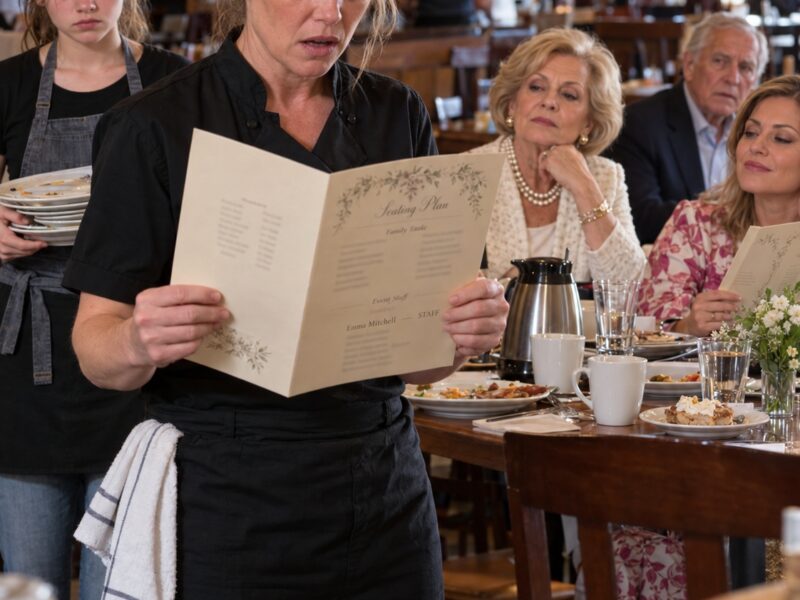
My Mother Demanded My Restaurant Cater Her Vow Renewal for Free—Then I Found My Seventeen-Year-Old Daughter Listed as “Staff” on the Family Seating Plan
My mother asked for a free four-course dinner for 120 people while my seventeen-year-old daughter cleared the plate she had just eaten from.
My sister called it a “family discount,” then quietly built an entire event business around food, workers, and money that belonged to me.
I might have swallowed all of it again—until I saw exactly where they had placed my daughter on the seating plan.
My mother said it with her fork still in a crab cake she had never paid for.
“You’ll cater our vow renewal for free.”
I was standing beside Table Six with a coffee pot in one hand and a dish towel tucked into the waistband of my black chef pants. The Sunday lunch rush had thinned to the comfortable after-church hum we had every week—silverware against plates, the espresso machine hissing behind the bar, somebody laughing near the front windows.
Mom looked up at me as if she had asked for more iced tea.
“You own a restaurant,” she added. “That’s the point of having one, isn’t it?”
My younger sister Brooke did not look up from her phone.
“Family discount is one hundred percent.”
She tapped the edge of the check presenter sitting beside her plate.
Inside was a ticket my server had already marked the way every family ticket had been marked for ten years.
FAMILY 100.
My father Ray was concentrating on the slice of pecan pie his cardiologist had finally allowed him to have after months of dietary restrictions. He had undergone bypass surgery the previous summer, and ever since then I watched the way he breathed between sentences more carefully than I listened to the sentences themselves.
Behind my mother, my daughter Nora balanced four dirty plates along her left forearm.
She was seventeen.
A senior in high school.
She had worked weekend shifts at Kesler’s Kitchen since she was twelve, first rolling silverware, then bussing tables, then learning pastry because she had somehow inherited patience I never had.
“Grandma,” Nora said, “can I get this plate?”
Mom lifted her coffee cup so Nora could reach it.
She did not say thank you.
Neither did Brooke.
I watched my daughter stack the plate and walk toward the kitchen.
Then I looked at Mom again.
“How many people?”
“One hundred twenty.”
I laughed because I genuinely thought she was joking.
She wasn’t.
“Saturday night?”
“October tenth.”
“That is a Saturday.”
“Yes.”
“Our busiest night.”
Brooke finally looked up.
“You close all the time for private events.”
“No. I don’t.”
“You did for the Wilson wedding.”
“They paid twenty-two thousand dollars.”
Mom frowned.
“It’s our fortieth anniversary, Meredith.”
There it was.
Not an argument.
A moral invoice.
My father looked up from his pie.
“Your mother doesn’t mean anything fancy.”
Mom turned toward him.
“Yes, I do.”
Dad looked back down.
Brooke smiled.
“We’re doing the ceremony at Cedar Ridge, then the fellowship hall. I’m handling design, florals, rentals, timeline, all of it. This is basically the launch event for Halverson Events.”
I knew about Halverson Events.
Brooke had created the Instagram account six months earlier.
Before that, she had sold boutique candles.
Before that, she had trained to be a Pilates instructor.
Before that, she had run an online children’s clothing store for nine months.
My mother described every new venture as Brooke “finally finding her thing.”
I had been cooking professionally for twenty-two years.
No one had ever described my restaurant as my thing.
Mom pulled a cream folder from her handbag.
“Here.”
Inside were pages of ideas.
Gold tablecloths.
White roses.
A four-course menu she had copied from a country club website.
Crab cakes.
Wedge salads.
Prime rib.
Chocolate tortes.
I flipped the page.
A preliminary seating chart.
Head table: Ray, Diane, Brooke, Grant, Harper, Sloan, Meredith.
I looked again.
My name was there.
One person was missing.
“Where’s Nora?”
Brooke reached over and turned another page.
“That’s still being worked out.”
A grid appeared.
Servers.
Kitchen.
Setup.
Breakdown.
At the bottom, in the same neat font as the paid staff positions, was one line.
NORA KESLER — STAFF.
For a few seconds, the restaurant around me seemed to go quiet.
Not actually quiet.
Luis was calling for a side of fries through the pass.
A baby was crying near the windows.
Someone dropped a fork.
But all I could see was my daughter’s name under the word staff while Brooke’s daughters—Nora’s cousins—were listed at the family table as flower girls.
Nora came back through the dining room carrying a fresh stack of water glasses.
Mom smiled at her.
“Nora, sweetheart, you’ll help your mother at the party, won’t you?”
Nora looked at me first.
That was the part that hurt.
Not at her grandmother.
At me.
Like she already knew the answer depended on whether I was brave enough to give a different one.
I closed the folder.
“We’ll talk about the event after service.”
Mom’s mouth tightened.
“I thought you said yes.”
“I haven’t said anything yet.”
Brooke laughed.
“Come on, Mary. It’s family.”
My father pushed his empty pie plate away.
He looked tired, but happy.
“This was my idea,” he said quietly. “The renewal. Not all this fancy stuff.”
His hand touched Mom’s for half a second.
“I just wanted to give your mother the party we couldn’t afford forty years ago.”
That changed everything.
Because I loved my father.
And because loving someone can make a bad deal look honorable if you stare at it from the right angle.
“I’ll figure something out,” I said.
Mom smiled as if I had agreed to every page in the folder.
Nora did not smile at all.
At 1:42 that afternoon, Table Six’s ticket printed in the kitchen.
$186.40.
Comped.
FAMILY 100.
Luis Ortega tore it from the printer and pinned it to the corkboard beside the walk-in cooler.
He had been doing that every Sunday for nearly ten years.
This time, he looked at me.
“Vow renewal?”
I followed him into the walk-in because it was the only place in my restaurant where nobody could hear us over the compressor.
“October tenth.”
“How many?”
“One twenty.”
Luis put down the hotel pan of short ribs he was holding.
Then he removed his reading glasses.
“Free for who?”
“For my dad.”
He stared at me.
I hated that answer the moment I heard it.
Luis had worked beside me since the food-truck years. He had watched Nora grow up on milk crates behind prep counters. He had loaned me nine hundred dollars once when a refrigerator died and refused interest when I repaid him.
He knew when I was lying to other people.
He knew when I was lying to myself.
“Plated dinner for one twenty,” he said. “Saturday night.”
“Yes.”
“Twelve servers minimum. Two cooks besides us. Dish. Setup. Breakdown. Restaurant closed.”
“I know.”
“Your mother paying staff?”
“No.”
“Your sister?”
“No.”
“My people don’t work free, Mary.”
“They won’t.”
I folded my arms because suddenly I was cold.
“I’ll pay them.”
Luis nodded slowly.
“Out of your pocket.”
“Yes.”
The compressor kicked on above us.
Luis put his glasses back on.
“You know what I’m going to say.”
“I know.”
He picked up the pan again.
“But you’re doing it anyway.”
I opened the cooler door.
“My dad almost died last summer.”
“That isn’t what I was going to say.”
I stopped.
Luis looked at me.
“I was going to say Nora is watching you.”
Then he walked past me.
My phone buzzed ten minutes later.
Dad.
He almost never called during service.
I stepped into the back parking lot.
The asphalt still radiated August heat.
“Hey.”
“Your mother told you?”
“She did.”
He laughed softly.
“I may have made a mistake.”
“What kind?”
“I told her I wanted a real celebration.”
His breathing hitched between words.
I listened automatically.
Forty years earlier, my parents had married at the Hamilton County courthouse on a Friday afternoon with forty dollars between them.
Afterward they ate fried chicken, green beans, and cornbread at a diner.
Dad had spent decades telling that story like it was romantic.
After the bypass, apparently he had started telling himself it was unfinished.
“I got to thinking,” he said, “I ought to give your mother one proper party.”
“You don’t owe her a party.”
“Maybe not.”
“But I want one.”
His voice softened.
“And I told her your food. Nobody else.”
I closed my eyes.
Of course he had.
Dad had always been proud of my cooking.
Quietly.
Privately.
Mom was proud when other people were impressed by it.
There was a difference.
“Brooke says she’s handling everything else,” he continued. “Sounds like she’s spending a fortune.”
I looked through the restaurant’s back door at Luis plating somebody’s lunch.
“I’ll take care of the food.”
“You sure?”
“Yes.”
“I can pay something.”
“No.”
“Meredith.”
“Dad.”
He laughed.
“Same stubborn woman you were at twelve.”
“I learned from you.”
After we hung up, I sat in my car and wrote a menu on the back of a produce invoice.
Fried chicken.
Green beans.
Cornbread.
The meal they had actually eaten after their courthouse wedding.
Then I added smoked brisket because Dad loved mine and macaroni and cheese because he pretended he didn’t.
My phone buzzed again.
Mom.
Planning meeting Wednesday. Bring a menu. Nothing country.
I stared at those last two words.
Then folded the produce invoice and put it in my apron pocket.
Wednesday night, Mom’s dining room looked exactly as it had when I was sixteen.
Same china cabinet.
Same lace runner.
Same artificial lemon arrangement in the center.
Only Brooke’s silver laptop looked new.
A gold sticker across the lid read HALVERSON EVENTS.
Mom had a legal pad.
Brooke had spreadsheets.
Dad had been instructed to watch baseball in the den because, according to Mom, “men get bored with details.”
I sat across from them.
Mom read her list.
“Crab cakes to start.”
“No.”
She looked up.
“No?”
“Too labor-intensive for one twenty at no charge.”
Brooke glanced at Mom.
Mom continued.
“Wedge salad.”
“Possible.”
“Prime rib.”
“No.”
“Meredith.”
“A hundred and twenty portions of prime rib is thousands of dollars before labor.”
Brooke said, “It’s once.”
I looked at her.
“You’re welcome to buy it.”
She smiled.
“It’s your gift.”
“Exactly.”
“My gift.”
Mom put down her pen.
“So what are you proposing?”
I unfolded the produce invoice.
“Family-style.”
Her face changed before I even described it.
“Fried chicken.”
“Oh, Meredith.”
“Brisket.”
“That’s barbecue.”
“Mac and cheese.”
Brooke laughed.
“We’re not having a church picnic.”
Dad’s voice came from the den.
“What’s wrong with a church picnic?”
Mom shouted:
“Nothing, Ray.”
Then lowered her voice.
“It’s supposed to look elegant.”
“Food can be elegant because it tastes good.”
Brooke leaned forward.
“This is my launch event.”
There it was.
Not Mom’s marriage.
Not Dad’s second chance.
Brooke’s brand.
I looked at her.
“What does my menu have to do with your business?”
“Photos.”
“Portfolio.”
“People will ask who planned it.”
“And you’ll say you did.”
“I am.”
I held her gaze.
“I’m feeding them.”
Mom cut in.
“Nobody is taking that away from you.”
Funny how often people say that right before they take something.
Mom moved on.
“Harper and Sloan will be flower girls.”
Brooke’s daughters.
Twelve and nine.
“They’ll walk in with Ray and me after the ceremony.”
Then Mom said:
“Nora can help your servers.”
I looked at her.
“She’s family.”
“She works at the restaurant.”
“She’s seventeen.”
“She likes working.”
I almost said she did.
Because she did.
That was not the point.
Brooke turned the laptop toward me.
“I already made staffing assignments.”
There it was again.
NORA — STAFF.
My daughter’s name beneath people Brooke had never hired.
On another page, family photographs were listed.
Ray and Diane.
Brooke, Grant, Harper, Sloan.
Meredith.
No Nora.
I felt something old move inside me.
“Why isn’t Nora in the family pictures?”
Mom frowned.
“She’ll be busy.”
“Doing what?”
“Helping you.”
“I have employees.”
“She works for you.”
“She is also your granddaughter.”
Mom sighed like I was making a simple thing difficult.
“Meredith, you know what Nora is like. She doesn’t care about pictures and dresses. She’d rather be in the kitchen.”
That sentence sounded familiar.
Not because Mom had said it about Nora before.
Because she had said versions of it about me my whole life.
Meredith doesn’t care about clothes.
Meredith doesn’t care about parties.
Meredith would rather cook.
Meredith is practical.
Sometimes families define you by the work you do for them and then call the definition your personality.
I closed Brooke’s laptop.
“Let me run numbers.”
Mom nodded, satisfied.
Driving home, I could not stop hearing one word.
Help.
Nora could help.
I had been helping since I was old enough to reach a sink.
The first time I understood what “helping” actually meant in our family, I was twenty-six and six months pregnant.
Brooke was twenty-one.
She had just gotten engaged to Grant.
Mom asked me to cook the engagement party.
I said yes before she finished asking because I thought cooking meant I belonged there.
I made everything.
Cocktail meatballs.
Deviled eggs.
Spiral ham.
Three kinds of cookies.
I worked in Mom’s kitchen from eight in the morning until six at night.
When guests started arriving, I untied my apron.
Mom appeared in the doorway.
She did not block it.
Not exactly.
She just stood there.
“Stay back here, honey.”
“Why?”
“It’s easier.”
“Easier for what?”
Her eyes dropped to my stomach.
“You’re tired.”
I was not tired.
I knew what she meant.
Pregnant.
Single.
Nora’s father had stopped returning my calls four months earlier.
Brooke’s engagement party was supposed to be polished.
My life was not.
Through the swinging door I heard Mom tell the pastor’s wife:
“Oh, Meredith’s up in Atlanta now doing so well.”
I was nine feet away holding meatballs.
Later, a man stuck his head through the kitchen door.
“These are incredible. Who catered?”
Mom stood behind him.
“Oh, Brooke picked the caterer.”
I looked at my sister.
She looked away.
I stayed in the kitchen until every guest left.
I washed every dish.
Somewhere in that night, I learned a rule I would follow for fifteen years without ever saying it aloud.
If I was useful, I was allowed to stay near the family.
Seven years later, I started a food truck.
No restaurant would give a single mother the schedule I needed.
So I bought a used truck with a cracked windshield and a fryer that needed to be kicked twice before it lit.
Nora rode behind the driver’s seat in a car seat.
Her first word after “Mama” was “order.”
Luis joined me in 2012.
Catering happened because nobody else wanted the small jobs.
Funeral lunches.
Retirement parties.
Church homecomings.
Firehouse fundraisers.
At one funeral luncheon, a widow found me in the kitchen.
She held a paper plate with pound cake.
“My husband loved pound cake,” she said. “Who do I thank?”
I did not know how to answer.
Luis made cake.
A church volunteer baked rolls.
I made chicken.
Three people had cooked the meal.
She had found only me.
That night, at my kitchen table, I wrote a card.
Menu.
Names.
Who made what.
From then on, every catering table got one.
Restaurants put logos on everything.
I put the truth.
Kesler’s Kitchen opened in April 2015.
Fifty-eight seats.
Brick building on Fraser Avenue.
Kitchen barely wider than food truck.
Before opening to public, I scheduled friends-and-family night for thirty people.
Mom asked if she could invite “a few” from church.
Seventy people arrived.
Every one said:
“Your mother says it’s on the house.”
I had never told her that.
Brooke slipped behind the brand-new register.
The sales rep had shown me discount settings earlier that afternoon.
Brooke made a new button.
FAMILY 100.
She laughed.
“Now it’s official.”
That night, we gave away more than three thousand dollars in food and wine.
I put payroll on a credit card at twenty-four percent interest.
At one in the morning, I found six-year-old Nora asleep on a sack of flour in dry storage.
Her cheek was white with flour dust.
I carried her to the car.
I did not delete the discount button.
I told myself it was the price of getting Mom to walk through my door.
The button stayed.
So did they.
Every Sunday for ten years.
Table Six.
Mom.
Dad.
Brooke.
Grant.
Their girls.
Whatever they wanted.
Dessert.
Wine.
Entrees to go.
Always FAMILY 100.
A normal Sunday ran one hundred thirty-five dollars.
Some more.
Every December I printed annual comp report.
Around seven thousand dollars.
Ten years came close to seventy thousand.
I never said the number aloud.
Not even to Luis.
He could do math.
He simply respected my decision enough not to humiliate me with it.
Nora grew up inside those Sundays.
At four, she colored paper placemats.
At nine, she rolled silverware.
At twelve, she asked to bus tables because she wanted money for a school trip.
The first table she served was Table Six.
I watched from the kitchen pass.
Mom handed her a dirty plate without turning her head.
Kept talking to Brooke.
In the car that night, Nora asked:
“Mom, do they know I’m family or do they think I work there?”
“They know, baby.”
I lied without meaning to.
Because I had built my whole life on one quiet idea.
If I was useful enough, they would have to make room for us.
By September third, Luis and I had actual numbers for the vow renewal.
His office was barely large enough for two chairs.
He ran calculator.
“Plated for one twenty is impossible free.”
“Food alone with prime rib and crab cakes, almost five thousand.”
“Labor another two.”
“Lost Saturday sales?”
He did not even calculate.
I drew a line through prime rib.
Crab cakes.
Wedge salad.
Chocolate tortes.
Then wrote:
Buttermilk fried chicken.
Smoked brisket.
Green beans with country ham.
Skillet cornbread.
Mac and cheese.
Family-style.
Luis recalculated.
“Food cost maybe three thousand.”
“Crew of nine.”
“Labor seventeen-fifty.”
“Still painful.”
“I know.”
“You can cover?”
“Yes.”
“Without card?”
“Yes.”
He leaned back.
“Then if you’re doing it, do it your way.”
I looked at the blank dessert line.
“That belongs to Nora.”
Nora was applying to a culinary program in Asheville.
She had spent summer developing a lemon buttermilk cake.
She baked three versions for the renewal.
Chocolate because Grandma requested chocolate.
Coconut.
Lemon.
Luis tasted lemon.
Took another bite.
That was a standing ovation from him.
“Your name goes on card,” I told Nora.
She looked at me.
“Grandma won’t like that.”
“It goes on the card.”
“That’s rule.”
She poked chocolate cake with fork.
“Should I make lemon chocolate somehow?”
“No.”
“That sounds disgusting.”
“It does.”
“So why’d you ask?”
“I’m nervous.”
I smiled.
“Make your cake.”
“Your way.”
Nora laughed.
Three days later, she put her phone on the bar.
“Mom.”
Halverson Events Instagram.
A photograph of Mom’s wedding ring.
Gold lettering.
My first full-service event. 120 guests. Elegant in-house dinner. So honored to celebrate my parents’ 40th. Now booking 2027.
I stared.
No Kesler’s Kitchen.
No Meredith.
No Nora.
Nora pointed.
“In-house.”
“It’s marketing.”
“Everybody exaggerates online.”
“She’s stretching you right off the post.”
I sent Nora to help Luis break down line because I did not want her watching me absorb another insult.
That night, I reread Mom’s text.
Whatever. Just make it look nice.
I had thought she meant food.
Now I wondered if she meant ownership.
Four days later, Joan Whitaker tipped Nora ten dollars and told me she had already paid for her dinner.
Joan was seventy-four.
Retired librarian.
Thursday regular for eight years.
Chicken salad.
Paperback.
Hot tea.
She squeezed my hand.
“I sent my one-fifty.”
I smiled.
“For?”
“The anniversary dinner.”
My face stayed still.
Years of professional kitchen work will teach you that.
“You did?”
“Your mother said even with your family rate, dinner for one twenty is a mountain.”
The room seemed to tilt slightly.
“She said Brooke was collecting.”
“Venmo or check.”
Joan patted my hand.
“I’m glad to help.”
“Do you have invitation?”
“Of course.”
She brought it the next day.
Heavy cream paper.
Gold print.
Inside, a smaller insert.
Our Meredith is giving us her family rate, but dinner for 120 is still a mountain. If you’d like to help us climb it, gifts toward dinner can be sent to Halverson Events or by check to Brooke Halverson.
My name.
My family rate.
Their money.
Joan showed me photo of her check.
Payable to Brooke Halverson.
Memo:
Catering — Diane & Ray.
I took a photograph of the insert.
Thanked Joan.
Did not tell her anything.
It was not her mess.
That afternoon, two more women from Mom’s circle came for lunch.
One had sent one hundred dollars.
One seventy-five.
That night, I sat at my kitchen table.
Guest list.
Pen.
I marked every household from church.
Stopped at sixty.
I did not know total.
Did not ask.
I knew enough.
People I had fed for years were paying for a dinner I was giving away.
And the reason was my name.
Until that night, I only wanted to make Dad’s celebration beautiful.
Now I wanted something smaller.
Harder.
No one was going to pay for a lie with my name attached.
I went to Mom’s house Sunday while Dad was at cardiac rehab.
She was wiping a clean counter.
I set phone in front of her.
Photo of insert.
She looked two seconds.
“Gifts are gifts.”
“They gave for dinner.”
“You’re giving dinner.”
“Yes.”
“So?”
I stared.
“Where is money?”
Mom folded dish towel.
“Brooke needed storefront deposit.”
My stomach tightened.
“What?”
“She’s launching properly.”
“She needs space.”
“So you used church women’s catering money?”
“They chose to give.”
“They chose to give for food.”
“The food is free.”
She said it slowly, as if explaining arithmetic to child.
“So what does it matter?”
“Does Dad know?”
Her face hardened.
“Your father doesn’t need details.”
“You told him Brooke was spending fortune.”
“She is.”
“On her business.”
Mom looked at me.
“You were doing this free anyway.”
That sentence was the whole problem compressed into nine words.
Because I was giving something, she believed she owned the value of it.
“Return it.”
“No.”
“Then tell everybody where it went.”
“Meredith.”
“It’s my name on the insert.”
She stepped closer.
“If you embarrass your sister in front of my church, don’t bother coming Thanksgiving.”
I felt something settle.
Not break.
Settle.
Then she used Dad.
“Do not upset your father’s heart over money.”
I picked up my phone.
Did not promise anything.
Walked to car.
Before I backed out, Brooke called.
Bright.
Fast.
“Swinging by Tuesday with cute stuff for crew.”
Tuesday she arrived with six black aprons.
HALVERSON EVENTS in gold.
“For photos.”
“So staff looks cohesive.”
Then an envelope.
“Five hundred from fund for tips.”
I looked at it.
My staff could use money.
Rent.
Car payments.
Kids.
That made it dangerous.
I slid it back.
“My staff is paid by me.”
“They wear my aprons.”
Brooke’s smile thinned.
“And table cards?”
“Same as every event.”
“Oh my God, Mary.”
“Nobody reads those.”
“Mom said so.”
She left branded aprons.
Luis put them in lost and found.
September twenty-ninth, office printer spit out final seating chart.
Nora got there first.
I heard printer while in walk-in.
When I came out, she stood holding pages.
She handed them to me silently.
Head table:
Ray.
Diane.
Brooke.
Grant.
Harper.
Sloan.
Meredith.
Family photos:
Ray and Diane.
Brooke’s family.
Meredith.
Then staffing grid.
At bottom:
NORA KESLER — STAFF.
I looked up.
Nora was folding paper.
Half.
Half again.
Exactly how my mother folded the dish towel.
“It’s fine.”
“No.”
“I’ll work.”
“Nora.”
“I’m good at it.”
She said it easily.
Like weather.
I heard myself at twenty-six.
I’m good at it.
I’ll stay back here.
It’s easier.
I had spent thirty years believing usefulness earned a seat.
Now my daughter had learned same lesson by watching me say yes.
If I stayed quiet now, I was not only paying for Mom’s party.
I was teaching Nora price of belonging.
“It’s not fine.”
Nora shrugged.
“Grandma will be mad.”
“Probably.”
“Aunt Brooke too.”
“Definitely.”
“What are you going to do?”
“I don’t know yet.”
That night, after midnight, I made a list.
Cancel.
Tell Dad.
Stay silent.
Canceling felt satisfying for ten seconds.
Then I pictured Dad walking into empty fellowship hall.
Joan, who had already paid once.
One hundred twenty people.
That would punish wrong people.
I crossed it out.
Tell Dad.
I called next day.
Mom answered.
“He’s resting.”
“I need to talk to him.”
“Whatever this is can wait until after party.”
She hung up.
Stay silent.
Cook dinner.
Smile.
Let Brooke take credit.
Let Nora carry plates past family table.
I crossed that out so hard pen tore paper.
Then I listed cost of telling truth.
Mom.
Maybe for long time.
Thanksgiving.
Church regulars.
Brooke.
Dad’s opinion of Brooke.
I sat with list.
Then turned page.
There was one thing I knew how to do.
Keep my word.
I would cook dinner.
Generously.
Beautifully.
No stunt.
No spoiled meal.
No public speech.
And every table would get the same thing every catering client had received since 2012.
A card telling truth.
I found Nora next morning.
“You’re making cake.”
She smiled cautiously.
“Okay.”
“And you’re sitting down to eat it.”
Her smile disappeared.
“What?”
“You’re not staff.”
“But I am.”
“Not that night.”
“Mom—”
“You are my daughter.”
“You are their granddaughter.”
“You made dessert.”
“You get a seat.”
Nora swallowed.
“Grandma’s going to lose it.”
“Then she loses it.”
Luis helped me word card.
Draft one mentioned Venmo.
Deleted.
Too accusatory.
Draft two said dinner was gift and nobody else paid.
Too defensive.
Third draft was simple.
Menu.
Names.
Then two sentences.
Luis read twice.
“Any of this false?”
“No.”
“Print.”
I printed twelve.
One per table.
One spare.
In weeks before event, I paid staff in advance.
Not bonuses.
Wages.
I wanted no one wondering whether they had donated labor to my family.
We closed the restaurant that Saturday.
Lost revenue hurt.
But books could survive it.
Thursday night, Luis smoked eleven briskets.
Hickory drifted down Fraser Avenue.
Nora and I brined forty chickens.
Terrence scrubbed twelve oval KK platters by hand.
Friday, we loaded van for rehearsal.
At Cedar Ridge, Brooke filmed herself in fellowship hall.
“Tomorrow my team serves one twenty.”
Her team.
Luis looked at me.
I shook my head.
Not yet.
Mom stood with church women near coffee urn.
“Brooke carried whole cost.”
I heard her say it clearly.
“I don’t know how she does it.”
Memory flashed.
Brooke picked caterer.
Same theft.
Different decade.
Brooke kept directing my crew.
They looked at me.
I nodded if directions harmless.
Tables did not matter.
Truth did.
Luis unloaded platters.
Turned one upside down briefly.
KK stamped beneath glaze.
Our dishes.
Our work.
Before leaving, I walked to Mom.
Held one table card.
“Want to read before tomorrow?”
She did not look up.
“Nobody reads those, Meredith.”
I put it back.
I had offered.
Outside, Dad hugged Brooke.
“Thank you for all this, sweetheart.”
“I know what it’s costing you.”
Brooke hugged him.
Said nothing.
Then Dad came to me.
Squeezed shoulder.
“Thanks for cooking, Mary.”
Cooking.
Not paying.
He did not know difference.
I let him keep that ignorance one more night.
Saturday, Dad cried twice before dinner.
First in sanctuary.
I stood at back in chef coat.
He held Mom’s hands.
His voice cracked on word again.
Second time at fellowship hall door.
He smelled brisket.
Stopped.
Found me through kitchen pass.
Put hand on chest.
Not medical.
Emotion.
“That’s it.”
He laughed.
“That’s our wedding.”
In kitchen, Nora sliced lemon cakes.
She wore apron.
I walked over.
Untied it.
Lifted over head.
“Mom, I’m on—”
“Not tonight.”
I carried folding chair to head table.
Placed beside Dad.
“Go sit with your grandfather.”
Nora hesitated.
Dad saw.
Immediately stood.
“There’s my girl.”
He pulled chair out.
Mom’s mouth opened.
Then closed.
As I walked behind her, she whispered:
“She’s supposed to be working.”
“She worked.”
“She made cake.”
I kept walking.
At six-twenty, twelve platters stood beneath silver domes.
Beside each:
card.
Crew walked out.
One platter center each table.
Guests murmured.
One plate for ten people looked ridiculous until domes lifted.
Brisket.
Fried chicken.
Then skillets of cornbread.
Green beans.
Mac and cheese.
The smell changed room.
Someone said:
“Oh my Lord.”
Dad laughed.
Big laugh.
I had not heard since surgery.
“Diane.”
“That’s our wedding lunch.”
Mom stared.
At Table Four, Joan picked up card.
Put on reading glasses.
Read.
Around room, others did same.
Mom reached for card she said nobody reads.
Color left her face.
It said:
Diane & Ray — Forty Years
Smoked Brisket
Buttermilk Fried Chicken
Skillet Cornbread
Green Beans With Country Ham
Macaroni & Cheese
Nora Kesler’s Lemon Buttermilk Cake
Cooked as a gift by Kesler’s Kitchen: Meredith Kesler, Nora Kesler, Luis Ortega, and our crew.
There is no bill for tonight. No one paid Kesler’s Kitchen for this dinner, and no guest owes us for it.
Mom laid card face down.
Then Joan said:
“But I sent one hundred fifty dollars for catering.”
Nobody answered.
A man at Table Three:
“So did we.”
“Hundred on Venmo.”
Woman at Table Seven:
“We mailed a check.”
Conversation moved room to room.
Phones came out.
People searched receipts.
Brooke stood.
Grabbed microphone meant for toasts.
Bright laugh.
“Okay, everybody.”
“Little misunderstanding.”
“Halverson Events covered staffing and rentals.”
“That’s what gifts were for.”
It was a good save.
Might have worked.
At Table Seven, Luis set down green beans.
Mrs. Pruitt—Friday pie regular—asked:
“Luis, are these your dishes or hers?”
Luis said nothing.
He lifted empty platter.
Turned it.
KK.
Server Dana said quietly:
“Kesler’s aprons too, ma’am.”
“Meredith paid us Thursday.”
That traveled faster than Venmo.
Brooke kept smiling.
No words.
Mom moved table to table.
“Let me take cards.”
“They’re cluttering.”
People had already photographed them.
Joan folded hers.
Put it in purse.
At Table Seven:
“Diane, what is this?”
Mom used church smile.
“Meredith’s little habit.”
“Her way of saying food was gift.”
“Brooke handled everything else.”
Mrs. Pruitt held card.
“Then what did my hundred dollars handle?”
Mom had no answer.
I stood in kitchen doorway.
Towel in hands.
No speech.
I had promised myself.
The card had spoken.
Dad set his napkin down.
Walked toward kitchen.
He breathed carefully.
“Mary.”
“Yes?”
“Did anybody pay you?”
I could have softened.
I had softened things my whole life.
“No one.”
“Did Brooke?”
“No.”
“Your mother?”
“No.”
“Did you pay staff?”
“Yes.”
He nodded.
Then turned.
Walked back to head table.
Did not sit.
He stood behind Brooke.
“How much?”
Brooke looked at Mom.
“Ray, honey—”
Dad did not look at Mom.
“How much did people send?”
Brooke swallowed.
“It was a gift fund.”
“How much?”
“Eight thousand six hundred fifty.”
Room quieted.
“Sixty-one families,” she added.
Grant turned to his wife.
His expression changed.
He had not known.
That mattered.
“Where is it?” Dad asked.
Brooke looked at Mom again.
Mom answered.
“She’s building something.”
“It’s an investment in her future.”
“Your heart, Ray.”
“My heart is fine, Diane.”
Quiet.
First time I had ever heard Dad interrupt her.
He picked up microphone.
Tapped twice.
“Folks.”
Room settled.
“Forty years ago, Diane and I had forty dollars and plate fried chicken.”
A few people smiled.
“Tonight my daughter gave us that meal for one hundred twenty people.”
“She would not take a dime.”
He paused to breathe.
“I just learned some of you were asked for money for dinner.”
“Every one of you gets it back.”
“Every dollar.”
“By end of month.”
“You have my word.”
“And I’m sorry.”
“It was done in my name.”
No applause.
That was right.
Applause would make accountability performance.
Dad put microphone down.
Then placed hand on Nora’s shoulder.
“This is my granddaughter Nora.”
“She made cake.”
Nora turned red.
Joan began clapping.
Then others.
Not for family drama.
For cake.
For her work.
Nora stood.
Half embarrassed.
Half glowing.
Harper and Sloan squeezed beside her.
Asked if they could help cut cake.
Nora said yes.
For first time, I saw all three granddaughters together at same table.
Mom sat with hands folded.
Brooke left before dessert.
Grant stayed with girls.
Photographer called for family photos later.
Dad made sure Nora stood beside him.
I saw pictures afterward.
At time, I was in church storage closet crying into clean dish towel.
Not triumph.
Grief.
Because boundaries can feel like loss even when correct.
By midnight, Halverson Events post disappeared.
Monday morning, Mom waited outside restaurant before opening.
Church coat.
Purse clutched.
She looked older.
I unlocked door.
Luis was behind bar inventorying.
He did not leave.
“The storefront deposit is gone.”
Mom’s voice shook.
“Six thousand.”
“Nonrefundable.”
“Grant is furious.”
“Brooke can’t cover refunds alone.”
I waited.
“Your father gave his word.”
“I heard.”
“You have restaurant.”
There it was.
“You could lend difference.”
“Pay people directly.”
“Nobody needs know.”
“Your father won’t have to watch Brooke be humiliated twice.”
Old pattern.
Offered one more time.
Pay.
Smooth.
Cook.
Disappear.
Through kitchen window, I saw Nora arranging lemon cake in pastry case.
Humming.
She had been humming since Saturday.
“No.”
Mom blinked.
Maybe she had never heard that word from me without apology attached.
“I’m not paying refunds.”
“Not lending.”
“Not making quiet.”
“You’re welcome here anytime.”
“At prices on menu.”
“Meredith.”
“Brooke used other people’s money.”
“She and Grant can fix it.”
“That isn’t mine to carry.”
Mom’s chin lifted.
“After everything this family has done for you?”
“When you were alone with a baby, who took you in?”
I stared at her.
“Nobody.”
She flinched.
“Nobody took me in.”
“I worked in your kitchen.”
“I fed all of you.”
“For ten years, every Sunday.”
“I have reports.”
“Almost seventy thousand dollars.”
Her face changed.
I do not think she had ever considered it as number.
“I’m not asking it back.”
“I don’t want it.”
“I’m telling you so you understand.”
“I’m done.”
“With family?”
“With this.”
I went to register.
“Luis.”
He came around bar.
Logged manager screen.
Discount list.
Employee meal.
Manager comp.
Family 100.
Created April 2015.
I looked at Mom.
Then nodded.
Luis clicked.
Delete discount?
Yes.
Button disappeared.
The list closed over empty space.
Mom watched as if something had died.
Then turned.
Walked out.
Bell rang.
Refunds took three weeks.
Brooke paid every one.
I did not hear from her.
Heard from church women.
Venmo notifications.
Joan.
Grant had learned truth same moment everyone else.
He and Brooke used joint savings.
Every refund came with short apology.
Halverson Events paused.
Instagram private.
Brooke and I did not speak.
The Sunday after vow renewal, Table Six sat empty at one.
For first time in ten years.
I stood at host stand.
Looked.
Then seated young couple with baby carrier.
They ordered brisket.
Paid check.
Left note:
Cornbread tastes like my grandmother’s.
I pinned receipt on corkboard where Luis used to pin FAMILY 100 tickets.
Thursday after last refund, Joan came in.
Put check on table.
$150 refund from Brooke.
“I’m spending it here.”
“Where it was supposed to go.”
She ordered biggest lunch she had eaten in eight years.
Chicken salad.
Soup.
Brisket.
Two slices Nora’s cake.
One to go.
When Joan opened purse, I saw folded vow-renewal card inside.
Mom did not call for five weeks.
Nobody mentioned Thanksgiving.
Tuesday before Thanksgiving, Dad came alone.
Cold clear day.
New menus had arrived.
Near bottom:
Nora’s Lemon Buttermilk Cake.
Nora had read it forty times.
Dad took Table Six.
Maybe habit.
Maybe because window light.
He ordered fried chicken.
Green beans.
Cake.
When done, he asked Nora for check.
I came out automatically.
Old reflex.
“Dad—”
He held one hand up.
“Let me, Mary.”
I stopped.
Then let him.
It was one of easiest things I had ever done.
Twenty-four dollars and change.
He left Nora twenty.
Told her cake best thing since 1986.
Before leaving:
“Your mother’s thinking.”
He said carefully.
“She may come Sunday.”
“She asked what brisket costs.”
I smiled.
“It’s on menu.”
Dad laughed.
“That’s what I told her.”
After he left, Nora sat on stool by register.
“So are we going Grandma’s for Thanksgiving?”
“No.”
She nodded.
“We’re having it here.”
“We close at two.”
“Push tables together.”
“Luis bringing family.”
“Grandpa invited.”
Nora hesitated.
“And Grandma?”
“She’s invited too.”
“If she comes, she sits wherever she wants.”
Nora thought.
“Can I make pies?”
“You’re making pies.”
That afternoon I opened a new box of cardstock.
Printed small cards.
Set one on every table.
Nora followed.
Straightened them.
Each said:
Cooked by Meredith and Nora Kesler.
Simple.
True.
Thanksgiving morning, Mom came at eleven forty-seven.
I remember because Nora noticed clock and whispered:
“She’s early.”
Mom entered carrying sweet potato casserole.
Store-bought aluminum pan.
She looked around dining room.
Tables pushed together.
Luis’s wife and sons setting glasses.
Dad at window.
Nora flour on cheek.
Nobody stopped.
Nobody rushed.
Mom stood near host stand.
Then looked at menu.
At prices.
At card.
She took a breath.
“Where do you want this?”
I pointed to counter.
“Anywhere.”
She put casserole down.
Then opened purse.
Pulled folded piece of paper.
Not money.
A handwritten note.
“I don’t know what to say yet.”
I did not rescue her.
That was new too.
“So don’t say it yet.”
She nodded.
Went to sit beside Dad.
No apology that day.
No dramatic healing.
She paid for lunch three weeks later.
That was first small change.
Brooke took longer.
January, I received text.
Can we talk?
I stared at it a full minute.
Then replied:
Yes. Restaurant Tuesday after close.
She came without makeup.
No laptop.
No branded folder.
She sat at Table Six.
I brought coffee.
Charged nothing because restaurant was closed and coffee is not a moral battlefield.
Brooke wrapped hands around mug.
“I hated you.”
I nodded.
“Saturday.”
“I know.”
“I thought you planned to humiliate me.”
“I didn’t.”
“I know that now.”
Silence.
She swallowed.
“Mom told me you would never say anything.”
That hurt differently.
“Did you believe her?”
“Yes.”
“Why?”
Brooke looked down.
“Because you never did.”
There it was.
My silence had trained them too.
Not just Nora.
Everybody.
“If someone always says yes,” Brooke continued, “you stop hearing the yes.”
“You start hearing permission.”
I did not absolve her.
“But you knew money wasn’t for your storefront.”
“Yes.”
“And you took it.”
“Yes.”
“You let Dad thank you.”
Her eyes filled.
“Yes.”
I looked out window.
Cars passing.
January rain.
“I’m not ready to make this okay.”
“I know.”
She nodded.
“I’m in therapy.”
“I’m not telling you so you’ll be impressed.”
“Good.”
“I’m also dissolving Halverson Events.”
“What about Grant?”
“We’re trying.”
“He’s furious.”
“He should be.”
Another silence.
Then Brooke took wallet.
“I want to pay Sunday meals.”
I almost laughed.
“All seventy thousand?”
She grimaced.
“No.”
“I couldn’t.”
“Then don’t turn guilt into another performance.”
She put wallet away.
“What do I do?”
“Pay next time you eat.”
“That’s it?”
“That’s start.”
Brooke came back three Sundays later.
With Grant and girls.
Mom and Dad were not with them.
They sat Table Six.
Ordered carefully.
No to-go extras.
When check came, Brooke stared at it.
$94.22.
She handed card.
Her hand shook slightly.
Nora processed payment.
Then Brooke added tip.
Twenty percent.
Nora looked at me.
I looked back.
No cheering.
No speeches.
Just transaction.
It mattered because normal things can be sacred after years of entitlement.
Spring came.
Nora received acceptance to culinary program.
Partial scholarship.
She screamed in kitchen.
Luis dropped spoon.
I cried into walk-in.
Mom sent card.
Not check.
Inside:
We’re proud of you. I’m sorry I made you feel like work was your place in the family.
Nora showed me.
“What do I say?”
“Whatever’s true.”
She wrote:
Thank you. I’m still figuring it out.
I was proud of that too.
Dad’s health remained stable.
He started walking mornings.
Sometimes stopped by restaurant alone.
Paid every time.
He once said:
“I should’ve noticed.”
We were sitting at Table Six before opening.
“Noticed what?”
“How much you gave.”
I shrugged.
“I hid it.”
“That doesn’t make it less.”
He looked toward kitchen where Nora was testing pie crust.
“I thought your mother’s way of family was just her way.”
“I let her do the emotional stuff.”
“I worked.”
“Kept peace.”
“Maybe keeping peace was another way of making you carry it.”
I did not know what to say.
Dad smiled sadly.
“You don’t have to make me feel better.”
That was new language in our family.
I let silence stay.
By summer, Kesler’s Kitchen was doing better.
Not because viral scandal.
There was no viral scandal.
No newspaper.
No online revenge story.
Some church women talked.
Some customers heard.
Mostly life continued.
We added catering policy.
Written deposits.
No unpaid private events except charitable work approved by staff.
Family paid.
Including me.
When Nora and I ate after shift, I rang food as employee meal under actual policy.
FAMILY 100 remained gone.
September, nearly year after first demand, Nora left for school.
The night before, she came into restaurant after close.
Dining room dark except pendant lights over bar.
She sat at Table Six.
“Can I ask something?”
“Always.”
“Why did you say yes at first?”
I wiped counter.
“Grandpa.”
“That’s only part.”
She knew me too well.
I sat opposite.
“Because I wanted Grandma to need me.”
Nora’s face softened.
“I think I confused being needed with being loved.”
“That’s sad.”
“It is.”
“You okay?”
“I’m getting there.”
She picked at edge of menu.
“Do you think Grandma loves us?”
“Yes.”
“Then why was she like that?”
“Love doesn’t automatically make people fair.”
“That sucks.”
“It does.”
She smiled.
“Very inspirational.”
“I’m a chef, not therapist.”
Nora laughed.
Then looked at empty plate.
“I’m glad you made me sit down.”
“At renewal?”
“Yeah.”
“I almost didn’t.”
“I know.”
“How?”
“Because I know you.”
That answer was both comfort and indictment.
Next morning, we loaded her car.
Knives wrapped carefully.
Sheet pans.
Dorm boxes.
A stand mixer Luis insisted she take.
Mom came to say goodbye.
She asked before hugging.
Nora said yes.
Progress can be small enough to miss if you are only watching for miracles.
At Thanksgiving the next year, restaurant closed at two again.
Tables pushed together.
Everyone came.
Mom.
Dad.
Brooke.
Grant.
Girls.
Luis’s family.
Nora home from Asheville wearing chef-school hoodie.
She had brought a pear tart.
Mom asked:
“Do you need help?”
Nora said:
“No, but you can carry plates.”
Everyone laughed.
Mom did too.
Then carried plates.
When we sat, there were no staff seats.
No head table.
No family discount.
Just one long arrangement of tables.
Food in middle.
Cards beside dishes.
Not because anyone needed proof anymore.
Because telling truth had become tradition.
Mom picked up card by tart.
Read:
Pear Tart — Nora Kesler.
She looked at Nora.
“This is beautiful.”
“Wait until you taste it.”
Mom did.
Closed eyes.
Then said:
“You should charge more.”
Nora laughed so hard she nearly knocked over water.
After dinner, Dad paid me twenty-four dollars for a bottle of wine he had brought himself.
He said it was principle.
I gave it back.
He put it in tip jar.
Luis threatened to throw both of us out.
Normal.
Beautifully normal.
Later, after everyone left, Nora and I stood at register.
She was leaving next morning.
I opened manager screen for no reason except habit.
Discounts.
Employee meal.
Manager comp.
Veterans Day.
No FAMILY 100.
Nora leaned against counter.
“You ever miss it?”
“The discount?”
“Being the one everyone needs.”
That question took longer.
“Sometimes.”
She nodded.
“Me too.”
“You’re seventeen.”
“Eighteen now.”
“Worse.”
She smiled.
Then became serious.
“I like being useful.”
“So do I.”
“That’s not bad, right?”
“No.”
“Being useful is good.”
“What was bad?”
I looked around dining room.
Tables cleaned.
Chairs up.
One card still standing on Table Six.
“Thinking usefulness was rent I had to pay to belong.”
Nora followed my eyes.
She walked over.
Picked up card.
Read it.
Cooked by Meredith and Nora Kesler.
She brought it back.
Set it beside register.
“Keep this one.”
“I keep all of them.”
“I know.”
She hugged me.
No customer.
No grandmother.
No event.
No one waiting to be served.
Just my daughter.
After she left, I turned off dining-room lights one row at a time.
Table Six disappeared into shadow last.
For ten years, I had believed that keeping it free was proof I loved my family.
It took one seating chart, one stolen fundraiser, and my daughter’s name under the word staff to teach me something simpler.
Love can be generous.
But it should never require someone to earn their chair.
And Nora never did again.









