My Mother Gave Away My Twelve-Year-Old Dog While I Was in the Hospital—Then I Came Home to Learn She Had Told Our Entire Town I Was Dead
My mother did not put down her coffee when she told me she had given away the dog who had slept beside me for twelve years.
Three weeks earlier, I had been lying in a hospital bed with a missing spleen, a broken arm, and no idea she was emptying my apartment while telling neighbors I was dead.
By the time I found Baxter two houses away, an entire church had donated money for my funeral—and the first person to cry when she saw me alive was not my mother.
My mother did not put her coffee down when she told me she had given Baxter away.
“We gave him to the Hendersons,” she said, as though she were telling me she had dropped off an old winter coat. “He’s happier there. A dog his age needs a yard.”
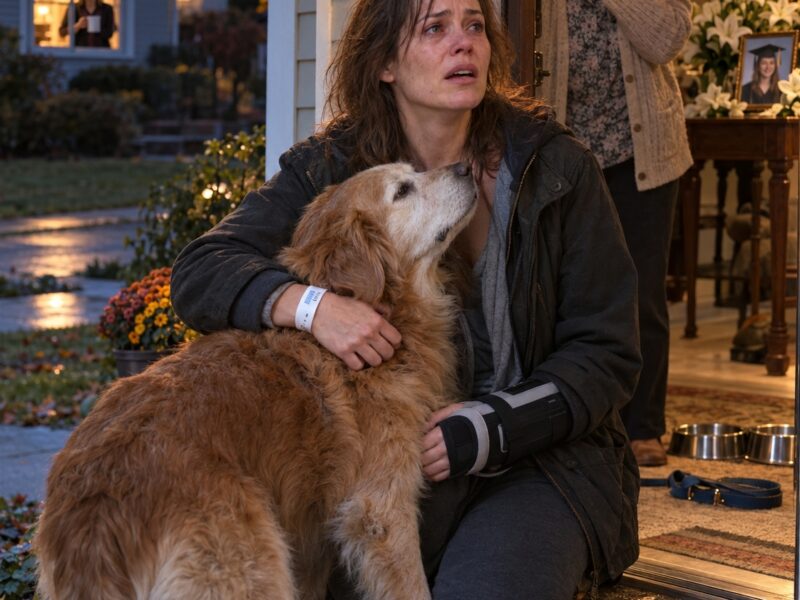
I stood inside the kitchen where I had eaten cereal before school for eighteen years, still wearing the plastic hospital bracelet I had forgotten to cut off. My left arm was locked inside a brace from wrist to elbow, my ribs hurt every time I breathed too deeply, and my twelve-year-old golden retriever was apparently living two houses away because my mother had decided he no longer belonged to me.
“When?”
She looked into her coffee.
“The first week.”
“The first week I was in the hospital?”
“You were busy.”
Busy.
That was the word.
Three weeks of surgery, pneumonia, fever, physical therapy, and learning how to button jeans with one hand had been reduced to busy.
I did not yell.
That surprised both of us.
My mother, Diane Whitaker, had spent most of my childhood teaching me that anger became evidence against the person who showed it. If I cried, I was dramatic. If I raised my voice, I was disrespectful. If I stayed calm, she usually found a way to call that cold.
At thirty-six, I had finally become good at giving her nothing she could use.
I picked up the rental-car keys from the kitchen counter.
She turned.
“Clare, don’t make a scene with those people.”
I stopped with my hand on the screen door.
“What people?”
“The Hendersons.”
“They’re two houses away.”
“I know where they live.”
“I mean don’t go over there acting like they did something wrong.”
I looked at her.
“I didn’t say they did.”
For one second, something passed through her face.
Not guilt exactly.
Calculation.
Then it disappeared.
“Baxter’s settled.”
“He’s old.”
“Moving him again will confuse him.”
That was almost funny.
She had removed him from my apartment while I was unconscious, taken away his bowls, his leash, his bed, every smell he knew, and now she was worried I might confuse him by coming back from the dead.
I opened the door.
“Clare.”
I looked back.
My mother lifted her mug with both hands.
“Please don’t embarrass me.”
That sentence landed harder than anything else.
Not please be careful.
Not you shouldn’t be driving.
Not I’m glad you’re alive.
Please don’t embarrass me.
I walked out.
The rental sedan was parked crooked beside her mailbox because turning the wheel with one usable arm still hurt. I lowered myself into the driver’s seat, pulled the belt across my bruised chest, and drove two hundred yards.
The Hendersons’ porch light was already on.
Lorraine Henderson opened the door before I knocked twice.
She was sixty-eight, a retired elementary-school secretary who still wore cardigans with tissues folded into the sleeves. I had known her since I was eight. She looked at my face and took one step backward.
Her hand covered her mouth.
Then she began to cry.
Not polite tears.
Not surprise.
Real grief breaking in reverse.
“Oh my God.”
I gripped the door frame.
“Where’s Baxter?”
Lorraine stared.
“Oh my God, Clare.”
I heard something behind her.
Nails on hardwood.
Slow.
Uneven.
A familiar drag on the left rear leg.
Baxter appeared at the end of the hallway.
Gray around the muzzle.
Cloudy eyes.
His tail hung still for half a second.
He lifted his nose.
Then his whole body changed.
A sound came out of his chest that I had not heard since he was a puppy.
High.
Broken.
Almost human.
He could not run anymore.
So he walked.
Fast as he could.
I got down on one knee with one good hand braced against the wall.
Baxter pushed his heavy face into my chest and nearly knocked me over.
I wrapped my right arm around him.
Twelve years leaned against me at once.
Tax seasons.
Breakups.
My father’s funeral.
Christmas mornings.
Three apartments.
Every night I had come home too tired to talk to another human being.
Baxter trembled.
I cried into his fur.
Lorraine stood behind us crying too.
Then she whispered the sentence that changed the entire shape of the day.
“Your mother told us you died.”
I stopped breathing.
Baxter kept pressing into me.
I looked up.
“What?”
Lorraine’s eyes widened as though she wanted to pull the words back.
“She told us you passed.”
“No.”
“Clare—”
“No.”
My voice did not sound like mine.
“She told you I died?”
Lorraine nodded.
“When?”
Her husband Gary appeared behind her.
He was seventy, quiet, broad-shouldered even after retirement, and had gone fishing with my father for thirty years.
He looked at me.
Then down.
“Saturday after your accident.”
I stared at him.
“That was three days after.”
Gary’s jaw tightened.
Lorraine said:
“She said you passed in the night.”
My mind began doing what it always did when emotion became too large.
Sorting.
Dates.
Facts.
Columns.
“Who else?”
Lorraine looked at Gary.
Then back at me.
“The prayer chain.”
My mouth went dry.
“The church?”
“Yes.”
“How many people?”
“I don’t know.”
“Everybody, probably.”
Baxter sat beside me.
His shoulder touched my leg.
Lorraine said:
“There’s supposed to be a memorial Sunday.”
For several seconds, I genuinely thought I had misheard.
“A memorial.”
“She called it a celebration of life.”
Gary said quietly:
“They’re planting a dogwood.”
I stared at them.
“A tree.”
Lorraine started crying again.
“There’s a plaque.”
I stood too quickly.
Pain ran through my ribs.
Gary reached for my elbow and stopped before touching me.
I waited until the room steadied.
Then asked:
“Why would they be planting a tree?”
Neither answered.
That told me there was more.
I looked at Lorraine.
“What else?”
She wiped her face.
“People gave money.”
The hallway seemed to narrow.
“For what?”
“Expenses.”
“What expenses?”
Lorraine looked ashamed.
“Funeral.”
I looked down at Baxter.
His steel bowls sat on a folded towel near the refrigerator.
Mine.
His.
Then I looked back at her.
“How much?”
“I don’t know.”
Gary said:
“I gave two hundred.”
The question I drove home with that night was no longer why my mother had given away my dog.
It was what, exactly, she had been doing with my death.
Twenty-one days earlier, a landscaping truck ran a red light on Route 33 and folded my Honda around a guardrail.
I remember almost none of the impact.
A horn.
White sky.
The sensation of turning sideways when the world should have stayed upright.
Then a paramedic saying my name like a question.
The next clear memory is waking beneath fluorescent lights while a surgeon explained that my spleen had been removed and my left forearm contained two metal plates I had not owned the day before.
My mother came the first morning.
I want that recorded accurately.
She came.
She sat in the vinyl chair beside my hospital bed for approximately forty minutes. Asked whether the surgery had gone well. Asked the nurse when I might be discharged.
Then she asked where my personal belongings were.
“I’ll take your keys.”
I was medicated enough that this sounded loving.
“Baxter.”
I whispered.
“I know.”
she said.
“I’ll take care of everything.”
I remember relief.
Warm.
Childish.
For forty minutes, I was not an auditor, homeowner, woman with an emergency contact list and paid leave and a twelve-year-old dog depending on me.
I was somebody’s daughter.
She was handling it.
She did not return.
The second week, I developed pneumonia.
Post-surgical complication.
Nothing dramatic for television.
Just the kind of medical setback that turns mornings and afternoons into the same gray stretch of fever.
My coworker Nadia Okafor came every evening.
Nadia is the sort of friend who does not ask whether you need anything because she assumes sick people should not have to manage healthy people’s usefulness.
She brought socks.
A phone charger before realizing my phone had been destroyed in the crash.
Lip balm.
Actual coffee.
On day nine, she brought a prepaid phone.
“Your mother called?”
she asked.
I shook my head.
“I called her twice.”
Nadia’s mouth tightened.
“She said Travis needed her.”
My younger brother.
Thirty-three.
Permanent emergency.
Truck payments.
Jobs that never lasted.
Relationships that somehow required my mother’s financial intervention.
“She said the hospital is far.”
Nadia added.
Seventy miles.
My mother drove ninety for Travis’s softball tournaments when we were teenagers.
I said nothing.
That night, I texted Mom first.
Can you send me a picture of Baxter?
She sent one three minutes later.
Baxter beneath a Christmas tree.
Red bow around his collar.
I smiled for nearly an hour.
The drugs helped.
So did loneliness.
I never noticed the tree.
It was September.
By the third week, I walked the hall twice a day with an IV pole and a physical therapist who called every movement “excellent progress” no matter how much it hurt.
My mother’s texts became shorter.
Rest.
Baxter’s fine.
Don’t worry about anything here.
That last word bothered me in hindsight.
Here.
As though something had been happening in a place I did not know existed.
Nadia signed me out on a Wednesday afternoon.
The insurance company had delivered an automatic rental to my apartment garage.
“You have one usable arm.”
she told me.
“Don’t be stupid.”
I promised.
First lie of the day.
The moment I opened my apartment door, I saw the empty leash hook.
Then the kitchen mat.
No
My Mother Gave Away My Twelve-Year-Old Dog While I Was in the Hospital—Then I Learned She Had Told Our Entire Town I Was Dead
My mother did not put down her coffee when she told me she had given away the dog who had slept beside me for twelve years.
Three weeks earlier, I had been lying in a hospital bed with a missing spleen, a broken arm, and no idea she was emptying my apartment while telling neighbors I was dead.
By the time I found Baxter two houses away, an entire church had collected money for my funeral—and the first person to cry when she saw me alive was not my mother. Văn bản đã dán (1)
My mother did not put her coffee down when she told me she had given Baxter away.
“We gave him to the Hendersons,” she said, as if she were telling me she had dropped off an old winter coat. “He’s happier there. A dog his age needs a yard.”
I stood inside the kitchen where I had eaten cereal before school for eighteen years, still wearing the plastic hospital bracelet I had forgotten to cut off. My left arm was locked inside a brace from wrist to elbow, every deep breath tugged at the incision where my spleen had been removed, and my twelve-year-old golden retriever was apparently living two houses away because my mother had decided he no longer belonged to me.
“When?”
She looked into her coffee.
“The first week.”
“The first week I was in the hospital?”
“You were busy.”
Busy.
That was the word.
Three weeks of surgery, pneumonia, fever, physical therapy, and learning how to button jeans with one hand had been reduced to busy.
I did not yell.
That surprised both of us.
My mother, Diane Whitaker, had spent most of my childhood teaching me that anger became evidence against the person who showed it. If I cried, I was dramatic. If I raised my voice, I was disrespectful. If I stayed calm, she usually found a way to call that cold.
At thirty-six, I had finally become good at giving her nothing she could use.
I picked up the rental-car keys from the kitchen counter.
She turned.
“Clare, don’t make a scene with those people.”
I stopped with my hand on the screen door.
“What people?”
“The Hendersons.”
“They’re two houses away.”
“I know where they live.”
“I mean don’t go over there acting like they did something wrong.”
“I didn’t say they did.”
For one second, something passed through her face.
Not guilt exactly.
Calculation.
Then it disappeared.
“Baxter’s settled. He’s old. Moving him again will confuse him.”
That was almost funny.
She had removed him from my apartment while I was unconscious, taken away his bowls, his leash, his bed, every smell he knew, and now she was worried I might confuse him by coming back.
I opened the door.
“Clare.”
I looked back.
My mother lifted her mug with both hands.
“Please don’t embarrass me.”
That sentence landed harder than anything else.
Not please be careful.
Not you shouldn’t be driving.
Not I’m glad you’re alive.
Please don’t embarrass me.
I walked out.
The rental sedan was parked crooked beside her mailbox because turning the wheel with one usable arm still hurt. I lowered myself into the driver’s seat, pulled the belt across my bruised chest, and drove two hundred yards.
The Hendersons’ porch light was already on.
Lorraine Henderson opened the door before I knocked twice.
She was sixty-eight, a retired elementary-school secretary who still wore cardigans with tissues folded into the sleeves. I had known her since I was eight. She looked at my face and took one step backward.
Her hand covered her mouth.
Then she began to cry.
Not polite tears.
Not surprise.
Real grief breaking in reverse.
“Oh my God.”
I gripped the door frame.
“Where’s Baxter?”
Lorraine stared.
“Oh my God, Clare.”
I heard something behind her.
Nails on hardwood.
Slow.
Uneven.
A familiar drag on the left rear leg.
Baxter appeared at the end of the hallway.
Gray around the muzzle.
Cloudy eyes.
His tail hung still for half a second.
He lifted his nose.
Then his whole body changed.
A sound came out of his chest that I had not heard since he was a puppy.
High.
Broken.
Almost human.
He could not run anymore.
So he walked.
Fast as he could.
I got down on one knee with one good hand braced against the wall.
Baxter pushed his heavy face into my chest and nearly knocked me over.
I wrapped my right arm around him.
Twelve years leaned against me at once.
Tax seasons.
Breakups.
My father’s funeral.
Christmas mornings.
Three apartments.
Every night I had come home too tired to talk to another human being.
Baxter trembled.
I cried into his fur.
Lorraine stood behind us crying too.
Then she whispered the sentence that changed the entire shape of the day.
“Your mother told us you died.”
I stopped breathing.
Baxter kept pressing into me.
I looked up.
“What?”
Lorraine’s eyes widened as though she wanted to pull the words back.
“She told us you passed.”
“No.”
“Clare—”
“No.”
My voice did not sound like mine.
“She told you I died?”
Lorraine nodded.
“When?”
Her husband Gary appeared behind her.
He was seventy, quiet, broad-shouldered even after retirement, and had gone fishing with my father for thirty years.
He looked at me.
Then down.
“Saturday after your accident.”
I stared at him.
“That was three days after.”
Gary’s jaw tightened.
Lorraine said, “She said you passed in the night.”
My mind began doing what it always did when emotion became too large.
Sorting.
Dates.
Facts.
Columns.
“Who else?”
Lorraine looked at Gary.
Then back at me.
“The prayer chain.”
My mouth went dry.
“The church?”
“Yes.”
“How many people?”
“I don’t know. Everybody, probably.”
Baxter sat beside me, shoulder pressed to my leg.
Lorraine wiped her face.
“There’s supposed to be a memorial Sunday.”
For several seconds, I genuinely thought I had misheard.
“A memorial.”
“She called it a celebration of life.”
Gary added quietly, “They’re planting a dogwood.”
“A tree?”
Lorraine nodded.
“There’s a plaque.”
I stood too quickly.
Pain pulled across my ribs.
Gary reached toward my elbow, then stopped before touching me.
I waited until the room steadied.
Then asked, “Why would they be planting a tree?”
Neither answered.
That told me there was more.
“What else?”
Lorraine closed her eyes.
“People gave money.”
“For what?”
“Expenses.”
“What expenses?”
Her voice dropped.
“Funeral.”
I looked past her into the kitchen.
Two steel bowls sat on a folded towel beside the refrigerator.
Baxter’s.
Mine, in every practical sense, because I had washed those bowls every night for twelve years.
Gary said, “I gave two hundred.”
The question I drove home with that night was no longer why my mother had given away my dog.
It was what, exactly, she had been doing with my death.
Twenty-one days earlier, a landscaping truck ran a red light on Route 33 and folded my Honda around a guardrail.
I remember almost none of the impact. A horn. White sky. The strange sensation of turning sideways when the world should have stayed upright. Then a paramedic saying my name like a question.
The next clear memory is waking beneath fluorescent lights while a surgeon explained that my spleen was gone and my left forearm contained two metal plates I had not owned the day before. He said I was lucky in the precise tone doctors use when they know luck is not the word you would choose for anything happening to your body.
My mother came that first morning.
I want that recorded accurately.
She came.
She sat in the vinyl chair beside my bed for approximately forty minutes, asked whether the surgery had gone well, asked the nurse when I might be discharged, then asked where my personal belongings were.
“I’ll take your keys.”
I was medicated enough that this sounded loving.
“Baxter,” I whispered.
“I know,” she said. “I’ll take care of everything.”
I remember relief.
Warm.
Childish.
For forty minutes, I was not an auditor, homeowner, woman with an emergency-contact list and paid leave and a twelve-year-old dog depending on me.
I was somebody’s daughter.
She was handling it.
She did not return.
The second week, I developed pneumonia.
Post-surgical complication.
Nothing dramatic for television.
Just the kind of medical setback that turns mornings and afternoons into the same gray stretch of fever.
My coworker Nadia Okafor came every evening.
Nadia is the sort of friend who does not ask whether you need anything because she assumes sick people should not have to manage healthy people’s usefulness. She brought socks, lip balm, actual coffee, and a phone charger before realizing the phone itself had been destroyed in the crash.
On day nine, she brought a prepaid one.
“Your mother call?” she asked.
I shook my head.
“I called her twice,” Nadia said.
My stomach tightened.
“What did she say?”
“That Travis needed her. The hospital was too far. She said to tell you she was praying.”
Seventy miles.
My mother had driven ninety for Travis’s baseball tournaments when we were teenagers.
I said nothing.
That night, I texted Mom first.
Can you send me a picture of Baxter?
She sent one three minutes later.
Baxter beneath a Christmas tree.
Red bow around his collar.
I smiled for nearly an hour.
The drugs helped.
So did loneliness.
I never noticed the tree.
It was September.
By the third week, I walked the hospital hallway twice a day with an IV pole and a physical therapist who called every movement “excellent progress” no matter how much it hurt. My mother’s texts became shorter.
Rest.
Baxter’s fine.
Don’t worry about anything here.
That last word bothered me in hindsight.
Here.
As though something had been happening in a place I did not know existed.
Nadia signed my discharge paperwork with me on a Wednesday afternoon.
The insurance company had delivered an automatic rental to my apartment garage.
“You have one usable arm,” Nadia said. “Don’t be stupid.”
I promised.
First lie of the day.
The moment I opened my apartment door, I saw the empty leash hook.
Then the kitchen mat.
No bowls.
My television was gone too.
Four screw holes remained above the low cabinet, with a rectangle of cleaner paint where the screen had protected the wall from years of dust.
A framed photograph of my father and me at Lake Erie was missing from the bookshelf.
Three kitchen drawers hung open.
An envelope lay just inside the doorway.
Property management.
I shoved it into my jacket pocket without opening it because my brain had room for exactly one thing.
Baxter.
I called my mother.
No answer.
Again.
No answer.
Nadia stood behind me, silent.
“Let me drive you tomorrow.”
“He’s twelve.”
“I know.”
“He doesn’t know what tomorrow is.”
Her face changed.
“Clare.”
I picked up the rental keys.
Seventy miles with one arm is not something I recommend.
Every lane change tugged my healing ribs, and every pothole sent a complaint through my forearm. I counted highway exits the way I count rows in a spreadsheet—one after another—because numbers keep behaving even when families do not.
Milbrook looked the same at dusk as it had when I was sixteen.
Grain elevator.
Dairy barn.
Water tower with the faded Wildcats mascot.
The feed store that still closed at five.
My mother’s porch light was on.
The kitchen window glowed yellow.
I could hear television through the basement vent, which meant Travis was downstairs.
Mom sat at the kitchen table with a mug.
When she saw me in the doorway, her face did something I would think about for months.
For one second it went blank.
Not relieved.
Not shocked.
Blank, like a screen before it loads.
Then she said, “You’re home early.”
Only after that did she tell me about Baxter.
We gave him away.
He’s happier.
Old dog needs a yard.
I asked when.
First week.
You were busy.
I left.
She told me not to embarrass her.
Two hundred yards later Lorraine told me I was dead.
That night I did not drive back to Columbus.
Lorraine refused.
“You can barely turn your neck,” she said. “And Baxter has already decided you’re sleeping here.”
He had.
He lay across the guest-room doorway as if twelve years away from me had occurred in twenty-one days and he intended to personally prevent a second mistake.
Lorraine brought tea.
Gary brought a folded quilt.
Neither asked me what I was going to do.
I appreciated that more than kindness.
People often confuse support with instruction.
At nine-thirty, I sat on their living-room floor with Baxter’s head across my thigh and asked Lorraine to tell me everything.
She did it in pieces.
My mother came to their backyard fence three days after my crash.
Dry-eyed.
“My Clare passed early this morning.”
Lorraine had gasped.
Diane told her the hospital called.
Complications.
Nothing could be done.
“She said she couldn’t stand to look at Baxter,” Lorraine said. “Travis brought him over about an hour later.”
“With his stuff?”
“Bowls. Leash. Your blue blanket.”
I wrote the date on a notepad Lorraine handed me.
September 6.
At eight that morning, the church prayer chain went out.
By noon, there were casseroles.
By Sunday, Pastor Dale Brener announced my death from the pulpit.
“Clare Whitaker, who went home to the Lord.”
I wrote that too.
On September 14, the church collected a love offering.
Forty-seven envelopes.
Cash.
Checks.
Money intended to help my family with expenses.
On September 20, the church paid a nursery nine hundred dollars for a dogwood and engraved plaque for my memorial.
The service was scheduled for Sunday the twenty-eighth.
My graduation photograph already stood in the narthex.
My mother had taken it from her mantel.
Flowers on either side.
The plaque read:
CLARE MARIE WHITAKER
BELOVED DAUGHTER
I stared at that word.
Beloved.
Lorraine said, “She said you didn’t want a funeral.”
“What?”
“She said you always hated people looking at you, so she wanted something quiet and meaningful.”
I almost laughed.
Instead I wrote it down.
“What else?”
Gary stood by the doorway.
“I put in two hundred.”
“Why?”
“Your dad and I fished thirty years.”
He looked ashamed.
As if generosity had become something embarrassing because the person receiving sympathy remained alive.
“That is not on you.”
Gary nodded once.
I asked Lorraine whether anyone requested proof.
Death certificate.
Hospital confirmation.
Funeral-home paperwork.
She did not know.
“What was the money used for?”
“I don’t know.”
“Did Mom say?”
“She said bills.”
“What bills?”
Lorraine’s face tightened.
“I assumed hospital.”
I wrote assumed.
When emotion gets too large, I make columns.
That is what I do professionally too.
I audit small nonprofits and churches for a regional accounting firm in Columbus.
I have spent fifteen years looking at handwritten ledgers, memorial gifts, restricted donations, benevolence accounts, and volunteer treasurers who keep receipts in grocery bags.
Numbers are not automatically honest.
But they leave trails.
People do too.
At ten-thirty, Lorraine took the pad from my hand.
“Honey, whatever you decide, he sleeps here tonight.”
She looked at Baxter.
“And so do you.”
I went to the guest room.
Baxter settled against the footboard.
I turned carefully.
Something crackled inside my jacket.
The property-management envelope.
I opened it at the Hendersons’ kitchen table the next morning while Lorraine made scrambled eggs and pretended not to watch.
It was addressed to:
Ms. Diane Whitaker
Next of Kin for Resident Clare Whitaker
Unit 3B
The first paragraph expressed condolences.
The second explained the documents required to terminate my lease and release my security deposit.
Certified death certificate.
Letters of administration or a qualifying small-estate affidavit.
Mailing instructions.
Date:
September 10.
Seven days after my accident.
I read it three times.
My mother had gone to my building while I was still hospitalized and asked how to close my apartment because I was dead.
I called management.
A woman named Maria Ruiz answered.
When I gave my name, she went silent so long I checked the screen.
“Ms. Ruiz?”
“I’m here.”
Then:
“Miss Whitaker, I am extremely glad to hear your voice.”
I closed my eyes.
“What did my mother tell you?”
“She and a man who identified himself as your brother came in.”
“When?”
“September tenth.”
“What did they ask?”
“How to clear the apartment legally.”
“And the deposit?”
“She asked where it would be sent.”
“How much?”
“Eighteen hundred.”
My hand tightened around the phone.
“Did you give her access?”
“You had listed her as emergency contact when you moved in six years ago.”
I had forgotten.
“So yes?”
“We permitted entry for welfare and property retrieval after she represented that you had died.”
Ms. Ruiz sounded sick.
“She said she needed clothing and family items.”
“My television is gone.”
Pause.
“I’m sorry.”
“Did you see them remove it?”
“No.”
“Cameras?”
“Hallway.”
“Preserve them.”
She straightened audibly.
“What?”
“Please preserve all footage showing my mother or brother accessing unit three-B, elevators, or garage between September sixth and today.”
“You sound like you know what you’re doing.”
“I audit organizations.”
Another pause.
“I almost called the hospital.”
“Why?”
“She never brought the death certificate.”
“What stopped you?”
“The hospital wouldn’t confirm patient information.”
HIPAA.
Privacy had protected me medically and helped kill me administratively.
“Preserve the video,” I repeated.
“I will.”
Next I called my neighbor, Mr. Okafor.
He lived across the hall.
Retired mechanical engineer.
Watered my plants when I traveled.
When he answered and heard my voice, he said nothing for several seconds.
Then:
“Clare?”
“Yes.”
“Oh, thank God.”
He told me he watched Mom and Travis carry my television and three boxes to the elevator.
Travis said:
“My sister passed.”
Mr. Okafor bought a plant and left it beside my door.
I had stepped over it the night before.
It was dead.
I thanked him.
Then Nadia video-called.
One look at me and she said:
“You found something.”
“My mother tried to close my lease.”
Nadia closed her eyes.
“Clare.”
“She took my television.”
“That is not the important part.”
“I know.”
“What are you going to do?”
“I need the number.”
Nadia stared.
“That’s what you say when you’re scared.”
I knew.
I hung up anyway.
Lorraine placed eggs in front of me and did not ask what Ms. Ruiz said.
That is how I knew she had heard every word.
“This isn’t about Baxter anymore,” I said.
“No.”
“My mother tried to liquidate me.”
Lorraine sat opposite.
Apartment.
Deposit.
Television.
Boxes.
Possibly my grandmother’s cedar keepsake chest, which had vanished from my bedroom closet.
“She was settling my estate while I was learning to walk hospital hallways.”
Lorraine’s mouth tightened.
“What now?”
“I go to the person who keeps the books before I go to the person who keeps the story.”
Milbrook Community Church sat one block from the high school.
White siding.
Brick addition.
Bell tower too small for the building.
Sign out front:
CELEBRATION OF LIFE FOR CLARE WHITAKER
SUNDAY 10:00 AM
I parked beneath it.
Baxter sat in the passenger seat.
“You’re bringing him?” Lorraine had asked.
“He’s the only evidence I have that doesn’t need a signature.”
The church secretary saw me first.
Her name was June.
She had taught vacation Bible school when I was ten.
She made a small sound.
Not scream.
More like a hiccup.
Pastor Dale Brener came from his office.
Soft-spoken.
Early fifties.
Remembered every child’s name.
He saw me.
Saw Baxter.
Put one hand against the door frame.
“I’m Clare Whitaker.”
He almost laughed from nerves.
“I know.”
“I’m not dead.”
“I can see that.”
“I’d like to see the records for gifts made in my memory.”
He looked toward the office phone.
“I should call your mother.”
“You can after.”
I held up my folder.
“Right now, I need Walt Jennings.”
Walt arrived twenty minutes later carrying a black ledger and a laptop he clearly considered a personal insult.
Seventy-two.
Bow tie.
Forty years at Milbrook First Federal before retirement.
He looked at me over his glasses.
“Church books aren’t public records.”
“I know.”
“I’m not a member.”
“You’re not.”
“But I’m the line item.”
That did it.
Walt sat.
Opened the ledger.
September 8.
Benevolence fund.
Two thousand dollars.
Payee:
Diane Whitaker.
Memo:
Funeral expenses.
One approval signature.
No supporting form.
September 14.
Special love offering.
$6,340.
Forty-seven envelopes.
September 17.
Check #4471.
$6,340.
Payee:
Diane Whitaker.
September 20.
Hollis Nursery.
$900.
Dogwood plus engraved plaque.
Total:
$9,240.
The church had retained nine hundred for the tree expense, meaning $8,340 had gone directly to my mother.
My mother had accepted $8,340 because I was dead while I was alive in a hospital seventy miles away.
I asked, “Who approved the plaque text?”
Walt checked.
“No board note.”
Pastor Brener said quietly, “Diane called the nursery.”
Walt removed his glasses.
“I spent forty years at a bank.”
He looked at the ledger.
“I didn’t ask her for one piece of paper.”
Pastor Brener leaned against the desk.
“She was grieving.”
I looked at him.
“Was she?”
He flinched.
“We took her at her word.”
“That’s not what I asked.”
He sat.
“No.”
His voice became smaller.
“I don’t know.”
Then he told me something that mattered.
On September eighteenth, Mom asked him for a letter on church letterhead confirming my death.
For my apartment.
He asked for the death certificate so he could cite something official.
She said the hospital was slow.
He refused.
“I knew something felt wrong.”
Pastor Brener rubbed his face.
“I did nothing.”
I did not comfort him.
I did not accuse him.
I asked Walt if the list of forty-seven donors still existed.
“Yes.”
“I want a copy.”
He hesitated.
Pastor Brener said:
“Give it to her.”
I thanked them.
Outside, Walt followed me.
Baxter moved slowly beside us.
“There’s something else,” Walt said.
I turned.
“When Diane collected the first check, she said Travis was about to lose his truck.”
My stomach dropped.
“She said you would want him to keep it.”
“When?”
“September eighth.”
The first two thousand.
Walt looked miserable.
“The next week Travis told the men’s group he’d caught up the loan.”
I stared toward the church sign bearing my name.
My mother had turned my death into my brother’s truck payment.
“What about the $6,340?”
“I don’t know.”
“Cash or deposited?”
“Check.”
“Into what account?”
“I don’t have her banking records.”
Good.
He stayed inside his facts.
Then he added:
“She also told Dale she needed to get into your apartment because a few things belonged to her mother.”
My grandmother’s cedar chest.
Walt looked toward the building.
“She asked for three minutes Sunday.”
“At the memorial?”
“To thank everyone.”
I sat in the rental car and arranged the dates the way I would reconcile statements.
September 3:
Crash.
September 4:
Mom took my keys.
September 6:
Baxter given away.
My death announced.
September 8:
$2,000 paid.
September 9:
Travis caught up truck loan.
September 10:
Mom tried to terminate apartment and collect deposit.
September 14:
Love offering.
September 17:
$6,340 paid.
September 20:
Tree and plaque ordered.
September 28:
Public memorial.
That was not grief getting away from someone.
That was a schedule.
I wanted it to be grief.
I wanted that so badly I almost offered the explanation to her myself.
Walt asked:
“What do you want us to do?”
“Nothing yet.”
He raised an eyebrow.
“I need to talk to my mother.”
“Why?”
“She gets one chance to tell me what happened before I decide what comes next.”
Walt nodded.
Did not say good idea.
Did not say bad.
I have since decided wisdom often sounds like an elderly man refusing to borrow your decision.
My phone rang.
Mom.
First call from her in twenty-one days.
She came to the Hendersons’ porch at six-thirty that evening.
Church cardigan.
Hair sprayed into place.
No makeup except lipstick.
She did not look at Baxter.
He lay between us like a border.
Mom began where she always began.
With injury.
“You went to the church before coming to me.”
“I came to you first.”
“You interrogated me.”
“You were drinking coffee.”
She ignored that.
“They told me you might not make it.”
“Who?”
“The hospital.”
“No one at the hospital told you I died.”
“They said you were very sick.”
“Then you turned sick into dead?”
“I was beside myself.”
“Three days after my accident?”
She flinched.
“I thought I had lost you.”
“Then why didn’t you come back?”
“Travis needed me.”
Of course.
Version one shifted.
“I made a mistake announcing it.”
I said nothing.
“You know how Milbrook is.”
“Once people started calling…”
“I couldn’t stop it.”
“You didn’t stop it for three weeks.”
She folded her hands.
“I didn’t know when you were coming home.”
That sentence almost impressed me.
“You texted me.”
“I sent messages.”
“You sent me a Christmas picture of Baxter.”
Her face flickered.
She had not expected me to notice.
“I couldn’t get a new picture.”
“Because you had already given him away.”
Silence.
Version two arrived.
“The money was for you.”
“For hospital bills.”
“I was holding it.”
“You paid Travis’s truck loan.”
Mom looked toward the yard.
“He needed it.”
There it was.
Twenty years collapsed into one sentence.
“You’re the one who can take care of yourself.”
Exactly what she said when I was sixteen.
Word for word.
I felt something inside me stop hoping.
Not break.
Hope does not always break dramatically.
Sometimes it simply gets enough evidence.
Mom leaned forward.
Her voice softened.
The church-lady voice.
The voice she used on Dad when she needed agreement to sound like mercy.
“Come Sunday.”
I stared.
“We’ll call it what it is.”
“What is it?”
“A miracle.”
I almost laughed.
“Everyone wants to see you.”
“Nobody needs to hear about checks.”
She let the sentence sit.
“You’ll have the whole church around you, Clare.”
“Have you ever had that?”
“Even once?”
That was the sharpest thing she said.
Because she knew the answer.
No.
Not once.
Not when I graduated.
Not when my father died.
Not when I bought my condo.
Not when I became partner-track at the firm.
There had never been a room full of people gathered for me.
Now there was.
Because I was dead.
She offered me the room if I agreed not to correct the price of admission.
“The programs are printed,” she continued.
“More than a hundred people are coming.”
“If you make this ugly, you won’t only embarrass me.”
“You’ll embarrass Dale.”
“Walt.”
“Every woman who made food.”
“Every person who gave because they loved you.”
“Do you want to make them fools?”
I did not answer.
Mom stood.
Walked down two porch steps.
Stopped with one hand on the railing.
Then the last card.
“Don’t make me the villain in front of them.”
Her voice cracked.
“I don’t have anybody else.”
She walked home.
Two houses.
Never looked back.
Lorraine opened the screen door after several minutes.
“Do you want me not to ask anything?”
I nodded.
Then:
“Do you know how much I wanted to say yes?”
Lorraine sat in the recliner.
I talked.
She listened.
If I went Sunday and smiled, Mom would hug me in front of one hundred people.
Travis would keep his truck.
Milbrook would remain a place I could call home.
The church would not have to admit it had written two checks without documentation.
No police.
No scandal.
No board meetings.
No one embarrassed.
My mother could say miracle.
I could say nothing.
For five minutes, it sounded almost merciful.
Then I made myself read the other column.
Gary’s two hundred.
Mrs. Patel’s fifty-dollar envelope.
People on fixed incomes.
Pastor Brener, who suspected something and failed to act.
Walt, who kept a ledger accurately enough that truth had somewhere to live.
My neighbor’s dead plant.
Ms. Ruiz’s condolence letter.
Baxter being carried into another house.
My own photograph in a church lobby while I learned to walk again.
I thought about Dad’s funeral four years earlier.
How my mother cried at the front of the church and accepted envelopes.
His life insurance was $25,000.
She used most of it to “get Travis settled.”
Three months later, Dad still had no headstone.
I paid $3,100 for one.
At the reception Mom told relatives:
“Clare’s so busy up in Columbus.”
That sentence became her explanation for my absence from everything she never invited me to.
Every year, I sent her $2,600 for property taxes because she said Dad would have wanted the house secure.
I never made scenes.
Making a scene meant risking the last title I had in that home.
Daughter.
I believed if I handled enough, paid enough, forgave enough, eventually she would see me.
Now I understood something uglier.
Every time I stayed silent, my mother got paid for the story of me.
Sometimes emotionally.
Sometimes literally.
Lorraine finally spoke.
“I didn’t take Baxter to be kind.”
I looked at her.
“I took him because I thought nobody was left to remember you.”
Her eyes filled.
“I was wrong.”
Then:
“But you pay attention to who cried for you.”
“And who wrote the check.”
I slept badly.
Baxter pressed his back against the guest-room bed frame exactly as he had done in my apartment for twelve years.
Nadia texted:
You don’t have to decide tonight. You have to sleep.
At seven the next morning, Travis’s truck blocked the Hendersons’ driveway.
He leaned against the hood.
Thirty-three.
Still stood like a boy waiting to hear whether the principal had called.
“Mom’s sixty-three.”
That was his opening.
“You want her arrested over church money?”
“I haven’t called the police.”
“You went through church books.”
“Because I’m apparently dead in them.”
He looked away.
“I’ll pay it back.”
“With what?”
Silence.
I walked down the steps slowly.
“Did you carry Baxter over?”
“Yes.”
“Did you take my television?”
“Mom wanted something to watch.”
I stared.
“You stole my television because Mom was bored?”
“It wasn’t like that.”
“What were the boxes?”
“Kitchen stuff.”
“Grandma’s cedar chest?”
“In Mom’s basement.”
“Why?”
“She said some of Grandma’s things belonged in the family.”
“I am family.”
Travis rubbed the back of his neck.
“Nothing got damaged.”
He said it like an inventory clerk expecting praise.
I asked:
“Before you took the television, did you ask whether I was alive?”
“Mom said—”
He stopped.
That unfinished sentence told me enough.
He had known he should verify.
He chose convenience.
“The tree is paid for,” he continued.
“Programs printed.”
“You just show up.”
“Smile.”
“Let her say a few words.”
“Everybody’s happy.”
I looked at him.
“You believe that?”
“Clare, you always have to make things harder.”
There it was.
The family translation of my refusal to absorb consequences silently.
“You do this to her,” he said, “don’t bother coming home.”
Gary came from the garage holding coffee.
Did not speak.
Just stood beside me.
Travis climbed into his truck.
Left.
I watched the taillights disappear.
I noticed I was not surprised.
That is its own kind of answer.
I sat in the rental car without starting it and called Nadia.
First thing I said:
“I know what I’m going to do.”
Pause.
“And I hate it.”
“Good.”
“What?”
“The decisions you enjoy immediately are usually the dangerous ones.”
I laughed once.
Then listed options.
Police.
No police.
Expose Mom.
Protect Mom.
Go Sunday and accept miracle.
Stay away and let a funeral occur for a woman eating eggs two houses down.
Nadia listened.
When I finished, she said:
“You’re looking for the version where you’re not the main character.”
I frowned.
“What?”
“You always do that.”
“You make the other person’s feelings the central problem.”
“Your mother’s humiliation.”
“Your brother’s truck.”
“The church’s embarrassment.”
“The donors’ regret.”
“Where are you in the list?”
I said nothing.
“You are the dead woman, Clare.”
That landed.
So I decided.
I would go Sunday.
I would not tell Mom.
I would not accuse her from the pulpit.
I would not bring a stack of evidence.
I would sit in the last pew with Baxter and let reality enter the room.
If Mom stood up and told the truth, I would walk forward and stand beside her.
If she called it a miracle, I would not help her.
The choice would be hers.
I drove to the church.
Pastor Brener listened.
He disliked my plan immediately.
“That is a trap.”
“No.”
“It is a choice in front of witnesses.”
“That sounds like a trap.”
“I’m not asking you to expose her.”
“I’m asking you not to help her lie.”
I gave him three requests.
Do not warn her.
Prepare a statement saying every gift made in my memory would be returned.
And if Mom requested her three minutes, allow them.
He looked at me.
“You want to give her the microphone?”
“Yes.”
“Why?”
“Because privately she can rewrite me again.”
“In public she gets one version.”
He leaned back.
“And if she confesses?”
“I stand with her.”
He stared for a long time.
Then nodded.
“I’ll call Walt.”
Saturday morning Walt arrived with a shoebox containing forty-seven empty donation envelopes.
We built a spreadsheet in the church finance room.
Name.
Amount.
Cash/check.
Address.
Three envelopes had cash with no identifying information.
Those funds would return to the benevolence fund with a bulletin notice explaining the reason.
No drama.
No public donor list.
No punishment disguised as transparency.
Just accounting.
Between rows, I handled my life.
Insurance company:
Emergency contact changed from Diane Whitaker to Nadia Okafor.
Microchip registry:
New phone number.
Apartment:
Locksmith scheduled.
Medical records:
Mom’s release authorization revoked.
Bank:
Security questions updated.
Walt watched quietly.
“You’ve done this before.”
“Cleaned up controls after somebody abused access?”
“Yes.”
“Many times.”
“For yourself?”
I stopped typing.
“No.”
He nodded.
That afternoon Lorraine brought sandwiches.
Baxter slept beneath the finance table.
At six, Lorraine opened Facebook and went still.
Mom had posted:
Tomorrow at 10 we celebrate my Clare’s life and plant her tree. Please come. I have something I need to say to everyone who has loved us through this impossible loss.
Sixty-one likes in an hour.
At seven, Pastor Brener called.
“She asked for three minutes.”
“You gave them?”
“Yes.”
His voice sounded tired.
“I’m praying she uses them.”
At seven-thirty Travis texted:
Mom says you didn’t say no. Thank you.
I did not answer.
That told me what Mom was doing.
She was betting silence meant surrender.
It had for twenty years.
Sunday would be the first time that bet lost.
Lorraine buttoned my dark blue dress because my left hand still lacked full strength.
Gary brushed Baxter and tied a blue ribbon around his collar.
“Not red,” he said. “Christmas is a long way off.”
The church parking lot was full.
More than full.
Cars along the road.
Gary parked facing out.
“In case you need to leave.”
“Paranoid.”
“Prepared.”
The narthex smelled like lilies and coffee.
My graduation photograph stood on a wooden easel.
Twenty-two-year-old me.
Cap.
Gown.
Laughing at something outside the frame.
My mother had originally stood beside me.
She had cropped herself out years ago so the picture fit a smaller frame.
Below it:
Brass plaque.
CLARE MARIE WHITAKER
BELOVED DAUGHTER
I read beloved twice.
The organ started.
Lorraine touched my elbow.
“Wait until the hymn ends?”
“No.”
“I want to walk in while they’re singing.”
“So nobody has to decide whether to look.”
I opened the sanctuary doors.
Took the end of the last pew.
Baxter lay in the aisle beside me with the grunt of an old dog making a permanent decision.
The room held maybe one hundred twenty people.
Built for ninety.
Mom sat in the front row.
Back straight.
Handkerchief folded in her lap.
Travis beside her.
Pastor Brener at the pulpit.
Walt stood near the usher table holding the black ledger.
Mrs. Patel sat two rows ahead of me.
Retired schoolteacher.
Eighty.
She heard Baxter’s nails click on tile.
Turned.
Looked at the dog.
Then at me.
Her hymnal closed by itself.
One hand went flat against her chest.
Recognition moved through the sanctuary the way wind moves across wheat.
One shoulder.
Then another.
A man in the aisle stopped singing in the middle of a line.
Nobody screamed.
People rarely scream in church.
They become very still.
Then look sideways to confirm reality.
Pastor Brener saw me.
Closed his eyes for one second.
Kept singing.
Mom did not turn.
Travis did.
His face drained.
He saw Baxter.
Saw me.
Turned back.
Shoulders rigid.
He did not warn her.
I have thought about that often.
Perhaps cowardice.
Perhaps mercy.
Perhaps the first thing he had ever refused to do for her.
He let her remain inside her story a few minutes longer.
The hymn ended.
Pastor Brener preached eight minutes instead of twenty.
About people we think we have lost.
About the mercy of being wrong.
He chose every word carefully enough that I could hear the effort.
Then he closed his notes.
“Diane has asked to say a few words.”
Mom rose.
Walked up three carpeted steps.
Turned.
Saw the last pew.
Saw me.
She got as far as:
“Thank you all for—”
Then stopped.
Three seconds.
I have sat through fire alarms shorter than those three seconds.
Somewhere a child whispered:
“Why’d she stop?”
Mom’s handkerchief remained halfway to her face.
Travis stared at the floor.
Then Mom made the choice I had predicted and still hoped she would not.
Her face broke.
Both hands lifted.
“Oh, praise God.”
A sound moved through the room.
“Praise God!”
Her voice rose.
“She’s here.”
“It’s a miracle.”
“My baby came back to me.”
Half the congregation stood.
An amen came from the front.
Someone behind me whispered:
“Thank you, Jesus.”
For perhaps five seconds, her version won.
Because miracles are easier than fraud.
Easier than family systems.
Easier than admitting a woman had been alive seventy miles away while donations were counted in her name.
Mom came down the center aisle with her arms open.
“Come here, baby.”
Baxter stood before I did.
He moved between my knees.
As she approached, he stepped backward.
The fur along his spine rose.
Not dramatic.
Not aggressive.
Recognition.
A dog does not understand miracle.
He remembered who put him in a truck.
People near us saw it.
Mom saw it.
Her arms faltered.
I stood.
Did not walk toward her.
Instead I turned and went back into the narthex.
Someone gasped.
Perhaps they thought I was leaving.
I lifted my graduation photograph from the easel.
Heavy frame against my chest.
Then I returned.
Baxter at my knee.
Six pews between Mom and me.
I did not raise my voice.
The room had become quiet enough that I did not need one.
“I wasn’t dead, Mom.”
Her face collapsed.
“I was in a hospital bed seventy miles away.”
“You had the number.”
Her arms lowered.
She tried one more time.
The last defense became the first thing she had never said publicly.
“I kept the money for you.”
Silence changed.
A few people sat.
“I was going to give you everything today.”
Mrs. Patel’s voice came sharp from the second row.
“What money, Diane?”
Mom looked toward her.
Pastor Brener stepped into the aisle.
Ten feet.
Maybe the hardest ten feet of his ministry.
He read the statement we prepared.
“The gifts given in Clare Whitaker’s memory will be returned in full to each giver. The dogwood will not be planted here today. The remaining issues will be handled privately by the family, the church board, and appropriate professionals. We ask everyone to respond with both compassion and truth.”
At the back, Walt lifted the ledger.
Said nothing.
The book spoke.
Travis stood.
Looked at Mom.
Looked at me.
Sat again.
Mom lowered herself into the front pew.
For ten seconds, nobody went to her.
Then one woman from her Tuesday Bible group crossed the aisle and put a hand on her shoulder.
I was glad.
Accountability does not require cruelty.
I said nothing else.
Nothing else belonged to me.
I walked out with Baxter and my own photograph under my arm.
Lorraine followed.
In the churchyard, a young dogwood sat in burlap beside a hole somebody had already dug.
Mrs. Patel found me first.
She took my good hand in both of hers.
“I gave fifty dollars.”
“You’ll get it back.”
“I don’t need it.”
“I do.”
She looked confused.
“It’s the only thing I can actually do for you.”
Gary came outside carrying an envelope.
His two hundred.
Before I could speak, he walked to the food-pantry donation box and dropped it in.
“Money ought to go somewhere honest.”
Around the side of the building, Mom emerged from the office.
Cardigan pulled tight.
Travis opened his truck door.
Neither looked at me.
They drove away.
Pastor Brener stood beside the hole.
“The tree is yours.”
“No.”
“It was bought with their money.”
“Hollis Nursery won’t take back a tree after digging it.”
Gary lifted the brand-new shovel he had brought from home.
“Then it needs a yard.”
That afternoon, the dogwood went into the back corner of the Hendersons’ property.
Not as a memorial.
As a tree.
No plaque.
No ceremony.
Gary dug.
Lorraine held it straight.
Baxter lay nearby.
The board met with Mom Monday.
Pastor Brener wrote me afterward.
They did not immediately call police.
They did not hide what happened either.
Mom signed a repayment agreement for $8,340 within thirty days.
The board documented the improper disbursements.
Walt mailed forty-four refunds.
Three anonymous gifts returned to the benevolence fund with a transparent bulletin notice.
The church adopted new controls:
Two signatures for benevolence payments.
Documentation required.
Memorial distributions held until basic verification.
Pastor Brener wrote:
Grief is not misconduct. Taking money on a false statement is. We failed by not asking for evidence.
Mom repaid $5,100 the first week.
Travis paid the remaining balance five hundred at a time.
The first time in his life, as far as I knew, he paid somebody back because he had to.
My property manager reviewed the hallway video.
Mom and Travis had removed the television, three boxes, cookware, and my grandmother’s cedar chest.
No death certificate.
No legal authority.
Ms. Ruiz apologized.
The management company replaced my locks at no cost.
I declined to pursue criminal charges over the apartment property after everything was returned intact.
Not because Mom deserved protection.
Because I got to decide what consequence served me.
There is a difference between declining punishment and pretending nothing happened.
Three days after the memorial, Mom came to the Hendersons carrying a casserole.
Of course.
Foil-covered dish as peace treaty.
She set it on the porch table.
Sat.
“Come home.”
I looked at her.
“I’ve got your room ready.”
“Your quilt is still there.”
“Travis is sorry.”
“He doesn’t know how to say it.”
“The three of us can start over.”
“Family.”
She said family the way she said miracle.
As if naming something created the fact.
Then she used the final card.
“I don’t have anybody else, Clare.”
I felt the pull.
I was sixteen again.
Thirty-two at Dad’s funeral.
Thirty-six with a hospital bracelet still cutting my wrist.
Same porch.
Same voice.
I asked the first concrete question.
“My apartment keys.”
Mom blinked.
“What?”
“You took them from my hospital bag.”
“I lost them.”
“Locksmith comes Monday.”
“You don’t need to find them.”
Her face hardened.
“How long are you going to punish me?”
I had spent two days thinking about that question.
The answer came shorter than expected.
“You can have me alive, Mom, or you can have the story.”
She frowned.
“I don’t know what that means.”
“Yes, you do.”
I looked toward the dogwood.
“You picked miracle in two seconds.”
Then I told her what alive meant.
No key to my apartment.
No access to my medical information.
She was no longer emergency contact.
No yearly property-tax check.
No financial help to Travis through her.
Anything important between us in writing for now.
“If it matters enough to say once, it should say the same thing the second time.”
“And I’m not coming for Thanksgiving.”
Mom looked stricken.
“Over one mistake?”
I stared.
“This is not one mistake.”
I slid a paper across the porch table.
Three items.
Television.
Grandma’s cedar chest.
Any spare key if found.
“Put them on this porch by Friday.”
“I’m not coming to your house to collect them.”
Mom picked up the casserole.
Reflex.
She never left dishes where she felt unwelcome.
Then she put it down again.
Walked home empty-handed.
Two houses.
Slower than she came.
I stayed outside until Lorraine switched on the porch light.
I did not cry then.
Twenty minutes later Baxter put both front paws on the glider cushion.
His hips had not allowed that in two years.
He struggled.
I moved to help.
Lorraine stopped me from the doorway.
“Let him decide.”
Baxter hauled himself up.
Turned once.
Laid his gray head in my lap.
Then I cried.
Not because Mom left.
Because something else had arrived.
Space.
Friday, Lorraine called while I was meeting Nadia in Columbus.
“There’s a box on the porch.”
No note.
Television wrapped in a blanket.
Grandma’s cedar chest.
Letters still tied with blue ribbon.
Spare key in a zip bag.
The key had not been lost.
I did not send thanks.
Travis texted:
Sent 500 to Walt.
I did not answer.
I did not block him either.
Both felt right.
Monday I drove back to Columbus.
Baxter in the back seat.
He slept almost the whole trip.
At my apartment, the locksmith waited in the hall.
Mr. Okafor opened his door.
Saw Baxter.
Smiled.
“You are both difficult to kill.”
“Apparently.”
His dead plant remained near my door.
That evening Nadia came over.
We mounted my television back over the four screw holes.
I repotted Mr. Okafor’s plant.
Put it outside his door with new soil.
No card.
He would know.
Then I placed two steel bowls on the kitchen mat.
Hung Baxter’s leash on the hook.
He stood in the doorway watching.
His tail moved once.
Home is sometimes only objects returned to familiar places.
The pastor’s letter arrived Thursday.
Refunds completed.
Policies changed.
Repayment on schedule.
Mom resigned from the women’s ministry before they voted on whether to ask her.
I read the letter once.
Folded it.
Waited for satisfaction.
Nothing.
That was the surprise.
Files do not feel triumphant when they close.
They simply stop demanding attention.
Nothing can be a form of relief.
For the next month, Mom sent three letters.
Paper, as requested.
First:
She blamed fear.
Second:
She blamed Travis.
Third:
She did something new.
She named herself.
I wanted people to take care of me.
That sentence stopped me.
She wrote:
When they thought you were dying, people called. When I said you were gone, they came. Food arrived. Money arrived. People sat with me. I have spent most of my life being the one who organizes everybody else’s need, and for once I liked being the person everyone looked after.
I sat at my dining table for a long time.
There it was.
Not pure greed.
Not cartoon evil.
Need.
Entitlement.
Old resentment.
A terrible choice reinforced by immediate reward.
Mom continued.
Then Travis needed the truck payment. I told myself you would help him anyway. Then the church gave more. Then I had already lied to so many people that telling the truth felt impossible. So I made the lie larger instead.
I read the paragraph twice.
Then the line that mattered:
None of that makes it your fault.
That was the first apology.
Not “I’m sorry you were hurt.”
Not “I’m sorry everything became confused.”
Responsibility.
I did not go home.
But I wrote back.
One page.
I believe you.
I am not ready to trust you.
Those are different things.
She did not answer for twelve days.
When she did, one sentence.
I understand.
Maybe she did.
Maybe she was learning.
Thanksgiving approached.
Lorraine called.
“I’m doing a fourteen-pound turkey for two people and a dog.”
“That is ridiculous.”
“Good.”
“Are you coming?”
She asked it casually.
I knew it was not casual.
Nadia had nowhere to go because her sister’s family was traveling.
Gary hated large gatherings.
I said yes.
Four people.
One dog.
Four chairs from three different sets.
Nadia brought jollof rice because she said mashed potatoes had enough representation.
Gary took one bite.
Coughed.
Then had seconds.
The brace had come off two weeks earlier.
Lorraine handed me the carving knife.
I used both hands.
Cut the turkey crooked.
Nobody fixed it.
Through the kitchen window, the dogwood had dropped its leaves.
Thin trunk held straight by a stake.
Baxter lay beneath it even though the tree offered no shade.
That spot had become his.
Halfway through pie, I realized I had not checked my phone since dinner began.
Did not know where it was.
Did not care.
That feeling was so unfamiliar I almost distrusted it.
After dishes, Lorraine picked up her phone.
“Go stand by the tree.”
“No.”
“Yes.”
“I’m thirty-six.”
“And still argumentative.”
I crouched beside the dogwood.
One hand on Baxter’s back.
Blue ribbon on his collar.
No brace.
Lorraine took the picture.
It came out slightly blurry because her hands shake.
It is the best photograph of me that exists.
Back in Columbus, the graduation picture from my memorial went into a dresser drawer face down.
Not thrown away.
Not displayed.
I did not need to look at it to know who I had been.
The new photograph went in a six-dollar frame beside the leash hook.
A month later, Mom asked whether we could have coffee.
Public place.
Milbrook diner.
I agreed.
Nadia knew where I was.
Not because I expected danger.
Because accountability is easier when somebody else knows your plans.
Mom arrived early.
No casserole.
No church cardigan.
Just jeans and a green sweater.
We talked forty minutes.
Mostly weather.
Travis.
Baxter’s hips.
Then she said:
“Can I ask something?”
“You can ask.”
“Do you hate me?”
I thought.
“No.”
She looked surprised.
“I don’t trust you.”
“That is harder.”
“For both of us.”
She stirred coffee.
“I went to counseling.”
I looked up.
“Dale recommended someone in Springfield.”
“Why Springfield?”
“Nobody knows me there.”
That made sense.
She continued.
“The counselor asked what would happen if I stopped fixing Travis.”
I almost smiled.
“What did you say?”
“That he might fail.”
“And?”
“She asked whether I thought that would kill him.”
“What did you say?”
Mom looked embarrassed.
“I said no.”
There it was.
Tiny.
Real.
“Travis got a second job.”
She added.
“Warehouse nights.”
“Good.”
“I didn’t pay his insurance this month.”
I raised an eyebrow.
“Congratulations.”
Mom almost smiled.
Then:
“I wanted to ask if Baxter could visit sometime.”
“No.”
Immediate.
Her face fell.
I did not soften it.
“Not yet.”
She nodded.
“All right.”
That mattered too.
She accepted no.
We finished coffee.
No hug.
No miracle.
No dramatic reconciliation.
On the drive home, I noticed my hands did not shake.
Baxter’s health declined slowly that winter.
Nothing sudden.
Arthritis.
Kidney numbers drifting the wrong direction.
Our veterinarian, Dr. Sethi, adjusted medication.
I bought ramps.
He refused one for two weeks, then accepted as if it had been his idea.
Every morning we walked Antrim Lake.
Shorter route.
Same habit.
Some mornings I looked at him and thought about losing him.
Then stopped.
Anticipatory grief can become another way of leaving early.
So I let him sniff every frozen patch of grass like it contained state secrets.
Mom wrote occasionally.
I answered selectively.
Travis texted one evening:
I’m sorry I moved your stuff.
I looked at it for a long time.
Then:
Thank you for saying that.
He replied:
I should’ve checked.
I wrote:
Yes.
Nothing more.
Not every relationship needs immediate restoration to prove growth.
Spring came.
The Hendersons’ dogwood flowered.
Small white blossoms.
Lorraine sent a photo.
Baxter stood beneath it with his nose tilted upward.
By then, we visited Milbrook every six weeks.
I stayed with the Hendersons.
Mom sometimes joined us for lunch.
Always asked first.
Never alone with Baxter.
Not because I believed she would take him.
Because boundaries do not become unnecessary just because someone dislikes them.
At one lunch, Mom said:
“I found your old scholarship letters.”
I froze.
“Where?”
“Your room.”
“Why were you in there?”
She paused.
Then understood.
“My house.”
“Your old room.”
“I was cleaning the closet.”
“That’s fine.”
She nodded.
“They were in a box.”
She slid it toward me.
Applications from age sixteen.
Financial aid forms.
Copies of essays.
The summer she emptied my savings account to buy Travis a Buick, I had applied for fourteen scholarships.
Won three.
Enough to leave.
Mom touched the edge of the box.
“I read one.”
I looked at her.
“You wrote that your greatest strength was independence.”
“I remember.”
“You were sixteen.”
“Yes.”
Her eyes filled.
“I used to tell everybody that was what made you special.”
I waited.
“Now I think I was describing what I required from you.”
That sentence hurt.
Because it was true.
I closed the box.
“Thank you for returning them.”
“I’m sorry.”
“I know.”
We did not hug.
Some apologies need somewhere to sit.
In June, my firm promoted me to senior audit manager.
Nadia organized dinner.
Six coworkers.
No family.
I did not feel guilty.
That was progress.
My mother sent a card.
No money.
Inside:
I am proud of what you built. I know I benefited from pretending you did not need support. I am trying to stop confusing strength with permission to leave you alone.
I put the card in a drawer.
Not face down.
Not displayed.
Somewhere in between.
Baxter turned thirteen that August.
We bought him a hamburger.
Dr. Sethi disapproved.
I told her to arrest me.
He slept afterward for five hours.
Late that night, he woke and could not get up.
I knew.
Not because dogs tell you.
Because twelve years teaches a language nobody wants to become fluent in.
We went to the emergency vet.
No panic.
No dramatic suffering.
His body was tired.
Dr. Sethi met us there even though she was off duty.
Nadia came.
Lorraine and Gary drove from Milbrook but did not arrive in time.
I called Mom.
I did not know why.
Maybe because I wanted to know what alive looked like in the last hour too.
She answered.
“Clare?”
“It’s Baxter.”
Silence.
“Oh.”
“He’s not coming home.”
Mom breathed out.
“Do you want me there?”
The question mattered.
Not “I’m coming.”
Not “you need me.”
“Do you want me there?”
I looked at Baxter.
His head rested on my leg.
“No.”
Mom’s voice shook.
“Okay.”
Then:
“Tell him I’m sorry.”
I closed my eyes.
“I will.”
We said goodbye just before dawn.
I kept one hand beneath his chin.
The other on his shoulder.
No brace.
No one took him away while I slept.
No one decided for me.
When it was over, I sat on the floor for almost an hour.
Nadia beside me.
No advice.
Just breathing.
The next week Lorraine asked whether I wanted the dogwood.
“No.”
“It’s his spot.”
“Keep it.”
We buried his blue ribbon beneath the tree.
Not ashes.
Not a monument.
Just ribbon.
Mom came later by herself.
She asked Lorraine first.
She left flowers near the tree.
No card.
That was better.
The apartment felt enormous without Baxter.
Two steel bowls remained on the mat for nine days.
I moved them on the tenth.
Could not explain why that was the day.
The leash stayed on the hook longer.
Months.
Grief is not tidy enough to be symbolic on schedule.
That Christmas, Mom invited me home.
I said no.
She answered:
I understand. Merry Christmas, Clare.
No guilt.
No “I don’t have anyone.”
No Travis.
I cried after reading it.
Not because I changed my mind.
Because she did not try to.
A year after the church memorial that never happened, Pastor Brener invited me to review their new internal controls.
Paid engagement.
Professional.
I agreed only after confirming the board wanted an external audit, not a symbolic absolution.
Walt met me in the finance room.
New dual-signature policy.
Digitized receipts.
Restricted-fund tracking.
Written benevolence applications.
He looked proud.
“You caused a lot of paperwork.”
“Good.”
“Spoken like an auditor.”
I reviewed the ledger.
One line made me stop.
Anonymous restitution gift — $500 — general benevolence
“Who?”
Walt looked over his glasses.
“I’m seventy-three, not senile.”
“I know who asked for anonymity.”
Travis.
I said nothing.
Walt closed the ledger.
“Some people apologize in installments.”
I smiled.
“Apparently.”
Before leaving, I opened the church-office drawer where the brass plaque remained.
CLARE MARIE WHITAKER
BELOVED DAUGHTER
Walt stood behind me.
“Still want it kept?”
“Yes.”
“Why?”
“So nobody forgets how easy it is to write something beautiful about someone you’re not actually listening to.”
He nodded.
Closed the drawer.
Mom and I developed something that was not the old relationship.
Better in some ways.
Smaller in others.
We spoke twice a month.
She asked before giving advice.
Sometimes failed.
Corrected herself.
I stopped sending property-tax money.
She refinanced.
Sold some things.
Learned her actual budget at sixty-four.
Travis kept the warehouse job.
Paid off his truck himself.
Not heroic.
Adult.
I visited Dad’s grave one November.
Mom arrived while I was there.
Coincidence.
She stood six feet away.
“Can I come closer?”
“Yes.”
We looked at the stone.
The one I bought.
She said:
“I let you handle too much after he died.”
“Yes.”
“I told myself you were better at it.”
“I was.”
“That does not mean I should have made you.”
I looked at her.
For years I wanted that sentence.
When it finally came, it did not repair childhood.
Nothing does.
But it gave the truth language.
We stood there ten minutes.
Then left separately.
At thirty-eight, I adopted another dog.
Not because Baxter could be replaced.
He could not.
A four-year-old mutt named June from the county shelter.
One ear upright.
One folded.
Suspicious of men with hats.
Nadia came with me.
Lorraine video-called.
Mom did not know until I told her later.
“That’s good,” she said.
“Can I see a picture?”
I sent one.
Fresh photo.
No Christmas tree.
She replied with a heart.
That was all.
The first Thanksgiving after June came home, I returned to the Hendersons.
Four people again.
Gary complaining about spices.
Nadia making too much food.
Lorraine directing everyone.
June sleeping beneath the dogwood.
The tree was taller now.
No stake.
The blue ribbon was somewhere underneath.
After dinner, Lorraine held up her phone.
“Picture.”
I groaned.
She ignored me.
I stood by the tree with June.
Same place.
Different dog.
Different year.
No brace.
Lorraine took the photograph.
It blurred slightly.
Her hands still shake.
Later, driving back to Columbus, my wallet sat in the cup holder.
Inside the emergency-contact card were two names.
Nadia Okafor.
Lorraine Henderson.
Mom knew.
She had once asked whether that hurt.
I told her:
“It is not punishment.”
“It is accuracy.”
She nodded.
That was the last time she asked.
When I reached my apartment, I hung June’s leash on the same hook that had been empty the day I came home from the hospital.
One steel bowl bumped another as I set down her water.
The sound stopped me.
For a second I saw Baxter’s gray face.
Lorraine’s doorway.
My mother’s coffee mug.
My graduation photograph between white lilies.
A room full of people mourning a woman who was alive.
Then June nudged my knee because memory is less interesting to dogs than dinner.
I laughed.
Filled her bowl.
My phone buzzed.
A message from Mom.
Home safe?
I looked at it.
Years ago, that question would have irritated me.
Or made me suspicious.
Now it was only a question.
I typed:
Yes.
She replied:
Good night.
No second message.
No hidden need.
No story attached.
I put the phone down.
June ate.
Outside, Columbus traffic moved softly through wet streets.
On the wall beside the leash hook hung Lorraine’s Thanksgiving photograph.
Me.
Dog.
Tree.
Alive.
That was the only story I needed now.









