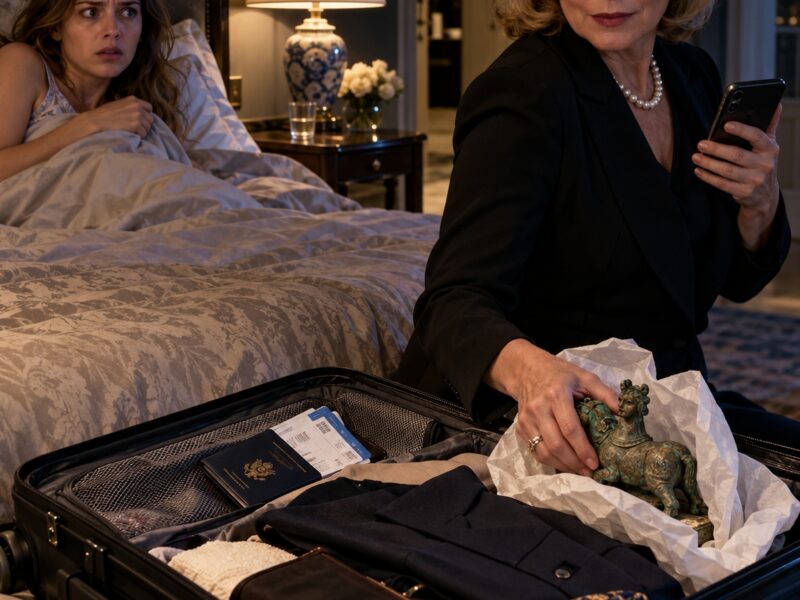
My Mother-in-Law Hid a Stolen Museum Artifact in My Carry-On Before My Flight—Then an Airport Tip Revealed She Had Planned My Arrest Before I Ever Packed
At twelve minutes past midnight, I watched my mother-in-law open my carry-on and hide something inside while she thought I was asleep.
Then I heard her whisper into the phone, “It’s in her bag—call airport security before six,” and realized someone intended to make me look like a thief fleeing the state.
What she did not know was that I had spent eleven years preserving evidence for a museum, and I had learned long ago that the smallest record could outlive the biggest lie.
My mother-in-law opened my bedroom door at twelve minutes past midnight.
I knew it was Christa before I saw her face. She walked on the outside edges of her feet whenever she wanted to move quietly, a habit I had noticed over eleven years of Thanksgiving mornings, Christmas visits, and weekends in the pale yellow house where my husband grew up. I had told her at dinner that my flight to Chicago left at 7:40 and that I needed sleep.
So I kept my eyes closed.
The hallway light drew her shadow across the wall. She waited beside the bed long enough that I could smell her hand cream, something floral and powdery she had used for as long as I had known her. Then she moved toward the chair where my carry-on sat beneath my gray conference blazer.
The zipper was loud.
She knew it.
She opened it one tooth at a time.
I heard paper shift. Then a small metallic weight touched the bottom of the inner pocket with a muted tap. A second object, wrapped in something soft, followed.
My pulse changed.
Christa remained beside the bag.
Then she walked toward the doorway.
I heard her phone unlock.
“It’s done,” she whispered. “Both pieces are in Harleen’s carry-on.”
A pause.
“No. She didn’t wake up.”
Another pause.
“Call airport security at six. Tell them she took museum property and she’ll be on the 7:40 to Chicago.”
My throat tightened.
Christa listened.
Then she said something that frightened me more than the rest.
“By the time they understand what she’s carrying, nobody will care what she says she found in the inventory.”
She ended the call.
Eleven soft steps carried her down the hallway.
Her bedroom door clicked shut.
I stayed still.
Not because I was calm.
Because moving too soon felt like stepping into a trap before I knew its shape.
For twenty minutes I listened to the house.
The old water heater ticked beneath the kitchen. My husband’s grandmother, Dorothy—Dot to everyone who loved her—coughed twice at the far end of the hall. Somewhere below me, Reed slept on the basement sofa because he had strained his back carrying folding tables for Dot’s eightieth birthday party.
Christa had insisted I take the guest room.
“You need real sleep before that flight, sweetheart.”
I had thanked her.
I had meant it.
When the house settled again, I sat up.
I did not turn on the lamp.
I switched my phone to airplane mode, lowered the brightness, and used a tissue from the nightstand to pull the carry-on zipper open without putting bare fingers on anything Christa might later claim had always been mine.
The first object lay inside a white archival tissue packet.
I knew the moment I saw the bronze.
Two inches long.
Green-brown patina.
Curved bow.
Pin mechanism corroded at one edge.
A first-century Roman fibula from the Beaver Valley Historical Museum’s study collection.
Drawer fourteen.
Accession 74.12.09.
I had cataloged it, photographed it, and handled it with nitrile gloves more times than I could count.
Its accession number had been scraped from the reverse.
My mouth went dry.
The second object was worse.
A small bronze oil lamp with a hairline fracture in the handle shaped almost like a letter V.
Drawer nine.
Accession 74.12.06.
Another museum object.
Another number removed.
I sat on the edge of the bed with my hands in my lap and understood exactly what Christa had built.
An anonymous airport tip.
Two stolen antiquities in my luggage.
A registrar whose own recent inventory had reported missing artifacts.
A flight leaving the state.
By sunrise, I would not be the woman who had found the theft.
I would be the thief they caught running.
And that was when I understood I could not go to the airport.
I also could not wake Reed yet.
That part hurt.
He was forty, steady, decent, and still somehow capable of becoming twelve years old whenever his mother said something with enough confidence.
If I woke him and said, Your mother planted stolen museum pieces in my suitcase, he would do exactly what a good son did.
He would ask Christa.
Christa would cry.
Dot would appear in the hallway.
Somebody would touch the bag.
Something would disappear.
And by the time police arrived, I would have a story instead of evidence.
So I photographed everything.
Wide shot.
Bag on chair.
Zipper position.
Tissue packets.
Close images of each object without moving them.
Phone clock visible.
12:37.
12:38.
12:39.
Then I uploaded the photographs to my work cloud archive and emailed copies to an account Reed did not know I still used from college.
A registrar learns quickly that one record is a memory.
Two records are evidence.
I zipped the bag again.
One tooth at a time.
Then I lay on top of the covers until 4:32 in the morning, fully dressed, watching darkness become gray around the curtains.
I thought about Thanksgiving.
Christa showing me how to pinch pierogi dough.
Dot laughing because I measured filling with a tablespoon.
Reed stealing buttered onions from the skillet.
I thought about my mother, dead since I was nineteen, and how easily I had accepted the Lindfists as the family I had been lucky enough to receive afterward.
At 4:40, I carried the suitcase downstairs by its top handle so the wheels would not wake anyone.
Christa’s coffee maker was already programmed.
Beside it sat a folded napkin with her handwriting:
Safe travels, sweetheart.
I left the spare key beside it.
Then I drove away.
The airport was fifteen minutes east.
I turned west.
At 5:07 a.m., I walked into the Moon Township Police Department with my carry-on still zipped.
A desk sergeant looked up from coffee.
His nameplate read OKAFOR.
I placed the bag on the floor.
Not the counter.
“I believe stolen museum objects were placed inside my luggage without my knowledge.”
He put down the cup.
“I haven’t touched them.”
I continued. “I have photographs showing where they were when I discovered them. I heard the person who put them there arranging an anonymous tip to airport security.”
Okafor studied me for several seconds.
Then his entire posture changed.
“Step away from the bag.”
I did.
A second officer came through a side door wearing gloves. She asked my permission to open the luggage while Okafor watched my hands.
“Yes.”
The zipper sounded enormous in the small lobby.
The white tissue packet came out first.
The fibula.
Then the oil lamp.
I watched Sergeant Okafor’s expression move from caution to something more complicated.
“You know what these are?”
“Yes.”
“Tell me without touching anything.”
I gave him the museum name.
Collection.
Drawer numbers.
Approximate acquisition year.
Accession numbers.
He wrote everything down.
“And how do you know?”
“I’m the registrar.”
His pen stopped.
“For the museum they came from?”
“Yes.”
“That complicates things.”
“I know.”
I handed him my phone.
Six photographs.
Time stamps.
Then I told him about Christa.
The door.
The whispered call.
The planned airport tip.
He listened without interrupting.
When I finished, he asked:
“Why didn’t you confront her?”
“Because evidence disappears when frightened people know you’ve seen it.”
That earned the first expression from him that looked almost like respect.
At 6:17, he contacted Beaver Valley Historical Museum.
At 6:36, he called Allegheny County Airport Police.
At 7:40, my flight to Chicago left without me.
I watched the minute pass on the clock above the station lobby.
The conference where I was supposed to speak about preventive collection audits suddenly felt like a joke written by someone cruel.
At 7:58, Okafor sat beside me.
Until then, he had spoken standing.
That worried me.
“Airport police received an anonymous tip at 6:03.”
My fingers went cold.
“Woman’s voice.”
“What did she say?”
“That a passenger named Harleen Mercer would be carrying stolen antiquities from Beaver Valley Historical Museum on the 7:40 flight to Chicago.”
Exactly enough.
Not too much.
“Prepaid number.”
he added.
“Forty-three-second call.”
I looked at the floor.
“That supports your statement.”
he said. “It doesn’t prove who placed the items in your bag.”
“I know.”
“You understand that if you had gone to the airport—”
“I would have been searched.”
“Yes.”
“And they would have found them.”
“Yes.”
“And because I work at the museum…”
He nodded.
“The situation would have looked very bad very quickly.”
I closed my eyes.
“Are you arresting me?”
“No.”
The word came immediately.
“Not today.”
Not today.
I heard the precision.
Okafor heard me hearing it.
“I’m being careful.”
he said. “The fact you brought the bag here before the tip was acted on matters. Your time-stamped photographs matter. The call matters. None of that gives me Christa Lindfist’s hands on those artifacts.”
“What happens now?”
“Now the museum identifies the property formally.”
“And then?”
“We investigate.”
He handed me a property receipt.
Two lines.
Roman fibula.
Bronze oil lamp.
Both suspected stolen museum property.
I folded the paper into my wallet.
Then I asked the question I dreaded.
“Does the museum know they were found in my bag?”
“Yes.”
My phone rang before I reached the parking lot.
Reed.
I sat inside the car before answering.
“Mom said you left.”
Not:
Are you okay?
Not:
Where are you?
Mom said you left.
“I’m at the police station.”
Silence.
“What?”
“I’ve been here since five.”
“What happened?”
I looked at the property receipt.
“Your mother put two stolen artifacts from my museum in my carry-on last night.”
Nothing.
Then:
“Harleen.”
“I heard her.”
“She walked into the guest room at twelve twelve.”
“I heard the zipper.”
“I heard her tell someone to call airport security at six.”
“That doesn’t make sense.”
There it was.
The exact sentence I had predicted.
“I know.”
“Mom’s right here.”
“I know.”
“Let me ask her.”
“No.”
“Harleen—”
“I need you to listen to me before you ask her anything.”
The words came harder than I intended.
“I already went to police.”
“They have the objects.”
“They have my photos.”
“Airport police confirm an anonymous woman called at six oh three and gave them my name and flight.”
Another silence.
Behind Reed, I heard Christa’s kitchen cabinet stick and release.
She was standing near him.
I could almost see it.
“I’ll call you back.”
he said.
“Reed.”
“I need to understand this.”
“So do I.”
He hung up.
Twenty minutes later, my museum director called.
James Abernathy had been director only seven months.
Careful man.
Tie on Saturdays.
The type who proofread condolence cards.
“Harleen, I’ve had two contacts this morning.”
“I know about one.”
“Police.”
“Yes.”
“The second was an email.”
I stopped breathing.
“It arrived at six thirty-two.”
“What did it say?”
“That you have been removing objects from the study collection and selling them privately.”
My grip tightened around the steering wheel.
“It specifically referenced the inventory discrepancies you reported last month.”
The timing was deliberate.
Airport tip at six.
Email at 6:32.
A trap with two doors.
“I found those discrepancies.”
“I know.”
“I reported them to you.”
“I know that too.”
Abernathy exhaled.
“But you understand the institutional problem.”
“Yes.”
“I have to place you on paid administrative leave while the museum conducts an independent review.”
My throat tightened anyway.
“My badge?”
“Disabled.”
“Network?”
“Disabled.”
“Do not contact collections staff about the investigation.”
Eleven years.
One morning.
I became a visitor.
“The fibula is 74.12.09.”
I said.
“The lamp is 74.12.06.”
“I have March photographs of both in their drawers.”
“Keep those.”
he said gently.
“For now, preserve everything.”
I drove home.
Our house was thirty-five minutes from Christa’s.
Small brick ranch on a street of almost identical houses.
Reed and I bought it nine years earlier because we could afford it without pretending.
The second bedroom was my office.
Three banker boxes sat against the back wall.
A blue binder beside them.
If the museum server was official memory, those boxes were mine.
Not stolen museum records.
Copies.
Monthly photographs of drawer contents.
Insurance notes.
Condition reports I had printed for home reference.
Photographs of sign-in sheets.
I started doing it after my mother died and I discovered half her bills existed only in her head.
People laughed at registrars because we wrote everything down.
They stopped laughing when something disappeared.
I opened the first box.
February.
March.
April.
Three missing groups.
Fibula.
Oil lamp.
Eleven Roman coins.
All donated in the 1970s by Walter Lindfist.
Reed’s late grandfather.
My husband’s family.
I stared at the name.
Walter had been a museum trustee for twenty years.
He collected small antiquities during military service and later business travel in Europe.
When he died, Dot sometimes joked that the museum got “the good things” while she kept “the sentimental junk.”
I had heard the joke fifty times.
Now it sounded different.
I laid out my photographs.
Fibula present March 3.
Oil lamp present February 18.
Coins present in January but absent when I checked in April.
Then I placed photographs of the annex paper sign-in log beside them.
March 5:
Dorothy Lindfist — Collections Committee.
February 21:
Dorothy Lindfist — Collections Committee.
No other visitor during those windows.
My stomach turned.
Dot still had a key.
Nobody ever reclaimed it after Walter died because she remained an honorary collections volunteer.
Eighty years old.
Soft voice.
Butter cookies.
A cane with a brass duck head.
The woman who called me sweetheart.
I made myself say it aloud.
“Dot removes them.”
The room stayed quiet.
“Christa sells them.”
Still quiet.
Christa was treasurer of Friends of Beaver Valley Museum.
She worked the annual antiques show.
She knew dealers.
She had once mentioned an antiques broker named Roland Hensley who always had “too much cash and too little taste.”
Last night at dinner, she asked when my inventory would be complete.
When reaccreditation auditors arrived.
Whether I personally presented discrepancies.
I had thought she was proud.
At seven that evening, Reed came home.
He stood in my office doorway.
Looked at the papers.
Then at me.
“You think Mom put those things in your bag.”
“I don’t think.”
“I heard her.”
“You were sleeping.”
“I was awake.”
He winced.
I handed him the police receipt.
Then my phone.
Photos.
12:37.
12:38.
12:39.
He looked for a long time.
I did not explain.
That was my promise to myself.
Paper first.
Then words.
Finally Reed handed the phone back.
“I need to sleep on the couch.”
My chest tightened.
“I’m not leaving.”
he said quickly.
“I just…”
He looked toward our bedroom.
“I can’t be in there tonight.”
“Okay.”
Hardest okay I had ever said.
At 10:06, his phone buzzed.
Christa.
He read the message without answering.
We’ll come Tuesday to pick up a few of your things and talk. Love you.
I looked at him.
“Your things?”
“I didn’t ask her to get anything.”
That mattered.
Tuesday, they arrived an hour early.
Reed was still working.
I saw Christa’s silver SUV through the kitchen window.
Dot climbed out slowly.
Cane.
Cardigan.
Christa carried a canvas tote.
For one stupid second, my body prepared to be glad to see them.
Eleven years of affection does not disappear because the truth changes.
It becomes grief with familiar posture.
I opened the door before they knocked.
“Reed’s at work.”
“We were nearby.”
Christa stepped inside.
She did not ask.
She rarely needed to.
She turned toward my office.
I followed.
“Where are you going?”
“Reed left some things.”
“In my office?”
“Closet.”
“He has nothing there.”
Christa kept moving.
I reached the doorway first.
Put one hand on the frame.
“Wait for Reed.”
She looked at me.
Then rested her palm against my shoulder.
Moved me aside.
Not violently.
Confidently.
Like furniture.
She entered.
And went straight past the closet.
To the banker boxes.
My breath stopped.
She picked up the second one.
“Those are my records.”
“Reed’s things.”
she said.
“No.”
I took the top box and held it against my chest.
Christa looked over the cardboard edge.
No confusion.
None.
She knew exactly what those records were.
“Put it down.”
I said.
Behind her, Dot spoke softly.
“Harleen, honey.”
Then Dot’s hand closed around my wrist.
I do not know what she intended.
Stop me.
Steady herself.
Make me release the box.
Her fingers were surprisingly strong.
I pulled back instinctively.
Her balance shifted.
Her shoulder hit the wooden doorframe.
A dull knock.
She gasped.
My box tilted.
Photographs spread across the floor.
Christa moved immediately.
She dropped the box she carried.
Grabbed my blue binder.
Two years of location logs.
Every month I photographed.
Every month I had missed.
And ran toward the front door.
“Christa!”
The door opened.
Reed stood there.
Keys in hand.
I had texted him when their SUV arrived.
He looked at his mother.
Then the binder under her arm.
Then at me kneeling in photographs.
Then at Dot holding her shoulder.
Christa spoke first.
“She shoved Nana.”
Fast.
Prepared.
“Look at her.”
Reed looked.
Then at the binder.
His face changed.
“Why do you have that?”
Christa stared.
“Reed—”
“Why do you have Harleen’s inventory binder?”
She walked around him.
He did not grab her.
He picked up the banker box she left behind.
Christa helped Dot outside.
Dot looked back toward me.
“She didn’t mean it.”
Loud enough for the neighbor watering flowers across the street.
The SUV pulled away.
Reed closed the door.
I remained on the floor.
My wrist had begun swelling where Dot gripped it.
Reed stared at the scattered photographs.
“I saw her take it.”
His voice sounded unfamiliar.
“I know.”
“Nana’s shoulder…”
“She grabbed me first.”
“I pulled away.”
“She hit the frame.”
“I’m not pretending it didn’t happen.”
Reed knelt.
Lifted my wrist carefully.
Finger-shaped red marks were already appearing.
He looked at them.
Then toward the front door.
“My mother needs to leave us alone.”
It was the first sentence in his life he had ever spoken against Christa when she was not present to answer.
The following morning, Sergeant Okafor called.
He had four photographs on the table when I arrived.
Dot’s shoulder.
Dark bruise.
Christa had filed a complaint alleging I assaulted an eighty-year-old woman.
I put my wrist beside the photographs.
Four oval bruises.
Finger marks.
“Reed gave a statement.”
Okafor said. “He says his grandmother grabbed you.”
Relief almost came.
He stopped it.
“He’s your husband.”
“I know.”
“That matters less to a prosecutor than you wish it did.”
I looked at the tissue box.
“No charges today.”
he continued. “But stay away from both women.”
“They’re the only ones who know what happened.”
“I know.”
“Then why—”
“Because that’s exactly how she keeps you inside her version.”
That sentence stayed with me.
In the parking lot, Abernathy called.
Another anonymous email.
This one to the museum board.
Photographs attached.
My banker boxes.
My home office.
Caption:
Registrar keeps unauthorized collection records at private residence.
Christa had stood in the hallway taking photographs while I believed she was helping Dot.
My records—my protection—were being reframed as evidence of misconduct.
Abernathy said:
“Why were those files at home?”
“For eleven years I photographed drawer inventories and annex sign-ins because our server permissions are shared by too many people.”
“You did this every month?”
“Yes.”
“No one approved it?”
“No one asked.”
“That’s a problem.”
“I know.”
“But those photographs are also now the only external record of what was present before things went missing.”
Silence.
“Yes.”
he said.
“That is also true.”
That night Reed wrapped my wrist badly with an elastic bandage.
His phone lit up.
One word from Christa:
Choose.
He turned the screen toward me.
Then finished clipping the bandage.
“I already did.”
he said.
“She just didn’t like the answer.”
I cried after he went to bed.
Not because he chose me.
Because I understood the cost of asking somebody to look at a parent and see a stranger’s capacity for harm.
The next breakthrough came from Marne Reyes.
Twenty-eight.
Collections assistant.
Brilliant with textile storage and terrible at keeping plants alive.
She texted despite orders not to contact me.
I still have my annex key.
I should have told her not to do anything.
Instead I asked for photographs of the paper sign-in binder.
February.
March.
April.
The month I lacked.
She went in after closing.
Six minutes later:
Pages are gone.
Then:
Not the binder. The pages. February through April ripped out.
I stood in my kitchen.
Someone with an annex key removed exactly the months I needed.
How did they know which months?
My blue binder.
Christa had not stolen it to hide what I knew.
She stole it to discover what I did not.
Marne was caught on a hallway camera.
Abernathy reassigned her and removed her key.
Then called me.
“You were told not to contact staff.”
“I know.”
“She could lose her job.”
“I know.”
“You cannot pull everyone else into this because you need vindication.”
The sentence hurt because he was right.
I apologized to Marne.
Face-to-face.
Coffee shop.
She cried.
“I wanted to help.”
“I know.”
“That doesn’t mean I had the right to ask.”
That was the moment my own flaw became clear.
Christa controlled people because she believed her reasons justified intrusion.
I had just done a smaller version.
Different stakes.
Same temptation.
I promised myself:
No more.
If the truth survived, it would survive cleanly.
I sent Okafor the February and March photographs I already had.
Fibula present March 3.
Dot signed in March 5.
Lamp present February 18.
Dot signed in February 21.
No other visitors those days.
Okafor replied:
Pattern tells me where to look. It does not put her hand on property. Keep going carefully.
At 6:41 Friday evening, Dot called me.
Okafor had told me not to speak with her.
I answered anyway.
I want to be precise about that.
It was a mistake.
But sometimes affection outlives judgment.
“Sweetheart.”
Her voice was hoarse.
Warm.
Thanksgiving voice.
“I’ve been so worried.”
I pulled a notepad toward me.
Pennsylvania requires all parties’ consent for many private audio recordings, and I was not going to create a new legal argument while trying to survive old ones.
So I wrote.
Time.
Words.
Everything I could.
“Walter bought those pieces himself.”
Dot said.
“Rome.”
“1968.”
“His own money.”
“He gave them to the museum because he thought people would enjoy them.”
“They sat in drawers for decades.”
“Nobody cared.”
I wrote:
Rome 1968. Drawers. Nobody cared.
“Christa’s shop is failing.”
Dot continued.
“There are loans.”
“She has done everything for me since Walter died.”
“She takes me to doctors.”
“She pays for things.”
“She never complains.”
My chest tightened.
There it was.
Not greed alone.
Debt.
Fear.
Family obligation twisted until theft could call itself restoration.
“If you would just tell people you were confused that night…”
Dot said gently.
I stopped writing.
“That you’d had wine at the birthday party.”
“That you woke frightened.”
“That you misunderstood Christa.”
“All this could go away.”
“The museum.”
“The police.”
“That silly complaint about my shoulder.”
“I never wanted that.”
My pen moved again.
Confused. Wine. Goes away.
Then Dot said:
“I’m an old woman.”
“I don’t have many years left to be ashamed.”
Silence.
“I only made one phone call in my life I’m not proud of.”
My pen stopped.
“One phone call?”
“For my daughter.”
Airport tip.
Woman’s voice.
Prepaid phone.
6:03 a.m.
Christa had not been speaking to some unknown partner at midnight.
She had been speaking to Dot.
The woman coughing at the end of the hall.
The grandmother who knew my flight.
My name.
The story.
“I have to go.”
I whispered.
“Harleen—”
I hung up.
When I turned around, Reed stood in the kitchen doorway.
Work boots.
White face.
“How much did you hear?”
“Rome.”
he said.
“1968.”
I stared.
“Nana told me that story my whole childhood.”
“Grandpa bought her the brooch in Rome.”
“She used to say giving it away was his great act of generosity and her great act of forgiveness because she never wanted him to donate it.”
Reed sat.
“She made the airport call.”
“Yes.”
He covered his face.
When he looked up, grief had changed him.
Then something else happened.
His eyes sharpened.
“The antiques show.”
“What?”
“Saturday.”
“Mom works the Friends table.”
“So?”
“Hensley.”
Reed said.
“Roland Hensley.”
“He has the booth beside them every year.”
I felt my pulse change.
For a week I had been trying to prove who put museum objects in my bag.
No witness.
No camera.
No fingerprints we knew of.
But if stolen museum property was being sold publicly by the dealer Christa knew?
That could be documented.
I called Okafor the next morning.
“I need to explain how I mark objects.”
He listened.
“Every study collection object has its accession number in archival ink.”
“The visible number.”
“Yes.”
“Whoever removed the pieces knew that.”
“Yes.”
“But I mark certain objects twice.”
Silence.
“Why?”
“Because accession ink can be removed.”
“Where is the second mark?”
“Depends on the object.”
“The oil lamp has a felt pad underneath.”
“I wrote the accession number in pencil beneath the pad eleven years ago.”
“Nobody knew?”
“I once told Christa I write everything twice.”
“She laughed and assumed I meant ledgers.”
“If the lamp is at Hensley’s booth…”
“You can tell me what’s underneath the felt before anybody lifts it.”
“Yes.”
“What number?”
“74.12.06.”
Okafor exhaled.
“Do not touch anything.”
“I won’t.”
“Do not go near Christa or Dorothy.”
“I won’t.”
“If one of them falls, grabs you, cries, screams—your hands stay visible.”
His specificity frightened me.
“I understand.”
“And I’m not walking into an antiques show on your claim alone.”
“I need the museum director.”
Fair.
I drove to Beaver Valley.
My badge still did not work.
Abernathy came outside carrying a leather folder.
“I checked historical key assignments.”
He said.
“One annex key issued in 1996 was never returned.”
“Dorothy?”
“Yes.”
He lifted the folder.
“Original accession ledger.”
“I’d like to read the numbers myself.”
I swallowed.
“Thank you.”
Reed sat in my passenger seat.
He had not asked permission to come.
He just did.
“If Mom sees you with me…”
he said.
“She understands I’m choosing to witness this.”
“You don’t have to.”
“Yes.”
He looked forward.
“I do.”
The Three Rivers Antiques Show filled an expo hall in Monroeville.
Two hundred booths.
Fluorescent lights.
Velvet tablecloths.
Old clocks.
Silverware.
Furniture.
Kettle corn.
Normal enough to make what happened there feel surreal.
The Friends of Beaver Valley table stood in row C.
Green cloth.
Museum banner.
Christa wore her good navy blazer.
She laughed with an elderly couple buying raffle tickets.
Dot sat beside her.
Cardigan.
Cane.
Right arm in a sling.
I stared.
On Tuesday she had walked to the SUV using that arm.
Okafor noticed too.
Said nothing.
“Hensley?”
he asked.
“Three booths down.”
Roland Hensley had glass display cases and a locked cabinet behind him.
White hair.
Reading glasses on a cord.
Business card:
Hensley Fine Antiques & Estates.
On the middle case lay seven objects on black velvet.
A handwritten card read:
From the Estate of Walter Lindfist.
Fourth from the left:
A Roman bronze oil lamp.
Hairline crack.
V-shaped fracture.
I stopped.
Reed touched my back once.
I knew that crack like a scar.
“Which?”
Okafor whispered.
“The lamp.”
We followed the plan.
Abernathy and I approached like customers.
Okafor stayed behind.
Reed beside me.
“Good morning.”
Hensley said.
“Can I see the Roman lamp?”
He unlocked the case.
Placed the object on velvet.
I kept both hands flat on the counter.
My right wrist still wrapped.
“First or second century.”
Hensley said.
“Family piece.”
“The Lindfists collected extensively in Italy.”
“Turn it over, please.”
He did.
Dark green felt disc covered the base.
New felt.
Craft-store felt.
“No marks.”
Hensley said.
“Private piece.”
Abernathy opened his ledger.
“Bronze oil lamp.”
he read.
“Single nozzle.”
“Handle with stable hairline fracture approximately four millimeters.”
Hensley’s face changed.
“Donated 1974 by Walter Lindfist.”
“Accession 74.12.06.”
“Beaver Valley Historical Museum.”
“Drawer nine.”
Hensley looked toward the green Friends table.
Abernathy saw it.
“So did Okafor.”
“Please lift the felt.”
Abernathy said.
“I don’t think I will.”
Hensley replied.
“If you have a provenance dispute, there are procedures.”
“There are.”
Okafor appeared.
He showed his badge.
“Sergeant Okafor.”
“Moon Township Police.”
“We can preserve the booth and request local officers while nobody touches anything.”
“Or you can voluntarily lift the edge of that felt.”
Hensley looked at him.
Then me.
Then the lamp.
He used his thumbnail.
The adhesive had dried near one edge.
Green felt lifted.
I knew what we would see before he did.
Tiny pencil marks.
My handwriting.
74.12.06
Hensley’s face lost color.
Behind me:
“What is she doing here?”
Christa.
Close.
I did not turn.
My hands stayed flat.
“She’s not allowed near us.”
Christa said.
“She assaulted my mother.”
Okafor stepped between our spaces without touching anyone.
“Mrs. Lindfist, remain back.”
Christa changed.
I watched it happen.
Anger softened into patient sorrow.
Voice lowered.
She looked toward nearby shoppers.
“Of course she marked it.”
“She’s handled every piece in that collection for a decade.”
“She could put numbers anywhere.”
“She’s obsessed with records.”
“She keeps boxes of them in her house.”
Good argument.
That was the terrible thing.
A convincing lie is usually built from true pieces.
Okafor looked at the lamp.
“Except she identified the mark before Mr. Hensley lifted a felt pad.”
“She has not touched this object today.”
“I watched her hands.”
Christa’s face tightened.
“Mr. Hensley.”
Okafor said.
“Who applied the felt?”
Hensley did not answer.
That answer was enough to deepen the question.
Then Dot approached.
Slow.
Cane.
Sling.
“Harleen.”
She whispered.
I turned my head.
Not my body.
Her cane slipped.
Or appeared to.
She pitched toward me.
“Don’t!”
Christa shouted.
“She’s doing it again!”
Every head turned.
Every instinct in me screamed to catch an eighty-year-old woman.
I did nothing.
Hands flat.
Body still.
Because Okafor had warned me.
Because Dot had already helped create one bruise into a story.
Because kindness could be turned into evidence.
She never reached me.
Reed stepped between us.
Caught his grandmother beneath her good arm.
Held his other hand open where everyone could see.
“Nobody touched you, Nana.”
His voice carried.
“I’ve got you.”
“Nobody touched you.”
He looked toward a woman at the next booth.
“Did anybody touch her?”
The woman shook her head.
“No.”
“She just fell.”
Reed looked at Dot.
His voice broke.
“I was there Tuesday too.”
“I saw what happened.”
Dot stared at him.
No answer.
Okafor called Monroeville police.
While he spoke, Hensley made a choice.
He opened a gray accordion file beneath the counter.
Removed a yellow carbon sheet.
Consignment agreement.
Nine objects.
Consignor:
Christa Lindfist.
Prices from $400 to $6,000.
February date.
Hensley spoke quickly.
“She told me they were family property.”
“Walter’s.”
“She said the museum had never formally accessioned them.”
“She said…”
He looked toward me.
“She told me the registrar was about to be arrested for theft.”
My chest went cold.
“When?”
“Three weeks ago.”
Before Christa planted anything.
The plan had been forming for weeks.
Hensley swallowed.
“I didn’t know about the airport.”
“I didn’t know about any framing.”
Okafor said:
“You can explain all of that formally.”
Christa stopped watching the lamp.
She looked at Reed.
“She’s taking you away from me.”
Reed held Dot upright.
“You put museum property in my wife’s suitcase.”
Christa stared at him.
Here was the moment she could have denied it.
One more lie.
Reed wanted one.
I could see that.
Instead, she looked toward Dot.
Then said quietly:
“I did what I had to do for Nana.”
No one spoke.
The kettle corn machine popped in the distance.
Ridiculous sound.
Ordinary.
Monroeville officers arrived.
Nobody was handcuffed immediately.
The officers separated people.
Collected statements.
Secured Hensley’s display.
Nine items on the consignment sheet.
Nine museum objects eventually identified.
As Dot prepared to leave, an officer asked to check her purse with consent as part of documenting personal property before transport to the station.
She handed it over.
Inside:
A cheap black prepaid phone.
Sticker still on the back.
Okafor looked at it.
Then at me.
Dot never threw anything away.
Birthday cards.
Cookie tins.
Apparently phones she had been told to discard.
My knees stopped working.
I sat in Dot’s folding chair beside the Friends table.
Green cloth.
Raffle basket.
Museum banner.
Then I cried.
Not quietly.
Reed stood in front of me so strangers could not watch.
He did not tell me everything was over.
It wasn’t.
That was another reason I loved him.
Nine days later, Allegheny County investigators obtained the airport tip recording.
Reed and I listened together.
A woman’s voice:
“I need to report a passenger.”
Reed whispered before the sentence ended:
“Nana.”
Call metadata matched the prepaid phone.
One outgoing call in its lifetime.
6:03 a.m.
Forty-three seconds.
Christa was charged later after investigators completed interviews and records review.
The allegations included theft-related offenses involving museum property, conspiracy, tampering with evidence, and conduct connected to the false airport report.
Dot faced lesser but still serious charges tied to museum theft and the airport call.
Her age did not erase responsibility.
It affected how prosecutors handled detention, medical evaluation, and eventual plea discussions.
Hensley cooperated.
His records documented prior sales.
Some items were recovered from buyers.
Others required months.
There was no instant courtroom victory.
No cinematic confession solving everything.
Investigators worked.
Provenance specialists worked.
Lawyers worked.
The museum’s insurer worked.
That was how truth usually moved.
Slower than accusation.
But steadier if documented.
The assault complaint involving Dot’s shoulder was closed after Reed’s statement, neighbor observations, medical records, and later witnesses from the antiques show undermined the claim that I intentionally harmed her.
I was never charged.
Still, for months the accusation existed in files.
That mattered.
False stories leave residue even after they lose.
Abernathy reinstated me after the museum’s independent review.
He asked me to meet in the lobby.
My badge worked again.
That tiny green light nearly made me cry.
“I owe you an apology.”
he said.
“I should have asked what your home records were before deciding what they looked like.”
“You also had an institution to protect.”
“Yes.”
He adjusted his tie.
“I’m learning those two sentences are not opposites.”
Marne returned to collections.
I apologized again.
She said:
“Stop.”
“You made one bad call.”
“I made twelve.”
“That isn’t how accountability works.”
I laughed.
She had learned something from me after all.
The museum adopted new procedures.
No lifetime volunteer keys.
Annual access review.
Dual-person entry for high-value study collections.
Automated access logging.
Independent off-site backup.
No single registrar controlling all reconciliation.
Including me.
I proposed that last rule.
One board member looked surprised.
“You’re the person whose private records saved the collection.”
“Exactly.”
I said.
“No institution should survive because one anxious woman photographs everything after hours.”
The board approved it.
Reed’s relationship with Christa did not repair neatly.
She wrote.
He read the letters.
Sometimes cried.
Sometimes became angry with me for being present while he was angry with her.
That was difficult.
There were nights when grief looked for somewhere nearby to land.
We went to counseling.
Not because our marriage was broken beyond repair.
Because pretending it had escaped damage would have broken it.
At our third session, Reed said:
“I keep wanting Harleen to tell me my mother never loved me.”
I stared.
“Why would I say that?”
“Because then I could hate Mom cleanly.”
The therapist waited.
I said:
“I think she loves you.”
Reed cried.
“That makes it worse.”
“I know.”
Christa had loved her son.
She had also framed his wife.
People wanted those truths mutually exclusive.
They were not.
Dot’s explanation emerged through her attorney months later.
Walter had donated objects she believed belonged to their family.
After his death, Dot’s finances shrank.
Christa’s antiques shop struggled.
A loan came due.
Dot began taking “just one thing” from museum storage, telling herself she was reclaiming property Walter never should have given away.
Christa sold it.
Then another.
Then another.
The first sale paid a medical bill.
The second kept the shop open.
The third became easier.
By the time I noticed discrepancies, they had already built a moral language in which theft sounded like family restoration.
They did not begin by asking:
How do we destroy Harleen?
They began with:
Walter bought these.
Nobody looks at them.
We need them more.
Then:
Harleen is auditing.
Then:
Harleen could expose us.
Then:
If she looks guilty, nobody will trust her.
Small failures.
One after another.
The museum recovered all nine missing objects eventually.
Some from Hensley’s inventory.
Two from collectors who surrendered them after being shown the museum’s documentation.
One had traveled to Ohio.
Another remained with police as evidence for nearly a year.
The bronze fibula came back last.
I carried it into the annex myself.
Drawer fourteen waited empty.
The scraped patch on the reverse looked pale and ugly.
I took out archival ink.
Rewrote:
74.12.09
Then I sharpened a pencil.
For eleven years, whenever possible, I had placed a second hidden accession mark.
Not because policy required it.
Because redundancy comforted me.
This time I wrote the number in a tiny protected recess.
A second record.
For someone else.
Not for me.
That distinction mattered.
I did not want the collection to depend on my memory forever.
At Dot’s sentencing, the judge approved a plea agreement involving probation under strict conditions, restitution, and community restrictions rather than incarceration, partly because of her age, health, cooperation, and lack of prior record.
Some people online called that unfair.
Maybe.
Justice is not a scale ordinary people get to calibrate perfectly.
Christa received a harsher sentence because evidence showed she organized the sales, removed records, created anonymous accusations, and deliberately planted artifacts in my luggage.
Even then, the sentence was not revenge.
It could not restore Thanksgiving.
It could not make pierogi innocent again.
It could not return Reed’s idea of his mother.
Months afterward, Reed asked whether I wanted to move.
“Different house.”
he said.
“Different town if you want.”
“Why?”
“So you don’t have to drive past her street.”
I looked around our kitchen.
Small table.
Coffee stain near the sink.
Magnets from trips.
The wall we painted twice because the first gray looked purple.
“No.”
“You sure?”
“Yes.”
“I’m not letting her take this place too.”
So we stayed.
We did not add cameras inside.
Did not chain the bedroom door.
I refused to build a prison around myself in the name of safety.
We changed the external locks because Christa had once held a key.
That was practical.
Then we lived.
Ordinary life returned strangely.
Laundry.
Work.
Dentist appointments.
A dishwasher that leaked.
Reed’s back finally healed.
Marne got engaged.
Abernathy stopped wearing ties on Saturdays.
Sergeant Okafor once brought his daughter to the museum and pretended not to recognize me until she dragged him over.
“This is the woman I told you about.”
he said.
I raised an eyebrow.
“What exactly did you tell her?”
“That you label things twice.”
His daughter, eleven, looked impressed.
“That’s weird.”
“It is.”
I agreed.
She smiled.
For the museum’s next reaccreditation, I presented the entire incident as a case study.
Not the family drama.
The system failures.
Unrecovered keys.
Weak access review.
No external audit trail.
Volunteer privilege continuing for decades.
Overreliance on trust.
A reviewer asked:
“What would you say was the single most important control that prevented total loss?”
I thought about photographs.
Hidden pencil.
Police receipt.
Independent accession ledger.
Then answered:
“No single control.”
“That was the lesson.”
“The truth survived because several imperfect records overlapped.”
Afterward, I stood alone in the annex.
Drawer fourteen closed smoothly.
Drawer nine stuck.
It always had.
I almost laughed.
For years, I believed my habit of writing everything twice came from fear.
Maybe it did.
But fear is not always useless.
Sometimes fear becomes discipline if you make it serve something instead of letting it own you.
Reed waited in the lobby.
He held two coffees.
“Done?”
“Yes.”
“How’d it go?”
“They liked the redundancy framework.”
“Of course they did.”
“You say that like it’s charming.”
“It is.”
I took my coffee.
“Your mother used to say I was compulsive.”
He went quiet.
I regretted it.
Then Reed said:
“She also used to brag about how organized you were.”
Both true.
Again.
Life refused simplification.
Two years after the airport incident, Christa sent me a letter.
Not through Reed.
Through her attorney.
I almost refused it.
Then read.
Harleen,
I have written versions of this where I explain the loans, Nana, the shop, your audit, and how trapped I felt.
Those versions were excuses.
You trusted me in my home.
I used that trust to put museum property in your bag because I believed frightening you was easier than admitting what I had done.
I told myself I was protecting my mother.
I was protecting myself too.
I knew the airport tip might get you detained.
I knew it could cost your job.
I did it anyway.
I am sorry.
I do not expect you to answer.
Christa.
I sat at our kitchen table for a long time.
Reed did not ask to read it.
That mattered.
I handed it to him because I chose to.
He cried.
Then folded it.
“Do you forgive her?”
he asked.
“I don’t know.”
“Me either.”
We left it there.
No label.
Months later, Dot died at eighty-three after a short illness unrelated to the case.
Reed went to the funeral.
I did too.
Not because I had forgotten.
Because grief and accountability are allowed to occupy the same church pew.
Christa sat across the aisle.
Older.
Smaller somehow.
We did not hug.
She nodded once.
I nodded back.
The pastor spoke about Dot’s generosity.
Meals delivered.
Children remembered.
Birthdays never forgotten.
All true.
No mention of museum drawers.
Also true.
Afterward, Reed stood beside his grandmother’s grave.
“I hate this.”
he said.
“I know.”
“I loved her.”
“I know.”
“She hurt you.”
“Yes.”
He looked at me.
“How do you carry both?”
I thought about accession records.
Condition reports.
Objects with damage and history.
“You don’t make one cancel the other.”
I said.
“You just stop lying about either.”
He took my hand.
We walked back to the car.
Three years after everything, I became deputy director of collections.
Not because I exposed my mother-in-law.
Because I had spent fourteen years doing the work.
Abernathy recommended me.
The board voted.
My first policy change was boring.
I standardized external backups and separated access-control authority from collection staff.
No one applauded.
Perfect.
Good systems are often invisible when they work.
I kept drawer fourteen exactly where it had always been.
The fibula remained a study object.
Students handled it under supervision.
Sometimes I watched them turn it over.
See the scraped place.
Ask:
“What happened here?”
I gave the institutional answer.
“Improper removal of an accession mark during a theft.”
Not:
My mother-in-law planted it in my suitcase.
Museums are not confession booths.
The object belonged to a larger history than mine.
One evening after closing, a new intern asked why I still wrote hidden pencil numbers when our digital tracking system had become so sophisticated.
I smiled.
“Systems fail.”
“People fail.”
“Memory fails.”
“So you don’t trust technology?”
“I trust overlap.”
She thought.
“That sounds pessimistic.”
“No.”
I said.
“It means one failure doesn’t get to become the whole truth.”
That night I drove home through light rain.
Reed was cooking.
Badly.
Our bedroom door was open.
For months after the incident, sometimes I woke hearing phantom sounds.
A zipper.
Footsteps.
Eleven steps down the hall.
Less often now.
But not never.
At 2:03 one morning, I woke to our bedroom door moving.
My body went still.
Old reflex.
Four soft steps.
Someone in socks.
A glass touched the nightstand.
I opened my eyes.
“I’m awake.”
Reed stood beside me.
“I know.”
He had brought water.
He climbed back into bed.
I looked toward the open door.
Years earlier, I thought safety meant knowing exactly who might enter.
Then I thought it meant locking everyone out.
Now I understood something more difficult.
Safety was not the absence of doors.
It was having the right to decide who crossed them.
I reached for Reed’s hand.
He found mine in the dark.
The house settled around us.
No whispered call.
No careful zipper.
No hidden artifact waiting to tell someone else’s story about me.
Just an open door.
And this time, nothing had been planted there.









