My Mother Moved My Brother’s Entire Family Into My Lake Cabin, Called the Police on Me, and Expected Me to Keep Paying for a Lie
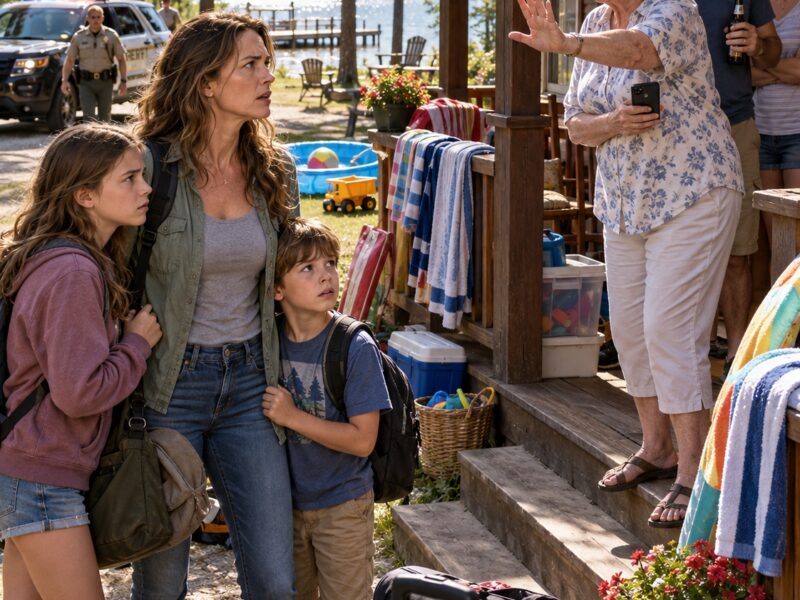
My mother walked off the porch of my own lake cabin and told me I was trespassing while my children stood beside me holding their overnight bags.
Then I saw my brother’s mail on my kitchen counter, his family calendar on my refrigerator, and the bed my son slept in stripped for someone else.
By the time Mom called the sheriff, I already knew the cabin wasn’t the only thing my family had taken from me.
I drove four hours north with two kids, three grocery bags, a cooler full of hamburger patties, and the unreasonable hope that maybe this Fourth of July would finally feel like ours.
We turned onto the gravel lane just after three in the afternoon.
Owen saw the lake first.
“There!”
My nine-year-old leaned between the front seats as if he could pull the water closer by pointing at it. Beside him, twelve-year-old Maisie took off her headphones and smiled when the dark blue line of Little Tamarack Lake appeared between the pines.
Then I saw the pickup truck parked in my spot.
I slowed.
There was a utility trailer beside it.
Beach towels I didn’t own hung over my porch railing. A red plastic kiddie pool sat on the grass. Someone had dragged Grandpa Walt’s charcoal grill out from the shed, and smoke lifted through the trees.
Maisie looked at me.
“Are people renting it?”
“No.”
The word came out too quickly.
I pulled beside the garage and shut off the engine.
Before I could open my door, my mother came down the porch steps.
She wore khaki shorts, white sneakers, and the pink visor she used whenever she wanted strangers to think she was cheerful. At seventy-one, Darlene Brandt was still small and quick, with a way of tightening her mouth that had made me feel sixteen well into my forties.
“What are you doing here?”
That was what she said.
Not hello.
Not you made it.
Not the kids are here.
What are you doing here?
I got out slowly.
“This is my cabin.”
Her eyes moved to Maisie and Owen as they climbed from the back seat.
“You can’t just show up.”
I stared at her.
“Mom.”
My brother Kyle appeared in the doorway behind her holding a beer.
He was forty-six now, broad through the middle, sunburned across the forehead, wearing a Packers T-shirt and the same expression he had worn as a boy whenever Mom had already decided who was wrong.
He didn’t say hello either.
Behind him, my sister-in-law Tessa crossed the kitchen carrying a wooden spoon.
I could see past her.
Someone had taped a chore chart to my refrigerator.
A stack of envelopes sat on the counter.
And through the open bedroom door I could see Owen’s bunk stripped bare.
His sleeping bag was rolled up on the porch.
My son saw it too.
He stopped beside me.
“Mom?”
I put one hand on his shoulder.
My mother crossed her arms.
“Kyle and Tessa need the place right now.”
“Right now?”
“You knew they were having a hard time.”
“I knew Kyle lost his job.”
“And their landlord wouldn’t work with them.”
“That doesn’t explain why they’re living in my house.”
Her eyes hardened.
“Your house.”
“Yes.”
“Your grandfather built this place for the family.”
“He left it to me.”
“He wasn’t well.”
That sentence had become her favorite since Grandpa died.
The first time she used it was at his funeral luncheon, holding a paper plate of ham sandwiches while I stood near the coffee urn trying to process the call I had just received from his attorney.
The cabin was mine.
Grandpa had signed and recorded a transfer-on-death designation seven years before he died.
Not my father.
Not my brother.
Me.
My mother had responded by telling a room full of relatives that an old man’s legal decision should not count because he had been “confused.”
Now she stood on my porch as if persistence could rewrite a deed.
“You need to leave,” she said.
I almost laughed.
Instead I looked at Kyle.
“How long have you been here?”
He took a drink.
“Couple weeks.”
Tessa lowered her eyes.
My heart began beating harder.
“Couple weeks?”
Mom stepped between us.
“He gets mail here now.”
I looked through the window again.
There it was.
An envelope addressed to KYLE BRANDT.
My address.
Not care of Heidi Brandt.
Not temporary.
His name.
My house.
My mother’s voice sharpened.
“You’re upsetting everybody.”
“I just drove four hours to my own property and found another family living inside it.”
“Your brother.”
“Yes.”
“Not another family.”
“He has a wife and three children. That is literally another family.”
Owen tugged my sleeve.
“Are we in trouble?”
That question did something to me.
Not because he sounded frightened.
Because I recognized the feeling.
The old confusion of standing somewhere you were told belonged to you until an adult decided it didn’t.
I looked at my mother.
“No, sweetheart.”
I took Owen’s hand.
Then I smiled at Mom.
“Go ahead.”
She frowned.
“Go ahead what?”
“Call the police.”
For the first time, something uncertain crossed her face.
It disappeared almost immediately.
“You think I won’t?”
“I think you should.”
She pulled out her phone.
I walked my children past her and sat on the porch swing.
The chains creaked under my weight.
I had owned the cabin almost three years.
I had visited it dozens of times growing up.
I had helped Grandpa repaint the railing, stack firewood, replace screen panels, winterize the pipes, and stain the dock.
I had never sat on that swing.
Not once.
My mother was already talking to dispatch.
“Yes, my daughter is refusing to leave.”
Maisie turned toward me.
Her eyebrows lifted.
I took out my phone and sent one message.
They’re here. All of them. Can you still come tomorrow?
The answer arrived before my mother finished giving the dispatcher the address.
Leaving Green Bay at seven. I’ll be there by ten.
I stared at the message.
Gene Halverson.
Seventy-eight years old.
Retired insurance adjuster.
And possibly the only person still alive who knew what really happened at this cabin twenty-eight years ago.
My mother ended the call.
“They said it could be two hours.”
“Okay.”
“Maybe you’ll come to your senses before then.”
I looked at her.
“I’m starting to think that’s exactly what’s happening.”
She didn’t understand.
Not yet.
I sat back on the swing, one arm around Owen, the other resting behind Maisie.
Across the yard, Kyle’s children splashed at the end of the dock as if they had lived here all summer.
Inside my kitchen, someone had put groceries in my cabinets.
Someone had moved Grandpa’s coffee mug from the shelf.
Someone had decided the cabin belonged to everyone except the person whose name appeared on the deed.
And tomorrow morning, a man I had not seen since I was sixteen was bringing me an envelope Grandpa had apparently spent years waiting for me to open.
The last time police came to this lake because of my family, the cabin burned to the ground and everyone decided it was my fault.
This time, I intended to stay long enough to hear what the paper said.
The dispatcher had warned my mother that deputies were tied up all over Vilas County because the holiday weekend had put half the county on the water.
Mom repeated that information like a threat.
“Two hours, Heidi.”
“I heard.”
She paced in front of the swing.
My father came around the garage holding a screwdriver.
I hadn’t seen him when we arrived.
Ron Brandt had always been a quiet man, but age had made his silence heavier. At seventy-four, his shoulders were narrower than I remembered, his hair mostly white beneath a faded baseball cap.
“Hi, kiddo.”
He said it to the screen door hinge.
Not to me.
He knelt and began tightening screws.
That told me more than hello would have.
Dad fixed things where he planned to stay.
A loose hinge at a cabin he was only visiting could wait.
A loose hinge at a place the family had already begun treating as Kyle’s needed attention.
“How long have you been here?” I asked.
Dad turned the screwdriver.
“Couple days.”
Mom answered for him.
“We came to help them get settled.”
Settled.
The word landed like a stone.
Tessa appeared at the kitchen door.
She had changed almost nothing since Christmas—same soft brown hair, same nervous half-smile, same habit of clutching whatever object was in her hand when conversations turned uncomfortable.
Today it was a wooden spoon.
“Oh,” she said. “Hi.”
“Tessa.”
“We thought you were coming in August.”
I looked at Mom.
“We?”
Tessa’s face changed.
Just slightly.
Enough.
Someone had given her a version of my schedule that did not come from me.
“I have an appointment here tomorrow morning,” I said. “I’m not leaving.”
Mom laughed.
“An appointment? With who?”
I didn’t answer.
That irritated her more than arguing would have.
I had spent most of my life explaining myself to my mother before I made a decision, while I made it, and afterward.
Not answering felt almost indecent.
I put my hand over Owen’s bouncing knee.
Maisie leaned against me.
She had inherited my habit of observing rooms before talking in them.
“Mom,” she whispered.
“What?”
“Is Grandma going to say it?”
I knew immediately what she meant.
“The fire?”
My mother heard.
Her head snapped toward us.
“You’ve got some nerve.”
There it was.
Kyle’s ten-year-old son Brody stopped bouncing a tennis ball against the garage.
Mom raised her voice.
“Showing up here on Fourth of July after what you did to this place.”
Tessa turned.
“What did she do?”
Brody asked it before anyone else could.
My stomach tightened.
Maisie looked at me.
Tell her.
I could see it in her face.
Not here.
Not yet.
I stood.
“Kids, go down to the dock.”
Owen hesitated.
“Can we?”
“Yes. Stay where I can see you.”
Brody ran ahead.
Within a minute, all four children were on the dock, and the tension on the porch became an adult problem again.
Owen stood at the edge for a moment.
Then Brody shouted, “Come on!”
My son jumped.
The lake swallowed him with a slap and gave him back laughing.
I sat down again.
My hands closed around the chains of Grandpa’s swing.
The dock was new.
The water wasn’t.
The last time I stood on that dock on the Fourth of July, I was sixteen years old.
It was 1998.
Grandpa’s original cabin had been smaller.
Cedar siding.
Green trim.
A shake roof that smelled like warm wood and dust whenever July heat settled over it.
Grandpa Walt had built most of it with his older brother after coming home from military service, though the family story grew grander every year until you would have thought the two men had personally felled every tree in Wisconsin.
That evening, mosquitoes were eating me alive.
I lit a citronella candle at the west end of the porch.
Glass jar.
Small flame.
I put my library book beside it, face down to save the page.
Then Grandpa called me inside to help with dishes.
He washed.
I dried.
He sang half of an old Patsy Cline song because half was all he ever knew.
My brother Kyle was fourteen.
He and Danny Doll from two cabins down were near the dock with a brown grocery bag.
Every few minutes came a hiss.
Then a pop above the water.
Bottle rockets.
Fireworks were restricted around the lake, but teenagers have always believed rules are written for people with worse aim.
Grandpa leaned through the kitchen window.
“Kyle! Knock it off.”
My mother was sitting in a lawn chair with a wine cooler.
“Oh, Walt. It’s the Fourth.”
Grandpa looked at her.
“Those cedar shakes are dry.”
“Boys will be boys.”
I remember that sentence.
I remember Grandpa returning to the sink.
I remember the singing stopping first.
Then the smell.
Sharp.
Sweet.
Burning pitch.
Grandpa shut off the water.
He ran out the east door.
I heard him shout my father’s name in a voice I had never heard before.
I ran out the west door because the garden hose was there.
I passed the porch table.
The candle was still burning.
Upright.
Calm.
My book beside it.
The flame was no bigger than my thumbnail.
I saw it.
I know I saw it.
Around the corner, the east side of the roof near the chimney was already burning.
The fire ran through the cedar shakes faster than anyone could believe.
I dragged the hose across the lawn.
Water struck flames and disappeared.
Grandpa tried another hose from the neighbor’s property.
Dad climbed halfway up a ladder until someone pulled him down.
By the time the volunteer department arrived, the roof had collapsed.
The chimney remained.
Almost nothing else did.
I sat in wet grass.
Soot streaked my arms.
My clothes smelled like smoke and lake water.
Dad stood near the shore gripping Kyle by both shoulders.
Kyle was shaking.
Something was in his hand.
A lighter.
At least that is how I remember it.
Memory becomes strange when everyone around you spends years telling you what happened.
Grandpa put his jacket over my shoulders.
He rested one hand on my head.
We watched his cabin smoke.
He did not blame me.
Two days later, my mother did.
We gathered at Lorraine Pruitt’s kitchen next door because our kitchen was ash.
Aunt Carol had driven from Toledo.
Grandpa sat at the table with untouched coffee.
Kyle stared at eggs he never ate.
Mom stood against the counter.
“It was Heidi’s candle.”
She said it calmly.
Almost gently.
As if the fact had already been confirmed somewhere official.
“She left it burning on the porch.”
Every face turned toward me.
I was sixteen.
“It was still there.”
Mom frowned.
“What?”
“The candle. When I ran for the hose. It was still burning on the table.”
“Exactly.”
That was how quickly she did it.
One word.
Exactly.
She took the one piece of information I trusted and turned it against me.
“You left an open flame unattended.”
“But the fire was on the other side.”
“Heidi.”
“It was.”
“You’re upset. You’re confused.”
I looked at Kyle.
He stared at his eggs.
I looked at Dad.
He stood and walked outside.
A heavyset man waited on Lorraine’s porch holding a clipboard.
The insurance adjuster.
I saw them talking through the screen.
For almost twenty minutes.
At one point, the adjuster looked straight through the door at me.
He held my gaze.
Not angry.
Not accusing.
Something else.
I did not understand that look for twenty-eight years.
That evening Mom packed a suitcase.
Mine.
“You’re staying with Aunt Carol for the rest of the summer.”
“What?”
“People are talking.”
“About what?”
She folded one of my shirts.
“What do you think?”
Kyle remained home.
I went to Ohio.
Before Aunt Carol drove away, I rolled down the passenger window.
Grandpa stood beside the car.
“I’m sorry.”
I didn’t know what I was apologizing for anymore.
Only that someone needed to be sorry and everyone had selected me.
Grandpa leaned toward the window.
“Don’t, sweetheart.”
That was all.
He straightened.
As the car pulled away, I watched him in the mirror walking toward the blackened foundation.
Somewhere between Wisconsin and Ohio, I began rewriting my own memory.
Maybe I had knocked the candle.
Maybe sparks traveled.
Maybe I remembered the flame because guilt created convenient details.
Mom was so certain.
Adults were supposed to know.
I was sixteen.
It was easier to be guilty than to be the only person in the family insisting everyone else was wrong.
I did not spend another Fourth of July at Little Tamarack Lake for twenty-eight years.
Grandpa rebuilt the following spring.
Same foundation.
Same stone chimney.
Larger windows.
Metal roof this time.
At the west end of the porch, near where my candle had been, he installed a wooden swing.
He tested the chains, wiped his hands on his jeans, and said, “That’s for whoever’s tired.”
I moved toward it.
Mom caught my elbow.
“Grandpa built that after what you did.”
Her voice was low enough that he could not hear.
“Don’t you dare.”
I didn’t.
For twenty-seven years.
The September after I turned eighteen, Mom sat me at our kitchen table and slid a photocopy across the wood.
A bank logo.
Dad’s name.
SECOND MORTGAGE.
Numbers I did not understand yet.
“Insurance didn’t cover everything,” she said. “Not because of how the fire happened.”
I stared at the document.
“Dad had to borrow money so Grandpa could rebuild.”
My college savings were gone too.
Every dollar.
I cried.
Not because of college.
Because debt felt like proof.
“You can help make it right,” Mom said.
“How?”
She had already calculated it.
“One hundred seventy-five dollars a month.”
“At eighteen?”
“Just until things are square.”
“How long?”
“We’ll see.”
She touched my hand.
“It’ll make you feel better.”
I believed her.
That week, I set up the transfer.
I worked reception at a title company and took night classes at community college.
Two years later, Kyle graduated high school.
Mom and Dad bought him a new pickup.
Nobody asked him for money.
I kept paying.
$175.
Every month.
On the fifteenth.
I became good at paper.
Better than I expected.
At the title company, I moved from answering phones to indexing records.
Then examining them.
Eventually I became a title examiner.
My job is to discover what people forgot, concealed, misfiled, misspelled, inherited, transferred, mortgaged, released, or failed to release.
A deed from 1973.
A divorce from 1988.
A mortgage satisfied but never properly discharged.
Paper does not tell the whole truth.
But it remembers where people tried to put it.
I learned that about everyone except my own family.
I married Greg.
We had Maisie and Owen.
We divorced without destroying each other.
Greg still picked the kids up every other Friday.
He still drove twenty miles back if Owen forgot his inhaler.
He still remembered my coffee order.
Some relationships fail without requiring villains.
I wish I had learned sooner that families can fail differently.
All through my marriage, I paid Mom $175 every month.
I labeled the automatic transfer CABIN—MOM.
I told myself it was responsibility.
Later, I admitted it was admission.
The fee I paid to remain welcome at Thanksgiving.
Mom’s favorite child was never really a secret.
Kyle was “our rock.”
Kyle “had such a good heart.”
Kyle “just needed one break.”
When he needed first-month rent, I sent money.
When his truck needed repairs, Mom asked me to help.
When he got behind after Lily was born, I helped again.
Mom usually called me when something needed fixing.
A bill.
A ride.
An application.
A deposit.
I said yes because yes kept the door open.
Greg was the first person who questioned it.
Owen was five when he found a book of matches in a kitchen drawer.
I screamed.
Not yelled.
Screamed.
Greg found me sitting on our back steps afterward.
My hands were shaking.
He didn’t ask, “What’s wrong with you?”
He asked, “What happened to you?”
So I told him.
Cabin.
Candle.
Fire.
Debt.
He listened.
Then he said, “That’s strange.”
I laughed.
“What is?”
“You were sixteen.”
“So?”
“Teenagers leave dumb things unattended every day.”
“It burned down a cabin.”
“Maybe.”
I looked at him.
He shrugged.
“But families don’t usually send one kid to another state for the summer and charge her for twenty-six years.”
I became angry with him.
Not because he was wrong.
Because he had touched the edge of something I had spent decades avoiding.
The first crack appeared in 2016.
Grandpa called me at work.
He was eighty-four.
He never called people at work unless someone had died.
“You do property stuff.”
“Hello to you too, Grandpa.”
“How do those transfer-on-death things work?”
I explained.
Wisconsin allowed a property owner to record a transfer-on-death deed naming a beneficiary. If properly executed and recorded, ownership could pass outside probate after the owner died.
“It has to be recorded before?”
“Yes.”
“So nobody can change their mind afterward?”
“The owner can revoke or replace it while they’re alive.”
He grunted.
“What if the family doesn’t like it?”
“That doesn’t matter if it’s valid.”
Silence.
Then he said, “Good.”
I should have asked why.
I didn’t.
I assumed the cabin would go to Dad.
Grandpa died in October 2023.
Ninety-one.
At his funeral luncheon, my phone rang.
His attorney told me about the recorded designation.
The cabin was mine.
I felt dizzy.
When I returned to the table, Mom already knew.
“Well.”
She placed sandwiches down.
“He’d been confused for years.”
Kyle looked at me.
“Must be nice.”
Those were the only words he said to me that afternoon.
I completed the transfer myself.
Filed the paperwork.
Moved utilities.
Paid the property taxes.
The first tax statement arrived with my name above the Little Tamarack address.
I stared at it for ten minutes.
Then I called Mom.
“I need Grandpa’s spare key.”
“Oh.”
A pause.
“I lost that years ago.”
I knew she was lying.
Not with proof.
With history.
I considered changing the locks.
I actually stood in a hardware store holding a deadbolt.
Then I put it back.
Changing the locks felt like war.
I still wanted to be the kind of daughter who did not need locks against her mother.
That was a choice.
I paid for it later.
The first summer after inheriting the cabin, I brought Maisie and Owen.
They loved everything.
The loons at dawn.
Cold lake water.
Pine needles stuck to bare feet.
Card games at the kitchen table.
Grandpa’s porch swing.
Owen found sparklers at a general store.
“Can we do these on the dock?”
“No.”
I said it so sharply the cashier looked up.
Owen silently returned the box.
I apologized later.
But fear is patient.
It waits inside ordinary moments.
That April, Mom called.
Kyle had lost his job at the paper mill.
His landlord had given him notice.
“So you’ll quitclaim the cabin to him.”
No hello.
No question.
I actually pulled the phone away from my ear.
“What?”
“He needs somewhere stable.”
“I’m sorry he’s going through that.”
“You don’t use it full time.”
“Neither did Grandpa.”
“That’s different.”
“No.”
Silence.
I had never said that word to her so plainly.
No.
My heart pounded.
I could hear my refrigerator humming.
“I can let them use it for two weeks in August,” I said. “No rent. That gives them time.”
“So you’re keeping it.”
“It’s mine.”
Another silence.
Then she hung up.
She did not call on my birthday.
She did not call when Owen broke his wrist at soccer practice.
It was the loudest silence I had ever heard.
Then Maisie found the newsletter.
Her seventh-grade class had a local-history assignment.
She picked the lake.
The Little Tamarack Lake Association had digitized decades of newsletters.
One evening she walked into my kitchen carrying her laptop.
“Mom.”
I was washing dishes.
“There’s one about the fire.”
Everything inside me tightened.
“What fire?”
She gave me the look children give adults who have asked a stupid question.
“Your cabin.”
I dried my hands.
The August 1998 newsletter showed a photograph of Grandpa’s chimney standing alone in ashes.
Below it was a short fire-safety column.
The fire had originated on the east roof slope near the chimney.
Cause: aerial firework.
Several juveniles had been setting off bottle rockets from docks that evening.
I read it again.
East roof.
Aerial firework.
Maisie looked at me.
“You said your candle was on the porch.”
“Yes.”
“Which side?”
My mouth was dry.
“West.”
The room became strangely quiet.
I saw it again.
Glass jar.
Small flame.
My library book.
The candle still burning calmly as I ran for the hose.
Twenty-eight years of doubt collapsed into one simple physical fact.
The fire started on the opposite side of the building.
I printed the newsletter.
Folded it.
Put it behind my passport.
Then I called Dad.
“Where did the fire start?”
Silence.
A baseball game played in the background.
Mom said something from another room.
Dad finally spoke.
“Let it lie, Heidi.”
My chest tightened.
“What?”
“Your mother has enough on her plate.”
He did not ask what I meant.
He did not say I was wrong.
He did not mention the candle.
“Dad.”
“Let it lie.”
People do not tell you to let something lie unless they know exactly where it is buried.
Memorial Day weekend, I drove to the cabin alone.
I went through Grandpa’s desk the same way I review a title file.
Slowly.
Nothing assumed.
Check registers.
Tax receipts.
Old fishing licenses.
Warranty cards.
A Rolodex so old half the people inside it were dead.
Then I found one card.
GENE HALVERSON.
BADGER MUTUAL.
CLAIMS.
A phone number had been crossed out and rewritten.
Along the bottom, Grandpa had written:
FOR H IF SHE ASKS.
I called.
A man answered on the fourth ring.
“Gene Halverson.”
“My name is Heidi Brandt.”
Silence.
“Walt’s granddaughter?”
“Yes.”
Another pause.
“I’ve been waiting for this call.”
My fingers tightened around the receiver.
“Why?”
“Your grandfather left something with me.”
“What?”
“An envelope.”
“What’s inside?”
“I’d rather hand it to you.”
“Why?”
“Because Walt asked me to.”
I sat down.
“When?”
“Three years before he died.”
Gene spoke carefully.
“He said if you ever started asking questions about the fire, I was to give it to you. At the lake.”
“Why at the lake?”
“He wanted certain things said there.”
I closed my eyes.
“Were you the insurance adjuster?”
“Yes.”
The man who had looked at sixteen-year-old me through Lorraine Pruitt’s screen door.
“Did my candle start that fire?”
Gene was silent.
Then he said, “That answer belongs in the envelope.”
I wanted to scream.
Instead, I scheduled a meeting.
July fifth.
Ten in the morning.
He would drive from Green Bay.
“I’ll be in an old white Buick,” he said.
After we hung up, I sat in Grandpa’s chair until sunset.
Then I made a decision that terrified me more than the newsletter.
I would bring my children to the cabin for the Fourth.
I still did not cancel the $175 transfer.
June fifteenth came.
The money left my account.
I told myself I wanted proof first.
The more embarrassing truth was that I was afraid of who I might become if I stopped paying.
That was how I ended up sitting on Grandpa’s porch swing on July third while my mother waited for the sheriff to remove me from my own cabin.
Around five, Owen needed sunscreen.
My bag was inside.
I stood.
Mom watched me.
“Where are you going?”
“Inside.”
“You don’t need to.”
“In my house?”
Kyle stepped away from the railing.
Tessa appeared behind him.
Nobody physically blocked me.
That mattered.
I walked through the screen door.
The first thing I noticed was Grandpa’s desk.
Someone had searched it.
The drawers were closed, but the checkbooks had been restacked.
The Rolodex faced the wall.
My stomach tightened.
Tessa stood at the stove stirring baked beans that clearly did not need stirring.
“Heidi?”
I looked at her.
“Can I ask you something?”
“Sure.”
She set the spoon down.
“Darlene told us you said we could stay.”
I didn’t move.
“She said you wanted someone here.”
“No.”
Tessa went pale.
“She said you were relieved.”
“I offered two weeks in August.”
Her mouth opened.
Then closed.
“Mom told you something else?”
Tessa glanced toward the porch.
“She brought us the key in June.”
There it was.
The key she had “lost.”
“She told us to forward our mail.”
I stared at her.
“Why?”
“She said if Kyle got mail here, it would help prove residency.”
The room seemed to tilt slightly.
“What else?”
Tessa spoke faster now.
“She told him to use this address on job applications.”
“Kyle knew I hadn’t agreed?”
Tessa looked at the floor.
I didn’t need the answer.
Outside, Mom called brightly.
“Heidi! Come sit down. Let’s handle this like adults.”
On the porch table lay a sheet of paper.
And a pen.
I recognized the document before I sat.
Quitclaim deed.
Downloaded from the internet.
GRANTOR: HEIDI BRANDT.
GRANTEE: KYLE BRANDT.
My mother had copied the parcel number incorrectly.
One digit wrong.
Twenty years of title work let me see it instantly.
I said nothing.
Mom sat across from me.
“Here’s what we’re going to do.”
Kyle stood near the porch post.
Dad had stopped fixing the hinge.
“You sign that.”
Mom tapped the deed.
“And I’ll call the loan paid.”
I stared at her.
“What?”
“Twenty-six years, Heidi. Enough is enough.”
My pulse changed.
She continued.
“You sign the cabin over to Kyle and you never owe this family another dollar.”
For one second, I felt eighteen again.
I imagined the fifteenth arriving without that automatic transfer.
I imagined Mom calling on my birthday.
I imagined being invited rather than summoned.
All it would cost was the cabin.
All it would cost was Grandpa.
I picked up the pen.
Kyle shifted.
Dad looked at me.
I turned the pen between my fingers.
“What loan?”
Mom blinked.
“You know what loan.”
“The second mortgage.”
Her expression tightened.
“Yes.”
“Whose name was on it?”
“Your father’s.”
“Which bank?”
“What?”
“Which bank held the mortgage?”
“Why are you doing this?”
“What was the original principal?”
“Heidi.”
“What was the account number?”
Mom stood.
“Enough.”
Dad lowered his screwdriver.
Very slowly.
I put the pen down.
“I’ll wait.”
“For what?”
“The deputy.”
Mom’s mouth thinned.
“You think a sheriff’s deputy is going to side with a grown woman throwing children out on Fourth of July weekend?”
“I think the deputy can check ownership.”
She laughed.
Then she looked toward the dock.
My children were coming up for towels.
Mom walked down the steps.
I followed.
She reached Maisie first.
Her voice changed.
Soft.
Sweet.
The voice she used with children and bank tellers.
“Your mother burned down your great-grandfather’s cabin right here.”
Maisie froze.
Mom put one hand on her shoulder.
“She owes this family because of it.”
Brody had followed them.
He looked at Owen.
“Your mom’s a fire starter.”
Owen’s face changed.
Brody repeated it because children test the power of cruel phrases before understanding their weight.
“Fire starter.”
“Stop.”
My voice carried across the water.
Everyone stopped.
Maisie stepped out from beneath her grandmother’s hand.
“That’s not what the newsletter said.”
Mom’s expression changed.
Maisie continued.
“It said the fire started—”
I touched her shoulder.
“Not yet.”
She looked at me.
Then at Mom.
Something had shifted in her eyes.
Grandma was no longer an authority.
She was a person telling a story that might not be true.
I picked Owen up.
Nine years old.
Too heavy.
Too embarrassed to usually let me.
He wrapped both arms around my neck anyway.
At the top of the dock stairs I turned.
“You do not speak to my children about that night again.”
Mom climbed two steps.
“If you throw Kyle’s babies out, don’t ever call me.”
My chest tightened.
“I mean it, Heidi.”
She looked directly at me.
“You’ll have no family.”
Then she walked back into my cabin.
The screen door slammed.
I sat on the swing with one child on each side.
My hands shook so badly I could not retie Owen’s shoe.
I almost quit.
I want that understood.
Not because Mom was convincing.
Because old conditioning does not disappear when you discover it.
I opened my messages.
Gene’s name.
I typed:
Never mind. Don’t come. I’ll handle it.
My thumb hovered over SEND.
If I cancelled, things might become quiet again.
The deputy could tell Kyle to leave.
Mom would tell relatives I threw children onto the street.
I would go home.
Keep paying.
Never open Grandpa’s envelope.
Eventually someone would die.
Then the truth would become impossible to ask for.
Quiet.
I had always been very good at quiet.
Owen lifted his head.
“Mom?”
“Yes?”
“Did you do it?”
I looked at him.
“The fire.”
I almost lied.
Then I realized lying gently was still lying.
“For a long time, I thought I did.”
He frowned.
“Do you think you did now?”
I pictured Grandpa standing beside the new swing in 1999.
That’s for whoever’s tired.
Not whoever deserved it.
Not whoever had paid enough.
Whoever was tired.
I deleted the message to Gene.
One character at a time.
“No,” I said.
Owen leaned against me.
“I don’t think I did.”
My phone buzzed.
Gene.
Passing Wausau.
I stared at the message.
Maisie took my hand.
I finally pushed the swing with one foot.
If my family wanted to argue about property, memory, debt, guilt, and twenty-six years of payments, then fine.
I would do what I knew.
I would bring paper.
The county register of deeds loaded slowly on my phone.
Grandpa’s recorded transfer.
My recorded acceptance.
Tax bill.
Electric account.
All my name.
Then I opened my banking app.
CABIN—MOM.
$175.
Next transfer July 15.
My thumb rested over CANCEL.
Not yet.
I wanted to know exactly what I had been paying for.
Kyle walked down from the porch.
He climbed into his truck.
Backed the utility trailer until it sat inches from my bumper.
Then returned to his beer.
Mom had told him to block me in.
I opened my notes app.
5:42 p.m. Trailer moved behind my vehicle.
I started documenting.
At six-thirty Mom called dispatch again.
She put the phone on speaker.
“Yes, this is Darlene Brandt. I called earlier about my daughter.”
She looked directly at me.
“I need the deputy to know she’s unstable.”
Maisie stiffened.
Mom continued.
“She has a history with fire at this property.”
I began recording notes.
“Also, I’m the property manager. My son pays rent.”
The dispatcher said a unit was en route.
Mom ended the call.
“Kyle.”
He understood.
He went inside.
Returned holding a white bank envelope.
On the porch table, he counted six hundred dollars in cash.
Six one-hundred-dollar bills.
“June rent.”
He handed it to Mom.
She put the money into her purse.
I wrote:
6:38 p.m. Kyle gives Darlene $600 cash, calls it June rent.
Rent for my property.
Paid to a woman who did not own it.
The sheriff’s cruiser arrived just before seven.
Deputy Lindgren looked about my age.
Her long braid hung beneath her hat, and her face carried the exhaustion of a woman who had probably already broken up three drunken dock arguments that day.
Mom reached her before the cruiser door fully closed.
“My daughter—”
Deputy Lindgren stepped away from Mom’s hand.
“Ma’am, please don’t grab my arm.”
Mom released her.
“Of course.”
“Who owns the property?”
“It’s family property.”
The deputy waited.
“My son lives here.”
“That isn’t what I asked.”
Mom smiled tightly.
“It’s been in our family for seventy years.”
Deputy Lindgren turned toward me.
I walked down the steps.
“My grandfather owned it. He recorded a transfer-on-death designation naming me. He died in 2023. I completed the transfer in January 2024.”
I handed her my phone.
She scrolled.
“Tax bill?”
I showed her.
“Utilities?”
I showed her.
She radioed dispatch.
We stood in the driveway.
Static crackled.
Then a voice answered.
Owner of record: Heidi Brandt.
Mom’s face changed.
Deputy Lindgren looked at Kyle.
“Do you have a lease with Ms. Brandt?”
Kyle opened his mouth.
Tessa answered from the porch.
“No.”
Everyone turned.
She swallowed.
“We were told Heidi agreed.”
Kyle stared at his wife.
Tessa continued.
“She didn’t.”
The deputy nodded.
“Okay.”
She explained the situation plainly.
Without permission from the owner, they had no legal right to remain merely because someone else had given them a key. Mail could matter in some tenancy disputes, but falsely creating paperwork did not create ownership. Cash handed to a person who did not own or legally manage the property did not magically make that person landlord.
Then she asked me the question Mom had been counting on me being too afraid to answer.
“Ms. Brandt, do you want them to leave?”
Everyone looked at me.
Mom moved first.
“She burned the first cabin down.”
Deputy Lindgren looked at her.
“What?”
“Ask her.”
Mom pointed.
“Ask what she did.”
Headlights appeared between the pines.
A white sedan turned into the driveway.
My heart stopped.
I looked at Deputy Lindgren.
“Please wait.”
The Buick stopped behind her cruiser.
A cane appeared first.
Then a tall old man in a thin windbreaker stepped out.
My father saw him.
The screwdriver he had carried all afternoon slipped from his hand.
It bounced down the porch steps.
Once.
Twice.
Three times.
Mom went pale.
“This is private.”
Gene Halverson walked toward us.
“This is a family matter,” she said.
He stopped beside the deputy.
“Gene Halverson.”
He nodded toward the cabin.
“Retired field adjuster, Badger Mutual.”
My mother did not move.
“I handled the fire claim at this address.”
He looked at me.
“July 1998.”
The yard became silent.
Gene removed a manila envelope from inside his jacket.
My name was written across the front.
HEIDI—AT THE LAKE.
Grandpa’s handwriting.
“He wanted you to have this here.”
Gene handed it to me.
“He said whoever happened to be present should hear what was inside.”
I looked at the porch.
My family.
My children.
The deputy.
The west-end table.
The place where my candle had once stood.
I sat.
Gene remained standing beside me.
Deputy Lindgren leaned against her cruiser.
“I can wait.”
I opened the envelope.
The first document was four pages.
BADGER MUTUAL INSURANCE.
CLAIM INVESTIGATION.
JULY 6, 1998.
At the bottom of the final page was my father’s signature.
Ronald Brandt.
My hands began trembling.
I turned to the witness statement.
Then I found the sentence.
My father sat on the porch steps.
“Dad?”
He did not look at me.
I read aloud.
“My son Kyle and neighboring juvenile Daniel Doll were launching aerial fireworks from the dock. One projectile traveled toward the cabin and landed on the east roof near the chimney.”
No one moved.
I kept reading.
“I observed my son Kyle holding a lighter after the fire began.”
Kyle lowered his head.
My throat tightened.
“My son.”
I looked at him.
“Not my daughter.”
The next document was the origin-and-cause report.
POINT OF ORIGIN: EAST ROOF SLOPE ADJACENT TO CHIMNEY.
PROBABLE CAUSE: AERIAL FIREWORK.
Fragments recovered.
West porch among the last areas affected.
The west porch.
Where my candle had been.
The candle I had spent twenty-eight years believing destroyed Grandpa’s home.
I stared at the words.
The third document was an insurance settlement.
Claim paid in full.
$121,400 structure.
$18,300 contents.
$250 deductible.
CLOSED.
October 1998.
My vision blurred.
I read the date again.
October.
Two years before Mom showed me a photocopied second mortgage and told me insurance had not covered the loss.
Two years before I started paying.
The final page was Grandpa’s stationery.
Four sentences.
Heidi,
Ron asked me to keep Kyle’s name out of it, and I agreed.
I did not understand until later what your mother had put on you instead.
The cabin is yours because the fire was never yours.
I should have said that in Lorraine’s kitchen. I am sorry, sweetheart.
I touched Grandpa’s signature.
For a moment, I was not forty-four.
I was sixteen.
Soot on my arms.
Wet grass beneath my legs.
Waiting for one adult to walk across the lawn and tell me what had happened.
“I didn’t do it.”
The words came out quietly.
Maisie stood behind the screen door.
She nodded.
She had known since May.
She had only been waiting for me to know too.
My mother recovered first.
“That’s ridiculous.”
Gene looked at her.
“Ma’am.”
“Ron lied to protect Heidi.”
Dad lifted his head.
“No.”
Mom turned.
He looked older than he had that morning.
“I told Gene the truth.”
“Ron.”
“The firework came off the dock.”
Kyle closed his eyes.
Mom’s voice sharpened.
“You don’t remember.”
“I remember.”
Gene leaned on his cane.
“The physical evidence matched his statement.”
Mom looked around for somewhere else to push the story.
“The candle still could have contributed.”
“It did not.”
Gene’s voice remained calm.
“The point of origin was nowhere near it.”
My hands stopped shaking.
Not because I felt better.
Because another question had become louder.
I opened my banking app.
The transfers went back years.
Not all the way—my first accounts had changed—but enough.
I had already calculated the total.
Three hundred ten payments.
$54,250.
I placed the phone on the table.
“Mom.”
She looked at it.
“The insurance paid in full.”
Her mouth tightened.
“So?”
“What was I paying for?”
“We had expenses.”
“What loan?”
“The mortgage.”
Dad spoke from the steps.
“There was no loan.”
Everything stopped.
Mom turned.
“Ron.”
“There was never a second mortgage for rebuilding.”
I stared at him.
“The paper she showed me.”
Dad rubbed both hands across his face.
“I don’t know what she showed you.”
Mom snapped, “It was household debt.”
“What household debt?”
“We had expenses.”
“For twenty-six years?”
“I used that money for this family.”
My eyes moved to Kyle.
Mom realized too late what she had said.
Dad stared at the ground.
“For Kyle’s first truck,” he said.
Mom’s head jerked toward him.
“Stop.”
His voice broke.
“His tuition.”
“Ron.”
“Some of his rent.”
“Stop talking.”
Tessa stepped onto the porch.
She looked at her husband.
“Kyle.”
He did not meet her eyes.
“Was it you?”
Mom pointed at her.
“This is none of your business.”
Tessa laughed once.
A small, shocked sound.
“I’m married to him.”
“Kyle,” she repeated. “Was it you?”
My brother looked at Mom.
She shook her head.
“Don’t.”
Twenty-eight years of training passed across his face.
Then something gave.
“It was me.”
The lake seemed to go silent.
Kyle swallowed.
“I aimed one at the chimney.”
Brody stood near the porch steps.
The tennis ball slipped from his hand.
Kyle continued.
“I thought I could hit it.”
Tessa covered her mouth.
“I was fourteen.”
He finally looked at me.
“Mom said the insurance people might get police involved because I’d already gotten in trouble that summer.”
I remembered.
A citation.
Another incident involving fireworks.
“She said you wouldn’t get charged.”
Mom stepped forward.
“You were strong.”
Nobody answered.
She looked at me.
“You were sixteen. You were a good kid. Nothing was going to happen to you.”
“You sent me to Ohio.”
“That was because people were talking.”
“You let them talk.”
“I protected this family.”
“Which part?”
Her face hardened.
“Kyle couldn’t have carried it.”
There it was.
Not an apology.
An explanation.
“He was sensitive.”
Tessa stared at her.
Mom kept going.
“You always handled things better, Heidi.”
I almost laughed.
“Handled what?”
“Pressure. Responsibility.”
“You decided I could carry a lie because I was better at carrying things?”
“I did what mothers do.”
“No.”
My voice surprised me.
Not loud.
Not shaking.
“No, you did what was easiest.”
Mom stared.
I had never spoken to her that way.
Not at eighteen.
Not at thirty.
Not when she dismissed Grandpa’s deed.
Not when she demanded the cabin for Kyle.
“You protected the child who caused the problem,” I said, “by making the child who didn’t cause it pay.”
She looked toward the deputy as if a stranger might rescue her from the sentence.
Nobody did.
Brody stared at his father.
I watched the understanding move slowly across his face.
An hour earlier he had called Owen’s mother a fire starter.
Now the phrase belonged to his father.
He looked at Owen.
Owen looked back.
Neither spoke.
I was grateful.
Tessa backed against the porch post.
“Twenty-eight years.”
Kyle rubbed his forehead.
“Tess—”
“You let her think she did it for twenty-eight years.”
“I was a kid.”
“You’re forty-six now.”
He had no answer.
“And the payments?”
His silence answered that too.
“You knew?”
“I didn’t know how much.”
“But you knew.”
Kyle looked toward the lake.
“Mom said it was settled.”
Tessa’s face changed.
“Settled for who?”
Deputy Lindgren closed her notebook.
“Ms. Brandt?”
I looked at her.
“I still need an answer.”
Mom moved toward me.
Her expression transformed.
I had seen it before.
When I was sick.
When I was little.
When she still tucked blankets around me.
“Heidi.”
Her voice softened.
“Baby.”
My chest tightened.
She had not called me that in thirty years.
“We’re family.”
She reached for my hand.
I let mine remain on the table.
“Let the kids stay tonight.”
She nodded toward Tessa’s children.
“Tomorrow we’ll sit down. Just you and me.”
“I’ll pay you back.”
For half a second, the sixteen-year-old part of me responded.
The daughter who had waited decades for Mom to choose her.
Then I looked at the quitclaim deed.
Still on the table.
She had printed it before I arrived.
She had moved Kyle’s family in before I arrived.
Forwarded his mail.
Created rent.
Given him my address.
Searched Grandpa’s desk.
Called me unstable.
Mentioned the fire to police.
None of it had been an emotional mistake made after seeing me in the driveway.
It was a plan.
I stood.
I looked at Deputy Lindgren.
“My parents leave tonight.”
Mom flinched.
“Kyle leaves with them.”
Tessa looked at me.
I continued.
“Tessa and the kids can stay in the bunkhouse tonight if she wants. I want them gone by ten tomorrow morning.”
Tessa nodded slowly.
“And I want that trailer moved away from my car now.”
Deputy Lindgren looked at Kyle.
“You heard her.”
He walked toward the truck.
Mom stared at me.
“You’re choosing strangers over family.”
I shook my head.
“No.”
I looked at Maisie and Owen.
“I’m choosing my family.”
The trailer moved.
Dad remained on the porch steps.
I sat on the swing.
Mom followed.
For several seconds, neither of us spoke.
Then I took out my phone.
Opened the bank app.
CABIN—MOM.
Scheduled transfer.
July 15.
$175.
CANCEL RECURRING PAYMENT.
A confirmation appeared.
ARE YOU SURE?
For twenty-six years, that question would have terrified me.
I pressed YES.
TRANSFER CANCELLED.
I turned the phone toward Mom.
She stared.
I picked up the quitclaim deed.
Turned it over.
On the blank side, I wrote:
$54,250.
MAISIE & OWEN EDUCATION FUND.
Then I handed it to Dad.
“You told me my college money burned.”
He stared at the number.
“Theirs won’t.”
His eyes filled.
I expected an apology.
He could not give one.
Not yet.
He folded the paper.
Put it in his shirt pocket.
Then I held out my hand to Mom.
“The key.”
She didn’t move.
“Mom.”
“You’re really doing this.”
“The key.”
She opened her purse.
Beneath the six hundred dollars Kyle had handed her was a brass ring with a red plastic tag.
Grandpa’s spare.
The key she had lost years ago.
She placed it on the table instead of my palm.
Then she walked to the car.
Dad stood slowly.
He stopped at the foot of the stairs.
Looked at me.
His mouth opened.
Nothing came out.
Then he followed her.
Kyle’s truck left first.
My parents’ sedan followed.
Deputy Lindgren waited until both reached the county road.
Before leaving, she touched two fingers to the brim of her hat.
“Change the locks.”
“I will.”
When the taillights disappeared between the pines, I started shaking.
Not crying.
Shaking.
Gene remained beside the porch.
“Mind if an old man sits down?”
I moved over.
He sat on Grandpa’s swing with his cane across his knees.
For almost an hour, we hardly spoke.
Then Gene told me the part that had haunted him.
In 1998, Dad had told the insurance company the truth.
The physical evidence supported it.
The insurance company paid the claim.
Gene assumed the family had handled the rest privately.
Years later, Grandpa learned I had been paying Mom every month.
He called Gene.
“Walt asked if it was too late to fix something.”
Gene looked out over the water.
“I told him it’s never too late to tell the truth.”
He sighed.
“I should’ve told him the truth gets more expensive every year you wait.”
“Why didn’t Grandpa tell me himself?”
“Shame, probably.”
I nodded.
That sounded like our family.
“We think silence protects people.”
Gene rubbed one thumb across the handle of his cane.
“Mostly it protects the silence.”
Before he left, I made him promise to return for dinner the next evening.
He smiled.
“I’ll bring tartar sauce.”
Tessa stayed in the bunkhouse with the children.
Kyle went with my parents.
At nine the next morning, I found Tessa packing their van.
“You don’t have to rush.”
“I do.”
She didn’t look at me.
“Not because of you.”
She closed the hatch.
“Because I need to figure out what my marriage actually is.”
“Tessa.”
She looked at me.
“I believed her.”
“You had no reason not to.”
“I had your phone number.”
That was true.
“I should’ve called.”
She hugged me.
Hard.
“I’m sorry.”
Lily, her youngest, left a crayon drawing on my refrigerator.
Blue lake.
Yellow sun.
Stick figures on the dock.
I kept it there.
At eleven, a locksmith from Boulder Junction replaced every lock.
This time it did not feel like declaring war.
It felt like closing my own front door.
I did not file charges against Mom or Kyle.
Deputy Lindgren documented the incident.
I kept copies of everything.
The deed.
The newsletter.
Gene’s envelope.
Bank records.
Texts.
Not because I planned revenge.
Because I had finally learned the difference between forgiveness and pretending nothing happened.
Dad sent five hundred dollars in August.
It appeared in the education account I had created for the kids.
Memo:
IT WAS NEVER YOURS TO PAY.
Another five hundred came in September.
Then October.
He has not missed a month.
It will take years.
I let him do it.
Not because money repairs childhood.
Because sometimes restitution is a person finally choosing to carry their own weight.
Kyle wrote me in September.
Two handwritten pages.
No excuses.
He admitted he knew enough to know Mom’s story was wrong.
He admitted he accepted help paid for with money I had sent.
He admitted the cabin made him angry because Grandpa leaving it to me felt like judgment.
At the bottom, he wrote:
I spent my whole life thinking Mom protected me because I needed it. I never asked what it cost you.
Inside the envelope was an old brass lighter.
I recognized it.
Maybe the one I remembered in his hand the night of the fire.
Maybe not.
I haven’t answered him yet.
I might.
Tessa and I speak occasionally.
The children still see each other.
Brody apologized to Owen without an adult forcing him.
He said, “I repeated something stupid.”
Owen said, “Okay.”
Then they went fishing.
Children sometimes know how to stop carrying what adults hand them.
Mom has not called.
For months, I expected the silence to feel like grief.
Sometimes it does.
Mostly it feels like a bill finally stopped arriving.
The evening after everyone left, July fourth finally came.
I drove into Boulder Junction.
At the general store, I bought hot dog buns, corn, lemonade, and a box of sparklers.
Legal ones.
The cashier recognized Owen.
She smiled when he placed the box on the counter.
Back at the cabin, I filled a metal bucket with lake water.
We carried it to the end of the dock.
I lit Owen’s sparkler.
He held it far from his body exactly as instructed.
Then he began writing his name in the dark.
O.
W.
E.
N.
Maisie laughed.
He turned toward the porch.
Then wrote MOM backward so I could read it.
I laughed too.
Really laughed.
Later, Gene came for dinner.
He brought tartar sauce.
I fried perch the way Grandpa had.
Gene told the children stories about Grandpa on the lake.
A muskie nobody else ever saw.
A storm that supposedly lifted a rowboat six feet into the air.
A winter when Grandpa tried to drive onto the frozen lake and Mom had threatened divorce even though she was his daughter-in-law.
At dusk, Gene shook my hand.
“Walt would’ve liked this.”
I looked toward the table.
The swing.
The lake.
“I hope so.”
He drove away in the white Buick.
I watched until his taillights disappeared between the trees.
Then I went inside.
At the bottom of the grocery bag was one last thing.
A citronella candle.
Glass jar.
Small wick.
I carried it outside.
Maisie watched me.
“Mom?”
“I’m okay.”
I set it on the west-end table.
The exact place where the old one had stood.
I lit it.
The flame caught.
Small.
Upright.
Calm.
For several seconds, I stared.
Then I walked away.
That was the part I had never been able to do.
Not light it.
Leave it.
I sat on Grandpa’s swing.
Maisie joined me.
She tucked her feet beneath her and rested her head on my shoulder.
Down at the dock, Owen’s final sparkler hissed into the bucket.
Across the lake, fireworks climbed into the sky.
Red.
Gold.
White.
Their reflections broke apart on the water.
“Are you sad?” Maisie asked.
I thought about Mom.
Dad.
Kyle.
Grandpa.
The sixteen-year-old girl who left Wisconsin apologizing for something she had not done.
“Some.”
Maisie nodded.
“Mostly?”
I looked at the candle.
Still burning.
Exactly where I had left it.
“Mostly I’m tired.”
“The good kind?”
I smiled.
“Yeah.”
Maisie pushed against the porch boards with one foot.
The swing moved.
Grandpa had built it for whoever was tired.
For twenty-seven years, I thought I had to earn the right to sit there.
That night, I finally understood.
I never had.
And neither did the truth.









