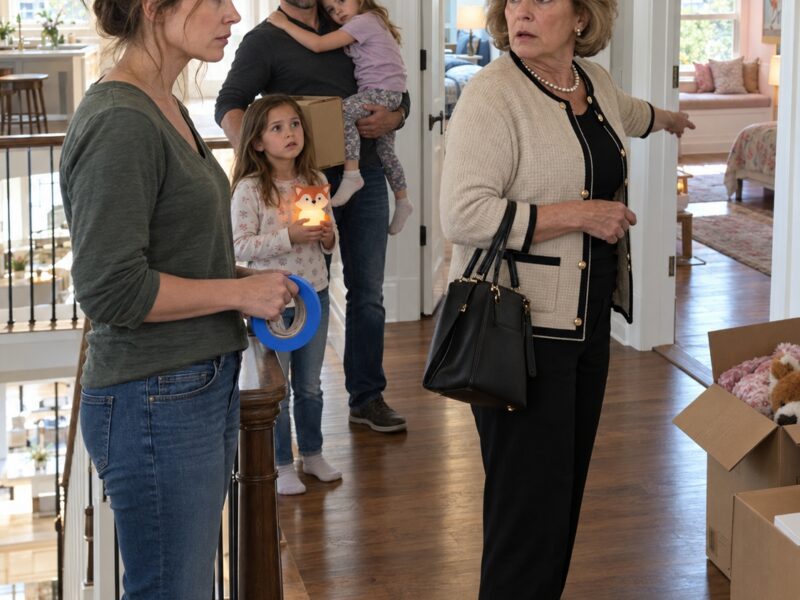
My Mother Walked Into My New House and Gave My Brother Three Bedrooms—Then She Learned I Had a Husband, Two Daughters, and No Intention of Moving
My mother walked through my brand-new house opening bedroom doors like a realtor and announced that my brother’s family would be moving in before I had unpacked a single box.
She did not know I had been married for nine years, did not know I had two daughters, and somehow still believed my home belonged to whoever she decided needed it more.
Then my husband came through the garage carrying our youngest, my eight-year-old asked which room was hers, and my mother started counting doors all over again.
My mother ran her hand across my new quartz countertop like she was checking it for dust.
“What a gorgeous kitchen,” she said.
I was still holding the roll of blue painter’s tape I had been using to label cabinet shelves. Half our dishes were in boxes. The refrigerator had exactly milk, eggs, mustard, and one takeout container Owen had warned me not to trust.
Mom didn’t ask where she could sit.
She didn’t ask how the move had gone.
She didn’t ask how I had been.
She walked past me.
Straight toward the stairs.
“Hannah, look at these floors.”
Her shoes clicked over hardwood I had spent six months saving for the down payment to own.
I followed her into the hallway.
“Mom, when did you get here?”
“Just now.”
“How did you know the address?”
She waved the question away and opened the first upstairs door.
Sunlight fell across an empty room where a moving company was supposed to deliver Josie’s bed the next morning.
Mom smiled.
“Oh, this is perfect.”
“For what?”
“The boys.”
I thought I had misheard.
She crossed the hall and opened another door.
“And this one for Jason and Kayla.”
My hand tightened around the tape roll.
“Mom.”
She was already moving.
At the end of the hallway, she opened the third bedroom and looked toward the window seat.
“No, actually, this one is better for the boys. Mason will love that window. Brody can have the wall side.”
I followed her into the room.
“What are you talking about?”
She turned as if the answer should have been obvious.
“Your brother’s family is moving in.”
There was no smile.
No request.
No awkwardness.
Just information.
“He already gave his landlord notice.”
The painter’s tape bent in my hand.
“Jason did what?”
“He gave notice.”
“Because he’s coming here?”
“Yes.”
“Who told him that?”
My mother looked genuinely confused by the question.
“I did.”
For a second, the house became very quiet.
Nine days earlier, Owen and I had signed our names on sixty-four pages at a title office ten minutes from downtown Springfield. I had read every line before we signed because reading property documents was literally what I did for a living.
The deed named Hannah and Owen Mercer.
The mortgage named Hannah and Owen Mercer.
The homeowner’s insurance named Hannah and Owen Mercer.
There was not a single page with my mother’s name on it.
There was definitely not one with my brother’s.
But my mother stood in the middle of my daughter’s bedroom arranging furniture that had not arrived yet.
“The big one with the window seat for the boys,” she continued. “The room by the bathroom for Jason and Kayla. The little room downstairs can be mine if we need it.”
I stared at her.
“Yours?”
“Well, we’ll see.”
She smiled like she had solved something.
Those rooms were empty because my daughters’ beds were still on a truck.
I read paperwork for a living.
I knew the difference between someone who owned something and someone who had simply decided they did.
Then the garage door opened downstairs.
Josie’s voice carried up first.
“Mom?”
My mother looked toward the stairs.
Footsteps crossed the kitchen.
Owen appeared in the hall with five-year-old Ren balanced on one hip and a cardboard box tucked beneath his other arm.
Josie came behind him holding the fox-shaped night-light she had refused to let the movers pack.
“Found it,” she announced.
Then she saw my mother.
Josie stopped.
Ren stared over Owen’s shoulder.
Owen looked at me.
He did not ask who the woman was.
He knew.
I had shown him pictures.
My mother, however, stared at Owen as if a stranger had entered her house.
Josie pointed toward the room behind me.
“Mom, which room is mine?”
My mother’s face went completely still.
There are silences that feel empty.
That one felt crowded.
Owen slowly lowered Ren to the floor.
Ren immediately wrapped both arms around his leg.
My mother looked at the girls.
Then at Owen.
Then at me.
“Wait.”
Her voice had lost the certainty it carried upstairs.
“You’re married?”
“Nine years.”
She blinked.
“You never told me.”
“I did.”
“No.”
“Yes.”
“I called you after the courthouse.”
Her face remained blank.
I could see her searching.
That hurt more than if she had accused me of lying.
I remembered the call exactly.
I had been twenty-eight, sitting beside Owen in our old Toyota outside a taco place in Omaha because we had just gotten married at the county courthouse and wanted carnitas instead of a reception.
I called my mother.
“Mom, I got married today.”
She paused.
Then said, “Oh, that’s nice, honey.”
Before I could tell her Owen’s last name, she said Jason needed eight hundred dollars for a lawyer.
I sent it.
Apparently that had been the memorable part.
Now she looked at my husband.
“Owen,” I said. “My husband.”
He gave her a polite nod.
“Nice to finally meet you, Mrs. Lowell.”
“Oliver?”
“Owen.”
“Right.”
She turned to Josie.
“And you are?”
“Josie.”
“What a pretty name.”
Two minutes later, she called her Jessie.
Then she looked at Ren.
“Well, aren’t you cute as a button?”
Ren buried her face against Owen’s jeans.
My mother laughed lightly.
“Shy.”
“She’s tired,” I said.
Mom looked upstairs again.
I watched the arithmetic happen behind her eyes.
Four bedrooms.
One downstairs.
Three upstairs.
A husband.
Two children.
She adjusted her purse on her shoulder.
“Well.”
I knew that tone.
It meant the facts had changed but the conclusion had not.
“The girls can share.”
Nobody moved.
Mom continued.
“Little girls love sharing. That still leaves two upstairs.”
I stared at her.
Somewhere inside me, a twelve-year-old girl had just sat up very straight.
“Nobody is moving in, Mom.”
Her face changed.
Not anger yet.
Disbelief.
“He already gave notice.”
“That was not my decision.”
“Hannah, where exactly are they supposed to go?”
“I don’t know.”
“You want your nephews sleeping in a car?”
“No.”
“Then what are you saying?”
“I’m saying nobody is moving into my house.”
She made a tiny sound with her tongue.
The same sound she used when I was thirteen and objected to giving Jason my headphones because he had broken his.
“I’m your mother.”
“I know.”
“I shouldn’t need an appointment.”
“I didn’t say appointment.”
“You said call.”
“Yes.”
“Same thing.”
Josie had moved behind my legs.
Owen returned to the kitchen, came back with a glass of water, and handed it to my mother.
He did not speak for me.
That was one of the first things I had loved about him.
He never tried to fight my battles.
He just made sure I wasn’t fighting them alone.
Mom took the glass.
Josie suddenly remembered the extension cord for her fox light and ran toward the garage.
She punched the keypad on the wall when she came back in, exactly the way Owen had shown her that morning.
Four numbers.
My birthday.
The garage door lowered.
My mother watched every button Josie pressed.
I noticed that.
I wish I had understood why.
Mom drank half the water.
Then set the glass down on the quartz counter she had admired when she arrived.
“We’ll talk when you’re not so emotional.”
She let herself out.
I stood at the counter afterward wiping the circle from the bottom of her glass long after it was clean.
That night, the girls slept on air mattresses because their furniture had not arrived.
Owen and I sat on the living-room floor between boxes labeled BOOKS, BATHROOM, and DO NOT PUT IN GARAGE.
He handed me a container of Chinese food.
“Did you really tell her about us?”
“I did.”
“About me?”
“Yes.”
“The wedding?”
“Yes.”
“The girls?”
I hesitated.
“No.”
Owen rested his forearms on his knees.
He did not judge the answer.
That somehow made it harder.
“I told her when we got married,” I said. “She just didn’t keep it.”
Outside, a truck hissed along the wet street.
Our new neighborhood was quiet after dark, the kind of subdivision where porch lights came on automatically and people still waved from driveways.
Moving back to Springfield had been my idea.
Owen’s mother, Rosa, had a knee replacement in June. She lived alone twenty-five minutes away in the small brick ranch where Owen grew up.
When my company offered me an escrow officer position at the Springfield branch, I said yes before Owen finished asking whether I was sure.
I told myself the city was big enough.
My mother lived on the north side.
Rosa lived east.
We could create distance with traffic lights.
That was the practical explanation.
The embarrassing one was that I still hoped my daughters could have two grandmothers.
Rosa already knew everything about them.
She knew Josie hated bananas unless they were sliced into cereal.
She knew Ren called thunderstorms “sky furniture.”
She had driven seven hours for every birthday before we moved.
My mother did not know they existed.
I had told myself that was protection.
The less she knew, the less she could claim.
But sitting on the living room floor in my own new house, I wondered whether I had confused boundaries with disappearance.
“How did she even find us?” Owen asked.
That question pulled me somewhere useful.
I thought about the previous Thursday.
Lowe’s paint counter.
A woman named Karen from my mother’s church had recognized me.
“Hannah Lowell?”
I hadn’t heard my maiden name said with that much enthusiasm in years.
We chatted.
She asked where I was living.
Without thinking, I told her the street.
I opened Zillow.
Our listing was still visible.
Four bedrooms.
Two and a half baths.
Quartz countertops.
Every room photographed empty.
I turned phone toward Owen.
“She didn’t come to see me.”
He looked at listing.
“She came to see the house.”
That thought should have made me angry.
Instead, it made everything make sense.
Then I remembered the garage code.
My birthday.
“She watched Josie type it.”
Owen looked at me.
“You want me to change it?”
I almost said yes.
Then stopped.
“She’s my mother.”
Owen waited.
“She isn’t going to break into our house.”
He did not agree.
He also did not argue.
At eleven that night, my phone buzzed.
Jason.
A photograph filled screen.
Stacks of moving boxes.
One labeled BOYS’ ROOM in thick black marker.
Underneath:
Mom says you’ve got plenty of space. Thanks, sis. You’re a lifesaver. 🙏
I stared at the box.
BOYS’ ROOM.
Not maybe.
Not temporary.
Not if Hannah says yes.
It had already been named.
It had happened before.
I was twelve the first time my mother gave away my room.
Jason was fifteen and failing two classes.
Mom decided he needed “a better study environment.”
My bedroom was larger.
It had a window overlooking the maple tree.
My grandfather had carved a wooden plaque for the door when I was six.
HANNAH.
He sanded every letter by hand.
Whenever he visited, he tapped that plaque with one knuckle like he was checking whether I still lived there.
I came home from school on a Tuesday and my bed was gone.
It had been moved into Mom’s sewing room.
My clothes were in black garbage bags.
Jason’s stereo was already playing in my old room.
“You’ll like this better,” Mom said.
“It’s cozy.”
“You don’t need much, Hannah.”
“You’re easy.”
I found my wooden plaque in the kitchen junk drawer.
That night, I nailed it to the sewing-room door.
The next morning, it was gone.
“Nails ruin trim,” Mom said.
She put it back in drawer.
From then on, she called the sewing room “your spare room.”
As though I were the spare part.
Grandpa noticed.
He found me in hallway.
Squeezed my shoulder.
“A name means something, kiddo.”
“Don’t let anybody tell you it doesn’t.”
He died two years later.
The plaque stayed in the drawer.
I learned my first family rule at twelve.
If you want to keep something, do not let Mom see how much you need it.
Being easy became my job.
At twenty-five, it cost me an apartment.
I was working at a title company in Kansas City and renting a two-bedroom place I loved.
Second bedroom was my office.
Pale green walls.
Secondhand desk.
One plant I managed not to kill.
Mom asked for a spare key “for emergencies.”
I gave it to her because saying no felt like an accusation.
That spring, I left for three weeks of escrow training.
Nine days later, building manager called.
Music at two in morning.
Pickup in my assigned parking space.
Someone staying in my unit?
No.
I called Mom.
“Jason needed somewhere to land.”
Like weather.
Like gravity.
His girlfriend kicked him out.
“What was I supposed to do?”
“You weren’t even using the room.”
When I came home, Jason’s things filled office.
Cigarette burns marked carpet.
Plant was dead.
He left next day.
Building fined me for unregistered occupant.
Kept deposit.
Did not renew lease.
When I told Mom what happened, she sighed.
“Family takes in family, Hannah.”
“I don’t know when you got so cold.”
That summer, I transferred to Omaha.
Three hundred miles away.
I never gave anyone a key again.
In Omaha, I learned how to read a deed of trust the way other people read a menu.
And I learned how to talk to my mother for five minutes without telling her anything.
Weather.
Holidays.
Work is busy.
Yes, I’m eating.
No, I don’t need anything.
Jason?
Sure.
How is Jason?
Then I met Owen.
He was a physical therapist assistant at a clinic one floor below our office. He helped one of my coworkers with a back injury, then somehow asked me to dinner in the parking lot.
He was terrible at flirting.
He was excellent at listening.
Three years later, we got married at Douglas County Courthouse.
Rosa cried.
Two coworkers signed as witnesses.
We ate tacos afterward.
I called my mother.
She forgot.
When Josie was born, I said nothing.
When Ren came three years later, I still said nothing.
At first, I felt guilty.
Then relieved.
Every call with Mom ended with Jason anyway.
Jason needed truck money.
Jason needed help with insurance.
Jason’s lawn-care business needed equipment.
Jason had a court fine.
Jason’s boys needed baseball registration.
I became an invisible daughter who sent visible money.
It worked for years.
But silence has a price.
My mother did not know me.
And I had never once forced her to admit that.
I simply moved farther away and let distance say no for me.
Now the distance was gone.
Monday morning, I sat down at my desk at Springfield branch for my first closing since move.
Three missed calls from Mom.
I turned phone facedown.
My buyers were Marcus and Bri Turner, a young couple purchasing a two-bedroom bungalow near Drury University.
Bri brought her own pen.
I liked her immediately.
I walked them through stack.
“This is deed.”
“It says who owns house.”
“This is deed of trust.”
“It says who you owe.”
“And what happens if you don’t pay.”
Bri smiled.
“You make it sound less terrifying.”
“That’s my job.”
During final title check, I found an unreleased deed of trust from a six-year-old home-equity loan.
Maybe paid.
Maybe not.
Either way, it was still of record.
I stopped closing.
Called seller’s bank.
Waited twenty minutes.
Got payoff confirmation and commitment to file release.
We started forty minutes late.
Bri hugged me when done.
I had spent eleven years protecting strangers from other people’s debts.
I was good at it.
I also had rules.
I never used company systems to look up my family.
If I searched something personal, I did it on my own laptop, at my own kitchen table, using public records anyone could access.
At lunch, I listened to Mom’s messages.
First:
“Hannah, call me.”
Second:
“I don’t appreciate being ignored.”
Third:
“Jason’s got until middle of month.”
Her voice had changed.
Flat.
Certain.
“Kayla’s beside herself.”
“I’m not asking you.”
“I’m telling you as your mother.”
I wrote two words in closing notebook.
Middle month.
Underlined them.
Then I picked up girls from Rosa’s.
Her house smelled like coffee and cumin.
She hated cane from knee surgery but used it.
Girls sat at kitchen table with markers.
“I made you something,” Rosa said.
Two wooden plaques.
JOSIE in purple wildflowers.
REN with a little brown bird.
“For their new rooms.”
My hands tightened around them.
Another wooden nameplate flashed in my memory.
Josie looked up.
“Mom, is that lady our grandma?”
“Which lady?”
“The one at our house.”
“Yes.”
“She didn’t know my name.”
“She’s my mom.”
Josie frowned.
“Then why doesn’t she know us?”
I had no answer an eight-year-old could carry.
“That’s a grown-up thing.”
Which is what adults say when truth embarrasses them.
Rosa poured tea.
She asked nothing.
When I apologized for dragging her into family mess, she waved one hand.
“Mija, I have known many families.”
“The mess is rarely fault of person cleaning it.”
Then she helped Ren color horse purple.
I watched them.
And felt envy.
Not of Rosa.
Of my daughters.
Owen’s mother gave and did not keep score.
Mine asked and called scorekeeping love.
I had spent years trying to earn wrong kind.
When we left, I put plaques in trunk.
I did not hang them.
I told myself walls needed patching.
That was not why.
I wanted to know whose house it was going to be first.
At home, I found text from Kayla.
Jason’s wife.
I had met her twice.
Hi, Hannah. Brody keeps asking which room has the window seat. I’m sorry. I know this is a lot.
I sat on front steps and read it four times.
Kayla was not enemy.
She was tired woman with two boys and husband who let his mother make phone calls.
That made it harder.
I created group text.
Mom.
Jason.
Kayla.
Then typed slowly:
To be clear, no one has permission to move into our home or store anything here. I’m sorry you’re in a hard spot. The answer is no.
My thumb shook before send.
Mom answered in under minute.
We’ll see what the family thinks.
Jason sent laughing emoji.
Kayla said nothing.
I stared at Mom’s message.
First time in my life, I had said no to her in writing.
Date.
Time.
Witnesses.
Nobody could later claim I had misunderstood.
It felt good for ten seconds.
Then I understood the threat.
She was not going to argue with me.
She was going around me.
“Long day?”
Voice came over fence.
Older man in cardigan watering shrubs.
“Gene Ostrander,” he introduced himself.
“Thirty-one years with postal service.”
“I still read every envelope on this street whether I want to or not.”
I laughed.
First time all day.
Next Monday, Gene knocked holding two envelopes.
“These came to my box.”
“But I don’t think they’re mine.”
“And I don’t think they’re yours.”
One was postal-service confirmation of address change.
Other was credit-card statement.
Both addressed:
Jason Lowell
at my address.
I stared.
Gene cleared throat.
“Anybody can submit forwarding request.”
“Don’t throw these away.”
“Take them to post office.”
“Tell them he doesn’t live here.”
Mail proves residence in a thousand ordinary ways.
Rental applications.
Schools.
Bank records.
Jason was not waiting for permission anymore.
He was moving in on paper first.
So that when truck arrived, it would look like he already belonged.
I did not call Mom.
Did not yell.
For first time, I decided not to argue about truth until I knew exactly what truth was.
That night, after girls slept, I opened Missouri court records on my laptop.
Typed Jason’s full name.
Case appeared immediately.
Rent and possession.
Filed August.
Consent judgment September.
Jason and Kayla agreed to vacate duplex by noon October fifteenth.
I read twice.
He had not given landlord notice.
Landlord had given him one and taken him to court.
Then I searched county recorder.
My mother’s house on Linden Court.
House Grandpa helped her pay off.
For years, free and clear.
Not anymore.
Two years earlier, Mom signed a home-equity line.
Forty-eight thousand dollars.
I remembered timing.
Jason had bought brand-new pickup for lawn-care business.
Business failed six months later.
Owen came into kitchen and set tea beside laptop.
“What does it mean?”
“My mother borrowed against her house to pay for Jason.”
I clicked back to court case.
“And now Jason needs a house.”
I expected anger.
Instead, I felt sad.
Mom was sixty-six.
She owed money against home she had owned outright since I was in high school.
Whatever she had done to me, she had done to herself first.
I decided not to trust a computer alone.
Tuesday morning, I drove past Linden Court.
A real-estate sign stood in Mom’s yard.
COMING SOON.
Boxes visible through window.
I pulled over two houses down and called Aunt Bev.
Mom’s younger sister.
Her confidant for sixty years.
Bev sighed before answering.
“I told her it was bad idea.”
“What?”
“She has buyer.”
“Closes twenty-fourth.”
My hand tightened on steering wheel.
“And where is she going?”
Silence.
“Bev?”
“With you, honey.”
I stopped breathing.
“She said she’s taking little room downstairs.”
“She says her knees aren’t what they were.”
I stared through windshield.
Three spare bedrooms.
Perfect.
Two for Jason’s family.
One for her.
Mom had not come to find room for my brother.
She had come to claim room for all of them.
Rent free.
While giving sale proceeds to Jason.
“How much?”
“What?”
“How much is she giving him?”
“Sixty thousand.”
I laughed once.
Dry.
Ugly.
That evening, phone exploded.
Mom had posted on Facebook.
Prayer request.
Photo of Jason’s boys in matching baseball caps.
Please pray for softened hearts in our family. My precious grandsons may have no roof in two weeks while some people have three empty bedrooms and a closed heart.
Forty-six comments by ten.
Church women.
Cousins.
Great-aunts.
Blood is blood.
Family comes first.
Some people forget where they came from.
Cousin Tammy tagged me.
I typed response.
Long.
Careful.
Used word judgment.
Then deleted all of it.
Took screenshot.
Date and time visible.
Saved.
Owen stood in doorway.
“Want me to say something?”
“No.”
“This one’s mine.”
Next morning, Mom made it my employer’s.
At ten, receptionist buzzed.
“Hannah, your mother’s here.”
Mom stood in lobby wearing church dress and carrying white bakery box.
Two clients waited for eleven o’clock closing.
Branch manager Mr. Hartley passed with coffee.
Mom placed box on reception desk.
“I’m Hannah’s mother.”
“I brought cinnamon rolls.”
“She won’t let me see my own granddaughters, so I thought I’d come where I know she’ll be.”
Receptionist looked at me.
I walked over.
Took Mom gently by elbow.
“Outside.”
Parking lot changed her voice.
Soft.
Reasonable.
Bank-call voice.
“I’ve been thinking.”
“I want to make you offer.”
I almost laughed.
“Jason pays six hundred a month.”
“Kayla helps cook.”
“I’ll pick girls up from school.”
“You won’t need daycare.”
“You won’t need Rosa.”
Then:
“You’d finally have your mother back, Hannah.”
Her fingers touched my arm.
“Isn’t that what you always wanted?”
I hate how close I came.
For several seconds, I saw it.
Mom at kitchen table.
Braiding Josie’s hair.
Ren on her lap.
Sunday dinners.
Family that looked like television commercials.
She had found exact place where I was still twelve.
Then I asked one question.
“Mom, what are their middle names?”
She blinked.
“Whose?”
“My daughters.”
“Josie and Ren.”
“What are their middle names?”
Her mouth opened.
Closed.
“Hannah, that is hardly point.”
I said nothing.
“Jason’s boys may be living in motel.”
There it was.
Again.
Always.
I knew judgment.
Loan.
Sale.
Downstairs room.
I did not say any.
“I’ll think about it.”
Only so she would leave parking lot.
She smiled.
Like she had won.
Inside, Mr. Hartley waited by office.
“Everything okay?”
“We can’t have family conflict in lobby.”
“Not with clients.”
“I know.”
“It won’t happen again.”
I sat at desk.
Cinnamon rolls had been moved to break room.
My mother had found one place I built without her and brought performance there too.
That night, lying awake, I finally said to Owen:
“What if she means it?”
He turned toward me.
Streetlight made pale square on ceiling.
I made list.
My nephews.
A grandmother for girls.
Six hundred dollars.
End of family war.
Other side:
Court judgment.
Loan.
House sale.
Downstairs room she already called hers.
“I keep thinking maybe if I give her this, she’ll finally see me.”
Owen was quiet long time.
“It’s your mother.”
“And it’s our house.”
“I’ll stand wherever you stand.”
Then he added:
“But I want you standing somewhere you can stay.”
Before I answered, bedroom door creaked.
Josie in pajamas holding fox light.
“I’m thirsty.”
I filled cup in bathroom.
She drank.
Then asked:
“Mom, is that lady going to sleep in my room?”
“No, baby.”
“Promise?”
I knelt until eye level.
“I promise.”
She nodded.
Went back to bed.
I stayed kneeling in hallway.
I had just promised my daughter something nobody had ever promised me.
Nobody guaranteed my room would still be mine after school.
Nobody kept my name on door.
I was not going to become second woman in my family who handed a little girl’s room to someone else and called it love.
I climbed back into bed.
Owen took my hand.
I had kept quiet my whole life to keep things.
Quiet was not going to keep this one.
Thursday lunch, I called Kayla.
She answered from grocery-store break room.
“Hannah?”
“I looked up case.”
Silence.
“The rent and possession judgment.”
Then she started crying.
No notice.
Never.
Jason had spent three months of rent money catching up on truck.
Kayla did not know until court papers appeared on door.
“He told me you said yes.”
My stomach dropped.
“He said you told Diane we could stay two weeks.”
“Until her house money came through.”
“What house money?”
“I don’t know.”
“That’s what he said.”
Kayla sent photo of judgment page from purse.
Creased.
Folded.
October fifteenth.
No longer website.
Paper carried by frightened woman.
“Kayla, I’m going to be honest because nobody else is.”
“I’m not taking Jason’s side.”
“I’m not taking anybody’s side against boys.”
“But door isn’t open.”
“It never was.”
“I’m telling you now so you can plan around truth instead of Jason.”
Silence.
Then:
“Thank you.”
“I think.”
I texted 211 community resource number.
That was all I could offer.
I did not pretend it was more.
When call ended, I searched locksmith.
Friday afternoon, every exterior lock changed.
One hundred forty dollars.
Owen changed garage code.
“What do you want it to be?”
“Anything except my birthday.”
“She knows my birthday.”
“She’s never asked what I did on it.”
Saturday, I took Jason’s mail to post office with Josie holding my hand.
Clerk marked address.
Then I sent certified letters to Mom and Jason.
Short.
Plain.
No one has permission to live, stay, store property, or receive mail at our address.
If anyone arrives to move in, it will be treated as trespassing.
Receipts went into closing notebook.
Monday, I called police non-emergency line.
Officer listened.
“If they haven’t moved in and you’ve clearly told them no, call us if they show.”
“If they get belongings inside and establish occupancy, things get more complicated.”
I wrote it down.
Before they are in, simple.
After they are in, not.
Then I told Gene next door.
He nodded.
“I’m home all day.”
“I’ll be on porch.”
Every door into my house finally had an owner.
Then Mom ended polite part herself.
Sunday after church, family group chat lit up.
Fourteen relatives.
Mom:
Moving day Thursday at 9. Jason, boys get big room upstairs. You and Kayla take room by bathroom. I’ll take little room off kitchen. Hannah will come around once we’re all there. 🙏
I read last sentence three times.
Hannah will come around once we’re all there.
There it was.
Not temporary.
Not request.
Plan.
Get boxes inside.
Then I would have no choice.
Kayla messaged privately.
Diane’s moving in too. Jason told me two weeks. I didn’t know. I’m so sorry.
Then Aunt Bev:
She told me not to tell you. I’m done keeping her secrets.
I saved screenshots.
For years, Mom told family story.
This time, she wrote it down herself.
Thursday, I took day off.
Wednesday night, Owen drove girls to Rosa’s.
“Pancakes in morning,” Rosa promised.
Girls cheered.
After they left, house became painfully quiet.
I opened trunk.
Took out wooden plaques.
Leaned JOSIE against wall outside one bedroom.
REN outside other.
Still did not nail them.
Not yet.
At kitchen table, I printed three documents.
Judgment.
Recorded deed of trust.
Certified mail receipts.
Clipped them.
Not to win argument.
To answer facts.
Owen sat opposite.
“What do you need me to do tomorrow?”
“Stand next to me.”
“And don’t carry anything.”
He nodded.
I decided more.
Talk outside.
Never open garage.
Say no once.
Do not explain ten ways.
I slept four hours.
At 8:58 Thursday morning, I heard air brakes.
Fifteen-foot moving truck turned onto street.
Jason driving.
Kayla passenger.
Two boys visible through cab.
Mom’s sedan pulled in behind, packed so full suitcases and lamps blocked rear window.
A framed picture leaned against glass.
Jason’s high-school graduation.
Gene came onto porch with coffee.
Woman walking golden retriever slowed.
I stood on front step.
Owen beside me.
Garage closed.
Jason jumped from truck.
Walked straight past us to keypad.
Entered four numbers.
Red light.
Again.
Red.
He turned.
“Mom, what’s code?”
She climbed from sedan.
“It’s your sister’s birthday.”
“I just did that.”
“It changed,” I said.
Brody rolled window down.
Eight years old.
Cowlick.
“Is this house with window seat?”
Kayla turned toward him.
Said something.
Window went up.
My chest hurt.
Mom walked up front path.
Stopped two steps below me.
“Hannah.”
Loud enough for neighbors.
“Your brother gave landlord notice.”
“These people have nowhere to go.”
“He didn’t give notice.”
I held out judgment.
“He agreed in court to leave by noon today.”
Mom looked at page.
Not taking it.
Then at Kayla.
Her face shifted.
“Kayla sent you that.”
“It’s public too.”
“Anybody can look.”
Mom straightened.
“I’m your mother.”
“I shouldn’t need permission to help my son.”
“You did help him.”
I held second paper.
“You took forty-eight-thousand-dollar loan against your house.”
“And you’re closing sale on twenty-fourth.”
Her chin rose.
“That is my business.”
“Then this is mine.”
I pointed toward house.
Jason had stopped at truck door.
Kayla stared at Mom.
Mom looked toward Gene.
Toward dog walker.
Then tried one more time.
“Those rooms are empty, Hannah.”
“You aren’t even using them.”
Same sentence.
Nearly word for word.
From twelve years earlier.
Different room.
Different city.
Same theft.
“They’re not empty.”
Mom frowned.
“They’re Josie’s and Ren’s.”
“You would know that if you had asked one question in nine years.”
Street went quiet.
Even dog sat.
Then Kayla spoke.
“Diane.”
Mom turned.
“Were you going to tell me you were moving in for good?”
“Oh, Kayla.”
“Don’t be dramatic.”
“It’s a big house.”
That was all.
Enough.
Kayla looked at truck.
House.
Jason.
Then Jason pulled box marked BOYS’ ROOM from truck.
He put it on shoulder.
Walked toward porch.
“Come on, Han.”
“Just let me put boys’ stuff on porch.”
“We’ll sort rest later.”
I knew what porch meant.
Porch became hallway.
Hallway became room.
Room became civil matter.
Once a child’s things were inside, guilt would do rest.
I raised phone.
Non-emergency number open.
“If that box touches my porch, Jason, I call.”
He stopped.
“You’re serious?”
“Yes.”
“Jesus, Hannah.”
“You were told in writing.”
Gene’s voice carried across yard.
“I’ve got date on certified letters if anybody needs it.”
Owen stepped down one stair.
Hands empty.
Exactly as asked.
Jason looked at Mom.
The way he always looked when things got hard.
For once, she had no answer.
Behind him, Kayla opened truck cab.
“Boys, seat belts.”
Then to Jason:
“Put it back.”
“Kayla—”
“We’re going to my sister’s in Joplin.”
“Today.”
Jason stood with box.
Then turned.
Walked back.
Sliding door crashed shut.
Truck reversed slowly.
Mason looked through side window.
Eleven.
Tired face.
He raised hand.
Small wave.
I waved.
Truck turned corner.
Only Mom’s sedan remained.
She stood beside it, one hand on roof.
For first time that morning, I went to her.
Up close, she looked older.
Lipstick carefully applied.
Hands shaking.
“I have nowhere to go.”
“I close on twenty-fourth.”
“You’ll have more than enough after closing to rent.”
“Jason needs money.”
“That is your choice.”
I said it quietly.
“It was never going to be my house’s job.”
She looked down street.
Then, in smallest voice I had ever heard from her:
“Can I at least see girls?”
I had waited nine years for that question without knowing.
I looked at suitcases.
Lamps.
Jason’s graduation photo.
“You can meet your granddaughters.”
“You cannot move into their rooms.”
Mom did not promise anything.
Got in car.
Drove away.
Owen put arm around me.
We went back inside.
House was quiet.
Still ours.
Nine days later, October twenty-fourth, Mom called at ten at night.
Extended-stay motel.
I heard TV through wall.
House had closed that afternoon.
She had already given Jason sixty thousand.
“He needed it for Joplin.”
“Deposit.”
“Truck.”
“Some things.”
Then she cried.
Not loudly.
My mother never cried loudly.
“It’s lonely here, Hannah.”
“Just November.”
“Little downstairs room.”
“I’d be quiet.”
“You’d hardly know I was there.”
I stood in dark kitchen.
Owen at doorway.
Old answer rose automatically.
Fine.
Okay.
Whatever you need.
Fastest way to end call.
For one second, I pictured slippers beside downstairs bed.
Pill organizer on windowsill.
Then I pictured sewing machine beside my childhood bed.
It would not be November.
It would become forever.
And every day, I would be twelve again in my own house.
“No, Mom.”
Silence.
“But I’ll pick you up Saturday at ten.”
“I’ll take you to look at apartments.”
“I won’t sign.”
“I won’t pay.”
“And you won’t live with us.”
She did not understand at first.
Saturday, she did.
I spent two lunch breaks calling fifty-five-plus apartment communities near her church.
Found two ground-floor units.
First had broken elevator.
Second had small one-bedroom facing dogwood tree.
Mom stood at kitchen window.
“It’s small.”
“It’s yours.”
She looked at me.
Really looked.
Not argument.
Not calculation.
Something closer to fear.
“What if I can’t afford it?”
“You can.”
“I checked numbers with you.”
“After rent and utilities, you’ll be okay.”
“Not luxurious.”
“Okay.”
She signed lease herself.
Wrote deposit from own account.
When leasing agent offered spare key:
“Who should have it?”
I said:
“She’ll decide.”
Mom looked at me.
Then took both keys.
On drive back, I handed her handwritten paper.
Sunday lunch. 12–2. Our kitchen table. Jason does not come. Nobody asks for money, rooms, rides, signatures, favors, or keys.
She read twice.
Folded.
Put in purse.
Did not say yes.
Did not throw away.
That was enough.
Kayla and boys stayed with sister in Joplin.
Jason worked warehouse nights and drove back and forth.
Most of sixty thousand disappeared within weeks to truck debt and failed rental deposit.
That was not my emergency.
Mom kept enough for apartment.
Facebook prayer post disappeared.
Cousin Tammy messaged:
I’m sorry. I didn’t know.
At work, Mr. Hartley never mentioned lobby again.
Denise left cactus on my desk.
Sticky note:
For the hard days.
First Sunday lunch came third week of November.
That morning, I got hammer.
Owen offered.
“No.”
“I want to do it.”
I hung Josie’s plaque.
Purple flowers.
Then Ren’s.
Brown bird.
Each nail made clean little sound.
Tap.
Tap.
Tap.
Then downstairs.
Small room off kitchen.
Rosa had been sleeping there Friday nights because girls begged for pancake mornings and her knee still hated stairs.
Josie and Ren painted a plaque for her.
ROSA.
Two handwritings.
One backward letter.
I nailed it to door Mom once declared hers.
At noon exactly, bell rang.
Mom waited outside.
That alone nearly undid me.
She held brown paper bag.
Inside was old wooden plaque.
Darkened with age.
Hand-sanded letters.
HANNAH.
“I found it packing house.”
Her voice shook.
“It was still in drawer.”
She did not say sorry.
Instead:
“I kept it.”
I held plaque with both hands.
Could not speak.
Later, I hung it on upstairs office door.
Nobody in our house called it spare room.
Lunch was simple.
Owen made enchiladas from Rosa’s recipe.
Rosa sat at one end.
Mom at other.
They were painfully polite.
Halfway through meal, Mom looked around kitchen.
Quartz.
Window.
Girls’ drawings on refrigerator.
“It’s a gorgeous kitchen.”
This time, she stopped there.
No room count.
No assignments.
Then she turned to Ren.
“What’s your middle name, sweetheart?”
Ren sat straight.
“Rose.”
“After Abuela.”
Mom looked down table at Rosa.
Long moment.
“That’s a lovely name.”
At two, Mom stood.
Thanked Owen.
Kissed top of each girl’s head.
Went home to her own apartment.
Nobody had asked anybody for anything.
I do not know what Mom and I will be in five years.
I know what we are on Sundays from twelve to two.
That is more than we were before.
That night, after girls slept, I stood at sink washing dishes in my gorgeous kitchen.
Upstairs and downstairs, every door had a name on it.
Every name belonged to someone who had been invited.
I dried my hands, walked into hall, and looked at my own wooden plaque upstairs.
Grandpa had been right.
A name means something.
So does a door.
And this time, I kept both.









