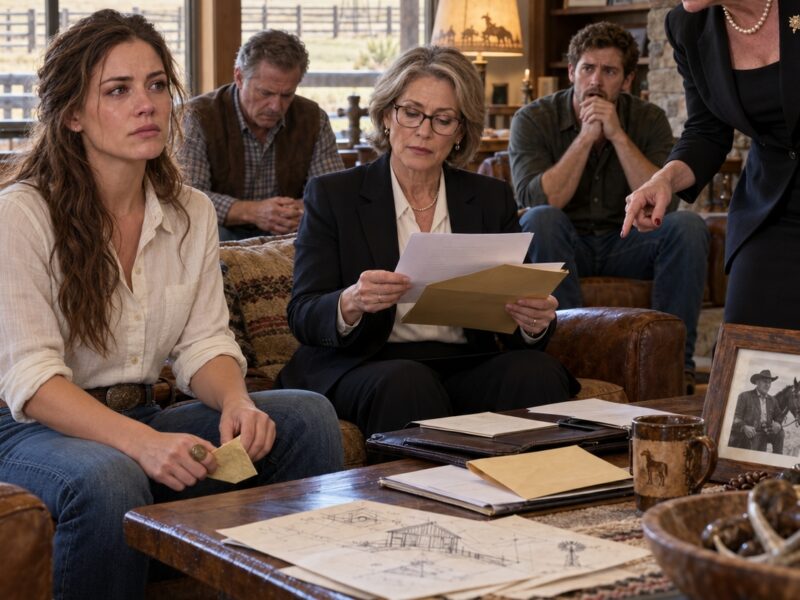
My Parents Abandoned Me at Grandpa’s Ranch When I Was Nine—Twenty-Two Years Later, His Lawyer Opened One Envelope and My Mother Finally Heard the Answer She Deserved
“You were the child we could afford to lose.”
My mother said those words in front of seven people, including the attorney who had just explained that my grandfather’s estate was worth considerably more than anyone in the room had imagined.
She was pointing at me.
Her face was flushed, her black funeral dress was creased at the waist, and the handkerchief she’d carried through the memorial service lay forgotten on the floor beside her chair.
For twenty-two years, she’d insisted that sending me to my grandfather’s horse ranch had been an act of love.
Now, with her father’s inheritance slipping away, she finally told the truth.
I was nine when she left me.
I was thirty-one when she admitted why.
And the woman sitting across from her, attorney Marian Voss, didn’t raise her voice or ask anyone to calm down. She simply turned a page in the document my grandfather had signed eighteen months before his death.
“Mrs. Mercer,” she said, “your father anticipated that you might describe his decision this way. That’s why he asked me to read the next paragraph aloud.”
My mother stopped talking.
Marian adjusted her glasses.
Then she began.
But to understand why that paragraph mattered, you have to understand the man who spent twenty-two years teaching me that being unwanted by one person didn’t make me disposable to everyone else.
My name is Iris Ashford.
I’m thirty-one now, a software engineer and the founder of a small agricultural technology company in eastern Oregon. Most of my work involves irrigation monitoring, equipment diagnostics, and the unglamorous business of helping farms use less water without gambling with their crops.
I own three pairs of good work boots, one decent black dress, and a pickup truck that smells permanently of coffee and horse feed.
When people ask where I’m from, I tell them Harney County.
That’s the truth.
But I was born in Portland, where my parents, Diane and Glenn Mercer, raised my older brother Brian and me in a narrow house with a blue front door.
Until I was nine, I thought families worked like the houses in television commercials.
The father came home from work.
The mother asked about school.
The children argued over breakfast cereal.
Nobody ever explained that parents could decide one child was worth the inconvenience of keeping and another wasn’t.
I learned that on an August afternoon.
I remember the heat first.
The vinyl back seat of my father’s Buick stuck to the backs of my legs. My shirt was damp beneath the seat belt, and a half-empty bottle of orange soda rolled against my plastic suitcase whenever Dad turned a corner.
We’d been driving east for nearly six hours.
Mom sat in the front seat reading a magazine.
Dad drove with one hand on the steering wheel, tapping the other against the armrest.
My brother wasn’t with us.
Brian was twelve. He’d stayed in Portland with a friend because, according to Mom, there wasn’t enough room for everybody’s luggage.
I believed her.
Children believe plenty of things when the alternative is realizing the adults they depend on are lying.
At a gas station in Bend, I’d asked how long we were staying with Grandpa.
Mom said, “We’ll see.”
When I asked whether Brian was joining us later, she told me to stop asking questions.
I didn’t ask another one.
By late afternoon, we were traveling along a gravel road bordered by dry grass, juniper trees, and fences stretching toward low hills.
A wooden sign beside the gate read:
ASHFORD STABLES.
Beyond it stood a weathered white farmhouse, two long barns, several fenced pastures, and an old windmill that made a thin metallic creak each time it turned.
I’d visited Grandpa Henry twice before.
Once at Christmas.
Once when he came to Portland for a family wedding.
He was a tall, quiet man with short white hair and hands that always looked as though he’d just finished repairing something.
I didn’t dislike him.
I barely knew him.
When the Buick stopped in front of his house, Mom turned around.
“You’ll have your own room here.”
I nodded.
“Grandpa has plenty of space.”
“Okay.”
She looked at my suitcase instead of my face.
“Be good for him.”
I glanced toward the porch.
“How long are we staying?”
Mom didn’t answer.
Dad got out and opened the trunk.
I followed him.
He removed my suitcase and placed it beside the front steps.
Then he shut the trunk.
I watched him walk back toward the driver’s door.
“Daddy?”
He stopped.
“Yeah, Iris?”
“Aren’t you bringing your bags?”
He looked toward Mom.
Her window was open a few inches.
She said, “Your father and I have things to do in Portland.”
My stomach tightened.
“When are you coming back?”
“Grandpa will take good care of you.”
I stared at her.
“That wasn’t what I asked.”
Dad looked away.
Mom’s expression hardened.
“Don’t make this harder than it needs to be.”
I remember those words because I didn’t understand them.
Harder for whom?
I was nine years old.
I had a suitcase containing four shirts, two pairs of jeans, pajamas, a toothbrush, and a stuffed rabbit with one ear missing.
I’d brought a library book I was supposed to return the following Thursday.
I’d left my bicycle leaning against the garage in Portland.
My favorite sweater was still hanging over my bedroom chair.
I didn’t know I was moving.
Nobody had asked me.
Nobody had told me to say goodbye.
Dad opened his door.
I stepped forward.
“Please.”
He paused.
For a second, I thought he might turn around.
Instead, he said, “Listen to your grandfather, okay?”
Then he climbed into the Buick.
Mom looked at me through the window.
Her face wasn’t angry anymore.
It was impatient.
She said something to Dad as he shifted into reverse.
I couldn’t hear every word.
Just enough.
“She’ll be fine. She’s the one who can manage.”
The car backed down the driveway.
Gravel snapped beneath the tires.
I watched it pass the fence, turn near the gate, and disappear behind the juniper trees.
I didn’t run after it.
I thought they would come back once they’d realized they’d forgotten to explain.
So I waited.
Five minutes.
Maybe ten.
The windmill creaked behind the barn.
A horse stamped somewhere nearby.
The screen door opened.
Grandpa Henry stepped onto the porch wearing a faded work shirt and brown pants with a measuring tape clipped to the pocket.
He looked at the empty road.
Then at me.
Then at the suitcase.
“Can you carry that yourself?”
I nodded because I could.
He pointed toward the staircase behind him.
“Your room’s upstairs, second door on the left. Put your bag there, wash your hands, and come find me in the workshop.”
That was all.
No hug.
No promise that Mom and Dad would return.
No speech about how lucky I was to live on a ranch.
Just a room and something to do.
At the time, I thought he didn’t care that I was frightened.
I would learn that Henry cared very much.
He simply didn’t know how to show it to a child yet.
The room upstairs smelled like cedar.
There was a narrow bed, a wooden dresser, and a quilt made of faded blue and yellow squares.
A small desk stood beside the window.
From there, I could see the windmill.
I placed my suitcase at the foot of the bed.
Then sat down.
For a while, I listened.
No car.
No voices.
No footsteps on the stairs.
Eventually, I opened my suitcase and took out the rabbit.
His name was Oliver.
I’d had him since I was four.
I placed him on the pillow.
Then I went downstairs because Grandpa had told me to.
The workshop stood behind the main barn.
Its large double doors were open, and inside the air smelled of saddle leather, machine oil, sawdust, and warm metal.
Tools hung on labeled pegboards.
Every wrench had its own outline.
Boxes of bolts were arranged by size.
There were diagrams pinned beside the workbench, showing gears, water pumps, and things I couldn’t identify.
Grandpa sat on a stool holding a leather bridle with a broken buckle.
He pointed to another stool.
“Sit.”
I climbed onto it.
He held up the bridle.
“This is broken.”
I nodded.
“Can you see where?”
I leaned closer.
The leather strap had pulled away from a metal fitting.
“Here.”
He nodded.
“Good.”
Then he showed me how the pieces fit together.
He worked slowly.
He explained what each tool did.
He didn’t let me use anything dangerous.
He only asked me to hold a small tray for the screws and hand him the pieces he needed.
When he finished, he tugged the repaired strap.
It held.
“See that?”
I nodded.
“Things don’t fix themselves,” he said.
I looked toward the open workshop door.
Beyond it, the gravel road led toward the place my parents had disappeared.
“Will Mom come tomorrow?”
Grandpa stopped moving.
It was the first time I’d seen him hesitate.
He set down the bridle.
“I don’t know, Iris.”
I swallowed.
“Did I do something?”
His face changed.
He looked at me for a long moment.
Then pulled the other stool closer.
“No.”
“Mom was mad.”
“That doesn’t mean you did anything wrong.”
I looked down at my shoes.
“Then why didn’t she take me home?”
Grandpa rubbed one hand over his face.
I understand now that he was trying to decide whether telling a child the truth would protect her or break something she still needed.
Finally, he said, “Your parents asked me to take care of you for a while. I agreed.”
“How long?”
He looked toward the workshop door.
“I don’t know yet.”
Tears gathered in my eyes.
I hated crying in front of people.
Even at nine, I knew my mother found it irritating.
Grandpa reached for a clean shop rag.
He handed it to me.
“Here.”
I wiped my face.
He waited.
Then said, “You don’t have to pretend you’re not upset.”
I looked up.
He seemed uncomfortable.
As if he’d never said that sentence aloud before.
Then he added, “But you’re not going to sit here alone all afternoon.”
He pointed toward the workbench.
“Help me put these tools away. Afterward, we’ll make dinner.”
I swallowed.
“Do you know how to cook?”
He looked offended.
“Of course.”
That night, he burned the scrambled eggs.
We ate them anyway.
The first month was the hardest.
I kept my suitcase packed beneath the bed because I thought my parents might arrive without warning.
Every afternoon, when a car turned onto the gravel road, I ran to the window.
Usually it was a feed delivery.
Sometimes the veterinarian.
Once it was a woman bringing documents for Grandpa to sign.
Never the Buick.
I started school in September.
The nearest school was small enough that everyone knew I was Henry Ashford’s granddaughter before I stepped into the classroom.
My teacher, Mrs. Jennings, asked me to write a paragraph about my summer vacation.
I wrote that I’d visited a horse ranch.
I didn’t write that my parents had left me there.
I didn’t know what to call that yet.
For several weeks, I told classmates I was staying with Grandpa because my parents were busy.
Nobody challenged me.
Children aren’t always interested in complicated explanations.
A few asked whether they could come see the horses.
One girl named Tess invited me to sit with her at lunch.
That helped.
Grandpa arranged my school enrollment, medical care, and the necessary legal paperwork with assistance from a family attorney.
He didn’t explain much of it to me.
I knew only that teachers called him when I was sick and that he was the person who signed my report cards.
At first, he was awkward about almost everything that involved raising a girl.
He bought the wrong shampoo.
He had no idea how to braid my hair.
He once packed a lunch consisting of three slices of roast beef, an apple, and a jar of pickles.
When I showed him the jar, he frowned.
“What’s wrong with pickles?”
“Nothing. But I need a sandwich.”
He thought about that.
Then nodded.
“Fair point.”
The next day, I got a sandwich.
He also learned to buy the kind of cereal I liked.
He discovered I hated peas.
He began leaving a small lamp on in the hallway because I’d told him the house sounded strange after dark.
And one night, about six weeks after I arrived, I woke crying from a dream in which my mother had driven away again.
Grandpa appeared at the bedroom door wearing an old flannel robe.
“You sick?”
I shook my head.
He came inside.
“Bad dream?”
I nodded.
He sat on the edge of the bed.
For a while, neither of us spoke.
Then I asked, “Do you think Mom forgot me?”
Grandpa looked down at his hands.
“No.”
“Then why doesn’t she call?”
He took a long breath.
“I don’t have a good answer.”
I began crying harder.
He looked helpless for a moment.
Then he opened his arms.
I moved toward him.
He held me clumsily, one broad hand against my back.
I’d never known someone could be so bad at hugging and still make you feel safe.
After a while, he said, “You’re here now, Iris.”
I nodded against his shirt.
“And I’m here.”
I didn’t understand yet that the second sentence would matter more than anything else.
Grandpa was seventy when I moved in.
He’d spent much of his adult life working as a mechanical engineer, specializing in water-control equipment for agricultural operations.
He had designed irrigation components, pressure regulators, and valve assemblies.
He still held patents on several systems.
At nine, I had no idea what a patent was.
I knew only that Grandpa liked drawing machines on yellow paper and that strange men occasionally visited to discuss things called licensing agreements.
He never talked about being rich.
He drove an old Ford pickup.
He wore work shirts with frayed cuffs.
He bought canned soup when he didn’t feel like cooking.
The ranch house needed painting, and he kept delaying the project because he thought the money would be better spent replacing an irrigation pump.
I assumed we were ordinary.
In many ways, we were.
Ashford Stables boarded and trained horses.
The operation employed two full-time ranch hands, Dale Peterson and Pete Lawson, and several seasonal workers.
There were fenced paddocks, hay storage buildings, equipment sheds, and a narrow creek that ran across part of the property during wetter months.
The land extended across more than a thousand acres of high desert grazing country.
Water rights were complicated and valuable.
I learned that much before I turned twelve.
But I didn’t know their monetary value.
To me, they were simply the reason Grandpa checked gauges, maintained pumps, and argued with people about how much water a field actually needed.
By October, he let me help with small repairs after school.
Nothing unsafe.
I sorted screws.
Measured boards.
Read the labels on equipment.
Checked whether water troughs were overflowing.
In November, he taught me how to use a torque wrench on a practice assembly.
“Not too loose,” he said, guiding my hand.
I turned.
“Like this?”
“A little more.”
I tried again.
The wrench clicked.
“There.”
He nodded.
“Good.”
I smiled.
He pointed toward the bolt.
“You don’t keep turning after the click. You can damage the threads by trying too hard.”
I looked at the wrench.
He continued, “People do that with plenty of things.”
I didn’t understand the second meaning.
Grandpa didn’t explain it.
He rarely did.
He preferred to let a lesson become useful when you were ready for it.
The workshop became the place where I felt most comfortable.
At school, I was the girl whose parents lived somewhere else.
At church, I was Henry’s granddaughter.
In town, people sometimes asked if my mother planned to visit.
But in the workshop, I was simply Iris.
The girl who remembered where the small sockets belonged.
The girl who liked measuring things twice.
The girl who asked questions until Grandpa sighed, then answered anyway.
He didn’t tell me I was brilliant.
He didn’t say I could be anything I wanted.
He told me when my measurements were wrong.
And when they were right, he trusted me to do the next thing.
For a child who’d been left behind, that trust felt enormous.
My parents called for the first time just before Thanksgiving.
Grandpa answered the kitchen phone.
I was at the table doing homework.
He listened for several seconds.
Then handed me the receiver.
“Your mother.”
My heart jumped.
“Mom?”
“Hi, sweetheart.”
Her voice sounded bright.
As though nothing unusual had happened.
“Are you behaving for Grandpa?”
“Yes.”
“Good. He’s very particular.”
I looked toward the window.
“Are you coming for Thanksgiving?”
A pause.
“Oh, honey, not this year.”
I swallowed.
“Christmas?”
“We’ll see.”
I closed my eyes.
Then she asked whether Grandpa was still using the same accountant and whether the ranch had made money that quarter.
I didn’t understand why that mattered.
“Grandpa’s right here,” I said.
“Put him back on.”
She spoke to him for nearly fifteen minutes.
Later, when he hung up, I asked whether they were coming at Christmas.
He set the phone down.
“They haven’t made plans.”
I looked at the floor.
He watched me for a moment.
Then said, “We have plans.”
I looked up.
“We do?”
“Yes.”
“What plans?”
He shrugged.
“Whatever you want to do.”
I thought about it.
“Can we make cookies?”
Grandpa frowned.
“Probably.”
He burned the first batch.
The second was better.
The years passed slowly when I lived them and quickly when I remember them now.
By eleven, I could identify most of the ranch’s equipment by the sound it made.
I knew when the irrigation pump was struggling because its normal hum developed a slight rattle.
I knew which gate needed lifting before it would latch.
I knew that Dale whistled when he was happy and stopped when something expensive broke.
At twelve, I began helping Grandpa draw simple diagrams.
At thirteen, he let me use his secondhand laptop to learn programming through beginner lessons he’d found online.
He bought me a book on basic electronics for Christmas.
I read it twice.
Then asked whether we could build a moisture sensor.
Grandpa studied the diagrams I’d copied into a notebook.
“Why?”
“So you don’t have to drive out to the far pasture just to see whether the ground is dry.”
He considered that.
“Not a bad reason.”
We built an ugly little prototype using inexpensive components and a plastic enclosure.
It failed the first time it rained.
Water got inside.
The readings became nonsense.
I cried because I’d spent weeks working on it.
Grandpa looked at the ruined board.
“Did it work before the rain?”
“Yes.”
“Then you found the next problem.”
I stared at him.
He continued.
“A failed test tells you something. That’s why you test.”
I wiped my face.
Then we started again.
The second version lasted longer.
By fourteen, I understood enough to build a simple monitoring system that recorded soil moisture and alerted us when certain levels changed.
It wasn’t revolutionary.
It wasn’t worth money.
But it was mine.
And Grandpa treated it with the same seriousness he gave his own engineering drawings.
One Saturday afternoon, while we worked at the bench, I asked him whether he had ever wanted children.
He looked surprised.
“I had one.”
“Mom.”
“Yes.”
“Did you like being a dad?”
He took a long breath.
“Sometimes.”
I smiled.
“That’s not a very nice answer.”
He glanced at me.
“It’s an honest one.”
I looked down.
“Did Mom make you unhappy?”
Grandpa didn’t answer immediately.
Then he said, “Your mother and I disagreed about a lot of things.”
“Like what?”
“Money. Responsibility. What it means to take care of people.”
I thought about that.
“Do you think she’ll come back for me someday?”
His hands stopped moving.
For a moment, I wished I hadn’t asked.
Then he said, “I don’t know.”
I nodded.
He turned toward me.
“But if she does, Iris, we’ll make sure you have a say in what happens.”
I looked up.
That was the first time an adult had suggested that my opinion mattered in the question of where I belonged.
I never forgot it.
The year I turned fifteen, Mom promised to visit for my birthday.
She called a week before.
“We’ll drive out on Saturday,” she said. “Your father has some business in Bend, so we can make a weekend of it.”
I sat on the kitchen floor with the phone cord stretched across my knees.
“Really?”
“Of course.”
“Will Brian come?”
“Yes. Your brother wants to see the horses.”
I hadn’t seen Brian since I was nine.
He’d been twelve when our parents left me.
By then, he was eighteen, finishing high school and preparing for community college.
I tried to picture his face.
The version I remembered had freckles, a chipped front tooth, and hair that never stayed flat.
“Can we go riding together?” I asked.
“We’ll see what there’s time for.”
After the call, I cleaned the spare bedroom.
I changed the sheets.
I made a list of things I wanted to show Brian: the horses, the workshop, the old windmill, and the moisture sensor Grandpa had helped me rebuild.
I even practiced explaining the sensor without using technical words.
Grandpa watched me prepare.
He didn’t say much.
But on Friday, he brought home a chocolate cake from the bakery in Burns.
He’d asked the woman at the counter to write my name in yellow icing.
When I opened the box, the lettering was crooked.
I loved it.
Saturday morning, I put on a clean shirt and waited.
By noon, no one had arrived.
At two, I called Mom.
Voicemail.
At four, I called Dad.
No answer.
At six, Mom left a message.
“Sweetheart, we’re so sorry. Glenn’s meeting ran long, and Brian has plans. We’ll try again next month.”
I listened to it twice.
Then set down the phone.
Grandpa was standing in the kitchen doorway.
He didn’t ask what she’d said.
He could probably see it on my face.
I went outside and sat on the porch steps with a slice of birthday cake.
The frosting had begun melting in the August heat.
The sun lowered behind the barn.
The windmill turned.
I kept watching the road, even though I knew nobody was coming.
A few minutes later, Grandpa went inside.
I heard him on the telephone.
His voice was lower than usual, but sharper.
“Diane, don’t promise that girl something you have no intention of doing.”
A pause.
“No. You listen.”
I’d never heard him speak to Mom that way.
“She cleaned a room for you. She waited all day. You don’t get to call that an inconvenience.”
Another pause.
“If you do it again, don’t call here making promises. Send a letter. At least paper doesn’t pretend it’s on the way.”
He hung up.
I wiped my face with the back of my hand.
When he came outside, he sat beside me.
For a while, we watched the pastures.
Then he said, “Cake’s better when you eat it.”
I looked at my plate.
“I thought they’d come.”
“I know.”
“Maybe Brian didn’t want to.”
Grandpa was quiet.
Then he said, “You can’t know what somebody thinks if they won’t tell you.”
I nodded.
He looked toward the barn.
“Dale’s got a young horse that needs groundwork tomorrow. Want to help?”
“Will you be there?”
“Yes.”
I looked at him.
“Promise?”
He turned.
For a long moment, he studied my face.
Then he said, “I won’t promise what I can’t do. But tomorrow morning, if I’m able to get out of bed, I’ll be at the barn.”
I laughed through tears.
He nodded.
“Seven-thirty.”
He was there at seven-fifteen.
By the time I graduated from high school, I knew two things.
I wanted to become an engineer.
And I never wanted to depend on a promise that didn’t come with somebody actually showing up.
I graduated with a 3.9 GPA and received a scholarship to Oregon State University.
I chose computer science, with additional coursework in engineering, because I liked making physical systems and software work together.
Grandpa pretended not to be impressed.
When I showed him the scholarship letter, he read it twice.
Then looked at me.
“Full tuition?”
“Yes.”
“Good.”
I waited.
He continued.
“Books aren’t free.”
I laughed.
“I know.”
“Room and board?”
“Partially covered.”
He nodded.
“We’ll make a plan.”
That was his version of congratulations.
Two days later, I found a new laptop on the workbench.
It wasn’t the most expensive model.
It was exactly the one I’d been researching for months.
Beside it lay a note.
For the work ahead.
— H.
I sat on the workshop stool and cried.
Grandpa found me there.
He looked uncomfortable.
“Wrong computer?”
I laughed.
“No.”
“Then what’s all this?”
I hugged him.
It was the first time I’d initiated a hug without warning.
He stood stiffly for a second.
Then wrapped his arms around me.
“Thank you,” I whispered.
He cleared his throat.
“Don’t spill anything on it.”
College was three hours from the ranch, but it felt like another country.
My dorm room had white cinder-block walls, an unreliable thermostat, and a roommate who talked in her sleep.
There were lectures with hundreds of students.
Coding assignments that kept me awake past midnight.
Dining halls where nobody knew Henry Ashford.
For the first time, I could introduce myself without someone already knowing why I lived with my grandfather.
It was wonderful.
It was also terrifying.
I called Grandpa every Sunday.
He’d ask about school.
I’d ask about the horses.
He never understood why a programming class required so much mathematics when, in his opinion, a useful program should simply do the job it was written to do.
We argued about that for months.
Then I noticed his cough.
It started as a rough clearing of his throat during our conversations.
He blamed dust.
Then cold weather.
Then allergies.
By October, he was stopping halfway through sentences to catch his breath.
I told him to see a doctor.
He insisted he’d already made an appointment.
When I asked for details, he changed the subject.
By Thanksgiving, I was frightened.
I came home during winter break and noticed immediately that the ranch wasn’t running the way it should.
The south gate had been secured temporarily instead of repaired.
The workshop lights flickered.
The barn roof leaked near the feed room.
Grandpa had lost weight.
His shirts hung loosely around his shoulders.
One morning, while he stood beside the kitchen sink, a coughing fit bent him forward so sharply that he had to brace himself against the counter.
I moved toward him.
“Grandpa.”
He waved me away.
“I’m fine.”
“You’re not.”
“I’ve been worse.”
“When?”
He didn’t answer.
I put down my coffee.
“We’re going to the doctor.”
“I have an appointment.”
“When?”
He stared at the window.
“Next week.”
I looked at him.
“What day?”
He sighed.
“Thursday.”
“I’m coming.”
“Iris—”
“Thursday.”
For once, he didn’t argue.
The diagnosis wasn’t simple.
He had chronic lung disease, complicated by another condition that required specialist evaluation. His physicians explained the treatment options carefully and warned us that his breathing problems might worsen over time.
Grandpa listened without complaint.
Then asked whether he would still be able to work in the barn.
The doctor looked at him.
“Mr. Ashford, I think you’ll need to make some changes.”
Grandpa frowned.
“I’ve been making changes to equipment for fifty years.”
“This time, the equipment is you.”
I almost laughed.
Grandpa didn’t.
But on the drive home, he said, “That doctor thinks he’s funny.”
I smiled.
“He’s right.”
Grandpa looked out the window.
“I know.”
It was the first time I’d heard him admit he might not be able to fix something himself.
I completed my first college year, then reorganized my studies so I could spend more time at the ranch.
I took some classes remotely where the university allowed it.
I traveled to campus when necessary.
I hired help with Grandpa’s permission.
That last part took the longest.
He didn’t like paying someone to do work he’d always done himself.
I reminded him that keeping the ranch operational was more important than proving he could still carry feed bags.
He looked at me.
“You sound like me.”
“I learned from the worst.”
He smiled.
Dale and Pete took over more of the heavy work.
We hired a part-time assistant for administration and scheduling.
Grandpa finally agreed to accept help with medical appointments and household tasks when he needed it.
I thought that meant things would become easier.
They didn’t.
There were days when his breathing improved and he wanted to walk to the workshop.
Other days, climbing the stairs exhausted him.
Sometimes he was irritated by the limits of his body.
Sometimes he was afraid.
He rarely admitted the second.
One evening, I found him sitting alone in the workshop.
The overhead light illuminated a sheet of graph paper.
He’d been sketching a modification to a water-pressure regulator.
But the pencil lay untouched beside his hand.
“Grandpa?”
He looked up.
“Can’t make the numbers settle.”
I sat beside him.
“Want me to check?”
He pushed the paper toward me.
I examined the drawing.
The concept was sound.
But he’d transposed two figures in the calculations.
I corrected them.
He stared.
Then shook his head.
“Used to catch that myself.”
I looked at him.
“You taught me to check.”
He nodded.
“Suppose I did.”
I put the pencil back in his hand.
“We can work together.”
He studied me for a moment.
Then looked away.
His eyes were wet.
I pretended not to notice.
It was a kindness he’d taught me years earlier.
Sometimes people need room to feel something without being required to explain it.
By twenty-three, I was working remotely for a software company while continuing my degree part-time.
The ranch had become both my home and the testing ground for the systems I wanted to build.
I developed software that monitored irrigation equipment, flagged abnormal pressure readings, and helped managers understand where water was being wasted.
Grandpa tested everything with the enthusiasm of a man who considered discovering defects a form of affection.
“This graph makes no sense,” he’d say.
I’d look at it.
“Because you’re reading the wrong axis.”
“Then label it better.”
He was usually right.
I learned more from his complaints than I did from praise.
Eventually, a neighboring agricultural operation asked whether I could install a similar monitoring system.
Then another.
Within two years, I had enough customers to establish a small company.
I called it Fieldline Systems.
Grandpa told me the name sounded respectable but slightly dull.
I said that was the point.
“Farmers don’t need exciting software.”
He nodded.
“Good answer.”
We celebrated by ordering pizza.
He ate two slices.
I ate three.
Then he asked whether I’d remembered to set aside money for taxes.
That was Grandpa.
Even when he was proud, he wanted to make sure the machine would keep working.
My parents didn’t know much about any of this.
They called occasionally.
Mom asked about the ranch.
Dad asked whether Grandpa still had the patents.
Sometimes they remembered my birthday.
More often, they sent a generic card a week late.
I eventually stopped expecting anything different.
That didn’t mean I stopped caring.
There were nights when I wondered what it would have been like to have parents who visited on weekends, asked about classes, or wanted to know what I was building.
There were days when I saw friends hug their mothers and felt something sharp and childish move through me.
It embarrassed me.
I was grown.
I had a degree to finish, a business to run, and an aging grandfather who needed help.
I told myself I didn’t have time to feel abandoned anymore.
But feelings don’t disappear simply because they become inconvenient.
They wait until a quiet moment.
A holiday.
A birthday.
An ordinary Sunday afternoon when you see a father teaching his daughter how to change a tire.
Then they return.
One evening, when I was twenty-six, Grandpa found me sitting on the porch.
I’d received a Christmas card from Mom.
It contained a photograph of her, Dad, and Brian standing in front of a decorated tree.
On the back, she’d written:
Hope you’re doing well. Love, Mom and Dad.
There was no personal note.
No question about me.
Just a family picture that didn’t include me.
Grandpa sat beside me.
I showed him the card.
He looked at it for a long time.
Then handed it back.
“Does it hurt?”
I nodded.
“Yes.”
He looked toward the pastures.
“I wish I knew how to make that part better.”
I stared at him.
He continued.
“I can fix a pump. I can build a gate. But I can’t make your mother become someone she hasn’t chosen to be.”
I swallowed.
“I know.”
He turned toward me.
“That doesn’t mean you have to keep waiting.”
I looked at the photograph.
Then at the old man beside me.
For the first time, I understood what he’d been trying to teach me all those years.
The point wasn’t to stop wanting love.
The point was to recognize where it was actually being offered.
I folded the card.
Then leaned against his shoulder.
He rested his hand over mine.
We stayed there until the sun disappeared.
Grandpa’s health declined gradually, then all at once.
By the time I was thirty, he spent most mornings in a chair beside the living room window.
From there he could see the barn, the pastures, and the line of low hills beyond the property.
He still made decisions.
Still reviewed engineering sketches.
Still argued with me about software interfaces.
But walking to the workshop had become difficult.
He carried a small notebook because speaking for long periods exhausted him.
Sometimes he’d write comments instead of saying them.
Most were technical.
A few were personal.
One morning, I found a note beside my coffee cup.
You work too late.
I wrote beneath it:
You taught me.
The next day, he’d added:
Then improve on the teacher.
I laughed so hard I woke him from his afternoon nap.
He complained.
Then asked what was funny.
I showed him.
For a moment, he looked pleased.
The first time Grandpa mentioned his estate planning directly, I was twenty-nine.
We were sitting in the kitchen after dinner.
He’d been sorting an old box of documents and stopped at a photograph of his father standing beside a machine shop.
His father’s name was Arthur Ashford.
He had been a machinist in Salem.
Grandpa told me Arthur worked forty-one years making parts for sawmills and agricultural equipment.
“He believed a person should be able to point at something and say, ‘I made that useful.’”
I smiled.
“Sounds familiar.”
Grandpa looked at the picture.
“He left me one thing I kept.”
He lifted his right hand.
On his finger was a thick iron ring.
I’d seen it my entire life.
The metal was dark, worn smooth on the outside.
He rarely removed it.
“Your grandfather made this from a piece of machinery,” he said. “Not jewelry. Just a piece of metal he liked.”
“Is there something written inside?”
He nodded.
He slid it off and handed it to me.
I turned it beneath the kitchen light.
Inside were a date and two words.
MARCH 14, 1962 — ASHFORD KEEPS
I looked up.
“What does that mean?”
Grandpa smiled faintly.
“Arthur’s way of saying you keep your word. You keep what you build. And when somebody depends on you, you don’t disappear because the work gets hard.”
I looked at the ring.
Then at him.
He took it back.
“Doesn’t mean you keep everything forever. Sometimes keeping what matters means letting the rest go.”
I thought about Mom.
He must have known.
He usually did.
Then he said, “I’ve taken care of the legal arrangements for the ranch and my other assets.”
I looked up.
“What arrangements?”
“Estate planning.”
I frowned.
“Grandpa, we don’t need to talk about that tonight.”
“Yes, we do.”
His voice remained gentle.
“I’ve got a lawyer named Marian Voss. She works in Bend. She knows where everything is.”
I looked at him.
“What exactly is everything?”
He smiled.
“That’s a conversation for another day.”
“Grandpa.”
“Iris.”
He reached for my hand.
“I’ve been working with Marian for years. We have a plan. I’ve had independent advice. You’re not going to be left sorting through boxes while people argue in the driveway.”
I laughed weakly.
“That’s very specific.”
He looked toward the window.
“Your mother has always been interested in things she didn’t help build.”
I went still.
It was the closest he’d come to criticizing her directly.
He continued.
“I want you to know that the ranch will be taken care of.”
I swallowed.
“Okay.”
He looked at me.
“And I want you to know something else.”
“What?”
“You don’t owe me the rest of your life because I raised you.”
I stared.
He continued.
“You’ve worked hard here. But if someday you want to leave, you should be able to.”
My throat tightened.
“Why would I leave?”
He smiled sadly.
“Because people grow. That’s what they’re supposed to do.”
I looked down at our hands.
“I don’t want to leave you.”
He squeezed my fingers.
“Then stay because you want to. Not because you think you have to repay me.”
I began crying.
He looked mildly alarmed.
“Now, what did I say?”
I laughed through tears.
“Something nice.”
He shook his head.
“Must be getting soft.”
Grandpa died on a Tuesday morning in November.
He was ninety-two.
The house was quiet when I woke.
I made coffee, checked the weather, and looked through the kitchen window toward the barn.
Dale was moving hay.
A thin layer of frost covered the fence rails.
I’d heard Grandpa coughing during the night, but the hospice nurse had visited, and he’d been resting comfortably when I checked on him.
I carried his coffee into the living room.
He sat in his favorite chair facing the window.
His eyes were closed.
One hand rested on the armrest.
The other lay loosely in his lap.
I knew before I touched his shoulder.
I don’t know how.
Perhaps because I’d spent years listening to his breathing.
Perhaps because the stillness was different.
“Grandpa?”
No answer.
I set down the coffee.
Then knelt beside him.
I called the hospice team.
I followed the instructions they gave me.
I don’t remember every detail of those first hours.
I remember the nurse’s gentle voice.
The sound of the kettle cooling in the kitchen.
The way the windmill creaked outside.
I remember sitting on the floor beside his chair and realizing that the person who had always been there was gone.
For twenty-two years, Grandpa had been the fixed point in my life.
Other people arrived and left.
Friends moved.
Teachers retired.
Employees changed jobs.
My parents appeared occasionally and disappeared again.
But Grandpa was there.
Until he wasn’t.
When the nurse and funeral director had completed what needed to be done, I stood alone in the living room.
The house looked exactly the same.
His books remained on the shelf.
His boots stood beside the door.
A yellow legal pad lay on the table.
I picked it up.
On the top page he’d drawn a small adjustment to the irrigation pump housing.
The sketch was unfinished.
That broke me.
Not because the work mattered.
Because he would never finish it.
I sat in his chair and cried until the light outside began to fade.
Marian Voss came to the ranch two days later.
She was a practical woman in her late fifties with silver-streaked hair, wire-rimmed glasses, and a habit of placing documents squarely on the table before opening them.
She wore boots suitable for mud and carried a leather portfolio that looked older than I was.
We sat in the kitchen.
I made coffee.
She declined sugar.
Then she said, “Your grandfather was very proud of you.”
I looked down.
“Thank you.”
“He talked about your company.”
I smiled faintly.
“He mostly complained about my charts.”
Marian smiled.
“He complained about everybody’s charts.”
For a moment, we both laughed.
Then she opened the portfolio.
“Henry retained me many years ago. We reviewed his estate plan repeatedly as his circumstances changed.”
I nodded.
“He told me you’d handle things.”
“Yes.”
She paused.
“He also asked me to give you something before the family meeting.”
I looked up.
“What family meeting?”
“The one your mother will request.”
I stared.
Marian’s expression was calm.
“Henry expected her to become interested in the estate after his death.”
I let out a tired breath.
“Of course he did.”
She handed me a sealed envelope.
My name was written across the front in Grandpa’s careful block letters.
I opened it.
Inside was a single sheet torn from a yellow legal pad.
Three sentences.
Stay calm.
Let them talk.
The paperwork already speaks.
I read it twice.
Then began crying again.
Marian waited.
I folded the letter carefully.
“Did he know they’d come?”
“Yes.”
“Did he know what they’d say?”
“He had some fairly accurate expectations.”
I looked toward the window.
“Can you tell me what he left?”
She paused.
“I can explain the administrative process and your rights to information. The governing documents are available through the trust administration, and the beneficiaries will receive the required notices. Henry also requested an in-person meeting at the ranch so I could walk everyone through the relevant provisions.”
I nodded.
“When?”
“After the memorial.”
I looked at the letter.
The paperwork already speaks.
For once, I decided not to argue.
My mother’s first call came on Friday morning.
Three days after Grandpa died.
I hadn’t spoken to her directly in almost two years.
The last time she’d contacted the ranch, she’d left a message asking whether Grandpa’s patent royalties could support a personal loan.
She hadn’t asked about his health.
Now she sounded devastated.
“Iris, sweetheart.”
I stood in the kitchen holding the phone.
“Hi, Mom.”
“We just heard about Daddy.”
I stared at the refrigerator.
Daddy.
She hadn’t called him that in years.
“We’re so sorry.”
“Thank you.”
“Your father and Brian are coming with me.”
“The funeral is Saturday.”
“We wouldn’t miss it.”
I looked toward the window.
Dale was walking one of the older horses toward the barn.
Then Mom asked, “Has anyone spoken to you about the estate?”
I closed my eyes.
Not how are you?
Not do you need help?
Not what happened during his final days?
The estate.
“There are attorneys handling things,” I said.
A pause.
“Attorneys?”
“Yes.”
“How many?”
“I don’t know all the details.”
She sounded unsettled.
“Well, we’ll discuss everything when we get there. We’re family, after all.”
I looked at the yellow note on the table.
Stay calm.
“Okay,” I said.
After we hung up, I sat down.
For a moment, I wondered whether I was being unfair.
Maybe Mom was grieving in her own way.
Maybe estate questions were easier for her than emotional ones.
Maybe the past didn’t have to determine every conversation.
Then my phone lit up.
A text from her.
Do you know if the water rights and patents are included in the estate? Glenn says those could be substantial.
I stared.
Then put the phone facedown.
Grandpa had been right.
Again.
They arrived Saturday morning in a rented black SUV.
I watched from the kitchen window as it came up the gravel drive.
Mom stepped out first, wearing a black dress and heels entirely unsuited to ranch gravel. Her blonde hair was pulled into a smooth knot, and oversized sunglasses concealed most of her face.
Dad followed in a charcoal suit.
He had grown heavier since I last saw him.
His hair was thinning.
He looked at the house as though he were trying to remember something from a long time ago.
Then Brian climbed out.
For a moment, I forgot to breathe.
He was thirty-four now.
Three years older than me.
Tall, sandy-haired, with Dad’s jaw and Mom’s eyes.
I hadn’t seen him in person since I was nine.
In my memory, he was a boy who loved baseball cards and once told me spiders could hear me thinking.
Now he was a stranger in an expensive-looking coat.
Before approaching the house, my parents walked toward the pastures.
Dad pointed toward the machinery sheds.
Mom examined the main barn.
Brian stopped at the paddock fence.
I watched them spend nearly fifteen minutes looking over the property.
They hadn’t yet knocked on the door.
Something inside me went very quiet.
When they finally approached, I stepped onto the porch.
Mom lifted her arms.
“Oh, sweetheart.”
She hugged me tightly.
I stood still.
Over her shoulder, I saw Dad studying the side of the house.
Mom pulled away.
“Look at you. All grown up.”
Twenty-two years.
That was all she could think to say.
Brian approached.
“Hey, Iris.”
“Hi.”
We looked at each other.
There was no natural way to greet the brother I had once shared a bedroom wall with and hadn’t seen since childhood.
He opened his arms awkwardly.
I hugged him.
For one second, I smelled a familiar cologne that reminded me of Dad.
Then we stepped apart.
“Sorry about Grandpa,” Brian said.
“Thank you.”
He glanced toward the barn.
“This place is huge.”
I nodded.
“Yes.”
“Always was?”
“Pretty much.”
He whistled softly.
Then Mom asked whether we could get inside because her shoes were hurting.
I led them into the house.
Grandpa’s memorial was held at the community church in Burns.
The building wasn’t large.
Its white siding needed repainting, and the front steps had been repaired twice during the previous decade.
Grandpa had helped with both repairs.
The pews filled quickly.
Ranch hands.
Neighbors.
The hardware-store owner.
The veterinarian who had driven out on Sundays when a horse was sick.
Teachers who remembered Grandpa helping the school maintain its irrigation system.
A county employee who told me Grandpa had spent years attending public meetings about water use.
People I recognized.
People I didn’t.
Every one of them seemed to have a story.
Some were funny.
Some were ordinary.
An elderly woman told me Grandpa had paid for a broken furnace in the middle of winter and refused repayment.
A rancher remembered him staying up all night to help repair a pump before a cold snap.
Mrs. Jennings, my old teacher, pressed my hands and said, “He was so proud of you, Iris.”
I started crying again.
Not because she said something extraordinary.
Because so many people seemed to know what Grandpa had felt without his ever telling me directly.
During the service, the pastor invited people to share memories.
Dale spoke first.
He described Grandpa’s patience with frightened horses and his complete lack of patience with poorly maintained equipment.
People laughed.
Then Mom stood.
She walked to the front with a tissue in one hand.
She spoke about her father’s wisdom.
His devotion to family.
The sacrifices he’d made.
She called him a loving parent whose example had shaped her entire life.
I stared at the back of her dress.
For a moment, I was nine again, watching the Buick disappear down the gravel road.
Mom’s voice trembled.
“Even when distance separated us, Dad’s love remained the foundation of our family.”
I looked toward Dale.
He stared at the floor.
Pete rubbed one hand over his face.
Neither said anything.
They didn’t have to.
Everybody in that church knew who had stayed.
After the service, neighbors gathered in the fellowship hall for coffee and sandwiches.
I was speaking with Mrs. Jennings when a woman named Helen Harmon approached.
She wore a navy cardigan and had been a friend of Grandpa’s for years.
“Iris, honey, may I ask you something?”
“Of course.”
She looked uncomfortable.
“Your mother mentioned Henry had become confused toward the end.”
I stared.
“What?”
Helen hesitated.
“She said you had taken over his finances and that the family was concerned about decisions he might have made while he was ill.”
I felt cold.
“Grandpa had an attorney handling his estate planning. I didn’t control that.”
Helen’s expression softened.
“I thought so.”
I looked across the room.
Mom stood beside a group of neighbors.
She had one hand on a woman’s arm.
Her expression was grave.
I understood what she was doing.
She was preparing the story.
Not for a court yet.
For the people who might later be asked what they’d heard.
My grandfather was elderly.
My grandfather was vulnerable.
I had isolated him.
I had influenced him.
I suddenly wanted to cross the room and tell everyone what she’d done to me at nine.
I wanted to ask how a mother who never called about her daughter’s health had become an expert on her father’s mental condition.
Instead, I remembered the note.
Stay calm. Let them talk.
I thanked Helen.
Then went outside.
Dad was waiting near my truck.
He’d loosened his tie.
“Iris.”
I stopped.
“What?”
“We’ve retained an attorney.”
I looked at him.
“For what?”
“To make sure the estate is handled fairly.”
I studied his face.
“The attorney Grandpa hired has been managing his estate plan for years.”
Dad folded his arms.
“We have some concerns.”
“What concerns?”
“Your grandfather was very old. You were living with him. You were involved in his affairs.”
I stared.
“Dad, I was his granddaughter.”
“Yes, but you were also in a position to influence him.”
I felt my hands begin to shake.
For twenty-two years, I’d been the child who stayed because nobody else would.
Now staying was evidence against me.
“You think I manipulated him?”
Dad looked uncomfortable.
“I’m saying these things need to be examined.”
I nodded slowly.
“Then your attorney can review the documents and raise whatever issues the evidence supports.”
He frowned.
“You don’t have to be hostile.”
I looked at him.
“I’m not being hostile.”
I opened my truck door.
“I’m telling you there will be a meeting Monday morning. You’re welcome to attend with your lawyer.”
Then I climbed inside.
My hands trembled against the steering wheel.
I sat there until I could breathe normally.
Brian found me in the workshop later that afternoon.
I was putting Grandpa’s tools back into their outlined places.
Nothing needed organizing.
I just needed to be somewhere familiar.
Brian stood in the doorway.
He looked around.
“Wow.”
I didn’t turn.
“Yeah.”
“So this is where he worked.”
“This is where we worked.”
He was quiet.
Then stepped inside.
The floorboards creaked beneath his shoes.
He examined a diagram pinned above the workbench.
“Did you make this?”
“Yes.”
“What is it?”
“A pressure-monitoring controller.”
He frowned.
“For the irrigation system?”
“Partly.”
He nodded.
For a moment, he looked genuinely interested.
Then he said, “Mom told me something different about why you came here.”
My hand stopped.
I turned.
“What did she tell you?”
“That you were having problems.”
I stared.
“What kind of problems?”
“Behavioral stuff. Trouble at school. Fighting with them.”
I almost laughed.
At nine, I’d been terrified of upsetting anybody.
I apologized when other children stepped on my feet.
“Did you believe her?”
Brian looked away.
“I was twelve.”
I nodded.
That was fair.
He continued.
“They told me Grandpa offered to take you because you needed structure.”
I looked around the workshop.
“And you never wondered why I didn’t come home?”
He swallowed.
“I did.”
I waited.
He looked down.
“Mom said you liked it here.”
That hurt more than I expected.
Because eventually, I had liked it here.
I loved the ranch.
I loved Grandpa.
But loving the life I’d built didn’t mean I had chosen the way it began.
Brian leaned against the workbench.
“Mom and Dad are in trouble financially.”
I looked up.
“What kind?”
“Dad’s business failed. They sold the house. There are debts.”
I said nothing.
“They think Grandpa intended to help.”
I stared at him.
“Did he tell them that?”
Brian hesitated.
“No.”
“Then why do they think it?”
He looked down.
“Because he’s family.”
I set down the wrench.
“Brian, family didn’t bring them here when Grandpa needed rides to the hospital.”
He looked uncomfortable.
“That’s not entirely fair.”
“Which part?”
He didn’t answer.
I pointed toward the doorway.
“Mom missed my fifteenth birthday after promising she’d come. Dad never attended a school event. Neither of them visited when Grandpa was sick.”
I took a breath.
“I can’t remember the last time they asked what I was working on.”
Brian stared at the floor.
Then said quietly, “I didn’t know.”
I believed him.
But belief wasn’t the same as forgiveness.
“You could have asked,” I said.
He looked up.
For a moment, his expression changed.
I thought he might apologize.
Instead, he said, “I just hope Monday doesn’t become ugly.”
I looked around Grandpa’s workshop.
“Then nobody needs to make it ugly.”
Brian nodded.
Then left.
I remained beside the workbench until the light outside began fading.
Monday morning arrived cold and clear.
Marian held the estate meeting in Grandpa’s living room at his written request.
The windows faced the eastern pastures.
His engineering awards stood above the fireplace.
The old grandfather clock ticked beside the bookcase.
Dale and Pete arrived early, not as legal witnesses to the trust’s execution, but as longtime associates whom Grandpa had wanted present for a personal explanation of his wishes.
Frank Bellamy, the retired veterinarian who had known Grandpa for forty years, joined them.
I sat near the window.
Grandpa’s iron ring rested on my right thumb.
It was too large for my other fingers.
He had given it to me several weeks before his death.
I’d kept it in a small wooden box until the day he died, then put it on.
Now the worn metal felt warm against my skin.
At nine-fifteen, my parents entered with Brian and their attorney, a man named Paul Whitcomb.
Paul carried a briefcase and a legal pad.
Mom wore a charcoal suit.
Dad looked tense.
Brian sat near the door.
Marian waited until everyone was settled.
Then she opened her portfolio.
“Thank you for coming. This is an informational meeting concerning the administration of Henry Ashford’s estate plan and the trust he created during his lifetime.”
Paul nodded.
Marian continued.
“You will receive the formal documents and notices to which you’re legally entitled. Today, I’m going to explain the provisions Mr. Ashford specifically wanted discussed together.”
Mom folded her hands.
The room became quiet.
Marian began with the basic structure.
Grandpa had established a revocable living trust many years earlier.
Over time, assets had been transferred into it.
He had amended the trust as his holdings changed and had appointed professional advisers to assist with administration.
His estate included the ranch property, associated water rights, investments, and interests in patents and licensing agreements.
The values were subject to formal appraisal, taxes, and administrative expenses.
But the preliminary estimates were substantial.
More substantial than I had realized.
The ranch land and water rights alone represented many millions.
The patent portfolio and licensing interests added considerably more, although their value depended on ongoing agreements and future income.
Marian gave the current preliminary range.
Between thirty-five and forty-two million dollars.
My father leaned forward.
Mom’s fingers tightened around her handbag.
I felt dizzy.
I knew Grandpa was financially comfortable.
I knew he owned valuable land and intellectual property.
But I’d never imagined those figures.
I looked toward the window.
The same fence ran along the eastern pasture.
The same windmill turned beyond the barn.
Nothing outside had changed.
Marian continued.
“Mr. Ashford designated his granddaughter, Iris May Ashford, as the principal beneficiary of the trust estate.”
The room went silent.
Mom turned toward me.
Dad stared at Marian.
Brian leaned back in his chair.
Marian explained that professional trustees would assist with certain investments and licensing matters during the transition, while operational plans for the ranch and other assets were already documented.
She also outlined gifts to employees and charitable organizations.
Dale received a retirement benefit.
Pete received a similar provision, adjusted for years of service.
A local agricultural education program would receive an endowed contribution.
Grandpa had also established funds for the care of older horses that could no longer be boarded or sold safely.
I stared at Marian.
He’d thought of everything.
Even the horses.
Then Marian turned another page.
“Mr. Ashford further made explicit provisions concerning his daughter, Diane Mercer, her husband, Glenn Mercer, and their son, Brian.”
Mom sat straighter.
Marian looked up.
“He directed that none of those individuals receive a beneficial interest in the primary trust assets.”
My mother blinked.
“Excuse me?”
Marian continued calmly.
“The trust documents state that these exclusions were intentional and not the result of omission.”
Mom looked at Dad.
Then back at Marian.
“He can’t do that.”
Paul, her attorney, touched her arm.
“Diane, let her finish.”
But Mom pulled away.
“I’m his daughter.”
Marian nodded.
“Yes. And Mr. Ashford addressed that relationship specifically.”
She looked down at the document.
Then read the passage my grandfather had instructed her to share.
He described the day my parents brought me to the ranch in August when I was nine.
He identified their agreement to leave me in his care.
He noted the later guardianship arrangements.
He documented their limited visits and financial support.
He described his concern that my mother’s decisions had left me without reliable parental care.
Mom’s face changed.
“This is outrageous.”
Marian continued.
Grandpa had written that his estate plan was not intended as punishment.
It reflected his judgment about responsibility, stewardship, and the people and purposes he wanted his property to support.
He had separately considered Brian’s circumstances and had not blamed him for decisions made when he was a child.
A modest educational and professional-development gift was available to Brian under separate provisions.
No one was required to accept it.
But the ranch itself would remain under the stewardship of the person who had helped maintain and develop it.
Me.
I couldn’t speak.
Mom stood abruptly.
Her chair scraped against the floor.
“This is insane.”
Dad reached toward her.
“Diane—”
“No.”
She pointed at Marian.
“My father was ninety-two years old. He was sick. He didn’t understand what he was signing.”
Marian closed the folder halfway.
“Mrs. Mercer, Mr. Ashford’s capacity and intentions were considered carefully during his planning. We have contemporaneous records, independent professional advice, and documentation of the relevant decisions.”
Mom turned toward Paul.
“Tell her we can challenge this.”
Paul looked at Marian.
Then at his notes.
“A challenge is legally possible if there are valid grounds,” he said carefully. “But we’d need evidence supporting those grounds. The material described so far suggests the planning was extensive.”
Mom stared at him.
“I’m his daughter!”
Nobody answered.
She turned toward me.
“And you’re going to sit there and take everything?”
I felt my pulse pounding in my ears.
I looked down at the iron ring.
Grandpa’s words came back.
Stay calm. Let them talk.
I looked up.
“I haven’t taken anything, Mom.”
She laughed bitterly.
“You’ve lived here for years. You were alone with him. You controlled everything.”
Marian spoke.
“Iris did not direct the drafting or execution of these documents. The records show that Henry received independent advice.”
But Mom wasn’t listening.
She was looking at me.
Her face had changed into something I remembered from childhood.
The expression she wore when she wanted me to stop asking inconvenient questions.
“You think you deserve all this because he raised you?”
I swallowed.
“No.”
“Then why should you get it?”
I looked at her.
“Because Grandpa chose what to do with his property.”
She stared.
Then the sentence came.
The one I’d heard through the Buick window at nine.
The one I’d spent twenty-two years trying to forget.
“You were the child we could afford to lose!”
Nobody moved.
Mom’s voice echoed through the living room.
She seemed startled by the sound of her own words.
Then her expression hardened again.
“We were struggling. Brian needed stability. We couldn’t keep carrying everybody.”
I sat very still.
At nine, I had wondered whether I was bad.
At fifteen, I’d wondered whether my mother forgot me because she didn’t love me.
At twenty, I’d wondered whether I should have tried harder to make her visit.
Now, at thirty-one, I was hearing the arithmetic behind my childhood.
Two children.
One inconvenient.
One kept.
I looked at her.
For a moment, I wanted to scream.
Instead, I asked, “Did you ever wonder what that did to me?”
She blinked.
I continued.
“Did you ever think about what it felt like to stand on that porch and watch you drive away?”
Her eyes filled.
“We did what we had to do.”
“No.”
My voice remained quiet.
“You did what you chose to do.”
She looked away.
I turned toward Marian.
“Please continue.”
Marian nodded.
Then opened another folder.
“Mr. Ashford anticipated that questions might be raised concerning his independence and decision-making. He therefore asked us to maintain a detailed record of his instructions.”
She explained the supporting documentation.
Meetings held over many years.
Amendments made before his final illness.
Independent legal advice.
Contemporaneous assessments where appropriate.
Correspondence establishing his intentions.
No single record made the plan immune to challenge.
But together, they made his intentions unusually well documented.
Marian looked toward Mom.
“Your father wanted you to understand that these were his decisions. They were not instructions given to him by Iris.”
My mother stared.
Then Marian continued.
“He left a personal statement, which he directed me to read.”
She unfolded a letter.
The paper was yellow.
I recognized his handwriting before she spoke.
And suddenly I was no longer thinking about money.
I was listening for my grandfather’s voice.
Marian read slowly.
“My granddaughter was nine years old when she came to live with me. I was seventy, and I had no idea how to raise a little girl. I knew how to repair machines and manage land. I did not know how to make a frightened child believe that a person would still be there in the morning.”
My eyes filled.
The room blurred.
Marian continued.
“I made mistakes. I expected too much of her at times. I sometimes offered work when she needed comfort, because work was the language I knew. But Iris taught me that taking care of someone means learning a language besides your own.”
I pressed my fingers against my mouth.
Grandpa had never said anything like that to me.
Not once.
“I watched her grow into a woman who treated every problem as something she could carry alone. I was proud of her strength. I was also concerned that she had learned to be strong because too many people failed to help her.”
Marian paused.
I looked down.
The iron ring was warm against my thumb.
“I do not leave Iris this property because she earned my affection through labor. A child should never have to earn the right to be loved. I leave it to her because I know her character, her judgment, and her commitment to the people and land connected with it. I have confidence in her ability to decide what should be preserved and what should change.”
The tears came then.
Quietly.
I didn’t try to stop them.
Marian continued.
“To my daughter, Diane: I loved you when you were born, and I loved you when you left. I have spent many years wishing we understood each other better. But affection does not require me to disregard the choices you made, and it does not entitle you to the property I spent my life building.”
Mom had sat down.
Her face was pale.
For once, she didn’t interrupt.
“To Glenn: I regret that you participated in leaving Iris without the care she deserved. I hope you understand that parenthood is not a responsibility you can transfer permanently and then reclaim when there is something to gain.”
Dad stared at the floor.
Marian read the final paragraph.
“To Brian: You were a child when the decisions affecting your sister were made. I do not hold you responsible for them. The separate gift provided for your education and professional development is offered in that spirit. If you ever seek a relationship with Iris, let it be because you want to know your sister, not because you expect her to provide something.”
Brian covered his eyes with one hand.
Then Marian lowered the letter.
“There is one final personal instruction.”
She looked toward me.
“Henry asked me to explain the ring.”
I lifted my head.
Marian smiled gently.
“He told me he’d given it to you.”
I nodded.
She continued.
“The ring belonged to his father, Arthur Ashford. The inscription reads ‘Ashford Keeps.’ Henry said it reminded him that the most important things a person inherits aren’t always the things listed on an asset schedule.”
She paused.
“He wanted you to know that you don’t have to keep every burden simply because it has been handed to you.”
I stared at the ring.
For years, I’d interpreted Grandpa’s lessons as instructions to endure.
Work harder.
Fix the problem.
Keep going.
Now I understood that he’d been trying to teach me something else too.
How to put down what wasn’t mine to carry.
The meeting ended without another confrontation.
Not because everyone agreed.
Because there was nothing useful left to say.
Paul Whitcomb spoke privately with Marian about receiving the full documents and reviewing any legitimate questions his clients had.
Mom stood near the fireplace with her arms folded.
Dad collected his notes.
Brian remained seated for several minutes.
When my parents finally walked toward the door, Mom stopped beside me.
“This isn’t over,” she said.
I looked at her.
“You can speak to your attorney.”
She stared.
I continued.
“But I’m not discussing Grandpa’s wishes with you while you’re trying to hurt me.”
Her mouth tightened.
Then she turned away.
Dad followed.
Brian lingered.
He looked toward the window.
Then at me.
“I didn’t know about the birthday,” he said.
I swallowed.
“What?”
“When Mom said we were coming. I didn’t know she’d promised you.”
I stared at him.
He continued.
“I didn’t know a lot of things.”
For a moment, I saw the twelve-year-old boy I’d lost.
Then I remembered twenty-two years of silence.
“I believe you didn’t know everything,” I said.
He nodded.
“But you knew where I was.”
His face changed.
He looked down.
“Yes.”
I waited.
He seemed to search for something else to say.
Finally, he whispered, “I’m sorry.”
I didn’t say it was okay.
It wasn’t.
I didn’t tell him we’d become close.
I didn’t know whether we could.
I simply nodded.
“Thank you.”
He left.
A moment later, the SUV started.
I watched it move down the gravel road.
For a second, I was nine again.
Standing on the porch.
Waiting for someone to turn around.
But this time, I wasn’t waiting for them.
I was standing in my own home.
My parents’ attorney sent a letter several weeks later asking for additional information about the trust administration and suggesting a discussion of possible claims.
Marian responded through the appropriate legal process, providing the required documents and explaining the supporting records.
Grandpa’s plan included provisions that could affect certain distributions if a beneficiary brought an unsuccessful contest, subject to applicable law. Marian never treated those provisions as a magical barrier against litigation.
She told me plainly that a person with legal standing could seek judicial review if there were sufficient grounds.
But threatening a lawsuit and proving that a properly executed estate plan was invalid were different matters.
My parents never filed a challenge.
I don’t know whether their lawyer persuaded them to stop.
I don’t know whether the cost frightened them.
I don’t know whether hearing Grandpa’s letter changed anything.
No one told me.
For a long time, I wondered whether Mom would call.
She didn’t.
Dad sent one short email asking about the status of a personal item he’d left at the ranch years earlier.
I arranged for it to be returned.
That was all.
Brian sent a message several months after the meeting.
It read:
I found an old photograph of us at the Portland house. You were six. I was nine. You were holding the blue bicycle I taught you to ride. I thought you might want a copy.
I stared at the message.
Then replied:
Yes. I’d like that.
He sent the picture.
In it, I was missing a front tooth.
Brian had one arm around my shoulders.
We were both smiling.
I kept the photograph.
We exchanged a few more messages that year.
Nothing dramatic.
No instant reconciliation.
But sometimes healing begins with two people agreeing to tell the truth about the same photograph.
The trust administration took time.
Assets had to be valued.
Taxes addressed.
Licensing agreements reviewed.
The ranch’s operational structure examined.
Professional advisers helped with responsibilities I hadn’t previously carried.
I didn’t suddenly have forty million dollars in a checking account.
Much of the wealth existed in land, investments, business interests, and intellectual property.
Managing those assets responsibly required more knowledge than I’d acquired repairing pumps and writing software.
For a while, I was terrified.
Every decision seemed capable of damaging something Grandpa had spent decades building.
Then I remembered his words.
You don’t have to fix everything yourself.
So I hired people who knew more than I did.
An experienced ranch manager.
An agricultural attorney.
An accountant familiar with royalty income.
An independent adviser who understood the long-term responsibilities attached to water rights and land stewardship.
I kept Dale and Pete.
I increased their benefits and made sure younger employees had access to training.
We repaired the older barns.
Improved the ranch’s water-monitoring systems.
Expanded the boarding operation carefully rather than trying to grow as quickly as possible.
And I continued running Fieldline Systems.
The company grew slowly.
We developed monitoring software for farms that couldn’t afford enormous automated irrigation systems.
Our tools weren’t glamorous.
They helped people identify malfunctioning valves, track water use, and recognize maintenance problems before equipment failed.
Sometimes that saved money.
Sometimes it saved a crop.
Whenever a customer called to say a problem had been caught early, I thought about the workshop.
A little girl.
A broken buckle.
An old man telling her to look carefully before deciding how to fix something.
Eighteen months after Grandpa died, I established a small charitable foundation in his name.
Not because I believed giving away money could repair my childhood.
It couldn’t.
Not because I wanted people to think I was generous.
Grandpa would have hated that.
I did it because I’d begun meeting young people who were trying to build lives without reliable family support.
Some were leaving foster care.
Others were living with relatives who wanted to help but lacked money or resources.
Several were working full-time while trying to finish school.
They reminded me of things I’d spent years trying not to remember.
At first, the foundation offered modest vocational scholarships and equipment grants.
Then we began supporting paid apprenticeships with local employers.
Eventually, we established a summer program at the ranch.
Eight young adults.
Six weeks.
Hands-on instruction in agricultural technology, equipment maintenance, basic engineering, and workplace skills.
Every participant received pay.
Nobody was asked to work in exchange for a place to sleep.
We brought in qualified instructors and made sure the program had proper safety procedures.
Grandpa had taught me many wonderful things.
I’d also learned enough to know that his way of doing everything personally wasn’t always the safest or most sustainable approach.
He would have argued about the paperwork.
Then insisted we do it correctly.
The first summer, I stood in the workshop while the participants arrived.
One young woman, nineteen, stopped beside the workbench.
She looked at the labeled tools.
“Wow.”
I smiled.
“Grandpa liked things organized.”
She ran one finger along the edge of the bench.
“Did he build all this?”
“Most of it.”
She looked at me.
“What did he teach you first?”
I thought about the broken bridle.
The tray of screws.
The fear I’d carried onto that porch at nine.
Then I answered.
“He taught me to notice what was wrong before trying to fix it.”
She nodded.
“Sounds useful.”
“It is.”
I handed her a pair of safety glasses.
“Let’s start with something simple.”
I’m thirty-one as I tell this story.
Grandpa has been gone for almost two years.
Sometimes I still reach for the phone on Sunday afternoons.
Sometimes I walk into the workshop and expect to find him bent over a diagram.
Occasionally, when I make a mistake in a program, I hear his voice in my head.
Check the assumptions, Iris.
And I do.
The windmill still turns behind the barn.
We repaired its bearings again last spring.
Now it makes a smooth, steady sound instead of the metallic creak I remember from the day my parents left me.
I used to think that creak was the sound of being forgotten.
Now I hear something different.
I hear the years Grandpa stayed.
The mornings he drove me to school.
The nights he helped with homework he didn’t understand.
The birthday cakes he burned.
The phone calls he answered.
The ordinary, repeated decisions that made a frightened child believe she belonged somewhere.
I don’t wear his ring every day.
The iron has worn thin in one place, and I’m afraid of losing it while working.
I keep it in a small wooden box on my desk.
Inside the lid is the note he left me.
Stay calm. Let them talk. The paperwork already speaks.
For years, I thought my parents’ decision was the most important thing that had ever happened to me.
They left.
Therefore, I was the girl who had been left.
But Grandpa never treated me as the child someone else discarded.
He treated me as someone who was already there and deserved to stay.
He gave me responsibilities.
He gave me room to fail.
He gave me the right to ask questions.
And eventually, he gave me the freedom to decide what kind of life I wanted.
The estate was a remarkable gift.
I would be foolish to pretend otherwise.
It opened doors that had been closed to people in my position for generations.
But the money wasn’t what silenced my mother that Monday morning.
Not really.
It was the fact that the man she’d assumed would eventually forgive her and hand over his life’s work had made a different decision.
He’d looked at the same family history she wanted everyone to forget.
He’d put it into writing.
He’d made sure his wishes could be understood.
And he had left me something greater than the right to own his land.
He left me the certainty that my presence in his life had mattered.
Last week, a new apprentice asked why the workshop sign still said ASHFORD KEEPS.
I told her about Grandpa’s father.
The machinist who made the iron ring.
The promise Grandpa associated with those words.
She listened.
Then asked, “So what does it mean to you?”
I looked around.
At the tools.
The repaired equipment.
The drawings pinned above the workbench.
The young people learning things that might help them build futures of their own.
And I finally knew how to answer.
“It means you keep your word,” I said. “You look after what you’ve been trusted with. And when someone shows up needing a place to begin, you don’t make them prove they’re worth keeping.”
She thought about that.
Then smiled.
“That’s a pretty good sign.”
I smiled back.
“Yeah.”
Outside, the windmill turned toward the late-afternoon sun.
And somewhere in the sound of its steady blades, I could almost hear Grandpa Henry saying the same thing he said after every repair we’d ever finished together.
There. Now let’s see if it holds.
This time, I knew it would.









