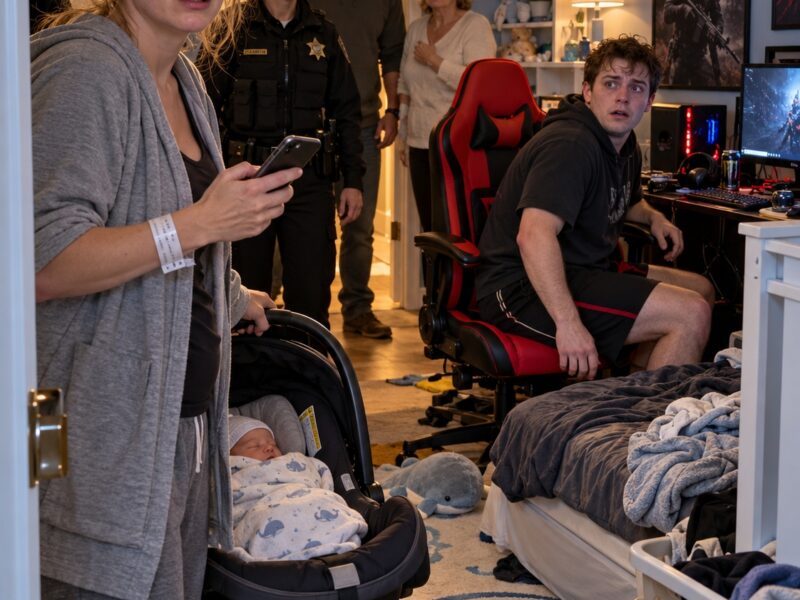
My Parents Put My Brother In My Baby’s Nursery While I Was In Labor—Then One Phone Call Turned His Face White
I came home from the hospital carrying my two-day-old son and found my brother gaming where his crib had been.
My mother had dismantled the nursery while I was in labor and told everyone I had agreed to let him stay.
Twenty minutes after I made one quiet phone call, my brother finally understood whose lie had put him there.
The first thing I noticed was the red gaming chair.
Not my mother standing behind me with a dish towel twisted between her hands.
Not my father hovering at the top of the stairs, pretending the chipped paint on the banister deserved his full attention.
Not even Tyler.
The chair.
It sat exactly where Wesley’s crib had stood three days earlier, centered over four small square dents in the carpet that Owen and I had jokingly called the baby’s footprints.
Tyler had one side of his headset pressed over his ear.
On the monitor balanced on Wesley’s dresser, tiny soldiers ran through a ruined city while the speakers spat muffled bursts of digital noise.
He didn’t hear me at first.
I stood in the doorway with my hospital bracelet still around my wrist and my two-day-old son asleep in his car seat beside my leg.
My back ached.
My stitches pulled.
My breasts hurt.
I had slept maybe four hours total since Tuesday morning.
And my baby’s room was gone.
The white sailboat wallpaper I had spent an entire Saturday smoothing onto the wall was punctured by three video game posters.
Tyler’s hoodies hung where the newborn sleepers had been.
A mattress lay beneath the window.
The childproof outlet cover Owen had installed a week earlier rested on the windowsill beside an empty energy-drink can.
The whale mobile had disappeared.
Behind me, Owen stopped breathing.
That was how I knew he had seen it too.
“Tyler.”
My brother spun around.
The red chair hit the wall.
“Whoa.”
His face changed when he saw me.
“Linds.”
Owen stepped past me.
“What the hell is this?”
Tyler stood.
“I thought you knew.”
“No,” Owen said. “You didn’t.”
My mother appeared behind us.
“Before everyone gets hysterical—”
Owen turned.
“Where is the crib?”
“Garage.”
Something in his expression frightened even me.
“You took apart my son’s crib?”
“Your son is two days old.”
My mother’s voice had the smooth patience she used when she believed someone else was being unreasonable.
“He doesn’t need an entire bedroom right now.”
I looked at her.
“What?”
“Tyler needs somewhere stable.”
My brother’s eyes dropped.
“He’s sleeping in his childhood bedroom at our house. Your father and he are constantly at each other. There’s no privacy, no independence.”
“And that made this okay?”
“Honey, the baby can sleep with you.”
Behind me, Wesley stirred.
I heard the hospital nurse as clearly as if she were standing in the room.
Room-share.
Do not bed-share.
On his back.
In his own safe space.
Every time.
“Not in our bed.”
Mom sighed.
“I slept with both you and Tyler.”
“That doesn’t make it safe.”
“You both survived.”
Owen made a low sound in his throat.
I touched his arm.
Not yet.
Not like this.
My mother continued because she mistook my quiet for weakness.
She had always done that.
“You have an entire house. Tyler has nothing.”
I stared at her.
“He has a room at your house.”
“That isn’t the point.”
“What is the point?”
Her mouth tightened.
“He needs a real chance.”
Tyler shifted beside the chair.
“Mom said you were okay with it.”
Everything in me went still.
I turned.
“What?”
He rubbed his palm against the back of his neck.
“She said you didn’t want Owen getting worked up before the baby came.”
Owen laughed once.
There was no humor in it.
My mother looked at the dresser.
“Tyler.”
“What?”
“You didn’t need to say it like that.”
I studied her face.
Then Tyler’s.
Then the room.
The mattress.
The posters.
The red chair.
The dismantled crib.
My mother had not improvised this after I delivered Wesley.
She had planned it.
She had waited until I was in labor.
She had used the spare key I had given her to care for our dog.
And she had told my brother I had consented.
Owen stepped toward Tyler.
“Get your stuff.”
Tyler’s jaw tightened.
“Man, I just got here.”
“I don’t care.”
“Owen.”
“Get out of my son’s room.”
My father appeared in the hallway.
“Everybody calm down.”
“No.”
Owen pointed toward the stairs.
“Everybody who doesn’t live here gets out.”
Tyler stepped forward.
My father moved between them.
My mother shouted.
Wesley woke.
His cry sliced through the hallway.
Thin.
New.
Frightened.
I bent for the car seat.
Pain pulled across my abdomen.
I stopped.
Breathed.
Then I put one hand on Owen’s forearm.
His muscles were rigid beneath my fingers.
“Don’t.”
He looked at me.
For half a second, I saw betrayal in his face.
He thought I was doing it again.
Making the problem smaller.
Keeping the peace.
Protecting the people who had caused it.
I understood why.
My whole life had trained him to expect that from me.
“Please,” I said.
His eyes searched mine.
I lowered my voice.
“Take Wes downstairs.”
My mother exhaled.
“Thank you, honey.”
She thought I had chosen her.
I sat on the third stair from the top.
Opened my wallet.
And pulled out the business card I had carried for four months.
The corners were worn soft.
There was a woman’s name written across the back in blue ink.
Teresa Vigil.
Adult Probation and Parole.
Direct line.
Four months earlier, Agent Vigil had told me exactly what to do if my brother ever moved into my house without my permission.
My mother was still talking when I dialed.
Twenty minutes later, someone knocked on my front door.
And Tyler’s face went completely white.
Three days earlier, at 10:04 on a Tuesday morning, my water broke on the bathroom tile.
I had been brushing my teeth.
There was no dramatic movie moment.
No gasp.
No shattered glass.
Just a warm rush down my legs and me staring at the pale grout between my bare feet.
“Owen.”
He was downstairs.
“Owen.”
Something in my voice changed the sound of the house.
His footsteps pounded up the stairs.
“What?”
“My water broke.”
He stared at me.
Then at the floor.
Then back at me.
“Okay.”
He turned around.
Walked halfway into the hall.
Stopped.
“Hospital.”
“Yes.”
“Keys.”
“In your hand.”
He looked down.
The keys were already in his fist.
I laughed.
Then a contraction started.
The laugh disappeared.
I gripped the sink.
Owen came back instantly.
“Breathe.”
“I am breathing.”
“You’re yelling.”
“That’s a type of breathing.”
He smiled.
I did too.
That was us.
Not perfect.
Useful.
Owen was an HVAC technician who could diagnose an air handler by sound from twenty feet away and still needed me to tell him where his wallet was three mornings a week.
I was a mortgage loan officer.
Paper was my language.
Risk was my job.
People handed me income statements, tax returns, credit reports, letters of explanation, and carefully edited versions of their lives.
I had learned not to accuse people quickly.
Most bad paperwork came from fear before it came from fraud.
But I had also learned something else.
When someone gives you five reasons before you ask one question, listen carefully.
While Owen loaded the hospital bag, I texted my mother.
Water broke. Heading to Davis. Can you use the spare key and give Biscuit his pill at seven and dinner at five? Just the dog, Mom.
Biscuit was our nine-year-old beagle.
Hypothyroidism.
Deep suspicion of anyone late with food.
Mom answered before I finished changing clothes.
Of course, sweetheart. Don’t worry about a thing at the house.
I remember the relief.
That matters.
Because betrayal looks simple after you know it happened.
Before that, it often looks like help.
On my way down the hall, I stopped outside the nursery.
The door was open three inches.
Soft blue nightlight.
White sailboats.
Oak crib.
Five felt whales hanging above it.
Folded newborn sleepers on the dresser.
Owen called from downstairs.
“Linds?”
“Coming.”
I looked at the crib one last time.
Not because I expected anything to happen to it.
Because babies make ordinary furniture feel ceremonial.
We had waited two years for that room to matter.
The pregnancy test that finally turned positive had sat on the bathroom counter for almost an hour before I trusted myself to pick it up.
I did not buy anything until twenty-eight weeks.
Not one onesie.
Not one blanket.
Not one stupid little hat with ears.
Then one Saturday, I painted the third bedroom blue-gray.
Owen built the crib by hand because he refused to use the drill.
“I want to feel every screw go in.”
“You realize that sounds insane.”
“Probably.”
His palm turned red from the Allen key.
When he finished, we stood shoulder to shoulder staring at the crib.
Four legs pressed four neat square dents into the carpet.
“This one’s his,” I whispered.
Owen kissed the top of my head.
“Good luck to anybody who tries to move it.”
We laughed.
Three days later, my parents took it apart.
Wesley James Carver arrived at 11:52 that night.
Seven pounds four ounces.
Dark hair.
Wrinkled forehead.
Furious.
At two the next afternoon, Owen was sleeping sideways in the vinyl chair beside the hospital window.
I was trying to feed Wesley.
My phone buzzed.
June Park.
Our neighbor across the street.
Seventy.
Widowed.
Best roses on the block.
She sent a photograph.
Dad’s silver pickup was backed into our driveway.
In the truck bed:
Mattress.
Boxes.
Red gaming chair.
Underneath:
Your dad’s truck. Everything okay? They’ve been carrying things in since ten.
My stomach dropped.
I called Mom.
Five rings.
Voicemail.
Thirty seconds later, she texted.
Don’t stress. You just had a baby.
Another bubble appeared.
Tyler is going to take the little room for a while. He needs it more.
Then:
The baby can sleep with you.
I read it three times.
No emotion at first.
Just comprehension.
My parents were inside my house.
They were moving my brother into my nursery.
While I was in a hospital bed.
I typed:
No, Mom. Take it out. We talked about this.
Read.
No response.
The nurse came in while I stared at the screen.
She adjusted Wesley’s blanket.
Checked his temperature.
Then gave us the same safe-sleep instructions every parent on the floor received.
“Room-sharing is great. Bed-sharing isn’t. Back to sleep, separate flat surface, no loose blankets or pillows.”
I nodded.
She smiled.
“You’ll hear that speech ten more times before discharge.”
I took screenshots of Mom’s messages.
Then I locked my phone.
I did not wake Owen.
That decision bothered me later.
But I knew my husband.
If I showed him that picture, he would leave.
He would drive home.
He would confront my father.
Tyler.
Mom.
I would lie in a hospital bed with a newborn wondering whether someone had called the police.
So I told myself the lie that felt safest.
Maybe they were storing his things.
Maybe Mom was exaggerating.
Maybe she would move everything back once I said no.
People who grow up surrendering boundaries become experts at inventing reasons other people might respect them eventually.
The next morning, I showed Owen.
He read the texts twice.
Called Dad.
Dad answered.
Owen put the phone on speaker.
“Gary, what’s going on at my house?”
Ten seconds of Dad listening.
Then:
“Your mother’s handling it.”
Click.
Owen stared at the screen.
I could see heat rising up his neck.
“Sit down.”
“No.”
“Owen.”
“No.”
“Sit.”
He sat.
I took his hand.
“When we get home, you are not touching Tyler.”
His jaw worked.
“I’m serious.”
“Lindsay—”
“Promise me.”
Silence.
“I’ll try.”
That meant no.
Our discharge took forever.
Paperwork.
Car-seat check.
Feeding instructions.
Prescriptions.
I rode home in the back seat beside Wesley.
Every few minutes I leaned toward him just to confirm his chest moved.
Owen drove.
Neither of us talked much.
At a red light on Antelope Drive, I opened my wallet.
Touched the business card inside.
Didn’t remove it.
Just made sure it existed.
The card came from May.
From Agent Vigil.
And the reason she had called me went back much further than May.
When I was twelve, my birthday fell on a Saturday.
Chocolate cake.
Purple icing.
My name across the top.
Tyler broke his wrist at the skate park that morning.
Of course the birthday changed.
It should have.
He needed the emergency room.
What I remember is four days later.
My cake was still in the refrigerator.
The icing had cracked.
Mom lifted it out and dropped it into the trash.
“You understand, honey.”
I did.
Always.
Lindsay’s fine.
That became her favorite sentence.
She said it like praise.
Lindsay’s always fine.
My report cards stayed on the refrigerator for a few days.
Tyler’s “Most Improved” certificates went over them.
Mom missed my spring concert because he had a fever.
Fine.
I walked home from debate because he needed the car.
Fine.
At seventeen, I worked weekends because he needed Mom’s attention.
Fine.
Our father was not cruel.
Gary Brandt fixed diesel engines for thirty years.
He was simply absent in the most dangerous possible way.
Physically there.
Morally elsewhere.
When Mom made a decision, he wiped his hands on a rag and let her have it.
I was twenty-two when I discovered how much “fine” could cost.
I had just started at Wasatch Ridge Credit Union.
Teller window three.
I applied for an auto loan.
Used Corolla.
Ninety thousand miles.
I was denied.
Carla, the loan officer, called me into her office.
She rotated her monitor.
“Do you recognize this?”
Credit card.
My name.
$6,437 past due.
Mailing address: my parents’ house.
I had never opened it.
“Could be identity theft,” Carla said.
My hands went cold.
“Do you want to file a fraud report?”
“I need to talk to my family.”
That evening, I laid the credit report on Mom’s kitchen table.
Tyler was seventeen.
He sat across from me.
Hood up.
Eyes down.
Mom stood behind him with both hands on his shoulders.
“He made a mistake.”
I looked at him.
“What did you do?”
He said nothing.
Mom answered.
“He was helping a friend.”
“With my Social Security number?”
“It got away from him.”
“Six thousand dollars got away?”
“Lindsay.”
Dad stood near the sink.
I looked at him.
He stared at the salt shaker.
Mom’s grip tightened on Tyler.
“If you report this, he could be charged.”
“It’s my name.”
“It’s your brother.”
Then she used the sentence that would follow me for years.
“You’re the strong one. You can handle it. He can’t.”
I agreed not to report him.
I paid the card myself.
Nineteen months.
One hundred thirty dollars at a time.
Every payment taught me the wrong lesson.
If I fixed it quietly, I was good.
If I objected, I was dangerous.
One good thing came from it.
I became excellent at my job.
Credit reports.
Fraud flags.
Income inconsistencies.
Addresses that did not belong.
Signatures that changed.
Carla noticed.
She recommended me for loan-officer training.
Years later, I became the person who told other people when paperwork did not match reality.
I wish I had done the same at home.
Tyler never paid me back.
Nobody asked him to.
He grew into the person my family expected him to become.
Not evil.
Not helpless.
Dependent on rescue.
At twenty-three he needed rent.
I sent eight hundred dollars.
At twenty-four, again.
When Mom needed surgery, I drove her.
Tyler mailed flowers.
I did not keep a spreadsheet.
I kept score somewhere deeper.
Then Tyler crossed a line even Mom could not erase.
He started doing small remodeling jobs.
Roof repairs.
Kitchen updates.
Decks.
He took deposits.
Then spent them before buying materials.
Four homeowners lost nearly thirty thousand dollars.
One was an eighty-one-year-old widower who had given Tyler cash from a coffee can.
Tyler was arrested.
Mom called me that night.
Paperwork covered her coffee table.
Second mortgage.
She needed a co-signer.
“I found a good lawyer.”
“Mom—”
“He’s expensive, but he wins.”
“I’ll help you find an attorney.”
She brightened.
“I knew you would.”
“I’m not signing the loan.”
The room changed.
“What?”
“I won’t co-sign.”
Her face went blank.
“Your brother could go to prison.”
“I know.”
“After everything I’ve done for you.”
That sentence almost worked.
Almost.
“I’ll sit with you at every hearing.”
“We don’t need company. We need help.”
“I am helping.”
“No. You’re judging.”
Dad went to the carport.
I stayed.
It was the first clear no I had ever given my mother.
They borrowed money another way.
Tyler pleaded guilty.
He served time.
Mom didn’t speak to me for two months.
That was the price of no.
Silence.
Then I became pregnant.
She cried when I told her.
“A grandbaby.”
I wanted to believe something had changed.
Pregnancy does strange things to hope.
You start imagining not only the child you will have, but the family everyone might become around them.
At five months pregnant, I sat in my car eating a turkey sandwich when an unfamiliar number called.
“Lindsay Carver?”
“Yes.”
“This is Teresa Vigil with Adult Probation and Parole.”
My body tightened.
“Is Tyler okay?”
“He’s fine.”
A pause.
“He listed your address as his proposed residence.”
I stopped chewing.
“My address?”
“Yes.”
“Nobody asked me.”
“That happens more than you’d think.”
Agent Vigil’s voice was steady.
“If he lives with you, we need homeowner consent. I would also make visits to the residence, sometimes without notice.”
I looked down at my stomach.
Five months.
The nursery was still empty then.
I saw my credit report.
The six thousand dollars.
The stolen homeowner deposits.
The future mail that would come to our house.
Bank statements.
Insurance cards.
A baby’s Social Security information.
“No.”
It came out small.
Then stronger.
“No. I don’t consent.”
She didn’t argue.
“Understood.”
I waited for guilt.
Instead she said, “His plan can be changed to your parents’ residence.”
“Okay.”
Then she added something.
“Mrs. Carver?”
“Yes?”
“If you ever find him staying at your house, call me directly.”
I sat up.
“Why?”
“Because your consent matters before residence changes, not after.”
She gave me a number.
I wrote it on the back of my own business card.
Blue ink.
Teresa Vigil.
Direct.
I put it behind my insurance card.
Five minutes later, Mom called.
“Did the state contact you?”
“Yes.”
“You embarrassed him.”
“How?”
“They put a note in his file.”
“Because he listed my house without asking me.”
“He thought you’d help.”
“I’m having a baby.”
Silence.
Then:
“Fine.”
Her voice went cold.
“He’ll stay with us.”
I believed it was finished.
That was my mistake.
Tyler came home seven weeks before Wesley was born.
Mom posted a photograph online.
Tyler sitting in a red gaming chair.
WELCOME HOME, MY BOY.
At my baby shower three weeks before my due date, Mom’s chair stayed empty.
Renee had decorated her backyard with paper lanterns.
White.
Blue.
Little whales.
At four, Mom texted.
Sorry, sweetheart. Tyler needs me. First week at his new job.
Owen read it over my shoulder.
He didn’t criticize her.
He simply wrapped one arm around me.
I told myself Mom was punishing me for May.
I did not understand that she was still trying to undo my answer.
By the time we pulled into our driveway with Wesley, my mother had already built an entire version of events in which my no had never existed.
The front door was unlocked.
Vanilla candle.
Pizza.
Root beer.
Paper plates.
A sign taped above the counter:
WELCOME HOME, BABIES.
Plural.
Biscuit barked from the laundry room.
Dad stood by the refrigerator holding pizza.
“Hey, kiddo.”
Couldn’t meet my eyes.
Mom rushed toward the infant seat.
“Let me see him.”
I stepped around her.
“I need to go upstairs.”
Every stair hurt.
Two days after giving birth, gravity feels personal.
Then I reached the nursery.
And saw the red chair.
Now, twenty minutes after I called Agent Vigil, I sat at my kitchen island feeding Wesley while Mom behaved as though nothing had happened.
That was the strangest part.
She was cheerful.
Not nervous.
Cheerful.
“We’ll buy you a bassinet.”
I looked at the microwave clock.
6:31.
“The nice one,” she continued. “That rocks automatically.”
Dad slid a white envelope across the counter.
“Five hundred.”
I looked at it.
“For what?”
He cleared his throat.
“The crib.”
“The crib isn’t broken.”
“For the inconvenience.”
I didn’t touch it.
Mom smiled.
“See? We’ll fix everything.”
6:32.
She poured root beer.
“You’ll actually like having the baby next to you.”
I adjusted Wesley against my shoulder.
“How long is Tyler staying?”
“Till spring.”
Owen stopped walking toward the garage.
I glanced at him.
He looked at me.
I barely shook my head.
Wait.
Mom continued.
“He’ll save money. Get first month and deposit.”
“He’s been working three weeks.”
“That’s why this is perfect.”
6:33.
Dad ate his pizza standing up.
I watched him.
“Did you know he was moving here?”
He looked at Mom.
“She said you agreed.”
There.
First crack.
Mom reached for a napkin.
“We discussed it.”
“No.”
“You knew Tyler was struggling.”
“That isn’t agreement.”
“You knew I wanted you to consider it.”
“That isn’t agreement.”
She sighed.
“You’re doing that banker thing.”
“What banker thing?”
“Where every word has to mean exactly one thing.”
Owen almost laughed.
I didn’t.
6:34.
Mom leaned closer.
“I already told people.”
“What people?”
“At church.”
My stomach tightened.
“What did you tell them?”
“That you were taking Tyler in.”
I stared at her.
She smiled.
“Sister Hadley cried.”
6:35.
“She said it was beautiful.”
I finally understood something I had missed.
This was not only about Tyler needing housing.
My mother had created a public story.
The redeemed son.
The supportive daughter.
The newborn bringing everyone together.
And she needed reality to cooperate.
“Who else?”
She listed names.
Five women.
Two relatives.
One neighbor.
The story existed outside my house now.
That mattered to her.
Image had always mattered.
She could survive hurting me.
She could not survive looking like a mother who had failed Tyler.
6:36.
Upstairs, the game noise continued.
I asked one more question.
“Did you tell Agent Vigil Tyler was here?”
Mom’s smile remained.
Her eyes changed.
She folded her napkin.
“She doesn’t need to know every little thing.”
Dad lowered his pizza.
“Darlene.”
She ignored him.
“It’s family.”
“Did you call her?”
“I was going to.”
Dad stared.
“You said you already did.”
Mom’s hands stopped.
“What?”
“You told me she approved it.”
“Gary, not now.”
“No.”
That word sounded unfamiliar in his mouth.
Not loud.
Just present.
“You said you called her last week.”
Mom’s face tightened.
I watched my father discover what I had known since childhood.
Mom didn’t only pressure people.
She rewrote them.
6:40.
The house went quiet.
I did not need to accuse her.
Truth had started moving without me.
Owen came back from the garage holding the Allen key from Wesley’s crib.
He slid it onto the counter.
Headlights crossed the kitchen blinds.
6:42.
A gray sedan stopped outside.
Two people got out.
One woman.
One man.
Dark jackets.
Mom stood.
“Who is that?”
Three knocks.
Even.
Firm.
No doorbell.
Mom moved toward the door automatically.
Her house.
Always.
She opened it.
A woman’s voice carried through the entryway.
“Evening. Adult Probation and Parole. I’m looking for Tyler Brandt.”
Mom’s shoulders froze.
“He’s not here.”
I closed my eyes for half a second.
Not because I was surprised.
Because she lied so quickly.
Agent Vigil looked past her.
Found me.
“Mrs. Carver?”
“Yes.”
“Is this your residence?”
“Yes.”
“May we come in?”
“Yes.”
Mom did not move.
Agent Vigil waited.
That was all.
She did not argue.
Did not push.
Just waited until Mom understood that the doorway was not hers.
She stepped aside.
Agent Vigil entered with a younger man named Ruiz.
Wesley slept against Owen’s chest.
Tyler appeared at the top of the stairs.
Headset in one hand.
He saw Vigil.
His face changed.
I had heard people say someone went white.
I always thought it was an expression.
It wasn’t.
Color drained out of Tyler so quickly he looked ill.
His hand caught the railing.
“Tyler.”
Agent Vigil’s voice remained flat.
“Come down for me.”
He descended slowly.
His eyes kept moving to Mom.
Like he was seventeen again.
Waiting for her to fix it.
Agent Vigil asked, “Where did you sleep last night?”
Mom answered.
“Our house.”
Vigil didn’t look at her.
“I asked Tyler.”
Silence.
Tyler swallowed.
Mom opened her mouth.
Agent Vigil lifted one hand.
Small movement.
“Tyler?”
He looked at the floor.
“Here.”
Mom inhaled.
Vigil nodded.
“Show me where.”
We went upstairs.
The room told the truth better than any person could.
Mattress.
Clothes.
Toothbrush.
Razor.
Gaming system.
Chair.
Posters.
Agent Ruiz checked the bathroom.
“His toiletries are in here.”
Mom tried.
“He was setting things up.”
Nobody responded.
I showed Vigil June’s photograph.
Dad’s pickup.
Mattress.
Gaming chair.
Timestamp.
Then Mom’s text.
Tyler is going to take the little room for a while.
He needs it more.
The baby can sleep with you.
Then my reply.
No, Mom. Take it out. We talked about this.
Vigil read both.
Twice.
She looked at Mom.
Not angry.
Professional.
Somehow worse.
“Ma’am, your son’s approved residence is your home in Roy.”
Mom folded her arms.
“This is temporary.”
“Any residence change must be approved before he moves.”
“I was going to call.”
“The homeowner already declined permission in May.”
Mom looked at me.
“She was pregnant.”
My body went cold.
“She was emotional.”
Everyone turned toward me.
Mom continued.
“She didn’t understand what Tyler needed.”
There were a hundred speeches I could have given.
Twenty years of them.
Credit card.
Rent.
Silence.
The baby shower.
The nursery.
Instead I said:
“I meant it then.”
Pause.
“I mean it now.”
Vigil nodded.
Then faced Tyler.
“Did your sister tell you that you could live here?”
He rubbed his thumb along the plastic edge of his headset.
“No.”
Mom turned.
“Tyler.”
He looked at her.
“You said she did.”
“I said she would.”
“No.”
Tyler’s voice changed.
“You said she changed her mind.”
Mom’s face tightened.
“Honey—”
“You said you called her agent.”
Vigil answered.
“She didn’t.”
The room went silent.
Tyler stared at Mom.
“You said she approved it.”
“I was going to call.”
“You said she already did.”
“She would have.”
Mom looked at me.
“She always does.”
There it was.
The sentence that changed everything.
Not because it revealed anything about me.
Because it revealed her plan.
She had moved Tyler into my house because she was certain I would eventually surrender.
She always does.
She had risked his parole on that belief.
Tyler understood too.
That was why his face had gone white.
Not only because Agent Vigil had arrived.
Because for the first time, my brother realized Mom’s rescue might be the thing that got him in trouble.
Vigil closed her notebook.
“Tyler, you’ll return to your approved residence tonight.”
He nodded.
“Your father can drive you. Agent Ruiz and I will follow.”
Mom stepped forward.
“You can’t—”
Vigil looked at her.
“I’m documenting an unapproved residence violation.”
Mom’s mouth closed.
“He reports to my office Monday at eight.”
Tyler’s jaw tightened.
“Am I going back?”
“Not tonight.”
He exhaled.
“But this will be reviewed.”
“Yes, ma’am.”
“You understand?”
“Yes.”
Vigil turned to me.
“I’ll need a statement.”
“You’ll have it tomorrow.”
Tyler unplugged his monitor.
He did it quietly.
No anger.
Dad carried the mattress.
Ruiz helped with the monitor.
Tyler removed each poster from the sailboat wallpaper.
He pulled the thumbtacks carefully.
I watched him trying not to create more damage.
Twenty minutes earlier, I had wanted him gone.
Now I saw something different.
Not innocence.
But manipulation.
Mom had lied to both of us.
Different lies.
Same purpose.
Dad rolled the posters into a tube.
Tyler pushed the gaming chair toward the stairs.
The wheels bumped every step.
At the front door, he stopped.
“Lindsay.”
I waited.
His eyes were red.
“Would you really have let them take me back?”
I thought about the answer.
He deserved an honest one.
“I didn’t send you anywhere.”
His face tightened.
“I called the person whose rules you were already under.”
“That’s the same thing.”
“No.”
I stepped closer.
“I told the truth about my house.”
He looked away.
“Mom moved you into it.”
Silence.
“That wasn’t mine to hide for you.”
He looked past me.
Owen stood in the kitchen holding Wesley.
“What’s his name?”
“Wes.”
Tyler nodded.
“Hi, Wes.”
He did not approach.
I respected that.
He rolled the red chair outside.
Dad loaded it into the truck.
The gray sedan followed them away.
Mom remained.
Of course she did.
The front door closed.
We stood in the entryway.
Just us.
Owen.
Baby.
Mom.
Me.
Then she cried.
Quiet tears.
Hand near her mouth.
The tears that had undone me since childhood.
“You’d send your own brother back to prison.”
“I didn’t.”
“Over a bedroom.”
“It wasn’t about a bedroom.”
“My grandson.”
She looked at Wesley.
“I’ll never get to know him now.”
“That’s your choice.”
Her face changed.
“You’re punishing me.”
“No.”
“I’m your mother.”
There.
Last card.
I felt it.
The old pull.
Twelve-year-old Lindsay watching birthday cake fall into the trash.
Twenty-two-year-old Lindsay agreeing to pay a fraudulent credit card.
Pregnant Lindsay hoping a baby would make her mother kinder.
I wanted to say sorry.
My mouth almost formed it.
Then I heard another sentence.
Lindsay’s fine.
Lindsay’s always fine.
I finally understood what it meant.
Mom never had to worry about me because she had trained me to absorb the damage myself.
I looked at her.
“You didn’t make a mistake.”
She stopped crying.
“You made a plan.”
“Lindsay.”
“You waited until I was in labor.”
“That’s not—”
“You used the key I gave you for Biscuit.”
“I was helping.”
“You dismantled my baby’s room.”
“He doesn’t need—”
“You lied to Tyler.”
Silence.
“You lied to Dad.”
She looked toward the driveway.
“You lied to his parole agent.”
“I was going to call.”
“And you counted on me staying quiet.”
Her mouth tightened.
“That isn’t fair.”
“No.”
My voice remained calm.
“It’s exact.”
Headlights appeared.
Dad’s truck.
He parked but did not get out.
I held out my hand.
“The key.”
Mom stared.
“What?”
“My spare key.”
“You don’t mean that.”
“I do.”
“After everything—”
“The key.”
She looked toward Dad.
“Gary?”
He lowered the window.
“Give it to her, Darl.”
Mom stared at him.
For once, he did not look away.
Her hands shook as she removed the key.
The little yellow rubber duck keychain came with it.
She placed both into my palm.
Warm from her pocket.
“You don’t get a key anymore.”
She looked at me as though I were a stranger.
“If you want to visit Wesley, call.”
“Lindsay.”
“You’ll be a guest here.”
Her eyes filled again.
“And tomorrow, I’m sending my statement to Agent Vigil.”
Mom shook her head.
“Family doesn’t do this.”
I closed my hand around the key.
“Family doesn’t do what you did either.”
She left.
Dad drove away.
I stood barefoot in the driveway until the truck disappeared.
Only then did I shake.
Owen came behind me.
Wrapped both arms around my shoulders.
For several seconds, neither of us spoke.
Then he whispered:
“I thought you were going to let them stay.”
“I know.”
“I’m sorry.”
“Don’t be.”
“I should’ve trusted you.”
I turned.
“No.”
He frowned.
“You were reacting to nineteen years of evidence.”
That made him smile.
Barely.
“Banker.”
“HVAC guy.”
He kissed my forehead.
Wesley cried inside.
We went back in.
The next morning, Owen called a locksmith.
By ten, every exterior lock had changed.
I sat at the kitchen table writing my statement.
One page.
Dates.
Times.
What Mom said.
What Tyler said.
What I observed.
Screenshots.
June’s photograph.
No adjectives.
Paper rarely needs adjectives when facts are ugly enough.
Nine days later, Wesley’s Social Security card arrived.
I stared at the envelope for a long time.
Then I opened my laptop.
I placed a security freeze for him with all three major credit bureaus.
Owen watched.
“Is that normal?”
“No.”
“Necessary?”
“For us?”
“Yes.”
He didn’t ask why.
He knew.
At twenty-two, I had learned that a name on paper can be stolen long before the person whose name it is understands what happened.
I would not hand that lesson to my son.
Agent Vigil called a week later.
“Tyler reported Monday at 7:52.”
“Okay.”
“He’s residing at his approved address.”
“Okay.”
“The rest is between him and this office.”
I breathed.
“Thank you.”
“You did the right thing by calling before things became physical.”
I thought about Owen upstairs.
Tyler standing.
The chair hitting the wall.
“I know.”
It surprised me that I meant it.
Tyler texted nine days after the incident.
I should have called you myself.
Then:
Mom said you changed your mind.
Then:
I’m sorry about Wes’s room.
I read the texts four times.
I did not answer.
I also did not delete them.
Mom sent eleven paragraphs.
I read everything.
She explained Tyler’s childhood.
His anxiety.
His setbacks.
Dad’s temper.
The pressure she felt from church.
Her fear that Tyler would fail again.
Her belief that family should help family.
Some of it was true.
That was what made it dangerous.
Manipulation rarely survives on lies alone.
It needs truth around the edges.
Tyler did need help.
Dad and Tyler did argue.
Mom was embarrassed by parole visits.
She was afraid.
She loved him.
None of those things gave her the right to use my house.
I replied with one sentence.
Call me when you are ready to come as a guest.
She did not answer.
Ten nights after we came home, Owen brought the crib upstairs.
Piece by piece.
The rails.
Mattress support.
Headboard.
Footboard.
A plastic bag of screws.
CRIB SCREWS written across masking tape in Mom’s handwriting.
I had removed the posters.
The thumbtack holes remained in the sailboat wallpaper.
Tiny scars.
Owen sat cross-legged on the floor.
He picked up the Allen key.
Then stopped.
Held it toward me.
“You want to?”
I sat carefully.
My body was still healing.
“Yes.”
He handed me the first screw.
I turned it.
Slow.
Metal into oak.
Again.
Again.
My palm reddened.
Owen smiled.
“I want to feel every one go in.”
I looked at him.
“That line sounds familiar.”
“Smart person said it once.”
“Insane person.”
“Handsome, though.”
“Debatable.”
He laughed.
The first real laugh since the hospital.
When the crib was assembled, we lifted it together.
Set it against the sailboat wall.
The four legs found the old dents in the carpet.
Exactly.
As if the room remembered.
There was still a faint gray track where Tyler’s gaming chair had rolled.
I vacuumed it three times.
It never fully disappeared.
Eventually, I stopped trying.
The mark became useful.
Not as punishment.
As memory.
Of how close I came to surrendering the room.
Of how easily people who love you can call taking something “help.”
Of how a boundary can exist clearly in your mind and still mean nothing if you refuse to defend it.
Tyler came to see me three months later.
He called first.
That mattered.
Mom still had not visited.
Dad had.
Once.
He stood on our porch holding a grocery-store bag of diapers.
“Your mom doesn’t know I’m here.”
I almost laughed.
“That’s probably not a healthy beginning.”
He looked ashamed.
“I know.”
I let him in.
Guest.
No key.
We sat at the kitchen table.
Wesley slept in a portable bassinet near the window.
Dad stared at him.
“He looks like you.”
“He looks like a potato.”
Dad smiled.
Then the smile disappeared.
“I should’ve stopped her.”
“Yes.”
He nodded.
No excuses.
That was new.
“Long time ago.”
“Yes.”
“Credit card.”
I looked at him.
His face tightened.
“I knew.”
The room went quiet.
“How much?”
“Not the amount.”
“But you knew Tyler did it.”
“Yes.”
I leaned back.
Dad rubbed his hands together.
“I told myself your mother handled the kids.”
“We weren’t kids.”
“I know.”
“You stood there.”
“I know.”
He looked at Wesley.
“I thought staying out of arguments made me peaceful.”
His voice broke slightly.
“It made me absent.”
I did not comfort him.
He needed to sit inside that truth.
After a while, he said, “Tyler talks about you.”
“What does he say?”
“That you called his agent.”
“That’s accurate.”
“He’s angry.”
“Okay.”
“He also says your mom lied to him.”
“Also accurate.”
Dad nodded.
“He’s starting counseling.”
That surprised me.
“Good.”
“He asked me not to tell Mom.”
That did not surprise me.
Dad looked toward the bassinet.
“I want to be different with him.”
“With Wesley?”
“Yes.”
“Then be different with me.”
He closed his eyes briefly.
“That’s fair.”
He visited again two weeks later.
Called first.
Each time.
Tyler called after four months.
Not text.
Called.
I almost let voicemail take it.
Then answered.
“Hello?”
“Hey.”
His voice sounded smaller than I expected.
“Hey.”
Long silence.
“I’m still mad.”
“Okay.”
“You could’ve warned me.”
“I told Mom no before you ever moved.”
“I know.”
“I told the state no.”
“I know.”
“You never called me.”
“That part is true.”
He exhaled.
“Mom told me you didn’t want me calling.”
I closed my eyes.
Of course she did.
“She said Owen hated me.”
“Owen did not want you living here.”
“Same thing.”
“No.”
Another pause.
“I thought you were too good for me.”
“Tyler.”
“What?”
“I paid six thousand dollars because you used my identity.”
Silence.
“You never apologized.”
“I was seventeen.”
“And twenty-three when I paid your rent.”
Silence.
“And twenty-four.”
He breathed hard through his nose.
“I know.”
“Do you?”
“I’m trying to.”
That was the first honest thing I had heard from him in years.
He told me the red gaming chair had stayed in Dad’s garage after he moved to a small approved apartment.
He could not stand looking at it.
I almost smiled.
“Good.”
“You hated that thing.”
“It replaced my baby’s crib.”
“Fair.”
More silence.
Then:
“Can I meet him sometime?”
“Maybe.”
“Not Mom.”
I said nothing.
“I mean it.”
“Maybe.”
I did not forgive him that day.
He did not become someone new in one phone call.
But we began using words without Mom translating them.
That changed more than I expected.
Mom finally called when Wesley was six months old.
I was making dinner.
Her name appeared.
I let it ring twice.
Answered.
“Hi.”
Silence.
Then:
“Can I come see my grandson?”
I leaned against the counter.
“What changed?”
“You said to call.”
“I said when you were ready to come as a guest.”
“I am.”
“What does that mean to you?”
She exhaled.
“Lindsay.”
“I’m asking.”
“It means I call.”
“Yes.”
“I don’t bring anyone.”
“Yes.”
“I don’t decide anything.”
“Yes.”
Her voice hardened slightly.
“You’ve made your point.”
“No.”
I looked at Wesley in his high chair smashing sweet potato between his fingers.
“This isn’t a point.”
“What is it?”
“A rule.”
Silence.
Then:
“Okay.”
She visited Sunday.
No key.
No Tyler.
No Dad.
She stood on the porch holding a stuffed whale.
I opened the door.
For once, she waited.
“Come in.”
Her eyes moved around the entryway.
My house.
Not hers.
She sat in the living room.
I brought Wesley.
She cried when I handed him over.
Real tears this time.
Maybe.
I did not try to decide.
She held him.
Rocked him.
Whispered things I couldn’t hear.
For almost an hour, everything was easy.
Then she looked toward the stairs.
“Can I see his room?”
I hesitated.
“Yes.”
We went up.
She stood in the nursery doorway.
The crib.
Mobile.
Sailboats.
Tiny thumbtack holes.
Gray chair line.
Her face changed.
“I’m sorry about the wallpaper.”
I waited.
She ran one finger near a hole.
“I thought the room could be fixed.”
“It could.”
She nodded.
“That’s not the same.”
“No.”
Another silence.
“I was scared for Tyler.”
“I know.”
“I thought if he got away from your father—”
“You still didn’t ask.”
“I know.”
“You could have called.”
“I know.”
“You could have listened when I said no.”
Her mouth trembled.
“I didn’t think you meant it.”
I almost laughed.
“That’s the problem.”
She looked at me.
“You always changed your mind.”
“No.”
My voice stayed calm.
“I changed my answer.”
She frowned.
“There’s a difference.”
“What?”
“I said no. Then you made the consequences of no painful enough that I eventually said yes.”
Her face fell.
I continued.
“That isn’t me changing my mind.”
She sat in the rocking chair.
I remained standing.
“I didn’t know you felt that way.”
“You didn’t need to know how I felt.”
She looked up.
“You only needed to hear what I said.”
That landed.
I saw it.
Maybe not acceptance.
But impact.
She looked toward the crib.
“I thought being a good mother meant keeping Tyler from falling.”
“And me?”
“You didn’t fall.”
“No.”
My throat tightened.
“I just learned nobody was coming if I did.”
Mom covered her mouth.
I looked away.
Not because I wanted to hurt her.
Because I didn’t want her tears to decide what happened next.
She stayed another twenty minutes.
Before leaving, she hugged me.
I hugged her back.
Not everything has to be solved for contact to be real.
But contact no longer meant access.
Love no longer meant keys.
A year after Wesley was born, I found the old business card in my wallet.
Agent Vigil’s number.
The blue ink had faded.
Tyler had completed parole without another residence problem.
He was still working.
Still in therapy.
He had paid me two hundred dollars.
Not much.
But the envelope said:
CARD.
I knew exactly which debt he meant.
I put the money into Wesley’s savings account.
Not because Tyler owed Wesley.
Because I didn’t want the money living between us anymore.
Owen found me staring at the card.
“You keeping that?”
I thought about it.
“No.”
I tore it in half.
Then stopped.
I did not throw it away.
I put it in a small box with Wesley’s hospital bracelet.
Owen laughed.
“You literally said you weren’t keeping it.”
“I changed my answer.”
He grinned.
“Dangerous.”
We walked upstairs.
Wesley was asleep.
The nursery was dark except for the whale-shaped nightlight near the dresser.
I stood in the doorway.
Same place I had stood the morning we left for the hospital.
The crib occupied the same four dents.
The mobile turned slowly in the vent air.
Biscuit slept across the threshold.
My son breathed.
Safe.
Separate space.
His room.
I thought about the red chair.
My mother’s key.
My brother’s white face.
The twenty minutes between making a call and discovering that my entire family had been built around the assumption that my no could be ignored.
Then I looked at the crib.
The room had not become mine again because Agent Vigil arrived.
Or because Owen wanted to throw Tyler out.
Or because my parents finally understood.
It became ours again when I stopped confusing peace with surrender.
I walked to the crib.
Rested one hand on the rail.
“This one’s yours,” I whispered.
And this time, nobody got to decide otherwise.









