My Parents Spent My $3 Million Inheritance to Buy My Sister a House for My 18th Birthday—Then Expected Me to Smile and Sign It Away
My sister hugged me at breakfast and thanked me for the house I had never agreed to buy her.
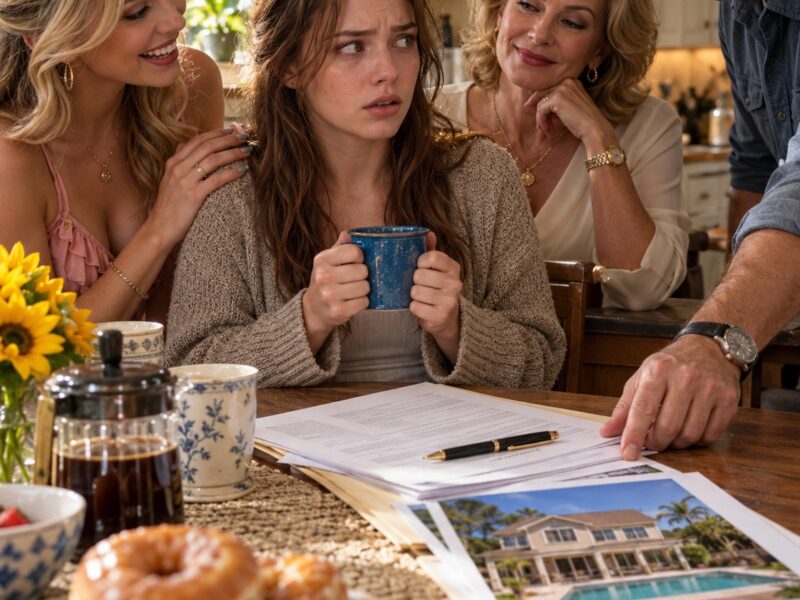
My father slid a purchase agreement across the table with my inheritance listed as proof of funds and a pen already clipped to the signature page.
What none of them knew was that less than twelve hours earlier, I had finally done the one thing my grandfather had warned me not to delay.
Belle hit me hard enough with the hug that coffee sloshed over the chipped rim of Grandpa Walt’s old blue enamel mug.
“Thank you,” she squealed into my hair. “Oh my God, Poppy, thank you.”
I went still.
Across the kitchen table, my mother smiled with the tight, pleased expression she wore when a surprise had gone exactly according to plan.
Dad sat beside her in his work shirt, one forearm resting near a stack of papers.
Belle pulled away.
She was twenty-five, seven years older than me, beautiful in the effortless way that had somehow required years of expensive hair appointments, whitening strips, boutique clothes, and emergency money from our parents.
Her eyes were wet.
“I can’t believe you did this.”
I looked from her to Mom.
“Did what?”
Mom laughed softly.
“Don’t ruin it.”
Dad picked up the papers.
“We wanted to do something special.”
“For Belle?”
“For the family.”
He slid the packet across my placemat.
A photograph of a beige two-story house was clipped to the front.
White columns.
Black shutters.
A pool behind a privacy fence.
Address: 2208 Larksburg Court, Elizabethtown, Kentucky.
Purchase price: $585,000.
Cash offer.
No financing contingency.
No appraisal contingency.
Earnest money already deposited.
My eyes moved down the page.
Buyer: Douglas Mercer and/or assigns.
Then I reached the attachment.
PROOF OF FUNDS.
The account holder line said:
Douglas Mercer, Custodian for Poppy Mercer.
My name.
Grandpa’s money.
Nearly all the money I had inherited at fourteen and had been told for four years I was too young to understand.
Belle clapped both hands together.
“Close is next Friday.”
I looked at Dad.
His expression was calm.
Almost bored.
Like this was paperwork.
Like my eighteenth birthday had not been yesterday.
Like the phrase “custodial account” had not changed meaning at midnight.
Mom pushed a pen toward me.
“You’ll just sign the gift letter and a couple banking forms.”
I looked at the pen.
Then back at her.
“This is the surprise?”
She leaned toward me.
“Don’t say it like that.”
“How should I say it?”
Belle laughed nervously.
“Poppy.”
Dad’s jaw tightened.
I turned another page.
The gift letter had already been drafted.
I, Poppy Mercer, hereby gift my sister, Elizabeth Mercer, the sum of $585,000 with no expectation of repayment.
My signature line waited at the bottom.
Dad’s signature was already on the purchase agreement.
Belle had apparently been told enough to thank me.
Nobody had told me enough to say yes.
I picked up Grandpa’s mug.
The coffee was black.
Too hot.
Exactly the way he used to drink it before sunrise.
I took one slow sip.
“You should call the realtor.”
Dad gave a short laugh through his nose.
“Why would I call the realtor?”
“Because you may have a problem.”
Mom’s smile faded.
Belle sat back.
“What problem?”
I looked at Dad.
For most of my childhood, he could silence me by changing the shape of his mouth.
He did it now.
I felt the old instinct rise anyway.
Be easy.
Be grateful.
Don’t embarrass anybody.
I wrapped both hands around the mug.
“The account may not work the way you think it does anymore.”
His eyes sharpened.
“What does that mean?”
I glanced toward the microwave clock.
7:08 a.m.
My birthday had ended seven hours earlier.
On paper, I had become an adult.
In my backpack beside the kitchen chair, between my calculus textbook and a folder of college applications, was the reason I had not slept.
Mom leaned toward me.
“Poppy.”
Her voice softened.
“Don’t make this ugly.”
There it was.
The sentence she used whenever she needed me to understand that peace belonged to the person willing to surrender first.
Belle stared at the house photo.
Dad tapped one finger against the signature line.
They had planned breakfast.
Donuts.
Sunflowers.
A house.
They had planned to put a pen in my hand while I was still half a child in their minds and fully responsible in the eyes of the law.
They thought the surprise was the house.
I knew the real surprise was sitting in my backpack.
The first cup of coffee I ever drank was on Grandpa Walt’s porch when I was nine.
Six in the morning.
June.
Fog over the field.
He poured it into the same blue enamel mug now sitting between my hands at my parents’ kitchen table.
It tasted like a burned penny.
I drank all of it anyway.
Grandpa watched me over his cup.
“Well?”
“It’s terrible.”
He laughed so loudly a cardinal flew off the gutter.
“That’s right.”
“Why do you drink it?”
“Because nobody makes good decisions after they start explaining themselves to everybody else.”
I didn’t understand.
He pointed at my cup.
“Coffee helps.”
“That doesn’t make sense.”
“Most useful things don’t at nine.”
He called me Pop.
Nobody else did.
To Mom, I was Poppy.
To Dad, “kiddo.”
To people at church, I was the easy one.
Belle was not easy.
Belle had always arrived in a room already needing something.
Pageant costumes.
Dance lessons.
New paint in her bedroom because lavender suddenly made her sad.
A car after graduation.
An apartment in Louisville.
I got her old jeans with the hems let down.
I didn’t resent her then.
That came later.
Grandpa’s farmhouse sat outside Bardstown on land his father had farmed before highways cut through Nelson County.
The kitchen smelled like coffee, bacon grease, and lemon furniture polish.
The back door was aluminum and warped.
If you pushed it straight, it stuck harder.
Grandpa taught me the trick.
“Lift the handle all the way.”
I did.
“Hip low. Twice.”
Bump.
Bump.
“Now shove.”
The door rattled and popped open.
“That’s ridiculous.”
“It’s an old door.”
“You should fix it.”
“You fix something when it stops doing its job.”
“It barely does its job.”
“So do I.”
That was Grandpa.
He believed objects earned character by refusing to work easily.
Dad hated that door.
He always used the front entrance.
He also hated getting up before seven.
Somehow the porch became Grandpa’s and mine because nobody else wanted it at six in the morning.
When I was thirteen, a bourbon distillery bought thirty-eight acres from him.
Warehouses were going up everywhere then—tall dark rickhouses filled with barrels that smelled faintly sweet in summer.
The sale was a little over three million dollars.
Dad immediately began talking about family.
I didn’t hear the first argument.
I heard his truck door slam afterward.
Then I found Grandpa on the porch.
Coffee cold in his hands.
“Dad mad?”
“He’ll recover.”
“What happened?”
“Your father thinks money is most useful when someone else has it.”
I laughed because I thought he was joking.
Grandpa did not.
The next spring he had a stroke.
He lived nine days.
I was fourteen.
The will was read in Wendell Ostrander’s office above a pharmacy downtown.
Mr. Ostrander had eyebrows like gray caterpillars and a habit of tapping his pen twice before saying anything serious.
Dad received the farmhouse and five acres surrounding it.
The remaining land-sale proceeds went to me.
Because I was a minor, Dad would act as custodian until I turned eighteen.
Then the account became mine.
I did not understand the law.
I understood faces.
Mom squeezed my knee too hard.
Dad stared out the window.
Belle whispered, “Seriously?”
In the car, they thought I was asleep.
I had my forehead against the glass.
Eyes closed.
Dad said, “Three million dollars.”
Mom answered quietly.
“She’s fourteen, Doug.”
“He gave it to the one who still sleeps with the hall light on.”
“You’re the custodian.”
Silence.
Then Mom added:
“For four years.”
I kept my eyes closed all the way home.
That was the first time I understood being chosen could make you less safe.
There was something else.
Something none of them knew.
On the fifth day after Grandpa’s stroke, I sat beside his hospital bed while my parents went downstairs for coffee.
He woke.
His mouth pulled slightly on one side.
Speech was hard.
But his hand closed around mine.
“Pop.”
“I’m here.”
“When eighteen.”
I leaned closer.
“What?”
“Call Margarite.”
“Who?”
“Fen.”
His eyes sharpened.
“Not before.”
“Okay.”
“Not after.”
I didn’t understand.
“Promise.”
“I promise.”
He relaxed.
Then he said something that stayed with me longer than almost anything else.
“Your father loves you.”
I waited.
“But love doesn’t make people fair.”
After he died, Mom cleaned out the farmhouse kitchen for donation.
She lifted Grandpa’s blue mug.
“This old thing is chipped.”
“I want it.”
She shrugged.
I took the stovetop percolator too.
Nobody wanted that.
It stayed at the farmhouse because Dad said the place was “mine someday anyway.”
Six months later, I saw the first account statement.
It lay on our kitchen counter beside church bulletins.
The envelope had already been opened.
Douglas Mercer, Custodian for Poppy Mercer.
I read it standing there with my backpack still on.
Most numbers meant nothing.
One did.
Withdrawal: $38,000.
Date: March 14.
That was the week Belle came home in a white Jeep with a red bow.
Mom posted fifty pictures.
Dad told everyone he had surprised her.
I waited two days before asking.
Mom was folding towels.
“Did Dad use money from Grandpa’s account for Belle’s Jeep?”
She did not stop folding.
“Your father is the custodian.”
“What does that mean?”
“He decides what’s appropriate.”
“For me?”
“For the family.”
“But it’s my account.”
That made her stop.
Her expression changed.
“Don’t do this.”
“Do what?”
“Make everything about money.”
I stared at her.
“I asked one question.”
“Your grandfather wanted this family taken care of.”
“He left Dad the house.”
“Poppy.”
The voice.
Warning.
“You’re fourteen.”
I went quiet.
The next day, Dad’s desk drawer had a lock.
That week taught me two things.
Questions created locks.
And if I wanted answers, I would need to collect them quietly.
Statements arrived every month.
Usually Tuesday.
I got home forty minutes before Dad.
I learned how to open an envelope without changing its crease.
I laid pages flat on the dryer.
Photographed each one.
Returned everything exactly.
The images went into a cloud folder called CHEM NOTES.
Nobody in my family would voluntarily inspect anything called CHEM NOTES.
I kept a separate notebook under my bed.
Withdrawal.
Date.
What appeared in our lives around the same time.
It became the saddest accounting ledger in Kentucky.
Belle’s tuition at a private college: $96,000 over three years.
Kitchen remodel: $61,000.
Mom told the contractor the kitchen benefited me too.
Belle’s failed wedding deposit: $22,000.
Nonrefundable.
Credit-card payments for Belle: $41,000.
Dad’s new pickup: $64,000.
That one apparently benefited me because I rode in it five times.
I hated knowing.
I hated opening mail.
I hated watching Belle receive gifts and automatically calculating.
Sometimes I skipped a month.
Then another statement came.
Another number.
I went back to the dryer.
By seventeen, I had documented $418,600.
Not all spending was clearly improper.
School expenses for me were legitimate.
Medical insurance.
A laptop.
But most of the large withdrawals had nothing to do with me.
Mr. Ostrander called that spring.
He asked to speak with me.
Not Dad.
Me.
“Can you come Thursday?”
“Why?”
“Your grandfather asked me to give you something when I believed you were old enough to keep it safe.”
His office looked exactly as I remembered.
Same brown carpet.
Same pharmacy sign outside the window.
He handed me an envelope.
My name was written in Grandpa’s pencil.
Pop.
Inside were two pages.
Some of the letter I have never repeated to anyone.
But one section changed everything.
Grandpa wrote that he knew his son had always confused providing with controlling.
He worried Dad would treat custodianship as ownership.
So Grandpa had gone to an old friend.
Margarite Fen.
Trust officer in Louisville.
He created an irrevocable trust in my name.
Funded it with ten dollars.
Ten.
That was all he could safely move at the time.
Then he wrote:
I built the vault, Pop.
But when you turn eighteen, you must carry the money in yourself.
Nobody can make that choice for you.
Do it before someone asks you to give it away.
My hands shook.
I showed Mr. Ostrander my CHEM NOTES folder.
Four years of statements.
He scrolled silently.
At the end, he removed his glasses.
“Your father cannot use custodial assets however he wishes.”
“He said he could.”
“He can spend money for your benefit.”
“What about Belle?”
“No.”
“The truck?”
“No.”
“The kitchen?”
“Depends on facts, but sixty-one thousand dollars would require explanation.”
I looked down.
“What do I do?”
“Nothing yet.”
“Nothing?”
“Keep copies.”
“That’s it?”
“You’re seventeen.”
“So?”
“So legally, your father still controls the account.”
I felt sick.
Mr. Ostrander leaned forward.
“But on your birthday, that ends.”
He pointed toward Grandpa’s letter.
“You call Margarite.”
Two weeks before I turned eighteen, I heard Dad in the garage.
Side door cracked.
He was on the phone.
“It’s a custodial account. I’m the custodian.”
Pause.
“What do you mean you need the account owner?”
Longer pause.
“She’s a kid.”
I stopped beside the trash cans.
“Fine. After the sixteenth.”
My birthday.
“Send me whatever she has to sign.”
That night I wrote every word into my notebook.
I still did not know exactly what he planned.
Then my birthday arrived.
October 16.
Thursday.
Nobody said happy birthday before school.
Belle’s car was already in the driveway.
Mom was on the phone about tablecloths.
“Tomorrow is a big day.”
“For what?”
She covered the phone.
“You’ll see.”
Then kept talking.
Embarrassingly, I spent half the day believing they had planned something for me.
My best friend Danny gave me a blueberry muffin in the cafeteria.
One candle.
She sang badly enough that the lunch lady clapped.
That was my birthday celebration.
Dinner was Chili’s.
Dad texted beneath the table.
Belle looked at real-estate listings and tilted her phone away every time I glanced over.
Mom kept saying:
“Tomorrow is going to change everything.”
Back home, Dad went upstairs.
The family iPad buzzed.
Three times.
I turned it over.
The passcode was Belle’s birthday.
Always had been.
Notification:
Completed: Residential Purchase Agreement — 2208 Larksburg Court.
I opened it.
$585,000.
Cash.
Proof of funds.
My account.
I put the iPad back.
Then heard the printer in Dad’s office.
The tray held papers.
Gift letter.
Wire authorization.
My name typed beneath.
Signature blank.
Date: October 17.
Tomorrow.
The garage phone call finally made sense.
Dad could not make a half-million-dollar gift from the custodial account once I turned eighteen.
He needed me.
He needed my signature.
They would sit me at breakfast.
Belle would cry.
Mom would say family.
Dad would say Grandpa wanted it.
And they expected me to sign because I had never truly refused them before.
At 9:41 p.m., I locked myself in the upstairs bathroom.
Turned on the faucet.
Called Margarite Fen.
She answered on the second ring.
“Poppy.”
I froze.
“You know who I am?”
“I’ve been waiting four years.”
I told her about the house.
The gift letter.
The wire authorization.
She listened.
Then:
“Can you leave your house tonight without being seen?”
My heart hammered.
“Yes.”
“I’m in Louisville.”
She gave me a place.
A Kroger parking lot outside Bardstown.
Open all night.
“Bring ID.”
“My parents—”
“Do not tell them.”
“What about my friend?”
“Tell no one unless we absolutely need them.”
I heard Grandpa’s voice.
Not before.
Not after.
“Okay.”
My parents’ bedroom light went off at 10:52.
Belle slept in the guest room.
My bedroom window opened quietly if you lifted the left side first.
I had never snuck out.
Never missed curfew.
Never drank at a party.
Never been grounded.
At eleven, I climbed through my own window wearing a gray hoodie.
Phone.
Wallet.
Nothing else.
I walked more than a mile beneath streetlights.
Closed bakery.
Gas station.
Dark car lot.
My heart sounded like footsteps behind me.
The silver Buick waited at the far end of Kroger’s lot.
Margarite Fen was sixty-something.
Small.
White hair.
Reading glasses on a beaded chain.
A second woman sat beside her.
“Joanne.”
Notary.
Apparently dragged out of bed in slippers.
Paper covered the center console.
Margarite explained each document.
First:
Transfer remaining custodial assets into the Walter Mercer Trust.
Second:
Instruction to brokerage to restrict Dad’s access immediately upon termination of custodianship.
Third:
Assignment of any claim I had against my father for improper withdrawals to the trust itself.
I looked at her.
“What does that mean?”
“If money was misused, you do not personally have to sue your father.”
She tapped the document.
“The trust can seek an accounting.”
I swallowed.
“And this?”
“Irrevocable.”
I read it again.
“What if I change my mind?”
“You can’t.”
“What if I need money?”
“The trust pays for your health, education, housing, reasonable living expenses.”
“Can I buy Belle a house?”
Margarite smiled sadly.
“Not because someone pressures you at breakfast.”
“When do I control it?”
“Thirty.”
I stared at her.
“So I’m locking myself out too.”
“Yes.”
“That’s the point.”
We almost failed because my learner’s permit had expired.
Joanne shook her head.
“I need current government ID.”
My stomach dropped.
School ID did not count.
Library card did not count.
Margarite thought.
“Credible witness.”
“Who?”
“Someone who knows you personally, has no financial interest, and can swear to your identity.”
I called Wendell Ostrander at 11:28.
He answered on the sixth ring.
“Is it your father?”
“Not yet.”
He arrived twelve minutes later in a wool coat over plaid pajama pants.
He climbed into the back seat.
Raised his hand.
Swore he had known me since I was nine.
Joanne verified him.
Then I signed.
11:51.
11:55.
11:57.
Last signature.
11:58.
Still my birthday.
Margarite called the brokerage’s overnight service.
Account owner reached age of termination.
Transfer authorized.
Custodial access restricted.
She hung up.
“Your father cannot move the money now.”
I exhaled.
All of it.
Four years.
Dad’s drawer lock.
The Jeep.
The kitchen.
The truck.
The quiet.
Margarite reached back.
Squeezed my hand.
“You did something difficult.”
Mr. Ostrander smiled.
“Your grandfather would have made coffee.”
I was back through my bedroom window at 12:40.
I did not sleep.
At 6:30, Dad’s truck started.
He was buying donuts.
And that was how, the next morning, Belle could hug me at breakfast and thank me for the house my parents had already decided I was going to give her.
Dad stared at me across the table.
“What did you mean?”
I wiped coffee from Grandpa’s mug.
“About what?”
“The account.”
Belle’s smile had faded.
Mom sat rigid.
I looked at the purchase agreement.
“Grandpa created a trust.”
Dad blinked.
“What trust?”
“The Walter Mercer Trust.”
His face changed slightly.
“Who told you that?”
“Grandpa.”
“When?”
“Before he died.”
Mom whispered:
“Poppy.”
“I moved the account into it last night.”
Dad laughed.
Too quickly.
“You cannot do that.”
“I turned eighteen yesterday.”
“You do not understand these things.”
“I understand enough.”
He stood.
Got his laptop.
The kitchen went silent while it booted.
Belle held the donut box against her stomach.
Dad logged in.
A red banner appeared.
CUSTODIAL ACCESS RESTRICTED.
ACCOUNT OWNER HAS REACHED AGE OF TERMINATION.
He stared.
Then called the brokerage.
Speakerphone.
A young man confirmed.
Transfer underway.
No further custodian authority.
Dad hung up.
Belle whispered:
“Is the house still mine?”
Nobody answered.
“Dad?”
“Be quiet a second.”
“But—”
“Belle.”
She recoiled.
Dad stood.
Walked to the sink.
Then made the first mistake of the morning.
“The earnest money came out of retirement.”
Mom closed her eyes.
“How much?”
“Seventeen-five.”
Belle stared.
“What does that mean?”
Dad turned toward her.
“It means if we don’t close next Friday, the sellers can keep the deposit.”
“And the house?”
“They can pursue damages depending on the contract.”
Belle started crying.
Immediately.
“I told everyone.”
Mom turned toward me.
For one stupid second, I expected:
Are you okay?
Why did you feel you had to sneak out?
How much did you know?
Instead:
“How could you do this to your sister?”
I stared at her.
Belle grabbed the sunflowers she had brought and threw them against the wall.
Yellow petals scattered.
“This was supposed to be my house.”
I stood.
Rinsed Grandpa’s mug.
Dried it.
Put it in my backpack.
Dad blocked the kitchen doorway.
“You will call Margarite.”
“No.”
“You will fix this.”
“I can’t.”
“Yes, you can.”
“It’s irrevocable.”
His face hardened.
“What?”
“Even I can’t remove it.”
His palm hit the table.
Sugar bowl jumped.
Mom flinched.
Belle sobbed harder.
Dad looked at her.
Something changed.
He stepped aside.
“Go to school.”
I did.
At 2:15, my phone buzzed during AP Government.
Dad.
COME STRAIGHT HOME.
I did.
I have asked myself many times why.
Because I was eighteen.
Because my clothes were there.
My books.
My bed.
Because thirty dollars in my wallet did not feel like enough to stop having parents.
The front door was unlocked.
The house smelled like smoke.
My bedroom had been searched.
Drawers dumped.
Mattress crooked.
My notebook missing.
I ran to the backyard.
Dad stood over the fire pit.
My notebook in his hands.
He tore pages.
Dropped them into flame.
Four years of Tuesdays.
Mom stood on the patio.
Belle held her phone.
Then I saw Grandpa’s letter.
Burning.
“No.”
I ran.
Reached toward the fire.
Heat struck my face.
I caught one corner.
Someone yanked me backward by my backpack.
I fell onto gravel.
The letter tore.
Most disappeared into flame.
Two fingers burned.
“That was his!”
I screamed it.
“That was his!”
I had never screamed at Dad.
I shoved him.
He barely moved.
He grabbed my wrist.
“You want to act like an adult?”
His voice was calm.
That was worse.
“Then talk like one.”
Mom took my phone from my hoodie pocket.
“You’ll get this back when you call that woman.”
Dad brought me inside.
Sat me at the same kitchen table.
Unlocked my phone by holding it toward my face.
Called Margarite.
Speaker.
His hand rested on my arm.
Heavy.
“Tell her.”
I stared at the phone.
“Tell her you made a mistake.”
Margarite answered.
“Poppy?”
Dad’s fingers tightened slightly.
I thought of Grandpa.
Carry the money yourself.
I inhaled.
“Margarite.”
“Yes?”
“I’m not saying this freely.”
Dad froze.
“My father is holding my arm and wants me to tell you to undo the trust.”
Margarite did not hesitate.
“Doug.”
Dad stared at the phone.
“I’m hanging up and calling the Nelson County Sheriff for a welfare check.”
“Margarite—”
“If you want to speak to me, you can speak through counsel.”
Click.
Dad picked up my phone.
Threw it into the sink.
Turned on the faucet.
I heard glass crack against steel.
He stood there.
Back to me.
“Get out.”
Mom stared.
“Doug.”
“You want to be an adult?”
He turned.
“Get out of my house.”
I looked at Mom.
Her eyes were wet.
She said nothing.
Belle kept recording.
I had a choice.
Stay.
Apologize.
Let them keep talking until I doubted myself again.
Or leave.
I put Grandpa’s mug into my backpack.
Picked up the tiny unburned corner of his letter.
Walked out.
Danny Kesler lived two miles away.
It began raining halfway.
My fingers throbbed.
I held my hand raised.
Danny opened the door.
Saw me.
Called her mother.
Rhonda Kesler had been an ER nurse for twenty years.
She put my fingers under cool running water.
Checked my wrist.
Asked precise questions.
“Did he hit your head?”
“No.”
“Did you fall?”
“Yes.”
“Did he restrain you?”
I looked at the red marks.
“Yes.”
Rhonda’s mouth tightened.
She said nothing.
Grandpa’s letter fragment dried on a paper towel.
Only two words remained.
Love, Pop.
I cried in Danny’s bathroom with the fan running.
First time since Grandpa’s funeral.
Later, Rhonda made grilled cheese.
“I want to call police.”
“Please don’t.”
“Why?”
“He’s my dad.”
She studied me.
“Tonight, you sleep.”
“Okay.”
“Tomorrow, you tell your version before somebody else tells it for you.”
Around nine, their landline rang.
Margarite.
She had gotten the number through Mr. Ostrander.
A deputy had already gone to my parents’ house.
Dad said I had thrown a tantrum about money and left voluntarily.
The deputy had gone.
Rhonda closed her eyes.
“Of course.”
Margarite spoke through the receiver.
“The trust can pay your housing.”
“I’m not—”
“You are not a charity case.”
“I didn’t say that.”
“You thought it.”
She was right.
“Your grandfather created this for exactly this reason.”
Monday, the trust would compensate the Keslers for room and board.
Replace my phone.
Cover what I needed.
I felt ashamed.
Then angry at myself for feeling ashamed.
Dad had burned my notebook.
But CHEM NOTES lived in the cloud.
Every statement.
Every withdrawal.
Sunday night, Belle posted the video.
Edited.
It began with me screaming at Dad.
“That was his!”
It showed me shoving him.
My nails dragging his forearm.
It ended with Dad standing still saying:
“Poppy, honey, please calm down.”
Missing:
Him pulling me away from the fire.
The burning letter.
The grip on my wrist.
The kitchen.
The sink.
Mom shared it to church.
Caption:
Please pray for our family. Our youngest has been manipulated by a stranger and has turned against the people who love her.
Two hundred shares.
Then more.
Monday at school, conversations stopped when I passed.
A boy imitated my scream.
A girl from youth group turned away.
The counselor called me in.
Mom had phoned.
Said I was emotionally unstable.
Possibly influenced by an older woman.
“You safe?”
“Yes.”
“Anybody pressuring you?”
I held up my bandaged hand.
Told her what happened.
She listened.
Then:
“Your mom sounded scared.”
Half believed.
That can feel worse than not believed.
At three, a process server met me outside school.
Envelope.
Petition for emergency guardianship.
My mother claimed I was unable to manage financial affairs.
Unduly influenced by a bank employee.
Emotionally unstable.
Evidence:
The edited video.
Counseling at fifteen.
Six grief-therapy sessions after Grandpa died.
Hearing in nine days.
They wanted Mom appointed guardian.
Rhonda drove me to Mr. Ostrander’s office.
He was on the phone.
His face turned gray.
When he hung up:
“Your father filed a complaint saying you assaulted him.”
I sat down.
“He also reported Margarite to her bank.”
“For what?”
“Improper influence over a minor.”
“I’m eighteen.”
“You were seventeen when she first became part of the trust planning.”
“But Grandpa—”
“I know.”
Margarite had been placed on administrative leave pending review.
Temporary trustee appointed.
Mr. Dale Coffey.
“What happens now?”
“The guardianship petition is weak.”
“Weak doesn’t mean impossible.”
“No.”
“If Mom gets appointed?”
“They could challenge the transfer.”
“Can they take it?”
“Not easily.”
“But?”
“Everything freezes.”
I felt sick.
My plan had been silence.
Finish school.
Graduate.
Let lawyers deal with Dad later.
Instead my parents were attacking my credibility before I could speak.
That night, the bookstore owner where I worked Saturdays called.
She attended my parents’ church.
“Maybe take some time off.”
I understood.
I lay awake on the Keslers’ pullout couch.
Rhonda had warned me.
First story told is the one people remember.
I had spent four years being quiet to protect myself.
Quiet had given them space.
At six the next morning, I told Mr. Ostrander:
“Send the demand.”
He knew what I meant.
Full accounting.
Every dollar.
Now.
Then I called Deputy Carla Holland.
“Did you get Mr. Pruitt’s camera footage?”
Our next-door neighbor had cameras on his house.
One pointed over our backyard fence.
“Yes.”
Pause.
“Poppy, come in.”
At the sheriff’s office, she played it.
No sound.
But enough.
Me running toward the fire.
Dad grabbing my backpack and throwing me backward.
Me getting up with my injured hand against my chest.
My shove.
Then his hand around my wrist.
Dragging me inside.
Mom following with my phone.
Deputy Holland stopped the video.
“I’m closing his complaint against you.”
I stared.
“And I’m forwarding this to the county attorney.”
She looked at my bandaged fingers.
“I’m sorry I called it a family argument Saturday.”
She did not make excuses.
That helped.
Mr. Ostrander sent Dad a demand letter.
Attached:
Spreadsheet.
Every withdrawal.
$418,600.
My father had burned paper.
He had not burned the numbers.
Two days later, the Larksburg sellers learned Dad did not have the cash.
They terminated.
Kept the $17,500 earnest money.
Belle texted nothing.
I sent her one screenshot.
March 14.
$38,000 withdrawal.
Then:
Your Jeep came home that week.
Read.
Silence.
Two hours later:
Did Dad know you saw these?
I replied:
Since I was fourteen.
She did not answer.
Thursday, Dad sent a message to Danny’s phone.
Grandpa’s things are boxed on the farmhouse porch. Pick them up Sunday at two or they go to the dump Monday.
Percolator.
Books.
Rocker.
He knew I would come.
So I planned.
Civil standby.
Deputy Holland.
Rhonda driving.
Rule:
Do not go inside.
Sunday, 1:48.
Deputy Holland called.
Major wreck on the Bluegrass Parkway.
She would be thirty or forty minutes late.
“Wait for me.”
“We will,” Rhonda said.
From the end of the lane, I could see the boxes.
Grandpa’s rocker.
Percolator.
Then Mom came out.
Alone.
She walked toward us.
Crying.
“Five minutes.”
I stayed in the car.
“Your father is in the barn.”
Rhonda touched my arm.
“Wait.”
Mom pressed one hand against the glass.
“I want to talk to my daughter.”
That sentence got me.
Not money.
Not Belle.
My daughter.
I had wanted that since fourteen.
“Five minutes.”
Rhonda looked at me.
“Porch only.”
“Porch only.”
I broke the rule.
Mom opened the storm door.
I followed her into Grandpa’s kitchen without thinking.
Coffee smell.
Wood polish.
Memory.
Dad was sitting at the table.
Not in the barn.
A woman I did not know sat beside him.
Green notary journal.
Stamp.
Documents with yellow SIGN HERE flags.
Belle stood in the hallway.
I turned.
Dad locked the front door.
Dropped the key into his shirt pocket.
“Nobody leaves until we settle this.”
Mom removed Danny’s phone from my back pocket.
Same motion as before.
The notary stood.
“My name is Kay Sizemore.”
Dad slid documents toward me.
First:
Statement claiming I had been pressured into the trust.
Second:
Release of all claims against him for custodial spending.
Third:
Consent to Mom acting as guardian.
“You sign.”
He pushed a pen toward me.
“Your mother drops the petition. I drop the police complaint. We tell the bank it was a misunderstanding.”
He smiled faintly.
“We go back to being family.”
“No.”
Kay stepped away from the table.
“Sir, I cannot notarize documents if the signer is being kept in a locked residence.”
Dad looked at her.
“Sit down.”
“No.”
She picked up her purse.
Moved toward the door.
Dad stepped in front of it.
Didn’t touch her.
Didn’t need to.
Six foot one.
Only front exit.
She stopped.
Her hand touched her smartwatch.
I noticed.
Dad didn’t.
I moved toward the door anyway.
He grabbed my hoodie sleeve.
Pulled me backward.
My hip hit Grandma’s china hutch.
Then my head.
Glass broke inside.
Pain flashed.
I touched my scalp.
My fingers came away red.
Kay made a sharp sound.
Belle stared at my hand.
Dad pointed.
“Stay by that door.”
Belle looked at me.
I did not ask her for help.
I didn’t believe I had the right anymore.
She uncrossed her arms.
Then stepped sideways.
Not saving me.
Just no longer blocking me.
Behind her:
Grandpa’s old storm door.
Warped.
Stuck.
Dad had latched it.
He followed my eyes.
Didn’t care.
Nobody had used it in years.
Everybody knew it didn’t open.
Everybody except Grandpa.
And me.
I grabbed Kay’s wrist.
“Come on.”
We crossed the kitchen.
Mom reached toward me.
I moved past her.
Lift handle.
All the way.
Bump low.
Twice.
Shove.
The door shivered.
Then popped open.
Exactly like when I was nine.
Kay and I went through.
Down the steps.
Dad grabbed the door from inside.
Pulled it straight.
Wrong way.
It stuck harder.
He cursed.
We ran around the house.
Kay spoke into her watch.
“We were locked inside. Young woman is bleeding.”
Dispatch answered.
“Units are coming.”
Rhonda was already running up the lane.
Dad came out the front door.
Saw me.
Saw Kay.
Saw Rhonda.
He kicked Grandpa’s boxes from the porch.
The percolator bounced down the steps.
Caved in on one side.
Then Deputy Holland’s cruiser appeared.
Lights.
Gravel.
Everything after happened quickly.
Dad detained.
Kay sitting on a cruiser bumper writing in her journal.
Refused signer under duress.
Door locked by requesting party.
Mom in the kitchen doorway.
Silent.
Then Belle walked out through the back door.
She held her phone toward Deputy Holland.
“The video from the fire pit.”
Dad stopped moving.
Belle swallowed.
“The real one.”
Not the edited clip.
Everything.
Rhonda rode with me to the ER.
Six stitches.
No serious injury.
My father faced charges related to restraining me and the farmhouse incident.
The guardianship petition disappeared two days after Mom’s attorney watched the footage.
Margarite returned to her position after the bank completed its review.
Dad’s accounting took months.
He did not have $418,600.
The truck was worth something.
Retirement had been reduced.
The farmhouse was the only major asset left.
It was sold.
The trust had a claim.
Margarite asked a question:
“Do you want the farmhouse?”
I stared.
“Can I?”
“The trust can purchase a residence for you.”
At the closing table months later, I signed.
The purchase price went toward what Dad owed.
Mr. Ostrander leaned over.
“Well.”
“What?”
“You bought a house after all.”
I laughed so hard I cried.
Not Belle’s house.
Grandpa’s.
I live there now.
University of Kentucky during the week.
Farmhouse weekends.
Own car.
Own license.
Grandpa’s remaining letter fragment is framed above the stove.
Love, Pop.
Mom sends Christmas cards.
She signs them:
Mom.
Not love.
I have not decided what to do with that.
Belle changed more than I expected.
Slowly.
She sold the Jeep.
Moved into a one-bedroom apartment above a nail salon.
Pays her own credit cards.
We do not pretend she knew everything.
She didn’t.
But she knew enough to avoid asking questions when questions might have cost her something.
That takes time to forgive.
One March morning, she showed up at the farmhouse carrying Grandpa’s percolator.
Dented from the porch.
“I took it that day.”
She looked embarrassed.
“Why?”
“I didn’t know.”
She set it on the table.
“I just knew Dad had kicked it.”
I touched the dent.
“Still works?”
“I didn’t test it.”
“Coward.”
She laughed.
We cleaned it.
Coffee leaked the first time.
I fixed the seal.
Now it gurgles louder.
Some Saturdays Belle arrives before six.
This morning, she came at 5:55.
The storm door has new hinges.
It opens normally.
I still lifted the handle.
Bumped it twice with my hip.
Habit.
Belle noticed.
“You know you don’t have to do that.”
“I know.”
I poured coffee.
Grandpa’s blue mug for me.
Plain white one for Belle.
She takes too much sugar.
We sat on the porch.
Fog lifted from the field.
Far away, the distillery rickhouses stood on land Grandpa had sold years earlier.
Dark rectangles against the morning.
Belle wrapped both hands around her cup.
“I really thought you bought me that house.”
“I know.”
“I thought Dad had talked you into it.”
“He didn’t talk to me.”
“I know that now.”
She stared into her coffee.
“I wish I’d asked.”
I could have said a hundred things.
Instead:
“Me too.”
She nodded.
That was enough.
For now.
The barrels in those warehouses will sit for years before anyone calls what is inside them finished.
Grandpa liked that.
Some things improve slowly because rushing them ruins what they are becoming.
The farmhouse is mine now.
Not because three million dollars saved me.
Money did not save me.
A trust did not save me.
Margarite did not save me.
Mr. Ostrander did not save me.
They gave me tools.
The choice still had to be mine.
At eighteen, I thought adulthood meant finally having legal control over the account.
I was wrong.
Adulthood began earlier.
It began at 11:58 p.m. in the back seat of a silver Buick when I signed away my own ability to be pressured.
It continued when I walked out of my parents’ house with thirty dollars.
When I told the sheriff my story before I knew whether she would believe me.
When I stopped protecting my father from the consequences of what he had done.
When I refused to sign papers just because somebody called surrender “family.”
Belle took a sip.
Made a face.
“This coffee is awful.”
I looked at Grandpa’s mug.
“It tastes like a burned penny.”
“Then why do you drink it?”
I smiled.
Because I finally understood.
I think better with it in my hand.
The sun was not up yet.
No one was asking me to sign anything.
No one had a key I had not chosen to give them.
The old porch boards creaked beneath my feet.
I took another sip.
Every decision in this house is mine now.









