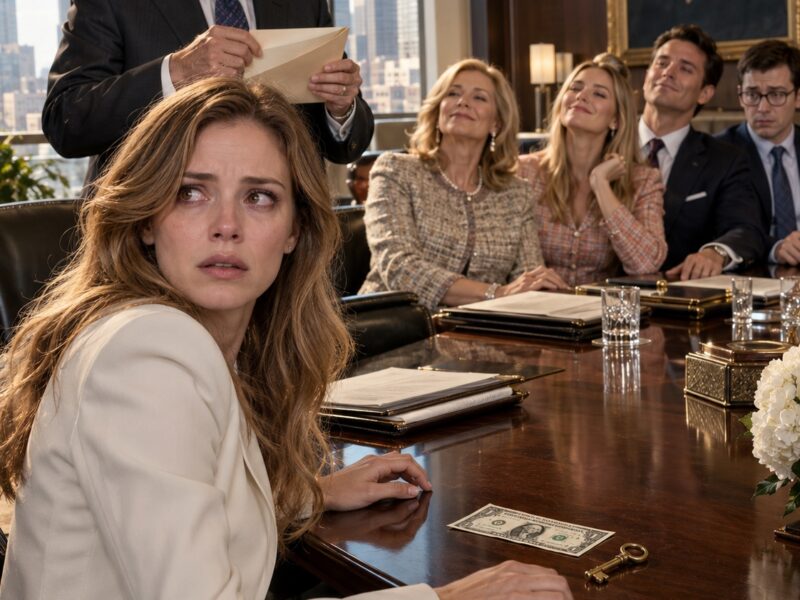
MY PARENTS STOLE MY INHERITANCE AT GRANDMA’S WILL READING—UNTIL HER REAL LAWYER OPENED A SEALED ENVELOPE THEY THOUGHT I’D NEVER FIND
My father laughed when the lawyer handed me one dollar.
Not smiled.
Not exhaled in relief.
Laughed.
My younger sister actually clapped.
That was the moment I stopped believing the will reading was merely cruel and started wondering whether it had been staged.
The lawyer slid an old brass key across the conference table toward me.
It scraped over the polished wood and stopped beside my water glass.
“One dollar,” he repeated, avoiding my eyes, “and the property located at 1147 Route Nine, including all structures and contents attached thereto.”
My mother smiled.
“You always did like rustic things, Claire.”
Across the table, my sister Madison covered her mouth to hide a laugh she had no real intention of hiding.
Her husband, Trevor, did not bother.
He leaned toward my father and raised one hand.
My father high-fived him.
At our grandmother’s will reading.
Nine days after we buried her.
I looked at all four of them.
Then at the lawyer.
His name was Leonard Briggs.
I had never met him.
That alone was strange.
Grandma Evelyn had used the same estate attorney for thirty-one years.
Henry Wallace.
Immaculate suits.
Silver hair.
An obsession with correct page numbering.
He had handled my grandfather’s death, Grandma’s business sale, three property purchases, two family trusts, and every annual estate review she had ever mentioned.
Henry Wallace was not in the room.
Instead, Leonard Briggs sat behind a conference table in a poorly fitted navy suit, sweating despite aggressive air-conditioning.
I had asked where Henry was before the reading began.
My mother had waved the question away.
“We changed direction.”
“For efficiency.”
Efficiency.
The word would become important later.
At the time, I simply filed it away.
That was what I did professionally.
I was thirty-three and had spent ten years working in commercial finance and distressed real estate.
My job was to notice the sentence somebody hoped you would skim past.
A lien buried four documents deep.
Debt moved off a balance sheet three weeks before closing.
A convenient appraisal.
A signature where no signature should exist.
My family had always treated that part of my life as slightly embarrassing.
Madison had married Trevor, a venture-capital founder who appeared in local magazines and described himself as a “serial allocator of disruptive capital.”
I analyzed warehouses.
Strip malls.
Distressed logistics portfolios.
Nothing glamorous.
My father once told a dinner table that I “checked spreadsheets for a living.”
He meant it as a joke.
Grandma Evelyn had not laughed.
She had said:
“Then at least one person at this table knows where the money actually is.”
That had been three years earlier.
Nobody seemed to remember.
Leonard continued reading.
Approximately $4.8 million in cash, municipal bonds, and blue-chip investments.
Divided among my parents and Madison.
My father received thirty-five percent.
My mother twenty-five.
Madison forty.
Trevor technically received nothing, but since Madison had never opened a checking account he could not access, the distinction was ceremonial.
My name appeared nowhere.
Then came the cabin.
The room relaxed.
That also bothered me.
People do not relax around a surprise.
They relax around confirmation.
The Route Nine cabin sat beside a small lake almost an hour outside town.
We had used it when Madison and I were children.
Then my parents decided it was too old.
Too isolated.
Too unimpressive.
No marina.
No club.
No chef.
No reason, in my mother’s opinion, to be photographed there.
Grandma kept it anyway.
By the time I was twenty, nobody used it except her occasionally.
By the time I was thirty, even she had stopped going because her knees could no longer handle the steps.
Leonard produced a single dollar from an envelope.
My father laughed.
“There you go.”
He leaned forward.
“Don’t spend it all at once.”
Trevor whooped.
Madison finally laughed openly.
My mother picked up the rusted key and flicked it toward me.
“You always liked old things.”
Then she turned toward Madison.
“And frankly, sweetheart, you need liquidity right now.”
Madison nodded as though discussing a legitimate estate concern rather than explaining why her sister had just been publicly disinherited.
“Trevor’s fund is scaling.”
Trevor adjusted his cuff.
“Big quarter.”
I looked at him.
“What fund?”
His smile sharpened.
“You wouldn’t know the deals.”
“I work in institutional credit.”
“That’s different.”
“Yes.”
I said.
“It is.”
He missed the insult.
My father leaned toward me.
“Just keep the taxes paid.”
“Nobody’s bailing you out if the property becomes a problem.”
That sentence stayed with me.
Not because it was cruel.
Because it was oddly specific.
Within ten minutes, my family was discussing dinner reservations.
Celebratory dinner.
My mother had apparently booked Bellamy’s.
A restaurant requiring weeks of notice.
That detail answered one question.
The result had not surprised them.
I folded the dollar once.
Put it in my wallet.
Took the key.
Said nothing.
Madison watched me.
“You’re seriously not going to make a scene?”
“No.”
She looked disappointed.
That mattered too.
People who plan humiliation often require reaction to complete it.
I did not give them one.
In the parking garage, I sat inside my car for fifteen minutes.
Then called Priya Shah.
Priya had worked beside me for almost a decade.
Brutally practical.
Impossible to impress.
The closest thing I had to a sister who behaved like one.
“They gave me a dollar.”
Silence.
“And?”
“A cabin.”
“What did everyone else get?”
“About five million.”
Another silence.
Then:
“That doesn’t add up.”
“Thank you.”
“I’m not comforting you.”
“I know.”
“I mean literally.”
Priya continued.
“Your grandmother spent nine years telling you to verify numbers and then cuts you out in favor of people she complained about every Sunday?”
I stared through the windshield.
“How do you know what she complained about?”
“You told me.”
Fair.
Priya said:
“Go look at the cabin.”
“Today.”
“Why?”
“Because if somebody gives the only financial analyst in the family a worthless asset instead of cash, either your grandmother was losing her mind…”
“She wasn’t.”
“…or the asset isn’t the point.”
I drove there.
The cabin looked worse than memory.
Roof sagging.
Gray siding peeling.
Porch tilted toward the lake.
One shutter hanging loose.
Then I saw the notice nailed to the front door.
Bright yellow.
County tax enforcement.
Three days until seizure.
I read it twice.
Five years of unpaid liabilities.
Not ordinary property taxes.
Transferred obligations.
Penalties.
Interest.
Roughly $47,000.
I stood on that porch holding the rusted key and understood.
The cabin was not an inheritance.
It was a deadline.
Somebody expected me to miss it.
Or be unable to pay.
Or panic and sell.
I walked around the property.
Nothing valuable.
At least visibly.
Old furniture.
Mildewed curtains.
Collapsed back ceiling.
Then I remembered Grandma.
I was nine.
Same porch.
She had been balancing a checkbook by hand.
I asked why she did not trust the bank statement.
She looked at me over her glasses.
“A number someone hands you is only a story until you check it yourself.”
At nine, I thought this was one of those strange grandmother sayings adults use to make arithmetic sound noble.
Now I understood differently.
Somebody hands you a story.
You check the number.
I went home.
Pulled every public record tied to the parcel.
Stayed awake until two.
At 2:17, I found the first anomaly.
Three years earlier, a tax obligation tied to my father’s holding company had been transferred through an old family trust clause onto the cabin parcel.
Legal-looking.
Technically documented.
Completely irrational.
I pulled the trust.
Then corporate records.
Then county reconciliations.
Then a lien chain.
By sunrise, I understood enough to feel sick.
My father had been moving liabilities off his own company.
Using Grandma’s old guarantor status.
Parking debt against a forgotten property.
The cabin.
If Grandma died and somebody inherited it without checking, the county would seize it.
Then the chain disappeared into foreclosure.
Clean.
I called Priya at six.
She answered:
“If someone is dead, I’m hanging up.”
“My dad moved corporate liabilities onto Grandma’s cabin.”
Silence.
Then:
“Okay.”
“Now I’m awake.”
I emailed the records.
Twenty minutes later:
“You know what this is.”
“Yes.”
“Say it.”
“He needed the cabin to disappear.”
“Good.”
Priya’s voice sharpened.
“Now stop being his daughter.”
I frowned.
“What?”
“Build the file like he’s any other counterparty.”
“Dates.”
“Signatures.”
“Entities.”
“No feelings.”
“You can have feelings later.”
That saved me.
By noon I had wired the county the full amount.
Painful.
Almost half my liquid savings.
Worth every dollar.
The foreclosure stopped.
The deed cleared.
Recorded solely in my name.
My father called the next morning.
His voice was warm.
Too warm.
“Claire.”
“Hi, Dad.”
“I’ve been doing some checking.”
“Have you?”
“That cabin has environmental issues.”
“Asbestos.”
“Mold.”
“Possibly lead.”
“Terrible exposure.”
“I don’t want you trapped.”
He paused expertly.
“I’ll give you twenty thousand.”
“Quick transfer.”
“I assume everything.”
Behind him, I heard Trevor.
“You’d be doing her a favor.”
I almost smiled.
I asked:
“Which environmental consultant inspected it?”
Pause.
“What?”
“You said asbestos.”
“Who inspected?”
“Well, someone we know looked at—”
“There has been no inspection.”
Silence.
I continued.
“Also, the tax balance has been paid.”
“What?”
“I wired the county forty-seven thousand yesterday.”
The phone became completely silent.
“The foreclosure is cancelled.”
“The deed is clear.”
“In my name.”
Three seconds.
Then my sister’s voice.
“What the hell is wrong with you?”
“Good morning, Madison.”
“You wasted forty-seven thousand dollars?”
“My money.”
“That is family property.”
“No.”
“It was devised directly to me.”
Trevor cut in.
“You don’t understand what you’re doing.”
I leaned back.
“That sentence keeps showing up.”
My father returned.
“Claire.”
“Sell it.”
“No.”
His voice hardened.
“This is not the time to be stubborn.”
That told me there was something in or under that property worth more than $20,000.
“I have a meeting.”
“Claire—”
I hung up.
Then called Miguel Torres.
Miguel ran a demolition and renovation company I trusted professionally.
Thirty years in construction.
Exact estimates.
No games.
I told him:
“I need the cabin gutted.”
“All interior finishes.”
“Down to framing.”
“Inventory everything first.”
“Change locks.”
“Security cameras.”
“No disposal without photographs.”
He paused.
“Family problem?”
“Yes.”
“Say no more.”
His crew arrived at sunrise.
At 6:32 a.m., Madison arrived in a Range Rover towing a rented trailer.
Miguel called me.
“She’s here with movers.”
“Of course.”
“She says Grandma promised her furniture.”
“Put me on speaker.”
Madison began immediately.
“You’re being insane.”
I said:
“There is a court-stamped inventory.”
“I filed it yesterday.”
“If anything leaves that property without written probate approval, I will report the theft.”
“You’d call police on your own sister?”
“If you steal from me, yes.”
“You don’t even want that junk.”
“Then why are you there at six-thirty?”
Silence.
Small.
But real.
Then:
“There are sentimental things.”
“Which?”
“Furniture.”
“Which furniture?”
Another pause.
“The cherry dining set.”
Madison’s house was all glass and Scandinavian white oak.
She hated antiques.
“Go home.”
She did.
But before hanging up she said something I wrote down immediately:
“You don’t even know what you’re sitting on.”
That afternoon, Miguel called again.
Different voice.
“Claire.”
“What?”
“I need you here.”
“What happened?”
“We found something.”
“Structure?”
“No.”
He lowered his voice.
“Under the bedroom floor.”
“And?”
“A steel safe.”
My hand stopped over my keyboard.
“Miguel.”
“Do not open it.”
“Already called police.”
“Good.”
“And Claire?”
“Yes?”
“Don’t tell your family.”
Forty minutes later, I pulled onto the dirt road.
Two police cruisers.
Miguel’s crew standing outside.
The safe had been embedded directly into the foundation.
Not stored.
Hidden.
Deliberately.
A jackhammer exposed its perimeter.
While we waited for evidence technicians, a black SUV tore down the road.
Trevor.
Italian suit.
Completely inappropriate shoes.
He stepped out waving what looked like a laminated card.
“I’m estate manager.”
Nobody had ever appointed him anything.
“The safe belongs to Harrington Holdings.”
One officer asked:
“Proof?”
Trevor talked faster.
“This is exactly why Richard wanted the cabin back.”
Everything stopped inside me.
He realized too late.
The officer looked at me.
I said nothing.
Trevor continued trying to recover.
“It contains corporate materials.”
“Possibly.”
“Private family records.”
The sergeant asked:
“How do you know what is inside a safe nobody knew existed?”
Trevor’s mouth opened.
Closed.
I handed over my deed.
The sergeant read it.
Then told Trevor:
“This is private property.”
“Leave.”
Trevor pointed toward me.
“She has no idea what she’s doing.”
The officer sighed.
“Sir.”
“One more word and I’ll consider trespass.”
Trevor left.
The safe contained one envelope.
Nothing else.
Thick cream paper.
Wax seal.
My grandmother’s handwriting.
To Henry Wallace.
Underneath:
If I am dead, Richard found a way to move before I could stop him. Follow the instructions exactly. Do not open before Thanksgiving.
Thanksgiving was two days away.
I felt the world become very quiet.
The sergeant logged the envelope.
Then released it to me after documenting chain of custody because no crime had yet formally been established.
I drove directly to Wallace & Pierce.
Henry Wallace saw me immediately.
He was sixty-eight.
Perfect charcoal suit.
White pocket square.
The same calm expression I remembered from childhood estate meetings.
I put the envelope on his desk.
For the first time in my life, Henry Wallace looked startled.
“Where?”
“Under the cabin.”
He sat slowly.
“Your grandmother.”
“I know.”
He touched the envelope.
Did not open it.
“My parents fired you.”
“The morning after the funeral.”
“Why?”
“They said my fees were excessive for a simple estate.”
“Was it simple?”
Henry looked at me.
“No.”
“What did Grandma tell you?”
He folded his hands.
“Three weeks before she died, she called me.”
“She had reconciled one of her quarterly brokerage statements.”
“A number was wrong.”
“Small enough most people would ignore.”
“She did not.”
Henry smiled faintly.
“That was Evelyn.”
“She found transfers.”
“Then more.”
“She asked me to help.”
“Within two weeks, we had enough to know somebody had been draining her assets.”
“My father.”
Henry’s silence answered.
“Why didn’t you stop him?”
“We were preparing to.”
“She died before we filed.”
I stared.
“Natural causes?”
“Yes.”
He answered immediately.
“Nothing suggests otherwise.”
“Your grandmother’s fear was financial.”
“Not physical.”
I exhaled.
Important distinction.
Henry continued.
“She told me if anything happened before the documentation was complete, I was to find you.”
“Why me?”
His expression softened.
“Because you could read it.”
“And?”
“Because she believed you would act.”
I looked at the sealed envelope.
“Thanksgiving.”
“Yes.”
“Why wait?”
“I don’t know.”
Henry thought.
“Probably because she anticipated your family gathering.”
That sounded like Grandma.
He looked at me.
“Do you want to follow her instructions?”
Every impatient part of me screamed no.
“Yes.”
Thanksgiving came.
My parents invited me.
That alone was suspicious.
My mother texted:
Wear something nice. We have guests. Please don’t embarrass us.
I replied:
I’ll be there.
Before dinner, I learned something else.
Trevor’s investment fund had applied for a $6 million bridge loan.
To my firm.
I discovered it during a conflict review.
I recused myself from the approval vote.
But not before reading the file.
The numbers were rotten.
Three million dollars of “strategic reserve capital” had passed through a chain of offshore entities.
One name matched a shell entity from Grandma’s preliminary records.
I escalated it internally.
Independent review denied the facility.
Compliance referred the file.
I told nobody in my family.
At Thanksgiving, my parents’ driveway looked like a luxury dealership.
Aston Martin.
Range Rovers.
Mercedes.
Trevor had parked diagonally near the entrance.
Of course.
My mother greeted me.
Looked at my navy suit.
“I said dress nicely.”
I looked down.
“This is a two-thousand-dollar suit.”
“It looks corporate.”
“It is.”
At dinner, she placed me at the far end.
Beside me:
A laminated children’s menu.
Crayon attached.
I stared.
My mother stage-whispered to a donor:
“Claire is going through something.”
I took the crayon.
Placed it beside my plate.
Data.
Not injury.
That classification helped.
Midway through dinner, Trevor opened a gift I had placed beside his chair.
Inside:
A framed magazine profile featuring his own face.
Behind the mat:
A copy of a regulatory preservation notice my firm had lawfully received regarding transactions linked to his fund.
Only he could see it.
The color left his face.
I smiled.
“Everything okay?”
“Fine.”
Then my father stood for a toast.
“Family.”
“Growth.”
“Legacy.”
All the usual words.
Then:
“And Trevor has just secured a six-million-dollar bridge loan that will take his fund into its next stage.”
Applause.
Trevor did not clap.
I raised my glass.
“To the bridge loan.”
Everyone looked at me.
My father smiled.
Finally.
Approval.
Then I continued.
“Unfortunately, it was declined.”
Silence.
“At nine yesterday morning.”
Trevor stared.
I said:
“The credit committee identified more than three million in hidden liabilities.”
“Several shell entities.”
“Material solvency concerns.”
“The file has been referred to compliance.”
One investor immediately reached for his phone.
Then another.
Trevor’s wineglass slipped.
Did not shatter dramatically.
Just tipped.
Red wine spread across white linen.
My mother stood.
“What are you doing?”
“Answering the toast.”
My father’s face became red.
“You had no right.”
“I had no vote.”
“I disclosed the conflict.”
“The independent committee declined it.”
Trevor stood.
“You sabotaged me.”
“No.”
I looked at him.
“Your numbers did.”
Madison screamed:
“You’re jealous.”
“Of what?”
Her mouth opened.
Nothing.
My father pointed toward the study.
“Enough.”
Then:
“You are signing the quitclaim deed tonight.”
He produced papers.
Already prepared.
There it was.
I looked around.
Guests.
Investors.
Witnesses.
“Why?”
“Because this nonsense with the cabin ends.”
Madison said:
“Just sign.”
“No.”
My father’s face changed.
Not performative anger.
Real panic.
“Claire.”
“You do not understand what is at stake.”
I almost smiled.
“Then explain it.”
He couldn’t.
My mother said:
“Your grandmother wanted family harmony.”
That nearly made me laugh.
Instead, I stood.
“I agree.”
My father relaxed slightly.
I lifted my phone.
Connected it to the living-room television.
Security footage appeared.
2:07 a.m.
Previous night.
Madison.
Black clothes.
Face partially covered.
Crowbar.
Trying the cabin’s new deadbolt.
The room went silent.
Madison turned white.
“That isn’t me.”
I froze the frame.
Her Range Rover license plate.
Clear.
She sat.
One guest whispered:
“Oh my God.”
My father grabbed my arm.
Hard.
“You’re done.”
I looked at his hand.
Then him.
“Remove it.”
He did.
Not because he respected me.
Because people were watching.
I left.
In the driveway, I sat in my car.
The open windows carried voices.
Trevor shouting.
Madison crying.
My father telling everyone to calm down.
Then Trevor:
“How much is the land worth?”
Silence.
My heart changed rhythm.
Then:
“The rezoning.”
My father said:
“Not now.”
Trevor:
“The corridor approval.”
Madison:
“Shut up.”
Commercial rezoning.
I started the engine.
The cabin was not merely hiding evidence.
The land itself mattered.
Next morning, I called the planning department.
Public proposal.
State-funded technology and logistics corridor.
Draft zoning map.
The cabin parcel sat almost exactly at the proposed center.
Projected value after approval:
Eighteen to twenty-two million dollars.
Now I understood everything.
They did not merely want evidence destroyed.
They wanted the land.
Two days later, a bulldozer arrived.
With a man claiming to be a municipal inspector.
Emergency demolition order.
Printed at three that morning.
I was already waiting.
I had spent the previous forty-eight hours filing for emergency heritage protection based on the cabin’s age and documented place in early lakefront development.
Temporary injunction had been granted.
I handed the inspector the stamped order.
He read it.
Went pale.
I said:
“If your demolition authorization is genuine, your city attorney can call my counsel.”
“It isn’t.”
He dropped the clipboard.
The bulldozer operator heard enough.
Climbed out.
“I’m not losing my license for this.”
They left.
My mother went on television the following morning.
A local news segment.
Beige suit.
Perfect hair.
Dry tissues.
She described me as unstable.
Paranoid.
Estranged.
Claimed the family had attempted “interventions.”
The reporter asked for documentation.
My mother fumbled.
I watched twice.
First time as a daughter.
Second as an analyst.
The second viewing hurt less.
My managing partner, Daniel Foster, called.
“Tell me whether any of this affects your professional conduct.”
“No.”
“Evidence?”
I sent the file.
Tax transfers.
Loan denial.
Cabin security footage.
Demolition order.
Grandma’s envelope.
He called back forty minutes later.
“Legal is yours.”
“All of it.”
“Communications will issue a statement.”
I thanked him.
Daniel said:
“Claire.”
“Yes?”
“I hired you because nine years ago you caught a problem every other analyst missed.”
“I care whether your math is right.”
“It is.”
“Everything else is noise.”
That night Henry Wallace finally opened Grandma’s envelope.
Thanksgiving had passed.
He used a silver letter opener.
Inside:
A later will.
Properly notarized.
Witnessed.
Dated five months after the one my family had presented.
And a black leather ledger.
Grandma’s handwriting.
Color-coded.
Exact.
Transfers.
Dates.
Entities.
My father had spent three years draining her bond portfolio and retirement accounts.
Small transfers.
Below reporting thresholds.
Through bland LLCs.
Meridian Capital Three.
North Harbor Consulting.
Lakeside Strategic Partners.
Money flowed into entities connected to Trevor’s fund.
Then back into my father’s holding company through “consulting fees.”
I read for almost an hour.
At one point Henry pushed a tissue toward me.
I had not realized I was crying.
“How much?”
I asked.
“Roughly three-point-four million traceable.”
“Possibly more.”
“And the will?”
Henry turned it.
Grandma had left the entire residual estate to me.
Cash.
Securities.
Cabin.
Any recoveries from misappropriated funds.
Then came the clause.
Anyone who knowingly submitted a fraudulent competing will, concealed estate assets, or misappropriated property forfeited any beneficial interest.
My family had done all three.
I looked at Henry.
“So the first will…”
“Fraudulent.”
“Who notarized it?”
“We’re investigating.”
“Lawyer?”
“Briggs appears to have been hired to read documents.”
“Not draft.”
“He may be incompetent rather than conspiratorial.”
Important.
Not every weak person in a fraud is equally guilty.
Henry tapped the ledger.
“If we file only in probate, they will delay.”
“How long?”
“Years.”
“Trevor will move money.”
“Yes.”
“So?”
“We preserve evidence.”
“We cooperate with regulators.”
“And we let them continue.”
I frowned.
“Why?”
“Because people this confident usually commit their cleanest crimes while trying to cover their earlier ones.”
My phone buzzed.
Mother.
We are holding a press conference tomorrow. You should come before this becomes uglier.
Henry read it.
“Perfect.”
The press conference was held at the Grand Monarch Hotel.
Two hundred people.
Donors.
Country-club acquaintances.
Reporters.
My parents announced a mental-health charity bearing my name.
Without asking me.
My mother cried at the podium.
My father pledged $100,000.
Money, investigators would later establish, he did not possess cleanly.
I entered with Henry.
My firm’s counsel.
And two federal financial-crimes agents.
No dramatic cuffs yet.
Just presence.
My mother stopped speaking.
I walked toward the stage.
The hotel’s LED screen changed.
Grandma’s ledger appeared.
A page showing $3.4 million moving through three shell companies into Trevor’s fund.
The ballroom became silent.
Trevor shouted:
“Forgery!”
I took the microphone.
“No.”
“My grandmother’s original ledger.”
“Recovered from a safe buried under the Route Nine cabin.”
“My parents tried to obtain that property for twenty thousand dollars.”
“My sister attempted to enter it after midnight.”
“Two days later, a forged demolition order arrived.”
I changed the slide.
Security footage.
Madison.
Then demolition order.
Then corporate filings.
Then loan records.
Trevor moved toward the exit.
An agent simply stepped into his path.
Not tackled.
No spectacle.
“Mr. Hayes.”
“We need you to stay.”
My father shouted:
“This is a family matter.”
The senior agent answered:
“Not anymore.”
Henry stepped forward.
“The will read last month was not Evelyn Harrington’s final testament.”
My mother stared.
Henry held up the document.
“This is.”
He read.
Claire Harrington, sole residuary beneficiary.
Madison screamed.
My mother shouted:
“I’m her daughter!”
Henry continued.
The forfeiture clause.
Fraudulent wills.
Estate theft.
Concealment.
Complete disinheritance.
My father sat.
Not collapsed.
Sat.
Like his body had finally received information his mind was still rejecting.
The senior agent approached Trevor.
“We have questions concerning wire fraud, forged financial instruments, and interstate transfers.”
Trevor looked at Madison.
She moved away from him.
Immediately.
That told me everything about their marriage.
My father looked at me.
“You did this.”
I shook my head.
“No.”
“Grandma did.”
“I checked her work.”
That was the last sentence I said to him that night.
The consequences took months.
Not minutes.
Real accountability is slower than viral stories.
Trevor’s assets were frozen.
His fund entered court-supervised wind-down.
Several investors recovered partial losses.
He eventually pleaded guilty to multiple financial offenses.
My father faced charges related to estate fraud, falsified transfers, and tax violations.
My mother was not charged with the same conduct because evidence showed she had benefited from money and ignored warning signs but had not directed the transfers.
That distinction mattered.
She still lost almost everything.
Civil recovery reached assets purchased with stolen funds.
Jewelry.
Cars.
A vacation property.
The country-club membership disappeared on its own.
Society is often faster at punishment than courts when embarrassment becomes public.
Madison had known more.
Her midnight cabin visit mattered.
Messages recovered from Trevor’s devices showed she knew the first will was fraudulent.
She had not designed the financial scheme.
But she had helped conceal it.
Her plea involved obstruction and attempted removal of estate property.
Probation.
Community service.
Restitution obligations.
She called me once from a motel.
“You have twenty million dollars coming.”
“And I have nothing.”
I said:
“That isn’t true.”
“What do I have?”
“Choices.”
She laughed bitterly.
“Easy for you.”
“No.”
I thought of twelve-year-old me watching her eat the largest piece of my birthday cake while my mother told me keeping peace mattered more than fairness.
“It was easier for you for thirty years.”
“That’s different.”
“No.”
“It was invisible to you.”
She had no answer.
I ended the call.
The cabin land eventually received final commercial rezoning approval.
Valuation:
Just under twenty million.
I did not sell immediately.
I drove to Grandma’s grave first.
Cold morning.
Thermos of her terrible over-steeped tea.
I poured two cups.
One for me.
One beside the stone.
“I found it.”
I told her.
No answer.
Obviously.
Still felt necessary.
“You were right about Dad.”
Silence.
“You were right about the numbers.”
Wind moved through the cemetery grass.
“And you were right about me.”
That was when I finally cried.
Not at the funeral.
Not at the will reading.
Not while federal agents entered a ballroom.
There.
Alone.
Because justice and grief are not opposites.
Winning does not resurrect the person who prepared you to survive.
A year later, the Route Nine property reopened as the Harrington Commercial Technology Center.
Not a monument to revenge.
That mattered to me.
Logistics startups.
Small manufacturing labs.
Workforce training.
Affordable office space for women-owned businesses.
The old cabin could not be preserved structurally.
Too damaged.
But I saved the original front door.
Rotten edges.
Faded paint.
The yellow foreclosure notice had left a rectangular stain in the wood.
We placed the door inside a glass case in the lobby.
At opening day, Priya stood beside me.
Henry sat in the first row.
Miguel wore a suit that clearly made him uncomfortable.
Carol, Grandma’s hospice nurse, came too.
I announced one more thing.
The Evelyn Harrington Financial Protection Fund.
Legal aid.
Forensic accounting.
Estate-fraud assistance.
Specifically for people experiencing financial abuse by relatives.
Henry agreed to chair its legal board.
He claimed he was retiring.
He did not.
Priya eventually left our old firm to run risk for the development company.
She called it “following the better deal.”
I knew better than to embarrass her with gratitude.
We still checked each other’s math.
That remained the most dependable relationship in my life.
My father eventually asked to see me.
I declined twice.
The third time, I agreed.
Public café.
Daylight.
He looked older.
Not dramatically.
Just reduced.
No expensive watch.
No performance.
He said:
“You could have taken the twenty thousand.”
“Let the cabin go.”
“Grandma was dead.”
“None of this brought her back.”
I looked at him.
“What did it get you?”
he asked.
“The truth.”
He laughed bitterly.
“You destroyed the family for truth.”
“No.”
“The theft destroyed the family.”
“The truth documented it.”
He looked away.
I continued.
“You taught me something without meaning to.”
“What?”
“That a lie survives longest when everybody agrees exposing it would be more embarrassing than living inside it.”
He said nothing.
I stood.
At the door, he asked:
“Do you hate me?”
I thought.
“No.”
That seemed to hurt him more.
“What do you feel?”
“Sad.”
“For yourself?”
“No.”
“For the father you could have been.”
I left.
I saw him months later by accident.
Parking lot.
Pushing shopping carts as part of work he had taken after losing his company.
For years, I had imagined a moment like that would feel triumphant.
It didn’t.
He looked tired.
Human.
Small.
And I understood something I had not expected.
Consequences do not require contempt.
You can believe somebody deserves the life their choices built without enjoying their suffering.
The light turned green.
I drove on.
I did not look back.
Today, the rusted key from the fake inheritance sits inside my desk.
The locks it belonged to no longer exist.
It opens nothing.
People ask why I keep it.
Because receipts matter.
Because there was a morning when my family sat around a polished conference table and handed me a dollar, a decaying cabin, and a rusted key.
They believed they were giving me nothing.
Worse.
They believed they were giving me a trap.
They assumed I would be too hurt to look closely.
Too inexperienced to understand.
Too isolated to fight.
Grandma knew differently.
For nine years, every Sunday, she had taught me without announcing the lesson.
Check your own numbers.
Read the line everybody else wants skipped.
Never confuse a summary with the underlying record.
And never accept somebody else’s story about your worth until you have done the arithmetic yourself.
The last provision of Grandma’s true will contained no dramatic declaration.
No insult.
No revenge.
Only one handwritten sentence Henry found clipped behind the signature page.
He gave it to me after the estate finally closed.
I keep that too.
Claire will understand why I gave her the cabin.
That sentence mattered more than the twenty million.
More than the fund.
More than the conviction.
Because she had understood me when the rest of my family never bothered trying.
At the fake will reading, my mother had smiled and said:
“You always did like cheap, rustic things.”
For years afterward, I thought about that insult.
Eventually I decided she had accidentally told the truth.
I liked old doors people thought worthless.
Handwritten ledgers instead of polished summaries.
Contractors who called before touching something that was not theirs.
Hospice nurses who attended funerals when families did not.
Friends who told useful truths instead of comforting lies.
Lawyers careful enough to preserve one dead woman’s instructions exactly.
None of those things were glamorous.
None were expensive in the way my family understood expense.
And every one of them proved more valuable than the millions my parents nearly destroyed themselves trying to steal.
My family gave me a rusted key because they wanted me to believe I had lost.
Grandma gave me the same key because she knew I would open the right door.
They thought the cabin was where my inheritance ended.
It was where the truth began.









