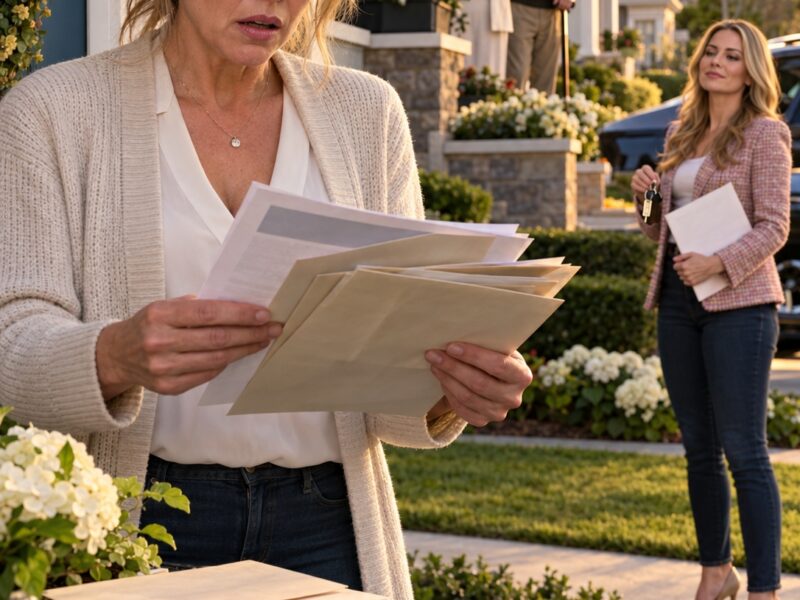
My Parents Took Over the HOA and Fined Me Fourteen Times So My Sister Could Buy My House Cheap—Then I Read the Rule They Counted on Me Ignoring
By the middle of September, I had fourteen HOA violation letters in a shoebox, $3,140 missing from my savings, and a mother who waved at me every morning from thirty feet away.
The fourteenth letter threatened a lien against the house I had bought so I could help my father after his stroke—and my sister suddenly offered to buy that same house for barely more than I had paid six years earlier.
Then she texted one sentence that made me realize the fines were not punishment for breaking neighborhood rules; they were a countdown.
The fourteenth violation letter was waiting in my mailbox on a Friday evening in September, tucked under a grocery flyer and one of those local coupon envelopes nobody ever admits to reading.
Cream paper.
No stamp.
No postmark.
My address centered on a white label.
412 Cedar Hollow Lane.
In the upper-left corner sat the little pine-tree logo of the Cedar Hollow Homeowners Association, cheerful enough to look like something from a campground brochure.
I stood at the curb and opened it there.
I had learned by then that carrying those envelopes into my kitchen unopened only made the walk longer.
SPECIAL ENFORCEMENT ASSESSMENT.
PATTERN OF CONTINUED NONCOMPLIANCE.
$1,500 DUE WITHIN TEN DAYS.
FAILURE TO REMIT MAY RESULT IN COLLECTION ACTION, INCLUDING A LIEN AGAINST THE PROPERTY AS PERMITTED BY THE GOVERNING DOCUMENTS AND APPLICABLE LAW.
I read it twice.
Then looked across the strip of grass between our houses.
My mother stood on her porch at 416.
Quilted robe.
Coffee mug.
Green watering can beside one slipper.
She had been there when I pulled into the driveway.
She was almost always there when I came home.
At six-forty every weekday morning, she stood on that porch while I backed out for work.
At six-ten or six-fifteen most evenings, she was somewhere visible again.
Watering ferns.
Checking mail.
Wiping a table.
Some families call that closeness.
By September, it felt more like surveillance with hydrangeas.
She lifted two fingers off her mug.
I waved back.
Habit is powerful.
“Everything all right, honey?” she called.
“Fine, Mom.”
She smiled.
“You know the board can’t play favorites.”
There was something almost tender in the way she said it.
I folded the letter.
“Of course.”
I turned toward my house.
Behind me, I heard her watering can touch the concrete.
Then a faint click.
Phone camera.
I did not turn around.
Inside, I opened the hall closet and took down the shoebox.
Size-eight flats.
Black.
Bought for a deposition in 2021.
The shoes were gone.
The box held thirteen cream HOA envelopes arranged in date order because I am the kind of woman who writes the violation number on the memo line of every check.
I carried them to the kitchen.
One by one.
Letter One.
July 14.
UNAPPROVED EXTERIOR COLOR.
My front door.
Harbor Blue.
$100.
The previous HOA board had approved that color in writing when I bought the house six years earlier, but the new board decided the old approval was “insufficiently documented.”
I repainted it beige.
Three coats.
Ninety-eight-degree heat.
My son Caleb helped.
I hated every brush stroke.
Letter Two.
Trash bins visible after pickup.
$50.
Letter Three.
Garden hose visible from street.
$75.
Letter Four.
Exterior wreath displayed outside “seasonal period.”
$75.
Letter Five.
Trash bins again.
$100.
Letter Six.
Grass exceeding five inches.
$150.
My mother measured it at five and a half with an old wooden yardstick from her sewing room.
I watched from my bedroom.
She did not know I saw.
Letter Seven.
Driveway staining.
$100.
Dinner-plate-sized oil spot beneath Caleb’s old Corolla.
I scrubbed it with dish soap and kitty litter at nine-thirty that night.
Letter Eight.
Porch light “inconsistent color temperature.”
$100.
Apparently my bulb was too warm.
Letter Nine.
Guest vehicle parked overnight.
$150.
Caleb’s Corolla.
He had come home from UT Austin for Labor Day.
Letter Ten.
Decorative planter “encroaching on walkway sightline.”
$100.
Letter Eleven.
Trash bins.
Again.
$150.
Letter Twelve.
Garage door open for “extended period.”
$200.
I had been unloading groceries.
Letter Thirteen.
Front lawn edging.
$390 after what the notice called “repeat enforcement escalation.”
Then fourteen.
$1,500.
Pattern.
Continued noncompliance.
Lien.
I spread all fourteen letters across the table the way I lay out exhibits before a deposition.
I am a court reporter.
Freelance.
Twenty-two years.
I spend my workdays sitting at the end of conference tables while lawyers argue over what words mean.
My job is not to react.
Not to interpret.
Not to decide who is lying.
My job is to preserve exactly what was said.
If a witness changes a story, I type both versions.
If an attorney is rude, I punctuate the rudeness properly.
If somebody says, “That is not what the contract means,” and the contract plainly says otherwise, I remain professionally invisible.
At home, I had spent most of my life doing the same thing for free.
I took out my checkbook.
$1,500.
Memo: LETTER 14.
My pen hovered.
The refrigerator cycled on.
Somewhere next door, my mother’s back gate shut.
I thought:
How many letters does it take before a person understands that obedience is not ending the punishment?
Then I signed.
Total paid:
$3,140.
Most of one good month’s freelance income.
Money that had been sitting in an account labeled CALEB SPRING.
My son was a junior.
Tuition did not care about neighborhood politics.
I told myself I could replace it.
I always replaced things.
Money.
Time.
Peace.
That had been my role in the family for as long as I could remember.
The strong one.
The reasonable one.
The one who would earn it back.
The next afternoon my sister walked into my house without knocking.
Kendra had never knocked.
Not when we were children.
Not when I was married.
Not now that we were both in our forties.
She came through the front door saying, “Hey, hey,” with sunglasses pushed into her blond hair and car keys still in one hand.
“Do you want coffee?”
“No, I can’t stay.”
She immediately looked up at the ceiling.
Then around the living room.
Not casually.
Assessing.
Kendra was forty.
Six years younger than me.
Fresh divorce filing.
Two children, eight and five.
She had moved into our parents’ back bedroom in April after her marriage to Gary finally collapsed under a combination of credit-card debt, resentment, and the kind of arguments where both people begin sentences with always.
I had felt sorry for her.
I still did.
Those things can coexist with anger.
She crossed into the hall.
“Your spare room could fit bunks.”
I looked at her.
“What?”
“The boys.”
“Which boys?”
“My kids.”
“You have a boy and a girl.”
“You know what I mean.”
She opened the spare-room door.
Touched the wall.
“This would work.”
“Kendra.”
“What?”
“Why are you measuring my rooms with your eyes?”
She laughed.
“I’m not.”
Then she walked into my bedroom.
“Okay, this is cute.”
I did not follow her in.
Something about seeing my sister stand at the foot of my bed made the house feel temporarily rented.
She returned to the front hall.
Looked at the door.
Sandstone beige.
“Honestly, Mom was right about the blue.”
I stared.
“The beige is calmer.”
“The blue was approved.”
“Still.”
She smiled.
“It was a lot.”
Then she placed a piece of paper on my kitchen table.
A do-it-yourself purchase offer printed from a home-buying website.
OFFER TO PURCHASE 412 CEDAR HOLLOW LANE.
$279,000.
CASH.
CLOSE WITHIN 30 DAYS.
AS IS.
I read it.
Then looked at her.
“What is this?”
“An offer.”
“I know what an offer is.”
She sat.
“Gary’s lawyer finally moved on settlement.”
“So?”
“So I can pay cash.”
“Kendra.”
“I’m giving you eleven thousand more than you paid.”
That sentence told me she had rehearsed this.
I bought the house for $268,000 in 2019.
A home with my floor plan two streets over had gone under contract the previous month for $418,000.
“You know what it’s worth.”
She looked offended.
“I’m family.”
“Yes.”
“That’s why it’s fair.”
I almost laughed.
Instead:
“Why now?”
She shifted.
“Mom said you’d probably be ready to talk.”
“Ready because of what?”
“The HOA stuff.”
My body went still.
Kendra waved one hand.
“Come on. It’s stressful.”
“What did Mom say?”
“Just that you’re tired of dealing with all this.”
“Those are not the same thing.”
She checked her phone.
“I have to get the kids from a birthday party.”
“Kendra.”
“What?”
“When did Mom tell you I’d sell?”
She gave me the face she had made since childhood whenever I was turning something small into something inconvenient.
“I don’t know.”
“When?”
“Summer.”
“June?”
“July?”
“Who remembers?”
“I do.”
She stood.
“Don’t do court-reporter thing.”
“What court-reporter thing?”
“The exact wording.”
That was interesting.
She picked up her purse.
“Just think about it.”
“Leave the offer.”
Her face brightened.
“Really?”
“Leave it.”
“Okay.”
She kissed my cheek.
“Mom says you always come around.”
I watched her SUV back out.
At the bottom of the driveway, she tapped the horn twice.
My mother stepped onto her porch.
Waved.
Kendra waved back.
At seven that evening, my phone buzzed.
Kendra.
Sorry if that was weird.
Second message.
Mom says once the fines hit 5 grand, you’ll take 279.
Third.
I don’t want this to get ugly. Think about it.
I read the second message again.
Once the fines hit five grand.
Not if.
Once.
I had paid $3,140.
My mother had a target.
She had been counting.
I took a screenshot.
Emailed it to myself.
Saved the original.
Then sat on my couch until the room darkened around me.
At eight-thirty, I opened the Cedar Hollow HOA portal.
I had paid fourteen fines under rules I had never read.
That realization embarrassed me more than the money.
I clicked GOVERNING DOCUMENTS.
The link returned:
TEMPORARILY UNAVAILABLE — UNDER REVISION BY BOARD.
Posted July 9.
July 9 was the day after my parents’ first board meeting.
I stared.
Then put on shoes.
Across the street, Mrs. Ines Salgado still had lights on.
Seventy-nine.
Widowed.
One of the first Cedar Hollow residents.
Her husband Reuben had been the first HOA president.
She opened the door in a cardigan with her reading glasses pushed into her hair.
“Lee Anne?”
“I need something strange.”
“Those are the only things worth answering doors for.”
I smiled despite myself.
“Do you still have Reuben’s HOA binder?”
Her expression changed.
“Yes.”
“Can I borrow it?”
She did not ask why.
She disappeared into the hall.
Returned with a three-inch green binder.
Old plastic cover.
Handwritten tabs.
“Reuben was a fussy man.”
“You’ve told me.”
“Fussy men write things down.”
She placed her palm on the binder for one second.
Then released it.
“Bring it back.”
I read until after two in the morning.
Sixty-four pages.
Covenants.
Bylaws.
Enforcement procedure.
Elections.
Special meetings.
Records.
Board duties.
I read like I was preparing a transcript for appellate counsel.
Page twenty-two.
Article Seven.
Section Three.
Special meeting must be called upon petition signed by owners representing at least ten percent of lots.
Thirty-eight homes.
Four signatures.
I highlighted.
Page thirty-eight.
Enforcement.
Written notice must be delivered in the method required by the declaration and give a reasonable cure period before escalating penalties, except certain urgent conditions.
Every letter to me had been hand-delivered.
No certified mail where the older covenant required it for formal notice.
Several gave forty-eight hours.
I wrote that down.
Still not enough.
Technical defects can be fixed.
Power simply learns procedure.
Then I reached page thirty-one.
Article Nine.
Duties of Directors.
Section 9.4.
CONFLICTS OF INTEREST.
I read once.
Then aloud.
“A director who has a personal or financial interest in any matter before the Association, including an interest held by a member of the director’s immediate family, shall disclose that interest to the Board in writing and shall not initiate, discuss, deliberate, or vote upon that matter.”
My heartbeat changed.
I continued.
“Any action taken in material violation of this section may be declared void by a majority of disinterested directors, subject to applicable law and governing documents.”
Then:
“Any fine collected under an enforcement action found void shall be refunded to the owner.”
Then:
“A director who knowingly violates this section may be removed pursuant to a vote of the membership at a properly noticed meeting.”
I set my phone beside the binder.
Kendra’s text glowed.
Mom says once the fines hit 5 grand, you’ll take 279.
Immediate family.
Financial interest.
Initiate.
I expected triumph.
Instead, nausea.
Because using that paragraph required something I had avoided my whole life.
Speaking.
Publicly.
Against my mother.
When I was sixteen, I worked at a barbecue restaurant off I-35.
Saved every cash tip.
Coffee can under my bed.
Goal:
A used Honda Civic.
$2,400.
By August:
$2,100.
One afternoon I came home.
Can empty.
My mother folded towels on the couch.
“Where’s my money?”
“Kendra has cheer.”
I stared.
“What?”
“Orlando.”
“You took it?”
“Loan.”
“She’s ten.”
“She has one shot at this.”
“That is my money.”
“You’re the strong one.”
My mother never stopped folding.
“You’ll earn it back.”
I screamed.
Cried.
Slamming-door teenage scene that became family mythology.
The money never returned.
What returned every Thanksgiving was my mother’s version.
“Remember when Lee Anne lost her mind over that old car?”
She imitated my voice.
Everyone laughed.
Eventually I laughed too.
In her version, there was no coffee can.
No two years of tips.
No theft.
Only my overreaction.
So I learned not to make scenes.
I became competent.
Useful.
Easy to explain.
My father had always survived family conflict by becoming quiet.
Television louder.
Newspaper raised.
Later:
he would rub my shoulder when nobody was looking.
That was his version of courage.
When he had the stroke in 2019, my mother called me at five in the morning.
“Kendra can’t help.”
Why?
“Babies.”
I had one child.
Thirteen.
Divorce finalized the previous year.
“You don’t have anything holding you down.”
The house next door to my parents came on market three months later.
I called it a sign.
Sold my San Antonio condo.
Bought 412 Cedar Hollow.
My name only.
For two years, Tuesdays and Thursdays belonged to Dad’s rehab.
I worked transcripts in hospital parking lots.
Learned to wait through his speech instead of supplying words.
Sorted medications.
Replaced bathroom bars.
Drove him when he could not drive.
My mother kept a spare key to my house.
Emergency.
I never requested it back.
When we closed, I painted the front door Harbor Blue.
My grandmother Opal’s color.
Dad’s mother.
Opal had a little frame house with pecan trees.
When I was nine, she let me help paint her front door blue.
I ruined my shoes.
She laughed.
“A door ought to say somebody’s glad you came.”
That color followed me.
At Cedar Hollow, the old board approved it in writing.
Six years later, my mother made me cover it.
Not because of paint.
I understood that now.
Five years after I moved next door, Kendra filed for divorce.
Mother’s Day dinner.
Pound cake.
My mother said:
“Kendra needs somewhere to land.”
“She has your back room.”
“The children need stability.”
“I agree.”
She smiled.
“So sell her your house.”
I thought she was joking.
“For what?”
“What you paid.”
“Mom.”
“Family price.”
“Kendra can’t afford market.”
“Then she can’t afford this house.”
The room changed.
Kendra looked at her plate.
Dad sliced cake smaller.
My mother stared.
I said:
“No.”
One word.
I had not said a clean no to my mother since I was sixteen.
Three seconds.
Then she asked who wanted coffee.
I drove home almost euphoric.
I thought boundaries worked like locks.
Say no.
Door closes.
I did not realize my mother preferred committees.
Annual HOA meeting came in June.
Two board seats vacant.
Nobody wanted them.
My parents volunteered.
“We want to give back.”
Nine ballots cast.
They won.
Mom became president.
Dad secretary.
Hank Odum remained treasurer.
Priya Raman held another seat.
Gail Mercer, one of Mom’s church friends, held fifth.
Three weeks later:
Letter One.
Door.
At the time, I did not connect anything.
That is difficult to admit.
People watching a story from outside always see the pattern first.
Inside your own life, patterns arrive disguised as individual inconveniences.
Door.
Trash.
Grass.
Car.
Light.
I complied.
Because compliance had once kept Thanksgiving quiet.
I assumed it could keep a neighborhood quiet too.
The Saturday after Kendra’s text, I walked the fourteenth check to Hank Odum’s house.
Retired insurance adjuster.
White crew cut.
Suspicious posture.
He was watering crepe myrtles.
I handed him the envelope.
He opened it.
“Letter fourteen.”
“Yes.”
He put it in his shirt pocket.
“You are the most punctual owner in this place.”
“I try.”
“You’re also the only owner I’m depositing this many fines for.”
I looked at him.
“What?”
Hank returned to the hose.
“I voted against the enforcement delegation.”
“What delegation?”
He looked toward my parents’ house.
Then mine.
“I’ll say this on my lawn and no farther until there’s a meeting.”
My pulse rose.
“What?”
“Read the minutes.”
“They’re unavailable online.”
His mouth tightened.
“Interesting.”
Across the street, Ines clipped dead roses.
She called:
“Twenty-one years and I’ve never gotten a violation.”
Hank said:
“Ines.”
“What?”
“Nothing.”
She waved clippers.
“My trash can stayed out three days when Reuben was in hospital.”
She looked at me.
“No letter.”
The pattern became visible.
At three, Kendra returned.
She walked through my house again.
“Did you think about it?”
“Yes.”
“And?”
“No.”
Her face tightened.
“Lee.”
“No.”
“Why are you making this hard?”
“I’m not.”
“You have no husband here.”
There it was.
“What does that mean?”
“You could move.”
“I live here.”
“The kids need—”
“My house is not a family relief fund.”
Her face changed.
“That’s ugly.”
“No.”
I took out her printed offer.
“This is $139,000 under the nearest comparable sale.”
“Cash matters.”
“Not that much.”
“Mom said—”
I held up one hand.
“Stop.”
She did.
That surprised both of us.
“Did Mom ask you to make this offer before or after joining the HOA board?”
Kendra stared.
“Why does that matter?”
“When?”
“June.”
“Before the election?”
“I don’t know.”
“Did she tell you she could make me sell?”
“No.”
“Did she tell you fines would pressure me?”
Kendra looked away.
I waited.
Court-reporting silence.
People hate it.
They fill it.
Finally:
“She said you hold onto things because you need control.”
“That is not an answer.”
“She said if living there got expensive enough you’d be practical.”
I stared.
“Practical.”
“She meant—”
“I know what she meant.”
Kendra stood.
“You think everything is some conspiracy.”
“No.”
I looked at her.
“I think you texted me the number.”
Her face drained.
“What number?”
“Five thousand.”
Silence.
“I don’t want to fight.”
“Neither do I.”
“Then sell.”
That almost made me laugh.
She left angry.
Sunday dinner happened anyway.
Five o’clock.
Pot roast.
Carrots.
Faded rose plates.
Dad’s rocker knife.
I arrived because I still had not learned that attendance and peace were different things.
Mother passed rolls.
I asked:
“Did you disclose to the HOA board that Kendra wants to buy my house?”
My mother stopped buttering bread.
“What?”
“The conflict-of-interest provision.”
Kendra looked at me.
Dad lowered his fork.
Mother’s face became amused.
“Who have you been talking to?”
“Nobody.”
I took a drink of water.
“I’ve been reading.”
Her smile disappeared.
“Reading what?”
“The governing documents.”
She set down the knife.
“Lee Anne.”
My childhood name arrived.
Not Lee.
Not honey.
Lee Anne.
“I want you to listen.”
I did.
“If you start making trouble for the association, the association will have to consult counsel.”
“Okay.”
“Attorney fees can sometimes be charged back to the owner.”
“Under what section?”
She stared.
“Don’t do this.”
“What section?”
“This isn’t one of your depositions.”
“No.”
I looked at Kendra.
“That’s the problem.”
Mother’s voice softened.
“Your father’s blood pressure was 160 last week.”
Dad’s hand trembled near his plate.
I felt guilt hit exactly where she intended.
Automatic.
Then Kendra entered late with her children.
She barely reached the table before asking:
“Did she sign?”
Nobody answered.
My mother looked at me.
That expression.
Generous.
“Honey.”
She smiled.
“Sell to your sister.”
I said nothing.
“All this stops.”
Still nothing.
“I can have the board waive the $1,500.”
The room froze.
My pulse actually slowed.
“Just like that.”
My mother reached for her water.
“Wouldn’t that be nice?”
She had confirmed it.
Not legally.
Not fully.
But morally.
In her own kitchen.
Board enforcement was negotiable if I gave Kendra the house.
I folded my napkin.
“Thank you for dinner.”
“Lee Anne.”
I stood.
Kissed Dad’s head.
He touched my wrist twice.
I walked home.
Behind me, my mother called through the screen:
“Don’t you make me the bad guy in front of this whole street.”
That sentence stayed with me longer than any fine.
Not:
I didn’t do it.
Not:
You misunderstood.
Don’t make me look bad.
At eleven, her porch light was still burning.
I could see it from my bedroom.
The next morning, I called Caleb.
Six a.m.
He was running before class.
Breathing hard.
“What happened?”
“How do you know something happened?”
“You never call at six.”
I told him.
The fines.
Offer.
Text.
Page thirty-one.
Sunday dinner.
He went quiet.
Then:
“Mom.”
“Yes?”
“Remember the door?”
I did.
Painting beige in July.
Caleb standing in ninety-eight-degree heat.
He had asked:
“Why don’t you just say something?”
I answered:
“Because the second I say something, it becomes my fault.”
Now my son said:
“You spend your whole life making sure everybody else’s words get written down exactly right.”
I closed my eyes.
“You’re allowed to be in the record too.”
That sentence unlocked something.
I did not need to win an argument with my mother.
Nobody had ever done that.
I needed a record.
At lunch, between depositions, I mailed certified notice to the HOA.
Four paragraphs.
Request for board minutes.
Enforcement log.
Written disclosure of conflict involving my sister’s proposed purchase.
Demand for review of all fourteen violations by disinterested directors.
Notice of intent to petition for special meeting.
Certified.
Return receipt.
My hands were steady.
That surprised me.
That evening, I printed forty petition copies at the library.
Then knocked on doors.
I hate knocking on doors.
I am the person who pretends not to be home when somebody rings unexpectedly.
But I went.
Priya Raman signed first.
Pharmacist.
Two children.
Board member who voted against my mother’s enforcement proposal.
“I got cited for my son’s bicycle.”
“When?”
“July.”
“How long was it out?”
“Maybe four minutes.”
She signed.
Ines signed.
Hank signed as owner, not treasurer.
A retired teacher signed.
A young couple signed.
One man listened through his storm door and refused.
“I don’t want Darlene mad at me.”
“I understand.”
I meant it.
Fear is not cured by being shamed for having it.
By Tuesday:
eleven signatures.
I needed four.
Wednesday morning, while my mother attended water aerobics, I carried the petition next door.
Dad sat on the back porch.
Coffee.
Cane.
I handed it to him.
He read every name.
“Special meeting.”
“Yes.”
He looked toward the house.
“Your mother…”
I waited.
Speech after stroke came slowly when he was emotional.
“Will be angry.”
“I know.”
He rubbed his thumb over the paper.
“You sure?”
“No.”
That made him look at me.
“But I’m doing it.”
Dad nodded.
I left him with the petition.
That night, email to all thirty-eight homes.
FROM: DARLENE PRUIT, PRESIDENT.
SUBJECT: REGARDING RECENT PETITION.
My mother wrote that a “private family grievance” had been dragged into association affairs.
She wrote:
I hold my daughter to the same standard as everyone else, and if anything, a higher one.
Then she attached nine photographs.
My yard.
Trash cans.
Hose.
Driveway spot.
Grass.
Caleb’s car.
Every photograph taken from the same angle.
Her porch.
Timestamps:
6:41.
6:42.
6:41.
6:41.
My stomach turned.
Every morning at 6:40, she waved.
At 6:41, she photographed my house.
I had waved back while she documented me.
The email devastated me for approximately six minutes.
Then I understood what she had done.
She put it in writing.
Family grievance.
Higher standard because I was her daughter.
Photographs personally collected.
I saved everything.
Printed it.
Ines replied all:
I’ll be at the meeting.
I’ll bring Reuben’s binder.
My mother stopped standing on the porch.
Friday afternoon, I heard Dad’s cane.
He walked across alone.
Slow.
Handed me an envelope.
Official special-meeting notice.
Monday.
7:00 p.m.
Community pavilion.
Proper notice.
At bottom:
Walter Pruitt, Secretary.
I looked at him.
“Mom said no?”
He breathed.
Took time.
“Bylaws say five days.”
I waited.
“I’m secretary.”
Then he walked home.
My mother watched through the screen.
For once, she did not wave.
Monday afternoon, Hank left a manila envelope on my porch.
Sticky note:
YOU ASKED IN WRITING. I ANSWERED IN WRITING.
Inside:
Board minutes.
Enforcement log.
July 8.
Motion to delegate routine enforcement authority to president.
Moved by Darlene Pruitt.
Seconded by Walter Pruitt.
Passed 3–2.
Hank opposed.
Priya opposed.
No conflict disclosure.
None.
Enforcement log:
Seventeen letters total.
Fourteen to me.
I sat down on the porch step.
Fourteen of seventeen.
That was not strict enforcement.
That was a project.
The special meeting drew twenty-seven owners.
Largest turnout in Cedar Hollow history.
The pavilion had ceiling fans that mostly moved warm air from one side to another.
My mother sat at the board table wearing navy.
Wooden gavel.
Dad beside her.
Gail Mercer.
Hank.
Priya.
Ines front row with green binder.
Kendra stood near the water fountain.
My mother called the meeting.
“Comments limited to two minutes.”
Hank spoke without looking up.
“Section 7.3 gives petitioners the floor to state purpose. No two-minute limit.”
Priya said:
“Correct.”
My mother’s smile stayed.
“Of course.”
I stood.
My knees shook.
I have sat in depositions where lawyers screamed.
Where widows cried.
Where one man threw a chair.
None scared me because I was not in the record.
Tonight I was.
I carried:
green binder.
Minutes.
Enforcement log.
Kendra’s text.
Mother’s email.
Photos.
Checks.
I opened to page thirty-one.
Read Section 9.4.
Every word.
Flat.
Clear.
Like testimony.
Then:
“On July eighth, the board delegated enforcement authority to the president.”
I held up minutes.
“Moved by the president.”
“Seconded by her husband.”
“No written conflict disclosure.”
Then log.
“Since July fourteenth, seventeen violation letters were issued.”
Pause.
“Fourteen went to 412 Cedar Hollow Lane.”
Murmurs.
“My house.”
I held up Kendra’s text.
Read it exactly.
“Sorry if that was weird. Mom says once the fines hit five grand, you’ll take 279. I don’t want this to get ugly. Think about it.”
Someone whispered:
“Oh, Lord.”
Kendra looked at the floor.
Then my mother’s email.
“She told all thirty-eight households this is a family dispute.”
I held up photos.
“Each timestamped 6:41 or 6:42 a.m.”
I looked at my mother.
“She took them from the porch at 416.”
My voice found its work rhythm.
“I am not asking anyone here to decide whether my mother loves me.”
The room quieted.
“I believe she does.”
My mother’s eyes changed.
“I am asking you to decide whether love gives a board president permission to use association authority to pressure one owner into a private real-estate transaction benefiting her immediate family.”
Silence.
“That is the question.”
My mother stood.
“Rules are rules.”
Her church voice.
Warm.
Steady.
“I held my own daughter to a higher standard because she is mine.”
Two people nodded.
“That is the opposite of favoritism.”
I said:
“Section 9.4 does not ask whether you were stricter.”
She looked at me.
“It asks whether you disclosed.”
Kendra moved.
My mother pointed toward her.
“My daughter’s private messages are not HOA business.”
“You made them HOA business when the fines became leverage.”
“That is your interpretation.”
“You offered to waive the $1,500 if I sold.”
“That was family.”
“Yes.”
I lifted her email.
“You told the whole street it was family.”
Murmurs grew.
Her voice cracked.
“Do you know what she is doing to her father?”
There it was.
Not evidence.
Dad.
“He had a stroke.”
Nobody moved.
“I hope all of you understand what stress does to a man like that.”
I looked at him.
Dad stared at his hands.
My mother leaned toward me.
Lower voice.
“Sit down.”
I could barely hear.
“I’ll pay you back myself.”
She looked desperate now.
“Every dollar.”
No one else needed to know.
Old offer.
Coffee-can offer.
Be quiet and I will decide what repair looks like.
I said:
“It isn’t your money to refund.”
She froze.
“It belongs to the association.”
I turned toward Hank.
“If those fines are void, the association refunds them under its own rules.”
My mother whispered:
“Lee Anne.”
I stayed standing.
Then Dad moved.
Both hands on cane.
Pushed up.
Slow.
Nobody helped.
He stood.
“I signed.”
His speech came rough.
“I signed what was put in front of me.”
Mom looked at him.
“Walter.”
“I didn’t read.”
His face reddened.
“I should have.”
He placed his pen on the table.
“I resign.”
My mother stared as though he had betrayed the family.
Maybe he had finally betrayed the right thing.
Hank cleared his throat.
“Then we need to address enforcement actions.”
Only disinterested directors voted.
Hank.
Priya.
Gail abstained.
Two to zero.
All fourteen enforcement actions void.
Refund:
$3,140.
Then Priya read the removal provision.
Membership vote.
Twenty-two in favor.
Four opposed.
One abstention.
Dad.
My mother picked up her purse.
Then the gavel.
She walked down the center aisle without looking at me.
Kendra followed.
Their cars disappeared.
I sat.
My hands shook only after it was done.
Violently.
Ines touched the green binder.
“Reuben would’ve liked you.”
I laughed once.
“Why?”
“He liked people who read to the end.”
Dad remained alone at the board table.
I sat beside him.
No apology came.
He had never been good at them.
He touched my knee twice.
That was what he had.
I walked him home.
At ten, my mother came to my porch.
Kendra behind her.
I left the screen door closed.
“You humiliated me.”
Mom’s voice was cold.
“In front of everyone.”
I waited.
No apology.
Not even now.
Kendra crossed her arms.
“Fine.”
She looked at me.
“Market.”
“What?”
“I’ll pay market.”
“How much?”
“Four-fifteen.”
It was reasonable.
That made it tempting.
“I’m not selling.”
She blinked.
“What?”
“Not at family price.”
“Not at market.”
“Not this year.”
“Why?”
“Because I live here.”
Kendra laughed bitterly.
“So all this was for nothing.”
“No.”
I looked at her.
“It was for me to be allowed to say that.”
My mother’s voice softened.
The dangerous soft voice.
“Come to dinner Sunday.”
Pot roast.
Reset.
“We’ll put this behind us.”
Part of me wanted it.
Sixteen-year-old me.
Empty coffee can.
Wanting back at the table.
I let that part hurt.
Then:
“No.”
My mother stared.
“And I need my spare key.”
“What?”
“My house key.”
“That is for emergencies.”
“I’ll change the locks at eight tomorrow.”
“You would do that to me?”
“I’m doing it for me.”
Dad’s rides:
“I’ll coordinate directly with him.”
Kendra scoffed.
“God.”
She walked away.
Mother stayed.
“What happened to you?”
That question almost broke me.
Because she meant:
What happened to the daughter who absorbed things quietly?
I answered:
“I read the rules.”
She went home.
Porch light turned off.
At eight the next morning, locksmith replaced two deadbolts.
$160.
Best money I spent that year.
I texted Dad.
Tuesday. 9:15. Physical therapy. Just you and me.
He answered:
Okay.
Three weeks later Hank brought a check.
$3,140.
Memo:
REFUND — LETTERS 1–14.
Priya became president.
Ines and a young father named Marcus Bell filled vacancies.
The original governing documents returned online.
All sixty-four pages.
Scanned from Reuben’s green binder.
The refund went back into CALEB SPRING.
My father began calling me himself.
Small thing.
Huge thing.
“Tuesday?”
“Yes.”
“Same.”
We drove.
He did exercises.
I worked in parking lots.
Some relationships improve by becoming smaller and more honest.
Kendra rented a house near her children’s school.
She texted:
Hope you’re happy.
I did not answer.
Did not block her.
Distance did not need theater either.
My mother did not stand on the porch for twenty-eight mornings.
Every day at 6:40, I backed out.
Empty chair.
I missed her.
That embarrassed me.
But missing someone is not evidence that boundaries are wrong.
It is evidence that love survives things it should not be asked to survive.
October came.
I submitted an exterior modification request.
Front door.
Harbor Blue.
Attached:
old approval.
Paint sample.
Photograph of Grandma Opal’s house.
No emotional explanation.
Priya called.
“You don’t need the photograph.”
“I know.”
“I like it.”
Approval:
5–0.
I taped it inside my front window.
Visible from the street.
Caleb came from Austin.
Two brushes.
Roller.
Proper sixty-eight-degree weather.
We sanded beige.
The first blue stroke went over it like water over dust.
Caleb rolled.
I cut around brass.
Around noon, he stepped to sidewalk.
“Now it looks like you live here.”
I looked at the door.
Grandma Opal:
A door ought to say somebody’s glad you came.
For years, I thought she meant guests.
Somebody outside.
Standing in my yard, blue paint on my hands, I realized a door can say that to the person who lives behind it.
I was glad I had come.
Not home.
Back to myself.
Caleb took a picture.
I looked tired.
Older.
Happy.
Monday morning, 6:40.
Travel mug.
Steno bag.
I stepped outside.
My mother stood on her porch.
First time in weeks.
Quilted robe.
Coffee.
She looked at the blue door.
Then me.
No phone.
No watering can.
She did not raise two fingers.
I stopped at the driveway.
Raised my mug.
One wave.
Not because she deserved it.
Not because everything was fixed.
Because I still wanted to be a person who waved at her mother.
Then I got in my car.
Did not wait for her response.
At the corner, the blue door stayed visible in my rearview mirror.
I thought that was the end.
It wasn’t.
Because families like mine do not change from one meeting.
They adapt.
Thanksgiving arrived.
My mother invited me through Dad.
Not directly.
“Dinner?”
He asked during physical therapy.
“Mom asking?”
He looked embarrassed.
“Yes.”
I considered.
“Is Kendra coming?”
“Yes.”
“Will Mom discuss the HOA?”
“No.”
“Will she discuss my house?”
He shook his head.
“I told her.”
That mattered.
I went.
Not because reconciliation had happened.
Because boundaries are not exile unless you make them.
My mother opened the door.
No hug.
“Potatoes are in the oven.”
“Okay.”
Kendra arrived twenty minutes later.
Children ran.
She avoided me.
Good.
Dinner passed.
Weather.
School.
Dad’s therapy.
Caleb’s classes.
My mother said:
“The door is very blue.”
I set down my fork.
“Yes.”
Silence.
Then Dad:
“I like it.”
My mother looked at him.
He kept eating.
Small rebellions.
After dessert, Kendra followed me outside.
“Can we talk?”
“Okay.”
She crossed her arms against cold.
“I’m mad at you.”
“I know.”
“You made me look like I was part of Mom’s plan.”
“You were.”
“I didn’t know all of it.”
“I believe that.”
She blinked.
That answer disarmed her.
“You do?”
“Yes.”
“I knew she was fining you.”
“I know.”
“I knew she thought you’d sell.”
“I know.”
“I didn’t know she was targeting you illegally.”
I waited.
“That matters.”
“Yes.”
“But it doesn’t erase what you knew.”
Her face tightened.
“I was desperate.”
“I know.”
“Gary wrecked my credit.”
“I know.”
“I have kids.”
“I know.”
She stared.
“Why do you keep saying that?”
“Because understanding why you did something doesn’t mean I have to pretend it was okay.”
Kendra looked toward our parents’ porch.
“So what now?”
“I don’t know.”
“You hate me?”
“No.”
That surprised her.
“I don’t trust you with my house.”
She looked down.
“That’s fair.”
First fair thing between us in months.
Then she said:
“I shouldn’t have walked through your bedrooms.”
I laughed.
“No.”
“That was weird.”
“Very.”
She smiled reluctantly.
It did not fix us.
It gave us one honest inch.
Sometimes that is the most a relationship can safely hold.
In December, something unexpected happened.
The HOA’s insurance carrier requested records after learning about the voided enforcement actions.
Not scandal.
Routine risk review.
Priya called.
“They want to know whether anyone else was fined under the improper delegation.”
“Three other letters.”
“Yes.”
Two were technically valid violations.
One was not properly noticed.
The board refunded that owner too.
Hank insisted.
“Rule’s a rule.”
I almost laughed at the irony.
The carrier recommended governance training.
Conflict disclosure forms.
Written enforcement procedure.
No single-director discretionary fines.
Good.
Systems should learn too.
My mother hated every change.
I knew because Ines told me.
Then immediately said:
“Don’t tell her I told you.”
I promised.
January, Mom stopped speaking to Priya at church.
February, she started again.
March, she waved at me three mornings in one week.
I waved twice.
Third morning, I was late.
That was healthy too.
Dad improved.
Walking farther.
Words easier.
One Tuesday, halfway to physical therapy, he said:
“Your mother thought…”
I waited.
“She thought she was helping Kendra.”
“I know.”
“She thought you could handle it.”
That sentence irritated me more than anything.
“Dad.”
He looked.
“Being able to handle harm is not permission to cause it.”
He stared ahead.
Then nodded.
“I know.”
We drove another mile.
“I’m sorry.”
He said it slowly.
Clear enough.
I nearly missed a stop sign.
“What?”
“I signed.”
His hand tightened on his cane.
“I knew.”
“What did you know?”
“Not all.”
He swallowed.
“Knew she was pushing.”
Tears came to my eyes.
Not because apology healed everything.
Because he finally put himself in the record.
“I was scared of her anger.”
He said.
I nodded.
“So was I.”
We drove.
No absolution.
No dramatic hug.
At physical therapy, he worked.
I typed.
That evening, I sat on my blue front step and cried for ten minutes.
Then went inside.
Spring arrived.
Caleb’s tuition bill arrived too.
I paid part from the restored savings account.
He called.
“You didn’t have to.”
“Yes, I did.”
“No.”
“You’re right.”
I smiled.
“I wanted to.”
Difference.
My work got busier.
Construction litigation.
One deposition lasted eleven hours.
At hour nine, an attorney slid a contract across the table.
Witness said:
“That isn’t what we agreed.”
Attorney tapped clause.
“The document says what it says.”
I typed it.
Then smiled.
Nobody noticed.
At home, I began using that sentence.
Not aggressively.
Clarifying.
When Mom said:
“You embarrassed me.”
I answered:
“The vote removed you because of conflict-of-interest rules.”
Document says what it says.
When Kendra said:
“You could have helped me.”
“I offered to help you find rentals.”
Document says what it says.
When I told myself:
You are selfish.
I opened the record.
Six years caring for Dad.
House bought with my money.
Fourteen fines.
Public vote.
No.
The record said something else.
I started therapy.
That surprised me more than anyone.
Not because I was broken.
Because being competent had become a hiding place.
My therapist, Janice, asked:
“What happens if someone is disappointed in you?”
“I fix it.”
“What if you don’t?”
“They get angry.”
“And then?”
I had no answer.
Apparently, after anger:
Tuesday still comes.
Mortgage still gets paid.
Door remains blue.
Useful.
By summer, Kendra had a job managing a dental office.
She rented a three-bedroom.
One Saturday she called.
“Do you still have the bunk beds Caleb used?”
“Yes.”
“Can I buy them?”
“No.”
Silence.
Then I laughed.
“I mean you can have them.”
“Oh.”
“Come get them.”
She came with a borrowed pickup.
We carried bed frames.
Sweated.
She said:
“Mom would’ve told you to deliver.”
“I know.”
“Thanks for not.”
“You’re welcome.”
At the curb, she looked at the blue door.
“I hated that color when we were kids.”
“At Grandma’s?”
“Yeah.”
“Why?”
“Because Grandma let you paint.”
I stopped.
Kendra stared at the truck bed.
“I was too little.”
“You were four.”
“I know.”
She laughed awkwardly.
“Still.”
There it was.
Families carry ancient scorecards nobody remembers opening.
“Do you want some paint?”
She looked.
“For what?”
“Your front door.”
She laughed.
“No.”
Then:
“Maybe.”
We did not become best friends.
We became sisters who told slightly more truth.
Better.
My mother remained hardest.
She never apologized.
Not directly.
At Christmas, she handed me a small box.
Inside:
brass house key.
My old spare.
She had kept it.
Even after I changed locks.
“I found this.”
I looked at her.
“You could throw it away.”
“I know.”
She stared at the blue door.
“I didn’t like what Grandma used to say about me.”
“What?”
“That I made everything a test.”
I had never heard that.
Mom continued.
“She thought I was too hard on you.”
“She was right.”
My mother’s mouth tightened.
Not ready.
Then:
“I thought if you could handle more, you should.”
I looked at her.
“That is not love.”
She flinched.
I softened nothing.
“It may feel like love to the person asking.”
I said.
“But it feels like a bill to the person paying.”
Mom looked at the key.
Then placed it in my palm.
“I don’t know how to do this differently.”
That was the closest to an apology I had ever received.
I answered:
“Learn slowly.”
She almost laughed.
“Bossy.”
“Runs in family.”
We stood there.
No hug.
Then she went home.
A year after the special meeting, the HOA held another annual election.
People nominated me.
I said no.
Priya asked twice.
“Why not?”
“I have enough transcripts.”
She laughed.
Caleb said I should do it.
I still said no.
That mattered.
Winning did not obligate me to become responsible for the system that hurt me.
I wanted my evenings.
My house.
My door.
Priya remained president.
Marcus took compliance.
Hank retired as treasurer after saying he was “too old for everybody’s trash cans.”
The HOA contracted a management company for notices.
No more porch photographs.
No more hand-delivered envelopes.
Violations required documented notice and appeal window.
Reasonable.
Boring.
Exactly what governance should be.
My mother attended one meeting.
Sat in the back.
Said nothing.
On the way out, she passed me.
“Looks like they’ve made it complicated.”
“Transparent.”
“Same thing sometimes.”
She was not entirely wrong.
Two years later, Dad had another small stroke.
Not catastrophic.
Hospital overnight.
Kendra came immediately.
So did I.
Mom sat between us.
For once, nobody asked who was stronger.
Kendra handled insurance calls.
I spoke with neurologist.
Mom got coffee.
Teamwork without mythology.
Dad came home.
Needed temporary help.
We made a schedule.
Written.
Kendra Mondays and Wednesdays.
Me Tuesdays and Fridays.
Home-health aide Thursdays.
Mom evenings.
Nobody assumed.
Nobody volunteered me before asking.
The first time Kendra texted:
Can you swap Friday? I have school conference.
I answered:
Can’t. Deposition.
She wrote:
Okay, I’ll ask aide.
That was it.
I stared at the phone like it was magic.
Healthy families sometimes look boring because boundaries remove drama.
A few months later, I found the shoebox.
Fourteen envelopes.
I had kept them.
Of course.
I considered throwing them away.
Instead, I put the Kendra text inside.
The meeting notice.
Refund check copy.
Then wrote on top:
CLOSED.
Court-reporter habit.
I placed the box on the closet shelf.
Not shrine.
Record.
At forty-eight, I refinanced the house.
Rates finally made sense.
The appraiser valued it at $462,000.
I laughed when I saw the number.
Not because Kendra once offered $279,000.
Because my mother had nearly convinced me my home was a burden.
It wasn’t.
It was an asset.
Shelter.
Memory.
Choice.
Caleb graduated.
First job in Dallas.
On graduation weekend, he gave me a gift.
Small frame.
Inside:
photograph from the day we repainted the door blue.
Me with brush.
Gray at temples.
Paint on wrist.
He had written beneath:
YOU’RE ALLOWED TO BE IN THE RECORD.
I cried.
He pretended not to notice.
“Hang it by the door.”
I did.
Years passed.
Dad died at seventy-eight.
Not suddenly.
Heart failure.
Hospice.
Home.
Kendra and I alternated nights.
Mom slept in the recliner beside him.
The final week, Dad could barely speak.
One afternoon, he looked toward me.
“Blue.”
I leaned closer.
“What?”
“Door.”
I smiled.
“Yes.”
“Good.”
That was one of his last clear words.
After the funeral, Mom asked me to help sort papers.
At her dining table, we found old HOA files.
One folder labeled 412.
My house.
Inside:
photographs.
Draft notices.
Notes.
Mom’s handwriting.
DOOR.
TRASH.
CAR.
$5K?
I stared.
She entered carrying coffee.
Saw folder.
Stopped.
We looked at each other.
No point pretending.
“I was angry.”
She said.
“I know.”
“I thought you were choosing that house over Kendra.”
“It was my house.”
“I know that now.”
I touched the note.
“Five thousand?”
She sat.
“I thought once it got expensive, you’d sell.”
“Did Dad know the number?”
“No.”
“Did Kendra?”
“Some.”
I nodded.
The truth arrived years late but still had weight.
“Why me?”
Mom looked exhausted.
“You always survived.”
I almost laughed.
There it was again.
The compliment that had cost me decades.
“I needed you to be easy.”
She whispered.
That was new.
Not strong.
Easy.
“And Kendra?”
“She needed me.”
“So did I.”
My mother cried then.
Quietly.
I did not rush to comfort her.
Not punishment.
Space.
Eventually she said:
“I’m sorry.”
First time.
Forty-nine years.
Two words.
They did not remake childhood.
They did not refill coffee can.
They did not return $3,140 because that had already happened through a vote.
They mattered anyway.
“Thank you.”
I said.
That was all.
After Dad died, Mom sold 416.
Her choice.
Moved into a condo near Kendra.
Some neighbors assumed I would buy the house and combine lots.
No.
A young couple bought it.
First baby due.
The wife introduced herself while moving boxes.
“We’re the Harrisons.”
“I’m Lee.”
She looked at my front door.
“I love that blue.”
“Thank you.”
“Our HOA allows it?”
I laughed so hard she looked worried.
“Yes.”
I said.
“Get it approved in writing.”
She did.
Some habits are healthy.
Mom visited occasionally.
Always knocked.
First few times, that alone made me emotional.
Knock.
Wait.
Permission.
One Sunday she brought pound cake.
“Can I come in?”
“Yes.”
She stood in foyer.
Looked at blue.
“Grandma Opal really did love that color.”
“Yes.”
“She didn’t like me much.”
“No.”
Mom laughed.
“I didn’t like her either.”
“That we knew.”
She touched the frame Caleb gave me.
“You’re allowed to be in the record.”
“He said that.”
“Smart boy.”
“Man.”
“Never.”
We drank coffee.
Not healed perfectly.
Nothing is.
But no leverage.
No committees.
No hidden terms.
Years after all of it, I still worked as a court reporter.
I eventually slowed down.
Fewer depositions.
More arbitration.
My hearing got slightly worse in my left ear.
I started saying:
“I’m sorry, could you repeat that?”
More often.
One morning, a young attorney apologized to me after a nasty deposition.
“I hate days like this.”
I packed my machine.
“You get used to it.”
“That sounds depressing.”
“It can be.”
Then I smiled.
“The trick is remembering you’re not always supposed to be invisible.”
He looked confused.
I let him.
Driving home, I turned into Cedar Hollow.
The pine-tree sign had been repainted.
HOA dues had gone up.
Of course.
Priya finally stepped down.
Normal people took turns.
Normal disputes happened.
Fence heights.
Pool hours.
Someone planted a palm tree nobody liked.
No one tried to use a governing board to steal a house.
A low standard.
Still progress.
At 6:40 the next morning, I stepped onto my porch with coffee.
I did not have to leave for work yet.
Semi-retirement.
Across the street, the young mother at 416 stood bouncing her baby.
She waved.
I waved back.
No phone in her hand.
No letter in mine.
The morning was cool.
My door behind me was blue.
For a moment I remembered my mother’s porch.
Her two fingers over the mug.
The photographs taken one minute later.
The old feeling of being watched.
Then the new mother called:
“Morning!”
“Morning.”
She pointed toward my door.
“We got ours approved.”
“What color?”
“Yellow.”
I laughed.
“Your neighbors will survive.”
“I hope.”
“They will.”
She went inside.
I stayed.
A pecan tree did not grow in my yard.
Grandma Opal was long gone.
Dad too.
Caleb lived three hours away.
Kendra had bought her own house eventually, with a green front door.
Mom lived near her and complained about condo parking rules she had no power to enforce.
Life had become pleasantly ordinary.
I touched the edge of the frame beside my door.
You’re allowed to be in the record.
For most of my life, I thought silence made me good.
Then I thought speaking made me dangerous.
Both were wrong.
Silence is a tool.
So is a voice.
The question is whether you chose it.
I lifted my coffee.
Blue door at my back.
Morning ahead.
And for the first time in my life, nobody else was counting down what it would take to make me leave.
I stayed.









