My Sister Called My Daughter’s Stanford Acceptance “Charity” at Easter Dinner, and My Mother Laughed—Then She Announced That My Late Father’s College Fund Belonged to Her Grandsons
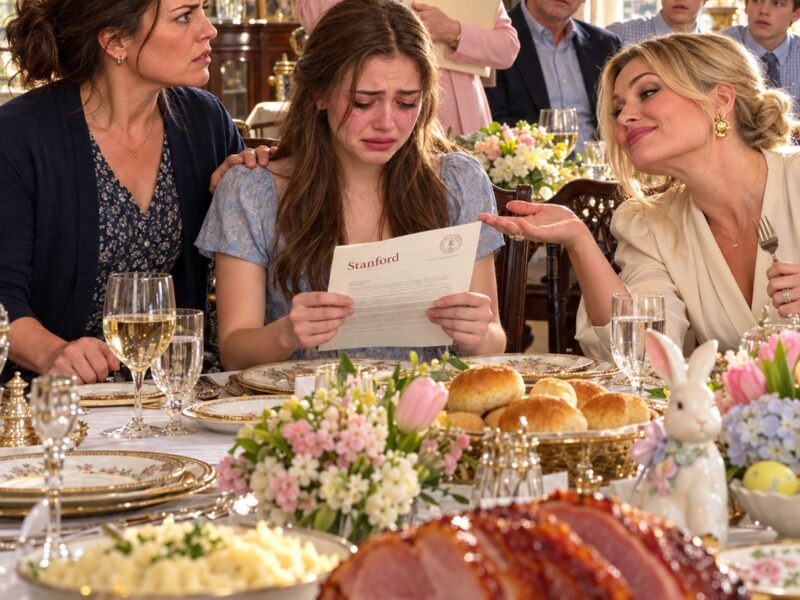
My sister called my daughter’s acceptance to Stanford a charity handout while the ham was still warm on our Easter table.
My mother laughed, then announced that the $240,000 my father had saved for education would go to my sister’s two boys instead.
I didn’t argue until I found three withdrawals in the bank records—and realized my mother had already spent $30,000 that legally belonged to my daughter.
“Charity admissions for poor kids. That’s what Stanford does now, isn’t it?”
My younger sister, Brooke, said it with her fork still in the air, a piece of glazed ham balanced on the end. She was looking directly at my eighteen-year-old daughter, Norah, whose acceptance letter lay unfolded beside the ceramic Easter rabbit my father had bought at Kroger more than thirty years earlier.
For a moment, nobody moved.
Then my mother laughed.
Not a nervous little chuckle. She threw her head back, pressed her embroidered linen napkin against her mouth, and laughed as though Brooke had delivered the funniest line she’d heard all year.
“Oh, Brooke,” Mom said, wiping beneath one eye. “You’re terrible.”
In our family, that had always meant Brooke was allowed to continue.
Norah lowered her eyes to her plate. Under the table, I felt her knee begin to shake, and I reached across to rest my hand against it.
“That’s not how Stanford admissions work,” I said.
Brooke shrugged. “Well, they have to meet certain numbers. Everybody knows that. I’m not saying Norah isn’t smart.”
“You just implied she didn’t earn her place.”
“Good grief, Athena. Can’t anybody take a joke anymore?”
My mother picked up her wineglass.
“Your sister is teasing. Don’t turn this into an argument on Easter.”
I looked at Norah. She had already begun folding her acceptance letter along the same crease she’d made after printing it at the public library three days earlier.
She folded it once.
Then again.
The sound of the paper was almost lost beneath the clink of silverware.
I was forty-one years old, a pediatric intensive care nurse, and I had spent fifteen years learning to recognize tiny changes in breathing, skin color, and heart rhythms before anyone else noticed something was wrong.
That afternoon, I watched my daughter make herself smaller in front of people who were supposed to love her.
And I hated how familiar it looked.
My mother, Linda Meyers, stood at the head of the table and tapped her dessert fork against her wineglass.
“Since we’re all here,” she announced, “I have some news about your father’s education money.”
Brooke’s eyes lifted immediately.
My father, Frank Meyers, had died four years earlier. He’d spent thirty-five years working as an electrician, most of them for the same commercial maintenance company outside Dayton, Ohio. He’d been the kind of man who saved bent screws in labeled jars because he couldn’t bear to throw away something that might still be useful.
When Mom mentioned his education fund, I assumed she was referring to whatever remained in his estate.
I had never asked.
There had always been something more urgent.
A hospital shift. A car repair. A school expense. A bill that arrived three days before payday.
Mom smiled at Brooke.
“Your father worked hard for that money. There’s approximately two hundred and forty thousand dollars, and I’ve decided Brooke’s boys should have first consideration.”
My stomach tightened.
“Which education fund, Mom?”
“The one your father established.”
“Established for whom?”
Her smile thinned.
“For the grandchildren, obviously.”
Brooke reached for her wine.
“Hunter will start high school next year. Cole isn’t far behind. Their education is going to cost a fortune.”
Norah sat perfectly still.
My mother leaned across the table and patted her hand.
“Sweetheart, you don’t need to worry. Stanford has programs for students like you. You’re bright, and your mother doesn’t make much money. You’ll qualify for all kinds of assistance.”
I looked at the hand resting on my daughter’s wrist.
“Mom.”
She ignored my tone.
“Your grandfather would want the boys prepared to support families someday. And Athena, honey, you’ve always managed.”
There it was.
The sentence I’d heard my entire life.
When Brooke got a new bicycle and mine was repaired with parts from Dad’s garage, I’d always managed.
When my sister needed help paying for her wedding and I was completing nursing school while raising an infant, I’d always managed.
When my husband left and I couldn’t afford to replace the furnace, Mom reminded me that I’d always managed.
I looked at my daughter, who was now staring at her folded acceptance letter as though she wished she hadn’t brought it.
Something inside me went very quiet.
I placed my napkin beside my plate.
“Norah,” I said, “get your coat.”
My mother blinked.
“Athena, don’t be dramatic.”
I stood.
“Come on, honey.”
Norah pushed back her chair.
Brooke sighed loudly.
“Unbelievable. We can’t even celebrate Easter without somebody making everything about themselves.”
I didn’t respond.
I helped Norah into her jacket in the front hallway while laughter resumed behind us, quieter now, mixed with the sound of silverware against my mother’s good china.
As I opened the front door, Norah touched my arm.
“Mom?”
I turned.
She was holding the folded letter against her chest.
“Grandpa told me that money had my name on it.”
I felt my hand tighten around the doorknob.
“What?”
Her eyes filled.
“He said it every birthday. He told me he was putting something away that nobody could ever take from me.”
Behind us, my mother’s voice rose from the dining room.
“There’s no reason to ruin a perfectly good holiday!”
I looked down at my daughter.
Then I looked toward the table where my father’s old ceramic rabbit sat beside the unfinished ham.
For the first time that afternoon, I wondered whether my mother had just humiliated Norah to distract us from something much worse.
The check-engine light glowed yellow on the dashboard of my Honda CR-V as we stopped at the intersection of Far Hills Avenue and Dorothy Lane.
The car had 182,000 miles on it. The passenger-side window made a grinding sound whenever it rained, and a mechanic had told me the transmission might last another six months if I was gentle with it.
Norah sat beside me with her acceptance letter in her lap.
Neither of us had spoken since leaving my mother’s house.
The light turned green.
I drove through the intersection.
“When did Grandpa tell you about the money?” I asked.
Norah watched the houses pass.
“Every birthday, pretty much.”
“What exactly did he say?”
“He’d give me five dollars in a card and tell me the important money was somewhere safe.”
She tried to laugh.
“I thought it was just something grandpas said.”
I remembered Dad bringing her birthday cards when she was little. They always contained a five-dollar bill folded into a triangle and a handwritten message in his square block letters.
He never forgot.
Not once.
Even when he was undergoing treatment for heart problems, he insisted on driving over with the card himself.
“Did he ever mention a bank?”
“I don’t remember.”
“Think.”
She turned toward me.
“Mom, you’re scaring me.”
I immediately softened my voice.
“I’m sorry. I’m not angry with you.”
“I know.”
She looked down at the Stanford letter.
“Grandma said the money was for the boys.”
“I heard.”
“So maybe Grandpa changed his mind.”
I gripped the steering wheel.
Your father would want the boys prepared to support families someday.
My mother’s words replayed in my head.
Norah pulled up the university’s financial aid information on her phone.
“We still need to figure out the actual cost,” she said. “Their estimate depends on the final aid package, and they haven’t finished reviewing everything.”
“We’ll handle it.”
She gave me a tired look.
“That’s what you always say.”
“I mean it.”
“I know you mean it, Mom.”
Her voice cracked.
“That’s what worries me.”
I glanced at her.
She swallowed.
“I can go to Wright State. They offered me a really good scholarship. I could live at home.”
“Do you want to go there?”
“That’s not the point.”
“It’s exactly the point.”
She looked out the window.
“I want Stanford.”
The words came so quietly I almost didn’t hear them.
“I’ve wanted it since sophomore year. I want to study biomedical engineering. I want to work with people designing devices for premature babies.”
I knew.
Of course I knew.
I’d watched her stay awake over engineering textbooks borrowed from the library. I’d driven her to weekend robotics competitions in neighboring counties. I’d listened while she explained why an inexpensive respiratory monitor could make a difference in hospitals that didn’t have the resources of major medical centers.
She’d earned her grades.
She’d earned her recommendation letters.
She’d earned the opportunity to choose.
“I did everything right,” she whispered.
I felt something break inside me.
“Norah.”
“Every single thing. I studied. I worked at the library. I volunteered. I didn’t ask for trips or expensive clothes. And somehow I’m still the one who’s supposed to step aside.”
I pulled into the parking lot of a closed pharmacy.
Then I turned off the engine.
“Look at me.”
She turned.
“You are not stepping aside because your aunt feels threatened by your success.”
“Mom—”
“And you’re not giving up Stanford because your grandmother thinks girls should make themselves convenient.”
Norah stared at me.
I had never spoken about my mother that way.
Not in front of her.
Not even privately, if I was honest.
“Grandpa was proud of you,” I said. “He didn’t care whether you went to Stanford or Wright State or became an electrician like him. He wanted you to have choices.”
She wiped her face.
“Then why did he never tell you about the money?”
I looked at the dark storefront beyond the windshield.
That was a question I couldn’t answer.
And it bothered me more than I wanted to admit.
By eleven-forty-eight that night, I was sitting on the kitchen floor surrounded by my father’s old paperwork.
The accordion file had lived on the top shelf of our hallway closet since his funeral. I kept it because Dad had given it to me during the last year of his life and told me it contained copies of documents he thought I might need someday.
I’d never gone through it carefully.
I already had enough paperwork of my own.
The file smelled faintly of old paper and the machine oil Dad could never completely wash from his hands.
Every tab was labeled in his handwriting.
TAXES.
TRUCK.
INSURANCE.
HOUSE.
Near the back, I found one marked:
RIVERBEND — NORAH.
The pocket was empty.
I checked it twice.
There was no statement, no agreement, and no account number.
Only a business card with a bent corner.
Walter Benner.
Trust Officer.
Riverbend Trust and Savings.
I sat staring at it.
Dad had been painfully careful about money. He balanced his checkbook every Sunday afternoon and saved receipts in envelopes labeled by month.
An empty pocket in one of his files didn’t feel accidental.
I turned the business card over.
On the back, he’d written a single date.
February 2008.
Norah’s birth month.
Footsteps sounded on the stairs.
My daughter entered the kitchen wearing flannel pajama pants and an oversized university sweatshirt she’d found at a thrift store.
She looked at the papers.
“Couldn’t sleep?”
“No.”
“Me neither.”
She poured cereal into a bowl, added milk, and sat cross-legged on the floor opposite me.
For a while, we listened to the refrigerator hum.
Then she pointed toward the file.
“What’s that?”
“Grandpa’s paperwork.”
She leaned forward.
“That’s my name.”
“Yes.”
“Did you find the money?”
“Not yet.”
Norah took another spoonful of cereal.
“Do you think Grandma lied?”
I thought carefully before answering.
“I think Grandma may have made a decision she didn’t have the right to make.”
“That’s a very nurse answer.”
I smiled faintly.
“I’ve been practicing.”
My phone vibrated.
A message from Mom appeared.
Don’t make Easter ugly because Brooke made one harmless joke. Your father wanted the family taken care of. I’ve handled it.
I stared at the screen.
Norah read it over my shoulder.
“She didn’t even ask whether I’m okay.”
No.
She hadn’t.
I set the phone facedown.
“Tomorrow morning, we’re calling Riverbend.”
Norah frowned.
“Can we do that?”
“You’re eighteen now. If the trust belongs to you, you have a right to ask about it.”
“And if Grandma doesn’t want us to?”
I looked at the business card.
“Then she can be unhappy.”
Norah blinked.
Then she smiled a little.
“Who are you, and what did you do with my mother?”
I laughed.
But after she went upstairs, I sat on the kitchen floor for another twenty minutes.
I thought about all the times I’d told myself that keeping peace in a family was worth the cost of staying quiet.
For the first time, I began wondering who had been paying that cost.
At eight-two the next morning, I was sitting in the fourth-floor parking garage at St. Brendan Children’s Hospital.
I’d just finished a twelve-hour overnight shift.
My navy scrubs smelled faintly of hand sanitizer, and there was a coffee stain near the pocket where I kept my penlight.
Norah was on another line from the student parking lot at Linden Ridge High School.
I merged the calls and dialed Riverbend Trust and Savings.
The hold music was a piano arrangement of Pachelbel’s Canon.
It played twice.
Then a woman answered.
“Riverbend Trust Department. This is Grace Whitfield.”
I explained that my father had established some kind of education account for my daughter and that we wanted to determine whether a trust existed.
Grace’s voice became professionally careful.
“Ms. Meyers, I’m unable to disclose account information to someone who hasn’t been verified as an authorized party.”
“I understand. My daughter is on the call.”
Grace asked to speak with Norah.
After confirming her identity through the bank’s procedures, she asked what information my daughter wanted.
Norah hesitated.
Then she said, “I’d like to know whether my grandfather left an education trust for me.”
I heard a keyboard clicking.
“Yes,” Grace said. “He did.”
My pulse quickened.
“Can you tell her who the beneficiaries are?” I asked.
Grace explained that she could discuss the account with Norah once the authorization was complete.
Then she asked, “Norah, would you like your mother to remain on the call while we discuss this?”
“Yes, please.”
More typing.
Then Grace spoke.
“The trust identifies one beneficiary.”
Norah stopped breathing for a moment.
Grace continued.
“Norah Gene Meyers.”
I closed my eyes.
One name.
Not Hunter.
Not Cole.
Not all the grandchildren.
My daughter.
I gripped the phone.
“Are you certain?”
“The trust document is quite specific.”
On the other line, Norah whispered, “Oh my God.”
Grace paused.
“May I ask why you’re concerned about other beneficiaries?”
I told her what had happened at Easter.
I told her my mother claimed the money was intended primarily for Brooke’s sons.
The keyboard clicked again.
Then stopped.
“Ms. Meyers,” Grace said carefully, “I’d prefer to review some records before we discuss anything further.”
A cold feeling moved through my stomach.
“What records?”
“The distribution history.”
I stared at the concrete wall beyond my windshield.
“Has money been taken out?”
Grace paused.
“I don’t want to give you an incomplete answer. Would you and Norah be available for another call this afternoon?”
“Yes.”
“I’ll gather the relevant documentation.”
Then her voice softened.
“There’s something else you need to see.”
Grace called at three-forty-one that afternoon.
I was sitting in the school pickup line behind a yellow bus, watching diesel exhaust drift across the windshield.
I’d managed four hours of sleep.
Norah climbed into the passenger seat carrying her flute case and a chemistry textbook.
I put the phone on speaker.
Grace began with the trust’s history.
My father had established an irrevocable education trust shortly after Norah was born in February 2008.
Riverbend served as corporate trustee.
After Dad died, my mother became a family co-trustee under the succession provisions he had included.
The trust’s purpose was explicit.
To pay educational expenses for Norah Gene Meyers.
No other beneficiary was named.
“What’s the current balance?” Norah asked.
Grace checked the latest statement.
“Approximately two hundred ten thousand, four hundred twelve dollars.”
I felt my stomach drop.
“Mom said it was two hundred forty thousand.”
“It was close to that amount in March 2024,” Grace said.
She paused.
“Then three distributions occurred.”
My hand tightened around the steering wheel.
“How much?”
“Ten thousand dollars each.”
“Thirty thousand total?”
“Yes.”
“Where did it go?”
Grace looked at her records.
“All three payments were made to Holy Cross Academy.”
Norah turned toward me.
Holy Cross was the private school my nephews attended.
Hunter and Cole Kesler.
Brooke’s sons.
I had attended their school fundraisers.
I’d bought raffle tickets and cookie dough.
I’d listened while Brooke complained that private education cost more than their annual vacations.
Now I was hearing that my daughter’s trust had paid thirty thousand dollars toward it.
Grace continued.
“The requests were certified by your mother as qualified educational expenses for the trust beneficiary.”
I stared at the phone.
“But Norah has never attended Holy Cross.”
“We’ve confirmed that discrepancy.”
“How did the bank approve the payments?”
Grace didn’t hide behind a vague answer.
“The requests were processed under a procedure that relied on the family trustee’s certification for certain expenses. Our internal review indicates the student names on the invoices were not adequately checked against the beneficiary records.”
“Who approved them?”
“An associate who no longer works in that position. We are examining the approval process and the bank’s responsibility.”
Norah sat completely still.
I looked at her.
She was staring at her hands.
Grace said, “The bank has placed restrictions on further distributions while we investigate. We’ll provide formal information about the trust and the disputed transactions.”
I swallowed.
“Does my mother know we’ve called?”
“We notify co-trustees when certain beneficiary inquiries are made. Your mother contacted us this morning.”
My mouth went dry.
“What did she want?”
Grace hesitated.
“She asked what procedures would be required to change the beneficiaries.”
Norah let out a small breath.
“Can she do that?”
“Not unilaterally,” Grace answered. “The trust is irrevocable, and its terms don’t give her authority to simply replace or add beneficiaries.”
I thanked her.
Then I ended the call.
For several minutes, neither Norah nor I spoke.
Outside, teenagers crossed the parking lot carrying backpacks and sports bags.
A boy knocked on our window because we’d been sitting in the pickup lane too long.
I waved him around.
Norah looked at me.
“Grandma took my money.”
I wanted to soften the statement.
I wanted to explain that financial transactions could be complicated, that we should wait for the documents, that perhaps there had been some misunderstanding.
But I’d spent fifteen years watching families suffer because somebody was afraid to state an uncomfortable fact.
The records were clear enough to tell us something was badly wrong.
“She used money from your trust to pay for your cousins’ school,” I said.
Norah looked down.
“Why?”
I had no answer.
And when we turned onto our street eleven minutes later, my mother’s silver Buick was waiting in our driveway.
Mom stood on the front porch holding a plastic container of leftover Easter ham.
The lid had turned cloudy from years in the dishwasher.
It was such an ordinary sight that for one second I felt myself slipping backward into our usual routine.
She brought leftovers.
I thanked her.
We pretended nothing had happened.
Then I remembered the bank statement.
Norah climbed out first.
Mom smiled at her.
“Hello, sweetheart.”
Norah didn’t answer.
My mother looked at me.
“You called a bank.”
“Norah called about her trust.”
“Don’t play word games, Athena. You know perfectly well what I mean.”
I stopped one step below her.
“Did you authorize thirty thousand dollars from Norah’s trust for Holy Cross?”
Mom shifted the container into her other hand.
“I moved money where it was needed.”
There was no hesitation.
No embarrassment.
No attempt to deny it.
I stared at her.
“You knew it was Norah’s money.”
“Your father wanted the grandchildren educated.”
“The document names Norah.”
She waved one hand.
“Documents don’t always tell the whole story.”
“Mom, did you certify those payments as expenses for Norah?”
Her mouth tightened.
“I handled the paperwork the way I’ve handled this family’s paperwork for forty years.”
“That isn’t an answer.”
She looked past me toward the driveway.
“Hunter was struggling at public school. Brooke was beside herself. Holy Cross has smaller classes, better supervision, and good teachers.”
“Then Brooke and Greg needed to pay for it.”
“They were already stretched.”
“Greg makes more money than I do.”
“That doesn’t mean they don’t have expenses.”
I felt heat climb my neck.
“And Norah doesn’t?”
My mother’s face softened.
That familiar expression.
The one that had ended every argument I’d ever tried to have with her.
“Oh, honey. Norah is smart. She’ll get scholarships. She’s like you.”
I closed my eyes.
“Don’t say it.”
“You’ve always managed.”
There it was again.
She said it as though my independence were an inexhaustible bank account.
I looked at the ham in her hands.
I’d eaten at her table almost every Sunday for years.
I’d washed those gold-rimmed plates by hand.
I’d brought groceries when her pension payment ran late.
I’d driven her to appointments after Dad died.
I’d never asked for repayment.
And now she was standing on my porch explaining why my daughter’s inheritance should belong to someone else.
“I need you to restore the money,” I said.
My mother stared at me.
“What?”
“All thirty thousand dollars.”
She laughed once.
It was a short, incredulous sound.
“You’re not serious.”
“I am.”
Her expression changed.
“If you push this, Athena, you’re going to find out what it’s like to be truly on your own.”
I felt the words land.
For a moment, I was seventeen again, standing in the kitchen after asking for help paying a college application fee.
Then I looked toward Norah.
My daughter was standing beside the front door, watching us.
I straightened.
“I’ve been on my own for a long time, Mom.”
My mother stared.
I continued.
“I just didn’t know I was supposed to be proud of never asking you for anything.”
She handed the plastic container to Norah.
Then she walked down the steps and climbed into her Buick.
The tires crunched over the gravel as she backed out.
Norah stood holding the warm ham.
“Mom?”
I turned.
“What does she mean, truly on our own?”
I looked at the empty driveway.
“I think we’re about to find out.”
Brooke called the next morning at ten-twenty.
I’d worked an overnight shift and had been asleep for barely two hours.
My bedroom was dark behind blackout curtains. The box fan hummed near the window, drowning out the landscaping crew cutting grass outside.
My phone rang three times before I answered.
“Hello?”
“You’re suing Mom?”
Brooke didn’t bother saying good morning.
I sat up.
“Nobody has filed a lawsuit.”
“She called me crying.”
“Then maybe she should explain why.”
“She said you sent the bank after her.”
“Norah asked about a trust that legally belongs to her.”
Brooke sighed.
“Athena, please. This is family money.”
“No. It’s Norah’s money.”
“Dad wanted all the grandchildren taken care of.”
“Were you there when he created the trust?”
“No.”
“Have you read it?”
“No, but Mom—”
“Then stop telling me what it says.”
The silence that followed was almost satisfying.
Almost.
Then Brooke spoke again.
“Do you understand what Holy Cross costs?”
“Yes. You’ve explained it every Easter for the last four years.”
“My boys don’t qualify for the kind of financial aid Norah gets.”
I closed my eyes.
“Brooke.”
“It’s true. Greg works hard, and we get punished because our household income looks good on paper.”
“That’s not Norah’s responsibility.”
“Your kid gets into Stanford with some charity admissions package, and suddenly everybody’s supposed to feel sorry for her.”
I took the phone away from my ear.
I stared at it.
Then I put it back.
“You called her admission charity in front of her.”
“It was a joke.”
“She folded her acceptance letter until it was the size of a drink coaster.”
Brooke went quiet.
I continued.
“She worked for years to earn that opportunity. You couldn’t let her enjoy it for five minutes.”
“Don’t make me the villain because your feelings are hurt.”
“This isn’t about my feelings.”
“Then what is it about?”
I looked at the small framed photograph on my dresser.
Dad holding newborn Norah through the hospital blanket.
Her head was barely larger than his hand.
“It’s about thirty thousand dollars taken from a trust your father established for my daughter.”
Brooke made an irritated sound.
“Mom’s lawyer will call you.”
I sat up straighter.
“She hired a lawyer?”
“She has to protect herself.”
“From what?”
“From you.”
Then she hung up.
I stared at the dark screen.
Outside, the lawn mower passed beneath my window again.
I lay back down.
But sleep didn’t come.
Riverbend Trust and Savings occupied an old limestone building in downtown Dayton.
The trust department was on the sixth floor, where the conference rooms overlooked the Great Miami River.
Grace Whitfield met us at the elevator on Wednesday morning.
She was a composed woman in her late fifties with silver-framed glasses and a habit of listening until a person had completely finished speaking.
She shook Norah’s hand first.
Then mine.
In the conference room, she placed a thick folder before my daughter.
“Norah, this trust belongs to you. I want you to understand what that means.”
Norah sat very straight.
Grace opened the folder to the second page.
SOLE BENEFICIARY: NORAH GENE MEYERS.
Beneath it was another sentence.
For the education and educational advancement of my granddaughter, Norah Gene Meyers, and for no other person.
My father’s signature appeared at the bottom in blue ink.
That enormous looping F.
I hadn’t seen it in years.
Norah touched the page.
“That’s Grandpa’s.”
“Yes,” Grace said.
“Why did he make the bank a trustee too?”
“He wanted a professional institution responsible for administration and a family representative involved in decisions. He believed the combination would provide oversight.”
I stared at the page.
Dad had trusted my mother.
But apparently, not enough to leave everything under her control.
Grace explained how the distributions had been approved.
The three payments to Holy Cross had been submitted with invoices naming Hunter and Cole Kesler.
My mother had certified that they were eligible educational expenses under the trust.
The bank had failed to reconcile the student names properly.
“That’s our error as well,” Grace said.
I appreciated that she didn’t pretend otherwise.
“What happens now?” Norah asked.
“We’ll complete a formal accounting and review the disputed distributions. The bank will need to address its responsibility, and there may be grounds to seek repayment from your grandmother.”
Norah looked at me.
I stayed silent.
Grace continued.
“You can also request that your grandmother be removed as co-trustee. The specific procedure depends on the trust terms and applicable law.”
Norah studied the documents.
“Does Grandma get to decide whether I use the money for Stanford?”
“Not by herself. And she cannot redirect trust assets to other people simply because she prefers their educational plans.”
My daughter exhaled.
For the first time since Easter, I saw a little of the tension leave her shoulders.
Then Grace closed the folder.
“There’s another issue we need to discuss.”
I felt myself tense again.
“What?”
“Your grandmother’s attorney has requested a meeting.”
“When?”
“Next Thursday.”
Norah looked at me.
I knew what she was thinking.
The bank meeting would be difficult.
But there was something else waiting for us before then.
Stanford’s financial aid office.
And we were about to tell them that my daughter had an education trust worth more than two hundred thousand dollars.
That evening, Norah and I sat at the kitchen table with my laptop open.
A pot of tea cooled beside the salt shaker.
The financial aid counselor at Stanford had a patient voice and explained the process carefully.
We had originally completed Norah’s financial aid application without reporting the trust because neither of us knew she was its beneficiary.
Now we needed to correct the information.
The counselor explained that the trust’s treatment would depend on its terms and the university’s financial aid methodology.
They needed the trust agreement and current documentation before completing the revised assessment.
“The aid package may change,” she warned.
“How much?” Norah asked.
“I can’t give you a reliable figure until our review is complete.”
After the call ended, Norah stared at the laptop.
“So we might lose some of the grant.”
“We might.”
“Because we found Grandpa’s money.”
“Because the university needs the correct financial information.”
She looked at me.
“We could have just not told them.”
I shook my head.
“No.”
“Mom—”
“I know you’re scared. I am too. But I won’t start your college experience by teaching you to hide something you’re legally required to disclose.”
Norah rubbed her forehead.
“I know.”
For several minutes, we sat in silence.
Then I did what I had always done when money frightened me.
I looked for another way to carry the burden myself.
I opened the website for my hospital retirement plan.
I clicked the section about participant loans.
The available amount appeared on the screen.
I began filling out the preliminary information.
Norah looked up.
“What are you doing?”
“Checking a backup option.”
“For what?”
“If the aid drops. If the bank takes months to recover the money. If we need to cover deposits or living expenses.”
Her expression changed.
“Mom.”
“I haven’t submitted anything.”
“But you’re going to.”
“I’m looking.”
She reached across the table and closed the laptop.
Not hard.
Just firmly.
“Please don’t.”
I stared at her.
“Norah—”
“You’re doing it again.”
“Doing what?”
“Making everything your problem.”
I opened my mouth.
Then closed it.
She stood.
“I don’t want Stanford if going there means you spend the next five years paying off another loan.”
Before I could answer, she went upstairs.
I sat alone at the kitchen table.
The tea had gone cold.
I thought about Dad telling me that money existed so Norah would have choices.
And now I was trying to protect her choices by creating another obligation that might follow me into retirement.
I didn’t reopen the laptop that night.
But I didn’t forget the loan either.
That Saturday, I drove twenty-five minutes to Springboro to watch Cole play baseball.
I’d been bringing blue Gatorade to his games since he was little.
The cooler sat on the passenger seat, rattling every time I turned a corner.
I didn’t want my nephew to lose his aunt because of something the adults had done.
When I arrived, Brooke was sitting in the third row of the bleachers.
She saw me.
Then she moved to the far end.
Several other mothers noticed.
They pretended not to.
I sat alone.
The aluminum bench was already hot beneath my jeans.
In the fourth inning, Cole ran toward the fence.
He was eleven, red-faced, and wearing his baseball cap backward.
Usually, he hugged me before taking the Gatorade.
This time, he stopped a few feet away.
“Aunt Thea?”
“Hey, buddy.”
He looked down at his cleats.
“Mom says you’re taking our school money.”
I felt something tighten in my chest.
I climbed down from the bleachers and crouched so we were eye level.
“Listen to me.”
He looked up reluctantly.
“You haven’t done anything wrong.”
“But Mom said—”
“Whatever the grown-ups are arguing about, it’s not your fault. Nobody is angry with you.”
He swallowed.
“Am I gonna have to leave Holy Cross?”
“I don’t know what your parents will decide. But you don’t need to solve it.”
He nodded.
Then he ran back toward the dugout.
I stayed by the fence for a moment.
Behind me, someone hit a baseball, and the aluminum bat made a sharp ringing sound.
Greg approached.
He stood beside me with his hands in his pockets.
“I didn’t know,” he said.
I looked at him.
“About the trust?”
He nodded.
“Linda told us she was helping with tuition using money Frank left for the family. I assumed she was allowed.”
“You never asked?”
He rubbed his face.
“I should have.”
Greg was not a bad man.
He worked as a regional sales manager and spent too many hours on the road. He was devoted to his sons, helped coach their teams, and had a habit of avoiding conflict with Brooke until the consequences became impossible to ignore.
Now he looked miserable.
“Brooke says you’re trying to bankrupt her mother.”
“I want Norah’s trust restored.”
“Yeah.”
He nodded slowly.
“I understand that now.”
I studied him.
“How is Linda planning to pay the money back?”
Greg hesitated.
“She has a certificate of deposit at Stillwater Federal. About forty thousand dollars, last I heard.”
I remembered my mother’s announcement at Easter.
The boys’ future.
The education fund.
The money she claimed belonged to them.
“What’s the CD for?” I asked.
“College. She calls it the boys’ college fund.”
I looked toward the baseball diamond.
Another fund.
Another promise.
Another story about money whose ownership nobody had bothered to examine.
Greg followed my gaze.
“I don’t think she understands what she’s done,” he said.
I shook my head.
“I think she understands exactly what she wanted to do.”
The umpire called the next batter.
Cole stepped onto the field.
I stayed to watch him play.
On Sunday evening, Norah sat beside me on the couch while I folded clean scrubs.
The television was off.
Outside, rain tapped against the gutters.
She had been unusually quiet all weekend.
Finally, she said, “I’ve been thinking.”
I set down a shirt.
“About what?”
“What if we just let Grandma keep the thirty thousand?”
I stared at her.
“Why would we do that?”
“There’s still more than two hundred thousand in the trust.”
“That isn’t the point.”
“I know, but maybe we could just use the rest. Then Grandma wouldn’t have to pay the bank back. Brooke would stop posting those things about selfish people.”
She picked at a loose thread on her sleeve.
“And Cole wouldn’t think we’re stealing his education.”
I looked at my daughter.
She was eighteen.
She should have been choosing a roommate, comparing dormitories, and deciding whether to take a summer engineering course.
Instead, she was sitting beside me trying to calculate how much unfairness she could absorb to make everyone else comfortable.
“Norah.”
She continued quickly.
“Grandma’s getting older. I don’t want her to be sad because of me.”
“She’s not being held accountable because of you.”
“I know.”
“Then why are you offering to give up money Grandpa left you?”
She shrugged.
“Because we can manage.”
The room went silent.
I looked at the folded scrub shirt in my lap.
There it was.
My mother’s sentence.
Coming out of my daughter’s mouth.
For eighteen years, I’d believed I was teaching Norah resilience.
I worked overtime without complaining.
I repaired things rather than replace them.
I told her we didn’t need expensive vacations or fancy clothes.
I said we were fine even when I worried about the electric bill.
I’d wanted her to know that circumstances didn’t determine her worth.
But somewhere along the way, she’d learned something else.
That capable people weren’t allowed to need anything.
That being strong meant giving up what belonged to you.
That other people’s feelings mattered more than your own future.
“Say that again,” I whispered.
She looked confused.
“What?”
“What you just said.”
“That we can manage?”
I nodded.
She watched me.
“Mom, you always do.”
The words hurt more than Brooke’s joke.
More than my mother’s laughter.
Because I knew exactly where Norah had learned them.
I put down the scrub shirt.
“Sweetheart, I need to tell you something.”
She waited.
“Being able to survive without help doesn’t mean you’re supposed to.”
Her expression softened.
“And just because you can give something up doesn’t mean you should.”
For a long time, she said nothing.
Then she reached for my hand.
“Are you going to ask Grandma for the money?”
I looked toward the kitchen where Dad’s accordion file sat beneath a stack of mail.
“No,” I said.
“We’re going to ask the bank to do what Grandpa told it to do.”
The full accounting arrived Monday afternoon.
I printed it at the hospital nurses’ station during a quiet interval between patient rounds.
Eighteen years of deposits, fees, investment activity, and distributions.
My father had funded the trust consistently.
He’d contributed regularly while he was working and continued adding money during retirement.
Sometimes the deposits were small.
Sometimes they were larger.
But every year, he remembered.
I ran my fingers down the pages.
There were contributions dated around birthdays.
A larger deposit after he sold his old truck.
Another after he received a retirement payout.
Dad had never owned an expensive car.
He wore the same winter jacket for twelve years.
He bought tools secondhand and repaired appliances until parts were impossible to find.
Yet he’d quietly built something substantial for my daughter.
Then I reached the three withdrawals.
Holy Cross Academy.
Ten thousand dollars.
Holy Cross Academy.
Ten thousand dollars.
Holy Cross Academy.
Ten thousand dollars.
My charge nurse, Dana Ruiz, came around the desk carrying coffee.
She was fifty-three, had raised four sons, and had a way of questioning surgeons that made even the most confident residents reconsider their assumptions.
She glanced at the papers.
“What’s all that?”
“My dad’s trust.”
She read my face.
“Trouble?”
I told her.
Not every detail.
Just enough.
Dana put down her coffee.
“Let me understand this.”
I waited.
“Your father created a trust for your daughter.”
“Yes.”
“Your mother spent thirty thousand dollars from it on your sister’s children.”
“Yes.”
“And now your family wants you to apologize for asking where it went?”
I laughed without humor.
“That about covers it.”
Dana leaned against the desk.
“When was the last time you asked someone for something, Thea?”
I opened my mouth.
Nothing came out.
I tried to remember.
When Norah needed braces, I found an orthodontist who allowed monthly payments.
When the transmission failed, I picked up holiday shifts.
When I completed nursing school, I used loans and worked weekends.
When Dad died, I arranged the funeral flowers because Mom said Brooke was too upset to handle them.
I couldn’t remember asking for much.
Dana watched my face.
“That’s what I thought.”
“I don’t like depending on people.”
“There’s a difference between depending on someone and expecting them to honor a responsibility.”
I looked down at the trust document.
Dana picked up her coffee.
“You spend all night telling frightened parents to ask questions until they understand what’s happening to their children.”
“Yes.”
“Try taking your own advice.”
Then she walked away.
A monitor alarm sounded down the hall.
I folded the accounting and tucked it into my bag.
Before returning to work, I sent Grace an email.
Norah wants a formal accounting and an explanation of the bank’s proposed corrective action. Please tell us how to request removal of the family co-trustee.
I read it once.
Then I pressed Send.
For the first time, I wasn’t waiting for my mother’s permission to do something necessary.
The following Thursday, my mother arrived at Riverbend wearing her navy church suit.
Her hair had been freshly set.
Beside her walked Howard Pruitt, an attorney with a polished leather portfolio and a gold pen he tapped against his legal pad while other people spoke.
Grace sat at the head of the conference table.
Norah and I sat opposite Mom.
Pruitt began.
“Frank Meyers was a generous family man.”
I looked at the ceiling.
That was certainly true.
He continued.
“He frequently expressed a desire to support all his grandchildren. My client believes the education trust should be administered in that spirit.”
Grace opened her folder.
“The written instrument identifies a sole beneficiary.”
Pruitt smiled.
“Documents don’t always capture a person’s complete intent.”
“No,” Grace replied evenly. “But trustees are required to follow the governing instrument.”
The gold pen tapped twice.
Pruitt leaned forward.
“Mrs. Meyers is prepared to resolve the disputed distributions privately.”
I felt Norah’s hand tighten around mine.
He continued.
“She proposes repayment of thirty thousand dollars over time, in monthly installments of two hundred fifty dollars.”
I calculated automatically.
Ten years.
Without interest or investment growth.
Pruitt slid a document across the table.
“In exchange, Norah would release further claims arising from those distributions, and Mrs. Meyers would remain family co-trustee.”
I stared at him.
“She’s asking my daughter to sign away claims while keeping the position that allowed the problem.”
“My client has served this family for decades.”
“That’s not what I asked.”
Pruitt stopped tapping.
Mom leaned toward Norah.
“Sweetheart, you don’t need all that money.”
Norah looked down.
My mother continued.
“Your cousins have needs too. I know your grandfather would never want this kind of division.”
I felt myself preparing to argue.
Then I remembered Dana’s advice.
Ask questions.
Don’t apologize for asking them.
I looked at Grace.
“What happens if Norah doesn’t agree?”
Grace answered without hesitation.
“The bank will continue its review, determine appropriate corrective action, and, if necessary, seek court direction regarding the co-trustee’s conduct and potential repayment obligations.”
Pruitt shifted in his chair.
I looked at my daughter.
“Norah, do you want to sign that release?”
She stared at the document.
Then she shook her head.
“No.”
My mother stiffened.
“Are you sure, sweetheart?”
Norah looked up.
“Yes.”
Pruitt opened his mouth.
I raised one hand.
“We’ll respond in writing.”
Outside the building, cold wind came off the river.
Mom caught up with us beside my Honda.
“Your father would be ashamed,” she said.
I turned.
She was clutching her purse tightly.
“Of what?”
“Taking your mother into a bank and treating her like a criminal.”
I looked at her.
“Dad named Norah as the sole beneficiary. You certified that money was being used for Norah when it wasn’t.”
Mom’s face hardened.
“You have no idea how much I’ve done for this family.”
“I know you’ve done a great deal.”
“Then show some gratitude.”
I took a breath.
“Gratitude doesn’t change who owns the money.”
She stared at me.
Then she turned and walked away.
For once, I didn’t follow.
The family group chat became unbearable after that.
It had twenty-two people spread across two time zones.
Normally, it contained pictures of grandchildren, recipes, and reminders about birthdays.
That Sunday, Mom posted:
Some of you have probably heard that Athena has decided money matters more than her own mother. I’m heartbroken, but I won’t discuss private family matters publicly. Please pray for us.
Within minutes, the replies appeared.
Heart emojis.
Praying hands.
Messages about respecting parents.
I watched them arrive while standing on my back porch, pinching dead leaves from a pot of basil.
Then Aunt Patty called.
She lived in Columbus and had sent the same homemade fruitcake to everyone at Christmas for as long as I could remember.
“Honey,” she said, “what’s going on?”
I explained.
She listened without interrupting.
When I finished, she sighed.
“That sounds like Linda.”
I stopped.
“What does that mean?”
Aunt Patty hesitated.
“Did your mother ever tell you about your Uncle Ronnie going to Ohio State?”
“Not really.”
“Your grandfather paid for every dime. Tuition, housing, books. Your mother wanted to go to college too, but he gave her money for a typewriter and six months at business school.”
I leaned against the porch railing.
“I didn’t know that.”
“Your grandfather believed boys needed college because they’d support families. Girls were supposed to marry.”
I stared at the basil.
“Mom never told me.”
“Linda was angry about it for years.”
A notification appeared on my phone.
Linda Meyers removed you from the family group.
I stared at the screen.
Aunt Patty was still talking.
“Your father hated that way of thinking. Frank always said his daughters should have the same choices.”
I swallowed.
“Then why is Mom doing exactly what her father did?”
Aunt Patty went quiet.
Finally, she said, “Sometimes people spend their whole lives resenting something, then repeat it because it’s the only way they know how to feel in control.”
I looked toward the kitchen window.
Inside, Norah was studying at the table.
The explanation didn’t excuse my mother.
But it made something about her suddenly clearer.
She hadn’t invented the rules she was using to hurt my daughter.
She had inherited them.
And somehow, she had mistaken passing them along for keeping the family together.
The next complication arrived on Wednesday afternoon.
Grace called while I was changing into clean scrubs.
“Your grandmother’s attorney has filed a petition,” she told Norah and me on a conference call.
I sat down on the locker room bench.
“What kind of petition?”
“He’s asking the court to authorize a restructuring of the trust that would add Hunter and Cole as beneficiaries.”
Norah stared at the phone.
“Can he do that?”
“The bank intends to oppose the petition. The governing language is unusually clear, and the requested change would conflict with your grandfather’s expressed purpose. But the court will need to address the filing.”
“When?”
“The hearing is scheduled for May twelfth.”
I looked at the calendar on the wall.
May first.
Stanford’s enrollment response deadline.
Less than two weeks away.
“That’s after Norah has to make her decision.”
“I know,” Grace said.
I rubbed my forehead.
“Can the trust still pay her education expenses while the petition is pending?”
“Possibly, subject to the terms and any court orders. We are reviewing what can proceed safely, but I don’t want to promise an outcome before our attorneys confirm it.”
After the call, I sat alone for several minutes.
Then I opened my purse.
Inside was the retirement plan loan form I’d printed earlier that morning.
I’d already filled in the amount.
Thirty thousand dollars.
I had been planning to submit it if the bank process stalled.
I unfolded the paper.
My signature was at the bottom.
For a moment, I imagined how much easier everything might be if I borrowed the money.
Norah could go to Stanford.
Mom wouldn’t have to repay the trust immediately.
Brooke could stop blaming us.
Cole wouldn’t have to worry about school.
And I would pay for it quietly over the next several years.
Like always.
I folded the paper again.
Then put it back in my purse.
I hadn’t decided what to do.
But I was beginning to understand that the familiar solution was not always the right one.
That evening, Norah found me staring at Dad’s old watch.
It was a stainless-steel Timex with a brown leather strap.
He had worn it every day for almost twenty years.
After his funeral, Norah asked whether she could have it.
The band was too large, so I’d punched another hole in it.
She wore it whenever something important happened.
Tonight, it lay on the kitchen table beside her laptop.
“Why did Grandpa make the bank a trustee?” she asked.
I looked up.
“What do you mean?”
“If he trusted Grandma, why didn’t he just let her handle the money?”
I considered the question.
Then I told her something I’d kept to myself for eighteen years.
“You were three days old when Grandpa first talked about setting money aside for you.”
Norah sat down.
“I was still in the neonatal intensive care unit. You’d been born six weeks early, and you weighed four pounds, two ounces.”
She knew those facts.
I’d told her the story often enough.
But not the rest.
“Your father had already stopped answering my calls regularly. I was twenty-three, exhausted, and terrified I wouldn’t be able to manage everything alone.”
Norah listened.
“Grandma came to the hospital once that week. She stayed about twenty minutes.”
“What did she say?”
“That Brooke was getting engaged, and the wedding was going to be expensive.”
Norah stared at me.
“Seriously?”
I nodded.
“She didn’t mean to be cruel. She was worried about Brooke. She was always worried about Brooke.”
I looked toward the photograph of Dad on the refrigerator.
“Grandpa came every night after work. He’d stand outside the nursery window in his work shirt, with his name stitched above the pocket, and watch you sleep.”
My voice tightened.
“On the third night, he told me he was going to put your name on something nobody could take away.”
Norah touched the watch.
“That’s what he meant.”
“Yes.”
I hesitated.
Then I told her the final sentence.
“He said, ‘Not even your mother.’”
Norah looked up sharply.
“He said that?”
“Yes.”
For a long time, neither of us spoke.
The watch ticked faintly on the table.
Finally, Norah whispered, “He knew Grandma.”
I nodded.
“He loved her. And he knew her.”
She picked up the watch and fastened it around her wrist.
Then she looked at my purse.
“Is that the loan form?”
I followed her gaze.
“Yes.”
“Please don’t do it.”
“Norah—”
“No.”
She reached across the table.
“I don’t want Grandpa’s money if getting it means you go into debt to protect Grandma from what she did.”
I stared at her.
Her voice softened.
“You’ve worked hard enough, Mom.”
Something in my chest gave way.
I took the loan form from my purse.
For a moment, I looked at my own signature.
Then I tore the paper in half.
Norah watched.
I tore it again.
And again.
Finally, I dropped the pieces into the recycling bin.
My daughter exhaled.
“Thank you.”
I sat beside her.
“No,” I said. “Thank you.”
The following morning, we returned to Riverbend.
Grace had prepared a formal demand for restoration of the disputed funds and associated losses, subject to final accounting.
Her preliminary calculation included thirty thousand dollars in improper distributions and an additional amount representing investment growth the trust might have earned.
The total demand was thirty-four thousand, three hundred fifty dollars.
The bank’s legal team had reviewed the figure and the applicable trust provisions.
Grace placed the document before Norah.
“This is a formal demand,” she explained. “If the matter isn’t resolved, the bank may seek court remedies, including removal of your grandmother as co-trustee and appropriate financial recovery.”
Norah read the letter slowly.
I didn’t interrupt.
Grace continued.
“This is your decision as beneficiary. You should understand that formal proceedings may have lasting consequences for family relationships.”
Norah looked at me.
I thought about the group chat.
The baseball game.
Mom’s words on the porch.
Brooke’s contemptuous smile.
Then I thought about my father’s hands holding my newborn daughter.
I looked at Norah.
“What do you want?”
She swallowed.
“I want Grandpa’s wishes respected.”
“Then that’s what we ask for.”
She signed the necessary authorization.
Grace took the document.
“I’ll send the demand through counsel.”
Norah nodded.
For a moment, she looked frightened.
Then she straightened her shoulders.
“Okay.”
I watched her.
My daughter was learning something I hadn’t learned until forty-one.
Asking for what belongs to you is not the same as taking something from someone else.
My mother’s seventieth birthday party was scheduled for the following Saturday.
We weren’t invited.
I knew because Brooke posted photographs of the invitations on Facebook.
Gold balloons.
Catered food.
A backyard celebration.
My name wasn’t mentioned.
Neither was Norah’s.
I tried not to care.
But on Saturday afternoon, my daughter appeared in the kitchen holding a greeting card.
A watercolor cardinal sat on the front.
“Can we drive over?” she asked.
I looked at her.
“Why?”
“I want to leave Grandma a card.”
I hesitated.
“You don’t have to.”
“I know.”
She looked down.
“I still love her.”
The words hurt.
Because I did too.
Despite everything.
Despite the years of feeling second-best.
Despite her laughter at Easter.
Despite the money.
Love didn’t disappear simply because someone behaved badly.
Sometimes that was what made boundaries so difficult.
I picked up my keys.
“Okay.”
We drove to Mom’s house just before five.
Cars lined the street.
Gold balloons shaped like a seven and a zero bumped against the mailbox in the wind.
Someone was grilling in the backyard.
Norah climbed out with the card.
She had just opened the mailbox when Brooke appeared on the porch holding a glass of white wine.
“Seriously?”
I lowered the car window.
“Norah wanted to leave Grandma a birthday card.”
Brooke walked down the driveway.
“Do you have any idea what you’ve done to her?”
Norah froze.
“She got that bank letter two days before her birthday,” Brooke continued. “She’s been crying all week.”
I took a breath.
“Brooke, don’t do this in front of Norah.”
“Why not? You didn’t mind making everything public.”
“Nothing about the bank process has been public.”
She ignored me.
“If Mom has to repay that money, it comes out of the boys’ college fund.”
“That’s between Mom and her financial adviser.”
Brooke laughed sharply.
“Of course you’d say that. You’d take college away from two boys so yours can go to some charity school in California.”
Norah flinched.
I opened the car door.
“Stop.”
Brooke stared.
“Excuse me?”
“You will not insult my daughter’s admission again.”
“It’s just—”
“No.”
The word came out quietly.
But it stopped her.
I looked toward the house.
Through the front window, I saw Mom standing behind the curtain.
She was wearing a pale pink blouse.
Her hair was curled.
She watched us for several seconds.
Then she let the curtain fall.
Norah held out the card.
Brooke took it reluctantly.
“Happy birthday to Grandma,” Norah said.
Then she returned to the car.
We drove away without another word.
At the first stoplight, she looked out the window.
“I don’t think I want to go to Easter next year.”
I reached across and squeezed her hand.
“We’ll find somewhere else to have it.”
Three days later, Mom appeared in the hospital parking garage.
I had just finished an overnight shift.
She stood beside my Honda holding two coffees.
The sight stopped me.
In fifteen years of working nights, she had never once brought me coffee after a shift.
“Morning,” she said.
I approached cautiously.
“Mom.”
She held out a cup.
“Still take it with cream?”
“Yes.”
I accepted it.
The coffee was too hot to drink.
For a moment, we stood beside the car while a hospital shuttle rolled past.
Then Mom spoke.
“Aunt Patty called me.”
I waited.
“She told you about my father paying for Ronnie’s college.”
“Yes.”
Mom looked toward the concrete floor.
“I was eighteen.”
Her voice sounded different.
Less certain.
“My father sat me at the kitchen table and told me girls married while boys carried the family name. Ronnie was going to Ohio State. I was going to business college.”
She raised her right hand.
There was a small callus near her index finger.
I’d seen it my whole life.
“Thirty-one years at Dayton Tire Supply,” she said. “Typing invoices for men who couldn’t spell half the things they ordered.”
I looked at her.
She gave a brittle laugh.
“I was good at my job. Better than most of them.”
“I believe you.”
She looked startled.
For a moment, I saw the girl she’d been.
Eighteen.
Disappointed.
Told to accept less because someone else supposedly needed more.
Then she continued.
“When Brooke’s boys were having trouble at school, I remembered what my father said. Boys need opportunities. They need a strong start.”
I stared at her.
“Mom, you did to Norah what your father did to you.”
Her eyes filled.
“I was trying to help the boys.”
“I know.”
“They’re good children.”
“I know.”
“I didn’t want them to struggle.”
“Neither did Dad.”
She looked at me.
“He made the trust for Norah because he knew you would always find a way.”
I shook my head.
“No. He made the trust because he didn’t want her to have to.”
My mother looked away.
For a moment, I thought she might finally understand.
Then she lowered her voice.
“Sign the release, Athena.”
I felt my stomach drop.
She continued.
“Let me repay the money slowly. Let me remain co-trustee. Don’t make me lose that position in front of Brooke.”
I stared at her.
There it was.
Not an apology.
Not a recognition that Norah had been wronged.
A request to protect her image.
I looked at the coffee cup in my hand.
She had brought it because she wanted something.
And because she knew how difficult it was for me to refuse the rare moments when she seemed to care.
“Mom,” I said, “the bank’s deadline is Thursday.”
Her face hardened.
“You’ll regret this more than I will.”
Then she turned and walked toward the elevator.
I remained beside my car, holding a coffee I couldn’t bring myself to drink.
On Wednesday evening, Norah sat at the kitchen table wearing my father’s old Timex.
Her laptop was open to Stanford’s enrollment portal.
The response deadline was the next day.
She stared at the screen.
Then looked at me.
“What if everything isn’t settled?”
“We’ll keep working through it.”
“What if the aid changes?”
“Then we’ll review the updated offer and the trust information carefully.”
She swallowed.
“Do you think I should accept?”
I sat beside her.
“What do you want?”
“Stanford.”
“Then accept.”
She looked at me for several seconds.
“Are you sure?”
“No,” I admitted.
She blinked.
I smiled.
“I’m not sure how every financial detail will work out. I’m not sure what Grandma will do tomorrow. I’m not sure how I’m going to handle you being three time zones away.”
Norah laughed nervously.
“But I am sure you earned the right to make this decision.”
She looked at the screen.
Then she clicked the button.
A confirmation appeared.
For a moment, she didn’t move.
Then she covered her mouth and laughed.
“I did it.”
I hugged her.
“You did.”
She began crying.
So did I.
We sat there for several minutes, holding each other beside the laptop.
When she finally pulled away, she looked at the Timex.
“I wish Grandpa could see this.”
I smiled through tears.
“He’d be unbearable.”
She laughed.
“He’d tell everybody.”
“Every cashier at Kroger.”
“Every mechanic.”
“Every person sitting within six feet of him.”
Norah wiped her face.
Then she looked at me.
“Mom?”
“Yes?”
“Can Uncle Greg come to the meeting tomorrow?”
I studied her.
“Why?”
“Because Grandma said the money belonged to his boys in front of him.”
She touched the watch.
“I want him to hear the truth.”
I thought about it.
Then I nodded.
“Okay.”
At nine-forty the next morning, Norah and I sat in the marble lobby of Riverbend Trust and Savings.
I wore the black blazer I’d bought for a nursing interview in 2015.
It was the same blazer I’d worn to every funeral since.
Norah wore a simple cardigan and my father’s watch.
Her hair was pinned back the way she wore it for flute recitals.
She kept checking the time.
“Relax,” I whispered.
“I’m trying.”
The revolving door turned.
Mom entered with Howard Pruitt.
A white envelope protruded slightly from her purse.
She saw us.
Her expression tightened.
Then she walked directly toward Norah.
“Sweetheart.”
Norah stood.
Mom put one hand on her elbow.
“You know Grandma loves you.”
“I know.”
“Don’t let your mother make this uglier than it needs to be.”
Norah didn’t pull away.
She simply looked at her grandmother.
“I just want what Grandpa left me.”
Mom stared.
For a moment, her eyes moved to the watch on Norah’s wrist.
Something changed in her face.
Then it disappeared.
The revolving door turned again.
Brooke entered wearing sunglasses.
Greg followed with his hands in his pockets.
Nobody spoke.
The elevator arrived.
Grace stepped out carrying a folder.
“Good morning,” she said calmly. “Let’s go upstairs.”
The conference room was cold.
Someone had set the air conditioning far too low for late April.
Grace sat at the head of the table.
Mom and Pruitt took one side.
Norah and I sat opposite.
Brooke and Greg settled near the door.
Pruitt opened his portfolio.
“My client would like to resolve this matter today.”
He placed a document on the table.
“Mrs. Meyers is prepared to restore thirty thousand dollars immediately by cashier’s check. In exchange, Norah would execute a release relating to those distributions, and Mrs. Meyers would remain family co-trustee.”
Grace looked at him.
“The demand includes the calculated lost growth and additional conditions.”
Pruitt nodded impatiently.
“We’re aware.”
“The bank is also prepared to continue proceedings regarding Mrs. Meyers’s conduct as trustee if an acceptable resolution isn’t reached.”
My mother’s mouth tightened.
Pruitt tapped his pen.
“Let’s not turn this into a public performance.”
Norah looked at me.
I could see the uncertainty in her eyes.
Thirty thousand dollars was a lot of money.
It would be tempting to take it and leave.
I asked Grace for five minutes.
She agreed.
Norah and I stepped into the hallway.
A tall window overlooked the river.
The water was brown from rain the previous night.
Norah folded her arms.
“We could take the thirty thousand.”
“Yes.”
“Then it would be over.”
“Not necessarily.”
She looked at me.
“Grandma would still be a trustee.”
“Yes.”
“And she could tell everybody it was just a misunderstanding.”
I nodded.
Norah looked down at the watch.
“What do you want, Mom?”
The question stopped me.
Nobody had asked me that in a long time.
I was accustomed to being asked what I could afford.
What I could manage.
What I could give up.
Not what I wanted.
I looked at our reflections in the glass.
A woman in an old blazer.
An eighteen-year-old girl wearing her grandfather’s watch.
“I want the truth,” I said.
Norah nodded slowly.
“Then let’s ask for it.”
She opened the conference room door.
And I walked back inside.
I sat down and placed both hands on the table.
“Here are the terms we’re asking you to consider.”
Pruitt raised an eyebrow.
I continued.
“Full restoration of the disputed funds, including the calculated lost growth.”
“That’s under discussion,” he said.
“Second, Mom resigns as family co-trustee under a written agreement acceptable to the bank and the beneficiary.”
My mother stiffened.
“Absolutely not.”
I looked at her.
“Third, I want Brooke and Greg to understand whose trust this is.”
Pruitt gave a short laugh.
“This is unnecessary theater.”
I shook my head.
“No.”
My voice remained steady.
“Mom made an announcement at Easter dinner in front of the whole family. She said Dad’s money belonged to Brooke’s boys.”
Brooke shifted in her chair.
I continued.
“She can correct that statement here.”
Pruitt leaned forward.
“My client does not need to submit to a humiliating family interrogation.”
Grace opened the trust agreement.
“The governing document is clear. The beneficiary’s identity isn’t a matter of negotiation.”
Mom looked at me.
“Athena.”
I met her eyes.
She leaned forward.
“If you force me to do this in front of your sister, don’t come home again.”
The room became silent.
She continued.
“Not for Easter. Not for Christmas. Not for birthdays.”
My throat tightened.
There it was.
The threat beneath every argument we’d ever had.
The possibility of losing the family table.
For forty-one years, I’d shaped myself around that fear.
I’d brought the rolls.
I’d washed the china.
I’d accepted the smaller gifts.
I’d apologized when Brooke was upset.
I’d convinced myself that keeping my place in the family required being easy to love.
Now my mother was telling me the price of that place.
My silence.
My daughter’s inheritance.
My willingness to accept less.
I looked at Norah.
Her hand found mine beneath the table.
Then I looked back at Mom.
“Then I won’t come home.”
My mother stopped moving.
For one moment, even Pruitt seemed uncertain what to say.
I continued quietly.
“I love you, Mom. But I won’t teach Norah that love means surrendering something Grandpa legally left her.”
Brooke removed her sunglasses.
“Mom,” she said sharply, “just tell them the money was supposed to be for all of us.”
Nobody answered.
Grace opened the trust agreement and slid a copy toward Greg.
“Mr. Kesler, this is the relevant provision.”
Greg leaned forward.
He read the page slowly.
His finger moved along the sentence.
For the education and educational advancement of my granddaughter, Norah Gene Meyers, and for no other person.
He read it twice.
Then looked at Mom.
“Linda?”
She stared at him.
“Did Frank leave this for all the grandchildren or not?”
Mom didn’t answer.
Brooke leaned forward.
“Mom?”
Still nothing.
Then Brooke’s voice cracked.
“Mom, is it ours?”
My mother looked at her younger daughter.
I knew that expression.
I’d seen it when Brooke failed a spelling bee and Mom blamed the judges.
When Brooke spent too much money on her wedding and Mom covered the difference.
When Brooke complained about private school tuition and Mom promised to help.
It was the look that meant, I’ll fix it for you.
But this time, there was nothing she could quietly rearrange.
Pruitt leaned toward her.
“Linda, you don’t have to—”
“Be quiet, Howard.”
Everyone froze.
Mom reached for her purse.
She unzipped it slowly.
The sound seemed unusually loud in the cold conference room.
Then she removed the white envelope.
Inside was a cashier’s check.
She placed it on the table and pushed it toward Grace.
The amount was thirty-four thousand, three hundred fifty dollars.
Mom’s hand trembled.
“I brought the full amount,” she said.
Grace examined the check.
Then she looked toward Norah.
My daughter sat perfectly still.
Pruitt began discussing the wording of the restoration agreement and the proposed resignation.
The documents were reviewed.
There were questions.
A few changes.
Then my mother signed the agreement restoring the funds and resigned as family co-trustee, subject to the bank’s administrative requirements.
I watched her hand move across the paper.
It was the same hand that had held mine while crossing streets when I was little.
The same hand that had made birthday cakes.
The same hand that had signed the improper distribution requests.
People are rarely only one thing.
That didn’t mean every thing they did deserved forgiveness.
When the documents were finished, Grace looked at Mom.
“For the record, Mrs. Meyers, who is the sole beneficiary named in the trust?”
Mom stared at the table.
“Norah Gene Meyers.”
“Is anyone else named?”
The room seemed to hold its breath.
My mother lifted her eyes.
She looked at Brooke.
“No.”
Brooke stared.
Mom continued.
“Only Norah.”
Greg leaned back slowly.
Brooke’s face turned red.
“You told me Dad wanted the boys taken care of.”
“He did care about them.”
“But the trust?”
Mom looked down.
“He made it for Norah.”
Brooke pushed back her chair.
It struck the wall.
For a moment, she looked exactly like the twelve-year-old girl who used to blame everyone else when she lost a competition.
Then she turned toward me.
“Happy now?”
I considered her.
I could have delivered a cruel remark.
I could have reminded her of Easter.
I could have said something about who had actually benefited from someone else’s money.
The words were waiting.
But I looked at Norah.
My daughter had already suffered enough from adults using her future to punish one another.
“No,” I said.
Brooke blinked.
“I’m not happy that we’re here. I’m relieved the truth is finally clear.”
She stared at me.
Then she walked out.
The door closed behind her.
Greg remained seated.
After a moment, he stood and approached Norah.
“Congratulations on Stanford,” he said.
His voice was quiet.
“I mean it.”
Norah shook his hand.
“Thank you.”
Greg looked at me.
“The boys didn’t know.”
“I know.”
“They didn’t ask for this.”
“I know that too.”
He rubbed his forehead.
“Tell me something, Athena.”
“What?”
“Are you still coming to Cole’s game Saturday?”
I looked at him.
Then nodded.
“Blue Gatorade.”
His eyes softened.
“Okay.”
He left.
Pruitt gathered his papers and stepped into the hallway.
Grace excused herself to arrange the next administrative steps.
For a moment, only Mom, Norah, and I remained.
My mother stood.
She buttoned her cardigan one pearl button at a time.
Then she looked at me.
“You’ve always managed.”
Her voice sounded smaller than I’d ever heard it.
I looked at her.
For once, I didn’t hear praise.
Or blame.
Only the last sentence she knew how to use when she couldn’t understand me.
“I managed,” I said.
Then I reached for Norah’s hand.
“This time, I asked.”
Mom looked at us.
For a moment, I thought she might say she was sorry.
Instead, she picked up her purse.
And walked away.
The bank completed the agreed restoration and issued documentation for Norah’s records.
Grace provided the updated trust information needed for Stanford’s financial aid review.
The university recalculated the package based on the corrected information.
The grant amount changed.
But once the trust was properly documented, we could see how the remaining costs would be covered.
Norah didn’t need me to take a retirement loan.
She didn’t need to give up her place.
And she didn’t need to pretend the money didn’t exist.
We learned all of that while sitting in my Honda in the Riverbend parking garage.
Norah had her phone on speaker.
When the financial aid counselor confirmed the updated figures, my daughter covered her mouth.
“So I can go?”
“Yes,” the counselor said. “Your revised package and documented resources support the plan we’ve discussed.”
Norah thanked her repeatedly.
Then the call ended.
For several seconds, neither of us spoke.
Finally, Norah turned toward me.
“Mom.”
I looked at her.
“We did it.”
Something inside me gave way.
I lowered my forehead to the steering wheel and began crying.
Not the quiet kind I did in the hospital supply room after a difficult shift.
Not the controlled tears I’d learned to hide before anyone noticed.
I cried loudly.
Messily.
Without trying to stop.
Norah put her hand on my back.
I felt her fingers move gently between my shoulder blades.
For most of her childhood, I’d tried to make sure she never saw me frightened.
I’d hidden bills.
I’d cried in the bathroom.
I’d smiled through exhaustion.
I wanted her to believe she was safe.
Now I understood that she’d also needed to see that being strong didn’t mean never needing anyone.
“You asked,” she whispered.
I laughed through tears.
“I asked.”
She hugged me.
Then she began laughing too.
The check-engine light glowed yellow on the dashboard.
I looked at it and laughed harder.
Norah followed my gaze.
“Mom, your car is literally celebrating by threatening to break down.”
That made us both laugh until we couldn’t breathe.
A parking attendant eventually knocked on the window to make sure everything was all right.
I wiped my face.
“Everything’s fine,” I told him.
And for once, it wasn’t a lie.
My mother didn’t call that summer.
Not on my birthday.
Not when Norah graduated.
Not when she received the final information about her dorm assignment.
At first, the silence hurt.
I checked my phone more often than I wanted to admit.
I imagined Mom sitting alone in her kitchen, offended that nobody had come to apologize.
Then I remembered that I hadn’t done anything requiring an apology.
I had protected my daughter’s legal rights.
That wasn’t cruelty.
It was responsibility.
Brooke didn’t call either.
Greg sent occasional messages about the boys.
He told me Hunter was doing well and Cole had improved his batting average.
He was now handling Holy Cross tuition through their household finances.
I continued attending games when my schedule allowed.
Cole hugged me again.
The first time he did, I nearly cried.
He didn’t know how much I’d missed it.
One afternoon, while we sat beside the field, he asked whether Norah was really going to California.
“Yes.”
“That’s far.”
“It is.”
“Does she get to build robots there?”
I smiled.
“Something like that.”
He thought about it.
“Cool.”
Then he ran back toward the dugout.
Children had a remarkable ability to return to what mattered once the adults stopped making them carry the conflict.
In September, I stood beneath a eucalyptus tree in Palo Alto watching my daughter walk toward Stanford’s freshman gathering.
She wore a red university T-shirt, jeans, white sneakers, and my father’s old Timex.
The California sun felt different from Ohio sunlight.
Sharper.
Drier.
Almost impossibly bright.
Around us, students carried backpacks and coffee cups.
Parents took photographs.
Some cried.
Some pretended not to.
Norah stopped beside me.
“Mom?”
“Yes?”
“Are you okay?”
I looked at her.
For eighteen years, I’d answered that question automatically.
I’m fine.
Now I considered it.
“I’m going to miss you terribly.”
She smiled.
“I know.”
“And I’m proud of you.”
“I know.”
“And I might cry in the rental car.”
“You probably will.”
We laughed.
Then she hugged me.
For a long time, neither of us moved.
Finally, she stepped back.
“Grandpa would have liked this.”
I looked at the watch on her wrist.
“He would have loved it.”
She smiled.
Then she joined the other students.
I watched until I couldn’t pick her out from the crowd.
For a moment, I felt the familiar urge to call Mom and tell her everything.
To describe the campus.
The dorm.
The students.
The look on Norah’s face.
Then I lowered my phone.
Not every important moment had to be taken back to the people who had diminished it.
Some moments could belong entirely to us.
That evening, Norah posted a photograph on Instagram.
She stood beside her new roommate beneath a sandstone archway, smiling into the California sun.
Her caption contained four words.
Grandpa, I made it.
I sat on the bed of my hotel room and cried again.
Then I noticed that Brooke had viewed the story.
She hadn’t liked it.
Hadn’t commented.
Hadn’t sent a message.
But she had watched.
Twenty minutes later, Norah called.
“Mom?”
“Hey, sweetheart.”
“Did Aunt Brooke see my picture?”
I hesitated.
“Yes.”
Norah smiled.
“Good.”
Somebody called her name from the dorm hallway.
She turned.
“Gotta go. We’re getting dinner.”
“Have fun.”
“I love you.”
“I love you too.”
The call ended.
I sat holding the phone.
For years, I’d mistaken being included in every family gathering for belonging.
Now I was beginning to understand that belonging wasn’t about having a place assigned to you at somebody else’s table.
It was about being able to sit down without making yourself smaller.
Back in Ohio, I started hosting Sunday lunch at my own kitchen table.
At one-thirty.
Just like my mother always had.
Except my plates came from Target and could go in the dishwasher.
Some weeks, Dana joined me.
Sometimes two nurses from the night shift came over.
Occasionally Greg brought Cole after baseball practice.
Norah called on FaceTime when the time difference worked out.
She propped her phone against the salt shaker and ate breakfast while the rest of us had lunch.
One Sunday in October, I made a ham.
I hadn’t made one since Dad died.
The kitchen smelled of cloves and brown sugar.
Dana stood beside the counter holding a glass of lemonade.
“Who’s carving?”
I opened the drawer.
Inside was Dad’s old carving knife.
A simple wooden handle.
A blade he’d sharpened every Easter morning.
I picked it up.
“Me.”
From the phone beside the salt shaker, Norah called, “Save me a plate!”
Dana laughed.
I looked at my daughter on the screen.
Behind her was a dorm room full of books, posters, and the beginnings of a life that belonged to her.
Then I looked around my kitchen.
There was no fine china.
No polished silver.
No one waiting to decide which person deserved the biggest slice.
I began carving the ham.
And for the first time, I understood something my father had tried to teach me long before I was ready to hear it.
Managing without help can be a skill.
But believing you deserve nothing is a lesson someone teaches you.
I had spent forty-one years learning that lesson.
My daughter wouldn’t spend another day repeating it.
This time, we both had a place at the table.









