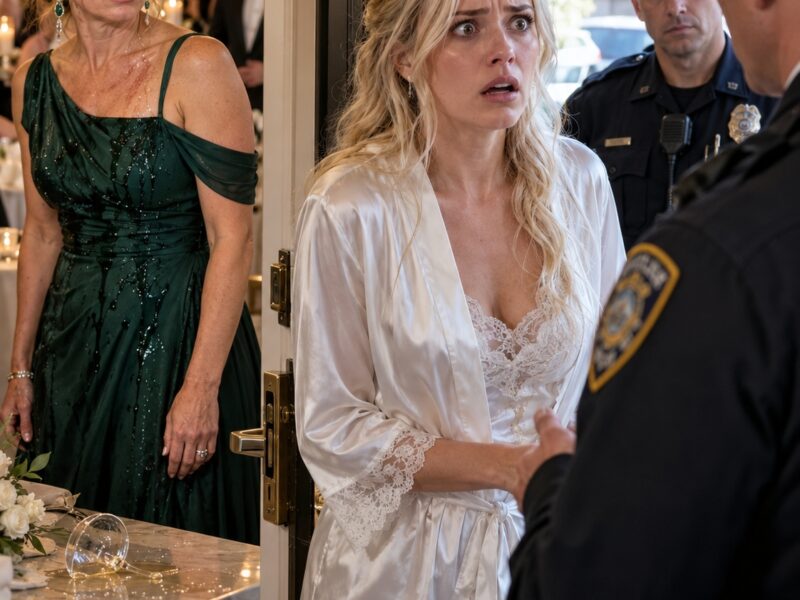
My Sister Threw a Drink in My Face at Her Wedding—Three Days Later, Police Arrived at Her Door Asking What Was Really in the Glass
My sister smiled for the cameras, lifted a glass she had not touched all night, and threw its contents directly into my face.
At first the guests laughed because she told them it was a joke—then my skin began burning and my mother tried to pull me away from the cameras.
Three days later, the police knocked on Kendall’s door before sunrise, and by then I had realized the glass was only the beginning.
My sister threw the drink at me at exactly 8:05 p.m., while the little red light on the camera beside the bar was still glowing.
I was halfway through the wedding toast Kendall herself had insisted I give.
One second I was standing beneath warm Edison bulbs talking about how our father would have cried through the vows and blamed it on allergies. The next, Kendall was coming toward me in an ivory dress, smiling brightly enough for the camera, holding a shallow coupe glass by the stem.
She swung it underhand.
Cold liquid hit the left side of my face.
A few guests gasped.
Then Kendall laughed.
“Relax, Sloan. It’s a joke.”
Someone near the dance floor laughed with her.
I blinked.
The liquid ran down my cheek, along my jaw, into the neckline of my dark green dress.
It felt strangely slick.
Soap-slick.
That detail reached me before the pain did.
And in my head, suddenly clear after twenty-nine years, I heard my father’s voice in our old garage.
Slippery first.
By the time it hurts, it’s already deep.
My smile disappeared.
“Kendall.”
She was still laughing for the camera.
“What?”
My left eye snapped shut.
The first real pain arrived a second later.
Not dramatic at first.
Heat.
Then sharper.
I touched my cheek and immediately pulled my hand away.
“Water.”
The room seemed to hesitate.
My mother reached me first.
“Sloan, don’t make a scene.”
I stared at her with my right eye.
“What?”
“Come to the restroom.”
Her fingers closed around my wrist.
She started pulling me away from the bar.
“The cameras are still rolling.”
That sentence cut through the confusion.
Not Are you okay?
Not What happened?
The cameras.
I twisted free.
“Water.”
My voice was louder.
“Now.”
Rafi, the Harbor Light’s bar manager, came through the side opening behind the counter so quickly he knocked a stack of napkins onto the floor.
He caught my shoulder before I stumbled.
“I’ve got you.”
He turned me toward the stainless-steel rinse sink.
“Don’t touch your face.”
He pulled down the sprayer hose.
Cold water struck my cheek.
I gasped.
“Keep it running,” I said.
He looked at me.
“My father was a plumber.”
That was all I could get out.
Rafi nodded as if I had told him something important.
“Then we keep it running.”
Water soaked my dress.
Behind us the room had gone completely silent.
I could hear Kendall saying something.
I could not make out the words.
Rafi moved the water across my cheek, neck, and eye.
“Count.”
“What?”
“Count with me. Twenty minutes.”
My father again.
Water.
Lots of it.
Twenty minutes.
Don’t rub.
Count so you don’t stop early.
“One Mississippi,” I said.
Rafi answered, “Two.”
Through my good eye, I saw my mother cross the reception room.
She went to Kendall.
Kendall handed her the empty coupe.
My mother covered it with a white napkin.
Then she walked quickly toward the hallway leading to the bridal suite.
My stomach dropped.
“The glass.”
Rafi kept the water on me.
“What?”
“My mother took the glass.”
He glanced past me.
“I saw.”
“Stop her.”
“No.”
I tried to turn.
His hand steadied my shoulder.
“Your eye first.”
Something in me—the actuary, the daughter of a plumber, the woman who spent her career assigning probabilities to terrible events—understood what he meant.
The glass mattered.
But my face mattered more.
I stayed under the water.
And while I counted, the only physical evidence from the table disappeared down a hallway with my mother.
Three days later, the police knocked on Kendall’s door before sunrise.
Six weeks before the wedding, my mother had called me at work asking for a key.
I was forty-one that year and had been an actuary in Boston for eighteen years.
People hear “actuary” and imagine arithmetic.
My job was really about patterns.
I looked at thousands of bad outcomes and decided which ones were accidents, which ones were preventable, and which ones were waiting to happen again.
That afternoon I had three monitors open with loss projections for a trucking company when Mom called.
“Sloan, do you still have the little brass key?”
“What key?”
“The one with the yellow tag. For your father’s truck box.”
I stopped typing.
Dad had died two years earlier.
His old dark green pickup still sat in Mom’s driveway in Gloucester because I could not bring myself to move it.
He had left it to me.
I had never driven it.
The cab still smelled like coffee, rubber boots, and orange hand cleaner.
A steel toolbox was bolted across the bed.
Dad had kept things there he did not want children touching.
Torches.
Solvents.
Industrial cleaners.
And one red plastic jug.
“What does Kendall need from the truck box?”
“Your father’s brass lantern.”
“There isn’t a lantern in the box.”
Mom sighed.
“You know what I mean. That old work light.”
“No, I don’t.”
“The production people want rustic family details.”
That was how every wedding conversation had gone for months.
Production.
Content.
Story.
Kendall had nearly half a million followers online and had built a small lifestyle company called Ever After Media.
My mother handled the bookkeeping.
Kendall handled the camera.
A production company in Los Angeles had agreed to film the wedding for a possible development deal.
If the footage performed well, Kendall might get her own streaming lifestyle show.
Mom spoke about it as though the entire family had been drafted into service.
“They want your father represented,” she said.
I looked at the spreadsheets on my screen.
“Why?”
“Because family matters.”
That phrase had become elastic in our house.
It meant whatever Mom needed it to mean.
Earlier that spring, she and Kendall had asked me to cosign a ninety-thousand-dollar business loan after one of Kendall’s sponsors demanded repayment of an advance.
I had reviewed the financial statements.
The numbers were bad.
Not temporarily bad.
Structurally bad.
I said no.
Mom had not forgiven me.
“You’re still coming to the rehearsal Friday?” she asked.
“Yes.”
“And you’ll bring the key?”
I hesitated.
That should have mattered more.
At the time, it felt petty to refuse.
“Fine.”
“Thank you.”
Then came the second request.
“And you’ll give the toast.”
“I told Kendall I would.”
“On camera.”
“Mom.”
“Please don’t start.”
“I’m not starting anything.”
“Kendall needs this wedding to go well.”
“I’m aware.”
“She needs family support.”
There it was again.
I agreed.
Later I would think about that conversation repeatedly.
Not because saying yes made me responsible for what happened.
It didn’t.
But because boundaries rarely collapse all at once.
They erode in small permissions.
At the rehearsal dinner, I put the key into Mom’s palm myself.
She slipped it into the large canvas tote she had been carrying everywhere.
“Thank you, honey.”
“Bring it back tomorrow.”
“Of course.”
Kendall was across the room laughing with her fiancé, Tyler.
She barely looked at me.
We had been closer once.
Eight years separated us.
I was old enough to braid her hair before school.
Old enough to remember holding her hand when Dad took us to the hardware store.
Old enough to remember carrying her to the sink when she pulled a pot of hot pasta water onto her arm at five years old.
I had turned the cold tap on.
Held her arm beneath it.
Counted because Dad had taught me how to think when everybody else panicked.
She used to call me Sloanie.
By the time she became Kendall Ever After online, I was Sloan.
The wedding was at the Harbor Light, an old net loft on a Gloucester pier converted into an event hall.
Gray shingles outside.
White beams inside.
Long windows facing the harbor.
Everything glowed gold that September evening.
The production crew arrived before the flowers.
Their producer, Jenna Stroud, wore black and carried a tablet.
“You’re the sister with the toast?”
“That sounds ominous.”
She smiled.
“We love family.”
Of course they did.
She explained that the cameras uploaded directly to a remote server.
“Camera-to-cloud. Everything is backed up almost instantly.”
I remember that sentence because later it became the first thing my mother could not erase.
Before dinner, I stood near the bar drinking club soda.
Rafi Duarte, the manager, put lime in it without asking.
“You look like someone who needs something in her hand.”
“I look that obvious?”
“Twenty years in hospitality.”
He showed me his setup because Dad had been a plumber and apparently tradespeople recognize one another even by proxy.
Three sinks.
Wash.
Rinse.
Sanitize.
A logbook under the register.
Test strips for sanitizer concentration.
A short sprayer hose mounted above the rinse basin.
“Health inspector loves me.”
“Or hates you.”
“Same relationship.”
At dinner I could see Kendall’s place setting clearly.
She had champagne.
Water.
Tyler’s beer when he offered it.
And one shallow coupe glass filled with something clear.
A white napkin had been folded over the top.
I watched Mom straighten that napkin once.
Kendall never drank from it.
Not once.
When Tyler came over to say hello, I nodded toward the glass.
“What’s the secret potion?”
He laughed.
“Your mom made it.”
“My mother?”
“Some kind of bit for the toast.”
“What bit?”
“No idea. I’m under instructions.”
I should have asked more.
At eight, Jenna signaled me.
Camera ready.
Red light on.
I stepped beside the bar.
My toast lasted less than four minutes.
I told stories about Kendall wearing rain boots to her fourth birthday.
About Tyler driving ninety minutes during a snowstorm because Kendall had the flu and wanted soup from one specific restaurant.
People laughed.
Then I talked about Dad.
“Dad would have cried through the ceremony and told everyone it was allergies.”
The room softened.
Kendall stood.
For one second, I thought she was coming to hug me.
She lifted the white napkin.
Picked up the coupe.
Held it away from her dress.
That detail lodged in my memory.
Her arm extended.
Glass distant from the ivory fabric.
Then she stepped forward and threw it.
After Rafi started flushing my face, Tyler called 911.
The cameras kept rolling.
I know that because through the water I saw Jenna make a small circular gesture toward the operator.
Keep filming.
I hated her for it then.
Later, I would be grateful.
At sixty-one Mississippi, I saw Mom carrying the glass away.
At one hundred ten, I told Rafi.
He said he had seen it too.
At some point somebody wrapped a white tablecloth around my shoulders.
My dress was soaked.
The EMTs arrived before twenty minutes had passed.
Rafi refused to stop the rinse.
“Strong base,” he told them.
One paramedic nodded.
They brought saline.
When the twenty minutes ended, they moved me.
My mother returned.
“It was the bar,” she announced.
Nobody had asked.
“Their cleaning chemicals. I knew that place looked sloppy.”
Rafi stared at her.
Said nothing.
At the local emergency department, a physician named Dr. Amara Okafor tested the residue on my skin.
The paper turned dark blue.
She looked at the nurse.
“Strong alkaline exposure.”
They flushed my face and eye again.
“What was in the drink?”
“I don’t know.”
“Alcohol doesn’t do this.”
“My sister threw it.”
Dr. Okafor stopped.
“Your sister?”
“Yes.”
She looked at me for several seconds.
Then spoke to the nurse.
“Bag the dress.”
They placed it in a paper evidence bag.
The injury was serious enough that I was transferred to a Boston burn center.
Before medication made everything blurry, Mom arrived carrying my purse.
She stood beside the bed.
Smoothed my wet hair back.
I let her.
That still bothers me.
I was forty-one.
But when your mother touches your forehead in a hospital, some part of you becomes eight.
“It was the venue,” she said.
“Mom.”
“You’re exhausted.”
“Dad’s truck.”
Her hand paused.
“What?”
“The red jug.”
I was fading.
I tried again.
“The box.”
Mom turned toward the nurse.
“She misses her father. She’s confused.”
The last thing I saw before transfer was Mom holding my purse against her chest.
I woke Sunday afternoon.
Left side bandaged.
Eye patched.
A burn nurse named Teresa asked if I wanted a mirror.
I said yes.
I looked.
Then gave it back.
“Forty-two ceiling tiles,” I said.
Teresa blinked.
“What?”
“I’m counting.”
“Whatever works.”
She sat beside me.
“You need to know something.”
“What?”
“A detective came this morning.”
I turned my head carefully.
“Why didn’t she talk to me?”
“Your mother showed us a healthcare proxy.”
I had signed one after Dad died.
Mom was authorized to make decisions only if I could not.
“She told the detective you weren’t competent to give a statement.”
I stared at her.
“Am I?”
“You’re medicated.”
“That’s not what I asked.”
Teresa studied me.
“You know where you are?”
“Yes.”
“Date?”
I answered.
“Who’s president?”
I answered.
“What happened?”
“My sister threw something strongly alkaline into my face at her wedding.”
Teresa nodded slowly.
“I’d like my doctor.”
That evening the attending physician evaluated me.
I revoked the proxy.
Signed a new directive.
Mom became a visitor.
Nothing more.
It was the first deliberate decision I made after the wedding.
Monday morning she returned with coffee.
“My phone.”
“You should rest.”
“Where’s my phone?”
“At home.”
“Bring it.”
“Sloan.”
“Bring it.”
She left angry.
That afternoon my coworker Dev Ralph visited.
Dev worked in special investigations at the insurance company where I was an actuary.
He brought clementines.
Then reluctantly showed me a video.
Kendall.
White couch.
Red eyes.
“My sister was injured at my wedding because a venue served a contaminated glass.”
I stared.
The clip cut to Rafi holding me beneath the sprayer.
Cropped tightly enough to make his arm look aggressive.
Kendall cried.
Said the Harbor Light used dangerous cleaning chemicals.
Said she had only meant to create a funny viral toast moment.
Two million views.
Thousands of one-star reviews.
Rafi’s name posted online.
I watched three times.
Then muted it.
“What?”
Dev asked.
“She’s selling the glass.”
“What does that mean?”
“They’re building a liability claim.”
At four that afternoon, Mom arrived with Brent Toiver, a personal-injury lawyer.
He sat beside my bed.
“I’ll represent you on contingency.”
“No.”
He kept smiling.
“You should hear me out.”
He showed me a prepared statement.
Venue contamination.
Negligent glass cleaning.
No mention of Kendall knowingly throwing anything dangerous.
Then he showed me another paper.
A media release granting Lantern House rights to use my name, image, voice, and story.
“What is this?”
Mom answered.
“For the pilot.”
“I’m not signing either.”
Her expression collapsed.
“Do you know what we owe?”
“What?”
“Ninety thousand dollars.”
I looked at her.
“The sponsor. The wedding. Credit cards. The business.”
She lowered her voice.
“This insurance money fixes everything.”
There it was.
Not my eye.
Not my face.
Money.
“The venue has coverage.”
“Mom.”
“Nobody gets hurt.”
I stared at her.
“Somebody already did.”
She looked away.
Tuesday morning, the hospital room phone rang.
Mom was already shouting.
“Police are at Kendall’s condo.”
I sat up.
“What?”
“Two officers. In front of neighbors.”
Her voice shook.
“They’re asking about chemicals.”
I looked toward the window.
Morning light over Boston.
“What did you tell them?”
“Nothing.”
“Don’t lie.”
“I haven’t spoken to police.”
Silence.
Then I added:
“You told them I couldn’t.”
Mom stopped talking.
“So who did?”
“The hospital.”
“What?”
“They reported it.”
Another pause.
Then she hung up.
Later that afternoon, Detective Maureen Kilbride arrived.
Short gray hair.
Navy blazer.
Pencil.
Not pen.
I liked her immediately.
“I was told you couldn’t give a statement.”
“I revoked the proxy.”
“Good.”
No sympathy voice.
No family assumptions.
“Start at the beginning.”
I told her.
The key.
The truck box.
The napkin.
The covered coupe.
How Kendall held it away from her dress.
Mom taking the glass.
The red jug Dad had kept.
Dad’s lesson.
Slippery first.
Kilbride wrote.
Then closed the notebook.
“I believe you.”
I waited.
“But belief isn’t proof.”
That sounded like my job.
She explained.
Hospital chemistry confirmed strong alkali.
My dress was at the state lab.
Rafi had seen Mom remove the glass.
But the glass was missing.
Kendall claimed prank.
Mom claimed venue contamination.
Toiver had already contacted the venue’s insurer.
“What about Dad’s truck?”
“What about it?”
“The jug could be there.”
“Could.”
“Search it.”
“It’s parked on your mother’s property.”
“It’s my truck.”
“The toolbox?”
“Also mine.”
“Locked?”
“Yes.”
Kilbride leaned back.
“I can’t build probable cause on your memory of where a container was two years ago.”
“What if I talk to Mom?”
“Fine.”
“Record her?”
“No.”
I frowned.
“Massachusetts requires all parties’ consent for secretly recorded private conversations.”
“So I can’t wire myself.”
“Not unless she consents.”
“That defeats the purpose.”
“Yes.”
She left a card.
That evening Tyler came.
My brother-in-law looked exhausted.
He carried my purse.
“Your mom asked me.”
I took it.
My phone was inside.
Off.
I powered it up.
Hundreds of messages.
Then I saw two emails.
Electronic signature confirmations.
Representation Agreement — Toiver & Associates.
Talent Appearance Release — Lantern House Media.
Completed Sunday, 2:14 a.m.
At 2:14 Sunday morning, I was in Boston receiving treatment.
My phone had been in Mom’s possession.
I opened the signature record.
There was my name.
My signature shape.
Wrong pressure.
Wrong curve.
I had copied Dad’s signature as a child and developed a distinctive looped S.
Somebody had drawn it.
My mother.
Tyler was still standing there.
“Sloan?”
“This is fraud.”
“What?”
“She signed my name.”
He looked genuinely confused.
I called Kilbride.
Read both timestamps.
She was quiet.
“Forward everything.”
Then:
“Change every password you have.”
I did.
Tyler waited.
Before leaving, he stopped.
“That glass.”
I looked up.
“The one with the napkin.”
“Yes.”
“Kendall never drank it.”
“I know.”
“She kept it beside her plate all night.”
“I know.”
“I thought it was part of the show.”
“So did everybody.”
He left.
Friday, I was discharged.
Wide-brim hat.
Dressings.
Eye sensitive to light.
My apartment felt unfamiliar.
I covered the bathroom mirror with a towel.
That night Rafi called.
“They suspended me.”
“What?”
“Venue insurer.”
His voice cracked.
“They say until they know where the chemical came from, I’m responsible for the bar.”
“You’re not.”
“People are calling the restaurant.”
He laughed bitterly.
“Asking if the bartender who burned the bride’s sister still works there.”
I sat at my kitchen table.
“Walk me through your wash system.”
“What?”
“Everything.”
He explained.
Detergent concentration.
Basin volume.
Rinse.
Sanitizer.
Drying.
Log entries.
Test strip readings.
I started calculating.
This was what I knew.
Even in an absurd worst case—poor dilution, skipped rinse, residual liquid—a trace on a glass could not plausibly create the concentrated exposure documented by the hospital.
The numbers refused to support the story.
I wrote two pages.
Assumptions.
Ranges.
Worst-case scenarios.
No dramatic language.
Sent it to Kilbride.
She called after the state lab tested my dress.
“Sodium hydroxide.”
I closed my eyes.
“Concentrated.”
“Yes.”
“That supports the jug.”
“It supports your theory.”
“But not the source.”
“Exactly.”
I hated correct people when they were telling me things I did not want to hear.
I wrote Lantern House asking them to preserve all wedding footage.
Their lawyers responded.
They claimed I had signed a valid release.
Proprietary footage.
No access.
A week after the wedding, I made my worst decision.
I went to Mom’s house alone.
Dad’s truck sat in the driveway.
I still had a garage key.
Inside everything smelled like him.
Tools outlined on pegboard.
Washers in coffee cans.
Hose reel.
High shelf.
And the spot where the red jug had once stood.
Empty.
Dust covered everything except one clean circle.
Recently disturbed.
I photographed it.
“Why are you taking pictures?”
Mom stood in the doorway.
“Where is Dad’s red jug?”
She glanced at the shelf.
Barely a second.
“I threw his chemicals away.”
“When?”
“Months ago.”
“Then why is that the only clean spot?”
She didn’t answer.
The front door opened.
Kendall’s voice.
“Is she here?”
My sister appeared in the garage.
Leggings.
Sweatshirt.
No makeup.
For one second, she looked like the girl whose hair I used to braid.
Then she saw my phone.
“What are you doing?”
“Documenting.”
She crossed the garage.
“Give me that.”
“No.”
She grabbed the phone.
I held on.
She pulled.
I was weak.
Still healing.
My back hit Dad’s workbench.
Pain tore through the dressing on my neck.
Kendall released the phone.
I looked down.
The bandage had opened.
“Kenny.”
She stared.
Then said:
“You attacked me.”
“What?”
“You came here.”
Tyler appeared at the side door.
He saw me.
Saw Kendall holding my phone.
Saw Mom.
He walked over.
Took the phone from Kendall.
Handed it to me.
“You’re bleeding.”
Mom’s voice sharpened.
“Get out of my house.”
I pressed my scarf against my neck.
“Call the police.”
“What?”
“Please.”
She didn’t.
At the ER, part of the healing graft had been disrupted.
Dr. Feldman told me the scar would likely be wider.
That was the cost of going alone.
I knew better.
I had acted on grief.
Anger.
A clean circle in dust was not evidence.
It was absence.
Sunday night, Kendall posted another video.
This time she said I was unstable from medication.
That I had entered Mom’s house and attacked her.
That Dev had manipulated me into extorting the venue.
Four million views.
I said nothing publicly.
Kilbride told me not to.
I listened.
Tuesday, a constable served me with a temporary harassment-prevention order filed by Mom.
I was legally barred from her house.
From Dad’s truck sitting in her driveway.
I understood the strategy immediately.
Distance.
She did not need protection from me.
She needed me kept away from something.
Wednesday, my company placed me on paid administrative leave after an anonymous complaint accused me of using company resources for a personal dispute.
Dev was instructed not to contact me.
For the first time after the wedding, I had no next move.
I sat fully dressed in my bathtub that night.
Mirror still covered.
And counted to twenty.
No water.
Just counting.
At eleven, I remembered Kendall at five.
Pasta water.
Her arm under the faucet.
“Keep going, Sloan.”
She had trusted me.
That memory hurt more than the wedding.
Then my brain did what it always does under pressure.
It asked:
What does this cost?
Mom hated court.
She hated paperwork.
She hated strangers judging the family.
Yet she had sought a protective order.
Why?
Because the legal cost was smaller than whatever she feared I would find.
I took the towel off the mirror the next morning.
Looked at my face.
Then sat at the kitchen table.
I started with the forged signatures.
The e-signature platform generated certificates.
Device.
Time.
Network location.
Both documents were signed from my phone at 2:14 Sunday morning in Gloucester.
Hospital records placed me in Boston.
Sedated.
Vital signs documented.
Thirty miles away.
I wrote to Lantern House’s general counsel.
Not emotionally.
Professionally.
Your release appears to have been executed without authorization.
Your system records the signature in Gloucester while I was hospitalized in Boston.
My mother possessed my device.
The footage may depict evidence relevant to a criminal investigation.
Preserve all original files.
Then I found Lantern House’s professional liability insurer through a public filing.
Sent them the same letter.
Added one paragraph.
If footage were altered or deleted after notice of potential criminal evidence and a forged release, coverage could become complicated.
I had read enough insurance contracts to know the sentence that would make someone nervous.
Two hours later, Jenna Stroud called.
“I didn’t know.”
“About?”
“The release.”
She sounded nothing like the confident producer from the wedding.
“Your mother submitted it Sunday.”
I said nothing.
“And there’s something else.”
“What?”
“Kendall has administrative access through Ever After Media.”
My hand tightened around the phone.
“Eleven clips were deleted Monday night.”
My heartbeat changed.
“Gone?”
“No.”
“Camera-to-cloud trash retention. Thirty days.”
I stood.
“I restored them.”
“Did you copy them?”
“Yes.”
“Lock her out.”
“Already done.”
Silence.
Then Jenna said:
“I told the camera operators to keep rolling when you were at the sink.”
“I remember.”
“I’m sorry.”
“Make it matter.”
Kilbride obtained a subpoena.
The following week, we watched the footage.
B-camera.
Before dinner:
Mom placing the coupe beside Kendall.
White napkin.
Mom’s fingers smoothing it.
Later:
Kendall leaning toward her.
The microphone barely caught:
“On three?”
Mom smiled.
After my toast:
Kendall lifted the glass.
Arm away from her dress.
And afterward:
Mom walking quickly toward the bridal-suite hallway carrying the glass under the napkin.
Me blurry at the sink in the background.
Counting.
Kilbride paused.
“This is good.”
“Not enough.”
She looked at me.
“You really are an actuary.”
“I need source.”
“You need intent.”
“Yes.”
She tapped the screen.
“They’ll say they planned a prank.”
“With club soda?”
“Something unpleasant.”
“And had no idea it was caustic.”
“Exactly.”
I thought about the key.
Six weeks before the wedding.
Mom asking for Dad’s toolbox key.
For a brass lantern that had never appeared anywhere at the wedding.
Then the missing jug.
The legal order keeping me from the property.
The truck.
I looked at Kilbride.
“It’s in the toolbox.”
“You don’t know that.”
“No.”
“But?”
“The truck is mine.”
“Yes.”
“The box is mine.”
“Likely.”
“When the harassment order hearing happens, I can request escorted property retrieval.”
Kilbride leaned back.
A slow smile appeared.
“That’s different.”
The court permitted me to retrieve Dad’s truck and personal property with an officer present.
Saturday morning.
Nine.
Officer Paul Dennehy met me at the bottom of Mom’s street.
Rafi came too.
I needed someone to drive Dad’s truck because my left eye was still sensitive.
He had volunteered instantly.
We walked up the hill.
Leaves orange.
Truck exactly where it had been for two years.
Steel box closed.
Tyler’s car was parked nearby.
He came from the garage carrying a cardboard box.
Saw us.
Stopped.
He had moved out of the condo.
I learned later he and Kendall had separated.
Officer Dennehy knocked.
No answer.
He returned.
“You get your truck. You get the listed belongings. You do not enter the house.”
“Understood.”
I handed Rafi the truck key.
He opened the cab.
Dad’s smell came out.
Coffee.
Rubber.
Orange cleaner.
I had to look away.
Rafi started the engine.
Then the front door flew open.
Mom came running in a bathrobe.
“Those are Frank’s things.”
Officer Dennehy stepped between us.
“The vehicle belongs to Sloan.”
“The box has my husband’s personal property.”
“Ma’am, return inside.”
She went around him.
Quick.
Panicked.
She climbed onto the rear bumper.
In her hand:
A small brass key.
Yellow tag.
The key I had given her.
“Mom.”
She shoved it into the box lock.
Turned.
The lid opened.
And there it was.
Red plastic.
Dad’s handwriting on masking tape:
DANGER. FRANK’S. DO NOT TOUCH.
The jug was half empty.
Everything slowed.
Officer Dennehy’s voice changed.
“Ma’am, put the container down.”
Mom looked at him.
Then me.
The face I saw was not anger.
It was panic.
Pure.
Cornered.
She removed the cap.
“Mom.”
She jumped down from the bumper.
Started toward the storm drain.
Officer Dennehy moved.
I stepped sideways.
Not toward her.
Between her and the drain.
“Move.”
“No.”
“Sloan.”
“Put it down.”
She tried to push past.
The open jug tilted.
Liquid splashed across the driveway.
A small amount hit Dennehy’s boot.
More ran down Mom’s own forearm where her bathrobe sleeve had slipped.
She froze.
For one second, nothing.
Then she looked at her arm.
Her hand rubbed once.
Her expression changed.
Slick.
She knew.
“Oh.”
The jug fell.
Dennehy used his boot to push it upright and away.
Mom began panicking.
Rubbing her arm.
“Don’t.”
I grabbed her shoulders.
She fought me.
“Mom, don’t rub.”
My father’s voice.
Rafi’s voice.
Mine.
I pulled her into the garage.
The hose reel was still mounted where Dad had placed it decades before.
Three steps from the bench.
I opened the valve.
Water.
Held her forearm underneath.
“Count.”
She cried.
“Count.”
“One Mississippi.”
She didn’t answer.
“Two Mississippi.”
At four, she whispered:
“Four.”
Footsteps came from the kitchen.
Kendall stood in the doorway.
T-shirt.
Socks.
Hair tangled.
She saw Mom under the hose.
Saw my scar.
Saw the red jug through the open garage door.
Her face folded.
“I knew.”
Mom jerked.
“Kendall.”
“I knew it was Dad’s.”
“Stop.”
Kendall started crying.
Not camera crying.
Messy.
“I knew.”
Officer Dennehy was standing behind her.
She did not notice.
“Mom poured it into the glass.”
My hand tightened around Mom’s wrist.
Kendall kept going.
“She said it would make you red.”
Mom whispered:
“Kendall, shut up.”
“She said we’d blame the venue.”
“Kendall.”
“The insurance would pay.”
Tyler stood on the lawn.
Phone raised openly.
Recording.
My sister looked at me.
“I remembered the jug, Sloan.”
Her voice broke.
“I remembered Dad teaching us.”
I said nothing.
“She said it was diluted.”
Kendall covered her face.
“But I knew what it was.”
That was the truth.
Not Mom tricking an innocent bride.
Not Kendall inventing it alone.
Both.
Different motives.
Same choice.
Mom had needed money.
Kendall needed a spectacle.
They believed I would survive because I always did.
The ambulance arrived fourteen minutes into the rinse.
A paramedic reached toward Mom.
“Six more minutes.”
He looked at me.
“It’s alkali.”
He nodded.
We continued.
I held Mom’s arm beneath water for the full twenty minutes.
Then stepped away.
The red jug was collected.
Evidence bag.
Photographed.
Lab later matched the chemical to residue on my dress.
Mom was arrested after receiving medical care.
Kendall went voluntarily to the station.
Seven months later, I sat in a courtroom.
Mom wore a gray cardigan.
A pale scar ran along her forearm.
She pleaded guilty to serious assault charges, forgery connected to my electronic signature, and attempted insurance fraud.
The judge imposed prison time.
I did not feel victorious.
I felt tired.
Kendall had entered a plea earlier.
Her cooperation reduced what she faced, but not to nothing.
Tyler filed for annulment.
Ever After Media collapsed.
Lantern House abandoned the pilot.
They publicly corrected the false allegations against the Harbor Light.
Rafi was reinstated.
Eventually promoted to general manager.
Brent Toiver withdrew the insurance claim after the forged representation agreement surfaced and faced his own professional review.
My employer investigated me.
Then reinstated me with a written apology.
Dev took me to lunch.
“Try not to commit any insurance fraud this week.”
“I’ll check my calendar.”
He smiled.
That normal joke mattered.
Healing was slower.
My left eye recovered better than doctors first expected.
Bright light bothers it.
The scar across my cheek and neck softened over months.
It did not disappear.
Some mornings I still hate it.
Most mornings I see a face.
Mine.
In May, I finally drove Dad’s truck.
The first time.
I sat behind the wheel for ten minutes before starting it.
His reading glasses were still in the console.
A pencil.
Two hardware-store receipts.
A folded Red Sox schedule from two years earlier.
I cried.
Not because I missed a perfect father.
He wasn’t perfect.
He taught me safety.
He also taught me stubbornness.
He loved both daughters.
He died before seeing what we became without him.
I drove down to the harbor.
Rafi came outside.
Two club sodas with lime.
He held one out.
“Three sinks.”
I stared at him.
“Seriously?”
“Washed it myself.”
I laughed.
Then took the glass.
Held it by the stem.
For a second, my hand shook.
Rafi pretended not to notice.
I drank.
Cold.
Lime.
Nothing else.
We sat on the tailgate.
The steel toolbox was open.
I had removed every chemical.
Inside now:
First-aid kit.
Two gallons of clean water.
Eyewash.
Gloves.
And a laminated card.
My handwriting.
WATER.
20 MINUTES.
DON’T RUB.
COUNT OUT LOUD.
Kendall has written to me.
Three pages.
I have read the first sentence.
Sloan, I do not know how to ask forgiveness for something I knew could hurt you.
I haven’t read the rest.
Not yet.
Maybe I will.
Forgiveness is not the same thing as access.
That took me forty-one years to understand.
Rafi handed me his Red Sox cap.
“Sun.”
I put it on.
“Bossy.”
“Twenty years in hospitality.”
The harbor was bright.
I closed my eyes.
Counted.
One.
Two.
Three.
All the way to twenty.
Not because anything hurt.
Not because something was burning.
Just because for most of my life, counting had meant surviving the next minute.
When I opened my eyes, the water was calm.
Nothing needed saving.
Nothing needed proving.
Nothing was burning.









