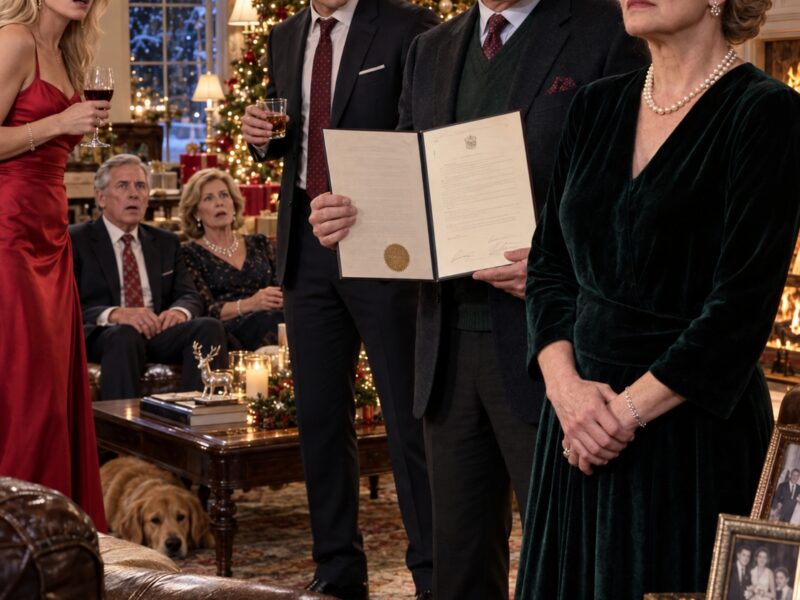
My Son Called Me “Beneath Us” and Voted Me Out of the Family—Then My Husband Read the Name on the Deed and Everything Changed
At Christmas, my son asked five people to vote me out of the family.
His wife smiled when every hand went up.
Then my husband unfolded the deed to the house they were standing in and read the one name none of them expected to hear.
Mine.
The room went so quiet I could hear ice tapping against the living-room windows.
My son, Caleb, was still standing beside the fireplace with a half-empty whiskey glass in one hand. His wife, Brooke, stood three feet away in a red silk dress, looking pleased with herself in the way people do when they think humiliation has already been successfully delivered.
Her parents sat together on my leather sofa.
My sofa.
My living room.
My house.
And yet five minutes earlier, Brooke had lifted her wineglass and announced that I was no longer welcome at “family events” because my presence had become, in her words, “emotionally toxic and socially uncomfortable.”
Caleb had not corrected her.
He had made it worse.
He had looked straight at me and said, “Mom, you have to understand. You’re just not really on the same level anymore.”
I stared at him.
He hesitated.
Then finished the sentence anyway.
“You’re beneath us.”
My husband, Henry, did not raise his voice.
That was one reason I had married him.
At sixty-eight, Henry could become furious without becoming loud. He had spent thirty-six years as a structural engineer, and he approached arguments the way he approached damaged bridges: first identify the load, then find the fracture, then decide whether the structure should be repaired or closed.
He reached inside his jacket.
Brooke’s father, Martin, frowned.
“What are you doing?”
Henry ignored him.
He removed a folded sheet of heavy cream paper.
Caleb looked at me.
For the first time that evening, uncertainty entered his face.
Henry opened the document.
“This,” he said, “is the current recorded deed for 1847 Brookfield Lane.”
Brooke’s smile weakened.
Her mother, Cynthia, set down her wine.
Henry adjusted his glasses.
Then read.
“Sole owner: Nora Whitmore.”
My son’s face changed.
Not because he had forgotten.
Because he had spent the previous year behaving as though remembering did not matter.
Henry folded the deed again.
“No joint ownership.”
Caleb swallowed.
“No transfer.”
Brooke’s hand tightened around her glass.
“No life estate to Caleb.”
Henry looked at her.
“No ownership interest whatsoever held by Brooke Whitmore.”
Cynthia’s eyes moved quickly toward her daughter.
That was the first moment I realized something else was wrong.
Not just disrespect.
Not just entitlement.
Surprise.
Brooke’s parents looked genuinely surprised.
Martin leaned forward.
“Caleb told us the house had been transferred.”
Caleb closed his eyes.
And there it was.
The first crack.
But to understand why my thirty-three-year-old son had spent Christmas Eve trying to exile me from a house that had been mine for twenty-seven years, you have to understand something about generosity.
People rarely become entitled all at once.
Entitlement grows quietly.
A favor becomes routine.
Routine becomes expectation.
Expectation becomes ownership.
And if you continue giving without requiring gratitude, responsibility, or even basic respect, one day someone may look you in the eye while standing beneath your roof and sincerely believe you are the intruder.
My name is Nora Whitmore.
I was sixty-five that winter.
My first husband, Michael, died ten years earlier after a sudden heart attack at fifty-eight. We had been married thirty-three years, raised two children, survived one layoff, two miscarriages, a flooded basement, three terrible kitchen renovations, and more ordinary Tuesday nights than I could count.
The house on Brookfield Lane had been ours.
Not grand by Connecticut standards, but beautiful.
Four bedrooms.
Red brick.
White columns that Michael repainted every other spring because he never trusted anyone else to do it properly.
Two acres behind the house sloped toward a line of maple trees.
At the back of the property sat an old carriage house that Michael converted into a two-bedroom cottage when his mother became ill.
After she died, we used it for guests.
Years later, it became the place where I learned how dangerous a gift could become when people stopped seeing it as one.
Two years before that Christmas, I married Henry Dawson.
He had been widowed too.
We met at a grief-support fundraiser neither of us wanted to attend.
He spilled coffee on my sleeve.
I told him his apology sounded rehearsed.
He said engineers did not rehearse apologies because they preferred not making mistakes.
I laughed.
Six months later, he took me to dinner.
A year after that, we married at the courthouse with twelve people present and ate Italian food afterward.
No champagne tower.
No string quartet.
No seating chart.
It was the happiest wedding I ever attended.
Henry owned a comfortable condominium in Hartford, but after we married we decided to live at Brookfield Lane.
Then Caleb and Brooke announced they wanted children.
They had been married four years and were renting a modern apartment downtown. It had one bedroom, white walls, a gym they rarely used, and rent that increased every year.
One Sunday, Brooke stood in my kitchen looking through the window toward the backyard.
“This would be such a perfect place for kids.”
I heard longing.
I did not hear calculation.
That distinction mattered.
A month later, I made the offer.
“Move into the main house.”
Caleb stared.
“What?”
“Henry and I can renovate the cottage.”
“Mom.”
“It’s just the two of us.”
The carriage house was twelve hundred square feet.
Enough.
The main house was almost three thousand.
Too much for Henry and me.
Caleb looked emotional.
Brooke looked stunned.
“You would really do that?”
“Yes.”
“For how long?”
I should have listened to that question more carefully.
Instead I said:
“As long as it makes sense.”
No rent.
That was my mistake.
Not because parents should never help adult children.
Because undefined generosity creates undefined expectations.
My only conditions were simple.
They would cover their own utilities.
Maintain the property.
Consult me before structural changes.
And understand that I still owned the home.
Caleb hugged me.
“Mom, this changes everything.”
I smiled.
That sentence turned out to be true in ways none of us understood yet.
The first six weeks were pleasant.
Brooke sent me photographs of furniture arrangements.
Caleb helped Henry repair a gutter on the cottage.
We had dinner together twice a week.
Brooke planted herbs beside the back steps.
I bought a small dining table for the cottage.
Everyone congratulated us on making “multigenerational living” work.
Then small things changed.
The first was my key.
Three months after Caleb moved in, I walked across the lawn to retrieve two baking sheets I had left in the main kitchen.
I unlocked the side door.
Brooke was standing near the island unpacking a twelve-hundred-dollar espresso machine.
She looked up.
Then looked at my key.
“Nora.”
Something about the way she said my name made me stop.
“Yes?”
“We should probably talk about boundaries.”
I almost smiled.
“Certainly.”
She folded her arms.
“You can’t just come in.”
I looked behind her.
Caleb sat in the family room with his laptop.
He could hear us.
He did not move.
“I came for my baking sheets.”
“I know, but this is our home now.”
“Our residence,” I corrected gently.
Brooke frowned.
“What?”
“The house is still mine.”
“That’s exactly the kind of thing I mean.”
I stared at her.
She continued.
“It makes it hard to feel settled when you keep reminding us that technically you own everything.”
“I reminded you because you told me I could not enter my own house.”
Brooke sighed.
“You’re being literal.”
“I find literal useful when property is involved.”
Caleb finally looked up.
“Mom, she just means knock.”
I turned toward him.
“Is that what you mean?”
He looked at Brooke.
Not me.
“Yeah.”
That should have been my warning.
Not that my son wanted privacy.
Privacy was reasonable.
The warning was that he had stopped answering questions based on what he thought and started answering based on what would keep his wife comfortable.
“Fine,” I said.
“I’ll knock.”
Then I opened the cabinet where my baking pans had always been stored.
Empty.
I checked another.
Nothing.
“Brooke?”
“Yes?”
“Where are my pans?”
“Oh.”
She barely looked up.
“I donated a bunch of old kitchen stuff.”
I turned slowly.
“You donated my baking pans?”
“They were really worn.”
“They were professional-grade aluminum pans.”
“They looked old.”
“They were Michael’s mother’s.”
Brooke stopped.
For half a second, I thought remorse might arrive.
Instead she said:
“Well, I didn’t know that.”
“You didn’t ask.”
Her face hardened.
“I can’t ask permission about every object in a house we’re supposed to live in.”
“You can ask before throwing away something you did not buy.”
Caleb stood.
“Mom.”
I looked at him.
His expression irritated me more than hers.
Exhausted.
As though I were creating unnecessary work.
“They were pans.”
“They were mine.”
“Okay.”
That word.
Okay.
Not apology.
Not acknowledgment.
A sound used to end conversations.
I looked around the kitchen.
The warm yellow walls Michael and I painted years earlier were now pale gray.
My curtains were gone.
The oak stools replaced by white leather ones.
Even the small ceramic rooster my daughter Emily made in eighth-grade art class had disappeared.
I had not noticed how much had changed because I had been trying not to hover.
“Where is the rooster?”
Brooke blinked.
“What rooster?”
I knew.
I left.
Henry was reading in the cottage when I walked in.
He looked up.
“You found the pans?”
“No.”
Something in my voice made him close the book.
“What happened?”
I told him.
All of it.
He listened.
Then asked:
“What do you want to do?”
That was another reason I loved him.
He did not immediately tell me what I should do.
“I don’t know.”
“Yes, you do.”
I looked at him.
He smiled slightly.
“You just don’t like your answer yet.”
He was right.
For almost a year, I had been paying for Caleb and Brooke’s groceries.
That arrangement started before they moved in.
Caleb claimed he was aggressively saving for a family car.
I offered a family credit card for household essentials.
Milk.
Eggs.
Cleaning supplies.
Basic groceries.
I rarely checked the charges.
That night, I did.
Imported wine.
One hundred eighty-seven dollars.
Dry-aged steaks.
Two hundred fourteen.
Truffle oil.
Designer candles purchased from a gourmet market.
Forty-eight dollars each.
A ninety-six-dollar cheese board.
Three bottles of champagne on a random Wednesday.
I scrolled for twelve minutes.
Then I laughed.
Henry looked over.
“What?”
“They’re becoming independent.”
“That sounds expensive.”
“For them.”
I opened the banking app.
Removed the card authorization.
Done.
Two days later, Caleb called.
Not Brooke.
Smart.
“Mom.”
“Hello.”
“Something’s wrong with your card.”
“No.”
“It declined at Bellmore Market.”
“I know.”
Pause.
“Can you call the bank?”
“No.”
Longer pause.
“Why?”
“Because I canceled it.”
He sounded genuinely confused.
“Why would you cancel it without telling us?”
“Because it is mine.”
“Brooke is standing at the register with her parents.”
“I hope she has another card.”
“Mom.”
“What?”
“This is humiliating.”
I poured tea.
“Then use it as a growth experience.”
He exhaled sharply.
“We’re trying to save.”
“I know.”
“That was the whole reason you offered the card.”
“For groceries.”
“That is groceries.”
“Caleb, your wife charged one hundred eighty-seven dollars of wine.”
Silence.
“And dry-aged ribeyes.”
Another silence.
“And candles.”
“They sell candles at the grocery store.”
I smiled.
“That defense is almost impressive.”
“Mom.”
“Brooke wants an independent household.”
“She said that?”
“She said this is your home and I need permission to enter.”
He groaned.
“Are we really still talking about that?”
“No.”
I looked toward the main house through the cottage window.
“We’re talking about consequences.”
“What does that mean?”
“It means independent households buy their own food.”
I ended the call.
Brooke did not speak to me for nine days.
I slept beautifully.
The utility bills were next.
Not as retaliation.
As correction.
Electricity, gas, water, internet, landscaping, waste service.
All remained in my name.
I had continued paying because moving accounts seemed annoying.
Convenience is expensive when it hides responsibility.
I called each provider.
Transferred billing responsibility where permitted.
Paid my final balances.
Sent Caleb the account information.
He replied with one word.
Seriously?
I responded:
Yes.
Three weeks later, the internet shut off.
Not because I canceled it.
Because Caleb had forgotten to set up autopay.
He stormed across the lawn at seven thirty at night.
Henry and I were sitting on the cottage porch under blankets.
“Nora.”
He used my first name only when trying to sound adult and furious.
I marked my page.
“What?”
“The internet is off.”
“So?”
“Brooke has a presentation tomorrow.”
“I hope it goes well.”
He stared.
“You transferred everything.”
“Yes.”
“Our electric bill is almost six hundred dollars.”
“I know.”
“How?”
“Your wife runs the air conditioning at sixty-eight degrees with twelve-foot ceilings.”
His jaw tightened.
“You know we’re saving.”
“For what?”
“A future.”
“Then perhaps the present should cost less.”
“Mom, you offered us this house.”
“Yes.”
“You said you wanted to help.”
“I do.”
“This doesn’t feel helpful.”
I closed my book.
“Caleb.”
He stopped.
“Helping you live in a house rent-free is help.”
He said nothing.
“Paying every cost associated with your adult life while being told I am disruptive inside my own property is servitude.”
His face changed.
“You’re exaggerating.”
“No.”
Henry lowered his newspaper.
Caleb looked at him.
Henry said nothing.
That made Caleb more uncomfortable.
“You’re choosing money over family,” Caleb said.
I almost admired the sentence.
It took talent to live for free in someone’s house and accuse them of greed.
“No.”
I stood.
“I am separating money from family so we can find out whether family remains.”
He walked away without answering.
Thanksgiving was when things became embarrassing.
Brooke announced she would host.
Not asked.
Announced.
Her parents were coming from Massachusetts.
Her sister and brother-in-law too.
“Of course you and Henry can join us,” she texted.
Then came the next message.
Could you handle turkey, pies, stuffing, cranberry sauce, and wine? I’m overwhelmed with décor.
Henry read it over my shoulder.
“What is she making?”
I considered.
“Ambiance.”
He laughed so hard he coughed.
I should have declined.
Instead, I cooked.
Partly because I loved Thanksgiving.
Partly because Caleb still liked my stuffing.
Partly because some habits survive disrespect longer than they should.
By eleven that morning, the cottage smelled like sage, butter, apple pie, and roasted turkey.
Henry carved nothing.
I insisted the bird arrive whole.
“Presentation,” I told him.
“I thought we were beneath presentation.”
“Apparently we are supplying it.”
At three, we carried everything across the lawn.
Brooke opened the door wearing cream silk.
Not an apron.
The main dining table was set beautifully.
Candles.
Gold chargers.
White roses.
Her parents sat near the fireplace drinking a bottle of wine I recognized because I had once paid for three just like it.
Brooke looked at the turkey.
“Put it in the kitchen.”
No thank you.
No hello to Henry.
Then:
“And Nora, could you grab more napkins while you’re in there? Dad keeps spilling.”
Martin chuckled.
“I do not.”
Brooke laughed.
I looked toward Caleb.
He sat watching football.
He heard.
Our eyes met.
Then he looked away.
Something inside me became very calm.
I placed the turkey on the counter.
Henry followed with two pies.
He looked at me.
One eyebrow.
I nodded.
He understood immediately.
We repacked everything.
Brooke turned.
“What are you doing?”
“Leaving.”
“What?”
I picked up the stuffing.
“If I am catering the meal, I prefer to eat it somewhere I am also a guest.”
Her face reddened.
“Are you seriously doing this in front of my parents?”
“No.”
I lifted the turkey.
“You did it in front of your parents.”
Caleb stood.
“Mom.”
“Happy Thanksgiving.”
“Nora, don’t be ridiculous.”
I stopped at the door.
That one word almost made me turn around.
Ridiculous.
Not hurt.
Not upset.
Not disrespected.
Ridiculous.
I looked at my son.
“Come eat with us if you want.”
Brooke stared at him.
Caleb hesitated.
There are moments when people reveal themselves not through what they do, but through how long they require to decide.
He looked at Brooke.
Then me.
“I think we should all calm down.”
I nodded.
“That is your answer.”
Henry opened the door.
We walked home.
We ate Thanksgiving dinner on our small cottage table.
Two plates.
Turkey too large for both.
Pie enough for ten.
At seven, Henry put on old jazz records.
At eight thirty, Caleb texted:
You embarrassed Brooke.
I deleted it.
Monday morning, my key no longer worked.
I had crossed the lawn to retrieve property-tax correspondence that still went to the main mailbox.
The lock was new.
Bright brass.
I tried once.
Twice.
Then stopped.
Brooke had changed it.
For a few seconds, anger came so sharply my hands shook.
Then I remembered Henry.
Find the fracture.
Decide whether to repair or close.
I photographed the lock.
Called my attorney.
That was something the original version of me would not have done.
She would have called her son.
Pleaded.
Demanded an explanation.
I had learned explanations were becoming a luxury Caleb used to delay accountability.
My attorney, Melissa Grant, was blunt.
“You still own the property?”
“Yes.”
“Any written lease?”
“No.”
“Written gift?”
“No.”
“Any recorded transfer?”
“No.”
“Good.”
She paused.
“Do not play lock games.”
“What?”
“Do not change them yourself tonight because you’re angry.”
“I wasn’t planning to.”
“Yes, you were.”
I smiled.
“Possibly.”
“Let me send a formal notice establishing access rights and occupancy terms.”
That sentence changed the direction of everything.
Occupancy terms.
Until then, I had been treating family arrangements as though love made paperwork unnecessary.
Love does not make paperwork unnecessary.
Sometimes paperwork protects love from assumptions.
Melissa prepared a written occupancy agreement.
Caleb and Brooke would remain rent-free through June.
They would pay utilities.
Maintain insurance required of occupants.
Make no property changes without written approval.
Permit reasonable owner access with notice.
No additional permanent residents.
No encumbrances.
That last phrase caught my attention.
“Why is that there?”
“Standard protection.”
“Against what?”
“Anyone trying to represent ownership they don’t have.”
I looked at her.
“You think that could happen?”
“I think you are calling me because your daughter-in-law changed the locks on your house.”
Fair.
Caleb refused to sign initially.
“This is insane.”
“What is?”
“A contract between mother and son.”
“It is an agreement between owner and occupants.”
“There.”
He pointed at me.
“That.”
“What?”
“You’re making everything transactional.”
I looked at him.
“No.”
“You made it transactional when you wanted the privileges of ownership without any legal or financial responsibility.”
He became quiet.
Brooke signed first.
She barely read it.
That bothered me.
Another warning I ignored.
December arrived cold.
The property looked beautiful under the first snow.
Caleb and Brooke stopped speaking to us except when necessary.
I assumed distance might help.
Henry did not.
“They’re planning something.”
“You don’t know that.”
“No.”
He stirred soup.
“But silence is not the same as surrender.”
He was right.
Two days before Christmas, Caleb knocked on the cottage door.
He wore a wool coat and looked nervous.
“Mom.”
“Yes?”
“Brooke and I are hosting Christmas Eve.”
I waited.
“Her parents are coming.”
“Lovely.”
“We want you and Henry there.”
I nearly laughed.
“Why?”
“To clear the air.”
Henry, behind me, lowered his newspaper.
Caleb continued.
“We’ve all been holding resentment.”
“All?”
“Yes.”
I looked at him.
“What does your mother-in-law resent me for?”
He blinked.
“It’s complicated.”
“Usually a bad sign.”
“Mom.”
“Fine.”
He handed me a cream invitation.
Embossed.
For a dinner twenty yards from my front door.
I looked at Henry.
He smiled.
“Sounds festive.”
Caleb’s relief was visible.
“Seven.”
“We’ll be there.”
After he left, I closed the door.
Henry looked at me.
“Trap?”
“Obviously.”
“Should we bring wine?”
“No.”
“Pie?”
“No.”
“Deed?”
I stared.
He smiled.
“You’re learning.”
Christmas Eve arrived under freezing rain.
The main house glowed.
Candles in every window.
Garland around the staircase.
A ten-foot tree in the living room.
Brooke had good taste.
I had never denied that.
She also had no idea how much of the furniture surrounding her still belonged to me.
Martin and Cynthia Langley were seated on the leather sofa when Henry and I entered.
Brooke wore red.
Caleb stood near the fireplace.
No dinner smell came from the kitchen.
Interesting.
Cynthia looked me up and down.
“Nora.”
“Cynthia.”
“We haven’t seen you in ages.”
“We live across the yard.”
Her smile tightened.
Before Henry and I could sit, Caleb cleared his throat.
“Mom.”
There was a prepared quality to his voice.
I looked at Henry.
He gave the smallest nod.
Here we go.
Caleb placed his drink on the mantel.
“Brooke and I have spent a lot of time talking about what’s happened this year.”
“I’m sure.”
“Please let me finish.”
I nodded.
He continued.
“The dynamic here has become unhealthy.”
Brooke stepped beside him.
“You have been controlling.”
I almost responded.
Henry touched one finger to my wrist.
Wait.
Brooke continued.
“You use the fact that you own the property to manipulate us.”
Interesting framing.
“You withdraw financial help whenever we assert ourselves.”
Caleb nodded.
“You ruined Thanksgiving.”
I finally spoke.
“I removed food I cooked after your wife ordered me around like catering staff.”
Brooke rolled her eyes.
“That.”
“What?”
“That tone.”
Cynthia leaned forward.
“Nora, from an outside perspective, you really have created a hostile environment.”
I looked at her.
“You live two states away.”
“I hear what my daughter goes through.”
Martin cleared his throat.
“This situation has affected everyone.”
“Has it affected you financially?”
Caleb’s face changed.
Only slightly.
I noticed.
Martin looked annoyed.
“That is exactly the kind of remark we mean.”
Brooke lifted her wineglass.
“We took a family vote before you arrived.”
I looked around.
“A vote.”
“Yes.”
“On what?”
She smiled.
Not broadly.
Just enough.
“Whether your behavior should continue being tolerated.”
Caleb looked pale.
He had agreed to the performance.
He had not enjoyed rehearsing it.
“And?”
Brooke glanced at her parents.
“Unanimous.”
Henry shifted slightly beside me.
Brooke continued.
“From this point forward, you and Henry will not be included in holidays, birthdays, dinners, or other family gatherings in this house.”
I almost laughed.
But then Caleb spoke.
That was the part I had not expected.
“You need to respect that, Mom.”
I looked at him.
He avoided my eyes at first.
Then forced himself to meet them.
“Brooke’s right.”
His voice became firmer.
“You have made everything harder than it needs to be because you can’t accept that we have a different life now.”
“What life?”
“This.”
He gestured toward the room.
The furniture.
The fireplace.
The Christmas tree.
My room.
My furniture.
My house.
“We’re building something.”
Caleb continued.
“And you keep dragging us backward.”
“How?”
“You’re always reminding us where things came from.”
I stared.
He finally said it.
“You’re beneath us now, Mom.”
The sentence did not hurt immediately.
Shock has mercy for the first second.
Then it entered slowly.
My son.
The child whose fever I once monitored every forty minutes.
The boy Michael taught to ride a bicycle.
The teenager whose first car I helped buy.
The man living rent-free under my roof.
Beneath us.
Henry stood.
No shouting.
No insult.
He reached inside his coat.
Martin frowned.
“What are you doing?”
Henry unfolded the deed.
And read my name.
Brooke’s parents stopped breathing comfortably.
Caleb’s face drained.
Martin leaned forward.
“What do you mean sole owner?”
Henry looked at him.
“It is a common phrase.”
Martin ignored the sarcasm.
“Caleb told us this house transferred when they moved in.”
I turned toward my son.
He looked at the floor.
“Did you?”
“Mom.”
“Did you tell them you owned my house?”
“It wasn’t exactly—”
Brooke interrupted.
“You said your mother gave you the property.”
Caleb looked at her.
“I said she gave us the house.”
“That means ownership.”
“It means use.”
“No, Caleb.”
Brooke’s voice sharpened.
“You told my parents we had equity.”
Everything inside me became still.
“Equity?”
No one answered.
I looked at Henry.
His expression changed.
He had heard it too.
“Caleb.”
My voice was quiet.
“What did you use my supposed equity for?”
“Nothing.”
Brooke turned toward him.
“What do you mean nothing?”
He snapped.
“Brooke, stop.”
“No.”
She looked at me.
“My father was considering investing in our renovation business.”
“What renovation business?”
Caleb closed his eyes.
Layer two.
Brooke and Caleb had been planning to launch a high-end residential renovation company.
Brooke would handle design.
Caleb, who worked in procurement for a construction firm, would manage suppliers.
Martin offered startup money.
But only if they had “real assets behind them.”
My house had become part of their presentation.
Not legally pledged.
Not yet.
But represented as theirs.
Martin stood.
“You showed me a property summary.”
Caleb said nothing.
“What summary?” I asked.
He rubbed his forehead.
“Just numbers.”
Henry’s voice turned cold.
“Whose numbers?”
“The estimated value.”
“How did you get it?”
“Online.”
“That isn’t what he asked,” I said.
Caleb looked at me.
“I had an appraisal done.”
My chest tightened.
“On my house.”
“It was informal.”
“You brought an appraiser into my property?”
Brooke stepped forward.
“Nora, we were trying to build a future.”
“With my house.”
“You weren’t using it.”
The sentence came from her mouth so naturally that for one second I wondered whether she heard herself.
“I was living twenty yards away.”
“That cottage is beautiful.”
“Because I renovated it with my money.”
Brooke crossed her arms.
“You offered us the house.”
“To live in.”
Caleb said:
“We thought eventually—”
“What?”
Silence.
“Say it.”
He looked miserable.
“We thought eventually you would transfer it.”
I laughed.
One sound.
No humor.
“Based on what?”
“You always said family property should stay in the family.”
“Yes.”
He looked relieved.
Then I finished.
“After I die.”
The room went quiet again.
Caleb looked like I had struck him.
Perhaps because death had remained an abstraction to him while inheritance had become a plan.
I turned to Brooke.
“Did you know it was never transferred?”
She hesitated.
That told me something.
“You knew.”
“I knew the deed wasn’t updated yet.”
Yet.
Henry repeated the word.
“Yet?”
Brooke looked irritated now.
“You’re making this sound sinister.”
“No.”
I met her eyes.
“I am making it sound specific.”
Martin stood too.
He looked at Caleb.
“I need to know whether the financial package you showed me contained any false ownership statements.”
Caleb stared.
Cynthia whispered:
“Martin.”
He ignored her.
“Did it?”
“No.”
Too fast.
Martin’s jaw tightened.
“Caleb.”
“It said family-controlled property.”
Henry laughed quietly.
I had heard that laugh only twice.
Both times someone had said something spectacularly dishonest.
“Family-controlled.”
Caleb looked toward him.
Henry folded the deed.
“Your mother is the family member controlling it.”
Brooke put down her wine.
“This is ridiculous.”
She turned to me.
“Fine. You own it. Congratulations. Does that make you feel powerful?”
“No.”
I looked around the room.
“It makes me feel stupid.”
Everyone went still.
Caleb looked up.
I continued.
“I thought I was helping my son build a family.”
My voice shook for the first time.
“I did not realize I was providing scenery for a life in which I had already been written out.”
His face softened.
“Mom.”
“No.”
I lifted a hand.
“Do not use that word until you remember what it means.”
His eyes filled.
Brooke scoffed.
“You’re being theatrical.”
I turned toward her.
“No.”
“Then what do you want?”
That was an excellent question.
For months I had acted reactively.
Card.
Utilities.
Thanksgiving.
Locks.
Rules.
Every move answered something they had done.
That night, for the first time, I knew what I wanted before they forced me to choose.
“My house back.”
Caleb stared.
Brooke laughed.
Then stopped when I did not.
“You cannot just throw us out.”
“I’m not going to.”
She relaxed.
I continued.
“My attorney will handle it.”
Her face changed.
Caleb stepped forward.
“Mom.”
“You asked for independence.”
“I didn’t ask to move.”
“You voted me out of gatherings in my own living room.”
“That was about boundaries.”
“Exactly.”
Henry stood beside me.
I looked at my son.
“We are finally going to have some.”
Christmas dinner never happened.
Henry and I left.
Freezing rain covered the walkway.
Halfway across the yard, my knees started shaking.
Henry took my arm.
“Cold?”
“No.”
He knew.
Inside the cottage, I removed my coat.
Then sat at the table.
For almost five minutes, neither of us spoke.
Finally I said:
“I raised him.”
Henry sat opposite me.
“Yes.”
“How does someone I raised say that?”
“Which part?”
“Beneath us.”
Henry considered.
“People say cruel things for different reasons.”
“That is not an answer.”
“No.”
He leaned forward.
“Sometimes cruelty is belief.”
My eyes filled.
“Sometimes it is fear.”
I waited.
“And sometimes,” Henry continued, “people need to make someone smaller because admitting what they took from that person would make them feel ashamed.”
That one hurt differently.
“You think he’s ashamed?”
“I think he should be.”
I laughed through tears.
Henry reached across the table.
“You are allowed to love your son and remove him from your house.”
I looked at him.
“Those statements feel incompatible.”
“They aren’t.”
“How do you know?”
“Because love is not the same as access.”
That became the line I carried into January.
Melissa handled everything legally.
No dramatic lockout.
No furniture on the sidewalk.
No self-help eviction.
We followed the proper process for Connecticut.
Written notice.
Documented occupancy arrangement.
Reasonable timeline.
That disappointed Brooke, who apparently wanted a villain.
Instead she got forms.
Forms are difficult to accuse of emotional abuse.
Melissa also reviewed the property packet Caleb had shown Martin.
That was where the third truth surfaced.
Caleb had not forged my deed.
He had done something more ambiguous and, in some ways, more revealing.
He had created a business presentation listing Brookfield Lane under:
Founders’ Family Real Estate Assets
No explanation that he did not own it.
No disclosure that he paid no rent.
Just photographs.
Estimated market value.
A note about “available equity following restructuring.”
Melissa circled the phrase.
“What restructuring?”
“I have no idea.”
Caleb did.
He had hoped I would eventually transfer part ownership.
Then the proposed company could potentially use his share as collateral.
“He never asked me.”
Melissa nodded.
“Because asking creates the possibility of no.”
That sentence clarified my entire year.
Caleb had not merely become entitled.
He had begun planning around my future consent as though consent were administrative.
He assumed I would eventually say yes because I usually had.
That was my part.
Not his dishonesty.
Not his cruelty.
But the pattern that taught him my no could be delayed until it became inconvenient.
Brooke’s parents withdrew their investment.
Not because they suddenly respected me.
Because Martin did not trust the financial representations.
Brooke blamed Caleb.
Caleb blamed Brooke for the Christmas vote.
They began fighting.
Loudly enough that Henry and I heard them from the cottage twice.
I hated that.
Not because I wanted them happy.
Because I did not want my boundary to become entertainment.
On January tenth, Caleb knocked.
He looked terrible.
Unshaven.
Dark circles beneath his eyes.
“Can we talk?”
Henry was inside.
I stepped onto the porch.
“Here.”
“Can I come in?”
“No.”
The word surprised us both.
He nodded.
“Okay.”
Snow covered the lawn.
Caleb put his hands into his pockets.
“Brooke and I are looking for apartments.”
“Good.”
“They’re expensive.”
“I know.”
“We don’t have enough for first month, last month, and deposit without touching the business savings.”
I waited.
He looked at me.
Old reflex.
Parent sees problem.
Parent offers solution.
I did not.
Finally he said:
“I guess that’s it.”
“What?”
“You’re not going to help.”
I felt something inside me ache.
“No.”
He laughed bitterly.
“Okay.”
“Caleb.”
He looked up.
“I love you.”
His face twisted.
“Doesn’t feel like it.”
“I know.”
“Then why say it?”
“Because it is true.”
He shook his head.
“If you loved me—”
“No.”
My voice sharpened.
“Do not finish that sentence.”
He stopped.
“I have spent your entire adult life allowing love to become evidence you were entitled to rescue.”
Tears entered his eyes.
I continued.
“That was bad parenting disguised as generosity.”
His mouth tightened.
“So this is my lesson.”
“No.”
“Then what?”
“This is your rent.”
He stared.
“Your utility bills.”
“Your deposit.”
“Your consequences.”
I swallowed.
“I did not create them.”
He looked toward the main house.
“Brooke hates me.”
“I’m sorry.”
“She says I lied to her.”
“Did you?”
“Yes.”
There.
Small truth.
Useful truth.
“I told her you were giving us the house eventually.”
“Why?”
“Because I thought you would.”
“Why?”
He laughed once.
Sad.
“Because you always did.”
I looked away.
Wind moved through the maples.
Caleb continued.
“College.”
I turned back.
“You paid the shortfall.”
“Car broke.”
“You helped.”
“Wedding.”
“You helped.”
“Apartment.”
“You helped.”
His face crumpled.
“I thought that was what Mom meant.”
My heart broke.
Not because he was right.
Because he was partly right.
“I taught you something I never meant to teach.”
He looked at me.
“That I would always absorb impact.”
He nodded.
I stepped closer.
“But Caleb, I did not teach you to call me beneath you.”
His eyes closed.
“I know.”
“Or lie about owning my house.”
“I know.”
“Or let your wife humiliate me.”
“I know.”
He covered his face.
For several seconds, we stood there.
Then he lowered his hands.
“I’m sorry.”
I wanted to hug him.
Instead I asked:
“For what?”
He stared.
“That’s cruel.”
“No.”
I shook my head.
“Specific apologies matter.”
He took a breath.
“I’m sorry I let Brooke talk to you like you were in the way.”
Good.
“I’m sorry I used your money and complained when you stopped.”
Better.
“I’m sorry about Thanksgiving.”
His voice broke.
“I’m sorry I changed the locks.”
I waited.
“And I’m sorry I told her parents the house was basically ours.”
He looked at me.
“Basically was a lie.”
“Yes.”
Then the hardest part.
His lips trembled.
“I’m sorry I said you were beneath us.”
I cried.
Silently.
He did too.
That did not change the move-out date.
I think that surprised him.
Apologies are necessary.
They are not magic.
January twenty-eighth, a moving truck arrived.
Brooke did not speak to me.
Her parents came to help.
Cynthia avoided my eyes.
Martin did not.
Before they left, he crossed the lawn.
“Nora.”
“Yes?”
“I owe you an apology.”
I was surprised.
“For?”
“I believed what Caleb told us.”
“That isn’t your fault.”
“No.”
He looked toward the house.
“But I also enjoyed believing it.”
I waited.
He continued.
“I liked telling people my daughter lived here.”
That honesty earned something.
He looked embarrassed.
“I should have asked more questions.”
“So should many of us.”
He nodded.
Then left.
Brooke carried the final box out herself.
She stopped near me.
For a second, neither spoke.
Finally she said:
“You won.”
I looked at her.
“No.”
“You got your house.”
“I already had the house.”
Her expression hardened.
“Then what do you call this?”
I looked toward Caleb loading boxes.
“Expensive clarity.”
She did not understand.
Or pretended not to.
“I hope one day you realize what you did to him.”
I nodded.
“I hope one day you realize what you helped him avoid.”
Brooke walked away.
I did not watch the truck leave.
Henry did.
I went inside.
The house smelled different.
Empty.
Brooke had taken most of their furniture.
My old pieces had been moved to storage.
Gray walls everywhere.
Nail holes.
A rectangle on the floor where a rug had protected the wood from sunlight.
The kitchen felt like a hotel.
I stood in the middle.
Then cried for twenty minutes.
Not because they were gone.
Because relief had arrived wearing grief.
Henry found me sitting on the floor.
He sat beside me.
Neither of us was young enough for sitting on hardwood floors comfortably.
He did it anyway.
“What color?” he asked eventually.
I knew immediately.
“Yellow.”
He smiled.
“Of course.”
We repainted the kitchen the same warm yellow Michael and I had chosen twenty years earlier.
Not to restore the past.
You cannot.
We bought new curtains.
Not copies.
Different ones.
Henry insisted.
“Otherwise we’re building a museum.”
Fair.
We moved back slowly.
Books first.
Then furniture.
Then photographs.
One photograph of Caleb at age eight went onto the mantel.
Henry saw me place it.
Said nothing.
I loved him for that too.
Brooke and Caleb rented a two-bedroom apartment twelve miles away.
Not glamorous.
Not terrible.
Caleb sold his boat.
That one surprised me.
He used the money for the deposit and paid down credit cards.
Brooke took on freelance design work.
The renovation-company dream died.
For a while.
Maybe permanently.
I stopped asking.
Three months passed.
Caleb texted on my birthday.
Happy birthday, Mom. I hope you and Henry have a good day.
No request.
I replied:
Thank you. I hope you’re well.
Then put down the phone.
Growth is sometimes painfully unremarkable.
Six months later, he called.
“Can I come by?”
“For what?”
“To see you.”
I waited.
No hidden emergency appeared.
“Tomorrow at four.”
“Okay.”
He knocked.
That mattered.
He once had keys.
Now he waited.
I opened the door.
He held a paper bag.
“What’s that?”
“Baking pans.”
I stared.
“I know they’re not Grandma Whitmore’s.”
My throat tightened.
He continued.
“I found the same manufacturer online.”
I opened the bag.
Two heavy aluminum baking sheets.
Same dull finish.
Same rolled edges.
Not the originals.
Never the originals.
Caleb looked nervous.
“I know replacing something isn’t the same as undoing it.”
I touched the metal.
“No.”
“I know.”
That was better than pretending.
“Come in.”
He removed his shoes.
Another thing he had never done unless asked.
We made coffee.
Talked for an hour.
No money.
No Brooke complaint.
No housing problem.
He told me work was difficult.
I told him my tomatoes had failed.
Ordinary things.
Repair begins there more often than in dramatic speeches.
Brooke did not come for almost a year.
Her apology arrived as a letter.
Not text.
Not email.
A physical letter.
Three pages.
The first page was mostly explanation.
I almost stopped reading.
Then the second changed.
She wrote about growing up in a family where appearance had been treated like insurance.
Her father’s career rose and fell with clients.
Her mother taught her that looking successful made other people believe success would continue.
Brooke learned early that houses, clothes, vacations, and dinner tables were evidence.
She married Caleb and saw Brookfield Lane.
Old brick.
Large yard.
Mature trees.
She felt she had finally arrived somewhere nobody could question.
Then she began protecting the image of the life more fiercely than the people who made the life possible.
One line stayed with me.
I kept acting as though your ownership of the house threatened my belonging, when the truth was that your generosity was the reason I belonged there at all.
That sentence sounded earned.
Her final paragraph said:
I do not expect the house back. I do not expect a key. I do not expect you to forgive me quickly. I only want to say without defending myself that what I did was ugly, and you did not deserve it.
I cried.
Then put the letter in a drawer.
I did not call immediately.
Forgiveness need not be performed on schedule either.
At Thanksgiving the following year, Caleb called.
“Mom.”
“Yes?”
“Brooke and I are having dinner at our apartment.”
“All right.”
He hesitated.
“We’d like you and Henry to come.”
I looked at Henry.
He was reading across the room.
“Do you want us there?”
“Yes.”
“Or do you think you should invite us?”
A long silence.
Then:
“I want you there.”
I believed him.
Their apartment was small.
Six people barely fit around the table.
Brooke’s parents came.
So did Emily, my daughter, who had wisely stayed out of most of the previous year’s disaster.
Brooke cooked the turkey.
It was dry.
I ate it.
Nobody discussed aesthetics.
Martin brought inexpensive wine.
Cynthia complimented my sweater without calling it practical.
Progress.
After dinner, Brooke approached me near the sink.
“Nora.”
“Yes?”
“I’m sorry.”
I looked at her.
She did not add because.
No stress.
No childhood.
No explanation.
“I know.”
She began crying.
I hugged her.
Briefly.
Not because everything had been repaired.
Because I wanted to.
Christmas came a month later.
Henry and I hosted.
My house.
My invitation.
Caleb stood on the porch holding wine.
Brooke carried pie.
I opened the door.
He did not step inside automatically.
“Can we come in?”
I almost cried.
“Yes.”
That Christmas, nobody voted.
Nobody discussed who ranked above whom.
We ate.
We argued about whether Henry had overcooked the roast.
Emily cheated at cards.
Caleb accused her.
She denied it badly.
Brooke laughed.
Normal laughter.
Not polished.
Not strategic.
At nine, everyone left.
Caleb hugged me by the door.
“Love you, Mom.”
“I love you too.”
No key changed hands.
That mattered too.
He had not earned one yet.
Maybe someday.
Maybe not.
A relationship does not require unrestricted access to prove it exists.
Two years after the Christmas vote, Caleb and Brooke bought a small townhouse.
Not Brookfield Lane.
Theirs.
Eighteen percent down.
Mortgage.
Utility bills.
Property taxes.
The first winter, the furnace failed.
Caleb called me.
Old reflex rose inside both of us.
He said:
“Do you know a good HVAC company?”
Not:
Can you pay?
I smiled.
“Yes.”
I gave him a number.
That was all.
Later he texted:
$1,900. Being an adult is a scam.
I replied:
Welcome.
He sent a laughing emoji.
It should not have meant much.
It did.
Henry and I remained at Brookfield Lane.
We converted the carriage house into a rental for a retired nurse named Marjorie who had a small terrier and an alarming collection of wind chimes.
The first month, I almost charged her too little.
Henry stopped me.
“No.”
“What?”
“Market rent.”
“She’s nice.”
“Nora.”
I sighed.
“Fine.”
He smiled.
“Recovery.”
Maybe he was right.
The lesson had never been to stop helping people.
It was to stop helping in ways that erased responsibility.
There is a difference between generosity and self-abandonment.
I had confused them for years.
So had Caleb.
One Sunday afternoon, he helped Henry repair the back steps.
I sat on the porch drinking lemonade.
Caleb looked at the house.
“You know something?”
“What?”
“I used to think you were keeping this from me.”
I waited.
“The house.”
“Yes?”
“I thought you didn’t trust me enough to give it to me.”
“What do you think now?”
He wiped sawdust from his hands.
“I think I wanted the result of your life without living the part where you built it.”
That was one of the most mature things my son had ever said.
I smiled.
“Your father and I nearly lost this house in 1994.”
He stared.
“What?”
“Michael was unemployed eleven months.”
“You never told me.”
“You were seven.”
“What happened?”
“I worked nights doing payroll for a nursing home.”
He looked shocked.
“I thought you always worked at the school.”
“I did.”
“Days.”
Henry laughed from the steps.
Caleb stared at me.
“You worked two jobs?”
“For eight months.”
“Dad?”
“Construction.”
“When he could get it.”
Caleb looked toward the brick house.
Maybe for the first time, he saw more than value.
He saw time.
Fear.
Hours.
Sacrifice.
Equity in its original form.
Life accumulated slowly.
“I’m sorry,” he said.
“For what?”
“For calling it something you were just keeping from me.”
I nodded.
“Thank you.”
He looked at the windows.
“Brooke and I want kids.”
“I know.”
“We’re trying.”
I did not say anything for a moment.
Then:
“I hope it happens.”
He smiled.
“If it does…”
“Yes?”
“I want to do things differently.”
“You will do some things differently.”
He frowned.
“Some?”
“You’ll make brand-new mistakes.”
Henry laughed.
“That’s comforting.”
“It should be.”
I leaned back.
“Parents don’t get perfection.”
“What do we get?”
“Another generation of people who need therapy.”
Caleb laughed.
That afternoon became one of my favorite memories.
Not because everything had healed.
Because nothing was being hidden.
The deed to Brookfield Lane remains in my name.
Henry occasionally jokes that he should frame it above the fireplace.
I refuse.
Ownership is not a trophy.
The paper mattered that Christmas because people in the room had forgotten reality.
That was all.
The deeper lesson had nothing to do with real estate.
The house simply made entitlement visible.
My son believed access was ownership.
Brooke believed generosity was weakness.
Her parents believed appearances without asking what supported them.
And I believed saying yes repeatedly was the same as loving well.
We were all wrong in different ways.
Some errors cost money.
Some cost pride.
Some cost a year of family dinners.
But the Christmas Caleb called me “beneath us” did not destroy our family.
It destroyed an arrangement that had allowed love, money, housing, guilt, and entitlement to become impossible to separate.
That arrangement needed to die.
The relationship did not.
Years later, Caleb once asked me whether I regretted making him leave.
I thought about it.
“No.”
He nodded.
“Do you regret letting us move in?”
That answer was harder.
“No.”
He looked surprised.
“Why?”
“Because if you had never moved in, I might still believe giving endlessly was the kindest thing a mother could do.”
He smiled faintly.
“And I might still believe accepting endlessly was what sons were supposed to do.”
“Probably.”
He looked toward Henry.
“Do you regret bringing the deed?”
Henry folded his newspaper.
“Absolutely not.”
We laughed.
Then Caleb became serious.
“Were you really going to evict us before Christmas?”
Henry looked at me.
I looked at him.
“No.”
Caleb frowned.
“I decided after you called me beneath you.”
His face collapsed into embarrassment.
“That sentence is going to haunt me forever.”
“Good.”
“Mom.”
“Not forever.”
I smiled.
“Just long enough.”
He shook his head.
Then hugged me.
The house behind us was warm.
Yellow kitchen walls.
New curtains.
Old photographs.
Two replacement baking pans scratched from actual use.
No one in the room was beneath anyone.
No one was above anyone either.
That had been the mistake from the beginning.
Family was never supposed to be a ladder.
And the name on the deed had only mattered because, for one painful year, the people I loved had forgotten that standing inside someone else’s generosity did not make them taller than the person who opened the door.
The paper proved the house was mine.
What happened afterward taught us something harder.
Respect could not be inherited.
It could not be gifted.
And unlike property, it had to be earned again every time someone chose to forget its value.









