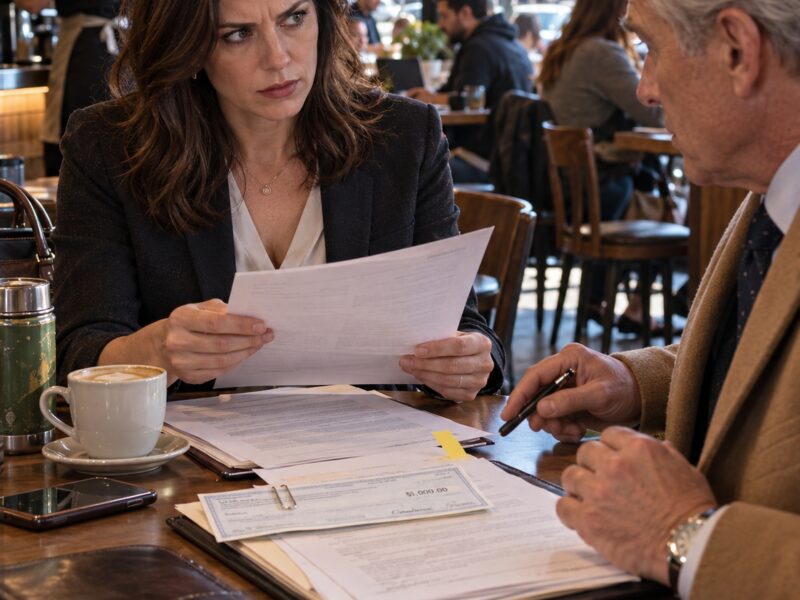
My Stepdad Mocked My Late Father in Front of My Mom—Then His Lawyer Found Me at a Coffee Shop With Papers I Had Never Signed
Two years after my mother laughed while her new husband called my late father “a man who never amounted to anything,” his lawyer found me at my morning coffee shop.
He set a deed beside my cup, offered me five thousand dollars for one signature, and casually claimed I had already signed away the orchard my father left me.
I appraise farmland for a living, and the lawyer’s mistake was assuming grief had made me forget the one thing my father taught me never to surrender: my name.
At 8:14 on a Tuesday morning, a man in a camel-colored overcoat sat across from me at a coffee shop on J Street and told me I had signed a deed I had never seen.
He said it gently.
That was the strange part.
No pressure at first. No raised voice. No dramatic envelope slid across the table like something from a movie. He simply set a leather folder beside my coffee, opened it to a page marked with a yellow tab, and smiled with the patient confidence of a man who believed the conversation was already over.
“Wendy Caulfield?”
“Yes.”
“Martin Pruitt. I represent Douglas Ashford.”
My stepfather.
I had not spoken Douglas’s name aloud in almost two years.
Martin noticed the pause but misread it as surprise rather than disgust.
“I realize this is unexpected,” he said. “I’ll keep it brief.”
He removed a two-page document.
A check was clipped to the front.
Five thousand dollars.
“For your time.”
I looked at the check.
Then at him.
“What am I signing?”
“Nothing complicated. A ratification and correction.”
He folded his hands.
“There was a clerical error in a deed you executed last year. The notarial certificate contains a county discrepancy, and the title company won’t insure the upcoming transaction until the record is cleaned up.”
I picked up the first page.
I did not touch the check.
Martin kept talking.
“Very routine. Your mother and Mr. Ashford are refinancing, and the lender wants clear title. Once you sign, everyone can move forward.”
I read the first paragraph.
Then the second.
My coffee cooled beneath my hand.
I am a certified general real-estate appraiser specializing in agricultural land. Banks hire me to value orchards, vineyards, dairies, ranches, and development acreage throughout California’s Central Valley.
I read deeds before breakfast.
I read easements in parking lots.
I have spent entire afternoons arguing over whether one faint line on a parcel map represented an access road, a drainage easement, or a surveyor’s mistake from 1973.
And according to the paper in front of me, I had executed a grant deed on March 11 of the previous year transferring my future ownership interest in thirty-eight acres of almond trees outside Visalia to my mother.
I had done no such thing.
The deed supposedly carried my signature.
The ratification in front of me said that I “confirmed and reacknowledged” that earlier conveyance as my free and voluntary act.
I looked up.
Martin was still smiling.
“Where did I sign the original deed?”
His smile changed by half an inch.
“I believe it was handled in Fresno.”
“By whom?”
“A notary.”
“That’s generally how notarization works.”
The smile disappeared.
I set the paper down.
“Mr. Pruitt, on March eleventh of last year, I was in Yolo County appraising a tomato operation outside Woodland.”
He opened his mouth.
I continued.
“It’s in my calendar. My mileage log. My assignment file. I probably still have the gas receipt.”
“There may be some confusion about the date.”
“There isn’t.”
I leaned forward.
“California notaries keep sequential journals for deeds affecting real property.”
He stopped moving.
“They record the signer’s identification.”
I watched color leave his face slowly, starting around his mouth.
“And they take a thumbprint.”
His hand moved toward the papers.
I put two fingers on the top page.
Not hard.
Just enough.
“So before I sign anything, I have one question.”
Martin looked at me.
“On March eleventh of last year, which thumb did I supposedly press into the notary’s journal?”
For the first time since he sat down, Martin Pruitt had no answer.
The espresso machine hissed behind him.
Someone laughed near the pastry case.
Outside, morning traffic moved along J Street as if nothing had happened.
Martin reached for his pen.
Then seemed to think better of touching it.
“I think,” he said carefully, “we should avoid jumping to conclusions.”
“I’m not jumping.”
“You haven’t seen the underlying file.”
“You just told me I signed a deed.”
“I said the record reflects—”
“You said I executed it.”
Martin looked toward the front window.
He had silver hair combed straight back and the kind of watch lawyers buy after the first decade they stop worrying about billable hours. I guessed he was around sixty.
He looked like a man who was accustomed to being the calmest person at any table.
That morning, I had taken that job away from him.
He lowered his voice.
“Closing is scheduled for the twenty-ninth.”
“What closing?”
“A refinance.”
“On what?”
He hesitated.
“The orchard and related property.”
That answer mattered.
My father’s orchard had never been collateral for anything while he was alive.
He hated debt with a farmer’s distrust of weather forecasts and bankers.
My grandfather had planted the first almond trees in 1978.
My father spent the next four decades keeping them alive.
The land had carried a mortgage once, when I was small.
He paid it off early.
I remembered the dinner when he brought the stamped release home and slid it under my mother’s plate like a birthday card.
Now Martin Pruitt was talking about a refinance.
“Who is the current borrower?”
He shifted.
“Your mother and Mr. Ashford’s development company are involved.”
“Involved how?”
“That’s beyond the scope of what I came here to discuss.”
“Then I’m not signing.”
He exhaled through his nose.
“Miss Caulfield, I don’t think you understand the consequences.”
I almost laughed.
That sentence had been said to me by property owners, attorneys, lenders, divorcing spouses, and one county supervisor who later discovered that wetlands regulations did not care how important he believed himself to be.
“I understand enough.”
Martin opened another door.
“The existing bank can call the loan if this refinance fails.”
I stared at him.
“Your mother’s house is additional collateral.”
That was the first time the word collateral had ever been attached to the home where my father died.
Martin watched my face closely.
“I’d hate to see Joanne lose the house over what may simply be a misunderstanding.”
There it was.
Not a threat exactly.
Something more refined.
A consequence laid on the table and pushed toward me.
I picked up my phone.
Martin stiffened.
I photographed the first page.
Then the ratification paragraph.
Then the preliminary title sheet beneath it before he closed the folder.
He did not stop me.
I think he was still deciding how much trouble he was in.
When he stood, he left a business card beside my coffee.
Martin J. Pruitt.
Attorney at Law.
Visalia, California.
“Call me when you’ve had time to think.”
“I already have.”
“You may think differently after speaking with your mother.”
That was the first time he mentioned her as leverage rather than a party to the transaction.
He walked away.
His untouched coffee sat across from me, a pale skin forming over the surface.
I watched him cross J Street without looking both ways.
Then I called my office, canceled my afternoon inspection, and went to my car.
I opened my laptop before starting the engine.
Two years earlier, my mother had laughed while Douglas Ashford insulted my dead father.
That was why I stopped speaking to her.
By lunchtime, I was beginning to understand that the insult had not been the worst thing Douglas had done to him.
At seven that evening, I sat cross-legged on the floor of my apartment with Tulare County’s recorder index open on my laptop and a yellow legal pad on my knee.
I had spent most of the afternoon collecting public records.
Parcel maps.
Recorded instruments.
Planning applications.
Corporate filings.
Nothing exotic.
Nothing private.
The same records I would use for any professional assignment.
It felt different when the name in the grantor column was mine.
Document number 202511482.
Recorded March 14, 2025.
Grant Deed.
Grantor: Wendy Caulfield.
Grantee: Joanne Ashford.
My mother.
I paid the fee and downloaded the image.
Two pages.
Clean office font.
My name typed beneath a signature that leaned sharply to the right.
I sign straight up and down.
Always have.
My father used to tease me that my handwriting looked like fence posts.
I enlarged the signature.
The W was wrong.
Too soft.
My real W began with a vertical stroke.
This one curved.
The lowercase f in Caulfield looped.
Mine never did.
Someone had practiced.
Not enough.
I scrolled to the notarial certificate.
Carla Benitez.
Notary Public.
Fresno County.
The venue at the top said Tulare County.
That was likely the clerical problem Martin wanted me to “correct.”
A county mismatch.
Something a title examiner had finally noticed.
I kept searching.
One month after the fraudulent grant deed came a deed of trust.
Borrower: Ashford Ridge Development LLC.
Trustor: Joanne Ashford.
Beneficiary: Sierra Crest Bank.
Original principal balance: $1.4 million.
Secured by the orchard.
My mother had signed it.
That part looked real.
I knew her handwriting.
The J slanted left.
She still dotted the i in her maiden name even when writing quickly.
The loan was not for farm improvements.
I pulled corporate records for Ashford Ridge Development.
Douglas controlled it.
The address matched an office complex in Fresno.
Several projects.
Two active.
One in trouble.
A retail development near Clovis carried mechanic’s liens.
A small apartment project had been delayed.
I looked at the preliminary title report I had photographed from Martin’s folder.
Proposed lender: Golden Delta Bank.
Proposed policy amount: $3.2 million.
Three point two million dollars.
The orchard itself, as agricultural ground, was not worth that.
Not even close.
Which meant somebody was valuing the land for another use.
I opened the county planning portal.
Typed the parcel number.
There it was.
Pre-application.
Asheford Ridge Development.
Residential subdivision.
One hundred forty-one lots.
Working title:
Caulfield Ranch Estates.
I stared at those words until they blurred.
Caulfield.
My father’s name.
My grandfather’s name.
Mine.
Douglas Ashford was planning to pull out my father’s trees, divide the land into suburban lots, pour curbs and sidewalks over the irrigation lines, and sell houses beneath a sign carrying the name of the man he had mocked at Thanksgiving.
My phone lay beside me.
I did not call my mother.
Two years of not calling is a muscle.
Mine held.
Instead, I switched to satellite view.
Thirty-eight acres east of Visalia.
Long green rows.
The equipment shed.
The old farmhouse.
A faint line of pink dots across the northwest block.
Survey stakes.
I zoomed until the image pixelated.
Then I closed the laptop.
Because suddenly I could smell the orchard.
Dust.
Almond hulls.
Diesel.
The faint mineral smell of well water hitting dry ground.
And black coffee from a dented green thermos.
When I was eight, my father began taking me out to the trees before sunrise.
My mother hated it.
First she said girls needed sleep.
Then she said girls should help her in the kitchen.
Eventually she stopped arguing and simply sighed when I came in with dirt on my knees.
Dad carried a green Stanley thermos with a dent along the side from the time it fell off the tractor.
He drank coffee black.
He poured me a little into the cap and cut it with milk from a glass jar.
We would stand at the end of a row while the sky turned from gray to gold.
Sprinklers clicked.
Birds woke.
Dad taught me soil before numbers.
He would crouch beside a tree and press his thumb into the ground.
“Thumb test.”
Dry crumbs meant irrigate.
Dark smear meant wait.
He made me do it until I stopped guessing.
“Land tells you what it needs,” he said. “People just get loud enough that they stop listening.”
At the northwest corner, my grandfather had set a brass survey marker into concrete.
Dad showed it to me once.
Numbers stamped into the metal.
“That’s where everything starts.”
“What?”
“Every property line.”
He tapped the marker.
“Somebody argues where our land ends, this wins.”
I crouched and touched it.
Cool metal.
Permanent.
My grandfather Walt was louder than my father.
He believed volume proved ownership.
At dinner he regularly told stories where he was the hero and Dad was the helper.
“Ray never would’ve kept this place going without me.”
My mother would laugh.
A bright, quick laugh.
Dad would pass the potatoes.
I asked him once why he let Grandpa talk that way.
We sat on the porch after dinner.
Dad took a long time answering.
“Loud doesn’t mean right, kiddo.”
Then he looked out toward the orchard.
“Land doesn’t care who yells at it.”
I took that lesson too far.
Dad was quiet because he was paying attention.
I became silent because silence hurt less.
I did not understand the difference until after he died.
The last time I heard my mother use that bright little laugh was Thanksgiving 2024.
Dad had been gone two and a half years.
Cancer.
Slow enough for goodbyes.
Fast enough that none of them felt complete.
My mother married Douglas the following summer.
He was a developer from Fresno.
A widower.
White teeth.
Navy sport coats.
The kind of man who stood in other people’s rooms as if he had signed the lease.
My mother said he made her feel safe.
I tried to be happy for her.
I really did.
At Thanksgiving, I drove three hours with an apple pie from Dad’s favorite bakery.
There were six people at the table.
Mom.
Douglas.
Two couples he knew.
Me.
Dad’s photograph used to sit on a shelf facing the dining table.
That afternoon, somebody had put a decorative platter in front of it.
Only the top of his hat showed.
Douglas carved the turkey standing up.
He talked about interest rates.
Growth corridors.
Residential demand east of Visalia.
“The upside on this dirt is going to surprise people.”
He gestured toward the windows.
One of his friends asked who had farmed the orchard before.
Douglas smiled.
“Ray?”
He carved another slice.
“Ray was a man who never amounted to much.”
My fork stopped halfway to my mouth.
“Thirty-eight acres and a pickup with a bad clutch.”
His friends laughed.
Then my mother laughed.
That bright little laugh.
She touched Douglas’s hand.
I put my fork down.
“Mom.”
The room quieted.
“Are you going to let him say that?”
Her face went pink.
“Doug was joking.”
“He called Dad nothing.”
“Wendy.”
“It’s Thanksgiving.”
“Don’t make a scene.”
I looked at the top of Dad’s hat behind the platter.
Then I stood.
Put the unopened pie on kitchen counter.
Took my coat.
Nobody followed me.
I drove three hours home in darkness without radio.
At 11:40 p.m., Mom sent one text.
You embarrassed me in front of Doug’s friends.
That was all.
I read it twenty times.
Put my phone facedown.
Did not answer.
She never sent another.
That is how two years of silence begin.
Not with a slammed door.
With one message unanswered and another message that never comes.
I wish I could say I spent those two years feeling strong.
Mostly I stayed busy.
I worked.
Drove.
Wrote reports.
On Mother’s Day, I bought a card and wrote MOM on envelope.
It remained in my desk drawer.
On Dad’s death anniversary, I carried his green thermos to work and drank black coffee from cap.
Nobody asked why.
Mom did not call on my birthday.
I did not call on hers.
Each of us waited for apology.
Each believed the other owed it first.
Then, six months before Martin found me in the coffee shop, Hector Ruiz left me a voicemail.
Hector had farmed the orchard under lease since Dad became too sick to do it.
He had known me since diapers.
“Wendy, it’s Hector.”
Pause.
“There are men out here putting stakes between Ray’s trees.”
“Pink flags.”
“Don’t know what it’s about.”
“Call me.”
I listened from a parking lot in Merced.
Then did nothing.
That mattered.
I told myself the life estate belonged to Mom.
My father’s will had given her the right to live on and use the orchard for her lifetime, with the remainder coming to me after her death.
Whatever she did during her life was her business.
That was what I told myself.
More important, I told myself silence was what Dad would have done.
While I was busy being dignified, somebody had gone into a notary office, signed my name, and pressed another woman’s thumb into a journal.
I worked in a profession built around checking stories.
And I had failed to check my own family because checking would have required speaking.
The morning after I found the planning application, I arrived at my office before my staff.
My firm occupied the third floor of a brick building on J Street.
Two junior appraisers.
One administrative assistant.
A reputation for being slow and right.
Banks hired me.
Courts hired me.
Once, a divorce lawyer told me my best professional quality was that everyone left the room equally annoyed.
I considered it a compliment.
I opened the photographs from Martin’s folder.
The preliminary title report.
The proposed $3.2 million policy.
Then the ratification.
It said I was confirming that the 2025 deed was my “free and voluntary act.”
If I signed, I would not be fixing a typo.
I would be validating the forgery.
I called Naomi Ferrante.
Naomi practiced real-estate litigation near Sacramento.
She had hired me for valuation work several times and had never once told me something simply because she thought I wanted to hear it.
She saw me that afternoon.
I laid out everything.
Public-record deed.
Deed of trust.
Planning application.
Photos from coffee shop.
Naomi read silently.
When finished, she removed her glasses.
“A forged deed is void.”
I nodded.
“It’s not voidable?”
“Void.”
She tapped the deed.
“If you didn’t sign this, your remainder interest never transferred.”
“What about Sierra Crest?”
“The bank can’t get more than the borrower owned.”
“My mother has a life estate.”
“Yes.”
“Your remainder remains yours.”
“Which means?”
“Which means they need you.”
She tapped the ratification.
“If you sign this, you’re not correcting the notary.”
“You’re making the fraudulent transfer effective.”
My stomach turned.
“So I don’t sign.”
“You don’t sign.”
“You don’t call Douglas.”
“You don’t email his lawyer.”
“You don’t accuse anybody yet.”
“Why?”
“Because right now you know enough to be alarmed, not enough to prove who did what.”
She picked up a pen.
“Who notarized it?”
“Carla Benitez.”
“Where?”
“Fresno.”
Naomi wrote.
“Request the journal entry.”
“In writing.”
“Specific date, signer, document.”
“She’s required to provide a certified copy if the request meets statutory requirements.”
Then Naomi looked at me over her glasses.
“One more thing.”
“Your mother signed the later deed of trust.”
“I know.”
“If this turns into litigation or investigation, she gets pulled in.”
“I know.”
“You need to decide whether you’re prepared for that.”
I said yes.
I was lying.
The next morning I drove south on Highway 99 with a typed request in a manila envelope and Dad’s thermos in the cup holder.
Carla Benitez operated from a small office in North Fresno between a nail salon and a phone-case shop.
A sign advertised notary, tax preparation, and live scan.
She was in her forties.
Cardigan.
Hair pulled back.
Careful eyes.
When I explained the request, she did not immediately open her journal.
She asked for the written letter.
Read it twice.
Asked for my driver’s license.
Then unlocked a cabinet.
The journal was thick, red, sewn at the spine.
She turned pages slowly.
March 11, 2025.
“Here.”
She rotated the book toward me.
Signer: Wendy Caulfield.
Document: Grant Deed.
Identification: California driver’s license ending 4471.
Signature slanting right.
Thumbprint in black ink.
At bottom, Carla had written a note.
Accompanied by Douglas A. — stepfather — paid cash.
I read it twice.
Douglas had been there.
Carla watched my face.
“I remember them.”
“The signer?”
“Yes.”
“Blonde woman.”
My hair is dark brown.
“She was probably late forties.”
I was forty.
“Sunglasses on head.”
“Mr. Ashford did most talking.”
“He said she was nervous about paperwork.”
I placed my driver’s license beside journal.
Last four digits:
Carla stared.
Then at me.
Then back at the book.
Her face changed.
“Can I ask you something?”
“Of course.”
“Do you have an ink pad?”
She did.
I pressed my right thumb into black ink.
Then onto clean paper beside the photocopy she made.
My father’s thumb test.
Different ground.
Same idea.
My actual print was a whirl.
Tight circular pattern.
The journal print was a loop.
It entered from one side and curved back.
You did not need an expert.
A child could see it.
Carla covered her mouth.
“Oh my God.”
I wiped my thumb with baby wipe she offered.
“I’m so sorry.”
“You did what law required.”
“I checked identification.”
“Whose?”
Her face fell.
“I don’t know.”
That was the painful truth.
A convincing fake license.
A borrowed identity.
Somebody close enough to know my information.
Carla sat at computer.
Without my asking, she wrote a statement.
Date.
Appearance.
Douglas’s presence.
What he said.
Who paid.
Then had another notary in the strip mall notarize her declaration.
She told me she would report the discrepancy to the Secretary of State.
I thanked her.
Put certified journal entry and statement into envelope.
My hands shook.
I had what I came for.
I had never felt less like I had won.
In the parking lot, I called Hector Ruiz.
He answered on second ring.
“Took you long enough, mija.”
No anger.
That was worse.
“I’m sorry.”
“Don’t be sorry.”
“Listen.”
Douglas had brought survey crews twice.
April.
August.
In September, he told Hector not to buy fertilizer for next season.
“He says old trees come out next fall.”
Hector paused.
“I’ve been watering what I can.”
“He cut budget.”
“They’re thirsty.”
I looked at steering wheel.
“Mom knows?”
“I don’t know what she knows.”
“She doesn’t come out anymore.”
“Used to walk rows every evening after Ray died.”
“Now she stays in house.”
Something shifted.
Until then, I had treated Mom as either participant or victim.
Maybe she was both.
Maybe neither.
Maybe there were facts I still did not know.
I told Hector I would come down soon.
When I hung up, my phone buzzed with unfamiliar 559 number.
I let it go to voicemail.
It called again immediately.
I answered.
Douglas.
His voice was warm.
Almost tender.
“Wendy.”
“Look, I know we didn’t get off on right foot.”
I said nothing.
“And some things were said that came out wrong.”
Silence.
“Water under bridge?”
Still nothing.
Most people fill silence if you let them.
Douglas did.
“Martin says you’re confused about deed.”
“He understands.”
“Grief does strange things to memory.”
“He said you signed it last spring because things were rough with your mom.”
“You didn’t want anything to do with place.”
“That’s not true.”
“I’m not accusing you of lying.”
He laughed softly.
“I think you’ve forgotten.”
“Did you watch me sign it?”
Silence.
Half a second.
Long enough.
“Martin handled paperwork.”
“I wasn’t involved.”
I looked at journal copy on passenger seat.
Accompanied by Douglas A.
“Okay.”
“Look, I want to make this easy.”
“Twenty-five thousand.”
“For what?”
“Sign ratification.”
“Call it a thank-you.”
“For being adult.”
I almost smiled.
“I’ll think about it.”
His voice changed.
Not louder.
Flatter.
“Let me explain what you’re thinking about.”
“If Golden Delta doesn’t close on twenty-ninth, Sierra Crest calls existing loan.”
“Your mother’s house is collateral.”
“She loses it.”
“Everything your old man left her.”
“And you’ll be reason.”
“You.”
“Not me.”
Then he hung up.
I sat in my car and wrote everything he said.
Word for word.
Time.
Date.
Just as I would document an interview with a landowner.
That night I did not sleep.
At 7:02 the next morning, my phone lit.
Mom.
I had never changed the contact.
I let it ring three times.
Then answered.
Neither of us spoke.
For several seconds, two women who had not spoken in almost two years listened to each other breathe across two hundred miles.
“Wendy.”
Her voice was thinner than I remembered.
“It’s your mother.”
“Hi, Mom.”
First words I had said to her since Thanksgiving.
She did not ask how I was.
She went straight to script.
“Doug says you signed that deed through Martin’s office.”
“He said you didn’t want to see me.”
“That you didn’t want anything to do with property.”
“I understood.”
“I didn’t like it.”
“But I understood.”
“So I don’t know why you’re doing this now.”
“Martin says it’s only correction.”
“Just sign it.”
“Please.”
I sat up.
“Mom.”
“Did you watch me sign the deed?”
Silence.
“Did you see me in Martin’s office?”
Nothing.
“Did you see me in Fresno?”
Nothing.
“Did you see my signature on anything before Doug brought it home?”
The line remained silent.
In that silence, for the first time, I believed she might not have known.
Not because she was innocent of everything.
But because Douglas had told her a story that fit something she already feared.
Her daughter had left.
Her daughter had stopped calling.
Her daughter wanted nothing to do with her.
A lie is easiest to sell when it resembles a wound.
Then Mom began crying.
Not loud.
She never cried loudly.
“I can’t lose this house.”
“I can’t lose it too.”
“It’s all I have left of your father.”
Something inside me loosened.
I almost said okay.
Almost said I would drive down.
Almost said we would fix it together.
Then she said:
“You always loved that dirt more than you loved me.”
And hung up.
I stared at phone.
Eight years old again.
Mud on knees.
Her sigh at sink.
Thirty-nine.
Pie in bakery box.
That sentence had been sitting inside her a long time.
Maybe some of it was true.
I loved the orchard.
It was where Dad and I understood each other without talking.
Mom had always felt excluded from that language.
But the trees were not why I left Thanksgiving.
And protecting my name was not choosing dirt over her.
That night, I called Naomi.
We mapped options.
If I signed:
Mom kept house for now.
Douglas received refinance.
Forged deed became effective.
Subdivision moved forward.
Trees came out.
If I did nothing:
Closing failed.
Existing lender might accelerate loan.
Mom faced consequences without understanding why.
If Naomi sent evidence immediately:
Title company stopped closing.
Lenders froze.
Mom learned truth through lawyer letter.
“The letter is safe,” Naomi said.
“You don’t need to be there.”
I looked at Dad’s green thermos on my counter.
“Yes.”
“I do.”
Naomi was quiet.
“She has to hear it from me.”
“You may lose her.”
“I already did.”
“That’s not same as losing her while looking at her.”
I knew.
Still:
“I’m going.”
Naomi exhaled.
“Then we do it properly.”
Monday morning, October twenty-sixth, I drove to orchard.
First time in almost two years.
I parked on dirt shoulder near mailbox Dad used to repaint every spring.
Walked between rows.
Late October.
Leaves yellowing at edges.
Ground hard.
Pink survey stakes cut through northwest block.
Orange spray-painted numbers on trunks.
I found brass marker in corner.
Grandfather’s numbers still stamped.
Beside it:
New stake.
Black marker.
LOT 1.
I crouched.
Pressed my thumb into soil.
Held it.
Pulled it up.
Pale.
Dry.
The trees were thirsty.
Douglas had already stopped caring for something he planned to destroy.
I stood.
House was visible beyond rows.
Kitchen light on.
A figure moved at sink.
My mother.
I could have walked up.
Knocked.
I did not.
Not yet.
Instead, I emailed Martin.
I will appear at Valley Oak Title on October 29 at 10:00 a.m. to address the document in person.
He replied four minutes later.
Excellent. Please bring valid photo identification.
I laughed.
Actually laughed.
He had no idea what he had just asked me to bring.
The next day Naomi prepared affidavit.
I swore I had never signed, seen, or authorized 2025 deed.
Her notary took my thumbprint.
That made me laugh again, then nearly cry.
We built file.
Certified journal entry.
Carla’s statement.
My assignment calendar.
Mileage log.
Gas receipt from Woodland at 7:46 a.m.
Driver’s license.
Actual thumbprint.
Whirl beside loop.
Naomi explained timing.
“The minute title company sees this, they must stop.”
“If I send it now, Douglas may cancel meeting.”
“So?”
“I send it one hour before.”
“Everybody already traveling.”
“Closing dead.”
“But room still happens.”
“What do you want from room?”
She asked.
“Not legally.”
“You.”
I thought.
“I want deed gone.”
“Trees left alone.”
“And I want Mom to know what he did with my name.”
That evening Douglas texted me photo of forged signature.
Circled red.
See your own hand. Let’s be adults.
I saved screenshot.
Did not answer.
The next afternoon Martin called.
His voice was tired.
He said Golden Delta loan officer wanted to join by speakerphone because Douglas had told bank “family was aligned.”
Mom would attend.
A mobile notary would be there.
An hour later Douglas texted:
Bring ID. Notary needs it.
Perfect.
He had gathered lender.
Lawyer.
Title company.
My mother.
Notary.
He thought he was arranging ceremony.
He thought I would be too ashamed to accuse him in front of a bank.
In three years of being married to my mother, Douglas had never asked what I did for a living.
That failure of curiosity was about to cost him more than money.
The night before closing, I checked into a motel on Mooney Boulevard.
Two stories.
Empty pool.
Air conditioner rattled.
I ate a sandwich standing up.
Washed Dad’s thermos in bathroom sink.
Filled it next morning with black coffee.
I tried writing speech.
First draft angry.
Second worse.
Tore both up.
I decided to read their language.
Not mine.
Lying in dark, I remembered last real conversation with Dad.
Hospital.
Three days before he died.
He was too tired to lift his head.
“Keep trees if you can.”
Then he squeezed my hand.
“If you can’t keep trees, kiddo, keep your name.”
At time I thought he meant property.
That night I understood he might have meant something larger.
At 9:52 a.m., I parked outside Valley Oak Title.
Low stucco building near courthouse.
Dry fountain out front.
Conference room had long laminate table and speakerphone shaped like black starfish.
Naomi already there.
Gray suit.
Reading glasses on chain.
Escrow officer Dana Whitfield stood when I entered.
Younger than me.
Composed.
She shook my hand.
Set pen parallel to edge of table.
Did not pick it up again.
She had already read Naomi’s evidence.
At 9:58, Douglas arrived.
Navy sport coat.
No tie.
Martin behind him.
My mother behind both.
Mom was thinner.
Hair almost completely white.
She wore pearl earrings Dad gave her for thirtieth anniversary.
She looked at me for one second.
Then down.
Douglas walked straight to Naomi.
Hand extended.
“Doug Ashford.”
“Naomi Ferrante.”
“I’m Miss Caulfield’s attorney.”
His smile remained.
Only eyes changed.
A mobile notary sat in corner.
Journal open.
Speakerphone chimed.
“Brent Howard, Golden Delta. I’m on.”
Douglas sat at head of table as if it belonged to him.
Martin opened folder.
Slid ratification toward me.
“Page three.”
Yellow sticky flag.
I did not touch pen.
I looked at Dana.
“Before anyone signs, may I read one paragraph aloud?”
Dana looked at Naomi.
Then me.
“I think you’d better.”
I turned to page three.
Read slowly.
“Grantor hereby ratifies, confirms, and reacknowledges that certain grant deed executed by Grantor on March 11, 2025, and recorded March 14, 2025, as Document Number 202511482, Official Records of Tulare County, and declares that said instrument was her free and voluntary act.”
I put page down.
“I did not sign that deed.”
Douglas sighed theatrically.
“Wendy—”
Naomi raised one finger.
He stopped.
I continued.
“On March eleventh, 2025, I was in Yolo County appraising a tomato farm outside Woodland.”
I placed calendar.
Mileage log.
Gas receipt.
One at a time.
“California notaries are required to maintain journal entries for deeds affecting real property.”
I placed certified journal copy.
“This is entry for deed.”
“Signer identified as Wendy Caulfield.”
I placed my driver’s license.
“The journal says license ending 4471.”
“Mine ends 0928.”
On speakerphone, Brent cleared throat.
“Ms. Whitfield, can you confirm those numbers?”
Dana did.
Silence.
I set actual thumbprint beside copied journal print.
“That loop is thumbprint of person who signed my name.”
“This whirl is mine.”
Dana leaned forward.
The mobile notary stood without realizing she had.
Martin’s face drained.
Then I lifted journal copy again.
“One more line.”
I looked at my mother.
“The notary wrote: ‘Accompanied by Douglas A. — stepfather — paid cash.’”
Mom slowly turned toward her husband.
Douglas laughed.
Warm.
Easy.
The laugh of a man who had escaped rooms like this before.
“Okay.”
“Look, I didn’t want to do this publicly.”
He leaned back.
“Wendy hasn’t been well since her father died.”
I felt Naomi’s hand flatten against table.
Douglas continued.
“She signed deed.”
“She doesn’t remember.”
“Now she wants land.”
“That’s all.”
I said:
“Then let’s call Carla Benitez.”
“Ask her who sat across from her.”
Douglas waved hand.
“A strip-mall notary?”
“They make mistakes constantly.”
“Name number, Wendy.”
“Seriously.”
“Let’s end this.”
I did not answer.
He turned to Mom.
“Jo.”
“Tell them.”
“Tell them she signed.”
Mom’s hands were folded in lap.
She stared at thumbprints.
Then note.
Then Douglas.
When she spoke, barely whisper.
“You told me she signed at Martin’s office.”
Douglas opened mouth.
“You said Martin handled it.”
Martin removed his glasses.
Set them on folder.
I saw his face go pale for second time that week.
“Ms. Whitfield.”
“For record, I never saw Miss Caulfield sign original deed.”
Douglas turned.
“Martin.”
“I prepared document at Mr. Ashford’s request.”
“He returned it to my office already executed and notarized.”
“He told me Miss Caulfield signed in Fresno for convenience.”
Martin closed folder.
“I’m withdrawing as counsel, Doug.”
“Effective immediately.”
“You’ll need separate representation.”
Douglas stared at him.
The man who told me Martin handled everything had just watched Martin refuse to handle anything else.
Dana muted speakerphone.
Room quiet except air conditioner ticking.
Then:
“Valley Oak Title will not close this transaction.”
“We will notify title underwriter.”
“We will notify Sierra Crest Bank.”
She unmuted.
Brent spoke.
“In light of information presented, Golden Delta is withdrawing loan commitment effective immediately.”
He thanked everyone.
Call ended.
Three point two million dollars disappeared from room in about ninety seconds.
Douglas pulled new loan papers toward Mom.
“Sign your part.”
“We’ll fix rest.”
“I’ll fix it.”
Mom looked at pen.
Picked it up.
Put it down.
Then placed hands in lap.
“I’m not signing anything else today.”
Not loud.
But I had never in my life heard my mother tell a man no in public.
Douglas stood so fast chair hit wall.
He looked at her.
Then me.
Then Naomi.
He walked out.
Glass door swung shut behind him.
Martin gathered papers slowly.
He paused beside me.
“Miss Caulfield.”
That was all.
He nodded.
I nodded.
Naomi touched my shoulder.
“I’ll be outside.”
Dana followed.
Then conference room held only my mother and me.
Speakerphone.
Unsigned papers.
Two thumbprints.
Mom did not look at me for a long time.
When she did, her eyes were wet.
“Did you really think I knew?”
I answered truthfully.
“I didn’t know what you knew.”
“That’s what two years does.”
She touched paper with my thumbprint lightly.
Like a photograph.
Then pulled her hand away.
“I thought you signed it because you hated me.”
The sentence was so naked I could not answer immediately.
“Why would you think that?”
“You stopped talking to me.”
“You laughed when he insulted Dad.”
“I know.”
“Then you texted that I embarrassed you.”
“I know.”
“You never apologized.”
“I was angry.”
“So was I.”
“No.”
She shook her head.
“You were hurt.”
“I was angry because you made me look foolish.”
“That’s different.”
I stared.
For first time, Mom was not defending herself.
Not exactly.
She was naming ugliness.
“That still doesn’t explain why you believed I gave away my share.”
She looked toward door Douglas had exited.
“He said you wanted nothing from us.”
“He said you told Martin you were done with orchard.”
“He said you wanted clean break.”
“Did you ever ask me?”
“No.”
“Why?”
Her mouth trembled.
“Because I was afraid you’d say yes.”
That was midpoint truth.
Douglas had not invented our silence.
He exploited it.
Mom had helped by preferring a painful assumption over risk of hearing it directly.
And I had helped by disappearing.
Nobody forged my signature except the people who physically did it.
But the empty space around forgery belonged partly to all of us.
A week later, Mom called.
“Will you come to house?”
“Just you?”
“Yes.”
Douglas had moved to hotel in Fresno.
I drove down November fifth.
Mom stood on porch wearing Dad’s old barn coat over sweater.
His photograph was visible through window.
Back in front of decorative platter.
She had moved it.
She poured coffee into Dad’s chipped brown mug.
I had thermos.
She told me Douglas called every day.
He had new lawyer.
An offer.
He would sign property back.
Pay Sierra Crest.
Withdraw subdivision.
Everything returned.
All I had to do was sign statement calling matter a family misunderstanding so district attorney would close file.
Mom held mug in both hands.
“We could have Thanksgiving here again.”
“All of us.”
“Like family.”
For a moment, I saw it.
Pie.
Table.
Her laughing at something I said.
Then I looked at Dad’s photograph through window.
Remembered motel.
Hospital.
Keep your name.
“I’m not signing anything that says it didn’t happen.”
“Not for him.”
“Not for house.”
“Not even for you.”
Mom’s face tightened.
I raised hand gently.
“I filed sworn statement with district attorney this morning.”
“Naomi filed quiet-title action two days ago.”
“It’s done.”
I placed envelope on porch rail.
Copies.
Then business card.
“Linda Okafor.”
“Real-estate and family attorney in Visalia.”
“She’s yours.”
“Not mine.”
“I paid initial retainer.”
Mom stared.
“Why?”
“Because you signed deed of trust.”
“You need someone whose only job is protecting you.”
“I can’t be that lawyer.”
“And Naomi can’t.”
Mom pressed card beneath thumb.
I stood.
“When you want to talk about Dad without Douglas in room, call me.”
“Just you.”
“I’ll answer.”
“I promise.”
She did not respond.
Held envelope to chest.
I walked down porch steps.
This time I was not fleeing.
I was leaving a door open.
It took paper about four months to catch truth.
Sierra Crest agreed to stipulated judgment canceling forged deed once evidence became impossible to defend.
Its lien never attached to my remainder interest.
Other consequences were messier.
Douglas’s company lost Golden Delta financing.
Sierra Crest called portions of existing loan.
A commercial project stalled.
The subdivision application was withdrawn.
District attorney opened investigation.
The woman who appeared before Carla using my identity turned out to be Renee Kowalski, Douglas’s office manager.
She had access to employee records.
Copy of my license from an old development inquiry.
My address.
Birth date.
Douglas had arranged the rest.
Martin was interviewed.
Carla cooperated fully.
My mother filed for legal separation in December.
With her permission, Linda told me Mom had given investigators a shoebox full of documents Douglas asked her to sign over three years.
She had not read many.
That hurt in a different way.
My mother had not only allowed him to diminish my father.
She had allowed herself to disappear inside someone else’s certainty.
I recognized pattern more than I wanted to.
In January, a card came to my office.
Fresno postmark.
Carla Benitez.
She wrote that after what happened, she changed her routine.
When someone signs a deed, she now asks casual questions while checking ID.
Mother’s maiden name.
Father’s birthday.
Something difficult to fake smoothly.
Thank you for showing me what I missed.
I pinned card above desk.
In late February, Hector texted.
Photo.
White blossoms.
Blooms early, mija.
I drove down before dawn Saturday.
Hector and two workers were pulling final survey stakes from northwest block.
Pink flags tossed into truck.
The orchard was in bloom.
Every tree white.
Air smelled faintly of honey.
Bees worked.
Brass survey marker sat in concrete.
Nothing beside it.
Just my grandfather’s numbers.
The screen door opened.
Mom came down from porch.
Dad’s barn coat.
First time in years, Hector later said, that she had walked into trees.
She stopped a few feet from me.
I could tell she had rehearsed.
Then watched her abandon speech.
“He was wrong about your father.”
I waited.
“I was wrong to laugh.”
Her voice shook.
“And I was wrong to let him put my hand on papers without asking you.”
She swallowed.
“I’m sorry, Wendy.”
No explanation.
No request for forgiveness.
Just apology.
Cold air moved through blossoms.
I held out Dad’s green thermos.
Mom looked at it.
Took it.
Unscrewed cap.
Poured black coffee.
Steam rose between us.
Then handed cap to me.
The same thing Dad did every morning when I was eight.
I drank.
Coffee bitter.
Hot.
Perfect.
Then I crouched beside nearest tree.
Pressed my thumb into soil.
Held it.
Pulled it up.
Dark.
The trees had water.
I stood.
Opened my phone.
Signed up for county recording alert on parcel.
If anyone ever filed document with my name again, I would know within a day.
Mom watched.
“Still don’t trust me?”
The old version of me might have lied.
Instead:
“I’m learning not to confuse trust with not checking.”
She considered.
Then nodded.
Fair.
I looked down row.
“Sunday mornings.”
“What?”
“Here.”
“Just us.”
“Coffee in rows.”
Her eyes filled.
She did not wipe them.
“Okay.”
We stood beneath white blossoms while sun came over Sierra.
Douglas Ashford had called my father a man who never amounted to anything.
Ray Caulfield amounted to thirty-eight acres that still carried his name.
A widow who finally walked back into his orchard.
A daughter who knew how to read a deed.
And one lesson I learned later than he intended.
Quiet is not silence.









