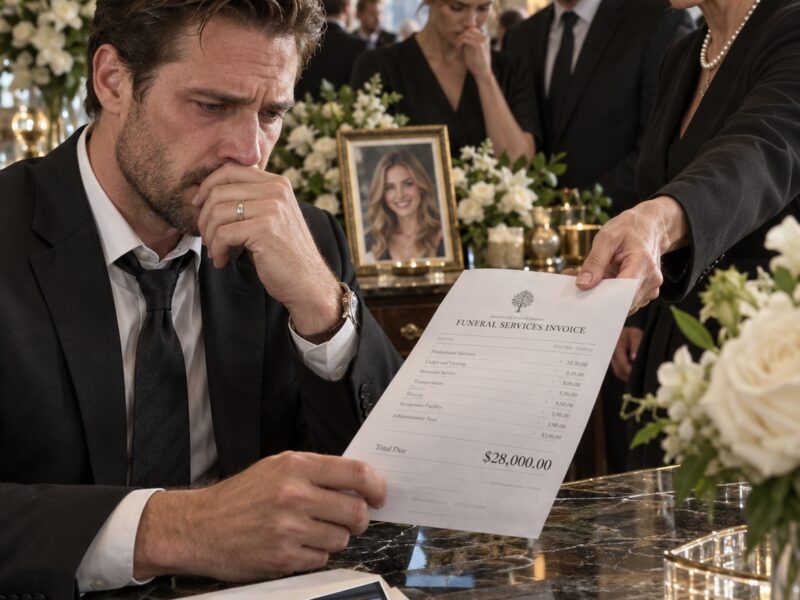
My Wife Died in Another Man’s Apartment—Then Her Family Handed Me a $28,000 Funeral Bill Before I Found Out What They’d Been Hiding for Years
There is a kind of silence hospitals reserve for people whose lives have already changed but whose bodies have not caught up yet.
I learned that at 3:58 on a Wednesday morning.
My name is Daniel Foster.
I was thirty-six years old, a forensic auditor for a national accounting firm, and until that night I believed my strongest professional skill was recognizing when numbers did not match the story being told about them.
I had spent thirteen years tracing missing money.
Expense reports.
Shell companies.
Invented vendors.
False invoices.
Executives who smiled across polished conference tables while quietly stealing from people who trusted them.
I had always believed I was difficult to deceive.
That belief survived exactly four hours after my wife died.
The hospital called at 3:12 a.m.
A woman asked if I was Daniel Foster.
“Yes.”
“Are you the husband of Lauren Foster?”
My body went cold before my mind understood why.
“Yes.”
“There’s been a medical emergency.”
“What happened?”
“Mrs. Foster experienced cardiac arrest.”
Everything after those words became fragments.
“Where?”
“She’s at St. Catherine Medical Center.”
“Is she alive?”
A pause.
Not long.
Long enough.
“The emergency team is still working.”
I was already pulling on jeans.
“What happened?”
“I think the physician should speak with you when you arrive.”
That answer bothered me.
Not then.
Later.
Everything bothered me later.
I drove twenty-three minutes in fourteen.
Ran two lights.
Left three voicemails on Lauren’s phone.
The first said, “I’m coming.”
The second said, “Please call me.”
The third was mostly breathing.
I still have never listened to them.
At the hospital, an ICU nurse stopped me before I reached the family waiting room.
Her name was Teresa Alvarez.
I would remember that name for the rest of my life.
She was maybe fifty, calm-eyed, hair pulled tightly into a bun, the kind of person whose voice sounded steady because she had spent decades learning exactly how much truth a frightened human being could absorb at once.
“Mr. Foster?”
“Yes.”
She touched my arm.
“Before you go in there…”
I looked toward the doors.
“What?”
Her expression changed.
Not pity.
Something more deliberate.
“Walk in with your eyes open.”
I stared at her.
“What does that mean?”
She looked as though she wanted to answer.
Professional rules stopped her.
“Just…pay attention.”
Then she opened the door.
I walked in.
My mother-in-law, Marlene Shaw, sat nearest the window.
Her husband, Richard, beside her.
Lauren’s younger brother, Evan, against the wall with his phone.
And beside Marlene sat a man I had never seen before.
Mid-forties.
Tan skin.
Expensive shirt wrinkled at the waist.
Shoes without socks.
Red eyes.
Hands clasped together.
Marlene looked at me.
Her first word was:
“Finally.”
Not Daniel.
Not She’s still alive.
Not The doctors are trying.
Finally.
I stopped.
The stranger looked at me.
Then away.
Richard shifted in his chair.
Evan kept scrolling.
I looked from one face to another.
“What happened?”
Marlene sighed.
“She collapsed.”
“Where?”
Nobody answered immediately.
That was the first discrepancy.
I repeated the question.
“Where did Lauren collapse?”
Richard finally spoke.
“Maybe we should wait for the doctor.”
I stared at him.
“Where?”
The stranger’s hands tightened.
Marlene looked at him.
Not me.
That was the second discrepancy.
“Who is he?”
Silence.
The man glanced toward the floor.
Marlene’s jaw tightened.
“This is not the time.”
My wife was three doors away possibly dying.
A stranger was sitting beside her mother.
And somehow I was the person violating decorum.
I moved closer.
“What is your name?”
The man opened his mouth.
Marlene answered for him.
“Daniel, stop.”
I looked at her.
She had spent twelve years correcting other people’s emotional volume as though she owned it.
Tonight was no different.
“He was with Lauren when she collapsed,” Richard said quietly.
There.
Not enough.
But something.
I looked at the stranger.
“Where?”
He rubbed both palms against his knees.
“My apartment.”
The room changed shape.
Not loudly.
Nothing dramatic happened.
No one screamed.
No music swelled.
The fluorescent lights remained exactly as ugly as before.
But something inside me registered a fact before I had any emotional category large enough to hold it.
My wife had suffered cardiac arrest in another man’s apartment at night.
And her family was already sitting with him.
Comfortably.
Familiar enough that nobody had thought to introduce us.
“How do you know my wife?”
He looked toward Marlene.
I noticed that.
I notice things for a living.
“My name is Ryan Blake.”
“That was not what I asked.”
His face tightened.
“We’re friends.”
Marlene stood.
“Daniel.”
“Friends.”
“Yes.”
“At three in the morning.”
Ryan looked miserable.
Not guilty.
Not exactly.
Miserable like someone had lost something.
That distinction frightened me.
Before I could continue, the attending physician entered.
Everything else disappeared.
“Mr. Foster?”
“Yes.”
“I’m Dr. Campbell.”
I remember his eyes.
Gentle.
Tired.
“I’m very sorry.”
The sentence ended my marriage before I understood that most of the marriage had apparently ended somewhere else.
Lauren was pronounced dead at 4:19 a.m.
Sudden cardiac arrhythmia.
Undiagnosed genetic condition.
Nothing anyone could have prevented.
The physician explained that Ryan had called 911 quickly.
Performed CPR.
Paramedics continued.
No delay.
No negligence.
No poison.
No injury.
Her heart simply stopped.
That mattered later.
It mattered because after everything else I learned, I never had to wonder if someone had killed her.
Her betrayal was human.
Her death was random.
Life occasionally has the cruelty to separate those things cleanly.
I remember Marlene crying.
Then doing something I will probably remember when I am eighty.
She turned away from me.
Crossed three feet.
Wrapped both arms around Ryan Blake.
“I’m so sorry,” she sobbed. “I know how much you loved her.”
I stood behind her.
Lauren’s husband.
Twelve years.
Nobody touched me.
Nobody said my name.
That was when Nurse Alvarez’s warning finally made sense.
Walk in with your eyes open.
Ryan left before sunrise.
No apology.
No explanation.
He simply walked out.
I did not follow him.
There is a version of this story where the husband chases the lover into a parking garage, grabs him by the collar, demands answers.
That man would have been easier to understand than me.
Instead I watched Ryan leave.
I memorized his face.
His watch.
His shoes.
The slight inward turn of his right foot.
Then I went home.
The house felt larger than it had twelve hours earlier.
Lauren’s coffee mug sat beside the sink.
Her running shoes were by the back door.
A cardigan she complained I always sat on was hanging over the dining chair.
Her life was everywhere.
I stood in the kitchen and vomited into the sink.
Then I washed it.
That is who I was.
Clean the surface.
Handle the immediate problem.
Feel whatever remains later.
Later would become expensive.
Two days after Lauren died, Marlene arrived with funeral brochures.
No appointment.
No warning.
She walked into the dining room as though the house still belonged partly to her daughter and therefore partly to her.
“Rosewood.”
She laid down a brochure.
“What?”
“For the casket.”
I stared at her.
She continued.
“Lauren would hate anything cheap.”
I had slept three hours in two days.
“Marlene.”
“I spoke to Holloway & Sons. They can fit us in next Friday.”
She opened a folder.
Flowers.
Reception.
Casket.
Music.
Catering.
Printed memorial books.
A video package.
Private viewing.
Two hundred fifty guests.
Total:
$28,460.
I looked at the number.
Then at her.
“You already planned this?”
“Someone had to.”
I heard Nurse Alvarez again.
Eyes open.
“Who is paying?”
Marlene frowned.
“You are.”
Not asking.
Stating.
I said nothing.
She misread my silence.
She had misread it for twelve years.
“We need the deposit tomorrow.”
“How much?”
“Seven thousand.”
“From where?”
She looked genuinely confused.
“Daniel.”
“What?”
“You have savings.”
There it was.
Again.
The money existed.
Therefore it was available.
My money had been treated that way in Lauren’s family from almost the first year of our marriage.
Richard’s car repair.
Evan’s tuition gap.
Marlene’s dental work.
A beach rental she promised everyone would reimburse and nobody did.
It had never seemed predatory.
Just family.
And I had grown up poor enough that being the person who could help felt like becoming the man I had wanted my mother to have around when I was a child.
My father left when I was ten.
My mother raised me alone on a school secretary’s salary.
I learned early that money was not luxury.
Money was lights staying on.
A reliable car.
Medicine.
Rent paid before anyone had to ask.
When I became successful, generosity felt less like generosity than insurance against becoming the kind of man my father had been.
Marlene knew that.
I did not yet understand how thoroughly.
“I need time,” I said.
Her mouth tightened.
“For what?”
“To think.”
“About your wife’s funeral?”
“Yes.”
She stared.
“Daniel, grief is making you strange.”
No.
Grief was beginning to make me visible to myself.
She left irritated.
That night I sat at the kitchen table.
At 12:41 a.m., I noticed Lauren’s iPad charging beside the fruit bowl.
Same place it had sat every night for years.
Unlocked.
Family device.
Shared streaming accounts.
Recipes.
Photos.
Nothing private.
At least that was what I believed.
I picked it up.
I did not begin by searching for an affair.
I began by searching for Ryan Blake.
Due diligence.
That is the word I used.
Professionally neutral.
Emotionally dishonest.
The photo app opened first.
Lauren categorized everything.
Trips.
Family.
Studio.
Receipts.
Ideas.
Then a folder without a name.
Two hundred eighty-four photographs.
The first image showed Lauren sitting across from Ryan at a restaurant.
Timestamp:
Two years, eight months earlier.
My heart did not break.
Not yet.
It calculated.
Next photo.
Hotel balcony.
Weekend.
Next.
Cabin.
Snow.
Next.
Ryan’s hand around Lauren’s waist.
Next.
Lauren kissing him on a lake dock.
I kept scrolling.
The human brain protects itself strangely.
Mine turned the affair into an audit.
Dates.
Locations.
Patterns.
I opened our shared calendar on my phone.
Compared.
“Girls weekend.”
Actually cabin with Ryan.
“Pilates certification seminar.”
Actually hotel.
“Marlene’s cousin’s birthday.”
Restaurant forty minutes away with Ryan.
Then our tenth wedding anniversary.
That one stopped me.
Lauren had told me her sister-in-law in Denver needed help after minor surgery.
I remembered driving her to the airport.
Except she had never flown.
The photo showed Lauren in a white hotel robe holding champagne.
Hotel metadata.
Twenty-six minutes from our house.
Message caption:
Best anniversary I’ve ever had.
I stared.
Our anniversary.
Same date.
I remembered eating pad thai alone.
Sending her a photograph.
Romantic dinner for one. Miss you.
Her reply:
Miss you more. Exhausted. Going to sleep early.
She was twenty-six minutes away.
I set the iPad down.
Stood.
Walked outside.
It was January.
No coat.
I stayed on the porch until my hands hurt.
Then went back inside.
Because the evidence was still incomplete.
I hate that this is true.
I wish I could tell you I stopped because enough was enough.
I did not.
I am very good at my job.
Sometimes a strength is merely a compulsion that happens to be marketable.
At 2:18 a.m., I found the family group chat.
Lauren.
Marlene.
Richard.
Evan.
Ryan Blake.
Twenty-three months of messages.
Ryan was not a secret from her family.
He was part of it.
Marlene:
Ryan, Sunday dinner at six. Daniel has quarter-end stuff again, so you’re safe lol.
Lauren:
Mom.
Ryan:
I’ll bring wine.
Evan:
Red this time please. Last bottle was criminal.
Another.
Christmas.
Marlene:
Wish you could be here properly one year, Ryan.
Ryan:
Maybe someday.
Lauren:
Don’t start.
My breathing changed.
They had eaten at my table.
Used my guest room.
Accepted my gifts.
Let me pay for restaurants.
Trips.
Repairs.
Birthdays.
All while treating the man sleeping with my wife as a parallel family member.
Then I found the message that changed anger into something colder.
Seven months before Lauren died.
Marlene:
He won’t notice as long as the house feels normal. Daniel likes everything settled. Dinner, bills, routine. Men like him don’t go looking for problems when things run smoothly.
Lauren responded:
👍
I read it again.
Men like him.
Apparently I was not a husband.
I was a behavioral profile.
Reliable.
Predictable.
Easy to manage through comfort.
Another message.
Lauren:
Sometimes I feel disgusting doing this.
For one second, grief softened me.
Then Marlene replied:
You’re not hurting him by keeping quiet. You’d hurt him more by blowing up a stable marriage over something separate. As long as you keep both worlds where they belong, everyone gets what they need.
Everyone.
Interesting word.
At 3:07 a.m., I found a draft document.
Change of beneficiary.
My $750,000 employer life-insurance policy.
Current beneficiary:
Lauren Foster.
Proposed replacement:
Ryan Blake.
One hundred percent.
Never submitted.
Dated nineteen days before her death.
I felt nothing for almost a full minute.
Then another document.
A draft property transfer.
The lake cabin I had purchased four years earlier.
Lauren wanted her name added to the deed.
I remembered Marlene pushing the issue.
“Marriage means shared ownership.”
I had almost signed.
Work got busy.
The paperwork sat.
Now I understood why timing mattered.
Then the screenshot.
Lauren and Marlene.
Five months earlier.
Lauren:
Should I just file?
Marlene:
Not yet. Get your name on the cabin first. And don’t use joint cards for Ryan’s expenses anymore. Put them on the blue Visa.
Lauren:
What if Daniel notices?
Marlene:
He won’t. Be sweet for a week before you ask him to sign anything. He always gets soft when things feel good between you.
I read that line four times.
Then I found the Visa.
A card I had never opened.
Opened in my name.
Nineteen months old.
Balance:
$16,800.
Restaurants.
Hotels.
Jewelry.
Lingerie.
Weekend rentals.
The mailing address was a PO box.
The application used my Social Security number.
The signature was supposed to be mine.
It was not.
I printed everything.
At 4:52 a.m., my printer ran out of paper.
I laughed.
Not because anything was funny.
Because somehow that felt like the most normal problem in my life.
I had been financing my wife’s affair.
Not metaphorically.
Literally.
Through identity theft.
At 5:20, I found one more thing.
An unsent email.
To me.
Dated eleven days before Lauren died.
Daniel,
I don’t know if I’m going to send this. I’ve been living two lives for too long and I’m exhausted. I keep telling myself I’m protecting you, but I think I’m mostly protecting myself from what happens when you know.
I stopped.
Kept reading.
You deserved the truth years ago.
No excuse.
No blame.
I don’t know whether I want to leave you or leave Ryan or leave every version of myself that requires lying to somebody.
Then:
I’m sorry. I know that is nowhere near enough.
It ended.
No signature.
I sat at the kitchen table until sunrise.
Lauren was not a cartoon villain.
That made everything harder.
Some part of her had known.
Some part had wanted to stop.
She had simply died before deciding whether knowing was enough to make her honest.
At 7:00 a.m., I almost texted Marlene.
My draft began:
Can we please sit down calmly? I found some things and I’d like to understand—
I stopped.
Read it.
Deleted it.
Because suddenly I saw the mechanism.
Even betrayed.
Even financially defrauded.
Even sitting with documentary proof that my mother-in-law had coached my wife on how to manipulate me—
my first instinct was still to make the confrontation comfortable for them.
That was the old Daniel.
Useful Daniel.
Quiet Daniel.
Generous Daniel.
The version Marlene had accurately described.
He won’t notice.
Be sweet.
He’ll sign.
I made coffee.
Opened a legal pad.
Wrote:
KNOWN FACTS.
Then:
UNVERIFIED.
Then:
FINANCIAL EXPOSURE.
Then:
IMMEDIATE ACTIONS.
For the first time since the hospital, I felt steady.
Not good.
Steady.
Rage is loud.
Documentation is durable.
At nine, I walked into my bank.
Every joint account that passed to me automatically after Lauren’s death was converted to sole ownership.
Marlene’s authorized-user card on my premium account:
Cancelled.
Richard’s SUV payment I had been covering “temporarily” for thirty-one months:
Stopped.
Insurance:
Stopped.
Evan’s family phone line:
Removal scheduled.
Monthly grocery transfers to Marlene:
Cancelled.
Automatic contribution to Evan’s rent:
Cancelled.
Then I froze my credit.
Disputed the Visa.
Requested the original application.
Filed an identity-theft report.
At eleven, I called my closest friend, Marcus Grant.
Marcus and I had joined the firm the same year.
He was the only person besides Lauren who knew how quiet I became when something actually hurt.
I told him everything.
He did not interrupt.
When I finished:
“Daniel.”
“Yeah.”
“Are you actually okay?”
“I’m functioning.”
“That wasn’t my question.”
“I know.”
Pause.
“Do you want me to come over?”
“No.”
“You sure?”
“Yes.”
“Okay.”
Then:
“I’m coming over anyway.”
He arrived forty minutes later with groceries and printer paper.
The printer paper made me laugh again.
Marcus did not.
“You need an attorney.”
“I know.”
“And a therapist.”
“Later.”
“You always say later.”
“I’m aware.”
“You say that like it solves the problem.”
It did not.
The attorney came first.
Rebecca Lin.
Probate and financial-fraud specialist.
Forty-three.
Direct.
Unimpressed by drama.
She read the file.
Photos.
Messages.
Visa.
Beneficiary draft.
Property transfer.
Then looked at me.
“You document for a living.”
“Yes.”
“I can tell.”
“Is that bad?”
“For your in-laws?”
She closed the folder.
“Yes.”
Rebecca confirmed three things.
Funeral expenses belonged to the estate unless I personally signed a contract.
The fraudulent Visa was identity theft.
And nobody—not Marlene, not Ryan, not Lauren’s family—was getting the iPad before it was forensically preserved.
“You’re still planning a funeral.”
“Yes.”
“Who is asking for the expensive package?”
“Marlene.”
“Can she afford it?”
“No.”
“Then she is not choosing a $28,000 funeral.”
“She thinks I am.”
Rebecca looked at me.
“Are you?”
“No.”
“Good.”
She did not smile.
That made me trust her.
Detective Maya Chen took the fraud report.
She read everything.
“Most spouses minimize this.”
“I’m not.”
“No.”
She looked impressed.
“You’re definitely not.”
“The person who opened the card is dead.”
“Potentially.”
“You think Lauren did it.”
“I think the documents suggest it.”
Maya nodded.
“Then we follow documents.”
I liked her immediately.
One week later, Holloway & Sons scheduled the final funeral meeting.
Marlene believed we were choosing flowers.
I brought a briefcase.
Rebecca advised me not to ambush them emotionally.
I told her I was not planning emotion.
“That,” she said, “is exactly what worries me.”
The funeral director, Mr. Holloway, sat at the head of a polished oak table.
Marlene and Richard on one side.
Evan beside them.
Me opposite.
Marlene placed the $28,460 package sheet in the middle.
“This is what we agreed.”
I looked at her.
“I didn’t agree.”
“You said you needed time.”
“Yes.”
“And you’ve had it.”
“Yes.”
Mr. Holloway looked at me.
Professional instinct.
He sensed temperature.
Marlene handed him my old authorized-user credit card.
“Deposit.”
Mr. Holloway ran it.
Declined.
He frowned.
“Let me try again.”
Declined.
Marlene turned toward me.
“Daniel.”
“Yes?”
“Your card isn’t working.”
“It is.”
She stared.
“I closed your access.”
Silence.
Richard shifted.
Evan looked up.
Marlene laughed nervously.
“What?”
“I also stopped Richard’s vehicle payment.”
Richard went white.
“Daniel.”
“Your insurance too.”
I looked at Evan.
“Your phone line ends Friday.”
“What the hell?”
“Your rent contribution ended Monday.”
Marlene stared.
“You’re doing this now?”
“Yes.”
“At Lauren’s funeral planning?”
“Yes.”
She stood.
“This is vindictive.”
I opened the briefcase.
“No.”
I took out the first photograph.
Lauren and Ryan.
Dinner.
Then another.
Cabin.
Then hotel.
Then the anniversary photograph.
Marlene sat back down.
Richard closed his eyes.
Evan whispered:
“Jesus.”
I placed the twenty-three-month group chat.
Then:
The beneficiary change.
Then:
The cabin deed draft.
Then:
The Visa.
Finally:
Marlene’s text.
Be sweet for a week before you ask him to sign anything. He always gets soft when things feel good between you.
Marlene looked at the paper.
Her face changed.
Not shame.
Calculation.
Still.
Even now.
“Daniel.”
“No.”
“You’re misunderstanding context.”
I almost admired the reflex.
“What context?”
“Lauren was unhappy.”
“So?”
“She was confused.”
“So?”
“She never would have actually taken your—”
“The Visa was opened.”
Silence.
“That is not hypothetical.”
“She was going to fix it.”
“Was she?”
“Yes.”
“How?”
No answer.
I slid another document forward.
Police case number.
Fraud dispute.
Credit freeze.
Marlene stared.
“You called the police?”
“Yes.”
“On your dead wife?”
“I reported identity theft.”
“She is dead.”
“The debt is not.”
Richard looked at me.
“Daniel, maybe we can handle this privately.”
I turned.
“Privately.”
He lowered his eyes.
That was Richard.
Not malicious enough to plan.
Never brave enough to stop anything.
I placed the group chat in front of him.
“You knew Ryan.”
Richard’s eyes filled.
“Yes.”
“How long?”
“About two years.”
“Did you ever consider telling me?”
Silence.
“Once?”
His mouth opened.
Nothing.
Marlene interrupted.
“It was Lauren’s marriage.”
“Correct.”
I looked at her.
“Mine too.”
She flinched.
Evan spoke.
“I didn’t know about the credit card.”
I looked at him.
He looked miserable.
“The Ryan stuff—I knew. I should have said something.”
“Yes.”
“I didn’t know Mom was telling her to take money.”
Marlene snapped:
“I never told her to steal.”
I turned the screenshot around.
“You advised her how to keep his expenses away from our joint accounts.”
“That’s not the same.”
“No.”
My voice stayed level.
“It is worse than knowing.”
She stared.
“You participated.”
Her face hardened.
“Your wife is dead.”
“Yes.”
“And you’re sitting here auditing her.”
That one hit.
Because it was partly true.
I kept my face still.
“I’m auditing what remains attached to my name.”
Silence.
Mr. Holloway sat motionless.
Professionally invisible.
I respected him for it.
Marlene’s voice broke.
“She was my daughter.”
“Yes.”
“You have no idea what I lost.”
I looked at her.
“You knew where she was the night she died.”
She stopped.
“You knew who Ryan was.”
Silence.
“You comforted him before me.”
Richard stared at the table.
Evan looked away.
“I was her husband for twelve years, and somehow I was the last person in that hospital to understand why a stranger was grieving my wife like a widower.”
Marlene’s face changed.
For the first time:
shame.
Small.
Then anger covered it.
“You think money makes you morally superior.”
“No.”
I looked at the funeral package.
“I think money made me useful.”
She went still.
“For twelve years.”
I pushed the sheet toward her.
“You did not lose access to a son-in-law.”
My voice stayed quiet.
“You lost access to funding.”
Her mouth opened.
Nothing came.
Mr. Holloway finally spoke.
“Mrs. Shaw.”
Marlene turned.
He folded his hands.
“Legally and contractually, funeral expenses belong to whoever signs the agreement unless paid from estate funds under probate.”
She stared.
“You mean he doesn’t have to pay?”
“No.”
“But he’s her husband.”
Mr. Holloway’s face remained kind.
“That does not obligate him to select or personally finance a package he did not authorize.”
Marlene looked at me.
“What are you paying for?”
“A simple service.”
“How simple?”
“Community chapel.”
She laughed.
Bitter.
“Flowers?”
Basic.
“Catering?”
“No.”
“Video?”
“No.”
“Mahogany?”
“No.”
“She deserved better.”
That hurt.
Because part of me agreed.
Not with the money.
With the grief underneath it.
Lauren had been more than her betrayal.
The woman who taught frightened beginners to trust their bodies.
The woman who used to put notes in my lunch bag.
The woman who laughed so hard in our first apartment that the downstairs neighbor banged on the ceiling.
She deserved truth.
Not theater.
I looked at Marlene.
“If you want the $28,000 package, sign it.”
Silence.
“You pay.”
She did not.
Of course she did not.
That was the point.
The actual funeral cost $6,400.
Small chapel.
Grocery-store flowers.
Coffee.
No catered reception.
About seventy people.
I paid the estate’s appropriate share.
Nothing more.
I spoke.
That surprised everyone.
I stood beside Lauren’s photograph and talked about the version I had actually known.
Not Ryan.
Not the Visa.
Not the texts.
I spoke about the Pilates studio.
Her terrible singing.
Her crossword cheating.
Her ability to remember every dog’s name in the neighborhood and forget every human one.
It was not dishonest.
The marriage had contained love before it contained fraud.
Two truths can coexist without reconciling.
Ryan did not attend.
I was grateful.
Marlene barely spoke to me.
Richard shook my hand before leaving.
“I’m sorry.”
“For what?”
He looked toward his wife.
Then at me.
“For not being the kind of man who says something when he should.”
That was the most honest sentence Richard ever gave me.
I nodded.
“Me too.”
Evan waited in the parking lot.
“I really didn’t know about the card.”
“I believe you.”
His shoulders dropped.
“Does that mean—”
“No.”
He stopped.
“My phone?”
“No.”
He almost smiled despite himself.
“Fair.”
“Get your own plan.”
“I will.”
That was the beginning of Evan growing up.
Slowly.
Not because I punished him.
Because consequences finally arrived.
The fraud investigation continued.
The credit-card issuer sent me the application.
Forged signature.
My Social Security number.
My income.
My employer.
Everything accurate.
Handwriting experts compared samples.
Lauren’s handwriting.
Mine.
The application.
Conclusion:
Strong indications Lauren had written it while attempting to imitate my signature.
Detective Chen called.
“The primary suspect is deceased.”
“I assumed.”
“We can still formally classify the account as fraudulent.”
“Good.”
“Marlene?”
“No evidence she physically opened the account.”
“But the messages?”
“Show knowledge of concealment. Not enough for criminal participation in the application itself.”
I sat at my desk.
“Okay.”
“You sound disappointed.”
“I don’t know what I sound.”
Maya paused.
“Can I tell you something unofficial?”
“Yes.”
“A lot of people think justice means everyone who behaved badly gets a charge.”
I waited.
“It doesn’t.”
She continued.
“Sometimes justice is simply getting the lie off your credit report.”
That stayed with me.
The $16,800 disappeared.
Credit restored.
The life insurance beneficiary change had never been filed.
I remained the beneficiary.
$750,000.
When Marlene learned, she called.
I answered once.
“You got the insurance.”
“Yes.”
“Lauren intended—”
“No.”
“Daniel.”
“No.”
“She was going to change it.”
“She did not.”
“You know what she wanted.”
I looked around the kitchen.
The same room.
Different life.
“No.”
I said it quietly.
“I learned the week she died that I knew very little about what Lauren wanted.”
Marlene breathed into the phone.
Then:
“She would want her family taken care of.”
I laughed.
Not cruelly.
Exhaustedly.
“I was her family.”
Silence.
“You all made it very clear that night I wasn’t.”
I hung up.
Blocked her two months later when she texted asking whether I could help fix her cable account.
That message almost broke me more than the angry ones.
Because she genuinely expected the resource to still function.
Daniel solves problems.
Daniel pays.
Daniel handles.
Habit outlived relationship.
Richard’s SUV was repossessed eleven days after I stopped paying.
A cousin told me.
I did not celebrate.
Evan took a warehouse night shift.
Then a customer-support job.
Then, eventually, enrolled in a community-college certification program.
One evening six months after Lauren died, he emailed me.
No money request.
Just:
I’m sorry I treated your help like something automatic.
I stared at the message.
Then replied:
Thank you.
That was all.
He became the only member of Lauren’s immediate family I eventually spoke to again.
Not often.
Enough.
Lauren’s Pilates studio closed four months after her death.
Her partner, Simone Park, called me.
Crying.
“I’m sorry.”
“For what?”
“I can’t keep it running.”
“You don’t owe me an apology.”
“She loved this place.”
“I know.”
Simone went quiet.
“Did she?”
“What?”
“Love it.”
“Yes.”
No hesitation.
That mattered.
Simone continued.
“She was complicated, apparently.”
I smiled sadly.
“That’s one word.”
“But she was good here.”
“I believe you.”
“I don’t want you thinking—”
“I don’t.”
I looked toward the window.
“People don’t become fake everywhere because they lied somewhere.”
Simone cried harder.
So did I.
That was the first time I cried with another person after the funeral.
Not at the hospital.
Not during the financial investigation.
At the thought that Lauren had still been genuinely good at something.
Grief gets strange when betrayal contaminates it.
You start wanting the dead person to become simple.
Villain.
Victim.
Anything easy.
Lauren refused simplicity.
She had loved me once.
Probably for years.
She had also lied to me for almost three.
She had helped strangers feel stronger.
She had stolen my identity.
She had written an unsent apology.
She had planned to move life insurance to another man.
She had kept our wedding ring on her finger when she died.
All true.
Therapy taught me I did not have to resolve those facts into one moral sentence.
Marcus forced me into therapy.
Six weeks after the funeral.
Dr. Priya Shah.
Specialist in complicated grief.
Our first session:
“I’m functioning.”
She nodded.
“I can tell.”
“The legal pieces are handled.”
“Yes.”
“The financial pieces are handled.”
“Yes.”
“So I don’t know what I’m doing here.”
Dr. Shah looked at me.
“Those are projects.”
I waited.
“Grief is not.”
That annoyed me.
Mostly because it was true.
She asked:
“What do you miss?”
I almost said nothing.
Then:
“Sunday crosswords.”
That was the first crack.
Lauren and I did them every week.
In pen.
She cheated with her phone.
Denied it.
I always knew.
I missed that woman.
Not the woman on Ryan’s balcony.
The woman in my kitchen.
Dr. Shah taught me that missing her was not forgiving the fraud.
Anger did not cancel grief.
Grief did not erase anger.
I could love who Lauren had been without pretending what she did later was acceptable.
Forensic auditors like clean conclusions.
Marriage rarely provides them.
Two months after the funeral, I packed Lauren’s clothes.
No checklist.
That made it harder.
Sweaters.
Running shirts.
Shoes.
Jewelry.
Old birthday cards.
At the back of one drawer, I found a note I had written six years earlier.
Happy birthday to the woman who makes ordinary days feel expensive.
I sat on the bedroom floor for almost an hour.
Because at the time, it had been true.
Maybe that was why betrayal hurt so much.
Not because every good memory becomes false.
Because many remain true anyway.
The hospital had returned Lauren’s rings in a plastic bag.
Wedding band.
Engagement ring.
I left them sealed for three weeks.
Eventually I opened it.
Held both rings.
I considered selling them.
Did not.
The diamond from the engagement ring became a necklace.
I gave it to my mother on her birthday.
She had never owned a real diamond.
Not once.
She cried.
“Daniel, I can’t take this.”
“Yes, you can.”
“Wasn’t this Lauren’s?”
“Yes.”
“Are you sure?”
I thought about it.
“Yes.”
My mother wore it the next Sunday to church.
Some objects are better redirected than worshipped.
I kept the house.
Everyone assumed I would sell.
I almost did.
Then one afternoon the realtor asked:
“What would moving solve?”
I could not answer.
So I stayed.
Renovated the kitchen.
Changed the floors.
Painted Lauren’s pale gray walls dark navy.
Turned Evan’s former crash-pad guest room into a gym.
Chose everything myself.
Not spitefully.
Deliberately.
The first time I selected tile without imagining whether Lauren would approve, I stood in the showroom for ten minutes feeling ridiculous.
Freedom is often visually disappointing.
Sometimes it looks like choosing between two shades of gray.
I chose the darker one.
Liked it.
That was enough.
One year after Lauren died, I returned to St. Catherine’s.
Not because I wanted to.
I wanted to thank Teresa Alvarez.
Nurse Alvarez.
The woman who had told me:
“Walk in with your eyes open.”
Patient relations helped me find a mailing address through the hospital.
I wrote:
You warned me before I knew I needed warning. Thank you.
No details.
No story.
Just that.
Three weeks later, a note arrived.
Mr. Foster,
I remember you. I worried afterward that I had overstepped. I’m glad the words helped, though I’m sorry you needed them.
Take care of yourself.
T. Alvarez, RN
I kept that note.
Not framed.
In my desk.
Some truths do not need display to matter.
The first anniversary of Lauren’s death fell on a Wednesday.
I visited her grave.
No flowers.
She hated cut flowers.
Called them “plants being forced to die indoors.”
I sat on the grass.
Cold morning.
I thought about Ryan Blake.
Strangely, less than I expected.
He had moved to Arizona.
Lost his job.
No great downfall.
No cinematic punishment.
He was never the center.
He had been evidence.
The affair revealed the larger thing.
A family system in which my generosity had slowly stopped being interpreted as kindness and started being interpreted as infrastructure.
Lauren’s family did not wake up one morning and decide to exploit me.
That would have been easier.
They simply accepted.
Then accepted again.
Then again.
Eventually the help became normal.
Normal became expected.
Expected became owed.
And once something is considered owed, withdrawing it feels like aggression to the person who never noticed the debt building.
That is how Marlene could demand a $28,000 funeral after comforting my wife’s lover in front of me.
Not because she believed herself evil.
Because in her mind I still had a job.
Pay.
Fix.
Absorb.
Keep the structure standing.
What changed was not my bank balance.
I stopped accepting the role.
I sat at Lauren’s grave for almost thirty minutes.
Then said something aloud for the first time.
“I loved you.”
Wind moved through the trees.
“And you hurt me.”
Both sentences stayed.
Neither defeated the other.
“I wish you had told me.”
That one hurt most.
Her unsent email lived in my memory.
I’m tired of living two lives.
Maybe she would have confessed.
Maybe not.
Death does not resolve unfinished character arcs.
It merely stops them.
I stood.
Brushed grass from my pants.
Walked back to the car.
That evening I had dinner with Marcus and his wife.
Their children argued over pizza toppings.
Someone spilled soda.
Nobody asked me to pay for anything.
Marcus’s wife, Lena, shoved a container of leftovers into my hands.
“You’re taking these.”
“Why?”
“Because I made too much.”
“No reimbursement?”
She stared.
“What kind of psychopath reimburses lasagna?”
I laughed.
Harder than the joke deserved.
Some generosity is just generosity.
I had forgotten.
A year and four months after Lauren’s death, my firm asked me to speak to new auditors.
Topic:
Identity theft within families.
I almost declined.
Then accepted.
I removed names.
Changed locations.
Changed amounts.
Kept the mechanics.
Forged application.
Redirected statements.
Small recurring transfers.
Emotional assumptions that prevent scrutiny.
At the end, one junior auditor asked:
“How do you catch something like that if it’s someone you trust?”
I thought about Lauren.
Marlene.
My kitchen.
The Visa.
Nurse Alvarez.
Then answered:
“You don’t prevent every betrayal by becoming suspicious of everyone.”
The room stayed quiet.
“You build boundaries strong enough that trust does not require blindness.”
I paused.
“And when something stops adding up, you look.”
Afterward Marcus waited near the door.
“You sounded almost healthy.”
“Insulting.”
“High praise.”
We walked out together.
My house was quiet when I got home.
Not empty.
Quiet.
Different.
I made coffee.
Opened the Sunday crossword even though it was Thursday.
Completed half.
Got stuck.
Looked up one answer.
Lauren would have called that cheating.
I smiled.
Then kept going.
For most of my adult life, I believed being dependable meant never closing the account.
Never refusing the request.
Never letting someone I loved feel unsupported.
I know better now.
Support without reciprocity becomes subsidy.
Generosity without boundaries becomes infrastructure.
And loyalty, when other people are allowed to treat it as unlimited credit, eventually bankrupts more than money.
My wife died in another man’s apartment.
That was the fact that shocked everyone.
It was not the fact that changed me most.
What changed me was discovering that for years I had been living inside a family system where everyone knew the truth except the person paying to keep the illusion comfortable.
Then they handed me a funeral bill.
As though nothing had changed.
As though I would sign because I always signed.
As though being kind once meant being available forever.
They were wrong.
Not because I became cruel.
Because I finally became precise.
I paid what was mine.
I grieved what was real.
I reported what was fraud.
I stopped funding people who had confused access with entitlement.
And for the first time in twelve years, the numbers in my own life finally matched the story I was willing to tell about them.









