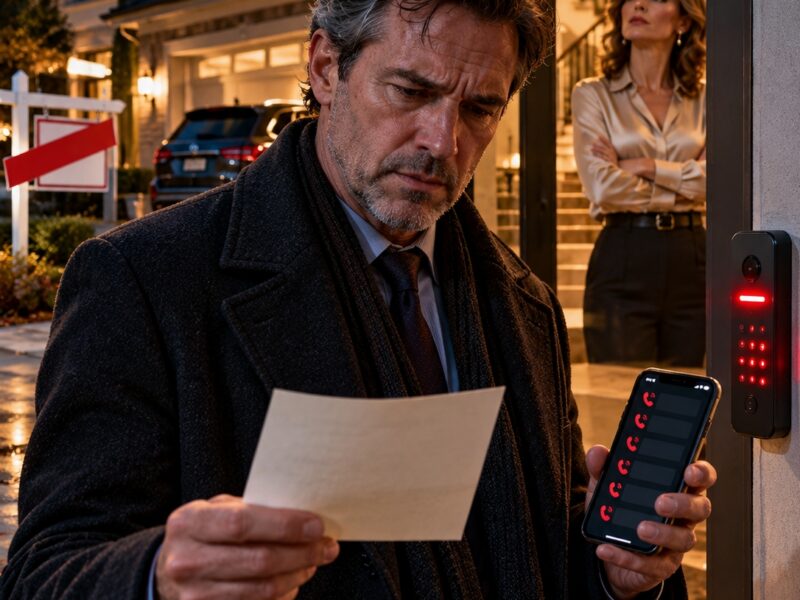
My Wife Left a Note Saying the House Was Sold and I Had to Leave—By Midnight, Thirty-Seven Missed Calls Told Me She Had Miscalculated
My wife locked me out of our Chicago home, left a note ordering me to pack and leave, and told me the sale would close the next morning.
Six months after a minor stroke, she was counting on me being too confused, too tired, and too dependent to challenge what she had done.
But when I turned her note over and wrote two words on the back, I already knew the house was not the asset she should have been worried about.
The note was waiting beneath a crystal paperweight on the kitchen island.
I’m done with you. The house is sold. Pack and leave.
No signature.
No explanation.
Just four short sentences in Evelyn’s careful handwriting, written on cream stationery expensive enough to make the cruelty feel rehearsed.
I read it twice.
The first time, I registered the words.
The second time, I understood that my wife of seventeen years expected me to disappear from my own life before dinner.
The house was warm behind the glass.
Outside, late-October wind pushed maple leaves across the driveway and under my shoes. I had just returned from a cardiology appointment, and the fingers of my left hand still carried the faint tremor that had followed me since the minor stroke six months earlier.
I had typed our front-door code.
Red light.
Access denied.
I tried again.
Same result.
The garage remote didn’t respond either.
That was when I saw the note through the narrow glass panel beside the door.
I walked around back.
The patio slider had been left unlocked.
Evelyn had thought about the keypad.
She had thought about the garage.
She had not thought about the door she used every morning to carry coffee into the sunroom.
The kitchen smelled faintly of rosemary and roasted garlic. The dishwasher hummed. One of Evelyn’s wineglasses stood upside down on a drying mat.
Everything looked ordinary enough to make the note feel obscene.
Upstairs, a floorboard creaked.
“Evelyn?”
She appeared at the landing.
Silk blouse.
Dark trousers.
Hair pinned neatly behind her head.
Perfectly composed.
For most of our marriage, her composure had reassured me.
That afternoon it looked more like preparation.
“You got it,” she said.
I held up the note.
“The message?”
“Yes.”
“The house is sold?”
“Yes.”
“You can’t sell the house without my signature.”
A faint smile touched her mouth.
“I don’t need it.”
I watched her descend halfway.
Not all the way.
She kept the staircase between us.
“Explain.”
She folded her arms.
“You had a stroke, Daniel.”
“A minor stroke.”
“You forget things.”
“I’m recovering.”
“You missed appointments.”
“One.”
“You left the stove on.”
“Twice, during the first month.”
“You sleep in the afternoon.”
“My neurologist told me to.”
She looked away for half a second.
Then back.
“I can’t spend the rest of my life wondering whether you’ll wake up normal tomorrow.”
The word normal landed harder than anything else.
I kept my voice level.
“So you sold the house.”
“I accepted an offer.”
“Who did?”
“We did.”
“I didn’t.”
“I have power of attorney.”
There it was.
Six months earlier, during the foggiest week after the stroke, Evelyn had placed a document beside my hospital bed.
Temporary authority.
Bills.
Insurance.
Routine financial matters.
“In case you can’t speak for yourself,” she had said.
I signed because I trusted my wife more than I trusted my recovering brain.
Now she was using that trust like a crowbar.
“Closing?”
“Tomorrow morning.”
“Buyer?”
“That doesn’t concern you.”
“And where exactly am I supposed to go?”
Her shoulders lifted.
“You have money.”
“You’ll manage.”
That answer told me more than the note.
Not we’ll figure it out.
Not I found you somewhere safe.
Not even I’m sorry.
You’ll manage.
I looked at her face.
Under the confidence was something else.
Urgency.
Not the clean relief of someone ending a marriage.
The brittle urgency of someone who needed a transaction to happen before another problem caught up.
I walked back to the island.
Turned her note over.
Took the pen beside the fruit bowl.
And wrote two words.
Check again.
Evelyn’s expression changed.
“What does that mean?”
I placed the note exactly where I had found it.
“You’ll see.”
“Daniel.”
I picked up my coat.
“Where are you going?”
I looked at her.
“To make sure I understand what you just did.”
Then I walked out through the back door.
The cold air hit my face.
My heart was steady.
And for the first time since my stroke, I did not feel fragile.
That was when I stopped thinking like a husband and started thinking like a trustee.
I drove downtown.
Not to a hotel.
Not to my sister’s house.
Not to the lakefront condo I kept telling Evelyn we should sell because we never used it.
I went to Margaret Hill.
Margaret had been my attorney for fourteen years and my friend for almost as long, though she would have objected to the second description on professional grounds.
She was forty-six, compact, dark-haired, and so methodical that she could make a threat sound like a scheduling note.
When I called from the car and said, “I need the trust documents,” she didn’t ask why.
She said:
“How fast?”
“Now.”
“Come in.”
Her office overlooked the Chicago River from the twenty-ninth floor of a building made almost entirely of glass.
By the time I arrived, dusk had turned the water black between bands of reflected light.
Margaret had three folders open.
She took one look at me.
“You look terrible.”
“Cardiologist says I’m improving.”
“I didn’t ask your cardiologist.”
“I found a note from Evelyn.”
Margaret stopped.
“What kind of note?”
I handed it over.
She read.
No visible reaction until she turned it over.
Check again.
Then she looked at me.
“Subtle.”
“I was tired.”
“What did she do?”
“She says the house is sold.”
Margaret sat.
“When?”
“Closing tomorrow.”
“Daniel.”
“I know.”
“Do you?”
“I know enough.”
She turned to computer.
“Let’s confirm the rest.”
Cook County records gave us first answer within minutes.
A quitclaim deed had been recorded at 9:03 that morning.
Grantor listed:
Daniel Henderson, by Evelyn Henderson as attorney-in-fact.
My signature appeared beneath.
Or something trying to be my signature.
I stared.
“That’s not mine.”
Margaret leaned closer.
“No.”
“It looks traced.”
“Yes.”
“But if she signed under POA, why forge?”
“That is excellent question.”
She opened another database.
Then smiled without humor.
“Because whoever prepared this believed you held title individually.”
I leaned back.
“The trust.”
“The trust.”
Twelve years earlier, before Evelyn ever cared who owned what on paper, I had transferred the Brier Glen property into an irrevocable asset-protection trust created during a business restructuring.
The trust owned the house.
I served as managing trustee.
Evelyn’s power of attorney authorized certain decisions for me personally.
It did not turn her into trustee.
It did not let her convey trust assets.
Margaret tapped screen.
“She tried to transfer property you do not own personally.”
“So deed is invalid.”
“Most likely voidable at minimum, depending on title handling.”
“And tomorrow’s closing?”
“Stops the moment title company gets certified trust documents.”
I should have felt relief.
Instead I felt colder.
“Who is brokerage?”
Margaret read.
“Lang Residential Partners.”
My stomach tightened.
“Travis Lang.”
She glanced at me.
“You know him?”
“I know of him.”
Three months earlier, I had walked into the garage around ten at night.
Evelyn stood beside her SUV laughing softly into her phone.
When she saw me, she ended call too quickly.
“Who was that?”
“A developer.”
“What developer?”
“Travis.”
“Travis what?”
“Lang.”
Then she kissed my cheek and said I looked tired.
I had accepted that because I was tired.
Margaret searched.
Travis Lang.
Forty-four.
Boutique developer.
River North redevelopment project.
Two active lawsuits.
One mechanics lien.
One lender complaint.
Several LLCs dissolved in previous eighteen months.
Margaret leaned toward screen.
“Well.”
“What?”
“He has liquidity problem.”
“How bad?”
“Bad enough that he’s living on bridge debt.”
I took out phone.
Thirty-one percent battery.
No missed calls yet.
Interesting.
“Joint lines,” I said.
Margaret looked up.
“What?”
“Check anything Evelyn can access.”
“You’re asking me to review marital accounts?”
“I’m asking you to tell me whether there are unusual draws.”
She called our private banker with me present.
Authorization questions.
Identity verification.
Then silence.
Margaret took notes.
When she ended call, she looked at me.
“Home equity line is maxed.”
I stared.
“That line should have been closed.”
“It wasn’t.”
“Amount?”
“Three hundred thousand.”
My mouth went dry.
“Anything else?”
“Two personal lines.”
“Nearly full.”
“A pending transfer from your investment account was flagged yesterday for callback.”
“I was at cardiology.”
“Yes.”
“Who initiated?”
“Evelyn.”
The picture sharpened.
Not completely.
Enough.
“She needs cash.”
Margaret folded her hands.
“Or someone near her does.”
I thought of Travis laughing through Evelyn’s car speakers.
“Pull everything public on Lang.”
She did.
One bridge loan appeared through UCC filings and litigation references.
High-interest private note.
Maturity missed.
Approximate exposure north of half a million.
“What collateral?”
“Project interests and personal guarantee.”
“Lender?”
Margaret read holding company.
I recognized it.
Three weeks earlier, a forensic accountant I had quietly retained had flagged the same debt while reviewing suspicious household transfers.
I had not hired him because I suspected an affair.
I hired him because I had spent thirty-five years structuring estates, family partnerships, and commercial assets.
Fear leaves patterns.
Evelyn’s spending pattern had changed immediately after Travis’s missed maturity.
Transfers.
Airfare to Miami.
Consulting fees.
Payments to one of his LLCs.
I had asked my accountant to trace.
Two days earlier, after speaking with lender through counsel, I acquired the note at a discount through a holding company I controlled.
Not as revenge.
At the time, I didn’t even know whether Evelyn was involved.
I wanted leverage over a man whose instability was bleeding into my household.
Margaret stared when I told her.
“You own his note.”
“Yes.”
“And Evelyn is selling a house owned by your trust to pay a debt now owed to you.”
“That appears to be the structure.”
She removed glasses.
“Daniel.”
“What?”
“This is either absurdly elegant or the beginning of several ethical headaches.”
“I prefer not to discover which by losing my house first.”
She nodded.
“Fair.”
My phone buzzed.
Evelyn.
First call.
5:42 p.m.
I let it ring.
Thirty seconds later, again.
Then again.
Margaret looked at screen.
“You should probably answer eventually.”
“Eventually.”
“At least preserve voicemails.”
“Yes.”
She turned back to documents.
“First priority is innocent buyers.”
I nodded.
That mattered.
Whoever had put money down on our house had done nothing wrong.
“No ambush.”
“No letting them wire funds just to make point.”
“Agreed.”
“Title company gets notice tonight.”
“County recorder dispute first thing.”
“Petition to restrict further use of POA.”
“Bank notified.”
“Joint credit temporarily requires dual authorization.”
I stood at window.
Chicago traffic moved below.
“What about Evelyn?”
Margaret was quiet.
“What do you want?”
That question was harder than legal ones.
“I want to know why.”
“That is not a legal remedy.”
“I know.”
“And after?”
“I don’t know.”
“Good answer.”
At 7:18, phone showed nine missed calls.
At 8:03, twelve.
At 9:41, seventeen.
I listened to one voicemail.
“Daniel, the title company called. What did you do?”
Not:
Where are you?
Are you safe?
Can we talk?
What did you do?
I deleted nothing.
Preserved all.
Then drove to my lakefront condo.
It smelled stale from disuse.
I opened windows despite cold.
Sat in one chair.
At 11:06, twenty-one missed calls.
At 12:14, twenty-three.
I slept three hours.
At 6:30 next morning, twenty-nine.
Margaret called at 6:47.
“We have issue.”
“What?”
“Buyer’s attorney wants to close at ten pending clarification.”
“They shouldn’t.”
“They’re cash buyers and were told discrepancy was administrative.”
“By whom?”
“Travis.”
Of course.
“Who are buyers?”
“Dr. Noah Bennett and his wife, Elise.”
“First home?”
“Looks like.”
I closed eyes.
“Then we go.”
“To closing?”
“Yes.”
Margaret paused.
“Why?”
“Because they deserve to hear from actual trustee.”
“And Evelyn?”
“She deserves to hear it in same room.”
That sounded harsher aloud.
I corrected.
“No theater.”
“No humiliation.”
“Just facts.”
“Good.”
At 7:12, I sat in Margaret’s office.
She slid certified trust copy toward me.
“Quitclaim deed recorded under POA.”
“Ownership mismatch.”
“Notice of dispute filed.”
“Title insurer notified.”
“Bank security placed.”
“Petition ready.”
“Closing ten.”
Then she pushed another sheet.
“Travis’s company made an urgent wire request yesterday.”
“To where?”
“Private lender’s servicing account.”
“How much?”
“Five hundred thirty-two thousand.”
“That’s nearly exact debt.”
“Yes.”
“So house proceeds were going to him.”
“Appears so.”
My phone buzzed.
Thirty-four missed calls.
I listened to another voicemail.
Evelyn’s voice was different now.
“Daniel, call me. Please. This isn’t what you think.”
That phrase almost made me smile.
It was exactly what everyone said when documents started saying things clearly.
At nine fifteen we left.
At nine fifty-eight, elevator opened onto forty-second floor of Sterling & Wyatt.
Polished walnut.
Marble reception.
Floor-to-ceiling glass.
Money liked architecture that made people sit straighter.
Margaret walked beside me.
We had no detectives.
No need.
This was a title dispute, not a raid.
A court order had not been issued.
Police were not props.
That distinction mattered.
Through glass wall I saw Evelyn.
Navy blouse.
Pearl earrings.
Posture perfect.
Travis sat beside her in tailored gray suit.
Across table:
Noah and Elise Bennett.
Young.
Nervous.
Hopeful.
A cashier’s check rested inside Elise’s leather portfolio.
I felt anger then.
Not at Evelyn first.
At the fact that two strangers had been brought into our mess.
Margaret touched my sleeve.
“Facts.”
“Facts.”
At 10:03, we entered.
Evelyn’s color disappeared.
“Daniel.”
Travis recovered quicker.
“Well.”
I ignored him.
The closing officer stood.
“Mr. Henderson?”
“Yes.”
“We were told you couldn’t attend.”
“I can.”
Evelyn’s voice sharpened.
“You have no reason to be here.”
“I’m managing trustee.”
Noah looked between us.
“Trustee?”
Margaret placed folder on table.
“The property is owned by Henderson Asset Protection Trust.”
“Mr. Henderson is managing trustee.”
“The recorded instrument executed yesterday does not establish valid trustee conveyance.”
Closing officer’s face tightened.
He opened documents.
Evelyn stared.
“That’s not possible.”
“It is.”
“I have POA.”
Margaret kept tone calm.
“For Daniel Henderson individually.”
“Not authority to act as trustee.”
Travis leaned forward.
“Let’s not overcomplicate.”
Margaret turned to him.
“This is title.”
“Complication is built in.”
Noah slowly removed hand from portfolio.
I looked at him.
“I’m sorry.”
“You were told sale valid.”
“It isn’t.”
“We’re pausing it.”
Evelyn’s eyes burned.
“You can’t do this.”
“I’m not doing anything to you.”
“I’m preventing invalid transfer.”
“This is humiliating.”
I looked at buyers.
“Yes.”
“It is.”
“And they didn’t deserve it.”
That landed.
Evelyn looked down.
Closing officer cleared throat.
“We cannot proceed pending review.”
Elise whispered to Noah.
They stood.
Noah said:
“We’d like earnest money returned immediately.”
“It will be,” Margaret replied.
“I’ll confirm in writing today.”
I said:
“I’m sorry.”
They left.
Door closed.
Travis stood.
“This is absurd.”
I looked at him for first time.
“Sit.”
He didn’t.
Margaret slid another folder.
“Mr. Lang, you may want counsel before making statements.”
His face changed.
Evelyn looked between us.
“What is that?”
“The debt you were trying to pay.”
Travis froze.
I placed assignment document on table.
He recognized lender.
Then transferee.
Then me.
“Daniel.”
“You purchased it?”
“Yes.”
Evelyn’s hand moved toward mouth.
“You knew.”
“I suspected.”
“When?”
“Before your note.”
Her eyes widened.
“So you planned this.”
“No.”
“I planned for uncertainty.”
“You created this situation.”
“No.”
I tapped recorded deed.
“You created that.”
Travis grabbed briefcase.
“I’m leaving.”
I did not block.
“Good idea.”
He left.
No intimidation.
No theatrics.
Just elevator waiting.
When door closed, Evelyn turned on me.
“You set him up.”
“I bought distressed paper.”
“He signed loan voluntarily.”
“You knew he couldn’t pay.”
“Lender knew too.”
“That is why debt was discounted.”
“You’re destroying him.”
“He overleveraged.”
“That happened without me.”
Her face tightened.
“He was trying to build something.”
“So was I.”
“What?”
“A marriage.”
Silence.
For first time, composure cracked.
Margaret gathered papers.
“I’ll give you two privacy.”
She left.
Evelyn stared at table.
I sat.
After a while:
“Is there an affair?”
Her head snapped up.
“That’s what you care about?”
“It matters.”
“No.”
I believed partly.
“Did you sleep with him?”
“No.”
“Did you intend to?”
She looked away.
“That isn’t fair.”
“That means answer is complicated.”
“I cared about him.”
“How?”
“He made me feel…”
She stopped.
“Visible?”
Her eyes lifted.
“Yes.”
That hurt more than I expected.
“After stroke, you shut down.”
“I was learning how to speak without slurring.”
“You stopped touching me.”
“My left side was numb.”
“You moved accounts.”
“Estate review.”
“Without me.”
“The trust predates marriage.”
“Exactly.”
Her voice rose.
“I lived seventeen years in house where every important asset had some structure I was expected not to question.”
“I asked.”
“You said not to worry.”
“I trusted you.”
“And then you almost died.”
The sentence broke.
Not anger.
Fear.
Evelyn sat.
“I thought I was going to become your nurse.”
I looked at her.
“There it is.”
She covered face.
“No.”
“It sounds terrible.”
“It is terrible.”
“It’s also true.”
She lowered hands.
“I was terrified.”
“My mother spent nine years caring for my father after his aneurysm.”
“She disappeared.”
“She stopped being person.”
“She became appointments and pills and bathing him and worrying every time he coughed.”
“When you had stroke…”
“You saw future.”
“Yes.”
“So you found exit.”
“I found someone who talked about future.”
“Travis talked about Miami.”
“Travel.”
“Starting over.”
“He made it sound possible.”
“And house sale financed it.”
She flinched.
I continued:
“You maxed home equity.”
“Joint lines.”
“Tried transfer investments.”
“For stability.”
“For him.”
“For us.”
“There is no us in the sentence you left on counter.”
She looked toward door.
“I panicked.”
“That explains note?”
“Yes.”
“Forged signature?”
“I didn’t forge it.”
I went still.
“What?”
“I signed as attorney-in-fact.”
“Why does deed show my signature?”
Her face changed.
“I don’t know.”
That was first genuinely surprising answer.
“Travis prepared documents.”
“I signed POA certification.”
“I did not sign your name.”
I believed her uncertainty.
That meant another layer.
We called Margaret back.
She listened.
Immediately ordered full copy of e-sign audit trail from brokerage and title provider.
By afternoon answer came.
Travis’s assistant had uploaded a scanned signature from unrelated closing file.
Used without direct authorization from Evelyn, according to audit log.
That did not absolve her attempt to sell trust property.
It changed forgery issue.
I felt relief I did not want to feel.
Some part of me still needed seventeen years not to include that.
Margaret said:
“We need independent counsel for Evelyn.”
I agreed.
Evelyn stared.
“You’re helping me?”
“No.”
“I’m avoiding pretending our interests align.”
“Get your own lawyer.”
She did.
Nora Bell.
Family and fiduciary litigation attorney.
Smart.
Precise.
No patience for drama.
Three days later we sat neutral conference room.
Evelyn beige sweater.
No pearls.
No silk armor.
Nora beside her.
Margaret beside me.
Evelyn started:
“I want to talk without pretending I’m victim.”
Good start.
I said nothing.
“I misused POA.”
“Yes.”
“I did not understand trust boundary.”
“That doesn’t excuse.”
“No.”
“I authorized sale I should not have.”
“Yes.”
“I moved marital funds toward Travis’s project.”
“How much?”
“Two hundred eighty-six thousand.”
I had expected forty-eight.
My chest tightened.
Margaret’s pen stopped.
Evelyn continued:
“Some listed consulting.”
“Some loans.”
“Did he promise repayment?”
“Yes.”
“In writing?”
“Some.”
Nora slid documents.
Promissory notes existed for part.
Others not.
“Why hide?”
Evelyn looked at me.
“Because I knew you’d say no.”
“That is usually clue.”
“I know.”
“What about life insurance?”
Her eyes closed.
“What?”
Margaret slid change request.
Beneficiary revision initiated online.
From Evelyn to a family trust.
Then secondary beneficiary entity related to Travis?
Wait, source has change request maybe suspicious. Need make more plausible. She says not hers maybe malicious actor. Better discover Travis attempted via compromised access, widening conflict. Let’s do.
Evelyn looked genuinely confused.
“I didn’t do this.”
Nora leaned.
“Are you sure?”
“Yes.”
“Why would you remove yourself?”
The pending request listed new contingent beneficiary:
Lang Capital Recovery Trust.
Room chilled.
Evelyn whispered:
“Oh my God.”
I looked at Margaret.
“Verification log?”
“Request initiated through household computer while Daniel was hospitalized.”
“IP?”
“Home network.”
“Login?”
“Daniel’s insurance portal.”
“Who had access?”
Evelyn swallowed.
“Travis came over twice.”
“When Daniel in rehab?”
“Yes.”
That changed everything.
“You gave him password?”
“No.”
“He helped me organize documents.”
I stared.
“You let him into office.”
“I didn’t think—”
“No.”
“You didn’t.”
The anger came hot.
First real anger.
I stood because sitting felt impossible.
Evelyn recoiled.
I stopped.
Breathed.
My neurologist had drilled that into me.
Slow.
Four counts.
Again.
Then I sat.
“We report that.”
Nora nodded.
“Immediately.”
“Insurance fraud unit.”
“Cybercrime complaint if evidence supports.”
“No private confrontation.”
Evelyn’s face crumpled.
“He told me he was helping.”
“He was helping himself.”
For first time, betrayal shifted.
Evelyn had betrayed me.
Travis had been using her fear to access me.
Both true.
Neither erased other.
That was midpoint truth.
I had spent days imagining wife as calculating architect.
Reality was messier.
She was culpable.
Manipulated.
Afraid.
Dishonest.
Used.
I was angry enough to want simplicity.
Truth refused.
Investigators from insurer and bank security took over digital trail.
Travis’s assistant cooperated through counsel.
She produced emails showing he had asked for Daniel’s signature samples, trust statements, insurance documents.
He had told her Evelyn “was managing incapacitated spouse.”
He had been building option if house sale failed.
Meanwhile his debt matured.
Pressure intensified.
Evelyn became lifeline.
He made fear sound romantic.
He told her Daniel could decline rapidly.
That she needed protect herself.
That a new life required liquidity.
He never explicitly told her Daniel would die soon in writing.
He didn’t need to.
Implication did work.
Evelyn had laughed once on car recording when Travis said, “You told me vascular damage shortens horizon.”
The laugh had haunted me.
At conference, she explained.
“I laughed because I was uncomfortable.”
“Not because I agreed.”
I looked at her.
“How could I know difference?”
“You can’t.”
“Exactly.”
That broke something in her.
Not dramatically.
Shoulders lowered.
For seventeen years, Evelyn believed her intention should count heavily.
Now she understood effect did not ask permission.
Our divorce moved forward.
Not revenge.
Separation.
Margaret sought court order limiting POA and requiring accounting.
Evelyn consented through Nora.
Joint accounts temporarily supervised.
Not frozen to starve her.
Normal expenses continued.
No criminal complaint from me over her trust mistake in exchange for full disclosure and cooperation.
Travis faced separate investigation for signature misuse, attempted beneficiary manipulation, wire activity.
I did not decide his charges.
Authorities did.
That boundary mattered.
Civil hearing was quiet.
Cook County judge reviewed trust deed.
POA.
Attempted conveyance.
Accounting.
Declared sale ineffective.
Ordered correction to county records.
Required formal accounting for transactions initiated under POA.
No speeches.
No dramatic arrest.
No judge delivering television insults.
Just law doing boring work.
Outside courtroom, Evelyn stood near window.
Women from our country club watched from distance.
I hated that.
Not because she didn’t deserve consequences.
Because public appetite for humiliation makes everyone worse.
She approached.
“You won.”
“No.”
“You always say that.”
“Because this was never contest.”
Her mouth twisted.
“Feels like one.”
“I wanted separation.”
“Accounting.”
“Protection.”
“That is all.”
“You bought Travis’s debt.”
“That was leverage.”
“Wasn’t that revenge?”
I considered.
“At first, maybe partly.”
Honesty surprised her.
“I told myself it was risk management.”
“It was also anger.”
“What will you do with it?”
“Enforce contract.”
“Reasonably.”
“Not accelerate unless default requires.”
She looked toward elevator.
“He left for Miami.”
“I heard.”
“Didn’t call me.”
“I’m sorry.”
She laughed bitterly.
“No, you’re not.”
“I’m sorry you were used.”
“Different from being sorry he left.”
“Yes.”
Fair.
“What happens to house?”
“The trust keeps it until I decide.”
“You’ll live there?”
“No.”
“Why?”
I looked down corridor.
“Because walls know too much.”
Three months later, I sold house properly.
Trustee-authorized.
Market listing.
Independent broker.
Full title review.
No secret cash closing.
Proceeds remained inside trust.
I moved lakefront condo.
Evelyn rented townhouse near Lincoln Park.
Divorce settlement gave her marital property legally hers.
No punitive stripping.
No secret offshore games.
She repaid documented unauthorized transfers from her share over time.
Therapy became part of her life voluntarily, not court ordered.
Mine too.
That surprised me more.
Dr. Aaron Patel asked first session:
“Why do you think she believed you wouldn’t fight?”
“Because I’m calm.”
“That isn’t answer.”
I smiled despite myself.
“Because I avoided conflict.”
“For how long?”
“Years.”
“Why?”
“My father fought about everything.”
“I decided adulthood meant not being him.”
“So your alternative was?”
“Silence.”
“Which your wife read as?”
“Absence.”
We sat.
That was uncomfortable.
Evelyn had betrayed.
I had withdrawn after stroke.
Not cause of her misconduct.
Context.
Important difference.
I had been angry enough to want entire moral burden on her.
Therapy made me distinguish blame from contribution.
She chose deception.
I contributed to a marriage where hard conversations were rare.
Both could exist.
Six months after divorce finalized, Evelyn left voicemail.
“Daniel.”
Voice softer.
“I know I shouldn’t call.”
“I wanted to apologize without asking you to do anything with apology.”
Good opening.
“I was scared.”
“I turned fear into permission.”
“I told myself you were becoming dependent so I could justify making plans without you.”
“I told myself Travis was stability.”
“He was escape.”
“I know difference now.”
Pause.
“I’m sorry.”
Message ended.
No begging.
No “I never meant.”
No demand.
I listened twice.
Did not call.
Not because cruel.
Because apology can be accepted without reopening door.
I wrote email instead.
I heard you. Thank you for saying it clearly. I hope you keep building a life that does not require fear to make decisions for you. I am doing the same.
She replied:
I will.
That was enough.
My health improved.
Tremor faded.
Speech fully returned.
Cardiologist reduced one medication.
I resumed consulting fifteen hours a week.
Estate plans.
Business succession.
Trust reviews.
Clients joked I had become obsessed with powers of attorney.
They weren’t wrong.
I changed every template.
Plain-language limits.
Independent co-agent for major transfers.
Automatic review after incapacity event.
I told clients:
“A document designed to help during crisis should not become a blank check because nobody rereads it.”
No one knew where lesson came from.
Margaret did.
One afternoon she called.
“Travis case resolved.”
“How?”
“Plea on financial fraud and unauthorized digital access.”
“Restitution.”
“Probation plus restrictions.”
“No jail?”
“Fact pattern and cooperation.”
I sat with that.
“His debt?”
“He’s current under restructuring.”
“Good.”
“You sound disappointed.”
“No.”
“I’m relieved it’s boring.”
Margaret laughed.
“You’ve become tedious.”
“Goal.”
“Evelyn?”
“What about her?”
“She’s not implicated beyond civil accounting.”
“Insurer accepted she didn’t authorize beneficiary change.”
I breathed.
“Good.”
Again.
Not love.
Not reconciliation.
Human relief that seventeen years had not been darker than already known.
A year passed.
I began walking lakefront every morning.
At first for health.
Then because water changed every day.
Gray.
Blue.
Green.
Steel.
One Tuesday, I passed a couple arguing quietly.
Woman said:
“You never tell me anything.”
Man replied:
“I didn’t want worry you.”
I almost stopped.
Not my business.
I kept walking.
But sentence followed.
I didn’t want to worry you.
That had been my excuse after stroke.
I did not tell Evelyn every symptom.
Every fear.
Every financial restructuring.
I thought shielding was kindness.
She thought exclusion meant future without her.
Again—not excuse.
But seed.
Fear grows fastest in information gaps.
I wrote that down when home.
Not as wisdom for Facebook.
For myself.
Two years after note, I received certified envelope.
From Evelyn.
Inside was original crystal paperweight.
The one that held note down.
No note.
Just object.
I smiled.
She had found humor eventually.
I placed it on desk.
Not as trophy.
Reminder.
Paperweight holds paper.
It cannot make words true.
That spring, I met Claire Monroe at estate-planning conference.
Sixty-two.
Widowed.
Former hospital CFO.
Sharp enough to terrify conference panel.
We had coffee.
Nothing happened.
Then lunch month later.
Then museum.
No rush.
I told her early:
“I’m divorced.”
“I had stroke.”
“I can become quiet when afraid.”
She said:
“I’m widowed.”
“I interrupt when nervous.”
“I dislike jazz.”
I frowned.
“Last one may be deal breaker.”
She smiled.
There was affection eventually.
Gentle.
Adult.
No rescue.
No proof that leaving one marriage earns another.
Claire had own grief.
I had mine.
We did not combine pain and call it intimacy.
We talked.
Slowly.
One evening she asked why I always double-check documents after signing.
I told whole story.
Note.
House.
POA.
Travis.
Thirty-seven calls.
Claire listened.
Then asked:
“What were the two words?”
“Check again.”
She laughed.
“That is extremely lawyer-adjacent for a non-lawyer.”
“I work in trusts.”
“Worse.”
She did not call me clever.
Did not celebrate Evelyn’s humiliation.
She said:
“Sounds like everyone was scared and made increasingly expensive decisions.”
Exactly.
Three years after divorce, I saw Evelyn in person again.
Charity hospital gala.
Of all places.
She was on advisory committee for stroke recovery support.
That surprised me.
She saw me.
Came over.
Claire was beside me.
I introduced.
“Claire Monroe.”
“Evelyn Henderson.”
Evelyn shook her hand.
Then smiled faintly.
“Formerly Henderson.”
“Evelyn Carter again.”
I nodded.
“How are you?”
“Better.”
“You?”
“Better.”
No hidden meanings.
She looked at my left hand.
“Tremor gone.”
“Mostly.”
“I’m glad.”
“Thank you.”
A man approached Evelyn.
Not romantic necessarily.
She excused herself.
Claire watched her go.
“She seems…”
“What?”
“Human.”
I laughed.
“She is.”
“That sounded like difficult lesson.”
“It was.”
At home afterward, I opened desk drawer.
Original note still there.
I kept it not because stuck.
Because evidence teaches better than memory.
Front:
I’m done with you. The house is sold. Pack and leave.
Back:
Check again.
Once I had believed those two words meant:
I know more than you.
Years changed meaning.
Check again before assuming power.
Check again before trusting paper.
Check again before deciding silence equals weakness.
Check again before deciding fear equals love.
Check again before believing illness makes a person incapable.
Check again before believing capability means invulnerability.
Check again before making someone’s worst choice their entire identity.
Most importantly:
Check yourself.
That part took longest.
Five years after stroke, I turned sixty-five.
Claire organized small dinner.
Margaret came.
My sister.
Two old colleagues.
No speeches.
After cake Margaret handed envelope.
Inside certified copy of final trust amendment.
We had recently converted old Henderson Asset Protection Trust into updated structure with independent trustee succession.
I was no longer sole point of failure.
“Happy birthday,” Margaret said.
“You gave me governance.”
“You’re impossible to shop for.”
I laughed.
Later balcony.
Chicago lights.
Claire beside.
“You ever miss house?”
“Sometimes.”
“Which part?”
“Kitchen in mornings.”
“Fireplace.”
“Maple tree.”
“Not marriage?”
I considered.
“I miss parts of it.”
“That allowed?”
“Yes.”
“You can miss what was good without disputing what became bad.”
Claire nodded.
“Useful.”
“Therapy.”
“Expensive useful.”
We stood.
My phone buzzed.
Unknown number.
For one old second, body remembered thirty-seven calls.
Then I looked.
Spam.
Car warranty.
I laughed.
“What?”
“Nothing.”
I blocked it.
Inside, guests argued about whether cake needed more coffee.
Ordinary noise.
Good noise.
That night after everyone left, I unfolded Evelyn’s old note one last time.
Not because anniversary.
Because paper had begun tearing at crease.
I took a photograph.
Then fed original into shredder.
Claire watched from doorway.
“You sure?”
“Yes.”
“Why now?”
“I don’t need object anymore.”
She smiled.
“Good.”
The strips fell into bin.
Cream paper.
Black ink.
Two sides.
Two stories.
Neither needed carrying.
I thought about man standing in cold driveway years earlier.
Recovering from stroke.
Locked out.
Believing wife had taken home.
He had been right about betrayal.
Wrong about some motives.
Right to protect himself.
Wrong to think foresight made him morally untouched.
He learned all of that slowly.
That was healing.
Not court order.
Not debt acquisition.
Not twenty-nine missed calls, thirty-seven, or any number.
Healing was when story became something I could tell without needing audience to agree who villain was.
Evelyn made terrible choices.
She paid consequences.
Travis exploited fear.
He paid consequences.
I protected myself.
Then had to ask why my marriage had become place where both of us stopped telling truth.
No clean heroes.
No clean villains.
Just boundaries.
Accountability.
Paper trails.
And the rare grace of understanding before bitterness becomes identity.
The next morning I made coffee.
Sunlight spread across lake.
My cardiologist appointment was at ten.
Routine now.
I took medication without reminder.
Checked calendar.
Wallet.
Keys.
Then I noticed crystal paperweight on desk.
Still there.
I picked it up.
Clear glass.
Nothing underneath.
For years, it had held the note down.
Now it held nothing at all.
I smiled.
Left it exactly that way.
And walked out the door.









