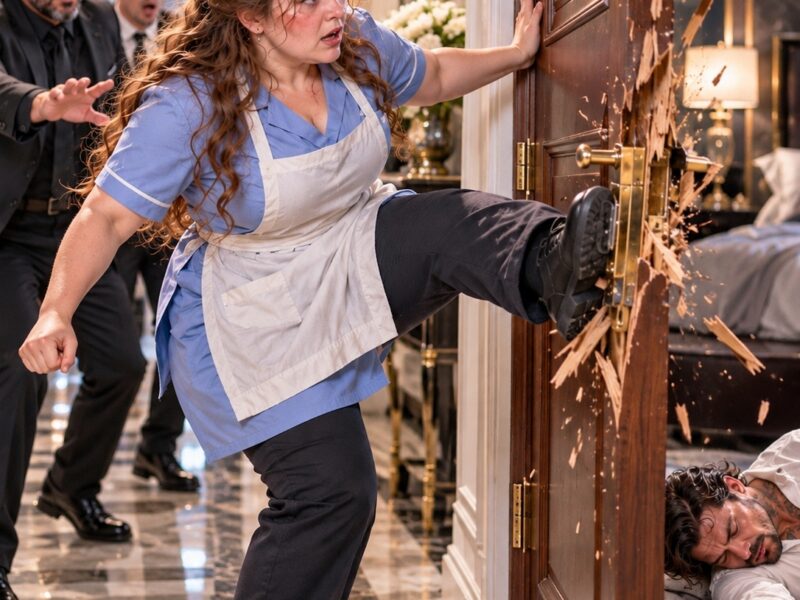
No Guard Dared Open the Mafia Boss’s Door at 2 A.M.—So His Chubby Cleaner Kicked It In and Exposed the Betrayal Inside His Own House
At 2:04 a.m., Winnie Doyle heard a body hit the floor behind Rhett Marquetti’s locked bedroom door while two trained guards stood three feet away and did nothing.
The rule protecting Providence’s most feared crime boss was simple: after midnight, nobody entered that room without permission—even if the man inside could no longer give it.
Winnie had spent eight years learning what a locked door could cost, so while everyone else obeyed, the woman they barely noticed made the one choice that could save him—or destroy them both.
The Door Nobody Touched
The first crash came from behind Rhett Marquetti’s bedroom door at 2:04 in the morning.
Winnie Doyle stopped pushing her cleaning cart.
Both guards outside the room turned toward the sound.
Neither reached for the handle.
The younger one, Tommy Velez, had been standing with one shoulder against the wall and a paper cup of coffee cooling in his hand. At the crash, he straightened so fast that coffee splashed across his knuckles, but instead of moving toward the door, he looked at the older guard.
Frank Corsi looked back.
The silence between them lasted less than two seconds.
It told Winnie everything.
Then came another sound.
Smaller.
Heavier than a book.
Lighter than furniture.
Followed by a rough dragging noise.
Winnie abandoned the cart.
“Open it.”
Frank lifted one hand.
“Stay back.”
“Something fell.”
“I heard it.”
“Then open the door.”
His face hardened.
“You know the rule.”
Everybody in the Marquetti house knew the rule.
Any door on the second floor could be opened by security in an emergency except one.
Rhett’s.
After midnight, nobody entered.
No guard.
No housekeeper.
No doctor unless summoned personally.
Nobody.
A cleaner before Winnie had knocked once because she found a tray outside his room and thought he might want fresh towels.
She was gone by breakfast.
Her locker had been emptied before the morning shift arrived.
Nobody ever explained where she went.
Winnie had worked at the estate for three weeks.
Long enough to understand that curiosity was an expensive habit.
Not long enough to watch a man die politely.
Something struck the floor again.
Winnie shoved the mop handle into Tommy’s hands.
“Move.”
Frank caught her sleeve.
His fingers pinched through the faded blue cotton of her uniform.
“Winnie.”
She looked down at his hand.
Then at him.
“Let go.”
“You walk through that door, you’re finished.”
Another scrape came from inside.
Something in Winnie’s chest went cold.
Eight years earlier, her younger brother Charlie had collapsed in a locked stairwell while she stood on the other side pounding until her hands went numb.
She had been thirty seconds away.
Thirty seconds.
For eight years she had replayed them.
Frank stepped between her and the bedroom.
“You don’t understand whose room that is.”
Winnie planted one hand against his chest.
“Then fire me.”
“What?”
“Tomorrow.”
She shoved him backward.
“Fire me tomorrow.”
Then she stepped away from the guards, lifted one work shoe, and drove her heel into the damaged section of the frame beside the lock.
Wood cracked.
Tommy cursed.
Frank reached for her again.
Winnie kicked a second time.
The frame split.
The door swung inward.
Rhett Marquetti lay on the floor between the bed and the nightstand.
His body was rigid, one arm trapped awkwardly beneath him, breath coming in short rough pulls.
Winnie moved before either guard.
“Call emergency medical.”
Tommy stared.
“Now!”
He grabbed his radio.
Winnie dropped to her knees beside Rhett.
She did not restrain his arms.
Did not put anything in his mouth.
She cleared the nightstand away from his head, turned him carefully enough to keep his airway open, and checked the time on the digital clock beside the bed.
2:05.
She began counting softly.
“Thirty-seven.”
“Thirty-eight.”
Frank stood in the broken doorway.
“You know what you’re doing?”
“My brother.”
That was all she said.
Rhett’s breathing caught.
His fingers clenched against the carpet.
Winnie slid a folded towel beneath his head.
“Forty-two.”
His belt sat tight against his abdomen.
She loosened it without moving him onto his back.
Tommy returned.
“Doctor’s on the way.”
“Ambulance?”
Frank said quickly, “No outside ambulance.”
Winnie looked up.
“Then your doctor better fly.”
Frank’s face hardened.
She ignored him.
“Forty-six.”
The movement began to ease.
“Forty-seven.”
Then stillness.
Not complete.
Breathing.
Winnie stayed beside him.
At forty-eight seconds, she stopped counting.
The guards still had not crossed the threshold.
A strange anger went through her.
Not dramatic.
Not hot.
The kind that rearranged something permanent.
Rhett’s jaw gradually loosened.
His breathing deepened.
Several seconds later his eyelids opened.
Dark eyes.
Disoriented.
Then focused.
First on the ceiling.
Then Winnie.
His head rested partly against the towel and partly against her skirt where she had knelt beside him.
He looked beyond her shoulder.
Saw Frank.
Tommy.
The broken door.
Nobody moved.
Rhett Marquetti had built an organization around people obeying him before he finished sentences.
Now he lay on the floor looking at three people who had all made different choices about whether his life mattered more than his rules.
His gaze returned to Winnie.
“You broke my door.”
His voice sounded scraped raw.
Winnie swallowed.
“Yes.”
“Why?”
“Because you weren’t answering.”
“That usually means people wait.”
“You were having a seizure.”
He stared at her.
“You knew?”
“My brother had them.”
The statement changed something behind his eyes.
Before either could say more, footsteps approached.
A physician entered with a medical bag.
Frank finally crossed the threshold.
Only then.
Winnie saw it.
Rhett did too.
He pushed himself upright with the doctor’s help.
His face became unreadable.
“Everybody out.”
Winnie rose.
She picked up her abandoned badge from the floor.
Frank took it from her hand.
“What are you doing?”
“Procedure.”
“You breached a restricted room.”
Of course.
There it was.
Her rent.
Her groceries.
Her sister’s diner loan she was helping pay.
Three weeks of night shifts.
All of it disappearing because she refused to stand outside a locked door again.
Winnie looked once at Rhett.
He said nothing.
So she left.
For the remaining four hours of the shift, she folded sheets in the laundry room and waited for somebody to tell her which exit to use.
At seven fifteen, someone finally came.
Not Frank.
Tommy.
“Boss wants everybody downstairs.”
“To fire me publicly?”
Tommy looked uncomfortable.
“I don’t know.”
The entire household staff stood in the marble entry hall.
Cooks.
Drivers.
Groundskeepers.
Maintenance workers.
Security.
Even Frank stood near the staircase.
Rhett came down wearing a dark suit and white shirt as if his night had contained nothing stranger than poor sleep.
No weakness showed.
Only a faint shadow beneath his eyes.
He stopped three steps above the floor.
“The east bedroom rule is gone.”
Whispers started.
Stopped when he looked across the room.
“One emergency key will be issued.”
He turned.
“Winnie.”
Her stomach dropped.
A housekeeper stepped forward carrying a small steel key on a plain ring.
Rhett took it.
Walked down.
Placed it in Winnie’s palm.
“You carry this.”
She stared.
“What?”
“You heard me.”
His gaze moved to the staff.
“If she believes that door needs opening, she opens it.”
“Any hour.”
“Any reason involving my health or safety.”
“No permission required.”
Nobody breathed normally.
Then Rhett looked toward Frank and Tommy.
“Anyone who prevents her answers to me.”
Frank’s face went pale.
Winnie closed her hand around the key.
Rhett added:
“Her pay changes today.”
Her eyes snapped up.
“To what?”
“Enough that kicking in my property becomes less financially stressful.”
Several staff members looked down to hide smiles.
Winnie did not.
“I didn’t do it for a raise.”
“I know.”
That answer shut down whatever argument she had prepared.
At the back of the hall stood Garrick Hale, Rhett’s underboss and oldest senior adviser.
Gray suit.
Silver at the temples.
Hands folded loosely.
He did not whisper like everyone else.
He watched Winnie.
Not with gratitude.
With calculation.
As though Rhett had not handed a cleaner a key.
As though he had handed her a fault line.
And Garrick Hale had just decided to find out how far it ran.
The Woman Nobody Counted
The first person to congratulate Winnie was Dolores Kim, the morning cook.
She set a plate of eggs in front of Winnie at eight and said, “Eat before you become important enough to forget breakfast.”
“I’m not important.”
Dolores looked toward the steel key hanging from Winnie’s apron.
“Of course not.”
Winnie ate.
Three hours later she took the bus home to a second-floor apartment over her sister’s diner on Federal Hill.
The diner had belonged to their mother first.
Doyle’s Corner.
Twenty-two stools.
Six booths.
A coffee machine older than Winnie.
Her sister, Dana, stood behind the counter wearing reading glasses and arguing with an invoice.
“You look terrible.”
“Good morning to you too.”
“What happened?”
Winnie hesitated.
Dana was thirty-seven, three years older, practical enough to manage payroll and emotional enough to cry over stray cats.
“Work.”
“That answer means crime.”
“It means work.”
“Your employer is Rhett Marquetti.”
“So crime adjacent.”
Dana lowered her glasses.
“Did someone threaten you?”
“No.”
“Did you see something?”
“Yes.”
“What?”
“A floor.”
Dana stared.
Winnie poured coffee.
“I’m sleeping.”
“Winnie.”
“Dana.”
They held each other’s gaze.
Dana knew when the wall went up.
She hated it.
She also knew why it existed.
After Charlie died, Winnie had spent years becoming the useful one.
The person who remembered appointments.
Paid late fees before anyone noticed.
Fixed loose cords.
Counted seizure seconds.
Watched exits.
Never asked anybody to rescue her because rescue had once arrived thirty seconds too late.
She went upstairs.
Slept until six.
When she woke, a black sedan sat across the street.
Probably nothing.
Providence contained black sedans.
She dressed for work.
The sedan was gone.
At the estate, the broken frame outside Rhett’s room had already been repaired.
A new lock gleamed.
Winnie tested the key.
It turned.
That should have been the end of it.
Instead Garrick found her in the pantry corridor where no cameras reached.
He carried an envelope.
Thick.
He placed it on a shelf between canned tomatoes and flour.
“What’s that?”
“An opportunity.”
“I’m employed.”
“Better opportunity.”
“No.”
“You haven’t heard it.”
“I’ve cleaned rich houses before.”
“Envelope on shelf usually means either hush money or bribery.”
Garrick smiled.
“You’re direct.”
“I’m tired.”
He tapped the envelope.
“Twenty thousand.”
That was more than Dana’s diner earned in a good quarter.
Winnie’s pulse changed.
She did not touch it.
“For what?”
“One conversation.”
“With?”
“People concerned about Mr. Marquetti’s health.”
Winnie stacked two cans.
“What do you want me to say?”
“The truth.”
“That’s cheap.”
His smile thinned.
“You were alone with him during an episode.”
“No.”
“Two guards saw you enter.”
“They stood outside.”
“You held the key afterward.”
“Afterward.”
Garrick leaned against the shelf.
“Describe what you saw.”
“I saw a man on the floor.”
“Disoriented?”
“Anyone waking from a seizure is disoriented.”
“Violent?”
“No.”
“Confused?”
“Yes.”
“Unable to control himself?”
“He was unconscious.”
Garrick’s voice softened.
“Winnie, nobody is asking you to lie.”
That was when she understood.
The truth could be arranged dishonestly too.
“How much would you like me to misunderstand for twenty thousand dollars?”
Garrick stopped smiling.
“Your family rents.”
“Lots of families do.”
“Dana’s diner has a balloon note due in December.”
Winnie’s hand froze over the cans.
She turned.
“How do you know my sister’s loan?”
“Providence is small.”
“No.”
She looked at him carefully.
“Men like you make it small.”
Garrick lifted the envelope.
“You could pay it off.”
“I could.”
“And?”
“I’d still know how.”
His eyes cooled.
“You’re making an expensive mistake.”
Winnie returned to the cans.
“I make those without assistance.”
He left.
Twelve hours later the mistake arrived itemized.
Dana called at six fourteen in the morning.
The diner had been closed by an emergency municipal inspection.
Electrical violations.
Food-storage violations.
Rodent evidence.
Dana was crying from anger.
“We passed inspection three months ago.”
“Take pictures.”
“I did.”
“Everything.”
“Already.”
“Do not sign anything admitting fault.”
“Winnie, what happened?”
She stood in the service stairwell at the estate.
Garrick’s warning echoed.
Running to Rhett immediately would be exactly what Garrick expected.
A desperate cleaner complaining to the boss.
A woman newly favored.
Easy to paint as dependent.
Manipulative.
Maybe bought.
“I’m going to fix it.”
“How?”
“I don’t know yet.”
“That is not comforting.”
“I know.”
She hung up.
Then went back to cleaning.
For two days she said nothing.
Not to Rhett.
Not to Frank.
Not to anyone.
Instead she photographed cleaning logs.
Delivery schedules.
Maintenance slips.
She noticed people because people ignored cleaners.
Men lowered their voices when she approached.
Then resumed conversations as soon as she bent to wipe baseboards.
The first useful thing came from maintenance.
A gardener caught a stranger photographing the east wing from the lower garden.
Not flowers.
Windows.
The repaired bedroom door when opened for ventilation.
Security brought the man inside.
Private investigator.
Licensed.
Terrified.
Paid through a downtown law office.
The same firm used for several property transactions associated with Garrick.
Rhett did not rage.
That surprised Winnie.
He brought the investigator coffee.
Spoke privately for forty minutes.
Then released him.
Later Winnie passed Rhett in the gallery.
“You let him go.”
“He was paid to look.”
“By whom?”
Rhett glanced at her.
“Would you tell me if I asked?”
“No.”
“Then why complain when I copy your technique?”
She almost smiled.
He continued:
“I doubled his fee.”
“For what?”
“To tell his employer a different story.”
“What story?”
“That I collapsed because of an old shoulder injury.”
Winnie stopped walking.
“You lied.”
“Yes.”
“Why?”
“To see who behaves differently when they believe I’m healthy.”
That answer unsettled her.
Not because it was clever.
Because it meant Rhett already suspected the house.
“You think the seizure wasn’t private.”
“I think somebody knew before you kicked in the door.”
Winnie’s fingers tightened around the mop.
“Garrick offered me twenty thousand.”
Rhett stopped.
She had not planned to tell him yet.
Something about his answer changed the calculation.
“For what?”
“To describe what happened.”
“When?”
“Two days ago.”
“And?”
“I told him you sleep ugly.”
Rhett stared.
Then laughed.
One short surprised sound.
The first Winnie had heard from him.
“What happened next?”
“My sister’s diner got closed.”
The laughter disappeared.
“Why didn’t you tell me?”
“Because I didn’t know whether telling you was the move he wanted.”
Rhett studied her.
“You think like somebody who has spent time around dangerous men.”
“I think like somebody who has spent time around landlords.”
That almost pulled another smile.
Instead he said:
“Give me the inspection report.”
“No.”
His expression changed.
“Why?”
“Because Dana has an attorney looking at it.”
“Your attorney can’t move as fast as mine.”
“That’s not the point.”
“What is?”
Winnie faced him.
“If every problem in my life disappears because you make a call, then Garrick gets to say I belong to you.”
Silence.
The words had come out harder than she intended.
Rhett’s face did not change.
But he listened.
“I don’t.”
“I know.”
“Do you?”
“Yes.”
“Then let Dana fight her case.”
Winnie nodded.
“If she loses because somebody cheated, then I may ask what legal help exists.”
“Ask.”
Not I’ll handle it.
Ask.
The difference mattered.
That night, while restocking Rhett’s bathroom, Winnie found the second clue.
The prescription bottle looked normal.
Same pharmacy label.
Same dosage.
Same name.
But the tablets inside were different.
Tiny imprint.
Wrong numbers.
Winnie had noticed the old ones because she cleaned around that shelf every night.
The replacement prescription had arrived Thursday.
She took one tablet.
Wrapped it in tissue.
Put the bottle back exactly as she found it.
Then she went downstairs.
The cook told her a new pharmacy courier had delivered the refill.
Winnie borrowed a cigarette from a driver even though she did not smoke and used the excuse to linger near the gatehouse log.
Courier route sheet.
Three initials.
One delivery.
Only the Marquetti estate.
No courier route contained one address.
She copied the company name onto the inside of her wrist.
Then went upstairs.
Rhett was seated in the library.
He looked up.
“You’re writing on yourself.”
“Couldn’t find paper.”
“What is it?”
She placed the tissue-wrapped tablet on his desk.
“I think somebody changed your medication.”
For the first time since she met him, Rhett Marquetti looked afraid of something that was not happening yet.
The Medicine That Wasn’t Medicine
Rhett did not touch the tablet.
He called Dr. Adrian Bell instead.
Not the house physician Winnie had seen that first night.
An outside specialist.
Neurologist.
The doctor arrived through a side entrance with no entourage and took both the suspicious tablet and one older verified dose from a sealed emergency supply.
Laboratory analysis would take hours.
Rhett waited.
Waiting did not suit him.
He paced.
Winnie cleaned a lamp that had already been clean for ten minutes.
“You can sit.”
he said.
“I’m working.”
“You’re polishing brass into another dimension.”
She stopped.
“Fine.”
She sat on the opposite sofa.
“You had another episode before?”
Rhett looked toward the fire.
“Two.”
“How long ago?”
“Four months.”
“Who knows?”
“Doctor.”
“Garrick?”
“No.”
“Frank?”
“One episode occurred on a flight.”
“Pilot saw.”
“Medical team.”
“Second?”
“Hotel suite.”
“Garrick found me afterward.”
There.
Winnie leaned forward.
“He knows.”
“He knows something.”
“Enough.”
Rhett’s expression tightened.
“Enough to argue incapacity.”
“What happens if people decide you’re medically unfit?”
“That depends who decides.”
“Your company board?”
“No.”
He almost smiled at her innocence.
“My other board.”
She understood.
The organization.
The men who made decisions that never appeared in shareholder minutes.
“And?”
“If they think I cannot function, I’m replaced.”
“That sounds civilized.”
“It isn’t.”
“What happens to the old boss?”
Rhett looked directly at her.
“Usually he stops being a problem.”
Winnie did not ask more.
The answer was enough.
Dr. Bell called shortly after noon.
The tablet was counterfeit.
Not merely inactive.
It contained a stimulant inconsistent with Rhett’s prescription and likely to reduce seizure threshold in someone already vulnerable.
Winnie felt cold.
Somebody had not simply removed treatment.
They had increased the likelihood of another episode.
Publicly, perhaps.
Predictably.
Rhett ended the call.
“What now?”
Winnie asked.
“We prove who.”
“You already know.”
“I suspect.”
“Garrick.”
“Suspicion is how stupid men make permanent mistakes.”
She studied him.
“You don’t seem stupid.”
“I’ve had moments.”
He looked at the pill.
“If I accuse my underboss on a cleaner’s observation and a counterfeit tablet, he says I’m paranoid because I’m sick.”
“And?”
“He gets exactly what he needs.”
Winnie understood.
Garrick did not need Rhett dead.
He needed everyone to see Rhett fail.
A seizure at a meeting.
Confusion afterward.
A frightened household.
Then evidence suggesting the boss’s new favorite cleaner had access to his room and medicine.
Elegant.
Winnie hated elegant crimes.
They were harder to explain.
Rhett arranged for the courier to be located.
Not harmed.
Questioned by counsel and a private investigator whose statements could later survive scrutiny.
The courier admitted he had been paid to make a single delivery through a subcontractor.
He believed the package was legitimate.
The subcontractor traced to two shell companies.
Those traced to the same law office Garrick used for real estate.
Still circumstantial.
Then the diner case changed.
Dana’s attorney discovered the municipal inspector who signed the closure report had photographed none of the alleged violations.
Routine city procedure required images.
None existed.
The diner’s previous inspection had passed.
A clerk admitted the emergency review had been requested by a private attorney representing a neighboring property owner.
That property owner was another Garrick-linked company.
Dana called Winnie.
“We reopen Saturday.”
Winnie sat on the edge of the laundry counter.
“You did it.”
“My attorney did.”
“You hired him?”
“Free legal clinic referral.”
Winnie smiled.
“Good.”
“Don’t sound surprised.”
“I’m emotional.”
Dana went quiet.
“Is this about your job?”
“Yes.”
“You need to quit.”
“I can’t yet.”
“Can’t or won’t?”
Winnie looked toward the service hallway.
“Both.”
“Why?”
“Because somebody tried to make a sick man look incompetent.”
Dana sighed.
“You always do this.”
“Do what?”
“Stay where the emergency is.”
Winnie’s grip tightened around the phone.
“Charlie was an emergency.”
“Charlie was our brother.”
“And I wasn’t there.”
“You were thirty seconds away.”
“Exactly.”
Dana’s voice softened.
“You cannot spend your whole life breaking every locked door because one killed him.”
The sentence landed too accurately.
Winnie ended the call soon after.
That night she found Rhett sitting on the main staircase at three in the morning.
No suit.
Dark sweater.
Bare feet.
The feared head of the Marquetti organization looked like an exhausted man who had forgotten what bedroom he owned.
Winnie kept mopping.
“You can say it.”
Rhett looked at her.
“What?”
“That I look terrible.”
“I clean mirrors.”
“I don’t insult clients.”
“I’m your employer.”
“That distinction has become unclear.”
He almost smiled.
The house was silent.
One lamp burned.
Lemon polish scented the stairs.
Rhett looked toward the east hall.
“The worst part isn’t the seizure.”
Winnie’s mop stopped.
“What?”
He looked at his hands.
“It’s waking up.”
“People staring.”
“Waiting to see if you’re still you.”
Winnie sat two steps below him.
“My brother hated that.”
Rhett looked over.
“Charlie?”
She had never told him the name.
Maybe Dana.
Maybe background check.
She decided not to care.
“He started having seizures at six.”
“Mom left when I was fourteen.”
“Dana worked mornings.”
“I worked nights later.”
“We built our life around counting.”
“How long.”
“How hard.”
“Whether he breathed.”
“When to call 911.”
“Which stairwell doors locked.”
Her throat tightened.
“He died at nineteen.”
Rhett said nothing.
“Apartment stairwell.”
“The landlord kept one fire door locked because tenants used it to sneak in friends.”
“I was outside that door.”
“I heard him fall.”
“I couldn’t get through.”
Rhett looked away.
“Thirty seconds.”
Winnie whispered.
“I can walk past almost anything now.”
“Not a locked door at two in the morning.”
The silence after that was different.
Shared.
Rhett reached up and touched the faint scar near his hairline.
“My father was attacked when I was fifteen.”
Winnie listened.
“I was beside him.”
“Head injury.”
“Scar tissue.”
“Seizures started years later.”
“You hid them.”
“Of course.”
“Because?”
“Because the men around me understand weakness as an invitation.”
“Garrick?”
Rhett’s mouth tightened.
“Garrick understands systems.”
“He believes this organization survives only when the man at the top appears impossible to frighten.”
“And you don’t?”
“I used to.”
There it was.
Not innocence.
Change.
“What changed?”
“My father died.”
“That usually makes men like you harder.”
“It did.”
“For a while.”
“Then?”
Rhett looked around the enormous house.
“I realized everybody who feared me also lied to me.”
Winnie considered that.
“Sounds lonely.”
“It is efficient.”
“That wasn’t my question.”
He laughed quietly.
Then his face became serious.
“Garrick thinks efficiency is survival.”
“And you?”
“I’m beginning to think survival without truth is only delayed collapse.”
The front door of his bedroom stood open an inch that night.
Winnie noticed.
So did the guards.
Nobody commented.
A blade of warm light crossed the corridor.
The next evening Garrick requested a formal commission review of Rhett’s health.
No accusation.
No urgency.
Just concern.
The kind designed to sound responsible.
Midnight in three days.
At the Marquetti estate.
Rhett received the notice while Winnie was replacing trash liners.
He handed it to her.
“Read.”
She did.
Fitness review.
Medical competence.
Decision by eleven commission members.
Garrick presenting evidence.
Winnie looked up.
“He’s moving.”
“Yes.”
“Do we have enough?”
“Almost.”
“Almost gets you replaced?”
“Almost gets me buried politely.”
She stared.
Rhett took the paper back.
“Then we need him to reach.”
“For what?”
“Control.”
“In front of witnesses.”
Winnie understood.
Garrick’s plan required Rhett to appear unstable.
Rhett’s defense required Garrick to stop pretending.
And suddenly Winnie realized exactly where Garrick would strike next.
Not Rhett.
Her.
The Cleaner Became the Evidence
The photograph arrived the following morning.
Winnie entering the pantry corridor.
Garrick’s envelope visible on the shelf.
Second photograph:
Her hand near it.
Cropped so it looked like she was taking the money.
No image of her refusing.
No image of Garrick leaving with the envelope.
She looked at the prints on Rhett’s desk.
“Clean.”
he said.
“Very.”
“Your diner closes twelve hours later.”
“Motive.”
“You have access to my bedroom.”
“Opportunity.”
“You found the medication.”
“Means.”
Rhett looked at her.
“He built the story around you.”
Winnie felt something unexpected.
Relief.
“Good.”
Rhett frowned.
“Explain.”
“If he’s framing me, he still thinks you haven’t figured out the pills.”
Rhett leaned back.
“He thinks I believe you changed them.”
“Exactly.”
“So we let him.”
Winnie’s idea grew as she spoke.
Rhett remained silent until she finished.
Then:
“No.”
She stared.
“That was fast.”
“You will not walk into a commission fitness hearing.”
“Why?”
“Protocol.”
“I don’t care about protocol.”
“You should.”
“Staff breaches the chamber during a review, protection is forfeited.”
“Protection from what?”
“From everyone.”
Winnie’s face hardened.
“That sounds like a rule invented by people who dislike witnesses.”
“Possibly.”
“And you’ll obey it?”
“If I violate the process, Garrick wins before evidence is heard.”
“Then I wait outside?”
“Yes.”
“With the tablet?”
“Commission doctor gets another sample.”
“From whom?”
“Frank.”
Winnie looked at him.
“No.”
Rhett’s eyes narrowed.
“Why?”
“Because Garrick’s entire story says the cleaner manipulated the medication.”
“The cleaner has to speak.”
“You cannot.”
“Won’t.”
He stood.
“Do not confuse those.”
Winnie stood too.
“Do not confuse protecting me with deciding for me.”
Silence.
The sentence echoed something Rhett had told nobody.
He looked toward the window.
“I know what happens to people without rank in those rooms.”
“So do I.”
“No, you don’t.”
“I know what happens when people outside a door decide a rule matters more than the person behind it.”
His jaw tightened.
“Winnie.”
“Charlie died behind a door.”
“You almost died behind one.”
“You want me to stand outside another because men wrote rules?”
“That is exactly what I’m asking.”
“Then the answer is no.”
For a long moment, neither moved.
Rhett finally said:
“You are very bad at employment.”
“You are very bad at gratitude.”
“Fair.”
He did not give permission.
She did not promise obedience.
That night they prepared.
The commission’s doctor received a sealed verified prescription sample.
The outside chemist prepared a written report.
The courier gave a recorded sworn statement through counsel.
The private investigator who photographed the east wing provided retainers and invoices.
Dana’s lawyer supplied documentation connecting the diner closure request to Garrick’s property company.
Every piece went to outside counsel.
Duplicates went somewhere Garrick did not know.
Winnie insisted.
“If the house burns, evidence shouldn’t.”
Rhett looked at her.
“Your metaphors are becoming threatening.”
“I clean for criminals.”
“It affects vocabulary.”
Then came the relationship change neither expected.
At one in the morning, while everyone else prepared downstairs, Winnie found Rhett in his room tying his cuff links.
The broken door had been repaired perfectly.
Almost.
A faint line remained in the frame.
She touched it.
“They missed a crack.”
“I told them to leave it.”
“Why?”
Rhett looked at the mark.
“Reminder.”
“Of bad carpentry?”
“Of the first person in six years who ignored me correctly.”
Winnie laughed.
Then stopped when she saw his face.
He was serious.
“You don’t owe me.”
“I know.”
“Saving your life does not make me yours.”
“I know.”
“I’m serious.”
“So am I.”
He stepped closer.
Not touching.
“I don’t know what this becomes.”
“This?”
He glanced between them.
“The thing where I trust somebody who insults my coffee and breaks expensive doors.”
“Sounds unhealthy.”
“Possibly.”
Winnie’s pulse changed.
She looked away.
Not romance yet.
Something more dangerous.
Possibility.
Rhett said:
“If tonight goes wrong, Dana has funds available through an independent attorney.”
Winnie looked back sharply.
“No.”
“Not mine.”
“You arranged it.”
“Yes.”
“No.”
“It is not a gift.”
“Then what?”
“Witness protection money, for lack of a better phrase.”
“You think Garrick will come after her.”
“If he wins, yes.”
Winnie’s anger cooled.
This was not control.
Contingency.
“What do I owe?”
“Nothing.”
“That makes me uncomfortable.”
“Good.”
He handed her a card with the attorney’s number.
She took it.
First intimate scene.
Trust as paperwork.
Not jewelry.
Midnight arrived in five black cars.
Eleven commission members entered the estate.
Older men in expensive coats.
Two women from New York and Boston operations.
Lawyers were excluded from the inner chamber except on call.
Medical documents admitted.
Witnesses only by vote.
Garrick arrived last.
Grave expression.
Thin folder.
Concerned friend.
Winnie hated him most when he looked reasonable.
The great room doors were four inches of oak.
The commission entered.
The sergeant-at-arms closed them.
Latch falling.
The sound went through Winnie like ice.
Locked.
Again.
She stood outside holding the counterfeit tablet wrapped in tissue.
Inside, voices were muffled.
Minutes passed.
Then Garrick’s voice rose.
Clear enough.
“I love Rhett like a brother.”
Winnie almost laughed.
Bad sign.
“Which is why it breaks me to say this.”
Pause.
“Our boss is ill.”
Another pause.
“And the woman he elevated above every rule in this house has made him sicker.”
Winnie’s hand closed around the tablet.
Inside, Garrick presented photographs.
The pantry envelope.
The broken bedroom door.
The key.
Diner debt.
One of the commission members asked:
“Who had access to the medication?”
Garrick answered:
“One person without supervision.”
Winnie.
The framing was complete.
Another voice.
“Where is she?”
“Outside.”
“Why?”
“Protocol.”
Chairs shifted.
Rhett did not speak.
Fitness rules.
Boss did not argue his own case.
Evidence did.
Except Garrick had corrupted the evidence.
Winnie stepped toward the door.
Two of Garrick’s men moved from the shadows.
“Staff stays back.”
One smiled.
“Sweetheart.”
Frank and Tommy stood near the door under commission authority.
Neither looked at Winnie.
She walked toward them.
“You froze once.”
Frank’s jaw tightened.
“You watched me count.”
Tommy finally looked up.
“Winnie.”
“You know what happened in that room.”
Garrick’s man reached for her arm.
Frank caught his wrist.
Slowly.
Firmly.
Everyone stopped.
Frank said:
“Protocol says staff does not enter.”
Winnie stared.
Then Frank added:
“Protocol does not require me to protect the furniture.”
He stepped aside.
Tommy did too.
Winnie looked at the oak door.
Four inches.
Old lock.
Reinforced frame.
She smiled without humor.
“Of course.”
The first door took two kicks.
This one took three.
On the third, the latch tore loose.
The doors opened.
Eleven commission members turned.
Every conversation stopped.
Garrick stared.
Rhett did not.
He sat at the head of the table, hands folded, as if he had known all night exactly what Winnie would do.
She stepped into the room.
Cleaner’s uniform.
Hair coming loose.
Counterfeit tablet in one hand.
Fear in every nerve.
Voice steady enough.
“Before you vote,” she said, “you should know what you’re voting on.”
The Second Door
No one invited Winnie farther.
She went anyway.
Garrick recovered first.
“This is precisely the instability I described.”
Winnie ignored him.
She crossed to the commission doctor.
Placed the tissue on the table.
“One tablet from the Thursday refill.”
The physician frowned.
“I already have a sample.”
“You have one from the current bottle.”
“This came from the delivery before Mr. Marquetti’s last episode.”
Garrick’s face changed.
Tiny.
Enough.
The doctor compared tablet imprints.
Different.
Winnie continued.
“The pharmacy label is real.”
“The contents weren’t.”
“Outside laboratory report is in the blue folder.”
One commissioner opened it.
The room changed as pages moved.
Garrick stood.
“She had uncontrolled access to the room.”
Winnie turned.
“After the seizure.”
“She had access to the medicine.”
“So did pharmacy delivery.”
“So did whoever approved a courier route containing exactly one house.”
She placed the copied route sheet down.
“Ask why.”
Garrick laughed.
“This is theater.”
Winnie’s hands shook now.
She allowed them.
“I clean bathrooms, Mr. Hale.”
“I’m not trained in theater.”
A few faces shifted.
She continued.
“I notice what people leave behind.”
“Different pills.”
“One-stop delivery forms.”
“Law firms paying photographers.”
“Emergency inspections with no photographs.”
Garrick looked toward Rhett.
“You coached her.”
Rhett remained silent.
Commission rule.
Winnie answered:
“No.”
“He mostly tells me to stop doing things.”
That pulled one quiet laugh.
The tension broke just enough.
Then the side door opened.
The private investigator entered.
Commission-approved.
Folder in hand.
Retainers.
Invoices.
Company registrations.
A chain leading from the surveillance job to Garrick’s attorney.
Then the courier’s recorded statement played.
Payment instructions.
Subcontractor.
Shell company.
Same office.
Still Garrick remained controlled.
“Circumstantial.”
A commissioner nodded.
“Some of it.”
Garrick spread his hands.
“My concern remains unchanged.”
“Rhett is ill.”
“He concealed it.”
“He elevated a cleaner with no standing.”
“She has entered his private quarters.”
“Handled his medicine.”
“Her family experienced financial distress.”
“It is possible she—”
“Enough.”
The voice came from Dr. Bell.
The neurologist had been seated near the wall as a medical witness.
“This medication is not simply inactive.”
“It contains a compound likely to worsen seizure control.”
Garrick looked at him.
“Can you prove she didn’t place it there?”
Winnie’s stomach dropped.
There it was.
The remaining gap.
The question nobody could document.
She had possessed the tablet.
She had access.
She had motive if Garrick’s photographs were believed.
Rhett still could not defend himself.
Garrick knew it.
Winnie looked at Frank.
The older guard stepped forward.
“I can.”
Garrick’s eyes narrowed.
Frank looked at the commission.
“Before Ms. Doyle was given a key, medication deliveries went upstairs through security.”
“Who accepted Thursday’s?”
“Me.”
“Was Winnie present?”
“No.”
“Did she enter the room before the boss took the medication?”
“No.”
Tommy spoke next.
“She was assigned west gallery until after two.”
Garrick turned on them.
“You expect this commission to believe two men who failed their own post?”
Frank absorbed it.
“Yes.”
“Why?”
“Because failing once is why I remember every minute.”
Silence.
Winnie looked at him.
He did not look back.
He was testifying to his own shame.
Stable ally.
Not saving them.
Choosing truth.
Then the last piece arrived.
Dana.
Not physically.
A recorded statement from the city investigator reviewing the diner closure.
The emergency complaint originated from Garrick-controlled property counsel.
The supposed health violations were unsupported.
Timing matched his attempted bribe.
Motive for framing Winnie.
Garrick’s arithmetic began failing.
Winnie saw it happen.
Not panic.
Calculation.
His eyes moved to exits.
People.
Distance.
Then his hand went inside his coat.
No weapon needed to appear.
The movement alone changed the room.
Every commissioner saw it.
Rhett finally stood.
Garrick froze.
Rhett’s voice remained level.
“Eleven witnesses just watched you reach during a fitness vote.”
Garrick slowly withdrew his empty hand.
Too late.
The gesture had exposed what words concealed.
Rhett continued:
“You wanted them to believe illness made me dangerous.”
“You needed the cleaner disposable.”
“You needed me angry enough to remove you without proof.”
“Then you could call it paranoia.”
Garrick’s face hardened.
“You are sick.”
“Yes.”
The admission landed harder than denial.
Rhett looked around the table.
“I have a seizure disorder.”
“Documented.”
“Treatable.”
“Managed when my medicine isn’t replaced.”
Several commissioners shifted.
Rhett continued.
“I concealed it because this room taught me that vulnerability and incompetence were the same thing.”
“They are not.”
Garrick shook his head.
“You think saying that changes what we are?”
“No.”
“It changes what I am willing to preserve.”
There.
The ideological conflict finally visible.
Garrick believed survival demanded fear.
Rhett had begun to believe secrecy created fragility.
Garrick looked at Winnie.
“This woman turned your house against you.”
Winnie answered:
“No.”
“You did.”
The commission suspended Garrick immediately pending external investigation.
Rhett did not punish him privately.
That shocked the room more than anything.
The evidence went to federal prosecutors already investigating shell-company fraud and pharmaceutical tampering.
Rhett’s legitimate attorneys provided transaction records.
The counterfeit pharmacy operator was arrested two days later.
The courier cooperated.
The law office partner negotiated immunity for records.
Garrick was eventually charged with fraud, conspiracy, witness intimidation, and tampering-related offenses.
Not because a mafia boss destroyed him.
Because Winnie insisted evidence survive outside the house.
The commission kept Rhett.
Not unanimously.
Eight to three.
He accepted the margin.
After the vote, everyone began leaving.
Winnie stood beside the broken oak doors.
Her hands finally shook openly.
Rhett approached.
He took the chamber’s iron key ring from the wall.
Placed it in her hand.
Winnie frowned.
“What is this?”
“Symbolic nonsense.”
“I hate symbolic nonsense.”
“I know.”
He closed her fingers around the keys.
Then addressed the remaining commissioners.
“Put this in the record.”
The room quieted.
“Winnie Doyle broke two locked doors because the men on the correct side of them were too afraid of rules.”
“She breaches any door in my house necessary to prevent harm.”
“Any hour.”
“Nobody stops her.”
Winnie looked at him.
“That is excessive.”
“Probably.”
“And very dramatic.”
“I’ve been told.”
A commissioner near the fireplace almost smiled.
Winnie lowered her voice.
“You still don’t own my choices.”
Rhett looked at her.
“No.”
“Good.”
“You still owe me two doors.”
She laughed.
For the first time since Charlie died, the sound of a broken lock did not feel like failure.
It sounded like someone getting through.
What Happened After the Locks
Dana reopened the diner Saturday.
The line reached half a block.
Some customers came because they loved the food.
Some because local newspapers had reported an improper inspection.
Some because scandal improves breakfast business.
Winnie arrived at ten after sleeping four hours.
Dana hugged her.
Then hit her shoulder.
“Ow.”
“You didn’t tell me enough.”
“I told you diner problem.”
“You neglected the attempted overthrow.”
“It was workplace drama.”
“You are impossible.”
They ate pancakes in the kitchen.
Dana looked at the key around Winnie’s neck.
“You staying there?”
Winnie hesitated.
“I don’t know.”
That evening Rhett placed an envelope on the kitchen table at the estate.
Not Garrick’s kind.
Legal.
Documented.
“Severance.”
Winnie stared.
“You’re firing me?”
“No.”
“I’m giving you a clean exit.”
“Enough to pay your share of the diner debt.”
“Enough to move.”
“Enough to take six months off.”
“No conditions.”
“No surveillance.”
“No obligation.”
She looked at him.
“Why?”
“You’ve seen what this life costs.”
“So have you.”
“I was born into it.”
“I wasn’t.”
“Exactly.”
Winnie sat.
“You want me to leave.”
Rhett’s jaw tightened.
“I want you able to.”
That was different.
She looked at the envelope for a long time.
Then pushed it back.
“No.”
His shoulders went still.
“Why?”
“Because I haven’t decided I’m leaving.”
“That isn’t a reason to refuse money.”
“It is when accepting it feels like letting fear make the decision.”
Rhett looked at her.
“Winnie.”
“I spent eight years on the wrong side of one locked door.”
“I’m done letting them decide where I stand.”
She rose.
Walked down the hall.
Hung her coat on the hook inside his bedroom door.
Rhett followed.
“That hook is for jackets.”
“Excellent.”
“You’re staying?”
“For now.”
“As cleaner?”
“No.”
He almost smiled.
“What then?”
Winnie looked around.
“You need a household operations manager.”
“I have one.”
“She let a fake pharmacy courier into the house.”
“Fair.”
“And health protocols.”
“Boring.”
“Alive is boring.”
He considered.
“Salary?”
She named one.
Higher than his likely offer.
Rhett raised an eyebrow.
“You negotiate aggressively.”
“I kicked in your door.”
“Twenty percent less.”
“Ten.”
“Fifteen.”
“Dental.”
He laughed.
“Done.”
No romantic declaration.
Not yet.
They worked.
Winnie rewrote medical emergency procedures.
No locked room could override health response.
Two-person medication verification.
Outside pharmacy confirmation.
Security drills based on emergencies that did not involve imagined enemies.
The guards hated the first CPR course.
Frank became the best student.
Tommy became obsessed with automated external defibrillators.
Rhett complained until Winnie threatened to schedule morning drills.
He stopped.
Their intimacy developed in ordinary scenes.
The first came during a late-night kitchen inspection.
Winnie found Rhett making toast at two thirty.
“You own cooks.”
“They sleep.”
“Apparently you have morals now.”
“Temporary condition.”
He burned the first slice.
She took the toaster away.
“You can run a criminal empire but bread defeats you.”
“Bread is unpredictable.”
“That is not bread’s reputation.”
They ate toast standing by the counter.
No guards.
No staff.
Rhett asked:
“What did Charlie like?”
Winnie froze.
Then answered.
“Baseball.”
“Bad jokes.”
“Peanut butter on pancakes.”
“Terrible music.”
“You miss him.”
“Every day.”
Rhett did not say Charlie would be proud.
Did not turn grief into encouragement.
He simply listened.
Second intimacy.
Weeks later Rhett had a routine neurological appointment.
He asked Winnie to attend.
“Why me?”
“You know what I look like after.”
“You have Dr. Bell.”
“I know.”
She went.
Afterward they sat in a hospital parking garage while rain ticked against the windshield.
Rhett looked exhausted.
“Good results.”
Winnie said.
“Yes.”
“You don’t look happy.”
“I hate medical buildings.”
“Same.”
He looked at her.
“You?”
“Charlie.”
Of course.
They sat.
Then Rhett said:
“I’m afraid every time.”
“Of the seizure?”
“Of waking up less myself.”
Winnie rested her hand on the console between them.
Palm up.
Not reaching.
Offering.
Rhett placed his hand over hers.
No kiss.
Third intimacy.
The relationship changed after Dana’s diner anniversary.
Twenty-three years.
Rhett came alone.
No security inside.
Dana watched him suspiciously.
“You’re the boss.”
“Unfortunately.”
“You almost got my sister killed.”
“Also unfortunately.”
Winnie glared.
Dana continued.
“You like pie?”
“Yes.”
“Good answer.”
Rhett spent two hours washing dishes when the dishwasher failed.
Nobody ordered him.
Winnie watched the most feared man in Providence dry coffee mugs while Dana criticized his technique.
Something shifted.
Later, outside under the diner’s red awning, Rhett said:
“I had a good time.”
“You washed dishes.”
“I contain multitudes.”
“You’re insufferable.”
“Yes.”
Rain fell softly.
He looked at her.
“Can I kiss you?”
Winnie blinked.
The question itself mattered.
She smiled.
“You really are learning procedures.”
“Is that a yes?”
“Yes.”
The kiss was quiet.
No dramatic music.
No ownership.
Two adults who had seen each other afraid.
When they separated, Winnie touched his collar.
“This doesn’t make me your weakness.”
Rhett’s eyes held hers.
“No.”
“What does it make me?”
“Someone I don’t want to lie to.”
That was better.
The House With No Forbidden Door
Garrick’s case took almost a year.
There were hearings.
Motions.
Deals.
People who once praised him claimed they barely knew him.
The pharmacy contractor pleaded guilty first.
The attorney managing shell companies cooperated.
Garrick eventually accepted a federal plea on financial conspiracy, witness intimidation, and medication tampering-related charges after prosecutors documented the payment structure.
His motive became clearer through discovery.
He had not believed he was simply stealing power.
He believed Rhett’s increasing reliance on legitimate businesses, compliance controls, and outside audits would expose decades of arrangements that supported older members of the organization.
He saw himself as preserving continuity.
He also enriched himself.
Ideology and greed rarely stay separate for long.
Rhett lost people after the case.
Two senior partners resigned.
One hotel contract collapsed after public scrutiny.
Several legitimate boards demanded governance changes.
For once, Rhett did not use fear to hold everyone in place.
He accepted outside audits.
Separated businesses.
Closed several operations that depended on intimidation.
It cost money.
Actual money.
Not symbolic sacrifice.
Winnie watched him become less powerful in ways that made his life more stable.
Strange arithmetic.
She did not become his moral savior.
Rhett made choices.
Some because of her.
Most because he finally recognized the structure Garrick exploited had been built from rules Rhett once defended.
The locked bedroom door was merely the most literal one.
A year after the night Winnie broke it, Frank retired.
Rhett hosted a small dinner.
Frank raised a glass.
“To the woman who made me look like a coward.”
Winnie stared.
“That toast needs work.”
Frank smiled.
“I was a coward.”
The room quieted.
He continued.
“I thought obeying the boss meant protecting him.”
“I forgot sometimes protecting somebody means disobeying the thing they said yesterday.”
Rhett lifted his glass.
“Annoying lesson.”
“Expensive door.”
Winnie added.
Laughter.
Later that night, the estate was quiet.
Winnie walked the east corridor.
She no longer cleaned it.
Her job now included staffing, medical readiness, vendor audits, and enough paperwork to make her nostalgic for mops.
Rhett’s bedroom door stood open.
Not one inch.
Fully.
Light spilled across the hallway.
She paused.
Inside, Rhett was reading.
“You’re hovering.”
“I’m appreciating property damage prevention.”
“Come in.”
She did.
On the wall beside the doorway hung a small framed piece of wood.
Splintered.
From the original lock.
Winnie stared.
“You framed the door?”
“One piece.”
“That is the stupidest thing money has ever done.”
“Dana helped.”
“Traitor.”
Rhett closed the book.
“There’s something else.”
He held out a chain.
Not jewelry.
A steel master key.
Same metal used for the estate’s internal emergency system.
Winnie took it.
“No staff brass?”
“No.”
“What does it open?”
“Everything except legal file storage.”
“Why not legal?”
“My attorney threatened me.”
“Smart woman.”
Rhett watched Winnie turn the key between her fingers.
“It’s not symbolic.”
“You said that last time.”
“It’s practical.”
“Better.”
“If there is an emergency—”
“I know.”
“Any door.”
“I know.”
He looked at her.
“Stay tonight.”
Winnie’s eyes narrowed.
“Is that an order?”
“No.”
“A request?”
“Yes.”
She considered.
“Fine.”
Rhett smiled.
“You say that when you mean yes but want me nervous.”
“I learned from you.”
That night he slept.
Winnie read in the chair near the window for a while.
Not guarding him.
Not professionally.
Simply there.
At 2:04 a.m., exactly one year after the first seizure, Rhett shifted in his sleep.
Winnie looked at the clock automatically.
Her body remembered before her mind did.
2:04.
She listened.
Steady breathing.
Nothing wrong.
Outside, two guards walked the hallway.
They passed the open door.
Neither slowed.
Winnie looked toward the repaired frame.
The faint old crack still showed beneath the paint.
Rhett had refused to replace it.
Reminder.
She thought of Charlie.
The stairwell.
Her fists against a locked door.
For years she had believed the lesson of his death was that she should always arrive sooner.
Break faster.
Watch harder.
Maybe that had only been half the lesson.
The other half was simpler.
People should not build systems where fear prevents help from entering.
Weeks later, Winnie and Rhett attended a city fundraiser for emergency housing and tenant safety.
Dana came.
So did Frank.
The organizers recognized Rhett first.
Of course.
Then one reporter asked Winnie how she had become director of estate operations.
She smiled.
“Property damage.”
Rhett nearly choked.
The story of the kicked-in door became sanitized in public.
Medical emergency.
Quick-thinking employee.
Improved protocols.
Nobody needed the criminal details.
What mattered was true enough.
A person heard someone fall.
Others hesitated.
She moved.
Years later, when Winnie finally moved out of the apartment above Doyle’s Corner, Dana cried.
“You’re abandoning me for a mansion.”
“I am moving six blocks.”
“It has gates.”
“You have a grease trap.”
“Same emotional function.”
Winnie did not move into Rhett’s bedroom.
Not immediately.
She took a suite on the first floor and kept her own bank account, her own car, and her own job contract.
Rhett did not protest.
Growth could be measured in arguments a man no longer started.
They married eventually.
Small ceremony.
City hall.
Dana wore green.
Frank signed as witness.
No mafia spectacle.
No commission.
No expensive cathedral.
Winnie insisted on lunch at the diner afterward.
Rhett agreed.
His one request:
“No locked doors.”
Dana laughed.
At fifty, Rhett stepped away from the remaining leadership role entirely.
Not because Winnie demanded it.
Because the legal businesses had become more valuable than the structure Garrick fought to preserve, and because Rhett had grown tired of every relationship being distorted by rank.
He remained wealthy.
Still intimidating when irritated.
Still terrible at toast.
But no man waited outside his bedroom for permission to spend his own money anymore.
The estate changed too.
Fewer guards.
More staff.
Emergency protocols on every floor.
Every bedroom door could be opened by emergency personnel when required.
No forbidden rooms.
That became Winnie’s favorite rule.
On the eighth anniversary of the night she first kicked the door open, a storm moved over Providence.
Rain hit the windows.
The house lights flickered once.
Winnie was walking upstairs carrying two mugs of tea when she heard a thud from Rhett’s room.
Her heart stopped.
The mugs landed on the hall table.
She reached the door.
Open.
Rhett sat on the carpet beside the bed.
Very much awake.
Holding a fallen stack of books.
Winnie stared.
He looked up.
“No seizure.”
“I see.”
“Bookshelf.”
“I see.”
“You look angry.”
“I am deciding whether murder violates the new household manual.”
“It does.”
“Shame.”
He started gathering books.
Winnie leaned against the doorframe.
Eight years earlier two armed guards had stood exactly here and waited because a rule had told them fear was safer than action.
Now there was no guard.
No lock.
No rule.
Only an open doorway.
Rhett looked at her.
“You coming in?”
Winnie smiled.
She stepped across the threshold.
This time, nobody had to break anything.









