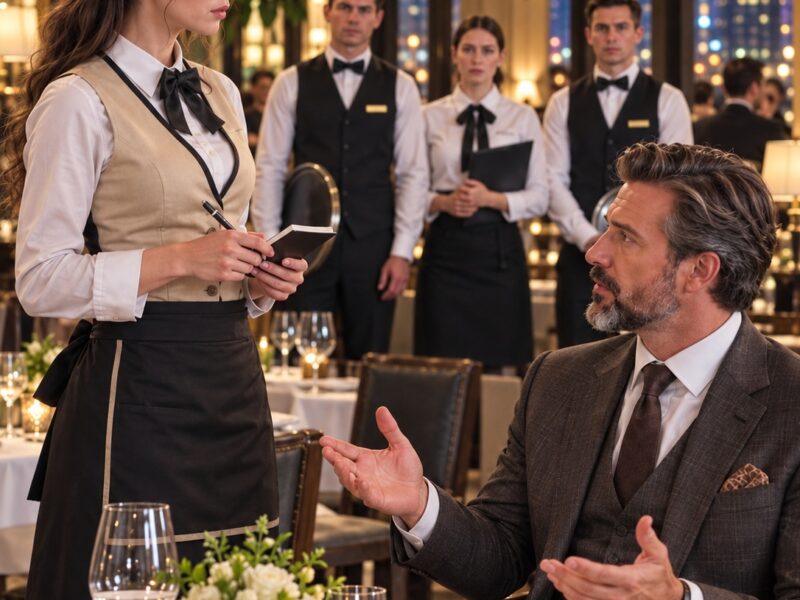
No One Could Serve the Foreign Tycoon — Until the Waitress Switched Languages!
By 1:19 p.m., three servers had been sent away from Table Twelve, the general manager was sweating through his collar, and the richest guest in the room still had not ordered lunch.
Marin Whitlock noticed what everyone else missed: the foreign tycoon’s hands were trembling.
Then she heard him whisper one sentence in French—and realized the restaurant was minutes away from serving him something that could put him in an ambulance.
Aurelia occupied the ground floor of the Halcyon Hotel in Boston’s Back Bay, where the ceilings were high enough to make ordinary conversations sound expensive and every table seemed positioned beneath its own pool of flattering light.
There were no paper menus.
No wobbling chairs.
No servers introducing themselves with rehearsed jokes.
Water appeared before people noticed they were thirsty, napkins were replaced when guests stood, and plates arrived on porcelain warm enough to make butter soften but never melt.
Aurelia did not sell dinner.
It sold the reassurance that nothing awkward would happen while you were paying for it.
Which was why Alistair Crane looked as though someone had announced a fire.
“Who sent Daniel back?”
Marin glanced up from the service station.
Daniel Mercer, one of the restaurant’s senior captains, was walking rapidly toward the kitchen with his jaw locked and a wine list pressed flat against his chest.
“He sent himself back,” Sofia Reyes said.
Sofia was Aurelia’s executive chef, forty-four, sharp-eyed, and unwilling to pretend panic became more dignified when people wore suits.
Marin lowered her voice.
“What happened?”
“Table Twelve.”
Everyone knew Table Twelve.
The window table.
Reserved for people whose assistants called instead of making reservations.
Lucien Vartan sat there alone.
He had arrived seventeen minutes earlier in a black sedan with diplomatic-looking plates and no visible entourage.
Marin knew the name because everyone on staff had been briefed that morning.
Lucien Vartan.
Forty-seven.
Born in France.
Based in Geneva.
Chairman of Vartan Groupe, an industrial conglomerate with interests in ports, hotels, energy infrastructure, data centers, and transportation systems across Europe, North Africa, and the Middle East.
His face had appeared in Forbes, Bloomberg Businessweek, and on the front page of the Financial Times after one of his companies bought a failing Mediterranean shipping network and turned it profitable within two years.
He was in Boston because Vartan Groupe was negotiating a partnership with Crescent Hospitality, the company that owned the Halcyon and eleven other luxury hotels.
Rumor placed the deal somewhere north of six hundred million dollars.
Alistair had repeated that figure twice during pre-shift.
As if servers tipped more carefully when they knew exactly how much money was breathing near them.
“What did Daniel do?” Marin asked.
Sofia glanced toward the dining room.
“Apparently Mr. Vartan asked a question about the sauce.”
“That sounds survivable.”
“Daniel couldn’t understand him.”
“His English?”
“He speaks English.”
“That narrows it down.”
Sofia almost smiled.
Then another server appeared.
Madeline Cho.
Usually unflappable.
Now pink across the cheeks.
“He wants someone else.”
Alistair intercepted her.
“What happened?”
“He asked whether the lamb has something in it.”
“What?”
“I don’t know. Mustard maybe? Or nuts? I asked him to repeat himself and he switched languages.”
Alistair’s mouth tightened.
“You were told he speaks English.”
“He does. He’s just—”
“What?”
Madeline stopped.
Frustrated.
“Upset.”
Alistair glanced toward the window table.
From across the room, Lucien Vartan did not look upset.
He looked still.
That was different.
He wore a charcoal suit with no tie. His dark hair showed silver at the temples, and one hand rested beside a closed menu while the other remained beneath the table.
His posture was straight.
Face unreadable.
Only his jaw moved occasionally.
Alistair sighed.
“Ben.”
Benjamin Lyle, the youngest captain, looked up.
“No.”
“You speak French.”
“I took it in high school.”
“That counts.”
“It absolutely does not.”
“Go.”
Ben looked toward Marin.
“You speak French.”
Marin kept polishing the wineglass in her hand.
Alistair did not look at her.
“Ben.”
That was not accidental.
Marin had worked at Aurelia for nineteen months.
Alistair knew exactly which languages she spoke.
He also knew she had once applied internally for a guest-relations position and been told her experience was “too service-side.”
Ben went.
Three minutes later, he came back.
“He asked me to leave.”
Sofia murmured:
“That makes three.”
Alistair rubbed one hand over his mouth.
“What did you say?”
“I said bonjour.”
Marin closed her eyes.
“And?”
“He answered too fast.”
“You told him you spoke French.”
“I said I studied French.”
“That is not the same sentence,” Marin said.
Ben looked miserable.
“I understand that now.”
Alistair turned on her.
“You find this entertaining?”
“No.”
“Good.”
He straightened his jacket.
“I’ll handle it.”
Marin watched him cross the dining room.
Something in her stomach tightened.
She could not have explained why.
Maybe it was because Lucien’s right hand emerged from beneath the table just long enough to reach for his water.
It trembled.
Barely.
His fingers closed around the stem.
Then he abandoned the glass without drinking.
Nobody else seemed to notice.
Alistair approached with the broad, polished smile he used when he wanted wealthy people to remember Aurelia as accommodating.
“Mr. Vartan, my apologies.”
Lucien looked up.
“I understand there’s been some confusion.”
Lucien answered in English.
His accent was noticeable but not difficult.
“I have asked one question.”
“Of course.”
“Three times.”
Alistair smiled harder.
“Perhaps if you point to the entrée you’d like, we can move forward.”
Lucien stared at him.
The restaurant seemed to become quieter.
“I do not need help pointing.”
“No, certainly, I only meant—”
“I asked whether the sauce contains moutarde or walnut.”
Alistair hesitated.
Marin heard it from twenty feet away.
So did Sofia.
Mustard.
Lucien continued, more slowly.
“There is oil. Is it walnut oil?”
Alistair looked toward the menu.
“I’m sure our kitchen can accommodate preferences.”
Lucien’s eyes changed.
“It is not a preference.”
Marin set down the wineglass.
She saw the black leather case half-hidden beside Lucien’s phone.
Slim.
Medical.
She had seen one like it hundreds of times while caring for her mother after an allergic reaction two years earlier.
Epinephrine.
At that exact moment, a food runner emerged from the kitchen carrying an amuse-bouche Alistair had ordered for the table without asking.
Roasted pear.
Whipped goat cheese.
Candied walnut.
Walnut oil.
Marin moved.
“Stop.”
The runner froze.
Alistair turned.
“What are you doing?”
Marin took the plate.
Lucien looked at her.
Alistair’s voice sharpened.
“Marin.”
She ignored him.
Walked to Table Twelve.
Placed the plate on an empty service stand instead of in front of Lucien.
Then she looked at him and switched languages.
“Vous essayez de nous dire que vous êtes allergique aux noix et à la moutarde, n’est-ce pas?”
You’re trying to tell us you’re allergic to walnuts and mustard, aren’t you?
Lucien stopped moving.
Not dramatically.
His shoulders simply lowered.
One inch.
Like a man who had been holding something heavy and finally realized someone else had taken hold of the other end.
“Yes,” he answered in French.
Then more quietly:
“Severely.”
Alistair came closer.
“Marin, what is he saying?”
She kept her attention on Lucien.
“Any other allergies?”
“Hazenuts. Walnut. Mustard seed. I carry epinephrine.”
“Have you eaten anything since arriving?”
“No.”
“Did you have a reaction before you came here?”
His eyes narrowed.
“Why?”
“Your hand is shaking.”
He looked down.
For the first time, irritation appeared.
Not at her.
At being observed.
“Long day.”
“Okay.”
She did not diagnose him.
Did not tell him what he felt.
“May I have the kitchen prepare something from a clean station?”
A pause.
“Yes.”
“What would feel safest?”
That question changed his expression.
Not What would you like?
What would feel safe.
“Fish.”
“Plain?”
“Olive oil. Lemon. Salt.”
“No mustard. No nuts. Separate utensils.”
“Yes.”
“Vegetables?”
“Anything simple.”
Marin nodded.
Then translated everything for Sofia.
Sofia immediately removed the walnut plate and called the sous-chef.
“New pan. New board. New gloves.”
Alistair looked offended.
“We have allergy procedures.”
Sofia glanced at him.
“Then we’re using them.”
Marin returned to Lucien.
“Sparkling or still?”
“Still.”
She replaced his untouched glass.
No performance.
No apology speech.
No mention of wealth.
Lucien looked toward the plate that had nearly reached him.
“Walnut?”
“Yes.”
“Oil too?”
“Yes.”
His jaw tightened.
Marin said:
“It won’t come near your table again.”
A long silence.
Then:
“Thank you.”
Alistair stepped in.
“Mr. Vartan, of course, we sincerely apologize for this misunderstanding.”
Lucien looked at him.
“That was not a misunderstanding.”
Alistair’s smile faltered.
Lucien pointed toward Marin.
“She understood.”
The distinction hung there.
Alistair glanced at Marin.
His eyes said they would discuss it later.
Marin knew that look.
She had worked under managers her entire adult life.
There was always a moment when helping the customer stopped being the goal and embarrassing the manager became the offense.
She returned to service.
But Lucien kept looking at her.
Not constantly.
Once while she refilled another table’s water.
Again while she carried plates toward the kitchen.
Not interest in the romantic sense.
Recognition.
When his meal arrived, Sofia herself brought it.
Seared cod.
Roasted fennel.
Potatoes.
Olive oil.
Lemon.
Nothing decorative enough to hide an ingredient.
Lucien asked Marin one final question in French.
“Can you stay until I taste it?”
She nodded.
He took a bite.
Waited.
Then another.
His shoulders lowered again.
“All right?”
“Yes.”
“Good.”
She turned to leave.
“Miss?”
“Whitlock.”
“Marin Whitlock.”
“Yes.”
His pronunciation of her first name was almost French.
“How did you learn?”
She knew what he meant.
“My grandmother.”
“French?”
“French Canadian.”
His face changed.
“Québécoise?”
“Montreal for twenty-five years. Then Boston.”
He looked down at his plate.
“My mother was from Quebec City.”
There was something in the way he said mother.
Not sentimental.
Careful.
Marin noticed.
“She spoke French with you?”
“Always.”
“Then your English is better than you were letting everyone think.”
A faint surprise.
Then, unexpectedly, he smiled.
It transformed him.
Not because he became handsome.
He already was in the severe, magazine-cover way wealth often polishes men.
The smile simply made him look less defended.
“My English is fine.”
“I know.”
“I was trying to explain the allergy precisely.”
“I know.”
“When I’m angry, I lose words.”
Marin nodded.
“When I’m tired, I lose numbers.”
He looked amused.
“That could be dangerous in your job.”
“Only if somebody pays cash.”
Another smile.
Then it disappeared.
“My mother died fourteen months ago.”
Marin did not know what to say.
So she did not fill the silence.
Lucien looked toward the windows.
“She was the last person who spoke to me in French without wanting something.”
There it was.
The loneliness Marin had seen before she understood the problem.
She had seen that look once on her grandmother’s face during the final months of vascular dementia.
Colette Whitlock had spent half her life translating between French and English for neighbors who needed help with schools, doctors, landlords, immigration forms.
Then memory started stealing language from her.
English first.
French later.
People would speak louder when she could not answer.
As if volume could build a bridge where comprehension had collapsed.
Marin had learned something during those months.
Confusion and fear can look almost identical from across a room.
She said:
“I’m sorry.”
Lucien looked at her.
Not for your loss.
Not a speech.
Just I’m sorry.
He nodded.
“So am I.”
Alistair appeared at Marin’s elbow.
“Marin, your other tables need you.”
She looked at him.
They did not.
He knew she knew.
Lucien knew too.
Marin stepped back.
“Enjoy your lunch, Mr. Vartan.”
“Lucien.”
Alistair’s eyes flickered.
Marin did not take the bait.
“Enjoy your lunch.”
She walked away.
Five minutes later, Alistair called her into the service corridor.
The door swung shut behind them.
“What was that?”
Marin stared.
“Service.”
“Do not be clever.”
“I stopped a walnut dish from reaching someone with a walnut allergy.”
“I am aware.”
“Then what are we discussing?”
“You inserted yourself into a VIP interaction without authorization.”
“Because three authorized people couldn’t understand him.”
“Lower your voice.”
“I’m not loud.”
That was true.
Alistair was the one whispering aggressively.
“You made the restaurant look incompetent.”
Marin’s eyebrows rose.
“The walnut oil did that.”
His face hardened.
“You think because you speak French you get to improvise policy?”
“No.”
“You spent twelve minutes at one table.”
“He was trying to explain a medical risk.”
“I heard enough.”
“You didn’t hear enough to stop the walnuts.”
Silence.
Wrong sentence.
She knew it the instant it left her mouth.
Not because it was false.
Because it made him feel exposed.
Alistair straightened.
“You’re off VIP rotation for the rest of the week.”
Marin stared.
“That’s half my income.”
“Then consider the cost of disregarding chain of command.”
Sofia appeared at the far end of the corridor.
“What happened?”
“Nothing,” Alistair said.
Sofia looked at Marin.
Marin answered:
“I’m off VIP rotation.”
“For stopping an allergen?”
“For insubordination.”
Sofia’s eyes moved to Alistair.
“Interesting.”
“Chef.”
“I said interesting.”
She kept walking.
Alistair lowered his voice further.
“Go back to work.”
Marin did.
Not because he was right.
Because rent was due in eleven days.
Her mother’s physical-therapy copay had gone up again.
And righteous exits are easier in stories than when your checking account contains $1,842.
She finished the shift.
Lucien remained for another forty minutes.
He did not summon her again.
When he left, he paid by black metal card and tipped thirty percent.
Marin only knew because Daniel told everyone.
She did not care.
At four thirty, she reset Table Eight for dinner service.
There was a folded piece of hotel stationery beside her tray.
Her name on the front.
Marin Whitlock
Inside, one line in French.
Thank you for speaking to the frightened man before everyone else decided he was merely difficult.
She read it twice.
Then folded it.
Her canvas bag sat beneath the employee lockers.
Inside was the notebook she had carried for three years.
The cover was cracked.
A photograph of her grandmother occupied the inside pocket.
Behind it sat an unopened-looking letter Marin had actually read forty-three times.
New England Institute for Language and Interpretation
Advanced Community Interpretation Program
Admission Deferred — Final Extension
The deadline was December first.
Ten days away.
She slid Lucien’s note behind the letter.
Then closed the notebook.
At five, her phone rang.
“Mom.”
“You sound tired.”
Grace Whitlock had an irritating ability to hear fatigue through one syllable.
“I’m okay.”
“Lie better.”
Marin smiled despite herself.
“How was therapy?”
“Your mother remains an athletic phenomenon.”
“You walked six minutes.”
“Seven.”
“With a cane.”
“Do professional athletes not use equipment?”
Marin laughed.
Grace had suffered a moderate stroke two years earlier.
She had regained speech quickly but still dealt with weakness on her left side.
Marin had dropped her interpretation program within a week.
Not because Grace asked.
Because hospital bills, rehabilitation, and reduced income created a math problem love could not solve poetically.
She took additional restaurant shifts.
Then weekend catering.
Then told herself school would still be there later.
Later became two years.
Grace asked:
“What happened?”
“Foreign billionaire almost got served walnuts.”
Silence.
“What?”
“I’ll explain later.”
“Did you poison him?”
“No.”
“Then I’m proud.”
“Your standards are alarming.”
“You’re alive. He’s alive. Good shift.”
Marin looked toward the dining room.
“Alistair cut my VIP section for the week.”
Grace became quiet.
“Why?”
“Because I embarrassed him.”
“Did you?”
“Yes.”
“Was he wrong?”
“Yes.”
“Excellent.”
“Mom.”
“What?”
“You’re supposed to teach me conflict avoidance after a stroke.”
“My brain injury improved my priorities.”
Marin leaned against the wall.
Grace’s voice softened.
“Come over after work?”
“I have dinner shift.”
“Tomorrow.”
“I’ll bring groceries.”
“I have groceries.”
“You have yogurt and one onion.”
“That is technically groceries.”
Marin smiled.
“Tomorrow.”
She hung up.
At six thirty the restaurant filled again.
Life resumed.
That was the strange thing about significant moments.
They rarely announce whether they are significant.
You still refill bread baskets afterward.
The next morning, Marin arrived at eleven.
Alistair was waiting beside the host stand.
“Office.”
Her stomach dropped.
Sofia looked up from the kitchen pass.
Marin followed him.
The Halcyon’s director of human resources sat inside.
So did Evelyn Hart, the hotel’s general manager.
And Lucien Vartan.
Marin stopped.
“No.”
Everyone looked at her.
She pointed at Lucien.
“With respect, if you complained, I am going to be furious.”
For one full second, nobody spoke.
Then Lucien laughed.
Not polite laughter.
Actual laughter.
Alistair looked mortified.
Lucien stood.
“I did not complain.”
“Good.”
“I called.”
“That is dangerously adjacent.”
Evelyn Hart gestured toward the chair.
“Marin, sit.”
She remained standing.
“What is this?”
Evelyn looked at Alistair.
That seemed to make him uncomfortable.
“We’re reviewing yesterday’s service incident.”
Marin folded her arms.
“Okay.”
“Mr. Vartan’s office requested that all camera footage, service tickets, kitchen logs, and allergy procedures be preserved.”
Marin looked at Lucien.
He said:
“My general counsel requested preservation.”
“Why?”
“Because your manager told my assistant this morning that the restaurant followed protocol and that I became upset because of a language misunderstanding.”
Marin turned slowly toward Alistair.
His jaw tightened.
Lucien continued:
“That is not what happened.”
Evelyn opened a folder.
“Chef Reyes submitted an incident report independently.”
Good Sofia.
“It states an unrequested walnut course was en route to Table Twelve after Mr. Vartan had attempted repeatedly to identify a walnut allergy.”
Alistair spoke.
“There was confusion around pronunciation.”
Marin looked at him.
He ignored her.
Evelyn said:
“The allergy question was recorded on the dining-room audio system.”
Alistair’s face changed.
Marin had forgotten Aurelia’s ceiling microphones were used for staff-training review.
Lucien’s English had been clear enough.
Mustard.
Walnut.
Allergy.
Three separate times.
Evelyn continued.
“The tablet translation service assigned to VIP tables was not available.”
Alistair said:
“It had been malfunctioning.”
“For how long?”
He did not answer.
Evelyn looked at the report.
“Six weeks.”
Marin’s eyes narrowed.
She had heard servers complain about it.
No one had treated it as urgent.
Because nobody important enough had needed it yet.
Evelyn said:
“There are three prior maintenance requests.”
Alistair’s posture stiffened.
Lucien remained silent.
That mattered.
He was not directing the room.
Evelyn was.
Marin understood why.
Lucien could have demanded Alistair’s job.
Instead, his attorney had preserved evidence.
Let the hotel’s own process do the rest.
Evelyn closed the folder.
“Alistair, you’re being placed on administrative leave pending completion of the safety review.”
His face drained.
“For this?”
“For the protocol failure and for potential retaliation against an employee who intervened.”
His eyes went to Marin.
There it was.
The real injury.
Not the investigation.
Her presence.
He stood.
“Mr. Vartan, surely you understand—”
Lucien looked at him.
“You are speaking to the wrong person.”
Alistair stopped.
Lucien continued:
“This is your employer’s review.”
A beat.
“I am a guest.”
The distinction was surgical.
Alistair left.
Nobody celebrated.
That made the moment better.
Evelyn looked at Marin.
“Your VIP rotation is restored.”
“Thank you.”
“We also owe you an apology.”
“Yes.”
Evelyn blinked.
Marin added:
“But I appreciate hearing it.”
Lucien’s mouth almost moved.
Evelyn continued.
“I’d like you to participate in the protocol review if you’re willing.”
“Paid?”
Evelyn smiled.
“Yes.”
“Then yes.”
After HR left, Marin picked up her bag.
Lucien remained.
She looked at him.
“Was there something else?”
“My lunch.”
She waited.
“I wanted to thank you without the table.”
“You wrote a note.”
“I did.”
“It was enough.”
Lucien studied her.
“You say that as though people often try to make gratitude expensive.”
Marin considered him.
“Rich people sometimes confuse gratitude with acquisition.”
His eyebrows rose.
“Do they?”
“You tell me.”
A real smile.
“I am trying not to.”
“Good.”
He noticed the canvas notebook protruding from her bag.
“You write?”
“Mostly lists.”
“Languages?”
“Sometimes.”
“You speak more than French.”
It was not a question.
“French fluently. German well. Spanish conversationally. Enough Portuguese to embarrass myself in four countries.”
“And Armenian?”
“No.”
“My mother would have approved of your honesty.”
“Your mother spoke Armenian?”
“My father was Armenian. She learned.”
Marin nodded.
Lucien hesitated.
Then:
“She ran a foundation.”
“Past tense?”
“Technically it still exists.”
“But?”
“I ignored it.”
His voice flattened.
“After she died.”
Marin said nothing.
Lucien looked toward the window.
“My mother funded language programs. Interpretation in hospitals, schools, immigration clinics. Scholarships.”
Marin’s hand tightened around her bag strap.
He noticed.
“What?”
“Nothing.”
“That was visibly not nothing.”
She sighed.
Then pulled out the notebook.
The admission letter slid partially free.
Lucien read the heading before she could stop it.
New England Institute for Language and Interpretation.
His eyes lifted.
Marin tucked it back.
“That is private.”
“You’re right.”
He looked away immediately.
No follow-up.
No offer.
That surprised her.
She said:
“I got in two years ago.”
He waited.
“My mother had a stroke.”
“I’m sorry.”
“She’s better.”
“But you didn’t go.”
“No.”
“Money?”
“Partly.”
“Time?”
“Mostly.”
He nodded.
No billionaire sentence.
No I can fix that.
Marin relaxed slightly.
Lucien said:
“My mother’s foundation is called Geneviève House.”
“That sounds like a perfume.”
His mouth twitched.
“She would have agreed.”
“Why did you ignore it?”
He looked at her.
“Because grief is not logical.”
“Fair.”
“Everything connected to her felt like someone had left a door open in winter.”
Marin understood that sentence too well.
“Closing the door doesn’t change the weather.”
“No.”
“But it keeps you from feeling it.”
“Yes.”
He looked down.
“You spoke French to me yesterday and for maybe ten seconds I hated you.”
Marin laughed before she could stop herself.
“That’s charming.”
“I know.”
“Why?”
“Because you sounded like home.”
The humor left her.
Lucien continued.
“Then I realized I had spent fourteen months treating everything she loved as though it had died with her.”
He glanced toward her bag.
“I don’t know what I’m going to do with that yet.”
“Good.”
He looked surprised.
“Good?”
“If you had a complete philanthropic strategy twenty-four hours after lunch, I’d assume it was guilt with branding.”
Lucien stared.
Then laughed again.
“You are unusually unimpressed by me.”
“I work in fine dining.”
“I don’t understand.”
“I meet impressive men every night.”
That shut him up.
For a moment.
Then:
“Would you have coffee with me?”
“No.”
His face registered surprise.
Marin added:
“I’m starting lunch service.”
“Oh.”
“At three thirty I get fifteen minutes.”
He nodded.
“Three thirty.”
“You cannot reserve my break.”
“I understand.”
“Do you?”
“No.”
“Progress.”
At three thirty, he was still there.
No entourage.
No private room.
He sat at the employee-side café inside the Halcyon lobby, drinking coffee that cost four dollars instead of forty.
Marin sat opposite him.
Fifteen minutes.
He asked about Colette.
Marin’s grandmother.
She told him Colette had spent twenty-five years in Montreal and another thirty in Massachusetts.
She had never worked professionally as an interpreter.
She simply became the person people called.
Parent-teacher conference.
Hospital intake.
Rental dispute.
Immigration letter.
A neighbor’s citizenship interview.
“She hated official titles,” Marin said.
“Why?”
“She said useful work existed before somebody invented a credential for it.”
Lucien smiled.
“That sounds like my mother.”
“What did yours do?”
“Everything.”
“Specific.”
He looked into the coffee.
“She was born in Quebec City. Met my father while studying economics in Paris. He died when I was twelve.”
“I’m sorry.”
“She raised me.”
Lucien’s mouth tightened.
“We didn’t have money then.”
Marin blinked.
“Really.”
“Very little.”
“What happened?”
“My father’s business partner stole from him before he died.”
There it was.
A different kind of inheritance.
“My mother worked.”
“Doing?”
“Translations. Bookkeeping. Anything.”
Lucien looked almost embarrassed by the next sentence.
“I decided money would solve the feeling.”
“What feeling?”
“Powerlessness.”
Marin understood.
“Did it?”
He looked around the luxury hotel.
“Some of it.”
“And the rest?”
“Apparently I became unpleasant in restaurants.”
She smiled.
His fifteen minutes ended.
He did not ask for more.
That mattered.
Three days later, Marin got an email from Geneviève House.
Not from Lucien.
From Nadine Mercier, general counsel and temporary board secretary.
Mr. Vartan has requested that Geneviève House resume active grantmaking. He has recused himself from applicant selection for the upcoming interpretation fellowship. Your name was not provided to the committee. Applications close December 1. If you independently wish to apply, the public link is below.
Marin read it three times.
Then called Grace.
Her mother answered:
“You sound dangerous.”
“What does that mean?”
“You only breathe that quietly before making decisions.”
Marin told her.
Grace listened.
Then:
“Apply.”
“It would feel like—”
“Stop.”
“Mom.”
“Did he offer you a scholarship?”
“No.”
“Did he put you on the committee?”
“No.”
“Did he tell them to choose you?”
“Apparently the opposite.”
“Then apply.”
Marin rubbed her forehead.
“I left school because of you.”
“No.”
“That is literally what happened.”
“You left school when I had a stroke.”
“Same thing.”
Grace’s voice hardened.
“No.”
Marin went silent.
Grace continued:
“I needed help.”
“You needed a lot.”
“Yes.”
“You were alone.”
“Yes.”
“And I chose to stay.”
“Yes.”
Grace paused.
“But I never asked you to turn staying into your identity.”
That landed.
“Mom.”
“You paused your life.”
“I know.”
“No, you converted a pause into a permanent address because it felt noble.”
“That is unfair.”
“Yes.”
“Great.”
“Apply.”
Marin closed her eyes.
“I hate when you’re right.”
“I survived a stroke to enjoy this.”
Marin applied.
She told no one at work.
Not Sofia.
Not Lucien.
Especially not Lucien.
Life continued.
Alistair’s investigation did too.
The hotel found more than one problem.
Incomplete allergen training records.
Translation tablets left unrepaired because replacement costs had been delayed until the next quarter.
Two prior guest complaints minimized as “communication issues.”
A server written up for spending too long helping an elderly guest understand a medication-related dietary restriction.
Alistair had not created every failure.
That mattered.
Some were structural.
Pressure to turn tables.
Pressure to protect ratings.
Pressure to give wealthy guests an appearance of perfect service even when perfection required pretending nobody had needs.
He had simply become very good at serving the system that rewarded those choices.
Three weeks later, he was dismissed.
Not for insulting Marin.
Not because Lucien wanted revenge.
For documented safety failures and retaliatory management decisions.
Marin heard from Evelyn.
Then went back to polishing glasses.
Sofia watched her.
“That’s it?”
“What?”
“No victory lap?”
“I have six tables.”
“You are deeply disappointing.”
“Thank you.”
“Alistair spent nineteen months telling everyone speed was hospitality.”
“He believed it.”
“That makes it worse.”
Marin looked toward Table Twelve.
Empty now.
“I think he believed control was hospitality.”
Sofia shrugged.
“Same disease.”
Lucien returned to Europe.
For twelve days, Marin did not hear from him.
She was relieved.
Then strangely not relieved.
Not because she missed him exactly.
Because the encounter had opened questions she had been avoiding.
About school.
About languages.
About how much of her adult life had been shaped by emergency rather than choice.
December first arrived.
At 11:48 p.m., Marin sat at Grace’s kitchen table.
Her mother was asleep upstairs.
The application portal showed:
SUBMITTED
Marin stared.
Then closed the laptop.
No dramatic music.
No instant transformation.
Just one small decision sent into the dark.
Six weeks later, she received an interview.
Four candidates.
Three committee members.
None named Vartan.
She almost laughed from relief.
The interview lasted forty-seven minutes.
They asked about ethics.
Neutrality.
Medical interpretation.
Community trust.
Boundaries.
One committee member asked:
“You learned much of your French informally. Why should we invest in formal training now?”
Marin thought of Colette.
Of the ER visits.
Of Lucien’s trembling hand.
“Because being understood should not depend on whether the right waitress happens to be standing twenty feet away.”
Silence.
Then someone wrote something down.
Two weeks later, she got the fellowship.
Full tuition.
Living stipend modest enough not to feel like fantasy.
Part-time placement at Massachusetts General’s community language-access program.
Marin sat in her car after work and cried.
Not because the money saved her.
Because an old version of herself she had stopped expecting to meet had suddenly knocked.
She called Grace.
Her mother cried louder.
Then:
“I told you.”
Marin laughed.
“You ruin everything.”
“Correct.”
She did not call Lucien.
She did not have his number.
That seemed healthy.
Nadine emailed a formal congratulations message on behalf of the foundation.
Nothing personal.
Also healthy.
Three months passed.
Marin reduced her restaurant schedule.
Classes started.
Interpretation was harder than speaking languages.
That surprised her.
Memory drills.
Ethics.
Register.
Consecutive note-taking.
Medical terminology.
The discipline of translating precisely without inserting yourself.
Marin discovered that instinctive empathy could become its own form of interference.
Sometimes helping meant not improving someone’s words.
Just carrying them accurately.
She loved it.
She also hated being bad at something again.
One Tuesday, she interpreted a simulated pediatric appointment and missed a medication dosage.
The instructor stopped her.
“Again.”
Marin flushed.
Restarted.
Missed less.
Again.
Third time correct.
She left class furious.
Then realized she was smiling.
At Aurelia, the safety review changed things.
Translation devices at every service station.
Allergen questions written and verbal.
No unrequested amuse-bouche for flagged guests.
Language skills listed privately in staff profiles so multilingual employees could volunteer, not be summoned as unpaid translators for every interaction.
Marin insisted on that last part.
Evelyn listened.
Sofia approved.
Six months after Table Twelve, Marin entered Aurelia for an afternoon shift and saw Lucien sitting near the window.
Same table.
Different man.
No suit jacket.
No assistant.
A small wooden box beside his water.
Marin stopped.
He noticed.
Stood.
“Hello.”
“Do you still terrorize servers?”
“Only in Geneva.”
“That’s unfortunate for Geneva.”
He smiled.
“I heard you got the fellowship.”
“From Nadine?”
“She enjoys telling me things I am not allowed to influence.”
“Good woman.”
“She is terrifying.”
“I like her.”
“I expected that.”
Marin looked at the wooden box.
“What is that?”
“My mother.”
She stared.
“That sentence needs work.”
Lucien almost laughed.
“Photographs.”
He touched the lid.
“And letters.”
Marin’s expression softened.
“What changed?”
“You.”
“No.”
He paused.
She continued.
“I spoke French to you for ten minutes.”
“Twenty-three.”
“That is alarming.”
“I checked the security footage.”
“More alarming.”
His smile faded.
Marin leaned one hand on the chair.
“You reopened the box.”
“Yes.”
“You did that.”
Lucien looked down.
“I was hoping to blame someone.”
“Find a therapist.”
“I did.”
That surprised her.
He saw.
“Again, you are unusually flattering.”
“What did you find?”
Lucien opened the box.
On top lay a photograph.
A younger Geneviève Vartan stood outside a community center in Montreal with six teenagers, all holding textbooks.
She had dark hair.
Strong eyebrows.
A smile very much like Lucien’s when he forgot to restrain it.
“She was beautiful.”
“Yes.”
Lucien handed Marin a folded letter.
“You don’t have to read it.”
Marin did.
It was written in French.
Geneviève describing Lucien at seventeen.
He thinks strength means never letting anyone see when he is afraid. I hope adulthood is kind enough to teach him otherwise.
Marin looked up.
Lucien gave a humorless smile.
“She was annoyingly accurate.”
“Good mothers specialize.”
“There are dozens.”
“What are you going to do with them?”
“Archive them.”
“Foundation?”
“Yes.”
He closed the box.
“Geneviève House has an independent director now.”
“Not you?”
“No.”
“Excellent.”
“You are enjoying this.”
“A little.”
He continued.
“We’re expanding hospital interpretation grants.”
Marin’s attention sharpened.
“Where?”
“Massachusetts, Rhode Island, Maine.”
“Why hospitals first?”
“Because of you.”
She stared.
He corrected himself.
“Because the incident at Aurelia made me realize how dangerous misunderstanding becomes when people are afraid.”
Better.
“And my mother’s old files showed that her earliest work was in clinics.”
Marin nodded.
“That makes sense.”
“I have another question.”
“No job offer.”
Lucien blinked.
“How did you know?”
“You are physically incapable of sitting with possibility.”
“That seems unfair.”
“Is it wrong?”
He considered.
“No.”
Marin folded her arms.
“What job?”
“Not now.”
“Good.”
“When you finish training.”
“Better.”
“Geneviève House will need program staff.”
“Apply publicly.”
“Yes.”
“Independent hiring.”
“Yes.”
“No special phone call.”
His eyes narrowed.
“You have thought about this.”
“I work around rich people.”
“That continues to wound me.”
“Survive.”
He did.
Marin completed the fellowship eleven months after the day Lucien first entered Aurelia.
Graduation took place in a small theater in Cambridge.
Grace sat in the second row with her cane and a bouquet she had been specifically told not to buy.
Sofia came wearing chef whites because she had left work late.
Lucien did not attend.
Marin noticed.
Then realized she was glad.
The day belonged to people who had done the work.
Two weeks later, she applied to Geneviève House.
Publicly.
Resume.
References.
Writing sample.
Interview.
She did not tell Lucien.
Nadine interviewed her.
So did an emergency physician, a public-school administrator, and the foundation’s new executive director, Anita Rao.
They made her work.
Good.
She got the job.
Program coordinator for healthcare language access.
Not director.
Not executive.
Not rescued genius.
A beginning.
Her first assignment involved three community clinics where interpreter coverage failed after five p.m.
Marin spent four weeks interviewing nurses, families, interpreters, receptionists, and administrators.
Her report was not elegant.
It was practical.
Pay interpreters for standby hours.
Stop relying on bilingual janitors and relatives.
Translate consent forms before emergencies.
Build phone interpretation as backup, not default.
Create language preference fields people could actually update.
Lucien read the final report because Geneviève House’s board sent quarterly summaries.
He emailed one sentence.
My mother would have underlined page nine.
Marin replied:
Your mother sounds bossy.
His answer:
Extremely.
That became their friendship.
Not constant.
No private jets.
No luxurious rescue.
Occasional emails.
Coffee when he was in Boston.
French when grief made English feel too far away.
Marin learned more about him in fragments.
Lucien had built Vartan Groupe partly from the remnants of his father’s failed freight company.
His father died when Lucien was twelve.
His mother spent years balancing books after midnight.
Lucien learned early that money could make other people stop deciding for you.
So he pursued it with the discipline of a man outrunning an old fear.
He became excellent at control.
Less excellent at needing anyone.
After Geneviève died, his work doubled.
Meetings multiplied.
Travel increased.
His staff praised the discipline.
Nobody called it grief.
Marin did not romanticize that.
She once told him:
“You know replacing mourning with acquisitions still counts as avoidance.”
He replied:
“Your bedside manner remains poor.”
“I’m not your doctor.”
“Fortunately.”
A year after Table Twelve, Aurelia hosted Geneviève House’s first Boston scholarship luncheon.
Not a gala.
Lucien refused a gala.
Marin agreed.
One hundred scholarship recipients and community partners filled the room.
Students.
Teachers.
Hospital staff.
Parents.
Interpreters.
A sixteen-year-old girl from Lowell practiced French with her Haitian grandmother near the windows.
Two brothers whose parents spoke limited English showed off acceptance letters to a summer language program.
A Cambodian American nursing student stood with his mother while an interpreter helped her understand why everyone kept congratulating him.
Marin watched.
The room sounded different from Aurelia’s normal lunch crowd.
Messier.
Warmer.
Several languages overlapping.
Nobody rushing to make everything uniform.
Sofia found Marin near the service station.
“Look.”
Marin turned.
Lucien stood at Table Twelve.
Same table.
He was speaking French to an elderly woman.
Slowly.
Rusty.
Smiling.
Marin’s throat tightened.
Sofia said:
“That him?”
“Yes.”
“The difficult billionaire?”
“Foreign tycoon.”
“Sorry.”
“He hates tycoon.”
“Good.”
Lucien eventually took the microphone.
Marin expected a polished speech.
She had learned not to underestimate his capacity for overpreparation.
Instead he unfolded one sheet of paper.
“My mother believed language was practical.”
His French accent thickened certain English vowels.
“She disliked people who treated it as decoration.”
A few laughs.
“She believed a person who cannot make themselves understood becomes vulnerable very quickly.”
Marin looked toward Grace.
Her mother was already crying.
Traitor.
Lucien continued.
“After my mother died, I closed every door connected to her work because I mistook avoidance for strength.”
The room became still.
“Then one year ago, in this room, I behaved badly.”
Marin looked down.
Lucien said:
“I was frightened. I was frustrated. I had a medical concern I could not communicate with enough precision, and I treated several people unfairly because I was angry at not being understood.”
No excuses.
Good.
“Then a waitress spoke to me in French.”
Several heads turned toward Marin.
She hated that.
Lucien anticipated it.
“Her name is Marin Whitlock, and she has specifically instructed me not to tell you she changed my life.”
Laughter.
Marin covered her face.
Lucien almost smiled.
“So I will be precise.”
He looked at her.
“She did not change my life.”
Better.
“She noticed something.”
His voice softened.
“That I was afraid.”
The room quieted again.
“She helped me safely order lunch. Everything after that was my responsibility.”
Marin lowered her hand.
Lucien continued.
“Money can buy attention.”
He looked around the room.
“It cannot force understanding.”
A pause.
“And kindness is not useful if it only appears when the recipient has enough status to reward it.”
That one landed harder.
Especially with Aurelia’s staff.
Especially with Evelyn Hart.
Especially with Marin.
After the speech, nobody applauded immediately.
Then someone did.
Then the room followed.
Lucien stepped away from the microphone.
No triumphant music.
No transformation completed.
Just a man slightly less defended than the year before.
Later, Marin found him beside the windows.
“You ignored instructions.”
“I was precise.”
“You used my full name.”
“It is public on the program.”
“Technicality.”
“My lawyers teach me.”
“You need worse lawyers.”
“Nadine will be hurt.”
“She’ll recover.”
Lucien looked toward Grace.
“Your mother?”
“Yes.”
“She looks formidable.”
“She is.”
Grace caught them looking.
Raised her cane slightly.
Lucien blinked.
“Was that a threat?”
“Possibly affection.”
“I cannot tell.”
“Welcome to the family.”
The words escaped before Marin considered them.
Lucien went still.
Not because they were romantic.
They were not.
Because belonging had become a difficult word for him.
Marin saw it.
Let it rest.
He nodded once.
“Thank you.”
Two years after the restaurant incident, Marin’s job took her into a pediatric emergency department in Worcester.
A seven-year-old girl sat on an examination bed while her father tried to answer questions in Haitian Creole.
The hospital had an interpreter.
Not a cousin.
Not Google Translate.
Not a staff member improvising.
An actual trained interpreter on video within forty seconds.
Marin stood in the hall beside the nursing director, reviewing response times.
The little girl’s father relaxed when the interpreter greeted him.
Marin recognized the movement.
Shoulders lowering.
One inch.
Exactly like Lucien.
She wrote something in her notebook.
Grace had given her a new one when she finished school.
Marin still carried the old canvas bag.
Some habits survive success.
Inside the bag was Colette’s photograph.
Lucien’s note from Aurelia.
And the original admission letter she had once nearly allowed to expire.
Not trophies.
Coordinates.
Proof of where she had been.
That evening, she stopped at Grace’s apartment.
Her mother was making soup badly.
“You’re late.”
“I have a job.”
“Excuses.”
Marin took the knife from her.
“You’re cutting carrots like you resent geometry.”
“I do.”
Grace sat.
“How was Worcester?”
“Good.”
“Meaning?”
“Interpreter response average under a minute.”
Grace smiled.
“You like saying that.”
“I do.”
Her phone buzzed.
A message from Lucien.
Photograph.
A small wooden desk.
Geneviève’s old French-English dictionary open beside a cup of coffee.
Caption:
I found her notes in the margins. Apparently my pronunciation was terrible at nine.
Marin smiled.
Grace noticed.
“The tycoon?”
“He prefers industrialist.”
“Of course he does.”
Marin replied:
Some problems cannot be fixed with money.
Lucien:
Tragic.
Grace watched.
“You know what I like about him?”
Marin glanced up.
“What?”
“He did not marry you.”
Marin nearly dropped the carrot.
“Mom.”
“What?”
“Why would he marry me?”
“Exactly.”
Grace looked satisfied.
“The bad version of this story has a billionaire reward the waitress by choosing her.”
Marin stared.
Grace continued stirring soup.
“The better version is the waitress already had a life.”
Marin smiled slowly.
“And?”
“The rich man learned something and did his own work.”
“You have become very opinionated.”
“I had a stroke.”
“That excuse is aging.”
“It remains effective.”
They ate soup at the small kitchen table.
Later, Marin walked home through cold Boston rain.
Aurelia’s windows glowed across the street when she passed.
She stopped.
Inside, a server leaned over a table where an older couple looked confused.
The server listened.
Then walked away and returned with one of the restaurant’s interpretation tablets.
A second employee joined them.
No panic.
No embarrassment.
No one gesturing impatiently at a menu.
Just people solving the actual problem.
Marin watched for thirty seconds.
Then kept walking.
That was enough.
Three years after Lucien first sat at Table Twelve, Geneviève House opened a permanent Boston language-access center.
Marin had been promoted once.
Program manager.
Not because Lucien asked.
Anita Rao made her interview against six candidates.
Marin lost sleep over the panel.
She got the job by two votes.
Nadine told her afterward.
“You were not unanimous.”
Marin smiled.
“Perfect.”
“You are a strange woman.”
“I like evidence.”
The center occupied an old brick building in Roxbury.
Classrooms upstairs.
Interpretation labs downstairs.
A small legal clinic twice a week.
Hospital-navigation workshops.
Translation scholarships.
No marble lobby.
Lucien offered one.
Marin said no.
He sulked professionally.
Opening morning, Grace cut the ribbon.
Not Lucien.
That had been his idea.
Marin stood beside her mother.
Sofia came carrying pastries.
Evelyn Hart came from the Halcyon.
Nadine stood in the back checking her phone.
Lucien arrived late.
Commercial traffic from Logan.
Marin noticed.
“You’re late.”
“Seven minutes.”
“You own planes.”
“Nadine told me not to use one for optics.”
From across the room, Nadine said:
“I told you not to use one because Boston air traffic does not reorganize around your emotions.”
Lucien sighed.
“You see what I endure.”
Marin laughed.
A group of new fellows entered the classroom.
One carried the same terrified expression Marin remembered from her first week of interpretation training.
She walked over.
“First day?”
The young woman nodded.
“I’m going to mess up.”
“Yes.”
Her eyes widened.
Marin smiled.
“Then they’ll make you do it again.”
“That’s supposed to help?”
“Eventually.”
The fellow glanced toward Lucien.
“Is that Lucien Vartan?”
“Yes.”
“What is he doing here?”
Marin looked at him.
He was helping Grace move a chair because she had told him the room arrangement was “stupid.”
“Getting bossed around.”
The fellow laughed.
Good.
People should be allowed to become ordinary in some rooms.
The center opened.
Weeks passed.
Then months.
Some stories ended with the obvious moment.
The language switch.
The rich man surprised.
The waitress discovered.
This one did not.
Because being understood once is moving.
Building systems so the next person does not have to depend on luck is harder.
Marin preferred harder.
One rainy Thursday, almost exactly four years after Table Twelve, she met Lucien at Aurelia for lunch.
He requested Table Twelve.
Of course.
Marin arrived first.
She was no longer an employee.
That still felt strange.
The new manager greeted her by name.
No special performance.
Good.
Lucien arrived carrying a worn book.
Geneviève’s dictionary.
He placed it on the table.
“You brought homework.”
“My French is improving.”
“Prove it.”
He ordered entirely in French.
The server understood.
Not because she happened to speak it.
Because Aurelia’s tablet displayed translated allergy information, confirmed ingredients, and linked to the kitchen’s allergen protocol.
Lucien still asked questions.
The server answered without embarrassment.
No walnut oil.
No mustard.
Separate utensils.
Lucien looked at Marin.
She knew what he was thinking.
Neither said it.
The meal arrived.
Simple fish.
Fennel.
Potatoes.
Lemon.
Almost identical to the first meal.
Lucien took a bite.
Then:
“Safe.”
“Good.”
He opened Geneviève’s dictionary.
Inside the cover, his mother had written something in French decades earlier.
He turned it toward Marin.
Comprendre quelqu’un est une forme de respect.
Understanding someone is a form of respect.
Marin read it.
“She sounds like Colette.”
“I thought so.”
He closed the book.
For a while they ate.
No speeches.
Outside, Boston traffic moved through rain.
Inside, silverware touched porcelain.
At another table, a child laughed too loudly and nobody seemed bothered.
Lucien said:
“Do you ever think about that day?”
“Sometimes.”
“I was unbearable.”
“You were afraid.”
“Both can be true.”
Marin smiled.
He had learned.
“Yes.”
He looked toward the kitchen.
“You could have ignored me.”
“I almost did.”
“Why didn’t you?”
Marin thought about it.
Not her grandmother.
Not the scholarship.
Not destiny.
Just the exact moment.
“Your hand.”
He looked down.
“What about it?”
“It was shaking.”
Lucien became quiet.
“Everyone else was watching your face.”
Marin folded her napkin.
“I watched your hands.”
That answer seemed to stay with him.
He nodded.
When lunch ended, Lucien paid.
Normal tip.
Marin noticed.
Approved.
Outside, they stood beneath Aurelia’s awning.
Rain fell softly across Boylston Street.
Lucien’s car waited at the curb.
Marin had a train to Worcester.
Two different directions.
“Safe flight,” she said.
“Safe train.”
He opened the car door.
Then paused.
“Marin.”
“What?”
“Merci.”
She smiled.
“De rien.”
He left.
Marin adjusted the strap of her old canvas bag and walked toward the station.
Inside it, the worn notebook rested beside her interpreter badge.
Colette’s photograph was still tucked inside the cover.
The old admission letter was still there too, creased from years of being unfolded and refolded.
She had never thrown it away.
Not because she needed proof that Lucien Vartan had once seen something in her.
Because long before a foreign tycoon sat helpless at Table Twelve, before scholarships and foundations and new jobs, there had already been a young woman quietly learning languages after midnight because she believed understanding another person mattered.
The world had simply taken longer to catch up.
Behind her, Aurelia’s door opened for the dinner crowd.
Somewhere inside, someone would eventually speak a language a server did not understand.
This time, nobody would tell them to point at the menu.
Someone would know what to do.









