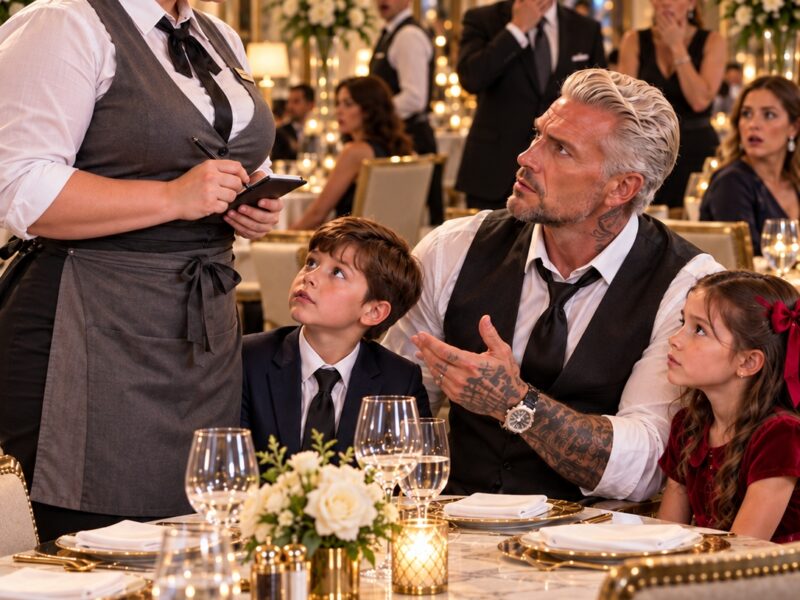
No One Could Understand the Mafia Boss’s Terrified Daughter—Until a Plus-Size Waitress Spoke Italian and Revealed What Everyone at the Table Had Missed
The first waiter left Gabriel Moretti’s table pale.
The second left shaking.
By the time the manager approached, half the dining room had stopped pretending not to watch the nine-year-old girl sitting across from one of Chicago’s most feared men, fighting tears over a plate she refused to touch.
Then a plus-size waitress named Hannah Reed heard five frantic words in Italian.
And realized the child was not being difficult.
She was trying to tell them the food might send her to the hospital.
Gabriel Moretti had spent most of his adult life being understood before he finished speaking.
At forty-one, he had the kind of reputation that entered rooms several seconds before he did. Hotel managers remembered his preferred table. Contractors returned his calls at midnight. Men who owed him money suddenly discovered exceptional punctuality. Prosecutors called him a businessman when microphones were nearby and used less generous language when doors closed.
He disliked both descriptions.
He considered himself practical.
That evening, however, practicality had failed him.
His daughter sat three feet away, speaking rapidly in a language he had once known well enough to fall in love in and had neglected long enough to lose.
“Lucia,” Gabriel said quietly. “Slowly.”
The girl’s dark eyes flashed with frustration.
She pointed at the green sauce beneath her chicken and spoke again.
Too quickly.
Gabriel caught perhaps four words.
Salsa.
Pinoli.
Mamma.
Pericoloso.
Sauce.
Pine nuts.
Mother.
Dangerous.
Individually, he understood them.
Together, under the pressure of a crowded restaurant and his daughter’s trembling voice, they would not arrange themselves fast enough.
His ten-year-old son, Nicholas, sat beside him holding a translation app toward his sister.
“Say it again,” Nick whispered.
Lucia did.
The phone produced several lines of nonsense.
Nick frowned.
“It says something about trees.”
Lucia pushed the phone away.
Her eyes filled.
Gabriel felt something cold move through him.
Not anger.
Something worse.
Helplessness.
He had spent six years telling himself that his separation from Lucia was unfortunate but manageable.
Tonight, for the first time, he wondered whether manageable was simply the word adults used when children were carrying the cost.
“Mr. Moretti?”
The restaurant manager stood beside the table.
Colin Harper was fifty, compact, immaculate, and experienced enough to know exactly who Gabriel was.
His smile was careful.
“May I help?”
Gabriel looked at his daughter.
“That depends.”
Colin leaned toward Lucia.
“Is something wrong with your meal?”
Lucia stared at him.
He repeated the question more loudly.
Gabriel’s jaw tightened.
“She isn’t deaf.”
Colin straightened immediately.
“Of course.”
Lucia tried again in Italian.
The waiter who had delivered the plate looked miserable.
“She said ‘nuts’ earlier,” he offered. “I told her the sauce was pesto.”
Gabriel turned his head.
“You told her what?”
The waiter swallowed.
“I thought she was asking what it was.”
“And then?”
“She seemed unsure, so I said she could taste a little.”
Lucia flinched at the word taste.
That was enough.
“Take the plate away.”
The waiter reached for it.
Lucia recoiled sharply.
“No!”
Every head within twenty feet turned.
The waiter froze.
Gabriel rose halfway from his chair.
Lucia’s breathing became faster.
She looked at him.
Not the waiter.
Not Colin.
Her father.
And whatever Gabriel saw in her face made him sit down again.
Fear.
Not of the restaurant.
Of him failing to understand.
That hurt in a place violence never reached.
“Everybody step back.”
His voice became very quiet.
The waiter moved.
Colin moved.
One of Gabriel’s security men near the bar shifted forward.
Gabriel lifted two fingers.
The man stopped.
Lucia pressed both hands together beneath the table.
Her knuckles were white.
Gabriel leaned toward her.
“Lucia.”
She looked up.
“I’m trying.”
The words were English.
Simple enough that she understood.
Her expression changed.
That somehow made it worse.
Because the girl nodded as if she were trying too.
Across the dining room, Hannah Reed had already stopped polishing the wineglass in her hand.
She was thirty-one, full-figured, five foot six, with warm brown skin, soft hazel eyes, and dark curls pinned back beneath the restaurant’s formal service standard.
She had been working at Bellavere for fourteen months.
Long enough to know which customers tipped badly after demanding perfection.
Long enough to recognize anniversaries going wrong before couples did.
Long enough to know when managers were smiling because they were calm and when they were smiling because they were terrified.
Colin Harper was terrified.
Hannah knew Gabriel Moretti by reputation.
Everyone working downtown hospitality did.
His legitimate companies owned freight warehouses, restaurants, construction interests, and portions of several commercial properties.
The other stories were less suitable for staff meetings.
Hannah noticed his expensive watch.
The men standing near the bar.
The tattoos visible beneath his cuffs.
But those were not the first things she noticed.
The first thing she noticed was Lucia’s right hand.
The girl kept rubbing two fingers against her throat.
Then Hannah heard her say, “Ho avuto una reazione.”
I had a reaction.
Colin gestured subtly toward Hannah.
Stay away.
She ignored him.
He gestured again.
Sharper.
Hannah put down the glass.
She walked toward the table.
One of Gabriel’s men noticed immediately.
Gabriel did too.
His gaze moved over her.
Name badge.
Black uniform.
No fear that he could see.
Hannah stopped beside Lucia.
She did not address Gabriel.
That was the first unusual thing.
Almost everyone addressed Gabriel first.
Hannah lowered herself beside the girl until they were eye level.
Then she spoke softly.
“Ciao. Mi chiamo Hannah. Posso aiutarti?”
Hello. My name is Hannah. Can I help you?
Lucia froze.
Gabriel froze too.
For perhaps two seconds, nothing moved.
Then relief broke across Lucia’s face so quickly that Gabriel felt ashamed.
The girl began talking.
Fast.
Breathless.
Hannah listened.
No interruptions.
No requests to slow down until Lucia had emptied the first wave of fear.
Then Hannah asked one short question.
Lucia answered.
Another.
Lucia nodded hard.
Hannah turned toward Gabriel.
“She hasn’t eaten it.”
“What?”
“The pesto.”
Gabriel looked at the plate.
“She’s allergic to pine nuts.”
The waiter’s face lost color.
Hannah continued.
“Her mother had her tested after a reaction in Florence. Lucia says the first time her lips swelled and her throat felt tight.”
Gabriel stared at his daughter.
Lucia looked back at him.
“You’re certain?”
Hannah’s expression changed.
Not offended.
Firm.
“She is.”
Gabriel immediately corrected himself.
“I meant the sauce.”
“I need the ingredient sheet.”
Colin stepped forward.
“I’ll check—”
“No,” Hannah said. “I’ll go with you.”
Colin glanced at Gabriel.
That irritated her.
“Mr. Moretti isn’t the person with the allergy.”
Gabriel’s eyebrows lifted.
Colin looked as if his soul had temporarily left his body.
Hannah turned back to Lucia.
“I’m going to check exactly what’s in it. Don’t touch anything on the plate.”
Lucia nodded.
Hannah stood.
Gabriel said, “Hannah.”
She looked at him.
“Thank you.”
Her face softened slightly.
“Thank her. She kept trying.”
Then she left.
The words stayed.
Gabriel looked at Lucia.
She was nine.
Chestnut hair.
Brown eyes shaped like her mother’s.
A small silver bracelet on one wrist.
For years he had preserved her through photographs.
School pictures.
Christmas calls.
A video of her losing two front teeth.
A recital Julia sent because Lucia had asked.
Images had allowed Gabriel to believe he knew his daughter.
Now he realized he had known her outline.
Not the contents.
“Why didn’t your mother tell me?”
Lucia understood enough.
She frowned.
Then answered in Italian.
Gabriel caught one sentence.
“She did.”
He stopped.
“What?”
Lucia repeated more slowly.
“Mamma te l’ha scritto.”
Mom wrote it to you.
Nick looked at his father.
Gabriel’s face did not move.
“When?”
Lucia shook her head.
She could not understand.
He looked at Nick.
“Phone.”
Nick gave it to him.
Gabriel typed.
When did your mother tell me about the allergy?
Lucia read.
She typed back.
She said it was in the medical information she sent before I came.
Gabriel stared.
His attorney had forwarded him travel documents.
School records.
Custody paperwork.
A folder marked medical.
He had delegated it to his household manager.
“Dad?”
Nick’s voice was careful.
Gabriel looked at him.
Nick lowered his voice.
“You didn’t read it?”
Gabriel placed the phone on the table.
“No.”
There were lies a parent told a child because the child needed protection.
This was not one of them.
“No.”
Nick looked toward Lucia.
Gabriel did too.
She was studying both of them.
He felt something inside him shift.
He had spent the entire week preparing for Lucia’s arrival.
Her room had been painted twice.
He ordered a new bed because the first seemed too childish.
He imported the peach candies Julia once mentioned Lucia liked.
He had one of his assistants find the exact brand of sketchbook sold near her school in Florence.
He scheduled security.
Drivers.
Meals.
Activities.
Everything visible.
Everything purchasable.
And had not read four pages of medical history.
Hannah returned with the chef.
The chef introduced himself as Samuel Ortiz.
He did not waste time apologizing before giving facts.
“The pesto contains pine nuts.”
Gabriel’s eyes went cold.
The waiter closed his eyes.
Samuel continued.
“She did not eat from the plate, correct?”
Hannah translated.
Lucia answered.
“No.”
“Nothing touched her mouth?”
“No.”
Samuel nodded.
“Good. We are removing everything from the table that may have had contact. New utensils, new plate, separate station.”
Hannah translated each part.
Lucia asked whether the roasted vegetables had touched the sauce.
Samuel answered honestly.
“Yes.”
Lucia’s mouth tightened.
Samuel continued.
“So they go too.”
Hannah translated.
Lucia visibly relaxed.
No adult told her the amount was small.
No adult called her dramatic.
Nobody asked her to taste something to prove it was safe.
For the first time in fifteen minutes, her shoulders dropped.
Gabriel watched the movement.
He had seen men release tension after acquittals.
After debt negotiations.
After doctors announced tumors were benign.
Nothing had ever accused him more quietly than his daughter taking one full breath because another adult had finally understood her.
Hannah started to step away.
Lucia caught her sleeve.
She asked something.
Hannah answered.
Gabriel looked at her.
“What did she say?”
“She asked if I have to leave.”
Gabriel looked around the restaurant.
At Colin hovering nearby.
At the waiter trying not to look sick.
At his security men.
Then at Lucia.
“Do you?”
Hannah hesitated.
“I’m working.”
Gabriel almost reached for the solution that came naturally.
Money.
Compensation.
Authority.
Instead, he stopped.
“What would cause the least trouble for you?”
Hannah noticed the difference.
“My section is covered for another ten minutes.”
Gabriel nodded.
“Then ten minutes.”
Hannah sat in the empty chair beside Lucia.
Those ten minutes changed the evening.
Once fear left, Lucia began speaking.
Not about food.
About Florence.
Her school.
A teacher named Signora Conti who smelled like lavender.
A neighborhood cat named Bruno that stole ham from open windows.
The Arno river at sunrise.
A boy in her class who claimed Leonardo da Vinci invented pizza and refused to accept correction.
Hannah translated in pieces.
Nick leaned forward.
He had spoken with his sister hundreds of times on video.
Yet half these stories were new.
“Ask her if she still paints buildings.”
Hannah translated.
Lucia’s face brightened.
She pulled her phone from her purse.
Photographs filled the screen.
Watercolors.
Rooftops.
Balconies.
Church domes.
Windows.
Nick stared.
“You did those?”
Hannah translated.
Lucia nodded proudly.
Gabriel said nothing.
He had received photographs of paintings.
He had praised them.
He had never asked why buildings.
Hannah did.
Lucia answered.
“She likes windows.”
“Why?”
Hannah translated.
Lucia thought for several seconds.
Then answered.
Hannah looked toward Gabriel.
“She says windows tell you whether people inside are waiting for someone.”
The sentence went through him.
Gabriel looked away.
Lucia had arrived in Chicago six days earlier.
Six years after Julia moved her to Florence following the divorce.
Gabriel had kept Nick because the boy wanted to stay in the United States and because Julia, exhausted by litigation, finally agreed.
Sophia—Lucia then only three—had gone with her mother.
The arrangement was supposed to last one school year.
One became two.
Two became six.
Gabriel visited Italy.
At first frequently.
Then cases happened.
Contracts.
An indictment against a partner.
A strike at a warehouse.
An emergency involving men whose names never appeared in company records.
Visits shortened.
Calls became scheduled.
He sent gifts because gifts could cross oceans faster than guilt.
Lucia grew.
Gabriel watched through screens.
He learned to mistake access for closeness.
“Ask her something,” Hannah said.
Gabriel looked at her.
“What?”
“You’re staring.”
“I’m listening.”
“She’s talking to Nick.”
Gabriel felt an old irritation.
Nobody corrected him.
Hannah apparently did.
“What should I ask?”
She gave him a look.
“I don’t know your daughter.”
The statement was not cruel.
That made it worse.
Gabriel turned toward Lucia.
He searched for a question that did not involve logistics.
Not school performance.
Not travel.
Not what she needed.
“What does she miss most when she’s here?”
Hannah translated.
Lucia answered quickly.
“Her mother.”
Expected.
Then more.
“Bruno the cat.”
Nick laughed.
More Italian.
“The bells from Santo Spirito on Sunday.”
Another sentence.
“The bakery downstairs because the owner gives her burned biscotti.”
Hannah smiled.
Then Lucia slowed.
Hannah’s expression changed.
“What?”
“She misses speaking without thinking first.”
Gabriel became still.
Lucia looked at him.
“Ask her if she is unhappy here.”
Hannah translated.
Lucia shook her head.
Gabriel released a breath.
Then Hannah added, “She’s not finished.”
Lucia spoke softly.
Hannah listened.
When she translated, her tone lost its professional neutrality.
“She says she isn’t unhappy.”
Gabriel waited.
“She says she doesn’t know whether you actually want her here.”
Silence.
Nick stared at his sister.
Gabriel’s expression emptied.
Hannah continued because Lucia continued.
“She thinks maybe you brought her because it was your turn.”
Gabriel’s jaw tightened.
“Turn?”
“Custody schedule.”
He looked at Lucia.
The child lowered her eyes.
For years, Gabriel had frightened men simply by allowing silence to extend.
This silence frightened him.
“Tell her that’s not true.”
Hannah did.
Lucia answered.
“She asks why.”
“Why what?”
“Why isn’t it true?”
Gabriel stared.
Hannah waited.
The question demanded evidence.
Not authority.
He looked toward his daughter.
“I prepared everything.”
Hannah did not translate.
Gabriel noticed.
“What?”
“That isn’t what she asked.”
His eyes narrowed.
Hannah did not flinch.
“Then what exactly is she asking?”
“She wants to know why you want her here.”
Gabriel sat back.
He almost laughed.
Not because it was funny.
Because he could explain why a company should acquire another company in under sixty seconds.
He could explain why a man should accept a settlement instead of taking a case to trial.
He could explain why seventeen freight routes needed to change before winter.
This answer should have been simple.
It wasn’t.
“I’m her father.”
Hannah waited.
Gabriel closed his eyes briefly.
There it was.
Duty.
The exact thing Lucia feared.
He opened them.
“No.”
He looked directly at his daughter.
“Tell her I missed her.”
Hannah translated.
Lucia’s eyes lifted.
“Tell her the house feels different when she’s in it.”
Translation.
Lucia remained very still.
“Tell her I walk past her room at night because I still can’t believe she’s sleeping there.”
Hannah’s voice softened as she translated.
Nick looked down at the table.
Gabriel continued.
“Tell her I bought those stupid peach candies because when she was three she used to hide them in her pockets and I didn’t know if she still liked them.”
Lucia’s mouth trembled.
“She does,” Hannah said.
Gabriel almost smiled.
“Tell her I didn’t bring her here because it was my turn.”
He swallowed.
“I brought her because six years is too long to love someone from an airport departure screen.”
Hannah translated.
Lucia cried.
Quietly.
One tear.
Then another.
Gabriel reached toward her.
Stopped.
He did not know whether she wanted him.
Lucia solved it.
She got out of her chair and walked around the table.
Gabriel stood.
She wrapped her arms around his waist.
He closed his eyes.
Across the restaurant, Colin Harper looked away.
So did Gabriel’s security men.
Hannah did not.
Not because she wanted to intrude.
Because Lucia’s face was pressed against Gabriel’s shirt, and Hannah saw something important happen there.
The child relaxed first.
Then the father.
Dinner ended two hours later.
Hannah stayed far longer than ten minutes.
Colin pretended not to notice.
The kitchen replaced Lucia’s meal.
Samuel personally checked it.
Lucia ate.
Nick argued with her about whether Pluto deserved to be considered a planet.
Hannah translated both sides until she laughed too hard to continue.
Gabriel spoke less than everyone.
But he listened.
When Hannah finally stood, Lucia hugged her.
“Grazie.”
“Prego.”
Lucia said something longer.
Hannah smiled.
“She says if we come back, she wants you to be our waitress.”
Gabriel looked at the name badge.
“Hannah Reed.”
“Yes.”
“Where did you learn Italian?”
“From my grandmother.”
“Italian?”
“Sicilian.”
“That answer sounds dangerous.”
Hannah smiled.
“She would agree.”
Her grandmother, Rosa Bellini, had immigrated to Chicago at nineteen and spent fifty years refusing to speak English at home if Italian would do.
Hannah had grown up in a two-flat in Bridgeport surrounded by cousins, tomato plants, arguments, and old women who treated translation as a moral duty.
Later, Hannah studied linguistics.
Started coursework toward medical interpretation certification.
Then her father suffered a spinal injury at work.
School became appointments.
Tuition became rent.
Future became later.
“Did you finish?”
“No.”
“Why not go back?”
Hannah shrugged.
“Life got expensive.”
Gabriel’s instincts immediately produced a solution.
He could pay.
Call someone.
Create a position.
Remove the obstacle.
Then he remembered the table.
The difference between solving a person and knowing one.
Instead he said, “You would have been good at it.”
Hannah looked surprised.
“Maybe I still will.”
Then she walked away.
The following afternoon, Gabriel returned to Bellavere.
Alone.
Hannah was at the service station entering reservation notes.
She saw him approaching.
“You forgot something?”
“No.”
“Complaint?”
“No.”
“That’s disappointing. Colin prepared three apologies.”
Gabriel almost smiled.
“I want to hire you.”
Her expression changed immediately.
“For what?”
“Lucia is here another nineteen days.”
“And?”
“You speak Italian.”
“So do thousands of people in Chicago.”
“She trusts you.”
“That’s different.”
“Yes.”
Hannah crossed her arms.
“What exactly are you offering?”
“A temporary position. Language liaison. Flexible hours. Whatever Bellavere needs compensated.”
“No.”
Gabriel blinked.
People told him no.
Lawyers.
Judges.
Julia.
Occasionally his children.
Still, Hannah’s refusal surprised him.
“You haven’t heard the compensation.”
“I don’t need to.”
“That is generally considered relevant.”
“So is the part where I’d be entering the private household of a man who caused thirty people to stop chewing because he got quiet.”
Gabriel stared.
Hannah continued.
“Your daughter needed help last night. I helped her.”
“Yes.”
“That does not make me part of your world.”
“My world?”
“You know exactly what I mean.”
Gabriel’s face became unreadable.
Hannah’s heartbeat quickened.
She was not stupid.
Courage and stupidity were neighbors; she tried not to confuse their addresses.
Gabriel asked, “Are you afraid of me?”
“Yes.”
The answer surprised him again.
She continued.
“But fear isn’t consent.”
He studied her.
Then nodded.
“Understood.”
That was all.
No raised offer.
No threat.
No manager summoned.
He turned to leave.
Hannah called after him.
“Mr. Moretti.”
Gabriel looked back.
“Learn Italian.”
He stared.
“She shouldn’t need a stranger every time she wants her father.”
Then she returned to work.
Gabriel went home angry.
Not at Hannah.
At the fact that she was right.
Lucia and Nick were outside near the pool.
Nick was trying to teach her how to throw a football.
The ball went sideways.
Lucia laughed.
Gabriel watched through the glass.
He remembered speaking Italian once.
Fluent enough.
Julia had been born in Boston to Italian parents but spent most summers with family near Bologna. During their marriage, Italian filled the house.
Arguments.
Flirting.
Dinner.
Birthdays.
Nick’s first word.
Lucia’s lullabies.
After the divorce, Gabriel stopped.
At first because every Italian sentence reminded him of Julia.
Then because English felt safer.
Then because shame hardened into habit.
Six years later, he could negotiate waterfront leases but could not ask his daughter whether she feared pine nuts.
That evening, he opened an Italian language application.
Nick walked into the kitchen.
Stopped.
“Are you learning Italian?”
“No.”
The application pronounced a phrase.
Nick looked at the phone.
Then at his father.
Gabriel sighed.
“Yes.”
Nick smiled.
“This is going to be amazing.”
“Leave.”
“Can I record it?”
“Absolutely not.”
Lucia entered behind him.
Nick pointed.
“Dad’s learning Italian.”
Lucia stared.
Gabriel felt more exposed than he had during federal testimony.
He cleared his throat.
“Buona sera.”
Lucia blinked.
Then corrected his pronunciation.
Nick laughed.
Gabriel gave him a look that had ended boardroom arguments.
Nick laughed harder.
Gabriel repeated the phrase.
Lucia corrected him again.
He repeated it again.
By the fifth attempt, she smiled.
By the seventh, she was laughing.
Gabriel wanted to stop.
A lifetime of authority had trained him to avoid public incompetence.
Instead he said, “Again.”
Lucia pronounced it slowly.
Gabriel copied her.
Wrong.
Again.
Better.
Nick applauded.
Gabriel considered disowning him.
But Lucia was smiling.
So he stayed.
Three days passed.
Gabriel practiced every morning.
At breakfast.
In the car.
In his office between calls.
He mislabeled verbs.
Destroyed conjugations.
Once accidentally told Lucia he had eaten the refrigerator instead of opened it.
Nick nearly fell out of his chair.
But something changed.
Lucia started correcting him without hesitation.
Correction required confidence.
Confidence required safety.
Gabriel noticed.
On the fourth afternoon, his phone rang.
Unknown number.
“Hannah?”
A child whispered.
“Ciao.”
Gabriel recognized the voice.
“Lucia?”
Rapid Italian followed.
He caught almost nothing.
Then Nick’s voice appeared in the background.
“I gave her your phone number from the restaurant card.”
Gabriel closed his eyes.
“Why?”
“She wanted Hannah.”
“This is Gabriel.”
“I know.”
“Why are you there?”
“Dad, relax.”
He hated that phrase.
Nick continued.
“Lucia wants to ask Hannah something.”
Hannah came on.
“Hello?”
Gabriel could hear Lucia talking beside her.
“Apparently your children have staged a communication network.”
“I’ll address that separately.”
“Please don’t terrify them before they finish.”
He exhaled.
“What does Lucia want?”
Hannah translated.
“She wants help telling you something.”
Gabriel leaned back in his chair.
“Can she tell me tonight?”
“She says no.”
“Why?”
A pause.
Hannah’s voice softened.
“Because she’s afraid if she waits, you’ll arrange something before listening.”
That hurt.
“What does she want?”
“To cancel Saturday dinner.”
Gabriel frowned.
He had planned a large family gathering.
Aunts.
Uncles.
Business associates.
A chance for everyone to meet Lucia.
“Why?”
“She doesn’t want thirty people asking questions in English while she smiles and pretends she understands.”
Gabriel looked at the invitation list on his desk.
Thirty-eight names.
He had thought family would make her feel welcome.
He had not asked.
“Cancel it.”
Hannah went quiet.
“That easy?”
“No.”
Gabriel picked up the printed guest list.
“It cost several thousand dollars and my aunt will accuse me of ruining civilization.”
Hannah laughed.
“But cancel it.”
“I’ll tell her.”
“Wait.”
“Yes?”
“Ask Lucia what she wants instead.”
Hannah translated.
Lucia responded.
Gabriel listened to a language that once belonged inside his own home.
Hannah returned.
“She wants pizza.”
“That’s it?”
“And a movie.”
“Which movie?”
“She says Nick chooses terrible movies, so she chooses.”
From the background Nick shouted, “That’s biased translation!”
Hannah laughed.
Gabriel did too.
Saturday became pizza.
Four people.
Gabriel.
Nick.
Lucia.
Teresa, the housekeeper, because she refused to leave until everyone ate.
Lucia selected an Italian comedy.
Gabriel understood perhaps twenty percent.
Nick understood less.
Neither cared.
Halfway through, Lucia fell asleep against Gabriel’s shoulder.
He did not move for forty minutes.
On Monday, Hannah received another call.
This time Gabriel asked first.
“Would you help us with one conversation?”
“Not a job?”
“No.”
“Not a trap?”
“I don’t generally call traps conversations.”
“That sounds like something someone with traps would say.”
He almost smiled.
“One conversation.”
She agreed.
That one became three.
Not because Gabriel pressured her.
Because Lucia asked.
Hannah met them in public places.
A café.
A museum courtyard.
Once at Lincoln Park because Lucia wanted to explain why she disliked the private art tutor Gabriel had arranged.
“He corrects everything,” Hannah translated.
“He’s a teacher,” Gabriel said.
Lucia replied.
“She says he corrects before she finishes.”
Gabriel recognized the pattern.
He canceled the tutor.
Asked Lucia what she wanted.
She wanted a sketching class with other children.
Gabriel found one.
Then stopped himself from choosing the most expensive private studio in Chicago.
Hannah noticed.
“You’re improving.”
“I dislike that sentence.”
“Why?”
“It implies prior deficiencies.”
“You had those.”
Gabriel looked at her.
Hannah smiled.
His security men, standing twenty feet away, pretended the trees were fascinating.
Over the following week, Hannah began understanding something deeper.
Gabriel did not lack love.
He lacked a language for love that was not built from provision.
If Nick said he worried about a math test, Gabriel offered a tutor.
If Lucia missed Florence, Gabriel proposed flying her favorite foods from Italy.
If either child mentioned fear, Gabriel tried to remove whatever caused it.
Solutions.
Always solutions.
Never simply, I hear you.
One evening Lucia went upstairs early.
Nick followed.
Hannah remained in Gabriel’s study because rain had started heavily outside.
Bookshelves covered one wall.
Architectural plans another.
Very few photographs.
One showed Gabriel with Julia and the twins as toddlers.
Everyone looked exhausted.
Everyone looked happy.
“You loved her.”
Gabriel followed Hannah’s gaze.
“Yes.”
“What happened?”
“That is generally not a question employees ask.”
“I’m not your employee.”
He looked at her.
“Apparently you enjoy reminding me.”
“Frequently.”
Gabriel poured water.
“Julia hated my life.”
“Reasonably?”
“Yes.”
The honesty surprised Hannah.
“She knew who I was when we married. But knowing a thing in theory and watching security check your child’s stroller are different experiences.”
Hannah waited.
Gabriel continued.
“After someone followed her from preschool one day, she left.”
“Someone dangerous?”
“Maybe.”
“You don’t know?”
“No.”
His face tightened.
“I had many people who disliked me.”
“So Julia took Lucia.”
“She wanted both children.”
“Why didn’t she?”
“Nick refused.”
“How old was he?”
“Four.”
Hannah stared.
“You let a four-year-old decide?”
“No.”
Gabriel looked toward the photograph.
“A judge decided after twelve months of lawyers convinced everyone this was reasonable.”
“Was it?”
“No.”
The word came immediately.
Hannah sat.
Gabriel continued.
“By the time we understood what we had done, the children had separate schools, separate routines, separate continents.”
“So why didn’t you change it?”
“I tried.”
“Legally?”
“Yes.”
“Emotionally?”
He looked at her.
Hannah did not soften.
“You keep saying schedules, custody, Italy, Julia.”
“And?”
“None of those explain why your daughter speaks a language you abandoned.”
His expression closed.
There.
The wall.
Hannah saw it.
“Why did you stop speaking Italian?”
Gabriel turned toward the window.
“Because I stopped needing it.”
“That’s not true.”
He looked back.
“You seem comfortable telling me what is true in my own life.”
“I heard you speak it to Lucia.”
“Poorly.”
“You remember more than you pretend.”
Gabriel’s jaw tightened.
Hannah continued.
“You didn’t lose Italian.”
Silence.
“You abandoned it.”
His eyes sharpened.
“Be careful.”
The old warning.
Quiet.
Controlled.
Hannah felt fear.
But something else too.
Sadness.
“Because it hurt,” she said.
Gabriel’s face changed.
Only slightly.
“You abandoned the language because it belonged to Julia.”
He said nothing.
“And Lucia inherited the punishment.”
That landed.
Hannah knew because Gabriel stopped looking dangerous.
He looked tired.
“I never punished my daughter.”
“Not intentionally.”
“That matters.”
“To adults.”
Hannah leaned forward.
“To children, consequences usually arrive before intentions.”
Gabriel looked away.
The rain struck the windows.
“You’re making her walk the entire distance toward you.”
He closed his eyes.
Hannah continued more gently.
“Learn the language.”
“I am.”
“No.”
He opened his eyes.
“You’re studying vocabulary.”
“What is the difference?”
“Let yourself be bad at it with her.”
Gabriel stared.
“You don’t have to impress your daughter.”
“I’m aware.”
“No, you aren’t.”
Hannah stood.
“You’re trying to become fluent before she notices you aren’t.”
That was exactly what he had been doing.
He hated her for seeing it.
He hated himself more.
The next morning, Lucia found her father at breakfast with an Italian workbook open.
Nick was already there.
Gabriel looked up.
“Sit.”
Lucia sat.
He attempted one sentence.
Wrong tense.
Wrong gender.
One word pronounced so badly Lucia stared.
Nick slowly put his spoon down.
“No.”
Gabriel looked at him.
Nick covered his mouth.
“I’m sorry.”
He was not.
Lucia corrected Gabriel.
Gabriel repeated.
Wrong again.
Nick bent over the table laughing.
Gabriel’s old instinct arrived.
End the embarrassment.
Close the workbook.
Restore authority.
Instead:
“Again.”
Lucia smiled.
She repeated the sentence.
Gabriel copied.
“Better,” she said in English.
He looked at her.
“You understood that.”
She grinned.
“Yes.”
They practiced for twenty minutes.
At the end Lucia asked him in Italian whether he wanted to paint outside with her that afternoon.
Gabriel understood enough.
“Yes.”
They sat in the courtyard after work.
Lucia painted the skyline.
Gabriel attempted the lake.
His looked like a blue parking lot.
Lucia studied it.
Then laughed so hard she dropped her brush.
Gabriel looked at his painting.
“It is water.”
“No.”
“It absolutely is.”
“It is floor.”
Nick appeared behind them.
“Why is the floor blue?”
Gabriel considered having both children relocated.
Instead, he laughed.
It surprised all three of them.
Lucia’s visit approached its final week.
Gabriel noticed time differently.
Not dates.
Moments.
Four breakfasts left.
Three nights.
Two mornings before the airport.
He hated the countdown.
One afternoon Hannah came by to help Lucia explain something about school enrollment.
Afterward, while the twins argued upstairs, Hannah wandered into a side office.
Boxes of old company records waited for archive.
One binder caught her attention.
Moretti Community Health Access Project.
She opened it.
Photographs.
Hospitals.
Interpreters.
Immigrant families.
A woman appeared repeatedly.
Dark-haired.
Petite.
Sharp smile.
Gabriel entered.
“My mother.”
Hannah looked up.
“She started this?”
“Yes.”
“Language access?”
“Among other things.”
The program funded interpreters across several Chicago clinics.
Medical forms in Polish, Italian, Spanish, Mandarin.
Transportation.
Patient advocates.
Then the records stopped.
“What happened?”
Gabriel looked through the binder.
“I don’t know.”
“How do you not know?”
“She died.”
Hannah waited.
“After that, my father closed most community programs. I reopened some when he died.”
“Not this one.”
“No.”
“Why?”
Gabriel turned pages.
“I didn’t know enough about it to care.”
The sentence was unpleasant.
True.
Hannah sat across from him.
“What happened to Lucia at Bellavere happens in hospitals every day.”
Gabriel’s hand stopped.
“People know exactly where something hurts,” Hannah said. “They know what medicine made them sick. They know what happened to their child.”
She tapped the binder.
“But knowing something and being able to make the person with power understand it are not the same thing.”
Gabriel looked down.
Lucia’s trembling fingers appeared in his memory.
He closed the binder.
The next morning he called his company’s legal director.
Then community affairs.
Then three hospitals.
The first proposal he received irritated him.
A charitable dinner.
Publicity.
Donations.
He rejected it.
The second created a Spanish-only interpreter fund.
He rejected that too.
“Chicago speaks more than one language.”
By the third meeting, his executives looked exhausted.
“Then what exactly do you want?”
Gabriel thought about Hannah.
Lucia.
His mother.
“Something that still exists when nobody remembers my name.”
Silence.
“Build that.”
Two days later, he told Hannah.
She listened.
Then Gabriel said, “Finish your certification.”
Her expression hardened.
“No.”
He sighed.
“Again?”
“You’re doing it again.”
“What?”
“Turning a person into a problem and money into the answer.”
“You need tuition.”
“That doesn’t mean you should pay it.”
“Why?”
“Because then every success afterward belongs partly to you.”
“That is absurd.”
“To you.”
Gabriel sat back.
Months earlier he would have increased the offer.
Instead, he thought.
“What if I don’t pay you?”
“You just said—”
“The program establishes scholarships.”
Hannah stopped.
“Independent selection.”
He continued thinking aloud.
“Outside educational board. Applicants from hospitality, education, clinics, community organizations.”
“No obligation to work for Moretti companies?”
“No.”
“No repayment?”
“No.”
“No special slot for me?”
Gabriel grimaced.
“That seems unnecessarily difficult.”
“Gabriel.”
He had not noticed she stopped calling him Mr. Moretti.
“Fine.”
“Fine what?”
“No special treatment.”
Hannah watched him.
He added, “You apply.”
“And if I lose?”
“Then you lose.”
“That sounded painful.”
“It was.”
She smiled.
“I’ll apply.”
The morning Lucia left arrived too quickly.
Nick carried her backpack through O’Hare.
Gabriel carried nothing.
He needed his hands free.
That thought frightened him.
At security, Lucia hugged Nick first.
Long.
Both pretended otherwise afterward.
Then she turned toward Gabriel.
“Ciao, Papà.”
Her English had improved.
His Italian had improved slightly less.
He opened his arms.
Lucia hesitated.
Only a second.
Then stepped forward.
Gabriel held her.
Not carefully.
Not politely.
Like someone leaving mattered.
When she pulled away, she walked toward security.
Gabriel watched.
Ten feet.
Fifteen.
Then something inside him resisted the old pattern.
Let the distance happen.
Call later.
Send something.
Manage it.
“Lucia!”
She turned.
Travelers moved around them.
Gabriel had practiced a sentence all night.
Now half vanished.
Nick looked at him.
“Go on.”
Gabriel ignored him.
He spoke in Italian.
Slowly.
Wrong article.
Corrected himself.
Wrong verb ending.
Started again.
Lucia waited.
“You don’t have to keep coming toward me alone.”
Her face changed.
Gabriel swallowed.
“This time…”
He searched for the words.
Nick whispered one.
Gabriel used it.
“This time I come toward you too.”
Lucia dropped the handle of her suitcase.
Ran back.
Gabriel barely bent before she crashed into him.
Arms around his neck.
Nick joined them.
For several seconds the three Morettis stood tangled together beneath airport lights while strangers flowed around them.
Gabriel closed his eyes.
Power, he realized, had taught him to believe being heard was the same as being understood.
He had built a life where people listened because silence around him had consequences.
But his daughter had sat three feet away from him in terror while he possessed every kind of authority except the one that mattered.
The ability to meet someone where they were.
After Lucia returned to Florence, the house felt wrong.
Too quiet.
Nick complained about the silence while contributing half of it.
Gabriel called Lucia every night for the first week.
Italian only.
The first call lasted seven minutes.
The second twelve.
By the fourth, Lucia stopped correcting every error because there were too many.
Gabriel considered that progress.
Hannah returned to her normal schedule.
For two weeks, Gabriel did not visit Bellavere.
On the fifteenth day, he appeared near closing.
Hannah looked up.
“No emergency daughter?”
“No.”
“Food allergy?”
“No.”
“Translator crisis?”
“No.”
“Then why are you here?”
Gabriel considered lying.
“I wanted dinner.”
“You own restaurants.”
“I don’t own this one.”
“Yet.”
“That sounded accusatory.”
“Experience.”
She seated him.
He ordered.
When she brought coffee afterward, Gabriel said, “The scholarship applications opened today.”
“I know.”
“You applied?”
“Yes.”
“Nervous?”
“No.”
“That is clearly a lie.”
Hannah smiled.
“A little.”
Gabriel nodded.
Then did something new.
He did not offer reassurance.
Did not say he could influence it.
Did not promise she would win.
He simply said, “I hope you get it.”
Hannah looked at him for a long moment.
“Thank you.”
She did.
Not because Gabriel touched the process.
The outside board ranked her second among nineteen applicants.
When the acceptance email arrived, Hannah cried in the employee locker room.
Colin found her.
Thought someone died.
Then cried too, though he denied it.
Training began that winter.
Hannah kept working weekends at Bellavere.
Gabriel kept appearing.
Sometimes with Nick.
Sometimes alone.
Occasionally Lucia joined by video call from Florence and spoke rapidly enough to make both adults surrender.
The Moretti Language Access Initiative began with two hospital systems.
Then four.
The first year it funded certification for twelve interpreters in seven languages.
Gabriel refused press photographs.
His communications director nearly resigned.
“My mother’s name goes on it.”
“Not yours?”
“No.”
“But the company—”
“My mother started it.”
“What about Hannah Reed?”
Gabriel looked at Hannah.
She immediately said, “Absolutely not.”
He almost smiled.
“No names.”
The initiative expanded.
Not dramatically.
Deliberately.
Hannah completed certification thirteen months after Bellavere.
Her first hospital shift happened in an emergency department on the South Side.
An elderly Italian man with heart failure refused treatment because he misunderstood a physician’s explanation.
Hannah sat beside him.
Listened.
Translated.
The man’s daughter cried afterward.
Not because Hannah had saved a life.
Because her father stopped being afraid.
Hannah drove home that night and understood exactly what she had almost given up years earlier.
The following summer Lucia returned.
She was ten.
Taller.
More confident.
English improved enough to argue with Nick fluently.
Gabriel’s Italian improved enough for Lucia to mock him with greater precision.
The first dinner back in Chicago was not at Bellavere.
Lucia insisted on cooking.
Pasta.
Tomatoes.
No pine nuts.
She made Gabriel read every ingredient label.
He did.
Twice.
Nick watched him.
“You’re traumatized.”
“Yes.”
“Understandable.”
Lucia looked at her father.
“Papà.”
“Yes?”
She switched to Italian deliberately.
“Do you remember that restaurant?”
Gabriel looked at Hannah, who had been invited to dinner.
“Yes.”
“You were scary.”
Nick laughed.
Gabriel did not.
“I know.”
Lucia continued.
“You scared the waiter.”
“Yes.”
“And the manager.”
“Yes.”
“Hannah wasn’t scared.”
Hannah coughed.
“I was.”
Lucia looked surprised.
“You were?”
“Very.”
“Then why did you come?”
Hannah thought.
“Because you were more scared than I was.”
Lucia became quiet.
Gabriel watched Hannah.
That sentence stayed with him.
Years of his life had been designed around becoming the most intimidating person in every room.
Hannah had walked toward him because a child needed someone to be braver than fear.
Later that evening, after the children went upstairs, Gabriel and Hannah sat in the courtyard.
Summer air.
City glow beyond the walls.
“You lied to her,” Gabriel said.
“What?”
“At the restaurant.”
“When?”
“You said you weren’t focused on me.”
“I wasn’t.”
“You noticed enough to be afraid.”
“That isn’t focus. That’s survival.”
Gabriel laughed softly.
Hannah watched him.
“You laugh more now.”
“My son has complained about that.”
“Really?”
“He says it damages my brand.”
“Smart child.”
Gabriel looked toward the upstairs windows.
“One year.”
“What?”
“Since Bellavere.”
“Almost.”
“My daughter speaks English now.”
“And you speak Italian.”
“Poorly.”
“Less poorly.”
Gabriel nodded.
“Hannah.”
She looked at him.
He did not continue immediately.
Old Gabriel would have planned the sentence.
Predicted the answer.
Created conditions where refusal became unlikely.
This version disliked uncertainty just as much.
He simply no longer believed dislike was an excuse to remove it.
“Would you have dinner with me?”
Hannah blinked.
“We’ve had dinner.”
“No children.”
“We’ve had coffee.”
“Not work.”
“We’ve discussed hospitals.”
Gabriel sighed.
“A date.”
Hannah smiled.
He waited.
“That was difficult for you.”
“Extremely.”
“Good.”
“Hannah.”
“Yes.”
His expression changed.
“Yes?”
“Yes.”
He looked suspicious.
“That easy?”
“No.”
She stood.
“You’ve been asking for a year.”
“I asked once.”
“With your face.”
Gabriel laughed.
Their relationship did not become dramatic quickly.
Hannah refused that too.
No expensive rescues.
No sudden move into Gabriel’s house.
No pretending his past became harmless because he learned Italian and funded interpreters.
She asked questions.
Some Gabriel disliked.
What exactly did he still control outside legitimate business?
What would happen if his old world endangered her?
What did leaving actually mean?
Gabriel answered.
Slowly.
Sometimes incompletely.
Then better.
Over the following two years, he dismantled pieces of his inherited organization he had once considered permanent.
Not because Hannah demanded a moral conversion.
Because Lucia had taught him something his own childhood had hidden.
Children inherited consequences adults called necessary.
He moved money out of businesses that depended on intimidation.
Sold interests.
Turned management of the legitimate companies over to outside executives.
Men complained.
Some left.
One told him his father would be ashamed.
Gabriel replied, “My father is dead. My children are not.”
The conversation ended.
Julia noticed the changes from Florence.
Her relationship with Gabriel remained complicated.
They would never become friends exactly.
But hostility softened.
One night during a video call, Julia asked him in Italian:
“Why now?”
Gabriel looked at Lucia beside her.
“Because she asked me to meet her halfway.”
Julia became quiet.
Then nodded.
“That was all I wanted six years ago.”
Gabriel accepted the sentence.
No defense.
That was another language he had finally learned.
Accountability.
Three years after Bellavere, Hannah became clinical language-access coordinator for a major Chicago hospital network.
Not through Gabriel.
Her résumé.
Certification.
Experience.
She still advised the Moretti initiative.
Usually by telling Gabriel what his executives were doing wrong.
He seemed to enjoy it.
Or had learned to hide suffering well.
Lucia returned every summer.
Nick spent one Christmas in Florence and returned convinced Italian espresso should replace American breakfast.
Gabriel told him he was twelve and not entitled to espresso.
Nick accused him of cultural prejudice.
Hannah laughed until she cried.
One August evening, the four of them returned to Bellavere.
Same restaurant.
Different table.
Colin still managed.
He visibly relaxed when Hannah entered with Gabriel.
“Nice to know I’m a tranquilizer,” she said.
“For management,” Colin whispered, “you have no idea.”
Lucia was thirteen now.
Confidently bilingual.
She ordered her own food.
Then stopped.
She looked at the menu.
Green pesto.
Gabriel noticed immediately.
“Different dish.”
Lucia shook her head.
“I want the pasta.”
“It contains—”
“I can ask.”
Gabriel stopped.
Lucia called the waiter.
In fluent English, she explained her allergy.
Asked about ingredients.
Cross-contamination.
Separate preparation.
The waiter answered carefully.
Then went to confirm with the chef.
Gabriel watched his daughter.
No trembling hands.
No tears.
No fear of not being understood.
Hannah touched his wrist under the table.
“You okay?”
Gabriel nodded.
“No.”
She smiled.
“Better answer.”
The chef confirmed they could prepare the dish safely using a different sauce.
Lucia ordered it.
Then she looked at Gabriel.
“You were about to order for me.”
“Yes.”
“You stopped.”
“Yes.”
“Good.”
Nick whispered, “Personal growth.”
Gabriel kicked his chair lightly.
Nick grinned.
Halfway through dinner, Lucia pointed across the restaurant.
A family sat near the window.
An older woman looked confused while a young waiter tried to explain something.
The woman spoke Polish.
The waiter did not.
Before Hannah could move, another employee approached.
She wore a small pin on her uniform.
Language Access Trained.
She called someone through a tablet.
Within seconds, the woman was speaking with an interpreter.
Hannah watched.
Gabriel noticed.
“That is yours.”
“Ours.”
“No.”
Hannah looked at him.
“Your mother’s idea. Lucia’s crisis. Your money. A lot of stubborn people.”
Gabriel shook his head.
“You made me see it.”
“Lucia made all of us see it.”
Across the table, Lucia was arguing with Nick.
Neither noticed.
Hannah smiled.
“Funny thing about children. They rarely know when they’re changing adults.”
Gabriel looked at his daughter.
“Maybe that’s why it works.”
Later, Hannah went to the restroom.
Nick followed Colin toward the dessert cart.
Gabriel and Lucia were alone.
The restaurant hummed around them.
Lucia looked across the table.
“Papà.”
Gabriel smiled.
His Italian was good now.
Not perfect.
Good enough for the conversations that mattered.
“Yes?”
“Do you remember what I told Hannah that first night?”
“About the allergy?”
“No.”
He thought.
Lucia continued.
“When you asked if I hated being with you.”
Gabriel’s chest tightened.
“Yes.”
“I said I didn’t know if you wanted me.”
“I remember.”
Lucia traced one finger around her water glass.
“I was wrong.”
Gabriel said nothing.
She looked at him.
“You wanted me.”
His throat tightened.
“Yes.”
“You were just bad at showing it.”
Gabriel laughed softly.
“That sounds less generous.”
“It is true.”
“Unfortunately.”
Lucia smiled.
Then her expression became serious.
“I think Mom was wrong about one thing too.”
“What?”
“She thought your world would always be more important than us.”
Gabriel looked toward Hannah.
Toward Nick.
Back at his daughter.
“For a long time she was right.”
Lucia considered.
“Maybe.”
Gabriel did not correct her.
Children did not need their parents to rewrite history.
They needed them to stop repeating it.
Lucia reached across the table.
She put her hand over his.
A small gesture.
No drama.
No witnesses who mattered.
Gabriel turned his palm and held her hand.
The first night in this restaurant, he could command every employee in the building and still could not understand the child sitting across from him.
Tonight, Lucia needed no translator.
Neither did he.
When Hannah returned, she stopped beside the table.
“What did I miss?”
Lucia answered in English.
“Nothing.”
Gabriel answered in Italian.
“Everything.”
Hannah looked between them.
Then smiled.
Years later, people still told the Bellavere story incorrectly.
They remembered the mafia boss.
The silence.
The frightened staff.
The tattooed hands.
The plus-size waitress who walked toward him when everyone else moved away.
Some versions made Gabriel angrier than he had been.
Some made Hannah fearless when she had been anything but.
Some claimed she saved Lucia’s life.
She always corrected that part.
Lucia saved herself.
She recognized danger.
She kept speaking.
Hannah only became the first adult in the room who listened in the language Lucia had available.
That difference mattered.
Because the event that changed Gabriel Moretti did not begin when Hannah spoke Italian.
It began several minutes earlier.
With a nine-year-old girl trying repeatedly to make her father understand.
For most of Gabriel’s life, men listened when he lowered his voice.
He had mistaken that for power.
His daughter taught him the opposite lesson.
Real power was not forcing the room to understand you.
It was being willing to cross the room when someone you loved could not reach you.
And sometimes the person who finally teaches you how is the stranger everyone else underestimated—the curvy waitress who ignored a warning, knelt beside a frightened child, and asked four simple words in the language the girl called home:
“Posso aiutarti? Can I help you?”
Lucia had looked at Hannah that night as though a locked door had suddenly opened.
Gabriel spent the rest of his life making sure his daughter never had to wait for a stranger to open it again.









