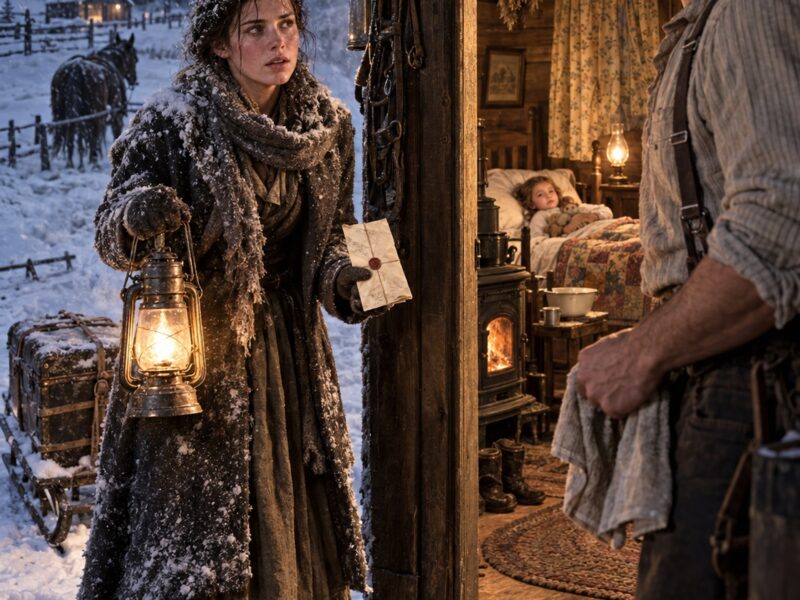
No One Met the Mail Coach in the Blizzard—The Woman Waiting by the Depot Stove Carried a Contract Meant for Someone Else and a Secret She Couldn’t Hide
No one came to meet the mail coach at Alder Creek.
The woman beside the depot stove had four dollars and sixty cents, one pine trunk, and a contract bearing another woman’s name.
Before dawn, she would walk five miles through a Montana blizzard to a widower who had never sent for her—and find his four-year-old daughter burning with fever.
Eleanor Harper noticed the cold through the floorboards first.
It came through the soles of her boots while the depot door was still swinging shut behind her, a hard upward chill that made the building feel less like shelter than a place where winter had simply been delayed.
Outside, snow erased the road as quickly as the horses had made it.
The mail coach disappeared east behind a curtain of white.
Eleanor stood with one gloved hand on the handle of her trunk and watched until even the lanterns were gone.
“You expecting somebody?”
The depot agent did not sound curious.
He sounded tired.
He was a narrow man with an uneven mustache and spectacles that fogged every time he bent toward the small iron stove.
Eleanor looked toward the front window.
“No one appears to be expecting me.”
“That wasn’t what I asked.”
“No.”
He waited.
She did not explain.
The agent looked at the trunk, then her dark wool coat, then the snow collecting against the bottom of the depot door.
“Mail coach from Billings?”
“Yes.”
“Only passenger?”
“Yes.”
“That’s bad luck.”
Eleanor removed one glove with her teeth.
“That depends on what comes next.”
The agent made a sound that might have been amusement.
He returned to sorting envelopes.
Eleanor sat on the bench closest to the stove and took a folded document from the inside pocket of her coat.
She had read it so often during the journey that the creases had begun to soften.
Western Household & Matrimonial Bureau
Billings, Montana Territory
Below that were the terms.
A widowed rancher.
Thirty-five years old.
One child, female, age four.
Two hundred forty acres outside Alder Creek.
Room.
Meals.
Household wages through spring, followed by the possibility of a permanent domestic arrangement or marriage only upon mutual agreement.
And at the bottom:
Employer: Silas Ward.
Above it:
Applicant: Miriam Cole.
Eleanor stared at the name.
Miriam Cole.
Not Eleanor Harper.
That difference had seemed smaller when she boarded the coach.
The blizzard had made it larger.
She folded the paper before the agent could see.
“Is there a boarding house?”
“Mrs. Pritchard’s.”
“How much?”
“Dollar twenty-five.”
Eleanor almost smiled.
“For the room or the building?”
The agent glanced at her.
“Room.”
“I have four dollars and sixty cents.”
“Then you’ve got three nights.”
“And after that?”
“You planning to solve the rest in three days?”
“I generally prefer two.”
That earned her the smallest smile.
Outside, wind struck the building hard enough to rattle the window glass.
The agent stopped smiling.
“If you’re waiting for Ward, he lives five miles east.”
Eleanor looked up.
“You know him?”
“Everybody knows everybody here. That’s the disadvantage.”
“Does he usually fail to collect people he has invited across half a territory?”
The man frowned.
“Silas?”
“Yes.”
“He sent Ben Daley through town this morning.”
“For me?”
“Couldn’t say.”
“What did he say?”
“His little girl’s sick.”
Eleanor’s hand tightened around the contract inside her coat.
“How sick?”
The agent shrugged.
“Fever.”
“And Mr. Ward?”
“Home with her.”
Eleanor stared at the stove.
There it was.
An explanation.
Not the one she had feared.
Somewhere during the last twenty miles, she had convinced herself that Silas Ward had changed his mind.
Perhaps received Miriam’s real letter.
Perhaps learned a stranger had boarded under circumstances she did not yet know how to defend.
Perhaps he had simply decided no woman was worth riding into a blizzard to collect.
Instead, a child was sick.
“How far did you say?”
“Five miles.”
The agent looked toward the window.
Then back at her.
“No.”
Eleanor raised an eyebrow.
“I haven’t asked anything.”
“You were about to.”
“How do you know?”
“I’ve been married twenty-two years.”
She almost laughed.
“I need directions.”
“You need sense.”
“I have some.”
“Not enough.”
He stepped around the counter.
“You cannot walk five miles tonight.”
“I walked farther in Wyoming.”
“Not in this.”
He pointed at the windows.
“That road drifts closed near Miller Ridge. Wind comes sideways from the north. You’ll lose the wagon ruts before the first mile.”
“Do you have a horse?”
“No.”
“A sled?”
The agent stared at her.
“There’s a freight sled behind the depot.”
“Lantern?”
“You are not hearing me.”
“I am hearing you very clearly.”
Eleanor stood.
“So far you have told me there is no one coming, I can afford three nights in town, and the only man whose address I possess is sitting alone with a sick four-year-old.”
She pulled on her glove.
“I dislike all three facts.”
The agent removed his spectacles.
“You always this stubborn?”
“No.”
She buttoned her coat.
“Sometimes I’m worse.”
Twenty-seven minutes later, Eleanor left Alder Creek pulling her trunk behind her on a narrow freight sled.
The depot agent, whose name turned out to be Amos Bell, had given her a lantern, a wool scarf, and enough directions to repeat in her head.
Follow the cottonwoods.
Keep the creek on the right.
Do not take the south fork.
When you see a broken windmill, turn north.
If you reach the red barn, you’ve gone too far.
Amos had also given her his opinion.
“You’ll turn back before a mile.”
Eleanor did not argue.
There was no reason.
The first mile nearly proved him right.
Snow struck her face so hard she eventually stopped trying to look straight ahead.
The trunk dragged heavily behind her.
Wind found every seam in her clothing.
The lantern flame fluttered inside the glass.
More than once she stopped and considered the absurdity of what she was doing.
She was thirty-one years old.
Unmarried.
Nearly broke.
Dragging a trunk across Montana in a blizzard toward the home of a man who believed another woman was coming.
A sensible person would have taken the boarding-house room.
A sensible person would have waited for daylight.
Eleanor had spent the previous year discovering how expensive sensible choices could become when other people made them for you.
Her father had died in Cheyenne the previous spring.
Not suddenly.
That would have been kinder in some ways.
Lung disease had taken nearly two years, their savings, two horses, most of the household furniture, and eventually the small dressmaking business Eleanor ran from the front room.
When he died, she inherited six dollars, a Bible, a box of unpaid pharmacy receipts, and an astonishing number of people willing to advise her.
A cousin suggested she move in and care for his children.
A pastor suggested patience.
A widowed shopkeeper suggested marriage before asking whether she liked him.
Eleanor suggested no.
The housekeeping placement through the Western Household Bureau had been her decision.
A family near Fort Benton needed a woman to cook, sew, and manage three children.
The pay was modest.
It was still pay.
She sold what little remained, bought passage north, and arrived in Billings to learn the family had changed its plans.
They were moving back east.
No position.
No reimbursement sufficient to get her home.
And that was where she met Miriam Cole.
Only for perhaps ten minutes.
Miriam sat in the agency hallway holding a carpetbag with both hands.
She was fair-haired, younger than Eleanor, and crying with such determination not to be noticed that Eleanor noticed immediately.
“Are you waiting?”
Miriam shook her head.
“I’m leaving.”
“That usually requires standing.”
Miriam almost laughed.
Eleanor moved her own trunk.
“Sit.”
Miriam sat.
For several minutes, neither woman spoke.
Then Miriam said:
“I cannot marry a man I’ve never seen.”
Eleanor looked at her.
“You don’t have to.”
“The bureau says the arrangement begins as employment.”
“Then don’t marry him.”
Miriam stared at the carpetbag.
“My sister is in Billings.”
“Go to her.”
“She’ll say I wasted everyone’s time.”
“Probably.”
Miriam looked surprised.
Eleanor continued.
“People survive disappointing their sisters.”
That made Miriam laugh through tears.
A clerk opened the office door.
“Miss Cole, the coach is loading.”
Miriam stood.
Then sat again.
“I can’t.”
Eleanor said nothing.
Miriam pulled the folded contract from her bag.
“I’ve written to him three times.”
“The rancher?”
“Yes.”
“Did you promise marriage?”
“No.”
“Then you owe him the truth, not your life.”
Miriam stared at her.
Ten minutes later, the coach driver shouted final boarding.
Eleanor collected her own useless papers.
Miriam remained beside the window.
Then, abruptly, she held out the Ward contract.
“If you’re still going north…”
Eleanor looked at it.
“No.”
“He needs someone.”
“He asked for you.”
“He asked the agency for a capable woman.”
“That does not make women interchangeable.”
“No.”
Miriam lowered the papers.
“But you’re capable.”
“You met me twelve minutes ago.”
“You gave me your seat.”
“That is not a professional qualification.”
Miriam almost smiled.
Then the coach bell rang.
Eleanor should have walked away.
Instead she looked at her last four dollars.
At her useless placement letter.
At the coach.
At Miriam.
“What are you going to do?”
“Go to my sister.”
“And him?”
Miriam swallowed.
“I’ll write.”
“Today?”
“Yes.”
Eleanor held out her hand.
“Give me the address.”
Not the identity.
Not permission to pretend.
The address.
Miriam handed her the entire contract.
“Explain when you arrive.”
Eleanor took it.
“I intend to.”
That intention had survived Billings.
It survived the first mile outside Alder Creek.
It nearly froze to death during the fourth.
By the time Eleanor saw a single square of lamplight through the snow, her hands had stopped feeling like hands.
She left the sled beside a fence.
Dragged the trunk the last hundred feet.
Then knocked.
Nothing.
She knocked again.
The door opened.
Silas Ward was taller than she expected.
Dark hair.
Unshaven.
Shirt sleeves rolled despite the cold.
A wet cloth in one hand.
His eyes went first to her face, then to the trunk, then past her into the storm as though searching for the person who should logically accompany a woman arriving like this.
“You’re Silas Ward.”
It was not a question.
“Yes.”
“My name is Eleanor Harper.”
His expression changed slightly.
She saw the name fail to match something in his memory.
Good.
At least there would be no pretending.
“Your daughter is sick.”
He glanced toward the back room.
“How do you know?”
“Depot agent.”
Wind drove snow through the open doorway.
Eleanor’s teeth started chattering again.
“I have a complicated explanation for why I’m here.”
Silas stared.
“I would prefer to give it when I can feel my mouth.”
He looked at the trunk.
Then the storm.
Then her.
“You came from town on foot?”
“Yes.”
“Tonight?”
“Yes.”
“Why?”
“Because your daughter is sick.”
His face tightened.
“You don’t know my daughter.”
“No.”
“Or me.”
“No.”
Another gust entered.
Eleanor gripped the doorframe.
“You can interrogate me in the morning.”
She looked past him.
“But if the child’s fever is still high, tonight I’d rather help you keep her drinking.”
Silas Ward was known in Alder Creek as a man who took time deciding and almost no time once he had decided.
He stepped aside.
Eleanor entered.
The first thing she noticed was that the house was warm enough to save a person and untidy enough to prove someone had been sick.
A basin sat on the table.
Two cups.
A child’s blanket on the floor.
A pot of water had boiled almost dry.
Silas shut the door.
“What do you know about fevers?”
“Enough to know children need water more than adults think they do.”
He watched her.
“My father was ill two years.”
“That isn’t a child.”
“No.”
Eleanor removed her coat.
“But sickness teaches routines.”
She nodded toward the back room.
“May I?”
For half a second he hesitated.
Then:
“Yes.”
June Ward lay beneath three blankets.
Her cheeks were bright.
Dark hair stuck damply to her forehead.
She opened her eyes when Eleanor entered.
“Who’re you?”
“Eleanor.”
June frowned.
“That’s long.”
“So I’ve been told.”
“You the woman Papa ordered?”
Silas appeared behind Eleanor.
“June.”
The child looked at him.
“What?”
He seemed to have no answer.
Eleanor did.
“No.”
June studied her.
“Then why are you here?”
“Because I heard you’re bad at being sick.”
June’s eyebrows rose.
“I am not.”
“Excellent.”
Eleanor touched the child’s forehead.
“Then drink this.”
The girl glared at the cup.
“No.”
“Your father said you were stubborn.”
Silas said, “I did not.”
Eleanor glanced back.
“You looked like you had.”
June made a small sound that might have been a laugh.
Then coughed.
Eleanor’s expression changed.
She helped her sit.
Not rushed.
Not frightened.
“Slowly.”
June drank two swallows.
“More.”
“No.”
“Three.”
“You said more.”
“I am renegotiating.”
Silas watched from the doorway.
Eleanor looked at him.
“Do you have broth?”
“Dried beef.”
“Onion?”
“Yes.”
“Salt?”
“Yes.”
“Good.”
“I can make it.”
“I’m sure.”
She handed him the cup.
“Stay with her.”
He looked at her.
“That wasn’t a criticism.”
Something passed across his face.
Not offense.
Recognition.
Eleanor went to the kitchen.
For the next three hours, the house stopped feeling like a place occupied by two frightened people and began feeling like a problem being managed.
Broth.
Water.
Cloths.
Fire.
Sleep.
Silas carried whatever Eleanor asked for and never once demanded to know why she had arrived with another woman’s contract.
That made her more uneasy than questioning would have.
At midnight, June’s fever was still high but no longer climbing.
At one, she drank half a cup of broth.
At two, she slept without waking every ten minutes.
At three fifteen, Eleanor touched the child’s forehead and felt the first unmistakable retreat of heat.
Silas saw her expression.
“What?”
“Better.”
He closed his eyes.
Only briefly.
But Eleanor saw what the night had cost him.
She stepped into the hallway.
“She needs rest.”
He nodded.
“So do you.”
“No.”
“Yes.”
“I’m fine.”
“So am I.”
He looked at her.
She smiled faintly.
“See how convincing that sounds?”
Silas sat beside June’s bed.
Eleanor returned to the kitchen.
There was only one useful chair near the stove.
She slept in it.
Or tried.
At some point after four, she woke because the fire had dropped.
She added two logs.
Then stood with her hands extended toward the heat.
The contract in her coat pocket seemed heavier than paper ought to be.
In the morning, she would tell him.
Miriam Cole.
Billings.
The failed placement.
Four dollars.
The coach.
Everything.
Then Silas Ward would probably put her back on the next coach south.
That was reasonable.
Eleanor had never been especially fond of reasonable outcomes.
Dawn came gray.
The storm had blown itself empty.
Silas found her making cornmeal mush.
He stood in the kitchen doorway with his hair untidy and exhaustion carved around his eyes.
“How is she?” Eleanor asked.
“Fever broke.”
She nodded.
“Good.”
He sat.
Eleanor stirred the pot.
Silence settled.
Then Silas said:
“You are not Miriam Cole.”
“No.”
There.
No drama.
No delay.
Silas folded his hands on the table.
“The bureau said Miriam Cole.”
“Yes.”
“She wrote to me.”
“I know.”
“You know.”
“I met her in Billings.”
His eyes sharpened.
Eleanor turned off the stove.
She faced him.
“My employment farther north disappeared before I arrived. Miriam was at the bureau preparing to come here.”
“What happened?”
“She changed her mind.”
“And gave you her contract.”
“Yes.”
“You decided to take her place.”
“No.”
His expression hardened.
“You walked into my house carrying her papers.”
“I walked into your house and gave you my name.”
That stopped him.
“I never told you I was Miriam.”
Silas said nothing.
“I intended to explain at the depot.”
“You expected me there.”
“Yes.”
“I wasn’t.”
“Your daughter had a fever.”
“Yes.”
“And once I learned that, explaining myself became less important than getting here before the road vanished.”
His jaw tightened.
“That was not your decision.”
“No.”
Eleanor accepted it.
“That part was wrong.”
Silas looked almost surprised by the agreement.
She continued.
“I had four dollars and sixty cents.”
“That doesn’t excuse it.”
“No.”
“My own position had disappeared.”
“That doesn’t excuse it either.”
“No.”
“You could have stayed in town.”
“For three nights.”
“You could have written the bureau.”
“And waited how long?”
“I don’t know.”
“Neither did I.”
Silas stood.
For the first time, anger showed.
Not loud.
Tighter.
“You entered my home under a contract meant for another woman.”
Eleanor held his gaze.
“Yes.”
“My daughter woke this morning asking whether you were staying.”
Her face changed.
Silas saw it.
“That is the part I do not like.”
“Neither do I.”
“You got close to her in one night.”
“She was sick.”
“That does not change the result.”
Eleanor lowered her eyes.
“No.”
He walked toward the window.
Outside, snow covered the ranch in hard white silence.
“I lost her mother two years ago.”
“I know only that you are widowed.”
“Anna died of pneumonia.”
His voice changed on the name.
“June remembers enough to ask when people leave.”
Eleanor looked toward the bedroom.
“I will not promise her something I cannot keep.”
Silas turned.
“Good.”
Another silence.
Then:
“You need a place.”
“Yes.”
“I need help.”
“Yes.”
He seemed almost irritated by her willingness to let each truth remain plain.
“I can offer the room off the kitchen.”
Eleanor blinked.
“For how long?”
“Until the road clears, if that’s what you want.”
“And after?”
“We decide.”
“You’re keeping me?”
“I am not keeping anyone.”
His tone sharpened.
“I am offering employment.”
Eleanor almost smiled.
“What terms?”
“Room. Meals. Eight dollars a month until spring.”
“That is less than the bureau contract.”
“You are not the woman under the bureau contract.”
“Fair.”
“After calving, I can increase it.”
“What work?”
“House. Cooking. Mending.”
“June?”
His face became careful.
“Help where she allows.”
“Not where you allow?”
“Both.”
Eleanor nodded.
“That sounds like a contract.”
“It is.”
“Do we need paper?”
Silas looked at the document folded beside her coat.
“Eventually.”
She turned back to the stove.
“The mush is burning.”
“That means yes?”
“It means breakfast.”
He waited.
Eleanor glanced over her shoulder.
“And yes.”
June appeared in the doorway wrapped in a quilt.
She looked pale.
Small.
Suspiciously alert for a child who had frightened two adults half to death twelve hours earlier.
“You stayed.”
Eleanor set a bowl on the table.
“I did.”
“In that chair?”
“Yes.”
June looked at it.
“Papa says that chair hates backs.”
Silas looked away.
Eleanor smiled.
“Your father and I agree on something already.”
June climbed into her seat.
“Why did you stay there?”
Eleanor placed the bowl in front of her.
“To keep the fire going.”
June considered.
“For me?”
“For everyone.”
The answer seemed to satisfy her.
She ate.
Three spoonfuls later she asked:
“Are you staying tonight?”
“For a while.”
“How long is a while?”
Eleanor looked at Silas.
He was standing by the window pretending not to listen.
“I don’t know yet.”
June nodded.
Children could sometimes accept uncertainty more easily than adults when nobody tried dressing it as certainty.
“Okay.”
The first week was not romantic.
It was work.
The pump froze twice.
Two hens stopped laying.
Silas discovered one fence line buried under snow.
Eleanor burned biscuits on Tuesday because June distracted her with a question about whether dead people could get cold.
“What did your mother tell you?” Eleanor asked.
“That Heaven is warm.”
“Then I would trust her.”
June watched her.
“You know about Heaven?”
“No.”
“Then why trust Mama?”
“Because she knew you.”
June seemed to understand that.
Silas, standing outside the kitchen door with an armful of wood, heard the conversation.
He did not come in for several seconds.
Eleanor learned the ranch by repetition.
Water barrel before breakfast.
Bread every third day.
Lamp oil measured.
Coffee stretched farther than Silas preferred.
The barn door stuck if snow packed beneath the south hinge.
Silas kept tools in an order so exact that moving one by a single peg could ruin his morning.
Eleanor discovered that when she borrowed a hatchet.
He spent ten minutes searching.
Not complaining.
Not swearing.
Simply becoming more silent with every passing minute.
She watched him from the kitchen window.
When he came in, she said:
“Third peg?”
“Fourth.”
“I apologize.”
“Third is the drawknife.”
“I know that now.”
He took off his gloves.
“Most people would say it doesn’t matter.”
“Most people are not trying to find a hatchet in the dark.”
He looked at her.
Then nodded once.
After that, they understood each other better.
February arrived with wind sharp enough to carve the snow into ridges.
By then June no longer asked every morning whether Eleanor was leaving.
That worried Eleanor more than the questions had.
Expectation was more dangerous.
One evening June fell asleep with her head in Eleanor’s lap while Eleanor repaired a torn sleeve.
Silas entered.
Stopped.
Eleanor looked down at the child.
“I can move her.”
“No.”
He took one step forward.
Then stopped again.
The hesitation made Eleanor understand something she had not understood before.
Silas was not distant from his daughter because he lacked tenderness.
He had too much of it.
He handled love as though any pressure might break what remained.
“Pick her up,” Eleanor said.
His eyes moved to her.
“You’re closer.”
“She’s your daughter.”
“I know.”
“Then pick her up.”
Something in her tone irritated him.
Good.
Irritation sometimes moved people when kindness failed.
Silas bent.
June stirred.
He froze.
Eleanor whispered:
“She will not shatter.”
His jaw tightened.
He slid one arm beneath the child’s knees and another behind her shoulders.
June turned into his chest without waking.
Silas’s face changed so quickly Eleanor looked away.
Not to embarrass him.
He carried June down the hall.
Returned two minutes later.
Eleanor continued sewing.
Silas sat across from her.
“Anna used to do that.”
“What?”
“Fall asleep holding her.”
Eleanor waited.
“June.”
“I assumed you did not mean the sleeve.”
A small breath left him.
Almost laughter.
Then disappeared.
“After Anna died, June would wake screaming if I moved her.”
“And?”
“I started letting Mrs. Reilly from town put her to bed.”
“So she wouldn’t scream?”
“So I wouldn’t hear Anna’s name.”
There it was.
Not noble.
Not pretty.
True.
Eleanor threaded the needle.
Silas looked ashamed.
She did not rescue him from it.
“You can start again.”
He looked at her.
“With June.”
Silas stared toward the hallway.
“I don’t know if she wants me to.”
“That is convenient.”
His eyes sharpened.
“Excuse me?”
“You’re making a four-year-old responsible for determining whether her father should behave like her father.”
His face went cold.
Eleanor’s heart beat faster.
She continued anyway.
“She cannot invite you back into a place she does not know you left.”
“I did not leave.”
“You stand in the room.”
“That is not the same thing.”
He went very still.
Eleanor realized she had crossed somewhere dangerous.
Not physically.
Emotionally.
She lowered her voice.
“You were here last week when she had a fever.”
Silas said nothing.
“She kept asking whether you had left.”
His face shifted.
“I told her you were outside.”
Silence.
“She relaxed every time.”
Eleanor tied off the thread.
“She wants you.”
Silas stared at the floor.
“That does not mean she knows how to ask.”
He left the room without replying.
The next night, he put June to bed himself.
The night after that too.
On Thursday, Eleanor heard him reading aloud.
He was bad at it.
Everything sounded like cattle inventory.
June interrupted constantly.
Eleanor stood in the kitchen smiling into the bread dough.
Three days later, Silas built a second chair.
He did not announce it.
Wood appeared beside the stove.
Then pieces.
Then shavings.
By Friday, there was a plain sturdy chair opposite his.
The back was taller than necessary.
Eleanor looked at it.
“For me?”
Silas did not look up from sharpening a knife.
“Current chair hates backs.”
She ran her hand over the smooth arm.
“You remembered.”
“It was difficult not to.”
She sat.
It fit.
That was the first gift anyone had given Eleanor in nearly two years that had not been chosen because she was poor, grieving, female, or useful.
A chair.
Because she sat.
The simplicity hurt.
She said only:
“Thank you.”
Silas nodded.
That night she cried quietly in the small room off the kitchen.
Not from sadness exactly.
Relief could hurt when the body had been braced too long.
A week later, Eleanor found the letter.
She was looking for lamp wick in the sideboard.
The folded paper lay beneath a bundle of receipts.
A woman’s handwriting covered the outside.
Silas.
Eleanor stopped.
She did not open it.
The paper was soft from repeated handling.
She found the wick.
Closed the drawer.
That evening she set two cups of coffee on the table.
Silas was studying feed accounts.
“I saw a letter.”
His pencil stopped.
“Sideboard.”
He looked up.
“I did not read it.”
For several seconds nothing moved except the flame in the lamp.
“Anna.”
The name came softly.
“She wrote it before June was born.”
Eleanor sat.
“Was she sick then?”
“Yes.”
“She knew?”
“She knew she might not have long.”
Silas turned the pencil between his fingers.
“She had been ill before we married.”
“I knew.”
“I thought Montana would help.”
He gave a small humorless smile.
“Dry air. Clean living. Men believe geography can bargain with death if we need it badly enough.”
Eleanor did not answer.
“She wrote the letter in case.”
“Did you read it after?”
“Yes.”
“Once?”
He looked toward the drawer.
“No.”
Eleanor understood.
“You do not owe me the contents.”
“I know.”
They drank coffee.
Wind moved along the roof.
Then Silas said:
“She told me not to turn the house into a grave.”
Eleanor lowered her cup.
“I did.”
He stared toward June’s room.
“Not intentionally.”
“Most damage isn’t.”
His mouth tightened.
“Anna said I would take good care of June.”
“You do.”
“No.”
He shook his head.
“I kept her fed.”
“Warm.”
“Safe.”
“Those are not small things.”
“They are not the whole thing.”
Eleanor waited.
Silas rubbed both hands over his face.
“She said if I ever brought another woman here, it should not be because June needed a mother.”
Eleanor’s pulse changed.
“What did she mean?”
“I think she knew me.”
He looked almost embarrassed.
“She said I would turn marriage into a ranch chore if grief frightened me enough.”
Despite herself, Eleanor smiled.
“I might have liked Anna.”
Silas looked at her.
“She would have liked you.”
“You don’t need to say that.”
“I do not say things I don’t mean.”
The room changed.
Only slightly.
Enough.
Eleanor looked down at her coffee.
“What else did she say?”
Silas became quiet.
“Nothing I’m ready to repeat.”
That answer might once have offended Eleanor.
Instead she nodded.
“Then don’t.”
For the first time since she arrived, Silas looked at her not as a useful stranger, not as a temporary employee, and not as someone standing near his daughter.
He looked directly at Eleanor.
She felt it.
So did he.
Neither spoke.
The next complication arrived wearing city shoes.
Mr. Horace Pritchard of the Western Household & Matrimonial Bureau came to Alder Creek in early March.
He reached the ranch in a hired wagon with polished boots, a brown coat too fine for mud, and an expression suggesting the frontier had personally inconvenienced him.
Eleanor opened the door.
“Miss Harper?”
Her stomach tightened.
“Yes.”
“I thought so.”
Silas came in from the barn.
Mr. Pritchard removed his hat.
“Mr. Ward.”
Silas looked at Eleanor.
Then at the stranger.
“Who are you?”
“Horace Pritchard.”
Recognition.
“The bureau.”
“Yes.”
June appeared behind Eleanor.
She took Eleanor’s hand.
Mr. Pritchard noticed.
His expression softened almost imperceptibly.
“This will be awkward.”
Eleanor said:
“Those are usually the conversations worth having.”
Mr. Pritchard accepted coffee.
Then placed three envelopes on the table.
The first was from Miriam Cole.
Eleanor stared at it.
“She married a shopkeeper in Billings,” Pritchard said.
Silas glanced at Eleanor.
“She wrote us before Christmas. The letter was delayed because our office manager was ill.”
“Why come here?” Silas asked.
“Because Miss Cole also told us she gave her papers to Miss Harper.”
Eleanor looked up.
Pritchard continued.
“She was very specific.”
He opened Miriam’s letter.
“I won’t read all of it.”
“Please don’t,” Eleanor said.
He smiled faintly.
“She said Miss Harper did not ask for the contract, did not claim to be her, and actually advised her to write you truthfully.”
Silas looked at Eleanor.
She folded her hands.
Pritchard added:
“So there will be no complaint from the bureau regarding fraud.”
“I never claimed to be Miriam.”
“I know.”
“Did you before today?”
Eleanor’s question came sharper than intended.
Pritchard looked at her.
“We knew something was irregular.”
“That is not an answer.”
“No.”
He sighed.
“We did not.”
Eleanor nodded.
At least it was honest.
“What are the other envelopes?”
Pritchard pushed one toward Silas.
“Formal closure of the Cole placement.”
Then he pushed the third toward Eleanor.
“This is yours.”
She stared.
“From whom?”
“The Henderson family.”
Her original employers.
Her heart beat once, hard.
“They returned to Montana?”
“They never left.”
“What?”
Pritchard looked uncomfortable.
“The husband’s eastern business arrangement collapsed.”
“They canceled my employment.”
“They did.”
“After I sold my things.”
“Yes.”
“After I traveled to Billings.”
“Yes.”
“And now?”
“They need a household manager.”
Eleanor did not touch the envelope.
Pritchard continued.
“Twenty-two dollars a month.”
Silas’s expression did not change.
Eleanor felt him become still.
“Private room.”
Pritchard glanced at June.
“No children under six in the household.”
That sentence landed strangely.
A job with no June.
No fever charts.
No questions about Heaven.
No small boots beside the stove.
“A legitimate contract,” Pritchard said.
Eleanor looked at him.
“You could have omitted that word.”
“You’re right.”
He seemed genuinely sorry.
Silas stood.
“You should take it.”
Eleanor turned.
“What?”
“The job.”
June’s hand tightened around hers.
Silas continued.
“Twenty-two dollars is more than I can pay.”
“That is true.”
“Private room.”
“I have a private room.”
“A pantry with a bed.”
“It has a door.”
“You know what I mean.”
“No.”
Eleanor released June gently.
“What do you mean?”
Silas looked at Pritchard.
Then June.
Then Eleanor.
“You came here because you had nowhere else.”
The sentence struck harder than he intended.
She saw that immediately.
So did he.
Eleanor’s face went still.
“I see.”
“That is not—”
“No.”
She picked up the Henderson envelope.
“You are correct.”
“Eleanor.”
“I had four dollars.”
He stepped closer.
“That was not my point.”
“What was?”
Silas struggled.
That frightened her.
Silas never struggled for plain words.
“I will not ask you to stay because you are dependent on this house.”
Silence.
Eleanor looked at him.
He continued.
“If there is a better choice, you should have it.”
“And if I choose this?”
Silas’s jaw tightened.
“Then I need to know it is a choice.”
Something in her anger loosened.
Not completely.
“You might have said that first.”
“I should have.”
Pritchard looked at his coffee.
June glared at her father.
“You’re making her leave.”
Silas crouched.
“No.”
“Yes.”
“June.”
“She stays in her chair.”
The child pointed.
“You made it.”
Silas closed his eyes briefly.
June’s voice broke.
“Mama left.”
Every adult stopped breathing normally.
Silas looked at her.
“Mama didn’t want to.”
“I know.”
“People leave anyway.”
Eleanor knelt.
June turned toward her.
“I have not decided anything.”
“You have a paper.”
“Yes.”
“Papers make people go.”
Eleanor touched her cheek.
“No.”
“Sometimes papers give people choices.”
June began crying.
Not loudly.
That was worse.
“I don’t want you to choose there.”
Eleanor pulled her close.
Silas looked away.
Mr. Pritchard quietly collected his hat and stepped outside.
He had enough sense to know when bureaucracy had finished its part.
That evening Eleanor packed half her trunk.
Not because she had decided to leave.
Because she needed to know she still could.
Silas saw it through the open door.
He did not enter.
After supper June refused to speak to him.
At bedtime she asked Eleanor to read.
Silas stood near the door.
June said:
“Not Papa.”
Silas left.
Eleanor found him later in the barn.
He was repairing a harness that did not need repairing.
“You hurt her.”
“I know.”
“You hurt me.”
His hands stopped.
“I know.”
“That is irritating.”
“What?”
“You agreeing.”
He looked at her.
“What would you prefer?”
“A defense I can argue with.”
“I don’t have one.”
Eleanor folded her arms.
“You truly want me to take that job?”
Silas took a long breath.
“I want you to be able to.”
“That is different.”
“Yes.”
“Do you want me to?”
He looked toward the barn doors.
Cowardice, Eleanor realized, did not always look like running.
Sometimes it looked like refusing to say what would make you vulnerable.
“Silas.”
“No.”
Her heart moved.
He looked at her.
“I do not want you to take it.”
The admission seemed to cost him.
“Why?”
He almost laughed.
“Do you need every word?”
“Yes.”
“Of course you do.”
He set down the harness.
“Because the house changes when you are in it.”
Eleanor waited.
“Because June sleeps better.”
Her face cooled slightly.
Silas saw.
“No.”
He corrected himself.
“That is the wrong beginning.”
“Very.”
“I think of you when June is not in the room.”
Eleanor stopped breathing for half a second.
Silas continued.
“I know when you are angry by how hard you set cups on the table.”
Her mouth almost moved.
“I know you put the hatchet back on the fourth peg now.”
“That is devotion.”
“I know you always eat the heel of the bread because you think nobody else wants it.”
She looked away.
“I know you hum when you mend things.”
He stepped closer.
“And when you went to town last week, I kept expecting to hear the sound of your chair.”
The barn had become very quiet.
“So no.”
His voice lowered.
“I do not want you to take the job.”
“Then why tell me to?”
“Because wanting you here does not give me the right to make staying your only decent option.”
There it was.
Eleanor looked at him.
For months, men had been offering her security in exchange for surrender.
Cousin.
Shopkeeper.
Agency.
Employers.
Silas, standing three feet away, was offering her the door.
That was why staying suddenly became frightening.
“You read the rest of Anna’s letter,” Eleanor said.
His face changed.
“Yes.”
“When?”
“Today.”
“What did it say?”
Silas hesitated.
Then:
“She said if I ever asked another woman to stay only because June needed her, I should have the decency to pay wages and leave the woman’s heart alone.”
Eleanor smiled despite the tears rising.
“Anna was direct.”
“Yes.”
“What else?”
He looked at her.
“She said if I noticed the woman when June was asleep, if I missed her voice when she was gone, if I began arranging my days around whether she was at the table…”
He stopped.
Eleanor waited.
“Then I should stop hiding behind June.”
Her throat tightened.
“And?”
“She said I should ask for myself.”
Silas looked almost angry at his own fear.
“So I am.”
Eleanor’s eyes filled.
“Ask what?”
He moved one step closer.
“Not yet.”
She stared.
“What?”
“I will not ask while that job offer is unopened.”
Silas nodded toward the house.
“Read it.”
“Silas—”
“Read it.”
He picked up the harness again.
“Decide what your life looks like if I am not in it.”
Eleanor stared at him.
“And then?”
He met her eyes.
“Then come tell me whether I get to ask.”
She hated him a little for being right.
The next morning Eleanor went to town.
Alone.
She took the Henderson offer.
Sat beside the same depot stove where she had waited during the blizzard.
Amos Bell recognized her immediately.
“You survived.”
“Disappointing?”
“Lost a nickel on it.”
She smiled.
The depot looked smaller without the storm.
Eleanor opened the Henderson letter.
Twenty-two dollars a month.
Private room.
Two Sundays free each month.
Employment guaranteed one year.
Clean.
Respectable.
Safe.
She tried to imagine it.
A proper household.
Children old enough not to need her in the night.
Money she could save.
A bed not occupying a former pantry.
No dead wife’s letter in a drawer.
No man who could break her heart by simply becoming important.
She folded it.
Amos looked over his newspaper.
“Well?”
“It is a good job.”
“Congratulations.”
“I did not say I was taking it.”
“You look angry.”
“I am thinking.”
“Same face?”
“Today.”
At noon, the mail coach arrived.
Eleanor watched passengers step down.
One elderly man.
A mother with two boys.
A traveling salesman.
No frightened woman waiting for someone she had never met.
She thought about Miriam.
How courage had looked like refusing to board.
Then she thought about herself.
How courage had sometimes looked like boarding anyway.
There was no single correct direction.
Only honest reasons.
Amos poured coffee.
“You going somewhere?”
Eleanor looked at the contract.
“No.”
“Then why are you sitting in my depot?”
“I wanted to know if I could.”
He considered.
“Can you?”
“Yes.”
“That help?”
“Yes.”
She stood.
Then noticed a woman near the depot door.
Fair-haired.
Holding the arm of a thin man in a shopkeeper’s coat.
The woman stared at Eleanor.
“Miriam?”
Miriam Cole’s mouth opened.
Then she smiled with visible disbelief.
“Eleanor.”
For a second, neither moved.
Then Miriam crossed the room.
“You went.”
Eleanor laughed.
“Yes.”
“To Ward?”
“Yes.”
“Oh God.”
“That reaction is late.”
Miriam covered her mouth.
“Is he terrible?”
“No.”
“Mean?”
“No.”
“Old?”
“Thirty-five.”
“That is old enough.”
Eleanor laughed harder.
Miriam’s husband looked confused.
She introduced him as Samuel.
Then asked:
“Did you tell him?”
“First morning.”
“And?”
“I’m still there.”
Miriam stared.
“Oh.”
That one syllable contained too much understanding.
Eleanor narrowed her eyes.
“What?”
“Nothing.”
“Miriam.”
“You look different.”
“Colder?”
“No.”
Miriam smiled.
“Like you expect to go somewhere after this.”
Eleanor’s throat tightened.
Miriam looked at the Henderson letter.
“You got another position.”
“Yes.”
“Are you taking it?”
“I don’t know.”
Miriam sat.
Samuel wisely moved away toward the ticket window.
For several seconds, the two women listened to the stove.
Then Miriam said:
“I gave you the contract because I was frightened.”
“I know.”
“I also gave it to you because you weren’t.”
Eleanor almost laughed.
“I was terrified.”
“You didn’t look it.”
“That proves nothing.”
Miriam nodded.
“Good.”
She touched Eleanor’s sleeve.
“Then if you stay, don’t stay because you think you were braver than me.”
Eleanor looked at her.
“Stay because you want the life.”
That was the final piece.
Not the man.
Not June.
Not wages.
The life.
Did she want waking to a frozen pump?
Burned biscuits?
A child asking impossible questions?
A man who built chairs instead of saying thank you?
Yellow curtains belonging to a dead woman nobody wanted erased?
Yes.
The answer arrived so quietly Eleanor almost missed it.
Yes.
She returned to the ranch before sunset.
Silas was in the barn.
Of course.
Eleanor entered.
He looked at her hands.
No luggage.
Then her face.
“You read it?”
“Yes.”
“Good offer?”
“Very.”
His jaw tightened.
“I see.”
“No.”
He looked at her.
“That is becoming an irritating phrase in this family.”
Silas waited.
Eleanor took the Henderson contract from her pocket.
She placed it on the workbench.
Then placed Miriam’s old contract beside it.
Two papers.
Two possible lives.
“I could go.”
“Yes.”
“I could earn more.”
“Yes.”
“I could have a proper room.”
“Yes.”
“Two Sundays free.”
Silas almost smiled.
“Tempting.”
“Extremely.”
He waited.
Eleanor’s hands began to shake.
She hated that.
Then decided shaking did not invalidate courage.
“I don’t want it.”
Silas did not move.
Eleanor continued.
“I want the chair you built badly.”
His mouth moved.
“I want June correcting my Bible reading even though she cannot read.”
He smiled now.
Barely.
“I want the stupid fourth peg.”
“Important peg.”
“I want the yellow curtains.”
His expression changed.
Eleanor stepped closer.
“And I want the man who was decent enough to make sure I had another door before he asked me not to walk through it.”
Silas’s eyes closed for one second.
When they opened, nothing in him was guarded.
“Then may I ask?”
“Yes.”
He took one breath.
“Stay.”
Eleanor smiled through tears.
“That is not much of a proposal.”
“I was not finished.”
“Good.”
Silas came closer.
“Stay because I want you here.”
Another step.
“Stay because the house is no longer only a place I endure.”
Eleanor’s eyes filled.
“Stay because when you are angry with me, I would rather have you angry in the kitchen than agreeable somewhere else.”
She laughed.
“Better.”
“Stay because I have spent two years thinking loyalty to Anna meant never wanting anything after her.”
His voice roughened.
“And I think that would have made her furious.”
Eleanor nodded.
“Probably.”
“Stay because I love my daughter.”
He stopped.
“And because I have begun to love you in a way that has nothing to do with what she needs.”
Eleanor did not answer immediately.
Silas went pale.
That almost made her smile.
“The contract?” she asked.
“What?”
“You are proposing a permanent arrangement.”
“Yes.”
“Terms?”
Silas stared.
Then understood.
His shoulders loosened.
“Negotiable.”
“Good.”
“What do you require?”
Eleanor pretended to consider.
“My own money.”
“Yes.”
“Authority in the kitchen.”
“Mostly.”
“Silas.”
“Yes.”
“No decisions about my belongings without asking.”
“Agreed.”
“No making June responsible for your feelings.”
His smile disappeared.
“Agreed.”
“And no assuming a wife is an employee with different paperwork.”
He looked almost offended.
“I would not.”
“You once advertised for a household woman with marriage as an option.”
“Fair.”
She stepped closer.
“What do you require?”
Silas looked at her for a long time.
“Tell me when you want to leave before you are already gone.”
The simplicity of it broke her heart.
“I can do that.”
“And do not move the hatchet.”
“No promises.”
He laughed.
The sound startled both of them.
June heard it from the house.
She came running.
She reached the barn door in her boots without a coat.
“Papa laughed!”
Silas turned.
“So?”
“You don’t.”
“I do.”
“When?”
“Apparently today.”
June looked at Eleanor.
Then at the two contracts.
Her eyes narrowed.
“Are you leaving?”
“No.”
The child froze.
Eleanor crouched.
“I’m staying.”
“For a while?”
Eleanor looked at Silas.
Then back at June.
“No.”
June’s face transformed.
“Forever?”
Silas said gently:
“Nothing is promised forever.”
June looked disappointed.
Eleanor continued:
“But I am planning for tomorrow.”
“And the day after?”
“Yes.”
“And spring?”
“Yes.”
“Summer?”
Eleanor smiled.
“Yes.”
June threw both arms around her.
Silas looked away.
Too late.
Eleanor saw the tears.
They married in April.
Not because June needed a mother.
That distinction mattered enough that Eleanor insisted on saying it aloud before Reverend Samuel Price agreed to perform the ceremony.
“I will care for her.”
Eleanor sat across from the reverend.
“But I will not replace Anna.”
Silas nodded.
“June already has a mother.”
The reverend studied them.
“And what are you becoming?”
Eleanor looked at Silas.
“Something else.”
June, sitting in the corner with a rag doll, answered:
“Eleanor.”
The adults laughed.
They married on a Thursday because Thursday was when Silas could leave the cattle longest without irritating himself.
Miriam and Samuel came from Billings.
Amos Bell closed the depot for two hours.
Mr. Pritchard attended because Eleanor suspected he liked seeing one of his complicated files conclude successfully.
June wore a pale yellow dress Eleanor made from one of the better gowns in her trunk.
She held Eleanor’s hand through the entire ceremony.
When the reverend asked Silas for Eleanor’s hand, June refused to release it.
So Silas took the other one.
They stood before the altar connected by a small stubborn child who considered herself essential to the legal process.
On the wagon ride home, June fell asleep between them.
Spring mud pulled at the wheels.
Snow remained in the shadows of the north hills.
Silas drove.
After a mile, he said:
“June’s curtains.”
Eleanor looked at him.
“What about them?”
“Anna made them.”
“I know.”
“Yellow.”
“With white flowers.”
“Yes.”
Silas swallowed.
“If you ever want to change them…”
He stopped.
Eleanor waited.
“I would understand.”
She looked down at June sleeping against her arm.
Then at the waking fields.
“I like yellow.”
Silas looked ahead.
“So did Anna.”
“Then we finally agree on decorating.”
He smiled.
They kept the curtains.
Not because the house could not change.
Because change did not require erasure.
Eleanor’s trunk remained in the room off the kitchen for three weeks.
One afternoon she returned from feeding hens and found it gone.
For one terrible second, panic struck.
Then she entered the bedroom.
Silas had placed it at the foot of their bed.
No announcement.
No question.
A simple relocation from temporary to belonging.
Eleanor opened the trunk that evening.
Two dresses.
Bible.
Old papers.
Tin of buttons.
She had collected buttons since childhood because her mother believed no household could contain too many things capable of fastening what had come loose.
Eleanor placed the tin on the windowsill.
It looked wrong there.
Too narrow.
The next afternoon Silas came inside smelling like fresh-cut pine.
Above the window was a small new shelf.
Exactly wide enough for the tin.
Eleanor touched it.
“You could simply say you love me.”
Silas removed his coat.
“I did.”
“Once.”
“I assumed it remained valid.”
“Words require maintenance.”
He considered.
“Like hinges?”
“Less oil.”
He kissed her forehead.
“I love you.”
“Better.”
Years passed.
June remembered the blizzard differently from both adults.
According to her, Eleanor arrived because June had “ordered help from the weather.”
Eleanor never corrected her.
Silas did.
Constantly.
June ignored him.
The old contract remained folded in the sideboard.
Not framed.
Not treasured exactly.
Simply kept.
Beside Anna’s letter.
Miriam’s name remained on one.
Anna’s on the other.
Two women whose choices had shaped the same household without either woman needing to disappear for the next life to become legitimate.
Years later, Silas finally read the back page of the agency paperwork carefully.
He noticed something Eleanor had missed.
The contract had been amended in Billings.
Small handwriting near the witness line.
Applicant declined placement voluntarily. Papers transferred to E. Harper for delivery and explanation.
Signed:
Miriam Cole.
Silas carried the document into the kitchen.
Eleanor was kneading bread.
He put it down.
“You knew?”
She read the line.
Then laughed.
“No.”
“She protected you.”
“Apparently.”
“You spent months believing you had stolen a contract.”
“I did not steal it.”
“Borrowed another woman’s future?”
“That sounds more dramatic.”
“You like dramatic.”
“I married a cattleman who communicates through furniture.”
Silas folded the contract.
Then placed it beside Anna’s letter again.
Eleanor watched him.
“You are not throwing it away?”
“No.”
“Why?”
He thought.
“Evidence.”
“Of what?”
Silas looked around.
June, now eight, sat by the stove reading aloud badly.
The second chair had gained scratches.
The yellow curtains remained.
The button tin had doubled.
“Of how little paper understands about what it starts.”
Eleanor smiled.
That was good enough.
Long after Alder Creek had a railway instead of a mail coach, people in town still told the story of the blizzard woman.
They usually told it badly.
They said Silas Ward ordered a wife and received the wrong one.
That was not true.
No woman was cargo.
They said Eleanor tricked him.
Also wrong.
She gave him her name before she crossed his threshold.
They said fate arranged everything.
Eleanor disliked that version most.
Fate had not pulled a trunk five miles through snow.
Fate had not kept the stove fed at four in the morning.
Fate had not forced Silas to pick up his daughter.
Fate had not built a chair.
Fate had not offered Eleanor another job so staying could become voluntary.
People had done those things.
Ordinary people.
Frightened people.
Imperfect people.
Miriam had stepped away from a coach because she knew the life waiting at the other end was not hers.
Eleanor stepped onto it because she had no idea where else to go.
Silas failed to meet either woman because his child was burning with fever.
June trusted the stranger because the stranger kept the fire alive.
Then, layer by layer, necessity became routine.
Routine became trust.
Trust became the dangerous freedom to choose.
That was the part the contract could never record.
The night Eleanor arrived, no one met the mail coach.
She sat beside a weak depot stove with four dollars, a pine trunk, and another woman’s name folded inside her coat.
She believed the greatest question in front of her was whether Silas Ward would let her remain until morning.
She was wrong.
The question that mattered took months to become visible.
Would he ask her to stay after she had somewhere else to go?
Would she stay after she knew leaving was possible?
Years later, when June was grown and preparing to leave the ranch to teach school in Helena, she found the old papers in the sideboard.
She carried the contract to Eleanor.
“This isn’t your name.”
Eleanor looked at it.
“No.”
June frowned.
“Papa married the wrong woman?”
From across the room, Silas said:
“Be careful.”
June ignored him.
Eleanor took the paper.
“No.”
She smiled.
“He married the woman who stayed.”
June thought about that.
Then shook her head.
“You didn’t stay.”
Eleanor looked at her.
“I didn’t?”
“You chose.”
The room became quiet.
Silas looked up.
Eleanor stared at the young woman who had once been a feverish four-year-old asking whether everyone eventually left.
June folded the contract.
“You always told me those were different things.”
Eleanor’s throat tightened.
“Yes.”
“They are.”
June placed the paper back beside Anna’s letter.
That evening Eleanor sat in the chair Silas had built during their first winter.
The arms were worn smooth.
The back carried an old repair.
The chair no longer looked new enough to be a gift.
That made it better.
Silas sat opposite her.
Outside, fresh snow had begun to fall.
Not a blizzard.
Just winter.
“You thinking about that coach?” he asked.
“How do you know?”
“You have a face.”
“I have several.”
“That one.”
Eleanor watched the snow beyond the glass.
“If you had come to the depot that night, what would you have done?”
Silas considered.
“Asked where Miriam was.”
“And then?”
“Probably become angry.”
“At me?”
“Yes.”
“Charming.”
“I was tired.”
“You are still tired.”
“Then I would have brought you here.”
Eleanor looked at him.
“Even knowing?”
“My daughter had a fever.”
There it was.
The plain truth that had begun everything.
Eleanor smiled.
“So you would have hired the wrong woman anyway.”
Silas shook his head.
“No.”
He looked toward the yellow curtains visible through the open bedroom door, toward the button tin on its shelf, toward the sideboard containing two old letters.
“I think I would have discovered sooner that the contract was wrong.”
“And?”
Silas reached across the space between their chairs.
Eleanor put her hand in his.
“The woman wasn’t.”









