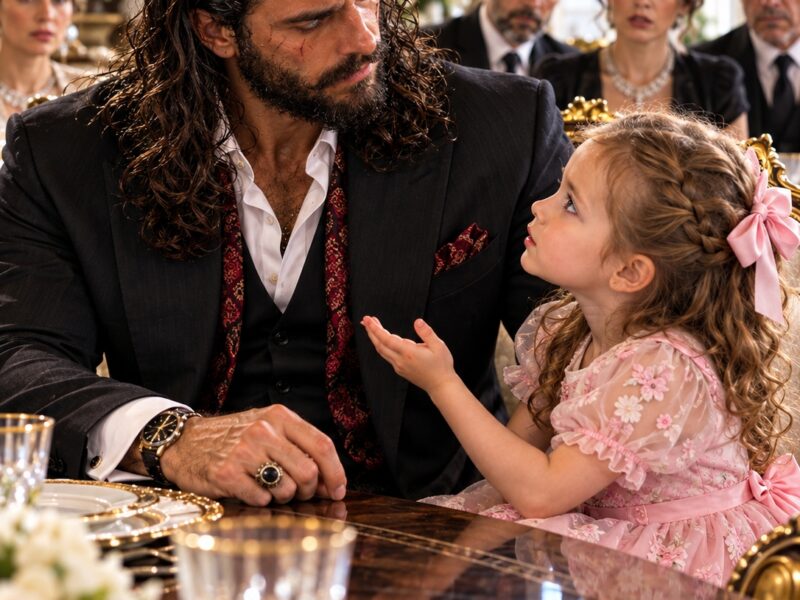
Nobody Dared to Sit Beside the Mafia Boss for Six Years—Until a Seven-Year-Old Girl Took the Forbidden Chair and Asked, “Why Me?”
The first time I sat beside Alessandro Romano, his nephew dropped a wineglass, his sister turned white, and fourteen adults stopped breathing at the same time.
I was seven years old.
I had no idea that the leather chair beneath me had been empty for six years, or that the woman who once sat there had died under circumstances nobody in the house dared discuss.
I only knew that my feet couldn’t reach the floor, the chair was much more comfortable than the wooden stools in our kitchen, and the man everyone feared looked unbearably lonely.
So I turned toward him and asked, “Why does everyone act like you’re dangerous when you just look sad?”
Nobody answered.
At the far end of the table, Marco Romano muttered something I wasn’t supposed to hear. His aunt Katarina pressed her napkin against her mouth, while Father Benedetto lowered his eyes as though he’d suddenly remembered an urgent prayer.
Alessandro didn’t move.
He looked at me for so long that I began wondering whether I should apologize.
Then his gaze dropped to the small blue ribbon tied around my wrist.
The expression on his face changed.
Not much.
Just enough for me to notice.
“Where did you get that?” he asked.
I touched the ribbon.
“My mama.”
“Your mother gave it to you?”
I nodded.
“She says it belonged to somebody who loved me before I was born.”
The room became even quieter.
Alessandro slowly reached for his water glass, but his hand stopped before touching it.
Then he said something that made Katarina push back her chair.
“Lucia, I need to ask you a question.”
I nodded.
“Did your mother ever tell you who your real father was?”
I shook my head.
And the man who controlled half the waterfront, the man grown men were afraid to look directly in the eyes, stared at me as though he’d just seen someone return from the dead.
My name is Lucia Bianchi.
I’m thirty-one now, and I still have the blue ribbon.
It’s faded almost white. The fabric is frayed at one end, and the small knot my mother tied in it all those years ago has never completely come undone.
I keep it inside a wooden box beneath my bed, along with an old photograph, a handwritten letter, and a postcard that smells faintly of the cedar drawer where it was stored for decades.
I’ve thought about telling this story many times.
People have written articles about Alessandro Romano. Some call him a businessman. Others describe him as a criminal who managed to outlive nearly everyone who once opposed him. A few insist he was the most dangerous man in New York during the years his family’s influence stretched from the Hudson Valley to the ports along the East Coast.
I won’t pretend those stories are all wrong.
But none of them explains the man who taught me how to sharpen colored pencils with a pocketknife, who learned to make pancakes because I didn’t like oatmeal, or who sat through my third-grade school play with tears in his eyes even though I only appeared for forty seconds as a talking tree.
To understand him, you have to understand the chair.
And to understand the chair, you have to understand my mother.
The woman I called Mama was Maria Bianchi.
She had dark hair that she usually twisted into a bun, strong hands with short fingernails, and a habit of humming while she worked. She could make a meal from almost nothing, mend a torn sweater so carefully that the stitches were nearly invisible, and tell whether I was lying simply by watching how quickly I answered.
For eleven years, she worked as a housekeeper at the Romano estate outside Tarrytown, New York.
The estate stood behind high stone walls on a hill overlooking the Hudson River. It had a long driveway lined with maple trees, a conservatory filled with plants that weren’t supposed to survive New York winters, and a main house so large that I believed it must contain at least three separate families.
My mother and I lived in a cottage beyond the gardens.
It had two bedrooms, a small kitchen, and a narrow porch where we sat on summer evenings watching fireflies rise from the grass.
We didn’t have much money.
Mama’s coat was always older than mine. She cut her own hair, saved the good dishes for Christmas, and kept a jar labeled Emergency inside the cupboard above the stove.
But I never thought of us as poor.
We had pancakes on Sundays, a library card, and a little patch of dirt where we planted marigolds every spring.
My mother read to me every night.
Sometimes she fell asleep halfway through a sentence, her finger still resting beneath the words.
I would quietly close the book and cover her with the blanket from the couch.
She always woke up before morning.
And she always apologized for being tired.
I didn’t understand why.
Not then.
The Romano house was another world.
Black cars arrived at odd hours.
Men in dark suits stood beside the entrance, speaking quietly into their phones.
Some visitors wore expensive watches and carried briefcases. Others looked like they’d been sent there by people who preferred not to appear in person.
My mother had rules about that house.
Rules she repeated so often they became part of my childhood.
“Stay in the garden when guests arrive.”
“Don’t wander into the offices.”
“Never open a door that’s closed.”
“And don’t ask questions about things that don’t concern us.”
I was a curious child.
That last rule was particularly difficult.
“Why?” I asked one morning while Mama buttoned my coat.
She stopped.
“Because some questions make grown-ups uncomfortable.”
“Why?”
She sighed.
“Lucia.”
“I’m just asking.”
“I know, sweetheart.”
She knelt in front of me.
Her face softened.
“But sometimes it’s safer to let people tell you things when they’re ready.”
I considered that.
“Like when you didn’t tell me my birthday cake was chocolate?”
She smiled.
“Something like that.”
I accepted the explanation.
Mostly.
But there was one thing about the Romano house that I could never stop wondering about.
The empty chair.
Every Sunday evening, the Romano family held dinner in the formal dining room.
The table was long enough to seat sixteen people.
Heavy curtains framed tall windows overlooking the gardens. Silver candlesticks stood between arrangements of white flowers, and the room smelled of roasted meat, fresh bread, and expensive furniture polish.
I wasn’t supposed to watch.
Naturally, I watched whenever I could.
Sometimes I stood near the kitchen door, pretending to wait for Rosa, the elderly cook who occasionally gave me scraps of pastry.
Rosa knew perfectly well what I was doing.
She usually pretended not to notice.
“Little mouse,” she’d whisper as I hovered near the doorway, “if you’re going to spy, at least learn to stand where your shoes don’t show.”
Then she’d hand me a butter cookie and send me back to the kitchen.
At the head of the table sat Alessandro Romano.
He was fifty-two when I first remember seeing him clearly.
Tall.
Broad-shouldered.
Dark hair turning silver around the temples.
He wore perfectly tailored suits and a plain gold wedding band on his left hand.
His voice was low, and he rarely repeated himself.
When Alessandro entered a room, nobody hurried to greet him.
They simply became careful.
Men who had been laughing moments earlier lowered their voices. People straightened in their chairs. Conversations continued, but their subjects changed.
I found that fascinating.
I had never seen anyone demand so much attention while appearing to want so little of it.
His sister Katarina sat to his left.
She was elegant and thin, with dark hair pulled tightly away from her face. Her jewelry seemed to make little noises whenever she moved, and she wore perfume strong enough that I could smell it from the hallway.
Marco, Alessandro’s nephew, sat farther down.
He was twenty-nine, handsome in a polished way, and always seemed impatient to say something important.
There were lawyers, business associates, an occasional priest, and several relatives I couldn’t keep straight.
But beside Alessandro, on his right, stood the empty chair.
It was different from the others.
Its dark leather back was slightly taller, the arms intricately carved, and a faint impression remained in the cushion from years of use.
Nobody sat there.
Nobody placed a coat on it.
Nobody moved it closer to the table.
The staff cleaned it every Saturday, and by Sunday evening it looked ready for someone who never arrived.
For years, I assumed it was broken.
Then one afternoon, I asked Rosa.
We were in the kitchen.
She was peeling potatoes, and I was drawing a horse that looked suspiciously like a dog.
“Rosa?”
“Yes, little mouse?”
“Why doesn’t anybody sit next to Don Alessandro?”
Her knife stopped.
Only for a second.
Then she continued peeling.
“Some places are kept for people who aren’t with us anymore.”
“Where did they go?”
Rosa looked toward the door.
“Far away.”
“Like Florida?”
A sad smile crossed her face.
“Farther.”
I thought about that.
“Will they come back?”
She set down the potato.
“Not this time, sweetheart.”
I looked at her.
Something in her voice made me stop asking.
But the following Sunday, I watched Alessandro glance toward that chair after dinner.
Everyone else was talking.
Katarina was discussing a property sale.
Marco was arguing about shipping contracts.
The priest was reaching for another piece of bread.
Nobody noticed Alessandro except me.
His eyes moved to the empty chair.
For one brief moment, the stern expression vanished.
He looked like my mother sometimes looked when she thought I was asleep and sat by the kitchen window with tears moving silently down her cheeks.
Then Marco said something about a missing payment.
Alessandro straightened.
The expression disappeared.
But I remembered it.
A man everybody feared had looked at an empty chair as though it were the only thing in the room he truly wanted.
And I couldn’t understand why nobody tried to help him.
I was seven that November when my mother became ill.
Nothing dramatic.
A fever.
A stubborn cough.
The kind of sickness that usually sends adults to bed for a few days.
But Mama had spent years pretending she was less tired than she really was, and by Thursday she could barely stand long enough to make breakfast.
I insisted on bringing her tea.
I spilled half of it on the kitchen counter.
She drank the rest and told me it was perfect.
Rosa visited that afternoon.
She brought soup, fresh bread, and a thermometer.
“She’s staying in bed,” Rosa announced.
My mother tried to protest.
Rosa folded her arms.
“Maria, I have known you for eleven years. I am not interested in hearing your arguments today.”
Mama looked at me.
“See what happens when you get old, Lucia? Everybody starts ordering you around.”
Rosa laughed.
“Somebody has to.”
By Saturday, my mother’s fever had eased, but she remained exhausted.
Rosa covered her duties in the main house.
On Sunday afternoon, she appeared at our cottage carrying a clean white apron.
I was sitting at the kitchen table coloring.
She looked at me.
“Little mouse.”
I glanced up.
“Yes?”
“How would you like to earn two dollars?”
My eyes widened.
“Two whole dollars?”
“Two whole dollars.”
“What do I have to do?”
“Carry a basket of bread into the dining room. Set it on the table. Come straight back.”
I stared.
“The big dining room?”
“Yes.”
“With all the people?”
“Yes.”
I looked toward my mother.
She frowned.
“Rosa.”
“It’s just bread,” Rosa said. “I’ll be watching from the doorway.”
Mama looked at me for a long moment.
I could see she wanted to refuse.
But she was ill, and Rosa needed help.
Finally, she nodded.
“Only the bread, Lucia. Don’t stop to talk.”
“I promise.”
“And don’t touch anything.”
“I promise.”
“And don’t ask questions.”
I sighed.
“Mama.”
She raised an eyebrow.
“Promise.”
I nodded.
That was my third promise.
It was also the one I broke.
The basket was heavier than I expected.
Rosa had filled it with warm rolls wrapped in a linen cloth.
The smell made my stomach growl.
She tied the apron around my waist, folding the fabric twice because it was much too long.
Then she smoothed my hair.
“Straight down the hall,” she whispered.
I nodded.
“Set it in the center.”
I nodded again.
“Then come back.”
“Okay.”
She opened the kitchen door.
I stepped into the hallway.
The marble floor felt cold beneath my shoes.
Portraits of stern-looking Romano men lined the walls, and the chandelier above the staircase glittered so brightly that I had to look down.
I counted my steps.
One.
Two.
Three.
By the time I reached the dining room, I’d forgotten what number came next.
The doors were open.
Warm light spilled across the floor.
Inside, the family was already seated.
I entered with the basket held tightly against my chest.
Conversation continued for a moment.
Then began falling away.
One man stopped speaking.
Another lowered his glass.
Katarina turned.
Marco looked at me with an amused expression.
I felt my cheeks grow hot.
The room seemed enormous.
I placed the basket in the center of the table.
Then I should have turned around.
I should have walked straight back to Rosa.
I should have remembered every instruction my mother had given me.
Instead, I looked up.
Alessandro Romano was watching me.
Not angrily.
Not with the impatient expression adults sometimes wore when children interrupted important conversations.
He looked curious.
“You’re Maria’s daughter,” he said.
I nodded.
“Yes, sir.”
“How old are you?”
“Seven.”
“Seven?”
“Yes.”
He studied me.
“Your mother is ill.”
I nodded again.
“She has a fever, but Rosa says she’s getting better.”
His expression softened.
“Good.”
Then I remembered something.
“She says she’s sorry she couldn’t come today.”
Katarina’s fork stopped halfway to her plate.
Marco glanced toward her.
Alessandro remained very still.
Then he said, “Tell your mother there is nothing to apologize for.”
I nodded.
“And tell her she may take the rest of the week off.”
My eyes widened.
“A whole week?”
“Yes.”
“Will she still get paid?”
Someone coughed.
I felt my cheeks burn.
That was probably an improper question.
But Alessandro didn’t seem offended.
“Yes,” he said.
“She will.”
I smiled.
“Thank you.”
He nodded.
I turned toward the kitchen.
Then my eyes drifted toward the empty chair.
It was right beside him.
Dark leather.
Carved arms.
A space nobody had occupied in all the Sundays I’d watched.
I stopped.
“Sir?”
Alessandro looked up.
“Yes?”
“Why does nobody sit there?”
The room fell silent.
Not the ordinary silence that happens when conversation ends.
A different kind.
A silence that felt heavy.
Katarina put down her fork.
“Lucia, return to the kitchen.”
I looked at her.
Then at Alessandro.
He was staring at the chair.
For a moment, his face looked almost frightened.
Then he said, “Let her stay.”
Katarina turned.
“Alessandro.”
He looked at his sister.
“I said let her stay.”
She closed her mouth.
He turned back to me.
“Come here, Lucia.”
I walked toward him.
My heart was pounding.
I thought perhaps I had made him angry after all.
But when I reached the chair, he gestured toward it.
“Would you like to sit?”
I stared.
“Here?”
“Yes.”
“Am I allowed?”
He looked at me for a long moment.
Then said, “Tonight you are.”
I climbed into the chair.
The leather was cold beneath my hands.
My feet swung above the floor.
I sat very straight because Mama always told me good manners mattered most when people were watching.
Then I looked at Alessandro.
He was studying me with an expression I couldn’t understand.
I touched the carved armrest.
“It’s a nice chair.”
A faint smile appeared.
“It is.”
I looked around the table.
Everyone seemed uncomfortable.
Katarina stared at her plate.
Marco was holding his wineglass too tightly.
The priest looked as though he wanted to speak but couldn’t find the words.
I leaned toward Alessandro.
“Why is everybody afraid of you?”
The faint smile disappeared.
He looked at me.
I continued before I could stop myself.
“You don’t shout. And you always say thank you to Rosa. And you let Mama have a whole week off.”
He remained silent.
I looked toward the others.
“But everyone looks scared when you come into a room.”
My voice grew smaller.
“Why?”
Katarina whispered my name.
I didn’t look at her.
I was watching Alessandro.
For a moment, he looked away.
His eyes moved toward the window.
The garden beyond it was dark.
Then he looked back at me.
“People remember things I’ve done.”
I thought about that.
“Bad things?”
He didn’t answer immediately.
Then he nodded.
“Yes.”
I studied his face.
“But you look lonely.”
Someone gasped.
I heard glass touch the table too hard.
Alessandro stared at me.
Then slowly raised one hand to his mouth.
It was the hand with the wedding ring.
For several seconds, he couldn’t speak.
Finally, his voice came out rough.
“The last person who sat there was someone I loved very much.”
I looked down at the chair.
“Where is she?”
He closed his eyes briefly.
“She died.”
My chest tightened.
“Oh.”
I considered what to say.
When my mother was sad, I sometimes hugged her.
But I didn’t think hugging Alessandro Romano in front of fourteen adults would be a good idea.
So I asked the only question I could think of.
“Does it hurt when nobody sits here?”
He looked at me.
For the first time, I saw tears gathering in his eyes.
He blinked them away.
“Yes,” he said quietly.
“Sometimes.”
I thought about that.
Then I moved a little closer to him.
“Well, I can sit here tonight.”
He looked down.
A small, surprised laugh escaped him.
It was so unexpected that several people around the table turned toward him.
He reached for his water.
Then stopped.
His gaze had fallen on my wrist.
A small blue ribbon was tied around it.
Mama had given it to me that morning because I wanted something pretty to wear with my dress.
Alessandro stared at it.
I didn’t understand why.
Then he said quietly, “Lucia, where did you get that ribbon?”
I touched it.
“Mama.”
“Did she tell you anything about it?”
I nodded.
“She said it belonged to someone who loved me before I was born.”
His face became very still.
I glanced toward Katarina.
She looked as though she had stopped breathing.
Then Alessandro asked, “Lucia, did your mother ever tell you who your father was?”
I shook my head.
“She says he died when I was little.”
Alessandro looked at me for a long time.
Then he turned toward Rosa, who had appeared in the doorway.
“Please bring our young guest a plate.”
Rosa stared.
“A plate, sir?”
“Yes.”
He looked back at me.
“And something she likes.”
I smiled.
“Can I have potatoes?”
He laughed softly.
“As many as you want.”
That was how I became the first person in six years to eat dinner beside Alessandro Romano.
And it was the beginning of everything my mother had spent my entire childhood trying to keep hidden.
When I returned to the cottage that night, Mama was sitting upright in bed with a blanket around her shoulders.
She heard me before I opened the bedroom door.
“Lucia?”
I stepped inside.
She looked at my face.
Then at the clean apron folded over my arm.
“Did everything go all right?”
I nodded enthusiastically.
“Yes!”
She smiled.
“Good.”
“And I earned two dollars.”
“Wonderful.”
“And Don Alessandro says you can stay home all week and still get paid.”
Her smile faded slightly.
“He said that?”
“Yes.”
“And did you thank him?”
“Of course.”
She relaxed.
Then I added, “He let me eat dinner beside him.”
My mother’s face changed so quickly that I stopped smiling.
“What?”
“In the big chair.”
She stared.
“Which chair?”
“The one nobody uses.”
For a moment, she seemed unable to breathe.
Then she slowly lowered her hands to the blanket.
“Lucia.”
I looked down.
“Was that wrong?”
She closed her eyes.
“Did he invite you?”
“Yes.”
“Are you sure?”
I nodded.
“I asked why nobody sat there, and then he told me I could.”
My mother stared at the wall.
I couldn’t understand why she looked so frightened.
“He was nice,” I offered.
She looked back at me.
“Did anyone else speak to you?”
“Katarina told me to go to the kitchen.”
Mama’s mouth tightened.
“But he said I could stay.”
She looked down at her hands.
“Did you talk about anything else?”
I nodded.
“I asked why everybody was afraid of him.”
My mother made a small sound.
I hurried on.
“He said people remember bad things he’s done. But I told him he looked lonely.”
She covered her mouth.
For a moment, I thought she was going to cry.
Then she asked, “What did he say?”
“He told me someone he loved died.”
Mama’s eyes filled.
I hesitated.
“And he asked about my ribbon.”
She went completely still.
I lifted my wrist.
“This one.”
My mother’s gaze moved to the faded blue fabric.
She looked at it as though it had become something dangerous.
“What did you tell him?”
“Just that you gave it to me.”
She swallowed.
“Anything else?”
“That somebody loved me before I was born.”
Mama turned toward the window.
Her face was pale.
For several seconds, neither of us spoke.
Then I asked the question I’d been holding since dinner.
“Mama, who was the lady?”
She closed her eyes.
“What lady?”
“The one who sat in that chair.”
She didn’t answer.
I moved closer.
“Was she his wife?”
My mother looked back at me.
There were tears on her cheeks.
“Yes,” she whispered.
“Her name was Elena.”
I sat on the edge of the bed.
“Did you know her?”
Mama nodded.
“Very well.”
“Did she like children?”
The question seemed to hurt her.
“She loved children.”
I thought about that.
“Then maybe she would have liked me.”
My mother reached for me.
She pulled me against her chest and held me so tightly I could feel her heart beating.
“Oh, Lucia.”
Her voice broke.
“She would have loved you more than anything.”
I didn’t understand why she was crying.
I only knew that something about the empty chair had frightened her more than anything I’d ever seen.
On Monday morning, a small envelope arrived from the main house.
The messenger was a driver named Carlo who usually collected groceries and carried packages between the estate and the city.
He knocked while Mama was making tea.
“Good morning, Mrs. Bianchi.”
“Morning.”
He handed her the envelope.
“From Don Alessandro.”
My mother took it with trembling fingers.
After Carlo left, she stood beside the kitchen window reading the note.
I was eating toast.
“What does it say?”
She didn’t answer immediately.
Then she sat down.
Her expression was strange.
Not quite frightened.
Not quite relieved.
“He has invited you to Sunday dinner again.”
I stared.
“Me?”
“Yes.”
“Can I go?”
She looked at me.
For a long moment, she seemed to be considering something much larger than dinner.
Then she asked, “Do you want to?”
I nodded.
“I like him.”
Her eyes filled.
“Why?”
I thought about that.
“Because he listens.”
She looked down at the note.
Then whispered, “Yes. Sometimes he does.”
I moved closer.
“Mama?”
She looked up.
“Why are you sad?”
She smiled through tears.
“Because I have some things to think about.”
I considered that.
Then asked, “Can I help?”
She shook her head.
“Not yet, sweetheart.”
Those two words stayed with me.
Not yet.
Children are remarkably sensitive to the difference between no and not yet.
No means the door is closed.
Not yet means someone is standing on the other side, deciding whether to open it.
That week, I became obsessed with the locked drawer in my mother’s bedroom.
It stood at the bottom of her dresser.
For as long as I could remember, she’d kept important papers inside it.
Birth certificates.
Insurance documents.
Old photographs.
Letters.
She never forbade me from touching the drawer because she didn’t need to.
It was locked.
But on Saturday afternoon, while Mama was hanging laundry outside, I found a small brass key beneath the sugar tin.
I knew I shouldn’t use it.
I stood in the kitchen holding it for nearly a minute.
Then curiosity won.
I went into her bedroom.
The key turned easily.
Inside the drawer were several envelopes tied with string, a small wooden box, and a photograph wrapped in tissue paper.
I unwrapped the photograph.
A woman stood beside a stone wall overlooking the sea.
She wore a white summer dress.
Her dark hair blew across her face, and she was laughing at someone beyond the frame.
She looked young.
Beautiful.
Alive in a way photographs usually aren’t.
On her wrist was a blue ribbon.
My blue ribbon.
I stared.
Then turned the picture over.
Written on the back were five words.
Elena. Amalfi. Summer before Lucia.
I read them twice.
My name.
Why was my name written on the back of a photograph taken before I was born?
I searched the drawer again.
One envelope was sealed with dark blue wax.
Across the front, in elegant handwriting, were the words:
For Alessandro, if I cannot tell him myself.
I touched the envelope.
The wax was unbroken.
Before I could examine it further, the bedroom door opened.
“Lucia.”
My mother stood in the doorway carrying an empty laundry basket.
Her face was white.
I froze.
She looked at the open drawer.
Then at the photograph in my hands.
I expected her to shout.
She didn’t.
She set down the basket.
Very slowly.
Then sat beside me on the bed.
“Mama,” I whispered, “who is Elena?”
My mother covered her face.
For a long time, she said nothing.
Then she looked at the photograph.
“She was Don Alessandro’s wife.”
I nodded.
“I know that part.”
Mama looked up.
“What?”
“He told me.”
She took a shaky breath.
I held out the photograph.
“Why does it say my name?”
My mother stared at the writing.
Her eyes filled.
Then she reached for my hand.
“Because Elena knew you before anyone else did.”
I frowned.
“Before you?”
She looked down.
And in the silence that followed, I understood that the story of my life was about to change.
My mother had met Elena Romano eleven years earlier.
At the time, Elena was thirty-two and married to Alessandro, who had recently inherited much of his father’s business after a serious illness forced the older man into retirement.
Elena was different from the rest of the family.
She studied painting.
Volunteered at a community arts program.
Preferred old jeans and simple sweaters to expensive dresses.
And frequently argued with Alessandro about how much of their life was shaped by his criminal associations.
My mother began working at the estate after answering an advertisement for household staff.
She had come to New York from a small town in Connecticut, where she’d been working as a hotel housekeeper.
She needed steady employment.
The Romano estate offered housing.
It also paid enough for her to save.
Elena interviewed her personally.
They talked for an hour.
Not about cleaning products or household schedules.
About books.
Cooking.
Families.
The difficulty of beginning again somewhere unfamiliar.
At the end, Elena offered her the position.
Over time, they became friends.
It happened quietly.
Maria would bring tea into the art studio.
Elena would ask her opinion about a painting.
Sometimes they shared lunch while the rest of the household was occupied.
When Elena learned Maria liked gardening, she invited her to help restore the greenhouse.
They planted lemon trees in large ceramic pots, knowing the trees would need protection from the New York winters.
Elena loved the smell of their blossoms.
Maria loved the work.
The conservatory became their private refuge from the enormous house.
Six years before I sat in the forbidden chair, Elena was killed in a car crash on a coastal road outside the city.
That was the story everyone knew.
But my mother told me another story.
One she had kept hidden because she was afraid of what might happen if she spoke.
“Elena came to me the night before the accident,” Mama said quietly.
I sat beside her on the bed.
“She was frightened.”
“Of what?”
“Someone had been threatening her.”
“Who?”
Mama hesitated.
“I don’t know.”
I looked toward the envelope.
“Did she tell you?”
“She said she’d discovered something in the family business. Something that could get people in trouble.”
I frowned.
“Like stealing?”
My mother nodded slowly.
“Something like that.”
She looked at the sealed envelope.
“She asked me to keep it safe until she returned.”
“But she didn’t return.”
“No.”
I stared at the photograph.
“Why didn’t you give it to Don Alessandro?”
Mama’s eyes filled.
“Because Elena told me she wasn’t sure whom she could trust.”
“Even him?”
She looked away.
“I think she loved him. But she was afraid someone close to him was dangerous.”
I thought of the people around the Sunday table.
Katarina.
Marco.
The lawyer who laughed too quickly.
All the men who spoke softly when Alessandro entered.
“Do you think somebody hurt her?”
My mother didn’t answer immediately.
Then she whispered, “I’ve wondered that for six years.”
I sat quietly.
The question was too large for me.
Death was something I knew through my mother’s explanations.
People got sick.
People grew old.
Sometimes accidents happened.
But the idea that someone might deliberately hurt a person who loved painting and lemon trees was almost impossible to understand.
I looked down at the ribbon.
“Was this hers?”
Mama nodded.
“She wore it on the day that photograph was taken.”
I touched the knot.
“Why did she give it to me?”
My mother’s eyes filled again.
She looked at me.
Then said, “Because she loved you.”
I frowned.
“But I was a baby when she died.”
“Yes.”
“Did she hold me?”
Mama’s face crumpled.
“Oh, sweetheart.”
She gathered me into her arms.
“Yes,” she whispered. “She held you.”
I pressed my cheek against her shoulder.
“Why didn’t you tell me?”
My mother cried quietly.
“Because I was afraid.”
I didn’t know what to say.
So I hugged her back.
And for a while, we sat together on the bed with the old photograph between us.
The next morning, my mother woke before sunrise.
I found her at the kitchen table.
The sealed envelope lay in front of her.
She was staring at it.
Beside it sat a cup of coffee that had gone cold.
“Are you going to open it?” I asked.
She looked up.
“No.”
“Why?”
“Because it isn’t addressed to me.”
I climbed onto the chair opposite her.
“Then why do you keep it?”
She sighed.
“Because Elena trusted me.”
I thought about that.
“Does Don Alessandro trust you?”
Mama looked toward the window.
“I think he once did.”
“Does he now?”
She didn’t answer.
I looked at the envelope.
“Maybe you should give it to him.”
Her expression changed.
“Lucia.”
“He’s sad.”
“I know.”
“And he misses her.”
“I know.”
“Maybe she wrote something that would make him less sad.”
My mother closed her eyes.
I watched her.
Then she whispered, “Maybe.”
She picked up the envelope.
Turned it over.
Studied the unbroken seal.
Finally, she placed it inside a smaller cloth pouch.
“Tonight,” she said, “I want you to listen carefully.”
I nodded.
“We’re going to the main house together.”
“Both of us?”
“Yes.”
She looked at me.
“If Don Alessandro asks about Elena, I’ll tell him what I know.”
I smiled.
“Good.”
“But I need you to promise something.”
I sighed.
“Mama.”
She reached across the table.
“Please.”
I became serious.
“What?”
“If anything makes you uncomfortable, you tell me. You don’t have to stay in that dining room just because he invited you.”
I thought about that.
“But he’s nice to me.”
“I know.”
She squeezed my hand.
“Then you can enjoy dinner. Just remember that you always have a choice.”
I nodded.
“I promise.”
For once, I meant it completely.
Sunday arrived gray and cold.
Rain moved across the gardens in thin sheets.
Mama dressed me in a blue wool dress with a white collar.
She brushed my hair until it shone, then tied it back with a plain ribbon.
She did not use the old blue one.
I noticed.
“Why not Elena’s ribbon?”
My mother hesitated.
Then said, “Because it needs to stay safe.”
She placed the cloth pouch in her handbag.
I watched.
“Are you giving him the letter?”
She nodded.
“If the moment is right.”
I considered that.
“How will you know?”
Mama looked at me.
For the first time that morning, she smiled.
“I think you’ll help me recognize it.”
We walked up the garden path together.
The leaves were wet beneath our shoes.
At the main entrance, a guard opened the door.
He greeted my mother respectfully.
Then looked at me.
“Good evening, Miss Lucia.”
I stared.
Nobody had ever called me Miss Lucia before.
I looked toward Mama.
She seemed equally surprised.
Inside, Rosa waited near the staircase.
She greeted us with a hug.
“Little mouse.”
I smiled.
“Hello.”
Then she looked at my mother.
Her expression changed.
They exchanged a glance I couldn’t understand.
Rosa led us toward the dining room.
The doors were open.
Alessandro sat at the head of the table.
When he saw me, he stood.
Not completely.
Just enough to make the movement unmistakable.
Katarina noticed.
So did Marco.
Alessandro looked toward my mother.
“Maria.”
She lowered her head.
“Good evening, sir.”
“How are you feeling?”
“Better. Thank you.”
He nodded.
“I’m glad.”
Then he turned toward me.
“Lucia.”
I smiled.
“Hello.”
He stepped beside the empty chair.
And pulled it away from the table himself.
For the second Sunday in a row, I climbed into Elena Romano’s seat.
This time, I could feel everyone watching.
But I wasn’t afraid.
I had learned something about the man beside me.
He might frighten other people.
But he listened to me.
And at seven years old, that seemed like a very important kind of kindness.
Dinner began normally.
At least as normally as dinner could begin when half the guests seemed determined not to look at a child.
Alessandro asked about school.
I told him I liked drawing.
He asked what I drew.
I told him houses, trees, animals, and people I remembered from dreams.
He seemed interested.
“What kind of houses?”
“Big ones.”
He smiled.
“Like this one?”
I shook my head.
“No. Mine have more windows.”
He laughed softly.
“More windows?”
“Yes. So everybody can see the garden.”
He looked toward the dark windows.
For a moment, his expression softened.
“Elena used to say something like that.”
I looked up.
“She liked windows?”
“She loved sunlight.”
I smiled.
“So do I.”
He nodded.
“I can see that.”
Across the table, Katarina set down her fork.
“Alessandro, we should discuss the property documents before dessert.”
He glanced toward her.
“Tomorrow.”
“Marco leaves for the city early.”
“Then he can call me.”
Marco smiled tightly.
“Of course, Uncle.”
I noticed how often the adults seemed to change conversations when Alessandro mentioned Elena.
It was strange.
They could discuss shipping contracts and bank loans for hours.
But one woman’s name made the entire table uncomfortable.
Halfway through the meal, a member of the household staff approached Alessandro and whispered something in his ear.
His expression changed.
He placed his napkin beside his plate.
“Excuse me.”
He stood.
Then looked at me.
“Finish your dinner, Lucia.”
I nodded.
He left through the side door.
For several seconds, nobody spoke.
Then Katarina turned toward me.
“Little one.”
I looked up.
“Yes?”
Her smile was polite.
Too polite.
“What have you been doing this week?”
I shrugged.
“School.”
“And your mother?”
“Resting.”
“Has she been looking through any old things?”
I frowned.
“Old things?”
“Letters. Photographs. Keepsakes.”
I stared at her.
How did she know about the drawer?
Katarina leaned forward.
“Did Maria give you anything to bring tonight?”
My heart began beating faster.
I looked toward my mother.
She was seated near the far end of the table, talking quietly to Rosa.
She hadn’t heard the question.
I looked back at Katarina.
“No.”
It was technically true.
Mama had not given me the envelope.
She carried it herself.
Katarina studied my face.
Then smiled.
“Good.”
Marco leaned toward his aunt and murmured something.
She responded without looking at him.
I couldn’t hear the words.
But something about their expressions made my stomach tighten.
I looked down at my plate.
For the first time since entering the dining room, I wanted to leave.
Then Katarina spoke again.
“Lucia.”
I looked up reluctantly.
“Have you ever wondered why your mother was allowed to remain on the estate after Elena died?”
I frowned.
“What do you mean?”
She gave a small smile.
“Most employees would have been replaced after such a tragedy.”
My chest tightened.
“Mama works hard.”
“I’m sure she does.”
I looked toward my mother.
Then back at Katarina.
“She takes care of me.”
Something moved in the older woman’s eyes.
“Of course.”
She lifted her wineglass.
“Let’s hope she continues doing so.”
I didn’t understand the words.
But I understood the tone.
And for the first time, I began to feel frightened of someone at that table.
After dinner, my mother took my hand.
“Come with me.”
We walked into the hallway.
Her fingers were cold.
“Mama?”
She looked down.
“What?”
“I don’t like Katarina.”
My mother stopped.
She knelt.
“Did she say something?”
I nodded.
I told her about the questions.
The letters.
The photographs.
The suggestion that Mama might lose her job.
My mother’s face became pale.
She looked toward the dining room.
Then toward the staircase.
“Stay with Rosa.”
“Where are you going?”
“To speak with Don Alessandro.”
I held her hand tighter.
“Can I come?”
She hesitated.
Then nodded.
“Yes.”
We found him in the library.
The room was enormous, with dark wooden shelves and a stone fireplace.
Rain moved across the tall windows.
Alessandro stood beside his desk holding a telephone.
He looked troubled.
When he saw us, he ended the call.
“Maria?”
My mother swallowed.
“Sir, I need to speak with you.”
He studied her.
Then looked at me.
“Of course.”
She hesitated.
“Privately.”
He nodded.
He approached the door, closed it, and asked the guard outside to allow no interruptions.
Then he turned.
My mother stood near the fireplace.
She looked very small in the enormous room.
For a moment, she couldn’t speak.
Alessandro waited.
Finally, she opened her handbag.
She removed the cloth pouch.
Then the sealed envelope.
The moment he saw the handwriting, his expression changed.
He stepped forward.
“Where did you get that?”
My mother closed her eyes.
“Elena gave it to me.”
Alessandro stopped.
For several seconds, he seemed unable to move.
“When?”
“The night before she died.”
He stared at the envelope.
“Six years ago?”
“Yes.”
His voice became very quiet.
“Maria.”
She lowered her eyes.
“I’m sorry.”
He looked at her.
“Why didn’t you tell me?”
Her hands trembled.
“Because she was frightened.”
“Of whom?”
“I didn’t know.”
He stared.
My mother continued.
“She said someone inside the family had been selling information to rivals. She said she’d found proof.”
Alessandro looked down.
His jaw tightened.
“She asked me to keep the envelope until she returned,” Mama whispered. “She never came back.”
For a moment, the only sound was rain against the windows.
Then Alessandro extended his hand.
“May I?”
My mother gave him the envelope.
He held it carefully.
I watched his fingers.
They were shaking.
Not much.
But enough for me to notice.
He looked at the wax seal.
Then at my mother.
“Have you read it?”
She shook her head.
“No.”
He closed his eyes.
For a moment, I thought he might not open it.
Then he broke the seal.
Inside were three folded pages and a smaller envelope.
He unfolded the first page.
His eyes moved across the writing.
Once.
Twice.
Then he sat down.
Very slowly.
My mother remained standing.
I moved closer to her.
Alessandro read the letter again.
His face became pale.
Then he looked at my mother.
“Is this true?”
She began crying.
“Yes.”
He looked toward me.
Then back at the page.
For a long time, nobody spoke.
Finally, he said my name.
“Lucia.”
I stepped forward.
He crouched in front of me.
His eyes were wet.
I had never seen a grown man look quite so frightened.
“Sweetheart,” he said quietly, “I need to ask you something.”
I nodded.
“Did your mother ever tell you who your father was?”
I shook my head.
“She says he died when I was little.”
He closed his eyes.
Then looked at my mother.
She nodded through tears.
Alessandro turned back toward me.
“Lucia, there is something about Elena that I think you deserve to know.”
I looked at him.
“About the lady who sat in my chair?”
He nodded.
“Yes.”
I waited.
Then he said the words that changed my entire life.
“Elena was your mother too.”
I looked at Alessandro.
Then at my mother.
Then back at him.
I thought he was confused.
Children understand mothers in very simple terms. A mother is the person who wakes you for school, knows how you like your sandwiches, and remembers which stuffed animal you cannot sleep without.
My mother was Maria.
That was an obvious fact.
She was standing beside me.
So I shook my head.
“No. That’s not right.”
Alessandro didn’t argue.
He looked toward Mama.
She knelt beside me.
Her eyes were red.
“Lucia, listen to me, sweetheart.”
I stared at her.
“You’re my mama.”
She took both my hands.
“Yes.”
I felt relieved.
Then she continued.
“And Elena was the woman who gave birth to you.”
For several seconds, I couldn’t understand the sentence.
I knew where babies came from. Mama had explained it when a neighbor had a child the previous spring.
But the idea that I had come from someone other than her seemed impossible.
I pulled my hands away.
“No.”
My mother began crying harder.
“Sweetheart—”
“You’re my mama.”
“I am.”
“Then why are you saying that?”
She looked as though I’d hurt her.
I didn’t mean to.
I was frightened.
I looked at Alessandro.
“Tell her she’s wrong.”
He lowered himself onto the chair beside me.
His voice was gentle.
“Lucia, sometimes a child has one mother who gives her life and another who raises her. Sometimes both women love the child very much.”
I looked toward Mama.
She nodded.
“Elena loved you,” she whispered. “And so do I.”
I stared at her.
“Did she give me away?”
My mother made a sound like she’d been struck.
“No, sweetheart.”
“Then why didn’t she keep me?”
Alessandro looked at the letter.
For a long time, he didn’t speak.
Then my mother answered.
“Because she was trying to keep you safe.”
I frowned.
“From what?”
The adults exchanged a look.
It was the same look people gave when they were deciding whether a child should hear something difficult.
This time, Alessandro didn’t let the silence continue.
“From problems the grown-ups around her had created,” he said.
I looked at him.
“Bad problems?”
“Yes.”
“Did they hurt her?”
He closed his eyes briefly.
“I think they may have.”
I leaned against my mother.
She wrapped her arms around me.
The world suddenly felt much larger and much less certain than it had that morning.
Then I remembered something.
“Mama?”
“Yes?”
“Are you going to stop being my mama?”
She pulled me close.
“Oh, Lucia. Never.”
I buried my face against her shoulder.
She held me while I cried.
Alessandro sat beside us.
He didn’t interrupt.
Didn’t ask me to be brave.
Didn’t tell me everything would be fine.
He simply waited.
When I finally lifted my head, he offered me a handkerchief.
I took it.
Then asked the only question I could manage.
“Does this mean Elena loved me?”
His expression softened.
“Yes.”
“Even though I don’t remember her?”
He nodded.
“Even then.”
I looked down at the ribbon on my wrist.
For the first time, it seemed different.
Not magical.
Not frightening.
Just something a woman I couldn’t remember had once held in her hands.
Something she’d wanted me to have.
I touched the knot.
Then asked, “Can I see her picture again?”
Alessandro’s eyes filled.
“Yes, sweetheart.”
He stood.
Walked to the desk.
And returned with a framed photograph.
Elena stood in the conservatory holding a small pot of lemon blossoms.
She was laughing.
Her dark hair fell over one shoulder.
The blue ribbon was tied around her wrist.
I stared.
Then looked toward my mother.
“She looks happy.”
Mama smiled through tears.
“She was, that day.”
I touched the frame.
“Did she like drawing?”
Alessandro gave a small, startled laugh.
“She loved drawing.”
“So do I.”
“I know.”
He studied me.
Then said quietly, “I noticed.”
The rest of Elena’s letter was not meant for a seven-year-old child.
I learned its contents gradually over the years.
Some parts my mother explained when I was older.
Others came from the investigation that followed.
The truth was more complicated than the story I’d been told.
Elena and Alessandro had desperately wanted children.
For years, they tried to become parents.
They endured losses that left both of them grieving in ways they didn’t know how to share.
Eventually their marriage began to suffer.
Alessandro spent more time working.
Elena spent more time in her art studio.
They still loved each other, but they had begun living in separate corners of the same enormous house.
During one particularly difficult period, Elena became involved with a man named Daniel Varela.
He was an artist who worked with a gallery in Manhattan.
The relationship was brief.
Elena ended it.
Then discovered she was pregnant.
She was frightened.
Not simply because she’d been unfaithful.
Because Alessandro’s world was dangerous, and his family treated questions of loyalty and inheritance as matters that could change people’s lives.
She didn’t know how her husband would react.
She also feared what his relatives might do if they discovered she was carrying another man’s child.
Daniel died in a traffic accident before I was born.
Elena arranged her pregnancy privately with the help of a doctor and an attorney outside the Romano family’s usual circle.
My mother, Maria, was the person she trusted most.
I was born at a small hospital in Connecticut.
For the first months of my life, Elena visited whenever she could.
But she became increasingly frightened after discovering financial records that suggested someone within the Romano organization had been stealing money and sharing business information with a rival group.
Elena believed she was being watched.
She feared her daughter’s existence could become leverage against her.
With legal assistance, she arranged for Maria to become my guardian and, eventually, my adoptive mother.
The process wasn’t simple.
There were records, attorneys, and sealed documents I didn’t understand until adulthood.
But the important fact was this: Maria did not steal me.
Elena had asked her to raise me.
And Maria had agreed because she loved Elena and wanted me safe.
For nearly a year, Elena continued visiting quietly.
Sometimes she came to the cottage.
Sometimes Maria brought me to a rented apartment in Connecticut.
Elena held me.
Fed me.
Sang to me.
Took photographs.
Bought tiny dresses.
And tied the blue ribbon around my wrist during one visit because it matched the color of my eyes.
Then, shortly after my first birthday, she died.
The official report described a single-vehicle accident on a coastal road.
Her car had left the roadway during heavy rain.
She was pronounced dead at the scene.
The investigation was closed.
Alessandro grieved.
The family continued operating.
Maria kept raising me.
And the envelope remained locked in her drawer for six years.
Until I climbed into an empty chair and asked why a dangerous man looked so lonely.
After Alessandro read the letter, the investigation into Elena’s death changed.
He had already suspected the crash wasn’t accidental.
The original police reports contained inconsistencies.
Some evidence had been mishandled.
A mechanic who examined Elena’s car shortly before the accident had reported concerns about its braking system.
That report had never appeared in the final investigation file.
An insurance investigator had also raised questions about alterations to certain maintenance records.
Alessandro had hired private investigators.
But the family business was complicated, and several people who might have known something had refused to speak.
For six years, he’d been searching without knowing exactly what Elena had discovered.
Now the letter supplied names.
Dates.
Financial accounts.
And a description of the records Elena believed had placed her in danger.
She had written that Marco Romano, Alessandro’s nephew, was involved in diverting money from the family’s freight operations.
She also suspected Enzo, the family’s attorney, had helped conceal transactions.
Katarina knew about the financial irregularities, Elena believed, but the letter did not establish whether she was involved in the crash itself.
The distinction mattered.
Alessandro had spent most of his life in a world where suspicion often became punishment before evidence could be examined.
This time, he chose another path.
He contacted an independent attorney.
The attorney arranged to preserve the letter and supporting records.
Then investigators were notified.
What happened next was not immediate.
There was no dramatic confrontation in the dining room.
No midnight confession.
No single document that solved everything.
There were interviews.
Financial audits.
Court orders.
Former employees who had moved away.
Old records retrieved from storage.
And months of careful work.
I remember very little of that.
I remember only that the adults suddenly became quieter.
My mother stopped letting me walk to the garden alone.
Rosa checked the cottage doors before leaving each evening.
Several unfamiliar cars came to the estate.
And Alessandro began visiting us almost every day.
The first evening he came to the cottage, he carried a small wooden box.
I was sitting on the porch drawing a horse.
He stopped beside the steps.
“May I sit?”
I looked up.
“You don’t have to ask.”
He smiled faintly.
“I think I do.”
I moved my crayons aside.
He sat.
For a while, neither of us spoke.
Then he placed the box between us.
“What’s that?” I asked.
“Something Elena made.”
I looked at him.
He opened the lid.
Inside were dozens of small drawings.
Trees.
Flowers.
Houses.
The river.
A dog sleeping in sunlight.
A little girl in a yellow dress.
I stared.
“Who is that?”
He looked at the drawing.
“You.”
I studied it.
The little girl’s hair was dark.
Her cheeks were round.
She held a stuffed rabbit.
I frowned.
“I don’t remember that.”
He smiled sadly.
“You were very small.”
I touched the paper.
“She drew me?”
“Yes.”
I looked through the other pictures.
There were sketches of the cottage.
The greenhouse.
My mother’s hands holding a teacup.
And a tiny baby sleeping beneath a blue blanket.
I turned toward Alessandro.
“Did she make all these?”
He nodded.
“She loved drawing more than almost anything.”
I looked at my own horse.
Its legs were uneven.
Its head was too large.
I suddenly felt embarrassed.
“Mine aren’t as good.”
Alessandro glanced at it.
Then shook his head.
“I don’t think she’d agree.”
I smiled.
He looked toward the garden.
For a moment, his expression became distant.
Then he said quietly, “Would you like to keep these?”
I stared.
“All of them?”
“Yes.”
I looked at the box.
Then at him.
“Wouldn’t you miss them?”
He considered.
“I would.”
I thought about that.
Then pushed the box gently toward him.
“Then we can share.”
Alessandro looked at me.
For several seconds, he couldn’t speak.
Then he smiled.
A real smile.
The first one I remember seeing on his face.
“I’d like that very much.”
Over the following months, Alessandro and I developed a friendship nobody had expected.
He wasn’t my father.
He never pretended to be.
He was Elena’s husband, a man whose life had been changed by the same woman whose absence shaped mine.
Sometimes we sat in the greenhouse while I drew.
Sometimes he told me stories about Elena.
How she loved thunderstorms.
How she once rescued an injured pigeon and insisted on caring for it in their bathroom.
How she hated being late.
How she’d always stop to admire old buildings, even when they were falling apart.
I loved those stories.
They made Elena feel less like a mysterious woman in photographs and more like someone who might have laughed at my jokes.
My mother joined us sometimes.
At first, she seemed uncomfortable.
She was accustomed to serving Alessandro.
Not sitting beside him.
He noticed.
One afternoon, he placed a cup of tea in front of her.
She stood immediately.
“Sir, I can get that.”
“Maria.”
She stopped.
He looked at her.
“You’ve raised Lucia for seven years.”
My mother lowered her eyes.
“Yes.”
“You’ve given her a home. A childhood. Love.”
She swallowed.
“I did what Elena asked.”
Alessandro shook his head.
“You did far more than that.”
My mother began crying.
He looked toward me.
Then back at her.
“I cannot repay what you’ve done.”
She wiped her eyes.
“I don’t want repayment.”
“I know.”
For a moment, neither spoke.
Then he said, “But I hope you’ll allow me to be part of her life.”
My mother looked at me.
I was drawing a lemon tree.
She smiled through tears.
“I think she’d like that.”
I looked up.
“Can he come for pancakes?”
Alessandro laughed.
My mother laughed too.
And something about the sound made the cottage feel warmer.
The investigation eventually established that Marco and Enzo had participated in a financial conspiracy connected to rival criminal operators.
Evidence also linked Marco to efforts to conceal the true circumstances of Elena’s crash.
The prosecution took years.
There were hearings, legal challenges, and testimony that brought painful details into public view.
Marco was convicted of serious offenses.
Enzo cooperated with investigators and received a lesser sentence.
Katarina was questioned extensively.
The evidence showed she had known about financial wrongdoing and helped conceal certain transactions, but investigators did not establish that she had arranged Elena’s death.
Her relationship with Alessandro never recovered.
She moved away from the estate.
I saw her only once afterward, at a family funeral many years later.
She looked older.
Smaller.
Less frightening than I remembered.
For a moment, I considered approaching her.
Then decided against it.
Some relationships end not because there is nothing left to say, but because the people involved no longer know how to hear one another.
Alessandro changed after the investigation.
Not overnight.
Not completely.
He had spent decades surrounded by people who measured loyalty in obedience and silence.
Breaking those habits required more than discovering one betrayal.
He gradually separated his legitimate businesses from the criminal operations that had shaped the Romano family for generations.
The process was difficult.
Expensive.
And legally complicated.
There were investigations into his own conduct.
Financial penalties.
Former associates who no longer trusted him.
He accepted that.
I didn’t understand the details as a child.
I only knew that the black cars came less often.
The men who visited seemed less frightening.
And Sunday dinners became quieter before they became happier.
The first Sunday dinner after the investigation began was unlike any I’d seen.
There were only seven people at the table.
Alessandro.
My mother.
Rosa.
Father Benedetto.
Two older relatives.
And me.
The enormous dining room looked almost empty.
But the chairs had been moved closer together.
Alessandro sat at the head.
My chair remained on his right.
To his left, where Katarina had once sat, he invited my mother.
She hesitated.
“Sir, I can’t.”
He looked at her.
“Why not?”
“It’s not my place.”
He studied her.
Then said quietly, “Maria, I think we’ve been wrong about people’s places in this house for a very long time.”
My mother looked toward me.
I smiled.
“Sit, Mama.”
She laughed nervously.
Then sat.
Rosa passed her the bread.
Father Benedetto offered a blessing.
For the first time, the dining room felt less like a formal ceremony and more like an actual family dinner.
Halfway through, Alessandro leaned toward me.
“Lucia.”
I looked up.
“Yes?”
“Is the chair comfortable?”
I nodded.
“Very.”
He smiled.
“Good.”
I looked around the table.
Everyone was talking.
Rosa was telling a story about burning a roast twenty years earlier.
My mother was laughing.
The priest was reaching for more potatoes.
Nobody seemed frightened.
I leaned closer to Alessandro.
“Are you still lonely?”
He looked at me.
For a moment, he seemed surprised by the question.
Then he considered it.
“Sometimes.”
I nodded.
“Me too.”
He smiled sadly.
“Really?”
“Yes.”
I looked down at my plate.
“Sometimes I miss Elena even though I don’t remember her.”
His eyes filled.
He nodded.
“I understand.”
I looked toward the empty space where Katarina’s chair had been.
Then back at him.
“But it’s better when people sit together.”
Alessandro looked around the table.
My mother was smiling.
Rosa was arguing with Father Benedetto about whether rosemary belonged in potatoes.
The windows reflected warm light.
For a moment, the enormous room seemed smaller.
Kinder.
Then Alessandro looked at me.
“Yes, Lucia.”
He rested his hand gently on the arm of my chair.
“It is.”
I grew up between two homes.
The cottage remained ours.
My mother never moved into the main house, even after Alessandro offered.
She loved our little kitchen, our porch, and the patch of garden where we planted marigolds.
I loved them too.
But I spent many afternoons in Alessandro’s library.
He helped me with homework.
Not particularly well.
He was excellent at mathematics but terrible at explaining it to children.
When I struggled with fractions, he would draw complicated diagrams that made the problem seem more difficult.
Eventually, he hired a tutor.
I was offended.
He apologized.
Then asked the tutor to teach both of us.
We laughed about that for years.
He also encouraged my drawing.
For my tenth birthday, he gave me a beautiful wooden box filled with colored pencils.
I stared at it.
Then looked at him.
“These are expensive.”
He smiled.
“Probably.”
“Mama says expensive things should be saved.”
“Does she?”
I nodded.
He considered.
“Then perhaps we should make an exception for art.”
I grinned.
That afternoon, I drew the greenhouse.
The lemon trees.
The glass ceiling.
The little table where Mama and Elena had once shared tea.
Alessandro framed the picture.
He hung it in his study beside one of Elena’s paintings.
When I asked why, he said, “Because they belong together.”
I didn’t fully understand then.
I do now.
At fifteen, I finally read Elena’s entire letter.
My mother and Alessandro had waited until I was old enough to understand the complicated circumstances of my birth.
They didn’t hide the truth from me.
But they allowed me to grow into it.
I read the letter in the conservatory.
Rain moved across the glass roof.
The lemon trees were flowering.
Elena’s handwriting was elegant, with long sweeping letters and tiny corrections where she’d changed a word.
She wrote about fear.
About discovering financial wrongdoing.
About loving Alessandro while becoming frightened of what his family might do.
She wrote about Daniel, my biological father, and the mistakes she regretted.
But most of the letter was about me.
She wanted me safe.
Wanted me to grow up outside the family’s criminal world.
Wanted Maria to raise me with kindness, honesty, and the freedom to become someone who wasn’t defined by the Romano name.
Near the end, she wrote:
If Lucia ever asks why I wasn’t there, please tell her I wanted to be. Tell her I loved her before I saw her face, and that loving her made me braver than I knew how to be.
I read that sentence several times.
Then I cried.
Not because I had never been loved.
Because I suddenly understood how much love could exist in a life I couldn’t remember.
Alessandro found me sitting beside the lemon trees.
He didn’t ask what was wrong.
He sat beside me.
For a while, we listened to the rain.
Then I looked at him.
“Do you forgive her?”
He was quiet for a long moment.
Finally, he said, “Some days I think I do. Other days I remember things that still hurt.”
I nodded.
He looked toward the greenhouse windows.
“But I don’t think forgiveness has to mean pretending those things never happened.”
I considered that.
“Do you still love her?”
His eyes filled.
“Yes.”
“Even after everything?”
He smiled sadly.
“Love doesn’t always disappear because something painful is true.”
I looked down at the letter.
Then asked, “Do you wish she’d told you about me?”
“Every day.”
I swallowed.
“Would you have been angry?”
He considered.
“Yes.”
I looked at him.
He continued.
“I would have been hurt. Confused. Probably very angry.”
Then he turned toward me.
“But I hope I would have been wise enough to remember that a child is not responsible for the mistakes adults make.”
I studied his face.
He smiled faintly.
“I don’t know whether I was that wise then.”
“And now?”
He looked toward the lemon trees.
“I’m trying.”
I leaned against his arm.
He rested his hand on my shoulder.
For a long time, neither spoke.
Years passed.
I graduated from high school.
Went to art school.
Moved into my first apartment.
Opened a small studio in Brooklyn.
My mother cried when I moved out.
Alessandro pretended not to.
He bought me a set of professional drafting pencils as a graduation gift.
Then stood in the doorway of my apartment examining the locks.
“Lucia.”
I sighed.
“Yes?”
“That window doesn’t close properly.”
“I know.”
“And the streetlight outside is broken.”
“I’ll call the landlord.”
He looked toward the stairs.
“I don’t like this building.”
I laughed.
“You don’t have to live here.”
He looked at me.
Then smiled.
“No.”
He touched my cheek.
“I suppose I don’t.”
He stepped back.
Then added, “Call your mother.”
“I will.”
“And eat properly.”
“Alessandro.”
“And remember to lock the door.”
I laughed.
He smiled.
Then hugged me.
For a moment, I felt like the seven-year-old girl sitting in a leather chair too large for her.
Only now I understood the man holding me.
He had been dangerous.
He had made mistakes.
He had lost people.
He had hurt others through choices he later spent years trying to confront.
But he had also learned to listen.
And sometimes, listening was the beginning of becoming someone different.
Now, at thirty-one, I return to the estate every Sunday.
Alessandro is seventy-six.
He walks with a cane.
His hair is completely white.
He complains about the weather, refuses to admit he needs reading glasses, and occasionally forgets where he placed his phone.
Mama still lives in the cottage.
She grows tomatoes and roses.
She also continues to remind Alessandro when he has missed a doctor’s appointment.
He complains.
She ignores him.
Rosa died several years ago.
We buried her beneath a tree near the old church where she attended Mass.
I planted rosemary beside her grave.
Father Benedetto retired to a small parish upstate.
He still sends Christmas cards with handwriting so elaborate that nobody can read them.
The Romano estate remains large.
The rooms are still beautiful.
But the house is different now.
Children run through the halls during family gatherings.
Staff members have proper offices, schedules, and protections.
The conservatory is open to local students during art workshops.
And the dining room is no longer a place where everyone waits nervously for the most powerful person to speak.
The table is noisy.
Sometimes too noisy for Alessandro.
He pretends to complain.
But he always looks disappointed when people begin leaving.
There is one thing I have never allowed anyone to change.
The chair on his right.
It remains slightly pulled away from the table.
Not because it belongs to someone who is gone.
Not because nobody is allowed to sit there.
Because Alessandro once told me that a place kept empty out of grief can become a prison if nobody is ever allowed to fill it again.
Sometimes I sit there.
Sometimes my mother does.
Sometimes one of the younger children climbs into it before dinner and swings their feet above the floor.
Nobody scolds them.
Last Thanksgiving, the daughter of a new household employee wandered into the dining room while we were setting the table.
She was six.
Her hair was tied into two uneven pigtails.
She stood near the doorway, looking frightened.
I remembered that feeling immediately.
Alessandro noticed her.
He was sitting at the head of the table with his cane resting beside him.
“Hello, sweetheart.”
The little girl looked up.
“Hello.”
“What’s your name?”
“Emma.”
He smiled.
“Would you like to sit?”
She glanced toward her mother, who was standing beside the kitchen entrance.
Her mother hesitated.
Then nodded.
Emma approached the table.
She looked at the empty chair beside Alessandro.
“Here?”
He smiled.
“Of course.”
She climbed into it.
Her feet didn’t reach the floor.
I watched her settle into the dark leather cushion.
For a moment, I could almost see myself at seven.
The blue ribbon.
The trembling hands.
The enormous room.
The man everyone feared.
Emma looked around.
Then turned toward Alessandro.
“Why is your chair so big?”
He laughed.
A full, warm laugh that made several people look up.
“Because I’m a very old man.”
She considered that.
Then said, “My grandpa’s old too.”
Alessandro smiled.
“Is he?”
“Yes.”
“He sounds like a fine gentleman.”
Emma looked toward me.
Then back at Alessandro.
“Are you Lucia’s grandpa?”
The room grew quiet.
Not frightened.
Just curious.
Alessandro looked at me.
I smiled.
He considered the question.
Then said, “Something like that.”
Emma nodded, satisfied.
Then reached for a bread roll.
My mother appeared beside her with a plate.
“Here you go, sweetheart.”
Emma smiled.
“Thank you.”
I watched Mama set the plate down.
Her hair was almost entirely gray now.
Her hands were still strong.
Still careful.
Still the hands that had brushed mine before school, bandaged my scraped knees, and held me when I learned the truth about my birth.
I reached across the table and squeezed her fingers.
She looked at me.
“What?”
I shook my head.
“Nothing.”
She smiled.
She knew.
Mothers usually do.
That evening, after dinner, I walked with Alessandro into the conservatory.
The lemon trees were flowering again.
Outside, snow had begun falling.
He stopped beside the old wooden bench where Elena used to sit and sketch.
I looked toward the glass ceiling.
“Do you ever think about that first Sunday?”
He smiled.
“Frequently.”
“I was very rude.”
“You were seven.”
“I asked why everybody was afraid of you.”
“Yes.”
“And then I sat in Elena’s chair.”
He nodded.
I laughed softly.
“What were you thinking?”
He looked at the lemon trees.
For a long moment, he didn’t answer.
Then he said, “I was thinking that for six years, people had treated that chair as though touching it would destroy me.”
He turned toward me.
“And then a little girl sat down, asked a question nobody else dared ask, and reminded me that being alive wasn’t something I had to apologize for.”
My eyes filled.
He smiled gently.
“You didn’t know who Elena was.”
“No.”
“You didn’t know what had happened.”
“No.”
“You weren’t trying to solve anything.”
I shook my head.
“I just thought you looked lonely.”
He looked toward the falling snow.
For a moment, he seemed very far away.
Then he whispered, “I was.”
I stepped closer.
He reached for my hand.
We stood together beneath the glass roof.
Outside, the estate grounds were turning white.
Inside, the air smelled of lemon blossoms and warm earth.
I thought about Elena.
The young woman in the white dress.
The mother whose face I remembered only through photographs.
The woman who loved me enough to entrust me to someone else when she feared she could no longer keep me safe.
I thought about Maria.
The mother who raised me.
Who worked long hours, saved every dollar, and taught me that kindness mattered even when nobody important was watching.
And I thought about Alessandro.
A man who had spent six years keeping a chair empty because he believed grief was the last form of loyalty he could offer his wife.
Then a child asked why nobody sat there.
And he finally allowed someone in.
Alessandro squeezed my hand.
“Lucia?”
“Yes?”
“Are you happy?”
I looked at him.
The question surprised me.
Then I smiled.
“Yes.”
He nodded.
“Good.”
I leaned my head against his shoulder.
For a while, neither of us spoke.
The snow continued falling.
The lemon trees stood quietly around us.
And somewhere inside the house, I could hear my mother laughing at something one of the children had said.
Alessandro looked toward the sound.
Then smiled.
It was the same smile I’d seen for the first time when I was seven years old.
Only now it came easily.
Without hesitation.
Without fear.
I took his arm.
“Come on.”
He raised an eyebrow.
“Where?”
“Back to the dining room.”
“Why?”
“There’s dessert.”
He laughed.
“Of course.”
We walked slowly toward the house.
His cane tapped against the stone path.
I kept my arm linked through his.
And when we reached the dining room, the chair beside his was waiting.
Not empty.
Not forbidden.
Simply waiting for whoever needed a place.
Alessandro looked at it.
Then at me.
“Would you like to sit?”
I smiled.
“Why me?”
He held my gaze.
Then answered with the words I wish every lonely child, every grieving adult, and every person who has ever felt they didn’t belong could hear at least once.
“Because you don’t have to earn a place at a table where you’re loved.”
I sat beside him.
My mother passed me a plate.
The children began arguing cheerfully over the last piece of cake.
Alessandro laughed.
And the chair that had once held six years of silence was surrounded by the ordinary, beautiful noise of people who no longer feared being together.









