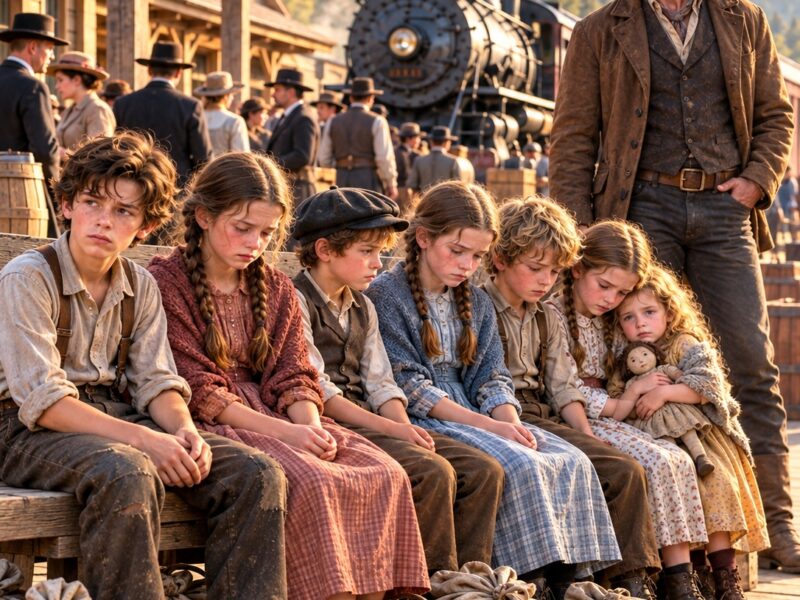
Nobody Wanted These Nine Foster Kids—Until a Lonely Wyoming Cowboy Risked His Ranch, Reputation, and Future to Keep Every Last One Together
The caseworker called them “the children nobody will take” while all nine were standing close enough to hear every word.
The county planned to split them into four homes before sunset, separating siblings who had already lost everything else.
Then a rancher who had lived alone for seven years put his keys on the table and said, “Show me what I have to do to keep them together.”
The first person to cry was not one of the children.
It was the receptionist.
She turned her chair toward the wall, pressed two fingers beneath her glasses, and pretended she was reading something on her monitor while Denise Holloway closed the conference-room door.
Nine children stood in the hallway outside.
Old enough to understand the conversation.
Young enough that nobody should have expected them to.
Denise apparently expected neither.
“We’re out of options,” she said, holding a county tablet against her chest. “No licensed home in the region will take nine. We have one couple willing to take the twins, another placement for the youngest, and a group home with three beds for the older boys.”
Twelve-year-old Clara Vale went completely still.
Four-year-old Maisie pushed her face into thirteen-year-old Wesley’s jacket.
Wesley’s right leg dragged slightly when he shifted his weight, the result of a childhood infection that had damaged muscle and left him with a permanent limp.
He put one arm around Maisie.
The other children closed ranks without being told.
Nell, eleven.
Eddie, ten.
Jonah, nine.
Twins Rose and Ruth, eight.
Benny, six.
And Clara and Wesley at the front because that was where they had learned to stand when adults started deciding things.
Denise continued.
“I know they want to stay together.”
The receptionist turned back.
“They’re siblings?”
“Not all biologically.”
That sentence hurt more than it should have.
Because the nine children were not blood.
They had met over three years inside the same overcrowded foster home outside Casper, Wyoming, a place officially called Cedar Ridge Family Center and unofficially called whatever the children needed it to be that week.
Home.
Shelter.
Waiting room.
Prison.
Family.
When the state shut Cedar Ridge down after an investigation into staffing violations, everyone promised the children they would be kept together if possible.
If possible had survived exactly eleven days.
Denise rubbed her forehead.
“The system has to be realistic.”
From the hallway, Wesley said:
“We can hear you.”
Everything inside the room stopped.
Denise opened the door.
Wesley stared at her.
He was skinny, tall, tired, and far too good at looking like he expected disappointment.
Denise’s face changed.
“Wesley—”
He said:
“You said nobody wants us.”
“I did not say that.”
“You said no home will take nine.”
“That is not the same thing.”
“It feels the same.”
Denise lowered the tablet.
Behind him, Eddie stared at the floor.
Benny had stopped bouncing his knee.
Rose held Ruth’s hand hard enough to whiten both their knuckles.
The receptionist stood.
“Maybe we should—”
Denise looked at the clock.
It was 3:17 on a Tuesday afternoon.
Outside the county family-services office, November snow had started dusting the sidewalks.
“We have to transport them before weather gets worse.”
Wesley asked:
“Where does Maisie go?”
Denise hesitated.
That hesitation told him everything.
“Different home.”
“And Clara?”
“Wesley.”
“Where?”
“Different placement.”
His face emptied.
“So you’re splitting everybody.”
“We’re trying to meet individual needs.”
“That’s adult language for splitting everybody.”
Denise winced.
He was right.
Nobody noticed the man sitting at the far end of the waiting room until he stood.
He had come in twenty minutes earlier to deliver a notarized land-use affidavit to the county clerk next door.
Cal Boone had mud on his boots, snow melting across the shoulders of his canvas ranch coat, and a paper coffee cup he had forgotten to drink.
Forty-three.
Weathered face.
Brown hair going gray faster than he liked.
Hands scarred from fencing wire, horses, and thirty years of believing gloves were optional.
He had heard enough.
Not everything.
Enough.
Cal walked toward the group.
Denise looked at him.
“Sir, this is a private matter.”
Cal’s eyes went to the children.
Not assessing.
Seeing.
Maisie clinging to Wesley.
Rose and Ruth touching elbows.
Jonah staring at a crack in the linoleum.
Benny trying very hard not to ask a question because someone had apparently taught him questions were dangerous at the wrong time.
Cal set his untouched coffee on the receptionist’s desk.
“You planning to separate them tonight?”
Denise straightened.
“I’m going to need you to step back.”
“Are you?”
“Sir.”
“Are you splitting them tonight?”
Wesley answered.
“Yes.”
Denise closed her eyes.
Cal looked at him.
Then at the others.
Something old moved in his chest.
Seven years earlier, Cal’s wife, Sarah, had died after a sudden brain aneurysm at thirty-six.
No children.
They had tried.
Three miscarriages.
One failed adoption.
Then grief had made the house quiet.
The ranch kept moving.
Cattle still needed feeding.
Fence still broke.
Winter still arrived.
Cal learned how much life could continue while a person stopped participating in it.
He had done that for seven years.
Worked.
Slept.
Paid bills.
Fixed equipment.
Spoke to horses more than people.
Now nine children stood in front of him looking like they were preparing to be dismantled.
Cal heard himself say:
“I’ll take them.”
Denise blinked.
The receptionist stopped breathing.
Wesley’s expression did not change at all.
Cal repeated:
“All nine.”
No one spoke.
Then Benny whispered:
“You know there’s nine, right?”
Cal looked at him.
“I counted.”
“You counted fast.”
“I own cattle.”
Benny considered that.
“Cows move around.”
“They do.”
“So kids should be easier.”
Cal almost smiled.
Denise did not.
“Mr.—”
“Boone.”
Her face changed slightly.
“Calder Boone?”
“Cal.”
“Boone Ranch?”
“Five miles north of Red Hollow.”
Denise stared.
“You are not a licensed foster parent.”
“No.”
“You have no active certification.”
“No.”
“No home study.”
“No.”
“No training.”
“No.”
“Then you cannot take nine children home today.”
Cal nodded.
“All right.”
Denise looked almost relieved.
Then he pulled out a chair.
“Tell me what I have to do first.”
Wesley finally looked at him directly.
And that was the moment the children stopped preparing to leave.
Not because they believed him.
Because, for the first time that afternoon, an adult had asked for instructions instead of giving them.
The Man With Too Many Empty Rooms
Emergency placements did not happen because a stranger felt strongly in a hallway.
Denise explained that three times.
Cal listened three times.
Wyoming required background checks, fingerprinting, safety inspections, references, financial documentation, child-welfare training, and a home study before certification.
There were emergency exceptions.
None were designed for one man proposing nine children at once.
Cal asked:
“What can happen tonight?”
Denise exhaled.
“A short-term kinship-style emergency placement can occasionally be approved under extraordinary circumstances if the state determines immediate safety, supervision, and sleeping arrangements are adequate.”
“I’m not kin.”
“No.”
“But you’re asking the right question.”
Wesley said from beside the wall:
“He needs beds.”
Everyone looked at him.
He shrugged.
“I’ve been through three placements.”
Cal turned.
“What else?”
Wesley’s eyes narrowed.
“Why?”
“Because apparently you know more than I do.”
That answer disarmed him slightly.
“Smoke detectors.”
“Working water.”
“Food.”
“Locked medication.”
“Background check.”
“References.”
“Transportation.”
“School plan.”
Cal took out the folded affidavit he had come to file.
Turned it over.
Borrowed a pen from reception.
“Slow down.”
Benny whispered to Eddie:
“He writes like a doctor.”
Cal looked up.
“I heard that.”
Benny smiled for half a second.
Denise watched the exchange.
Then:
“Mr. Boone.”
“Cal.”
“Cal, even if your property passes inspection tonight, this would only be temporary.”
“Understood.”
“The department could still decide separate placements are in their best interest.”
Cal looked at the children.
“Is staying together their preference?”
Denise hesitated.
Clara answered:
“Yes.”
Her voice was quiet but firm.
Cal looked at Denise.
“There you go.”
“That isn’t the only factor.”
“I know.”
“What makes you think you can handle nine children?”
Cal thought about the honest answer.
“I don’t.”
Denise blinked.
“That’s supposed to reassure me?”
“No.”
“But pretending would be worse.”
He looked down at the list.
“I have a six-bedroom ranch house.”
Denise interrupted.
“Six?”
“The county record probably says four.”
“It was four.”
“I added two rooms after my wife died.”
“Why?”
He paused.
That was personal.
Then:
“We planned to adopt.”
Clara’s eyes moved to him.
Cal continued.
“I have three hundred acres owned outright.”
“Two ranch hands who live off-property.”
“Livestock income.”
“Some mineral lease money.”
“No debt except equipment financing.”
“I can buy whatever the house needs.”
He looked at Wesley.
“Beds included.”
Wesley did not smile.
But he stopped looking at the floor.
Denise made calls.
County supervisor.
State office.
On-call licensing worker.
She argued.
Cal listened.
At 4:11, Denise said:
“We inspect tonight.”
Cal nodded.
“Fine.”
“You’re not driving them.”
“Fine.”
“County van follows separately.”
“Fine.”
“If the home fails, they go to temporary placements.”
Cal’s jaw tightened.
“Fine.”
The children gathered three duffel bags.
Three.
For nine kids.
Cal noticed.
Said nothing.
The drive to Boone Ranch took fifty minutes because snow thickened after four.
Cal drove his pickup.
County van behind.
Denise rode with another worker named Janet Cho.
Janet was younger, calm, and looked at Cal the way a person looks at a bridge she has not yet decided to cross.
The ranch appeared through snow at dusk.
Low cedar house.
Barn.
Equipment shed.
Pole fencing running into white fields.
Porch light glowing.
Wesley stepped out of the van first.
Maisie asleep against him.
Cal looked at her.
“You want help?”
Wesley tightened his hold.
“No.”
“Okay.”
That was the first thing Cal got right.
He did not insist.
Inside, the house smelled like wood smoke and coffee.
Too quiet.
Too clean in the wrong way.
A home maintained by one man who did not own decorative objects because nobody had ever required them.
Denise inspected.
Smoke alarms.
Water heater.
Fire extinguishers.
Bedroom windows.
Gun safe—locked, unloaded, ammunition stored separately.
Medication cabinet.
Ranch chemicals.
Stair rails.
Cal wrote everything she flagged.
Outlet covers.
Bathroom lock.
Emergency numbers.
Carbon monoxide alarm in the upstairs hallway.
He never said that’s ridiculous.
Never said I’ve lived here safely for years.
That impressed Janet.
Then they reached sleeping arrangements.
Six bedrooms.
Cal’s.
One guest room.
Four others.
Two beds in three.
One bed in one.
Enough for seven.
“Problem.”
Denise said.
Cal nodded.
“Barn has two new twin frames boxed from when Sarah and I were planning—”
He stopped.
Denise looked at him.
“Can they be assembled tonight?”
“Yes.”
“Mattresses?”
“Still wrapped in storage.”
Clara asked:
“Can I help?”
Denise turned.
“You don’t need to.”
Clara’s expression hardened.
“I asked if I can.”
Cal answered:
“Yes.”
That was another thing he got right.
By six-thirty, the house had become chaos.
Cal and Clara assembled bed frames.
Wesley found the toolbox before Cal asked.
The twins unfolded sheets.
Nell checked cabinets.
Benny discovered the mudroom boot rack and wanted to know who built it.
Eddie investigated the barn.
Jonah stood near the paddock fence, watching a chestnut mare that had not approached strangers in months.
Maisie woke.
Saw the house.
Saw strangers.
Saw Cal.
Immediately began crying.
Not loud.
Worse.
Silent tears.
Wesley picked her up.
Cal froze.
Denise noticed.
“You can’t fix every reaction.”
she said quietly.
“I know.”
“You look like you’re trying.”
“I usually fix things.”
“These aren’t fence posts.”
“No.”
At seven-fifteen, Clara opened the refrigerator.
Looked inside.
“Do you eat?”
Cal frowned.
“Obviously.”
“There are six eggs.”
“Steak in freezer.”
“For nine kids?”
“Not all at once.”
Clara gave him a look.
Cal said:
“I said I was learning.”
She opened pantry doors.
“Rice.”
“Beans.”
“Pasta.”
“Canned tomatoes.”
“That works.”
“You cook?”
“A little.”
“Define little.”
“I haven’t died.”
Clara sighed.
“I’ll make dinner.”
Cal started to object.
Stopped.
“What do you need?”
That answer softened her by half an inch.
Dinner was pasta.
Too little sauce.
Too much garlic.
Nobody complained.
They ate around a table designed for six by adding folding chairs and a bench from the mudroom.
Maisie spilled milk.
The glass tipped.
Everyone went still.
The reaction was so immediate Cal understood something before anyone explained.
Spills had consequences somewhere in their past.
He stood.
Got a towel.
Wiped it.
“That one was aggressive milk.”
Benny looked at him.
“What?”
“Came right out of the glass.”
Eddie snorted.
Maisie looked at Cal.
“You’re not mad?”
“No.”
“Why?”
“It’s milk.”
She watched him clean.
Then carefully set her cup farther from the edge.
Denise wrote something on her tablet.
Cal pretended not to notice.
At eight-forty, Denise approved the seventy-two-hour emergency placement.
Not custody.
Not permanency.
Not even foster certification.
Seventy-two hours.
Enough time for the state to decide whether the impossible arrangement deserved another look.
The children heard the number.
Wesley did too.
Cal walked Denise and Janet to the door.
Denise said:
“They know this is temporary.”
Cal looked toward the living room.
“They know everything is temporary.”
“That is not the same thing.”
“No.”
Denise lowered her voice.
“Do not promise permanence tonight.”
Cal nodded.
She left.
He closed the door.
Turned.
Nine children looked at him.
Benny asked:
“What happens after three days?”
Cal leaned against the door.
“I don’t know.”
Wesley studied him.
“Most adults say it’ll be fine.”
“I don’t know that.”
“Do you want us to stay?”
Cal looked at him.
“Yes.”
“Why?”
There it was.
The question Cal had avoided asking himself.
He looked around his silent house that had become loud in four hours.
Then answered:
“Because nobody should get broken into pieces just because the paperwork is easier that way.”
Clara looked down.
Wesley held his gaze.
Maisie climbed onto the couch.
“What do we call you?”
Cal blinked.
“Cal.”
“Not Dad?”
The entire room stopped.
Cal’s face changed.
“No.”
he said gently.
“Not unless something changes a long time from now and you decide differently.”
Maisie nodded.
“Cal is shorter.”
“It is.”
She curled beneath a blanket.
Ten minutes later, she was asleep.
Cal stood in the doorway of his bedroom at midnight.
Voices upstairs.
Floorboards.
Benny asking Eddie a question.
The twins whispering.
A toilet flushing.
Someone laughing.
For seven years, Cal had believed silence was grief’s final form.
That night he discovered silence had simply been waiting to be interrupted.
Seventy-Two Hours
The first morning began at 4:53 because Cal woke at his normal ranch hour.
He entered the kitchen.
Clara was already there.
She stood at the counter measuring oats.
He frowned.
“What are you doing?”
“Breakfast.”
“You don’t have to.”
“I know.”
“Then why?”
“Because nine people need breakfast.”
“Ten.”
Clara looked at him.
“You count?”
“I intend to eat.”
“You’re not a child.”
“Still hungry.”
She almost smiled.
Cal poured coffee.
“Who usually cooks?”
“Me.”
“Why?”
“Because I’m good at it.”
He heard the wall in that sentence.
Not obligation.
Not entirely.
He did not challenge it.
“Teach me.”
Clara looked up.
“What?”
“I can make eggs.”
“I can grill.”
“I can burn pancakes.”
“But apparently oatmeal requires management.”
For the first time, Clara smiled.
Small.
Real.
“Get the cinnamon.”
Cal had no cinnamon.
That became item one on the supply list.
By six, Wesley was outside.
Cal found him repairing a loose stall latch.
“You sleep?”
“Enough.”
“You don’t need to work.”
Wesley kept turning the screwdriver.
“You keep saying that.”
“Because you don’t.”
“And I keep doing it.”
Cal leaned against the stall.
“Your leg hurting?”
“No.”
Lie.
Cal could see it.
He did not call him a liar.
“Clinic appointment part of foster intake?”
Wesley stopped.
“Probably.”
“Good.”
“I don’t need a doctor.”
“Didn’t ask.”
“You’re going to make me go?”
“If the state requires it.”
Wesley’s jaw tightened.
Cal continued:
“And if your leg hurts more than you’re saying.”
Wesley looked at him.
“Why do you care?”
Cal shrugged.
“I own the screwdriver.”
That surprised a laugh out of him.
Barely.
Gone immediately.
But Cal heard it.
At nine, Denise returned with a licensing specialist.
Background interview.
Financial records.
Insurance.
Ranch safety.
Cal answered.
Then the children had private interviews.
He stayed outside.
That mattered.
Janet later told him Clara said:
“He doesn’t listen at doors.”
Denise asked:
“Is that unusual?”
Clara said:
“Yes.”
The medical screenings came next.
Wesley’s leg required orthopedic follow-up.
Eddie needed glasses.
Benny had untreated ADHD documented in an old file but no current treatment plan.
Jonah’s school records suggested he was two grades behind in reading but ahead in math.
The twins were academically strong and anxious when separated.
Maisie wet the bed.
Nell had chronic asthma.
Clara had been functioning as an adult since she was nine.
Cal sat through the entire intake conference.
Nine files.
Nine histories.
Nine sets of medical records.
He took notes.
Denise watched.
“You still want this?”
“Yes.”
“You have not heard the hardest parts yet.”
“Then keep talking.”
On day two, the hardest part arrived.
The county board chair, Robert Prescott, drove to the ranch.
Good wool coat.
Perfect truck.
Polite concern.
Cal disliked him immediately and tried not to let that matter.
Prescott toured the house.
Saw children.
Asked questions.
Then sat at Cal’s kitchen table.
“Nine is not sustainable.”
“You’ve been here forty minutes.”
“I have thirty years in child welfare administration.”
“And I have forty-three years being me.”
“That isn’t experience.”
“No.”
Cal leaned back.
“What specifically is wrong?”
Prescott did not like that question.
He preferred concerns to findings.
“Single adult household.”
“Remote property.”
“Livestock hazards.”
“School transportation.”
“Financial strain.”
“Limited child-care backup.”
“Your grief history.”
Cal stared.
“My grief?”
“You were widowed.”
“Yes.”
“No remarriage.”
“No children.”
“You live largely isolated.”
“You’re suggesting my wife dying makes me unfit.”
“I’m suggesting loneliness can distort judgment.”
That landed because it might be true.
Cal did not react quickly.
He looked through the window.
Benny was following Jonah toward the barn.
Rose and Ruth sat on the porch, sorting donated clothes by size.
Wesley carried feed with Eddie.
Clara hung towels.
The ranch had changed shape in forty-eight hours.
Maybe Prescott was right.
Maybe Cal had seen children being hurt and filled his own empty house before understanding theirs.
“What do you recommend?”
Cal asked.
Prescott seemed surprised.
“Separate placements.”
“All nine?”
“Four placements.”
“No.”
Prescott frowned.
“You asked.”
“And you answered.”
“Still no.”
“Mr. Boone, wanting something does not make it safe.”
Cal nodded.
“Correct.”
“Then—”
“But you have not told me it’s unsafe.”
“You’ve told me it’s unusual.”
“Difficult.”
“Expensive.”
“Complicated.”
He leaned forward.
“Those are not the same word.”
Prescott’s face cooled.
“The board will review after seventy-two hours.”
“I know.”
“Do not make commitments you cannot control.”
Cal thought of Denise’s warning.
Then:
“I won’t.”
That evening, he told the children.
All of it.
Prescott.
Review.
Possible separation.
Benny cried immediately.
Rose did not.
Ruth did not.
They simply held hands.
Clara asked:
“What can we do?”
Cal said:
“Nothing.”
She stared.
“That’s not true.”
“You can be kids.”
“That won’t help.”
“That’s the point.”
Clara’s face hardened.
Wesley spoke.
“What can you do?”
Cal looked at him.
“Finish certification.”
“Hire backup support.”
“Get school transportation.”
“Show the finances work.”
“Handle the county.”
Wesley nodded.
“Then what can we do?”
Cal understood the difference.
Not children earning placement.
Household participation.
“Same chores any household has.”
“Nothing designed to prove you deserve to stay.”
Clara looked away.
That sentence hurt.
Because it named the thing she had been planning.
Be useful.
Be indispensable.
Make returning them economically irrational.
Cal saw it.
“Clara.”
She looked back.
“You do not have to earn your bed.”
Silence.
She said:
“People say things.”
Wesley glanced at her.
Cal remembered his first conversation with him.
“I know.”
“So watch.”
he said.
“Decide later.”
At the seventy-two-hour review, Denise recommended extension.
Thirty days.
Prescott objected.
Janet supported Denise.
The children’s appointed guardian ad litem, attorney Melissa Grant, asked one question:
“What is the harm of thirty days together compared with immediate separation today?”
Prescott answered with hypotheticals.
Melissa answered with trauma research.
The court commissioner approved thirty days.
Cal signed eleven forms.
Wesley watched.
Then said:
“Your signature changes every time.”
Cal looked at the papers.
“It gets tired.”
“So does my leg.”
“Difference is nobody asks my signature to walk.”
Wesley almost smiled.
Thirty days.
The clock became longer.
Not safe.
Longer.
That night, Maisie sat by the fireplace.
Cal lowered himself to the floor beside her.
“Can’t sleep?”
She shook her head.
“Why?”
“Thirty days.”
“What about them?”
“Then what?”
Cal considered lying.
Didn’t.
“I don’t know.”
Maisie stared into the fire.
“The last place said yes.”
“Yes to what?”
“That we could stay.”
“And then?”
“We left.”
Cal’s chest tightened.
“Who told you?”
“Everyone.”
She looked at him.
“How do I know your yes is a real yes?”
Cal sat with that.
Then:
“You don’t.”
Maisie looked surprised.
“Not yet.”
“You watch.”
“Every day.”
“If I say one thing and do another, you notice.”
“If I keep doing what I said, you notice that too.”
Maisie thought.
“Watch and decide?”
“Exactly.”
She nodded.
Then:
“Can you tuck me in?”
Cal stood.
“I can.”
That was the first night she let him.
The Things Children Shouldn’t Have Learned
The ranch found rhythm slowly.
Not sentimentally.
Benny wandered.
Eddie climbed.
Nell forgot her inhaler twice.
The twins reorganized Cal’s pantry so thoroughly he spent ten minutes looking for coffee.
Clara’s bread improved.
Jonah befriended a retired mare named Pearl that Cal had assumed disliked everyone.
Wesley became Cal’s extra set of eyes without either of them formally agreeing to it.
One morning, they repaired fence posts together.
Wesley used the post driver.
Cal noticed his leg shake.
“Enough.”
“I’m fine.”
“That wasn’t a question.”
Wesley threw the tool down.
Cal stared.
Wesley stared back.
“You think I can’t do it.”
“I think you’re hurting.”
“Same thing.”
“No.”
“For people who decide where I live, it is.”
There.
Cal understood.
Wesley’s limp had not merely been a medical fact.
It had been evidence against him.
Farm placements wanted strong boys.
Group homes complained about transport to specialists.
Adults had turned his body into a logistical inconvenience.
Cal lowered his voice.
“I need you to hear something.”
Wesley said nothing.
“Your leg changes how we do work.”
“It does not change whether you belong here.”
Wesley’s eyes shifted.
Cal continued.
“If you need lighter work, we adapt.”
“If you need surgery, we figure it out.”
“If you never run, I don’t care.”
“I need someone who notices when the north fence is soft before the cattle do.”
Wesley looked away.
“That matters more.”
Silence.
Then:
“Post still needs set.”
“Yes.”
“You finish it.”
“Fine.”
Wesley handed him the tool.
Trust looked like that.
Not hugs.
Tools passed without argument.
Clara’s moment came differently.
Margaret Vale arrived during week three.
Fifty-eight.
Widow.
Head of the Red Hollow Community Foundation.
County welfare-board member.
The woman who funded half the school district’s extracurricular programs while claiming she merely “filled gaps.”
She came prepared to disapprove.
Cal could tell.
“You took nine children with no preparation.”
“Yes.”
“That was reckless.”
“Yes.”
She blinked.
“You agree?”
“Mostly.”
“That makes it worse.”
“Probably.”
Margaret toured.
School room.
Bedrooms.
Medical binder.
Fire plan.
Chore board.
Then she found Clara cooking.
“You’re twelve.”
Margaret said.
“Yes.”
“You cook every day?”
“Most.”
“Why?”
“I’m good at it.”
Margaret looked at Cal.
He raised both hands.
“She won the argument.”
Clara said:
“I didn’t argue.”
Cal:
“You absolutely argued.”
Margaret asked:
“What do you need?”
Clara went blank.
“What?”
“What do you need?”
Not what do the children need.
You.
Clara.
For several seconds, she could not answer.
Then:
“A bigger stockpot.”
Margaret waited.
“And?”
“Better flour if I’m supposed to make enough bread.”
“And?”
Clara glanced at Cal.
He nodded.
She swallowed.
“Maisie needs something to sleep with.”
“She lost her bag.”
“Nell gave her a blanket, but Nell gets cold.”
Margaret opened her large handbag.
Took out a cloth rabbit.
Old.
Soft from years of handling.
“My daughter’s.”
“She’s thirty-two now.”
Clara accepted it.
“Thank you.”
Margaret’s fingers held on one second longer than necessary.
She let go.
When Maisie saw it, she named it Button because Margaret’s coat had “too many buttons.”
Margaret nearly laughed.
Then came Eddie.
Ten.
Bold.
Good with horses.
Could not read beyond first-grade level.
Cal discovered it accidentally.
Sent him for the feed register.
Eddie returned with the wrong ledger.
Cal corrected him.
Eddie’s face shut down.
Clara immediately offered to fetch it.
Cal stopped her.
Not because he wanted humiliation.
Because he understood something.
“Eddie.”
“What?”
“You know which one I mean?”
“Yes.”
“Can you read the labels?”
Silence.
Eddie’s jaw tightened.
“Some.”
“How much?”
“Enough.”
That meant no.
Cal sat on an overturned bucket.
“Nobody taught you?”
“They started.”
“Then we moved.”
“How many times?”
“Four.”
Eddie’s eyes flashed.
“I’m not stupid.”
“I know.”
“How?”
“You got December to let you stand beside her after she kicked a stall board when I tried.”
Eddie blinked.
“That horse reads people better than most judges.”
“You read her.”
“That isn’t stupid.”
His shoulders loosened.
“Clara can teach you.”
“No.”
“Miss Daly?”
“No.”
“Me?”
Eddie stared.
“You read?”
Cal laughed.
“Occasionally.”
That got him.
Eddie looked down.
“Maybe Clara.”
“Your call.”
Within a week, Cal found Clara and Eddie at the kitchen table every evening.
No baby voice.
No praise for basic words.
Clara treated reading like fence repair.
This part works.
This part doesn’t.
Try again.
Eddie improved because nobody was asking him to be grateful.
Jonah’s change came through Pearl.
Pearl was seventeen.
Lame.
Cal bought her cheap from a rancher who lied about her leg.
She had not trusted humans since.
Jonah sat near her every afternoon.
No rope.
No pressure.
By week four, Pearl approached him.
By week six, she rested her nose against his shoulder.
Jonah said:
“She’s lonely.”
Cal answered:
“Probably.”
“So was I.”
It was the most Jonah had said about himself.
Cal did not respond immediately.
Then:
“Still?”
Jonah considered.
“Less.”
That night, Cal wrote nothing about it in the county log.
Some things did not belong in records.
Benny became the ranch’s chaos.
Six years old.
Questions without end.
He wandered to the creek his second morning.
Cal found him throwing stones.
“You leave without telling people again, we have a problem.”
“I didn’t want to wake anyone.”
“You tell someone anyway.”
“What if I forget?”
Cal pulled twine from his pocket.
Tied it loosely around Benny’s wrist.
“When you want to go somewhere, look at this.”
“Then find me.”
“Or Wesley.”
Benny stared at the string.
“Like a rule bracelet?”
“Sure.”
“Can it be blue?”
“It’s twine.”
“Tomorrow?”
Cal sighed.
“Tomorrow.”
The next day, Cal drove twenty miles to buy blue cord.
He told himself he needed hardware anyway.
Nobody believed him.
Thirty days became ninety.
Prescott remained unconvinced.
Not malicious.
Careful.
He believed systems existed because unregulated good intentions hurt children too.
He had seen foster parents begin with love and collapse under strain.
He had seen religious families take too many kids.
Ranches use boys as unpaid labor.
Couples collect reimbursements.
Single men overestimate themselves.
He had reasons.
That made him harder to hate.
At the ninety-day review, Prescott said:
“Your home is functioning.”
Cal nodded.
“But functioning is not permanence.”
“I agree.”
“The children are carrying too much responsibility.”
That landed.
Cal looked at Clara.
Wesley.
Prescott continued.
“You cannot allow children to become the infrastructure that makes the placement possible.”
Cal said nothing.
Because that was partly true.
That evening, he changed the chore board.
Paid housekeeper twice weekly.
Hired an afternoon tutor.
Limited ranch work hours.
Clara protested.
“We don’t need someone cleaning.”
Cal said:
“I do.”
“You’re doing too much.”
“No.”
“You are.”
“Clara.”
She stopped.
“I am the adult.”
“The house should work if you are sick.”
“If Wesley is in pain.”
“If you decide not to cook.”
“If Rose and Ruth decide they hate bookkeeping.”
“That is my responsibility.”
Clara’s eyes filled unexpectedly.
She looked away.
“You’ll send us back if it gets hard.”
There.
The belief beneath competence.
Cal lowered his voice.
“No.”
“You don’t know.”
“I know what I’ve filed.”
“What does that mean?”
Cal walked to the desk.
Pulled out papers.
Guardianship petition.
Not foster extension.
Legal guardianship.
All nine.
Clara stared.
“You filed already?”
“Yesterday.”
“Why didn’t you tell us?”
“Because filing is not winning.”
“And I told you I wouldn’t promise what I can’t control.”
She touched the first page.
“Every one?”
“All nine.”
Clara started crying.
Quiet.
Angry at herself for it.
Cal pretended not to notice until she said:
“You can look.”
He did.
She wiped her face.
“Okay.”
“Okay.”
A minute later, she asked:
“What happens now?”
“Home study update.”
“Court.”
“Guardian ad litem.”
“Probably six more kinds of paperwork invented specifically to insult me.”
Clara laughed through tears.
Cal thought that was progress.
Then the storm came.
The Night The Ranch Became A Family
Late November turned vicious.
Rain first.
Then sleet.
Then wind that shook windows.
At ten-fifteen, Clara called:
“Cal.”
He heard something in her voice and moved.
Maisie lay in bed.
Eyes open.
Face flushed.
Breathing fast.
Cal touched her forehead.
Hot.
Too hot.
“How long?”
Clara said:
“She was fine an hour ago.”
Maisie whispered:
“Cold.”
Cal grabbed the thermometer.
103.7.
He called the after-hours nurse line.
Symptoms.
Age.
Temperature.
Breathing.
No rash.
No stiff neck.
No trouble waking.
The nurse advised fluids, fever medication dosed by weight, close monitoring, and urgent evaluation if breathing worsened, she became difficult to wake, or fever persisted.
The county urgent-care clinic was closed.
Nearest emergency department forty-five miles.
Roads deteriorating.
Cal chose to go.
Not dramatic.
Medical.
He told Wesley:
“You stay here.”
Wesley’s face hardened.
“I can help.”
“I know.”
“Then—”
“I need the most reliable person in this house running it while I drive.”
That stopped him.
“You mean that?”
“Yes.”
Cal pointed.
“Medication schedule on fridge.”
“Clara knows.”
“Call 911 if breathing changes.”
“Landline works if cell goes.”
“Margaret lives eight miles south.”
“Her number’s on the board.”
Wesley nodded.
“Go.”
Cal drove the truck.
Chains.
Slow.
No cowboy heroics.
At the highway junction, county plow had partially cleared.
He reached the ER in fifty-seven minutes.
A physician evaluated Maisie.
Viral infection.
Dehydration.
No pneumonia.
IV fluids.
Antipyretics.
Observation.
Cal sat beside her.
At two-thirty, her fever came down.
She opened her eyes.
“Where’s everybody?”
“Home.”
“You left them?”
“They have Wesley.”
Maisie smiled faintly.
“He worries.”
“Yes.”
“More than you.”
“Impossible.”
She closed her eyes again.
At the ranch, things did not stay calm.
Power failed.
Backup generator refused to start.
Eddie and Wesley tried it.
No.
Margaret arrived after Clara called.
She drove through sleet with emergency lanterns and food.
At one a.m., she sat on the floor near Ruth and told a story about losing power during the winter of 1989.
Benny fell asleep with blue cord still around his wrist.
Jonah checked the horses with Wesley.
Clara made tea.
Nobody broke.
When Cal returned at 5:40 with Maisie wrapped in a hospital blanket, the front porch lights were dark.
But lanterns glowed inside.
Wesley opened the door before Cal knocked.
He looked at Maisie.
“She okay?”
“Yes.”
Wesley exhaled.
Cal saw all nine children in the living room.
Counting.
Always counting.
Maisie woke.
Saw Wesley.
Clara.
Margaret.
Then looked at Cal.
“You came back.”
The sentence hit him harder than anything in the ER.
“Of course.”
She touched his wet sleeve.
“I knew.”
Margaret looked away.
Wesley did too.
Cal carried Maisie to bed.
She held his hand.
Did not let go until sleep.
At six-thirty, Cal entered the kitchen.
Margaret sat with coffee.
Hair damp.
Coat drying near the stove.
“You came.”
Cal said.
“I live eight miles away.”
“In that weather.”
“I’ve driven worse.”
They sat.
Margaret said:
“My son died when he was four.”
Cal looked up.
“Thomas.”
“Pneumonia.”
“Eleven years ago.”
“I was on the welfare board then too.”
She stared at her coffee.
“I became very good at procedure afterward.”
“Rules.”
“Documentation.”
“Risk.”
Cal said nothing.
“It made me feel like bad things could be prevented if someone had enough checklists.”
“And?”
“They can prevent some.”
“Not all.”
She looked at him.
“Tonight I sat here watching those children wait for you.”
“And I realized I have spent months evaluating whether you are qualified to be their family.”
“But they already decided.”
Cal’s throat tightened.
Margaret continued.
“That does not remove the county’s duty.”
“No.”
“But it changes mine.”
“What does that mean?”
“I’m withdrawing my objection to the guardianship petition.”
Cal stared.
“You objected?”
“I had not formally supported it.”
“That’s politician language.”
“Yes.”
She almost smiled.
“I will support it now.”
Cal looked toward the hallway.
“Why?”
“Because I watched nine children behave like siblings while one of them was sick.”
“And I watched a man drive to an ER without turning the rest into abandoned children for the night.”
She finished her coffee.
“Also, Wesley threatened to walk to the highway if you didn’t call by four.”
Cal rubbed his face.
“I’m going to kill him.”
“No.”
“You are going to tell him he was irresponsible.”
“Which will hurt more.”
Cal laughed.
That morning, Wesley found him repairing the generator.
“You threatened to walk to the highway?”
Wesley kept his face blank.
“Maybe.”
“In sleet.”
“I didn’t.”
“Because Margaret stopped you?”
“Because you called.”
Cal stared.
Wesley stared back.
“You came back.”
“Yes.”
Wesley nodded.
“Okay.”
That word.
Cal had learned it.
From Wesley, okay meant more than agreement.
It meant a door unlocking one inch.
The Fight To Keep All Nine
Guardianship should have become easier after Margaret’s support.
It did not.
Prescott raised a new issue.
Money.
Not current income.
Long-term sustainability.
Nine children meant food.
Medical care.
College possibilities.
Vehicles.
Home maintenance.
Insurance.
Potential ranch downturn.
Cal’s attorney, Melissa Grant, explained bluntly:
“Courts don’t require wealth.”
“But they require credible stability.”
Cal had savings.
Land.
Livestock.
Lease income.
Still, one bad drought could change numbers fast.
He considered selling seventy acres.
Wesley overheard.
“No.”
Cal looked up from financial statements.
“What?”
“You’re not selling land.”
“You’re thirteen.”
“You’re bad at accounting.”
“That’s unrelated.”
Rose and Ruth entered.
Rose carried a notebook.
Ruth carried another.
“We looked.”
Cal stared.
“You looked at what?”
“Household expenses.”
“You should not have my bank statements.”
“You left them on the table.”
“That is not permission.”
Ruth nodded.
“Fair.”
Then:
“But selling land is stupid.”
Cal leaned back.
“Excellent.”
“Now eight-year-olds are giving financial advice.”
Rose opened the notebook.
“Feed costs are high because you buy retail in winter.”
“You should contract hay before first frost.”
Cal blinked.
Wesley said:
“They’re right.”
Cal looked betrayed.
Ruth continued.
“And Clara’s bread income could become a legal cottage-food business.”
Clara appeared from the hallway.
“I did not authorize that presentation.”
Benny shouted from somewhere:
“BUSINESS MEETING!”
Cal closed his eyes.
“No.”
But the point remained.
The household was becoming an economic unit.
That created danger too.
He did not want the court believing children’s labor supported their placement.
So he did something important.
He separated their money.
Clara’s bread profits went into an account in her name under court-supervised minor rules.
Twins received no burden to manage ranch finances.
Wesley could earn hourly wages for ranch work only within legal limits and only for optional work beyond household chores.
No child’s income counted toward Cal’s guardianship capacity.
Melissa approved.
So did the court.
Cal sold cattle instead.
Not land.
Prescott still worried.
“You’re reducing productive assets.”
“I’m reducing herd size.”
“Why?”
“Because nine children require time.”
“I cannot run the same operation.”
That answer surprised him.
Cal continued.
“I’m choosing smaller revenue for a manageable household.”
Prescott looked at him.
“That is financially inefficient.”
“Yes.”
“Long term?”
“Yes.”
“Why?”
Cal was tired of the question.
Then realized Prescott deserved an answer.
“Because I’m not trying to maximize the ranch anymore.”
“I’m trying to run a life.”
Prescott wrote that down.
The first major hearing occurred in January.
Family court.
Small courtroom.
No jury.
Judge Evelyn Cross presiding.
Guardian ad litem.
State attorney.
Cal’s attorney.
Prescott.
Denise.
Children interviewed privately.
The key issue:
Should the court grant Cal temporary legal guardianship of all nine while permanent placement was evaluated, or divide the group among certified homes?
State argued caution.
Not hostility.
Nine was extraordinary.
Cal’s attorney emphasized stability and the children’s expressed wishes.
Judge Cross asked Cal:
“Mr. Boone, what happens if this becomes harder than you imagined?”
Cal answered:
“It already has.”
A few people smiled.
Judge did not.
“What if one child requires more care than you can provide?”
“I get more care.”
“What if your ranch fails?”
“I work somewhere else.”
“What if you become ill?”
“I have backup guardianship planning.”
“Who?”
Margaret Vale as temporary adult contact.
Denise’s eyebrows rose.
Cal continued:
“My sister in Colorado also agreed, though she can’t take all nine long term.”
Judge Cross:
“So you have thought about failure.”
“Yes.”
“Why?”
“Because pretending failure is impossible is how you hurt children.”
The courtroom went quiet.
The judge looked at Wesley.
Not directly questioning him in open court.
Just noticing.
Then:
“Temporary guardianship granted for six months.”
Cal closed his eyes.
Not permanent.
Enough.
Outside, reporters waited.
Someone had posted the story online.
WYOMING COWBOY TAKES IN NINE FOSTER CHILDREN.
Cal hated it.
A reporter asked:
“Do you consider yourself a hero?”
“No.”
“What do you call what you did?”
“Paperwork.”
The clip went viral.
Donations arrived.
Cal rejected direct cash.
Melissa advised him to create a nonprofit educational fund if people insisted.
He did.
Independent board.
No control by Cal alone.
Money for tutoring, medical needs, vocational training, college.
Not ranch expenses.
That distinction mattered.
The internet loved the story.
Then it turned.
A local blogger found that Cal’s late wife had once been investigated after an allegation during their failed adoption process.
Headline:
RANCHER WITH TROUBLED ADOPTION HISTORY GIVEN NINE CHILDREN.
Cal stared at the article.
He had known this might surface.
Sarah had been accused by a former foster parent of “emotional instability.”
The allegation came after her third miscarriage.
Investigation found no wrongdoing.
But the file existed.
Prescott called.
“We need to review.”
Cal’s anger exploded.
“You already had that record.”
“I had a summary.”
“You knew.”
“Not the details.”
“Sarah is dead.”
“This isn’t about punishing her.”
“It sure looks like it.”
The children heard.
Again.
Always hearing.
Wesley confronted Cal.
“What happened?”
“Nothing you need to carry.”
“That is not an answer.”
Cal nearly snapped.
Then remembered.
Truth.
“Sarah and I tried to adopt six years before she died.”
“A former foster parent accused her of being unstable after she cried during a placement meeting.”
“County investigated.”
“Cleared us.”
“Adoption still failed.”
“Why?”
“The child was placed with relatives.”
Wesley studied him.
“You wanted kids.”
“Yes.”
“You never told us.”
“No.”
“Why?”
“Because you’re not replacements.”
That mattered.
Wesley nodded slowly.
The review cleared Cal.
Again.
But damage remained.
The online story attracted attention to Clara.
A woman in Nebraska claimed to be her biological aunt.
DNA confirmed relation.
She petitioned for custody of Clara and Nell, who were biological sisters.
Suddenly the promise to keep all nine together collided with family reunification principles.
The aunt, Rachel Moore, was not cruel.
She had searched for them.
Their mother—Rachel’s sister—had concealed the children’s placement after losing custody.
Rachel only learned through the viral article.
She wanted them.
She had a stable home.
Two children.
Marriage.
School district.
No criminal record.
No reason to deny her automatically.
Clara panicked.
“No.”
Cal said:
“You have to meet her.”
“No.”
“She’s family.”
“So are they.”
She pointed toward the house.
“I know.”
“You don’t.”
“I do.”
“Then say no for me.”
Cal’s chest hurt.
“I can’t.”
Clara looked betrayed.
“You said you’d keep us together.”
“I said I would fight for you.”
“This isn’t somebody trying to separate you because you’re inconvenient.”
“This is a woman who may love you and deserves to be heard.”
Clara started crying.
“You sound like Denise.”
Cal nearly reached for her.
Stopped.
She was furious.
“You want me gone.”
“No.”
“You’d have more room.”
“No.”
“Less expense.”
“No.”
“Then fight.”
Cal whispered:
“I’m fighting for your right to choose honestly.”
“That means you need the truth.”
She hated him for three days.
Rachel arrived Saturday.
Clara refused dinner.
Nell attended.
Rachel brought photographs.
Their mother as a teenager.
Grandparents.
A lake house.
Family Christmas.
Clara stood in the hallway listening.
Eventually came in.
Rachel cried when she saw her.
Clara did not.
“You knew we existed?”
“Not where.”
“Did you look?”
“Yes.”
“How long?”
“Four years.”
“Why didn’t you find us?”
“Your mother changed names twice.”
“County records were sealed.”
“I did not know what state.”
Clara asked brutal questions.
Rachel answered.
No perfection.
No magic.
At the end, Rachel said:
“I’m not here to take you against your will.”
Clara stared.
“You filed.”
“Yes.”
“Because without filing, I had no legal voice.”
“That’s not the same as wanting to force you.”
Clara looked toward Cal.
He said nothing.
Rachel eventually withdrew her custody petition.
Not because she stopped wanting them.
Because Clara and Nell asked to remain.
Instead, she became family.
Calls.
Visits.
Summer weekends.
An aunt rather than a replacement home.
That changed Cal’s understanding too.
Keeping children together did not mean keeping everyone else out.
Possession was not permanence.
Choice was.
The Lowest Point
The crisis came in spring.
Not dramatic weather.
Money.
Disease.
A respiratory outbreak hit Cal’s cattle herd.
Veterinary costs surged.
Market prices dropped.
Insurance did not cover all losses.
Within six weeks, ranch income projections collapsed by forty percent.
Cal did what he had always done.
He hid it.
Not from the court.
From the children.
He took a line of credit.
Sold equipment.
Worked nights hauling feed for another rancher.
Slept four hours.
Became irritable.
Benny noticed first.
“You’re mad.”
“I’m tired.”
“That’s what adults say when they’re mad.”
Cal stopped.
“Fair.”
Wesley found the loan paperwork.
Because papers left on tables never survived children.
“You said no secrets.”
“I said no lies.”
“Same family.”
Cal sighed.
“I was handling it.”
Wesley’s expression hardened.
“That’s what people say before they send kids back.”
That sentence wrecked him.
Cal sat.
“The ranch is in trouble.”
Everyone eventually gathered.
Cal explained.
No foreclosure yet.
No immediate danger.
But if losses continued, he might need to sell land.
Prescott’s office would be notified.
Clara said:
“They’ll separate us.”
“I don’t know.”
“You always say that.”
“Because I don’t.”
Maisie began crying.
Cal felt the room slipping.
Wesley asked:
“What can we do?”
“Nothing.”
That was the wrong answer.
Wesley slammed his hand on the table.
“Stop saying that.”
Cal looked up.
“We live here too.”
“You cannot make us family when it’s chores and bedtime and then make us children again when something matters.”
Silence.
Cal’s face tightened.
He knew the truth in it.
But he also knew children should not carry adult financial fear.
“I will not put mortgage responsibility on a thirteen-year-old.”
“I didn’t ask for mortgage responsibility.”
Wesley shot back.
“I asked for the truth and a job.”
Clara said:
“Same.”
The twins nodded.
Cal rubbed his face.
“All right.”
He laid out numbers.
What ranch needed.
What he could sell.
What had to remain separate.
The children proposed ideas.
Not rescue fantasy.
Practical.
Clara expanded bread sales, but proceeds remained hers unless she voluntarily contributed to household extras—not mortgage.
Wesley worked paid weekend fencing for neighbors.
Rose and Ruth built inventory tracking that reduced waste.
Jonah helped Cal identify two horses suitable for sale.
Eddie offered horse training.
Benny became free advertising to everyone in town, which nobody authorized and everybody benefited from.
Nell expanded eggs.
Community members offered contracts.
Margaret arranged a cooperative bulk-feed purchase for multiple ranches, reducing everyone’s costs.
The ranch did not survive because children worked themselves into exhaustion.
It survived because Cal stopped operating alone.
Then Prescott arrived.
Financial review.
He saw everything.
The loans.
Reduced cattle.
Income changes.
He said:
“This materially changes the guardianship analysis.”
Cal’s stomach dropped.
“We are still solvent.”
“Yes.”
“But thinner.”
“Yes.”
“Emergency reserve decreased.”
“Yes.”
Prescott looked at the children working outside.
“You understand I have to report this.”
“Yes.”
That night, Cal sat on the porch.
Margaret joined him.
“You think they’ll take them.”
Cal said:
“I think Prescott has a duty.”
“That was not what I asked.”
“Yes.”
Margaret looked out over the ranch.
“You could sell.”
“Half the north pasture.”
“Then you’re safe financially.”
“For a while.”
“So why haven’t you?”
Cal stared.
“Because the north pasture is where most winter grazing happens.”
“Selling it creates operating costs later.”
Margaret nodded.
“You could marry money.”
Cal laughed.
“Is that a proposal?”
“Absolutely not.”
“Good.”
“I’m difficult.”
“I noticed.”
She almost smiled.
Their relationship had grown quietly.
Coffee after inspections.
Supply trips.
Hospital night.
Arguments about school budgets.
No declarations.
No rescue.
Just two adults who had both built fortresses around grief.
Margaret said:
“There is another option.”
“What?”
“Community land trust.”
Cal looked at her.
“No.”
“You haven’t heard it.”
“I know where this is going.”
“You donate development rights.”
“Keep ranching rights.”
“Tax burden drops.”
“Land cannot be subdivided.”
“The trust pays a conservation easement value.”
Cal frowned.
“That money comes from grants.”
“And private contributions.”
“No charity.”
Margaret’s eyes flashed.
“It is not charity.”
“It is a legal conservation transaction.”
“You preserve open land.”
“The county gets water protection.”
“You get liquidity.”
“Stop turning pride into arithmetic.”
Cal stared.
She stared back.
That was their first real fight.
Then she said quietly:
“Your wife is dead.”
“My son is dead.”
“We know what cannot be saved.”
“Do not lose what can because you need survival to look solitary.”
Cal looked away.
The sentence hurt because it was true.
He agreed to explore it.
The process took months.
Appraisal.
Legal review.
Environmental assessment.
No miracle.
No instant money.
During that period, the court scheduled permanency review.
The children were terrified.
Cal pretended he wasn’t.
That was another mistake.
Maisie asked:
“Are you scared?”
“No.”
She looked at him.
“You tell us not to lie.”
Cal closed his eyes.
“Yes.”
“I’m scared.”
Maisie nodded.
“Me too.”
Then held his hand.
That was the lowest point.
Not because disaster had happened.
Because all of them understood it still could.
After nearly a year, they had something to lose.
The Choice That Made Them A Family
The final hearing occurred on a bright June morning.
Judge Cross.
Same courtroom.
Different children.
Wesley taller.
Clara more confident.
Eddie reading.
Benny incapable of sitting still.
Maisie holding Button by one ear.
Prescott presented the financial concern fairly.
Then surprised Cal.
“The ranch experienced a material downturn.”
he said.
“Mr. Boone disclosed it.”
“He restructured.”
“Reduced herd size.”
“Entered a pending conservation easement transaction.”
“Added backup guardians.”
“Expanded community support.”
Prescott looked toward Cal.
“I originally considered his decision reckless.”
Cal raised an eyebrow.
Prescott continued.
“I still consider the original decision reckless.”
A few people smiled.
“But reckless is not synonymous with wrong.”
Margaret looked down.
That was her phrase.
Judge Cross asked:
“Do you support permanent guardianship?”
Prescott took a breath.
“Yes.”
Cal stared.
Denise cried immediately.
Again.
The same receptionist from months earlier sat in back.
Crying too.
Then came the children.
The judge had received private statements.
But she asked whether any wanted to speak.
Wesley stood.
He leaned slightly because of his leg.
“My name is Wesley Carter.”
“I’m fourteen.”
“Cal says I don’t have to work to stay.”
A ripple of laughter.
Wesley continued.
“That sounded stupid when he first said it.”
“Because places always say you’re family until you stop being useful.”
The courtroom went quiet.
“At Boone Ranch, I got hurt once.”
“I couldn’t work for three weeks.”
“Nothing changed.”
“That’s how I knew.”
He sat.
Clara stood.
“I’m Clara Vale.”
“I’m thirteen.”
“I have an aunt now.”
“She’s good.”
“I visit her.”
“I still want to live at Boone Ranch.”
“I learned family can get bigger without replacing anyone.”
She sat.
Jonah stood.
“I want to stay because Pearl is there.”
Judge Cross smiled.
“Pearl?”
“Horse.”
“That is not the only reason.”
“But it’s enough.”
He sat.
Benny raised his hand.
Everyone groaned.
Judge Cross said:
“All right, Benny.”
He stood.
“I used to have a string.”
Cal looked at his wrist.
Blue cord.
“I still do.”
“I’m supposed to look at it before I go anywhere.”
“So I remember to tell someone.”
He looked at Cal.
“I think family is people who notice when you leave.”
Silence.
Even Prescott looked down.
Maisie went last.
Four turning five.
Too young for speeches.
She climbed onto the witness chair because the judge allowed it.
Button in her lap.
“What do you want?”
Judge Cross asked.
Maisie looked at Cal.
“Forever.”
The judge nodded.
“Do you know what that means?”
Maisie thought.
“It means tomorrow too.”
Cal broke.
Not dramatically.
One hand over his mouth.
Eyes closed.
Because that was the exact fear she had named by the fireplace months ago.
Tomorrow.
And the day after.
Judge Cross signed permanent guardianship.
All nine.
Legal adoption would require separate processes depending on parental rights and histories.
Some children might choose adoption later.
Some might keep their names.
Permanent guardianship gave them home without forcing identity.
Cal liked that.
Choice.
Outside courthouse, reporters waited.
One shouted:
“Mr. Boone, how does it feel to save nine children?”
Cal stopped.
Turned.
Looked at Wesley.
Clara.
Jonah.
Eddie.
Nell.
Rose.
Ruth.
Benny.
Maisie.
Then:
“They saved a ranch.”
The reporter laughed uncertainly.
Cal did not.
He meant it.
The conservation easement closed two weeks later.
The ranch remained viable.
Community land trust protected the north pasture permanently from development.
Cal received enough liquidity to clear emergency debt and rebuild reserves.
Not wealth.
Stability.
Margaret refused praise.
“It was paperwork.”
Cal looked at her.
“You stole my line.”
“Yes.”
That evening, after the children were asleep, they sat on the porch.
Margaret held coffee.
Cal said:
“You were right.”
She looked genuinely suspicious.
“About?”
“Solitary survival.”
“That is dangerously close to emotional growth.”
“Don’t get excited.”
She smiled.
Their hands rested on the bench between them.
Eventually, Margaret placed hers over his.
No proposal.
No rescue marriage.
No sudden mother replacement.
Just contact.
Cal turned his hand.
Held hers.
That was enough.
The House That Learned Noise
Years changed the ranch.
Not cleanly.
Wesley’s leg worsened at seventeen.
Surgery helped.
Did not cure.
He studied agricultural engineering through a state program and returned to redesign irrigation systems across Wyoming ranches.
He eventually became the man other ranchers called when water systems failed.
He still limped.
He stopped apologizing for it.
Clara built a bakery business in Red Hollow.
She bought a small building at nineteen using money she had saved since her first bread sales.
Cal offered to help.
She said:
“No.”
He said:
“Fine.”
Then spent two weekends fixing plumbing because she asked.
That distinction pleased them both.
Eddie became a horse trainer.
Not a romantic cowboy whisperer.
A disciplined professional who specialized in anxious and mishandled horses.
He learned to read fluently.
Slowly.
He kept the first book he finished alone on a shelf in his workshop.
Jonah became a teacher.
Quiet.
Patient.
Excellent with children adults described as difficult.
He never used the word difficult.
He said:
“Not reached yet.”
Nell turned chickens into an actual business.
Rose became an accountant.
Ruth became a nurse.
Benny grew into a county emergency coordinator, which surprised nobody except people who had known him only as the child who wandered.
He still wore a blue cord bracelet.
Maisie grew up stubborn.
Opinionated.
Funny.
The center without trying.
She kept Button until the cloth rabbit was more repair than original fabric.
Margaret became part of the family slowly.
She did not move into the ranch for three years.
The children called her Margaret.
Then Miss Margaret.
Then some called her Grandma Margaret after her first granddaughter was born.
Cal married her at fifty.
Small ceremony.
Children everywhere.
Not because he needed a mother for them.
Because, after years of knowing her, he wanted her.
That mattered.
Denise attended.
So did Prescott.
Prescott brought no clipboard.
At the reception, Benny asked him:
“Do you still think this was reckless?”
Prescott looked at Cal.
“Yes.”
Benny frowned.
Prescott added:
“And I’m glad I was wrong about what happened after.”
That satisfied him.
Agnes Hollowell did not exist in this modern version of their lives.
But Denise did.
And years later, she changed the language county workers used in group-placement reports.
No more “hard-to-place unit.”
No more “sibling burden.”
No more shorthand that transformed people into logistics.
She trained new workers to say:
“Children with placement barriers.”
Clara told her once:
“That’s still bureaucratic.”
Denise answered:
“I work for government.”
“There are limits.”
Clara laughed.
Twenty years after the courthouse hearing, Boone Ranch hosted a summer gathering.
Cars lined both sides of the drive.
Children ran through the yard.
Grandchildren.
Friends.
Spouses.
Neighbors.
People Cal could not immediately place.
The house had expanded twice.
Not grand.
Functional.
Long dining room.
Big kitchen.
Bunkhouse converted into guest rooms.
The porch board that once flexed underfoot had been replaced so many years earlier nobody remembered which one it was.
Cal was sixty-three.
Hair white.
Hands stiff.
Margaret sat beside him on the porch.
Maisie, now twenty-five, came out carrying lemonade.
“You’re hiding.”
Cal said:
“I’m sitting.”
“You always hide by sitting.”
Margaret nodded.
“She’s right.”
Cal sighed.
Maisie sat on the porch rail.
“You remember the county office?”
“Every day.”
“That seems unhealthy.”
“I remember pieces.”
“What piece?”
Cal looked toward the yard.
Benny arguing with Rose about parking.
Wesley’s teenage son carrying a folding table.
Jonah helping a little girl untangle a kite.
Clara arriving with too much food.
Eddie checking a horse trailer because apparently he could not attend any event without inspecting livestock equipment.
“The hallway.”
Cal said.
“You were asleep.”
“Wesley carried you.”
“Denise was talking about splitting everybody.”
“I remember your shoes.”
Maisie laughed.
“My shoes?”
“They had pink lights.”
“They did?”
“No idea.”
“I may have invented that.”
She smiled.
Then grew serious.
“I used to think you rescued us.”
Cal looked at her.
“And now?”
“Wesley told me something when I was twelve.”
“That you saved us from the placements, but we saved you from the house.”
Cal looked toward the front windows.
The same house had once gone entire days without voices.
He remembered eating dinner standing at the counter because setting a table for one felt theatrical.
He remembered leaving Sarah’s coffee mug in the cabinet for three years because moving it seemed like a declaration he was not ready to make.
Then nine children arrived.
Spills.
Shoes.
Noise.
Fear.
Homework.
Illness.
Money problems.
Court hearings.
Laughter.
He had believed he gave them a place.
They had given the place a reason.
“Wesley’s right.”
Cal said.
“He usually is.”
“Don’t tell him.”
“Too late.”
Wesley’s voice came from behind the screen door.
“I heard you.”
Cal groaned.
Wesley stepped onto the porch.
Older.
Same careful eyes.
Limp still visible.
He sat.
For a moment, the three of them watched children run near the fence.
Maisie said:
“You know the weird thing?”
“What?”
Cal asked.
“You didn’t keep us together by never letting us leave.”
Cal looked at her.
She continued.
“Clara left.”
“Ruth left.”
“I left for college.”
“Wesley practically lives in Laramie half the month.”
“You let everyone go.”
“And that’s how we knew we could come back.”
Cal swallowed.
Margaret squeezed his hand.
Maisie smiled.
“That’s family, I think.”
“Not being trapped.”
“Knowing where home is.”
A truck horn sounded at the gate.
Benny shouted something nobody understood.
Rose shouted back.
Somebody dropped a metal tray.
Cal flinched automatically.
Twenty years of children had not cured that.
Maisie laughed.
“You okay?”
“No.”
“Too much noise?”
Cal looked around.
At the ranch.
At the people.
At everything that interrupted the silence he once mistook for safety.
“No.”
he said.
“Exactly enough.”
Dinner happened outside because the house could not contain everyone.
Three tables.
Then four.
Then someone added another folding one.
Children sat wherever space appeared.
Nobody assigned seats.
Cal found himself beside Maisie.
Across from Wesley.
Clara passed bread.
Nell complained Benny had parked too close to the coop.
Eddie said the chickens were judging him.
Rose corrected somebody’s math.
Ruth checked a scraped knee.
Jonah quietly moved a hot dish out of reach of a toddler.
Margaret watched all of it with the satisfied expression of a woman who had once arrived at this ranch prepared to prove it could not work.
Maisie spilled water.
The glass tipped.
Water spread across the table.
For one second, everyone looked at Cal.
Old joke.
Old memory.
Cal reached for a towel.
“Still aggressive.”
Maisie laughed.
“Twenty years later?”
“Milk, water.”
“Same criminal instincts.”
Cal wiped the table.
Nobody froze.
That was how he knew they had made it.
Not the court papers.
Not the ranch.
Not the money.
Not the photographs.
A spilled glass nobody feared.
Later, after sunset, Cal sat alone on the porch for five minutes.
Only five.
The family still moved inside.
Dishes.
Voices.
Doors.
Someone laughing too loudly.
Someone telling Benny to stop telling the same story.
Margaret called from the kitchen:
“Cal!”
“Coming.”
He did not stand immediately.
He looked down the driveway.
Years ago, he had driven into town for fencing wire and coffee.
Never bought either.
Instead, he found nine children being divided according to what adults believed was practical.
He had made a reckless promise before understanding the cost.
Then spent years paying that cost honestly.
That was the part people left out when they told the story.
They liked the cowboy in the hallway.
The dramatic decision.
I’ll take all nine.
They did not talk as much about licensing classes.
Bedtime panic.
Medical appointments.
Budget spreadsheets.
Court reviews.
Apologies.
Therapy.
The times he was wrong.
The days children hated him.
The nights he wondered whether Prescott had been right.
The work required after compassion stopped feeling heroic.
Cal understood now that rescue was a moment.
Family was repetition.
Show up.
Tell the truth.
Come back.
Do it again tomorrow.
The screen door opened.
Maisie stepped out.
“You coming?”
“Yes.”
She stood beside him.
“Forever?”
He looked at her.
At twenty-five, she still had the serious eyes of the four-year-old who had once asked whether tomorrow was real.
Cal smiled.
“Yes.”
Maisie nodded.
“Good.”
She went inside.
Cal rose more slowly than he used to.
His knees objected.
His hands hurt.
The house glowed behind him.
He opened the screen door.
Noise met him.
He went in.
Tomorrow was still theirs.









