“Please Listen Before You Sign,” a Little Girl Told the Mafia Boss—Then His Dead Wife’s Voice Exposed the Agreement Everyone Expected Him to Approve
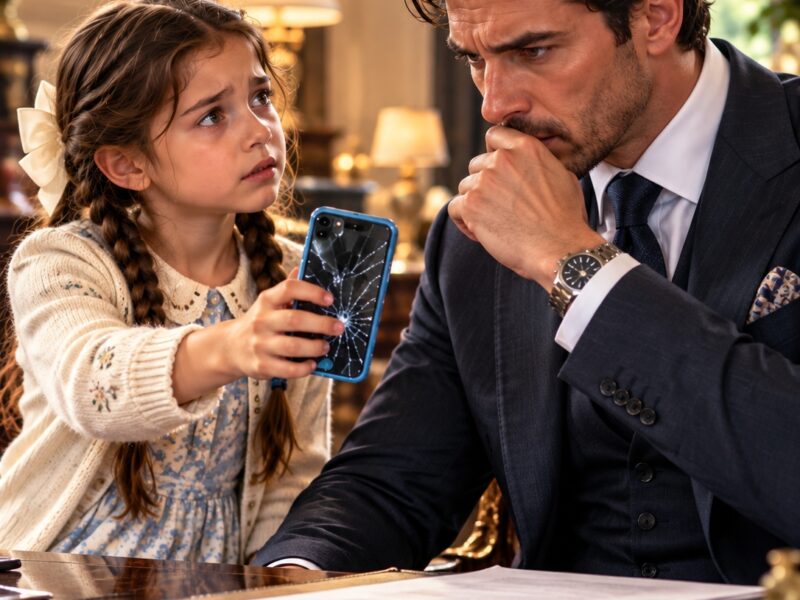
Eight-year-old Elsie Collins crossed a line no staff child was allowed to cross and interrupted Nico Viscari seconds before his pen touched the final page of a multimillion-dollar agreement.
She carried a cracked blue phone and a message her mother had hidden for three years—a message that warned Nico not to trust the lawyer standing at his elbow.
Then Elsie pressed play, and the voice that filled the dining hall belonged to Nico’s dead wife.
“Please listen before you sign, sir.”
The child’s voice was so small that Nico Viscari almost believed he had imagined it.
His pen stopped less than an inch above the signature line.
Eleven men sat around the long walnut table beneath the dining hall’s brass chandeliers. Outside the tall windows, October sunlight fell across clipped lawns and the fountain his wife had once complained looked more like a monument than a place where children might sit. Inside, no one moved.
Elsie Collins stood just beyond the brass strip inlaid across the marble floor.
Staff children were not permitted past that line.
She knew it.
Nico knew she knew it.
Her mother, Mara, had worked in the Viscari household for nine years and had taught the girl every rule powerful families invented so ordinary workers would never forget where they belonged.
Elsie’s school cardigan hung crooked from one shoulder. Her dark braids were coming loose. Both hands clutched an old blue phone with a crack spreading across the screen like lightning through ice.
Nico looked at the phone.
Then at the child.
“Who brought her in here?”
Graham Sloan, the family attorney, rose too quickly.
His chair scraped.
“An unfortunate misunderstanding. I’ll have someone return her to staff quarters.”
He moved around the table.
Elsie backed away.
“It’s the lady who used to live here.”
Graham stopped.
Bruno Viscari, Nico’s cousin, gave a quiet laugh from beside the windows.
“The girl is confused.”
Elsie’s eyes filled, but she did not leave.
“She told Mama not to let him make you sign.”
Nobody laughed this time.
Nico’s gaze moved to Graham.
The attorney’s face remained composed.
Twenty years of family service had made composure nearly permanent on him.
“Elsie.”
Nico said her name carefully.
“Who is ‘the lady’?”
The child looked at the phone.
“Mrs. Viscari.”
Something cold moved beneath Nico’s ribs.
His wife, Audra, had been dead three years.
Graham stepped forward.
“Nico, she’s eight. Whatever she thinks she heard—”
He reached toward the phone.
Elsie jerked it against her chest.
Nico saw the motion.
A grown man reaching for a child’s hand because whatever she carried made him uncomfortable.
“Take your hand away, Graham.”
The attorney froze.
Nico’s voice had not risen.
It did not need to.
Graham slowly lowered his hand.
Elsie swallowed.
Then pressed the white triangle on the screen.
Static.
A rustle.
A woman breathing too fast.
And then:
“Mara, it’s Audra.”
Nico’s pen slipped from his fingers.
It struck the table.
No one moved.
Audra’s voice continued through the cracked speaker.
“I don’t have long. If Graham is standing beside Nico, don’t let him sign anything he brought. Please. You have to make him listen.”
Three metallic chimes sounded faintly in the background.
Then silence.
Nico stared at the phone.
For three years, he had lived with the memory of Audra’s final ordinary sentence to him.
You never hear me when the numbers inconvenience you.
He had spent three years telling himself grief had distorted the exchange.
That she had been angry.
That he had been tired.
That people said cruel things inside marriages and survived them.
Audra had not.
She died hours later in what police concluded was a single-car collision near Harbor Nine.
Now a dead woman had just spoken from a child’s phone.
Nico looked down at the unsigned agreement.
Then at Graham.
“Everyone sit.”
No one had stood except Graham.
Still, every person in the room became motionless.
Nico capped the pen.
Placed it across the document.
“The signing is suspended.”
Bruno straightened.
“Nico, the lenders have already been told those voting rights transfer today.”
“Then the lenders can wait.”
“You delay this and the port facility financing can freeze.”
Nico looked at the stack of pages in front of him.
“Then perhaps I should know what I’m signing before I decide whether that is my problem.”
Bruno’s mouth tightened.
Nico turned toward Elsie.
“Where is your mother?”
“They took her upstairs.”
“Who?”
“Mr. Sloan’s people.”
Graham’s face changed by almost nothing.
Nico saw it.
“Why?”
“She had papers.”
Nico looked at Graham.
“Where is Mara Collins?”
“In the staff office.”
“Why?”
“A routine employment matter.”
“Then why did her eight-year-old daughter need to interrupt my meeting to tell me?”
Graham placed both palms on the table.
“We should establish the recording’s origin before giving a child’s interpretation too much weight.”
Nico stood.
“I did not ask for her interpretation.”
He signaled toward the door.
A guard appeared.
Elsie flinched.
That movement caught Nico harder than it should have.
He had spent most of his adult life making people flinch.
Until that morning, he had rarely considered what the movement meant from their side.
“Bring Mara Collins.”
he said.
“No one questions her.”
“No one searches her room.”
“No one touches that phone.”
Graham began:
“Nico—”
“No one from your office touches anything.”
The guard left.
Nico looked at Elsie.
She remained standing.
He pulled out a chair.
“You can sit.”
She climbed into it.
Her feet did not reach the floor.
“Am I in trouble?”
“No.”
“Not for this.”
Her eyes narrowed slightly.
“Not for what?”
Nico realized he had answered like a man accustomed to leaving possibilities open.
He corrected himself.
“You are not in trouble for bringing me the phone.”
She nodded.
Not reassured.
Only informed.
That distinction stayed with him.
The door opened several minutes later.
Mara Collins entered without her apron.
Thirty-five.
Brown hair pinned back too quickly.
Plain black work dress.
A red mark across one wrist where she had apparently been gripping her own sleeve.
Her first look went to Elsie.
“Honey.”
Elsie jumped from the chair.
Mara wrapped both arms around her.
Then looked at Nico.
Her gaze landed on the unsigned agreement.
“You heard it.”
“Yes.”
Mara closed her eyes.
Not relief.
Something older.
The expression of a woman who had spent years walking toward a door and had finally reached it only after her child kicked it open.
Graham spoke first.
“Mrs. Collins, before you make any statement, you should understand that materials removed from this property may constitute theft.”
Mara looked at him.
“I didn’t steal anything.”
“You possessed confidential material belonging to Mrs. Viscari.”
“She called my phone.”
Four words.
Enough to quiet the entire room.
Mara placed one hand on Elsie’s shoulder.
“I want a lawyer before I answer anything else.”
“And I want my daughter out of this room.”
Bruno scoffed.
“You’re making demands in a meeting you were never invited into.”
Nico turned.
“She will make whatever requests she wants.”
Bruno looked at him.
“She works for you.”
“That is becoming less relevant by the minute.”
Nico faced Mara again.
“You can retain outside counsel.”
“If I pay the legal fees, the agreement will state that counsel represents you, not me.”
Mara held his gaze.
“I’ll believe that when I see it in writing.”
Something about the sentence irritated him.
He had just stopped the signing.
He had protected the phone.
He had overridden Graham.
Some part of him expected those actions to purchase trust.
Mara’s expression told him they had purchased nothing.
He disliked that.
Which was exactly why he needed to hear it.
“Fine.”
he said.
“In writing.”
Nico turned back to the agreement.
The document proposed temporary transfer of voting authority in three holding companies controlling harbor real estate, foundation assets, and several vendor approvals.
He had been told it was financing housekeeping.
Schedule C had been summarized for him by Graham.
Nico had not read every page.
He now turned to Schedule C.
Stonebridge Services LLC.
The name struck him.
Not like discovery.
Like memory returning from another room.
Audra at their kitchen table three years earlier.
Invoices spread beneath her hands.
Why are we paying Stonebridge for equipment the youth center never received?
Nico had been exhausted.
There had been a violent dispute at the docks that week.
He had a dozen men calling.
A bank threatening a covenant review.
Bruno waiting on another line.
He remembered saying:
“Not every missing dollar is a conspiracy, Audra.”
She had looked at him.
Not angry.
Worse.
Finished.
He turned another page.
Stonebridge appeared again.
Vendor renewal.
Procurement waiver.
Records custody.
All routed to a committee Bruno controlled.
Nico lifted his eyes.
“Send a copy of every page to an outside lawyer.”
Graham said:
“You have already approved the substance.”
“That was not my question.”
Silence.
“Preserve the originals.”
Nico continued.
“No amendments.”
“No destruction.”
“No digital changes.”
Bruno leaned forward.
“You are freezing critical foundation operations over an old voicemail.”
“No.”
Nico looked at him.
“I am freezing a signature until I know what it does.”
“The distinction matters.”
By six that evening, Bruno had called seven times.
Nico answered none of them.
Instead he sat in the ground-floor library with Evelyn Pierce, an outside attorney recommended by a retired judge who had once described Nico’s legitimate businesses as “well dressed chaos.”
Evelyn was fifty-four, compact, unsentimental, and apparently immune to reputation.
She declined coffee.
Opened the agreement.
Read thirty-two pages without speaking.
Then said:
“Do you want a lawyer?”
Nico frowned.
“That’s why you’re here.”
“No.”
She looked up.
“Do you want legal advice, or do you want someone to tell you you’re a decent man because you stopped signing when a child asked?”
Nico stared.
“Legal advice.”
“Good.”
“Then stop treating Mrs. Collins like she belongs to your evidence.”
“Her phone is relevant.”
“It is also hers.”
“You don’t get to seize it.”
“I wasn’t going to.”
“You were thinking about it.”
He said nothing.
Evelyn continued.
“Mrs. Collins chooses her lawyer.”
“She chooses whether the phone is copied.”
“She chooses whether she speaks.”
“She can leave this property.”
Nico’s jaw tightened.
“If she leaves and someone pressures her—”
“Then you can offer safety.”
“Offer.”
“Not order.”
“You are going to find that word inconvenient.”
He almost smiled.
“I already do.”
Across the courtyard, Mara sat with Elsie in a guest cottage that had once housed visiting gardeners.
The key lay on the kitchen table.
The door locked from inside.
No guards stood immediately outside.
A sheet of paper listed an independent attorney’s number, a victim-support organization, and the main gate.
Mara inspected every window anyway.
Elsie stood at the sink washing a spoon.
She washed it twice.
Then a third time.
Mara took it gently.
“You didn’t do anything wrong.”
Elsie frowned.
“You say that when I did.”
“Not always.”
“You said it when I broke the blue bowl.”
“You broke the bowl because I dropped it and you tried to catch it.”
Elsie considered.
“That still sounds like breaking.”
Mara sat.
Her daughter sat too.
“Are we leaving school?”
“I don’t know.”
“Are you losing your job?”
“I don’t know.”
“Is Mr. Viscari mad?”
“Yes.”
Elsie’s face fell.
Mara touched her braid.
“He has a right to be angry about things that happened.”
“That doesn’t give him a right to frighten us.”
Elsie looked toward the window.
“Then why are we staying?”
“Because I want advice from someone who can help us decide what is safe.”
“Not someone who decides for us.”
That evening Norah Fields called.
Employment lawyer.
Experience with coercive housing arrangements.
Nico would pay fees through a neutral trust.
Norah’s duty belonged to Mara alone.
Mara asked what happened if she never returned to work.
Norah answered with law.
No lecture on gratitude.
No suggestion that accepting legal fees created obligation.
For the first time in years, Mara ended a professional conversation without feeling she had agreed to something hidden.
The next morning she met Norah and Evelyn in a neutral conference room downtown.
Elsie stayed with a teacher Mara trusted.
Mara carried no uniform.
No keys.
Only a recipe book.
She told them what happened on October 21, 2023.
Audra entered the downstairs laundry shortly after nine.
No coat despite the cold.
Eyes clear.
Hands shaking.
“Mara.”
she had said.
“You still have that blue phone?”
Mara used an old prepaid device when the house system failed.
“Yes.”
Audra handed her an invoice.
Stonebridge Services.
Equipment billed to a youth-center renovation.
Mara recognized the center.
Her sister volunteered there.
“They never got this equipment.”
Mara had said.
“I know.”
Audra answered.
“Bruno approved it.”
“Did you tell Mr. Viscari?”
Audra’s face changed.
“I tried.”
She asked Mara to keep the invoice until morning.
If she could not reach Nico directly, she wanted someone outside legal to see it.
Mara placed the page inside a recipe book.
At 11:30 her shift ended.
Elsie—five then—was asleep in a staff bedroom after a school event.
Mara carried her upstairs.
At 1:26 a.m., the old blue phone downloaded a voicemail.
Audra’s warning.
Don’t let him sign.
Make him listen.
Three metallic chimes.
Then nothing.
Mara called back.
No answer.
At seven the next morning, staff were told there had been an accident.
Audra Viscari was dead.
By noon, Graham Sloan began collecting statements.
“He asked whether I saw her leave through the east gate.”
Mara said.
“I told him no.”
“He gave me a page about linen inventory.”
“I read it.”
“It listed my shift correctly.”
“I signed.”
Three days later Graham showed her a scanned “witness statement.”
Same signature.
New text.
It claimed Mara saw Audra leave alone.
“I never signed that.”
Mara said.
Norah stopped writing.
“You told him?”
“Yes.”
“He mentioned my housing.”
“My job.”
“An unpaid hospital bill.”
“He knew exactly what I owed.”
“And the invoice?”
“He said taking private documents could be theft.”
Mara looked at the recipe book.
“I understood.”
“Say anything and lose everything.”
Nico was not in the room.
That mattered.
Mara could speak without studying his face.
“Did you try reaching him?”
Evelyn asked.
“Twice.”
“I waited outside his study three hours once.”
“Bruno’s assistant told me Nico didn’t want more stories about the accident.”
“I wrote him.”
“What happened?”
Mara opened the recipe book.
Removed an envelope.
Return address:
Graham Sloan, General Counsel.
Her letter inside remained unopened.
“I kept it.”
Norah took a breath.
“Why?”
“Because after a while, keeping things became easier than trusting anybody with them.”
Then Mara said something neither attorney expected.
“I know silence was also my choice.”
“I don’t want this written as though I had no part in it.”
Norah closed her pen.
“Your choices can be examined without transferring responsibility for other people’s crimes onto you.”
“Threats matter.”
“So does the fact that you are speaking now.”
Mara nodded.
Precision felt strange.
Shame had always been faster.
That afternoon Evelyn gave Nico only the facts Mara authorized.
He pulled old scheduling archives.
One entry:
M. Collins — personal matter re Mrs. Viscari.
Disposition:
Declined by legal office.
Checkbox:
Principal informed.
“I was never informed.”
Nico said.
His assistant looked uncomfortable.
“After Mrs. Viscari died, legal screened everything related to the accident.”
“I thought that was what you wanted.”
Nico almost snapped:
“You should have known better.”
Then stopped.
He had spent years training assistants not to question filters established by legal.
Blaming her would be dishonest.
“Find the routing policy.”
His assistant returned with a file.
Emergency protocol signed two weeks after Audra’s funeral.
Nico’s initials.
Claims contradicting official collision findings were to be routed through Graham before reaching Nico.
No direct approach without legal-reviewed corroboration.
Nico stared.
He remembered signing.
Graham told him opportunists were inventing stories.
Bruno provided examples of supposed extortion attempts.
Nico wanted silence.
He got it.
The policy file contained Mara’s letters marked:
Unverified.
A red note:
Possible financial motive due to employment and housing dependency.
No evidence supporting that accusation.
Nothing needed to be forged there.
Nico had supplied the gate.
Graham merely decided who passed through it.
“I need Mara to see this.”
Nico said.
Evelyn shook her head.
“She has a right to know.”
“That is different from you having a right to confront her.”
Nico closed his mouth.
Evelyn sent the file to Norah.
Mara read it that afternoon near Elsie’s school.
She stared at Nico’s signature.
“He signed it.”
“Yes.”
Norah said.
“He was told it would filter false claims.”
“That does not excuse what it did.”
Mara remembered waiting outside his study.
A guard saying Mr. Viscari did not wish to hear more stories.
She had believed Graham was blocking her because Graham feared the truth.
The reality hurt differently.
“Nico told them not to bring me in.”
That evening Mara packed the cottage.
Two suitcases.
Elsie’s mug wrapped in a towel.
The drawing pad Nico had sent.
Yellow pencils.
Their clothes.
Norah arranged a short-term apartment whose address would not be controlled by Viscari security.
“Did I make him mad?”
Elsie asked.
“No.”
“Then why are we leaving?”
“Because I need somewhere that belongs to us.”
Nico saw the car leaving from an upstairs window.
His first instinct came instantly.
Follow them.
Two cars at distance.
No lights.
Protection without being seen.
His hand reached for the phone.
Then he looked at the routing policy on his desk.
His own signature.
A document written by a man convinced he knew what other people needed.
He put the phone down.
Called Norah instead.
“Does Mara want an escort?”
“No.”
Nico closed his eyes.
“All right.”
The cottage key waited on the table.
Beneath it:
My daughter needs a home where kindness is not another form of permission. Please respect our decision.
Nico read the note four times.
He could send ten cars to protect Mara.
He could not order her to feel safe.
It was the first loss of control he chose not to fight.
Meanwhile, investigators reopened parts of Audra’s collision.
Detective Leah Grant had reviewed the original case years earlier as a junior officer.
Now a detective sergeant, she disliked private families trying to manage criminal investigations.
“No hallway interviews.”
she told Nico.
“No associates persuading witnesses.”
“No private retrieval of records.”
“If this is real, you can destroy it by trying to control it.”
Nico glanced toward Bruno’s office.
“I’ll stay out.”
“We’ll see.”
The blue phone produced more than Audra’s voice.
Its final three metallic chimes matched a hand-operated service bell near the west freight entrance.
Maintenance archives proved that entrance had been active shortly after midnight the night Audra died.
Official reports said it had been disabled for weeks.
Owen Briggs, the former head of security, returned to the estate for the first time since Audra’s funeral.
He arrived in an aging pickup.
Refused staff entrance.
Nico met him in a ground-floor office.
“I should have asked why Bruno fired you.”
Owen did not sit.
“I tried to tell you.”
Nico nodded.
“I’m beginning to understand how often people say that to me.”
“Understanding isn’t fixing.”
“No.”
Nico pushed out a chair.
“That is why I need the truth even if it makes me look worse.”
Owen sat.
West service-door data went to a local server.
Nightly billing packets went to a contractor.
The local files were overwritten.
The contractor kept copies.
On Audra’s final night, the west bell triggered after midnight.
Owen flagged the discrepancy.
A week later Bruno said he had misread the system.
Three weeks later Owen was dismissed.
Graham offered a settlement with broad confidentiality terms.
Owen refused.
The contractor still had records because Stonebridge never paid one maintenance invoice.
One photograph showed the crooked striker producing the uneven three-note chime.
For years, the house had remembered a sound its owners claimed never happened.
The next discovery was worse.
Mara’s original inventory sheet remained carbon-copied in housekeeping files.
Her genuine signature sat beneath a linen checklist.
The supposed witness statement contained the same signature.
Not similar.
Identical.
Same tiny ink hesitation beneath the C in Collins.
Forensic review strongly suggested the signature image had been lifted and reused.
Mara stared at both pages.
“I thought they changed what I said.”
“I never imagined they used the page I really signed.”
Nico sat across the table.
Anger rose.
Promises of punishment.
He swallowed them.
“What do you need right now?”
Mara answered immediately.
“For you to stop acting like I owe you every explanation whenever you want one.”
“I’m speaking through Norah.”
“I want that respected.”
Nico nodded.
“It will be.”
That evening he walked toward the cottage out of old habit before remembering Mara no longer lived there.
The porch was empty.
He stood there anyway.
Three days earlier, Elsie had drawn the fountain.
In her picture, the mansion was missing.
When he asked why, she said:
“The house takes up all the room.”
He had almost laughed.
Now the sentence felt like an audit.
The investigation widened.
Stonebridge insurance records showed a company truck reported unexplained front-end damage two days after Audra’s crash.
A law firm affiliated with Graham intervened.
The claim disappeared.
Not proof.
A reason to look.
Foundation auditors found Stonebridge invoices for computers, chairs, and renovation equipment never delivered.
Money flowed toward a holding company tied to Bruno.
Audra had found the same pattern three years earlier with nothing more than spreadsheets and stubborn attention.
Nico visited Audra’s old foundation office.
He had not entered since her death.
A portrait hung above low bookshelves.
Children’s chairs stacked in the next room.
Ruth Bell, Audra’s former program director, brought binders stored off-site.
“She thought people would call her difficult.”
Ruth said.
“Not because she needed them to like her.”
“She knew once they called her difficult, they could stop hearing the numbers.”
Nico looked down.
“Why didn’t she show me these?”
Ruth stared.
“She tried.”
“You called the foundation her hobby.”
Memory arrived without mercy.
Kitchen.
Invoices.
Bruno waiting on the phone.
Audra saying:
“They billed chairs nobody received.”
Nico replying:
“I cannot fight your hobby’s bookkeeping problems tonight.”
He remembered her face.
Quiet.
Settled.
“I was wrong.”
he said.
“Yes.”
Ruth did not comfort him.
She opened Audra’s final binder.
A note dated October 21:
Meet source near Harbor Nine. Bruno says records available after midnight. Do not go alone.
Beneath it:
Graham controls signatures. Tell Mara if access blocked.
Nico stared at Mara’s name.
Audra had not expected Mara to solve everything.
She expected her to keep a door open.
Mara had spent three years believing she failed.
Nico was beginning to understand he had built the wall around the door.
The following evening he found Elsie at a public library café.
Mara had agreed to a meeting.
Norah sat several tables away.
No Viscari men inside.
Only one distant security officer outside because Mara consented.
“Thank you for not sending guards to the school.”
Mara said.
Nico stiffened.
“What happened?”
“A caller tried to have Elsie released early.”
“He claimed Viscari security sent him.”
Nico’s face changed.
“Did anyone—”
“No.”
“The school followed procedure.”
“They called me.”
“They documented it.”
“They involved district safety and Detective Grant.”
Nico’s old instincts arrived instantly.
Men.
Phones traced.
School surrounded.
Mara saw the calculation.
“Don’t.”
“Someone used my name to reach your child.”
“I know.”
“Then—”
“Her school cannot become another property you control.”
Nico stopped.
Mara continued.
“The secretary protected her by following rules.”
“Not by being afraid of you.”
“If you fill that school with your men, Elsie learns powerful people get to rewrite normal life whenever they’re scared.”
Nico hated the argument.
Because it was right.
“What do you want?”
“One contact at the main gate if the school asks.”
“No one inside.”
“No unrequested drivers.”
“Cooperate with police.”
Nico exhaled.
“Fine.”
Mara looked at him.
“Fine?”
“I said yes.”
“You’re annoyed.”
“Very.”
“That doesn’t mean you get to change the answer.”
“I know.”
For a moment she almost smiled.
Elsie emerged carrying a book about migrating birds.
She stopped.
“Did you fix the bell?”
Nico looked confused.
“The hinge?”
“Yes.”
“I left the bell sounding the same.”
“Good.”
“Mrs. Viscari liked it.”
“She did.”
Elsie sat.
Opened the book.
A tiny bird flew across dark ocean water.
“It doesn’t know where land is.”
she explained.
“How does it find the way?”
Nico asked.
“Stars.”
“Wind.”
“Patterns.”
“Is it scared?”
“Probably.”
“Then why does it keep going?”
Elsie looked at him as though the answer were obvious.
“Because scared isn’t the same as lost.”
Mara met Nico’s eyes.
Neither spoke.
The criminal evidence sharpened over the next week.
Peter Doss, a former Stonebridge driver, agreed to be interviewed with counsel.
He said a logistics manager instructed him to block part of Harbor Nine’s access lane until Audra surrendered a folder.
“No one was supposed to touch her.”
he said.
“I was told stop the car.”
Audra swerved.
Lost control.
Crashed farther down the road.
Doss fled.
A supervisor told him lawyers would handle it.
Detective Grant made no promise about leniency.
His account required corroboration.
It came slowly.
Dispatch entries.
Gate logs.
Insurance photos.
A calendar invite from Bruno’s office.
Then the preserved audio file.
Stonebridge had disputed Doss’s damage claim, causing its insurer to retain the call archive.
One recording originated from a Bruno-authorized business line.
The voice:
“Keep the truck across the access turn until she gives us that folder.”
“Nobody touches her.”
“I want the papers.”
“I want her stopped.”
Investigators did not pretend the recording proved intent to kill.
It did not.
What it supported was a deliberate road obstruction meant to force confrontation.
Audra swerved.
The crash followed.
A separate communication from Graham’s legal coordination account went out after emergency services arrived:
Driver reports no contact. All inquiries through counsel.
Mara’s fabricated witness statement appeared days later.
The picture was no longer one bad decision.
It was a system moving to protect itself.
Nico listened to the authorized recording once.
Then again.
Bruno’s voice sounded ordinary.
That was the worst part.
The man who helped Nico’s father through illness.
Who stood beside Nico at Audra’s funeral.
Who taught younger cousins how to negotiate leases.
Who had saved legitimate companies from insolvency more than once.
He had also told a driver to take away Audra’s road.
Those truths coexisted.
Betrayal did not erase history.
It poisoned its meaning.
The board met downtown under independent chair Helen Price.
Lawyers present.
Outside auditor present.
Bruno attended with counsel.
Nico attended with Evelyn.
No private security inside.
Helen made the scope clear.
“We are addressing governance and financial control.”
“Criminal culpability belongs elsewhere.”
Bruno argued Stonebridge’s invoices were subcontracting costs.
That Audra misunderstood operational accounting.
That Doss was protecting himself.
That Mara had hidden evidence for three years.
Then he looked directly at Nico.
“You’re letting a dead woman’s suspicions and a maid’s recording tear apart everything your father built.”
The room waited.
There had been a time Nico would have ended the meeting with one sentence.
Instead:
“Helen.”
he said.
“Continue.”
The auditor presented invoices without deliveries.
Hidden related-party ownership.
Approval irregularities.
Record alterations.
The board voted to suspend Bruno’s signatory powers pending investigation.
Independent managers would control disputed accounts.
Bruno’s attorney reserved objection.
After the meeting, Bruno asked Nico to stay.
Counsel remained.
Helen remained.
Bruno placed a sealed folder on the table.
“There’s still a way to contain this.”
Inside:
Private settlement.
Repayment of some disputed funds.
Withdrawal of allegations against Mara.
Relocation money for Mara and Elsie.
Confidentiality provisions.
Review narrowed to selected invoices.
Nico read the amount beside Mara’s name.
A price assigned without asking her.
Evelyn said:
“No lawful settlement can stop a witness reporting crimes.”
Bruno looked irritated.
“That is not what this says.”
“It says enough.”
Nico closed the folder.
“You think money makes the road disappear?”
“It keeps your name out of headlines.”
“You know what these port contracts are worth.”
“It isn’t a settlement.”
Nico said.
“It’s another gate.”
He handed the proposal to Helen.
“Preserve it.”
Bruno stared.
“You’re destroying yourself.”
“You think your workers will thank you when lenders pull out?”
“You think Mara Collins will still sit beside you when you have no protection left to offer?”
Nico became still.
“What does Mara have to do with this?”
Bruno laughed.
“You’ve become sentimental.”
“You think she will love you because you finally listen?”
“She wanted your protection.”
“They all do.”
The old Nico rose inside him.
Cold voice.
Precise threat.
One sentence that could make Bruno remember fear.
Nico looked at Evelyn.
Helen.
Witnesses.
He breathed.
“Mara never asked me to become something I’m not.”
“She asked me to stop lying about what I am.”
Bruno scoffed.
“Audra said things like that too.”
“I told you she would destroy everything with her questions.”
“You told me to handle the noise.”
Evelyn’s pen stopped.
Bruno’s attorney immediately said:
“That is not an admission regarding the accident.”
No one claimed it was.
But Nico heard something else.
Noise.
Audra had become noise.
Mara became noise.
Owen.
Ruth.
Anyone inconvenient became noise when powerful people found listening expensive.
“You’re finished directing these companies while this is investigated.”
Nico said.
“And I will not silence anyone to protect either of us.”
Bruno stood.
“You’ll regret this.”
Nico looked at him.
“I already regret enough.”
The meeting ended.
The harder decision came the following morning.
Evelyn placed two stacks of documents on Nico’s desk.
One concerned Bruno.
The other concerned Nico.
Businesses.
Cash arrangements.
Permitting shortcuts.
Unreported dealings.
Conduct unrelated to Audra’s death but potentially unlawful.
Nico stared at the stacks.
“If I produce everything?”
“I cannot promise your freedom.”
Evelyn said.
“Or your position.”
“Or the survival of some companies.”
“And if I produce only Bruno’s?”
“If records are responsive, hiding them creates a new problem.”
“I will not advise that.”
Nico leaned back.
He had spent most of his adult life believing courage meant willingness to use force.
Now courage looked like signing permission for strangers to judge him.
“Preserve everything.”
he said.
“Create a lawful disclosure process.”
“Privilege where valid.”
“Facts where required.”
“No lies about my role.”
Evelyn studied him.
“You understand cooperation doesn’t buy forgiveness?”
“Yes.”
“Then sign.”
He did.
Financing froze.
A shipping contract suspended.
Two directors threatened resignation.
Independent managers took over disputed businesses.
Workers uninvolved in any scheme worried about paychecks.
Nico faced employees instead of issuing one reassuring statement.
He admitted uncertainty.
The board created a payroll reserve under outside oversight.
Not enough to protect every job forever.
Enough to stop innocent workers becoming immediate collateral.
When an associate called offering to “persuade” Bruno’s witnesses, Nico forwarded the communication to Evelyn.
Cut the man off.
No private retaliation.
No threats.
Each decision cost him power.
That was why the decisions meant something.
Mara heard about the disclosure through Norah.
Not Nico.
She read the summary at her kitchen table.
By then she and Elsie lived in a small two-bedroom apartment.
Yellow curtains.
Secondhand sofa.
Books stacked in boxes because shelves cost money.
Nico had surrendered records that could hurt him.
Mara understood what that meant.
She also understood it did not erase three years.
She wrote six lines through Norah.
I heard what you did. Elsie is safe tonight. I hope you understand those are two different things, and both matter.
Nico read it twice.
Protecting Elsie was obligation.
Surrendering power was beginning.
Neither entitled him to Mara.
He replied:
Thank you for telling me both.
Winter arrived.
The investigations continued.
Prosecutors filed charges related to the financial scheme.
Audra’s death remained under separate criminal review.
Bruno denied criminal responsibility.
Graham challenged evidence.
Ivy Cader, the foundation accountant, began cooperating.
She admitted approving false Stonebridge invoices.
Bruno initially called them “temporary reallocations.”
Then threatened to expose her own financial irregularities if she spoke.
“I kept waiting for a day when I could undo one wrong without admitting the rest.”
Ivy told investigators.
“Every day I waited, there was another thing to hide.”
Her cooperation did not erase her misconduct.
It helped explain the architecture.
Graham had used legal authority to control documents after Audra’s death.
Bruno had used vendor networks and personal loyalty.
Nico had created the environment in which both could work.
The distinction mattered.
So did the overlap.
The reopened collision review formally identified the Stonebridge road obstruction as a contributing cause of Audra’s fatal swerve.
Final criminal liability belonged to prosecutors and courts.
But one cruel lie was gone.
Audra had not simply driven recklessly after an argument with her husband.
She had been carrying evidence.
Trying to reach a meeting.
Trying to protect money intended for children.
Nico sat alone in her old study after reading the report.
Her chipped ceramic mug remained in a cabinet.
She hated formal silver service.
“Sitting with you should not feel like negotiating with a bank.”
she used to say.
Nico had once laughed.
Now he wrote her a letter.
Not apology meant to absolve himself.
Just facts.
You were right about Stonebridge.
I called your work a hobby.
I signed the rule that kept Mara outside.
I believed grief gave me permission not to listen.
It did not.
He told her about Elsie’s fountain drawing.
Seven seats.
No mansion.
He thought Audra would have liked it.
Then folded the letter.
Kept it.
Mara built another life.
Office-administration course.
Part-time nonprofit coordination.
Her first paycheck was smaller than her Viscari salary.
But her apartment did not disappear if she lost a job.
Her housing belonged to her lease.
Her daughter’s school belonged to a district, not a family.
One evening Elsie asked:
“Are we poor?”
Mara laughed.
“We’re not rich.”
“Then why do you look happier?”
Mara considered.
“Because I know what our money means now.”
“Does it mean bookshelf?”
“Eventually.”
They bought a flat-pack bookshelf.
Spent a Saturday assembling it wrong.
Elsie read instructions upside down.
Mara lost a screw under the radiator.
They made toast.
Argued.
Laughed.
The shelf leaned left.
Mara called it perfect.
At Christmas, Nico sent a card through Norah.
No money.
No gift.
Elsie drew migrating birds and wrote:
I hope you have somewhere nice to sit.
Nico kept the card beside Audra’s letter.
In January, Ruth Bell asked Mara to help reopen the children’s reading program Audra had planned.
Not inside the Viscari estate.
A neighborhood storefront.
Independent board.
Free books.
After-school space.
Waiting room for working parents.
Mara asked for the budget.
Read every page.
Requested independent complaints procedures.
Waited until trustees approved them.
Ruth smiled.
“Audra would have wanted you here.”
Mara looked at the empty chair beside her.
For a moment she wished Audra could hear it.
Nico offered a donation.
Transparent.
Reviewed by trustees.
No naming rights.
Mara said:
“The building does not get your name.”
Nico answered:
“Fine.”
“The board controls the money.”
“Yes.”
“You don’t appoint members.”
“No.”
“You understand you can donate without owning the result?”
He almost smiled.
“I am becoming familiar with the concept.”
She accepted the donation.
The center belonged to the community.
In February, Nico visited after Ruth invited him.
No entourage inside.
He stopped at the entrance.
Mara was unpacking books.
“You can come in.”
she said.
“I didn’t want to interrupt.”
“You’re going to have to learn people sometimes work while you’re present.”
The teasing surprised both of them.
They smiled.
Elsie waved from the floor.
“We need somebody tall.”
Nico removed his coat.
“What do you want me to do?”
She handed him a box labeled ANIMALS.
“Top shelf.”
He carried it.
Did not redesign anything.
Later he placed a whale book with birds because both migrated.
Elsie corrected him.
“Whales aren’t birds.”
Nico moved the book.
No argument.
Mara watched.
Courtesy meant more when no one applauded.
Afterward, she and Nico drank tea on the front steps.
Traffic moved past.
The old estate felt like another country.
Nico said:
“Corporate reviews continue.”
“I may lose more authority.”
“Possibly more companies.”
Mara nodded.
“Are you afraid?”
“Yes.”
He did not hide it.
“That’s new.”
“Yes.”
She pulled her coat tighter.
“I used to think if I said one wrong thing, my entire world would collapse.”
“Now?”
“Now I think the world was already collapsing.”
“Silence just kept me standing inside it.”
Nico looked at her.
“You were protecting Elsie.”
“Yes.”
“And I was afraid.”
“Both are true.”
He nodded.
“Both are true.”
Mara studied him.
“I’m still afraid of trusting you.”
“I know.”
“I’m less afraid than I was.”
He did not reach for her.
Did not make the moment into permission.
After a while, Mara rested her fingers against his.
Briefly.
Choice.
Nothing more.
The reading center opened in March.
Seven wooden seats circled a low table.
Elsie helped choose them because:
“Children shouldn’t have to look up that far just to talk.”
A photograph of Audra hung near the entrance.
Not grand.
Audra kneeling beside a child holding a book.
Elsie stood beneath it.
“She looks happy.”
“She was.”
Nico said.
“She tried to make people feel welcome.”
“Then she’d like this place.”
“I think so.”
Ruth spoke briefly.
Mara thanked volunteers.
Elsie invited children toward the story corner.
Nico declined a speech.
He stacked chairs.
Near closing, he found Mara straightening shelves.
“Can I come next Saturday?”
“To help?”
“Or read.”
“Whatever you need.”
Mara looked across the room.
Three years behind them.
More legal hearings ahead.
No promise that Nico would keep everything.
No promise Mara would forgive everything.
“Come for lunch first.”
she said.
“We’ll decide after.”
Elsie heard.
“Can we make soup?”
Mara laughed.
“If you help.”
Elsie turned to Nico.
“Do you know how?”
“Not well.”
“Then Mama can teach you.”
Nico looked at Mara.
Waited.
She nodded.
That Saturday he arrived at Mara’s apartment carrying groceries.
No driver at the curb.
Too many onions.
Not enough carrots.
Elsie inspected the bag.
“This is bad soup planning.”
“I was given an incomplete list.”
“Mama said vegetables.”
“That is not a list.”
Elsie sighed like a disappointed supervisor.
Mara laughed from the kitchen.
“Come in.”
Nico rolled up his sleeves.
Asked which knife he should use.
Elsie pointed to the smaller one.
“Because you’re new.”
“I’ve used knives before.”
“Not here.”
Nico accepted the ruling.
They ate beneath yellow curtains.
Halfway through lunch, Evelyn called.
Another review hearing.
More exposure.
Nico told Mara only what he knew.
No promise it would end well.
No request that she reassure him.
Mara listened.
Passed bread.
Later, while Elsie worked on a puzzle in the living room, Mara stood beside Nico at the sink.
Water ran over bowls.
She watched him rinse a plate.
“I need to ask you something.”
“Anything.”
“If this becomes harder…”
“If you lose more…”
“Will you start keeping things from me because you think you’re protecting us?”
Nico set down the plate.
“I’ve done that to people I loved.”
“Yes.”
“I don’t want to again.”
“That isn’t an answer.”
He dried his hands.
“If something changes, you hear it from me.”
“You still decide what it means for you.”
“I don’t turn staying into a trap.”
Mara looked at him.
“That isn’t a promise to stay.”
“No.”
“It’s a promise not to make leaving impossible.”
“Yes.”
She took his damp hand.
“Then I’d like you to come again.”
Nico’s face softened.
“Because Elsie needs protection?”
“No.”
“Because you owe me?”
“No.”
Mara held his gaze.
“Because I want to know who you are when the door isn’t locked.”
He breathed out.
“I’d like that.”
Elsie appeared carrying a puzzle piece shaped like a bird.
“If you’re done with dishes…”
She pointed toward the table.
“There’s an empty chair.”
Nico looked at Mara.
He waited.
Mara nodded.
A small decision.
Entirely hers.
He pulled out the chair.
For once, the man who had spent half his life controlling rooms did not need to control a thing.
Audra would never come back.
The courts still had work to do.
No apology could restore three years.
No investigation could return a wife to her husband.
No romance could turn failure into innocence.
But a little girl had crossed a brass line carrying an old blue phone because the adults had failed to carry the truth far enough.
The message reached Nico.
Not in time to save Audra.
In time to stop one more signature.
In time to expose a system built from fear, loyalty, money, and convenient silence.
In time for Mara to stop asking permission to speak.
In time for Nico to learn that listening was not the pause before he gave an order.
It was sometimes the moment when he chose not to give one.
Soup cooled on the table.
Elsie pushed the bird-shaped puzzle piece toward him.
“Here.”
Nico took it.
“Where does it go?”
She smiled.
“You have to listen.”
And this time, he did.









