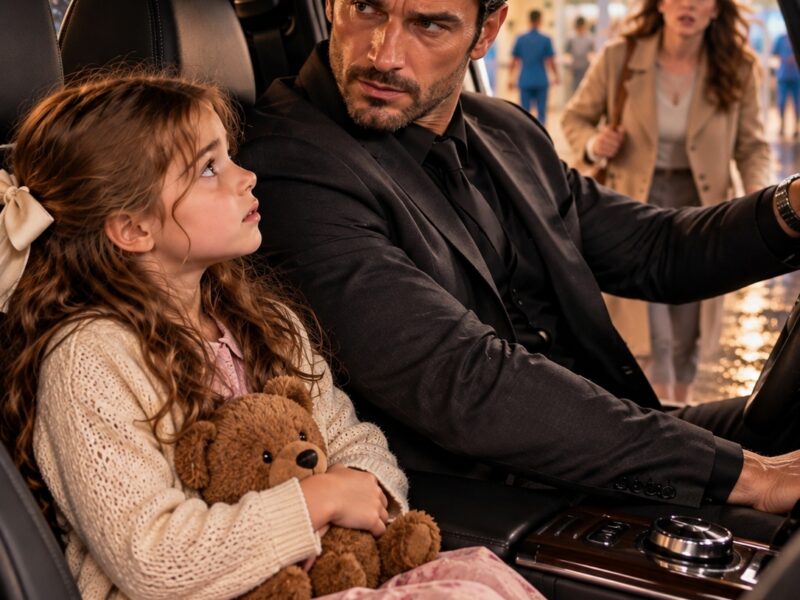
“Please Take Us Home,” A Little Girl Climbed Into the Wrong Black Sedan and Asked a Feared Crime Boss for a Ride Home—Then He Recognized Her Mother’s Address
The little girl opened the passenger door of the black sedan and said, “Please take us home, sir. My mom’s had a really long day.”
Two men in dark coats moved at once, but the driver raised one hand—and everyone around the hospital entrance stopped as if they had been trained to obey him.
Then he saw the name printed on the woman’s canvas bag and realized he had signed a document that morning threatening the one place her daughter considered safe.
Rain hissed against the curb outside St. Catherine’s Medical Center in Newark, turning the patient pickup lane into a sheet of black glass.
Eight-year-old Willa Parker stood with one sneaker on the curb and one foot inside the open door of a charcoal sedan, clutching the edges of her cream cardigan together beneath her chin.
“Please take us home, sir,” she repeated. “My mom’s had a really long day.”
For half a second, nobody moved.
Then two men near the rear of the sedan reacted at once.
One started toward the door.
The other, Caleb Ross, said one word.
“Matteo.”
The man behind the wheel raised his hand.
Both stopped.
Matteo Caruso was forty-three, broad through the shoulders, dressed in a charcoal suit that had been on his body since six that morning. Rain darkened the pavement beyond the windshield, and the dashboard lights cut hard planes across a face that people in Newark’s quieter rooms recognized before he ever introduced himself.
Willa did not recognize him.
She was looking at his hand instead.
“Did you forget dinner?”
Matteo glanced down.
His fingers were trembling slightly against the steering wheel.
Not enough for most adults to notice.
Enough for a child.
“Maybe.”
“My grandma says people get cranky when they don’t eat.”
A woman’s voice cut through the rain.
“Willa.”
Hannah Parker hurried from the hospital doors with a canvas tote slipping from one shoulder and a pharmacy bag tucked beneath her arm. Her phone was still lit in her hand, the rideshare app open across the screen.
She reached her daughter, pulled her gently but firmly back onto the sidewalk, and checked Willa’s face and arms before she looked at the man in the car.
“You okay?”
“Yes.”
“Did the car move?”
“No.”
“You never open a car door until I check the plate.”
“I know.”
“Never.”
Willa’s mouth tightened.
“Even if it looks right.”
“I said I know.”
Hannah exhaled through her nose, then turned toward Matteo.
“I’m sorry. She thought this was our ride.”
“No harm done.”
His voice was quieter than she expected.
Then she noticed Caleb’s earpiece.
The second dark SUV.
The two men who had moved without being told.
Her eyes returned to Matteo.
Recognition arrived slowly.
Not personal recognition.
Reputation.
Caruso.
The name connected to freight yards, property holdings, restaurants, trucking companies, political fundraisers, and the kind of stories people repeated without ever saying which parts they had actually seen.
Hannah did not step back.
That interested him.
She reached for the passenger door.
“Thank you.”
“Your car.”
Matteo nodded toward a gray sedan pulling toward the marked pickup space.
“Plate ends in four-six-two.”
Hannah checked her phone.
Then the approaching plate.
Matched.
“Thank you.”
“He didn’t eat dinner,” Willa told her.
“Willa.”
“I was helping.”
Something shifted near the corner of Matteo’s mouth.
Almost a smile.
He stopped it before it fully arrived.
Hannah collected her mother, Evelyn, from the bench beneath the canopy. Evelyn was seventy-two and moving carefully after a minor fall in her kitchen that had frightened everyone more than it injured her.
Willa climbed into the correct car.
Hannah checked the driver’s name.
Then the plate again.
Only after she was satisfied did she get in.
The sedan disappeared into ordinary Newark traffic.
Caleb approached Matteo’s window.
“You want me to find out who they are?”
“No.”
“She recognized you.”
“The mother did.”
“The kid didn’t.”
Matteo looked toward the intersection where their taillights had vanished.
“Leave them alone.”
Caleb nodded.
He knew when not to repeat a question.
Matteo reached into his center console.
A bottle of water.
Crackers.
His assistant had left them there two days earlier.
He ate two.
The trembling eased.
He hated that the girl had been right.
Then something returned to him.
White lettering across Hannah’s canvas tote.
HARBOR HOUSE COMMUNITY CENTER.
Below the words was a child’s drawing of a brick building with bright yellow windows.
He had seen that name less than twelve hours earlier.
On the ninth floor of Caruso Property Holdings, his cousin Silas had placed a redevelopment packet on the table.
Commercial properties.
Lease expirations.
Vacancy estimates.
Projected returns.
One property on Newark’s west side was partially occupied by a nonprofit after-school program.
Harbor House.
Matteo had signed beneath a recommendation authorizing preparation for non-renewal when the lease expired in March.
He had not read the program description.
He had read the projected increase in property value.
Now the child who had opened his car door because she needed a ride home had carried the building’s name on a canvas bag.
Matteo stared through the windshield.
For the first time that day, the signature felt heavier than the paper it sat on.
At Hannah’s apartment, Willa changed into pajamas while Hannah made tea for Evelyn.
The apartment was small, warm, and crowded with evidence of actual life.
A line of school drawings on the refrigerator.
Three grocery coupons held under a magnet shaped like a tomato.
Ethan Parker’s old boots still pushed into the bottom of the hall closet three years after his death because Hannah had never found a correct moment to decide whether grief had an expiration date.
Evelyn sat at the kitchen table with an ice pack against her hip.
“That man had a very serious face,” Willa said from the doorway.
“He did.”
“Who tells him to eat?”
Evelyn laughed.
“That is an excellent question.”
“Not your job,” Hannah said.
She set down tea.
“Your job is to wait beside me when we call a car.”
“I will.”
“Promise.”
“I promise.”
Willa climbed into the chair beside her grandmother.
“He wasn’t mean.”
“I’m glad.”
“He looked tired.”
“Polite doesn’t mean safe.”
Hannah crouched in front of her.
“And tired doesn’t mean someone needs you to fix them.”
Willa considered this with the solemnity children reserve for rules they are not sure adults obey themselves.
“Okay.”
“Grandma’s going to be fine.”
“I heard that,” Evelyn said.
“And tomorrow she gets to boss both of us from the couch.”
“I heard that too.”
Across the city, Matteo sat alone in his office after ten.
Caruso Property Holdings occupied three floors of a riverfront building that used to store machine parts. The old freight elevator still groaned between floors even though the executive level had marble counters and glass conference rooms now.
Matteo called Silas.
“The Harbor House property.”
A pause.
“What about it?”
“What happens to the program?”
“They relocate.”
“To where?”
“I don’t know.”
“You signed off on relocation assistance.”
“That wasn’t my question.”
Silas’s voice remained smooth.
Silas Caruso was forty-seven, thin, immaculate, and talented at making ugly decisions sound administrative.
“Matteo, it’s commercial real estate.”
“How many families use it?”
“I’ll have someone send you the enrollment.”
“You don’t know?”
“No.”
“And I signed this anyway.”
“You approved a portfolio strategy.”
Matteo leaned back.
“Send me the file.”
Silas exhaled.
“You met somebody.”
Matteo’s face went still.
“What?”
“You don’t ask who uses a building unless someone put a face inside it.”
“Send me the file.”
“Of course.”
The call ended.
Silas sat behind a different desk three floors below.
He opened his locked drawer.
Inside lay two folders.
One contained the Harbor House lease.
The other contained a preliminary purchase option through a shell company linked indirectly to Northline Facility Services.
Northline maintained several Caruso buildings.
Officially, Silas had nothing to do with Northline beyond vendor oversight.
Unofficially, he had been moving money through it for years.
Harbor House was valuable because the lot sat near a planned transit improvement.
Vacant space would sell for more.
Much more.
The nonprofit complicated everything.
Silas closed the drawer.
For the first time in years, Matteo had asked a question that could not be answered with profit.
On Monday morning, Hannah received the lease letter.
No threats.
No eviction notice.
Just language polished until it almost sounded considerate.
Caruso Property Holdings did not presently intend to offer renewal beyond March 31.
Relocation assistance could be discussed.
Hannah read it twice.
Then she opened a legal pad.
Harbor House served sixty-two children.
Homework support.
After-school meals.
Supervised pickup.
Sliding-scale fees.
Two buses.
Four part-time instructors.
Three full-time staff.
One nurse twice a week.
Most parents did not use Harbor House because they wanted enrichment.
They used it because work did not end at three.
By three that afternoon, Hannah had called their board chair, nonprofit counsel Morgan Ellis, and two neighborhood organizations.
At four, Denise Alvarez appeared at Hannah’s office door wearing the navy vest from the grocery store where she worked.
“Is it true?”
“We have a lease until March.”
“That’s not what I asked.”
Hannah stopped.
“No. They are not closing us tomorrow.”
Denise’s shoulders lowered slightly.
“They’re saying they might not renew.”
“Yes.”
“My shift ends at five-thirty.”
“I know.”
“My son’s here until six.”
“I know.”
“I can’t tell my boss I suddenly need to leave at three every day.”
“I know.”
Denise looked toward the homework room.
“What do I do?”
That was the question Hannah hated most.
Not because she did not care.
Because caring did not create another licensed facility.
“Right now, nothing changes.”
“And March?”
“We’re going to fight for a workable option.”
“Fight who?”
Hannah looked at the letter.
The signature block at the bottom listed a corporate representative.
But above everything, in the company name, was a surname she now knew.
Caruso.
That evening Willa sat at the kitchen table coloring a building.
Harbor House.
Every window yellow.
“Are we moving?”
“Maybe some classes.”
“Why?”
“Because grown-ups are arguing about the building.”
“Did the dinner man do it?”
Hannah stopped folding laundry.
“What?”
“The man at the hospital.”
“His company owns it.”
“So he did.”
“Partly.”
Willa frowned.
“That means yes.”
“No.”
Hannah sat beside her.
“It means grown-up choices usually have more than one person inside them.”
“Did he sign something?”
Children are frighteningly direct.
“Yes.”
“Then that’s a choice.”
Hannah looked at her daughter.
Ethan would have smiled.
Willa had inherited his habit of walking straight into the center of a question.
“Yes.”
“He made a choice.”
Willa colored another window.
“Maybe he was hungry.”
Hannah laughed despite herself.
Four days later, Harbor House held a community meeting.
The multipurpose room smelled like coffee, crayons, and the tomato sauce from that afternoon’s snack.
Parents filled folding chairs.
Morgan sat beside Hannah with a yellow folder.
Silas arrived first.
Gray suit.
Narrow smile.
Then Matteo entered.
Conversations softened.
One father looked toward the door.
Another parent pulled her child’s coat from the chair beside her as if she expected someone important to need the seat.
Matteo noticed.
He always noticed fear.
He had spent twenty years manufacturing it.
Hannah recognized him immediately.
So did he.
Neither mentioned the hospital.
Silas spoke first.
“Caruso Property Holdings understands Harbor House’s importance.”
Hannah wrote the sentence down.
Not because she believed it.
Because she wanted to remember exactly how it had been said.
“We’re prepared to offer a substantial relocation payment.”
“How substantial?” Morgan asked.
Silas gave the number.
Several parents reacted.
It was more money than Harbor House had in reserves.
Enough to sound generous.
Not enough to create a new center.
Hannah raised her hand.
Silas smiled.
“Ms. Parker.”
“How many licensed facilities within three miles have room for sixty-two children?”
“We’re not a placement service.”
“Then what does the relocation money relocate?”
A few parents murmured.
Silas’s smile thinned.
“It gives your organization flexibility.”
“That’s not an answer.”
“Business decisions are not always comfortable.”
“No.”
Hannah kept her voice calm.
“But uncomfortable and unworkable aren’t the same thing.”
Matteo watched her.
She did not look at him for rescue.
That mattered more than if she had.
“What do you need first?” he asked.
Silas turned.
Hannah hesitated.
“Complete building maintenance records.”
“What does that have to do with lease renewal?”
Morgan answered.
“We have unresolved electrical complaints.”
Silas opened his folder.
“The site passed inspection.”
“Then we want the reports,” Hannah said.
Matteo looked at Silas.
“Give them the reports.”
Silas’s jaw moved once.
“Of course.”
“Independent review too.”
Hannah looked at Matteo.
“You’re agreeing to that?”
“I’m ordering it.”
She held his gaze.
“Those aren’t the same thing.”
The room went still.
Something almost amused appeared in his eyes.
“No.”
He corrected himself.
“I’ll authorize an independent review with your board represented in the scope.”
Morgan nodded.
“That works.”
Before the meeting ended, Hannah asked what she had been waiting to ask.
“Mr. Caruso.”
“Yes?”
“Did you personally authorize putting Harbor House on the non-renewal list?”
Silas looked at him.
Matteo answered.
“I authorized a property review in September and preparation of a non-renewal option in October.”
“So yes.”
“Yes.”
The honesty hurt more than a lie would have.
Hannah nodded.
“Thank you.”
He understood the thank-you was not forgiveness.
Afterward, Willa came from the supervised classroom.
She saw Matteo.
“You’re the dinner man.”
Hannah closed her eyes.
“Willa.”
“What?”
“Mr. Caruso.”
Matteo crouched slightly but stayed several feet away.
“I ate dinner that night.”
“Good.”
She held up her drawing.
Harbor House.
Yellow windows.
“This is where I go.”
“I know.”
“I made the windows bright.”
“I can see that.”
“So people know where home is.”
Matteo looked at the drawing.
Something in his chest shifted unpleasantly.
He had spent most of his adult life believing buildings mattered because they could be owned.
The child was telling him they mattered because people knew where to go.
Outside, Silas caught up with him.
“You undermined me.”
“I authorized an inspection.”
“You did it publicly.”
“The tenant had a right to hear it.”
“Since when?”
Matteo looked toward the doors.
“Since I realized we were making decisions about rooms we’ve never entered.”
Silas laughed once.
“Careful.”
“Of what?”
“Becoming sentimental.”
“I’m becoming informed.”
“That’s worse.”
Silas walked away.
That night he met Rocco Bellini above a freight warehouse.
Rocco was sixty-two and had spent thirty years making logistics problems disappear before they became official problems.
“He’s letting parents question him now?” Rocco asked.
“He invited it.”
“That won’t last.”
“He ordered an outside audit.”
Rocco stopped drinking coffee.
“What exactly are they auditing?”
“Maintenance.”
“Make sure they audit maintenance.”
Silas looked toward the dark warehouse windows.
“And nothing else.”
The independent engineer arrived the next morning.
At Harbor House, he opened a breaker panel.
A work order said the assembly had been replaced in August.
The manufacturer’s plate said otherwise.
So did worn fittings.
He photographed everything.
Asked for the original invoice.
By afternoon, Hannah had the preliminary note.
So did Matteo.
He read it twice.
Someone had billed his company for electrical work that had apparently not been done.
The room on the other side of that wall held children every weekday.
He called Caleb.
“Get a maintenance crew in tonight.”
Caleb did not move.
“Engineer restricted the area.”
“Pay more.”
“It’s not about money.”
The sentence irritated Matteo.
He looked up.
Caleb had worked beside him for twelve years.
Former corrections officer.
Patient.
Unimpressed by money.
“What?”
“There needs to be a documented repair scope, permit if required, inspection, then reopening.”
“Fine.”
“You were about to tell people to ignore that.”
Matteo stared.
Caleb stared back.
Ten years earlier, almost nobody would have.
Matteo looked at the report.
“Cancel the order.”
Caleb nodded.
“Do it properly.”
“That I can do.”
Harbor House lost access to a rear classroom two days later.
Then half a hallway.
Hannah closed the doors before children arrived.
No smoke.
No dramatic failure.
Just an engineer telling them the wiring had been running too hot.
Safety created chaos anyway.
Art moved to the multipurpose room.
Pickup schedules changed.
Parents scrambled.
Denise stood near Hannah’s desk almost crying.
“I’m going to lose my job.”
“We’re trying the library.”
“Trying.”
“Yes.”
“You can’t promise anything.”
“No.”
Denise looked hurt.
Hannah hated that.
But she had learned something from widowhood.
False certainty was only kindness for the person saying it.
“I can promise I will call when I know.”
Denise nodded slowly.
“Okay.”
Later, Hannah sat alone for ninety seconds with her eyes closed.
Then called the library again.
Matteo visited during a scheduled inspection update.
Without Silas.
Willa was sorting markers on the floor.
Matteo moved an art board out of the path of a rolling cart.
“That’s ours,” Willa said.
He stopped.
“I’m moving it so nobody hits it.”
“Miss June put it there.”
Matteo looked toward June.
The teacher smiled.
“A few inches is fine.”
He moved it exactly that far.
Willa inspected.
Then nodded.
“Okay.”
Small moment.
Ridiculous moment.
But Matteo thought about it in the car.
Permission.
Three inches.
Ask first.
He had spent his life assuming efficiency excused permission.
The child had corrected him in six seconds.
A week later, he told Hannah he would help move storage boxes after closing.
At five-thirty, Rocco called an emergency meeting at the freight depot.
Three contracts threatened.
Two drivers threatening to walk.
One shipment issue.
Matteo put his phone face down.
When he looked again, it was 6:20.
At Harbor House, the boxes were already moved.
Willa had asked Hannah once:
“Did he get lost?”
“No.”
“Did he forget?”
“I don’t know.”
She had carried the smallest box herself.
The next afternoon Matteo arrived.
“I said I’d come.”
Willa looked up.
“I remember.”
“I didn’t.”
“You forgot?”
“Yes.”
“Miss June says grown-ups forget.”
“She’s right.”
“You should call.”
“I should have.”
There were two boxes left.
Willa pointed.
“That one is heavy.”
Matteo carried it.
No gift.
No excuse.
No promise that his work was important.
Just the box.
Hannah watched from the supply closet.
Something in her softened despite her intentions.
Later, in the parking lot, she said:
“You looked more nervous apologizing to her than you did facing sixty angry parents.”
“They were not eight.”
She laughed.
He looked at her as if he had discovered a new sound.
They walked slowly.
“My sister has a boy,” Matteo said.
Hannah glanced over.
“Your sister?”
“Lucia.”
“You never mentioned her.”
“We don’t speak.”
“Why?”
He looked toward Caleb waiting beside the car.
“Because I tried to protect her.”
“That sounds like a strange reason not to speak.”
“It became one.”
He told her.
In 2020, someone connected to the freight side of his organization made a threat.
Nothing direct against Lucia.
Enough to frighten him.
So he placed men near her apartment.
Her son’s school.
Her errands.
Without asking.
Lucia found out.
She said his protection felt like surveillance.
She left Newark.
Changed routines.
Stopped answering him.
“You thought you were keeping them safe,” Hannah said.
“Yes.”
“Were they in danger?”
“Maybe.”
“That’s not what I asked.”
Matteo looked at her.
“No proof.”
Hannah buttoned her coat.
“That matters.”
“I know now.”
“Do you?”
He did not answer quickly.
That was the first thing she respected.
They met for coffee after the next board meeting.
Public café.
Busy street.
No security at the table.
Matteo studied the menu.
“It’s apple pie,” Hannah said.
“I’m considering the risk.”
“Of pie?”
“Of ordering it and having you judge me.”
“I already judge you.”
“Then the risk is confirmed.”
She smiled.
He ordered one slice.
Two forks.
For forty minutes nobody asked him to solve freight, property, or family.
Hannah told him about Ethan.
Her husband.
Willa’s father.
Kind.
Bad singer.
Excellent at calling when late.
He had died after a fast illness.
Hannah spoke without making Ethan smaller to make room for Matteo.
Matteo respected that.
“I’m not looking for a replacement father,” she said.
“I wouldn’t know how to be one.”
“Good.”
He looked surprised.
“I’d worry if you thought you did.”
“What are you looking for?”
“I’m not sure I’m looking.”
He nodded.
She appreciated that he did not turn the moment into a declaration.
Then she asked:
“If Lucia were in danger tomorrow, would you send people again?”
Matteo stared into his coffee.
“I want to say no.”
“But?”
“I’m not sure I’d know how to sit still.”
“That’s honest.”
“Not flattering.”
“I didn’t ask for flattering.”
The attraction sat between them.
Real.
Inconvenient.
Unfinished.
Three days later, Rocco and Silas confronted Matteo in his office.
“The Northline review ends.”
“No.”
“Open those invoices and they ask about transportation next.”
“Let them.”
Rocco pushed a folder across the desk.
Three supervisors threatening to resign.
“You can order them to stay.”
Matteo looked at the signatures.
Once, fear would have solved this.
He knew who owed money.
Who had mistresses.
Who had sons with bad habits.
He knew exactly which pressure points could produce loyalty.
He closed the folder.
“I’m not threatening them.”
Rocco stared.
“You used to understand how leadership works.”
“I understand how silence works.”
Silas leaned back.
“Harbor House changed you.”
“No.”
Matteo’s voice stayed low.
“It showed me something.”
“What?”
“That I’ve been calling obedience loyalty.”
Rocco stood.
“Keep talking like that and one day nobody moves when you give an order.”
Matteo met his eyes.
“Then that’s the price.”
Rocco walked out.
Silas stayed.
“You really think they’ll forgive you because you save a daycare?”
“It isn’t a daycare.”
“That’s your answer?”
“My answer is I’m not stopping the audit.”
Silas smiled.
“You should.”
“Why?”
“Because you signed more than you remember.”
That landed.
Silas left.
In his office downstairs, he opened the October approval packet.
Matteo’s signature.
A property valuation page.
Projected increase if Harbor House became vacant.
Matteo had seen it.
Briefly.
Signed anyway.
Silas did not need a forged document.
Only timing.
In early January, copies of the approval packet began appearing in parents’ inboxes.
Anonymous message:
Ask your program director what her new friend knew before he offered to help.
Hannah received it between pickup messages.
She opened the attachment.
Matteo’s signature.
Vacant-space valuation.
Commercial redevelopment.
She felt the room go cold.
He had told the November meeting he authorized a review and preparation for possible non-renewal.
He had not said he already knew their absence increased the property’s value.
The difference mattered.
Not legally, maybe.
Personally.
Absolutely.
Morgan verified the visible pages appeared genuine.
Hannah asked Matteo to meet at Harbor House.
Empty office.
Cold radiator.
No children present.
She placed the page in front of him.
“Did you see this?”
He looked.
“Yes.”
Her face changed.
“You knew.”
“I saw the estimate.”
“And signed.”
“Yes.”
“You told us you authorized preparation.”
“I did.”
“You didn’t tell me you knew how profitable empty classrooms would be.”
He closed his eyes briefly.
“No.”
“Why?”
“I treated it like a number.”
Hannah laughed once.
Not kindly.
“A number.”
“I know how that sounds.”
“No, I don’t think you do.”
He waited.
“Parents are asking whether I went soft because you bought me coffee.”
“I never asked you to hide anything.”
“You didn’t have to.”
Her voice stayed low.
“I liked you.”
Matteo said nothing.
“That matters because it changed how carefully I looked at you.”
“I understand.”
“No.”
She shook her head.
“You understand now.”
That hurt.
Because it was true.
At the next parent meeting, Hannah entered every private contact with Matteo into the board record.
Coffee.
Conversations.
Inspection updates.
Everything relevant.
Then she asked Morgan to take over property negotiations.
One parent accused her of becoming too friendly with the landlord.
Hannah did not defend her pride.
“My judgment became personal.”
Silence.
“So Morgan handles the lease.”
That night, Matteo learned what she had done from his attorney.
Not from Hannah.
For the first time, he understood the cost of being associated with him.
Silas used the opening.
Peter, the facilities supervisor who had refused to backdate a completion acknowledgment, lost his scheduled hours.
A man appeared outside an adult staff meeting photographing attendees.
Morgan told everyone to document anything unusual and report it.
Caleb briefed Matteo.
“Pressure on witnesses.”
“Any threat to Hannah?”
“Nothing specific.”
“Willa?”
“No.”
Matteo’s mind moved backward.
Lucia.
Her son.
School.
Fear.
“I want Willa’s pickup schedule.”
Caleb’s expression hardened.
“No.”
Matteo looked at him.
“What?”
“You have no evidence anybody is after the kid.”
“I want precautions.”
“Then ask Hannah.”
“I know what she’ll say.”
“Then there’s your answer.”
Matteo ignored him.
That was the mistake.
He told a junior security coordinator to make a quiet inquiry at Willa’s school.
Just dismissal time.
Approved pickup adults.
The coordinator entered the school office and asked questions no stranger had any right to ask.
The administrator refused.
Documented his name.
Called Hannah.
Hannah sat in the school office with both hands trembling.
Willa was down the hall reading a chapter book.
Safe.
Ordinary.
Unaware.
The next morning Hannah met Matteo in a busy café.
“Why did someone from your security team go to my daughter’s school?”
He did not lie.
“I told them to.”
“Did you ask me?”
“No.”
“Was Willa threatened?”
“No.”
“Was I?”
“Not directly.”
She leaned back.
“Then why?”
“People are pressuring witnesses.”
“Adult witnesses.”
“Yes.”
“And because you were afraid, you sent a strange man to ask a school when my daughter leaves.”
He had rehearsed explanations.
They sounded grotesque now.
“I wanted her protected.”
“You made her school call me because a man connected to Matteo Caruso was asking about her schedule.”
Her eyes shone.
Not with fear.
Fury.
“Do you understand what that phone call felt like?”
He did.
Because suddenly he could see himself through the office secretary’s eyes.
Not protector.
Threat.
“I lost Ethan.”
Hannah’s voice changed.
“Willa already lost her father.”
“I know.”
“No. You know the fact.”
She swallowed.
“You do not know what it was like explaining to a five-year-old that Daddy wasn’t coming back.”
Matteo stayed still.
“I will not let another man enter her life and decide rules because he’s afraid and powerful enough to make people move.”
“You’re right.”
“I don’t need you to say that here and forget it when you panic outside.”
That was exactly what he had done.
He looked down.
“You won’t have to see me again.”
She flinched.
He continued.
“No contact with Willa. No private security inquiries. Nothing around your home or school unless you request it through counsel.”
“I want it in writing.”
“You’ll have it.”
Hannah stood.
Something in her face hurt him more than anger.
Grief.
Not for something they had.
For something they might have.
She left.
That afternoon, Willa asked:
“Can we go home now?”
“Yes.”
Hannah took her hand.
They walked three blocks.
Bakery.
Pharmacy.
Apartment.
Ethan’s boots in the closet.
Home was small.
Imperfect.
But it was theirs.
Days later Willa took an unfinished drawing from her school folder.
Three people outside a house.
Two yellow windows.
One blank.
“Can we put this away?”
“Of course.”
“It makes me miss him.”
Hannah looked at the tall figure with long arms and a dark coat.
She did not ask Willa to erase him.
They folded the drawing.
Put it in a drawer.
Matteo received the written restriction.
He signed acknowledgment.
Canceled all informal inquiries.
Ordered Caleb to report any violation.
Then he typed a message to Hannah.
I need to explain—
Deleted.
Caleb found him near the warehouse window.
“You don’t get to call it protection when she tells you not to do it.”
“I know.”
“Then make knowing worth something.”
Matteo went home.
Sat at his kitchen table.
Wrote a letter to Lucia.
One page.
No excuses.
No request to see Owen.
No request for forgiveness.
Only:
I was wrong to track you.
Fear did not give me permission.
I will not seek information you do not choose to give me.
He mailed it.
February was brutal.
Snow turned gray against curbs.
Harbor House operated from safe front rooms and library space.
Hannah carried two sets of keys.
Two pickup schedules.
Two emergency-contact binders.
Nothing about their survival looked cinematic.
Parents volunteered.
Staff drove boxes.
A librarian adjusted closing time.
Denise’s supervisor moved her to an earlier shift after Hannah wrote a schedule-impact letter.
“You can’t fix everything,” Denise told her.
“I’m aware.”
“But you keep telling us what’s true.”
Hannah smiled.
“Sometimes that’s all I have.”
At Caruso headquarters, the audit deepened.
Northline invoices.
Missing work.
Connected shell companies.
Then the real problem.
A buyer interested in Harbor House shared financial ties with Silas.
Matteo’s attorney placed the file on the table.
“If we disclose everything, the review may reach freight contracts.”
Matteo looked at the names.
Some transactions were legitimate.
Some were gray.
Some were not.
Orders he had approved.
Years when he chose not to ask.
“What happens if we don’t?”
“We protect ourselves temporarily.”
“And Silas?”
“He keeps leverage.”
“Harbor House?”
“Uncertain.”
His attorney leaned closer.
“I need instructions you will not change when they hurt.”
Matteo thought of Hannah.
Then Lucia.
Then Willa’s school.
“Preserve everything.”
“All records?”
“Yes.”
“Even logistics?”
“Yes.”
“This may not protect you.”
“I know.”
The reaction was immediate.
Rocco called a meeting.
Veteran men around a long table.
“You’re giving outsiders our books.”
“I’m following counsel.”
“You are giving them a map.”
“I’m not ordering records buried.”
A supervisor spoke.
“Maybe the family needs another man.”
Five years earlier Matteo would have ended the room with one sentence.
Now he asked:
“Do you believe that?”
The man looked surprised.
“Yes.”
“Then you may have to choose one.”
Rocco stood.
Two followed.
Another put company keys on the table.
Matteo knew exactly how to stop them.
Threat.
Debt.
Fear.
He said nothing.
Cars left the lot.
Caleb stood beside him at the window.
“You okay?”
“No.”
Caleb nodded.
“Good answer.”
A week later Morgan sent Hannah a message through the agreed professional channel.
Matteo would like fifteen minutes to apologize in person.
No property discussion.
No expectation.
Hannah waited three days.
Then agreed.
Public café.
Daylight.
Fifteen minutes.
He arrived alone.
Sat where she could see the entrance.
“I was wrong to send someone to Willa’s school.”
Hannah said nothing.
“I was wrong not to tell you the full scope of the packet I signed.”
Nothing.
“And I was wrong to think fear gave me authority over you.”
She looked at the tea between her hands.
“I stopped the inquiries.”
“I know.”
“I preserved the records.”
“I know.”
“I’m cooperating with counsel.”
“I know.”
He waited.
Then Hannah asked:
“Do you know the worst part?”
“No.”
“I liked you.”
He looked down.
“I liked the man who apologized to an eight-year-old because he missed carrying boxes.”
Matteo’s jaw tightened.
“I liked the man who listened when I talked about Ethan.”
She exhaled.
“Then you did exactly what you told me drove Lucia away.”
“I did.”
“Willa drew you into a picture.”
His eyes lifted.
“She put you outside a house with us.”
He said nothing.
“She folded it up because looking at it made her miss you.”
Pain moved across his face.
Hannah watched it.
Did not rescue him from it.
“I won’t ask to see it.”
“Good.”
“I won’t ask to see her.”
“Good.”
Their fifteen minutes nearly ended.
Hannah looked at the clock.
“One question.”
“Yes.”
“If Willa and I never come back into your life, do you still turn over the records?”
Matteo could have answered instantly.
A polished man would have.
He waited because the truth deserved space.
“Yes.”
“Why?”
“Because I should have done it before I met you.”
Something in Hannah softened.
Not forgiveness.
Not yet.
But belief.
She stood.
“Time.”
Matteo stood too.
No touch.
No kiss.
No promise.
She walked out.
He stayed until the door closed behind her.
That evening, an email arrived from Lucia.
Two sentences.
I read your letter.
I need time.
Matteo read them twice.
He wrote no reply.
Waiting felt terrible.
He let it.
March brought another deadline.
Harbor House’s lease expired March 31.
Morgan negotiated a ninety-day extension with Caruso’s newly authorized representatives.
Safe rooms only.
Repairs documented.
Independent inspection.
No side agreements.
Matteo read every page this time.
Every line.
Every attached exhibit.
Caleb watched from the doorway.
“You’re reading the appendix?”
“Yes.”
“That’s growth.”
“Leave.”
“Absolutely.”
The extension was signed.
Parents exhaled.
Hannah did not call it victory.
“Monday operates normally in the approved rooms.”
That was what people needed.
Not speeches.
April first brought a new problem.
Silas’s hidden buyer exercised its purchase option.
Financing confirmation due April fifth.
If the sale closed, long-term Harbor House occupancy became uncertain again.
Silas intercepted Matteo beneath an old photograph of their fathers.
“Withdraw the disclosures.”
“No.”
“You’ll lose the company.”
“Parts of it.”
“You’ll lose the docks.”
“Maybe.”
“You’ll lose men who made your name mean something.”
Matteo looked at the photograph.
“I know.”
“All for a school room.”
“No.”
He faced Silas.
“I stopped pretending I could keep everything.”
Silas’s expression hardened.
“If those records go out, questions reach you too.”
“Yes.”
“You signed things.”
“Yes.”
“You approved shipments.”
“Yes.”
“You think that woman will love you when she hears every ugly thing?”
Matteo’s face went still.
“This isn’t for her.”
Silas laughed.
“That’s the first lie you’ve told well.”
Matteo stepped closer.
“No.”
His voice dropped.
“The lie was thinking I could fix what I’d done only if someone rewarded me.”
He walked away.
The records were produced.
The buyer’s lender reviewed disclosed related-party interests.
Silas’s financial connection became a problem.
Funding confirmation did not arrive by the deadline.
The sale did not close on schedule.
Lawyers entered standstill negotiations.
Litigation threatened.
Nothing magical happened.
Harbor House was simply still standing when the week ended.
Silas called once.
“You surrendered everything for a daycare.”
Matteo looked at the freight yard from an office that no longer fully belonged to him.
“No.”
“What then?”
“I surrendered the part I should never have had.”
He hung up.
At an April community meeting, Matteo sat midway down the table.
Not at the head.
A father stood.
“Why should we trust you?”
Matteo did not look toward Hannah.
“You shouldn’t trust my word.”
The room quieted.
“I signed the property review.”
A few parents shifted.
“I approved preparation for non-renewal.”
More silence.
“I saw financial estimates that valued the property higher without Harbor House and treated them like numbers.”
Hannah watched.
“I failed to make sure maintenance work was done. Those failures are mine.”
The father folded his arms.
“And what stops you changing your mind?”
Matteo nodded toward Morgan.
“The lease.”
Then toward the engineer.
“The inspections.”
Then the board.
“The people who don’t answer to me.”
He paused.
“My word should not be what keeps your children here.”
Nobody applauded.
Matteo seemed relieved.
At the library, Willa drew a new Harbor House.
Three windows.
Different sizes.
Blue door.
Huge yellow light spilling onto the sidewalk.
Evelyn leaned over.
“That’s a lot of yellow.”
“So people can find it.”
Near the end of April, Hannah saw Matteo leaving another formal meeting.
Alone.
No cluster of men.
He passed the front desk without asking about Willa.
Without trying to catch Hannah privately.
“Matteo.”
He turned.
She had not called him by his first name before.
“When the center reopens fully, you can come.”
He stared.
“As a guest.”
“Only if you want me there.”
“I’ll tell you the date.”
“If Willa sees me—”
“I’ll be there.”
“Of course.”
Small invitation.
Hers.
That evening Matteo received another email from Lucia.
I still need time.
But I am not asking you never to write again.
He sat with that for ten minutes.
Then wrote:
Whenever you are ready.
Nothing else.
May came warmer.
Hannah proposed a short meeting in a public garden.
Evelyn and Willa present.
Matteo arrived on time.
Stayed forty-five minutes.
Willa showed him a drawing of a dog she wanted.
“You never had a dog?”
“No.”
“Not ever?”
“No.”
“What did you have?”
“Work.”
“That’s sad.”
Evelyn laughed.
Matteo did too.
Another week, a legal appointment threatened to make him late.
He called beforehand.
“I won’t make the agreed time.”
Hannah waited.
“I’m sorry.”
“No problem.”
“I can come afterward.”
“No.”
The old Matteo would have solved.
Rearranged.
Sent a car.
Created a new time by force of logistics.
Instead:
“Okay.”
“Next week.”
“Next week.”
Willa was disappointed.
Then recovered.
Children do that when adults do not turn every disappointment into abandonment.
The following week, Hannah sat beside Matteo outside a café.
Willa was with Evelyn.
“I can’t promise this will be easy.”
“Neither can I.”
“If something in your life could affect mine or Willa’s, I need to know.”
“Yes.”
“I need to be able to say no after saying yes to something else.”
“Yes.”
“I need you not to interpret fear as permission.”
Matteo looked at her.
“I know.”
“Don’t say that unless you mean what comes after it.”
He nodded.
“I mean it.”
She watched him.
“I want to try.”
He did not move.
“With me?”
“Yes.”
“Why?”
“Not because you helped Harbor House.”
He listened.
“Not because you lost money.”
He waited.
“Because I watched what you did when you thought we might never speak again.”
Something shifted in his face.
Hannah continued.
“You kept doing it.”
Matteo slowly turned one hand palm up on the bench.
Did not reach.
Did not take.
Offered.
Hannah chose to put her hand into his.
His exhale was almost silent.
At home, Willa opened the old folded drawing.
Three people.
House.
Third window blank.
She found a yellow pencil.
Colored it carefully.
Hannah saw her.
“You finishing that?”
“The light.”
“Want to take it to the exhibition?”
Willa considered.
“No.”
“Why?”
“This one can stay here.”
Hannah nodded.
The picture went back into the folder.
By early June, Harbor House signed a longer-term lease with independent safety oversight.
The disputed purchase option remained tied up.
But the center’s future no longer depended on whether Matteo liked Hannah.
That distinction mattered more than any romantic gesture.
On June nineteenth, Harbor House reopened the repaired rooms.
Parents brought cookies.
Staff hung children’s art.
Evelyn carried a cake box like it contained state secrets.
Matteo arrived as invited.
Navy jacket.
No security circle.
He checked in at the front.
Waited until Hannah came.
Willa spotted him.
“Mr. Caruso.”
She pulled him toward the art display.
“Look.”
Her newest painting showed Harbor House glowing.
Long yellow beam from the door.
Tiny figures walking toward it.
“I can see where everyone is going,” Matteo said.
“That’s the point.”
She looked at him.
“Did you eat today?”
“I did.”
“Good.”
Hannah laughed.
“You can stay for cake.”
Matteo looked at her.
“If that’s all right.”
“It is.”
At sunset they walked into the parking lot.
Hannah held Willa’s hand.
Matteo’s black sedan waited several rows away.
No convoy.
No men standing around it.
Willa recognized the car immediately.
“That’s the one.”
“It is.”
“The wrong car.”
“Yes.”
“I won’t open it again.”
“Good plan.”
“Mom checks the plate now.”
“Excellent plan.”
They stopped beside Hannah’s car.
Matteo was about to say goodbye.
Willa looked from him to her mother.
“Mom?”
“Yes?”
“Can Matteo come home with us?”
Matteo went completely still.
He did not smile at Willa.
Did not crouch.
Did not make a joke.
He looked only at Hannah.
The answer was not his.
Hannah watched him understand that.
Then she looked at Willa.
“Yes, sweetheart.”
Matteo’s voice was quiet.
“Are you sure?”
“Dinner.”
A faint smile touched her mouth.
“You’ll have to survive Evelyn’s opinion of your table manners.”
“My table manners deserve whatever she says.”
Willa giggled.
They drove separately.
Matteo followed at the distance Hannah had asked for months earlier.
No dramatic procession.
No black SUVs controlling traffic.
Just two cars moving through evening Newark.
Evelyn had cooked chicken.
Roasted potatoes.
Green beans.
Willa inspected the beans suspiciously.
On the refrigerator hung a photograph of Ethan holding Willa as a toddler.
Matteo noticed.
Said nothing.
A family could make room without erasing anyone.
Hannah set plates near the sink.
Matteo removed his jacket.
Then stood awkwardly.
“Can I help?”
She handed him a dish towel.
“Dry.”
He took it.
“And don’t let Willa convince you green beans are optional.”
“I heard that.”
“Good.”
Matteo dried a plate.
Evelyn watched.
“You know forks go on the left?”
“Yes.”
Willa interrupted.
“They can go on the right.”
“No,” Evelyn said.
“They did yesterday.”
“That was because you set the table.”
“So?”
“So you were wrong.”
Matteo laughed.
Easy.
Unexpected.
Hannah looked at him.
Eight months earlier, her daughter had opened the wrong car door and asked a stranger to take them home.
That night, Hannah opened her own door for him.
And this time, everyone knew exactly where they were going.









