“Pull Everything.” They Poured Wine on the Mafia Boss—Then the Curvy Architect Took Back the Entire Room
“Pull everything.”
Sarah Kuri heard the words clearly because she had engineered the ballroom so even a low voice would carry cleanly across the nearest reflective surface.
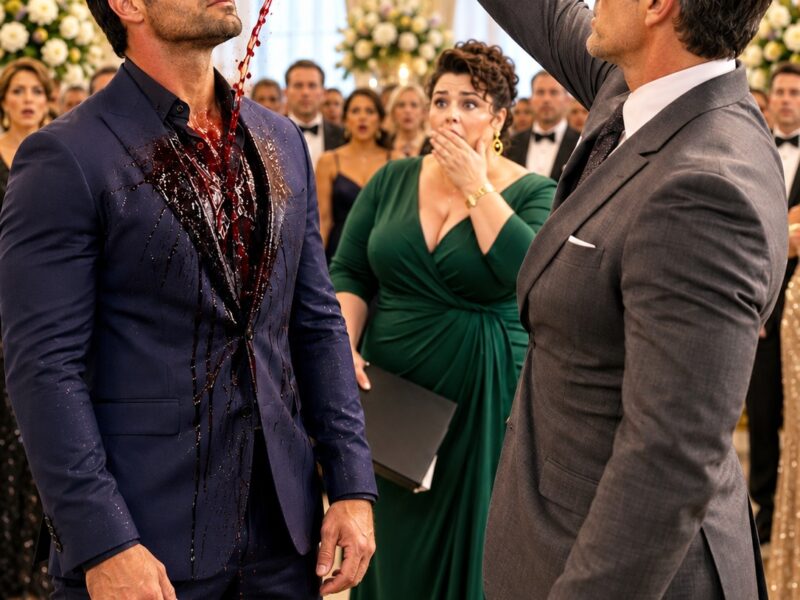
Enzo Valente stood six feet from her with a full glass of Château Margaux running down the front of his navy suit.
Two hundred people had just watched Dominic Castellano pour it there.
Thirty or forty of them had laughed.
The others had done something worse.
They had looked away.
Enzo had not flinched.
He had not grabbed Dominic by the throat.
He had not shouted.
He had not done any of the things Sarah would later learn half the men in that ballroom were terrified he might do.
Instead, he took one of the linen napkins from the nearest table.
One of hers.
Ivory cotton, folded by Sarah’s team into the cathedral peak shape her grandmother used to make for Lebanese weddings in Beirut.
Enzo wiped the wine from his jaw.
Folded the napkin once.
Set it down.
Then removed his phone.
“This is Enzo.”
Pause.
His ice-gray eyes remained on Dominic.
“Pull everything connected to Castellano.”
Another pause.
“Yes.”
He ended the call.
Dominic smiled.
It was an ugly smile made possible by alcohol, inherited money, and the lifelong belief that consequences belonged to people with smaller last names.
“What exactly are you pulling?”
Enzo slipped the phone into his pocket.
“You’ll know before I finish drying.”
Sarah looked between them.
She had known Enzo three weeks.
She had known Dominic Castellano three months.
And at that moment she realized she did not know either man at all.
Ninety seconds later, the first phone buzzed.
Then another.
Then fifteen.
Then so many at once that the ballroom sounded briefly like an electronic hive.
The chairman of the Castellano Foundation crossed the floor holding a tablet with both hands.
His face had gone pale.
“Dominic.”
Dominic barely glanced at him.
“What?”
“We have a problem.”
“Handle it.”
“I can’t.”
That changed Dominic’s smile.
The chairman lowered his voice.
“Vale North Infrastructure just suspended its capital commitment.”
Dominic frowned.
Sarah did too.
Vale North was the lead private-finance sponsor of the two-billion-dollar waterfront redevelopment everyone in the ballroom was supposedly celebrating.
Hospitals.
Commercial towers.
Public promenade.
Hotels.
Three years of approvals.
Eighteen months of negotiations.
Tomorrow morning was supposed to be the final closing.
Dominic turned slowly toward Enzo.
The chairman continued.
“Valente Maritime suspended its guarantees too.”
Silence widened around them.
“And the debt syndicate?”
The chairman swallowed.
“Reviewing.”
Dominic looked at Enzo for the first time as if the man standing in front of him had acquired weight.
“Valente.”
Enzo said nothing.
The chairman stared at Dominic.
“You poured wine on Enzo Valente?”
Sarah heard the name differently the second time.
Not because the pronunciation changed.
Because twenty people around them physically moved farther away.
Dominic’s empty wineglass slipped from his hand.
It shattered on Sarah’s marble dance floor.
Her floor.
Her lighting.
Her flowers.
Her carefully calibrated room.
The room she had spent three weeks building so that men like Dominic could stand at its center and feel important.
Dominic looked at Sarah.
Then at Enzo.
Then back at Sarah.
And when men like Dominic feel the ground disappear beneath them, they rarely look for the truth.
They look for someone smaller to blame.
“This is your fault.”
Sarah went still.
Dominic pointed at her.
“You brought him.”
“Yes.”
“You put him at the service table.”
“He asked to sit there.”
“You humiliated this company.”
Sarah stared at him.
For three months, she had swallowed every correction delivered as contempt.
Every sweetheart.
Every party girl.
Every casual assumption that because she was curvy, brown, female, and twenty-eight, she must be decorating instead of engineering.
Something inside her became very quiet.
Dominic stepped closer.
“You’re finished.”
Sarah’s assistant, Jules, appeared at her elbow.
Sarah did not look away from Dominic.
“Am I?”
“You and your people.”
Dominic gestured toward the ballroom.
“All of this. Get it out.”
Sarah’s gaze moved around the room.
Sixteen rented lighting rigs.
Four modular architectural screens.
Custom brass trelliswork.
Twenty-four tables owned by Kuri & Co.
One hundred and twenty crystal votive towers leased through her vendor account.
The floral installations.
The linen.
The acoustic panels hidden behind silk walls.
The suspended installation over the dance floor.
Nearly everything that made the Meridian Ballroom look like the inside of a jewelry box belonged either to Sarah or to vendors contracted through her.
She looked at Dominic.
“You want my company off this property?”
“Yes.”
“And all property controlled by my company removed?”
“Yes.”
The chairman stepped forward.
“Dominic, perhaps we should—”
“No.”
Dominic did not take his eyes off Sarah.
“She wants to pretend she’s an architect?”
He laughed.
“Let her pack up her decorations and go.”
Sarah felt her grandmother’s old gold bangle against her wrist.
Teta Leila had spent thirty years catering weddings for people who remembered the cake but not the woman who baked it.
When Sarah was ten, her grandmother had told her something over a pot of cardamom coffee.
The woman who builds the room controls the room.
Sarah had believed it as a child.
Tonight she intended to prove it as an adult.
She touched her earpiece.
“Jules.”
Her assistant straightened.
“Yes?”
“Begin strike.”
Jules blinked once.
Then understood.
“All of it?”
Sarah looked directly at Dominic.
“All of it.”
Six hours earlier, the ballroom had still belonged to possibility.
Sarah arrived at 2:47 in the afternoon carrying two clipboards, three phones, one emergency sewing kit, and the kind of exhaustion that made caffeine feel less like a beverage and more like moral support.
The Meridian Hotel’s Grand Ballroom occupied nearly fifteen thousand square feet in Midtown Manhattan.
By itself, it was impressive in the way expensive blank spaces often were.
Marble.
Chandeliers.
Gold leaf.
High ceilings.
Nothing memorable.
Sarah’s job was to make people feel something inside it.
She was not an event planner.
She corrected that distinction constantly.
An event planner managed schedules.
Sarah designed environments.
She calculated sight lines so the person at the worst table could still see the stage.
She mapped sound reflection so speeches carried without becoming harsh.
She controlled light temperature so skin looked warm rather than yellow.
She engineered walkways around wheelchairs before anyone asked.
She knew exactly how high a floral installation could rise before blocking conversation.
She understood that twenty-four inches between chairs meant intimacy, while thirty-four meant formality.
Rooms communicated.
Most people simply did not realize someone had written the language.
“Kuri.”
Jules approached carrying a lighting meter.
Thirty-four.
Buzzed blond hair.
Black jumpsuit.
Sarah’s first employee and only person authorized to tell her when she was being unreasonable.
“You’ve been staring at that chandelier for four minutes.”
“It’s wrong.”
“It has existed since 1928.”
“And tonight it is wrong.”
Jules checked the meter.
“Two-seven-two-zero Kelvin.”
“I asked for twenty-seven hundred.”
Jules stared.
“That is twenty degrees.”
“Yes.”
“No human eye can see twenty degrees.”
“I can.”
“You need sleep.”
“I need ladder three.”
Jules sighed into the radio.
Sarah smiled.
That was how the afternoon worked.
Fifteen minutes correcting amber light.
Twenty adjusting a stage angle because Dominic’s production company had moved the podium without telling her.
Thirty replacing pale-gold ranunculus someone mistakenly stored beside a refrigeration vent.
At four, Dominic Castellano arrived.
He did not greet Sarah.
He inspected.
That was his word.
Sarah thought of it as walking through other people’s work while searching for reasons to complain.
Dominic was forty.
Handsome in a polished, television-interview way.
Silver at the temples by genetics rather than age.
Third-generation Manhattan money.
Executive vice president of Castellano Development.
Chairman’s eldest son.
The kind of man who had never carried anything heavier than expectation.
He stopped beneath the suspended brass installation.
“It’s low.”
“It’s exactly fourteen feet.”
“It feels low.”
“The ceiling is twenty-eight.”
“I want it higher.”
Sarah looked at him.
“Why?”
His expression changed.
Clients did not like why when they expected yes.
“Because I said so.”
“If I raise it three feet, the projection angle misses the brass surfaces.”
“I don’t care.”
“Then you lose the reflection pattern your board approved.”
Dominic sighed.
“There it is.”
“What?”
“The lecture.”
Sarah glanced at Jules.
Jules became fascinated with the lighting meter.
Dominic continued.
“Sarah, this is a party.”
“It’s a two-billion-dollar closing event.”
“Exactly.”
“Which is why the visual identity matters.”
He looked around.
“It’s pretty.”
Pretty.
Sarah smiled carefully.
“Thank you.”
Dominic walked away.
Jules waited until he was out of range.
“I could hit him with ladder three.”
“No.”
“Ladder two?”
“No homicide by equipment.”
“Your rules are oppressive.”
Sarah laughed.
At five-fifteen, Enzo arrived through the service entrance.
Sarah found him near table twelve reading the seating card she had made for him.
ENZO VALENTE
Black ink.
Ivory stock.
Hand-calligraphed.
“Early.”
He looked up.
“So are you.”
“I’ve been here since before the flowers.”
“That explains the expression.”
“What expression?”
“Hostility toward oxygen.”
Sarah smiled despite herself.
Enzo wore a navy suit with no visible label.
White shirt.
No tie.
No watch.
No cufflinks.
Nothing that men in Dominic’s world usually used to advertise their ranking.
He did not need them.
He was six-three, broad through the shoulders, dark-haired, and quiet in a way Sarah had noticed during their first meeting.
Not shy.
Not withdrawn.
Contained.
Three weeks earlier, he had walked into her Astoria studio asking her to design a private dinner.
Forty guests.
Warehouse overlooking the East River.
“No ballroom,” he had said.
“Good.”
He had raised one eyebrow.
“You don’t like ballrooms?”
“I like rooms that admit what they are.”
“What does a ballroom pretend to be?”
“More important than the people working inside it.”
That had made him smile.
Barely.
She designed his dinner.
He asked questions no ordinary client asked.
Why the walls curved.
Why the tables were offset nine degrees.
Why she had chosen linen over silk.
How far one person could stand from another and still feel included in a conversation.
Sarah finally asked:
“What do you actually do?”
“Import-export.”
“That is the answer men give when the real answer is annoying.”
“Sometimes the real answer is boring.”
“Is yours?”
“No.”
They met four times.
On the fourth, Sarah mentioned the Castellano gala.
Not because she wanted him there.
That was what she told herself afterward.
She mentioned she was attending alone.
Enzo said:
“Take me.”
Sarah stared.
“This is work.”
“I know.”
“You’re a client.”
“The invoice cleared yesterday.”
“You memorized the payment date?”
“I sign my own checks.”
“That makes you either impressive or controlling.”
“Can I decide after dinner?”
She had laughed.
Then said yes.
One condition.
“You do not announce yourself.”
“As?”
“Anything.”
He studied her.
“You don’t want me networking.”
“I don’t want people thinking I brought a client to validate me.”
Enzo nodded.
“Then I’m nobody.”
“That sounded suspiciously comfortable.”
“It often is.”
Now Sarah pointed at table twelve.
“There.”
Enzo looked.
Behind a decorative column.
Near the service partition.
Fluorescent light leaking faintly beneath the curtain.
The worst table in the room.
“You really put me there.”
“You said you wanted my table.”
“I do.”
“You could have had a guest seat.”
“I don’t want a guest seat.”
“Why?”
“Because you won’t sit there.”
He nodded toward the center.
“You’ll eat between problems. You’ll drink half a glass of water standing up. You’ll sit for four minutes at this table and then someone will ask where the extra extension cord is.”
Sarah narrowed her eyes.
“You’ve been watching me.”
“I paid attention.”
That felt different.
Men had looked at Sarah her entire adult life.
Some looked at her curves.
Some looked past her because of them.
Some acted surprised when her body and expertise arrived in the same woman.
Enzo looked at her as if both were facts.
Nothing to reconcile.
“You’re doing it again,” she said.
“What?”
“Looking.”
“Yes.”
“That usually embarrasses people when they’re caught.”
“I’m not embarrassed.”
“Apparently.”
His gaze moved toward the room.
“You built this.”
“Yes.”
“It’s good.”
Sarah folded her arms.
“Good?”
“Do you want dishonest adjectives?”
“Always.”
“It is technically disciplined, visually restrained, spatially intelligent, and emotionally manipulative.”
Sarah stared.
“That is the nicest thing anyone has said to me all week.”
“I thought so.”
At 6:47, Dominic’s shoulder hit her clipboard in the service corridor.
Forty pages scattered.
He did not stop.
“Watch where you’re standing.”
Sarah looked at his back.
Jules began picking up sheets.
“I have revised my position on ladder homicide.”
Sarah crouched.
“Denied.”
At 7:15, Sarah approached the ballroom entrance.
Dominic stood with two board members.
He lifted one hand.
“Staff use the side entrance, sweetheart.”
Sarah stopped.
“I’m the event architect.”
“Yes.”
“I designed the room.”
“And?”
One board member looked embarrassed.
Dominic gestured toward the service doors.
“You know how this works.”
Sarah looked through the open ballroom doors.
Her room glowed.
Warm amber.
Crystal throwing small rainbows across ivory linen.
The suspended brass installation reflecting light exactly as calculated.
Two hundred seats waiting for people who would walk into the room believing beauty had simply happened.
Sarah smiled.
“Apparently I do.”
She used the side entrance.
Enzo saw.
She knew because ten minutes later he appeared beside her near the kitchen doors.
“You okay?”
“Perfect.”
“That answer is usually false.”
“Are you enjoying table twelve?”
“Yes.”
“Then enjoy it quietly.”
He looked toward Dominic.
“What did he say?”
“Nothing worth repeating.”
Enzo accepted that.
He did not step in.
Sarah noticed.
She appreciated it more than she expected.
At eight-thirty, Dominic took the stage.
He thanked everyone.
The board.
Investors.
Hotel management.
Political guests.
Consultants.
Then:
“And a special thank-you to our charming little party planner for putting together such a pretty room.”
Scattered applause.
Sarah stood beside the service partition.
Her clipboard pressed against her chest.
Jules muttered:
“Party planner.”
“I heard.”
“Charming little.”
“I heard.”
“You designed seventeen thousand pounds of temporary infrastructure.”
“Technically twelve.”
“That makes it better?”
“No.”
Sarah adjusted a centerpiece.
One ranunculus had rotated.
She corrected it.
Behind her, one of Dominic’s associates whispered:
“The bigger event girl is surprisingly good.”
Sarah’s fingers stopped.
Surprisingly.
A word that always revealed the expectation preceding it.
Jules heard too.
Her face reddened.
Sarah touched her arm.
“Don’t.”
“You heard that.”
“Yes.”
“You’re going to keep working?”
Sarah looked around.
“Yes.”
“Why?”
“Because I know what I built.”
At nine-ten, Enzo found her beside table six.
“You haven’t eaten.”
“I’ve eaten.”
“What?”
Sarah thought.
“Two almonds.”
“That is not food.”
“It is mathematically food.”
He held out a plate.
Chicken.
Potatoes.
Vegetables.
Sarah stared.
“You brought me dinner.”
“I acquired dinner.”
“You stole from table twelve.”
“I financed the chicken.”
She laughed.
“How?”
“Import-export.”
“Of course.”
She took the plate.
Then Dominic appeared.
Wine glass in hand.
Two board members behind him.
“Well.”
His gaze moved from Sarah to Enzo.
“The party planner brought a date.”
Sarah set down the plate.
“Event architect.”
Dominic smiled.
“Right.”
His eyes traveled over Enzo’s suit.
No watch.
No cufflinks.
No obvious status marker.
He saw a big man sitting at the service table.
And because Dominic measured people by where they sat, he saw nobody.
“Nice suit.”
Enzo said nothing.
“Off the rack?”
Still nothing.
Dominic looked at Sarah.
“Where did you find him?”
Sarah’s voice cooled.
“He’s my guest.”
“Your guest sits with the staff.”
“He asked to.”
One board member shifted.
“Dominic.”
But Dominic had been drinking for two hours.
Not drunk.
Just unedited.
He looked at Enzo.
“Can I get you something?”
Enzo’s expression remained neutral.
“No.”
“Taxi?”
“No.”
“A table where the help won’t confuse you with one of them?”
Sarah stepped forward.
“That’s enough.”
Dominic’s eyes moved to her.
“Excuse me?”
“You’ve insulted me all evening.”
“I complimented your room.”
“You called me a party planner.”
“You plan parties.”
“I architect temporary environments.”
Dominic laughed.
“Sarah.”
“Do not sweetheart me.”
Something in the surrounding conversations softened.
People were listening.
Dominic heard them listening too.
He needed to reassert himself.
That was when he made the mistake.
He raised the wineglass.
Looked at Enzo.
Then slowly poured the entire glass down the front of his suit.
Dark red wine spread across navy wool.
Someone laughed.
Then another.
The sound multiplied because cruelty becomes easier in groups.
Sarah stared.
Her entire body went cold.
Enzo did not move.
Wine ran from his shoulder to his cuff.
A drop touched his jaw.
He picked up Sarah’s napkin.
Wiped it.
Folded it.
Set it down.
“I hope that made you feel important.”
Dominic’s smile faltered.
Enzo took out his phone.
“Pull everything.”
Ninety seconds later, Dominic learned who he had humiliated.
Five minutes after that, he made the second mistake.
He blamed Sarah.
“You brought him.”
“Yes.”
“You hid who he was.”
“I didn’t know.”
Dominic laughed.
“You expect me to believe that?”
Sarah looked at Enzo.
He said nothing.
Not rescuing her.
Not answering for her.
Sarah turned back.
“I knew his name.”
“His name?”
Dominic pointed.
“That man controls the majority commitment behind tonight.”
Sarah looked at Enzo again.
“Do you?”
Enzo’s expression tightened.
“Yes.”
A different anger entered her.
“You said import-export.”
“I am.”
“You left out several nouns.”
“I did.”
Dominic seized it.
“See?”
He pointed toward Sarah.
“She brought a hidden investor into our gala and seated him with kitchen staff.”
“I seated my date beside me.”
“You made us look ridiculous.”
“No.”
Sarah’s voice became very quiet.
“You did that without help.”
Dominic stepped closer.
“You’re fired.”
The chairman said:
“She doesn’t work for us.”
“Terminate the contract.”
“You can’t—”
“I said terminate it.”
Dominic looked at Sarah.
“Take your people and get out.”
Sarah waited.
“Everything?”
“What?”
“My people. My equipment. My rented installations.”
Dominic scoffed.
“Everything.”
Jules appeared.
Sarah touched her earpiece.
“Begin strike.”
Jules stared.
Then smiled.
“Copy.”
The first thing to disappear was the light.
Sarah’s company did not own the Meridian chandeliers.
But they owned the sixteen LED architectural rigs creating the warm amber wash.
Jules dimmed them.
The ballroom cooled instantly.
Skin lost its glow.
Crystal stopped sparkling.
Flowers became ordinary flowers.
People looked older.
More tired.
More honest.
Dominic turned.
“What did you do?”
Sarah looked at him.
“My lighting package has been terminated.”
“You cannot turn the lights off.”
“The hotel lights are on.”
And they were.
Flat overhead fixtures.
Service illumination.
Functional.
Ugly.
The magic had not belonged to the room.
It had belonged to the people who knew how to build it.
Sarah’s team moved.
Seven people dressed in black.
No shouting.
No destruction.
They began with rented votive towers.
Then floral frames.
Then modular screens.
The suspended brass installation lowered carefully.
Guests moved aside.
Waiters stood frozen.
Dominic stared.
“Stop.”
Sarah checked the termination clause on her tablet.
“You instructed Kuri & Co. to vacate immediately and remove all company-controlled property.”
“I didn’t mean during the event.”
“You said everything.”
“Sarah.”
“Mr. Castellano.”
His face reddened.
“This is childish.”
“No.”
She looked around.
“It is inventory management.”
Jules passed carrying a crate.
“Crystal towers?”
“All ours.”
“Table linens?”
“Vendor lease under us.”
“Stage surround?”
“Ours.”
Jules smiled.
“Cathedral peaks?”
Sarah looked at the napkin Enzo had used.
“Pack them.”
The napkins disappeared.
The ivory overlays.
The custom brass menu stands.
The floral runners.
Kuri & Co.’s twelve demonstration tables.
The portable acoustic panels.
One beautiful layer at a time.
Twenty minutes later, the Grand Ballroom looked exactly like what it had been before Sarah entered three weeks earlier.
Marble.
Gold leaf.
Hotel chandeliers.
A stage.
A box.
Two hundred people stood in formal clothes inside a room that no longer told them they were important.
Dominic stood at its center.
Sarah approached.
His voice was low.
“You just destroyed your career.”
“No.”
She removed her headset.
“I removed my property after the client terminated my services.”
“You think that contract protects you?”
“I wrote the equipment schedule.”
“Lawyers will bury you.”
“Then yours can talk to mine.”
“You have no idea who you’re dealing with.”
Sarah looked at him.
“That sentence has had a difficult evening.”
She turned away.
Enzo waited near table twelve.
Or where table twelve had been.
The chairs were gone.
His navy suit was stained dark red.
Sarah looked at him.
“You knew.”
“Yes.”
“You knew this entire time that your money was behind Castellano.”
“Yes.”
“You let me bring you here as a date.”
“Yes.”
“You let me seat you with staff.”
“That was my choice.”
“You could have told me.”
“Yes.”
Sarah stared.
“Do you have any word other than yes?”
“Several.”
“Use one.”
“Sorry.”
That stopped her.
Enzo continued.
“You told me you did not want a man entering the room and making people decide your value by his status.”
Sarah remembered.
She had said exactly that during their fourth meeting.
He went on.
“If I told you Vale North was mine, you would have spent tonight wondering whether people respected your work or my name.”
“That was my decision to make.”
Enzo’s face tightened.
“Yes.”
“Stop saying yes.”
“I’m trying not to defend something that bothered you.”
Sarah exhaled.
That was annoyingly reasonable.
“You froze two billion dollars because someone poured wine on you?”
“No.”
She looked at him.
Enzo removed the stained jacket.
“The consortium was scheduled to close tomorrow.”
“I know.”
“My commitment remained subject to final governance review.”
“That sounds less dramatic.”
“It is.”
“Good.”
“I have been concerned about Dominic for six months.”
Sarah frowned.
“Why?”
“Vendor complaints. Procurement pressure. Last-minute substitutions. He pushes costs downward and side payments upward.”
Sarah thought about her own project.
Four budget changes.
Two preferred vendors Dominic tried to force into her production plan.
She had refused both because their safety records were poor.
Enzo continued.
“Tonight was not about wine.”
“What was it about?”
“A man with responsibility for two billion dollars publicly humiliated a vendor, insulted staff, ignored board members trying to stop him, then poured wine on someone he believed could not answer back.”
Sarah’s anger cooled into thought.
Enzo looked toward the stripped ballroom.
“If he behaves like that in a room full of witnesses, I no longer trust what he does in rooms without them.”
“So you pulled funding.”
“I paused my commitment.”
“Same thing tonight.”
“Not tomorrow.”
Sarah folded her arms.
“What happens tomorrow?”
“Due diligence.”
“To him?”
“To everything.”
Sarah looked back at Dominic.
For the first time, she did not see an enemy.
She saw risk.
Enzo picked up the ivory seating card from the floor.
ENZO VALENTE — TABLE 12
He slipped it into his inside pocket.
Sarah noticed.
“Why?”
“What?”
“The card.”
He looked at her.
“I like the table.”
“There is no table anymore.”
“There will be others.”
Outside, Sarah took off her heels.
Jules looked down.
“Professional.”
“I have been standing sixteen hours.”
“You just dismantled a ballroom in front of two hundred people.”
“And?”
“Shoes are where you draw the line?”
“My feet are unionizing.”
Jules laughed.
Enzo walked several paces behind them.
Sarah stopped near the curb.
Turned.
“Why are you following us?”
“My car is this direction.”
“Of course you have a car.”
“I also walk.”
“Rare skill.”
A black sedan waited at the corner.
Sarah looked at it.
Then at Enzo.
“How much of the import-export answer was technically true?”
“All of it.”
“What do you import?”
“Steel. Medical equipment. Wine.”
“Export?”
“Machinery. Agricultural equipment.”
“And the thing where everyone in the ballroom suddenly stopped breathing when they heard your name?”
Enzo was quiet.
Jules looked between them.
“I’m going to get our van.”
She disappeared.
Sarah waited.
Enzo finally said:
“My family did business differently before I took over.”
“That is an elegant sentence.”
“It is meant to be.”
“Mafia?”
He met her eyes.
“Yes.”
Sarah stared.
The traffic on Fifth Avenue seemed suddenly too loud.
“You are telling me you’re a mafia boss.”
“I’m telling you I inherited an organization with criminal operations.”
“That is not better.”
“No.”
“And now?”
“Some are gone.”
“Some.”
“Yes.”
Sarah rubbed her forehead.
“I brought a mafia boss to a corporate gala.”
“You brought Enzo.”
“That sentence is not as comforting as you think.”
His mouth almost curved.
Sarah pointed at him.
“Do not smile.”
“I wasn’t.”
“You were thinking about it.”
“That isn’t illegal.”
“Given tonight, I’m not taking your legal opinions seriously.”
His smile appeared.
Small.
Sarah hated that she noticed.
The following morning, three things happened before nine.
The first was a formal breach notice from Castellano Development accusing Kuri & Co. of sabotaging the gala.
The second was an email from Sarah’s largest existing corporate client requesting a “temporary pause” on an upcoming project because of “reputational uncertainty.”
The third was a text from Enzo.
Do you want my counsel’s number?
Sarah typed:
No.
Three dots.
Then:
Understood.
No argument.
No unsolicited attorney.
No threatening Dominic.
That helped more than she wanted it to.
Jules entered carrying coffee.
“We have a problem.”
“Which one?”
“Internet.”
Sarah closed her eyes.
“Please tell me nobody posted video.”
“Everybody posted video.”
Sarah opened her laptop.
There she was.
Dominic pouring wine.
Enzo standing still.
Sarah confronting Dominic.
The lights going cold.
Her team removing the room.
Short clips stripped of context.
Some comments called her iconic.
Others called her unprofessional.
Some praised Enzo’s restraint.
Others romanticized him in ways that made Sarah deeply uncomfortable.
One headline called her:
CURVY QUEENS EVENT PLANNER DESTROYS BILLION-DOLLAR GALA
Sarah stared.
“Event planner.”
Jules winced.
“That’s your takeaway?”
“And curvy.”
“You are curvy.”
“I know.”
“Is that bad?”
“No.”
Sarah closed the laptop.
“It’s irrelevant to structural lighting.”
Jules sat.
“What are we going to do?”
Sarah looked around their studio.
Twelve hundred square feet.
Not twelve thousand, despite the way she sometimes joked about it when nervous.
Three desks.
Fabric samples.
Material boards.
A model-making table.
An espresso machine that truly worked only when it felt emotionally supported.
Kuri & Co. had six weeks of operating cash.
Maybe eight if Sarah stopped paying herself.
The Castellano contract represented thirty percent of their year.
Dominic could hurt them.
That was real.
The room strike had felt powerful.
Morning made power expensive.
Sarah took a breath.
“We document.”
Jules nodded.
“Everything?”
“Every revision request. Every vendor substitution Dominic pushed. Every email. Every equipment schedule. His verbal termination if anyone recorded it.”
Jules smiled.
Sarah narrowed her eyes.
“You recorded it.”
“My phone was live-streaming internal production audio to backup.”
“You never told me.”
“You never asked.”
Sarah stared.
Jules looked innocent.
“Teta would like me.”
“Teta would hire you and then complain you were nosy.”
“Excellent.”
At eleven, Sarah’s small-business attorney called.
By noon, the response to Castellano was ready.
Kuri & Co. had not vandalized property.
Had not removed hotel-owned fixtures.
Had not interrupted emergency systems.
Dominic personally terminated services and ordered Sarah’s team to remove company-controlled property.
Every removed item appeared in the contract’s rental schedule.
Nothing had been damaged.
Nothing had been stolen.
More importantly, Castellano still owed the final thirty percent of Sarah’s fee.
Sarah sent the letter.
Then waited.
At two, the chairman of Castellano Foundation called.
Not Dominic.
“Ms. Kuri.”
“Yes.”
“I’d like to meet.”
“With counsel.”
A pause.
“Of course.”
“Dominic?”
“Will not attend.”
That mattered.
The meeting took place the next morning in a conference room overlooking Bryant Park.
Sarah brought Jules and her attorney.
Enzo was not there.
She appreciated that.
The chairman looked exhausted.
Three board members sat beside him.
“We owe you an apology.”
Sarah said nothing.
“We failed to intervene.”
“Yes.”
The chairman’s mouth tightened.
“You are not required to make this easy.”
“I wasn’t planning to.”
One board member almost smiled.
The chairman continued.
“Dominic has been suspended from project authority pending review.”
Sarah absorbed it.
Not fired.
Not destroyed.
Suspended.
Realistic.
“We’ve also received notice from Vale North that its funding suspension will remain until our governance review is complete.”
“That sounds expensive.”
“It is.”
“Why am I here?”
The chairman folded his hands.
“Because the gala incident began with our treatment of your company.”
“No.”
Sarah shook her head.
“It began long before the gala.”
They waited.
She opened her file.
“Four times, Dominic attempted to force vendor substitutions after design approval.”
She placed the emails down.
“Twice, the vendors had lower safety ratings.”
Another page.
“He changed payment timelines without authorization.”
Another.
“He instructed hotel staff to deny my team access to the main ballroom entrance despite accessibility and equipment-flow plans.”
She looked at them.
“You don’t have a gala problem.”
Silence.
“You have a culture problem.”
The chairman leaned back.
Sarah continued.
“Dominic behaved the way he behaved because nobody in your organization had ever made the cost of that behavior larger than the convenience of tolerating it.”
No one interrupted.
“And no, I am not saying this because he called me a party planner.”
She looked at the oldest board member.
“I am saying it because I was the vendor who could walk out.”
Her voice softened.
“What does he do to people who can’t?”
That question changed the meeting.
Three hours later, the board agreed to pay Kuri & Co.’s full outstanding balance.
No settlement requiring silence.
No admission Sarah sabotaged the event.
A mutual termination.
The foundation also agreed to an independent procurement review.
Sarah walked out carrying the signed agreement.
Jules exhaled in the elevator.
“We survived.”
“For today.”
“Can we celebrate?”
“We have payroll Thursday.”
“That is not celebration.”
“It is when you own a small business.”
At street level, Sarah saw Enzo across the avenue.
He stood beside a coffee cart.
No entourage.
No black sedan.
Just Enzo.
She almost crossed.
Then stopped herself.
Jules noticed.
“Go.”
“I’m working.”
“You just survived litigation.”
“Potential litigation.”
“Sarah.”
“What?”
“You dismantled a ballroom in front of two hundred people but are scared to cross the street.”
“I am not scared.”
“Then go.”
Sarah crossed.
Enzo saw her coming.
He waited.
“How did you know where I was?”
“I didn’t.”
She stared.
“This is my building.”
Sarah looked up.
The polished tower.
Vale North Infrastructure.
Of course.
“That is annoyingly plausible.”
“How did it go?”
“I didn’t need your lawyer.”
“I noticed.”
“They paid.”
“Good.”
“Dominic is suspended.”
“I heard.”
“Did you demand it?”
“No.”
“You could.”
“Yes.”
“Stop answering like that.”
Enzo smiled.
Sarah accepted coffee from the cart.
He paid for his.
She paid for hers.
He noticed.
She noticed him noticing.
“Do you regret pulling the funding?”
“No.”
“What if the board fixes the problem?”
“I reconsider.”
“So the project may survive.”
“Yes.”
“Dominic?”
“That is not my decision.”
Sarah studied him.
“You really are trying not to behave like the thing people think you are.”
Enzo’s expression became unreadable.
“That is a complicated compliment.”
“It wasn’t entirely a compliment.”
“I know.”
They walked.
Sarah asked:
“How criminal is your criminal organization?”
Enzo glanced at her.
“That is not first-coffee conversation.”
“It is when you discover your date is a mafia boss because someone dumps Bordeaux on him.”
“Margaux.”
“Do not correct the wine.”
He almost laughed.
Sarah stopped near the park.
“I need to know.”
Enzo looked toward the trees.
“My grandfather built the organization through gambling, trucking, labor rackets, and violence.”
Sarah did not move.
“My father expanded into ports.”
“And you?”
“I inherited at thirty-one.”
“How old are you?”
“Thirty-eight.”
“Seven years.”
“Yes.”
“What did you close?”
“Sports books. Collections. Protection schemes.”
“What remains?”
Enzo paused.
“Relationships I cannot erase by pretending they never existed.”
“That is vague.”
“Intentionally.”
Sarah folded her arms.
“Do you hurt people?”
“Not for business.”
“That answer has too much room.”
He accepted that.
“I have ordered force to protect people.”
“Have you killed anyone?”
Enzo looked directly at her.
“Yes.”
Sarah’s stomach tightened.
He did not romanticize it.
Did not say only bad men.
Did not say he had no choice.
He simply let the word stand.
“When?”
“Years ago.”
“Do you regret it?”
“Some.”
“Some?”
“I’m not going to lie to make myself easier to date.”
Sarah flinched at the word.
“Date.”
“You brought me to a gala.”
“That was before I knew.”
“I know.”
She looked away.
“I don’t know what to do with you.”
Enzo nodded.
“That is fair.”
He did not touch her.
That mattered.
A week passed.
Then two.
Kuri & Co. received more inquiries than it could handle.
Half wanted Sarah because they respected her work.
Half wanted the woman from the viral video.
She rejected the second half whenever she could tell the difference.
One prospective client opened the meeting with:
“So are you going to tear down our ballroom if we annoy you?”
Sarah closed her folder.
“Probably not a fit.”
He laughed.
She did not.
The meeting ended three minutes later.
Jules asked:
“Can we afford standards?”
Sarah looked at the numbers.
“No.”
“Then why do we have them?”
“Because otherwise we become people who build beautiful rooms for clients we hate.”
Jules considered.
“Fair.”
The next major inquiry came from Vale North.
Sarah called Enzo immediately.
“No.”
He answered:
“Good afternoon to you too.”
“You cannot hire me.”
“I didn’t.”
“Your company sent an RFP.”
“I know.”
“You own the company.”
“I own sixty-eight percent.”
“That is worse.”
“The procurement committee issued it.”
“You told them.”
“I disclosed our relationship and removed myself.”
Sarah went quiet.
“Relationship?”
“Acquaintance.”
“Better.”
“Possible former date.”
“Enzo.”
“I recused.”
Sarah hated that this was responsible.
“What’s the project?”
“Public waterfront pavilion.”
“Budget?”
“Eight million.”
Sarah sat down.
“That is not funny.”
“I am not joking.”
“You cannot rescue my company by handing me a contract.”
“I agree.”
“Then why am I on the list?”
“Because three independent consultants put you there.”
She did not believe him.
He emailed the documentation.
They had.
Kuri & Co. was one of six firms.
Sarah competed.
Presented.
Lost.
She called Enzo.
“I lost.”
“I heard.”
“You sound suspiciously calm.”
“You were second.”
“That is losing.”
“Yes.”
“Did you interfere?”
“No.”
“Good.”
Sarah hung up.
Then smiled.
Two months later, another RFP arrived.
This one from a hospital foundation in Brooklyn.
No connection to Enzo.
Kuri & Co. won.
The project was twice the size of Castellano’s gala.
Sarah sat in the empty space after the contract signing.
Concrete floor.
Exposed ceiling.
No flowers.
No lighting.
Nothing yet.
She called Teta.
Her grandmother answered from Dearborn, Michigan.
“Habibti.”
“Teta.”
“You sound tired.”
“I got the hospital job.”
Silence.
Then screaming.
Sarah pulled the phone away.
Teta shouted for Sarah’s aunt.
Then came back.
“How big?”
“Big.”
“Good client?”
“I think so.”
“You think?”
“We’ll see.”
“What about the handsome man?”
Sarah closed her eyes.
“What handsome man?”
“The wine man.”
“How do you know about the wine man?”
“Your cousin sent me the video.”
Sarah groaned.
“He looks serious.”
“He is.”
“Rich?”
“Teta.”
“I am eighty-two. I have earned practical questions.”
Sarah laughed.
“He is complicated.”
“All men are complicated. Poor men simply do it in smaller apartments.”
“Teta.”
“What?”
“He is…”
Sarah hesitated.
“How do I say this?”
“Married?”
“No.”
“Children?”
“No.”
“Politician?”
“Worse.”
Teta waited.
“Crime family.”
Silence.
Then:
“Lebanese or Italian?”
Sarah stared at the phone.
“That is your question?”
“It matters for food.”
Sarah laughed so hard Jules came from the next room.
“What happened?”
Sarah waved her away.
Teta’s voice softened.
“Does he respect your work?”
“Yes.”
“Does he respect no?”
Sarah stopped laughing.
So simple.
“Yes.”
“Then watch everything else carefully.”
Sarah looked through the hospital windows.
“That’s it?”
“No.”
Teta’s voice sharpened.
“If he disrespects no even one time, run so fast you leave your shoes.”
Sarah smiled.
“I’ve already left one hotel barefoot.”
“I saw.”
Three months after the gala, the Castellano board completed its review.
Dominic had not stolen money.
That would have made the story easier.
Instead, he had pressured vendors.
Circumvented procurement standards.
Used family influence to direct contracts toward friends.
Retaliated against employees who challenged him.
Nothing cinematic.
Everything corrosive.
He was removed from project leadership.
The redevelopment survived.
Vale North restored forty percent of its original commitment, conditional on new oversight and revised partners.
Other investors returned.
The final financing closed at 1.6 billion instead of two.
Dominic remained wealthy.
Still lived well.
Still had his name.
Consequences did not have to be poverty to be consequences.
He lost authority.
For a man like Dominic, that was the wound.
Sarah heard from him once.
An email.
No greeting.
You cost my family hundreds of millions.
Sarah stared at it.
Then replied:
No. Your behavior became expensive. There is a difference.
She did not hear from him again.
Enzo read the email weeks later.
“You should frame that.”
“No.”
“You framed table twelve.”
Sarah froze.
“How do you know?”
“I visited your studio.”
“You saw it?”
“Yes.”
The ivory seating card sat on Sarah’s desk beside the espresso machine.
Not romantic.
Not exactly.
A reminder.
Sarah had kept it because table twelve was where everything had been misunderstood.
Dominic saw it and assumed Enzo had no value.
Sarah had assumed Enzo’s lack of announcement meant he had no hidden power.
Enzo had assumed keeping his identity from Sarah respected her wishes.
All three had been wrong in different ways.
Sarah looked at him.
“Why did you keep yours?”
Enzo reached into his wallet.
Pulled out a slightly worn ivory card.
Sarah stared.
“You carry it?”
“Sometimes.”
“That is absurd.”
“Yes.”
“You hate paper.”
“I like this paper.”
She took it.
Her own handwriting.
ENZO VALENTE — TABLE 12
“You could sit anywhere.”
“I know.”
“Why there?”
Enzo leaned against her worktable.
“Because the first time I came into your studio, everyone else who visited you sat in the front conference room.”
Sarah waited.
“You were in the back helping Jules lift a model onto a table.”
“So?”
“You owned the company.”
“Yes.”
“You were carrying your own work.”
“Should I have levitated it?”
“You didn’t understand what I noticed.”
“What?”
“You never positioned yourself where people expected the important person to stand.”
Sarah looked at him.
Enzo continued.
“You were always wherever the work needed you.”
She said nothing.
“I wanted to see the room from where you saw it.”
Her chest tightened.
“That is dangerously charming.”
“I practiced.”
“No, you didn’t.”
“No.”
They began dating again slowly.
That was Sarah’s condition.
No armed drivers at her door unless there was an actual threat.
No gifts larger than dinner.
No business routed through her company without independent review.
No surprise appearances at client meetings.
No investigating people in her life.
Enzo agreed to all of it.
Then broke one rule accidentally.
Sarah entered her apartment one Friday and found twelve Lebanese pastries on the counter.
She stared.
Enzo stood beside them.
“You said no expensive gifts.”
“This is forty-three dollars.”
“You researched the price.”
“I respect compliance.”
“Who let you in?”
“You.”
“When?”
“Last month.”
Sarah remembered giving him a key during a plumbing emergency.
“That was for a pipe.”
“The pipe is fine.”
“Enzo.”
He held out the key.
She looked at it.
“You don’t have to give it back.”
“You sound conflicted.”
“I am.”
“That is allowed.”
She took the key.
Then placed it back in his hand.
“Keep it.”
He did not smile.
His eyes softened instead.
That was worse.
Six months after the gala, Sarah finished the hospital foundation room.
It was not glamorous.
That was why she loved it.
A multipurpose gathering hall for pediatric cardiac patients and their families.
Natural wood.
Warm indirect light.
Curved walls.
Acoustics soft enough that medical equipment did not echo.
Tables on wheels.
No seat with a bad sight line.
No service door hidden from guests.
Sarah had insisted on that.
There was one entrance.
Everyone used it.
The opening event was small.
Parents.
Doctors.
Donors.
Children in colorful socks running where donors had expected elegant silence.
Sarah stood near the wall.
Jules brought her water.
“You’re doing the thing.”
“What thing?”
“Standing outside your own room.”
“I’m working.”
“The room is done.”
Sarah looked around.
A little girl rolled her wheelchair beneath the timber canopy Sarah had fought three committees to keep.
Her mother bent beside her.
They both looked up at the light moving across the curved wood.
Sarah’s throat tightened.
Then a voice beside her:
“You built this.”
Enzo.
Charcoal suit.
No tie.
No announcement.
“Technically my team built it.”
“You designed it.”
“Yes.”
“Good.”
Sarah looked at him.
“Just good?”
“Do you want dishonest adjectives?”
She smiled.
“You remember.”
“I remember most things.”
A hospital executive approached.
“Ms. Kuri.”
Sarah turned.
“We’re ready for your remarks.”
She blinked.
“My what?”
“The board asked you to speak.”
“I’m not on the program.”
“We changed it.”
Sarah looked at Jules.
Jules suddenly found the ceiling fascinating.
“You knew.”
“I might have advocated.”
“Traitor.”
The executive smiled.
“They want the architect to explain the room.”
Sarah stared.
Not the party planner.
Not the decorator.
The architect.
She walked to the front.
Enzo stayed where he was.
Did not join her.
Did not position himself where cameras could connect them.
Sarah stood at the microphone.
For a second, she thought about Dominic’s gala.
The warm amber light.
The applause that was never really for her.
The staff door.
The wine.
Then she looked at the families in front of her.
“This room was designed around one principle.”
She paused.
“No one in it should feel like an afterthought.”
The room quieted.
“We lowered sight lines for children seated in wheelchairs. We softened surfaces because hospitals already contain enough hard sound. We used one entrance because staff, families, donors, doctors, and patients should not be told by architecture which door they deserve.”
Enzo watched her.
Sarah continued.
“A room cannot make people kind.”
She looked around.
“But it can stop making cruelty convenient.”
No grand speech after that.
She thanked her team.
She thanked the hospital.
She stepped away.
Jules whispered:
“Not bad.”
“I hate public speaking.”
“You dismantled a ballroom in public.”
“That was anger.”
“Useful fuel.”
Later, Enzo and Sarah walked outside.
Brooklyn evening.
Cold.
Sarah pulled her coat tighter.
“You didn’t tell me you were coming.”
“Is that a complaint?”
“No.”
“Then I’m improving.”
She looked at him.
“You still have illegal businesses?”
Enzo’s face changed.
It had been months since she asked directly.
“Fewer.”
“That is not none.”
“No.”
“What are you doing about them?”
“Closing two operations this year.”
“And the others?”
“Transitioning where I can.”
“Where you can.”
“Yes.”
Sarah stopped walking.
Enzo stopped too.
“I cannot build a life around ‘where I can’ forever.”
“I know.”
“Do you?”
“Yes.”
“No.”
She looked at him.
“I like you.”
His expression softened.
“That sounded painful.”
“It is.”
Sarah continued.
“I may love you.”
Enzo became completely still.
“But I cannot spend ten years waiting for you to become a man I can safely explain to myself.”
He absorbed it.
Sarah looked toward the street.
“I don’t need you innocent.”
His brow moved.
“I need you accountable.”
Enzo said nothing for a long time.
Then:
“That is harder.”
“Yes.”
“And fair.”
“Yes.”
He did not promise a miracle.
Sarah would have distrusted one.
Instead, over the next year, Enzo sold or dissolved several businesses.
Not cleanly.
Not painlessly.
People lost positions.
Old partners became angry.
One family branch sued him.
A federal inquiry reopened two historical cases.
Enzo cooperated through attorneys.
He paid penalties on one logistics company for conduct predating his leadership but continuing under it.
Sarah watched.
Sometimes from close.
Sometimes from a distance.
They argued.
Once, badly enough that Enzo did not call for four days.
On the fifth, he appeared at her studio.
No pastries.
No flowers.
Just himself.
“I was wrong.”
Sarah looked up from a model.
“About which thing?”
“You said I was using transition as a word that let me avoid deadlines.”
“You hated that sentence.”
“I still do.”
“Good.”
“I set deadlines.”
He placed a paper on her desk.
Not for approval.
For transparency.
A schedule.
Divestitures.
Independent audits.
Compliance appointments.
Sarah read.
“You don’t need my permission.”
“I know.”
“Then why show me?”
“Because I want you to know whether my actions match what I say.”
That was the right answer.
She folded the paper.
“Coffee?”
“Yes.”
“The machine is broken.”
“It’s Tuesday.”
Sarah looked over.
The espresso machine sputtered to life.
Enzo stared.
“You were not joking.”
“I never joke about equipment.”
Two years after the wine incident, the Meridian Hotel invited Sarah back.
Not Castellano.
The hotel.
They were renovating the Grand Ballroom and wanted Kuri & Co. to redesign it permanently.
Sarah almost declined.
Then she visited the space.
Same marble.
Same chandeliers.
Different management team.
Dominic no longer had project authority anywhere near it.
Sarah walked to the place where table twelve had stood.
Empty.
The hotel director said:
“What would you change?”
Sarah looked around.
“Almost everything.”
He laughed.
She did not.
They hired her.
The renovation took nine months.
Sarah widened service corridors.
Created integrated staff access.
Improved acoustics.
Reworked lighting.
Added discreet ramps built into the architecture instead of temporary accessibility afterthoughts.
And she removed one thing entirely.
The narrow side door once reserved for staff near the ballroom entrance.
The hotel director asked:
“Why?”
Sarah said:
“Because the building already has enough doors.”
On reopening night, three hundred guests arrived.
Sarah wore deep green.
Not black.
No clipboard.
For the first time in years, she let someone else run production.
Jules had become operations director.
She carried two clipboards with aggressive pleasure.
“You’re not allowed to work.”
“I own the company.”
“You’re a guest.”
“That feels irresponsible.”
“Learn.”
Sarah entered through the main doors.
Nobody stopped her.
The room glowed.
Warmer now.
More human.
Enzo arrived twenty minutes later.
Black suit.
No security visibly near him.
His organizations were not clean enough for fairy tales.
But they were smaller.
Legal scrutiny had done what Sarah hoped love never needed to do.
Forced reality into the room.
He had spent the previous year disentangling the last major illicit revenue stream from Valente-controlled shipping.
It cost him money.
Influence.
Two cousins who stopped speaking to him.
He did it anyway.
Sarah saw him across the ballroom.
He saw her.
Then looked toward the seating chart.
Sarah had not told him where he was sitting.
He found his card.
Smiled.
Walked toward table twelve.
Sarah followed.
This version of table twelve was not behind a column.
Not beside a fluorescent service partition.
Sarah had designed it near a wall of windows overlooking Manhattan.
Not VIP.
Not stage-adjacent.
Quiet.
Good light.
Room to breathe.
Enzo picked up the card.
Same ivory stock.
Same black ink.
ENZO VALENTE — TABLE 12
He looked at Sarah.
“You kept the number.”
“I like the table.”
He smiled.
“That was my line.”
“Architects retain blueprints.”
They sat.
Across the ballroom, people knew Enzo’s name now.
Some feared it.
Some respected it.
Some disliked it.
Sarah no longer cared what the room decided before knowing him.
A waiter poured wine.
Enzo looked at the bottle.
Then at Sarah.
“Margaux.”
She raised an eyebrow.
“Do not start.”
He laughed.
The waiter moved away.
Enzo lifted his glass.
“To the architect.”
Sarah looked around.
Her room.
Her team.
Her company, now eleven full-time employees instead of three.
Not enormous.
Enough.
She touched her glass to his.
“To table twelve.”
Later that evening, the hotel director took the microphone.
He thanked the staff first.
Then the engineers.
Then contractors.
Then Kuri & Co.
Finally:
“And the architect who taught this building that the people behind the room belong inside it too—Sarah Kuri.”
Applause rose.
Sarah did not stand immediately.
Enzo looked at her.
“Go.”
“I hate this.”
“I know.”
“Everyone is looking.”
“That happens when people say your name.”
Sarah stood.
No one called her little.
No one called her charming.
No one called her a party planner.
She did not need the correction anymore.
They knew.
After midnight, when most guests had gone, Sarah walked the room alone.
Old habit.
Checking light.
Chair alignment.
Nothing needed fixing.
Enzo waited near the door.
“You ready?”
“In a minute.”
He nodded.
Did not rush her.
Sarah reached table twelve.
One ivory seating card remained.
His.
She picked it up.
“Want it?”
Enzo shook his head.
“You keep this one.”
“Why?”
“I have the first.”
Sarah looked at him.
“You still carry it?”
“No.”
“Where?”
“Desk.”
“That is almost sentimental.”
“Don’t tell anyone.”
She smiled.
They left through the main entrance.
Outside, Manhattan was wet from an earlier rain.
Sarah’s heels clicked against stone.
After half a block, she stopped.
Took them off.
Enzo looked down.
“Again?”
“I have been wearing them six hours.”
“Need a car?”
“No.”
He took off his jacket.
Sarah looked suspicious.
“What are you doing?”
“Nothing.”
“Good.”
They walked.
Barefoot architect.
Former mafia boss, though the word former remained more aspiration than clean biography.
No audience.
No board.
No room to control.
Sarah carried her shoes in one hand.
The seating card in the other.
Two years earlier, someone poured wine on Enzo because he mistook quiet for weakness.
Dominic had made the same mistake with Sarah.
Enzo possessed financial power.
Sarah possessed something less obvious.
She knew where every invisible support was.
Which light created warmth.
Which surface carried sound.
Which object belonged to whom.
Which clause mattered.
Which door had been built to tell certain people they belonged somewhere else.
Enzo could pull money.
Sarah could pull the room.
The difference between them had never been power.
It had been architecture.
Enzo inherited his.
Sarah built hers.
And when she finally understood that, she stopped wondering who was the most important person in any room.
She knew better.
Importance was not a seat.
It was not a surname.
It was not the person holding the largest check.
Sometimes it was simply the woman who knew exactly how the whole thing had been put together—and therefore knew what could be removed without bringing herself down with it.
Sarah looked at the ivory card in her hand.
Then slipped it into her coat pocket.
This time, she did not keep it because of what Enzo had done.
She kept it because of what she had.









