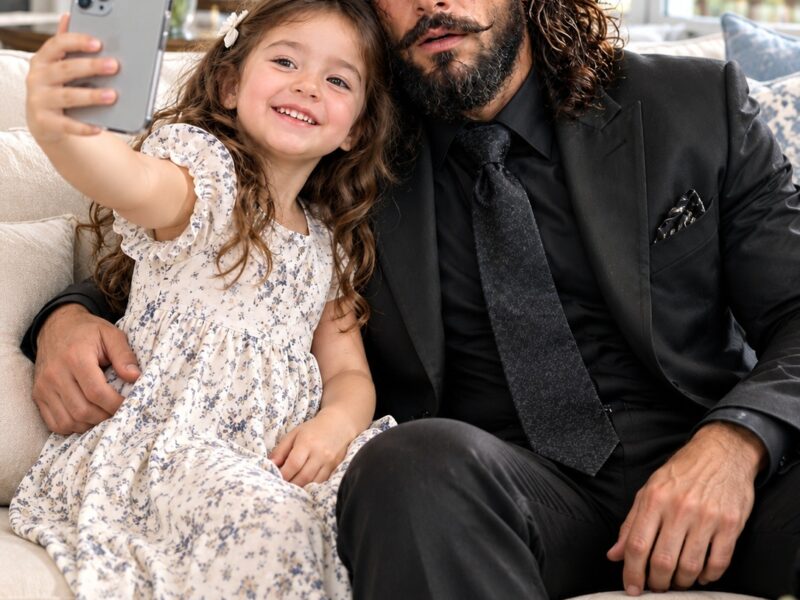
“Say Cheese!” the Maid’s Toddler Told the Mafia Boss—Then He Saw the Photo and Froze
The first time I saw Adrien Voss smile, my daughter was holding my phone upside down.
I remember that detail because everything after it became frightening enough that I spent months wondering if I had imagined the ordinary part.
The warm afternoon light.
The smell of furniture polish.
Mia’s strawberry shampoo.
The ridiculous concentration on the face of the most feared man I had ever met as a two-and-a-half-year-old girl told him how photographs worked.
“Say cheese.”
Adrien Voss looked at her.
I stood frozen in the doorway of his study with folded towels against my chest.
I had worked at the Voss estate for eleven months, and I had never seen him smile.
Not once.
Not when lawyers left his study satisfied.
Not when somebody delivered a bottle of whiskey worth more than my car.
Not when politicians came through the private entrance and emerged two hours later looking relieved.
Adrien did not smile.
He barely changed expression at all.
He was forty-one, broad-shouldered, gray-eyed, and so controlled that even his silence seemed deliberate.
People in New York called him many things.
Businessman.
Investor.
Shipping executive.
Philanthropist when newspapers were being polite.
Other names when they weren’t.
I never repeated those names.
I needed my job too badly to be curious.
Mia did not have that problem.
She stood beside Adrien’s desk in pink leggings and a sweater with a rabbit on the front, both hands wrapped around my phone.
“Mister Voss.”
His eyes moved from the contract in front of him to her.
“Yes?”
“Picture.”
“I can see that.”
“No.”
Mia frowned.
“You picture.”
I closed my eyes for half a second.
“Mia.”
She turned.
“Mommy.”
“That is my phone.”
“Yes.”
“Why do you have it?”
“Picture.”
Apparently we had reached the limits of cross-examination.
Adrien looked at me.
I started forward.
“I’m sorry, sir. She must have taken it from the kitchen counter. I’ll—”
He lifted one hand.
I stopped.
Mia raised the phone.
“Say cheese.”
Adrien stared at her.
Beside the windows, his chief of staff, Renzo Moretti, went absolutely still.
Renzo had worked for Adrien for thirteen years. He could deliver bad news without blinking and had once continued drinking espresso while two men screamed at each other in the foyer.
Now he looked nervous.
“Mia,” I whispered.
Adrien set his pen down.
“What happens if I don’t say cheese?”
My daughter considered this.
“Bad picture.”
Renzo looked toward the ceiling.
I knew that look.
He was trying not to laugh.
Adrien noticed.
“You have an opinion?”
“No, sir.”
“Your face does.”
“I’ll discipline it.”
Mia tugged on Adrien’s sleeve.
“Down.”
His eyebrows lifted.
She pointed at the floor.
“You too tall.”
For one impossible moment, nothing happened.
Then Adrien Voss stood from behind his desk, buttoned his jacket without seeming conscious of the movement, walked around the massive oak desk, and crouched beside my daughter.
His suit probably cost more than I made in two months.
Mia placed one hand against his cheek.
“Look happy.”
The entire study became silent.
Adrien’s gray eyes flicked toward me.
I wanted to disappear into the molding.
Then something changed.
The corners of his mouth lifted.
Barely.
But it was real.
The expression softened the severe lines around his eyes and changed his whole face so completely that I almost dropped the towels.
Mia beamed.
“There.”
She pressed the screen.
The phone made its tiny camera click.
For one second, Adrien Voss looked like an ordinary man posing badly for a child.
Then Mia turned the phone around.
“See?”
Adrien reached for it.
He was still smiling.
Then he looked at the screen.
The smile vanished.
Not slowly.
Instantly.
His fingers tightened around my phone.
His body became so still that the change frightened me before I knew why.
Renzo noticed too.
“Adrien?”
Adrien enlarged the photograph.
Once.
Twice.
His eyes moved toward the study windows.
Then back to the screen.
I stepped closer.
“Sir?”
He ignored me.
“Renzo.”
Something in his voice changed.
Renzo crossed the room immediately.
Adrien turned the phone toward him.
Renzo’s face drained of color.
“That’s impossible.”
Adrien looked at the windows again.
“Close the curtains.”
The two security men near the fireplace moved before I fully understood the sentence.
Heavy curtains crossed the afternoon light.
The room darkened.
Mia frowned.
“Picture dark now.”
I bent and picked her up.
“What’s wrong?”
Adrien looked at me.
For eleven months, I had seen irritation in that face.
Coldness.
Calculation.
Once, exhaustion.
I had never seen fear.
I saw it then.
“Alina.”
“Yes?”
“Who has been near the east lawn today?”
My heart accelerated.
“I don’t know.”
“Visitors?”
“None that I saw.”
“Deliveries?”
“Groceries around ten.”
“Flowers for Mrs. Callaway’s sitting room.”
“Who delivered them?”
“I don’t know.”
Adrien turned.
“Renzo.”
“Already checking.”
I tightened my arms around Mia.
“Mr. Voss, what did you see?”
His eyes returned to the photograph.
A second passed.
Then another.
“Take Mia upstairs.”
“What?”
“Use the rear staircase.”
“Go to the blue guest room.”
“Lock the door.”
My stomach dropped.
“Why?”
“Alina.”
His voice softened.
That frightened me more.
“Please.”
I went.
I did not stop for my purse.
The hall that had always felt too elegant suddenly felt exposed.
Every window.
Every doorway.
Every turn.
Mia bounced against my hip.
“Mommy fast.”
“I know.”
“Game?”
“No, sweetheart.”
She felt my fear.
Her body changed.
Children do that.
They become quiet before adults realize they’ve let the truth into the room.
I reached the blue guest room, locked the door, pulled the curtains, and sat on the carpet with Mia pressed against me.
Downstairs, the house erupted into movement.
Doors.
Footsteps.
Men speaking into radios.
A car engine starting.
Another stopping.
For eleven months, I had worked around Adrien Voss’s security as if it were part of the architecture.
Men in dark suits.
Cameras at gates.
Black SUVs.
Nothing unusual if you refused to think too hard.
That afternoon, the architecture moved.
And for the first time, I understood that every precaution in that house existed because somebody, somewhere, had given Adrien reasons to need them.
Mia touched my cheek.
“You mad?”
“No.”
“Scared?”
I swallowed.
“A little.”
She climbed into my lap.
“I scare too.”
That almost broke me.
I loosened my arms.
“You’re safe.”
I had no evidence for the promise.
I made it anyway.
Forty-three minutes later, somebody knocked.
Three slow.
Two quick.
I recognized Adrien’s pattern.
I opened the door two inches.
He stood alone.
No jacket.
White shirt sleeves rolled to his forearms.
He looked tired.
“Is she okay?”
“Yes.”
I opened the door.
Adrien stepped inside.
Mia was sitting on the bed drawing circles on hotel stationery I had found in a desk.
She looked up.
“Cheese man.”
Adrien closed his eyes briefly.
“Apparently.”
I folded my arms.
“What was in the picture?”
He looked at me.
“Something I need to explain.”
“Then explain it.”
Adrien glanced at Mia.
I understood.
“Mia, sweetheart.”
She looked up.
“Can you put all the circles on this page?”
“Yes.”
“How many?”
“All.”
Excellent.
I took Adrien into the small adjoining sitting room but kept the connecting door open.
I could still see Mia.
Only then did he take out my phone.
He had printed the photograph.
Of course he had.
The original showed Mia’s face in the foreground, Adrien crouching beside her, that rare smile.
Behind them, the study windows reflected the lawn beyond the house.
Adrien pointed.
At first I saw nothing.
Then I saw a man.
Across the service road beyond the eastern hedge.
Dark coat.
Head angled slightly.
Standing beside an old oak.
His face was small in the reflection.
Blurred.
But visible.
“Who is he?”
Adrien stared at the print.
“Marcus Ray.”
The name meant nothing to me.
“Should I know that?”
“No.”
His jaw tightened.
“He was the closest thing I had to a brother.”
“Was?”
“I was told he died eight years ago.”
I looked at the photograph again.
“And you’re certain that’s him?”
“I spent six years working beside him.”
“How did he die?”
Adrien’s eyes hardened.
“That answer depends on which lie I believed.”
I waited.
He leaned against the table.
“Eight years ago, somebody gave the Kavak organization information about one of my operations.”
There were names even people like me knew not to ask about.
Kavak was one.
“Four men died.”
I said nothing.
“Marcus had access.”
“Evidence pointed to him.”
“He disappeared before I could confront him.”
“A week later, I received proof that he was dead.”
“What kind of proof?”
Adrien’s expression closed.
“The kind that was sufficient at the time.”
“That is not an answer.”
“No.”
I surprised both of us with the sharpness in my voice.
Adrien nodded slightly.
“It isn’t.”
He looked toward Mia.
“When people want you afraid, they rarely give you the whole truth.”
I crossed my arms tighter.
“If that man betrayed you, why would he stand outside your house?”
“I don’t know.”
“Why would he let himself appear in a photograph?”
“I don’t know.”
“You say that a lot for someone everyone else seems terrified of.”
The corner of his mouth moved.
Not amusement.
Recognition.
“That may be why this bothers me.”
I looked at the photograph.
“He wasn’t looking at you.”
Adrien became still.
I pointed.
“The angle.”
His head was turned slightly.
Not toward Adrien.
Toward Mia.
Adrien took the photograph from me.
Studied it.
Then looked through the open doorway at my daughter.
His expression changed.
“Alina.”
“What?”
“Has anyone contacted you recently?”
“What kind of contact?”
“Someone from your past.”
“A stranger who knew things.”
“Anything.”
“No.”
I answered too quickly.
Adrien noticed.
“What?”
“Nothing.”
His gaze sharpened.
“Do not do that.”
“Do what?”
“Decide what I can handle.”
The irony of that sentence would matter later.
At the time, it only irritated me.
“I said no.”
Adrien stared.
Then nodded.
“All right.”
He handed back the phone.
“I’m increasing security.”
“You and Mia should remain here tonight.”
My stomach tightened.
“Remain here.”
“As a precaution.”
“That sounded like an order.”
His jaw moved.
Then he corrected himself.
“I am asking.”
“You can say no.”
That surprised me.
I looked toward Mia.
The sun was already dropping.
I had no idea who Marcus Ray was.
But I had seen Adrien’s face.
“Yes.”
“One night.”
He nodded.
“One night.”
It became three.
Adrien’s security team found no one on the eastern road.
The traffic camera at the nearest intersection had been out for maintenance.
A house two blocks away had doorbell footage showing a dark sedan leaving around the time the picture was taken.
The plate was unreadable.
Nothing useful.
Nothing comforting.
Mrs. Callaway, the senior housekeeper, moved Mia and me into a guest suite away from the exterior windows.
She had worked at the estate for twenty-seven years and possessed the dry patience of a woman who had seen wealthy men mistake anxiety for authority too many times.
The second morning, she brought coffee.
“For you.”
“Thank you.”
“And juice for the small anarchist.”
Mia looked up.
“I not ant.”
“Exactly what an anarchist would say.”
I smiled.
Mrs. Callaway lowered her voice.
“You should eat.”
“I’m not hungry.”
“Neither is Mr. Voss.”
“That is not my problem.”
“Good.”
I stared.
She sipped her coffee.
“Keep saying that.”
Then she left.
Something had changed in the house.
Adrien doubled security.
He also became quieter.
He did not bark orders at me.
Did not explain more than he knew.
That should have reassured me.
Instead, I found myself watching him.
On the third afternoon, I carried a folder into his study.
The photograph lay enlarged on his desk.
A security still sat beside it.
Marcus Ray’s face.
Sharper.
I stopped.
Not because I recognized the face.
Because I recognized the body.
The slight lean onto his right leg.
The left shoulder a fraction lower.
The way his hand rested near his coat pocket.
My fingers went cold.
Adrien looked up.
“What?”
I could not answer.
I stepped closer.
The man in the photograph was older.
Hair longer.
Thinner through the face.
A scar crossed one side of his jaw.
But posture does not age the way faces do.
“Alina?”
I touched the photograph.
“My husband stood like that.”
Adrien did not move.
“What?”
“Daniel.”
I heard my voice as if someone else were using it.
“He hurt his knee in high school.”
“Always favored the right side when he stood still.”
Adrien’s face lost color.
“What was Daniel’s last name?”
I looked at him.
“Ray.”
Silence.
Not room silence.
The kind that seems to suck sound out of the walls.
Adrien stood.
“Full name.”
“Daniel Marcus Ray.”
His eyes closed.
One second.
That was all.
I understood before he spoke.
“No.”
My hand went to the desk.
“Alina.”
“No.”
“I need you to listen.”
“That is not him.”
“It may be.”
“My husband disappeared three years ago.”
Adrien’s head jerked slightly.
“Disappeared?”
I laughed once.
Painfully.
“Yes.”
“I told people he left.”
“Eventually I told Mia her father was gone.”
“But there was no body.”
Adrien stared.
“You thought he abandoned you.”
“What else was I supposed to think?”
“We had been fighting.”
“He said something about needing to fix a problem before it reached us.”
“Then he vanished.”
“His phone disconnected.”
“His bank account stopped moving.”
“Nobody came to tell me anything.”
“I was five months pregnant.”
I stopped.
Adrien’s expression changed.
“He knew?”
“No.”
“I found out two days after he left.”
The words hurt as much as they had three years ago.
“I spent six months calling hospitals.”
“Police.”
“Old coworkers.”
“The shipping company where he said he worked.”
“They had never heard of him.”
Adrien looked sick.
“Because Daniel wasn’t his first name.”
I stared.
“What?”
“Marcus Daniel Ray.”
The room tilted.
I sat without deciding to.
“No.”
Adrien remained standing.
“He used Daniel sometimes.”
“His mother called him Danny.”
“Most of us called him Marcus.”
“You’re lying.”
“I wish I were.”
I looked toward the photograph.
The scar.
The posture.
The gray in his hair.
Three years of anger against a man who had vanished.
Eight years of Adrien believing that same man was dead.
Neither version made sense.
“Why would he tell me his name was Daniel?”
“I don’t know.”
“Why would he marry me?”
Adrien’s face sharpened.
“You were married?”
“Courthouse.”
“No family.”
“He said his parents were dead.”
Adrien looked away.
“His mother died when he was twenty-four.”
“Father before that.”
That detail was true.
My chest hurt.
“Mia.”
Adrien looked toward the hallway.
“How old exactly?”
“Two years, seven months.”
He calculated.
Then stopped himself.
I saw it.
“Do not.”
“Do not what?”
“Turn my daughter into arithmetic in front of me.”
His face changed.
“You’re right.”
I stood.
“I need to leave.”
“Alina.”
“I need to take Mia home.”
“There may be someone watching—”
“And there it is.”
I faced him.
“You tell me I can say no until my answer becomes inconvenient.”
“That’s not fair.”
“No?”
“My husband may be the man outside your house.”
“You knew him.”
“You thought he betrayed you.”
“Now I’m living under your roof because you think somebody might use my daughter.”
“And you expect me to stay because you say it’s safer.”
“I expect nothing.”
“Good.”
I picked up the photograph.
He did not stop me.
“I’m taking this.”
“Yes.”
“I want copies of everything that shows that man.”
Adrien nodded.
“Yes.”
“And I want your security people nowhere near Mia’s daycare without my permission.”
His jaw tightened.
“Alina.”
“No.”
“I need one thing in my life nobody secretly arranges.”
He said nothing.
Then:
“Agreed.”
I left that afternoon.
I went to my sister’s apartment instead of mine.
I told her enough to make her stop asking questions.
Then I called Rachel Kim.
Rachel had represented me during a wage dispute after Daniel disappeared.
She was thirty-nine, Korean American, wore red glasses, and had a habit of tapping a pen twice before saying something unpleasant.
She listened.
Then tapped twice.
“First unpleasant thing.”
“What?”
“You do not go back to that estate until we know more.”
“I need the job.”
“I know.”
“Second unpleasant thing.”
Tap.
Tap.
“You need to stop treating Adrien Voss’s security team like law enforcement.”
“I don’t.”
“You were sleeping in his house because he told you there was danger.”
“That is treating private power like public authority.”
I hated that she was right.
“What do I do?”
“Police report.”
“For what?”
“The suspicious man photographing you and your child.”
“I have no proof he took the photo.”
“No.”
“But you have evidence he was watching the house.”
“You also have a man with two identities who may be your missing husband.”
“We document.”
The word steadied me.
Rachel continued.
“No dramatic confrontation.”
“No secret meeting.”
“No accepting a bag of money.”
“I wasn’t planning to.”
“You work for a reputed mafia figure.”
“I am covering the obvious.”
I almost smiled.
“Anything else?”
“Eat.”
“That is not legal advice.”
“It is if I say it while billing.”
We filed a report.
The detective did not laugh.
That mattered.
We gave him the photograph.
The name Marcus Daniel Ray.
Daniel’s missing-person report.
The old address.
My marriage certificate.
The detective promised nothing.
Also good.
Then Rachel requested my employment records.
That was the first real piece of evidence.
Eleven months earlier, I had applied through Harrison Domestic Staffing.
I remembered filling out forms in a cramped office in White Plains while Mia colored on the back of an old brochure.
A placement coordinator named Denise had told me about the Voss position.
“Family friend referral.”
That was what she had called it.
I never asked whose friend.
Rachel did.
Harrison’s records showed my application had been pushed into a priority interview category after an outside employment nonprofit sent a recommendation.
The nonprofit was called New Path Initiative.
Harmless name.
Clean website.
Job support for widows and single mothers.
I remembered them.
They had helped me after Daniel disappeared.
Boxes of clothes.
A grocery card.
One donated stuffed rabbit for Mia.
My stomach turned.
The recommendation to Voss had come from New Path.
Rachel traced its largest private donor.
Kavak Community Foundation.
I called Adrien immediately.
He answered after one ring.
“Alina.”
“Did you know?”
“Know what?”
I told him.
Silence.
Then:
“Send it to Renzo.”
“No.”
Another silence.
“My lawyer will send it to the detective.”
“Then you can receive a copy through him if they allow it.”
Adrien did not argue.
That mattered.
“Okay.”
I almost didn’t know what to do with the word.
Then he said, “Are you somewhere safe?”
“Rachel would object to the question.”
“I like Rachel less every hour.”
“She’ll survive.”
“So will I.”
“I hope so.”
His voice went quiet.
“So do I.”
Two days later, somebody tried to pick Mia up from daycare.
The woman wore navy scrubs.
She knew my full name.
Mia’s name.
My sister’s name.
She said I had been injured and sent her.
The daycare director asked for our family password.
The woman did not know it.
Strawberry moon.
She left.
Police obtained security footage.
The car she used had temporary plates that did not match its registration.
That was the moment fear stopped feeling abstract.
I sat in Rachel’s office with my hands wrapped around cold coffee.
“I want to disappear.”
“That may be an option.”
“I’m serious.”
“So am I.”
She tapped her pen twice.
“But not through Voss.”
I looked at her.
“If law enforcement believes you need relocation, we handle it properly.”
“No private safe house.”
“No unrecorded men with guns.”
“You are remarkably judgmental about my employer.”
“I am remarkably alive.”
My phone rang.
Adrien.
I looked at Rachel.
She nodded.
I answered.
“I heard.”
“How?”
“The detective called Renzo because of the original photograph.”
His voice was controlled.
Too controlled.
“Are you and Mia safe?”
“Yes.”
“Alina.”
“What?”
“I am going to ask you something.”
“You may say no.”
I waited.
“Let Mia’s rabbit be examined.”
My body went cold.
“What?”
“The one she carries.”
“How do you know about Kevin?”
“She had it in the study.”
“I noticed a repair along the side.”
“Marcus once used commercial trackers hidden in ordinary objects.”
I stood.
Rachel watched my face.
“You think—”
“I don’t know.”
“There it is again.”
“I know.”
I looked toward Mia, who was drawing in Rachel’s outer office.
The stuffed rabbit sat beside her.
One button eye.
A stitched seam along the belly.
I had bought it at a New Path charity sale.
Or thought I had.
“Police.”
I said.
“Yes.”
Adrien answered immediately.
“Police.”
We surrendered the rabbit.
Mia cried harder over losing Kevin for evidence than she had cried after falling from a playground slide.
The forensic report came forty-eight hours later.
Inside the toy was a small commercially available location transmitter and audio recorder.
Nothing exotic.
Nothing magical.
A device with a serial number.
Purchase records eventually connected a batch to a security contractor that had done subcontracted work for Kavak-owned properties.
The report changed the case.
So did the employment referral.
We now had two independent threads.
One placed me in Adrien Voss’s house.
One placed a tracking device in an object my daughter carried there.
Neither proved I was the intended spy.
Together they made coincidence much harder to defend.
Adrien came to Rachel’s office.
At her insistence.
No private mansion.
No security team in the room.
Renzo stayed outside.
Adrien looked uncomfortable in the cheap conference chair.
I appreciated that more than I should have.
Rachel placed the evidence folders between us.
“This is what we know.”
She summarized.
No speculation.
No mafia mythology.
Records.
Dates.
The photograph.
The attempted daycare pickup.
Then she looked at Adrien.
“What do you know that law enforcement does not?”
He was quiet.
Rachel tapped her pen.
“Mr. Voss.”
“I know Marcus survived.”
“That is an inference.”
“No.”
Adrien looked at me.
“He contacted Renzo last night.”
My chest tightened.
“What?”
Rachel’s expression hardened.
“How?”
“Encrypted message through an old business channel.”
She held up one hand.
“I do not need technical details.”
Good woman.
Adrien continued.
“Marcus asked for a meeting.”
“With you?”
“Yes.”
“And?”
“I said no.”
That surprised me.
“Why?”
Adrien looked at me.
“Because Alina has spent three years having men decide what truth she gets.”
I stared.
Rachel said, “That is unexpectedly sensible.”
Adrien almost smiled.
“I dislike you.”
“Mutual.”
He looked back at me.
“He says the danger is not you.”
“Not Mia.”
“He says you were placed inside my house without your knowledge.”
“Why?”
“He won’t say except face-to-face.”
Rachel leaned back.
“Then there will be no private face-to-face.”
Adrien’s jaw tightened.
“I know.”
She looked almost disappointed not to argue.
The meeting happened two days later at a police-controlled conference facility in Westchester.
Not Adrien’s estate.
Not a warehouse.
Not some dramatic abandoned dock.
Fluorescent lights.
Bad coffee.
A table bolted to the floor.
Reality is rarely elegant.
Marcus Ray entered through another door.
My body forgot how to breathe.
Older.
Thinner.
Scar across his jaw.
But Daniel.
My Daniel.
The same eyes that used to find me across crowded grocery stores.
The same crooked left thumb from a childhood baseball injury.
The same man I had cursed in empty rooms for three years.
He saw me.
Stopped.
“Alina.”
I stood so fast the chair scraped.
Rachel touched my wrist.
Not restraining.
Reminding.
Marcus’s eyes filled.
“I’m sorry.”
I laughed.
It sounded awful.
“That is your opening?”
His face crumpled.
“No.”
“Good.”
I sat.
Adrien remained completely still across the table.
If hatred could be measured in temperature, the room would have frozen.
Marcus looked at him.
“Adrien.”
“Marcus.”
Neither man moved.
Rachel said, “This is already exhausting.”
The detective almost smiled.
Marcus looked at me again.
“I did not know about Mia until six months ago.”
I gripped the table.
“How?”
“Kavak communications.”
“My name appeared.”
“Your maiden name.”
“Your employment.”
“A reference to a female child.”
He swallowed.
“I did the math.”
“Don’t.”
I said it so sharply everyone stopped.
“Do not reduce her to math.”
His eyes closed.
“You’re right.”
The similarity to Adrien’s earlier mistake made me furious.
“You both do that.”
“What?”
“Turn fear into calculation.”
“No wonder you used to be friends.”
Adrien looked away.
Marcus did not defend himself.
That helped a little.
He continued.
“Three years ago, I disappeared because people had found me.”
“I believed if I stayed, you would become leverage.”
“You were already pregnant.”
“I didn’t know.”
“So instead of telling me anything, you vanished.”
“Yes.”
“Protection.”
I spat the word.
He flinched.
“Yes.”
“I am beginning to hate that word.”
“I understand.”
“No.”
“You don’t.”
I leaned forward.
“You left me without a body.”
“Do you understand that?”
“I checked morgues.”
“I called your mother’s old number even though she had been dead for years because I had nowhere else to call.”
“I spent nights wondering if I had missed some sign that you were planning to leave.”
“And when Mia was born, I had to decide whether to tell her her father abandoned us or died.”
“I chose ‘gone’ because it was the only honest word I had.”
Marcus’s face had gone gray.
“I know I cannot repair that.”
“Good.”
“Do not try today.”
He nodded.
Adrien finally spoke.
“Kavak.”
Marcus looked at him.
Eight years compressed into that one name.
“I gave them information.”
The room became still.
Adrien’s jaw tightened.
Marcus continued before he could interrupt.
“They threatened my younger brother.”
“I told them where one meeting would happen.”
“They said they wanted to scare you.”
“Four men died.”
Adrien’s voice went flat.
“I know how many.”
Marcus looked down.
“I have known every day.”
“You disappeared.”
“I tried to go back.”
“Kavak’s people came for me first.”
“They left me in a car they set on fire.”
“That was the proof you received.”
Adrien stared.
Marcus touched the scar along his jaw.
“I survived.”
“A truck driver found me.”
“I spent months recovering under another name.”
“And then?”
“I ran.”
Adrien laughed once.
A terrible sound.
“You always were good at that.”
Marcus accepted it.
“I built a life as Daniel Ray.”
“I met Alina.”
“I thought the past was dead.”
He looked at me.
“I was wrong.”
I said nothing.
Marcus continued.
“Kavak found me again three years ago.”
“I left because I believed leaving was the only way not to bring them to her door.”
Rachel said quietly, “And did it work?”
Marcus closed his eyes.
“No.”
“Because they found Alina anyway.”
“Yes.”
“How?”
“I don’t know exactly.”
“They had old records.”
“Employment records.”
“Marriage filings.”
“Eventually they connected her.”
Adrien tapped the folder.
“They sent New Path.”
“Yes.”
Marcus looked sick.
“The nonprofit is legitimate at the surface.”
“Kavak money moves through it.”
“They steer vulnerable people toward places where those people become useful.”
Rachel’s face hardened.
“That is an ugly sentence.”
“It is an ugly system.”
Marcus looked at me.
“They put you near Adrien because your connection to me made you valuable.”
“You carried a child.”
“You looked harmless.”
I stared at him.
“Mia’s rabbit.”
He nodded.
“I found references to the device six months ago.”
“Why didn’t you just contact police?”
“I did.”
That surprised everyone except the detective.
Marcus glanced toward him.
The detective said, “Mr. Ray has been cooperating for five months.”
Adrien’s eyes narrowed.
“With whom?”
“Federal investigators.”
No one spoke.
Marcus continued.
“They needed evidence connecting Kavak’s front organizations to surveillance and intimidation.”
“I was helping identify channels.”
“Then I saw Alina’s name.”
“Why stand outside the estate?”
I asked.
He looked ashamed.
“I wanted to see you.”
My throat tightened.
“And Mia.”
“Yes.”
“So the photograph was an accident.”
“Mostly.”
Adrien leaned forward.
“Mostly.”
Marcus looked at him.
“I saw her lift the phone.”
“I realized the window reflection would catch me.”
“I could have moved.”
“You didn’t.”
“No.”
“Why?”
Marcus swallowed.
“Because I needed you to know I was alive.”
Adrien’s expression hardened.
“That was reckless.”
“Yes.”
“It endangered them.”
“Yes.”
Marcus did not soften it.
“I made another decision for everyone because I thought I knew best.”
“I am learning that pattern has cost me almost everything.”
For the first time, Adrien had no immediate answer.
I looked at both men.
The feared mafia boss.
The presumed-dead betrayer.
Two intelligent adults who had built entire lives around not asking permission from the people they claimed to protect.
“Here is what happens now.”
Everyone looked at me.
I surprised myself.
“Mia and I cooperate with law enforcement.”
“Through Rachel.”
“Not through Adrien.”
“Not through Marcus.”
Adrien nodded once.
Marcus did too.
“No private security unless police recommend it.”
Adrien opened his mouth.
I pointed.
“No.”
He closed it.
“Good.”
Rachel almost smiled.
I continued.
“Marcus does not meet Mia until I decide.”
Pain crossed his face.
He nodded.
“And Adrien.”
“Yes?”
“If I return to work, it is because I choose to.”
“Not because you think your house is safest.”
“Understood.”
I looked at the detective.
“What do you need from me?”
For the first time in the entire nightmare, somebody answered the question without telling me where to go first.
The investigation lasted four months.
Most of it was boring.
That was reassuring.
Statements.
Device records.
Financial documents.
Agency contracts.
Phone calls from Rachel asking if I remembered dates.
More statements.
I did not become bait.
Mia did not become leverage.
The police and federal investigators made that boundary explicit.
The transmitter from the rabbit, the New Path referral trail, and Marcus’s records helped establish a pattern of unlawful surveillance tied to several Kavak-connected businesses.
Other victims emerged.
Former employees.
Contractors.
A city inspector who had found a tracker beneath his car.
A bookkeeper whose sister had been threatened.
The mythology around powerful families began to shrink once people put dates beside invoices.
Adrien cooperated too.
That cost him.
His businesses came under scrutiny.
He handed over records his lawyers would once have hidden behind procedural walls.
Some of his associates disappeared from his life when they realized he was serious about making his legitimate companies actually legitimate.
Renzo called it “the least glamorous revolution in organized crime history.”
Adrien looked at him.
“You are still employed.”
“Barely.”
“Correct.”
One evening, I found Adrien alone in his study.
The same room where the photograph started everything.
My phone sat on the desk beside him.
Police had returned it after imaging the original photograph.
“You kept the picture.”
I said.
He looked down.
A print lay beside him.
Mia laughing.
Adrien smiling.
Marcus in the reflection.
“Yes.”
“Why?”
“I’m not sure.”
I stepped closer.
“Try.”
He thought.
“Because for years, every photograph taken of me was deliberate.”
“Press.”
“Events.”
“Evidence that I was somewhere.”
“Evidence that I wasn’t somewhere.”
“Mia took one because she wanted me to say cheese.”
I looked at the photograph.
“And it almost blew up your life.”
“No.”
Adrien shook his head.
“My life was already built around things I refused to look at.”
“The photograph just put them in one frame.”
That was better than I expected.
I sat.
“What happens to you when this case ends?”
He understood the real question.
Not Marcus.
Not Kavak.
Him.
“I leave certain businesses.”
“Certain relationships.”
“You make that sound easy.”
“It will be expensive.”
“Good.”
He looked at me.
“You’re becoming cruel.”
“I work around terrible influences.”
The corner of his mouth lifted.
Then faded.
“I cannot ask Mia to grow up around a world where men solve fear with violence.”
The honesty in that sentence hurt.
“What if you cannot leave cleanly?”
“I leave slowly.”
“Legally.”
“With people who know what they’re doing.”
“No dramatic exit.”
I nodded.
“Rachel would approve.”
“I continue liking her less.”
“That is mutual.”
By then, I no longer worked at the estate full-time.
I had resigned six weeks after the photograph.
Not because Adrien asked me to.
Because I needed something in my life that did not exist because a man with power decided it should.
Mrs. Callaway wrote me a reference.
A brutally accurate one.
ALINA MARSH: EXCELLENT ORGANIZATION, EXCELLENT DISCRETION, OCCASIONALLY ARGUMENTATIVE WHEN MANAGEMENT DESERVES IT.
I framed it.
I took a supervisory housekeeping position at a hotel in White Plains.
Less glamorous.
More ordinary.
Exactly what I wanted.
Mia started preschool full-time.
She missed Adrien.
That complicated things.
“Cheese man come?”
She would ask.
“Not today.”
“Tomorrow?”
“Maybe.”
Eventually I stopped pretending distance was a moral achievement.
Safe relationships were not measured by how far apart people stood.
They were measured by choice.
So Adrien saw Mia in public places.
A park.
A diner.
Once the aquarium.
The first time he arrived without a security detail visible, I stared.
“Where are they?”
“Far enough away that you won’t complain.”
“I can still complain.”
“I assumed.”
Mia ran toward him.
“Cheese man.”
Adrien crouched.
“I have a name.”
“No.”
He looked at me.
“I blame you.”
“Accept consequences.”
He smiled.
Marcus did not meet her until almost five months after the conference-room meeting.
That was my choice too.
By then, he had pleaded guilty to one federal conspiracy charge related to the information he had given Kavak eight years earlier.
His cooperation mattered.
It did not erase what he had done.
The agreement included prison time.
Thirty months.
When his lawyer told me, I felt three contradictory things at once.
Relief.
Anger.
Grief.
Rachel said that was normal.
I told her I was tired of normal being so inconvenient.
Before sentencing, I let Marcus meet Mia.
Supervised.
A quiet room at a family-services center.
He brought no gift.
I had asked him not to.
Mia looked at him.
He looked at her.
My daughter’s eyebrows pulled together.
“You know Mommy?”
Marcus’s face almost broke.
“Yes.”
“Long time?”
“Yes.”
“You make Mommy sad?”
He closed his eyes.
“Yes.”
Mia considered.
“Say sorry.”
“I am sorry.”
She looked at me.
I nodded.
Then she handed him a plastic dinosaur.
“Hold.”
Marcus took it like someone had placed a heart in his hands.
They played for twenty minutes.
He did not tell her he was her father.
Not that day.
That came weeks later with a child therapist guiding the conversation.
Mia’s understanding was simple.
“Daddy was gone because he made bad choices and scary people found him.”
Not elegant.
Accurate enough for three.
She asked the question that hurt most.
“Why didn’t he come home?”
Marcus answered himself.
“Because I was scared.”
She stared at him.
“Mommy scared too.”
“Yes.”
“And Mommy stayed.”
Marcus cried.
I did not rescue him from that moment.
He needed it.
Before he reported to prison, he wrote Mia letters for every month he expected to be gone.
Rachel kept them.
We decided together when Mia received them.
That was what accountability looked like in our house.
No heroic disappearance.
No mystery.
Dates.
Promises.
Consequences.
Adrien’s consequences were different.
No court sentenced him for being feared.
Life did.
He sold his interests in two businesses that had depended on men he no longer trusted.
He installed outside compliance leadership in the companies he kept.
He stopped using family loyalty as a substitute for oversight.
Renzo resigned from operational work and returned as a consultant six months later.
Mrs. Callaway retired and immediately began calling Adrien twice a week to tell him what he was doing wrong.
He answered every call.
That may have been his greatest reform.
The estate itself changed.
Curtains stayed open.
The east study door stopped being treated like a sacred object.
Adrien donated half the art he did not like but had kept because intimidating people seemed like a reason to own enormous paintings.
He bought a photograph for the mantel.
Not our photograph.
His mother.
I had not known she existed.
“She died when I was nineteen.”
He said.
“You never mention her.”
“No.”
“Why?”
He looked at the frame.
“She hated what my father became.”
“And?”
“I became enough like him that remembering her felt like being observed.”
I understood that too well.
“Maybe being observed isn’t always bad.”
“No.”
He looked at me.
“Apparently not.”
Our relationship changed so slowly I did not notice the exact day friendship became something else.
There was no rescue.
No moment where he handed me a house and I realized I loved him because billionaires solve things attractively.
I would have hated that story.
Instead, it was small.
He learned not to send a car unless I asked.
I learned to call him when I was angry rather than punish him with silence.
He came to Mia’s preschool winter concert and sat in the back because I said I didn’t want his security distracting everyone.
Mia wore cardboard antlers and sang three notes too loudly.
Adrien looked at her like she had just performed at Carnegie Hall.
Afterward, he said, “She was the best.”
“She was one of twelve identical reindeer.”
“No.”
“Objectively.”
I laughed.
“You know nothing about music.”
“Correct.”
“Then your opinion is invalid.”
He stared.
“Mia.”
She ran over.
“Yes?”
“Your mother is being disrespectful.”
Mia looked at me.
Then at him.
“Say cheese.”
Adrien closed his eyes.
That became our private joke.
Photos.
The thing that exposed everything.
Mia insisted on taking them constantly.
Most were terrible.
Half a face.
A chair.
Adrien’s shoes.
One picture of his forehead that she considered exceptional.
For months, Adrien checked reflections automatically.
Windows.
Mirrors.
Glass doors.
I noticed every time.
Then one afternoon at the park, Mia held up my phone.
“Picture.”
Adrien crouched beside her.
He hesitated.
Only a second.
Then smiled.
She took it.
Turned the screen around.
Adrien looked.
Nothing behind them.
No shadow.
No dead friend.
No warning.
Just blue sky.
Trees.
A toddler’s grin.
His own face.
He exhaled.
Mia frowned.
“What?”
“Nothing.”
She put both hands on his cheeks.
“Smile bigger.”
He did.
I took another picture.
That one stayed on my phone.
A year after Marcus entered prison, Adrien asked me to dinner.
A date.
He used the word because I had once complained powerful men liked ambiguity when it benefited them.
“I am asking you on a date.”
He said it in my hotel lobby.
I looked at his suit.
“You rehearsed that.”
“Yes.”
“How many times?”
“Enough.”
“Where?”
“Restaurant.”
“Public?”
“Yes.”
“No private room?”
“No.”
“Security?”
“Discreet.”
“No men staring at the table?”
“I negotiated them down.”
I smiled.
“Yes.”
Dinner was awkward.
Good awkward.
He asked questions he did not already know the answer to.
That was new for him.
“What do you want in five years?”
“To stop being asked five-year-plan questions by rich men.”
He almost choked on his wine.
“Fair.”
I thought.
“I want Mia to know she is loved without having to perform for it.”
Adrien’s expression changed.
“That’s not about five years.”
“No.”
“Some goals are ongoing.”
“What about you?”
He was quiet.
“I want to become someone people can disagree with safely.”
That silenced me.
He looked down.
“I don’t know if that sounds strange.”
“It sounds difficult.”
“Yes.”
“Good.”
“You say that often.”
“Difficult keeps you humble.”
“I have employees for that.”
“No.”
“You have employees for work.”
“Humility is personal.”
He laughed.
No one in the restaurant turned around.
Another change.
We dated for eighteen months before I let him suggest living together.
Suggest.
Not announce.
Mia was five by then.
Marcus had been released after serving most of his sentence and was in supervised reentry.
He saw her every other weekend at first.
Then more.
Their relationship grew carefully.
Not magically.
Mia loved him.
Mia also got angry at him.
Both were healthy.
One afternoon she refused to hug him goodbye.
Marcus looked hurt.
I waited until we were in the car.
“You okay?”
“No.”
“Want to talk?”
“No.”
Ten minutes later:
“He leaves.”
The sentence broke me.
“Yes.”
“He always leaves.”
“He has to right now.”
“I don’t like it.”
“I know.”
She kicked the back of the seat once.
I did not tell her to stop being angry.
Marcus learned too.
The next visit he did not arrive with a toy.
He sat beside her.
“I know leaving makes you mad.”
She glared.
“Yes.”
“I’m going to keep coming back when I say I will.”
Mia said nothing.
Trust is repetitive.
Children know that before adults do.
Adrien respected Marcus’s place in her life.
That surprised everybody, including Marcus.
The first time they were in the same room after his release, tension sat between them like furniture.
Marcus finally said, “You don’t have to forgive me.”
Adrien replied, “Good.”
I closed my eyes.
“Wonderful start.”
Adrien looked at me.
“I’m being honest.”
“Try being useful.”
Marcus almost smiled.
Adrien looked back at him.
“I don’t forgive what you did.”
“I believe you were afraid.”
“Both can be true.”
Marcus nodded.
Adrien continued.
“But Mia should not have to divide her loyalty to make us comfortable.”
Something shifted in Marcus’s face.
“Agreed.”
That was their peace treaty.
Not friendship.
Enough.
The proposal happened three years after the first photograph.
No private helicopter.
No ballroom.
No restaurant full of violinists being paid to pretend not to watch.
My kitchen.
Tuesday night.
Mia was at the table making a school poster about insects.
Adrien had cooked.
Technically he had ordered dinner and put it on plates.
He considered that cooking.
I was arguing with him about it.
“You moved food.”
“I plated.”
“You transferred chicken between containers.”
“With intention.”
Mia looked up.
“Fight later.”
Adrien and I both stopped.
She pointed at her poster.
“I need glue.”
I handed it over.
When I turned back, a small black ring box sat beside my water glass.
I stared.
Adrien looked terrified.
Mia gasped.
“Cheese.”
“No.”
Adrien said.
She grabbed my phone.
“Cheese.”
“Absolutely not.”
I laughed so hard I had to sit down.
Adrien looked betrayed.
“I planned this.”
“That was your first mistake.”
Mia held the phone up.
“Say cheese.”
Adrien looked at me.
I looked at him.
Then he laughed.
“Fine.”
Mia took the photograph before he even opened the box.
The click filled the kitchen.
For a second, nobody moved.
Three years earlier, one child’s photograph had captured a man who should have been dead and ripped open every lie around us.
Now Mia turned the phone around.
All three of us looked.
Adrien.
Me.
Mia at the edge of the frame.
Behind us, the kitchen window reflected only the room.
Warm lights.
A refrigerator covered in Mia’s drawings.
Marcus’s latest postcard to her held by a magnet.
Nothing hidden.
Adrien stared at it.
I touched his arm.
“You okay?”
“Yes.”
He looked at me.
“Actually, yes.”
Mia pointed at the ring box.
“You forgot marry.”
Adrien closed his eyes.
“I am being managed.”
“Ask Mommy.”
He opened the box.
The ring was simple.
Beautiful.
Not enormous.
I later learned Renzo had threatened to resign from friendship if Adrien bought “something with its own weather system.”
Adrien took my hand.
“I spent most of my adult life thinking protection meant controlling every variable.”
“I was wrong.”
He glanced at Mia.
“Repeatedly.”
She nodded.
I laughed.
He continued.
“You taught me that loving someone is not the same as arranging their life.”
“Mia taught me that people who aren’t afraid of you sometimes tell you the truth faster than everyone else.”
“And both of you taught me that being seen is not the same thing as being vulnerable to attack.”
His voice shook.
That mattered.
“I want to build something ordinary with you.”
“Something nobody has to hide inside.”
“Will you marry me?”
I looked at Mia.
She was practically vibrating.
Then at Adrien.
“Yes.”
Mia screamed.
Adrien laughed.
And then she made us take twelve more photographs because apparently one engagement required documentation from every angle.
We married the following fall.
Small ceremony.
Marcus attended.
He sat beside Mia.
Not in the front row.
Not hidden.
Simply there.
Renzo gave a toast that began:
“I have known Adrien for sixteen years, and I can confirm that a toddler achieved in one photograph what therapy, legal advice, and several near disasters failed to accomplish.”
Adrien stared.
Renzo raised his glass.
“He learned to smile before checking the exits.”
People laughed.
Adrien did too.
There were consequences that laughter did not erase.
Kavak-linked businesses lost licenses after investigations exposed surveillance, fraud, and intimidation.
Several executives went to prison.
New Path was restructured under new independent leadership after investigators found its job-placement system had been abused.
The daycare woman pled guilty to charges connected to the attempted unauthorized pickup.
Marcus continued reporting to his probation officer.
Adrien remained under legal and financial scrutiny as he dismantled parts of the world he had built.
We paid taxes.
Attended therapy.
Argued over schedules.
Had ordinary fights about whether Mia needed another pair of shoes.
That was the recovery.
Not becoming untouchable.
Becoming ordinary enough that problems could remain problems instead of emergencies.
Five years after that first photograph, I found the original print in Adrien’s study.
It sat inside a drawer beneath contracts.
Not displayed.
Not hidden either.
Mia was seven.
She had lost two teeth and gained strong opinions about science.
She found me holding it.
“That me?”
“Yes.”
She climbed beside me.
“Why Mr. Adrien look weird?”
I smiled.
“You call him Adrien now?”
“Sometimes.”
“He says Dad is okay too.”
My throat tightened.
Marcus was still Dad.
Adrien had never asked for the word.
Mia had eventually given him her own version.
She looked at the photograph again.
“Who’s behind us?”
The question finally came.
I sat down.
“That man is your father.”
“Dad?”
“Yes.”
“You knew?”
“Not when the picture was taken.”
She frowned.
“What happened?”
I chose truth in pieces.
“Your dad had made some serious mistakes before you were born.”
“He got scared.”
“He left when he should have trusted me enough to tell me what was happening.”
“Then some people tried to use us because of those mistakes.”
“And this picture helped us realize something was wrong.”
Mia studied Marcus’s tiny reflection.
“So my picture helped?”
“Yes.”
She looked pleased.
“I’m good photographer.”
“That is not the lesson.”
“Still true.”
I laughed.
Adrien entered.
“What are you two doing?”
Mia held up the photograph.
“Old cheese.”
He stopped.
For a moment, I saw the old reaction.
Shoulders.
Eyes.
Memory.
Then he crossed the room and sat beside us.
Mia studied him.
“Were you scared?”
Adrien looked at the picture.
“Yes.”
“Lots?”
“Yes.”
She leaned against him.
“You didn’t look scared.”
“I practiced.”
“Why?”
He thought.
“Because when I was younger, I thought people respected men who never looked afraid.”
Mia frowned.
“Do they?”
“Sometimes.”
“Is that good?”
“No.”
She nodded.
Then took my phone.
“New picture.”
Adrien groaned.
“No.”
“Say cheese.”
“Mia.”
She lifted the phone.
I laughed.
Adrien looked at me.
The same man.
Different face.
He moved closer.
Mia squeezed between us.
“Ready?”
Adrien glanced once toward the window.
I noticed.
So did he.
Then he looked back at the camera.
No checking twice.
No calculation.
Just trust enough for one second.
“Cheese.”
The phone clicked.
Mia turned it around.
No figure waited in the reflection.
No secret.
No warning.
Behind us was only the study.
Sunlight.
Books.
A framed dinosaur drawing.
A family photograph from our wedding.
The ordinary evidence of years nobody had planned correctly.
Mia approved.
“This one good.”
Adrien looked at the screen.
Then at me.
“Yes.”
He said it quietly.
“This one is good.”
And this time, when he smiled, nobody froze.









