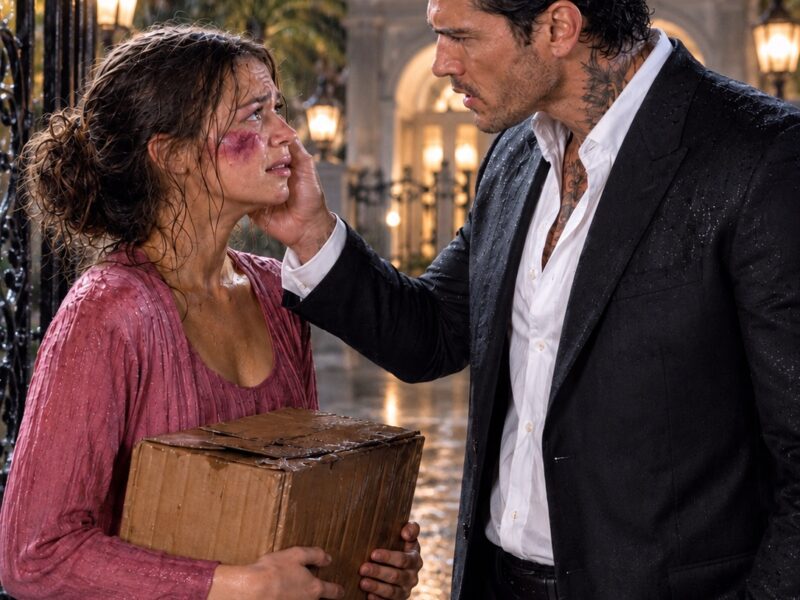
She Arrived at the Mafia Boss’s Mansion Bruised — He Looked at Her and Asked, “Who Hurt You?”
Delia Kavanaugh arrived at the Santangelo mansion carrying an empty cardboard box.
That was the first thing Emilio noticed.
Not the rain flattening her dark hair against her face.
Not the coat ripped open at one shoulder.
Not even the purple bruise spreading beneath her left cheekbone.
The box.
One corner had been crushed inward. The bottom sagged from having once carried more than it did now, but when Delia shifted it beneath her arm, the thing weighed almost nothing.
She stood outside the wrought-iron gate on Atwells Avenue at seven sixteen on a Sunday evening, shivering beneath a streetlamp while November rain glazed the sidewalks of Providence.
People in Federal Hill knew the house.
They also knew not to linger near it.
Emilio Santangelo had lived behind those iron gates for seventeen years, and in that time men had come asking for loans, favors, protection, introductions, contracts, forgiveness.
Some came wearing thousand-dollar suits.
Others came with hats in their hands.
One man had once come on his knees.
Delia Kavanaugh came with a broken box and apologized before Emilio could say a word.
“I know how this looks.”
Her voice was hoarse.
He said nothing.
“You hired a teacher.”
Rain slid from the edge of her coat.
“And whatever showed up at your gate tonight does not particularly resemble one.”
Emilio’s eyes dropped once to the bruise.
Delia noticed.
She immediately angled her face away.
“I understand if you changed your mind.”
“I didn’t say that.”
“You don’t have to.”
She gave a tiny, exhausted smile that did not survive long enough to become convincing.
“I have nothing with me anymore. I can find somewhere else tonight. I’m sorry you had to come outside.”
Emilio looked at the empty box again.
Then at the tear in her coat.
“Who hurt you?”
Delia’s fingers tightened around the cardboard.
“No one.”
His expression did not move.
“I slipped on the stairs.”
Three seconds passed.
Delia would remember those three seconds for years.
She expected disbelief.
An interrogation.
Maybe the kind of cold amusement powerful men used when they knew someone had lied badly.
Emilio only nodded.
“All right.”
That frightened her more.
Because he clearly did not believe her.
Before either could say more, the front door opened behind him.
Emilio turned sharply.
A small figure slipped through the doorway.
Bare feet touched wet stone.
“Sabina.”
The eight-year-old girl ignored him.
She descended the seven front steps one at a time.
Her white nightgown brushed her ankles. Her dark hair hung loose around her shoulders.
Delia had seen one photograph of Sabina Santangelo attached to the job description Father Bruno had given her.
That photograph had been taken before the funeral.
In it, Sabina was six and smiling around two missing front teeth.
The child approaching Delia now had not spoken a word in almost two years.
Delia bent automatically when Sabina stopped in front of her.
Not because she expected speech.
Because eight years of teaching had taught her adults frightened children most when they towered over them.
“Hi,” Delia said quietly.
Sabina looked at the bruise on her face.
Then at the torn coat.
Not the box.
Not Emilio.
The bruise.
Delia resisted the instinct to hide it.
Rain tapped against the iron gate.
Somewhere down the street, tires hissed over wet pavement.
Sabina lifted her hand.
Delia did not move.
The child placed her palm inside Delia’s.
Carmela Ruggiero, who had worked in the Santangelo household for twenty years, appeared in the doorway behind them.
She froze.
Emilio did too.
Delia did not understand why.
Sabina closed her fingers.
Then turned toward the house.
She began walking.
Delia had two choices.
Pull away from a silent child.
Or follow.
She followed.
Halfway up the steps, the cardboard box slipped from beneath her arm and fell into the courtyard.
She did not notice.
Sabina did not release her hand.
Carmela moved aside as they entered.
Her eyes were wet.
Delia thought she had imagined it.
Behind them, Emilio bent in the rain and picked up the box.
It was exactly as light as he expected.
Three weeks earlier, a private investigator had given him thirty pages about the woman who had just lied to his face.
Her teaching record.
Her husband.
Her dead son.
A civil judgment.
Two years of garnished wages.
A debt company whose name had appeared once before in a file connected to Emilio’s late wife.
He knew the bruise had probably not come from stairs.
He also knew Delia had arrived anyway.
Emilio carried the box into the foyer and placed it on the table where Carmela usually left mail.
Delia stood under the chandelier dripping onto hardwood.
Sabina still had her hand.
“I’m sorry,” Delia began.
Emilio interrupted.
“I didn’t hire a suitcase.”
She stopped.
He took off his coat.
“There were three applications.”
Delia looked at him.
“Father Bruno gave me all three.”
Emilio nodded toward the staircase where Sabina stood beside her.
“You had the least impressive résumé.”
Delia blinked.
“That is reassuring.”
Carmela almost smiled.
Emilio continued.
“You remember what you wrote at the bottom?”
Delia did.
She had written the application at two in the morning on ruled notebook paper because she could no longer afford printer ink.
“I said I couldn’t promise to make her speak.”
“Yes.”
“I said I could sit beside her while she remained silent.”
“For as long as it takes.”
Delia looked toward Sabina.
The girl watched them.
Emilio’s voice softened.
“That’s why you’re here.”
Delia swallowed.
He looked at Carmela.
“Find her dry clothes.”
Then toward Delia.
“Dinner is still warm.”
“I’m not hungry.”
“In this house, nobody has to earn food before eating it.”
Something in Delia’s face broke.
Only for a second.
She looked away.
Emilio saw.
He pretended not to.
That night, after Sabina finally slept, Emilio asked Delia to meet him in the kitchen.
Carmela was already there.
Delia noticed immediately.
“Am I being fired?”
“No.”
Emilio pulled out a chair.
“Sit.”
She remained standing.
His eyes shifted toward the chair, then back to her.
“Please.”
Better.
Delia sat.
Emilio stayed across from her. Carmela took the head of the table.
“I asked Carmela to stay because I do not want what I’m about to say remembered later as something said by a man alone with a woman who works for him.”
Delia’s shoulders loosened slightly.
Emilio noticed that too.
“You’ll have the room across from Sabina.”
He folded his hands.
“It locks from inside. You will have the only key.”
Delia said nothing.
“Your wages are paid weekly. Bank transfer or check. You choose.”
“All right.”
“You may leave whenever you want.”
Her eyes lifted.
“No notice required?”
“No.”
“That is not normal employment.”
“No.”
Emilio held her gaze.
“No one will block the gate. No one will follow you. No one will ask why.”
She understood the emphasis.
Some of the tension in her neck eased.
Then he said, “And I will not ask about the bruise again.”
Delia froze.
“Or the box.”
Silence.
“Or anything from before tonight that you do not choose to tell me.”
Delia studied him.
Carmela did not move.
The kitchen clock ticked.
“You make very generous rules,” Delia said finally.
“I make clear ones.”
“Those are not the same.”
“No.”
Her eyes narrowed.
“What’s the cost?”
Emilio almost smiled.
“There is one.”
“I assumed.”
“You should know whose house you entered.”
Delia looked toward the ceiling.
“I know your name.”
“That is not the same.”
He leaned back.
“I own Santangelo Bakery. Three warehouses on the harbor. A construction company. Several apartment buildings.”
“I read newspapers.”
“Those are the things newspapers can print without lawyers.”
Delia’s face became still.
Emilio continued.
“People tell stories about me.”
“Yes.”
“Assume most are true.”
Carmela’s eyes moved toward him.
Delia did not flinch.
“You’re telling me you’re a criminal.”
“I’m telling you not to discover it from somebody trying to frighten you later.”
Outside, rain tapped against the kitchen window.
“There is a sedan at the end of the block every night.”
Delia had noticed it.
“Security?”
“Yes.”
“For you?”
“My daughter.”
That answer mattered.
Emilio continued.
“I am not telling you this so you stay.”
His voice became quieter.
“I am telling you so you can decide whether to.”
Delia looked at her hands.
The knuckles were scraped.
Emilio saw them.
He kept his promise.
No questions.
“What does Sabina eat?” Delia asked.
Emilio stared.
Carmela lowered her eyes.
Delia waited.
“What?”
“You told me everything about the locks, guards and exits.”
She looked toward the staircase.
“What does your daughter like for breakfast?”
Emilio opened his mouth.
Nothing came.
Carmela looked ashamed.
“Toast sometimes,” she said.
“With what?”
Silence.
Delia looked from one adult to the other.
Neither knew.
Emilio finally whispered, “I don’t know.”
That answer frightened him more than admitting to organized crime had frightened her.
Delia spent her first night in the Santangelo house in a bedroom with a lock.
She turned the key twice.
Then sat on the edge of the bed.
Carmela had left folded clothes beside her.
Sweatpants.
A sweater.
Clean socks.
Delia took off the torn coat.
The bruise in the mirror looked worse under yellow light.
She touched it once.
Then stopped.
On the dresser sat the empty cardboard box.
Carmela must have brought it upstairs.
Delia stared at it.
That morning, the box had contained the last physical evidence that her son had existed.
By night, it contained nothing.
Three years earlier, Owen Kavanaugh was seven months old when he stopped breathing normally.
Not suddenly.
Quietly.
That made it worse.
Delia had been grading third-grade spelling tests when she heard a thin rasp from the crib.
Her husband Beck was working nights at a plastics plant.
Delia did not wait for an ambulance.
The emergency room was three blocks away.
She ran.
Owen spent nineteen days in intensive care.
Delia learned every machine.
Every alarm.
Every number.
She learned which nurses used gentle tape on infant skin.
She learned how to sleep upright and wake when oxygen saturation changed.
She learned that hope could shrink until it became one more stable hour.
On the nineteenth day, a doctor sat beside her.
Delia knew before he spoke.
She held Owen afterward.
For twenty-two minutes.
Then a nurse asked gently whether she was ready.
Delia was never ready.
Three weeks later, the bill arrived.
Forty-six thousand dollars after insurance.
The hospital had assistance programs.
Delia filled out everything they gave her.
One income verification form had not been included in the original packet.
The application was returned.
She found the form.
Resubmitted.
Three weeks late.
During those three weeks, the hospital sold the balance to an outside company.
The assistance program could no longer touch it.
There was no villain standing over the paperwork.
Just deadlines.
Policies.
Departments.
A machine doing exactly what it had been designed to do.
Beck could not stand watching Delia carry more.
So he made the worst decision of his life alone.
He signed a restructuring agreement with a private debt company called Pharaoh Recovery Services.
The interest clause was buried inside language Delia would later read hundreds of times.
Beck did not bring home the contract.
He believed he could fix everything before she ever knew.
By winter, he could not.
A friend found him work aboard a commercial fishing vessel leaving Point Judith.
Ten days at sea.
Triple his normal pay.
He kissed Delia at four in the morning.
“I’ll be home before you miss me.”
She almost hit him for saying something so stupid.
The Mary Doyle never returned.
A storm tore through the Atlantic.
Search crews found debris.
A life ring.
No bodies.
Delia was twenty-five when she stood beside two coffins within thirteen months.
One was small.
One was empty.
Then Pharaoh’s contract found the survivor.
For two years, Delia paid.
Nearly four hundred dollars every week.
When the company obtained a civil judgment, the payments came directly from her wages.
She worked full time at Olneyville Elementary.
Supervised after-school programs.
Tutored on weekends.
Ate soup more often than anyone should.
After two years she calculated what she had paid.
Over forty thousand dollars.
Then she looked at the balance.
Thirty-eight thousand remained.
She worked it out three times on the backs of student worksheets.
Same number.
Every time.
She told nobody.
Not the principal.
Not her coworkers.
Not Father Bruno.
Then the eviction notice arrived.
On her final Saturday in the apartment, four cardboard boxes stood beside the door.
Delia had two hundred dollars left in cash.
Inside a cloth bag she kept that money beside an old cigar tin.
The tin contained Owen’s baptism ribbon.
And one photograph.
The only photograph Delia owned of her son.
Someone knocked around nine.
A man Delia had seen once before said he had come for that week’s payment.
“My wages are already garnished.”
“Doesn’t cover fees.”
“I don’t have anything else.”
He looked around the empty apartment.
Then took the cloth bag.
Delia lunged.
He shoved her.
Her face struck the doorframe.
Her shoulder tore through the coat seam.
She landed on the hallway steps.
By the time she stood, he was gone.
Delia called police.
Two officers arrived forty minutes later.
They were polite.
Professional.
They asked for the man’s name.
She did not know it.
Cameras?
None.
Witnesses?
None.
Proof of what was inside the bag?
A withdrawal receipt for two hundred dollars.
Not proof of possession.
They filed a report.
They gave her a case number.
Nobody failed at their job.
And Delia still lost the only photograph of her dead son.
She packed three of the cardboard boxes into the landlord’s storage area for later.
The fourth held nothing.
She carried it to Federal Hill the next evening because arriving with empty arms felt more frightening than carrying an empty box.
Now, in Emilio Santangelo’s guest room, Delia lay beneath a clean blanket and stared at the ceiling.
He had promised not to ask.
She did not understand why that promise felt more dangerous than any question.
Morning came quietly.
Sabina sat at the breakfast table eating dry cereal with her fingers.
Delia sat opposite.
She did not mention speech.
She did not mention grief.
She placed a small blackboard beside the salt.
Sabina looked at it.
Delia wrote:
GOOD MORNING.
Then ate toast.
Sabina did nothing.
That afternoon Delia erased it.
She wrote:
RAIN AGAIN.
Nothing.
Next morning:
THE BAKERY SMELLS BETTER THAN THIS HOUSE.
Carmela read it.
“Excuse me?”
Delia smiled.
“Observation.”
Sabina’s mouth moved.
No sound.
On the fourth day Delia drew a terrible cat.
Sabina stared at it for almost five minutes.
On the fifth afternoon Delia returned from school and found writing beneath her morning sentence.
HOW LONG ARE YOU STAYING
No question mark.
The chalk was pressed so hard part had broken.
Delia stood still.
Carmela saw her from the kitchen doorway.
Neither spoke.
Delia picked up the chalk.
She did not write forever.
Children who had already lost someone did not need promises adults could not control.
She wrote:
I DON’T KNOW THE LAST DAY YET.
Then beneath it:
BUT I WILL TELL YOU BEFORE IT COMES.
The next morning one word waited.
OKAY.
Something changed after that.
Not speech.
Trust came first.
The blackboard became a bridge.
Sometimes Sabina wrote three words.
Sometimes twenty.
She asked whether Delia liked snow.
Why people buried bodies.
Whether cats dreamed.
Why adults whispered when children entered rooms.
Delia answered what she could.
When she could not, she wrote:
I DON’T KNOW.
Sabina seemed to trust that answer most.
Emilio watched from doorways.
He did not interfere.
One afternoon, Delia asked permission to bring Sabina into the family bakery after closing.
“Why?”
“She needs something to do with her hands.”
Emilio looked at Sabina.
“What?”
“Bread.”
He frowned.
Delia added, “Children are less suspicious of dough than therapists.”
Carmela snorted.
Emilio allowed it.
At four thirty, after customers left, the bakery became another world.
Flour hung in warm air.
Old wooden tables bore knife scars older than Delia.
Renzo Santangelo—Emilio’s cousin and closest lieutenant—stood near the ovens watching Delia teach Sabina to fold dough.
Sabina made a misshapen head.
Two eyes.
A huge mouth.
Delia laughed.
Sabina’s shoulders began shaking.
No sound.
But laughter.
Renzo went very still.
That night he told Emilio.
“She laughed.”
“I know.”
“How?”
“I was standing outside.”
Renzo looked at him.
“You always standing outside rooms now?”
Emilio did not answer.
Renzo softened.
“She’s good with her.”
“Yes.”
“You trust her?”
Emilio looked toward the staircase.
“I’m trying.”
Delia earned Carmela’s trust eleven days after arriving.
At two in the morning, Carmela went downstairs for water.
She found Delia under the kitchen lamp sewing the ripped shoulder of her coat with black thread.
“You know he’ll buy you another.”
Delia did not look up.
“I know.”
“Then why are you doing that?”
“Because this one still works.”
“That man owns half of Federal Hill.”
“I’ve noticed.”
“He would give you money without asking.”
Delia pushed the needle through fabric.
“That is exactly why I will not ask.”
Carmela stood in the doorway.
The next evening, she left a plate of lasagna warming beneath a cloth for Delia after school.
Neither mentioned it.
Emilio watched the household shift.
Small things.
Sabina began sitting downstairs longer.
Carmela hummed again while cooking.
Delia left school papers on the dining table.
The house had spent two years behaving like a mausoleum.
Now chalk dust appeared on furniture.
Emilio did not know how much he had missed mess until it returned.
But Delia noticed something too.
Every few evenings Sabina disappeared into the attic.
She would climb the narrow stairs.
Pull the door nearly shut.
Stay forty minutes.
Sometimes an hour.
Delia never followed.
Never asked.
Waiting meant respecting closed doors.
Four months later, an open door found her instead.
It began with chalk.
The kitchen box ran empty.
Emilio was reading a shipping invoice when he said, “There’s more in the bakery office.”
Delia looked up.
“Now?”
“Renzo should be there.”
He wasn’t.
The bakery had closed.
The back door was unlocked.
A lamp burned inside the office.
Renzo’s coat hung over his chair.
His coffee remained warm.
He had obviously left in a hurry.
Delia found the stationery cabinet.
Then saw the file.
Her name was typed across the cover.
DELIA KAVANAUGH.
She stood motionless.
Two steps.
That was all the distance between ignorance and knowledge.
Delia should have left.
She knew it.
Instead she walked to the desk.
Opened the file.
Her entire life sat inside.
Owen’s death certificate.
The Mary Doyle manifest.
Beck Kavanaugh, fourth line.
The garnishment order.
Pharaoh Recovery Services.
Two years of payments.
Her rejected hospital-aid application.
The police report from the night she lost the cloth bag.
Even the withdrawal receipt.
Delia turned page after page.
Anger should have come.
It did not.
Of course Emilio Santangelo investigated people entering his daughter’s home.
The real surprise would have been believing otherwise.
Then she reached the last page.
A yellow note was stuck inside the back cover.
Handwritten.
Dated ten days before Delia first arrived at the gate.
PHARAOH.
SAME PERSON?
VERIFY.
Delia read it three times.
The air changed.
The file was not merely a background check.
Emilio had been investigating Pharaoh before he hired her.
And somehow Delia’s name had intersected that investigation.
She closed the folder.
Put it exactly where it had been.
Took the chalk.
Walked home through cold streets without remembering a single turn.
At nine thirty she entered the kitchen.
Emilio was there.
Of course.
Tea sat between them.
Delia did not sit.
“I saw the file.”
Emilio placed down his cup.
“Yes.”
“You knew about the debt.”
“Yes.”
“The garnishment.”
“Yes.”
“My son.”
His expression changed.
“Yes.”
“My husband.”
“Yes.”
She swallowed.
“You had it before I arrived.”
“Three weeks.”
“Why?”
“I don’t let unknown adults live beside my daughter.”
“I understand that.”
Emilio looked surprised.
Delia stepped closer.
“What I don’t understand is the note.”
His face became unreadable.
“Pharaoh. Same person. Verify.”
Silence.
“Who is Pharaoh?”
Emilio looked at her for a long time.
Then said, “Wrong question.”
Delia’s eyes narrowed.
“I decide my questions.”
“Yes.”
He nodded.
“But the harder one is why, after reading everything in that file, I still opened the gate.”
Delia stopped.
Emilio held her gaze.
He did not answer.
Not that night.
The question remained between them for months.
Oddly, it brought them closer.
Around nine thirty each evening, after Sabina slept, Delia made tea.
Somehow Emilio was always there.
Neither called the meetings meetings.
They sat at opposite corners of the kitchen table.
One night, Emilio told her about Rosalie.
His wife had died two years earlier on Route 44.
Black ice.
No second vehicle.
No witnesses.
Accidental death.
Emilio had spent two years refusing the conclusion.
“I hired three investigators.”
“What did they find?”
“Nothing.”
“Bad investigators?”
“No.”
He looked toward his tea.
“The last returned half his fee.”
Delia understood.
“He believed it was an accident.”
“Yes.”
“What do you believe?”
Emilio’s jaw tightened.
“That people connected to me don’t usually die accidentally.”
Delia stayed quiet.
He continued.
“The investigator told me the most dangerous case is sometimes the one with no conspiracy and a client who needs one.”
Emilio rubbed one thumb along the cup.
“If Rosalie simply hit ice, there is no one to punish.”
Delia looked at him.
“And that is harder?”
“Yes.”
The answer came instantly.
Honest.
Ugly.
Human.
Emilio whispered, “An enemy gives grief somewhere to go.”
Delia poured more tea into his cup.
That was all.
A week later, she brought her own paper.
The hospital assistance application.
Folded so often the creases felt like cloth.
“I have read this at least four hundred times.”
Emilio frowned.
“Why?”
“To find where I made the mistake.”
He opened it.
Delia watched him read.
Her pulse climbed.
Maybe a man whose entire world depended on contracts and obligations would see the line she had missed.
Emilio read front.
Back.
Fine print.
Then read again.
Finally he folded it along the old creases and pushed it toward her.
“You didn’t make a mistake.”
Delia stared.
“The application was late.”
“Because they omitted a required attachment from your packet.”
“But I should have—”
“No.”
His voice sharpened.
“You followed the instructions you received.”
Delia’s face changed.
Emilio continued.
“The assistance structure allowed the hospital to sell the account before an incomplete application could be corrected.”
“That is legal.”
“Legal and fair are not synonyms.”
She looked at the paper.
For two years she had carried a private trial inside herself.
One defendant.
One judge.
Same woman.
“If I didn’t make the mistake…”
Her voice failed.
Emilio understood.
Then there was no reason.
No simple point where a better Delia could have fixed everything.
Her son died.
The form failed.
Beck hid a contract.
The boat sank.
Life did not arrange itself around moral arithmetic.
Tears filled her eyes.
Emilio did not touch her.
He did not tell her everything happened for a reason.
He sat there.
Exactly as she had promised to sit beside Sabina.
That night Delia put the application back into her wallet.
She never unfolded it again.
Three nights later, Carmela knocked on Delia’s bedroom door.
“Come with me.”
Carmela’s room was small and severe.
Inside a locked cabinet she removed something wrapped in linen.
An old leather ledger.
Delia stared.
“What is this?”
Carmela sat.
“Something I stole.”
Delia blinked.
“From whom?”
“Men who deserved worse.”
Carmela unfolded the cloth.
“I found it three years ago in the bakery office safe.”
“Why?”
“I wasn’t looking.”
“Then why take it?”
Carmela looked toward the hallway.
“Because I recognized names.”
She told Delia she had spent years unable to decide what to do.
The ledger documented debts.
Loans.
Collections.
People throughout Providence.
Some debts belonged to desperate families.
Some had been sold repeatedly.
Some appeared to continue long after payment.
Carmela feared going to police.
Feared giving it to Emilio.
Feared destroying the family that had paid her wages for twenty years.
“I kept waiting for someone I trusted.”
Delia looked at her.
“Why me?”
Carmela smiled sadly.
“You walked into this house with empty hands and never once asked what he could put in them.”
Delia carried the ledger to her room.
She opened it after midnight.
Names.
Dates.
Amounts.
Notes.
Page after page.
She recognized a florist from Knight Street.
A mechanic.
Parents of two former students.
Mrs. DeLuca from St. Bartholomew’s fourth pew.
An entire neighborhood written down like inventory.
Two-thirds through, Delia found Beck.
BECK KAVANAUGH.
Original balance.
Fees.
Dates.
Then a blue stamp.
PAID IN FULL.
Delia stopped breathing.
The handwritten date beside it was two months before the Mary Doyle left Point Judith.
She checked twice.
Then a third time.
No mistake.
The debt had been cleared.
Completely.
Before Beck took the fishing job.
Before the boat sank.
Before Delia spent two more years paying.
She sat on the floor.
The ledger open on her lap.
No tears.
Two years.
One hundred four weeks.
Nearly four hundred dollars each.
Soup.
Extra classes.
The torn coat.
The apartment.
The cloth bag.
All of it for a debt that no longer existed.
And Beck had died trying to pay something already paid.
Someone had known.
Someone kept collecting.
Delia turned more pages.
Then another name stopped her.
ROSALIE SANTANGELO.
Date: September.
Two months before her death.
No loan amount.
Another debtor’s name beside hers.
Mrs. DeLuca.
In the notes column:
REFUSED.
Underlined twice.
Delia understood piece by piece.
Rosalie had gone to Pharaoh’s people on behalf of an elderly woman from church.
Tried to buy or clear the debt.
They refused.
Her name entered the ledger not as debtor.
As interference.
As someone who had seen too much.
Two months later, her car left the road.
Delia closed the book.
She sat until morning.
Then carried it to Emilio.
Renzo was with him.
Delia opened to Rosalie’s name.
Emilio read.
He did not react outwardly.
He turned backward.
Found Beck.
Saw PAID IN FULL.
His jaw tightened.
Then he spent fifteen minutes reading.
Finally he closed the ledger.
His hands stayed on the cover.
“The night before you came here.”
Delia looked at him.
“You said you fell down the stairs.”
Renzo stood.
He looked once at Emilio.
Then left the room.
Delia stared across the desk.
Understanding came.
“You knew.”
Emilio said nothing.
“You knew someone from Pharaoh came to my apartment.”
“Yes.”
“Before I arrived.”
“Yes.”
“Why didn’t you say anything?”
“You told me you fell.”
“That was a lie.”
“I knew.”
Her voice rose.
“And you let me lie?”
“I promised I would not ask what you didn’t choose to tell me.”
Delia stopped.
He had kept it.
For four months.
Even when the answer might connect directly to his wife’s death.
Even when men like Emilio built lives on information.
“You needed that answer.”
“Yes.”
“And you waited.”
“Yes.”
“Why?”
Emilio looked toward the ledger.
Then at her.
“Because I had spent too many years making fear a reason to take things from people.”
His voice became quieter.
“I was not going to take the truth from you too.”
That was the moment Delia understood why he had opened the gate.
Not because he pitied her.
Because somewhere inside a file full of debt, death and bad luck, Emilio had recognized another person who had been crushed by systems built by men who believed power excused everything.
And perhaps because he knew the system had his fingerprints on it too.
The ledger changed the house.
Not immediately.
Secrets rarely explode on discovery.
They shift the floor.
Auggie Pharaoh was fifty-seven and had survived three generations of organized crime by understanding when power was changing before anyone else did.
He operated debt-purchasing companies through layers of legitimate names.
Pharaoh Recovery was only one.
He bought distressed debt cheaply.
Collected aggressively.
Sometimes legally.
Sometimes after debts were already satisfied.
Sometimes through intimidation.
And over the years Emilio’s own businesses had indirectly guaranteed several of those portfolios.
He had known there was money.
He had never asked closely enough how it was collected.
That was his guilt.
Not Rosalie’s death.
Not yet.
But participation.
One week after Carmela surrendered the ledger, a law firm mailed a letter to Delia’s old apartment.
The new landlord forwarded it.
The language was immaculate.
Their client had learned she changed residence.
Their client requested an updated address.
Their client understood that documents belonging to certain financial entities might have come into her possession.
Nothing legally threatening.
That made it worse.
Four days later, a sedan appeared outside the bakery.
Stayed forty minutes.
Left.
Two nights later it returned.
Then came the envelope.
Inside was the original contract Beck had signed.
The contract Delia’s free lawyer had once said might have allowed a challenge if she possessed it.
Clipped to the document was one handwritten sentence.
There are many more papers belonging to your family.
Renzo wanted war.
“Three men.”
Emilio sat inside the bakery office.
Renzo paced.
“One night.”
“No.”
“They’re testing us.”
“I know.”
“Everyone will know.”
“Let them.”
Renzo stared.
“What happened to you?”
Emilio stood.
He pointed toward the ceiling.
Above them, Sabina slept.
“Last time men in this family proved something with bullets, my daughter lost her mother.”
“We don’t know Pharaoh killed Rosalie.”
“No.”
Emilio’s voice hardened.
“And until I know, I will not manufacture certainty with bodies.”
Renzo looked at him for a long time.
Then sat.
“What do we do?”
“Read.”
Renzo frowned.
Emilio placed the ledger between them.
“All of it.”
Winter deepened.
Emilio asked Delia to stop teaching temporarily.
She refused.
“Twenty-two children expect me Monday.”
“You could be followed.”
“Yes.”
“I can replace your salary.”
“That is not the point.”
“I can put guards at the school.”
“No.”
“Delia.”
She stared.
Emilio closed his mouth.
Then asked.
“What would make you feel safe enough to continue?”
She considered.
“One car.”
“Two.”
“One.”
“Two men inside one car.”
“Across the street.”
“Fine.”
“No guns visible.”
“That is insulting to their professionalism.”
“Emilio.”
“Fine.”
She returned to school.
Her students noticed the car.
One boy asked whether Miss Kavanaugh was secretly president.
She said yes and assigned him multiplication.
At home, Sabina kept writing on the blackboard.
More now.
Still no voice.
February brought freezing rain.
Weather warnings covered Rhode Island.
One afternoon Sabina coughed three times during homework.
Delia touched her forehead.
Normal.
Emilio had business at the harbor.
He hesitated at the kitchen door.
“Should I stay?”
Delia looked at Sabina.
“She’s fine.”
“You’re sure?”
“As sure as anyone can be.”
He nodded.
Then left.
At eleven that night, power failed across Federal Hill.
The brownstone went black.
Sabina’s breathing had already changed.
Delia heard it from the hallway.
Tight.
Fast.
A whistle beneath each exhale.
Carmela called the physician.
Bridge closed.
Ambulances delayed hours.
Sabina had asthma.
The rescue inhaler helped.
Not enough.
Delia gave the prescribed second dose.
Then third.
Still not enough.
The nebulizer required power.
A portable generator sat in the garden shed.
Freezing rain coated every surface.
Delia brought Sabina into the bathroom and ran hot water until steam filled the room.
She propped the child upright.
Counted respirations by wristwatch.
Carmela held Sabina’s hand.
Inside Delia, another hospital room reopened.
Owen.
Monitor.
Oxygen.
Nineteen days.
Her hands stayed steady.
That was the strange thing about old terror.
Sometimes it taught the body what to do while the mind screamed.
Around midnight Delia handed Carmela the watch.
“Count thirty seconds.”
“Where are you going?”
“Generator.”
“Absolutely not.”
“Then you go.”
Carmela looked toward Sabina.
Neither woman moved.
Delia put on Emilio’s old raincoat from the mudroom.
“I’ll be back.”
Outside, ice covered the garden.
Delia fell once.
Hit her hip.
Kept going.
The generator started on the seventh pull.
At 12:48, three upstairs lights returned.
The nebulizer hummed.
Delia sat beside Sabina until dawn.
At five, the breathing finally eased.
Carmela went downstairs to make tea because her hands needed something ordinary.
Delia remained beside the bed.
Sabina slept.
Gray light reached the curtains.
Delia was about to stand when she heard a sound.
“Don’t.”
She froze.
Sabina’s eyes were open.
Delia stopped breathing.
The voice was faint.
Rough from disuse.
But unmistakable.
Sabina had spoken.
Delia leaned closer.
“What did you say?”
The child’s eyes filled with fear.
“Don’t tell my father.”
Four words.
Not Mama.
Not Delia.
Not water.
A warning.
Cold moved down Delia’s back.
“Tell him what?”
Sabina closed her eyes.
Would not speak again.
At six, the iron gate opened.
Emilio had walked the final two miles home because the roads were impassable.
His sleeve was torn.
Renzo followed with his shoulder bandaged.
Pharaoh’s men had used the storm to pressure the harbor warehouses.
No shots had been fired.
Because Emilio stood between both sides until everyone backed down.
He entered the foyer.
Carmela stood at the top of the staircase.
“She spoke.”
Emilio stopped.
One hand gripped the banister.
“What?”
“Sabina.”
His face lost all color.
“What did she say?”
Delia stood behind Carmela.
She had three seconds.
For four months, she promised Sabina she would never leave without telling her.
For months Emilio had kept every promise he made to Delia.
Truth had to move both directions.
“She said, ‘Don’t tell my father.’”
Emilio looked as if someone struck him.
He went upstairs.
Watched his daughter sleep.
Came back down.
Said nothing for three days.
Sabina began speaking in fragments afterward.
Water.
Toast.
No.
Homework.
Small words.
Nobody celebrated too loudly.
Delia waited.
On the third afternoon Sabina took her hand.
Led her upstairs.
Past the second floor.
To the attic.
Delia had never climbed those stairs before.
Sabina pulled up one loose floorboard near the window.
Beneath it lay a yellowed envelope.
She lifted it with both hands.
Held it toward Delia.
“I kept it for Mom.”
Delia did not ask questions.
She crouched.
Sabina collapsed into her arms.
The child cried.
Really cried.
Two years of grief came without elegance.
Then, with her face against Delia’s shoulder, Sabina whispered one word.
“Mom.”
Delia’s eyes closed.
She did not correct her.
She did not replace Rosalie.
Love did not require erasing someone dead.
“I’m here.”
That was all.
Later, after Sabina slept, Delia opened the envelope.
A letter.
Three handwritten pages of names and numbers.
Rosalie Santangelo’s handwriting.
Delia read twice.
Rosalie had discovered Pharaoh’s ledger.
She had copied three pages.
She planned to take them to federal prosecutors in Boston.
She wrote to Emilio because she knew what he would call it.
Betrayal.
She wrote that she still loved him.
That was why she was doing it.
Their daughter was six.
Rosalie could no longer bear imagining Sabina growing up understanding exactly what her father did and believing silence was the price of family loyalty.
She wrote:
I have asked you to leave this life in every language I know.
You always tell me there is no clean door out.
Maybe there isn’t.
But I cannot teach our daughter that the absence of a clean door means we stop looking for one.
She apologized three times.
The final line said:
I’ll be home before daylight.
She never came home.
Delia found Emilio in the attic.
He sat beneath the window beside the open floorboard.
She gave him the envelope.
But first she said, “Whatever you read, remember Sabina was six.”
Emilio looked at her.
“She carried this alone.”
“Yes.”
“When you finish, your face will be the first answer she gets about whether she did something wrong.”
Emilio took the letter.
He read.
Halfway through, he stopped.
His face lifted toward the ceiling.
Then he continued.
When he reached the handwritten ledger pages, his shoulders collapsed.
His wife had been prepared to send him to prison.
Not because she hated him.
Because she loved their daughter enough to believe prison might be safer for Sabina than inheriting his world.
That truth hurt.
The next truth was colder.
Rosalie saw the ledger in September.
Her name entered it.
She copied pages.
Two months later, her car left the road.
Emilio had searched two years for a thread.
It had been beneath his roof.
Fourteen steps from where he slept.
“What are you going to do?” Delia asked.
Emilio held the letter.
“I cannot prove Pharaoh killed her.”
“You believe it.”
“Yes.”
“Belief is not evidence.”
He looked at her.
The sentence hurt.
Because it was true.
“I can kill him.”
“Yes.”
“Everyone expects me to.”
“Yes.”
“What do you expect?”
Delia sat opposite him on the dusty floor.
“I expect you to decide what kind of father walks downstairs.”
Emilio looked toward the attic door.
“That is not an answer.”
“It is the only one that matters.”
The next morning he knelt on the kitchen floor in front of Sabina.
At eye level.
He told her he read the letter.
He told her she should never have had to carry it.
Then he said something no one in Federal Hill had heard Emilio Santangelo say easily.
“I’m sorry.”
Sabina’s hands clutched her nightgown.
Emilio’s voice broke.
“Adults are supposed to carry the heavy things.”
Her chin trembled.
“You carried mine.”
Sabina began crying.
Then asked the longest question she had spoken in two years.
“Was Mommy angry with me because I hid it?”
The kitchen went silent.
Carmela turned toward the sink.
Delia gripped the doorway.
Emilio finally had an answer.
“No.”
Sabina watched him.
“No, sweetheart.”
He swallowed.
“Your mother wrote that letter because she was thinking about you.”
Sabina’s lips trembled.
“From the first line to the last.”
He touched his own chest.
“She was angry with me.”
A breath.
“Not you.”
Sabina stepped forward.
Emilio opened his arms.
She wrapped herself around his neck.
Father and daughter stayed on the floor for a long time.
That evening Sabina talked through dinner.
A cat she drew.
A math problem.
Why bread rose twice.
Ordinary eight-year-old nonsense.
Nobody at the table dared look at anyone else for too long.
Ordinary had become sacred.
People in Federal Hill expected what came next.
A black car.
A warehouse.
Auggie Pharaoh disappearing.
It never happened.
Emilio carried the ledger to a copy shop.
Alone.
He made three complete copies.
He removed nothing.
Not even the pages connecting his own companies to the debt network.
One set went to the Rhode Island Attorney General.
One to federal financial-crimes investigators.
One to the Providence Journal.
Renzo discovered what he had done that afternoon.
For the first time in twenty years, he shouted at Emilio.
“You put our names in there.”
“I know.”
“The warehouses.”
“I know.”
“People will go to prison.”
“I know.”
“You could have torn out six pages.”
“I know.”
Renzo slammed both hands onto the desk.
“Then why didn’t you?”
Emilio looked toward the ceiling.
His daughter was upstairs.
“Because the first words Sabina spoke after two years were ‘Don’t tell my father.’”
Renzo stopped.
Emilio continued.
“She learned in this house that truth was dangerous.”
His voice became quieter.
“She watched her mother hide a letter from me. She hid it too. For two years.”
Renzo sat.
“I can keep warehouses.”
Emilio looked at him.
“Or I can raise a daughter who does not have to hide under my roof.”
Renzo stared at the floor.
“This will cost you everything.”
“No.”
Emilio shook his head.
“Everything is upstairs.”
Four months of investigations followed.
No sudden raids.
No spectacular revenge.
Subpoenas.
Bank records.
Interviews.
Audits.
Pharaoh’s debt network began collapsing under documentation.
Hundreds of families discovered they had continued paying debts already settled.
Delia learned Beck’s debt had been paid through a credit-life policy attached to his original hospital refinancing.
Pharaoh Recovery knew.
They kept collecting.
That discovery did not bring Beck back.
It did something quieter.
It finally removed guilt from his last decision.
He had gone to sea believing he failed his family.
The failure had never belonged entirely to him.
Delia cried when the restitution attorney explained it.
Not because the money mattered.
Because Beck had not been stupid.
He had been desperate inside a structure designed to make desperation profitable.
Emilio cooperated too.
Fully.
Against Pharaoh.
Against intermediaries.
Against himself.
His lawyers negotiated.
They told him he could shield certain transactions.
He refused.
“Everything.”
His attorney stared.
“You understand you may serve time.”
“Yes.”
“You have a child.”
“I know.”
“Then why volunteer evidence nobody asked for?”
Emilio thought of Rosalie.
Then Sabina.
“Because my wife died on the way to tell the truth.”
He looked toward Delia.
“I am not going to use her courage only against other men.”
Emilio pleaded guilty to financial coercion and conspiracy offenses tied to parts of the ledger.
Fourteen months.
The sentence stunned Federal Hill.
Not because it was severe.
Because Emilio accepted it.
The Sunday before he reported, the brownstone stayed deliberately ordinary.
Carmela cooked chicken with lemon.
Sabina completed homework.
Renzo discussed bakery payroll.
At nine, Sabina went upstairs.
Delia stood in the foyer with Renzo.
She asked him one quiet question.
He looked surprised.
Then nodded.
“All right.”
She never told Emilio what she asked.
After Renzo left, she returned to the kitchen.
Emilio sat with tea.
The same two corners of the table.
He looked at her.
“When I asked Father Bruno for applications, I thought I needed a teacher.”
Delia smiled faintly.
“You did.”
“No.”
He shook his head.
“I thought I needed someone useful.”
She waited.
“I needed someone to make my daughter speak.”
His eyes moved toward the blackboard.
“What I got was someone who taught me how to listen.”
Delia looked down.
Emilio continued.
“I spent two years living in this house and did not know what my daughter liked for breakfast.”
His voice roughened.
“I did not know what she did in the attic.”
“I was afraid to enter her room.”
He laughed without humor.
“I can call half this city at three in the morning and have them answer.”
He looked at her.
“I was afraid of an eight-year-old girl’s bedroom.”
Delia’s eyes filled.
“You were grieving.”
“I was hiding inside grief.”
Silence.
Emilio stood.
“I need to say something before Monday.”
Delia looked up.
“I almost asked you months ago to stay because Sabina needs you.”
She waited.
“That would have been wrong.”
“Why?”
“Because then I would be turning your care into an obligation.”
He came no closer.
“I am not asking you to be useful.”
Delia’s heart began beating harder.
“I’m asking whether you could someday let me love you.”
She closed her eyes.
Emilio continued.
“I am going away for fourteen months.”
“I know.”
“You owe me none of them.”
She opened her eyes.
“I know.”
“If you decide tomorrow that staying here is too much, Renzo will arrange anything you need.”
“Emilio.”
“I mean it.”
“So do I.”
He stopped.
Delia stood.
For most of her adult life, the first word of every difficult sentence had been sorry.
Sorry she needed help.
Sorry a payment was late.
Sorry police had to come.
Sorry a lawyer had wasted twenty minutes.
Sorry her grief made rooms uncomfortable.
Sorry she had survived when Owen and Beck had not.
This time she did not apologize.
“I have spent two years acting as if existing created a debt.”
Emilio said nothing.
“I’m done.”
Her voice trembled.
“I’ll wait.”
His face changed.
“Delia—”
“Not because I owe you.”
“No.”
“Not because Sabina needs me.”
“No.”
“Because Monday morning you are doing the thing Rosalie died trying to do.”
Tears reached Delia’s eyes.
“And because I promised Sabina I would tell her before I ever left.”
A small smile appeared.
“I haven’t told her.”
Emilio reached across the corner of the table.
Stopped halfway.
His palm remained open.
Delia looked at his hand.
Then placed hers inside it.
It was their first deliberate touch.
They remained there until almost dawn.
Auggie Pharaoh did not fall overnight.
The network unraveled through lawsuits, criminal charges, regulators and four hundred eleven families whose names appeared inside the leather ledger.
Properties were seized.
Debt judgments vacated.
Restitution ordered.
One newspaper headline called it the largest predatory debt scandal in Rhode Island history.
Emilio’s own cooperation became public.
Some people called him brave.
Delia hated that.
He was not brave because consequences finally reached him.
He was accountable.
There was a difference.
Emilio served twelve months of the fourteen-month sentence after receiving credit for cooperation.
Delia visited only when she wanted.
Sabina wrote letters every week.
Carmela sent cookies so terrible Emilio suspected punishment.
Renzo ran the bakery and legitimate properties.
The warehouses connected to the ledger were sold.
Some employees lost jobs.
Emilio carried that cost too.
Change did not arrive cleanly.
That mattered.
Fourteen months after he entered custody, Emilio walked through the release gate carrying one duffel bag.
Delia waited beside her old Honda.
She did not run toward him.
She held a package wrapped in brown paper.
Emilio stopped.
“You came.”
“You sound surprised.”
“Careful, teacher.”
She handed him the package.
“Open it.”
Inside was an old cigar tin.
Emilio looked at her.
Then opened it.
Owen’s baptism ribbon.
The photograph.
The one stolen from Delia’s apartment.
Perfectly intact.
Emilio stared.
“How?”
Delia closed the lid.
“Let’s go home.”
“Delia.”
She looked at him.
“How did you get this?”
She smiled.
“You asked once.”
He understood.
Some gifts were allowed to remain mysteries.
Years later he would ask Renzo exactly one time.
Renzo would say nothing.
Emilio never asked again.
They married the following May at St. Bartholomew’s.
No newspapers invited.
No political guests.
No men standing near the doors because they were afraid.
Carmela cried before the music began.
Renzo pretended he had allergies.
Delia wore a simple ivory dress bought with her own money.
She entered through the front.
Sabina walked ahead of her.
Ten years old now.
At the altar, Father Bruno asked Sabina to read a short passage.
Two years earlier, half the church had never heard the child speak.
Now her voice carried to the back pew without trembling.
People cried.
Some knew why.
Many did not.
It did not matter.
Delia never became a mafia queen.
Emilio never asked her to.
There was less mafia left to rule by then anyway.
He kept the bakery.
One construction company.
Several legitimate properties.
He sold or surrendered anything that required violence or coercive collection.
People still lowered their voices when he walked into certain rooms.
Old habits lasted.
But the reason slowly changed.
Three years after the wedding, Delia opened an evening school inside the rectory basement for children whose parents worked late.
Four classrooms eventually became eight.
The sign outside carried a name that belonged neither to Delia nor Emilio.
ROSALIE SANTANGELO LEARNING CENTER.
Sabina chose it.
Delia taught there twice a week even after she became director.
Carmela volunteered and terrified children into finishing homework.
Emilio baked bread downstairs until his hair went gray.
They had two more children.
Sabina called Delia Mom sometimes.
Other times Delia.
She spoke of Rosalie often.
No one asked her to divide love into acceptable portions.
On top of Delia and Emilio’s bedroom wardrobe sat an old cardboard box.
One corner still crushed.
It remained empty.
Guests occasionally asked why they kept it.
Neither answered.
Years later, on a rainy November evening much like the one when Delia first arrived, Emilio found Sabina standing at the gate.
She was twenty-eight now.
A lawyer.
Of course.
She spent much of her career representing families in consumer-debt disputes.
She looked at the house.
“You know what I remember about that night?”
Emilio leaned against the gatepost.
“You walking barefoot through cold rain.”
“I don’t.”
“You nearly killed Carmela.”
Sabina smiled.
“What do you remember?”
“The bruise.”
Emilio looked toward the house.
Delia stood inside the kitchen window arguing with one of their sons about homework.
“I remember seeing her and thinking she looked scared.”
Sabina’s expression softened.
“You took her hand.”
“I know.”
“Why?”
Sabina thought.
“I don’t remember deciding.”
Rain tapped against the gate.
“I just remember thinking she looked like me.”
Emilio turned.
“How?”
Sabina shrugged.
“She looked like she had something she couldn’t say.”
The answer stayed with him.
All those years earlier, Emilio thought the important mystery at the gate was who had hurt Delia.
He had been wrong.
He eventually learned the man’s name.
Learned where Owen’s photograph went.
Learned the debt Delia paid had been cleared before Beck died.
Learned Pharaoh’s network had touched Rosalie too.
Those truths mattered.
But they were not the first truth.
The first truth was simpler.
A bruised woman stood outside his home expecting rejection.
A silent child walked through the rain and held out her hand.
One believed she had nothing left to give.
The other had stopped believing adults could carry what hurt.
Neither asked anything from the other.
They simply recognized something.
Emilio looked toward the kitchen again.
The light above the table was on.
The same table where he once sat across from Delia and admitted he did not know what his own daughter liked to eat.
Sabina followed his gaze.
“Dad.”
“Yes?”
“You still thinking about it?”
“I’m old. Thinking is mostly what remains.”
“You’re sixty.”
“Practically historic.”
She laughed.
From inside, Delia opened the door.
“Are both of you planning to stand in the rain all night?”
Emilio looked toward her.
No bruise.
No torn coat.
No apology.
Delia stood with one hand on the doorframe as though the house had always known her shape.
Sabina walked toward the steps.
Emilio stayed at the gate a moment longer.
Seventeen years before Delia arrived, men came to those iron bars asking Emilio Santangelo for things.
Money.
Fear.
Protection.
Mercy.
Delia came asking for nothing.
She thought she had empty hands.
That had been the greatest mistake either of them made about her.
Because what she brought into the house could not fit inside a box.
She brought patience to a child everyone was trying to fix.
Truth to a man everyone was afraid to challenge.
And a kind of courage that did not look like revenge when revenge would have been easier.
Emilio closed the gate.
Then climbed the seven steps.
At the top, Delia waited.
He reached for her hand.
Not took.
Reached.
She looked down at it.
Even after all these years, that small difference still mattered.
Delia placed her hand in his.
Inside, Sabina was already telling Carmela’s granddaughter some embarrassing story about the blackboard.
The kitchen smelled like bread.
Rain struck the windows.
The old cardboard box remained upstairs, empty as the night Delia first brought it through the door.
And Emilio finally understood why they had kept it.
It was not proof of what Delia had lost.
It was proof that arriving with nothing did not mean a person had nothing left.
Sometimes the thing that saves a house cannot be carried in your hands at all.









