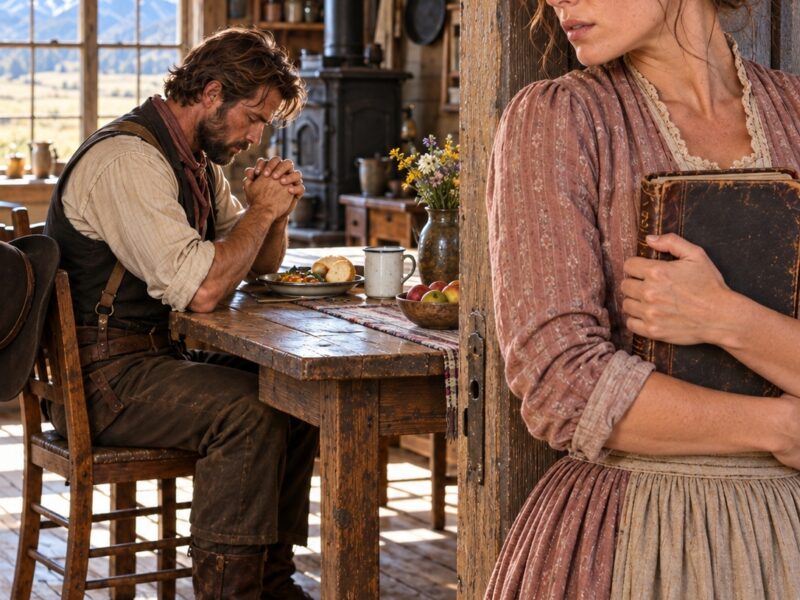
She Came to Collect an Overdue Debt—Then Heard the Lonely Rancher Pray, “Lord, I’m Tired of Eating Alone,” and Everything Changed
Judith Renick rode nine miles through a Texas drought to collect money from a rancher who was months behind, fully prepared to take his cattle feed account to court.
Instead, she stopped outside his kitchen and heard him thank God for a supper set for one, then whisper that he was tired of eating alone.
By the time she learned why he had not paid her, the debt in her ledger had become the smallest thing either of them owed.
The Prayer She Was Never Meant to Hear
Judith Renick had practiced her collection speech for nine miles.
Not one word survived Ezra Colton’s porch.
It was August 12, 1886, and the Texas Hill Country had forgotten what rain sounded like.
Branic Creek, which had turned her father’s mill wheel for twenty-two years, was a line of pale stones beneath a sky so white with heat it looked scraped clean.
The wheel had not moved in nine weeks.
Her bank note was due September thirtieth.
Three hundred forty dollars.
Judith had one hundred nineteen dollars in her strongbox.
Thirty-one customers owed her money.
Most of them had none.
Ezra Colton owed the largest single account.
Eighty-six dollars and forty cents.
Feed.
Meal.
Four sacks of oats.
Judith had sent one notice.
Then another.
No payment.
She was thirty-four years old, unmarried, and had spent too much of her life watching men assume those facts made her negotiable.
They did not.
Her father, Walter Renick, had taught her the mill before he taught her to dance.
Measure grain honestly.
Keep the stones dressed.
Never extend credit farther than your own roof can carry.
And never apologize for collecting what is owed.
So Judith rode to Ezra Colton’s place with her ledger beneath one arm and enough anger to carry her over nine dry miles.
The first thing she noticed was the water.
A wooden trough stood near the porch.
Clear water poured from an iron pipe into it, spilled over one side, and disappeared into cracked earth.
Judith stopped.
For twenty miles in every direction, wells were dropping.
Creeks were dust.
Men had started driving cattle at night to reduce heat losses.
And Ezra Colton was letting clean water run onto dirt.
She tied her mare to the post.
Climbed the steps.
The front door stood open for air.
Judith lifted her fist to knock.
Then heard a man’s voice from the kitchen.
Low.
Unhurried.
Not speaking to her.
“Lord, thank You for this bread.”
Judith froze.
“For the hands that raised the wheat.”
“For the rain we haven’t gotten yet.”
A pause.
“Bless the ones who are hungry tonight.”
“And the ones who are tired.”
Judith slowly lowered her hand.
Through the hallway she could see the kitchen.
Long pine table beneath a window.
A table built for eight.
Six chairs stacked upside down against the far wall.
Only one chair stood properly.
One plate.
One cup.
One man.
Ezra Colton sat with his head bowed.
Broad shoulders.
Dark beard trimmed short.
White scar through one eyebrow.
Hat hooked over the chair post.
He looked like prayer was simply another chore he intended to finish correctly.
“Mama always stopped there.”
he said quietly.
Judith frowned.
Ezra continued:
“I reckon I’ll add something.”
Silence.
A fly tapped against window glass.
Then Ezra Colton said:
“Lord, I’m tired of eating alone.”
Judith stopped breathing.
“Amen.”
The fork touched the plate.
Ordinary sound.
Terrible sound.
Judith stepped backward.
She should leave.
Come again tomorrow.
Pretend she had heard nothing.
She made it two boards.
The second board creaked.
Ezra’s chair moved.
“Somebody there?”
Judith closed her eyes.
No use running now.
She knocked.
Boots crossed the hall.
Ezra filled the doorway.
He was taller than she remembered from the mill.
His eyes moved to her ledger.
Then her mare.
“Miss Renick.”
“Mr. Colton.”
“You rode from the mill?”
“Yes.”
“In this heat?”
“I had business.”
“I figured you might.”
No embarrassment.
That annoyed her.
Judith tightened her grip on the ledger.
“Your account is overdue.”
Ezra nodded.
“I know.”
“I wrote twice.”
“I received both.”
“Then you understand why I’m here.”
“Yes.”
Still no argument.
No excuse.
Somehow worse.
Ezra stepped aside.
“Come in out of the sun.”
“I won’t be long.”
“Then you can be brief inside.”
“I’ve got coffee.”
“And supper enough.”
Judith almost refused.
Then she saw the table behind him.
One plate.
Six chairs stored upside down.
The prayer still hanging in the room like something private she had accidentally stolen.
She stepped inside.
Ezra pulled down one of the stacked chairs.
Judith noticed that.
Not another chair already waiting.
One he had to decide to use.
She sat.
Opened her ledger.
Found his page.
“Eighty-six dollars and forty cents.”
“Since March.”
“Feed.”
“Meal.”
“Oats.”
Ezra poured coffee into a chipped cup.
“My cattle money comes after the November drive.”
“That was not our agreement.”
“No.”
“I have a bank note due September thirtieth.”
“How much?”
“That is not your concern.”
“It is if my debt helps break your mill.”
Judith looked up.
His expression remained steady.
“Three hundred forty.”
“How much do you have?”
“One hundred nineteen.”
Ezra rubbed his thumb along the cup handle.
Judith said:
“I did not come nine miles for sympathy.”
“I know.”
“I came for payment.”
“I know that too.”
He looked toward the window.
At the barn.
At something beyond it.
Then:
“I cannot give you eighty-six dollars today.”
Judith closed her ledger.
“Then I will have to file against the account.”
“Fair.”
That answer made her angrier than resistance.
He continued.
“But before you do, I may have a way to pay you that helps both of us sooner.”
Judith hesitated.
“What way?”
Ezra stood.
“Your creek is dry.”
“Yes.”
“Your stones are fine.”
“Yes.”
“Your wheel needs force.”
“Water is force.”
“So are horses.”
Judith looked at him.
He pointed toward the barn.
“Two draft horses.”
“Duke and Sally.”
“Big enough to pull a house crooked.”
“I have post oak.”
“I have iron from my father’s old cotton gin.”
“We build a horse sweep.”
Judith stared.
Ezra continued.
“Long beam.”
“Team walks a circle.”
“Gear drives your mill shaft.”
“Won’t turn as fast as creek water.”
“Maybe a third speed.”
“But it’ll turn.”
“And the cost?”
“My timber.”
“My labor.”
“You pay castings.”
“If your father kept gear patterns, we use them.”
“I work the sweep for a dollar a day credit against what I owe.”
Judith calculated automatically.
Eighty-six working days.
Too long.
But a running mill could generate cash.
A dead mill generated memory.
“You know machinery?”
“Enough to break it intelligently.”
She almost smiled.
Did not.
Ezra added:
“If cattle money comes first, I pay the remainder.”
“And if your contraption fails?”
“Then you sue me with better cause.”
Judith studied him.
The water outside continued spilling.
The lonely table sat between them.
She hated that she knew something about him he did not know she knew.
Finally:
“A hired hand eats noon dinner.”
Ezra’s expression shifted.
“Custom.”
Judith said.
“I will not have a man collapse beside my stones because he thinks hunger is honorable.”
“That’s kind.”
“It is custom.”
“I’ll thank you not to turn it sentimental.”
Ezra nodded.
“Yes, ma’am.”
Monday.
They agreed.
Judith rode away.
At the bend in the road, she looked back once.
The trough overflowed.
Clear water.
Wasted.
She told herself to remember the debt.
Instead, she remembered the prayer.
The Mill That Wouldn’t Die
Branic Mill stood where the creek bent beneath a limestone bluff.
Three stories of gray stone.
Wheel twice Judith’s height.
Loading dock weathered silver.
Her father built half of it.
Inherited the rest.
For most of Judith’s childhood the wheel had sounded through the house at night.
A deep wooden rhythm.
Turn.
Catch.
Release.
After Walter died fourteen months earlier, Judith discovered the mill was quieter without him even when it ran.
Now it did not run at all.
Davey Branham sat on the loading dock when she returned.
Twelve.
Thin.
Freckles.
Hair that resisted combs on principle.
His mother died of fever when he was eight.
Walter had given him mill work and a room in the loft.
When Walter died, Judith discovered Davey had nowhere else to go.
She never formally adopted him.
He never formally left.
“Did Colton pay?”
Davey shouted.
“Do not shout account information across a yard.”
“So no.”
“He proposed labor.”
Davey jumped down.
“Prison?”
“Mechanical.”
She explained the horse sweep.
Davey’s eyes widened.
“That a real thing?”
“Yes.”
“Like when you said we might get a pony?”
“You were six.”
“I remember promises.”
Judith winced.
“Monday he brings timber.”
“How many questions can I ask him?”
“Six.”
Davey looked wounded.
“Per day?”
“Yes.”
“Six isn’t enough for an intelligent child.”
“Then become less intelligent temporarily.”
That evening Judith ate cold cornbread standing at her father’s old high desk.
Ledger open.
Lamp low.
She totaled outstanding accounts.
Four hundred twelve dollars.
Most small.
Three fifty.
Six twenty.
Nine dollars.
People were not refusing payment.
They simply had nothing.
Drought made honest people look dishonest on paper.
Judith hated that truth because banks did not care.
Monday at dawn, Ezra arrived with an oak beam that looked too heavy for his wagon.
Duke and Sally pulled it.
Davey used three questions before Ezra had unhooked them.
“How old?”
“Eight.”
“Which is Duke?”
“The one looking disappointed in you.”
“Do they bite?”
“Only people past six questions.”
Davey shut his mouth.
Judith caught Ezra smiling.
He walked the yard.
Measured.
Paced.
Set the pivot forty feet from the mill wall.
“Closer makes horses dizzy.”
“Farther takes your dead garden.”
“I don’t have a garden.”
Ezra looked at the bare patch.
“You have where one used to be.”
Judith said nothing.
Her mother had planted beans there.
Her father kept planting after she died.
Judith stopped.
By Tuesday, the beam was mounted.
Cast gears arrived from Tiver Crossing.
Eleven dollars from Judith’s strongbox.
She wrote the amount twice.
Ledger.
Then privately in her mind, where every dollar had begun to feel like a small injury.
Ezra worked without show.
No shirtless posing.
No speech about saving the mill.
He checked measurements.
Rechecked.
Admitted when an iron sleeve sat wrong.
Once Davey suggested filing a tooth.
Ezra tested it.
“You’re right.”
Davey glowed for two hours.
At noon Judith served beans with salt pork.
One plate at the kitchen table for Ezra.
Davey ate on the dock.
Judith put her own plate beside the ledger in the office.
Next day Ezra appeared in the doorway.
Hat in hands.
“Miss Renick.”
“Yes?”
“There’s an entire table in that room.”
“I’m aware.”
“I counted one plate yesterday.”
“Davey prefers the dock.”
“He prefers anywhere adults aren’t.”
“And?”
“You eat at the desk.”
“I work at the desk.”
“Those are different verbs.”
Judith looked up.
He did not smile.
Did not pity.
Simply observed.
“I have eaten there since my father died.”
Ezra nodded.
“Beans were good.”
She stared.
“That’s all?”
“That’s all.”
He returned to the kitchen.
Judith heard the chair scrape.
Then his voice.
Quiet grace.
His mother’s version.
No added line.
Of course not.
She was twenty feet away.
Judith stared at numbers.
Nine.
Seven.
Six.
Carry two.
The arithmetic blurred.
Wednesday she dressed the stones.
Her father had taught her at fourteen.
Stone grinding depended on grooves called furrows.
Wear them flat, grain heated.
Flour spoiled.
A miller lifted the runner stone with a crane, turned it, painted the bedstone with red pigment, rubbed surfaces together, then chipped high places by wrist.
Not shoulder.
Wrist.
“Feel it, Judy.”
Her father’s voice lived inside the work.
Four hours.
Limestone dust whitened her hair.
Leather apron heavy.
Forearms trembling.
When Judith descended the stairs, Ezra waited at the bottom with a dipper.
“I heard you were resting.”
“Who said that?”
“Davey.”
“Davey lies.”
“He was lying on the dock.”
“I judged his information accordingly.”
Judith drank.
Water cold.
Sweet.
Not from mill well.
“Your spring.”
“Yes.”
“You hauled this nine miles?”
“A barrel.”
“Why?”
“You’re short.”
“We have enough drinking water.”
“Now you have more.”
He said it as if discussing a nail.
No performance.
Judith handed the dipper back.
“Thank you.”
She meant it.
Ezra nodded.
“Tomorrow we hitch.”
Thursday morning, Duke and Sally leaned into collars.
Beam moved.
Gears caught.
The old shaft groaned overhead.
Judith stood at the meal spout with one palm against wood.
“Slow!”
Ezra could not hear over machinery.
She raised her hand.
He understood.
Reduced the team to a walk.
The runner stone began turning.
Grain dropped.
For several seconds nothing.
Then pale meal spilled through.
Warm.
Coarse.
Real.
Judith caught it.
Rubbed between fingers.
Good.
Not perfect.
Alive.
Davey screamed so loudly sparrows exploded from the roof.
Mr. Zeller, waiting with two bushels of corn, removed his hat.
“Well.”
he said.
“Walter’s girl did it.”
Judith looked at Ezra.
He shook his head.
“Walter’s girl and two horses.”
By noon they ground nine bushels.
One-third normal capacity.
Nine bushels more than nine weeks.
At dinner Davey dragged a bench inside.
Set three plates.
Judith stopped in the doorway.
“What?”
Davey pointed.
“Three.”
“I can count.”
“You always eat at the desk.”
“Yes.”
“That’s stupid.”
“Davey.”
“You told me truth matters.”
Ezra washed his hands at the pump.
Returned.
Stood with his hat against his chest.
Did not look at Judith.
Gave her space to refuse.
The prayer returned.
Lord, I’m tired of eating alone.
Judith pulled out a chair.
Sat.
Ezra looked up.
Then sat opposite.
Davey took the bench.
Nobody knew what to do with hands.
Finally Judith said:
“Mr. Colton.”
“Yes?”
“Will you say grace?”
Surprise moved across his face.
He bowed.
“Lord, thank You for this bread.”
“For the hands that made it.”
“Amen.”
Nothing else.
Judith picked up her fork.
Her eyes stung.
Dust.
Obviously.
Only dust.
What Ezra’s Debt Was Really Buying
The horse sweep kept the mill alive.
Barely.
Three bushels an hour.
Four on good stretches.
Ezra credited one dollar per day.
Judith collected grinding fees.
Small.
Not enough.
She began riding accounts.
One household at a time.
No threats.
No pretending.
First: Amos and Tilda Pettibone.
Three dollars fifty owed.
Tilda met Judith at the gate.
“I know why you’re here.”
“I prefer that.”
“We haven’t got it.”
Corn failed.
Calf sold.
Roof leaking.
Judith said:
“I’m not here for your cow.”
Tilda laughed bitterly.
“Ezra Colton wouldn’t forgive you.”
Judith stopped.
“What?”
Tilda’s face changed.
“You don’t know?”
“Know what?”
Tilda looked toward the road.
“He’s been feeding our cows since March.”
Judith stared.
“What?”
“Two cows.”
“Hundred pounds a week.”
“Shows up before sunrise.”
“Won’t take payment.”
“He says extra feed would spoil in his barn.”
Tilda snorted.
“As if grain spoils faster there than anywhere.”
Judith’s ledger opened inside her mind.
Every Tuesday.
One hundred pounds.
March through August.
Ezra’s account.
She whispered:
“He bought it from me.”
“Where else?”
Tilda shrugged.
“Dunlap widow’s mule.”
“The Svenssons’ milk cow.”
“Maybe others.”
Judith felt anger.
Not at kindness.
At secrecy.
“He let me ride nine miles and demand payment.”
Tilda smiled.
“That sounds like Ezra.”
“He never told me.”
“He’d rather be thought irresponsible than make us explain why we’re poor.”
Judith looked toward the field.
Amos approached with a limp.
Hat low.
He saw her.
Looked ashamed.
Judith hated that.
“Pay what you can.”
Tilda returned with two dollars twenty in coins.
Judith took it.
Wrote receipt.
Did not forgive rest.
Did not shame.
That distinction mattered.
All afternoon, similar stories.
Hester Dunlap owed seven dollars.
Ezra had quietly bought seed.
The Svenssons owed four eighty.
Ezra had covered veterinary medicine.
An elderly couple owed oats.
Ezra delivered their sacks himself and told them not to mention it.
By evening Judith collected fourteen dollars thirty-five.
Not enough.
But something.
At supper she sat at the table.
Ezra said grace.
Davey talked too much.
Judith watched Ezra.
He did not know she knew.
He had allowed her to believe the worst rather than expose neighbors’ hardship.
Part of her admired it.
Part of her thought it foolish.
After dinner, she said:
“Why is your account so large?”
Ezra’s fork stopped.
He looked at her.
There.
He knew.
“How much did Tilda tell you?”
“Enough.”
Ezra sighed.
“She talks when nervous.”
“You should have told me.”
“No.”
“Why?”
“Not my information.”
“It was my money.”
“That part is mine.”
“You took goods on your account for other people.”
“Yes.”
“Without telling me.”
“Yes.”
“Then stopped paying.”
“Yes.”
“Do you understand how irresponsible that looks?”
“Yes.”
“Did that concern you?”
“No.”
Judith almost threw something.
“Ezra.”
He set down his fork.
“They needed feed.”
“You had credit.”
“I used it.”
“I expected cattle money in July.”
“Market dropped.”
“Drive delayed.”
“That is explanation.”
“You asked for it.”
“No.”
“I asked why you didn’t tell me before.”
Ezra’s eyes moved to Davey.
Davey suddenly found beans fascinating.
Ezra said:
“Because the Pettibones don’t owe you an explanation of their pride.”
“Nor the Dunlap widow.”
“Nor the Svenssons.”
“They owe me money.”
“Yes.”
“And I owe you because I bought what they needed.”
“That was the arrangement I made with myself.”
Judith stared.
“That is not how ledgers work.”
“I know.”
“Then why?”
Ezra looked at his hands.
“Because I could.”
Simple.
Judith’s anger softened despite permission.
She hated that.
“You cannot feed half a county secretly.”
“Four households.”
“That is not better.”
“Depends on county.”
Davey snorted.
Judith glared.
He stopped.
Ezra said:
“I wasn’t asking you to forgive the debt.”
“I still owe it.”
“I’ll work it.”
“Pay it.”
“Whatever comes first.”
Judith leaned back.
“You’re an infuriating man.”
“I’ve heard.”
“From whom?”
Ezra looked at empty chairs still stacked against the wall in his mind.
Nobody.
He did not answer.
Judith understood.
Saturday she baked peach cobbler.
Last dried peaches.
Cornbread.
Rode nine miles.
Ezra was in far pasture.
She left basket on porch.
Note:
A hired man’s wage is dinner. This is supper. It is only custom. — J.R.
She did not know Ezra ate at sunset alone.
Slowly.
Then pulled down a second chair.
Placed it across from him.
Left empty.
He could not have explained why.
Monday morning, the bank sent for Judith.
Ellis Garrett had run Tiver Crossing Bank since before she had braids.
Gray.
Thin.
Careful fingers.
He removed spectacles.
“My lender in San Antonio has called local paper.”
Judith’s stomach tightened.
“My note is due September thirtieth.”
“Call clause.”
“It allows acceleration.”
“How much time?”
“September first.”
Nine days.
Judith went still.
“Three hundred forty.”
“Yes.”
“I have one hundred thirty-three thirty-five.”
“I know.”
Ellis folded hands.
“If you bring sixty percent and show operational revenue, I’ll carry balance to October thirty-first on my own signature.”
Judith calculated.
Two hundred four dollars.
Need seventy-one.
Nine days.
Horse mill could not earn enough.
She left bank numb.
That night, numbers refused mercy.
Then she thought of Ezra’s trough.
Water spilling in drought.
Clear.
Continuous.
She wrote one word:
SPRING.
At dawn Ezra arrived at mill.
Judith met him before he unharnessed.
“Where does your trough water come from?”
He looked up.
“Spring above house.”
“How much?”
“More than I use.”
“Year-round?”
“Ran through seventy-four.”
Judith’s pulse jumped.
“Where does overflow go?”
“Down draw.”
“Soaks flat.”
“Was there ever a ditch?”
Ezra stopped moving.
“Yes.”
“My father dug one.”
“He planned to sell flow rights to your father.”
Judith stared.
“What happened?”
“They couldn’t agree price.”
“Then ditch silted.”
“How far?”
“Mile and a half.”
“Would it reach Branic Creek?”
“Yes.”
“Would it turn the wheel?”
Ezra considered.
“Not full.”
“Maybe enough.”
“How long to clear?”
“One man?”
“Month.”
“Twenty?”
His expression changed.
“Few days.”
Judith looked at him.
Ezra looked at ground.
There was the real obstacle.
Not earth.
Asking.
She said:
“You know twenty men.”
“No.”
“You’ve fed four households.”
“That means four families know you.”
“Knowing isn’t the same as asking.”
“Correct.”
He took a breath.
Judith saw what pride looked like when stripped of arrogance.
Fear.
He could give secretly.
Could not receive openly.
“Ezra.”
He looked at her.
“You prayed because you were tired of eating alone.”
His face went still.
Judith realized too late.
There.
Secret opened.
“How do you know that?”
She swallowed.
“Your door was open.”
“The day I came.”
“I heard.”
Ezra stepped back.
Not angry.
Exposed.
“You heard all of it.”
“Yes.”
“How long were you there?”
“Long enough.”
He turned away.
Judith said:
“I’m sorry.”
“No.”
“I should have knocked.”
“Yes.”
“But I didn’t tell anyone.”
“That doesn’t make it less private.”
“I know.”
Silence.
Horses shifted.
Then Judith said:
“You can feed four families without asking permission.”
“You can work eighty-six days rather than ask anybody for help.”
“You can pray to God.”
“But you cannot ask a neighbor to lift a shovel?”
Ezra looked at her.
“That feels different.”
“It is.”
“How?”
“One costs pride.”
He almost smiled bitterly.
Judith stepped closer.
“If you want the mill to survive, you have to ask.”
“If you want your debt paid, I need the mill to survive.”
“If the mill survives, half the county gets grain processed.”
“This is no longer only your problem.”
Ezra looked toward the wheel.
Then at his hands.
“All right.”
“I’ll ask.”
The next morning he stood in Amos Pettibone’s yard with his hat in both hands.
“I need help.”
Amos stared.
Ezra continued:
“I can’t clear the ditch alone.”
“I need men.”
“Shovels.”
“Four days.”
Amos said nothing for so long Ezra nearly left.
Then Amos walked to barn.
Took down mattock.
“Took you long enough.”
Eleven People and a Ditch
By Wednesday, eleven people worked the old Colton ditch.
Not twenty.
Enough.
Amos Pettibone.
Tilda with food and shovel.
Hester Dunlap wearing her late husband’s boots.
Two Svensson boys.
Pastor Wills.
Davey.
Judith.
Ezra.
Old Mr. Zeller mostly supervising from a keg until Judith handed him a shovel.
“You’re cruel.”
he said.
“You’re alive.”
she answered.
The ditch existed beneath twenty years of silt.
They found pieces by memory.
Ezra’s father had lined portions with limestone.
Other sections disappeared beneath mesquite roots.
They dug.
Heat brutal.
Hands blistered.
At noon they ate beneath cottonwood shade.
Ezra said grace.
Plain.
No loneliness line.
But afterward he looked down the row.
People laughing.
Passing cornbread.
Arguing about shovel technique.
Judith saw him count faces without meaning to.
Thursday brought trouble.
Ellis Garrett rode out from bank.
Not alone.
Beside him was Henry Creel, representative of the San Antonio lender.
Young.
Clean coat.
Too polished for drought.
He watched workers.
Then mill.
“Mrs. Renick.”
“Mr. Garrett.”
Creel spoke.
“I understand you expect this ditch to restore water power.”
“Yes.”
“Temporary.”
“All water is temporary if you wait long enough.”
He did not appreciate humor.
“We are concerned about the collateral.”
Judith’s jaw tightened.
“The mill.”
“Yes.”
“The accelerated note permits foreclosure filing September second if threshold payment is not received.”
“I know.”
Creel looked at Ezra.
“And Mr. Colton’s land may be relevant.”
Ezra frowned.
“Why?”
Creel opened a folder.
“Your late father executed a preliminary water easement in 1872.”
Ezra froze.
Judith looked between them.
“What easement?”
Ellis said:
“Not completed.”
Creel corrected:
“Disputed.”
He produced paper.
Colton spring rights pledged as secondary security to Walter Renick’s mill expansion loan.
Judith stared.
“That makes no sense.”
Her father had never told her.
Ezra read.
Signature looked real.
If enforceable, bank could claim rights to spring if mill defaulted.
Ezra’s face hardened.
“You came for the water.”
Creel said:
“We came to clarify collateral.”
Judith took paper.
“Why was this never in my loan file?”
Ellis looked uncomfortable.
“Old records.”
“Your father and Ezra’s father disputed whether consideration was ever paid.”
“The document was never properly recorded.”
Creel said:
“It may still create equitable interest.”
Judith understood enough law to know uncertain paper can be weapon.
Ezra looked at her.
“Did you know?”
“No.”
“Your father?”
“I don’t know.”
For the first time, trust between them cracked.
Not because Judith lied.
Because dead men had made agreements neither understood.
Creel continued:
“If Mrs. Renick defaults, the lender may seek judicial declaration regarding the spring.”
Ezra’s jaw tightened.
“So clearing this ditch might increase what you can take.”
Creel did not answer directly.
“It demonstrates value.”
Judith felt sick.
The plan that could save her might endanger Ezra’s land.
After the bankers left, workers stood silent.
Amos spat into dust.
“Banks.”
Ellis had looked ashamed.
Judith noticed.
She also knew shame did not cancel signatures.
Ezra walked toward horses.
“Stop digging.”
Judith followed.
“No.”
“If water creates claim—”
“We investigate first.”
“You need the mill.”
“Not by taking your spring.”
“It may already be tied.”
“Then we find out.”
Ezra looked at her.
“September first is five days.”
“I can count.”
“You may lose everything.”
“So might you.”
He said:
“I offered the water.”
“Before we knew.”
“Still offering.”
Judith stared.
“Why?”
Ezra’s voice sharpened.
“Because your mill matters.”
“So does your ranch.”
“I can survive without spring rights.”
“Can your cattle?”
Silence.
No.
Drought.
Judith said:
“We don’t solve one person’s drowning by pushing another underwater.”
Ezra looked frustrated.
“You always make simple things difficult.”
“They were never simple.”
She turned to Ellis.
“Ride back.”
“Find original file.”
“All correspondence.”
“Every receipt.”
“Every map.”
“I want my father’s handwriting.”
“Ezra’s father’s.”
“And whether a penny changed hands.”
Ellis nodded.
Creel objected.
Ellis surprised everyone.
“Mr. Creel.”
“This is my bank.”
“Until you replace me.”
“I’ll verify my records.”
Creel’s face tightened.
Good.
Ally.
Not savior.
The digging paused.
That hurt.
Every hour mattered.
Judith returned to horse sweep.
Worked until dark.
Ezra joined.
Neither spoke much.
At dinner they sat apart.
Davey looked between them.
Finally:
“Did you have a fight?”
“No.”
both said.
Davey nodded.
“So yes.”
Judith glared.
Ezra almost smiled.
That was something.
Next morning Ellis returned.
Carrying a tin document box.
Walter Renick’s letters.
Silas Colton’s receipts.
Truth.
The easement had been proposed.
Never completed.
Walter paid Silas twenty dollars deposit.
Silas returned it after disagreement over maintenance costs.
Receipt signed.
AGREEMENT VOID.
Creel’s copy lacked back page.
Whether accident or intentional omission, unclear.
But the bank’s claim collapsed.
Ellis said:
“I should have known this before showing him the old file.”
Judith looked at him.
“Yes.”
No absolution.
He accepted.
Ezra exhaled.
“Dig.”
Eleven people returned.
Four days.
A mile and a half.
Hands torn.
Shoulders aching.
Judith carried water.
Ezra worked until she ordered him to stop.
“Custom?”
he asked.
“Medical tyranny.”
He sat.
Sunday morning the ditch was ready.
They did not open spring gate.
Pastor Wills insisted church first.
Half the congregation had blisters.
He changed sermon.
Read Psalm 68.
“God setteth the solitary in families.”
Then said:
“The verse does not say the solitary who earned it.”
“Nor the solitary who asked properly.”
“It says the solitary.”
“Perhaps God does the placing.”
“But He has always been suspiciously willing to use our hands.”
People laughed.
Ezra sat beside Judith.
Shoulder one inch from hers.
Did not move.
After service Hester Dunlap trapped him at door.
“Thursday supper.”
Ezra blinked.
“Hester—”
“That was not a question.”
“Yes, ma’am.”
Judith smiled.
He caught her.
“You enjoying this?”
“Deeply.”
Monday night they opened the spring gate.
Water entered ditch.
At first:
Nothing.
Then a whisper.
Dark line through dust.
Trickle became ribbon.
Ribbon reached Branic Creek bed.
Judith stood at wheel pit with lantern.
Ezra beside her.
Davey supposedly asleep.
Definitely watching.
Water touched race.
Filled first bucket of wheel.
Wood groaned.
Shuddered.
Turned.
Judith laughed.
Out loud.
She had not heard that sound from herself since Walter died.
Ezra removed hat.
Judith’s joy became something else.
She looked at him.
“I have to tell you.”
“You already did.”
“What?”
“The prayer.”
Ezra looked toward the wheel.
“I suspected.”
“How?”
“Porch board.”
“It creaks twice.”
“You only made it creak once when you knocked.”
Judith stared.
“You knew for eighteen days?”
“I wondered.”
“Why didn’t you say something?”
He shrugged.
“You didn’t.”
She laughed incredulously.
“Are you angry?”
“No.”
“It was private.”
“Yes.”
“I’m sorry.”
Ezra turned hat in his hands.
“I said it to God.”
“Didn’t know you were listening.”
“But I’m not sorry it got heard.”
Judith could not speak.
He continued.
“I would have been sorrier if I kept saying it to a wall.”
Water poured.
Wheel turned.
Judith whispered:
“I eat at my desk.”
Ezra looked at her.
“I know.”
“I have for fourteen months.”
“I called it efficiency.”
“It wasn’t.”
Ezra said:
“Well.”
very gently.
“He was in the room.”
Judith looked at him.
His hand rested on stone rim.
Hers beside it.
After a moment his fingers touched hers.
Question.
She let them stay.
No declaration.
Just contact.
The mill wheel turned behind them.
The next day wagons lined county road.
Corn.
Wheat.
Oats.
Nine weeks of backlog.
Judith ran hoppers.
Ezra hauled sacks.
Davey kept tally.
By six:
Seventy-eight dollars sixty-five cents.
Added to strongbox:
Two hundred twelve dollars exactly.
Davey checked twice.
“Sixty-two percent.”
Judith sat.
Forgot chair existed.
Next morning Ellis Garrett counted.
Two hundred twelve.
Signed extension.
Balance due October thirty-first.
“You kept your word.”
Judith said.
Ellis shook his head.
“You kept your mill.”
“Different.”
She walked outside.
Ezra waited at wagon.
He saw her face.
Did not ask.
She nodded.
He smiled.
Not large.
Enough.
The Debt That Wasn’t Finished
Saving mill did not end trouble.
It exposed another.
With water restored, demand exploded.
Horse sweep no longer needed for full power, but drought continued.
Colton spring fed enough to keep wheel turning at reduced but profitable speed.
Question:
Who owned the water?
Legally Ezra.
Morally complicated.
Neighbors had helped clear ditch.
Judith’s mill profited.
Ezra’s livestock used less overflow.
Everyone benefited.
Until cattle downstream owners complained.
One rancher, Calvin Morrow, claimed diversion reduced seepage to communal grazing flats.
He threatened injunction.
Judith’s stomach sank.
Another paper.
Another man claiming water.
Texas water law in 1886 was messy.
Riparian traditions.
Spanish influences.
Local customs.
Recorded rights.
Ditch precedents.
Nobody could promise.
They hired attorney Samuel Price.
Not rich.
Not flashy.
Read deeds.
Walked land.
Asked old men questions.
He found the ditch had historically carried spring overflow with permission.
Never permanently abandoned in law because stone works remained.
But using all overflow might harm downstream customary users.
Solution:
Measurement.
Not domination.
Judith hated that because measurement meant less water.
Samuel said:
“You want to win or stay running?”
“Both.”
“Choose realistic goals.”
They agreed to install gate.
Only surplus above livestock trough and minimum downstream release entered ditch.
Mill slowed some days.
Stayed alive.
Morrow withdrew injunction after written agreement.
Ezra grumbled:
“I preferred when water just went where gravity told it.”
Judith answered:
“Gravity has poor paperwork.”
He laughed.
Their relationship changed by inches.
Judith visited Colton place for supper.
First formally invited Sunday.
Davey came too.
Six chairs no longer upside down.
Hester.
Pettibones.
Mr. Zeller.
Pastor Wills.
Long table full.
Ezra stood.
Said grace.
His mother’s words.
Then continued:
“Thank You for water.”
“Thank You for neighbors.”
A pause.
“And Lord, thank You that I’m not eating alone.”
“Amen.”
said the table.
Judith sat at his right.
Did not stand until plates empty.
Afterward, washing dishes, Ezra asked:
“Does this count as custom?”
“What?”
“You eating here.”
“No.”
His hands stopped.
“What does it count as?”
Judith dried plate.
“Dinner.”
He smiled.
That was intimacy one.
Simple.
Autumn approached.
Cattle prices improved.
Ezra sold part of herd.
Paid Judith remaining debt.
Eighty-six dollars forty.
Exact.
She stared at coins.
“You worked off forty-two.”
“I know.”
“You owe forty-four forty.”
“I’m paying full original account.”
“No.”
“Judith.”
“Ledger says credit.”
“You built sweep.”
“Labor credited.”
“You helped ditch.”
“Neighbors helped ditch.”
“You fed four households.”
“Not relevant.”
“It is relevant to me.”
Ezra frowned.
“This is why I dislike millers.”
“You dislike arithmetic.”
She counted forty-four forty.
Returned rest.
Ezra looked offended.
“Take it.”
“No.”
“You need money.”
“I need correct books.”
“You are impossible.”
“Yes.”
He pocketed coins.
Later Judith opened ledger.
Wrote:
EZRA COLTON — PAID IN FULL.
The words affected her unexpectedly.
Their practical tie ended.
He no longer had to come.
Next morning:
He came.
Carrying coffee.
“What are you doing?”
“Checking gate bearing.”
“You don’t owe labor.”
“I know.”
“Then why?”
Ezra looked almost embarrassed.
“Thought I’d help.”
Judith’s chest tightened.
Not debt.
Choice.
That afternoon they walked ditch.
No work needed.
Still walked.
Ezra showed her a limestone shelf where spring emerged.
Judith knelt.
Cold water over fingers.
He said:
“My mother believed spring was miracle.”
“My father believed geology.”
“What do you believe?”
“Both can make good water.”
Judith smiled.
They sat on rock.
Second intimacy.
No urgency.
Ezra told her about his mother.
Widowed young.
Raised him and two sisters.
Both sisters moved east.
Letters monthly.
He had family.
Just not nearby.
Judith told him about her father’s final year.
Stroke.
How she became miller before being ready.
How men stopped calling her Miss Judith and started calling her “Walter’s girl” as if skill belonged to dead father.
Ezra said:
“I never thought you needed proving.”
“Most do.”
“I watched you dress stones.”
“You did?”
“From bottom stair.”
“That’s why water appeared.”
“Yes.”
“That was intrusive.”
“I brought water.”
“Still intrusive.”
He nodded.
“Fair.”
She laughed.
Then October brought final financial twist.
Bank balance due.
Judith could pay most.
Not all.
Mill revenue strong.
Ellis willing to refinance.
But Creel’s San Antonio lender refused.
Wanted foreclosure.
Why?
Not loan amount.
Land.
Railroad survey announced route near Branic Creek.
Mill property suddenly valuable.
Judith understood.
They were not collecting debt.
They wanted site.
Creel offered settlement.
Sell mill voluntarily.
Pay debt.
Keep house.
Walk away with modest sum.
Judith refused.
Bank filed.
Ellis warned:
“Court might enforce.”
Judith asked:
“Can we raise balance?”
Need one hundred twenty-eight dollars.
Three weeks.
Possible.
Then mill gear cracked.
Horse sweep could substitute, slow.
But main wheel out.
Foundry repair cost thirty-five.
Time.
Judith nearly broke.
Ezra offered money.
She refused.
“Why?”
“Because if I take your money, I’ll never know whether I saved the mill.”
“That’s pride.”
“Yes.”
“Bad kind.”
“Maybe.”
Ezra stepped closer.
“What if it’s investment?”
“No.”
“Loan?”
“No.”
“Gift?”
“Absolutely no.”
He became angry.
“You let eleven people dig.”
“That was community work.”
“You let Ellis extend credit.”
“Banking.”
“You let me build sweep when I owed you.”
“Debt.”
“But now because I care about you, my help becomes poison?”
Judith froze.
There it was.
Care.
Said accidentally.
Ezra realized.
Neither spoke.
Finally Judith said:
“That is not fair.”
“No.”
“I know.”
“But neither is making me watch you lose something because you’re afraid accepting help means owing me yourself.”
Judith’s eyes stung.
“My father lost half this property once.”
“To a partner.”
“He trusted him.”
“He signed paper without reading.”
“My mother never forgave him.”
“I learned early that dependence gives people leverage.”
Ezra’s voice softened.
“I don’t want leverage.”
“I know.”
“That’s the problem.”
He stared.
Judith continued:
“If you were cruel, refusing would be easy.”
Ezra almost smiled sadly.
“Hell of a compliment.”
She laughed through tears.
Then:
“Let me find another way first.”
“Fine.”
“If you fail?”
“I reconsider.”
“Specific date.”
“October twentieth.”
Ezra nodded.
“Agreed.”
Hard choice.
Not rescue.
Judith organized preorders.
Farmers paid deposits for winter grinding at discount.
Risky.
Transparent.
She explained mill might lose property if foreclosure succeeded.
Some paid anyway.
Not charity.
Contracts.
Hester bought six months.
Pettibones three.
Svenssons four.
Mr. Zeller bought a year.
“You’ll die before using this.”
Judith said.
“Then my sons inherit flour.”
Davey proposed milling cornmeal evenings.
Judith nearly refused.
Then remembered systems survive people.
She trained him tally.
Delegated.
By October twentieth:
One hundred fourteen dollars.
Short fourteen.
Ezra arrived.
Judith had promised reconsider.
He placed fourteen dollars on desk.
“Loan.”
She stared.
“Terms?”
“One year.”
“Two percent.”
“That’s insulting.”
“Three.”
“Still.”
“Five.”
“Usury.”
“Four.”
Judith laughed.
“Four.”
They wrote note.
Signed both.
No hidden meaning.
No ownership.
Fourteen dollars.
She accepted.
That was intimacy three.
Trust with paperwork.
She paid bank.
Creel lost foreclosure.
Mill remained hers.
Ezra did not save it.
He helped close gap.
The distinction mattered to both.
What Judith Owed Herself
Winter rain finally came in November.
First storm smelled like dust opening.
Branic Creek rose.
Wheel turned under its own water.
Judith stood in rain laughing.
Davey yelled.
Ezra rode in soaked.
She looked at him.
“Horse sweep is unemployed.”
“Good.”
“Duke will be devastated.”
“Sally never cared.”
They moved sweep components into storage.
Not destroyed.
Backup.
Another lesson.
At Christmas, Judith went to Colton house.
No loneliness.
Seven chairs.
More people.
Ezra’s sisters came from San Antonio.
Children.
Noise.
Judith almost missed quiet.
After dinner, porch.
Cold.
Ezra handed coffee.
“Do you still hear it?”
“What?”
“Prayer.”
She knew.
“Yes.”
“Embarrassing.”
“Only slightly.”
“I meant every word.”
“I know.”
He looked at her.
“I don’t want to eat alone anymore.”
Judith’s heart beat harder.
Ezra continued before she mistook it for proposal.
“That does not mean I’m asking you to fix it.”
Good.
She smiled.
“I don’t want to eat alone either.”
He looked surprised.
“You hide it better.”
“I call it efficiency.”
“That old lie.”
“Yes.”
They stood.
No kiss.
Not yet.
Spring, Ezra repaid fourteen-dollar loan plus interest.
Judith calculated four percent.
Fifty-six cents.
He brought fifteen dollars.
She returned forty-four cents.
“Still impossible.”
“Yes.”
Then he asked:
“Would you have supper with me Saturday?”
“At your house?”
“No.”
“Tiver Crossing hotel dining room.”
Judith raised eyebrow.
“That sounds like courtship.”
“It might be.”
“You should decide.”
“I have.”
She looked at him.
“You’re asking badly.”
“I’ve been eating alone a long time.”
“Practice rusty.”
She said yes.
They courted.
Slow.
No merging finances.
No immediate marriage.
Ezra learned mill.
Judith learned cattle.
Davey grew taller.
Mrs. Pettibone continued gossiping.
Pastor Wills pretended neutrality.
A year later Ezra proposed.
Not with ring first.
With question:
“If we marry, do you want Colton place, mill house, or both?”
Judith said:
“Both is foolish.”
“Probably.”
“Separate ownership?”
“Yes.”
“Written.”
“Yes.”
“You’ve learned.”
“I enjoy surviving conversations.”
She smiled.
Then he showed ring.
Simple gold.
Judith said:
“Yes.”
Marriage did not solve them.
They argued.
Judith worked too long.
Ezra hid worries.
He still gave things away secretly sometimes.
She still turned needs into tasks.
But they had language now.
“Are you helping or avoiding asking?”
Judith would say.
Ezra hated it.
“Are you working or avoiding sitting down?”
he would answer.
She hated that more.
Fair.
Years passed.
Branic Mill modernized.
Steam engine eventually supplemented water.
Judith insisted because drought memories stayed.
Davey became partner.
Not charity.
Earned shares over time.
Ezra shifted ranch toward smaller herd, better water management.
Spring ditch became cooperative agreement.
Written.
Recorded.
No dead-father ambiguity.
The four households Ezra once fed in secret became part of a grain cooperative.
Not dependence.
Collective purchasing.
Judith helped structure books.
Ezra hated meetings.
Attended anyway.
The long Colton table stayed full.
Sometimes neighbors.
Sometimes workers.
Sometimes only Judith and Ezra.
Those nights mattered too.
Because loneliness is not cured by crowds.
It is changed by one person whose presence is chosen.
On their tenth anniversary, drought returned.
Not as severe.
Still frightening.
Judith stood at mill race.
Water low.
Ezra beside her.
“Horse sweep?”
he asked.
She smiled.
“Stored.”
“Greased?”
“Davey checks annually.”
“Of course.”
They installed it in two days.
No panic.
Preparedness.
Judith looked at turning beam.
Thought of first summer.
Debt.
Prayer.
Trough.
All the things that had seemed like separate problems.
They were connected by one habit:
People trying to carry alone what should have been shared honestly.
Later that evening, Judith rode with Ezra to Pettibone place.
Tilda gone by then.
Amos old.
His grandson ran farm.
Cooperative feed delivery arrived.
No secrecy.
Receipt.
Account.
Discount for drought.
Ezra watched.
“You improved my charity.”
Judith said:
“I removed the part where everyone had to pretend.”
“Less romantic.”
“Much safer.”
He laughed.
That night at home, Ezra stood at table.
Six chairs no longer stacked.
Never stacked again.
He bowed.
“Lord, thank You for this bread.”
“For the hands that made it.”
“For rain when it comes.”
“For work when it doesn’t.”
Judith looked at him.
He continued.
“And thank You that I’m not eating alone.”
“Amen.”
Judith said.
Not table.
Not crowd.
Just her.
Years later, after Ezra died peacefully before dawn at seventy-eight, Judith sat at that table alone.
For first time in decades.
One plate.
She hated it.
Grief returned differently than before.
Not empty because no one had come.
Empty because someone had.
That mattered.
Davey—gray-haired now—came through back door without knocking.
Carrying stew.
“You eating?”
Judith almost said yes.
Almost said she preferred desk.
Old habits survive like seeds.
Instead:
“No.”
Davey pulled out chair.
“Good.”
“That means there’s room.”
Others arrived.
Pettibone grandson.
Pastor’s daughter.
Ezra’s nieces.
Neighbors.
No one asked whether Judith wanted company because Davey knew her too well.
He simply created option.
She could have left.
She stayed.
At supper someone asked about Ezra’s famous prayer.
Davey said:
“Judith heard it before he meant anybody to.”
Judith glared.
“Traitor.”
He smiled.
“Is it true?”
A young girl asked.
Judith looked at long table.
Then toward window.
Outside, trough still ran.
But now overflow traveled through maintained ditch.
Nothing wasted.
“It’s true.”
she said.
“What did he say?”
Judith remembered porch.
Heat.
Ledger.
Raised fist that never knocked.
A man alone at a table built for eight.
“Something honest.”
she said.
The girl waited.
Judith smiled.
“He said he was tired of eating alone.”
“And then you married him?”
Someone laughed.
Judith shook her head.
“No.”
“First he owed me eighty-six dollars and forty cents.”
More laughter.
“Then we built a mill.”
“Then we dug a ditch.”
“Then we argued for several years.”
“Then I married him.”
“That order matters.”
They ate.
The table filled with noise.
When plates emptied, Judith stayed seated.
She no longer needed to prove efficiency by standing alone at a desk.
Long after supper, she walked onto porch.
Drought had ended weeks earlier.
Frogs sounded near creek.
The mill wheel turned faintly in distance.
She thought about debts.
Money owed.
Work owed.
Promises.
Gratitude.
Love.
Some debts should be paid exactly.
Some should never be created.
And some things people call debts are simply gifts that become dangerous when someone insists they must be repaid.
Ezra taught her that by owing eighty-six dollars.
Judith taught him that by refusing to let kindness remain secret enough to become loneliness.
She rested one hand on porch rail.
There had been a time when she believed self-sufficiency meant safety.
Ezra believed generosity meant never needing anything back.
Both had been wrong.
People were safer when help had names.
Terms.
Boundaries.
And a chair pulled out at the table.
Judith heard Davey inside.
“Coffee?”
She turned.
“At this hour?”
“You’re eighty.”
“You can rebel.”
“I have always rebelled.”
“You kept ledgers.”
“Rebellion takes many forms.”
Judith went inside.
The table still held seven chairs.
Not because Ezra expected seven people every meal.
Because once a man had stacked six against a wall so he would not have to notice they were empty.
He never stacked them again.
Judith sat.
Davey poured coffee.
Outside, water ran through the ditch eleven neighbors had once dug by hand.
Inside, there was another cup waiting.
And nobody ate alone.









