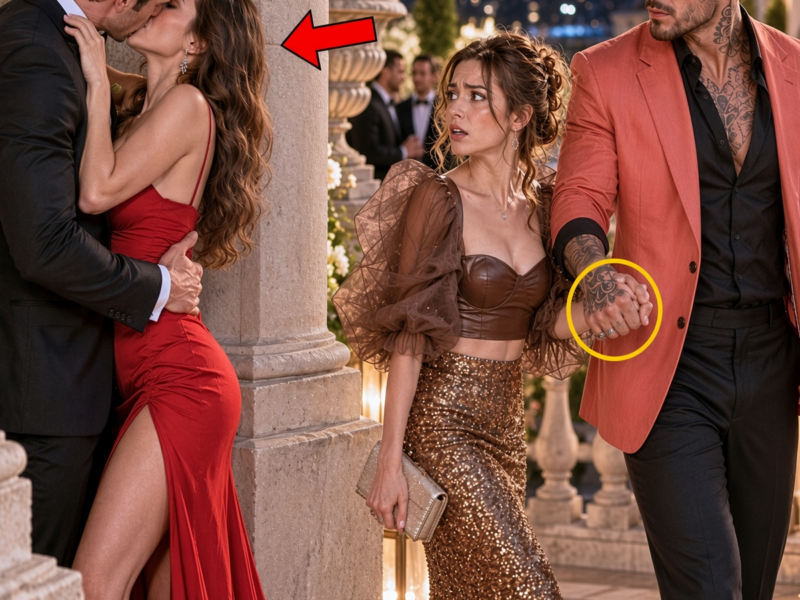
She Caught Her Husband Kissing the Mafia Boss’s Wife at a Charity Gala—Then the Man Everyone Feared Found Her Before She Could Decide What Came Next
Clara Miller expected heartbreak when she stepped onto the dark hotel terrace and saw her husband with another woman; instead, she felt the colder shock of recognizing the emerald dress wrapped around him.
The woman was Sophia Rossi, wife of Leo Rossi—the quiet businessman whose name could end contracts, careers, and conversations long before anyone admitted why.
Clara backed away without making a scene, only to discover minutes later that Leo had already seen everything from the balcony above.
Most betrayals break your heart.
Some only insult your intelligence.
Clara Miller discovered the difference at 10:58 on a Thursday night, beneath a flickering heat lamp on the east terrace of the Halcyon Hotel.
She had gone outside because the ballroom was too warm, the jazz band was too loud, and her husband had spent the previous two hours treating her like decorative proof that he was a respectable married man. “Stay near the donors,” David had told her earlier, squeezing her elbow while scanning the room for someone more important. “And if anyone asks, mention the literacy clinic. It makes the firm look good.”
The literacy clinic had been Clara’s idea.
She taught American history at Roosevelt High, where half her juniors worked after school and the other half knew exactly how much their parents owed in rent. She had spent seven months organizing free tutoring through the public library, but David had already mentioned it at three fundraisers as though he had personally rescued public education.
Clara had stopped correcting him.
That was what their marriage had become.
Not screaming.
Not slammed doors.
Small permissions granted to exhaustion.
The ballroom smelled of orchids, expensive perfume, and buttered appetizers arranged with tweezers. City officials laughed too loudly beside developers they publicly claimed not to know, while lawyers shook hands with contractors and cameras flashed near a twenty-foot banner for the children’s hospital foundation.
David belonged in rooms like this.
Or wanted to.
He was thirty-seven, handsome in the broad, polished way of men photographed for law-firm websites, with carefully parted brown hair and a navy tuxedo that cost more than Clara’s first car. He had made junior partner eight months earlier at Bell, Warren & Price, a firm that specialized in zoning, land use, and commercial redevelopment.
He had spent every day since behaving like senior partnership was a disease he could catch through physical proximity.
Clara watched him laugh before punch lines.
Agree before questions were finished.
Forget her drink twice.
At 10:45, she stopped waiting for him to remember she was there.
She left her untouched champagne on a passing tray and pushed through the heavy glass doors toward the terrace.
Cold air met her face.
For the first time all evening, she could breathe.
The terrace was nearly empty. Stone balustrades framed the city skyline, and the Hudson reflected broken strips of gold beyond the buildings. Two heat lamps glowed near the doors, while the far end disappeared beneath ivy and shadow.
Clara took three steps.
Then heard a sound.
A breath.
A soft laugh.
Fabric brushing stone.
She stopped.
Two people stood near the ivy-covered trellis.
David’s tuxedo jacket hung across a wrought-iron chair.
His back was against the wall.
A woman was pressed against him.
Clara did not gasp.
She did not cry.
She watched her husband’s hands tighten around the woman’s waist while the woman’s fingers disappeared into his carefully styled hair.
For one strange second, Clara felt almost relieved.
There it was.
The thing beneath months of late meetings, inverted phone screens, showers taken the moment David came home, and conversations that ended whenever she entered a room.
A fact.
Facts were easier than suspicion.
Then the woman shifted.
Light from the ballroom caught her dress.
Emerald silk.
Hand-draped at one shoulder.
A narrow line of antique beading at the waist.
Clara had seen it thirty minutes earlier on the guest of honor.
Her stomach went cold.
The woman turned.
Sophia Rossi.
For several seconds, Clara forgot how to breathe.
Everybody in the city knew the Rossi name, even people who pretended they did not. Rossi Holdings owned pieces of the harbor, commercial sanitation contracts, warehouses along three freight corridors, and minority interests in enough legitimate companies to make questions about the rest of the family’s business socially inconvenient.
Leo Rossi ran it.
He appeared in newspapers beside hospital administrators and union presidents, never smiling, never giving interviews longer than three sentences. The city called him a businessman because proving anything else had always been somebody else’s problem.
Clara had seen him once that evening from across the ballroom.
Black tuxedo.
Silver watch.
Stillness in a room full of men performing importance.
David was not merely having an affair.
He was kissing Leo Rossi’s wife against a hotel wall.
Clara took one silent step backward.
Her heel touched stone.
A tiny click.
David did not hear.
Sophia did not hear.
They were too consumed by whatever combination of lust, desperation, and bad judgment had brought them there.
Clara slipped through the glass door and let it close behind her.
The ballroom hit her like noise underwater.
She walked.
Not toward David’s table.
Not toward the coat check.
Not toward anyone she knew.
She needed five minutes in a place where nobody would ask whether she was all right.
The hotel’s old cigar lounge sat at the end of a paneled corridor behind the ballroom. Smoking laws had turned it into an underused bar with cracked leather chairs and a bartender who looked as though he had been polishing the same glass since 1987.
“Whiskey,” Clara said.
“Neat.”
The bartender nodded. “Preference?”
“The one you’d drink if you just found out your husband was catastrophically stupid.”
He paused.
Then reached for the top shelf.
“Double?”
“Please.”
Clara crossed to the darkest corner and sank into a high-backed leather chair. Only after she sat did her hands begin to shake, and even then it was not heartbreak that moved through her.
It was fear.
That bothered her more.
She had been married to David seven years. There had been a time she would have expected betrayal to split her open, but that marriage had been dying so quietly she had mistaken the silence for survival.
She remembered their first apartment, takeout eaten on moving boxes, David studying for the bar while she graded eighth-grade essays beside him. He had once brought coffee to her classroom during parent conferences because he knew she forgot to eat when nervous.
They had once been good.
Then ambition became the third person in their marriage.
Eventually, the loudest.
Now Clara pressed both palms against her knees and forced herself to think. Had Sophia approached David because of his firm’s waterfront clients? Had David somehow convinced himself an affair with Leo Rossi’s wife was networking? Had anyone else seen?
The bartender brought whiskey.
She lifted it.
“You look like a woman who just found a sinkhole under her house.”
The voice came from the chair beside her.
Clara jerked.
A man sat in the shadows.
She had not seen him.
He wore a charcoal suit instead of a tuxedo now, jacket open, tie gone. Dark hair showed gray near the temples, and his face was rougher than it looked in business photographs, marked by fatigue rather than vanity.
Clara recognized him instantly.
Leo Rossi.
Her blood went cold.
The bartender set down the whiskey and retreated without making eye contact.
Leo held a tumbler loosely against one knee.
He did not look at Clara.
He studied an ugly oil painting of a hunting dog hanging over the bar.
“I’m sorry,” Clara said.
Her voice stayed steadier than her hands.
“I thought this corner was empty.”
“It was.”
Leo took a slow sip.
“Until a few minutes ago.”
Clara stared at her whiskey.
He knew who she was.
Of course he knew.
“You’re Clara Miller.”
It was not a question.
She turned toward him.
“Yes.”
“David Miller’s wife.”
“For the moment.”
The answer came out before she could stop it.
Leo’s eyes shifted toward her.
For half a second, something moved at the corner of his mouth.
“Your husband has been trying to speak to me all night about harbor redevelopment.”
“David likes ambitious projects.”
“David likes being seen near ambitious projects.”
Clara lifted the whiskey and drank enough to feel it burn.
Leo continued.
“I was on the upper balcony earlier.”
Her fingers tightened around the glass.
“The upper balcony overlooks the east terrace.”
“Yes.”
Silence.
Clara looked at him.
He knew.
Not suspected.
Knew.
She felt nausea rise, but she held his gaze.
Leo watched her carefully.
Not angry.
Not wild.
That frightened her more.
“You didn’t confront them.”
“No.”
“You didn’t throw a drink.”
“It was expensive champagne.”
That almost made him smile.
“Most people would make a scene.”
“Scenes don’t change facts.”
“No.”
Clara swallowed.
“And he isn’t worth ruining a good glass.”
This time Leo did smile.
Briefly.
Then it disappeared.
He leaned back.
“You’re afraid.”
“Yes.”
“Of me?”
“Among other things.”
“Good answer.”
“I wasn’t flattering you.”
“I know.”
Leo looked toward the lounge door.
“What did you see?”
Clara hesitated, then understood there was no benefit in pretending.
“Enough.”
“Specific.”
“My husband kissing your wife. His hands on her waist. Her hands in his hair. Emerald dress.”
Leo’s jaw tightened.
That was all.
No threat.
No performance.
Clara said, “I’m sorry.”
He looked at her.
“For what?”
“I don’t know.”
“That seems to be everyone’s favorite apology.”
She set her glass down.
“What happens now?”
Leo took his time.
“To whom?”
“All of us.”
He studied her face.
“Go back to the ballroom.”
Clara stared.
“You’re serious?”
“Yes.”
“Smile if somebody speaks to you. Let David drive you home.”
“And?”
“Do not tell him I saw.”
Her spine stiffened.
“You’re giving me instructions.”
“I’m giving you information that may prevent your husband from doing something even more foolish tonight.”
“That is a remarkably high bar.”
Leo almost laughed.
Then he stood.
He buttoned his jacket.
Clara looked up at him.
“What are you going to do?”
He answered with the same calm he might have used discussing weather.
“I’m going to speak to my wife.”
“Is she in danger?”
Leo’s gaze sharpened.
“No.”
The answer came quickly enough that Clara believed him.
“David?”
A longer pause.
“He is currently in more danger from his own ambition than from me.”
“That is not comforting.”
“It wasn’t meant to be.”
Leo started toward the door.
Then stopped.
“For what it’s worth, Clara…”
He looked back.
“You deserve a better class of disappointment.”
The door closed behind him.
Clara finished the whiskey.
Then returned to the gala.
David appeared twenty minutes later with his hair repaired, his tuxedo jacket back on, and an expression so ordinary it almost offended her more than the kiss.
“There you are.”
“Here I am.”
“I finally got five minutes with Sophia Rossi.”
Clara nearly laughed.
“Did you?”
“Very promising.”
“What did you discuss?”
“Relationships.”
David grinned at his own joke.
Clara looked at him and understood, for the first time, how much of his personality depended on believing nobody else was paying attention.
On the drive home, he talked about waterfront zoning as rain began to smear the windshield. He tapped the steering wheel with two fingers, still buzzing from the gala.
“Henderson basically guaranteed I’d lead the redevelopment team.”
“That’s good.”
“It’s huge.”
“And Rossi?”
“I’m getting somewhere.”
“With Leo?”
“Not directly.”
David smiled.
“You have to understand how these families work. You establish trust through the right people.”
Clara turned toward him.
He had no idea how close he had come to confessing.
She said, “You should be careful.”
David laughed.
“Clara, I negotiate land-use deals for a living.”
“Yes.”
“That is exactly what worries me.”
He glanced at her.
“What’s that supposed to mean?”
“Nothing.”
He returned his attention to the road.
Clara watched his hands on the wheel.
Soft hands.
Well manicured.
Hands that typed emails and shook other soft hands.
David still believed consequences arrived as letters with logos.
At home, Clara stood beneath a hot shower until the mirror clouded. David poured a nightcap, watched half an hour of cable news, and came to bed smelling faintly of scotch, mint, and Sophia’s perfume.
He fell asleep immediately.
Clara lay on her back.
At 2:17 a.m., she opened a new note on her phone and wrote down everything she remembered.
Time she left the ballroom.
Location of the terrace.
David’s missing jacket.
Sophia’s dress.
The wording Leo used in the cigar lounge.
Not because she planned to expose anyone.
Because memory changed under pressure.
History teachers knew that better than most.
At 6:12, Clara emailed the note to a private account David did not know existed.
Then she slept for forty minutes.
Morning smelled like coffee and wet pavement.
David came downstairs at seven-thirty tying his tie.
“Big day.”
Clara spread cream cheese over half a bagel.
“What happens?”
“Senior partners. Harbor team. Rossi connection.”
He kissed her cheek without really looking at her.
She did not flinch.
At the door he said, “You should call the jeweler about your anniversary ring. Maybe upgrade it.”
Clara stared.
“Our anniversary was three weeks ago.”
He froze.
Only for a fraction of a second.
Then smiled.
“I know.”
“No, you didn’t.”
“Of course I did.”
“David.”
“I’m late.”
He left.
The front door clicked shut.
Clara stood alone in the kitchen.
That was the moment she stopped debating whether the marriage could be repaired.
Not because of Sophia.
Because even now, his first instinct was to revise reality rather than admit he had forgotten it.
Clara went to school.
Her first-period juniors were discussing Andrew Carnegie and whether philanthropy erased exploitation. Jamal Alvarez, who sat in the back and never raised his hand unless he was sure, said, “Giving away money doesn’t erase how you got it.”
A girl across the aisle answered, “But if the money helps people, why does motive matter?”
Clara leaned against her desk.
“What if both things are true?”
Twenty-eight teenagers looked at her.
She thought of Leo Rossi funding children’s hospitals.
David praising pro bono work he had never performed.
Sophia kissing another woman’s husband beneath a charity banner.
“History gets dangerous,” Clara said, “when we insist people have to be only one thing.”
The bell rang.
At lunch, she called an attorney.
Not anyone connected to David’s firm.
Rachel Kim had been recommended by the teachers’ union years earlier for an employment dispute. Her office was small, her reviews were blunt, and Clara liked that she represented teachers and nurses more often than executives.
“Family-law consult?” the receptionist asked.
“Yes.”
“Urgent?”
Clara thought of emerald silk.
“Probably.”
Saturday, Rachel sat across from her in an office above a pharmacy in Queens.
“You have joint savings?”
“Yes.”
“Joint home?”
“Mortgage.”
“Children?”
“No.”
“Physical abuse?”
“No.”
“Threats?”
“Not from David.”
Rachel looked up.
“That sentence has extra information in it.”
Clara almost smiled.
“My husband may have involved himself with people whose business relationships worry me.”
“Criminal?”
“I don’t know.”
“Then don’t guess. Tell me only what affects your choices.”
That immediately made Clara trust her.
Rachel asked about assets.
Checking.
Retirement.
House.
Debt.
Clara discovered how little she knew about the last category.
“David handles investments.”
“Do you have access?”
“Yes.”
“Use it today.”
“Download statements.”
“Do not move more than a reasonable share without advice.”
“Do not destroy anything.”
“Do not hide property.”
“Secure your individual accounts.”
“Freeze your credit.”
Clara wrote everything.
“Can I move out before filing?”
“Yes.”
“Can he force me back?”
“No.”
“Can he make divorce expensive?”
Rachel leaned back.
“Anyone can make divorce expensive.”
“Different problem.”
Clara stared at her notes.
“I want you to represent me.”
Rachel nodded.
“Then from now on, assume every text you send David could be read aloud in court.”
“That should improve my writing.”
“It usually does.”
By Thursday, Clara had found a third-floor walk-up fifteen minutes from school.
One bedroom.
Exposed pipes.
Old radiators.
A deadbolt heavy enough to satisfy Rachel.
It had no doorman.
No marble.
No view.
It felt like oxygen.
She moved her books first.
Then clothes.
Then her grandmother’s cast-iron skillet.
She took exactly half the balance from their joint checking account and left the investment accounts untouched. Rachel documented the transfer.
Friday morning, Clara’s suitcases waited in the trunk of her Honda.
David entered the kitchen pale and irritated.
“Henderson won’t return my calls.”
Clara drank coffee.
“Maybe he’s busy.”
“He is not busy.”
David dropped his briefcase on the island.
“My office got moved.”
“Moved?”
“Some internal restructuring nonsense.”
“Corner office?”
“Gone.”
He stared at her.
“Did you hear me?”
“Yes.”
“I don’t think you understand how strange this is.”
“I think I understand more than you do.”
David rubbed a hand over his face.
“And Rossi’s office won’t return anything.”
Clara put down her mug.
“Why are you contacting Leo Rossi?”
“Because that is how business works.”
“No.”
“That is how you want business to work.”
David frowned.
“What is wrong with you?”
“I’m leaving.”
His face stayed blank.
“Leaving for school?”
“Moving out.”
Now he understood.
“Clara.”
“My attorney will send paperwork Tuesday.”
“What attorney?”
“Rachel Kim.”
“You retained counsel?”
“Yes.”
“Why?”
She stared at him.
His irritation became alarm.
“If this is because I’ve been busy—”
“I was on the east terrace.”
David stopped.
The room went silent.
“I saw you.”
His mouth opened.
“I saw Sophia.”
Color drained from his face.
“Clara—”
“I saw your hands.”
“You’re misunderstanding.”
She laughed once.
“You had your mouth on another woman’s face. What exactly did I misunderstand?”
“It was a mistake.”
“A drunk mistake.”
“She kissed me.”
“You tripped into it?”
David’s lawyer brain began moving.
Clara saw it.
Distinctions.
Intent.
Mitigation.
“She approached me.”
“Doesn’t matter.”
“It matters.”
“Not to the divorce.”
His fear shifted.
Not marriage.
Something else.
“Did anyone see you?”
There it was.
Clara looked at him.
“What?”
“On the terrace.”
“Did anybody else see?”
“You mean did anybody see you?”
David swallowed.
She watched realization arrive.
Slowly.
“I didn’t say that.”
“You didn’t have to.”
Clara picked up her purse.
“Who saw?”
She considered leaving without answering.
Then remembered Leo’s warning.
David would do something stupid if he thought danger could be negotiated.
Maybe knowing would finally make him stop.
“Leo.”
David froze.
“What?”
“Leo Rossi was on the upper balcony.”
“No.”
“He saw everything.”
“No.”
“He told me himself.”
David sat down.
Not deliberately.
His knees softened enough that the stool caught him.
Clara stood by the kitchen doorway.
“You wanted his attention.”
“Congratulations.”
“You got it.”
She left.
For the first week, nothing dramatic happened.
That bothered David more than consequences would have.
Clara knew because he called twelve times.
She did not answer.
Then emails arrived.
We need to talk.
You cannot do this without discussing the house.
I made a mistake.
Please don’t tell anyone about Sophia.
Clara forwarded every message to Rachel.
Rachel replied with one sentence.
Preserve all communications. Respond only to logistics.
Clara obeyed.
At school, she taught the Progressive Era.
At night, she slept on a mattress on the floor because her bed frame had not arrived.
She liked the apartment anyway.
Every object in it was there because she chose it.
Three days after she moved, a courier delivered a brown package to Roosevelt High.
Clara’s heart tightened before she opened it.
Inside was a black wooden box.
A bottle of the same whiskey she had ordered at the Halcyon.
And a cream card.
No logo.
No telephone number.
One line.
Some sinkholes can be crossed. Others require you to leave the house.
L.R.
Clara stared at the handwriting.
She should have felt protected.
Instead she felt watched.
That mattered.
She placed the whiskey in a locked classroom cabinet and called Rachel.
“A package arrived from Leo Rossi.”
Rachel was silent for a second.
“Did you request contact?”
“No.”
“Any threat?”
“No.”
“Any instruction?”
“More like a warning.”
“Do not respond.”
“I wasn’t planning to.”
“Keep the card.”
“Photograph package.”
“Do not accept property or money.”
Clara looked at whiskey.
“What about alcohol?”
Rachel sighed.
“Legally, a bottle is not a house.”
“Good distinction.”
“But if this man frightens you, document that.”
Clara thought about cigar lounge.
Leo frightened her.
But not in the way Rachel meant.
“He unsettles me.”
“That counts too.”
Clara preserved the card.
Did not drink the whiskey.
Two days later, Bell, Warren & Price placed David on administrative leave.
Clara learned from a mutual friend before David told her.
The reason was not mafia retaliation.
At least not directly.
Rossi Holdings’ general counsel had contacted the firm to correct David’s repeated claims that he had established a professional relationship with the Rossi family. That correction triggered internal review.
The review found emails.
David had sent senior partners messages implying he had confidential access to Rossi waterfront strategy.
He had none.
Worse, he had forwarded nonpublic zoning drafts from a client matter to a personal account without authorization.
The firm opened an ethics investigation.
David called Clara at school.
She let it go to voicemail.
“You have to talk to Leo,” he said.
“No.”
“You don’t understand what’s happening.”
“I know he’s behind this.”
“He’s destroying me.”
Clara saved the voicemail.
Rachel listened later.
“He may believe it.”
“That does not make it true.”
“Exactly.”
Ten days after Clara moved out, a small business-column article reported that Sophia Rossi was stepping down from the Rossi Foundation while she and Leo addressed “private marital matters.”
Two weeks later, a public docket showed Sophia had retained divorce counsel.
Clara read the notice twice.
No disappearance.
No mysterious exile.
No headline about scandal.
Just lawyers.
Temporary support.
Separate residences.
A marriage ending through paperwork.
That should not have surprised Clara as much as it did.
She realized how quickly fear filled gaps where facts were missing.
That lesson stayed.
Tuesday evening, Clara sat in a diner three blocks from her apartment grading essays about labor reform.
The bell over the door jingled.
A shadow crossed the table.
“You grade harshly.”
Clara froze.
Her red pen stopped over the word definitely, spelled three different ways in one paragraph.
Leo Rossi stood beside the booth.
Dark wool coat.
No entourage in sight.
“You’re following me.”
“No.”
He slid into the opposite seat.
“I own the building.”
Clara stared.
“Of course you do.”
“Technically, a real-estate trust owns it.”
“That makes it much less strange.”
A waitress approached.
Leo ordered black coffee.
Clara capped her pen.
“What are you doing here?”
“I had a meeting nearby.”
“And decided to inspect your tenants?”
“No.”
He looked at her stack of papers.
“I recognized you through the window.”
“Still strange.”
“Fair.”
The waitress brought coffee.
Leo thanked her by name.
That surprised Clara.
He noticed.
“She’s worked here eleven years.”
“You keep records on everyone?”
“No.”
“She reminds me my coffee is bad.”
Clara glanced at chipped mug.
“She’s right.”
Leo drank anyway.
Then said, “I owe you an apology.”
That surprised her more.
“For what?”
“The package.”
“The whiskey?”
“And the card.”
“It was intrusive.”
“Yes.”
“I told myself I was warning you.”
“But I did not ask whether you wanted warning.”
Clara studied him.
“Who told you that?”
“My attorney.”
“She sounds useful.”
“He is deeply irritating.”
Clara almost smiled.
Leo continued.
“I won’t send anything else.”
“Good.”
“I also will not interfere in your divorce.”
“Better.”
Silence.
Then:
“David lost his job yesterday.”
“I heard.”
“You think I did it.”
“Did you?”
“No.”
His answer came without delay.
“I told our general counsel he was falsely implying professional access to my family. They contacted his firm.”
“What his firm found after that belongs to his firm.”
Clara searched his face.
“You expect me to believe you didn’t make calls.”
“I expect you to believe what I say until evidence gives you reason not to.”
“That’s a convenient standard.”
“Yes.”
He drank more coffee.
Clara said, “Sophia filed for divorce.”
“Yes.”
“Is she safe?”
Leo looked at her.
“You asked that at the hotel.”
“I remember.”
“She is in Manhattan.”
“Her own apartment.”
“Her own attorney.”
“She requested no direct contact except through counsel for now.”
“And you’re honoring that?”
“Yes.”
Something in Clara’s shoulders loosened.
Leo noticed.
“You thought I’d hurt her.”
“I didn’t know you.”
“You still don’t.”
“True.”
He accepted that.
Then his expression changed.
“David has other problems.”
Clara felt warning before words.
“What kind?”
“Debt.”
“How much?”
“Thirty thousand, approximately.”
“Legal?”
Leo looked at her.
“Sports betting.”
Clara’s stomach dropped.
“He doesn’t gamble.”
“That appears not to be true.”
“How do you know?”
“One of the people collecting asked a Rossi employee whether David had access to our money.”
“Why would they think that?”
“Because David told people he did.”
Clara closed her eyes.
Of course.
Ambition.
Performance.
Lies becoming currency.
Leo said, “The debt predates the gala.”
“So this isn’t retaliation.”
“No.”
“Is he in danger?”
Leo considered wording.
“Mostly from financial pressure and bad decisions.”
“Mostly?”
“The lender is not patient.”
“Has anyone threatened him?”
“I don’t know.”
“You just know enough to scare me.”
“I know he listed you as emergency contact on at least one private loan application.”
Clara went still.
“What?”
“He used your name.”
“Not as guarantor.”
“As spouse.”
“That could bring people to you.”
“Legally, I’m not responsible.”
“Correct.”
“People who collect illegal debt aren’t always precise about marital law.”
Clara stared at him.
“What do you want me to do?”
“Tell your lawyer.”
“Document it.”
“Change routines if advised.”
“Call police if anyone threatens you.”
She blinked.
“You’re telling me to call police.”
“I am not allergic to police, Clara.”
“Some newspapers would disagree.”
“Some newspapers need subscribers.”
She almost laughed.
Then stopped.
“Why are you telling me?”
Leo leaned forward slightly.
“Because David may decide your proximity to me gives him leverage.”
“It doesn’t.”
“I know.”
“He may not.”
Clara looked at him.
There was no offer of guards.
No house.
No envelope.
Only information.
That was different.
“Thank you.”
Leo nodded.
He left twenty minutes later.
Clara called Rachel from the booth.
Rachel immediately ordered credit report.
Then marital financial records.
Then something neither woman expected appeared.
A home-equity line of credit.
Eighty-five thousand dollars.
Opened eight months earlier.
Clara’s electronic signature sat on page fourteen.
She had never seen it.
Rachel’s voice over phone became very still.
“Did you authorize this?”
“No.”
“Are you certain?”
“Yes.”
“Did you ever give David blanket authority?”
“No.”
“Password access?”
“He knew our mortgage login.”
“That is different.”
Clara stared at statement.
Forty-eight thousand had been drawn.
Transfers to:
A consulting LLC.
A credit-card payoff.
Two cash withdrawals.
And a payment to a sports-book intermediary.
The marriage shifted again.
The affair was no longer the center.
The lie was financial.
Rachel said, “Do not confront him.”
“We notify bank fraud department.”
“We request signature records, IP logs, authorization process.”
“We amend divorce pleadings.”
“If evidence supports forgery, we refer.”
Clara sat at her tiny kitchen table, radiators knocking behind her.
“I didn’t know any of this.”
Rachel softened.
“That is why discovery exists.”
“I let him handle money.”
“That is not consent to forge.”
“I should have looked.”
“Yes.”
Clara closed eyes.
Rachel continued.
“You can regret not looking without accepting responsibility for what he did.”
Both could be true.
That became Clara’s first hard lesson about her own flaw.
She had called it peace when she avoided unpleasant questions.
She had let David manage investments because he became defensive when she asked.
She had stopped looking.
Not because she was stupid.
Because being tired made ignorance feel efficient.
The bank opened investigation.
Temporary hold.
Clara froze her credit.
Changed passwords.
Filed an identity-theft affidavit after Rachel confirmed procedure.
David learned within forty-eight hours.
He called from three numbers.
Clara did not answer.
Then email:
You knew about that loan.
Clara forwarded it.
Another:
We discussed renovations.
They had discussed replacing a kitchen backsplash.
Not eighty-five thousand dollars.
Another:
Don’t let Rossi turn this into criminal case.
Clara stared at that line.
He still believed Leo was author of every consequence.
That evening she wrote David one response, approved by Rachel.
All future communication regarding finances, property, or divorce should go through counsel.
Nothing else.
A week later, Sophia’s attorney contacted Rachel.
Sophia wanted to speak.
Clara almost refused.
Then remembered history.
Information should not be rejected because source was painful.
The meeting happened in a neutral conference room in Midtown.
Rachel sat beside Clara.
Sophia’s lawyer sat beside Sophia.
No Leo.
No David.
No emerald silk.
Sophia wore black trousers and a gray sweater. Her hair was tied back, and without gala makeup she looked less glamorous and more exhausted.
She stopped inside doorway.
“I’m sorry.”
Clara looked at her.
“For which part?”
Sophia absorbed that.
“For your marriage.”
“You didn’t break it alone.”
“No.”
“You still helped.”
“Yes.”
That honesty bought exactly one inch.
They sat.
Clara asked first question.
“Did you use David for information about waterfront projects?”
Sophia looked at attorney.
Attorney nodded.
Sophia answered.
“At first.”
“What did he give you?”
“Mostly public records he pretended were confidential.”
That sounded exactly like David.
“Then why continue seeing him?”
Sophia looked at window.
“Because Leo stopped talking to me years ago.”
Clara said nothing.
“He provided everything.”
“Money.”
“Staff.”
“Security.”
“The foundation.”
“But every disagreement became risk analysis.”
“Every feeling became logistics.”
“When I said I wanted independent finances, he heard disloyalty.”
“So you found David.”
“Yes.”
“That’s a generous description.”
Sophia nodded.
“I had already been thinking about leaving Leo.”
“David told me he understood family law.”
“He did not.”
“He understood enough to sound useful.”
“And then?”
“He started asking about harbor votes.”
“Judges.”
“Which contractors were friendly to which council members.”
“I realized he wanted access.”
“Why didn’t you end it?”
Sophia’s eyes filled.
“Because I liked being wanted.”
The answer was ugly.
Human.
Clara understood more than she wanted.
Sophia continued.
“That is explanation.”
“Not excuse.”
“I know.”
“Did Leo know?”
“Not before gala.”
“Did he hurt you?”
“No.”
“Threaten you?”
“No.”
“What happened after?”
Sophia folded hands.
“He told me we were done.”
“I told him I had been planning to leave anyway.”
“He said then we should stop performing a marriage neither of us respected.”
“He moved to a hotel that night.”
“Attorneys began Monday.”
Clara looked down.
The monster in her imagination kept becoming a man with terrible history but unexpected boundaries.
That did not make him safe.
It made him complicated.
Sophia slid a folder across table.
“These are David’s messages.”
Clara opened.
David asking for introductions.
David claiming his firm could “solve” regulatory obstacles.
David asking Sophia to identify which planning commissioner was “most persuadable.”
David writing:
If Leo trusts you with harbor strategy, I can help you leverage that in divorce.
Clara felt nauseated.
Sophia whispered, “I didn’t give him anything confidential.”
“I did give him names already public.”
“I should have stopped sooner.”
“Yes.”
“I know.”
Clara closed folder.
“Why give me this?”
“Because he lied to both of us.”
“And because I owe you something that isn’t money.”
“The truth?”
“Yes.”
Clara nodded.
“That’s enough for today.”
They did not become friends.
That would have been false.
They became two women standing on different sides of same man’s lies.
For Clara, that mattered more.
Then bank records came.
The HELOC application originated from David’s office IP address at 11:42 p.m. on a night Clara had been supervising a school trip in Washington, D.C.
Her electronic signature had been authenticated using a code sent to an email forwarding rule.
The forwarding rule had been created from David’s laptop.
Rachel sat across from Clara.
“This is strong.”
“Enough?”
“For civil court, very.”
“For criminal referral, prosecutors decide.”
“What happens to debt?”
“We ask court to assign responsibility pending bank fraud determination.”
“And house?”
“Equity gets complicated.”
Clara rubbed forehead.
“I want out.”
“I know.”
“But getting out cleanly sometimes requires staying in paperwork longer than emotions want.”
Clara laughed without humor.
“That should be on your business card.”
The divorce turned uglier.
David filed affidavit claiming Clara knew about the line of credit and had agreed verbally because they intended to renovate and invest in a vacation rental.
Clara read it three times.
He had sworn it.
Under penalty of perjury.
A lie was one thing at dinner table.
Different when notarized.
She called Rachel.
“I want to fight it.”
Rachel paused.
“You were always going to.”
“No.”
“I wanted escape.”
“That’s different.”
“I don’t want just escape now.”
“I want record to say what happened.”
Rachel’s voice warmed slightly.
“Good.”
“Then we build record.”
David’s deposition happened six weeks later.
He wore inexpensive gray suit.
Not the navy custom one.
His hair looked thinner.
Clara watched through conference-room glass before entering.
She expected pleasure.
Felt sadness instead.
Consequences had made him smaller, but not yet honest.
Rachel questioned.
HELOC.
Passwords.
Forwarding rule.
Washington trip.
David insisted Clara verbally approved.
Rachel placed hotel receipt from school trip.
Clara had been with thirty-four students and two faculty members when authentication happened.
“Did Mrs. Miller communicate authorization at 11:42 p.m.?”
David’s attorney objected to wording.
David answered anyway.
“She had told me earlier to do what was necessary.”
Rachel produced texts from that week.
Nothing about loan.
Nothing about renovation.
One text from Clara:
Please stop moving money between accounts without telling me. It makes budgeting impossible.
David looked at it.
His face changed.
Rachel asked:
“What did that mean?”
David stared.
Then said:
“She worried too much.”
Clara felt something final inside her.
Not anger.
Release.
He had just explained whole marriage in four words.
She worried too much.
Therefore he edited reality.
After deposition, Clara walked into courthouse corridor and found Leo sitting on bench across from another courtroom.
He wore a dark overcoat.
Daniel beside him.
Their eyes met.
Leo stood.
“Clara.”
She glanced at courtroom sign.
“Your divorce?”
“Financial conference.”
“Mine too.”
A strange symmetry.
Daniel excused himself.
Leo and Clara sat at opposite ends of bench.
“How bad?” he asked.
“David swore I approved a loan I didn’t know existed.”
Leo’s jaw tightened.
“What happens?”
“Evidence is good.”
“The bank is investigating.”
“Rachel thinks court will assign debt to him.”
Leo nodded.
“You don’t need anything?”
Clara looked at him.
“No.”
He accepted.
That was why she continued.
Then she asked:
“How is Sophia?”
Leo looked toward courtroom doors.
“Angry.”
“Good.”
He almost smiled.
“She wants clean separation of foundation.”
“I agreed.”
“She wants independent financial audit.”
“I agreed.”
“She wants no personal contact for six months.”
“That one I disliked.”
“But?”
“I agreed.”
Clara studied him.
“Why?”
“Because letting someone leave is not same as losing control.”
“That seems obvious.”
“Not to men raised to treat departure as betrayal.”
For a moment he looked older.
Not powerful.
Just honest.
That was their second intimate moment.
No touch.
No flirtation.
Only two people learning something about themselves while waiting for lawyers.
Clara returned to school.
Then trouble arrived from a direction she had not expected.
An anonymous email was sent to district superintendent.
It alleged Clara had an inappropriate relationship with Leo Rossi, had accepted financial favors from organized-crime interests, and might be using her position to influence students’ civic curriculum.
The accusation was absurd.
It still triggered review.
Clara was placed on paid administrative leave while district counsel investigated.
When principal told her, Clara felt room tilt.
“My classroom?”
“Temporary.”
“My students?”
“Substitute.”
“You believe this?”
“No.”
“That isn’t the issue.”
Of course.
Institutions loved procedure most when procedure hurt the easiest person.
Clara went home at eleven in morning carrying a cardboard box.
Five months earlier she had feared losing marriage.
Now losing classroom hurt more.
That was the low point.
Her apartment felt smaller.
She sat on floor beside books.
Phone rang.
Leo.
She almost ignored.
Then answered.
“I heard.”
“How?”
“Public school districts leak like sieves.”
“Do not do anything.”
Silence.
“Clara.”
“Do not call superintendent.”
“Do not call board.”
“Do not send donation.”
“I was not going to send donation.”
“You thought about it.”
“I did.”
“No.”
“What do you want me to do?”
“Nothing.”
The word hurt both.
Leo said quietly:
“Okay.”
She expected argument.
None came.
That night he sent one text.
I’m here if you ask.
Nothing else.
No flowers.
No investigator.
No pressure.
Clara cried then.
Not because she was grateful.
Because restraint had become proof.
Rachel investigated the anonymous complaint through district process.
No evidence Clara received money.
No property.
No undisclosed gifts beyond whiskey, which remained unopened and had been documented.
No curriculum violations.
But source of complaint remained unknown.
Then David made mistake.
During supplemental deposition, Rachel asked whether he had contacted Clara’s employer.
David said no.
Rachel produced an email from a public library computer account.
Language in complaint included a phrase David had used repeatedly in divorce filings:
“reckless association with known criminal interests.”
Metadata did not prove David sent it.
But library security reservation logs, obtained after subpoena in related harassment proceeding, showed his card used at terminal when message was sent.
He denied remembering.
Then his attorney asked recess.
Forty minutes later David amended testimony.
He had sent email.
He called it “concern.”
Rachel called it retaliation.
The judge called it relevant.
Clara called it enough.
School reinstated her after eight days.
No apology from district beyond formal letter.
Students returned to class and pretended not to stare.
Jamal waited until everyone sat.
Then asked:
“You okay?”
Clara looked around.
Twenty-eight faces.
“Yes.”
“Are we still doing urban renewal?”
“Yes.”
“Good.”
He opened notebook.
That ordinary moment nearly broke her.
After class, Clara emailed Leo.
Coffee?
He answered:
Name the place.
She chose diner.
He arrived alone.
They sat in same booth where he apologized months earlier.
Clara said:
“Thank you.”
“For doing nothing?”
“Yes.”
“That was difficult.”
“I know.”
“My lawyers had several ideas.”
“I’m sure they did.”
“I hated all of them.”
“Growth.”
Leo smiled.
Then:
“Your school cleared you?”
“Yes.”
“David sent complaint?”
“Yes.”
Leo’s expression darkened.
Clara held up one finger.
“No.”
“I didn’t say anything.”
“Your face has subtitles.”
He looked down at coffee.
“Fair.”
Clara asked:
“Why do you keep showing up?”
Leo took time.
“Do you want flattering answer or accurate one?”
“Accurate.”
“Because you interest me.”
“That is not enough.”
“No.”
He considered.
“Because everyone in my life either fears me, needs me, or wants access to something.”
“You do none.”
“That sounds like loneliness, not affection.”
“Yes.”
“It began there.”
“And now?”
Leo looked at her.
“Now I notice when something happens to you before I notice whether it affects me.”
Clara’s breath changed.
He did not reach for her.
Did not use confession as demand.
She said:
“That’s inconvenient.”
“Extremely.”
Clara looked at his hands around diner mug.
Then placed her hand on table.
Not touching.
Near.
Leo understood.
He moved his hand closer.
Stopped.
“May I?”
She nodded.
His fingers covered hers.
Warm.
No ownership.
That was their third intimate scene.
Still no kiss.
The major legal turn came two months later.
The bank concluded Clara’s authorization on the home-equity line was fraudulent.
The lender removed her from liability pending final court order.
Family-court judge found David had dissipated marital assets and assigned the disputed debt to him subject to final judgment.
The matter was referred to district attorney and attorney-disciplinary committee.
David’s lawyer negotiated.
No prison fantasy.
No sudden destruction.
David entered a plea to a lower-level financial offense involving unauthorized electronic authorization, paid restitution, received probation and mandatory financial counseling.
His bar license was suspended.
His firm’s termination stood.
He also entered treatment for gambling disorder after his attorney pushed and, eventually, David agreed.
At final divorce hearing, he looked nothing like man on terrace.
Not ruined.
Not redeemed.
Just stripped of performance.
The judge divided remaining assets equitably after accounting for dissipation.
House sold.
Mortgage and HELOC resolved.
Clara received her lawful share.
David received his.
No one “got everything.”
That felt more honest.
Outside courtroom, David approached with attorney nearby.
“Clara.”
She stopped.
He looked tired.
“I’m sorry.”
She waited.
“I know that doesn’t fix anything.”
“No.”
“I blamed Rossi for everything because it was easier.”
“Yes.”
“I blamed you too.”
“Yes.”
David looked down.
“Sophia wasn’t the reason our marriage ended.”
“No.”
“She was the thing that made it impossible to keep pretending.”
“Yes.”
He swallowed.
“I did love you.”
Clara believed him.
That was sadder than disbelief.
“I know.”
He looked up.
“Do you hate me?”
“No.”
“Is that worse?”
“For you, maybe.”
She started to leave.
David said:
“Clara.”
She turned.
“I hope you’re happy.”
This time she did not search for manipulation.
Maybe it existed.
Maybe not.
“Take care of yourself, David.”
She walked away.
That was their ending.
Sophia’s divorce finalized several weeks later.
Clara knew only because Sophia sent one email.
It is done. I’m moving to Boston for a year. I’m joining a foundation that has nothing to do with Rossis. Thank you for telling truth when it would have been easier to turn me into villain.
Clara stared at message.
Then replied:
You hurt me. So did he. But you told truth eventually. I hope Boston is quiet.
Sophia wrote:
So do I.
No friendship.
No revenge.
Closure.
Leo’s consequences were less visible but real.
Sophia’s financial audit uncovered several family holdings structured through aggressive trusts and opaque intermediaries. Some were legal. Some were gray enough that independent counsel recommended unwinding.
Leo could have resisted.
Instead he sold two sanitation interests, exited a gaming partnership that operated beyond licenses, and put legitimate shipping businesses under formal compliance oversight.
The city noticed.
His older associates hated it.
Daniel told Clara later, “Half the men around him think therapy is federal surveillance.”
Clara laughed.
Leo did not become harmless.
He remained powerful.
Still intimidating.
Still connected to men and industries Clara would never completely trust.
But he stopped asking trust to be blind.
One winter evening, school closed early under heavy snow.
Clara’s Honda would not start.
Roadside assistance estimated three hours.
She texted Leo because they had plans for coffee later.
Car dead. Cancel tonight.
His reply came:
Do you want a ride or do you want me to mind my business?
Clara smiled.
Ride.
Twenty-five minutes later, a black sedan stopped outside school.
Leo was in back seat.
No dramatic entrance.
No lecture about unsafe parking lots.
He took her canvas bag because she handed it to him.
On drive, snow thickened.
Her apartment radiator had failed earlier.
“You have heat?” he asked.
“Technically.”
“That answer concerns me.”
“The landlord says technician is coming.”
“When?”
“Eventually.”
Leo looked out window.
Clara said:
“Do not buy the building.”
He turned.
“I wasn’t going to.”
“You thought about it.”
“Briefly.”
“No.”
“Understood.”
At her apartment, the radiator groaned but worked.
Clara made tea.
Leo sat in thrift-store chair beneath stack of student essays.
He looked absurdly out of place.
She liked it.
“You’ve never been here.”
“No.”
“Why not?”
“You never invited me.”
That mattered.
Clara handed tea.
Leo glanced at shelves.
“History.”
“Occupational hazard.”
“Any book where powerful men make good decisions?”
“Fiction is over there.”
He laughed.
Snow pressed against windows.
They talked for two hours.
His mother.
Clara’s father.
Why Leo left college at twenty after his father suffered stroke.
Why Clara became teacher after watching a tenth-grade teacher make Civil Rights Movement feel like people instead of dates.
At nine, conversation quieted.
Leo looked at her.
“Can I ask something?”
“Yes.”
“Why haven’t you kissed me?”
Clara laughed, startled.
“You could ask yourself same question.”
“I know my answer.”
“What is it?”
“I’ve spent most of my life taking action before anyone can refuse me.”
“I’m trying something else.”
Her smile faded.
“That is probably healthiest thing you’ve ever said.”
“Depressing.”
“Very.”
Clara put mug down.
“Mine is simpler.”
“I wasn’t ready.”
“And now?”
She looked at him.
At scar near eyebrow.
At exhaustion.
At restraint.
At every reason this could still be a terrible idea.
Then she leaned forward.
Kissed him.
Once.
Slowly.
When she pulled away, Leo did not chase her mouth.
He looked at her.
“Again?”
Clara smiled.
“Yes.”
The relationship did not become simple after that.
That would have been suspicious.
Clara refused to move into any Rossi property.
Leo did not ask twice.
She refused gifts over reasonable dinner.
He stopped offering.
When he sent flowers, she returned first arrangement because it contained white roses.
He called.
“Was that a message?”
“Yes.”
“I deserved it.”
“Good.”
Next bouquet was yellow tulips.
Clara kept them.
She met Daniel properly.
He treated her with formal respect and occasional exhaustion.
“You tell him no more than anyone alive.”
“Somebody has to.”
“He is impossible after meetings now.”
“Why?”
“He asks whether decisions are consent or compliance.”
Clara smiled.
“That sounds terrible.”
“It is ruining our efficiency.”
“Excellent.”
Leo attended one of Clara’s student debates after asking permission.
Sat in back row.
No introduction.
Jamal recognized him.
After class:
“Mr. Rossi?”
Leo nodded.
“Do you still get city contracts?”
“Some.”
“Should you?”
Leo looked at Clara.
She did not rescue him.
He answered:
“Not automatically.”
Jamal said, “Good.”
Then left.
Leo stared.
Clara asked:
“Survived?”
“Barely.”
“You wanted honesty.”
“I did.”
“What you got.”
A year after gala, children’s hospital invited Clara’s school history program to receive civic-education grant funded by several donors, none controlled by Rossi Holdings.
Clara almost declined because venue was Halcyon.
Then stopped herself.
A building did not own memory.
She attended with three students and principal.
No beaded wife dress.
She wore simple black suit she bought herself.
Leo attended separately as longtime hospital donor.
They did not arrive together.
That was deliberate.
Clara wanted students’ work to exist without his shadow.
During dinner, Jamal gave short speech about urban policy and civic participation.
Leo applauded.
David was not there.
Sophia was in Boston.
Life had moved.
Near eleven, Clara stepped outside.
Same east terrace.
Same heat lamps.
Same ivy.
Cold air.
She walked to trellis.
The stone wall looked ordinary.
It had always been ordinary.
Places do not know what happened on them.
People carry that.
A glass door opened behind her.
Clara turned.
Leo stepped onto terrace.
He stopped several feet away.
“Do you want company?”
She looked at him.
One year earlier, he would have appeared beside her and decided.
Now he asked.
“Yes.”
Leo joined her.
For a moment they looked at skyline.
He said:
“You’re thinking about that night.”
“Yes.”
“Me too.”
“Do you regret seeing?”
Leo considered.
“No.”
“I regret what came before.”
“What came after needed to happen.”
Clara leaned forearms against stone.
“I used to think finding them was worst thing that happened to me.”
“And now?”
“It was worst ten seconds.”
“After that, it became information.”
Leo smiled.
“You really are teacher.”
“Tragic.”
He looked at her.
“Do you regret meeting me?”
Clara gave him a sideways glance.
“Some Tuesdays.”
“That’s fair.”
“And Thursdays?”
“Depends on traffic.”
He laughed.
Clara turned serious.
“I don’t know what this becomes.”
Leo nodded.
“I know.”
“I’m not moving in.”
“I know.”
“I’m not leaving teaching.”
“I know.”
“I won’t pretend your world doesn’t make me nervous.”
“I know.”
She looked at him.
“You say that a lot now.”
“I’m practicing listening.”
“Slow learner.”
“Expensive tutor.”
Clara smiled.
Leo extended one hand.
Not taking hers.
Offering.
She looked at it.
Then placed her fingers in his.
The first time on this terrace she had backed away quietly because survival demanded distance.
This time she stood still because staying was her choice.
Leo did not pull her closer.
Clara did.
She rested her head briefly against his shoulder.
Below them, traffic moved through wet streets.
Inside, the jazz band started another song.
The same city.
Different people.
Clara thought of David and his final apology.
Sophia in Boston.
Rachel’s files.
The little apartment with the bad radiator.
Students who had watched their teacher disappear for eight days and return.
Every choice she had made after the terrace had been hers.
Leo had opened some doors.
He had also learned not to push her through them.
That difference mattered more than money, power, or protection ever could.
“Clara?”
“Yes?”
“You’re quiet.”
“I’m thinking.”
“That usually means trouble.”
“History.”
“Worse.”
She smiled.
Then looked once at the ivy-covered corner where her old life had ended.
Nothing remained there except rain darkening the stone.
Leo squeezed her hand.
Lightly.
Question, not claim.
Clara squeezed back.
And this time, when the mafia boss found her on the terrace, she wasn’t running from anyone.









