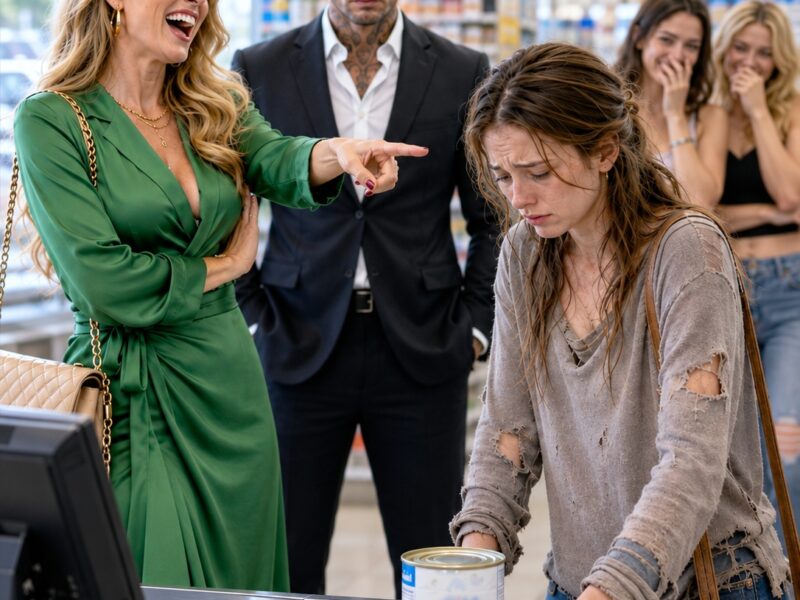
She Couldn’t Afford Baby Milk And Was Mocked — Until A Mafia Boss Stepped In And Silenced Everyone
At 6:40 on a Thursday morning, the checkout line at Romano’s Market in Providence went quiet for the ugliest reason a room ever went quiet.
Everybody had decided to watch.
Hannah Sullivan stood at register three with forty-one dollars and twenty cents in her palm.
The can of formula on the belt cost fifty-two ninety-nine.
She knew because she had checked the price online before leaving home, then checked her bank balance, then counted the money twice in the parking lot even though counting it a third time could not create eleven dollars and seventy-nine cents.
The formula was not a luxury brand.
It did not come in a gold container.
It was an amino-acid formula prescribed because Hannah’s fourteen-month-old daughter, Lily, reacted badly to cow’s-milk protein and had stopped gaining weight the last time Hannah tried a cheaper substitute.
The cashier scanned it.
Hannah inserted her debit card.
DECLINED.
She already knew.
Still, the red letters hurt.
The cashier was young, maybe twenty-three, with tired eyes and a plastic name tag that read KAYLA.
“Do you have another card?”
“No.”
Hannah heard how small the word sounded.
She placed the cash on the counter.
Kayla counted.
Then counted again.
“You’re short.”
“I know.”
Behind Hannah, somebody sighed.
She looked at the formula.
“Could you hold it until noon?”
Kayla glanced toward the manager.
“I don’t think we can hold formula.”
“I can come back.”
“I’m sorry.”
Hannah nodded.
She began gathering the money.
That should have ended it.
It did not.
A woman behind her spoke.
“If you can’t afford to feed them, maybe don’t have them.”
The words came in the casual tone people used when commenting on weather.
Hannah’s fingers stopped.
The woman wore a camel-colored wool coat, leather gloves, and earrings Hannah recognized from a department-store window because the price had once made her laugh.
She was in her early forties, beautifully dressed, impatient.
Her cart held imported coffee, sparkling water, organic berries, and flowers.
She looked Hannah up and down.
“Seriously. Everyone else has somewhere to be.”
A man farther back chuckled.
The woman continued.
“Fifty dollars. For one can.”
Hannah closed her hand around her cash.
“What kind of mother comes to a store without enough money to feed her baby?”
Kayla looked uncomfortable now.
“Ma’am—”
“What?”
The woman lifted her chin.
“I’m not the one holding up the line.”
Hannah had learned there were humiliations that improved when you fought them and humiliations that only grew teeth.
This was the second kind.
She pushed the formula slowly toward the cashier.
“Put it back.”
Kayla’s face changed.
“I can ask my manager if—”
“It’s okay.”
It was not.
But Hannah had no intention of crying in front of a woman whose greatest inconvenience that morning was waiting ninety extra seconds for blueberries.
She picked up her handbag.
The woman behind her muttered, “Unbelievable.”
Hannah turned.
Not to argue.
She looked at the woman once.
Long enough to remember her face.
Then walked away.
Nobody noticed the man at the coffee counter.
Not until he put down his cup.
Nico Ferrante had been standing near the back of the store reading the Providence Journal.
Dark overcoat.
Black gloves.
No hurry.
At forty-two, he had the composed stillness of a man who rarely needed to move quickly because other people moved first.
Most of Federal Hill knew him.
Some knew his legitimate businesses.
Trucking.
Construction.
Warehouse leasing.
Union contracts.
Others knew his surname.
Ferrante.
That was enough.
Nico folded the newspaper.
Walked toward register three.
The woman in the camel coat turned when she heard his shoes.
Her expression changed.
Not dramatically.
Just enough.
Nico stopped beside the conveyor belt.
Kayla was still holding the formula.
He pointed at it.
“How many?”
She swallowed.
“Sorry?”
“How many cans do you have?”
“Of this?”
“Yes.”
“Maybe eight on the shelf. I’d have to check the stockroom.”
“Check.”
The manager appeared before Kayla could call him.
“Mr. Ferrante.”
Nico looked at him.
“Don’t clear the shelf.”
The manager blinked.
Nico continued.
“Leave enough for other families. Put six cans aside.”
“Yes, sir.”
“And ring up the one she tried to buy.”
The woman behind him found her voice.
“Excuse me.”
Nico did not turn.
She continued.
“Some of us were waiting.”
He looked at her.
That was all.
The line went completely silent.
The woman’s cheeks colored.
“I only meant—”
“I heard what you meant.”
His voice was low.
Almost polite.
She straightened.
“You don’t know the situation.”
“No.”
Nico glanced toward the glass doors Hannah had just passed through.
“Neither did you.”
The woman opened her mouth.
He continued.
“You had enough time to count another woman’s money.”
His gaze dropped briefly to her cart.
“You had enough money to solve the problem.”
Nobody laughed now.
“You chose commentary.”
The woman’s face hardened.
“I don’t owe strangers groceries.”
“No.”
Nico nodded.
“You don’t.”
A pause.
“But if you choose not to help, humiliation is an expensive hobby.”
She stared at him.
Nico turned back to Kayla.
“Finish the sale.”
The manager hurried to the register.
The woman in camel abandoned her cart.
Her heels struck the tile as she walked toward the exit.
No one watched her leave.
Nico did not smile.
He took out a card.
“Can this store establish a prepaid account?”
The manager nodded rapidly.
“Yes.”
“For formula?”
“Yes.”
“Good.”
Nico looked at Kayla.
“If that customer comes back, tell her six cans are paid.”
Kayla blinked.
“All six?”
“Yes.”
“Under whose name?”
“Nobody’s.”
The manager reached for the card.
Nico kept it between two fingers.
“One more thing.”
“Yes, sir.”
“Her address does not leave this store.”
The manager froze.
Nico’s eyes narrowed.
“I don’t want an employee searching customer records because a man with money asked.”
The manager nodded.
“Of course.”
“If she returns, give her this.”
Nico wrote a number on the back of a receipt.
“Tell her it belongs to my office. If she wants delivery, she can call.”
Kayla looked at him.
“And if she doesn’t?”
“Then she doesn’t.”
He paid.
Turned.
At the door, he stopped.
“Kayla.”
Her shoulders tightened.
“Yes?”
“You looked tired.”
She stared.
“That doesn’t excuse making someone feel smaller.”
Her face went red.
“No.”
“But it also doesn’t mean you deserve to lose your job for one bad morning.”
The manager shifted.
Nico looked at him.
“She keeps the shift.”
“Yes.”
Then Nico left.
Hannah knew none of it.
She walked twenty minutes home because bus fare cost three dollars round trip.
Three dollars could become bananas.
Rice.
Laundry detergent.
Three dollars could become almost anything when you had almost nothing.
Her apartment sat above a laundromat on Atwells Avenue.
The ceiling sloped over one side of the bedroom.
When all twelve dryers downstairs ran at once, the floor became warm enough that Hannah could lower the thermostat.
That had mattered last winter.
She knocked on the ground-floor apartment.
Pearl Donnelly opened the door holding a wooden spoon.
Pearl was seventy-four, widowed, opinionated, and had spent thirty-two years working as a pediatric nurse before arthritis convinced her to retire.
She looked at Hannah.
Then at Hannah’s empty hands.
Asked nothing.
Behind her, Lily sat on a foam play mat stacking yellow blocks.
She saw Hannah and smiled.
“Mama.”
The word still sounded new.
Hannah bent.
Lily toddled into her arms.
Warm.
Solid.
Alive.
Hannah closed her eyes against her daughter’s hair.
Pearl said, “She ate banana and oatmeal.”
“Any stomach pain?”
“No.”
“Rash?”
“No.”
“Vomiting?”
“None.”
Hannah nodded.
Pearl looked at her.
“You didn’t get it.”
Hannah shook her head.
“How short?”
“I’ll figure it out.”
“That wasn’t the question.”
“Eleven seventy-nine.”
Pearl exhaled.
“I have twenty upstairs.”
“No.”
“Hannah.”
“No.”
Pearl’s monthly Social Security barely covered her own life.
“You’ve already watched Lily three mornings this week.”
“I enjoy her.”
“That doesn’t make electricity free.”
Pearl rolled her eyes.
“Young people are exhausting.”
Hannah almost smiled.
She carried Lily upstairs.
In the kitchen cupboard sat the nearly empty formula can.
Hannah opened it.
Enough for two normal bottles.
Maybe slightly more.
She did not dilute it.
The pediatrician had warned her never to change the concentration.
Instead, Hannah called the community clinic.
A nurse told her they had two sample cans of a comparable prescribed formula but needed the doctor’s approval before releasing them.
“Can I come today?”
“I’ll ask.”
“How long?”
“I’ll call back.”
Hannah thanked her.
Then sat on the bed.
Lily crawled into her lap.
“Milk?”
“Soon.”
Hannah kissed her forehead.
“Soon, bug.”
She opened a hardbound notebook.
The pages contained fourteen months of feeding records.
Time.
Amount.
Vomiting.
Rash.
Weight.
Every pediatric appointment.
Every trial of ordinary formula that ended with Lily screaming in pain.
The last recorded weight was twenty-four pounds, eleven ounces.
Three weeks earlier: twenty-four pounds, nine.
Progress.
Small.
Still progress.
Hannah closed the book.
Beside it sat a stack of clothing alterations from customers downstairs.
Eleven pieces.
Four dollars per hem.
Six for a zipper.
Ten for replacing a coat lining.
Work that came in irregularly because Pearl’s nephew who owned the laundromat sometimes told customers, “The widow upstairs sews.”
Hannah hated the phrase.
It got business.
On the table beside the alterations sat another envelope.
NOTICE OF FORECLOSURE.
The property named inside was not the apartment.
Pier 9.
Daniel Sullivan’s welding shop on Allens Avenue.
Her husband’s.
Now hers.
Daniel had died fourteen months earlier after falling from scaffolding at the edge of the pier.
No witnesses.
The official report called it a workplace accident.
Hannah had believed it because there was no alternative story she could survive while holding a six-week-old baby.
Daniel had taken a nineteen-thousand-dollar loan four years earlier to upgrade the electrical system and buy an industrial welding machine.
Thirty-one payments had been made on time.
After his death, Hannah fell behind.
The lender began adding fees.
Reassessment.
Administration.
Processing.
Late-charge interest.
Nineteen thousand had become thirty-four thousand six hundred.
Hannah understood enough arithmetic to know numbers were being used against her.
She did not understand enough law to prove how.
Pier 9 was the only thing Daniel left Lily besides photographs.
He used to stand on the dock with the river behind him and say:
“One day this belongs to her.”
Hannah had thought he meant sentiment.
She folded the foreclosure notice.
Then began sewing.
At 10:12, the clinic called.
One sample can was ready.
Hannah cried after hanging up.
Not because one can solved anything.
Because for twenty-four hours, Lily would eat.
At noon, Hannah walked back toward Romano’s.
She intended only to pass it on the way to the clinic.
Kayla saw her through the glass.
She ran outside.
“Hannah?”
Hannah stopped.
They had never exchanged names.
Kayla looked embarrassed.
“I saw it on your receipt.”
Hannah’s shoulders tightened.
“I’m sorry.”
“For what?”
“This morning.”
Hannah said nothing.
Kayla swallowed.
“I was tired. That’s not an excuse.”
“No.”
“I shouldn’t have read the price louder.”
Hannah looked at her.
“No.”
Kayla nodded.
“There’s something inside for you.”
“I’m going to the clinic.”
“It’s formula.”
Hannah froze.
Kayla continued.
“The man after you left. He bought six cans.”
Hannah’s face hardened.
“Who?”
“Nico Ferrante.”
The name meant nothing to her.
Kayla lowered her voice.
“He left a number. He said if you want delivery, call. If not, don’t.”
Hannah looked through the window.
Six cans sat in a cardboard box behind customer service.
Her pride rose first.
Then Lily’s face.
Pride lost.
“Did he ask where I live?”
“No.”
“Anything about me?”
“No.”
“He paid for six?”
“Yes.”
“Why?”
Kayla gave a helpless laugh.
“I think because Mrs. Crane was horrible.”
“Crane?”
“The woman behind you. Vivian Crane.”
Hannah stored the name.
She looked at the formula.
“Can I pay him back?”
Kayla hesitated.
“He didn’t leave an address.”
“Of course.”
Hannah entered.
She took one can.
Left five.
The manager objected.
“They’re all yours.”
“No.”
“Already paid.”
“Then someone else can use them if they need them.”
She wrote her phone number on the receipt.
“If Mr. Ferrante wants repayment, give him that.”
Then she left.
Three hours later, Nico sat in his office on Eddie Street while Vin Falco placed the receipt on his desk.
Vin was Nico’s chief of security for legitimate operations and the closest thing Nico had to a conscience willing to argue in complete sentences.
“She took one.”
Nico read the number.
“Only one?”
“Left five.”
“She say why?”
“No.”
Nico looked at the receipt again.
Vin asked, “Want me to call?”
“No.”
“You bought six.”
“She took what she chose.”
Vin shrugged.
Nico returned to paperwork.
Then noticed another sheet Vin had placed beneath the receipt.
“What’s that?”
“Public foreclosure filing.”
Nico looked up.
Vin continued.
“You said not to pull private information. I didn’t. This was published at city records.”
SULLIVAN WELDING — PIER 9
Nico’s expression changed.
“Pier Nine?”
“Yes.”
He took the page.
“Who owns the note?”
“Bay State Community Lending.”
“Parent?”
“Crane Harbor Financial.”
Nico looked at Vin.
“Crane.”
“Same family as the woman in the store.”
That could be coincidence.
Nico had lived too long to worship coincidence.
“Anything else?”
“Pier Nine is inside the proposed Harbor Crescent redevelopment zone.”
Now Nico went still.
Harbor Crescent.
Four hundred million dollars.
Marina.
Hotel.
Commercial waterfront.
A project his legitimate investment office had been evaluating through a regional infrastructure fund.
“Who owns the surrounding parcels?”
Vin smiled without humor.
“You’re going to like this less the longer I talk.”
“Usually true.”
“Crane Harbor Group.”
Nico leaned back.
One small parcel in the middle of a giant development.
A widow being foreclosed.
A lender owned by the developer.
Not proof of wrongdoing.
Enough to ask.
“Get Marian.”
Attorney Marian Hale arrived twenty minutes later.
Sixty-one.
Silver hair.
A courtroom voice even when ordering coffee.
Nico gave her the public foreclosure notice.
“I want to know whether the fees are legal.”
“Why?”
“Does it matter?”
“Yes.”
He told her.
Grocery store.
Formula.
Vivian Crane.
Hannah.
Pier 9.
Marian listened.
Then stared at him.
“You bought baby formula and somehow reached waterfront finance in three hours.”
“Yes.”
“You are neurologically incapable of normal charity.”
“I don’t give charity.”
“Of course not.”
She took the papers.
“If there are illegal fees, Hannah needs independent counsel.”
“Find one.”
“I will send her the name.”
“Not mine?”
“No.”
“Why?”
“Because the widow should not have to wonder whether saving her property means owing Nico Ferrante.”
He considered.
“Fair.”
Marian pointed at him.
“You are learning.”
“Slowly.”
“Painfully.”
The following afternoon, Hannah heard a knock.
She opened the attic door.
Kayla stood on the landing carrying a box.
Behind her stood a man in a dark coat.
Hannah recognized him only because Kayla looked terrified enough to identify him without words.
“Nico Ferrante?”
“Yes.”
Hannah looked at the box.
Five cans.
“I left those.”
“I noticed.”
“I took one.”
“I also noticed.”
“Then why are they here?”
“Because your daughter still needs them.”
Hannah’s face heated.
“If this is pity, take it downstairs.”
Kayla flinched.
Nico did not.
“I don’t need gratitude.”
“Good.”
“And I’m not asking you to accept the formula.”
“Then why bring it?”
“So the choice happens at your door instead of under fluorescent lights with an audience.”
Hannah looked at him.
That answer disarmed her slightly.
She disliked that.
“What do you want?”
“Nothing for the formula.”
“That’s never true.”
“With me, frequently.”
She almost shut the door.
Nico took a folded document from his coat.
“This is different.”
Hannah did not take it.
“What?”
“A bid.”
“For what?”
“Uniform jackets.”
Hannah frowned.
Nico continued.
“Ferrante Freight has two hundred warehouse and dock employees receiving new winter jackets.”
“And?”
“I was told you sew.”
“Who told you?”
“The laundromat website lists alteration services upstairs.”
Hannah glanced toward the old laptop on her table.
She had forgotten Pearl’s nephew created that page.
“I don’t make two hundred jackets.”
“You could.”
“With a household sewing machine?”
“The bid includes equipment reimbursement.”
Hannah finally took the pages.
Market rate.
Material supplied.
Forty jackets per installment.
Payment every Friday.
No percentage withheld.
No “advance” to repay.
No ownership clause.
No property.
No Pier 9.
She read every page.
Twice.
“Why me?”
Nico answered immediately.
“Because I need jackets.”
“There are factories.”
“Yes.”
“Cheaper ones.”
“Yes.”
“Faster ones.”
“Probably.”
Hannah looked up.
“Then try again.”
For the first time, Nico’s expression changed.
A faint smile.
“You asked whether you could repay the formula.”
She went still.
“This lets you decide whether we ever need to discuss repayment.”
“You’re giving me work so I can pay for something you already said I don’t owe.”
“I said the formula has nothing to do with the contract.”
“That sentence makes no sense.”
“It does to me.”
Hannah looked at Kayla.
Kayla was pretending to study a nail in the wall.
Hannah returned to the contract.
“I’d need an industrial machine.”
“Write the model under equipment.”
“It belongs to me afterward?”
“If the contract completes.”
“What if you cancel?”
“It still belongs to you.”
“I want that in writing.”
Nico looked almost pleased.
“It is.”
She found the paragraph.
He had anticipated the question.
“What happens if I refuse?”
“Kayla takes the boxes downstairs.”
“And?”
“I leave.”
“That’s it?”
“Yes.”
No threat.
No disappointment.
No debt.
Hannah looked at five cans of formula.
Then at the contract.
Lily appeared behind her leg.
Brown curls.
One sock.
She peered at Nico.
He looked down.
Lily hid.
Nico slowly crouched.
Not closer.
Just lower.
He did not extend a hand.
Lily watched him.
Then pointed at the box.
“Milk.”
Nico nodded.
“Yes.”
Lily smiled.
Something inside Hannah’s chest broke quietly.
She turned away before anyone saw.
When she looked back, Nico had already stood.
“The first installment is due in three weeks.”
“I haven’t agreed.”
“No.”
He put a business card on the stair.
“You have until tomorrow.”
“And the formula?”
“Stay either way.”
Hannah looked at him.
“Why?”
Nico’s eyes shifted to Lily.
“Because babies shouldn’t negotiate contracts.”
Then he left.
Hannah signed the next morning.
Not because she trusted Nico Ferrante.
Because the contract survived Marian Hale’s referral to an independent small-business attorney, who reviewed it for Hannah and confirmed the terms were unusually favorable but legitimate.
The attorney also reviewed Pier 9.
That changed everything.
The lender’s late fees were not all enforceable.
Two property “reassessment fees” had no supporting appraisal.
A processing surcharge exceeded what the signed agreement allowed.
The actual lawful payoff was nearly nine thousand dollars lower than the foreclosure notice claimed.
Hannah sat in the attorney’s office.
“So I still owe money.”
“Yes.”
Relief and disappointment arrived together.
“How much?”
“Enough to matter.”
“But not thirty-four thousand.”
“No.”
“Can we stop the foreclosure?”
“We can challenge it.”
“How long?”
“Months.”
Hannah nodded.
“Do it.”
She did not ask Nico to pay the balance.
He did not offer.
That mattered.
The industrial sewing machine arrived four days later.
When Hannah pressed the pedal for the first time, the motor snapped into a sharp mechanical rhythm that filled the attic.
Lily clapped.
Hannah froze.
Daniel had owned a similar machine.
For fourteen months, silence had occupied the place where that sound used to live.
She put one hand against the table.
Then kept sewing.
The first payment arrived Friday.
Exactly right.
No bonus.
No note.
Hannah smiled when she saw that.
Pity often arrived with witnesses.
Respect tended to get the number correct and leave.
Nico came for the first shipment.
He inspected one jacket beneath the laundromat light.
“Strong stitching.”
“It should be.”
“Collar’s good.”
“I know.”
His mouth moved faintly.
“You always this pleasant with clients?”
“Only mysterious ones.”
Then he asked:
“Has anyone offered to buy Pier Nine?”
Hannah stopped.
“How do you know about Pier Nine?”
“Public foreclosure filing.”
“You looked me up.”
“The property.”
“Difference?”
“Yes.”
“To you.”
Nico accepted the criticism.
“Fair.”
Hannah folded her arms.
“Two men came three weeks ago.”
“What men?”
“City inspectors.”
“When?”
“Seven at night.”
Nico’s expression went still.
“City inspectors don’t inspect private waterfront structures at seven at night.”
Hannah felt cold.
“They had badges.”
“Names?”
“I don’t remember.”
“What did they say?”
“That the pilings might be unsafe.”
“And?”
“That I should consider selling before the report damaged the value.”
Nico looked toward the street.
“You receive an official report?”
“No.”
“Notice?”
“No.”
“Inspection number?”
“No.”
Hannah’s stomach tightened.
“What are you thinking?”
“That I don’t know enough.”
He took out a card.
Different number.
“My security office.”
She stared.
“I don’t need bodyguards.”
“Good.”
“I mean it.”
“So do I.”
He placed the card down.
“If someone comes to Pier Nine after dark, call police first.”
That surprised her.
“Then call this number if you want.”
“Why second?”
“Because you should never have to depend on me before the law.”
Hannah studied his face.
“You don’t sound like the newspaper version of Nico Ferrante.”
His eyes sharpened.
“You read about me?”
“Not yet.”
“That word is doing work.”
She almost smiled.
He left.
That night, Nico sat in the back of Vin’s car reading public records.
Daniel Sullivan.
Workplace fall.
Thursday.
7:40 p.m.
Three days later, Crane Harbor Group submitted a dredging application covering almost the entire western shoreline.
The application included technical surveys that would normally take weeks to prepare.
Meaning Crane’s project existed before Daniel died.
Maybe months before.
Nico looked at a property map.
Every parcel shaded.
One white square.
PIER 9.
“Vin.”
“Yes?”
“Who controls deep-water access?”
“According to this?”
Vin tapped the map.
“Sullivan parcel.”
There it was.
Not a worthless welding shop.
A choke point.
The river naturally deepened in front of Pier 9.
Without those water rights, Crane Harbor would need expensive dredging, environmental review, and years of permitting.
Daniel had owned the cheapest entrance to a four-hundred-million-dollar project.
And he refused to sell.
Nico closed the file.
“Find the purchase offers.”
“Public?”
“Start there.”
Three letters existed.
Sixty-five thousand.
Seventy-eight.
Ninety-five.
Daniel’s response each time:
NOT FOR SALE.
Nico stared at the signature.
Three days after Daniel died, the developer renewed internal acquisition documents.
One month later, the loan company tied to Crane Harbor began aggressive collections against Hannah.
Still not murder.
Still not proof.
But the shape of the coincidence was becoming expensive.
On the fifteenth of the month, Kayla delivered another box of formula.
Hannah signed.
Kayla lingered.
“Can I ask something?”
“You already did.”
Kayla smiled nervously.
“Are you okay?”
“Better.”
“You look different.”
“I have work.”
Kayla nodded.
Then blurted:
“Do you know who Nico Ferrante is?”
Hannah’s expression changed.
“I know his name.”
“No.”
Kayla looked toward the stairs.
“I mean who he is.”
Hannah waited.
Kayla lowered her voice.
“My manager says everyone in the store knew except you.”
“Know what?”
Kayla swallowed.
“Google him.”
Then she left.
Hannah did.
That night after Lily slept.
Articles.
Federal investigations.
Dock unions.
Money laundering allegations.
Two indictments.
One acquittal.
The Ferrante family.
Organized crime.
Nico’s father.
Then Nico.
ALLEGED SUCCESSOR.
Hannah read until almost two.
Some articles used careful language.
Others did not.
She turned off the phone.
Thought of the black card.
The formula.
The jackets.
The night security number.
The way store employees stopped breathing when Nico entered the checkout line.
The next time he came for jackets, she made him come upstairs.
On the table lay the contract.
The formula delivery receipt.
The public article printed from the laundromat office.
“Tell me.”
Nico looked at the papers.
“You already know.”
“I want to hear you say it.”
He stood across from her.
“I control businesses at the port.”
“Legal businesses?”
“Yes.”
“All of them?”
“No.”
Hannah’s throat tightened.
Nico continued before she asked.
“There are operations my father built that would not survive federal scrutiny.”
“You run them.”
“Some.”
“Crime.”
“Yes.”
The directness hurt differently than denial would have.
Hannah looked toward Lily’s sleeping corner.
“My daughter has been drinking formula bought with your money.”
“Yes.”
“I sew clothes for your men.”
“Yes.”
“I don’t want her raised on blood money.”
Nico did not move.
He did not say he was misunderstood.
Did not say all powerful men were dirty.
Did not ask her whether a clean check would taste different.
He waited.
Hannah’s voice shook.
“I finish the jacket contract because I signed it.”
“Yes.”
“You pay only what the contract says.”
“Yes.”
“After that, no more formula.”
His jaw tightened slightly.
“She needs it.”
“Insurance appeal is pending.”
“And if denied?”
“I’ll figure it out.”
Nico looked toward the formula box.
“You can hate me.”
Hannah stared.
“I won’t argue you out of that.”
He spoke quietly.
“But don’t make Lily hungry to prove something about me.”
“That sounds like control.”
“You’re right.”
He corrected himself immediately.
“The formula is yours through the prepaid store account. I will not cancel it. You decide whether to use it.”
Hannah said nothing.
“If you don’t, the store can donate it.”
He picked up his coat.
“The work continues until the contract ends.”
“Yes.”
“No visits beyond pickup.”
“Yes.”
“Vin comes.”
“If that’s what you want.”
“It is.”
Nico nodded.
“All right.”
He walked toward the stairs.
His eyes paused on a gray suit jacket Hannah had begun cutting from leftover wool.
Not part of the contract.
Something she had started after the night at Pier 9 without admitting why.
She took it from the hanger after he left.
Placed it inside the closet.
Three weeks later, Hannah went back to Pier 9.
Daylight.
Vin waited outside because she had reluctantly agreed not to enter alone until the fake-inspector issue was resolved.
The workshop smelled exactly as it had the day Daniel died.
Cold iron.
Dust.
Welding flux.
Machine oil.
His gloves still hung beside the workbench.
One tucked into the other.
Hannah stared.
Then walked past.
The safe stood behind plywood.
She moved the panel.
The door was open.
Hannah stopped.
She knew she had locked it after Daniel’s funeral.
Inside, documents were scattered.
Folders torn.
Cash remained.
Daniel’s mother’s wedding ring remained.
His watch remained.
Nine hundred dollars in an emergency envelope remained.
Nothing valuable was missing.
Only papers had been searched.
Hannah stepped backward.
Vin saw her face through the open workshop door.
“What?”
“Someone was inside.”
He entered only after she nodded permission.
Looked at the safe.
“Don’t touch anything.”
“I already did.”
“Then stop now.”
Police documented the scene.
No usable prints.
No obvious theft.
The officer called it suspicious but explained there was no way to know when the search occurred.
Hannah understood.
Proof remained stubborn.
That afternoon, two men arrived from Crane Harbor Group.
Legitimate business cards.
Polite voices.
Ninety thousand dollars cash equivalent for Pier 9.
Closing in thirty days.
Hannah asked:
“What is it worth?”
The older representative smiled.
“Whatever a willing buyer and willing seller agree.”
“What are the water rights worth?”
His smile changed.
Only slightly.
“I’m not sure what you mean.”
“That usually means I asked the correct question.”
He recovered.
“Mrs. Sullivan, this building is deteriorating.”
“It isn’t for sale.”
“The city may declare it unsafe.”
“Then they can send an inspector during city hours.”
The younger man looked at her.
Hannah met his eyes.
The older man gathered his papers.
“We’ll give you time.”
“I don’t need it.”
He reached the door.
Then turned.
“This isn’t a safe place for a woman alone.”
Hannah felt cold.
She answered:
“That sounded less like concern than you intended.”
He smiled.
Left.
Her hands started shaking only after the car disappeared.
She called her attorney.
Then Nico’s security number.
In that order.
Vin answered.
That night Hannah returned because she had left her industrial shears at the shop.
A stupid reason.
She knew that later.
At the time, she wanted the second jacket shipment finished and did not want to lose half a morning.
She took a cab.
The rolling door at Pier 9 stood three feet open.
A flashlight moved inside.
Hannah stopped.
Voices.
Two men.
“Find the survey.”
“Which drawer?”
“All of them.”
Metal scraped.
Then came a liquid sound.
The smell reached Hannah.
Fuel.
Her stomach dropped.
One man said:
“Bases of the columns. Not the center.”
Arson.
Hannah backed away.
Her shoe struck a steel bar.
The clang echoed.
Silence.
Then footsteps.
Hannah ran.
She reached the rear service door.
Slipped inside the narrow pier corridor.
Bolted the steel door.
Someone hit it from the other side.
Once.
Twice.
Hannah called 911.
Then Nico’s number.
Vin answered.
“Where?”
“Pier Nine.”
“What happened?”
“Two men. They’re pouring fuel.”
“Police?”
“Called.”
“Good.”
Someone kicked the door.
Lily was with Pearl.
Thank God.
“Hannah.”
Vin’s voice sharpened.
“Stay where you are.”
“I am.”
“Do not open for anyone unless police identify themselves.”
The line stayed open.
Providence police arrived first.
Then fire.
Then Vin with licensed security staff.
No gunfight.
No dead men.
One intruder escaped.
One was caught trying to climb the river fence.
Inside the workshop, officers found fuel containers.
A pile of Daniel’s old survey documents beside the door.
Hannah stood under flashing lights with a blanket around her shoulders.
Nico arrived last.
He stopped ten feet away.
Did not touch her.
“You okay?”
“No.”
Good answer.
He nodded.
Hannah stared at him.
“I thought you only bought formula.”
Something changed in Nico’s face.
“I did.”
“This is bigger.”
“Yes.”
“What is Pier Nine?”
Nico looked toward the river.
Then back.
“Tomorrow.”
“No.”
“Hannah—”
“Tonight.”
He considered.
Then said:
“Your property controls the cheapest deep-water access to Crane Harbor’s marina project.”
She stared.
“How much?”
“Project?”
“Yes.”
“Four hundred million.”
Hannah laughed once.
Shock.
“I live above a laundromat because I can’t afford fifty-dollar formula.”
“I know.”
“And Daniel owned the key to a four-hundred-million-dollar marina.”
“Yes.”
“He never told me.”
“No.”
Her face changed.
“Why?”
“That I don’t know.”
The next morning, Nico met Hannah and her attorney at a coffee shop.
Not alone.
Her choice.
He spread a zoning map across the table.
Every neighboring parcel.
Crane Harbor.
Pier 9 in the middle.
White.
Nico explained water depth.
Federal dredging permits.
Sediment contamination.
Cost.
Time.
Water rights recorded in 1962.
Hannah listened.
Then saw the three purchase offers Daniel had refused.
“He could have sold.”
“Yes.”
“We needed money.”
“Yes.”
“Our dryer broke and stayed broken for two months.”
Nico said nothing.
“He borrowed nineteen thousand dollars.”
“Yes.”
“He had a ninety-five-thousand-dollar offer.”
“Yes.”
“Why wouldn’t he tell me?”
Nico looked at her.
“Maybe he believed the property would be worth more.”
“No.”
She knew Daniel.
“That wasn’t it.”
Memory came.
The pier.
Newly married.
Daniel pointing at the river.
One day this belongs to our kid.
At the time, they did not even have Lily.
Hannah closed her eyes.
“He wanted it for her.”
Nico nodded.
“Maybe.”
Hannah looked at the map.
“Did Crane kill him?”
“I don’t know.”
“Do you think they did?”
“I think there are questions.”
“That’s not an answer.”
“It is the only one evidence supports.”
Hannah studied him.
That restraint mattered.
Nico continued.
“The dredging application was ready before Daniel died.”
“How do you know?”
“Technical attachments.”
He showed her.
“Those take weeks.”
Hannah’s skin chilled.
“And the fake inspectors?”
“Likely tied to Crane.”
“The arson?”
“Police are investigating.”
“You know more.”
“I suspect more.”
“But?”
“Suspicion is not something I’m giving you as fact.”
Hannah folded the map.
“I’m not selling.”
Nico nodded.
“I know.”
Three days later, Hannah did something that surprised them both.
She asked Nico to come to the laundromat after closing.
“You still owe me nothing,” he said.
“I know.”
“Then why?”
“I’m making you a suit.”
He stared.
“No.”
“Yes.”
“Hannah.”
“You came to Pier Nine.”
“So did police.”
“You gave me information.”
“My lawyer did most of it.”
“You gave me work without turning it into a loan.”
He said nothing.
“I don’t like debts.”
“It isn’t a debt.”
“It is to me.”
“So charge me.”
“No.”
“That sounds like pride.”
“It is.”
He almost smiled.
She pointed at him.
“If you refuse, I return the sewing machine after the contract.”
“That is blackmail.”
“I learned from the newspapers.”
He laughed.
Actually laughed.
“All right.”
The fitting happened Tuesday night.
Hannah measured shoulders.
Chest.
Waist.
Sleeves.
Nico stood in the darkened laundromat beneath one lamp.
No guards inside.
Pearl upstairs with Lily.
Hannah moved behind him.
Her fingers brushed a raised scar near his left shoulder blade.
She stopped.
Nico did not turn.
She withdrew her hand.
Did not ask.
He noticed that.
When measurements ended, Nico sat on a plastic chair.
Hannah wound the tape.
Then he said:
“My mother used to shop at Romano’s.”
Hannah looked up.
He stared at the floor.
“I was six.”
A pause.
“She didn’t have enough money.”
Hannah remained still.
“She put back meat first.”
Then noodles.
Then laundry soap.
People sighed behind her.
Nico remembered staring at the tile because even at six he understood shame could be contagious.
“My father wasn’t around then?”
Hannah asked.
“Not reliably.”
“Did someone help?”
“No.”
He looked up.
“That’s why I noticed you.”
Hannah’s throat tightened.
“You bought six cans because of your mother.”
“No.”
“Then why?”
“Because I could.”
His eyes held hers.
“And because nobody helped her.”
Hannah nodded.
No thank you.
No apology.
Neither belonged there.
Small footsteps came down the stairs.
Lily appeared carrying paper.
She went straight to Nico.
Held it up.
A crayon drawing.
Three people beside a brown line.
Smallest in the middle.
Yellow circle overhead.
Nico studied it.
“Who’s that?”
Lily pointed.
“Mama.”
Second figure.
“Me.”
Then the third.
Lily looked at Nico.
Did not answer.
Hannah’s face heated.
Nico did not ask again.
He folded the paper carefully.
Put it inside his coat.
Two weeks later, someone called child protective services.
Anonymous.
The report alleged Lily was underfed.
Developmentally delayed.
Left with an unlicensed elderly neighbor.
Living in unsafe conditions.
Connected to organized crime.
The caseworker who arrived did not sneer.
Did not threaten to take Lily.
She explained the complaint.
Asked permission to enter.
Hannah let her.
The caseworker inspected food.
Formula.
Sleeping arrangements.
Hannah’s contract.
Pearl’s role.
Then Lily’s medical documentation.
Hannah brought the hardbound notebook.
Fourteen months of feedings.
Symptoms.
Weights.
The caseworker read.
“This is extremely detailed.”
“I had to know what made her sick.”
“Do you have a specialist diagnosis?”
“Community pediatrician.”
“Gastroenterologist?”
“Waitlist.”
“How long?”
“September.”
It was June.
The caseworker sighed.
“I believe you.”
Hannah’s eyes filled.
“But?”
“But my report needs medical records stronger than personal logs.”
Hannah looked at Lily playing with blocks.
“How long?”
“Fifteen days to submit additional documentation.”
“And after that?”
“If concerns remain, the agency may seek family-court review.”
Hannah’s face drained.
The caseworker softened.
“I’m telling you so you can act.”
After she left, Hannah sat against the door.
Lily brought her a yellow block.
“Stack.”
Hannah placed it on another.
Her hand shook.
Blocks fell.
Lily laughed.
Hannah cried.
She called Nico.
The distance she had demanded collapsed in one sentence.
“They said family court.”
Nico listened.
Asked for the case number.
Then said:
“Your lawyer first.”
“I already called.”
“Good.”
“My specialist appointment is months away.”
“I know someone at Hasbro Children’s.”
Hannah stiffened.
“No favors.”
“Cancellation list.”
“What?”
“My logistics company funds a pediatric transport program. Their office has a coordinator who can ask whether cancellations exist.”
“That’s a favor.”
“Yes.”
“I don’t want someone pushed out.”
“Neither do I.”
Nico’s voice stayed calm.
“If there is no opening, there is no opening.”
Forty minutes later, a cancellation appeared for Monday.
Hannah verified directly with the hospital.
No patient displaced.
She took Lily.
Vin drove but waited outside.
Dr. Leah Whitaker examined Lily for two hours.
Reviewed labs.
Ordered tests.
Then opened Hannah’s notebook.
Halfway through she stopped.
“You recorded every feeding?”
“Yes.”
“For fourteen months?”
“Yes.”
Dr. Whitaker looked at her.
“This is data.”
Hannah blinked.
“This is better longitudinal information than many charts I receive.”
Ten days later:
Non-IgE-mediated cow’s-milk protein allergy.
Growth faltering.
Amino-acid formula medically necessary.
No appropriate standard alternative.
The caseworker closed the investigation after reviewing records.
Unsubstantiated.
The insurance appeal was also approved.
Eighty percent coverage.
Retroactive six months.
Nico did not call the agency.
Did not threaten an insurance executive.
Did not send anybody to a parking garage.
Lawyers filed papers.
Doctors signed medical records.
The system worked slowly.
But this time it worked.
Kayla delivered formula on the fifteenth.
Then sat on the stairs and cried.
“I was the anonymous call.”
Hannah froze.
Kayla shook her head.
“No. Sorry. That sounded—no.”
She wiped her face.
“I mean I know who.”
Hannah waited.
“My manager overheard Vivian Crane bragging.”
Hannah’s face hardened.
“She called?”
“After the newspaper ran a little photo of Nico outside Pier Nine.”
Kayla swallowed.
“She said, ‘Let’s see how good a mother she looks when the state checks.’”
Hannah felt anger rise.
Clean.
Useful.
“Did you hear that directly?”
“Yes.”
“Will you tell the caseworker?”
Kayla hesitated.
Then nodded.
“Yes.”
Hannah sat beside her.
Kayla whispered:
“I laughed that morning.”
Hannah looked at her.
“When Mrs. Crane made fun of you.”
“Yes.”
“That hurt.”
Kayla cried harder.
Hannah did not say it was fine.
It had not been.
Instead she rested a hand on Kayla’s shoulder.
“Then do better with the next person.”
Kayla nodded.
That was enough.
Weeks later, Hannah returned to Pier 9 to finish clearing Daniel’s safe.
Vin waited outside.
She found an old rugged phone wedged beneath two broken folders.
Daniel’s work phone.
Dead battery.
At home, she found the charger.
The screen came alive after nearly an hour.
No password.
Hundreds of photographs.
Welds.
Serial numbers.
Equipment.
Invoices.
Then seventeen images taken three nights before Daniel died.
Providence River.
Night.
A barge anchored offshore.
A pipe extended over the side.
Black liquid poured into the water.
Illegal discharge.
Next images.
Two men on the pier.
One held an envelope.
Truck headlights crossed the scene.
For one second, both faces became clear.
Hannah enlarged the image.
One man accepted the envelope.
She did not know him.
Nico did.
She drove to his office that evening.
No appointment.
Vin let her in.
She placed Daniel’s phone on Nico’s desk.
“Look.”
He went through every photograph.
Slowly.
No skipping.
At the image of the envelope, Nico stopped.
Vin took one step closer.
Nobody spoke.
Hannah watched Nico enlarge the face.
Again.
Again.
Then he set the phone down.
Too carefully.
“Who?”
Nico stared at the screen.
“Rocco Ferrante.”
Hannah’s stomach dropped.
“Ferrante.”
“My cousin.”
She stepped backward.
“What does he do?”
Nico looked at her.
“Runs port operations under me.”
Silence.
“One of your men.”
“Yes.”
“Did you know?”
“No.”
“Did you know, Nico?”
His face changed.
“No.”
She looked at Daniel’s face reflected faintly in the dead-black edge of the screen.
“But you should have.”
“Yes.”
That answer hurt more than denial.
Hannah took the phone.
“I need to leave.”
“Hannah.”
“Don’t call me.”
“I wasn’t going to stop you.”
She stared.
Nico continued.
“The phone belongs to you.”
“Obviously.”
“Make a forensic copy before you hand it to anyone.”
“To police?”
“Federal environmental investigators.”
“Why not you?”
“Because if Rocco did this, my organization is inside the chain.”
Hannah’s eyes filled.
“And you expect me to trust you to expose your own cousin?”
“No.”
Nico held her gaze.
“Expect evidence.”
She left.
That night Hannah packed.
Not because Nico threatened her.
Because somebody had searched Daniel’s safe.
Burned Pier Nine.
Followed the property.
And now she knew Daniel photographed one of Nico’s senior men accepting money beside an illegal dumping operation three nights before he died.
Pearl came with her.
They checked into a roadside motel in Cranston under Pearl’s surname.
At 4:06 in the morning, Hannah woke to tires on gravel.
Two men walked along the motel corridor checking numbers.
She shook Pearl.
Lifted Lily.
Moved toward the rear exit.
A dark sedan waited beneath trees.
Vin stepped out.
“Get in.”
Hannah stopped.
“How did you find me?”
“Nico didn’t.”
“What?”
“Your lawyer called Marian after someone tried to access the motel booking system using Daniel’s name.”
Hannah’s heart pounded.
“Police?”
“On the way.”
“Who are those men?”
“We don’t know.”
She got in.
Not because Vin was Nico’s man.
Because Lily was asleep against her shoulder.
Police detained one man in the parking lot.
The second fled.
The detained man carried a photograph of Hannah.
No weapon.
No formulaic assassin.
Just a phone containing messages telling him to recover “the Sullivan device.”
Daniel’s phone.
The number directing him traced eventually to a contractor used by Rocco Ferrante.
Nico learned at 5:11.
He sat inside his car across from the motel.
Rocco sat opposite him later that morning only after Nico’s attorney and two security witnesses were present.
No threats.
No gun.
Nico put a printed photograph between them.
Rocco looked at it.
His expression did not change.
“You took money.”
Rocco sighed.
“Nico.”
“From who?”
“You think the world is clean because a widow looked at you disappointed?”
Nico said nothing.
Rocco continued.
“The barge operator dumped contaminated dredge material because disposal costs would kill Crane’s permit schedule.”
“Who paid you?”
“Crane.”
“Daniel saw.”
“Yes.”
Nico’s face went still.
“What happened?”
“He climbed where he shouldn’t.”
“Answer.”
Rocco looked at him.
“I confronted him.”
“And?”
“He wouldn’t give me the phone.”
“And?”
Rocco’s jaw tightened.
“We struggled.”
Nico felt something inside him go cold.
“He fell.”
“Accident?”
Rocco looked away.
“Nico.”
“Was it an accident?”
“I didn’t go there planning to kill him.”
That was an answer.
Not the one asked.
“You covered it.”
“Yes.”
“You searched his safe.”
“Yes.”
“You tried to burn Pier Nine.”
“I needed the original survey gone.”
“The men at the motel?”
“I needed the phone.”
Nico looked at his cousin.
Rocco leaned forward.
“I never intended to touch the little girl.”
Nico’s expression changed.
“That sentence is supposed to help you?”
“She wasn’t part of it.”
“She became part the moment her father died.”
Rocco’s voice sharpened.
“You’re family.”
“Yes.”
“You hand this outside, every man in the port sees you as a traitor.”
Nico sat quietly.
For years, family had been the argument that ended other arguments.
He thought of his mother in the grocery line.
Hannah with forty-one dollars in her hand.
Lily pointing at formula.
Daniel’s seventeen photographs.
One rule Nico’s father used to repeat:
We do not touch civilians.
The rule had always been partly mythology.
Now he understood mythology still demanded a price if you wanted to keep claiming it.
Nico opened the car door.
Rocco’s face changed.
“What are you doing?”
Nico looked at Vin.
“Call Marian.”
Rocco laughed.
“You’re calling your lawyer?”
“Yes.”
“To fix this?”
“No.”
Nico stepped out.
“To explain it.”
Marian Hale listened for eight minutes.
Then asked:
“Do you understand what happens if you make a federal proffer about conduct inside your organization?”
“Yes.”
“You may expose yourself.”
“Yes.”
“Your cousin.”
“Yes.”
“Other operations.”
“I will answer what they ask within the agreement.”
“You may lose the port.”
“Yes.”
“Men.”
“Yes.”
“Money.”
Nico looked through the office window.
Providence Harbor beyond warehouse roofs.
“Yes.”
Marian removed her glasses.
“Why?”
Nico’s answer came after a long silence.
“Because if the rule only applies when the man who breaks it has someone else’s surname, it isn’t a rule.”
The federal meeting lasted nearly five hours.
Nico turned over a forensic copy of Daniel’s phone.
Barge identification.
Rocco’s role.
Crane Harbor connections.
Security records.
Union schedules.
He did not confess to crimes unrelated to the defined matter without counsel negotiating each boundary.
Nor did prosecutors absolve him.
They made that explicit.
Assistant U.S. Attorney Erin Whitlock looked across the table.
“You understand you’ve placed yourself inside the chain of responsibility.”
“Yes.”
“Why keep talking?”
Nico looked at Daniel’s photograph.
“Because he’s dead.”
That was all.
Ten days later, Rocco was arrested.
Federal agents searched the barge operator.
Crane Harbor offices received warrants.
The news broke at noon.
Nico’s phone rang for two days.
Captains.
Union men.
Old allies.
He answered none.
On day three, silence replaced ringing.
Vin drove him home.
“Five men asked if I’m staying.”
“What’d you say?”
“That I am.”
Nico looked at him.
“Why?”
Vin shrugged.
“Somebody has to tell you when your ideas are stupid.”
Nico almost smiled.
Three weeks later, Crane Harbor held its groundbreaking ceremony anyway.
Public relations loved momentum.
A banner showed the marina.
Hotel towers.
Restaurants.
Luxury boats.
Preston Crane spoke about jobs.
Tourism.
Revitalizing the waterfront.
Hannah received an invitation because she owned the last unresolved parcel.
She almost threw it away.
Then learned Nico had turned evidence against Rocco over to federal prosecutors.
That night Hannah opened her closet.
Took out the unfinished gray suit.
Finished it.
Every seam.
Every buttonhole.
Every cuff.
Vin delivered it to Nico the morning of the ceremony.
At eleven, Hannah arrived carrying Lily.
Vivian Crane sat in the front row.
Same camel-colored coat.
Recognition did not happen immediately.
Hannah preferred that.
Preston finished his speech.
Then Nico Ferrante walked toward the platform.
Gray suit.
Hannah’s suit.
It fit perfectly.
Marian Hale walked beside him.
Two attorneys followed.
No entourage.
No guns.
No theatrical music.
Preston’s smile stiffened.
“Nico.”
“I need to correct something publicly.”
Reporters leaned forward.
Nico faced the microphones.
“Three years ago, my legitimate investment company committed capital to the Northeast Coastal Infrastructure Fund.”
Preston Crane’s face changed.
Nico continued.
“The investment was blind. I did not approve individual acquisitions.”
Marian held up documentation.
“Last week, the fund confirmed that Ferrante Holdings controls fifty-eight percent of currently committed capital.”
A murmur moved through the crowd.
Hannah stared.
Nico looked at Preston.
“For two years, Crane Harbor has been collecting waterfront land through debt pressure, distorted valuations, and fraudulent inspection threats.”
Preston’s smile vanished.
“That is defamatory.”
“Federal investigators have the supporting records.”
Camera shutters clicked.
Nico continued.
“You planned to package those parcels into a project financed mostly with my money.”
Silence.
“You were going to sell me access to land acquired by frightening people poorer than either of us.”
Preston stepped toward the microphone.
“This is not the forum.”
“It became the forum when you invited television cameras.”
Nico looked toward Hannah.
“Mrs. Sullivan.”
Every face turned.
Hannah’s stomach tightened.
She almost refused.
Then Lily touched her cheek.
Hannah walked forward.
Nico did not hand her a gift.
He handed her an appraisal.
Independent.
Water rights.
Market lease.
Three alternatives.
Sale.
Long-term lease.
Joint infrastructure easement.
Her attorney had received the documents the day before.
Nothing required an answer today.
Nico said:
“You are not selling anything unless you decide to.”
Hannah looked at Preston.
His face had gone pale.
Nico continued.
“The fund’s participation in Harbor Crescent is suspended pending the federal investigation.”
Reporters erupted.
Then Vivian Crane moved toward her husband.
A journalist caught her near Nico.
Perhaps desperate for something harmless to say, she looked at his jacket.
“That’s a beautiful suit.”
Nico looked down at the cuff.
Adjusted it.
Then looked directly at Vivian.
“The woman you called a useless mother at Romano’s made it.”
The ground seemed to stop breathing.
Vivian turned.
Saw Hannah.
Recognition crossed her face.
No one had to explain.
Cameras moved.
Hannah stood holding Lily with one arm.
She did not smile triumphantly.
Did not repeat Vivian’s cruelty.
Did not tell the crowd what formula cost.
She gave the woman one small nod.
The kind you gave somebody you no longer needed anything from.
Then stepped off the platform.
That silence humiliated Vivian more efficiently than revenge ever could.
Federal indictments followed six weeks later.
Crane Harbor executives faced fraud and environmental charges.
Preston Crane was charged with conspiracy related to coercive land acquisition and illegal dumping.
Vivian was not charged over the grocery-store cruelty.
Cruelty was not always criminal.
Her malicious child-welfare report became part of a separate harassment investigation, and she eventually admitted making it.
Rocco Ferrante pleaded guilty to environmental crimes, obstruction, attempted arson, and involuntary manslaughter in Daniel Sullivan’s death.
He received a long federal sentence.
Nico testified before the grand jury three times.
The cost arrived exactly as Marian predicted.
He lost his union position.
Several men left.
Businesses tied to illegal operations were dissolved or sold under oversight.
His trucking and construction companies remained because their books were legitimate.
Taxes paid.
Employees retained.
Vin stayed.
One afternoon, months later, Hannah asked:
“Did you lose all that because of Daniel’s phone?”
Nico looked toward the river.
“No.”
“Then why?”
He looked at her.
“Checkout line.”
She understood.
One year later, Hannah Sullivan opened Sullivan Workwear & Tailoring inside the renovated Pier 9 building.
She did not sell.
After months of negotiation, her attorney approved a twenty-year waterfront-access lease that paid fair market rent plus a small percentage of marina revenue once any lawful project proceeded.
The lease preserved Hannah’s ownership.
Lily’s future.
Daniel’s promise.
Six industrial sewing machines stood inside the old welding shop.
Four employees.
Kayla handled inventory and cutting after leaving Romano’s.
Pearl sat outside on sunny afternoons in a wooden chair, criticizing everybody’s posture.
Lily was nearly three.
Her allergy had improved enough that Dr. Whitaker had begun supervised food reintroduction.
On a high shelf above Hannah’s worktable sat one unopened can of amino-acid formula.
The final prepaid can.
Hannah could have donated it.
Could have thrown it away.
Instead she kept it.
Not because poverty deserved a shrine.
Because she wanted to remember the exact distance between being unable to buy one can and owning the place where six sewing machines now ran in rhythm beside the river.
Nico came by on a gray November afternoon.
He wore the suit Hannah made.
The fabric had softened at the elbows.
The left cuff showed a tiny repair she had done the previous month.
Lily saw him and ran.
“Nico!”
She wrapped both arms around his leg.
He crouched.
Always.
Never forcing her to look upward.
She told him a long story about a cat that had apparently stolen part of someone’s sandwich near the pier.
Nico listened as if port operations depended on it.
When Lily ran away, he reached inside his jacket.
Pulled out a folded paper.
The crayon drawing.
Three figures.
Yellow circle.
The creases had softened.
Hannah stared.
“You kept that?”
“Yes.”
“Why?”
Nico looked at the picture.
“I don’t know.”
“That’s a lie.”
“Probably.”
She wiped her hands on her apron.
Outside, the river had begun turning copper beneath late light.
Hannah stepped onto the concrete stoop.
Nico followed.
Sat beside her.
For a while, neither spoke.
The relationship between them had not become simple.
Hannah knew what Nico had been.
What parts of his past he could defend.
What parts he refused to.
She did not romanticize that.
He did not ask her to.
There had been dinners.
Arguments.
Weeks when they barely spoke.
One winter evening when Hannah told him that protection offered without consent was only another form of pressure.
He had gone quiet.
Then removed the security car he had placed near Pier 9 without asking.
The next morning he returned.
“Can we negotiate one?”
She had almost laughed.
They did.
That was how trust worked now.
Not as surrender.
As terms.
Nico looked toward the shop window.
The unopened formula can sat on the shelf.
“You still have it.”
“Yes.”
“Why?”
Hannah thought.
Then answered:
“Because I spent a long time thinking that morning was the lowest point of my life.”
“And?”
“It wasn’t.”
Nico waited.
“The lowest point was believing I had become smaller because other people could see I was struggling.”
She looked at him.
“I hadn’t.”
“No.”
“I was just broke.”
“Yes.”
“There’s a difference.”
“A large one.”
Hannah smiled.
Behind them, one sewing machine stopped.
Another started.
Pearl shouted at Kayla about wasting thread.
Lily laughed somewhere near the cutting table.
A ship’s horn sounded downriver.
Nico unfolded the drawing once more.
Three people.
Brown ground.
Yellow sun.
Hannah looked at it.
Then at him.
“You know she was two when she drew that.”
“I know.”
“She probably meant Pearl.”
Nico folded it carefully.
“Don’t ruin it.”
Hannah laughed.
A real laugh.
The kind she had once thought grief had taken permanently.
Nico smiled too.
Not the smile people photographed outside courthouses.
Not the one men at the waterfront watched for.
Something smaller.
Less defended.
Hannah looked back through the workshop door.
At the machines.
At Lily.
At the can on the shelf.
At Daniel’s old gloves still hanging from the iron column because she had never found a reason to take them down.
Nothing in the room had come from one man rescuing her.
Nico had bought formula.
Yes.
He had opened a door.
But Hannah had walked through every difficult thing afterward herself.
She signed the contract.
Kept records.
Fought the foreclosure.
Called police.
Protected Pier 9.
Told Nico no when no was necessary.
Finished the suit when yes became possible.
Kept Daniel’s phone.
Turned over evidence.
Raised Lily.
Built the shop.
Nico had learned something too.
Money could stop a humiliating checkout line.
It could not purchase dignity.
It could not buy Hannah’s trust.
And it could not erase the cost of what had been done in his family’s name.
Those things required evidence.
Time.
Consequences.
Choice.
The river moved below them.
Hannah leaned back on her hands.
“Do you remember what you said to Vivian Crane?”
Nico looked at her.
“Which part?”
“‘You had enough money to solve the problem. You chose commentary.’”
He frowned.
“I said that?”
“Yes.”
“Sounds dramatic.”
“You were wearing a black coat.”
“That explains it.”
She laughed.
Then became quiet.
“She thought not having enough money made me a bad mother.”
Nico looked through the window at Lily.
“She was wrong.”
Hannah nodded.
This time, she did not need anyone else to say it first.
“I know.”
Inside the workshop, Lily climbed onto a chair she had been told not to climb.
Pearl yelled.
Kayla caught her.
Hannah stood.
“Duty calls.”
Nico folded the drawing and returned it to the inside pocket of the suit Hannah had made for him.
She went back through the door.
He followed a moment later.
Above the worktable, the unopened formula can caught a narrow line of afternoon light.
Once, Hannah had stood in a grocery store unable to afford it while strangers decided her poverty gave them the right to judge her motherhood.
Now it remained sealed on a shelf above a business bearing her own name.
Not as proof that a powerful man had saved her.
As proof that the woman who once counted forty-one dollars and twenty cents had never been the failure in that checkout line.









