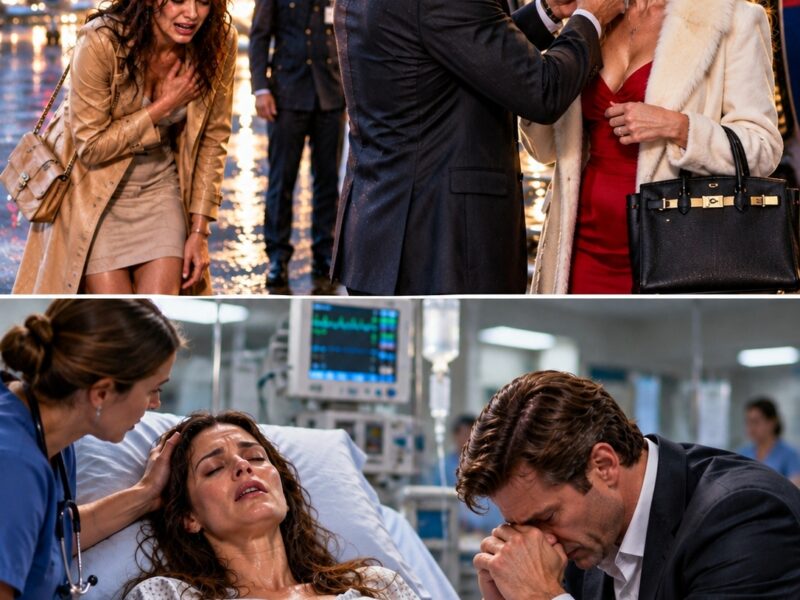
“She Needs It More,” My Husband Said as He Cut Off My Emergency Tag for His Mistress—Then I Lost Feeling in My Leg and He Lost Everything We Built
The yellow emergency tag had been around my wrist for less than four minutes when my husband cut it off.
“She needs it more.”
Graham said those words while I lay on a stretcher in freezing rain with one leg immobilized and his mistress trembling beside the plane that was supposed to take me to surgery.
For a second, I thought the pain medication had distorted what I was seeing.
Then the plastic strip fell from his hand onto the wet pavement.
“Graham.”
My voice sounded surprisingly calm.
Rain hammered the small mountain airfield hard enough to blur the lights of the Citation parked twenty yards away. Beyond it, the pine-covered ridges of central Oregon had disappeared into gray cloud.
Dana Morales, the emergency coordinator, stepped between Graham and the aircraft stairs.
“Mr. Hartwell, stop.”
Graham had one hand around Celeste Warren’s elbow.
Celeste was our company’s vice president of client relations.
She was also, as I had discovered forty-three minutes earlier, the woman my husband had been sleeping with for at least five months.
I had not yet confronted either of them.
The building had nearly killed me before I had the chance.
“Elise has a confirmed crush injury,” Dana said. “There’s evidence of compromised circulation below the knee. She is the priority patient.”
Celeste pressed one hand to her chest.
“I can’t breathe.”
Her makeup had streaked beneath her eyes.
She looked terrified.
I do not doubt that part.
Her fear was real.
So was my leg.
Dana glanced at the portable monitor clipped to Celeste’s finger.
“Your oxygen saturation is ninety-eight percent. You’re having a severe panic response, but your vital signs are stable.”
Celeste shook her head.
“My heart is racing.”
“I know.”
“I feel like I’m dying.”
Dana kept her voice level.
“You are not showing signs of a cardiac emergency.”
Graham turned on her.
“You don’t know that.”
“I know what the monitor says.”
“She needs a hospital.”
“So does your wife.”
Graham’s face tightened.
I had been married to him for eight years.
I knew that expression.
It meant the decision had already been made and whatever came next would be presented as reasonable discussion.
“Graham,” I said again.
He finally looked at me.
My left leg was trapped between two padded field splints from mid-thigh to ankle. The pain had changed character during the past ten minutes, shifting from violent pressure into a frightening numbness around my foot.
“What are you doing?”
His eyes moved toward my leg.
Then back to Celeste.
“The medic said you’re stable.”
“No.”
Dana answered for me.
“I said she is stable enough for transfer.”
Graham ignored her.
“The county ambulance can take Elise.”
Dana stared at him.
“The highway is partially closed.”
“There’s a bypass.”
“The bypass adds at least an hour in this weather.”
Graham looked irritated.
Not frightened.
Irritated.
“Then call ahead.”
Dana took one step closer.
“She needs an orthopedic trauma surgeon, preferably vascular support available, within the treatment window her receiving physician gave us.”
Celeste made a strangled sound.
Graham immediately turned toward her.
That was the moment something in me became colder than the rain.
Not because he cared that another person was frightened.
Because his body answered her before his mind answered me.
I had spent eight years believing reflexes revealed love.
Apparently they did.
Just not mine.
“Put her on the plane,” Graham told the flight coordinator.
The pilot, who had been standing under the wing, shook his head.
“The manifest says Mrs. Hartwell is the designated medical passenger.”
“I chartered the aircraft.”
“That doesn’t make you the medical coordinator.”
“I’m changing the passenger.”
Dana said, “You do not have the authority to change my triage assignment.”
Graham pulled Celeste toward the steps.
“Then write me up.”
The pilot stared at him.
For one second I thought he would refuse.
Then the operations manager, a nervous man from the conference center who had been hovering nearby, stepped in.
“Tom, we need somebody airborne before the weather closes the strip.”
The pilot looked at Dana.
Then at me.
I saw the argument happening silently.
Rules.
Contracts.
Responsibility.
A powerful client shouting in a storm.
I had spent enough of my professional life around emergency plans to recognize the exact moment when a system failed because nobody wanted to become the person who said no loudly enough.
Graham helped Celeste aboard.
I watched him.
She was breathing fast.
He held her shoulders.
Dana was still arguing.
The engine noise rose.
My toes felt farther away.
Then Graham looked back at me.
“She needs it more right now.”
I stared at him.
“More than blood flow?”
His face changed slightly.
“You’re being dramatic.”
Dana actually swore.
The pilot came down the stairs again.
“Mr. Hartwell, if we leave without the assigned patient, I’m documenting that you overrode the emergency allocation against medical advice.”
“Document whatever you want.”
Graham waved him away.
I looked at my husband.
He had always been good in boardrooms because he spoke with the confidence of a man who assumed resistance was temporary.
That afternoon, he applied the same skill to my body.
A minute later, the aircraft door closed.
I heard the mechanical seal.
Then the plane began to taxi.
I did not cry.
I reached for my phone.
Dana looked at me.
“What do you need?”
“Tail number.”
She understood immediately.
I photographed the plane through the rain.
Then the time on my phone.
Then the yellow priority tag lying on the pavement.
A dirty ribbon of plastic.
Proof that had been on my body until my husband decided it belonged to someone else.
I emailed the pictures to myself.
Then to my attorney.
The signal dropped seconds later.
The jet disappeared into the rain.
Dana crouched beside me.
“I’m getting you out.”
“How?”
“County ambulance.”
“The bypass?”
“Yes.”
“How long?”
She hesitated.
That scared me more than the answer.
“Dana.”
“Sixty-five to eighty minutes if the washout hasn’t worsened.”
I looked down.
“Tell me what happens if we’re late.”
She did not soften it.
“Circulation can deteriorate.”
“Permanent nerve damage?”
“Yes.”
“Loss of function?”
“Possible.”
I swallowed.
“Worst case?”
“I don’t think we’re there.”
“That wasn’t my question.”
She looked at me.
“Worst case can include losing viable tissue.”
I closed my eyes for three seconds.
When I opened them, I said:
“Give me my phone.”
The first call was to my attorney.
“Claire?”
“Elise?”
“I need you to open a file tonight.”
“What happened?”
“I’ll send photographs.”
“Elise, are you safe?”
“No.”
That changed her voice immediately.
“Where are you?”
“Juniper Ridge private airfield.”
“I thought you were at the conference.”
“I was.”
“What happened?”
“Service elevator failure.”
“Oh my God.”
“I need you to listen.”
“I’m listening.”
“My husband removed my emergency priority tag and put another passenger on the aircraft designated to evacuate me.”
Silence.
“Who?”
“I’ll explain later.”
“What do you need now?”
“Preserve everything.”
“Photographs.”
“Manifest.”
“Conference incident log.”
“Medical triage notes.”
“Pilot report.”
“Any radio recording.”
“Done.”
I called my younger sister next.
Nora answered on the first ring.
“You never call during conferences.”
“I need your truck.”
A pause.
“What happened?”
“I’m hurt.”
“How hurt?”
“Not dying.”
“That is not a useful unit.”
“Leg injury.”
“Where?”
“Juniper Ridge.”
“That road is flooding.”
“I know.”
“I’m leaving now.”
She hung up.
No speech.
No panic.
Just motion.
My third call was to Dr. Caleb Monroe, the orthopedic surgeon who had repaired Graham’s shoulder two years earlier.
I had saved his direct number because I saved numbers.
That was what I did.
I saved passwords.
Insurance cards.
Doctors.
Emergency contacts.
Client renewal dates.
Professional licenses.
The names of people who could solve problems before problems became disasters.
Graham liked to say I worried too much.
He had enjoyed the results of my worrying for years.
Dr. Monroe answered after four rings.
“Hartwell?”
“This is Elise.”
He heard my voice.
“What happened?”
I told him.
He asked precise questions.
Color.
Temperature.
Sensation.
Movement.
Pain.
Timing.
“Get here.”
“I’m trying.”
“How long?”
“Maybe seventy minutes.”
“Elise.”
“I know.”
“No, listen.”
His voice changed.
“Do not let anybody stop that ambulance for anything nonessential.”
“I understand.”
“I’ll alert vascular.”
The ambulance arrived sixteen minutes later.
By then, I could no longer reliably feel the side of my foot.
Dana rode with me until the county line.
Nora met us at the hospital because she had driven like an outlaw through the storm and beaten the ambulance by six minutes.
I reached surgery eighty-seven minutes after the plane left without me.
The last thing I remember before anesthesia was Dr. Monroe standing above me.
“Can you feel this?”
Pressure against my toes.
“Barely.”
“Okay.”
He looked at the anesthesiologist.
“Let’s go.”
When I woke, the room was dim.
My mouth tasted metallic.
My sister was asleep in a chair wearing the same rain jacket.
One hand still held her phone.
I lay still.
Then remembered.
My leg.
I tried to move my toes.
Nothing happened.
Panic shot through me so fast my heart monitor changed rhythm.
“Nurse.”
My voice cracked.
Nora woke.
“Elise?”
“Nurse.”
She jumped up.
“What?”
“I can’t move my toes.”
A nurse hurried in.
She touched my foot.
“Can you feel this?”
“Yes.”
“Here?”
“Yes.”
“Here?”
Faint.
But there.
Then one toe moved.
Barely.
I cried.
Not gracefully.
The kind of crying that leaves no room for dignity.
Nora put both hands over her face.
“Oh, thank God.”
The nurse smiled.
“Movement can be slow after this procedure.”
“Is it permanent?”
“The surgeon will talk to you.”
“Is it permanent?”
She did not lie.
“We don’t know yet.”
That sentence became the first honest thing I respected that morning.
Dr. Monroe came at seven.
The vascular compression had been relieved.
The circulation was restored.
But the joint damage was severe.
A second surgery would be required.
Months of rehabilitation.
Possible nerve complications.
No guarantee I would return to full strength.
“Will I walk normally?”
“That’s the goal.”
“That wasn’t what I asked.”
He gave me a look I would later recognize in another man.
The look of someone deciding whether comfort was worth sacrificing accuracy.
He chose accuracy.
“I don’t know yet.”
I nodded.
“Thank you.”
Graham was not there.
He had called twice.
That was what the nurse told me.
Once at midnight.
Again at four.
He arrived at nine-thirty.
Fresh clothes.
Fresh shave.
Coffee.
He placed the cup on my tray without asking if I wanted it.
He looked tired but clean.
That distinction told me where he had spent the night.
Not in a hospital chair beside me.
“Dr. Monroe says you’re going to be okay.”
“I talked to him.”
He pulled the chair closer.
“Elise.”
I looked at him.
He had beautiful gray beginning at his temples now.
People trusted men like Graham because confidence aged well on them.
“I had to make a call under pressure.”
“Yes.”
“Celeste couldn’t breathe.”
“Her oxygen was ninety-eight.”
“She thought she was dying.”
“My foot was losing circulation.”
He rubbed his forehead.
“The ambulance got you here.”
“Eighty-seven minutes later.”
“But it got you here.”
“That is your defense?”
“No.”
He leaned forward.
“I’m saying everything was chaos.”
“It wasn’t.”
“What?”
“Dana was very clear.”
“The pilot was clear.”
“The manifest was clear.”
“My surgeon was clear once I reached him.”
“You introduced chaos because you didn’t like the answer.”
His jaw tightened.
“Elise.”
“Did you sleep with her last night?”
He froze.
That was how I knew.
Not because he confessed.
Because for the first time all morning, he stopped managing the conversation.
I continued.
“I found her jacket in your office.”
His eyes narrowed.
“When?”
“Before the elevator failed.”
“I saw your phone inside the pocket.”
“Elise—”
“The message was on the screen.”
He looked toward the door.
“What did it say?”
I almost laughed.
Not denial.
Evidence management.
“You know what it said.”
He sat back.
“That has nothing to do with what happened at the airfield.”
“It has everything to do with it.”
“No.”
“You chose your mistress over your injured wife.”
“I chose the person I thought was in the more immediate crisis.”
“You were sleeping with her.”
“That didn’t determine the decision.”
“Of course it did.”
He stood.
“I’m not doing this while you’re medicated.”
I slid my wedding ring off.
My fingers were swollen from fluids, but the ring came free surprisingly easily.
I placed it beside his untouched coffee.
“I’m not asking you to do anything.”
He looked down.
“I’m telling you what I know.”
“Elise.”
“If you want to discuss finances, the company, the house, or this marriage, call Claire Benton.”
He stared at the ring.
“You already called a lawyer?”
“I called her from the runway.”
His eyes lifted.
That was the first time he looked afraid.
Not about losing me.
About losing control of the order in which things happened.
“You’re making legal decisions while you’re injured.”
“I documented a medical-priority override while I was injured.”
“There’s a difference.”
“You photographed me?”
“I photographed the plane.”
“The tag.”
“The time.”
His expression hardened.
“You’re building a case against me.”
“No.”
“I’m preserving the truth before somebody improves it.”
He left without touching the ring.
Nora returned forty minutes later with sandwiches.
She saw the ring.
Saw me.
Did not ask whether the marriage was over.
She unwrapped lunch.
“You need calories.”
“I’m not hungry.”
“You’re also not a plant.”
I looked at her.
“That’s your bedside manner?”
“I’m your sister.”
“Lower regulatory standard.”
I almost smiled.
She handed me half the sandwich.
“What do you need?”
“A plan.”
“That sounds more like you.”
I stared at my immobilized leg.
“No.”
“It sounds like who I’ve had to be.”
Nora paused.
I continued.
“I don’t know if that’s the same thing.”
The second surgery happened eleven days later.
Successful.
That word is slippery.
Successful meant the reconstruction held.
Blood flow remained good.
The damaged nerve began responding.
It did not mean I walked out healed.
I left with a walker.
A brace.
Medication.
A rehabilitation schedule.
And the possibility that my work life would change permanently.
My company was called Hartwell Environmental Strategies.
People usually assumed Graham founded it.
He was better known.
He spoke at conferences.
Appeared on panels.
Golfed with developers.
Remembered whose daughter attended Stanford and whose son needed an internship.
He could turn dinner into a contract.
I built the part clients actually purchased.
The environmental-response frameworks.
Compliance protocols.
Risk assessments.
Regulatory methodology.
Emergency-planning models.
I wrote our first operating manuals before Graham and I married.
Maintained the professional credentials.
Signed technical filings.
Built relationships with state environmental agencies.
Trained our analysts.
Reviewed reports carrying our company letterhead.
For years, I had thought the distinction did not matter.
We were married.
We were building together.
Then nine days after I left the hospital, my insurance premium payment failed.
I was staying at Nora’s house.
My leg was elevated on two pillows.
I logged into the business account.
Access denied.
I tried again.
Same message.
Then our accountant called.
“Graham instructed me to reroute operating deposits.”
“When?”
“Yesterday.”
“To where?”
“New commercial account.”
“Am I an authorized signer?”
Silence.
“No.”
That anger felt different from the airfield.
Cleaner.
At the airfield, I had been shocked.
Now I had confirmation.
Graham sent flowers while quietly removing my access to a company I had built.
I called Claire.
Then my accountant.
Then my licensing attorney.
Then I opened a blank document.
For six hours, I listed every technical framework I had developed since before the marriage.
Dates.
Versions.
Registrations.
Client applications.
Professional certifications.
Regulatory references.
Training modules.
Contracts.
Copyright notices.
Source files.
Internal invoices.
I had been organized enough to reconstruct the entire intellectual spine of the business.
Graham had always teased me for documenting everything.
That joke aged poorly.
Claire called at seven.
“Good news and bad news.”
“Good first.”
“He cannot simply erase your ownership interest by changing bank permissions.”
“Bad?”
“He’s going to claim everything created during marriage belongs to the marital business.”
“What predates it?”
“That is where your records matter.”
I looked at my spreadsheet.
“How much?”
“All of them.”
I smiled for the first time that week.
“I have all of them.”
Claire was quiet.
Then:
“Of course you do.”
The separation filing went in on Tuesday.
Graham’s lawyers responded Thursday.
Aggressively.
His position was simple.
Hartwell Environmental Strategies had grown during the marriage.
Therefore the technical work belonged to the marital enterprise.
Our answer was more precise.
My core methodology predated the marriage by sixteen months.
My state and federal professional credentials were personal.
Certain proprietary tools were licensed to the company but never assigned outright.
The regulatory relationships were tied to my certification.
And for six years, I had billed internal technical work separately for accounting purposes at Graham’s insistence because he wanted to track department profitability.
The system he created to prove his sales division generated revenue now documented exactly how much value depended on my work.
When Claire explained that, I laughed.
It hurt my ribs.
Graham did not.
He called from an unknown number after I blocked his personal phone.
“Elise.”
“How did you get this number?”
“Does it matter?”
“Yes.”
“Martin gave it to me.”
“I’ll tell Martin not to.”
“Can we stop doing this?”
“Doing what?”
“Acting like I’m the enemy.”
I looked at the brace around my leg.
“What would you call the man who removed my emergency medical priority?”
“Jesus Christ.”
“There.”
“That.”
“You turn everything into the runway.”
“The runway was clarifying.”
“You survived.”
I became still.
He heard it too late.
“Elise, I didn’t mean—”
“You survived.”
“That is what you just said.”
“I meant the surgeon fixed it.”
“I may never regain full nerve function.”
“You’re walking again eventually.”
“You don’t know that.”
“He said—”
“You spoke to my surgeon?”
Pause.
“At the hospital.”
“Not since?”
“No.”
“Then you have no idea.”
He exhaled.
“Can we talk about the company?”
There it was.
Not my leg.
Not my rehabilitation.
The company.
“What about it?”
“We built it together.”
“I agree.”
His voice softened.
Finally.
“Nadine—Celeste—was a mistake.”
I almost missed the name slip.
“Celeste was a mistake?”
“I’m saying the affair was.”
“How comforting for her.”
“She doesn’t matter compared to what we have.”
“What we had.”
“Fine.”
His patience cracked.
“What we had.”
“I’m willing to negotiate.”
“That is what lawyers are doing.”
“I’m talking about us.”
“No.”
“Elise.”
“No.”
He went quiet.
Then:
“You’re really going to destroy the business because you’re angry?”
I stared at the kitchen window.
Rain had begun again.
Not a storm.
Just rain.
“I am protecting my work.”
“That work exists because I brought clients.”
“Some.”
“Most.”
“And they stayed because somebody fulfilled the contracts.”
“You’re impossible.”
“No.”
“I’m documented.”
I hung up.
My physical therapist was named Miles Carter.
Forty-two.
Former collegiate runner.
No inspirational quotes on the walls.
No music loud enough to pretend pain was fun.
His clinic had tall windows and brutally cheerful morning light.
At my first session, he read the surgeon’s notes before touching my leg.
Then he pulled a stool over.
“This is going to be unpleasant.”
“Excellent sales pitch.”
“You’ve had enough people lying about what things cost.”
That got my attention.
He pointed to my knee.
“Flexion is limited.”
“Muscle loss is significant.”
“Nerve response is encouraging.”
“Circulation is good.”
“We’re going to work on range first.”
“When will I walk without the brace?”
“I don’t know.”
I almost smiled.
“Good answer.”
He looked at me strangely.
“Most people hate that answer.”
“I’ve had a difficult month with inaccurate reassurance.”
“Then I’ll give you accurate uncertainty.”
That became our agreement.
On session three, he bent my knee toward sixty degrees.
White heat shot up my leg.
I swore.
Miles stopped.
“You said sixty.”
“I did.”
“You said it like somebody describing room temperature.”
He considered.
“Next time I’ll provide emotional punctuation.”
“Please.”
He repositioned my foot.
“This will hurt.”
“Better.”
“Still hurts.”
“Yes.”
“Honesty is disappointing like that.”
Week by week, my body became a set of measurable facts.
Fifty-seven degrees.
Sixty-three.
Seventy-one.
Fourteen assisted steps.
Reduced swelling.
Intermittent nerve sensation.
I hated how slow it was.
I loved that progress could not flatter me.
Either the knee bent or it did not.
Either the muscle fired or it did not.
There was relief in data after a marriage built increasingly on interpretation.
Graham began apologizing in visible ways.
Flowers.
Letters.
Food deliveries.
A necklace I returned.
He also became obstructive in ways nobody photographed.
A client received an email implying I had stepped away indefinitely due to “complex medical circumstances.”
My professional liability renewal was redirected to an administrative inbox I could not access.
Two staff members were told future technical approvals would go through Graham.
That lasted forty-eight hours.
Then the state licensing office informed him that unlicensed executives could not substitute themselves for the professional of record.
He called me furious.
“Did you report me?”
“No.”
“Somebody did.”
“The regulator noticed you changed the designated professional.”
“You could have called me.”
“You could have called the regulator before changing it.”
“You’re enjoying this.”
“No.”
That was true.
I was not.
People imagine leaving a betrayal gives you immediate pleasure when consequences arrive.
Mostly it gave me paperwork.
Pain.
Fatigue.
Deadlines.
The pleasure was smaller.
I no longer had to pretend something inaccurate because admitting it would upset my husband.
Six weeks after surgery, I walked twenty-four steps without the walker.
Miles followed two feet behind me.
Not touching.
The corridor looked absurdly long.
My left foot landed cautiously.
Then again.
I reached the wall.
My eyes filled.
I became angry at them.
Miles said:
“That’s normal.”
“Please don’t call me brave.”
“I wasn’t going to.”
“Good.”
“I was going to say consistent.”
I looked back.
He shrugged.
“Bravery gets overused.”
“You showed up thirty-two times.”
“That’s the measurable part.”
I wiped my face.
“That might be the nicest thing anyone has said to me this year.”
“Walk back.”
“You ruined it.”
“You still need the return trip.”
I did.
The public version of the accident began changing around the same time.
Hartwell Environmental’s communications department issued a statement after a trade publication asked why I had missed a scheduled panel.
It described the conference emergency as involving “multiple guests requiring urgent transportation under extreme weather conditions.”
Another sentence said:
“Mrs. Hartwell elected ground transport while another distressed attendee was evacuated by air.”
I read it three times.
Elected.
There are words that turn harm into consent.
That one did.
Celeste oversaw communications.
I emailed the statement to Claire.
Then I did nothing publicly.
I did not post photographs.
Did not call journalists.
Did not tell LinkedIn what my husband had done.
The truth did not become more valid because strangers applauded it.
Then Juniper Ridge Conference Center submitted its incident response to the state safety authority.
The facility was already under investigation for the elevator failure.
Its report claimed emergency evacuation had been “successfully coordinated using private aviation and county ground resources.”
It cited Graham’s intervention as an example of “rapid executive decision-making.”
I read that phrase while sitting in Miles’s waiting room.
Rapid executive decision-making.
My silence was now being converted into institutional evidence that everything worked.
That I could not tolerate.
I filed a correction.
Nothing dramatic.
Chronology.
6:47 p.m.—medical priority assigned.
6:51—tag removed by non-medical individual.
Medical coordinator objected.
Pilot objected.
Assigned passenger replaced.
Ground transport delayed by weather closure.
Arrival at receiving hospital eighty-seven minutes after aircraft departure.
Surgery performed for vascular compromise.
Attachments:
Photographs.
Timestamp.
Dana’s incident report.
Original passenger manifest.
Pilot’s written objection.
I ended with one sentence.
I am not offering an opinion regarding motive; I am correcting the sequence of events.
Three weeks later, the state authority opened a secondary review into the emergency evacuation.
The conference center’s insurer became interested.
So did the charter operator.
So did Graham’s attorneys.
Claire called while I was at physical therapy.
“He wants to settle.”
Miles was entering measurements into his tablet.
“What does he want?”
“He’ll concede your pre-marital methodology.”
“Okay.”
“Drop the ownership challenge to the core technical frameworks.”
“Okay.”
“Cover unreimbursed medical expenses.”
“That was already in discussion.”
“Yes.”
“And?”
Claire sighed.
“He wants a joint statement.”
I laughed.
“Of course.”
“Language says the airfield incident resulted from a mutual misunderstanding during a rapidly evolving emergency.”
“No.”
“Elise, the business concessions are significant.”
“I know.”
“You should understand what you’re rejecting.”
“I do.”
Miles looked up briefly.
Then back at his tablet.
Claire continued.
“They’re giving ground worth a lot of money.”
“My medical truth isn’t a bargaining chip for intellectual property that was mine before I married him.”
Silence.
Then Claire said:
“That is what I expected.”
“Then why present it?”
“Because I’m your lawyer.”
“Not your editor.”
“Fair.”
I ended the call.
Miles adjusted the therapy table.
“You don’t have to explain.”
“I know.”
That was why I did.
“He wants me to call the runway a misunderstanding.”
Miles waited.
“It wasn’t.”
“No?”
“He made a decision.”
“I photographed it.”
Miles nodded once.
Then pointed to the table.
“Knee.”
I blinked.
“That’s it?”
“What do you want me to say?”
“I don’t know.”
“You came here for your knee.”
I stared at him.
Then understood.
He was not dismissing me.
He was returning my attention to the only thing in that room he was responsible for helping me repair.
“How’s the nerve pain?”
“Less frequent.”
“Morning or evening worse?”
“Evening.”
“Then we’ll move your harder sessions earlier.”
“You don’t have to rearrange your schedule.”
He looked puzzled.
“Your recovery responds better in the morning.”
“Yes.”
“So morning is the correct schedule.”
No performance.
No request that I admire his accommodation.
Just adjustment based on reality.
I thought about that for the entire drive back to the apartment I had rented.
I had moved out of the house Graham owned before our marriage.
Not because he demanded it.
Because after the hospital, I could not sleep there without hearing the plane door seal.
I took what was clearly mine.
My grandmother’s oak writing desk.
Reference books.
Clothes.
A cast-iron skillet.
The green wool blanket Nora and I fought over when we were children.
Nothing I would have to explain in court.
My new apartment had two bedrooms, an elevator I personally inspected, and windows facing east.
The divorce took fourteen weeks.
There were no dramatic courtroom speeches.
Five revised settlements.
Hundreds of pages.
Property schedules.
Valuation reports.
Business agreements.
Medical claims.
Our company dispute became easier once independent experts separated Graham’s sales contribution from my technical assets.
The final agreement allowed Graham to retain the existing corporate shell and certain client contracts.
I retained full ownership of the core compliance methodologies I had developed before marriage and licensed later.
I retained my credentials.
My professional databases.
My independent regulatory relationships.
The right to open a competing practice immediately.
He paid a negotiated amount relating to medical expenses, lost income, and disputed marital contributions.
Most importantly:
No joint statement.
No “misunderstanding.”
No sentence requiring me to participate in the rewrite.
The email confirming Graham had signed arrived while I was doing lateral resistance steps.
My phone buzzed on a bench.
I glanced toward it.
Miles said:
“Finish the set.”
“Could be important.”
“Your knee is currently important.”
I finished.
Then checked.
Executed. Filing complete.
I sat down.
Miles watched the tracking of my knee.
“Something happen?”
“My divorce is final.”
He stopped writing.
“How’s that landing?”
I thought.
“Like finishing a project that should have been closed two years ago.”
“Sad?”
“Yes.”
“Relieved?”
“Yes.”
“Angry?”
“Less than I expected.”
He nodded.
“Those can all be true.”
“You’re very therapist-adjacent today.”
“I care because stress affects recovery.”
“Convenient professional excuse.”
“Extremely.”
I laughed.
It surprised me.
I still could.
In October, my new company opened.
Ellison Environmental Compliance.
My maiden name was Ellison.
I had considered keeping Hartwell professionally because clients knew it.
Then I realized something.
My work had existed before the name.
It could exist after.
I hired six people from the old technical team after their non-solicitation periods and contractual questions were independently reviewed.
I did not raid Graham’s firm.
They applied.
One of them, Priya Shah, sat across from me during her interview.
“I want to work somewhere the technical team isn’t treated like backstage staff.”
I looked at her.
“Was it that bad?”
She smiled sadly.
“Elise.”
“You were backstage too.”
That hurt because it was accurate.
We lost four legacy clients.
Gained six within five months.
Not because I told everyone my husband betrayed me.
Because my reports were good.
My protocols worked.
Regulators trusted my documentation.
Clients discovered the person they had been relying on had not disappeared with the marriage.
Graham’s firm survived.
That mattered.
I did not need him destroyed to prove I had value.
He lost enough.
Celeste resigned after the state investigation requested her communications concerning the airfield statement.
Not because being a mistress was illegal.
Because she had approved language inconsistent with internal reports.
The company’s board removed Graham as chief executive during an independent governance review.
Temporarily at first.
Then permanently.
The review found no criminal conspiracy.
No cinematic fraud empire.
Something more ordinary.
A pattern of overriding technical authority.
Using personal judgment where protocols required independent decision-making.
Weak controls.
Retaliatory account changes during an active marital and ownership dispute.
A board can tolerate arrogance when results are good.
It becomes less charming when insurers start asking questions.
Graham retained equity.
Lost the title.
That consequence suited the truth better than total ruin.
He had spent years treating expertise as something he could overrule if he felt sufficiently certain.
Eventually, a board did to his authority what he had done to Dana’s.
It removed it.
The state investigation into Juniper Ridge concluded in November.
The elevator’s tensioning system had been flagged fourteen months before the accident.
Deferred maintenance.
I had written the original risk assessment.
That detail felt almost too neat, but life occasionally has cruel symmetry.
The facility had received my report.
Budgeted the repair.
Then postponed it during an ownership transition.
My own work had warned them about the mechanism that injured me.
The final aviation review confirmed the other half.
I had been the designated priority passenger.
The tag was removed by a non-medical party.
Medical staff objected.
The pilot recorded his objection.
The override delayed treatment.
The charter operator and conference facility received administrative findings for failure to enforce the emergency coordinator’s authority.
My copy arrived by email.
I opened it once.
Read every page.
Saved the citation number for Claire.
Closed it.
No victory music.
Just an accurate record.
That was enough.
In December, Miles discharged me from formal therapy.
Fourteen weeks earlier than the most conservative projection.
My circulation had fully recovered.
Functional flexion had returned to ninety-four percent of baseline.
Residual nerve sensitivity remained along the outer calf.
It might disappear.
It might not.
“Can I run?”
“Eventually.”
“That word has hurt me before.”
Miles smiled.
“Medically, it remains useful.”
“When?”
“Start with walking faster.”
“I can walk fast.”
“Your definition and the motion-analysis camera’s definition disagree.”
“Traitor.”
He handed me the home plan.
“If the nerve pain changes character, call.”
“If swelling doesn’t respond within forty-eight hours, call.”
“If the knee locks, call.”
“Yes.”
“If I decide to run a half marathon in March?”
“Call a psychiatrist.”
I laughed.
He remained completely serious for two seconds.
Then smiled.
I stood from the table without pushing off.
No brace.
No walker.
My knee held.
“Miles.”
He looked up.
I did not know what I wanted to say.
Thank you felt too small.
He had spent months telling me the truth about my body when comfort would have been easier.
“You did the work,” he said.
I blinked.
“I didn’t say anything.”
“You were about to turn this into an emotional graduation speech.”
“I was not.”
“You absolutely were.”
He held out his hand.
“Good luck, Elise.”
I shook it.
“Thank you.”
That time, the words were enough.
The following Monday, I unlocked the new office at 7:12.
Cold air.
Fresh paint.
Coffee machine Priya had already broken once.
My knee ached slightly because weather still affected it.
I sat at my grandmother’s desk and opened an impact assessment for a watershed restoration project.
The client had hired us because another consultant said:
“Elise finds the problems everybody else assumes someone has handled.”
I stared at the sentence when I heard it.
That had been my marriage too.
I found the gaps.
Handled the forgotten tasks.
Stored the numbers.
Maintained the systems.
Anticipated the emergency.
For years, I mistook being indispensable for being valued.
They are not the same.
Indispensable people are often given more work.
Valued people are considered before decisions are made.
By February, we had a waiting list.
One Tuesday evening, an unfamiliar number called.
“Is this Elise Ellison?”
“Yes.”
“My name is Marcus Hale.”
“Operations director at Cascade Regional Aviation.”
“I’m calling about the Juniper Ridge incident.”
My body reacted before my mind did.
Foot cold.
Chest tight.
Rain in my ears.
He must have heard my silence.
“I’m not calling about litigation.”
“We’re rewriting our regional medical-evacuation protocols.”
“Three smaller airfields have the same authority gap that existed at Juniper Ridge.”
I leaned back.
“What do you need from me?”
“Your technical opinion.”
Not testimony.
Not resilience.
Technical opinion.
He spent twenty minutes explaining the project.
Then asked:
“What would have prevented what happened to you?”
I answered immediately.
“A chain of authority with consequences.”
“Explain.”
“The medical coordinator’s patient designation must be binding.”
“A pilot needs explicit authority to refuse boarding when non-medical management tries to override triage.”
“Any deviation requires a second independent medical sign-off.”
“And the incident needs contemporaneous documentation.”
Marcus paused.
“That’s almost exactly where we’re heading.”
“Almost is where systems fail.”
He laughed.
“Would you consult?”
I thought about it.
For one second.
Then:
“Send the current protocols.”
“My standard agreement.”
“My timeline.”
“I’ll tell you where the gaps are.”
Nora came to dinner that weekend.
She arrived with soup despite my saying I had food.
“You say you have food the way people say they have insurance.”
“I do have insurance.”
“You know what I mean.”
She looked around my apartment.
Green blanket.
Writing desk.
Plants.
Nothing Graham had selected.
“You’re different.”
“More crippled?”
She glared.
“Do not joke like that.”
“Sorry.”
“Different how?”
She took wine from the bag.
“Like yourself.”
I looked toward the east-facing windows.
“I think I spent years managing everything quietly.”
“I thought that meant I mattered.”
Nora opened the bottle.
“You mattered.”
“I know.”
“But managing things didn’t prove it.”
“No.”
She poured.
“Managing everything buys continuation.”
“It doesn’t automatically buy partnership.”
I looked at her.
“That was annoyingly good.”
“I practiced in the car.”
I laughed.
“When did you figure that out?”
She asked.
“When I stopped managing Graham.”
“And?”
“Everything he said I was ruining kept functioning.”
She raised her glass.
I raised mine.
No toast.
We did not need one.
The aviation protocol project lasted four months.
Marcus was difficult in exactly the right ways.
He disagreed with me twice.
Substantively.
Once about requiring dual medical approval at rural strips where only one qualified clinician might be present.
He was right.
We built a remote physician override procedure instead.
The second time involved pilot authority under charter contracts.
He was right again.
I hated how much I respected that.
“You look angry,” he said during a video call.
“You’re correct.”
“About the policy?”
“About you.”
“Promising start to a consulting relationship.”
“I like people less when they improve my work.”
“I’ll try to be less useful.”
“Don’t.”
The framework passed regional review in June.
Three airfields adopted it.
Any medical-priority reassignment now required written clinical justification in real time.
Pilots were explicitly authorized to refuse non-priority substitution when an assigned patient had time-sensitive transport needs.
The protocol used a term I suggested:
Unauthorized Medical Priority Override.
Marcus initially thought it sounded severe.
“It should.”
“Why?”
“Unnamed failures become anecdotes.”
“Named failures can become reportable events.”
He nodded.
“That stays.”
At the summer aviation-safety conference, Marcus credited my firm by name.
Not my accident.
My work.
“Framework developed in consultation with Elise Ellison, whose direct technical analysis of a prior authority failure informed several provisions.”
I was sitting three rows back.
The sentence almost made me cry.
Not because he praised me.
Because he attributed accurately.
No borrowed credit.
No wife behind the curtain.
No “we” covering unequal labor.
Just:
She did this part.
We did that part.
Accuracy as respect.
I understood the difference now.
Graham sent one card when an industry publication profiled Ellison Environmental.
Congratulations on the new chapter.
No apology.
No demand.
No request to meet.
I recycled it.
That was not cruelty.
It was finished information.
Months later, I learned Celeste and Graham were no longer together.
Nora heard through a mutual friend.
“Want to know why?”
“No.”
She stared at me.
“Really?”
“Yes.”
“You have become extremely inconvenient to gossip with.”
“I’m healing.”
“Terrible personality change.”
I smiled.
The truth was I could guess.
Affairs often look different once secrecy stops giving them shape.
But their ending was not evidence about my worth.
Neither was their beginning.
Graham contacted me one final time almost a year after the airfield.
Not through a hidden number.
Through Claire.
He requested a meeting concerning one unresolved tax document.
I agreed.
Law office.
Daytime.
Thirty minutes.
He looked older.
Not ruined.
Just changed.
No executive title.
No perfect suit.
A simpler watch.
We signed the document first.
Then he stayed seated.
“Elise.”
“Yes?”
“There’s something I need to say.”
I waited.
“I thought about the runway every day for months.”
I said nothing.
“At first I thought you left because of Celeste.”
“She was part of it.”
“I know.”
“Then I thought you left because of your knee.”
“That was part of it too.”
He nodded.
“Now I think you left because of the sentence.”
“What sentence?”
His eyes met mine.
“She needs it more.”
I felt my body remember rain.
He continued.
“I said that as if your need and her need were mine to rank.”
“I ignored the only person whose job it was to rank them.”
“Dana.”
“Yes.”
“The medic.”
“And the pilot.”
“And you.”
He looked at his hands.
“I thought because I was responsible for the conference charter, I was responsible for the decision.”
“You confused paying for the plane with knowing who should be on it.”
“Yes.”
A faint, painful smile.
“That sounds obvious now.”
“It was obvious then too.”
He accepted that.
No defense.
“I also lied to myself about Celeste.”
“I knew I was choosing her emotionally.”
“I told myself I was choosing the emergency.”
That was closer to truth than anything he had said before.
“Why?”
“Because admitting the first version made me the kind of man I didn’t want to believe I was.”
I looked at him.
“And afterward?”
“I did the same thing.”
“With the company.”
“The statement.”
“The accounts.”
“I kept trying to turn consequences into misunderstandings.”
He swallowed.
“I thought if I could control the wording, I could control what I had done.”
I thought of the trade statement.
Elected ground transport.
“That was always your talent.”
He gave a small nod.
“I know.”
Silence settled between us.
Then he said:
“I’m sorry.”
I believed him.
Believing an apology does not obligate you to reopen a door.
“I know.”
He looked almost relieved by that.
Not hopeful.
Just relieved.
“Can I ask one thing?”
“You can ask.”
“Did you lose everything because of me?”
The question surprised me.
“What?”
“The title everyone repeats.”
“Your leg.”
“The marriage.”
“The company.”
“You lost so much.”
I looked down at my left knee.
A faint surgical scar beneath the fabric of my trousers.
Residual numbness on cold mornings.
A body altered.
A life altered.
Then I looked back at him.
“No.”
His face tightened.
“I almost lost mobility.”
“I lost our marriage.”
“I lost a business structure.”
“I lost the house we lived in.”
“Those things mattered.”
“But I didn’t lose everything.”
“What did you keep?”
I thought about Nora’s truck in the storm.
Dana arguing beside the plane.
Claire answering at night.
Dr. Monroe choosing accuracy.
Miles counting my steps.
Priya making terrible office coffee.
A company with my name on the door.
A medical protocol that now prevented someone else from doing what Graham had done.
“My work.”
“My judgment.”
“My sister.”
“My body, mostly.”
“My ability to tell when something is true.”
Then I smiled faintly.
“And apparently a fairly aggressive filing system.”
He laughed.
Quietly.
Sad.
“I used to make fun of that.”
“I know.”
“You saved the photographs before the plane left.”
“Yes.”
“Why?”
“Because I knew somebody would eventually say it happened differently.”
He looked at me for a long time.
“That might be the thing I’m most ashamed of.”
“Why?”
“Because you knew me well enough to expect the rewrite.”
I did not answer.
There was nothing kind or useful to add.
We left separately.
That summer, almost eighteen months after the accident, I ran for the first time.
Not far.
Not fast.
Miles had given me a graduated return-to-running plan before discharge.
I had followed it with irritating precision.
Walk.
Fast walk.
Incline.
Short intervals.
Strength.
Balance.
Finally:
One minute jogging.
Two minutes walking.
Repeat.
The first jogging interval happened on a riverside trail at seven in the morning.
I started my watch.
Moved.
My left leg felt strange.
Not weak.
Different.
Thirty seconds.
Forty.
At fifty-two, fear told me to stop.
At sixty, the timer beeped.
I slowed.
Then laughed aloud.
A cyclist passed and glanced at me.
I did not care.
I had spent months asking whether my leg would ever become what it had been.
Eventually I stopped needing that.
It was mine now.
Scarred.
Sensitive to cold.
Strong enough.
That became a useful definition for many things.
My life was not what it had been.
Good.
Two years after Juniper Ridge, Cascade Regional invited me back to review an emergency drill.
At the airfield, a coordinator clipped colored triage tags onto volunteer patients.
Yellow.
Red.
Green.
My chest tightened when I saw the plastic.
Marcus noticed.
“You okay?”
“Yes.”
He waited.
I appreciated that he did not repeat the question.
A volunteer executive tried to challenge an assigned transport priority as part of the scenario.
The coordinator said:
“No.”
The pilot said:
“Medical priority stands.”
The exercise stopped.
An evaluator documented the attempted override.
Simple.
Boring.
Successful.
Nobody powerful enough to make the wrong answer become operational reality.
I stood beside the runway and watched the training aircraft taxi.
No rain.
Clear sky.
My knee ached slightly.
Marcus handed me the evaluation sheet.
“Any changes?”
I read.
“Two.”
“Only two?”
“Don’t sound disappointed.”
“I budgeted for six.”
“Your people are getting competent.”
“Terrible news for consulting revenue.”
I marked the first issue.
Then the second.
Accuracy.
Authority.
Documentation.
The three things that had failed me.
Now built into procedure.
Later, Nora asked whether returning to an airfield had felt like closure.
I hated that word.
“Closure sounds like something shuts.”
“What would you call it?”
“Context.”
She looked confused.
“The place was no longer only where something happened to me.”
“I had work there.”
“I changed something.”
“That matters more.”
Nora smiled.
“You know normal people just say yes.”
“Normal people write weaker regulations.”
By then, my company employed fourteen people.
We operated in nine states.
Not enormous.
Profitable.
Respected.
Priya became technical director.
I refused two acquisition offers because neither buyer understood why the senior analysts needed real authority.
At the second meeting, a private-equity partner said:
“Surely final decisions have to remain commercial.”
I closed my notebook.
“No.”
He blinked.
“No?”
“Technical safety decisions need independent authority.”
“Business leadership can weigh risk.”
“Not by rewriting the finding.”
“We’re probably not aligned.”
He smiled the polite smile people use when they expect money to reopen a discussion.
“How much would alignment cost?”
I thought of yellow plastic on wet pavement.
“It isn’t for sale.”
We did not make the deal.
I slept beautifully that night.
The scar faded.
The numb patch shrank.
Graham eventually joined another consulting company in a nonexecutive role.
From what I heard, he did well.
I was glad.
Not because I wanted reconciliation.
Because permanent destruction is not the only meaningful consequence.
Sometimes a person loses authority, learns why, and becomes better in a smaller room.
Celeste moved to Arizona.
I never contacted her.
She never contacted me.
There was no confrontation.
No restaurant scene.
No apology needed for my life to continue.
One winter evening, Nora came over while snow threatened the city.
She sat at my kitchen table sorting old mail.
A regulatory journal lay open beside her.
My name appeared in an article on emergency authority design.
She tapped it.
“You know what’s funny?”
“Dangerous opening.”
“Graham gave away your emergency tag.”
“Yes.”
“And now your name is on the standard telling people they can’t do that.”
“I know.”
“That’s objectively satisfying.”
I poured tea.
“It is.”
“Say it with more joy.”
“It is moderately satisfying.”
“You’re exhausting.”
I sat across from her.
For a while we listened to sleet against the window.
Then she asked:
“What do you think you actually lost that night?”
I knew what she meant.
Not legally.
Not physically.
Something deeper.
I thought for a long time.
“The belief that if I made myself useful enough, the person I loved would automatically value me correctly.”
Nora went quiet.
“That’s a big one.”
“Yes.”
“Do you miss it?”
“No.”
I meant that.
Being indispensable had felt safe.
Until I learned someone could depend on everything I built and still decide somebody else “needed” my place more.
My seat on a plane.
My business account.
My credibility.
My version of events.
Graham had not taken those things because Celeste was more valuable.
He took them because somewhere inside our marriage he had learned that I would absorb the loss.
That was the pattern.
Not the affair.
Not the plane.
Not the bank account.
The assumption that Elise would manage.
Elise would understand.
Elise would fix it.
Elise would still be there.
I had been proud of being reliable.
I still was.
What changed was where I aimed that reliability.
At myself.
At people who reciprocated.
At systems that needed fixing.
Not at protecting another adult from the consequences of his choices.
Three years after the accident, I attended the same annual risk-management conference where everything had begun.
Different venue.
Denver.
Modern hotel with three inspected elevators.
I checked.
Of course I did.
After my presentation, a young engineer waited near the stage.
“You’re Elise Ellison?”
“Yes.”
“I read the aviation protocol paper.”
“Sorry.”
She laughed.
“No.”
“It helped us change our emergency chain at a mining site.”
That stopped me.
“Really?”
“We had managers who could override medical transport priority.”
“Had?”
“Not anymore.”
She smiled.
“I thought you’d like that.”
I did.
More than awards.
More than articles.
A place I had never seen now had a rule that might protect someone I would never meet.
That was the part of loss nobody tells you about.
Sometimes what survives you becomes useful.
That evening, I returned to my hotel room.
Took off my shoes.
My knee was tired.
I stretched it automatically.
Opened the curtains.
Denver lights spread across the dark.
For a second, I remembered a different evening.
Rain.
Aircraft lights.
Celeste’s pale face.
Dana’s anger.
Graham’s hand closing around the yellow tag.
She needs it more.
For years, I thought the cruelty lived in the comparison.
Her versus me.
Mistress versus wife.
Panic versus injury.
It did not.
The deeper cruelty was entitlement.
He believed he had the right to decide whose need counted without respecting the people trained to know.
Then when the outcome hurt me, he believed he could decide what the event meant.
A misunderstanding.
A chaotic emergency.
A marriage problem.
A business negotiation.
Each time, he tried to replace my experience with language he could control.
The thing I recovered was not merely my ability to walk.
It was authorship.
Of the record.
Of my work.
Of my future.
I bent my knee.
Not perfectly.
Enough.
On the desk beside me sat the conference program.
My name.
My company.
My session.
No Hartwell.
No borrowed title.
No invisible labor beneath someone else’s reputation.
I turned off the lamp.
The next morning, I walked to the conference center instead of taking a car.
Cold air.
Coffee in one hand.
Laptop bag over my shoulder.
My pace was slower than it had been before the accident.
I stopped caring about that a long time ago.
At the corner, the light changed.
I crossed with everyone else.
People heading to work.
Delivery drivers.
Tourists.
Nobody knew I had once lain on wet pavement unable to feel my foot while my husband flew away with another woman.
Good.
A life is healthier when its worst moment stops being its introduction.
At the conference doors, the young engineer from the previous night held the elevator for me.
I smiled.
“I’ll take the stairs.”
She looked at my knee.
“You sure?”
“Yes.”
Not because I needed to prove anything.
The stairs were one flight.
My leg felt good.
So I climbed.
At the top, I paused.
Not from pain.
Habit.
Then kept going.
Years earlier, Graham had looked at two women during an emergency and decided one of us could be postponed.
He was wrong about more than the medical risk.
He was wrong about what postponement costs.
You can delay treatment.
Truth.
Respect.
Credit.
Accountability.
For a while.
But eventually the bill arrives.
Mine arrived in surgery, physical therapy, legal fees, and grief.
His arrived in a divorce, lost authority, and the realization that the wife he assumed would manage the aftermath had finally stopped managing it for him.
Neither of us left untouched.
That is what consequences actually look like.
Not revenge.
Change.
I never became grateful for the accident.
I do not believe pain must become a gift to justify surviving it.
If I could erase the elevator failure, I would.
If I could restore the months of rehabilitation, I would.
If I could remove the moment on the runway from my nervous system, I would.
But I cannot.
So I did something more practical.
I stopped letting other people decide what it meant.
The yellow tag had been designed to identify who needed help first.
Graham cut it from my wrist because he believed his judgment mattered more.
For a long time afterward, I thought that strip of plastic represented the moment I lost everything.
It didn’t.
It marked the moment I finally saw what had already been missing.
Partnership.
Respect.
A voice equal to my labor.
And once I saw that clearly, I could stop trying to recover a marriage built around my usefulness and begin building a life where being valued was not something I had to earn by absorbing everybody else’s emergencies.
The scar remained.
So did one small numb place along my calf when winter came.
I kept both without shame.
Not trophies.
Not warnings.
Just facts.
And facts, I learned, do not need to be dramatic to change your life.
They only need to be true.









