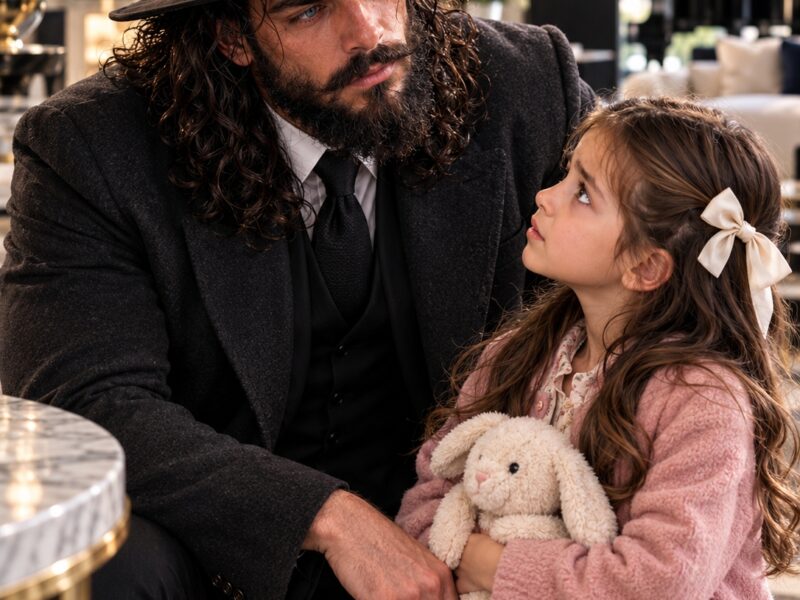
“SHE SAID I’M JUST A BURDEN,” THE LITTLE GIRL SOBBED TO THE MAFIA BOSS—THEN HER MOTHER’S MUSIC BOX REVEALED WHO WANTED HER GONE
The first time Evelyn Hart met the most feared man on the Massachusetts coast, she was hiding behind his curtains and trying not to cry loudly enough for him to hear.
She failed.
“What are you doing in my study?”
The voice came from the other side of the green velvet.
Evelyn pressed both hands over her mouth.
She was seven years old, three months past burying her mother, and old enough to understand that crying made adults tired.
So she tried to stop.
A man’s shoes crossed the hardwood.
Slowly.
Not angry.
Somehow that frightened her more.
The curtain moved.
Evelyn looked up.
Gabriel Moretti crouched in front of her.
She did not know his name yet.
She only knew he was the man who owned the enormous stone house on the hill, the man the kitchen staff stopped talking around, the man whose visitors sometimes arrived smiling and left looking as though they had forgotten how.
He was perhaps fifty.
Dark suit.
No tie.
Silver beginning at his temples.
A thin scar ran from the edge of his left eyebrow toward his hairline.
He looked down at Evelyn’s yellow cardigan, wet cheeks, scraped knee, and the small silver music box crushed against her chest.
He reached inside his jacket.
Evelyn flinched.
Gabriel stopped.
Then slowly withdrew a folded white handkerchief.
“That’s all.”
He held it out.
Evelyn stared.
“It’s clean.”
She took it.
“Thank you.”
“You’re welcome.”
He sat back on one heel.
“What’s your name?”
“Evelyn.”
“Evelyn what?”
“Hart.”
His expression did not change.
But something behind it did.
“Did someone bring you up here?”
She shook her head.
“I ran.”
“From who?”
Her fingers tightened around the music box.
“Someone said I’m a burden.”
Gabriel’s eyes became very still.
“Who?”
Evelyn looked toward the door.
“My aunt.”
He waited.
“She said she can’t carry me anymore.”
The handkerchief twisted in Evelyn’s small fingers.
“She said I’m just another thing she has to drag around.”
Gabriel did not immediately answer.
A large man standing outside the study shifted uneasily.
Gabriel glanced over his shoulder.
“Thomas.”
“Yes, boss?”
“Close the door.”
The guard obeyed.
Gabriel looked back at Evelyn.
“What’s your aunt’s name?”
“Rachel Hart.”
This time he reacted.
Barely.
His jaw tightened.
“Your mother?”
Evelyn swallowed.
“Melissa.”
Gabriel looked at the music box.
Then her face.
“Melissa Hart?”
Evelyn nodded.
“She died.”
“I know.”
Her brows pulled together.
“How?”
Gabriel stood slowly.
He looked like a man who had heard a sound nobody else could hear.
“How did she die?”
“A car fell off the bridge.”
“Route 9?”
Evelyn stared.
“Yes.”
Gabriel turned toward the windows.
Rain streaked the glass.
Outside, the Atlantic disappeared into blackness beyond the lawn.
Three months earlier, Melissa Hart’s car had gone through the guardrail on Route 9 and dropped into the freezing river below.
The newspapers called it an accident.
Gabriel Moretti had read the story.
He remembered the name.
Not because he knew Melissa.
Because she had come to his gate seventeen days before she died.
And someone he trusted had told him she was nobody.
Gabriel picked up the desk phone.
“Thomas.”
The guard opened the door again.
“Bring Mrs. Hart some warm milk.”
Evelyn frowned.
“I’m not Mrs. Hart.”
Gabriel looked at her.
“No.”
The faintest trace of a smile touched his face.
“You certainly aren’t.”
“And bread.”
He looked at her.
“Do you like butter?”
“Yes.”
“Sugar?”
Evelyn hesitated.
Her mother had considered sugar on bread “something grandmothers invented to make dentists rich.”
“Yes.”
“Bread, butter, sugar.”
Thomas nodded.
“And find Rachel Hart.”
Evelyn’s face tightened.
“No.”
Gabriel stopped.
“She doesn’t want me.”
“She brought you here.”
“She had to.”
“That’s different.”
Evelyn looked down.
Gabriel recognized that posture.
He had worn it himself at ten years old on the front steps of his uncle’s apartment after hearing the man tell a neighbor that Gabriel ate more than he was worth.
Some memories never faded.
They simply became quieter.
Gabriel sat in the chair opposite her.
“We’ll talk to her later.”
“I don’t want to.”
“Then we won’t.”
Evelyn looked up, surprised.
Adults usually asked children questions and then ignored their answers.
Gabriel nodded toward the silver box in her arms.
“What’s that?”
“My mom’s.”
“A jewelry box?”
“Music.”
She touched the blue enamel lid.
“It plays the blue song.”
“What’s the blue song?”
“I don’t know its real name.”
“Can you play it?”
Evelyn shook her head violently.
“Why?”
“Mom said never open it around strangers.”
Gabriel considered that.
“Smart woman.”
“You’re a stranger.”
“I am.”
“So no.”
“Fair.”
Thomas returned with milk and bread.
Gabriel cut the crusts off without being asked.
Evelyn watched.
“My mom did that.”
“Then she had excellent judgment.”
“No. She said crusts make your hair curly.”
Gabriel glanced at her hair.
“It seems she had evidence.”
Evelyn almost smiled.
Then remembered Rachel’s voice.
You’re just a burden.
Her mouth trembled again.
Gabriel pretended not to notice.
It was the first kindness.
He let her eat without asking another question.
Halfway through the second slice, her eyelids began to lower.
By the time the milk was gone, she was asleep sideways on the leather sofa with the music box under one arm.
Gabriel removed his jacket.
He laid it over her.
Then he walked to the window.
Thomas waited.
“Boss?”
“Who hired Rachel Hart?”
“Housekeeping agency.”
“Who approved her?”
Thomas thought.
“Martin.”
Gabriel turned.
“Martin?”
“Yes.”
Martin Vale.
Gabriel’s oldest friend.
Forty-two years together.
They had met when they were nine.
Gabriel’s father had been arrested.
His mother had vanished into a grief so heavy she stopped functioning.
His uncle took him in and resented every meal.
One afternoon, after the uncle called Gabriel a burden in front of half the block, Martin had sat beside him on the curb.
He handed Gabriel half a sandwich.
No speech.
No advice.
Just half a sandwich.
Gabriel had trusted him ever since.
“Where is Martin?”
“Downtown.”
“Call him.”
Thomas reached for his phone.
Gabriel stopped him.
“No.”
Thomas frowned.
Gabriel looked at the sleeping child.
“Not yet.”
At 1:47 that morning, Rachel Hart appeared at the study door.
Her housekeeping uniform was wrinkled.
Her hair had fallen from its pins.
She looked twenty years older than she had at dinner.
Her eyes found Evelyn asleep on the sofa.
For half a second, Rachel’s entire face broke.
Then she forced it closed.
“Mr. Moretti.”
Gabriel did not move from the window.
“You told her she was a burden.”
Rachel shut her eyes.
“Yes.”
“Why?”
“I need to speak to you alone.”
“She’s asleep.”
Rachel looked at Thomas.
Gabriel nodded.
Thomas stepped outside.
Rachel remained near the door.
Gabriel said, “You have sixty seconds before I decide you don’t deserve another chance to explain.”
Rachel’s chin trembled.
“My sister was murdered.”
Gabriel’s expression did not change.
But the room did.
Rain struck the windows.
One clock on the mantel ticked louder than the others.
“Prove it.”
Rachel reached into her apron.
She removed a folded photograph.
Melissa Hart stood outside an accounting office beside a dark-haired man.
There was a date written on the back.
Six months earlier.
“She kept books for Harrington Freight.”
Gabriel knew the company.
Everybody did.
Samuel Harrington controlled trucking contracts from Boston to Portland.
Legitimate on paper.
Less legitimate under the paper.
Rachel continued.
“Melissa found two accounting systems.”
Gabriel’s gaze hardened.
“One for taxes?”
“And one for everything else.”
“Everything else meaning?”
“Bribes. Police. Port inspectors. City contracts.”
Rachel looked toward Evelyn.
“Names.”
Gabriel said nothing.
“She copied it.”
“How much?”
“Enough that Harrington panicked.”
“And she came here.”
Rachel nodded.
“She thought you were the only man in the city he was afraid of.”
Gabriel’s mouth tightened.
“I never met her.”
“She tried.”
“When?”
“March eighteenth.”
Gabriel already knew.
He remembered the night.
Martin had come into this exact study while Gabriel reviewed port leases.
A woman at the gate.
Bookkeeper.
Domestic dispute.
Unpaid wages.
Nothing important.
Gabriel had said to give her money and send her home.
Martin said it was handled.
Seventeen days later, Melissa’s car went off Route 9.
“What happened at my gate?”
Rachel swallowed.
“A man in a gray coat spoke to her.”
“Who?”
“She didn’t know his name.”
“What did he say?”
“That you were busy.”
Gabriel felt something tighten in his chest.
“She came home soaked. Furious.”
Rachel looked down.
“She said, ‘Someone around Moretti doesn’t want him to hear this.’”
“And then?”
“She hid the records.”
“Where?”
Rachel looked at Evelyn’s sleeping shape.
“She wouldn’t tell me.”
Gabriel followed her gaze.
The music box.
His eyes narrowed.
Rachel nodded.
“She said she put them somewhere Evelyn would always carry.”
Gabriel stared at the silver box.
“When did she tell you?”
“In the hospital.”
Melissa had survived four days after the crash.
Rachel’s voice became rough.
“She made me promise never to give it to police.”
“Why?”
“Because names in the ledger wore badges.”
Gabriel turned from the window.
“Why are you here now?”
“I have been trying to get inside this house for three months.”
“You could have requested me.”
“I did.”
“Through who?”
Rachel’s eyes met his.
“Martin Vale.”
The name entered the room like a knife sliding between ribs.
Gabriel remained still.
Rachel continued.
“The agency told me all household placements were approved through him.”
Gabriel said nothing.
“Every time I asked for a meeting, I was told you were unavailable.”
“Why insult Evelyn tonight?”
Rachel pressed both hands against her mouth.
For several seconds no sound came out.
Then she lowered them.
“I received a call.”
“When?”
“Nine tonight.”
“From?”
“Blocked number.”
“What did he say?”
Rachel looked toward the sofa.
“That they knew my name.”
Her voice cracked.
“They knew Evelyn’s.”
Gabriel’s expression emptied.
“The man told me to bring Evelyn to the east garden gate at midnight.”
“What for?”
“Twenty thousand dollars.”
Gabriel’s eyes became cold.
“And?”
“A train ticket.”
“Where?”
“He didn’t say.”
“What did he want?”
Rachel’s gaze moved to the music box.
“That.”
Gabriel turned toward Evelyn again.
The child slept beneath his jacket.
Rachel whispered, “He said accidents happen to Hart women.”
Gabriel’s hand closed around the windowsill.
“Did you recognize the voice?”
Rachel nodded.
“Who?”
“I don’t know his name.”
“Describe him.”
“He spoke to me this afternoon.”
Gabriel waited.
Rachel swallowed.
“Gray suit.”
Gabriel’s pulse slowed.
Not accelerated.
Slowed.
That was what danger had always done to him.
Made the world more precise.
“What exactly did he say this afternoon?”
Rachel closed her eyes.
“‘Kitchen is through here, Mrs. Hart.’”
Gabriel looked toward the study door.
Martin wore gray today.
Martin had shown Rachel the kitchen.
Rachel began crying silently.
“I couldn’t tell anyone.”
“You could have told me.”
“How?”
Her voice sharpened.
“How was I supposed to know which person outside your door belonged to you and which belonged to him?”
Gabriel said nothing.
“Evelyn wouldn’t leave my side.”
Rachel’s whole body shook now.
“She follows me everywhere since Melissa died.”
“I noticed.”
“I needed her to run.”
Gabriel’s expression shifted.
Rachel looked at her niece.
“She only runs when she thinks someone doesn’t want her.”
The truth arrived slowly.
Gabriel’s eyes moved back to Rachel.
“You said it deliberately.”
Rachel covered her face.
“I said the worst thing I could think of.”
Her voice collapsed.
“I told her she was a burden because I knew she would run away from me.”
“Why upstairs?”
“I’ve worked here long enough to know there is one room nobody enters without permission.”
“My study.”
“Yes.”
Rachel wiped her face.
“I knew the guard never leaves this hallway.”
“You sent her to me.”
“I hoped.”
A broken laugh escaped her.
“I was gambling with a seven-year-old’s feelings because it was the only safe door I could see.”
Gabriel looked at Evelyn.
The yellow cardigan.
The music box.
His jacket covering her.
He remembered the little boy he had once been.
The curb.
Martin’s sandwich.
The first person who had told him, without words, that being unwanted in one house did not make you unwanted everywhere.
And now the same man might have used that memory to blind him.
Gabriel looked back at Rachel.
“You chose correctly.”
She stared.
“I called her a burden.”
“You chose the safest door.”
“That doesn’t make what I said disappear.”
“No.”
Gabriel’s voice softened.
“It doesn’t.”
Rachel cried harder.
“And I don’t think she’ll forgive me.”
“Not tonight.”
He looked toward Evelyn.
“Maybe not tomorrow.”
Rachel nodded.
She accepted the sentence because it was honest.
Gabriel walked to his desk.
His phone buzzed.
A message.
Martin.
Heard there’s a child in the house. Don’t move anyone until I arrive. On my way.
Gabriel read it twice.
Rachel saw his face.
“What?”
Gabriel did not answer.
He had told exactly three people Evelyn was upstairs.
Thomas.
The cook.
Rachel.
None had contacted Martin.
And Martin had not asked whether there was a child.
He knew.
Gabriel looked at the sleeping girl.
Then at the music box.
“Rachel.”
“Yes?”
“You’re going back downstairs.”
Her eyes widened.
“What?”
“You’re going to finish your shift.”
“I’m not leaving her.”
“She stays here.”
“No.”
Gabriel looked at her.
“Whoever called you believes you haven’t told me.”
Rachel understood.
“If I disappear—”
“They know.”
“If I keep working…”
“They wait.”
Her face went white.
“You want me to pretend.”
“I want you alive.”
Rachel looked at Evelyn.
Then nodded.
Gabriel walked to the sofa.
He sat beside the girl.
“Thomas will escort you downstairs.”
Rachel hesitated.
“Mr. Moretti.”
“Yes?”
“If Martin is the man…”
She could not finish.
Gabriel looked at the door.
“I know.”
Forty-two years.
That was a long time to mistake history for proof.
Martin arrived at 2:19.
Camel-colored coat.
Snow melting on his shoulders.
Kind eyes.
The face people trusted before they understood why.
Gabriel met him in the front hall.
Evelyn had woken and wandered to the upper landing.
She sat behind the balustrade in silence.
Martin embraced Gabriel.
“Hell of a night.”
Gabriel allowed it.
“Apparently.”
Martin removed his coat.
“I heard Rachel’s niece is here.”
Gabriel looked at him.
“Who told you?”
A pause too small for anyone else to notice.
“Kitchen gossip.”
“The kitchen was told not to speak.”
Martin smiled.
“Since when has that stopped kitchens?”
Gabriel almost smiled back.
Almost.
Martin lowered his voice.
“You don’t want a kid mixed up in this.”
“In what?”
“Harrington.”
Gabriel went still.
“I never said Harrington.”
Martin’s smile faltered.
Only slightly.
“Who else would it be?”
Gabriel watched him.
Then Martin did something worse.
He looked toward the stairs.
Not at Evelyn.
At the silver music box in her lap.
“Let me take Rachel and the kid north.”
Gabriel said nothing.
“My cousin has a place in Vermont.”
“Why?”
“For safety.”
“From Harrington?”
“Yes.”
“And the box?”
Martin looked back at him.
“What box?”
Gabriel waited.
Martin smiled again.
“The child’s toy.”
There it was.
Gabriel felt forty-two years collapse into one sentence.
He had never mentioned the music box.
Rachel had discussed it behind a closed study door.
Thomas had been outside.
Martin should not know it existed.
Gabriel said, “Let them sleep.”
Martin nodded.
“Of course.”
He touched Gabriel’s shoulder.
The same hand that had offered half a sandwich four decades earlier.
“Dawn.”
“Dawn.”
Martin walked toward the guest wing.
Gabriel remained where he was.
Evelyn came quietly down the stairs.
He found her beside him before he heard her.
“You lied.”
He looked at her.
“What?”
“You said I should sleep.”
“So did you.”
She sat on the bottom step.
Gabriel joined her.
For several seconds neither spoke.
Then he said, “Your aunt didn’t mean what she said.”
Evelyn’s face closed.
“You don’t know.”
“I do.”
“No.”
“She told me.”
Evelyn turned sharply.
“What?”
Gabriel considered how much truth belonged in a seven-year-old’s hands.
Not everything.
But not another lie.
“Someone scared her.”
“Who?”
“I don’t know yet.”
“She still said it.”
“Yes.”
The word hurt her.
He saw it.
“She wanted you to run.”
“Why?”
“To somewhere safe.”
Evelyn looked toward his study.
“She knew I’d go there?”
“She hoped.”
Evelyn picked at a loose thread on her cardigan.
“She could’ve told me.”
“She was afraid you would stay with her.”
“I would.”
“I know.”
A tear slipped down Evelyn’s face.
“That’s why she couldn’t tell you.”
She stared at the floor.
“Do you think I’m a burden?”
The question landed inside Gabriel harder than any threat he had heard in years.
He took his time.
“No.”
“You don’t even know me.”
“I know enough.”
“What?”
“You say thank you when someone gives you bread.”
She looked confused.
“You protected something your mother asked you to protect.”
Her fingers touched the music box.
“You trusted your aunt even after she hurt you.”
Evelyn looked away.
“You’re also apparently very bad at hiding behind curtains.”
She almost smiled.
“That last part is not evidence.”
“It is to me.”
A heavy footstep sounded behind them.
Thomas.
He stopped.
“Boss.”
Gabriel looked up.
Thomas looked sick.
“What?”
“In March…”
He swallowed.
“I was on the front gate.”
Gabriel stood.
Thomas continued.
“Martin told me you were not to be disturbed.”
Gabriel’s face became still.
“There was a woman.”
“Melissa Hart.”
Thomas nodded.
“She cried.”
Evelyn looked up sharply.
Thomas saw her.
His voice became rough.
“I told her to leave.”
Gabriel asked, “Why are you telling me now?”
Thomas looked at Evelyn.
“Because I have a daughter.”
Silence.
“I told myself it wasn’t my decision.”
Thomas stared at the floor.
“I haven’t slept well since the bridge.”
Gabriel did not shout.
Thomas looked almost more frightened because of that.
“You’re telling me now.”
“Yes.”
“That matters.”
Thomas’s eyes lifted.
“Not enough.”
“No.”
Gabriel agreed.
“But it matters.”
He pulled out his phone.
There was one number he had refused to call for ten years.
Assistant U.S. Attorney Helena Shaw.
She had investigated the Moretti organization through three administrations.
Gabriel admired her discipline almost as much as he hated seeing her name attached to subpoenas.
He dialed.
She answered after two rings.
“Shaw.”
“Helena.”
Silence.
Then:
“Gabriel Moretti.”
“You sound disappointed.”
“I’m trying to decide if this is a prank.”
“It isn’t.”
“What happened?”
Gabriel looked at Evelyn.
“You’ve wanted me to talk for ten years.”
“Yes.”
“I’m ready.”
Helena went silent.
“All of it?”
“All of it.”
“Why?”
Gabriel watched Evelyn rub her thumb over the blue enamel lid of the music box.
“Because somebody finally brought me something more expensive than staying free.”
At 4:08 a.m., Helena entered through the service gate in a florist van.
Two federal agents came with her.
No lights.
No sirens.
She wore jeans, a raincoat, and the expression of a woman who had prepared for almost every version of this meeting except the one where Gabriel invited her.
Evelyn sat on his study sofa.
Rachel beside her.
The music box rested between them.
Gabriel crouched.
“Evelyn.”
She looked at him.
“May I open it?”
She pulled the box closer.
“My mom said not around strangers.”
Gabriel nodded.
“Then don’t.”
Helena watched.
Evelyn looked at her.
“Are you a stranger?”
“Yes,” Helena said.
Evelyn considered this problem.
Then looked at Gabriel.
“Are you?”
“No.”
The answer came before he thought about it.
Evelyn apparently agreed.
She wound the tiny brass key.
The melody began.
Thin.
Sweet.
Slightly out of tune.
Rachel covered her mouth.
“My sister called it the blue song.”
Gabriel listened until the final note faded.
Evelyn opened the lid.
Inside was nothing but faded velvet.
Helena frowned.
Rachel whispered, “She said it was hidden.”
Gabriel ran a finger around the lining.
One edge lifted.
False bottom.
Beneath it sat a microSD card.
And a folded note.
Evelyn recognized the handwriting first.
“Mom.”
Rachel broke.
Gabriel unfolded it carefully.
He read silently.
Then looked at Evelyn.
“Do you want me to read it?”
She nodded.
His voice was steady until the second sentence.
If this reaches Gabriel Moretti, my name is Melissa Hart. I am asking you for nothing for myself.
Gabriel paused.
My daughter’s name is Evelyn. If I am not there to explain this, please understand that she was never part of what I found.
Evelyn stared at him.
Gabriel continued.
She is not evidence. She is not leverage. She is not a debt anyone owes me.
Rachel began crying openly.
Gabriel swallowed.
Then read the final line.
And if anyone ever tells her she is something heavy they were forced to carry, tell her I spent every day of her life believing she was the lightest, most valuable thing I ever held.
Evelyn stopped breathing.
Rachel reached for her.
Evelyn flinched.
Not away entirely.
Enough.
Rachel’s hand stopped.
Gabriel folded the note.
No one spoke for almost a minute.
Then Evelyn said, very quietly:
“She didn’t think I was a burden.”
“No,” Gabriel said.
“She thought the opposite.”
Helena inserted the card into an isolated laptop.
Folders appeared.
Scanned ledgers.
Audio files.
Photographs.
Bank transfers.
Police payrolls.
Port inspectors.
Judges.
Politicians.
Harrington Freight was everywhere.
Then Helena opened another folder.
Her expression changed.
“What?”
Gabriel asked.
She turned the screen.
MORETTI.
His own organization.
Gabriel stepped closer.
The ledger contained dates.
Shipments.
Payments.
Names.
Some were his.
Some belonged to men long dead.
Then one repeated over and over.
MARTIN VALE.
Gabriel sat.
Helena looked at him.
“This isn’t just Harrington.”
“I can see that.”
“Your friend has been moving information between your operation and theirs for at least eight years.”
Rachel whispered, “Why?”
Gabriel knew.
Or thought he did.
Martin had always been the bridge.
The negotiator.
The person who knew which conflicts needed resolving.
Which shipments were exposed.
Which politicians had changed allegiance.
If Martin secretly helped create half the instability he then solved, he was not merely betraying Gabriel.
He was manufacturing his own necessity.
Helena opened another file.
Photographs of Melissa.
Outside Gabriel’s estate.
At the gate.
Martin visible fifty feet away.
Then a different image.
Route 9.
Melissa’s car.
Two men standing beside it earlier that day.
One was Martin.
Rachel made a sound.
Helena looked at Gabriel.
“Your friend knew.”
Gabriel’s face hardened.
“He did more than know.”
At 5:36, Martin texted.
Harrington will trade. Box and girl for peace. You keep the port.
Gabriel stared.
Helena read over his shoulder.
“There.”
Rachel said, “He called Evelyn a trade.”
Gabriel’s eyes went cold.
Evelyn did not fully understand.
That was mercy.
Gabriel looked at Helena.
“What do you need?”
“A confession would help.”
“You’ll get one.”
Helena studied him.
“This includes you.”
“I know.”
“The files contain your operation too.”
“I know.”
“You could go to prison.”
Gabriel looked toward the sofa.
Evelyn was tracing the scratches on the music box.
“I’ve spent thirty years teaching men there are prices for touching what belongs to me.”
He looked at Helena.
“I should probably learn there’s a price for what I touched too.”
At dawn, Martin sent word to Samuel Harrington.
Gabriel was willing to negotiate.
They arranged the meeting at the estate.
No weapons visible.
No soldiers crowding the lawn.
Helena’s team waited down the hill.
Microphones recorded from inside the house.
Rachel and Evelyn watched through an upstairs window.
Samuel Harrington arrived in a black Cadillac.
Seventy.
Silver hair.
Camel coat.
He looked more like a retired judge than a man who had built an empire around bribery and freight theft.
Martin exited the passenger side.
Gabriel waited on the stone steps.
Samuel smiled.
“Long night.”
“Long year.”
Samuel looked toward the house.
“The box.”
Gabriel said nothing.
“And the child.”
Upstairs, Rachel pulled Evelyn closer.
Gabriel’s expression remained calm.
“What about her?”
“She’s young.”
Samuel smiled.
“Children adjust.”
“To what?”
“A different home.”
Gabriel looked at Martin.
His old friend avoided his eyes.
Samuel continued.
“You keep the port.”
Gabriel said nothing.
“You keep your council contacts.”
Nothing.
“You keep the unions.”
Samuel spread his hands.
“A great deal of unpleasantness simply stops.”
“And Melissa Hart?”
Samuel’s eyes shifted.
“Sad accident.”
“Was it?”
Samuel glanced at Martin.
A fraction.
Enough.
“Accidents are a fact of life.”
Gabriel looked at Martin.
“And the call to Rachel?”
Martin finally spoke.
“Don’t.”
Gabriel almost laughed.
“Don’t what?”
“Make this harder.”
“For who?”
Martin’s face tightened.
“For everyone.”
Gabriel stepped down one stair.
“You told me Melissa was nobody.”
“She was trouble.”
“You denied her entry.”
“To protect you.”
“You knew what she carried.”
Martin said nothing.
“You knew Harrington wanted her dead.”
“Gabriel.”
“You knew.”
Samuel interrupted.
“We aren’t here to relitigate history.”
Gabriel looked at him.
“No.”
Then back at Martin.
“We’re here because my oldest friend just tried to trade a seven-year-old child for dock rights.”
Martin’s face cracked.
“You think this is about the girl?”
“What is it about?”
“You.”
The answer came too quickly.
Martin’s voice rose.
“Always you.”
Samuel looked annoyed.
Gabriel remained still.
Martin took a step forward.
“I spent forty years cleaning up after you.”
“No.”
“I made calls while you played king.”
“No.”
“I kept cops paid, unions quiet, captains loyal.”
“You kept yourself necessary.”
Martin stared.
Gabriel understood now.
“Every fire I needed you to put out…”
Martin’s face went white.
“You started some of them.”
Silence.
Samuel looked toward his car.
Martin saw it.
He realized he had spoken too much.
Gabriel stepped closer.
“Melissa found the payments.”
Martin’s jaw worked.
“She found everything.”
“And you sent her away.”
“She would have destroyed us.”
“She went over the bridge.”
Martin looked at the ground.
Gabriel’s voice dropped.
“Did you order it?”
Samuel said, “Martin.”
Martin exploded.
“She would have destroyed forty years!”
The words echoed across the drive.
Upstairs, Rachel closed her eyes.
Helena Shaw heard every syllable through the recorder.
Martin continued.
“You think people followed you because they loved you? They followed because I made the machine work.”
Gabriel looked at him.
“And Melissa?”
“A bookkeeper.”
“Evelyn?”
Martin’s face hardened.
“A problem that should never have been brought inside.”
That sentence ended whatever remained.
Gabriel stared at the boy who had once given him half a sandwich.
The man who had spent four decades making sure he never felt like a burden.
The man who had now called a child a problem.
“You know what she said to me?”
Martin frowned.
“Who?”
“Evelyn.”
Gabriel’s voice became quiet.
“She said somebody she trusted called her a burden.”
Martin looked confused.
Gabriel continued.
“I spent half the night angry at Rachel for saying it.”
He stepped closer.
“Then I learned she said it because she was trying to save the child from you.”
Martin’s mouth opened.
“And I realized something.”
“What?”
Gabriel looked at him.
“A person is not measured by the kindness they gave you when you were weak.”
Martin stared.
“They’re measured by what they do when someone weaker than them needs the same kindness.”
The sound of vehicles came from the road.
Samuel turned.
Unmarked SUVs climbed the hill.
Martin stared at Gabriel.
“No.”
Federal agents stepped out.
Samuel backed toward his car.
Helena appeared at the bottom of the steps.
“Samuel Harrington.”
His shoulders lowered.
He understood.
Martin looked at Gabriel.
“You called them.”
“Yes.”
“You gave them everything?”
“Yes.”
“Your own files?”
“Yes.”
“You’re insane.”
“Probably.”
“You’ll lose the port.”
“I know.”
“The council.”
“I know.”
“Your freedom.”
Gabriel paused.
“Maybe.”
Martin’s face twisted.
“For her?”
He pointed toward the upstairs window.
Evelyn stood behind the glass.
Gabriel looked at her.
Then at Martin.
“No.”
Martin stared.
“For me.”
Helena walked up the steps.
“Gabriel Moretti.”
“I know.”
“You understand the material you provided implicates you in multiple federal offenses.”
“I do.”
“Then I need you to come with us.”
He nodded.
“Ten minutes.”
Helena looked toward Evelyn.
Something in her expression softened.
“Ten.”
The front door opened before anyone called her.
Evelyn ran down the steps.
Yellow cardigan.
Bare feet.
Music box in both hands.
Rachel came after her.
“Evelyn!”
The girl did not stop.
She collided with Gabriel’s coat.
He knelt.
She wrapped her arms around his neck.
He closed his eyes.
“I have to go somewhere.”
“Jail?”
Children had no respect for euphemism.
“Probably.”
“For being bad?”
Gabriel thought.
“For things I chose.”
She pulled back.
“Did you hurt my mom?”
“No.”
“Did you know someone would?”
“No.”
“Did you help people who hurt other people?”
He looked at Helena.
Then back to Evelyn.
“Yes.”
She considered that.
“Are you sorry?”
“Yes.”
“Does sorry fix it?”
“No.”
Evelyn nodded.
That answer made sense.
Then she asked, “Are you coming back?”
“I don’t know.”
Her face tightened.
Gabriel touched the music box.
“But I’m going to try to become someone who deserves to.”
Rachel reached them.
Her eyes were swollen.
Gabriel looked at Evelyn.
“There’s something else.”
“What?”
“Your aunt lied.”
Evelyn looked toward Rachel.
Rachel began crying.
Gabriel continued.
“She said the ugliest thing she could think of because she needed you to run to the safest room in the house.”
Evelyn’s face remained guarded.
“That doesn’t make it not hurt.”
“No.”
Gabriel nodded.
“It doesn’t.”
Rachel covered her mouth.
Gabriel said, “But she did not believe it.”
“How do you know?”
“She told me the truth when telling me could have gotten her killed.”
Evelyn looked at Rachel.
Her aunt whispered, “I’m sorry.”
Evelyn did not move toward her.
Not yet.
Gabriel respected that.
“You don’t have to forgive her today.”
Rachel nodded quickly.
“No.”
Her voice broke.
“She doesn’t.”
Evelyn looked at Gabriel again.
“Will you write?”
“If they let me.”
“About what?”
“Clocks.”
She almost smiled.
“You have too many.”
“That’s rude.”
“It’s true.”
“So are many rude things.”
She hugged him once more.
Then Helena took Gabriel away.
The Moretti organization did not collapse overnight.
Real life rarely gives people such clean endings.
It shrank.
Businesses were sold.
Investigations spread.
Men hired lawyers.
Some cooperated.
Some disappeared from public life.
Gabriel pleaded guilty to nine federal counts.
The prosecutors could have sought more.
Helena argued for consideration based on his cooperation, the evidence against Harrington, and his decision to dismantle significant portions of his own network.
The judge sentenced him to five years.
He served three years and eight months.
Samuel Harrington died in federal prison eleven years later.
Martin Vale received twenty-eight years for conspiracy, corruption, obstruction, and his role in Melissa’s death.
At sentencing, he never looked at Gabriel.
Gabriel looked at him.
Once.
That was enough.
Melissa Hart’s ledger became hundreds of pages of trial exhibits.
Her name entered the public record.
A bookkeeper.
A single mother.
A woman powerful men had dismissed because she carried spreadsheets instead of guns.
Helena said in court that Melissa had accomplished what dozens of people with badges had failed to do.
She documented the truth while everyone else negotiated with it.
Rachel and Evelyn moved out of the apartment above the laundromat.
Gabriel’s legitimate assets were placed under court supervision.
Part of them funded a trust for Evelyn.
Rachel initially refused.
Then Helena explained that the money had been independently reviewed and legally clean.
Rachel still hesitated.
Evelyn was the one who said, “Mom wanted me to go to college.”
So Rachel signed.
Forgiveness took longer.
For three weeks after the arrests, Evelyn barely spoke to her aunt.
Rachel did not force her.
She slept on the floor beside Evelyn’s bed.
Made breakfast.
Packed lunches.
Went to work.
Answered every question honestly.
On the twenty-second night, Evelyn woke and found Rachel sitting at the kitchen table.
Three pieces of a broken plate lay in front of her.
The plate she had dropped the night she received the threatening call.
Rachel had kept them.
Evelyn stood in the doorway.
“Why do you have that?”
Rachel looked up.
“I don’t know.”
“Yes, you do.”
Rachel smiled sadly.
Children learned merciless honesty from surviving adults.
“I think because it was the moment I decided what I had to do.”
“You were mean.”
“Yes.”
“You said Mom dying made everything harder.”
Rachel’s face broke.
“I know.”
“You said I was heavy.”
“I know.”
“I believed you.”
Rachel cried.
“I know.”
Evelyn’s eyes filled.
“You could’ve just told me to run.”
“You would have stayed.”
“Yes.”
“That’s why.”
Evelyn rubbed her sleeve over her face.
Rachel whispered, “It was the worst lie I have ever told.”
A pause.
“And I would tell it again if it were the only way to keep you alive.”
Evelyn stared at her.
“That’s confusing.”
“It is.”
“I hate it.”
“Me too.”
Evelyn walked across the kitchen.
Not quickly.
She climbed into Rachel’s lap.
Rachel wrapped her arms around her.
Neither apologized again.
They had already said the true things.
Sometimes repetition turns truth into performance.
They simply cried.
Gabriel’s first letter arrived that winter.
It was addressed to:
Miss Evelyn Hart, Keeper of the Blue Song.
Inside:
There are seventeen clocks in the prison workshop. Fourteen are wrong. This is unbearable.
Evelyn laughed.
She wrote back.
Maybe they know you need something to do.
The letters continued.
Gabriel never wrote about cases.
Never asked Evelyn to defend him.
Never pretended prison was unfair.
He wrote about books.
Bad coffee.
A sparrow that appeared outside the workshop window.
A clock he spent six weeks repairing.
Evelyn wrote about school.
Math.
A bully named Cameron.
A stray cat that lived behind the apartment but refused to acknowledge that it belonged to them.
When Evelyn turned nine, Gabriel mailed no gift.
Only a letter.
Your mother asked that nobody make you feel like something heavy they had to carry. I think people misunderstood what she meant. Love is not never carrying anyone. Sometimes love is choosing what is worth carrying and never making the person ashamed that you chose them.
Rachel read that paragraph twice.
Then handed the letter back.
“He’s getting annoyingly wise in jail.”
Evelyn smiled.
“Maybe he has time.”
When Gabriel returned home, Evelyn was eleven.
He came through the Boston bus terminal carrying one cheap suitcase.
No guards.
No black car.
No men waiting.
Rachel stood beside Evelyn.
The silver music box rested in Evelyn’s hands.
Gabriel stepped through the doors.
He looked smaller.
Gray had spread through his hair.
He saw Evelyn.
Stopped.
For several seconds neither moved.
Then he said, “You’re taller.”
Evelyn smiled.
“You’re older.”
“That seems unfair.”
“You were gone four years.”
“Three years, eight months.”
“You’re counting?”
“I own clocks.”
That did it.
Evelyn ran to him.
Gabriel caught her.
Rachel looked away.
Gabriel did not return to crime.
Not because prison magically transformed him.
He told Evelyn years later that prison mostly gave him long uninterrupted hours in which he could no longer confuse being busy with being innocent.
He sold what legitimate property remained.
Kept a modest house near Gloucester.
Started a maritime logistics consulting firm that was so aggressively legal Helena joked it might be his strangest act of rebellion.
Rachel became office manager.
She and Gabriel argued constantly.
Not romantically.
At least not for many years.
Evelyn suspected something eventually changed between them when she was seventeen and found Gabriel making Rachel coffee exactly the way she liked it without being asked.
She wisely kept her mouth shut.
At thirty, Evelyn Hart became a forensic accountant.
Rachel said this proved trauma had a sense of humor.
Evelyn said it proved spreadsheets were hereditary.
Her work focused on corporate fraud, hidden ownership, and public corruption.
She was good.
Too good, according to people whose second sets of books she found.
The music box stayed on her desk.
She almost never opened it.
The ledger had been copied long ago.
The evidence returned after trial.
What mattered now was not the card hidden beneath the velvet.
It was the melody.
The blue song.
One winter afternoon, Gabriel came to Evelyn’s office.
He was seventy-two.
His hands shook slightly now.
Age, not fear.
He carried a broken brass mantel clock.
“You fix financial crimes,” he said. “Surely this is easier.”
“No.”
“It has numbers.”
“That’s not how clocks work.”
“I’m disappointed in your education.”
She laughed.
They drove to Rachel’s house together.
Gabriel had moved into the spare room six months earlier after minor heart surgery because Rachel declared that “old men who think soup is a complete medical recovery plan cannot live alone.”
Neither called it romance.
Evelyn no longer needed labels for everything.
That evening, rain tapped the windows.
Exactly the kind of rain she remembered from the Moretti house.
Gabriel sat at the dining room table examining the clock.
Rachel cooked.
Evelyn took the music box from her bag.
She wound the key.
The melody filled the room.
Gabriel stopped working.
His eyes closed.
When the last note faded, he said, “Do you still have my handkerchief?”
Evelyn smiled.
She opened her purse.
Pulled out the white square.
Washed hundreds of times.
Pressed.
Folded in the same four creases.
Gabriel laughed softly.
“I gave you that when you were seven.”
“You never asked for it back.”
“Would you have given it?”
“No.”
“Then I was wise.”
She placed it in his hand.
Gabriel turned the cloth over slowly.
“You know,” he said, “Martin was the first person who ever made me believe I wasn’t a burden.”
Evelyn knew the story.
Half a sandwich.
Two boys on a curb.
“One kind thing can be real even if the person later becomes terrible,” she said.
Gabriel looked at her.
“That took me years to understand.”
“It took me years to understand Aunt Rachel could say something terrible without it being what she believed.”
Rachel called from the kitchen.
“I can hear you.”
“Good,” Evelyn said.
Gabriel smiled.
Then his face grew serious.
“Words still matter.”
“Yes.”
“What Rachel said hurt you.”
“Yes.”
“What my uncle said hurt me.”
“Yes.”
“But neither sentence decided what we were.”
Evelyn looked at the handkerchief.
“No.”
Gabriel folded it and placed it back into her palm.
“Some things you carry because they’re heavy.”
His old fingers closed hers around it.
“And some things you carry because they’re yours.”
Outside, rain moved steadily against the windows.
The broken brass clock on the table ticked once.
Stopped.
Then ticked again.
Rachel entered with three bowls of soup.
Gabriel looked at his.
“This is too much.”
Rachel stared at him.
“Careful.”
He glanced at Evelyn.
“She’s threatening me.”
“She loves you.”
“Same thing, apparently.”
Rachel rolled her eyes.
Evelyn laughed.
There had been a time when the word burden could empty an entire room inside her.
When she heard it, she saw a kitchen she did not belong in.
A broken plate.
Her aunt’s hard face.
A green velvet curtain.
A dangerous man kneeling in front of her with a clean white handkerchief.
She spent years believing the important moment was Gabriel finding her.
It wasn’t.
The important moment had happened earlier.
Her mother copying numbers no one wanted copied.
Rachel taking a job inside a house she feared.
Thomas admitting the truth he had buried.
Helena answering a phone.
Gabriel deciding freedom was less valuable than a child.
Even Martin, long before he became the man who betrayed them, offering half a sandwich to a boy who thought he was unwanted.
Lives were rarely divided cleanly into heroes and villains.
People were choices.
Repeated.
Accumulated.
Sometimes corrected too late.
Sometimes corrected just in time.
Evelyn had built her career around numbers because numbers left trails even when people lied.
But numbers taught her something else too.
A burden was not simply something with weight.
A bridge carried weight.
A foundation carried weight.
Arms carried children.
The question was never whether love asked you to carry something.
It was whether you made the person you loved feel ashamed for needing to be carried sometimes.
Her mother had understood that.
Rachel learned it the hardest way possible.
Gabriel spent half his life learning it.
And Evelyn?
She eventually stopped measuring herself by how little help she needed.
That was the final gift Melissa Hart left inside the music box.
Not the ledger.
Not the evidence.
One sentence written by a dying mother:
She is the lightest and most valuable thing I ever held.
For most of her life, Evelyn thought the two words contradicted each other.
Lightest.
Valuable.
Only when she became an adult did she understand.
Melissa had never meant her daughter weighed nothing.
She meant loving her had never felt like weight.









