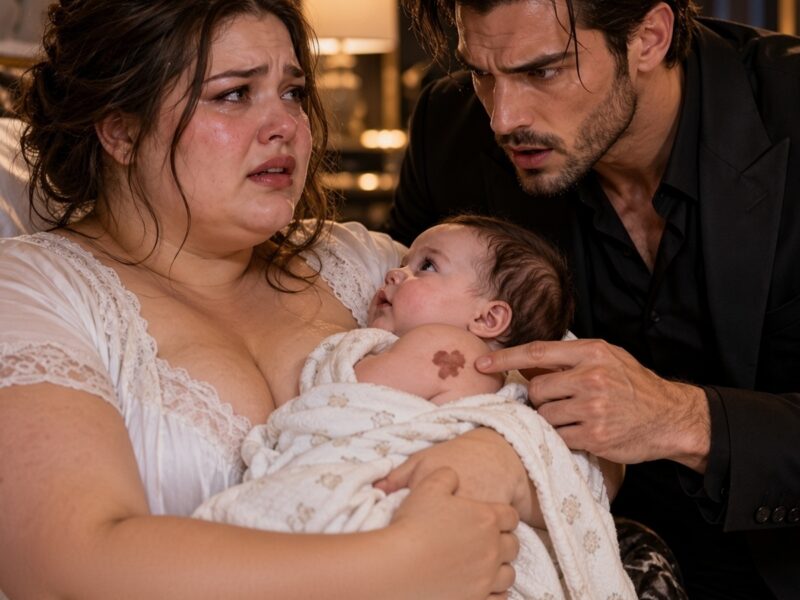
She Said the Baby Was Someone Else’s—Then the Mafia Boss Saw a Birthmark His Family Had Carried for Generations and Realized Someone Had Lied to Them Both
Isabella Bennett came to the Moretti mansion intending to return a dead woman’s pendant and leave before anyone noticed the baby sleeping against her chest.
Instead, one glimpse beneath the child’s blanket made Alessandro Moretti stop cold, because the broken-heart birthmark below her collarbone had appeared on men in his family for three generations.
When Isabella insisted the baby belonged to someone else, Alessandro understood the lie mattered—but he did not yet know she had been frightened into telling it.
“Don’t touch her shoulder.”
Isabella’s voice came out sharper than she intended.
Alessandro Moretti stopped with his hand inches from the white knitted blanket slipping down the sleeping baby’s chest. Three minutes earlier, he had been asking why a former hotel housekeeper had arrived uninvited at his family’s winter charity reception carrying a silver pendant that had belonged to his mother. Now he was staring at Isabella as if the room had changed shape around them.
“What’s wrong with her shoulder?”
“Nothing.”
“Then why can’t I touch it?”
Isabella tightened both arms around the baby.
“She doesn’t like strangers.”
The excuse sounded weak even to her.
Alessandro’s gaze dropped.
The blanket had already slipped.
Beneath the child’s left collarbone, visible against warm brown skin, was a small reddish birthmark shaped like a heart with one side interrupted by a pale line.
Alessandro did not move.
Isabella felt the moment before he said anything.
Recognition.
Not curiosity.
Recognition.
His eyes lifted slowly to hers.
“Whose child is this?”
Isabella swallowed.
“Someone else’s.”
The baby stirred.
Alessandro looked at the mark again.
Then he reached to the open collar of his black shirt and pulled the fabric aside.
Isabella closed her eyes.
She had known.
Of course she had known.
But seeing the same broken-heart mark beneath Alessandro’s left shoulder—the same position, same imperfect curve, same narrow gap in the center—destroyed the last lie she had spent three months teaching herself to live inside.
“My grandfather had this,” Alessandro said.
His voice was almost quiet enough to belong to another man.
“My father had it.”
He looked down.
“So did my brother.”
Isabella’s eyes opened.
Snow moved against the tall windows of his private sitting room. Beyond the closed door, the Moretti mansion still held nearly two hundred guests, waiters moving between chandeliers, string music floating above champagne glasses, men discussing shipping contracts and city zoning as if the night were ordinary.
Inside this room, it no longer was.
“Isabella.”
She looked at him.
“Whose child is she?”
Her daughter opened one small fist against Isabella’s cream dress.
“Sophie is mine.”
“That wasn’t my question.”
“I know.”
Alessandro stared at her.
The man in front of her was thirty-seven now. Dark hair. Controlled face. Expensive black suit that made him look even more severe than the newspaper photographs she had avoided for a year. Chicago business pages called him a logistics investor, property developer, and chairman of half a dozen companies whose clean legal structures existed beside older family interests reporters described much more carefully.
Thirteen months ago, Isabella had known none of that.
She had known a grieving man with shaking hands and cold coffee.
Tonight she knew exactly who he was.
And exactly why she had run.
“Her father isn’t involved,” she said.
Alessandro’s jaw tightened.
“That is not the same as saying I’m not her father.”
The baby began fussing.
Isabella rocked her automatically.
Alessandro looked from Sophie’s face to Isabella’s.
The expression that reached him then was not anger.
That would have been easier.
It was hope so restrained it looked painful.
“What’s her full name?”
“Sophie Eleanor Bennett.”
His eyes flickered at the middle name.
“My mother was Eleanor.”
“I know.”
“You named her after my mother?”
“My mother is Eleanor too.”
That was true.
It also gave Isabella somewhere to hide.
Alessandro studied her long enough that she felt every heartbeat.
Then he said, “Why are you here?”
Isabella reached into her coat pocket.
The silver pendant lay in her palm.
Oval.
Old-fashioned.
Tiny engraving around the edge.
Alessandro’s face changed again.
“My mother’s.”
“Yes.”
“Where did you get it?”
“Her nurse gave it to me.”
“When?”
“Last winter.”
“Why?”
“She said your mother wanted it returned to you personally.”
“Why through you?”
“I don’t know.”
That lie was smaller.
Still a lie.
Alessandro knew.
“Isabella.”
“Please.”
Her voice cracked.
“I came to give you the pendant.”
“That’s all.”
“I wasn’t going to come inside.”
“Security recognized it.”
“I intended to leave.”
“With my daughter?”
“With my daughter.”
His eyes returned to Sophie.
He took one step closer.
Isabella backed away.
Alessandro stopped immediately.
Something in his face hardened—not toward her, but toward the fact that she had moved.
“You think I’m going to take her.”
Isabella said nothing.
His mouth flattened.
“Do you?”
“I don’t know what you do when people complicate your life.”
“That answer tells me more than you think.”
She looked toward the door.
“I should go.”
“No.”
Fear crossed her face so quickly he saw it.
Alessandro corrected himself.
“I’m asking you not to leave yet.”
“That’s different.”
“Is it?”
“Yes.”
He absorbed that.
Then nodded.
“Will you stay for ten minutes?”
Isabella looked at Sophie.
Then at the pendant.
“Ten.”
Alessandro moved toward the opposite side of the room rather than closer.
Distance.
A choice.
Isabella noticed.
“Tell me what happened thirteen months ago.”
She froze.
His voice remained even.
“Tell me why you disappeared.”
The night at the Lakeshore Hotel had happened after midnight in a nearly empty lounge overlooking rain-darkened Michigan Avenue.
Isabella was finishing an evening housekeeping shift when she noticed a man sitting alone with a photograph facedown beside his coffee.
The lounge staff knew who he was.
They avoided his table.
She did not.
Not because she was brave.
Because she was tired enough not to recognize him.
“Your coffee’s cold,” she had said.
Alessandro looked up.
“Is that a complaint?”
“It’s an observation.”
“Do observations usually cost twelve dollars in this hotel?”
“Only if I bring you another one.”
He almost smiled.
She brought coffee.
No charge.
He asked why.
“Because nobody should have to feel invisible when they’re hurting.”
That sentence made him look at her differently.
They talked.
His younger brother, Luca, had died months earlier after discovering someone inside the Moretti organization had diverted money through shell companies and compromised a sensitive meeting. Alessandro still carried guilt because he had trusted the wrong people.
Isabella told him about her own life.
Hotel work.
Her mother’s medical bills.
Growing up in Milwaukee.
The humiliations attached to being a woman whose body strangers felt entitled to comment on.
By two in the morning, neither was pretending anymore.
By dawn, they had crossed a line neither had planned.
Three days later, Isabella received an envelope beneath her apartment door.
Photographs of her entering Alessandro’s hotel suite.
Photographs of her mother leaving a nursing facility.
A copy of her employment record.
One typed sentence:
Walk away before he loses someone else because of you.
Then a woman came to see her.
Elegant.
Controlled.
Victoria Hayes.
A senior consultant to the Moretti family’s legitimate investment company.
She brought photographs from a charity gala showing herself beside Alessandro.
“She told me you were engaged.”
Alessandro stared.
“I was never engaged to Victoria.”
“I know that now.”
“What did she say?”
“That I was a distraction.”
“That you had been grieving.”
“That you would regret the night.”
“That if I contacted you, my mother’s care could become complicated.”
Alessandro’s expression went cold.
“She threatened Eleanor.”
“She never said the word threat.”
“That doesn’t make it less of one.”
“She knew her room number.”
“She knew which nurse was on nights.”
“She knew the nursing-home administrator’s name.”
Isabella’s voice thinned.
“I believed her.”
Alessandro looked toward the fireplace.
“Did she pay you?”
“No.”
“Did she offer?”
“Fifty thousand.”
His head turned.
“You refused?”
“Yes.”
“Why?”
Isabella stared at him.
“Because I wasn’t leaving for money.”
The answer landed harder than accusation.
“She told me nobody would believe that.”
Isabella continued.
“She said if I disappeared, people would assume I got scared or embarrassed.”
“If I ever came back, she would make it look like I had taken money from one of your rivals.”
Alessandro’s eyes narrowed.
“That specific?”
“Yes.”
“Why didn’t you tell me?”
“I tried.”
He looked at her.
“I called the hotel.”
“They said you had checked out.”
“I emailed an address your assistant gave me.”
“It bounced.”
“I came to the Moretti office once.”
“Marco Duca met me downstairs.”
Alessandro became still.
“My security chief.”
“Yes.”
“What did he say?”
“That you knew I had come.”
“That you didn’t want to see me.”
“That he was sorry.”
A silence.
Isabella watched his face.
“I believed him too.”
Alessandro sat slowly.
Marco had worked for the family fifteen years.
He had been beside Alessandro at Luca’s funeral.
He had overseen the quiet investigation into Isabella’s disappearance.
He had returned after six weeks and said she had left voluntarily.
Moved out of state.
No evidence of coercion.
Alessandro had hated the conclusion.
He had eventually accepted it.
Now Isabella said Marco had known exactly where she was.
“When did you find out you were pregnant?”
“Three weeks after I left.”
“Did Victoria know?”
“I don’t know.”
“Did anyone contact you?”
“Not until Sophie was born.”
“What happened?”
“Flowers came to the hospital.”
“What kind?”
“White roses.”
“Card?”
“Beautiful children deserve beautiful families.”
Alessandro’s eyes hardened.
“Then?”
“A woman called my apartment.”
“Same voice as Victoria?”
“I wasn’t sure.”
“She said people like me shouldn’t imagine men like you stayed interested.”
Isabella looked down.
“She knew I had gained weight.”
“She described the blue coat I wore home from the hospital.”
Alessandro leaned forward.
“Why didn’t you go to police?”
“I had a newborn.”
“A sick mother.”
“No money.”
“And someone had already shown me they could reach my job and my family.”
She met his eyes.
“You ask that because you know how to move through fear with resources.”
“I didn’t.”
He said quietly.
“Not then.”
That answer surprised her.
Alessandro rose.
“May I hold her?”
Isabella tightened instinctively.
He saw it.
“I asked.”
“I know.”
“You can say no.”
Sophie fussed again.
Isabella looked at her daughter.
Then at Alessandro’s hands.
Large.
Still.
Oddly careful.
She moved closer.
“Support her neck.”
“I know how.”
“You said your brother had children?”
“No.”
“My cousins.”
He adjusted his arms exactly as instructed.
Isabella transferred Sophie.
The child opened her eyes.
Dark brown.
Sleepy.
She stared at Alessandro.
He stared back.
For the first time that night, his control cracked.
Not dramatically.
One breath.
A small tremor near his mouth.
Sophie curled her fist into his lapel.
“She’s comfortable.”
Isabella whispered.
Alessandro looked at the baby.
“I wish I had known.”
Isabella’s throat tightened.
“I wish I had been allowed to tell you.”
That sentence changed the room.
Not the birthmark.
Not the possibility of fatherhood.
That sentence.
Allowed.
Alessandro looked up.
“We find out who decided you needed permission.”
His phone vibrated.
Unknown number.
A photograph filled the screen.
Isabella sitting beside him ten seconds earlier.
Sophie in his arms.
Taken from above.
Inside the room.
Beneath it:
She was supposed to stay gone.
Alessandro showed Isabella.
Her face drained.
“That was taken here.”
“Yes.”
“Camera?”
“Probably.”
He looked toward a smoke detector near the ceiling.
Then the decorative sensor above the bookshelves.
The Moretti mansion had a closed surveillance system.
Remote access was restricted.
Marco controlled it.
Alessandro called him.
“Kill external access.”
A pause.
“Now.”
Marco’s reply came after half a second too long.
“Of course.”
Alessandro ended the call.
Isabella whispered:
“He knows.”
“Maybe.”
“You don’t believe me?”
“I believe evidence.”
She flinched.
He corrected.
“I believe you’re afraid.”
“I believe the photograph is real.”
“I believe Victoria threatened you.”
“I am not accusing Marco without more.”
That distinction mattered.
It also frightened her.
Because rationality meant this would not be solved through one emotional declaration.
They needed proof.
Alessandro called Daniel Russo instead.
Operations manager.
Quiet.
Forty-two.
The man responsible for legitimate logistics compliance, audits, and physical-access controls.
“Daniel.”
“Yes?”
“I need archive-level security logs for this room.”
“Without notifying Marco.”
A pause.
“Understood.”
“And pull my mother’s medical-record access history for the last year.”
“Why?”
“Because I asked.”
“That is usually not a reason you give me.”
Alessandro nearly smiled.
“Tonight it is.”
Daniel said:
“I’ll call.”
Isabella watched him.
“You trust Daniel?”
“I trust him enough to test him.”
“Is that how you live?”
“It is tonight.”
His phone buzzed again.
An internal security report.
Account access responsible for the photograph:
I. Bennett.
Isabella stared.
“That’s impossible.”
Login created yesterday.
ID scan recorded six weeks earlier.
She had not been in Chicago.
Alessandro scrolled.
The account was authorized by his digital signature.
He looked at the cryptographic timestamp.
“Someone used my credential.”
Marco entered carrying a tablet.
“We found the account.”
“I see.”
“Mrs. Bennett’s.”
“No.”
Marco looked at him.
Alessandro said:
“She hasn’t been here.”
“The system says otherwise.”
“The system can lie.”
Marco’s eyes shifted toward Sophie.
Barely.
Alessandro caught it.
“Why are you looking at the baby?”
“I’m assessing the room.”
“Then assess me.”
Marco looked directly at him.
“Someone framed Isabella.”
That answer was unexpected.
Not denial.
Not accusation.
Alessandro waited.
Marco continued.
“Could be Victoria.”
“Could be someone using her name.”
“Could be a rival trying to create internal distrust.”
All reasonable.
“Move Isabella and the child to another property.”
Marco said.
“No.”
“Boss—”
“She chooses whether she moves.”
Marco looked at Isabella.
She said:
“I stay.”
Marco’s jaw tightened.
Alessandro saw it.
“Leave us.”
When the door closed, Isabella exhaled.
“This is why I ran.”
Alessandro looked at her.
“Every explanation comes with another reason I look guilty.”
She said.
“Now there’s a security account in my name.”
“A bank account will come next.”
His gaze sharpened.
“What?”
“That’s what Victoria threatened.”
His phone buzzed.
Bank statement.
Fifty thousand dollars.
Account holder:
Isabella Bennett.
Funding source linked through two intermediaries to a company associated with one of Alessandro’s long-standing rivals.
Message:
Ask her what she sold.
Isabella laughed once.
Not because anything was funny.
“She told me.”
“She told me exactly what they would do.”
Alessandro zoomed in.
Account-opening address.
An old employee address from Lakeshore Hotel records.
Date created:
Fourteen months earlier.
Before Sophie’s birth.
“This was prepared.”
he said.
“Not tonight.”
“No.”
“They expected you might come back someday.”
Isabella sat down.
For the first time, she looked truly defeated.
“You don’t understand what it feels like to have someone prepare proof against you before you’ve even done anything.”
Alessandro sat opposite.
“I’m beginning to.”
Sophie began crying.
Isabella bounced her.
Nothing.
She checked diaper.
Warmth.
Hunger.
Exhaustion.
“I need formula.”
She reached for the diaper bag.
Alessandro stopped her.
“Wait.”
She frowned.
“What?”
His phone rang.
Medical-security supervisor.
“Mr. Moretti, the nursery inventory prepared for guests was checked after the network alert.”
“And?”
“One formula container was swapped.”
“Different product?”
“Yes.”
“Unsafe?”
“We don’t know yet.”
Alessandro looked at Isabella’s bag.
A matching unopened container sat inside.
“Don’t use it.”
Isabella froze.
“I bought that myself.”
“When?”
“Yesterday.”
“Where?”
“Pharmacy near Union Station.”
“Someone could have accessed the bag tonight?”
She thought.
Security cloakroom.
Ballroom.
Sitting room.
“Yes.”
Alessandro called for sealed formula from the kitchen stock.
Then inspected the bag without touching contents.
A folded note beneath the strap.
Elegant handwriting.
Tell Alessandro who paid you to disappear before everyone learns what kind of mother you are.
Isabella’s fingers went cold.
“I know that handwriting.”
“Whose?”
“Victoria.”
Before she could explain, the mansion lights went out.
Darkness swallowed the room.
Emergency lights came on seconds later.
Red.
Low.
Sophie cried.
Alessandro moved between Isabella and the door.
“Stay where you are.”
“Victoria came to my apartment.”
Isabella whispered.
“What?”
“Three days after the hotel.”
“She wrote the first note in front of me.”
“I remember the capital A.”
“That loop.”
“This is hers.”
Alessandro’s phone displayed a backup-system notice.
Generator fault.
Security network degraded.
Message from Marco:
Remain upstairs. We’re handling it.
Alessandro read it twice.
Marco had never told him to remain anywhere during a security event.
He called Daniel.
“Where are you?”
“West operations office.”
“Can you access archives?”
“I’m inside.”
“Check my mother’s medical records.”
Typing.
Then silence.
“Sir.”
“What?”
“Someone pulled hereditary family records last month.”
“Who?”
Daniel hesitated.
“Marco.”
Alessandro looked toward Sophie.
“What records?”
“Photographs.”
“Family medical history.”
“Notes about congenital marks.”
“Your father.”
“Grandfather.”
“Your own dermatology records.”
The room became very quiet.
“Specifically the birthmark?”
“Yes.”
Alessandro closed his eyes.
Marco had known what the mark would mean.
Before Sophie arrived.
Before Isabella returned.
“Pull Luca’s old security investigation.”
“Original access logs.”
“Not summaries.”
“Now.”
Isabella watched him.
“What is it?”
“Marco accessed records showing the birthmark.”
“Why?”
“I don’t know.”
She looked frightened again.
Alessandro crossed to her.
“I looked for you.”
“What?”
“After the hotel.”
“I went back.”
“You were gone.”
“I hired people.”
“Marco handled the search.”
Isabella’s eyes filled.
“You looked?”
“For months.”
“I thought you chose to disappear.”
“I never stopped wondering if you were safe.”
She turned away because the tears came before she could stop them.
“I wanted to tell you.”
“Every time Sophie smiled, I wondered if you did that.”
Alessandro crouched.
“You raised her believing you had nobody.”
“You kept her safe.”
“I will never treat that like a debt you owe me.”
She looked at him.
“DNA test.”
he said.
“When you’re ready.”
“No assumption.”
“No announcement.”
“No legal move.”
“Nothing involving Sophie without you.”
Isabella breathed.
“Thank you.”
The door handle moved.
Alessandro stood.
“Who?”
“Marco.”
Flashlight beam appeared.
Marco entered.
“Boss.”
“We need to move.”
“You told me to stay.”
“Situation changed.”
“So did mine.”
Alessandro held up his phone.
“Why did you access my mother’s hereditary records?”
Marco stopped.
His face changed.
No obvious panic.
Just the absence of his usual answer.
“That was part of the family medical-security review.”
“Requested by whom?”
“Dr. Hammond.”
“Daniel already checked.”
Alessandro said.
“No physician order exists.”
Marco lowered the flashlight.
Isabella stood holding Sophie.
Marco looked at the baby.
Then at Alessandro.
“You weren’t supposed to recognize it this quickly.”
Silence.
Isabella gasped.
Alessandro felt something old move inside him.
Not rage.
Recognition.
The same sensation he had felt when Luca died and every person around him offered explanations that fit too neatly.
“What did you do?”
Marco looked exhausted.
Suddenly older.
“Victoria wanted Isabella gone.”
“That part was her.”
“Not mine.”
“But you helped.”
“Yes.”
“Why?”
“Because thirteen months ago Isabella was not the problem.”
“Luca’s files were.”
Alessandro went still.
“My brother.”
Marco exhaled.
“He discovered money moving through Moretti development accounts.”
“Where?”
“Healthcare properties.”
“Shipping contracts.”
“Private vendor networks.”
“Victoria had built the structure.”
“For what?”
“At first?”
Marco gave a bitter smile.
“To survive.”
“Her father’s company collapsed.”
“She was carrying debt nobody knew about.”
“She started moving small amounts.”
“Then larger ones.”
“She became good at hiding it.”
“And you?”
“She paid for information.”
“Schedules.”
“Contract timing.”
“Nothing that was supposed to hurt anyone.”
Alessandro stared.
“That is what every betrayal sounds like in retrospect.”
Marco looked away.
“Luca found the pattern.”
“He told me he was going to you.”
“What did you do?”
“I persuaded him to wait.”
“For a meeting.”
“A day.”
“Time for Victoria to clean the accounts.”
“And his death?”
Marco’s face tightened.
“I leaked a meeting location.”
“I believed rival pressure would scare him.”
“Not kill him.”
The room seemed to tilt.
Alessandro had spent five years blaming himself.
Wrong meeting.
Wrong trust.
One delayed call.
His brother’s death had been treated inside the family as a rival retaliation that nobody could definitively prove.
Marco had provided the location.
“You knew.”
Alessandro said.
“Yes.”
“For five years.”
“Yes.”
“You stood beside me at his funeral.”
Marco looked sick.
“Yes.”
Isabella moved closer to Alessandro.
Not behind him.
Beside him.
That mattered.
Marco continued.
“Your mother suspected financial wrongdoing before she died.”
“She moved records out of the system.”
“Victoria discovered that recently.”
“The pendant?”
Marco nodded.
“Eleanor hid a storage card inside it.”
Alessandro looked at Isabella.
The silver pendant was still in her coat pocket.
Marco saw the glance.
“Give it to me.”
Isabella’s hand covered the pocket.
“No.”
“Your mother’s safety depends on it.”
Everything stopped.
“My mother?”
Isabella whispered.
Marco closed his eyes.
“Victoria moved Eleanor last week.”
“From assisted living?”
“Yes.”
“Where?”
“I don’t know.”
“You’re lying.”
“I know the holding company.”
“Not the room.”
Isabella’s face hardened in a way Alessandro had never seen.
“You keep saying you need that pendant.”
“Then why didn’t Victoria take it from me thirteen months ago?”
Marco looked at her.
“She didn’t know you had it then.”
Alessandro turned.
“You had it later?”
Isabella nodded.
“Your mother’s nurse found me last winter.”
“She said Eleanor had asked her to keep it safe.”
“She found me because my name appeared in an old hotel note.”
“She gave it to me.”
“Why didn’t you open it?”
“I thought it was jewelry.”
Marco muttered:
“Eleanor was better than all of us.”
Isabella took out the pendant.
“I want to see my mother.”
Marco hesitated.
“If she’s alive, show me.”
He called.
Video appeared.
Eleanor Bennett.
Isabella’s mother.
Seventy-one.
Seated beside a window.
Afraid but alert.
“Bella?”
“Mom.”
“Don’t give them anything.”
The call ended.
Isabella shook.
Then steadied.
“I spent thirteen months doing what people told me because they knew exactly what I was afraid of.”
She looked at Marco.
“I’m done.”
She opened the pendant.
A tiny memory card sat beneath the silver backing.
Marco moved forward.
Alessandro stepped between them.
“Don’t.”
Marco stopped.
A small blue light blinked under the bookshelves.
Alessandro saw it.
Emergency transmitter.
Independent circuit.
Still operational.
Daniel would know.
Alessandro needed time.
“Victoria will discard you.”
he said.
Marco laughed.
“She needs me.”
“That is what Luca thought.”
Marco’s face tightened.
“You think she trusts you?”
“After the files disappear?”
“You become the one person who knows she engineered Isabella’s disappearance.”
“Framed a mother.”
“Used my security credentials.”
“And helped conceal Luca’s leak.”
Marco’s confidence faltered.
Isabella saw it.
“Tell us where Eleanor is.”
Marco looked toward the hall.
“You don’t understand Victoria.”
“No.”
Isabella said.
“You don’t understand women you think are beneath you.”
The alarm sounded.
Not violent.
Security shutters.
Lights.
Electronic locks.
Daniel’s voice over the emergency system.
“Internal security isolation active.”
Marco stepped backward.
Two independent security supervisors appeared in the corridor.
No weapons raised.
Daniel behind them.
“Marco.”
“Hands visible.”
Marco looked at Alessandro.
“I can explain.”
“You’ve been explaining for five years.”
Daniel secured Marco inside an office with counsel and city police already en route.
The mansion lights returned.
Alessandro’s phone rang.
Victoria.
He answered on speaker.
“I understand you found the pendant.”
Her voice remained smooth.
“Congratulations.”
“Where is Eleanor?”
“With me.”
“Old Moretti shipping office.”
“Bring the memory card before midnight.”
“Otherwise?”
A pause.
“Then Eleanor’s care becomes considerably less comfortable.”
No graphic threat.
No need.
Control itself was enough.
Isabella stepped closer.
“I’m coming.”
Alessandro looked at her.
Victoria laughed softly.
“Of course you are.”
“Come alone.”
The call ended.
Alessandro immediately said:
“No.”
Isabella looked at him.
“My mother.”
“I know.”
“You said you wouldn’t make decisions about my life.”
“I am not sending you into a trap.”
“That is a decision.”
“It is also common sense.”
“Then trust me with common sense.”
He stared.
She continued.
“For thirteen months, everybody made decisions because they believed I was too weak to survive the truth.”
“Victoria decided I couldn’t handle you.”
“Marco decided I couldn’t understand their world.”
“You’re about to decide I cannot help save my own mother.”
“That is the same structure with kinder language.”
Alessandro flinched.
She had found the exact place.
Daniel entered.
“Police tactical negotiators are available.”
Alessandro turned.
“We use them.”
Isabella said:
“Good.”
He looked at her.
“I thought you wanted to go alone.”
“I want Victoria to believe I am.”
That answer changed him.
“Plan?”
Isabella held up the pendant.
“She wants this.”
“She thinks I’m scared enough to trade it.”
“I am scared.”
“But she mistakes fear for obedience.”
Daniel almost smiled.
Alessandro said:
“Sophie stays.”
Isabella nodded immediately.
“With someone I choose.”
“Absolutely.”
Daniel’s wife Elena came to the mansion.
Social worker.
Mother of two.
Isabella knew her from staff events years earlier.
Safe.
Sophie went with her.
Before leaving, Isabella kissed her daughter.
“Mommy is coming back.”
Alessandro touched Sophie’s tiny hand.
“And so am I.”
The DNA swab happened before they left.
Not because the crisis needed it.
Because Isabella asked.
Hospital-independent accredited lab.
Samples from Sophie and Alessandro.
Chain of custody.
No public announcement.
No legal filing.
Just truth.
The shipping office stood near the Chicago River.
Old brick.
Mostly unused.
Victoria waited in a conference room with Eleanor.
No weapons.
Two private security contractors stood outside.
Police had warrants connected to Eleanor’s unlawful confinement and financial evidence supplied by Daniel.
The operation depended on cooperation, not force.
Isabella entered alone.
Pendant visible.
Victoria wore the same emerald gown from the party.
Absurdly elegant against industrial windows.
“You actually came.”
“My mother first.”
“You always had such ambition for someone who used to make hotel beds.”
The old insult landed.
Less deeply now.
“He noticed me because I treated him like a person.”
Isabella said.
“You never understood that.”
Victoria’s face sharpened.
“I spent ten years earning influence beside that family.”
“You spent one night being kind to a grieving man.”
“And somehow that became more important.”
“Is that what this was?”
“Jealousy?”
“No.”
Victoria looked almost offended.
“Jealousy is too small.”
She paced.
“When Alessandro’s father died, he left an empire held together by men who believed loyalty was hereditary.”
“I was the woman in rooms where everyone assumed I was decoration.”
“I learned the contracts.”
“The debt.”
“The weak properties.”
“The people being paid twice.”
“I repaired things nobody credited me for.”
“Then Luca discovered the money.”
“You stole it.”
“I moved it.”
“For what?”
“To keep companies alive.”
“At first.”
Victoria’s expression changed.
There it was.
The nuance.
“At first?”
Isabella asked.
“Then you realized nobody noticed.”
Victoria looked at Eleanor.
“People take what institutions teach them they can take.”
Isabella said:
“So you taught yourself.”
Victoria’s mouth tightened.
“You think you’re better?”
“No.”
“I think you made choices.”
“That is different.”
Eleanor looked at her daughter.
Pride.
Victoria reached toward the pendant.
“Enough.”
Isabella stepped back.
“Where are the records?”
“Inside.”
“Give it.”
“Release my mother.”
“Then you leave.”
“Not enough.”
Victoria laughed.
“You still think this is negotiation.”
“It is.”
A voice from the doorway:
“She’s right.”
Alessandro entered.
Behind him:
Daniel.
Two detectives.
An attorney.
Victoria’s face changed.
“You brought police into family business.”
“Yes.”
“You’ll lose half your board.”
“Probably.”
“Contracts.”
“Probably.”
“Reputation.”
“Some.”
“You would let the Moretti name shrink for this?”
Alessandro looked at Isabella.
Then Eleanor.
“Yes.”
Victoria stared.
“That is why your family will die.”
“No.”
Alessandro replied.
“That is why it might survive without eating everyone inside it.”
Detectives informed Victoria she was being detained in connection with unlawful confinement, financial fraud, identity falsification, and obstruction.
She laughed once.
“You think those records save you?”
Alessandro held up his phone.
“Daniel copied them twenty minutes ago.”
Victoria’s eyes snapped toward the pendant.
“You opened it?”
“Isabella did.”
He looked at her.
“She chose.”
That sentence mattered more than the evidence.
Isabella crossed to her mother.
Eleanor held her face.
“My brave girl.”
Isabella cried.
Not because she was weak.
Because fear finally had somewhere to go.
Victoria was escorted out without spectacle.
No shouting.
No revenge.
Just consequences beginning.
Marco cooperated after counsel arrived.
The memory card proved years of unauthorized transfers.
Messages between Victoria and Marco.
Evidence Marco disclosed Luca’s meeting location.
No proof either intended Luca’s death.
That distinction mattered legally and morally.
They had intended intimidation.
Their choice still created the conditions that killed him.
Alessandro had to live with a truth more complicated than vengeance.
The people responsible had not been monsters in their own minds.
Marco had believed pressure could preserve order.
Victoria had begun by covering financial holes, then protected the power that concealment created.
Each compromised line made the next easier.
When Alessandro told Isabella that weeks later, she said:
“That doesn’t make what they did smaller.”
“No.”
“It makes the warning larger.”
The DNA result arrived seventy-two hours after the warehouse.
Probability of paternity:
Greater than 99.99 percent.
Alessandro read the report alone first.
Then called Isabella.
She came with Sophie.
He placed the paper on the table.
Did not touch it again.
“You were right.”
Isabella looked down.
“I knew.”
“I know.”
“You still needed proof.”
“Yes.”
She nodded.
“So did I.”
He looked at her.
“That surprises you?”
“A little.”
“I spent thirteen months being told I was imagining motives.”
“I’m done living on assumption.”
Alessandro understood.
“Then what happens now?”
“We learn.”
“That’s all?”
“That’s enough.”
Fatherhood did not transform him overnight.
The first time Sophie cried in his arms for forty minutes, he called Isabella.
“She hates me.”
“She’s three months old.”
“She has strong opinions.”
“She has gas.”
“That is less personal.”
“She still has gas.”
He learned bottles.
Burping.
Diaper changes.
The strange panic caused by a baby sleeping too quietly.
The absurd number of objects required to leave a house for twenty minutes.
He attended pediatric appointments only when Isabella invited him.
He asked before adding his name to emergency contacts.
He did not change Sophie’s last name.
“Not unless she wants that later.”
Isabella said.
Alessandro accepted.
That became the first real intimacy between them.
Not sex.
Not wealth.
A pediatrician’s waiting room on a rainy morning.
Sophie asleep across Isabella’s lap.
Alessandro sitting beside her holding a diaper bag that cost twenty dollars and looked ridiculous against his tailored coat.
“You could have had someone carry that.”
Isabella said.
“I offered.”
“You glared.”
“I did not glare.”
“You have one face for men trying to cheat you and another for diaper bags.”
“They are similar problems.”
She laughed.
Alessandro looked at her.
The sound brought him back thirteen months.
Hotel lounge.
Cold coffee.
A woman who did not know to fear him.
He said:
“I missed that.”
Isabella stopped smiling.
“What?”
“You laughing at me.”
“I never laughed at you.”
“You absolutely did.”
“I laughed near you.”
“Convenient distinction.”
Sophie woke.
Moment gone.
But not lost.
Second intimacy came in Eleanor’s rehabilitation center.
Her mother had been moved voluntarily to a facility Isabella chose after visiting four.
Alessandro offered private home nursing.
Isabella declined.
He did not push.
That was new.
Eleanor noticed.
“He listens now.”
she told Isabella.
“Sometimes.”
“Men like him require repetition.”
“Mother.”
“I raised you.”
“I know repetition.”
They sat in the garden.
Alessandro arrived carrying soup from a neighborhood restaurant Eleanor liked.
Not flowers.
Not jewelry.
Soup.
Eleanor approved.
“You’re learning.”
she said.
“I’m terrified of you.”
Alessandro replied.
“Good.”
Isabella laughed again.
Later, while Eleanor napped, Isabella and Alessandro walked the rehab garden.
“I hated you.”
she said suddenly.
He looked at her.
“When I left.”
“I hated that I still wanted you to come find me.”
“Both existed.”
“I thought that made me stupid.”
“It made you human.”
She looked toward bare trees.
“And you?”
“I thought you left because you regretted me.”
“Did that hurt?”
“Yes.”
“You never look hurt.”
“That is not the same as not being hurt.”
She stopped walking.
“So much of this happened because everyone decided what somebody else felt.”
“Yes.”
“Victoria decided you would never choose me.”
“Marco decided Luca would back down.”
“I decided you would believe them.”
“You decided I would take Sophie.”
Alessandro looked at her.
“I decided silence was dignity.”
“And it was mostly loneliness.”
Isabella touched his hand.
Not romantic declaration.
A small contact.
Chosen.
He did not close his fingers until she did first.
Third intimacy came at Sophie’s six-month checkup.
The baby received vaccinations.
Cried furiously.
Alessandro looked genuinely distressed.
“She’ll be fine.”
Isabella said.
“The doctor hurt her.”
“The doctor vaccinated her.”
“Same sequence from her perspective.”
“Don’t start a family dispute with pediatrics.”
“I’m considering it.”
She smiled.
Then noticed he had tears in his eyes.
Not dramatic.
Barely there.
“You okay?”
“I wasn’t there when she was born.”
Isabella’s expression softened.
“No.”
“I keep thinking about that.”
“I was scared.”
“Were you alone?”
“My mother was there.”
“Good.”
“Still.”
He looked at Sophie.
“I should have been.”
Isabella took a breath.
“You should have had the chance.”
Not:
You should have known.
Not:
I should have told you.
The right sentence was different.
“You should have had the chance.”
Alessandro looked at her.
“So should I.”
That was forgiveness beginning.
Not completed.
Beginning.
The legal fallout took months.
Victoria was charged with fraud, identity-related offenses, unlawful restraint connected to Eleanor, and conspiracy involving the security manipulation.
Marco pleaded to financial crimes, obstruction, and his role in leaking confidential security information tied to Luca’s death.
No dramatic life sentence.
No magical justice.
Evidence determined what the law could hold.
The Moretti board fractured.
Some members blamed Alessandro for bringing authorities inside.
Others blamed years of tolerated opacity.
Three resigned.
Two legitimate companies lost contracts.
A bank demanded new governance.
A city project paused.
Money disappeared.
Influence shrank.
Alessandro allowed it.
His father’s model had depended too heavily on trust concentrated in individuals.
He replaced it with audited systems.
Independent compliance.
Dual authorization.
Outside legal review.
Companies that could not survive transparency were sold or closed.
Some employees lost positions.
Alessandro funded transition assistance but did not pretend money erased disruption.
He met workers.
Took anger.
Listened.
One union representative told him:
“You people make decisions upstairs and call the consequences weather.”
Alessandro remembered the sentence.
Changed a closure timetable.
Not because he became soft.
Because the representative was right.
Isabella watched those changes from a distance.
She refused to move into the mansion.
Alessandro never asked twice.
She rented a two-bedroom apartment in Lincoln Park.
He offered to buy one.
She said no.
Then he offered to cover Sophie’s share of childcare and medical expenses under a formal parenting agreement.
That she accepted.
Because it was not rescue.
It was responsibility.
Attorneys drafted custody and support terms.
Equal access adjusted for Sophie’s infancy.
Decision-making shared.
No clause giving Alessandro unilateral control.
His lawyer raised concerns.
Alessandro said:
“Then rewrite it.”
Isabella saw the document later.
That mattered more than jewelry could have.
Seven months after the gala, Alessandro invited Isabella to dinner.
Not Moretti property.
Not private club.
Small Italian restaurant.
Public.
No security at the table.
He arrived first.
She almost turned around when she saw him.
Not from fear.
From memory.
Thirteen months earlier, she had sat across from a grieving stranger.
Now they had a daughter.
A conspiracy behind them.
Court dates ahead.
Too much history for one meal.
Alessandro stood.
“Before we sit.”
She waited.
“This is a date.”
“I figured.”
“I’m saying it because I don’t want ambiguity.”
“You’re getting better.”
“I have consultants.”
“Eleanor?”
“Mainly.”
Isabella laughed.
Dinner was ordinary.
That felt almost radical.
They talked about Sophie refusing peas.
Isabella’s plan to return to hospitality management.
Alessandro’s dislike of social media.
She accused him of owning a phone from another century.
He accused her of putting ketchup on eggs.
Neither mentioned Victoria until dessert.
Then Isabella said:
“Sometimes I still check the hallway before I sleep.”
Alessandro looked at her.
“I still check every report twice when someone says ‘trust me.’”
“Do you think that goes away?”
“No.”
“Is that sad?”
“Maybe.”
He thought.
“Or maybe the goal isn’t going back to who we were before.”
“What is it?”
“Becoming people who know what happened and can still choose what happens next.”
Isabella looked down at her hands.
“That sounded rehearsed.”
“I practiced in the car.”
She smiled.
“Better when you admit it.”
A year after Sophie’s birth, the Moretti mansion was sold.
Alessandro moved into a smaller house near the lake.
Still secure.
Not fortress-like.
No hidden rooms.
No staff wing.
He kept one photograph from the old library.
His mother.
Luca.
Himself.
Three people at a summer picnic years before everything broke.
The silver pendant went to Sophie.
Not physically yet.
Stored in a bank box under a trust agreement Isabella controlled jointly.
The memory card remained evidence.
The empty pendant belonged to the child whose birthmark exposed the lie.
Isabella returned to work.
Not as a housekeeper.
Operations manager at a boutique hotel where the general manager cared more about occupancy and staff retention than social status.
She was good.
Very good.
She understood invisible labor.
She promoted two women from housekeeping into supervisory roles.
One afternoon, an executive guest complained that a room attendant had “spoken above her position.”
Isabella asked what she said.
“She told me the balcony door was unsafe.”
“Was it?”
“The maintenance man said the latch is loose.”
Isabella smiled.
“Then she spoke exactly from her position.”
The guest did not like the answer.
Isabella did.
Alessandro heard about it later.
“You enjoy conflict.”
he said.
“I enjoy accurate job descriptions.”
“I know the feeling.”
Sophie turned one.
Small party.
Eleanor.
Daniel.
A few friends.
No ballroom.
No city elites.
No Victoria standing at a staircase.
Cake on Sophie’s face.
Alessandro wore frosting on his cuff for forty minutes without noticing.
Isabella did not tell him.
Finally he looked down.
“You let me walk around like this.”
“Yes.”
“Why?”
“Character development.”
He laughed.
That night, after Sophie slept, Isabella stood on the balcony.
Alessandro joined her.
No coat despite cold.
“You’ll freeze.”
“I survived worse.”
“That line works once.”
He went back inside.
Returned with a blanket.
Placed it around her shoulders only after asking:
“Okay?”
She nodded.
He stood beside her.
“Isabella.”
“Yes?”
“I love you.”
She did not answer immediately.
A year earlier, those words might have frightened her.
Love from powerful men had been presented to her as something that erased choice.
Now she understood it differently.
Not protection as ownership.
Not rescue.
Not money.
A man learning to ask.
A woman learning not to disappear.
A father showing up.
A mother keeping her own name.
A relationship surviving no because yes still needed meaning.
She looked at him.
“I love you too.”
Alessandro exhaled.
Not triumph.
Relief.
He kissed her.
Slowly.
No ring.
No audience.
Months later, when he eventually did propose, it was not in the garden with a velvet box waiting like proof of transformation.
He asked while they were assembling a bookshelf in Isabella’s apartment.
Sophie slept in the next room.
One screw was missing.
Alessandro was irritated.
Isabella was laughing.
He looked at her.
“Marry me.”
She stopped.
“You’re holding an Allen wrench.”
“I know.”
“There’s no ring.”
“It’s upstairs.”
“You planned this?”
“Yes.”
“Then why now?”
“Because I realized I’ve been waiting for a perfect moment.”
“And most perfect moments in my life were staged by people who wanted something.”
“This one is terrible.”
She looked around.
Cardboard.
Wood panels.
Instruction sheet upside down.
“Extremely.”
“So?”
Isabella smiled.
“Ask properly.”
Alessandro set down the wrench.
Got on one knee.
“Isabella Bennett.”
“I love the life you built before you trusted me again.”
“I love the mother you are.”
“I love that you tell me no without making it smaller.”
“I love that you stayed yourself even when everyone around you tried to rewrite you.”
“Will you marry me without giving up any of that?”
Tears filled her eyes.
“Yes.”
They married six months later.
Small.
Eleanor wore blue.
Sophie, nearly two, carried flowers for twelve feet, dropped them, and sat down in the aisle.
Nobody corrected her.
Daniel laughed loudly enough to ruin the photographer’s serious shot.
Isabella wore a dress she chose because she liked herself in it.
Not because it made her thinner.
Not because it hid anything.
Not because Victoria would have hated it.
Victoria had stopped being the audience.
That freedom mattered.
Years later, Sophie asked about the birthmark.
She was six.
Standing in Alessandro’s bathroom while he helped braid one side of her hair badly.
“Why do we match?”
He looked in the mirror.
She pointed beneath her collar.
Then at his.
“Family.”
“So Grandma Eleanor had one?”
“No.”
“Grandpa?”
“Yes.”
“Uncle Luca?”
“Yes.”
“Does Mommy?”
“No.”
Sophie considered.
“So it’s your side.”
“Yes.”
“Is that how you knew I was yours?”
Alessandro paused.
“It made me wonder.”
“What made you know?”
“A DNA test.”
Sophie frowned.
“What’s that?”
“Science telling grown-ups not to make important decisions because of feelings alone.”
She accepted that.
Then:
“Mommy said she told you I belonged to someone else.”
Alessandro nearly dropped the hair tie.
“Your mother is giving you the advanced version.”
“She said she was scared.”
“She was.”
“Of you?”
He looked at Sophie in the mirror.
“Partly.”
“Were you mad?”
“Yes.”
“At Mommy?”
“For a little while.”
“Was she bad?”
“No.”
“Was Victoria bad?”
Alessandro thought.
Children asked questions adults tried to answer too cleanly.
“Victoria did bad things.”
“Why?”
“She wanted control.”
“Why?”
“Because she was afraid of losing what made her feel important.”
Sophie turned.
“That’s silly.”
“Yes.”
“Did she go to jail?”
“She faced consequences.”
“Is that jail?”
“Some of them.”
Sophie nodded.
Then:
“Did Mommy get consequences?”
“For what?”
“Lying.”
Alessandro stared.
Interesting.
“No.”
“Why not?”
“Because not every lie is built from the same thing.”
He knelt.
“Your mother lied because someone frightened her and convinced her the truth would hurt people.”
“That doesn’t make lying good.”
“It means I had to understand why before deciding what the lie meant.”
Sophie thought about that with the seriousness she inherited from both parents.
“Did you forgive her?”
“Yes.”
“Did she forgive you?”
“That took longer.”
“Why?”
Alessandro smiled.
“Because she’s smarter.”
Sophie laughed.
In the hallway, Isabella heard.
“I heard that.”
“Good.”
Later that evening, they drove to Eleanor’s house.
The old silver pendant sat framed in a small shadow box on the wall.
Not because it was valuable.
Because inside it had once been a truth people thought they could bury.
Sophie pointed.
“That was Grandma Moretti’s?”
“Yes.”
Isabella said.
“And then mine?”
“For a while.”
“Then Daddy’s?”
“No.”
Alessandro answered.
“It was never mine.”
Sophie looked confused.
“Whose?”
Isabella smiled.
“Truth doesn’t belong to whoever has the strongest hands.”
“It belongs to whoever is willing to carry it long enough to bring it home.”
Sophie looked at the pendant.
Then at her father.
Then down at her birthmark.
Alessandro remembered a winter night years earlier.
A cream dress.
Snow.
A frightened woman saying the child belonged to someone else.
He had thought the great revelation was that Sophie was his daughter.
It was not.
The greater revelation was what fear had made all of them surrender.
Isabella surrendered her voice.
He surrendered judgment to trusted people.
Marco surrendered one line after another while calling each compromise temporary.
Victoria surrendered herself to power while insisting she was protecting what she had earned.
Recovery came when each surviving person chose differently.
Not once.
Repeatedly.
Years later, Alessandro still sometimes woke before dawn.
Habit.
He would walk downstairs.
Check locks.
Look through windows.
The instincts never vanished completely.
One morning Isabella found him in the kitchen.
“You checking security?”
He looked guilty.
“A little.”
“Anything wrong?”
“No.”
“Then coffee.”
He made two cups.
She sat.
No bodyguards.
No emergency calls.
No people waiting outside doors to interpret life for them.
The house was quiet.
Upstairs, Sophie slept.
Alessandro looked across the table.
“You know what I remember most about that night?”
“The birthmark?”
“No.”
“The first lie.”
Isabella lowered her cup.
“Someone else’s.”
“Yes.”
“I hated hearing it.”
“I hated saying it.”
“But?”
He smiled.
“Now I understand what it cost you to say anything at all.”
Isabella reached across the table.
Took his hand.
“And I understand what it cost you not to answer with power.”
Outside, Chicago woke slowly beneath pale winter light.
No ballroom.
No chandeliers.
No audience.
Only two people sitting at a kitchen table while their daughter slept upstairs.
Years earlier, Isabella had said the child belonged to someone else because fear had taught her that truth was dangerous.
Alessandro had seen the birthmark and believed the truth would give him something.
In the end, it demanded more than it gave.
It demanded patience.
Evidence.
Humility.
Consequences.
Choice.
And when Sophie came downstairs in pajamas, hair wild, asking for pancakes and complaining that her father made them “too round,” Alessandro lifted her onto a chair and kissed the broken-heart mark near her collarbone.
Not because it proved she belonged to him.
Because she never had to.
She was his daughter.
She was Isabella’s daughter.
And she belonged to herself.









