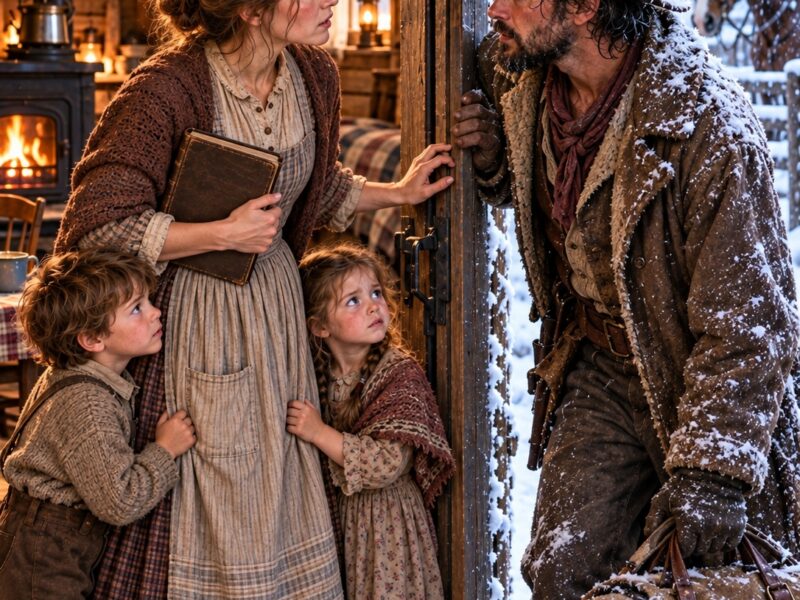
She Sheltered a Freezing Stranger Thinking He Was Poor—Then She Heard Him Pray for a Godly Woman and Learned His Company Owned Her Home
Ella Hart gave the freezing stranger her children’s last loaf of bread because she believed nobody should have to earn the right to survive a winter night.
She thought he was another broke ranch hand stranded in Wyoming, while he quietly owned more land than every family in her valley combined.
Then, sometime after midnight, she heard him whisper a prayer he never meant her to hear—and one sentence made her stop outside the kitchen door.
The Knock in the Blizzard
The knocking came at 10:43 on a Thursday night, three hours after the county weather service had told everyone in northern Wyoming to stay off the roads.
Ella Hart stood perfectly still beside the kitchen table.
Another knock.
Harder.
Her nine-year-old son, Samuel, looked up from the couch.
Six-year-old Ruthie stopped coloring.
Wind pushed snow against the windows so violently it sounded like handfuls of gravel.
Nobody came down Cottonwood Creek Road after dark in January.
Not unless they belonged there.
Ella crossed the room and checked the deadbolt without opening the door.
“Who is it?”
A man’s voice answered through the wood.
“I need help.”
Ella did not unlock it.
“Who are you?”
“Name’s Gideon.”
A pause.
“I slid off the county road about two miles east.”
“My phone’s dead.”
“I’m soaked.”
“I just need somewhere warm long enough not to freeze.”
Ella looked through the narrow side window.
A man stood on the porch beneath the weak yellow bulb.
Tall.
Hat crusted white.
Dark beard covered in ice.
No proper winter coat.
His flannel shirt was soaked almost black from the waist down, jeans stiff with frozen water.
Behind him stood a bay horse tied awkwardly to the porch rail, favoring one front leg.
Not a car.
A horse.
Of course.
This was Wyoming.
Ella opened the inside door but kept the storm door latched.
“You hurt?”
“Nothing serious.”
“That horse?”
“Cut on the fetlock.”
“Can walk.”
The man looked exhausted enough to fall forward through the glass.
“I’ve got no cash on me.”
he added.
“No wallet.”
“Lost it when I went through the creek.”
“I can’t pay you for food or a room.”
Ella glanced toward her kitchen.
One loaf of bread.
Half a jar of peanut butter.
Four eggs.
Enough oatmeal for breakfast.
Twenty-seven dollars in checking until Monday.
A propane tank she prayed would last through the weekend.
Samuel stood behind her now.
“Mama?”
Ella looked again at the stranger.
His lips had lost most of their color.
That decided it.
She unlocked the storm door.
“Get inside.”
The man blinked.
“You sure?”
“No.”
“Come in anyway.”
Samuel led the horse to the lean-to behind the house while Ella gave Gideon one of her late husband’s old sweatshirts and wrapped two blankets around his shoulders.
He sat beside the wood stove, hands shaking too hard to hold the mug she put between them.
Ruthie stared.
Ella said:
“Ruth.”
“What?”
“Staring is rude.”
“He has ice in his beard.”
“I noticed.”
Gideon almost smiled.
Ella warmed two thick slices of bread in a skillet.
Ruthie watched.
“Mama.”
Ella knew what was coming.
“That’s breakfast.”
Gideon looked toward the girl.
Then at the nearly empty bread bag.
He set the mug down.
“No.”
Ella turned.
“No what?”
“I’m not eating that.”
“Yes, you are.”
“Ma’am, I can see what’s left.”
“You don’t know what I have.”
“I know enough.”
Ella placed the plate in front of him.
“Tonight, you’re colder than we are hungry.”
Gideon stared at her.
Something in his face changed.
Not embarrassment.
Recognition.
Like he had heard words in a language he had forgotten existed.
He ate slowly.
Ella gave the children oatmeal instead.
Then put Samuel and Ruthie into her bedroom because the guest room had become storage after Daniel died.
Gideon slept on the couch.
At 1:17 in the morning, Ella woke to voices.
One voice.
His.
She walked quietly toward the kitchen.
The lamp over the sink was on.
Gideon sat at the table with Ella’s Bible open in front of him.
His head was bowed.
She should have walked away.
Instead, she heard him whisper:
“God, I don’t know if You still listen to men who ignored You this long.”
Ella stopped.
Gideon continued.
“I’ve got land.”
“Money.”
“Employees.”
“Rooms nobody sleeps in.”
“People who call when they need something.”
He swallowed.
“But I don’t have a home.”
His voice broke slightly.
“And if You’re not finished with me yet…”
A long silence.
Then:
“Send me a godly woman.”
Ella’s hand tightened around the hallway wall.
Gideon exhaled.
“Or make me the kind of man one would be safe loving.”
Ella stepped backward before the floorboard beneath her foot could betray her.
For the first time that night, she was no longer wondering why a stranger had appeared at her door.
She was wondering what kind of man prayed like that when he thought nobody was listening.
What He Did Not Tell Her
Morning came white.
The storm moved east before sunrise and left Cottonwood Creek buried beneath fourteen inches of snow.
Gideon’s horse was sound enough to travel by ten.
Samuel had already fallen in love with it.
“What’s his name?”
“Jonah.”
“That’s a Bible name.”
“My mother named him.”
“You let your mom name your horse?”
Gideon looked toward the kitchen window.
“My mother named almost everything.”
“Is she alive?”
“No.”
Samuel stopped rubbing Jonah’s neck.
“Sorry.”
Gideon nodded.
“Me too.”
Ella stood inside wrapping sandwiches in wax paper.
She had enough now because Gideon, apparently embarrassed by eating the last bread, had found three emergency energy bars buried in his saddlebag and insisted the children take two.
She handed him the third.
“You’ll need it.”
“So will you.”
“I’m home.”
“You think being home makes people less hungry?”
Ella looked at him.
“Are you always difficult?”
“Mostly when I’m right.”
She almost laughed.
Instead, she gave him a gray wool scarf Daniel had owned.
Gideon hesitated.
“I can bring it back.”
“That’s generally how borrowing works.”
He wrapped it around his neck.
For a moment, standing there in Daniel’s old sweatshirt and a dead man’s scarf, he looked less like a stranger than he had any right to.
That unsettled her.
“Thank you.”
he said.
“For everything.”
Ella folded her arms.
“Go before the road freezes again.”
He left.
She watched Jonah carry him toward the ridge until snow swallowed them.
Three days later, Gideon returned.
Same old horse.
Same borrowed scarf.
Different backpack.
Ella opened the door.
“You found us.”
“I remembered the road.”
“That’s suspicious.”
He smiled.
“I owe you bread.”
He placed a grocery bag on the table.
Not luxury.
Normal groceries.
Flour.
Beans.
Rice.
Coffee.
Bread.
Oranges.
Peanut butter.
Two small bags of gummy bears.
Ruthie gasped.
“Those are medicinal.”
Gideon said solemnly.
“For children recovering from blizzards.”
Ella looked at him.
“This is too much.”
“It’s thirty-eight dollars.”
She raised an eyebrow.
“You kept the receipt.”
“I thought you’d ask.”
“Smart.”
He handed it over.
Thirty-eight dollars and fourteen cents.
Reasonable.
That mattered.
If Gideon had arrived with five hundred dollars of groceries, she would have sent him away.
Instead, he brought exactly enough to repay what he ate plus a little dignity for everyone involved.
“You didn’t need to.”
“I know.”
“Then why?”
“Because I wanted to come back.”
Ella looked at him.
Direct.
No performance.
That made her more nervous than flirting would have.
Samuel appeared.
“The shed roof leaks.”
Ella closed her eyes.
“Samuel.”
“What?”
“You said Mr. Gideon fixes things.”
“I said no such thing.”
Gideon took off his gloves.
“Show me.”
That afternoon, Gideon patched the lean-to roof.
The next week, he returned with lumber Ella had paid for herself after he showed her the invoice.
He fixed the porch step.
Then the weather stripping.
Then a broken gate.
Not every day.
Not enough to feel like invasion.
Enough to become familiar.
Ella learned that Gideon knew cattle better than carpentry and carpentry better than plumbing.
That he drank coffee black.
That he hated canned peas.
That he never complained about cold.
That he carried an old Bible in his saddlebag now.
She also learned he knew suspiciously much about land values, water rights, and livestock markets for a man who described himself only as “ranch work.”
“What kind of ranch work?”
she asked one evening.
“Management.”
“That is not ranch work.”
“It happens on ranches.”
“What do you manage?”
“People who don’t enjoy being managed.”
Ella laughed.
“You sound expensive.”
Gideon looked at the table.
“I’ve been accused of that.”
He never directly said he was poor.
Ella realized that later.
She had assumed it.
Because of the wet clothes.
Old truck when he eventually drove.
Calloused hands.
No visible watch.
The first night he truly had no wallet.
She had built an entire category around him without asking.
That embarrassed her.
So did the fact that she liked him.
Not loved.
Not yet.
Liked.
That was dangerous enough.
Ella had been widowed for two years.
Her husband Daniel had died from an aneurysm at thirty-seven, not dramatically, not with time for speeches.
He complained of a headache after repairing fence.
Collapsed in the barn.
Gone before the helicopter arrived.
The suddenness rearranged Ella’s faith.
Not destroyed.
Rearranged.
She had spent months angry at God and guilty for being angry.
Then money ran short enough that grief had to share the room with arithmetic.
Daniel left the house.
Some cattle.
A small life-insurance policy mostly consumed by debt.
And a property problem Ella did not understand yet.
She worked part-time at Cottonwood Elementary.
Cleaned two vacation homes outside town.
Sold eggs in summer.
Kept going.
She did not need a man to rescue her.
She needed the mortgage company to stop sending letters with red borders.
Gideon knew none of that at first.
Then he saw one.
The letter arrived on a Friday.
Ella opened it beside the sink.
Her face changed.
Gideon noticed.
“What?”
“Nothing.”
“That’s not true.”
“You’re getting bold.”
“I’m learning from you.”
Ella folded the paper.
“Property issue.”
“What kind?”
“Daniel bought this place through a contract-for-deed arrangement.”
“The owner died.”
“His daughter sold everything to a land company.”
“They claim Daniel never completed the purchase terms.”
Gideon became very still.
“What company?”
Ella did not notice the change.
“Thorne Land & Cattle.”
The coffee mug stopped halfway to Gideon’s mouth.
Ella continued.
“They bought most of Cottonwood Valley last month.”
“Water access.”
“Grazing.”
“They say I can either sign a new lease at triple what we paid or leave in thirty days.”
Gideon put down the mug.
“Who signed the notice?”
“Harrison Pike.”
His face hardened.
Ella noticed now.
“You know him?”
“Yes.”
“How?”
Gideon looked at the paper.
Then at her.
“He works for the company.”
“That wasn’t my question.”
“No.”
It wasn’t.
Ella waited.
Gideon’s throat moved.
“I know him because…”
He stopped.
That pause was the first real lie between them.
Not a false sentence.
A truth withheld.
Ella felt it.
“Because what?”
“Because I’ve done work for Thorne.”
“What kind?”
“Land operations.”
Ella studied him.
“Can you help?”
The question cost her.
She hated that.
Gideon answered carefully.
“I can find out what happened.”
“That’s not what I asked.”
“I know.”
“Can you stop them?”
He looked at her.
“Yes.”
Too fast.
Too certain.
Ella’s suspicion woke.
“How?”
Gideon said:
“Let me make some calls.”
Then left before supper.
He drove forty miles to Cheyenne.
Past the feed store.
Past the courthouse.
Past the bank where the president stood whenever Gideon Thorne entered.
He parked beneath the stone sign reading:
THORNE LAND & CATTLE COMPANY — EST. 1948
Inside, employees straightened.
“Mr. Thorne.”
“Sir.”
“Didn’t know you were coming.”
Gideon kept walking.
Harrison Pike stood in the executive conference room beside a map of Cottonwood Valley.
Red parcels everywhere.
Ella Hart’s cabin was one of them.
Gideon stopped in the doorway.
“Explain.”
Pike turned.
Fifty-six.
Silver hair.
MBA.
Thirty years in land acquisition.
Not cruel for sport.
Worse.
Efficient.
“Gideon.”
“You said you were taking the week.”
“I changed my mind.”
Pike looked at the map.
“What am I explaining?”
“Cottonwood Creek.”
“Strategic acquisition.”
“We need winter water access for the east herd.”
“The creek rights consolidate three grazing blocks.”
“Mrs. Hart.”
Pike frowned.
Then searched his papers.
“Occupant parcel 17.”
“Contract defect.”
“We offered lease conversion.”
“You offered eviction.”
“We offered commercial terms.”
“To a widow with two children.”
Pike looked at Gideon like the sentence was emotionally relevant but economically irrelevant.
“The company cannot price land based on biography.”
Gideon’s jaw tightened.
“Did Daniel Hart make payments?”
“Yes.”
“How many?”
Pike checked.
“Ten years.”
“Purchase term?”
“Twelve.”
“Balance?”
“Approximately eighteen thousand.”
“And you offered her a lease instead of payoff?”
“The original contract was defective.”
“Seller failed to record.”
“Company has superior title after acquisition.”
“Legally, yes.”
“Ethically?”
Pike exhaled.
“We own sixty-eight thousand acres.”
“If we litigate every moral nuance—”
“Answer.”
Pike met his eyes.
“Ethically, it’s unfortunate.”
Gideon looked at the map.
“Cancel the notice.”
“Gideon.”
“Offer her completion for the original remaining balance.”
Pike stared.
“That creates precedent.”
“Then create one.”
“Board approval—”
“I’m chairman.”
“You’re also accountable to investors.”
That landed.
Pike stepped closer.
“Cottonwood expansion is worth eight figures over five years.”
“You signed the acquisition package.”
“I put the risk memo in front of you.”
“You signed every page.”
Gideon looked at him.
There.
Responsibility.
His.
Not just Pike.
He had signed.
Probably during a quarterly meeting.
Page after page.
Trusted management.
Approved strategy.
Ella’s fear carried his signature even if he had never known her name.
“Get legal on the phone.”
he said.
Pike sighed.
“Gideon, this woman means something to you.”
Not question.
Gideon’s face hardened.
“That is irrelevant.”
“No.”
“It’s exactly relevant.”
“If you reverse a profitable acquisition for someone you personally know, the board will ask why.”
“They should.”
“And what will you tell them?”
Gideon looked at the red parcel.
“The truth.”
Pike shook his head.
“You built this company by not making exceptions.”
“Maybe that is the problem.”
That night, Gideon returned to the cabin.
Ella was not relieved to see him.
She was angry.
Good.
It meant she had noticed the omission.
“What did you find?”
Gideon took off the gray scarf.
Folded it.
Placed it on the table.
Then:
“I owe you the whole truth.”
Ella looked at his face.
Something inside her dropped.
“What truth?”
Gideon sat.
“My name is Gideon Thorne.”
Silence.
She stared.
Then laughed once.
Not because it was funny.
“Thorne.”
“Yes.”
“As in Thorne Land & Cattle.”
“Yes.”
Her face emptied.
“The company trying to take my home.”
“Yes.”
“You work for them.”
“I own it.”
The room went so quiet Ella could hear the refrigerator cycle on.
Ruthie laughed from the bedroom at something Samuel said.
Normal life continuing behind catastrophe.
Ella’s eyes filled.
Not with gratitude.
Fury.
“You let me think you were broke.”
“I never said—”
“Don’t.”
Gideon stopped.
“That sentence will make this worse.”
He nodded.
She stood.
“You sat at my table.”
“Yes.”
“You ate my children’s breakfast.”
“Yes.”
“You came back here.”
“Yes.”
“Fixed my house.”
“Yes.”
“And every time I told you I was scared about money, you knew you could buy this entire valley.”
“Yes.”
The word sounded terrible.
Good.
It should.
Ella folded her arms.
“Why didn’t you tell me?”
Gideon looked at the gray scarf.
“Because the first night, I had nothing.”
“That’s dramatic.”
“It’s also true.”
“My truck was in the creek.”
“Phone dead.”
“Wallet gone.”
“My mother had been dead eleven years that day.”
“I had ridden to the ridge where we scattered her ashes because I couldn’t stand being in my house.”
“I hadn’t prayed since her funeral.”
He looked up.
“Then you opened the door.”
Ella’s expression did not soften.
Good.
Gideon continued.
“You gave me food you couldn’t spare.”
“You asked nothing.”
“You didn’t know my last name.”
“I liked being nobody.”
“That was selfish.”
“Yes.”
“I came back because I wanted to feel it again.”
“The part where nobody wanted anything.”
Ella swallowed.
“And me?”
“You became part of it.”
“That is not flattering.”
“I know.”
“You turned my ignorance into comfort.”
“Yes.”
He did not defend.
That helped one percent.
Not enough.
Ella asked:
“Did your company send the notice before or after you met me?”
“Before.”
“Did you know?”
“No.”
“Can you prove that?”
“Yes.”
“Will you?”
“Yes.”
“Did you sign anything connected to the purchase?”
Gideon hesitated.
There.
Second blow.
“Yes.”
Ella closed her eyes.
“What?”
“Acquisition approval.”
“I didn’t read the parcel-level materials.”
She looked at him.
“Your signature is on the thing threatening my children.”
“Yes.”
“And you came into my house pretending to be a ranch hand.”
“Yes.”
“Get out.”
Gideon stood.
“Ella—”
“Get out.”
He left.
No argument.
No grand gesture.
He took the gray scarf with him only because she threw it at his chest.
The Company Letter
Ella cried after the children slept.
Not because Gideon was rich.
Because he had made intimacy possible through information she did not have.
That felt too familiar.
Daniel had not lied to her cruelly.
But he had handled money badly.
Hidden late notices.
Assured her things were fine because he believed protecting her meant keeping fear away.
After his death, she discovered three debts she never knew existed.
Now another man had decided ignorance was kindness.
Different motive.
Same theft of choice.
The next morning, Ella called Naomi Brooks.
Naomi ran a small legal-aid office in Casper and attended Ella’s church irregularly enough to dislike being described as churchgoing.
She drove out with two coffees and a portable scanner.
“Show me everything.”
Ella did.
Original contract-for-deed.
Receipts.
Bank statements.
Tax payments.
Repairs.
Insurance.
Naomi read for two hours.
Then:
“They have title advantage.”
Ella’s stomach dropped.
“But?”
“But you have a strong equitable-interest argument.”
“You made ten years of payments.”
“Seller accepted.”
“You paid property taxes.”
“You improved the land.”
“The contract is imperfect, not nonexistent.”
“Can we win?”
Naomi looked at her.
“Maybe.”
“Not good enough.”
“It’s law.”
“Anyone promising certainty before discovery is selling certainty.”
Ella smiled weakly.
“You sound fun at weddings.”
“I’m magnificent.”
Naomi pointed at the Thorne letter.
“They gave thirty days voluntarily.”
“Wyoming eviction procedures don’t let them simply throw your furniture into snow.”
“We request records.”
“Challenge title treatment.”
“Seek injunction if needed.”
“What if Gideon cancels it?”
Naomi paused.
“Do you want him to?”
Ella hated the question.
“Yes.”
Then:
“No.”
Then:
“I don’t know.”
“Good.”
“That means you’re thinking.”
Ella pressed her palms to the table.
“If he fixes it because he likes me, then what happens to the next family?”
Naomi looked at her.
Exactly.
“What families?”
Ella asked.
Naomi opened the acquisition list.
“Seventeen occupied parcels along Cottonwood Creek.”
Ella stared.
“Seventeen?”
“Your notice references consolidated water-right development.”
“I’m guessing you aren’t alone.”
That changed everything.
The threat was no longer her cabin.
It was a strategy.
Ella drove Cottonwood Creek Road that afternoon.
The Millers got a notice.
So did Mr. Alvarez.
The Jenkins family.
An elderly couple named Kowalski.
Some had leases.
Some informal purchase arrangements.
Some grazing access their families had used for decades.
Nobody had Gideon Thorne coming by to chop wood.
Ella’s anger clarified.
That evening Gideon called.
She did not answer.
He texted:
I have paused every Cottonwood notice pending review. Not just yours. I’ll send documentation through your attorney.
Ella forwarded it to Naomi.
No response to Gideon.
Next day:
Board is resisting. I expected that. You don’t owe me a conversation.
No response.
Two days later, Naomi received formal notice.
Evictions paused sixty days.
Independent review.
Good.
But not permanent.
Gideon had opposition.
Harrison Pike became the face of it.
At the board meeting, Pike did not insult widows.
He presented numbers.
Water value.
Investor obligations.
Acquisition costs.
Risk of precedent.
“If every informal contract becomes a moral exception, we cannot manage land at scale.”
Gideon replied:
“Then maybe we shouldn’t manage homes at scale like vacant acreage.”
A director asked:
“Are you saying the acquisition model is unethical?”
“I’m saying we failed due diligence on occupied parcels.”
Pike said:
“We did legal due diligence.”
Gideon looked at him.
“Not human.”
The room disliked that sentence.
Boards preferred nouns like exposure.
Gideon continued.
“We knew who held title.”
“We did not ask who had paid for ten years believing they were buying a home.”
“That is operational negligence.”
Pike’s face tightened.
“You approved it.”
“Yes.”
“I did.”
That silenced everyone.
Gideon did not hide behind staff.
Important.
“I signed.”
“I’m responsible.”
“We fix it.”
Board formed a special committee.
Independent counsel.
Audit of all occupied parcels.
Pike hated it.
Not because he enjoyed suffering.
Because he believed Gideon was endangering a company supporting hundreds of employees for a sentimental problem.
He told Gideon privately:
“You are turning a personal attachment into policy.”
Gideon answered:
“Maybe personal attachment finally made me notice bad policy.”
That evening he drove toward Ella’s cabin.
Stopped half a mile away.
Did not continue.
She had told him to leave.
He honored it.
Instead, he went home.
Stone house outside Cheyenne.
Twelve rooms.
No laughter.
He opened his mother’s Bible.
The gray scarf sat beside it.
He prayed.
Not for Ella to forgive him.
That surprised him.
He prayed:
“Make me willing to fix what costs me.”
Then he opened his eyes and realized someone stood in the doorway.
His sister Catherine.
Forty-seven.
Divorced.
Runs the company foundation.
She looked at the Bible.
“Well.”
Gideon frowned.
“What?”
“Mother has been dead eleven years.”
“I thought that book was decorative.”
“Why are you here?”
“You missed dinner with the foundation trustees.”
“I texted.”
“You sent ‘can’t.’”
“Very nuanced.”
Catherine entered.
“What happened?”
Gideon told her.
Not romance first.
Land.
Notice.
Signature.
Then Ella.
Catherine listened.
At the end:
“You lied.”
“I withheld.”
“That is rich-man grammar for lied.”
Gideon glared.
She continued.
“You liked being treated normally.”
“Yes.”
“So you kept information that would change how she saw you.”
“Yes.”
“That means you controlled the experiment.”
“Yes.”
“Then stop trying to win forgiveness.”
“I’m not.”
“Good.”
“Earn credibility.”
“How?”
Catherine shrugged.
“Same way poor people do.”
“Over time.”
That annoyed him because it was true.
The Prayer She Was Never Meant to Hear
Three weeks passed before Ella saw Gideon again.
Not at home.
At the county community center.
Thorne Land & Cattle held a public listening session on Cottonwood parcels.
Pike opposed it.
Gideon insisted.
Independent moderator.
Attorneys.
Maps.
Residents.
Ella sat beside Naomi in the second row.
Gideon entered without security theater.
Dark coat.
Gray scarf.
Ella noticed.
Hated that she noticed.
The meeting was rough.
Mr. Miller shouted.
Mrs. Jenkins cried.
Alvarez asked why his father’s verbal grazing agreement meant nothing after fifty years.
Pike answered precisely.
“We acquired recorded rights.”
Ella stood.
“That wasn’t his question.”
The room turned.
Pike looked at her.
“What was the question?”
“Whether your company believes legal ownership is the only kind of obligation.”
Pike replied:
“A corporation’s obligations are defined by law, contract, and fiduciary duty.”
Ella nodded.
“Then maybe fiduciary duty is too small a vocabulary for a company that buys people’s homes.”
Applause.
Gideon did not smile.
Good.
This was not theater.
Pike said:
“If we abandon enforceable structures whenever hardship exists, investment becomes impossible.”
Naomi stood.
“No one is asking you to abandon law.”
“We are asking whether the company correctly interpreted equitable interests.”
She cited cases.
Specific.
Measured.
Pike’s expression changed.
Now it was real argument.
The meeting ended with commitments:
No displacement during review.
Original purchase balances honored where payment history supported intent.
Independent appraisal.
Mediation.
Water easements negotiated rather than assumed.
Not everything residents wanted.
Better.
Afterward, Gideon waited until Ella approached him.
She almost didn’t.
Then:
“Thank you for not making it about me.”
Gideon nodded.
“It isn’t only about you.”
“I needed to learn that.”
Ella looked at the scarf.
“You kept it.”
“Yes.”
“You could have returned it.”
“I considered it.”
“Why didn’t you?”
“Because I’m hoping someday you’ll take it back.”
Too romantic.
Ella’s face closed.
Gideon saw.
Corrected.
“That came out wrong.”
“Yes.”
“I mean it reminds me of the night someone helped me without knowing what I could do for them.”
“That is your memory.”
“Not my obligation.”
“Yes.”
He nodded.
“Exactly.”
Better.
Ella left.
Two days later, Gideon helped at the church food pantry.
Not because Ella asked.
Catherine had volunteered him after the foundation’s truck driver canceled.
He arrived in work boots.
Carried boxes.
No announcement.
Ella came to pick up food for one of the Cottonwood families.
Saw him stacking canned tomatoes.
He looked embarrassed.
“Catherine.”
he said.
Ella almost smiled.
“Your sister?”
“Yes.”
“I like her already.”
“You shouldn’t.”
“She’s dangerous.”
“Good.”
They worked an hour.
Small conversation.
No land.
No apology.
At the end, Samuel appeared from youth group and asked Gideon:
“You coming by again?”
Ella stiffened.
Gideon looked at her first.
Then Samuel.
“If your mother invites me.”
Samuel groaned.
“That means no.”
Ella surprised herself.
“Sunday.”
Gideon looked at her.
“For lunch.”
“Not courtship.”
“I understand.”
“Bring nothing.”
“Yes, ma’am.”
He arrived with nothing.
Ruthie opened the door.
“You forgot food.”
“Your mother threatened me.”
Ella laughed from the kitchen.
First real warmth since the reveal.
Lunch was chili.
Cornbread.
Samuel complained about fractions.
Gideon helped.
Badly.
Ella corrected him.
“You own a company and can’t explain fourth-grade fractions?”
“I delegate.”
“That explains several things.”
Gideon winced.
Fair.
After lunch, Ruthie fell asleep on the couch.
Samuel went outside.
Ella washed dishes.
Gideon dried.
Domestic.
Dangerous.
He said:
“I remember what you heard.”
Ella stopped.
“What?”
“That first night.”
Her hands froze.
“You knew?”
“The floorboard.”
Heat rose into her face.
“I wasn’t trying to listen.”
“I know.”
Silence.
Then Gideon said:
“I was embarrassed.”
“Why?”
“Because asking God to send me a woman like some delivery order is spiritually arrogant.”
Ella laughed despite herself.
“That is one interpretation.”
“I’ve revised the prayer.”
“Oh?”
“Yes.”
“What is it now?”
Gideon dried the same plate too long.
“Make me trustworthy.”
Ella looked at him.
He continued.
“Whether you ever choose me or not.”
That was the first thing he said that reached the place he had damaged.
Not because it promised romance.
Because it released her from responsibility for his change.
Ella returned to washing dishes.
“Better prayer.”
“I thought so.”
That became their first real intimate scene.
No kiss.
No confession.
Two people beside a sink learning a different kind of honesty.
The second came a month later.
Ella’s father arrived from Missouri.
Reverend Thomas Mercer.
Seventy-one.
Still preaching twice a month.
Ella had finally written him.
Not because Gideon told her to.
Because Ruthie found an old photograph and asked why she had never met Grandpa.
Shame stopped feeling noble after that.
Thomas drove fourteen hours with Ella’s older sister.
When he stepped from the car, Ella became nineteen again.
She stood on the porch.
Could not move.
Her father crossed the snow.
Stopped.
Then said:
“I have rehearsed being angry for eleven years.”
Ella’s eyes filled.
“And?”
“I got tired.”
She cried before he touched her.
He held her.
No sermon.
No I told you so.
Later, Gideon arrived to fix a gate hinge.
Thomas watched from the porch.
“Who’s that?”
Ella sighed.
“Complicated.”
Her father smiled.
“Those are usually the interesting ones.”
Gideon met him.
No mention of wealth until Thomas already knew from Ella.
Thomas asked:
“You the man praying for a godly woman in my daughter’s kitchen?”
Gideon nearly dropped the wrench.
Ella covered her face.
“Dad.”
Thomas laughed.
“Good.”
“Humility suits rich men.”
Gideon liked him immediately.
That evening, after supper, Thomas asked Gideon to walk.
They returned forty minutes later.
Ella did not ask what was said.
Gideon volunteered:
“He told me if I hurt you, he is too old to fight me.”
Ella smiled.
“That sounds loving.”
“He said he would pray the Lord inconvenience me permanently.”
“That sounds exactly like him.”
Gideon laughed.
Their second intimate moment came later.
Ella and Gideon stood outside under a sky so clear the stars looked sharpened.
He said:
“I envy your father.”
“Why?”
“He came back.”
“You can come back too.”
“To what?”
Ella looked at him.
“Faith.”
Not her.
Faith.
Gideon understood.
He nodded.
That night he prayed without asking for a woman at all.
The Lowest Winter
February brought the audit report.
Seventeen occupied parcels.
Nine families had strong equitable claims.
Four had enforceable lease rights longer than Thorne recognized.
Two cases were unclear.
Two families had almost no legal protection.
The board agreed to honor historical purchase arrangements.
But Pike fought one point.
Water.
Cottonwood Creek crossed several parcels.
Thorne’s expansion depended on long-term water access.
If the company ceded all water claims, it would lose millions.
Pike proposed settlement.
Families keep homes.
Company receives easements.
Reasonable.
Except the easement drafted for Ella’s parcel was too broad.
It allowed heavy equipment access within two hundred feet of the house.
Naomi caught it.
Ella refused.
Pike said:
“Then we proceed to court.”
Gideon called him.
“Revise.”
“No.”
“Harrison.”
“You hired independent review.”
“You said this would not become personal intervention.”
“And you are now intervening personally.”
Gideon went silent.
Pike continued.
“I have protected this company for twenty-seven years.”
“Your father taught me that sentiment kills ranches.”
“Your mother understood too.”
“Don’t use my mother.”
“She co-signed the original water strategy.”
That stopped Gideon.
His mother.
The woman he had turned into pure goodness in memory.
Pike sent the old minutes.
Martha Thorne had supported aggressive water consolidation during the drought twenty years earlier.
Not eviction.
But acquisition.
Business.
Complexity.
Gideon sat alone reading.
His grief had simplified her.
Just as he had simplified Ella into “godly woman.”
People were not symbols.
They were contradictions.
That realization mattered.
Then the story broke publicly.
A regional business blog reported:
Billionaire Rancher Reverses Land Deal After Romance With Widow on Disputed Parcel
Ella saw it at school.
Teachers whispered.
Parents stared.
Comments were worse.
Gold digger.
Strategic widow.
Prayer trap.
Someone posted photographs of Gideon at her cabin.
Another article noted she received preferential review.
Though all seventeen parcels had review.
Facts did not travel as fast as scandal.
Ruthie came home crying.
“A girl said you’re marrying a rich man because we’re poor.”
Ella went cold.
Samuel got into a pushing argument at school.
No serious injury.
Enough.
Ella called Gideon.
“I need distance.”
He closed his eyes.
“Okay.”
“No visits.”
“Okay.”
“No calls unless land case.”
“Okay.”
“I mean it.”
“I know.”
He did not say:
I can fix the press.
He did not send lawyers after commenters.
Progress.
But the board did something worse.
They placed Gideon under temporary conflict restrictions regarding Cottonwood decisions.
Reasonable corporate governance.
Pike became operational authority on the settlement.
He filed declaratory action on the water easement.
Ella’s property closing froze.
The thirty-day threat was gone.
But ownership remained unresolved.
Then Ella lost one cleaning client after the woman said she “didn’t want media complications.”
Small.
Humiliating.
Her father offered money.
Ella refused.
Then accepted groceries.
Growth.
Naomi asked:
“What do you want the outcome to be?”
“My house.”
“Not Gideon?”
Ella stared.
Naomi shrugged.
“I separate issues.”
“That’s why you’re useful.”
“I want the house legally mine.”
“Water agreement I can live with.”
“Clear precedent for the others.”
“And Gideon?”
Ella looked out the legal-aid office window.
“I don’t know.”
“Good.”
They prepared for mediation.
Pike came with company counsel.
Ella with Naomi.
Gideon did not attend.
Conflict restriction.
That hurt.
Also correct.
Pike offered:
Deed transfer at original remaining purchase balance waived.
In exchange, permanent access easement.
Ella read.
“No.”
Naomi looked at her.
“Which clause?”
“Emergency expansion rights.”
Company could widen access during drought.
“How wide?”
“Unspecified.”
Pike said:
“Operational flexibility.”
Ella said:
“Open-ended.”
They revised.
Again.
Again.
Six hours.
At 4:40 p.m., they were close.
Then Pike added confidentiality.
No public discussion of company errors.
Ella leaned back.
“No.”
Pike sighed.
“Mrs. Hart.”
“No.”
“This settlement already gives you substantial value.”
“I paid for substantial value for ten years.”
“You did not complete payment.”
“Because the seller died and your company bought the title.”
“Which gives us legal rights.”
“Yes.”
“And gives me a story I am legally allowed to tell.”
Pike’s mouth tightened.
“What do you want?”
Ella looked at him.
“Not revenge.”
“Accuracy.”
She wanted the final agreement to acknowledge:
Historic payments.
Company notice error.
Independent review.
No special romantic exception.
All affected households eligible for same process.
Pike stared.
“That language creates reputational exposure.”
“Then perhaps the reputation needs exposure.”
Mediation ended without settlement.
Lowest point.
Because that night another storm came.
Not as severe.
Enough to knock power out.
Ella’s propane ran low.
No Gideon.
By her own request.
Samuel asked:
“Did we lose the house?”
“No.”
“Are you sure?”
Ella opened her mouth.
Stopped.
Honesty.
“I’m sure we’re still fighting for it.”
Ruthie crawled beside her.
“Mr. Gideon could buy it.”
Samuel said.
Ella looked at both children.
“He could.”
“Why doesn’t he?”
“Because it matters that nobody owns our safety as a favor.”
Samuel frowned.
“That sounds complicated.”
“It is.”
“Wouldn’t free be easier?”
“Yes.”
Ella smiled sadly.
“Easy and secure aren’t always the same.”
After the children slept, Ella sat at the table.
Bible.
Lamp.
Same position as the first storm.
But now the shelf held food.
The problem was different.
She opened to 2 Chronicles.
The verse from the source story remained in her memory: “We do not know what to do, but our eyes are on You.”
Ella whispered:
“I still don’t know.”
Then she laughed softly.
“At least I’m consistent.”
She prayed.
Not for Gideon.
Not for land.
For courage to accept whichever answer required the most integrity.
At the same hour, forty miles away, Gideon sat in the boardroom with Catherine and three directors.
He had a choice.
Resume control through chairman authority.
Fire Pike.
Force settlement.
Win Ella’s land.
Or respect the governance process he himself had created.
Catherine said:
“What do you want?”
“To end this.”
“That wasn’t my question.”
Gideon looked at the table.
“I want to be the kind of man Ella could trust.”
“Then don’t make her legal case disappear because you’re powerful.”
He hated his sister.
Deeply.
Lovingly.
“What do I do?”
Catherine smiled.
“Nothing.”
“That cannot be the answer.”
“For once?”
“Let someone else decide whether you’re right.”
Gideon leaned back.
That felt harder than moving ten thousand cattle.
He did nothing.
And that choice saved the relationship more than any deed he could have signed.
The Choice at the Courthouse
Naomi found the missing document.
Not miracle.
Records request.
County archive.
Box misindexed under the original landowner’s middle name.
A signed amendment to Daniel’s contract.
It acknowledged full credit for improvements toward purchase price.
Fence.
Well repair.
Roof.
Drainage.
Value:
$21,600.
More than the remaining balance.
Legally significant.
Combined with payment records, Ella had a strong claim to equitable title independent of Thorne’s goodwill.
Naomi called at 7:12 a.m.
“We found your house.”
Ella sat down.
“What?”
“We found your house.”
The case changed.
Pike’s attorneys changed too.
Not out of kindness.
Risk.
If Ella won in court, the ruling could affect similar contracts.
Settlement now made sense.
Public.
No confidentiality.
Standardized review for other families.
Narrow water easement.
No heavy-equipment access near residences without separate consent.
Ella’s title recorded.
Not gifted.
Recognized.
She signed at the county courthouse.
Gideon was not there.
She noticed.
Naomi noticed her noticing.
“He stayed away.”
“Conflict.”
“Yes.”
Ella smiled slightly.
“Good.”
Outside, reporters waited because the story had grown.
Ella stood on the courthouse steps.
One asked:
“Did Gideon Thorne give you the property?”
Ella answered:
“No.”
“My husband and I paid for our home.”
“The company acquired the title.”
“The legal process recognized the interest already created by those payments.”
Another asked:
“Are you and Mr. Thorne romantically involved?”
Ella paused.
“That has nothing to do with today.”
“But are you?”
Ella smiled.
“That still has nothing to do with today.”
Naomi whispered:
“I’m proud of you.”
“Don’t get sentimental.”
“I bill by the hour.”
That evening, Gideon sent one text.
Congratulations.
Ella stared.
No heart.
No invitation.
No “I told you.”
She replied:
Thank you.
Then:
Sunday lunch. If you want.
Three dots.
Disappeared.
Returned.
I want.
Sunday, Gideon arrived carrying nothing.
Ruthie checked.
“Still nothing.”
“Your mother remains terrifying.”
Ella heard from the kitchen.
“As she should.”
Lunch.
Then Samuel dragged Gideon to the barn.
Ruthie colored.
Ella’s father read by the window.
Ordinary.
Afterward, Gideon and Ella walked to the creek.
Snow melting along the edges.
Water dark.
Moving.
He said:
“I’m glad you won without me.”
Ella looked at him.
“Are you?”
“No.”
“Part of me wanted to put the deed in your hand the first week.”
“Why didn’t you?”
“Because Catherine threatened to have me declared emotionally incompetent.”
Ella laughed.
“Smart woman.”
“Also because you were right.”
“I needed the house to belong to me because it belonged to me.”
“Not because you loved me.”
Ella stopped walking.
Gideon realized what he had said.
Too far?
Maybe.
He did not retreat.
“I do.”
Ella’s heart changed rhythm.
He continued.
“I’m not asking you to answer.”
“Good.”
“I’m telling you because hiding important information from you has gone poorly for me.”
That made her laugh.
Then cry.
Annoying.
Gideon stood still.
Did not touch.
Ella wiped her face.
“I hate crying outside.”
“It’s inefficient.”
“Exactly.”
He smiled.
She looked at him.
“You prayed for a godly woman.”
“Yes.”
“What did you mean?”
Gideon thought.
“Someone good enough to make me good.”
Ella shook her head.
“That’s a terrible idea.”
“I know now.”
“You cannot make a woman responsible for your character.”
“I know.”
“So what do you mean now?”
Gideon looked at the creek.
“Someone whose faith makes her honest.”
“Not obedient.”
“Not decorative.”
“Someone I can tell the truth to.”
“And who can tell it back.”
Ella’s expression softened.
“That’s better.”
“I’ve had coaching.”
“Catherine?”
“And your father.”
“Dangerous combination.”
They walked.
At the cabin, Thomas watched through the window.
Pretended not to.
Ella said:
“I love you too.”
Gideon stopped.
She held up a hand.
“Do not become dramatic.”
“I wasn’t—”
“You were about to.”
He closed his mouth.
Ella continued.
“I love you.”
“But I don’t trust you enough to marry you.”
Gideon absorbed it.
Pain.
Fair.
“What do I do?”
“Nothing spectacular.”
“Show up.”
“Tell the truth.”
“Let time do work money cannot.”
Gideon nodded.
“I can do that.”
“We’ll see.”
That was the third intimate scene.
No kiss yet.
He had asked for a godly woman.
God, apparently, had sent him a woman with conditions.
Good.
Spring on Cottonwood Creek
Spring came slowly.
Gideon kept showing up.
Not every day.
That would have been pressure disguised as devotion.
Tuesday supper sometimes.
Church twice a month.
Children’s school fundraiser.
Thomas Mercer’s birthday.
Cattle vaccination day when Samuel begged for help.
He remained chairman of Thorne Land & Cattle but gave operational authority over land acquisitions to an independent committee.
Pike remained with the company.
That surprised Ella.
“Why didn’t you fire him?”
Gideon answered:
“Because he wasn’t secretly evil.”
“He executed the policy I rewarded him for executing.”
“He was wrong about people.”
“So was I.”
“Now he has a different mandate.”
Pike apologized publicly at Cottonwood community meeting.
Awkward.
Corporate.
Real enough.
“I treated occupancy as a title problem.”
he said.
“That was too narrow.”
Alvarez muttered:
“That’s one way to say it.”
People laughed.
Tension broke.
Pike stayed afterward to answer questions.
Change did not always require exile.
Sometimes it required supervision.
Ella respected that.
The company created a resident-impact review.
Not charity.
Policy.
Catherine ran oversight.
Naomi served on advisory panel and charged market rate.
She insisted.
Ella went back to school too.
Online courses.
Accounting and nonprofit management.
Why?
Because the land fight showed how many rural families signed contracts they did not understand.
She began volunteering with Naomi’s office one afternoon a week.
Document intake.
Payment histories.
Organizing records.
The work suited her.
Gideon offered to fund a program.
Ella said:
“Through the foundation.”
“Independent board.”
“No naming rights.”
Gideon sighed.
“You take all the fun out of philanthropy.”
“Yes.”
The program launched:
Cottonwood Rural Property Clinic.
Legal-aid partnerships.
Contract education.
Farm succession.
Lease review.
It helped nine families in its first year.
No one called Ella rescued.
Good.
Her father moved closer.
Not into the house.
He valued everyone’s sanity.
Samuel became obsessed with cattle genetics.
Ruthie became obsessed with horses and announced she would marry Jonah.
The horse.
Ella said:
“We’ll discuss species compatibility later.”
Gideon nearly choked on coffee.
By autumn, trust had changed shape.
Ella gave Gideon a key.
Not romantic.
Practical.
He held it like a sacred object anyway.
“Do not make this weird.”
“I’m holding metal.”
“You’re holding it emotionally.”
“That accusation lacks evidence.”
She kissed him.
First time.
Kitchen.
Same table where he had prayed months earlier.
No music.
Samuel yelling outside because Ruthie had stolen his gloves.
Gideon touched Ella’s face.
Stopped.
Waited.
She kissed him again.
Choice.
Months later, he proposed.
Not with land.
Not house.
Not cattle.
No public audience.
He placed his mother’s old Bible on the kitchen table.
The gray scarf folded beside it.
Ella stared.
“This is either deeply romantic or you’re returning overdue property.”
“Both.”
He sat across from her.
No kneeling.
She appreciated that.
“I asked God for a godly woman before I understood that what I really needed was to become a truthful man.”
Ella’s eyes filled.
Gideon continued.
“You did not save me because you fed me.”
“You saved me because you refused to let my money become proof of my goodness.”
“You made me fix what I signed.”
“Wait when I wanted to force.”
“Tell the truth when hiding felt kinder.”
He breathed.
“I love Samuel.”
“I love Ruthie.”
“I love your father even though he threatens me spiritually.”
From the living room Thomas called:
“I heard that.”
Ella laughed.
Gideon smiled.
Then:
“I love you.”
“I have a home now whether you marry me or not.”
“That part matters.”
Ella’s throat tightened.
“Yes.”
“So I’m not asking you to rescue me.”
“I’m asking whether you want to build the rest with me.”
He took out a ring.
Simple.
Her grandmother’s style.
No giant diamond.
Ella looked at it.
Then at him.
“Did Catherine choose that?”
“Yes.”
“Good.”
“Why?”
“Your taste is questionable.”
“Cruel.”
Ella smiled.
“Yes.”
They married the next June.
Small church.
Cottonwood Creek.
Thomas officiated.
Naomi stood with Ella.
Catherine stood with Gideon.
Samuel carried the rings and nearly lost them.
Ruthie scattered wildflowers with the intensity of a military operation.
Pike came.
Sat in the back.
That mattered.
No society pages.
No ranch-magazine exclusive.
Gideon declined.
After ceremony, everyone ate under white tents beside the creek.
Bread on every table.
Ella noticed.
Of course.
Gideon noticed her noticing.
“I asked for extra.”
“You’re sentimental.”
“I’m rich.”
“Different disease.”
He laughed.
Years passed.
Not magically.
Marriage was still marriage.
Gideon sometimes solved before asking.
Ella sometimes rejected help because she feared dependence.
They fought.
Once over Samuel’s college.
Gideon wanted to pay everything.
Ella wanted scholarships and shared responsibility.
Samuel wanted to become a mechanic and skip college entirely.
He won.
Ruthie wanted veterinary school.
Gideon started to say:
“I’ll handle tuition.”
Then looked at Ella.
Corrected:
“Can we talk about what support feels right?”
Progress.
Thomas died at eighty-three.
Peacefully.
Ella held his hand.
Gideon held hers.
No theology made grief painless.
Faith did not erase loss.
It gave grief somewhere to sit.
Thorne Land & Cattle changed too.
Smaller acreage.
More conservation easements.
More employee ownership.
Less obsession with expansion.
Not because Gideon became a saint.
He remained difficult.
Competitive.
Capable of turning breakfast into strategy.
Ella once told Catherine:
“He’s still a lot.”
Catherine answered:
“Imagine childhood.”
The stone house outside Cheyenne stopped being silent.
Not because Ella moved there permanently.
She refused.
They kept Cottonwood.
Gideon divided his time.
Some weeks city.
Some creek.
Eventually the stone house became a retreat center for rural families dealing with medical travel and legal crises.
Gideon’s idea.
Ella’s conditions.
Independent board.
No portraits of Gideon.
One photograph of Martha Thorne by the library.
Her Bible beneath glass only after Gideon finally agreed books were meant to be used and donated a facsimile for reading.
On the tenth anniversary of the blizzard, snow came again.
Heavy.
Wind against the cabin.
Samuel was nineteen now.
Ruthie sixteen.
Both home.
Thomas gone.
Catherine visiting.
Gideon cooking badly.
Ella watching him.
Then:
Three knocks.
Everyone stopped.
Gideon looked toward the door.
Ella smiled.
“Apparently this house has traditions.”
She opened it.
A young couple stood outside beside a stalled car.
Baby wrapped inside the woman’s coat.
Terrified.
Phone battery dead.
No cell service.
“We’re sorry.”
the man said.
“We just need somewhere warm.”
Ella stepped aside.
“Come in.”
Gideon was already pulling blankets from the closet.
Ruthie heated water.
Samuel went to check the car.
Nobody asked for identification first.
Nobody asked what they could pay.
Later, after the strangers slept in the guest room, Ella stood in the kitchen.
Same room.
Different life.
Gideon found her.
“What?”
he asked.
Ella looked at the bread on the counter.
Plenty now.
More than enough.
“I was thinking about that first night.”
“So was I.”
“You lied to me.”
“I withheld.”
Ella glared.
He smiled.
“Sorry.”
“Reflex.”
She shook her head.
“You really were insufferable.”
“Past tense?”
“Don’t push it.”
Gideon wrapped his arms around her.
Outside, snow erased the road.
Inside, the lamp over the table cast the same yellow circle of light.
Ella looked toward the Bible on the shelf.
She had once prayed for an answer and received a freezing stranger who needed her help.
Gideon had once prayed for a godly woman and received one who would not let him use faith, money, or love as excuses.
Neither prayer had been answered in the form either person expected.
That was the point.
Ella rested her head against his chest.
Gideon whispered:
“You know what I pray now?”
“What?”
“Thank You.”
Ella smiled.
Outside, the storm kept moving.
Inside, nobody was cold.
And nobody had to earn the right to come in.









