“She Stopped Writing,” His Mistress Smirked—Then the Mafia Boss Found Seven Returned Letters, Two Hidden Babies, and the Order That Had Silenced Them All
The first thing Julian Moretti noticed was that Emma Reed no longer looked at him like someone she knew.
Not hatred.
Hatred would have been easier.
Hatred meant heat, history, unfinished business.
What Emma gave him across the emergency corridor of St. Vincent Medical Center was professional courtesy.
Nothing more.
“Mr. Calder is stable,” she said, holding a tablet against the navy fabric of her scrubs. “He suffered a serious cardiac event, but he did not go into full arrest. Dr. Warren is with him now.”
Julian stood three yards away with an untouched paper cup of coffee in one hand.
At his side, Vanessa Cole slipped her fingers through the crook of his arm.
Emma’s eyes dropped briefly toward the gesture.
Then returned to Julian’s face.
“Is he conscious?” Julian asked.
“Yes.”
A pause.
“He’s asking for you.”
Julian nodded.
Emma stepped aside.
That was it.
No tremor in her voice.
No accusation.
No visible surprise that the man she had once fallen asleep beside every night was now standing in front of her with another woman holding his arm like a claim.
Julian walked past her.
He made it four steps before stopping.
He did not turn.
Emma was already speaking to a paramedic at the nurses’ station.
Her attention had moved on.
That hurt more than anything Julian had expected to feel that night.
Vanessa leaned closer.
“Julian?”
He continued toward Trauma Bay Three.
Eleven months.
That was how long it had been since he last saw Emma.
Long enough that he had trained himself not to look for her face in restaurants.
Long enough that his staff had stopped mentioning her.
Long enough that Vanessa had moved clothes into one side of his bedroom without anyone officially acknowledging that she had done so.
Julian had convinced himself that silence meant closure.
He was about to learn how dangerous that assumption had been.
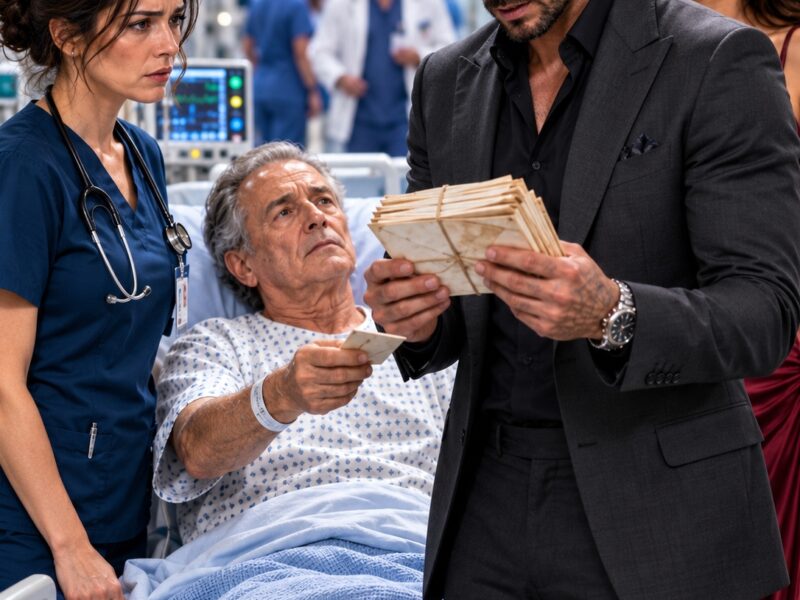
Thomas Calder lay beneath a thin hospital blanket with oxygen beneath his nose and a monitor tracing his heartbeat in green across a screen.
At sixty-nine, Thomas had spent almost thirty years handling legal correspondence, private settlements, family records, and the thousands of quiet documents that kept the Moretti organization functioning.
The public knew Julian as chairman of Moretti Maritime and Development.
Federal regulators knew him as the unusually controlled heir who had spent the last decade dragging an old New York criminal dynasty into legitimate ports, construction, and commercial real estate.
Men who had known Julian’s father used a different description.
They called him the last Moretti who still remembered what the name had once meant.
Thomas remembered too.
He had known Julian since he was twelve.
That was why the fear in the old man’s eyes mattered.
Julian approached the bed.
“You look terrible.”
Thomas managed a weak smile.
“You still lie badly.”
“I’m not lying.”
“Then your bedside manner is worse.”
Julian pulled the visitor chair closer.
“What happened?”
“Heart objected to thirty years of bad decisions.”
“You don’t drink.”
“I worked for your father.”
“Fair.”
Thomas’s smile disappeared.
He reached suddenly for Julian’s wrist.
His grip was surprisingly strong.
“There’s something in my jacket.”
Julian looked at the plastic bag of personal belongings on the chair.
“What?”
“Outer pocket.”
“Thomas—”
“Get it.”
The urgency stopped him.
Julian stood, retrieved the dark wool jacket, and reached inside.
His fingers touched paper.
Not one envelope.
Several.
He pulled them out.
Seven envelopes.
Bound together with an old rubber band.
The corners had softened from being handled repeatedly.
Julian looked at Thomas.
“What is this?”
Thomas closed his eyes.
When he opened them again, guilt had replaced exhaustion.
“I found them six weeks ago.”
“Where?”
“In the archived returns files.”
Julian’s attention dropped to the top envelope.
The return address stopped his breathing.
Emma Reed.
He read it again.
No mistake.
Emma Reed.
Apartment number omitted from the visible return label because her correspondence had always been routed through a secure medical mailbox.
Recipient:
Julian Moretti.
His fingers tightened.
“What returns file?”
Thomas swallowed.
“Personal correspondence exclusions.”
Julian looked up.
“I don’t have personal correspondence exclusions.”
Thomas said nothing.
And Julian remembered.
Not everything.
Just enough for dread to begin.
“Thomas.”
“The first two weren’t returned.”
Julian’s voice flattened.
“What?”
Thomas looked toward the door as if making sure no one else had entered.
“The first two arrived through the private liaison office.”
“Then where were they?”
Thomas’s mouth tightened.
“Accepted.”
Julian felt something cold move along his spine.
“By whom?”
“I don’t know what you were told at the time.”
“That is not what I asked.”
Thomas held his gaze.
“Vanessa handled personal correspondence during that period.”
Julian did not move.
The monitor beside Thomas continued its steady electronic rhythm.
Outside the room, a cart rattled past.
Julian looked down at the envelopes.
Seven.
“What about the other five?”
Thomas’s expression became worse.
“They were returned automatically.”
“Why?”
“A standing exclusion directive.”
Julian already knew.
He simply did not want Thomas to say it.
“Whose?”
Thomas closed his eyes briefly.
“Yours.”
The word landed without drama.
No raised voice.
No shattered glass.
Just fact.
Julian stared at him.
“No.”
“I checked the authorization code three times.”
“When?”
“Eight days after Emma left.”
Memory arrived.
Not cleanly.
Fragments.
Emma appearing unannounced at Moretti headquarters.
Julian in a closed negotiation with two private-equity executives and a union attorney.
His assistant telling him Emma was downstairs.
Julian, angry and wounded and too proud to leave the room, saying:
Tell her to use the proper channel.
The next morning he had instructed operations to route all unannounced personal contact from Emma through formal correspondence until further notice.
He remembered thinking he was establishing boundaries.
Structure.
Control.
He had never thought about the directive again.
Thomas watched comprehension move across Julian’s face.
“The system did exactly what you told it to do.”
Julian’s mouth went dry.
“Open the first one,” Thomas said.
Julian looked at him.
“You need to.”
He removed the rubber band.
The first envelope was dated eight months earlier.
Julian slid a finger under the seal.
The paper inside had been folded twice.
Emma’s handwriting.
Neat.
Controlled.
Almost clinical.
He read the first line.
Then stopped.
Thomas looked away.
Julian read it again.
Julian, I am twelve weeks pregnant.
His vision narrowed.
The rest blurred.
He forced himself to continue.
Emma wrote that the pregnancy was healthy.
That she had confirmed dates with her physician.
That she understood their relationship was over.
That she was not asking for reconciliation.
She was asking for acknowledgment.
A conversation.
A decision about what involvement, if any, he intended to have.
At the bottom:
I would rather hear a difficult answer than build a life around silence.
Julian lowered the page.
He could hear his own breathing.
“Thomas.”
The older man said nothing.
Julian opened the second letter.
Dated one month later.
He read the first paragraph.
Then sat down.
Not gracefully.
His knees simply stopped supporting the performance of control.
The specialist confirmed twins. Both healthy.
Twins.
Julian stared at the word.
Once.
Twice.
It refused to become comprehensible.
Two children.
His.
Emma’s.
Alive somewhere in Chicago.
He had not known.
“How old?”
Thomas’s eyes filled.
“Six months.”
Julian’s head lifted.
“What?”
“The children are six months old.”
Something inside him broke silently.
Across the hospital corridor, Emma was entering medication notes while a resident asked her about a patient in Bay Six.
She did not know Julian had opened the first letter.
She did not know he was reading about children whose diapers she had changed before sunrise that morning.
Children who had begun eating mashed banana two weeks earlier.
Children who had never heard their father’s voice.
She had spent almost a year learning what silence could mean.
At first she thought it meant Julian was thinking.
Then refusing.
Then punishing.
Eventually, she accepted the simplest interpretation.
He had made a choice.
Emma had made hers too.
She stopped asking.
Six months earlier, she had sat in the dark of her apartment with both bassinets beside the couch.
Miles had finally fallen asleep after crying for almost an hour.
Sophie had one fist curled beside her face.
Emma had looked at the seventh letter on the coffee table.
She had mailed it the following morning.
Three days later it came back.
RETURNED UNDER RECIPIENT COMMUNICATION DIRECTIVE.
That was when she stopped writing.
Not because she stopped caring.
Because after seven attempts, continuing had begun to feel less like hope and more like self-humiliation.
Now Julian was twenty yards away.
Reading what she had already survived.
Inside Trauma Bay Three, he opened the third envelope.
Returned.
Fourth.
Returned.
Fifth.
Returned.
Then the sixth.
The envelope felt heavier because something was folded inside.
Julian removed the letter.
A photograph slipped onto his lap.
Two newborn babies wrapped in hospital blankets.
A boy.
A girl.
Julian did not breathe.
Thomas whispered, “That was the birth announcement.”
Julian picked up the photograph with both hands.
The boy had dark hair.
The girl’s mouth was slightly open in sleep.
He did not know which was which until he read Emma’s letter.
Miles Thomas Reed, 5 pounds 3 ounces.
Thomas.
Julian looked at the old man in the hospital bed.
Thomas closed his eyes.
“She named him after me?”
“She always liked you.”
Julian looked back at the page.
Sophie Elena Reed, 4 pounds 15 ounces.
Elena.
His mother’s name.
The room shifted.
Emma had given his daughter the name of a woman she had never met but had once heard Julian speak about in the dark.
He remembered that night.
Emma lying beside him.
Her fingers tracing the old scar near his ribs.
“Tell me something nobody else gets.”
He had told her about Elena.
How she sang badly while cooking.
How she hid cash in books because she didn’t trust banks.
How Julian had been fifteen when she died and thirty-seven before he realized grief could turn into architecture if you built enough walls around it.
Emma had remembered.
Even after leaving him.
Even after the silence.
He stared at the photograph.
“Why didn’t I get this?”
Thomas’s answer came gently.
“You did.”
Julian looked up.
Thomas continued.
“Your system got it.”
The truth was worse phrased that way.
Julian had built a machine around himself.
Assistants.
Filters.
Security.
Protocol.
Layers of people whose primary job was to ensure that inconvenience never reached him without permission.
Emma’s letters had encountered that machine.
The machine obeyed.
Julian stood abruptly.
The chair scraped backward.
Thomas flinched.
Julian pressed one palm against the wall.
Not for support.
For resistance.
Something solid enough to push against.
“Where is Vanessa?”
Thomas’s voice sharpened.
“Julian.”
He turned.
“Where is she?”
“Do not make this easier by making it only about her.”
The sentence stopped him.
Thomas breathed carefully.
“The first two letters are on Vanessa.”
Julian’s jaw clenched.
“The next five are yours.”
Silence.
Thomas continued.
“You gave the order.”
“I didn’t know—”
“No.”
The older man’s voice remained weak.
But firm.
“You did not know what those letters contained.”
Julian stared.
“That is different from saying you did not know you had created a system that could keep her from reaching you.”
Julian looked down at the photograph again.
Two sleeping infants.
His children.
His directive.
His silence.
Outside, Emma moved from Bay Six to Bay Eight.
Julian opened the seventh envelope.
The final letter was shorter.
Julian,
This is the last time I will write.
He stopped.
His throat closed.
He continued.
I have changed delivery channels twice. The last four letters were returned. The first two were never acknowledged. I cannot continue sending information about the children into a structure that responds only with silence.
Miles and Sophie are healthy. They are growing well.
If you ever decide that you genuinely did not know, there is a secure contact number enclosed. It will remain active.
It is not an invitation back into my life.
It is a way to reach the children without forcing your way through me.
I hope someday that distinction matters to you.
At the bottom was a phone number.
Julian stared at it.
Thomas watched him.
“Do you know where she lives?”
“No.”
“Does anyone?”
“Not anyone under your authority.”
Julian looked toward the door.
For the first time in years, the inability to find someone felt less like a challenge and more like a verdict.
He walked into the corridor carrying all seven letters.
Vanessa saw him immediately.
Her face changed.
Not dramatically.
A fraction.
But Julian knew her too well.
She understood.
“Julian.”
He did not answer.
His eyes found Emma at the nurses’ station.
She was speaking to an elderly man’s daughter.
Patient.
Calm.
Completely unaware that the structure of her life had shifted thirty feet away.
Julian looked back at Vanessa.
“Did you receive these?”
She inhaled slowly.
“Julian, this is more complicated than—”
“Did you receive them?”
Two nurses looked over.
His voice had not risen.
That made it worse.
Vanessa lifted her chin.
“The first two.”
Julian stared.
“What did they say?”
“You read them.”
“What did you tell me?”
Vanessa’s mouth tightened.
“That Emma had contacted the office.”
“What did you tell me?”
“That she seemed to be adjusting.”
He closed his eyes.
One second.
No more.
“You left out the pregnancy.”
Vanessa looked toward the corridor.
“She had left you.”
“She was carrying my children.”
“She walked away from the relationship.”
“That is not the same thing.”
Vanessa’s composure cracked slightly.
“She chose to leave because she couldn’t tolerate the reality of your life.”
Julian stepped closer.
“And you decided that gave you authority over information about my children?”
“I was protecting you.”
“From what?”
“From going backward.”
He stared.
Vanessa’s voice sharpened.
“You were destroyed after she left.”
“No.”
“You stopped sleeping.”
“That was my problem.”
“You barely ate.”
“My problem.”
“You almost killed the Port Mercer merger because you couldn’t focus.”
“Still my problem.”
Vanessa’s eyes flashed.
“I helped you rebuild.”
Julian’s expression turned very still.
“You built something for yourself inside the vacancy.”
She flinched.
“That’s cruel.”
“It’s accurate.”
Vanessa looked down at the letters.
“You think she wanted nothing?”
“I don’t know what she wanted.”
“She wanted you back.”
Julian lifted the first letter.
“No.”
He held it between them.
“She explicitly wrote that she was not asking for reconciliation.”
Vanessa looked away.
Julian understood.
“You read it.”
“Yes.”
“All of it.”
“Yes.”
“And the second?”
“Yes.”
His jaw moved once.
“She told you there were twins.”
Vanessa’s eyes filled.
“Yes.”
The answer struck differently.
Twins.
Not an abstract pregnancy.
Two children.
Names unknown then.
Faces unknown.
But real.
“And you laughed?”
Vanessa looked at him sharply.
“What?”
Julian remembered Emma’s expression the night their relationship ended.
A charity gala.
Vanessa leaning close.
Emma standing ten feet away.
A laugh passing between Vanessa and another woman.
At the time Julian assumed the humiliation was about another rumor.
Now the title of his memory changed.
“Emma saw you at the gala.”
Vanessa went pale.
“She thought we were already together.”
“We weren’t.”
“Were we not?”
Julian’s voice cooled.
“Do not rewrite timelines now.”
Vanessa looked away.
Julian understood more.
“You wanted her to believe it.”
Silence.
“Why?”
Vanessa’s face hardened.
“Because she was always going to leave.”
“You don’t know that.”
“She hated your security.”
“She challenged it.”
“She hated the company.”
“She hated the criminal residue around it.”
“She hated the way you controlled everything.”
That one landed.
Vanessa saw.
“She was never built for this world.”
Julian looked toward Emma.
“No.”
His voice softened.
“She wasn’t.”
Vanessa mistook that for agreement.
Then he continued.
“That didn’t give you the right to decide whether my children belonged in it.”
Vanessa’s eyes filled.
“And what happens now?”
“I don’t know.”
“To us?”
Julian looked at her.
Something almost sad entered his face.
“There is no us after this.”
She swallowed.
“You’re leaving me for her.”
“No.”
That answer stunned her.
Julian looked down at the letters.
“I am ending this because you withheld my children from me.”
Vanessa stared.
“She may never take you back.”
“I know.”
“You may never have her again.”
“I know.”
“Then what are you doing?”
For the first time, Julian looked genuinely tired.
“Facing what I did.”
Vanessa almost laughed.
“What you did?”
He looked at her.
“You intercepted two.”
He tapped the remaining envelopes.
“I blocked five.”
Silence.
“The difference matters.”
Vanessa’s mouth opened.
Then closed.
Julian walked away.
He did not go to Emma.
Not yet.
That was the first correct decision he made that night.
At 12:07 a.m., Emma’s secure phone vibrated inside the pocket of her scrub jacket.
She was charting medication.
She ignored it until she reached the supply room.
The message came from Thomas Calder’s personal secure account.
Only one sentence.
He knows. He read all seven. I did not give him your address.
Emma stared at the screen.
Her heartbeat remained surprisingly steady.
She placed the phone face down on a shelf.
Then stood very still.
She had imagined this moment months earlier.
Julian finally understanding.
Julian furious.
Julian apologizing.
Julian showing up at her door with the force of his entire world behind him.
Back then, she thought discovery would feel like justice.
It did not.
It felt dangerous.
Not because she believed Julian would hurt her.
Because Julian had never learned how to want something without moving toward it until distance surrendered.
Her children could not become another acquisition.
Emma picked up the phone.
She typed:
Tell him the contact channel remains open.
Then another line.
He is not authorized to trace it.
She hesitated.
Then:
If anyone searches for my residence, the channel closes permanently.
She sent it.
Thomas read the message to Julian ten minutes later.
Julian was sitting alone inside a private consultation room.
Seven letters spread across the table.
The newborn photograph beside his left hand.
Thomas’s voice came through the phone.
“She says the secure channel remains open.”
Julian closed his eyes.
“She also says you are not permitted to trace her location.”
He opened them.
“And if anyone searches?”
“She closes the channel permanently.”
Julian looked at the photograph.
Every instinct inherited from his father told him this was absurd.
He had resources.
Private investigators.
Traffic cameras.
Property databases.
Police contacts who owed the Moretti family favors dating back decades.
Finding Emma would take hours.
Maybe less.
He could know where Miles slept.
Where Sophie slept.
Whether there were locks strong enough on the doors.
Whether Emma’s neighborhood was safe.
Whether another man entered the apartment.
The thought arrived.
He hated himself for it.
Thomas waited.
Julian said quietly, “No search.”
Thomas did not answer immediately.
“Julian.”
“No search.”
“You understand what that means?”
“Yes.”
“Say it.”
Julian stared at the seven envelopes.
“It means I do not get to turn finding out I have children into another reason to control their mother.”
Thomas exhaled.
“Good.”
Julian’s voice sharpened slightly.
“Don’t sound surprised.”
“I’m recovering from cardiac failure. Let me have small pleasures.”
Despite everything, Julian almost laughed.
It died quickly.
“What do I do?”
Thomas was silent for a moment.
Then:
“You wait until she tells you.”
Julian looked toward the wall.
Waiting had never been one of his skills.
That was precisely why he needed to learn it.
The first formal contact happened four days later.
Not in person.
Emma chose a neutral encrypted video platform.
No geolocation.
No recording.
No children present.
Five participants.
Emma.
Julian.
Vanessa.
Thomas.
And Owen Mercer, Moretti residential security director.
Julian entered the conference room alone.
He had dismissed his attorneys after Emma’s terms explicitly prohibited counsel.
Not because she feared lawyers.
Because she did not want anyone translating accountability into defensible language.
The screen activated at exactly 6:00 p.m.
Emma appeared.
Gray sweater.
Hair loose.
No makeup.
She looked tired.
Not fragile.
That distinction mattered.
Julian had forgotten how much her face changed when she was not bracing herself around him.
Vanessa appeared in a separate frame from an apartment Julian no longer recognized.
Thomas joined from home.
Owen sat across the table physically with Julian because the security directives required technical confirmation.
Emma looked directly into the camera.
“I’m not here to discuss our relationship.”
Julian nodded.
She continued.
“I’m here because seven letters were sent regarding two children and none were acknowledged.”
Her voice remained calm.
“I want each letter addressed in order.”
Vanessa shifted.
Emma noticed.
“No interruptions.”
Vanessa’s mouth tightened.
“No minimization.”
Emma looked at Julian.
“No threats.”
He held her gaze.
“Agreed.”
“If anyone attempts to redirect responsibility, I end the call.”
“Agreed.”
Emma looked toward Thomas.
“First letter.”
Thomas opened the scanned file.
“Sent when Emma was twelve weeks pregnant. Notification. Request for acknowledgment.”
Emma looked at Vanessa.
“Did you receive it?”
Vanessa’s face remained controlled.
“Yes.”
“What did you do?”
“I categorized it as private correspondence.”
“And?”
Vanessa hesitated.
Emma waited.
“I told Julian you had contacted the office.”
“What did you tell him the letter said?”
“That you were adjusting.”
Julian closed his eyes briefly.
Emma did not look at him.
“You omitted the pregnancy.”
“Yes.”
“Why?”
Vanessa’s chin lifted.
“Because I believed if he knew, he would go back to you.”
Emma’s expression did not change.
“Second letter.”
Thomas opened it.
“Sixteen weeks. Twin pregnancy confirmed.”
Emma’s eyes remained on Vanessa.
“Did you receive it?”
“Yes.”
“Did you tell Julian?”
“No.”
“Why?”
“The same reason.”
Emma nodded.
No anger.
No triumph.
Just record.
“Letters three through seven.”
Thomas looked toward Owen.
Owen read the system history.
“All returned under standing personal exclusion directive.”
Emma looked at Julian.
He spoke before she asked.
“Mine.”
Silence.
“My instruction.”
Emma waited.
Julian continued.
“I issued it after you came to headquarters without an appointment.”
Her face changed slightly.
He remembered that day.
She had stood downstairs for forty minutes.
He had been angry because she had left their relationship.
He had wanted her to feel boundaries.
He had mistaken humiliation for structure.
“I told staff to route all direct contact from you through approved channels.”
He swallowed.
“The instruction remained active.”
“Why?”
“Because I forgot it existed.”
Emma held his gaze.
“That sounds small when you say it.”
Julian did not defend himself.
“Yes.”
Her eyes narrowed.
“You had a system capable of silencing someone indefinitely.”
“Yes.”
“And no review date.”
“No.”
“No escalation condition.”
“No.”
“No person responsible for determining whether the content was urgent.”
“No.”
Emma looked toward Owen.
“Is that normal?”
Owen answered carefully.
“It was normal in that structure.”
“Not what I asked.”
Owen looked at Julian.
Then back.
“No.”
Emma nodded.
“Thank you.”
She returned to Julian.
“You understand why ‘I forgot’ is not a defense.”
“Yes.”
“Explain.”
The old Julian would have hated the instruction.
Explain.
As though he were an employee in a disciplinary meeting.
Perhaps that was exactly why Emma chose it.
He answered.
“Because I created the order deliberately.”
She waited.
“I benefited from not having to deal with the consequences of it.”
Silence.
“And I built the system so nobody below me had authority to question it.”
Emma’s expression changed.
Not softened.
Registered.
“That is closer.”
Julian continued.
“The staff returned those letters because they obeyed me.”
“Yes.”
“They are not responsible.”
“Correct.”
“I am.”
Vanessa looked toward him.
Emma noticed.
“Letter four.”
Thomas opened it.
Thirty-two weeks.
Emergency contact.
Emma had written that if complications occurred during delivery, Julian should be informed regardless of their personal situation.
Returned.
Julian read the scan now.
He had already memorized the wording.
Still, his throat tightened.
Letter five.
Hospital admission notice.
Returned.
Letter six.
Birth announcement.
Photo enclosed.
Returned.
Letter seven.
Final notice.
Returned.
When Thomas finished, Emma sat in silence for several seconds.
Then she looked at Vanessa.
“I do not require an apology tonight.”
Vanessa’s eyebrows rose.
Emma continued.
“I require you to state clearly that you understood the first two letters contained information about Julian’s children and withheld that information intentionally.”
Vanessa looked away.
Nobody spoke.
Emma waited.
Julian did not intervene.
Finally Vanessa said:
“I understood.”
Emma’s voice stayed calm.
“And?”
“I withheld them intentionally.”
Emma nodded once.
“That is the record.”
Then she looked at Julian.
“Letters three through seven.”
Julian’s chest tightened.
“My directive.”
“Whose signature?”
“Mine.”
“Whose failure to revoke it?”
“Mine.”
“Whose staff followed it?”
“Mine.”
Emma nodded.
“That is the record.”
Thomas removed his glasses.
Owen stared at the table.
Vanessa’s eyes were wet.
Julian felt strangely empty.
Not absolved.
Something closer to correctly placed.
Emma looked at Owen.
“The personnel who physically returned letters three through seven.”
“Yes?”
“They are not to be disciplined.”
Julian answered before Owen could.
“They won’t be.”
Emma looked at him.
“They followed a written instruction.”
“I know.”
“I don’t want you punishing the bottom of the chain because accountability is uncomfortable at the top.”
Julian’s jaw tightened.
Not in anger.
Recognition.
“Agreed.”
Silence settled.
Then Julian spoke.
“Can I ask something unrelated to the letters?”
Emma looked at him for a long time.
“One question.”
His heartbeat changed.
“Are they healthy?”
The words came out quieter than he intended.
Emma’s face finally softened.
Barely.
“Yes.”
Julian nodded.
Nothing else.
No names.
He already knew them.
No photographs.
He had one.
No address.
No demand to see them.
He did not deserve a second question.
Emma noticed that he stopped.
Something passed through her expression.
Then vanished.
She opened a written document.
“Conditions.”
Julian straightened.
“The standing exclusion directive is revoked tonight.”
“Yes.”
“On record.”
“Yes.”
“Witnessed.”
“Yes.”
Owen opened the administrative terminal.
Emma continued.
“No future correspondence from me passes through a romantic partner, personal assistant, family member, or household intermediary.”
“Agreed.”
“One authenticated channel.”
“Agreed.”
“You receiving information about the twins does not authorize you to locate us.”
Julian’s instinct tightened.
He forced it down.
“Agreed.”
“No active searches.”
“Agreed.”
“No surveillance.”
“Agreed.”
“No security near our residence unless I request it.”
That one hurt.
He pictured the children in an apartment without his people nearby.
“Julian.”
He looked at the screen.
Emma had seen the hesitation.
He answered.
“Agreed.”
Owen placed his thumb on the biometric reader.
Julian followed.
The screen displayed:
PERSONAL COMMUNICATION EXCLUSION — REVOKED.
Emma stared at the confirmation.
Then at Julian.
“I’ll keep the channel open.”
He nodded.
“Thank you.”
She ended the call.
Julian remained sitting after the screen went black.
Owen closed the terminal.
Thomas signed off.
Vanessa’s window vanished.
Only Julian remained.
Two children existed somewhere in Chicago.
And for the first time in his adult life, the correct response to wanting something desperately was to do nothing until invited.
He hated it.
Which was exactly how he knew he needed it.
Nine days passed.
Julian did not search.
On the first day, he instructed internal intelligence in writing that no database request involving Emma Reed, Miles Reed, Sophie Reed, or known relatives was authorized without Emma’s explicit consent.
On the second, he discovered three legacy tracking protocols could have located her automatically.
He shut them off.
On the third, Marcus Moretti—his cousin and head of executive security—asked whether Julian was certain.
“No.”
Marcus frowned.
“That usually means you want more security.”
“It means certainty is no longer the standard.”
Marcus stared.
“That sounds unpleasant.”
“It is.”
On the fourth day, Julian received no message.
Fifth.
Nothing.
Sixth.
Nothing.
He began to understand the shape of what Emma had endured.
Not fully.
He would never claim that.
But silence changed when you were the one without power over it.
On the ninth evening, his phone rang through the authenticated channel.
Julian stared at the screen.
His heartbeat accelerated.
He answered.
“Hello?”
Emma’s voice.
“Hi.”
No video.
Just sound.
Julian sat slowly.
“Hi.”
A small noise came through the phone.
Then another.
He stopped breathing.
“What was that?”
Emma laughed softly.
“Miles.”
Julian closed his eyes.
“What did he do?”
“He rolled over in his sleep.”
“Is that bad?”
“No.”
“Then why does he sound offended?”
Emma went quiet.
Then he heard it.
A laugh.
Hers.
The sound struck Julian harder than expected.
“He gets angry when rolling wakes him,” Emma explained. “Like gravity has personally betrayed him.”
Julian smiled.
“That seems reasonable.”
“It absolutely does not.”
Another sound.
Higher.
A squeal.
Julian sat straighter.
“Sophie?”
“Yes.”
“What is she doing?”
“Discovering that she can scream at a frequency only dogs should hear.”
Julian laughed.
The sound surprised him.
Emma became quiet.
So did he.
Not awkward.
Just new.
Julian asked, “What does Miles look like when he wakes himself?”
Emma answered slowly.
“Completely betrayed.”
He smiled.
“Dark hair?”
“Yes.”
“Still?”
“Yes.”
“Eyes?”
“Brown.”
“Yours?”
“Mostly.”
He swallowed.
“And Sophie?”
“You only get one child interrogation per call.”
He stopped.
“Right.”
Emma heard the correction.
He heard her hear it.
After a moment she said, “Her eyes are dark too.”
“Thank you.”
Another pause.
Then:
“I’m considering letting you meet them.”
Julian went still.
Emma continued immediately.
“I said considering.”
“Yes.”
“On my terms.”
“Yes.”
“Not at your house.”
“Yes.”
“Not at your office.”
“Yes.”
“No security inside the meeting space.”
Julian clenched his jaw.
“Yes.”
“You don’t even know where.”
“I know.”
Emma stayed quiet.
“You’re not going to argue?”
“I want to.”
That surprised a laugh from her.
He continued.
“But I’m not going to.”
“Why?”
Julian looked out across Manhattan.
“Because wanting something doesn’t make my fear more important than your conditions.”
Emma said nothing for several seconds.
Then:
“I’ll send a date.”
The call ended.
Julian remained seated with the phone in his hand.
Marcus entered ten minutes later.
“You look ill.”
“I’m meeting my children.”
Marcus stopped.
“When?”
“I don’t know.”
“Where?”
“I don’t know.”
Marcus stared.
“You’re accepting this surprisingly well.”
Julian looked at him.
“I have screamed internally for nine days.”
“That sounds healthier than your usual method.”
“Leave.”
Marcus smiled and did.
The location arrived one hour before the meeting.
A public pavilion inside a North Side park.
Concrete benches.
Trees.
A playground two hundred feet away.
Parents pushing strollers.
Dogs dragging humans in several directions.
Neutral ground.
Julian understood immediately why Emma chose it.
There was nothing here that belonged to him.
No staff.
No controlled entrances.
No private cameras.
No history.
His security remained two blocks away.
Julian walked alone.
Emma was already there.
He saw her first.
Then he saw the child on her hip.
His entire body stopped.
Miles.
Six months old.
Dark hair.
Serious eyes.
One tiny fist gripping Emma’s sweater.
Julian had spent eleven days looking at the hospital photograph from the sixth letter.
That baby had been red-faced and wrapped tightly in a blanket.
This child was awake.
Watching him.
Real.
Emma saw Julian stop.
She said nothing.
Julian forced his legs forward.
A baby carrier was strapped across Emma’s chest.
Sophie slept inside.
Julian stopped several feet away.
“Hi.”
Emma almost smiled.
“Hi.”
His eyes returned to Miles.
The boy stared.
Julian cleared his throat.
“Hi.”
Emma looked at Miles.
“He’s not much for greetings.”
“That makes two of us.”
She actually smiled.
Small.
Then:
“You can come closer.”
Julian moved.
Slowly.
He crouched so that his face was level with Miles.
The baby studied him.
Julian had sat across from federal prosecutors without blinking.
He had negotiated with men whose threats came disguised as jokes.
He had watched his father die.
None of that had prepared him to be evaluated by a six-month-old.
Miles leaned forward.
Julian held still.
The small hand reached out.
Grabbed the lapel of Julian’s coat.
Hard.
Julian inhaled sharply.
Emma said, “He does that.”
Julian looked up.
“To everyone?”
“To things he thinks matter.”
Silence.
Emma looked away first.
Julian’s eyes burned.
He turned toward the carrier.
Sophie had awakened.
She stared at him with extraordinary seriousness.
Julian whispered, “This one is judging me.”
Emma’s mouth twitched.
“She has standards.”
He moved slightly closer.
“Hi, Sophie.”
The baby watched.
Julian did not touch her.
After several seconds, Sophie moved one hand from beneath the blanket.
Her fingers found his knuckles.
Julian stopped breathing.
Emma watched his face.
He did not hide what happened there.
Couldn’t.
Something inside him simply gave up pretending.
His eyes filled.
He looked down.
Sophie’s fingers remained on his hand.
Emma quietly said, “You okay?”
Julian laughed once through a breath.
“No.”
That answer softened something in her.
They sat on the pavilion bench for forty-five minutes.
No dramatic declarations.
No promises that made history disappear.
Miles dropped a rubber ring.
Julian picked it up.
Miles dropped it again.
Julian retrieved it again.
Third time.
Emma said, “He’ll do that indefinitely.”
Julian handed the ring back.
“So will I.”
Miles dropped it.
Julian picked it up.
Emma watched.
At 11:43, she stood.
The meeting was over.
Julian felt panic immediately.
He did not obey it.
Emma adjusted Sophie.
Julian rose.
He almost asked for another hour.
Didn’t.
Almost asked when the next meeting would be.
Didn’t.
Almost asked where they were going.
Didn’t.
Emma held Miles toward herself.
Julian let go.
His hands felt empty.
“When can I see them again?”
The question escaped before he could stop it.
Emma looked at him.
“I don’t know yet.”
Julian’s jaw tightened.
Then relaxed.
“Okay.”
Emma bent to retrieve the diaper bag.
Julian picked it up first.
He handed it to her.
She took it.
“Thank you.”
He stepped backward.
“Goodbye, Miles.”
The boy stared.
“Goodbye, Sophie.”
The girl yawned.
Julian almost laughed.
Then he looked at Emma.
“Thank you.”
She nodded.
He turned.
“Julian.”
He stopped.
Looked back.
Emma stared.
“You’re leaving.”
He frowned.
“You told me to.”
A long silence.
Then she nodded.
“Yes.”
Julian walked away.
He did not look back.
Two blocks east, Marcus sat in the driver’s seat of the security sedan.
Julian entered the rear.
Marcus looked at him through the mirror.
“Well?”
Julian stared out the window.
He could still feel Sophie’s fingers on his hand.
“My son thinks gravity is a personal attack.”
Marcus waited.
“My daughter distrusts me.”
“That seems sensible.”
Julian almost smiled.
The car did not move.
Marcus waited.
Eventually:
“You want me to follow them?”
Julian looked at him.
The old answer existed.
Of course he did.
He wanted the address.
The building.
Fire exits.
Neighborhood crime statistics.
Pediatrician.
Daycare possibilities.
He wanted every unknown converted into information.
Then he remembered Emma saying:
Being informed does not give you ownership.
“No.”
Marcus nodded.
The car pulled away.
Julian looked through the rear glass.
He could no longer see the pavilion.
For the first time in his life, something he loved existed completely outside his reach.
And the only way closer was to stop trying to close the distance by force.
Vanessa requested one final meeting three weeks later.
Julian agreed.
Public restaurant.
Daytime.
No intimacy implied.
She arrived wearing cream wool and the same gold earrings she had worn the night at St. Vincent.
Julian noticed because he had once been good at noticing objects around women while ignoring what women themselves were trying to tell him.
Vanessa sat.
“You look different.”
“I’m sleeping less.”
“That’s not what I mean.”
Julian poured water.
“What do you want?”
Her face tightened.
“You’ve become efficient about cruelty.”
“I learned from the best.”
She flinched.
Julian regretted it immediately.
Not because it was untrue.
Because it was unnecessary.
He exhaled.
“That was cheap.”
Vanessa looked surprised.
“I’m sorry.”
She stared.
“Emma did this.”
“No.”
“She changed you.”
“No.”
Julian leaned back.
“She forced me to look at things I preferred not to see.”
“That is changing you.”
“The choice afterward is mine.”
Vanessa looked away.
“Are you with her?”
“No.”
“You expect me to believe that?”
“We are not together.”
“But you see her.”
“When she allows contact regarding the children.”
“Do you love her?”
Julian did not answer immediately.
Vanessa smiled sadly.
“There.”
He looked at her.
“Yes.”
She swallowed.
“Did you love me?”
Julian thought.
He owed her accuracy.
“I cared about you.”
Her expression hardened.
“That isn’t the same.”
“No.”
“Did you know that while we were together?”
“Not fully.”
“And now?”
“Yes.”
Vanessa laughed quietly.
“So I really was a vacancy.”
Julian looked down.
“That was unfair to say.”
“It was accurate.”
He said nothing.
Vanessa continued.
“I did love you.”
Julian looked up.
“I know.”
“I hated her because she could make you uncertain.”
Silence.
“You were never uncertain with me.”
Her eyes filled.
“I thought that meant I fit your life better.”
Julian understood the cruelty inside that logic because parts of it were true.
Vanessa had fit.
She moved through his world without resistance.
Accepted the security.
The hierarchy.
The unspoken rules.
Never asked why Julian needed control.
Emma had asked constantly.
“Why did you hide the letters?” he asked.
Vanessa looked down.
“Because I knew.”
“Knew what?”
“If you learned she was carrying your child, whatever existed between us would end.”
Julian’s voice stayed quiet.
“So you chose for me.”
“Yes.”
“And for her.”
“Yes.”
“And for Miles and Sophie.”
Vanessa’s eyes closed.
“Yes.”
For once, there was no defense.
Julian let the silence remain.
After a while she said, “Do they look like you?”
His face changed before he could stop it.
Vanessa smiled weakly.
“That much?”
“My son grabbed my jacket.”
Her eyes filled.
“And your daughter?”
“She touched my hand.”
Vanessa looked away.
“I’m sorry.”
Julian waited.
She continued.
“Not because I got caught.”
That mattered.
“I’m sorry because I convinced myself Emma leaving you meant I could erase information that belonged to all of you.”
Julian nodded.
“Thank you.”
“You forgive me?”
“No.”
Vanessa looked at him.
He continued.
“But I believe you’re sorry.”
She absorbed that.
Then stood.
At the table’s edge she paused.
“I hope they let you become their father.”
Julian looked at her.
“So do I.”
Vanessa left.
He did not watch her go.
The next six months were built from small permissions.
A photograph.
Then another.
A phone call every Sunday.
A second park meeting.
Then a pediatric appointment Emma allowed Julian to attend.
He sat in the waiting room beside mothers with diaper bags and toddlers throwing crackers onto the carpet.
Nobody cared who Julian Moretti was.
The pediatrician cared whether he knew when Miles last had a fever.
He didn’t.
Emma did.
That humbled him.
He learned.
Sophie disliked peas.
Miles liked ceiling fans.
Both children calmed when Emma sang badly.
Sophie slept with one sock off.
Miles refused to sleep unless something touched the left side of his face.
Julian began keeping notes.
Emma discovered the notebook one afternoon.
“You take minutes on our children?”
“I forget things.”
“You remember shipping manifests from 2009.”
“Those are less important.”
She stared at him.
Then looked away because she was smiling.
At nine months, Miles developed a respiratory infection.
Emma called Julian at 2:11 a.m.
Not because she needed permission.
Because she needed another adult.
“His breathing sounds wrong.”
Julian was already standing.
“Hospital?”
“I’m taking him.”
“Which—”
He stopped.
Emma heard it.
She gave the hospital name.
Julian arrived twenty-two minutes later.
Alone.
No security entourage.
No physician dragged from another city.
He sat beside Emma while Miles received treatment.
Sophie slept against his chest for the first time.
At 4:30 a.m., Emma looked over.
Julian had fallen asleep sitting upright.
Sophie’s small head rested beneath his chin.
One of his hands supported her back even in sleep.
Emma looked away quickly.
Trust was dangerous because sometimes it returned quietly before you had agreed to it.
Miles recovered.
Julian did not use the emergency to ask for more access.
That mattered more than flowers would have.
At ten months, Emma allowed him to take the twins for three hours without her.
Julian panicked.
He hid it badly.
“You said three hours.”
“Yes.”
“Without you.”
“Yes.”
“What if—”
“They are babies, Julian.”
“That is precisely the problem.”
Emma handed him a diaper bag.
“Everything you need is in here.”
He looked inside.
“There are six bottles.”
“Yes.”
“For three hours.”
“Planning ahead.”
“Diapers?”
“Twelve.”
“Why twelve?”
“Because you’re you.”
He looked offended.
Emma smiled.
“You’ll be fine.”
“What if I’m not?”
Her expression softened.
“Call me.”
Julian looked at her.
There it was.
Something simple.
Not control.
Access.
He nodded.
“I will.”
The three hours became the most exhausting experience of his adult life.
Miles cried because Sophie had a toy he wanted.
Sophie cried when he gave it to Miles.
Julian attempted lunch.
Banana reached his sleeve.
Mashed carrots reached a wall.
At one point both children cried simultaneously while Julian stood in the center of his penthouse holding one and staring at the other as though confronted with a hostile merger.
Marcus entered.
Saw the scene.
Slowly turned around.
“Do not leave.”
Marcus stopped.
“I thought you didn’t want help.”
“I have revised my position.”
Marcus laughed for five straight minutes.
Julian threatened to fire him.
Neither child cared.
When Emma returned, the living room looked damaged.
Julian stood barefoot with Sophie asleep against his shoulder and Miles chewing the end of his tie.
Emma stopped in the doorway.
“What happened?”
Julian looked at her.
“Parenthood is structurally unsound.”
She laughed so hard she had to lean against the door.
He watched her.
Something inside him hurt in a way he no longer wanted to fix.
The first real argument came when Julian installed security cameras outside Emma’s building without asking.
She discovered them immediately.
Of course she did.
She arrived at his office carrying two printed photographs.
Julian looked up.
Then at the photographs.
His stomach dropped.
“Emma.”
“No.”
She closed the door.
“I told you.”
“They’re exterior.”
“I told you.”
“There was a car following you Tuesday.”
“You could have told me.”
“I was confirming—”
“You could have told me.”
Julian stopped.
Emma’s anger was not loud.
That made it worse.
“You promised no surveillance at my residence.”
“They don’t face your windows.”
“That is not the point.”
“I was worried about the children.”
“So was I.”
He stood.
“Then why is security unreasonable?”
“Because I am their parent too.”
Julian froze.
Emma stepped closer.
“You keep doing this.”
“What?”
“You panic.”
Her voice shook.
“Then your panic becomes permission.”
The words landed.
He remembered Ethan.
Fear as permission.
He sat back down.
Emma watched.
Julian took his phone.
Called security.
“Remove the cameras.”
She stared.
He continued.
“Immediately.”
He hung up.
Emma’s anger did not vanish.
Good.
It shouldn’t.
“I’m sorry.”
She folded her arms.
“No explanation?”
Julian almost gave one.
The suspicious car.
Threat modeling.
His father.
His childhood.
Instead:
“I broke the agreement.”
Emma waited.
“I told myself fear made it reasonable.”
Silence.
“It didn’t.”
Something in her shoulders eased.
Not forgiveness.
Recognition.
Julian continued.
“If something frightens me regarding you or the children, I tell you first.”
“Yes.”
“And if immediate danger exists?”
“Immediate means immediate.”
“Define.”
“Somebody at the door with a gun.”
“That’s extremely specific.”
“Julian.”
“Fine.”
She almost smiled.
Then turned toward the door.
“Emma.”
She stopped.
He looked at her.
“Thank you for coming here instead of disappearing.”
Her expression changed.
“I don’t disappear.”
“I know.”
She looked at him for several seconds.
“Neither do letters.”
The sentence hurt.
It was supposed to.
She left.
Julian sat alone.
Then he wrote the sentence in the notebook beside Miles’s feeding schedule.
Neither do letters.
The twins turned one in October.
Emma held the birthday party in her sister’s backyard.
Twenty people.
Paper decorations.
A grocery-store cake.
Julian was invited.
Not his security.
Marcus complained.
Julian told him to survive.
Miles smashed cake into his own hair.
Sophie carefully ate icing one finger at a time like a scientist conducting controlled testing.
Julian sat on the grass in trousers that cost more than the folding table.
Emma watched him wipe frosting from Miles’s ear.
Her sister leaned closer.
“You love him.”
Emma did not look away.
“That is not the relevant question.”
“Which is?”
“Whether loving him is safe for me.”
Her sister considered.
“Is it?”
Emma watched Julian.
Miles shoved a fistful of cake against his shirt.
Julian closed his eyes.
Sophie laughed.
Julian laughed too.
“I don’t know yet.”
That evening, after everyone left, Julian stayed to help clean.
Emma handed him garbage bags.
He looked offended.
“You run shipping ports.”
“Yes.”
“You can operate a garbage bag.”
“Debatable.”
They worked silently.
At the end, Julian stood near the back gate.
“I have something for them.”
Emma stiffened slightly.
He noticed.
“Not property.”
“That is reassuring.”
“Not money.”
“Better.”
He handed her two envelopes.
Emma stared.
The irony did not escape either of them.
“What?”
“Open them.”
Inside were letters.
One addressed to Miles.
One to Sophie.
Emma looked at him.
“They’re for when they’re older.”
“What do they say?”
“The truth.”
Her expression sharpened.
“How much?”
“That I did not know about them.”
She waited.
“That you tried seven times.”
Her eyes changed.
“That two letters were intentionally withheld.”
Julian continued.
“That five were returned because of my directive.”
Emma said nothing.
“That I was not absent because you kept them from me.”
Her throat tightened.
“And?”
“That if they are angry someday, they should be accurate about who failed them.”
Emma looked down at the letters.
“You wrote that?”
“Yes.”
“Why?”
Julian’s voice softened.
“Because someday they may ask you to explain me.”
He swallowed.
“You should not have to protect my image while telling the truth.”
Emma stared at him.
The man she had left would never have understood that sentence.
This one did.
She placed the letters carefully inside the house.
When she returned, Julian was still by the gate.
“Thank you.”
He nodded.
Then turned.
“Julian.”
He looked back.
“Coffee?”
He froze.
Emma almost laughed.
“Coffee.”
“Now?”
“Yes.”
“With you?”
She narrowed her eyes.
“No, with Marcus.”
Julian smiled.
“Yes.”
“Don’t make it dramatic.”
“I am not.”
“You look dramatic.”
“That is my face.”
Emma laughed.
The sound followed them into the kitchen.
Coffee became dinner three weeks later.
Dinner became a walk.
The walk ended outside Emma’s apartment.
Julian stopped at the bottom of the steps.
She looked at him.
“You can come up.”
His entire expression changed.
Emma noticed.
“It’s tea, Julian.”
“I understand.”
“You look like I proposed.”
“I’m managing expectations.”
“Poorly.”
He followed her upstairs.
For the first time, Julian entered the apartment where his children had spent their first year.
He stopped inside the doorway.
Small.
Warm.
Toys in baskets.
A faded rug.
Two high chairs.
Photographs everywhere.
Birth.
First smiles.
Baths.
Snow.
Miles asleep across Emma’s chest.
Sophie wearing a hat too large for her head.
Julian stared.
Emma watched.
“You missed things.”
His throat tightened.
“Yes.”
She did not apologize.
Good.
He did not want her to.
Julian looked at a photograph taken in the hospital.
Emma pale.
Exhausted.
Two newborn babies against her chest.
No one beside her.
His chest hurt.
“I should have been there.”
Emma stood beside him.
“Yes.”
The word was simple.
No cruelty.
No comfort.
Julian nodded.
“I know.”
Tea went cold while they talked.
Not about reunion.
About the past.
Emma explained why she left.
“You didn’t cheat.”
“I know.”
“But you let Vanessa behave like she had access to parts of you I had to request.”
Julian listened.
“You made me feel unreasonable for asking where I stood.”
“I remember.”
“You answered every emotional question like it was a contract dispute.”
“That sounds accurate.”
Emma almost smiled.
“I didn’t leave because I stopped loving you.”
Julian became still.
“I left because loving you was making me smaller.”
He looked down.
“That is worse.”
“It was.”
“What would you have needed?”
Emma thought.
“For you to understand that protection without partnership is control.”
Julian looked toward the twins’ bedroom.
“I’m learning.”
“Yes.”
“Is it enough?”
Emma held his gaze.
“I don’t know.”
He nodded.
No argument.
That was part of the answer.
At eighteen months, Miles said “Dad.”
Not “Daddy.”
Dad.
Julian was reading a picture book badly.
Emma sat across the room sorting laundry.
Miles looked at Julian.
“Dad.”
Julian stopped.
Emma looked up.
Miles pointed at the book.
“Dad.”
Julian’s eyes filled instantly.
Emma laughed softly.
“He probably means duck.”
Julian looked offended.
“That was clear.”
“Miles, say duck.”
“Dad.”
Julian looked triumphant.
Emma rolled her eyes.
Sophie, unwilling to be ignored, shouted:
“Mine!”
Everyone laughed.
That night Julian drove home alone.
He cried in the car.
Nobody saw.
He was grateful for that.
Vanessa disappeared from their lives without drama.
No revenge.
No final sabotage.
She sold her apartment and moved to Boston.
Months later Emma received a letter.
She nearly threw it away.
Then opened it.
Vanessa did not ask forgiveness.
She wrote that she had begun therapy.
That for years she had mistaken being useful to powerful men for being loved by them.
That none of that excused what she did.
At the bottom:
I took your right to receive an answer because I was afraid of what his answer would mean for me. I’m sorry.
Emma folded the letter.
She did not respond.
Some apologies deserved acknowledgment internally without reopening doors externally.
Julian never asked what the letter said.
That mattered too.
When the twins were two, Julian proposed.
Poorly.
Naturally.
He did it in Emma’s kitchen while Miles was throwing cereal and Sophie was refusing socks.
Julian stood holding a ring box.
Emma stared.
“No.”
He froze.
She laughed.
“Not no to you.”
His shoulders lowered half an inch.
“No to this.”
“This?”
“Ambush proposal during breakfast.”
“I thought ordinary was good.”
“Ordinary is good.”
She pointed toward the children.
“Miles has oatmeal in his hair.”
“He often does.”
“Sophie is naked from the waist down.”
“She removed her pants.”
“I know.”
Julian stared at the ring.
“What do you want?”
Emma softened.
“Ask me when the answer isn’t competing with spilled milk.”
He nodded.
Closed the box.
Sophie shouted, “Ring!”
Julian hid it.
“No.”
Emma laughed.
Two weeks later he tried again.
No restaurant.
No helicopter.
No private rooftop.
They walked through the same park where he first met the twins.
Miles and Sophie were with Emma’s sister fifty yards away feeding ducks.
Julian stopped beneath the pavilion.
Emma recognized it.
“You planned this.”
“Yes.”
“That’s dangerous.”
“I was told planning is acceptable if it includes consultation.”
“Who told you that?”
“Your sister.”
“Traitor.”
Julian smiled.
Then his face became serious.
“I used to think asking made things weaker.”
Emma looked at him.
“Requests could be refused.”
“Yes.”
“And orders couldn’t.”
“That was the theory.”
“What changed?”
“You.”
She raised one eyebrow.
Julian corrected himself.
“My response to you.”
Better.
He took out the ring.
Did not kneel.
Not because kneeling was wrong.
Because he wanted to look directly at her.
“Emma Reed.”
She waited.
“I cannot promise I will never become controlling again.”
She laughed softly.
“Terrible start.”
“I can promise you will never have to pretend not to notice.”
Her smile disappeared.
“I will listen when you tell me.”
Julian swallowed.
“And if I build another wall, I will not blame you for refusing to live behind it.”
Emma’s eyes filled.
He continued.
“I love you.”
Simple.
No empire.
No legacy.
“I love Miles.”
His voice cracked slightly.
“I love Sophie.”
Emma reached for his hand.
“And I would like to spend whatever time I have left earning the privilege of being in the family you built while I was too blind to know it existed.”
Her tears spilled.
Julian opened the box.
“Will you marry me?”
Emma looked toward the children.
Miles threw bread too hard and hit a goose.
Sophie screamed with delight.
Emma laughed through tears.
Then looked back at Julian.
“Yes.”
His knees almost gave out anyway.
She noticed.
“Careful.”
“I’m fine.”
“You look pale.”
“I’m experiencing emotion.”
“Tragic.”
He kissed her.
The children noticed and came running.
Miles shouted, “Mommy!”
Sophie yelled, “Ring!”
The proposal ended with four people laughing under the same pavilion where Julian had once been grateful simply to touch his daughter’s hand.
That mattered more than perfection.
They married the following spring.
Small ceremony.
No press.
No criminal associates.
No politicians.
Thomas Calder attended with a cane.
He cried before anyone else.
Julian hugged him after the ceremony.
“You almost died to fix my life.”
Thomas snorted.
“My heart attack had very little strategic intent.”
“You still brought me the letters.”
“I should have found them sooner.”
Julian shook his head.
“No.”
Thomas looked at him.
Julian continued.
“You are not responsible for what my system hid from you too.”
The old man’s eyes filled.
“Look at you.”
“What?”
“Accountability without self-destruction.”
Julian sighed.
“Emma has become insufferable.”
Thomas smiled.
“She always was.”
Across the lawn, Emma held Sophie while Miles attempted to steal icing from the cake.
Julian watched them.
He no longer felt panic when something mattered.
Not every time.
Growth was less cinematic than he once imagined.
Mostly it looked like noticing fear before fear became an order.
Five years after the hospital night, Julian found the seven letters in a fireproof box inside their home office.
Emma had kept them.
He stared.
She entered carrying laundry.
“What are you doing?”
“You kept these.”
“Yes.”
“Why?”
Emma set down the basket.
“Because they happened.”
“I thought you might want to throw them away.”
“I did.”
“And?”
She touched the first envelope.
“They’re not romantic.”
“No.”
“They’re not proof that love conquers anything.”
“No.”
“They’re evidence.”
Julian looked at her.
“Of what?”
“That silence can be manufactured.”
He swallowed.
“That systems can hurt people without anyone raising their voice.”
“Yes.”
“That being powerful enough to find someone doesn’t mean you have the right to.”
Emma nodded.
“And?”
She picked up the seventh envelope.
“That people can stop writing without stopping caring.”
Julian stared at the handwriting.
This is the last time I will write.
He remembered reading it in a hospital consultation room.
Remembered believing he had lost an entire family because he had mistaken control for order.
Emma touched his arm.
“You know the strangest part?”
“What?”
“For years, I thought your silence was the clearest answer you had ever given me.”
Julian looked at her.
“And now?”
“Now I know it wasn’t an answer.”
She paused.
“It was a system.”
He nodded.
“A system I built.”
“Yes.”
Their son shouted from downstairs.
“Dad!”
Julian looked toward the door.
Miles was seven now.
Sophie too.
Different classrooms because their teachers had strongly suggested separating what one principal called “a remarkably coordinated conspiracy unit.”
Julian smiled.
“Coming!”
Emma watched him.
He turned back.
“What?”
“You still move when they call you.”
Julian looked toward the staircase.
“Of course.”
Something softened in Emma’s face.
Years earlier she had called.
Seven times.
The man she loved had not moved because he never heard her.
Worse, he had built the very wall that stopped the sound.
Julian looked again at the letters.
Then placed them back inside the box.
Not hidden.
Preserved.
He closed the lid.
Downstairs, Sophie shouted:
“Dad! Miles cheated!”
“I did not!”
“You absolutely did!”
Julian sighed.
Emma smiled.
“Go.”
He started toward the door.
Then stopped.
Looked back.
“Coming?”
Emma picked up the laundry basket.
“In a minute.”
He nodded.
No command.
No suspicion.
No need to know exactly why she needed a minute.
Julian went downstairs.
Emma remained in the office alone.
She looked at the fireproof box.
Seven letters.
The first written by a frightened pregnant woman who still believed communication might repair what pride had broken.
The seventh written by a mother who finally understood that repeatedly asking to be heard could become another way of abandoning herself.
Emma did not regret sending them.
She did not regret stopping either.
Both had been acts of love.
Only one of them had been for Julian.
The other had been for herself.
From downstairs came laughter.
Then a crash.
Then Julian saying, with suspicious calm:
“Why is there syrup on the ceiling?”
Emma closed her eyes.
Miles shouted something unintelligible.
Sophie blamed physics.
Emma laughed.
The sound filled the room that held the letters.
Five years earlier, Julian Moretti had believed the greatest tragedy was discovering that seven messages had been kept from him.
It took longer to understand the deeper truth.
The tragedy was not that Emma had stopped writing.
It was that she had needed seven attempts before giving herself permission to stop.
And redemption had never been about persuading her to start again.
It had been about becoming the kind of man who listened the first time.
Emma walked downstairs.
Julian stood beneath a syrup stain with both children arguing beside him.
He looked at her.
“Your children.”
“Our children.”
“I am reconsidering the merger.”
“You signed a lifetime contract.”
“That sounds unenforceable.”
She kissed him.
Miles groaned.
Sophie shouted, “Gross.”
Julian smiled against Emma’s mouth.
No one in the room knew or cared that years earlier men had once lowered their voices when the Moretti name entered a conversation.
No one cared how many buildings Julian owned.
How many boardrooms he controlled.
How much of his father’s old empire he had dismantled.
Here, his authority could be defeated by bedtime.
His schedule could be destroyed by a fever.
His expensive shirt could be ruined by syrup.
And the woman beside him could still tell him no.
Especially her.
Julian had once thought love meant being important enough that people stayed within reach.
He knew better now.
Love was Emma mailing seven letters even when silence kept returning them.
Love was also Emma finally refusing to mail an eighth.
Love was Julian learning that remorse did not purchase access.
That fatherhood did not begin with blood.
That apology did not erase consequence.
That being forgiven was different from becoming trustworthy.
Most of all, love was the door remaining unlocked because nobody inside feared what would happen if they chose to walk through it.
Julian looked at Emma.
She caught him staring.
“What?”
“Nothing.”
“You’re doing the face.”
“What face?”
“The one where you become sentimental and pretend you’re thinking about business.”
“I never do that.”
“You absolutely do.”
He smiled.
Emma shook her head.
“Clean the ceiling.”
“Yes, ma’am.”
Miles laughed.
Sophie applauded.
Julian reached for the cleaning cloth.
Once, seven letters had sat unseen in a filing system designed to protect him from discomfort.
Years later, he understood there had never been anything dangerous about the words inside them.
The dangerous thing had been the wall.
And the most important thing he ever built afterward was not another empire.
It was a life with no wall between the people calling his name—
and the man who finally knew how to answer.









